Whether it’s a pawprint in the mud, a pile of fur-filled scat or a photo on a trail cam, coyotes leave evidence of their presence all over northwest Ohio, and not just in rural areas.
“Most people don’t realize how closely they live around coyotes,” said Mike Ohlrich, the Ohio Department of Natural Resources (ODNR) wildlife officer for Lucas County. “Coyotes are very adaptive and can thrive in green spaces, not only in more rural areas but in cities.”

Metroparks personnel see signs of coyotes, and the mammals themselves, on occasion, said Scott Carpenter, director, public relations, noting that neighbors to several parks often report hearing coyote calls at night.
“Coyotes are likely present in every Metropark, but are reclusive and avoid contact with people, so it’s not very common to get a glimpse of one,” he said. “Coyotes are beneficial predators, and we would be concerned if they were not found in parks. They play an important part in the balance of the ecosystem.”
In the past, coyotes were often associated with the open deserts and prairies of the west, but as land was cleared for agriculture and larger carnivores were removed from the landscape, coyotes began expanding their territory eastward, according to the ODNR. By the 1930s, coyotes were in Ohio and, by 1988, were in every county. Bowhunter observations show that the coyote population steadily grew through the 1990s and 2000s, but has remained steady over the past 10 to 15 years.
Ohlrich believes one reason the coyote population increased is due to the decline in the number of hunters and trappers, as the interest in fur-bearing animals has waned.
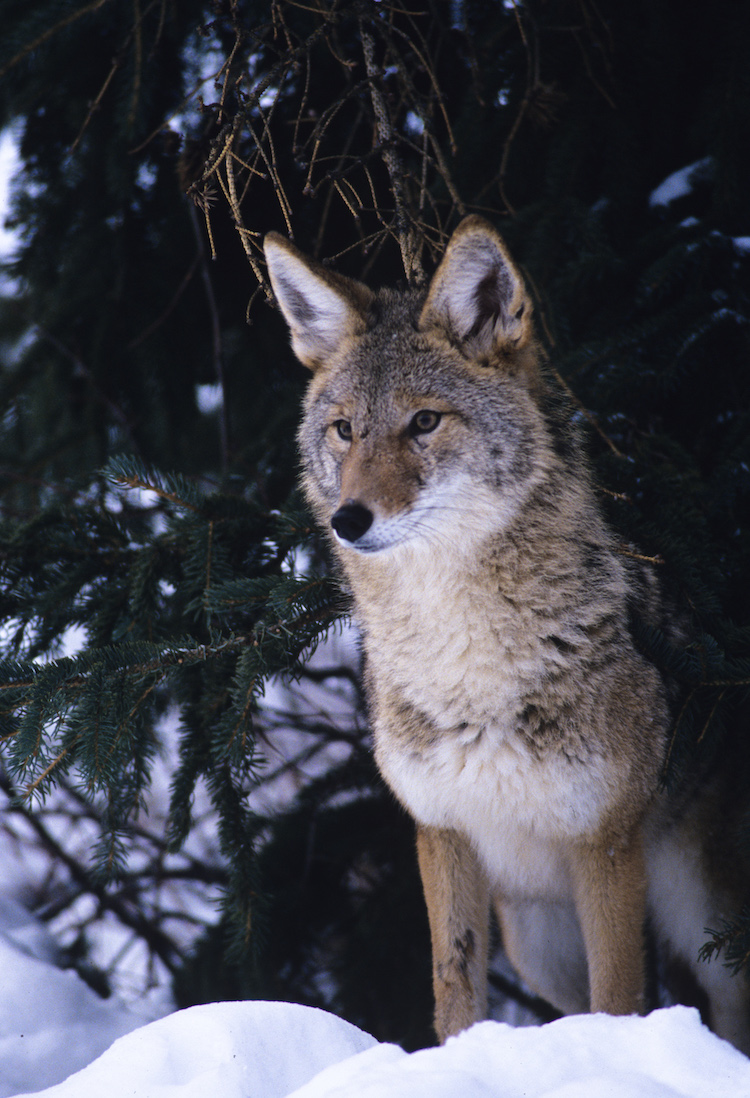
Slender and weighing about 20 to 50 pounds, coyotes are monogamous breeders that usually mate January through March. Litters are born in March and April, with five to 10 pups each. The female maintains the den, which is often dug into the ground or utilizes a hollow log or brushy thicket. Both parents hunt for food for their offspring, but the male usually takes the lead during the pups’ early months.
Around three weeks, the young leave the den with parents, and are weaned at six weeks. By 8 to 12 weeks, the pups are taught to hunt. The coyote family stays together through the summer and mid-fall. While some young coyotes will stay with the family until the next litter comes along, most will leave and develop their own territory anywhere from 10 to 100 miles away.
According to the ODNR, coyotes are primarily nocturnal, hunting during the night. In areas where they feel less threatened, coyotes will hunt during the day. Coyotes will form a pack consisting of an unrelated alpha pair and several subordinate adults, but usually hunt alone.
While many species avoid populated areas, the coyote has adapted.
Dr. Stan Gehrt leads several coyote research projects. Both Ohlrich and Nature’s Nursery Co-Founder Laura Zitzelberger refer to Gehrt’s research as a premiere source of information on coyotes.
When she reads a comment online from someone concerned that a pack of coyotes might take out a dog, for example, Zitzelberger often chimes in with factual information.
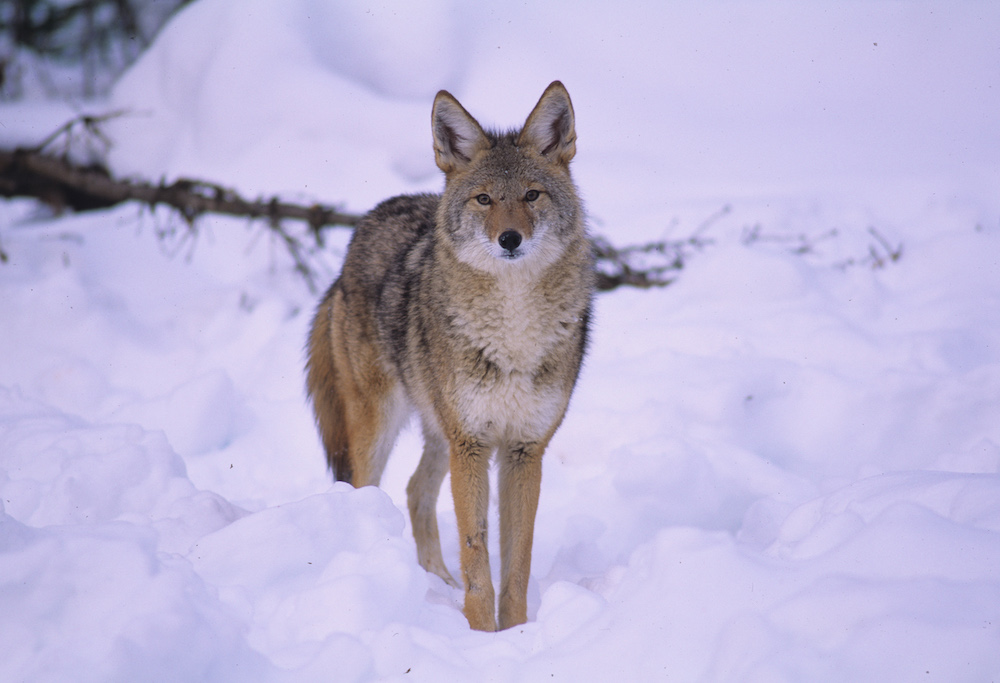
“They live in packs but hunt as individuals. They barely want to take on anything that’s larger than a cocker spaniel when they can survive on something that’s much easier to catch,” she said.
In the early 2000s, Gehrt led a study in the Chicago suburbs, studying what coyotes eat, and it was found that domestic animals are just a minute part of their diet, Ohlrich said. A larger percentage is mice, rats, fruit, young whitetail deer, raccoons and other small mammals such as shrews, voles, rabbits and moles.
“The number of mice and rats they eat can be a good thing. Lyme disease is up, and the primary carrier is the white-footed mouse. Having coyotes to prey on those rodents is a good thing to keep their (the mouse) population in check,” Ohlrich noted.
He suspects that coyotes might be contributing to a declining wild turkey population, especially as these birds nest on the ground, leaving the hens – along with their eggs and polts – vulnerable to predators until they’re able to fly and roost in trees.
“We are currently doing a study on nesting turkeys and hens to learn more. So far, the limited scope of the survey shows that a lot of predation is during the nesting period,” he said. “A big part of that is mammals, but it could also be birds of prey. Coyotes are predators and definitely contributing to that.”
The Ohio Coyote Project, a collaboration between The Ohio State University’s School of the Environment and Natural Resources and ODNR, involves working with livestock producers, hunters and trappers to better understand coyotes, their diet and how they impact livestock production. One focus is how much of the coyote’s diet is domestic livestock. Another aspect being studied looks at how far coyotes travel – some up to 100 miles.
With coyotes all over, that can also result in conflict.
Several times a week, Ohlrich gets calls, and they usually fall into two categories: someone spotted a coyote where they didn’t expect to, or the coyote appears to be sick. Last year, he fielded several calls about coyotes in Maumee, including some that swam over from the islands in the Maumee River.
One woman reported that her dog was attacked by a pack of coyotes. In 2018, residents in Waterville Meadows reported that a 60-pound dog lost her tail and needed stitches on her leg. In another case, a 10-pound poodle was grabbed by the neck and had deep puncture wounds.
Research shows that the best way to avoid conflict is to leave naturally-behaving, wary coyotes alone. The signs of aggressive coyotes are similar to those of domestic dogs, such as snarling, raised hackles, lunging or growling. Making eye contact or tracking a human are not considered aggressive acts on their own, according to the ODNR.
While conflicts with humans are rare, the Ohio Coyote Project has recommendations for avoiding them:
•Do not feed coyotes, as this might cause them to lose their fear of humans and encourage them to come too close.
“They’re following a food source, whether that’s outside pet food or water bowls, or fruit trees,” Ohlrich said, noting that fruit is a decent part of a coyote’s diet.
•If a coyote is around a property too often, remove bird feeders that attract squirrels – which are another popular prey for coyotes.
•Make sure garbage and compost are properly stored.
•Do not let pets run loose, but keep them on a leash or within a yard with a six-foot fence with a roll bar on top.
•If faced with a coyote, do not run, as this triggers an instinctual response to give chase. Instead, change course and walk or back away slowly.
“Make loud noises to scare them away,” Ohlrich said, adding that If a coyote is not deterred by shouting or waving, it may be defending a den.
When he gets a call about coyotes, Ohlrich uses it as an opportunity to educate the public, but sometimes he’ll be asked how to “take care of it.” As the only wildlife officer for the entire county, Ohlrich can only provide guidance on options, the first being removing attractants. For those who live in rural areas where shooting a firearm is permitted, that is an option.
The American Veterinary Medical Association standard for humane euthanasia includes the option of a gunshot to the head, Ohlrich said. But this is only a viable option for those who are skilled and licensed, and in areas of the county where use of firearms is permitted.
Trapping is also an option in outlying areas, and is permitted year-round. Nuisance laws allow property owners to kill a coyote if it is sick, injured or causing damage or a nuisance on private property. But trapping requires an education, in order to avoid capturing an unintended target, including domestic animals or other wild animals.
The goal is to find a balance between keeping the coyote population in check, limiting conflicts and appreciating the benefits of having coyotes around.
Ohlrich points to studies showing that, in order to eradicate coyotes, 70 percent of the population would need to be removed for four consecutive years. Even missing that target for one year would allow the population to replenish in one season, as coyotes have the ability to bear more, and larger litters.
“Usually in a community, the alpha male and a female breed and the community works to raise them. If the alpha male or female is killed, all the others start breeding and the population increases,” Zitzelberger said. “One thing I’ve learned is that they do well no matter what we do. They bounce back and have more babies.”
Before taking action to remove a coyote, first determine if it’s really causing problems, Ohlrich said. If it’s not, another coyote may move into the territory – and could be likely to cause more conflict.
“It’s incredibly difficult to manage their population and lower their numbers,” he said.
When Nature’s Nursery was still located on Schadel Road, the center took in Rue – a baby coyote that someone surrendered after realizing she didn’t make a good pet, Zitzelberger said.
For the first year, Rue lived in a closet and was taken out on walks on a leash. After raising money for an enclosure, Rue lived outside and would often hang out on top of a concrete culvert or logs placed inside.
“When I was in the enclosure, we would run and play. She’d let me brush her and give her vaccines, but never once did I let my guard down,” Zitzelberger said. “I learned that coyotes are extremely intelligent, but they’re always wild. Having them as pets is insane. People think because they’re born, bred and raised in captivity that they’re domestic. They aren’t.”
For those with questions about coyotes, contact the ODNR Division of Wildlife at 800-WILDLIFE (945-3543).