TOLEDO – On March 31, the $1,009,612,154 total operating budget for 2026 Toledo city budget was approved after about a half hour of deliberation by Toledo City Council, and millions in cuts.
All members of Council were present for a special session of the Finance, Debt & Budget Oversight Committee to deliberate on amendments for the 2026 Budget Ordinance (O-125-26), with the exception of Council Member John Hobbs III, who was absent due to work commitments.
Clerical update, Exhibit A
First on the agenda, Exhibit A passed with unanimous approval.
The amendment was proposed from the mayor’s administration, and it moved an administrative assistant position, $103,633, from Building Inspection to Code Compliance and carried over the remaining funding for the Choice Neighborhood Planning Grant Consulting Services for the Vistula Neighborhood.
A bookkeeping measure was also part of this first amendment, and it corrected the Road and Bridge Maintenance projects to reflect amended budgeting within Street Construction Maintenance, Special Assessment Services Fund, and the Capital Improvement Fund.
Department budget cuts, Exhibit B
Council Member Vanice Williams, District 4 and president of council, sternly addressed council after passing exhibit A, in the opening of the meeting.
“The biggest thing for us as a body is we did not recommend the removal of any positions that are currently filled,” she said. “We were not in the mind frame to take on laying off any staff that is currently working for the City of Toledo.”
This clarification from Williams came at the request of Council Member Adam Martinez, District 2, who wanted the objectives of the council to be clearly known before voting on Council’s proposed amendment, Exhibit B.
“No services lines were cut,” Williams said. “We cut an additional $120,000 out of the office supplies of various departments, and those are listed.”
In jest, Williams summed up her response and said the council did not cut positions but “we did cut pens,” referring to office supplies cuts.
Exhibit B was unanimously approved by all present council members.
$3,489,930.50 was cut from the General Fund through this amendment, which made good on Williams’ claims of cutting office supplies.
Fire & Rescue had 10 different items cut, the most separate designated cuts for a department, for a total of $422,599.00 reduction to their budget, including $30,788.00 of office supplies cut.
But even with less separate specifications the Police Department lost the most money of any department through this amendment. $943,801.00 was cut from the Police Department, which downsized an incoming police class of recruits from 25 to 20 ($526,600.00), got rid of funding for new uniforms ($150,000.00) and cut contractual services ($107,000.00), which included grass/snow removal expenses and GrayKey/Cellbrite software, used for unlocking and accessing data on cellphones.
Amendment for historical buildings
Council Member Theresa Gadus, District 3, proposed Exhibit C, $125,000 for a consultant for local landmark designations.
“The proposal is a community led initiative,” she said before voting began on this amendment to the budget. “Hundreds of residents, stakeholders and community leaders came together to ask this Council to take a proactive approach to preserving our historical structures, those architectural anchors that represent pride and identity across our neighborhoods.”
The loss of historical structures, Gadus said, go far beyond just losing a building, and negatively affect housing stability, public safety and economic development.
“Due to the transition in leadership within the plan commission, there was not sufficient time to bring forward the necessary legislation to authorize this expenditure before the end of the year,” Gadus said. “This amendment simply provides the commission the time and space needed to carry that work forward.”
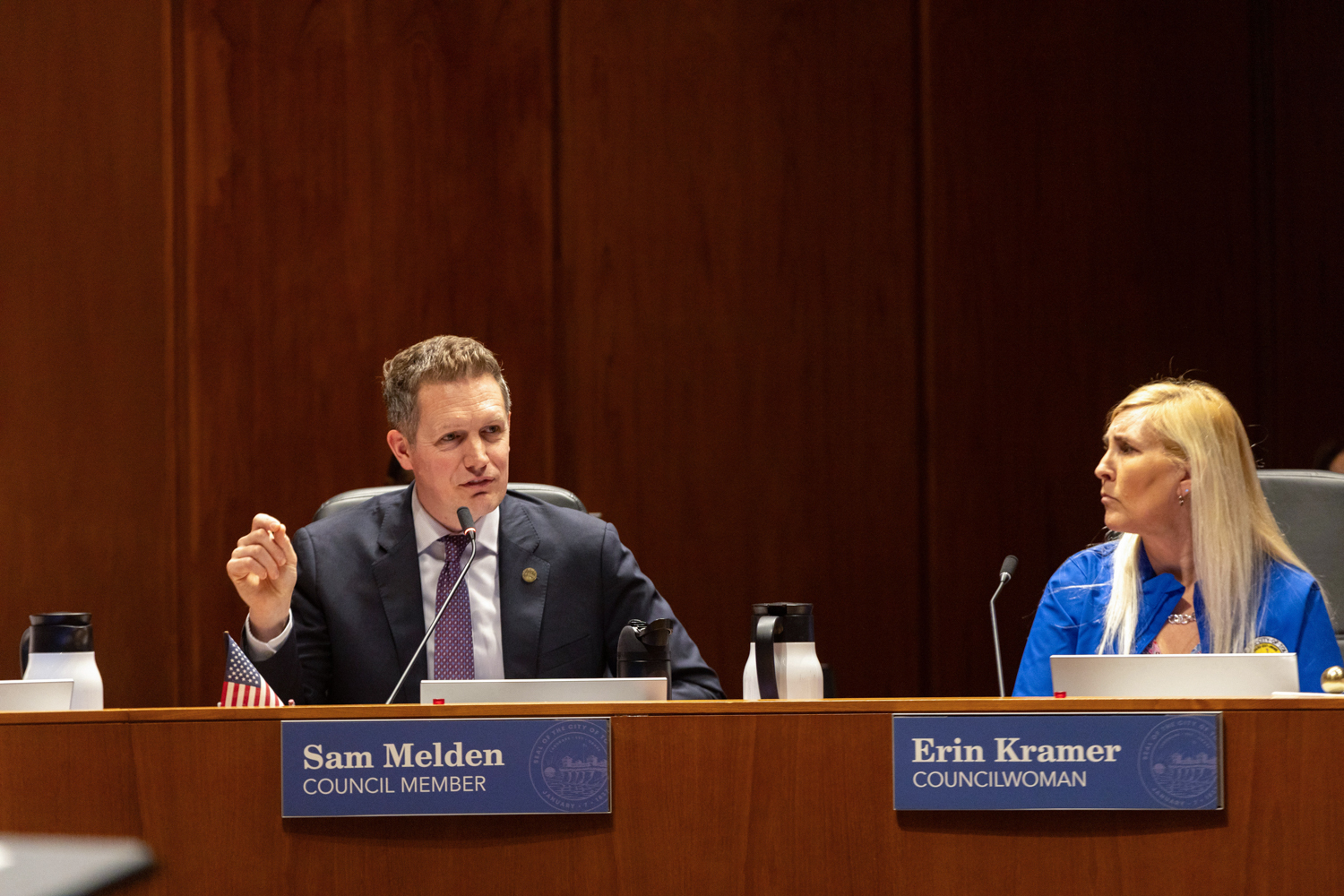
Exhibit C passed as an amendment, but was opposed by Council Members Sam Melden, District 5, George Sarantou, At-Large, and Williams.
Jazz Fest
Funding for Jazz Fest was the subject of the next amendment to the budget, Exhibit D, proposed by Council Member At-Large Cerssandra McPherson.
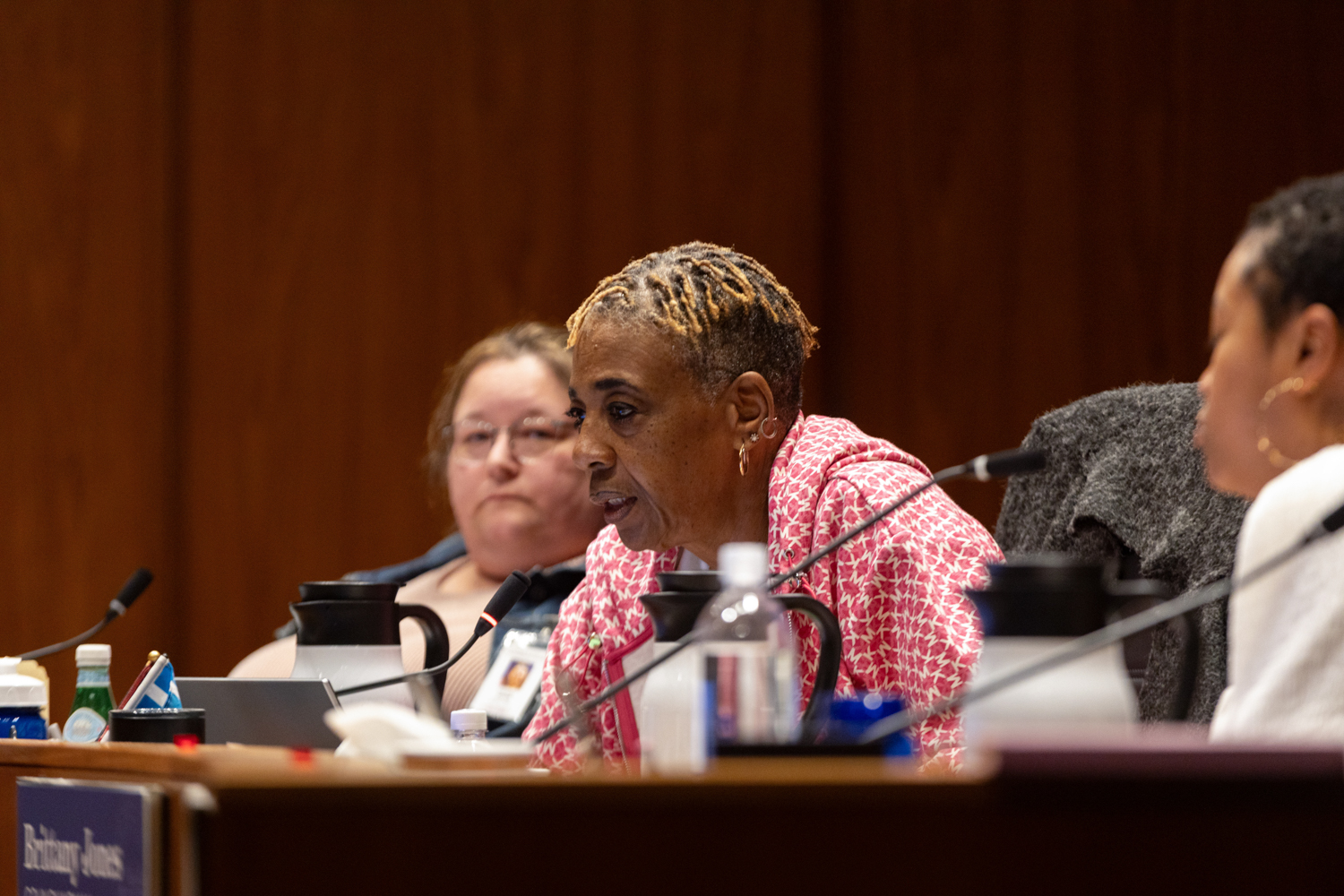
McPherson told council that Jazz Fest usually gets $50,000 from the city, but she cut the amount to $40,000 to help the budget.
The money for Jazz Fest, McPherson said, came from “the interest that we have from the ARPA [American Rescue Plan Act] dollars.”
Shortly after the amendment passed with all members voting yes except Council Member Melden.
Police substation
“Exhibit E is for the community police station to fill the gap left by the closing of the Northwest substation closure in 2025 that’s $500,000 by Council Member Melden,” said Julie Gibbons, the clerk of Toledo City Council.
Melden introduced this amendment, and told Council that it was not an initiative to replace the substation.
“This is about establishing a new community police presence, not just in District 5, not just in west Toledo, but in a strategic area,” Melden said, and defined the area as where districts one, four, five and six all come close to one another.
Maintaining a police presence in west Toledo was important for Melden, but he went further and said, “this is the potential pilot, a new way of having these outposts throughout the community.”
After Melden shared his thoughts, McPherson opposed Exhibit E, because she said it did not have enough structure.
“We should not approve monies without a plan,” she said, and compromised that the council could come back to this idea during the budget’s mid-year adjustments.
Both she and Martinez said they thought the police presence there was important, but wanted more definition for how money should be used. He also recommended bringing this issue back up at the mid-year budget review.
Defending the amendment, Melden said either council members could speak with the chief of police about their ideas, and resolved, “The beauty of this idea is that it is actually a new approach to community policing.”
Melden argued that not all the details in development are ironed out at the same time. “I’m not going to name a location and then have the price go up,” he said.
The amendment passed with four council members opposing it, Brittany Jones, At-Large, Martinez, McPherson and Williams.
ShotSpotter
Another police tool was the subject of the last amendment to the budget, Exhibit F, which Theresa Morris, District 6, sponsored in hopes of funding the city’s ShotSpotter, a surveillance technology by SoundThinking Inc.
Exhibit F would add $225,000 to the budget, but the claims made by SoundThinking about ShotSpotter include faster response times to dangerous situations and better evidence recovery after shootings.
“It’s one more tool that we can have in our toolbox to keep us safe in Toledo,” Morris said, and shared that this amendment doesn’t affect her district significantly. Morris said, “We don’t want to have [this summer], ‘Let’s name that sound: Is it a firework or a gunshot?’”
Council Member At-Large Nick Komives was the first to oppose ShotSpotter, after voting for the money to fill the gap left by the police substation.
“$225,000 is a lot of money,” Komives began, and said there was a good “feeling” of security that comes with ShotSpotter. But maybe $225,000 is not worth the feeling, he said.
“Since 2022, more than 45 cities have rejected or canceled their contracts with ShotSpotter,” he said, the foremost of these cities are Chicago, Dayton and Durham. “Public safety officials have determined the level of effectiveness of gunshot detection technology was incommensurate with the costs associated.”
Dayton’s decision to go without ShotSpotter was cited by Komives, and he said, “I believe that our police department felt the same, which is why they did not bring it forward, and I would encourage this body to reject the amendment. Thank you.”
At-Large Council Member Erin Kramer echoed Komives’ sentiments, and said that while she wants better gun safety, ShotSpotter might not be the best use of the city’s funds.
This is the only amendment on the agenda that failed, and was supported by Jones, Martinez, Morris and Gadus.
After the meeting, Morris expressed remorse at the amendment failing.
“I think that a lot of the neighborhoods that see high numbers of gunshots, I think they will continue and probably increase now that they know that there isn’t that monitoring system,” she said.
“So whether it’s a drone, whether it’s ShotSpotter, whether it’s a Flock camera, honestly, these are the things that when something happens, somebody says, ‘Where are the cameras?’”
Kramer spoke on her vote to not renew ShotSpotter.
“We have a lot of tools in our toolbox to prevent gun violence, and ShotSpotter is not one that we need to invest in anymore,” she said, and cited the efficacy of the technology and cost as restraints.
“We had to make a lot of really hard cuts in this budget, and so I don’t feel like it would have been responsible for us to then say, ‘Yes, we want to spend $225,000 on the software through this product.’”
The Toledo Free Press reached out to the Toledo Police Department for comment, and received this reply from Sargent Mohamad Nasser, the public information officer, on the cut to ShotSpoter.
“ShotSpotter will continue operating through the end of June. While that service will conclude at that time, our commitment to responding to gun violence remains unchanged. We will continue to use multiple tools and strategies, and we encourage residents to call 911 immediately if they hear gunshots so officers can respond quickly.”
Roads
Unanimous approval was given by all present to pass O-126-26. This ordinance approved the 2026-2030 Capital Improvement and Road Improvement Budgets, and authorized the appropriation of $77,447,820 for capital projects.
Reduce the budget
Last on the agenda for the special meeting of council was R-110-26, a proposal by all members of council “urging” the mayor to reduce the budget by $10 million per year for 2027 and 2028.
Sarantou spoke on behalf of this resolution. “I think it’s very important that we have this resolution passed unanimously, because we have some real budget challenges…and asking the administration to focus on $10 million of cuts from now for next year’s budget is absolutely critical.”
Public safety is Council’s number one responsibility, he said, but added, “We need to send a message to our taxpayers that we are serious about reducing expenditures in all the budgets as much as possible.”
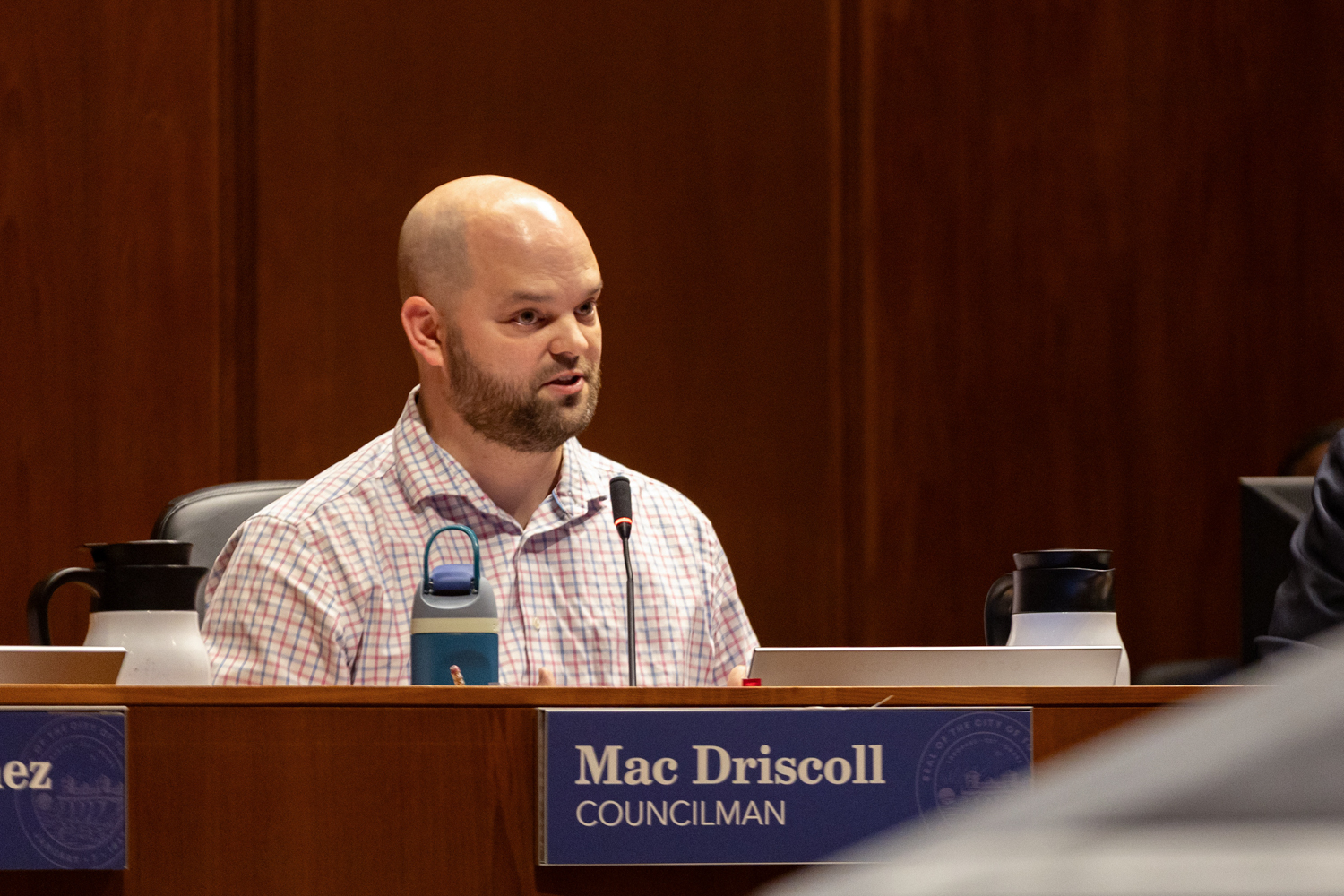
Council Member At-Large Mac Driscoll weighed in on the heels of Sarantou, and cautioned about the budget next year.
“I would say much of the additional cuts that we found, that Council has found, working alongside the administration, represent really one time options,” Driscoll said, and warned that the same “low hanging” fruit would not be available to cut next year.
Driscoll warned that next year the city will be facing a structural deficit, and, “within three years, we will not have a rainy-day fund any longer.”
2025’s city budget came off of fresh American Rescue Plan Act (ARPA) dollars from the federal government, some of which have been cut, but a large feature of the mayor’s budget at that time was the $60 million “rainy-day” fund, allowing for an improved bond rating for the city.
“I want to be clear that we are having these conversations in a time of, at least at this point in time, a time of economic expansion, and also a time when we’re projecting revenue growth,” Driscoll said.
“If you’re expecting revenue growth, you should be banking money, not borrowing from our savings account to balance the budget.”
Driscoll was clear that Council has the power of the purse for the city, but that the budget document comes from the mayor and sets up the template for expenditure, with the oversight of Council.
With positive revenue growth, and the decrease of $10 million a year for the next two years, Driscoll was confident the stabilization fund would be secure.
President of Council, Williams, pushed back on the idea that the council waited until the last minute to pass the budget, and instead said that the council combed through the document from the mayor thoroughly.
She stated that it was a difficult year all-around, speaking as an owner of a small business, and said the same difficulties for her business were present in the city’s budget. And that it was work to go through it with the administration, while not cutting human labor.
“Just because you can do something doesn’t mean you should, and just because we can pass it early doesn’t mean that we should,” Melden said, defending Williams’ claim and the rest of Council passing the budget on the last day for it to be approved.
Instead, Melden said what happened with this year’s budget was a great effort to make the most of the taxpayers’ money, and said, “We took the time to get it [the budget] as right as we could.”
The resolution passed unanimously for all present, but without Hobbs III’s vote.
Williams said before the vote, “We have to put forth how serious we are to take on this task with the administration, and that’s what this resolution is saying.”
This special financial meeting started at 2 p.m., and Hobbs III and Mayor Wade Kapszukiewicz were present for the 4 p.m. city council meeting.