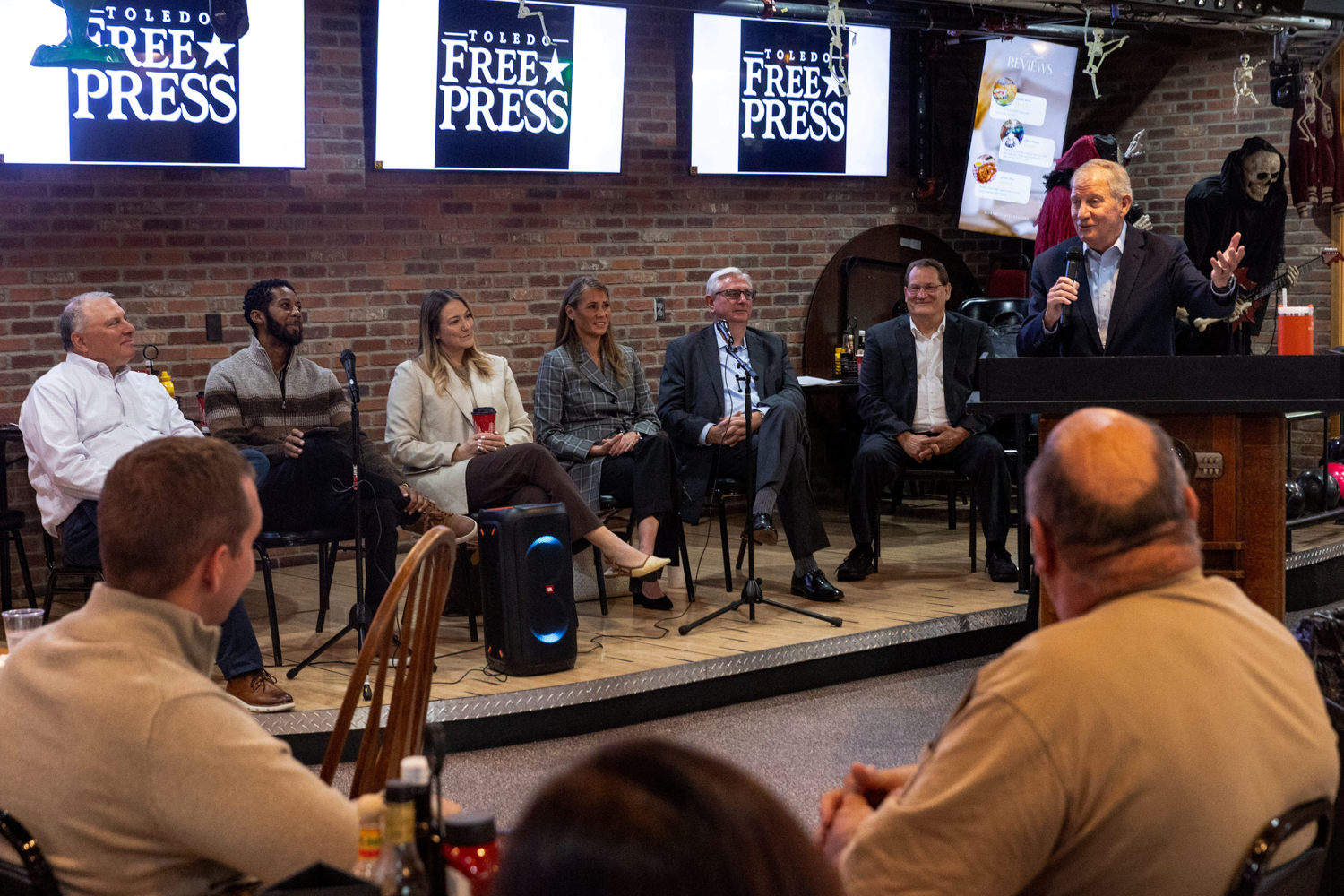

ROSSFORD – A bright red sunrise greeted attendees of the Eggs & Issues fundraiser for the Toledo Free Press.
Danny’s Cafe, 600 Dixie Hwy., hosted the event in Rossford, the focus of which was data centers. The discussion was moderated by retired WTOL news anchor, Jerry Anderson.
Supporters of TFP paid $50, and were served with a traditional American breakfast: coffee, eggs, sausage, bacon, toast and pastries. Attendees socialized and ate before panelists with expertise in technology, energy, zoning, business and government were able to speak on their area as it related to data center development projects.
Founder and Publisher of the Toledo Free Press, Tom Pounds, opened the event by thanking sponsors: Associated General Contractors (AGC) and Rudolph Libbe Inc.
“We’re here to talk about technology,” he said, and addressed the changing landscape of journalism from print to online and even the shift from profit to nonprofit.
Technology was responsible for the changing the industry of journalism he asserted, and thanked those in attendance for their support of TFP, expressing that with more support, the Toledo Free Press might be able to fill the shoes of the paper of record, The Blade, whose continuance has recently been called into question.
Anderson’s opening
“Eggs and issues!” Anderson announced. “I love the title, and we have plenty of both here today.” Poking fun at his own retirement, Anderson made light of his time outside of the spotlight.
“I’m a news guy, and I believe in people knowing. I’m not afraid of information. I endorse information,” he said, noting that he could make a pretty good argument for or against data centers, but that his goal was to shed more light on the issue itself. “Information is our friend, or should be,” he said.
Holding up a thick stack of papers that he described as the Ohio Chamber of Commerce economic study and economic impact study of data centers in Ohio, Anderson comically described the information as “light reading. If you’re ever having trouble sleeping, get a copy.”
Panel
Each member of the panel was introduced and spoke a little on their expertise.
Jeffrey M. Stopar is an attorney who practices law in the areas of zoning, land use, local government law, and real estate related litigation. He is licensed to practice in the state and federal courts in Ohio and Indiana, is a cum laude graduate from the University of Toledo College of Law, and holds a BA in economics, cum laude from the University of Akron.
Stopar said he had experience on both sides of development. “I did a lot of work for developers, and then in the last 10 or so years, my practice has shifted. I represent more local governments,” he said. “So I’ve kind of seen all perspectives on that.”
“I give advice. Clients make decisions,” Stopar said and clarified that he merely works within the law to help his clients, whether they are pro- or anti-data center.
“If they don’t want data centers, there’s a way to go about that. If they do want to entertain the possibility of a data center in their community, there’s a way to go about that,” he said, and explained that banning data centers was not a strong legally defensible strategy in terms of zoning. His addendum was that whether you want or don’t want a data center, “there’s a way to go about that.”
Ohio, Stopar said, had not had a large number of cases dealing with data centers, but referenced a federal lawsuit against the city of Urbana, Ohio by developer Thor Equities, for the city passing a moratorium on data centers. The situation in Urbana is still developing.
LeSean Shaw is a technology leader, entrepreneur, and educator, who is dedicated to making artificial intelligence practical and accessible through his work with Actual Reality Technologies and Empowered AI. He helps businesses, schools, nonprofits, and community members understand how to use AI to improve productivity, support workforce development, and create new opportunities.
Addressing the difficulties in Toledo, downsizing in many sectors and population loss, Shaw referred to data centers as something that could potentially “uplift all boats at the same time” for northwest Ohio.
“I say that with a huge caveat,” he said. “I think there should be a lot of conversations before they even break ground. There should be a lot of negotiation, and there’s a lot of tactics that we can take from previous communities.”
Based in Columbus, Amanda Miller Bartlome is a community engagement manager at Meta, where she manages the tech company’s local community partnerships and investments across Ohio. She leads regional engagement for major local infrastructure, including the New Albany data center and Meta’s AI optimized data center facility in northwest Ohio.
Bartlome introduced her position with Meta colloquially as “making sure that Meta’s data center is being a good neighbor in the communities where we operate.” She shared that Meta broke ground on the New Albany data center in Ohio in 2017, which has been referred to as the “Prometheus” campus.
Last year, Meta broke ground in Wood County, and she said Meta was working on getting that data center operational.
“Raise your hand if you maybe checked Facebook or Instagram this morning,” she said to a room that didn’t respond very enthusiastically. “I sure did before I woke up.”
“If you’re using Threads, if you’re using WhatsApp to communicate, you might be using Ray-Ban Glasses or the Meta AI technology,” she said. “All of that is powered by the backbone of our infrastructure of our global data center footprint that happens to also exist here in the state of Ohio.”
Victoria Herring is a partner and executive vice president at Rural Strategies Group, where she partners with companies, government leaders, and associations to develop strategic engagement initiatives that build trust, shape public opinion, and deliver meaningful results in rural communities. She has worked across the country in the data center industry as economic development program manager at QTS data centers, with experience working alongside businesses, government leaders, and community stakeholders.
Adding more context to some of her credentials, Herring said she had experience as the director of attractions for the state of Indiana, and before that worked as business development director for Indiana’s Department of Agriculture.
She said of her current role, “What our firm does is advocate for responsible data center development.”
“Every industrial revolution has come with concerns from citizens,” Herring said. Her firm “helps bridge the gap between the developers and the communities to help have success and ensure that the communities really do get the most gain out of this development.”
“As was mentioned, there are opportunities for these developments to boost communities in ways that are unprecedented.”
Herring drew attention to the town of Quincy, Wash., where a Microsoft data center was built. “As a result, they’ve got a new police station, a new high school, and they’ve seen their overall poverty rate reduced by more than half,” she said.
From an article by KUOW:
“ ‘We will add to the tax base that funds your local hospitals, your schools, your parks, your libraries … and I think no place better illustrates this than the small town where Microsoft built its first data center,’ said Microsoft President Brad Smith during an announcement event in Washington, D.C.”
The article also notes that one of the main objections to the data center came from Former Mayor Patty Martin who was concerned about the downstream effects of the data center in 10 to 20 years.
Mark Frye is president of Palmer Energy. Since he acquired the company, Palmer has grown into a leading provider of unbiased energy consulting services. Mark has often provided expert testimony before the Public Utilities Commission of Ohio, reflecting his deep industry knowledge and experience. Under Mark’s leadership, Palmer Energy advises 1,000s of clients on energy procurement and utilization across industrial, commercial, educational, governmental, aggregation, and institutional sectors. Palmer Energy serves more than 75 Ohio counties, numerous municipalities statewide, and Power Four schools, which represents over 170 Ohio public school districts. He’s also the mayor of Sylvania.
Frye chose to open with an anecdote about the founding of Rossford by Edward Ford of the Libbey-Owens-Ford Glass Company.
“The reason he decided to build it [the Rossford glass plant] was because you had a confluence of natural gas availability from the Findlay oil fields, sand availability, you could bring labor into the market and you had land available,” he said. “That’s why this place in this town exists today.”
“Data center developers are looking at the exact same thing,” Frye said, and made the point that had there been opposition to Ford, Rossford might not exist.
“There is a confluence of flat ground, availability of fiber, high-pressure natural gas lines to generate electricity, and skilled labor force in order to build these facilities,” he said when talking about the conditions making northwest Ohio attractive for data center development.
“Are we going to reject, or are we going to manage those decisions that we’re going to make?” he asked.
Frye turned to the issue of energy and energy prices. Regardless of whether a data center is built in proximity to northwest Ohio, Frye said everyone’s energy costs would continue to go up.
“Electric consumption at these facilities [data centers] are so large that they have spooked the market,” he said, and added, “Energy markets have not seen anything, any consumption like this ever in their history.”
“Five, six years ago, people didn’t expect data centers to have this kind of an impact,” Frye said, and explained that when the market demand was flat coal plants closed and turned over to renewables with intermittent power generation.
Over the next few years, at least, “You’re going to see higher electric bills, because of this economic development,” Frye said, regardless of people push back against data centers in their communities.
Mike Tyson is a graduate of Applied Business Marketing Management and has been an entrepreneur for some 50 years. He is the president of Tyson’s Inc. and author of a zoning research project, “Data Centers: The Impact on Public Health.” His awards include the League of Women Voters of Bowling Green Impact Award and the Ohio Lottery Retailer of the Week Award.
Tyson explained his work on the data center research project, which took him six months.
“I’ll be sharing with you my knowledge and opinions. A lot of this will be opinions, “ he said. “Hyperscale data centers are hazardous, heavy industrial businesses. We have to admit that,” Tyson said. Because they are complex, “I do not feel that zoning boards in 60 to 90 days could figure out all these factors to make a data center.”
“Municipalities and townships need to update their zoning regulations to address these massive businesses,” he said.
Citing a recent poll of 1,000 Ohioans he read the opinion, “75 percent oppose hyperscale data centers built in their communities.”
Referencing a conversation Tyson had with a CEO of Nvidia, Jensen Hung, Tyson recalled Hung had expressed that the industry owed communities better transparency.
“Most Ohio residents also oppose non-disclosure agreements and do not like to be kept in the dark,” Tyson said.
“We had special exceptions that stripped the citizens’ referendum rights,” Tyson continued. “That really was a major issue and needs to be addressed…The people should have the referendum rights.”
In his research, Tyson was surprised at how limited the Environmental Protection Agency (EPA) was in regulating data centers, and then he proposed that “local county health departments in Ohio should be involved in any hazardous heavy industrial zoning and business applications.”
Tyson recommended a new heavy industrial zoning classification for data centers because the projects went far beyond an industrial warehouse.
Then he drew a distinction between hyperscale data centers and smaller ones, noting that there are “11 various data center styles that I found in my research.”
Smaller data centers, Tyson said, had less impact on communities, but that “hyperscale data centers can produce loud sound vibration total noise that can travel easily two and a half miles, according to former NASA scientist from Virginia, Mr. John Liver.”
“Two and a half miles should be a minimum standard in Ohio for separation between a hyperscale density center and medium to heavy residential medical hospitals and other sensitive areas,” he assessed.
“Ohio Farm Bureau opposes the tax breaks and recommends hyper data centers be on existing industrial sites and abandoned ground brownfield sites,” he said. “In my opinion, the data center developing a mile square of farm ground and more will impact wildlife and natural drainage, create pollution in the air, soil, water runoff, and discharge.”
“People who cherish our natural resources feel saddened by this, and sportsmen who have paid for fishing, hunting licenses for decades are disturbed by this type of massive industrial development,” he concluded.
Panel discussion
As a segue, Anderson specified the discussion should be addressing hyperscale data centers specifically.
“According to Synergy Research Group, there are only about 700 hyperscale data centers in existence,” Anderson said, adding that about half of those facilities had been built in the past five years, alluding to the massive development and growth of these kinds of facilities.
Inevitable?
For the first topic of discussion, Anderson made the argument that data centers were inevitable, and then asked panelists to agree/disagree with him.
The main basis for the argument was that the data centers are necessary, there is a demand for increased data usage, increased data speed and that technology companies have the money to invest in data centers, so they are going to happen inevitably.
“You are absolutely correct. My vacuum cleaner runs off of an app,” Herring said immediately. “I can turn it on right now and make sure that my floor is swept when I get home, so yes, whether you know it or not, you are using a data center in your daily life.”
And she referenced online banking, healthcare, and schools to illustrate that people use data constantly in their daily lives.
Energy consumption
Anderson then asked Frye how much electricity is needed for hyperscale data, and added “How much is my electric bill going to go up?”
Frye estimated an average hyperscale data center operates 500 megawatts of electricity a month and 4 billion kilowatt hours a year, which he compared to the entire current energy usage of Lucas County, including current industry.
“That’s the reason why the market spooked,” he said, and affirmed that the hyperscale data centers were what were required to keep up with data usage.
Clarifying Frye’s answer, Anderson asserted that the United States had not adequately expanded the electrical grid, and asked if that was correct.
Affirming Anderson’s assertion, Frye said for the past 25-30 years, the United States had not significantly expanded its power capacity.
“But keep in mind, from 2005 to 2023, the amount of electricity consumed in the country only jumped 3 percent total for that entire time frame,” Frye said, explaining the reason for the stagnation. Better energy efficient products helped keep consumption down, and “we’ve been living off of the existing grid for many decades, and not refurbishing it and expanding it at the rate necessary to feed these facilities.”
Providing information from Bloomberg, Anderson said energy prices around data centers jumped 267 percent from 2022 to now. With this information, Anderson drew attention to the fact that energy prices could go up everywhere, but posed the question that energy prices around hyperscale data centers may be significantly higher than in other areas.
Explaining the jump in prices, Frye contended that five years earlier the pandemic shut down the economy, giving the United States the lowest energy prices since the ’50s, and now prices are reaching new highs. Neither individual addressed a specific comparison of energy prices between current data center communities and non-data center communities in proximity to one another.
Power supply
Jumping off the related energy discussion, Anderson asked an adjacent question, “Should data centers be required to supply their own power?”
The representative from Meta, Bartlome, chimed into the conversation, talking about how Meta was already paying for and supplying their own power.
She said this included “infrastructure upgrade costs and anything that we would need to bring that power to our data center site.”
“We have signed the White House ratepayer pledge that ensures that Meta is paying the full cost of any energy and that…our customers are not being negatively impacted, and those rates are not being passed on to consumers.”
Bartlome also shared that northwest Ohio had an abundance of natural gas, and that Meta was working with the Ohio EPA and their regulations to create a natural gas plant. All the development and infrastructure, she said, was following local ordinances and restrictions as well, as she quickly referenced noise and decibel levels that could affect the area.
Anderson inquired if the gas plant would provide all the power for that data center, and Bartlome said she thought it was a portion of the power required for the facility.
Anderson asked if data centers should be paying the electric bills of those who live closest to them, and if that was a realistic requirement.
“That’s an amazing political soundbite that is immensely impractical,” Frye responded.
Transparency
Public input on data centers was the next consideration for the panel.
“The feeling that people say, ‘It was already under construction before I knew what the heck was going on,’” Anderson said, reflecting on a popular criticism of development.
Anderson presented the reality that many times officials sign non-disclosure agreements (NDAs) with companies, and that businesses may not wish to tip off their competitors to their plans for development, causing them to invest elsewhere.
Spokar took this opportunity to share from his experience working with both local governments and for developers, and said, “I have never recommended to local government to have one of those [an NDA].”
“A lot of this keeping stuff out of the public eye, I don’t like,” he said, but added that most of the time government meetings are simply not well attended.
“So people aren’t paying attention, the journalists aren’t paying attention…And next thing you know, there’s an application [for development],” Spokar said. “That’s how it happens.”
As soon as people do find out that a data center is going up, Anderson said there is an uproar to stop that kind of development, and stated that roughly 75 percent of people distrust data centers.
Speaking from the tech perspective, Shaw explained that people don’t really understand what a hyperscale data center actually means.
“I know what hyper is, I know what scale is, I know what a data center [is] potentially, I can imagine what that looks like. I have no idea what all of those words collectively mean,” he said, coming from the average layman perspective.
“We have to make sure that we’re creating advocates, even if those advocates are just able to operate from a place of information,” he proposed, so that community members in local government can make informed decisions from a place of understanding, instead of from stigma or fear.
Shaw said that when people do not feel equipped to talk about an issue, they lose their voice.
Turning to Tyson, Anderson summarized the businessman’s earlier stance on the data center issue, as a push towards getting the right amount of regulations to accommodate surrounding communities.
“When a new business comes to town, you have to earn the trust. You got to earn the respect of these people. You got to really treat them well. You got to show the community that you’re upstanding,” Tyson said. “The people need trust. You got to start right there, guys.”
Agreeing that public trust was important, Herring said that most data centers had already done away with the use of NDAs.
“I think that’s a recognition that having them was a problem,” Spokar said. “If we’re going to do something that’s going to be community changing without having public records showing the paper trail, that’s a problem.”
Municipalities, Spokar said, have more power than townships, because townships just have the power to zone. When it comes to townships, he said, “We can regulate the size and location of buildings.”
Then he clarified that much of the conversation hinges on private property owners dealing with data center developers themselves. “Usually, what happens is the data center comes in, they will talk to property owners, get an option, and that’s how that goes forward,” he said.
Private transactions are not public, but zoning is public.
Jumping back to the topic of NDAs, Herring said, “The reason that they existed in the past was because they [companies] don’t want competitors to know that they’re looking in a certain area.”
Herring went on to say that transparency isn’t always an option, because developers are working with other parties and the community. When in collaboration not all the details or terms are settled, so developers are unable to tell the public things they do not know themselves.
Attendee input
The role of media
Trying to include some of the TFP supporters, Anderson opened up the conversation to those who came to hear the panel and enjoy the breakfast.
The first to make a comment was Gary Thompson, CPA, VP & Northwest Ohio Director of Regional Growth Partnership (RGP), who took the opportunity to criticize news media.
“Why doesn’t the media track down facts?” he asked, before a sound system malfunction played loud music drowning out the rest of his words.
Keeping the conversation on track, Anderson joked that the media was responsible for quite literally silencing Thompson as he was about to give an example.
When the air cleared, Thompson summarized a common stance against data centers, which has been that, “they’re going to use all this water” and drain Lake Erie. He said this was an easy fact for news media to refute and include in reporting that when dealing with Toledo’s watershed, water should not be an issue.
“The Toledo system has 70 million gallons of excess capacity a day, both on water service and sewer service,” Thompson said. TFP is unclear on where Thompson received these exact figures for excess capacity.
With the expansion of the Collins Park Water Treatment Plant in 2020 the total capacity of the plant was upgraded to 140 million gallons of water a day (mgd), and the capacity of the plant was determined by demand. Wastewater Digest estimated Toledo’s total need on a high capacity day, maxing out at 133 mgd, and so the plant was designed to meet the demand of roughly 500,000 people with a little extra.
Other improvements have been scheduled since the Digest’s report in 2021 on basins 1-6 at the plant, which if completed and running, would increase capacity by roughly 120 mgd. This would create the surplus to which Thompson alluded.
But on the City of Toledo’s own website, dated June 1, 2026, they claim, “We produce approximately 75 million gallons of safe drinking water daily for nearly 500,000 people.”
While it is clear that Lake Erie is a major source of freshwater, the United States Environmental Protection Agency has reported that “the Maumee watershed contributes the greatest phosphorus load to the lake (Maccoux et al., 2016), and to all of the Great Lakes.”
“Excessive algal growth in Lake Erie poses significant threats to the environment, human health, and the economy of the region,” the EPA wrote, and this uptick in phosphorus was caused by agricultural and municipal runoff by the surrounding region.
In short, Toledo has a significant resource in Lake Erie, potentially making it a prime area for a data center, but it is unclear specifically how data centers may affect Toledo’s watershed without knowing exactly what they require to function and what their outputs are.
Thompson’s other criticism dealt specifically with Anderson’s hosting of a different community conversation, where he accused Anderson of not fact checking an instance when he was on a panel. Anderson put the responsibility back on Thompson to say something, since Thompson was on the panel.
“The media sees this as a David versus Goliath story, and it’s selling papers or print or Facebook ads, and I think it’s irresponsible if the media doesn’t track down the facts,” Thompson said.
In response, Anderson cited his last broadcast date from 2020, and told Thompson to “Get off my ass.”
The retired broadcast host’s retort was received with laughter as he moved to the next consideration of the event.
Farmland, zoning and energy
Posing a question to Herring, Vince Croci, a professional master of ceremonies, asked about developments on farmland that potentially turn one neighbor suddenly rich by selling their land, and another in a sore spot.
Pointing to planning within communities, she said, “While a lot of the properties that these developments are looking at are currently active farm ground, they are zoned industrial, and have been planned for industrial development for years.”
“Go out and look at your town’s comprehensive plan,” Herring advised those in attendance, and advised those in communities who were worried about change to invest in a new strategic plan for their area.
Frye stepped in to talk about the demand for data centers, and their effect on the economy.
“They’re going to spend 800 billion dollars in the United States this year,” he said, making the point that the economy hinged on their investment. And just as people had never encountered a boom in data centers like this, he made the point that most of the companies were some sort of technology company that had never needed to scale to an industrial level before.
His point was that the data center companies were learning in hereto uncharted territory.
At this point, Frye may have been thinking of only some data center companies. The top four data center companies in the United States are in order: Amazon, Meta, Microsoft and Google. Amazon and Google both have massive preexisting industrial capacity and understanding, while Meta and Microsoft are quickly pivoting into the industrial sphere to meet the need of data center creation.
Stopar added that the effects of hyperscale data centers were not like the negative effects of a landfill, but, he said, it is important to keep in mind the massive effect of the massive infrastructure that they are, and to also keep in mind that a data center could change a community for good or for ill.
A consultant, Paul Hubbard, asked if there was an effort to use abandoned urban areas to create data centers.
Tyson mentioned that Scottsdale, Ariz. had data centers in their city.
Tim Pedro, the mayor of Waterville, then asked about the residual effect of the backlash against data centers for communities.
“How many other projects are going away and won’t come to that community?” because of the way they have dealt with data centers, he asked.
A local Oregon organizer against data centers, Jim Davis, spoke about his troubles trying to get information on the potential data center in Oregon, Ohio.
“We have found in Oregon there has been absolutely no disclosure,” he said. “They immediately bought the land and immediately transferred it to the Oregon Economic Development Foundation,” which he noted as a private organization unwilling to share information.
The CEO of the Associated General Contractors of Northwest Ohio and Chairman of RGP Joshua Hughes stood up in response to Davis’ accusations and began to speak against them.
“With all due respect, Mr. Davis is not correct,” he said. “This project has been in the works for more than two years.”
Hughes mentioned that the economic development agreement terms had been made public recently, and tried to explain with some of his experience, that development is a long process with many steps.
“In order to have this project in Oregon, the owner had to pay to have a load study done,” Hughes said, citing that it cost up to $300,000 for just the study. “Meta can’t just build a power plant in Middletown Township to power their project. They have to get the approval of First Energy, who has control over the grid.”
Echoing Frye’s earlier point, Hughes mentioned that power generation facilities and data centers were the main economic backing to the construction industry and to the U.S. economy. “Without these, our economy falls apart,” he said.
Backing up what Hughes was saying, Hans Rosebrock, director of power and energy systems for The Mannik & Smith Group, Inc., tried to shine some light on the norms of the industry.
“I’ve been doing this for 36 years. I’ve signed NDAs for about every project. Doesn’t have to be a data center,” he said. And then turning towards Hubbard’s earlier question about urban data center development he said, “They’re building a data center in Sandusky on the old General Motors plant, so they’re taking advantage of a brownfield site and redeveloping that. From an urban development standpoint, it makes a lot of sense.”
The Zoning Inspector for Rossford, Mark Zuchowski, then asked about how feasible it would be for data centers to run off of renewable energy sources.
“I’m 100 percent for renewable [energy],” Frye said. “But we also need to be realistic. A 500 megawatt data center would require 10,000 acres of solar,” he said, and to put the size of the solar area in context, Frye placed the Meta data center in Wood County at somewhere between 500 to 800 acres. “There’s 640 acres per square mile.”
Herring jumped in to say that requiring renewable energy for data centers would have a backlash on developers in general. “Ballot referendums, the issue with those is that it absolutely sends a signal to industry, period.” Other industries, she said, would be less likely to invest given push back or qualifications like that.
Pushing the conversation towards nuclear energy, Anderson cited a data center in Utah that is using four to five thousand small modular nuclear reactors to power it.
“All sorts of technologies will start to evolve because the demand and the money is there in order to develop it,” Frye said in reaction, but also maintained that modular nuclear reactors were first developed in things like the U.S.S. Nautilus in 1954, the first nuclear powered submarine.
Stopar chimed in to say the Ohio General Assembly would be more responsible for regulating NDAs and energy in large developments than townships or municipalities.
For the last few minutes of open discussion, people talked about how much water would be used and what percentage would be contaminated over time. Without a specific facility for context, the questions could not be answered.
Alec Thompson, of Rudolph Libbe, made the point that developments must abide by laws of the municipality, including noise ordinances, so as long as the laws are in place there shouldn’t be a problem or cause for fear.
A woman with Laibe Electric Technology, Angela Singer, then shared an anecdote about her hometown of Sandusky and the data center that was built there.
“It is very residential, and it is directly across from Sandusky High School. There is zero disruption to my hometown,” she said.
Anderson asked if he would be able to hear it if he drove by, and she answered that he would not.
A few other rapid-fire contested points were brought up without resolution before Anderson wrapped up the event, thanking everyone for coming.