PERRYSBURG – The bell above the door of a Toledo carryout rings out dozens of times a day. Factory workers on break, neighbors stopping for scratch-offs, traveling salesmen with a pitch…anyone might walk in. For Hasan Dudar, who grew up behind the counter of one, that doorway became the entrance to his debut book.
Published on May 5 by the University of Iowa Press, Carryout is a linked collection of 15 short stories following the Idilbis, a family of Palestinian and Lebanese refugees who open a corner store across from a General Motors plant in Toledo. It’s a space where the city’s Arab community and its working class share the same narrow aisles. Spanning from the late 1970s into the mid-2010s, the book tracks three generations through financial precarity, post-9/11 suspicion and the quiet heartbreaks of navigating two worlds.
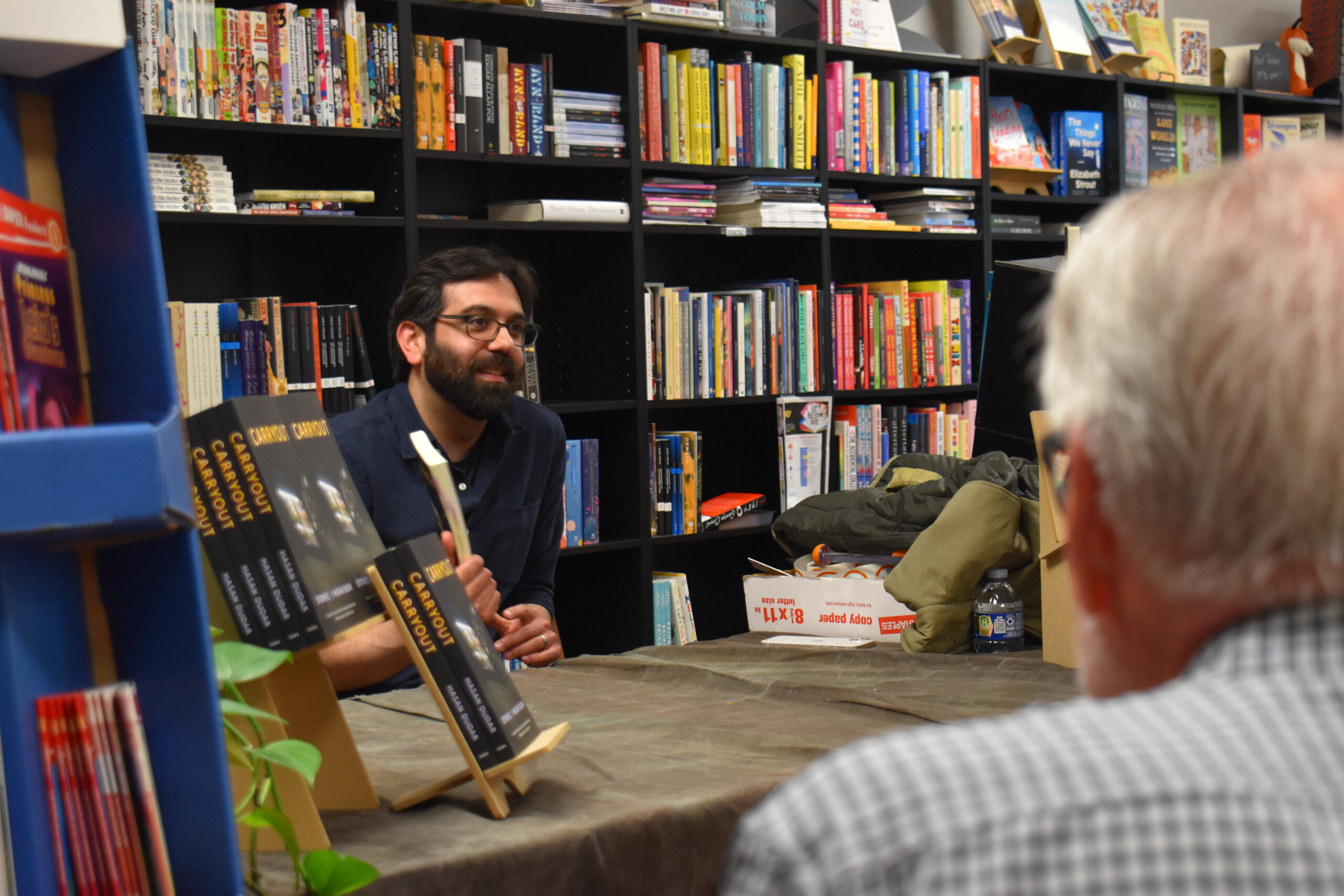
Dudar, who now lives in Washington, D.C., returned to northwest Ohio on May 17 for a reading at Gathering Volumes in Perrysburg. A packed room of former teachers, childhood friends, and community members gathered to hear him read from the collection for the first time in his hometown.
“We had a carryout in Toledo,” Dudar told the crowd. “It was a source of a lot of stress for my family, always trying to make the place work. But as a kid, it was also home.”
The store anchors the collection, serving as the place where neighbors linger for hours over lottery numbers, where a traveling salesman arrives in different cars and where the rhythms of the neighborhood play out shift by shift, day by day. Dudar read excerpts highlighting the everyday absurdity of the carryout counter. He started with “Love Rose,” introducing Ra’ed, a traveling salesman who shows up–once in a hearse–trying to peddle flowers to a skeptical store owner. When he moved to “The Super Lotto,” detailing a mysterious family friend who unplugs the lottery machine mid-transaction just to escape an indecisive customer, it drew knowing laughs from the crowd.
But that humor sits inside something heavier. These characters left everything behind to build something new, never quite sure if the foundation would hold.
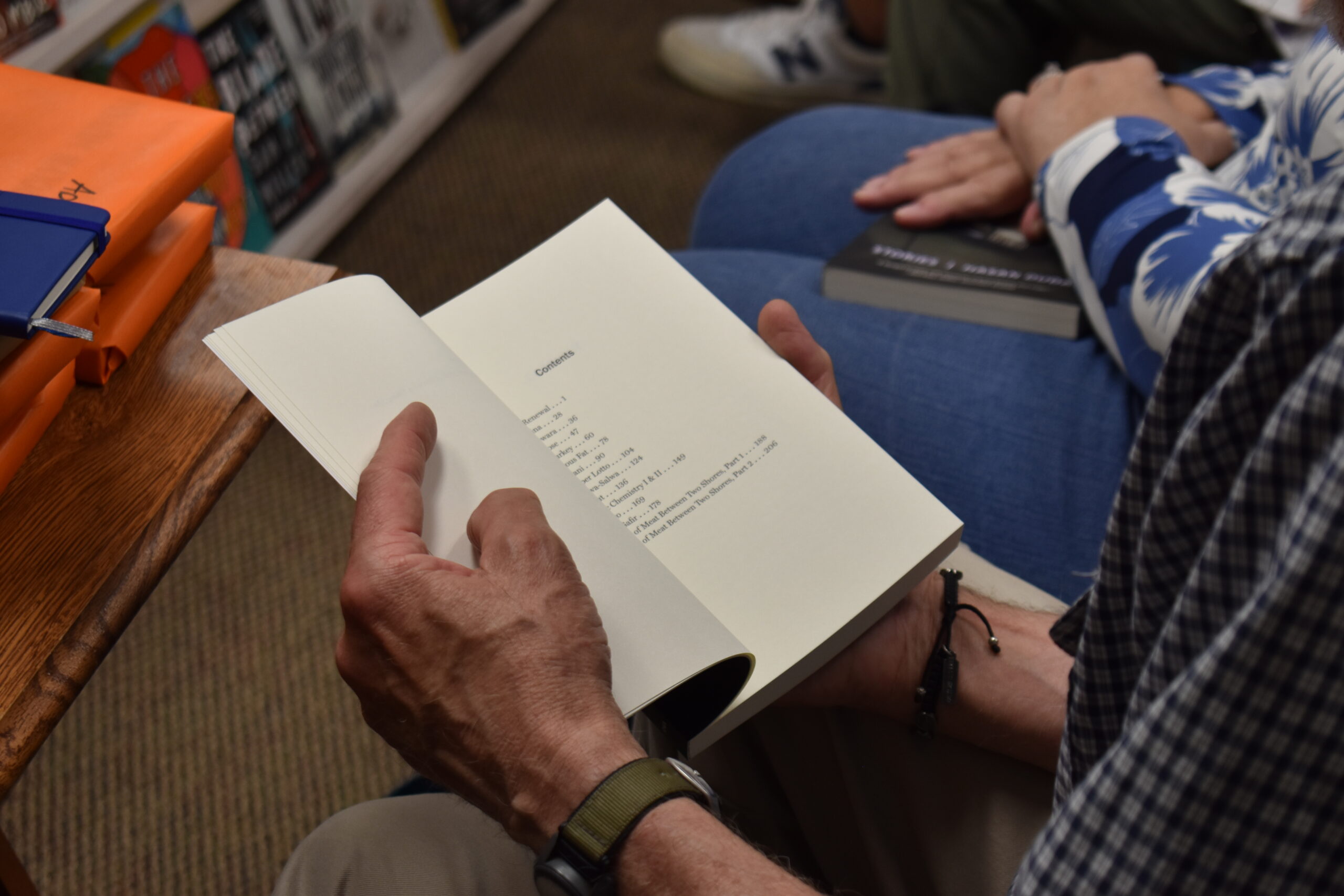
Before turning to fiction, Dudar spent most of his career in journalism –reporting for the Toledo Blade, USA Today, and Detroit Free Press. He also co-produced the 2015 documentary The Last of Little Syria, about Toledo’s historic Arab enclave. He sees a strong throughline between reporting and fiction writing, noting that both demand a focus on the subject rather than the author.
“Journalism forces you… It’s not about you,” he said. “The character kind of decides, and you have to take a back seat.” He added that reporting got him out of his own world in ways that directly fed the book, noting that in both fields, “you can’t really insert yourself.”
Carryout took roughly 12 years to piece together. Dudar wrote in stolen moments, typing on his phone’s notes app, waking up early and drafting between reporting assignments. He didn’t write chronologically; stories emerged months or even years apart. It was only when he assembled them into a single document that the overarching narrative took shape.
“When I started putting them into a manuscript and it starts adding up, it kind of started to feel a bit novel-like,” he said.
A full-length novel might be his next project, but Dudar admits he’s pacing himself after the long process of finishing his debut. Ultimately, two major life events pushed him across the finish line.
The first was becoming a father. “No time is promised,” he said. “That pushed me big time.”
The second was the loss of his mother in 2023. While she knew he was working on a book, she passed away just months before his first story from the collection was published in the Gulf Coast journal. She never got to see it in print.
The Toledo in Carryout is specific, complete with references to Hinkle’s Donuts, Alexis Road and the shadow of the GM plant. Dudar said he kept the real place names because they carried weight he didn’t want to lose.
“Those names are emotionally loaded for me,” he said. “I needed them to feel my way on the page.”
As for what he wants his hometown readers to glean from the collection, Dudar prefers to leave that up to them.
“Whatever they bring to it on the page, whatever they take away from it – that’s theirs,” he said. “I can’t say I have any takeaways for them.”
Carryout is available through the University of Iowa Press and independent booksellers, like Gathering Volumes locally, for $19.95.