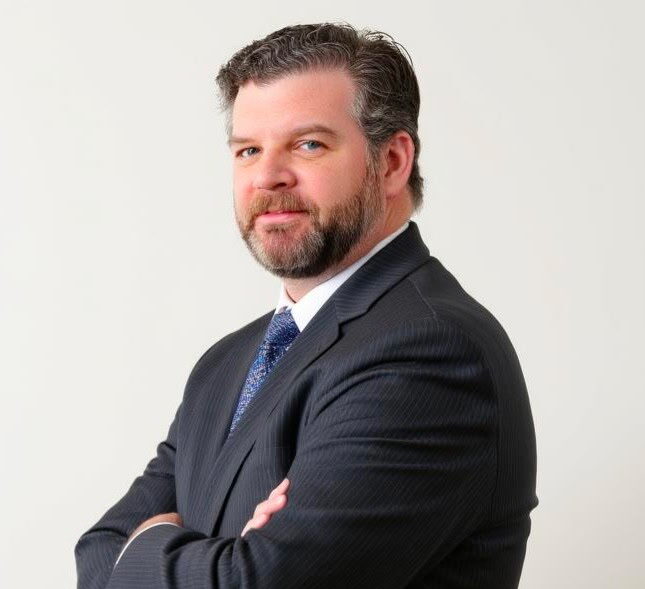
From farming, e-bikes and Flock cameras to school funding, state taxes, and data centers, Republican candidate Ed Schimmel has heard from House District 44 residents about a wide range of topics.
Schimmel, a practicing attorney and fifth-generation farmer, has served as mayor of Northwood since 2016. It’s experience he believes that will aid him if elected as state representative. When asked if he supports President Trump’s policies and plans, Schimmel said he prefers to focus on local issues.
“State reps don’t touch many of those federal issues. I’m just trying to stick with what issues are before the state,” he said. “I try to get the viewpoints of as many people as I can and form my own viewpoint. Several issues the party doesn’t have a stand on, or won’t take a stand on.”
One of those issues is Flock Safety cameras. Schimmel said he understands the need for Toledo Police, which he describes as understaffed, to use them as a tool. Flock is a private company in Texas, and he believes more control is needed on who can access the information gathered by the license plate readers.
“Most people are so distrusting of Flock cameras, they don’t want them,” he said.
In Northwood, as in all over the district, e-bike riders not obeying the laws has caused problems. The Ohio Municipal League recently came out with guidelines on how to regulate e-bike usage.
“What I’ve found, going around the district, is that the issues in every community are relatively the same,” he said.
Data centers, of course, remain a hot topic, and Schimmel said he’d like to encourage developers to look beyond farmland.
“We have a lot of brownfields sitting idle that we could utilize for data centers,” he said, noting that these are not just vacant industrial sites but also commercial spaces. Asking developers to wait two or three years for a site to be cleaned up isn’t realistic, so he suggests a proactive approach by the state to fund brownfield cleanup. Northwood obtained low-interest loans to remove the asbestos-filled, 900,000-square-foot Woodville Mall, which is now being developed into housing and a community center.
“If I’m elected, I want to make sure there’s more money to remediate asbestos, whether it’s industrial or retail sites,” he said, adding that local communities should have a say, following their master plans, on what goes into vacant properties.
Outright bans of projects like data centers or marijuana dispensaries open up communities to lawsuits, but Schimmel said adequate zoning and restrictions can minimize the impacts. Before deciding on giving tax breaks and abatements, each community should do a cost to benefit analysis and always insist on make schools whole, he added.
Schimmel said he believes the state has done a good job in economic development, citing a CNBC poll that named Ohio as the top state for business. Columbus has one of the fastest-growing markets in the U.S., but getting goods from northwest Ohio to the capital is not easy. Plans for a new U.S. 23 route and the recent completion of the Gordie Howe Bridge will benefit northwest Ohio, he said.
When it comes to schools, Schimmel said he supports the voucher program because it empowers parents and students to make the best choice based on programs or to deal with a bullying situation.
“In certain communities, they may not have a lot of options but private school, and that could be very expensive,” he said, noting that St. John’s Jesuit High School, for example, has many students who attend through scholarships or the voucher program.
“Not everyone who attends St. John’s is rich,” he said. “A lot of parents could use that help.”
The school funding program was deemed unconstitutional by the Ohio Supreme Court nearly 20 years ago, but discussions at the state level continue on how to address the issue. He noted that the two largest school districts, Anthony Wayne and Sylvania, are not being treated well by the state – getting $3,000 to $3,500 per student while others are getting upwards of $28,000 per student, he said. The process of dividing up the funding is “very unfair,” he said, noting that the average cost to educate a student is $18,000.
Anthony Wayne Superintendent Kevin Herman, who was asked to clarify for this article but does not endorse any candidate, explained more:
“Because we are a high wealth district, we only receive $3,087.94. Our local taxes support the rest of the money needed to educate our students. If you take the money we receive from the state and our local taxes and divide it by the number of students we have, you would find that our total cost to educate students is less than what many other districts spend. This is because those districts receive more state funding and have passed more millage, allowing them more operating money,” Herman said.
In his role as both a farmer and a mayor, Schimmel said he brings a unique perspective. Schimmel has taken on responsibility for the family’s 400 acres of soybeans, corn and wheat. It’s a rough business, with a small profit margin. Some costs can be attributed to tariffs, and others because of the world market, with more competition from Argentina and Brazil, he said.
Another issue with farming is real estate taxes. Schimmel notes that his farm’s taxes have doubled in the past decade, but the credit given to farmers doesn’t cover those increases. And farmland typically doesn’t use many of the services that property taxes pay for, he said.
“I go there one day to plant and one day to harvest. I’m not there using those services,” he said.
Schimmel said he’d like to see a reduction in taxes for senior citizens, who are on a limited income. As former farmland becomes housing, property valuations increase and long-time residents see their valuations, and taxes, skyrocket as new homes come in. Having those taxes linked to inflation would make more sense that throwing massive increases as homeowners all at once, he said.
At the same time, local municipalities are working to provide services to growing communities, while trying to fund aging infrastructure. In Northwood, the city has taken on debt and passed some of it on to consumers, in order to replace water lines that, in some places, are over 100 years old. He’d like to see the state have more funding available for municipalities to upgrade.
Providing services like water, sewer, fire, EMS and police to residents is at the core of local governments. Northwood is working with Lake Township and Rossford to conduct a fire study for a possible fire district. He pointed out that the Waterville, Waterville Township and Whitehouse (W3) fire co-op was the first in the state, and other communities are working to replicate those efforts in order to provide services at a more affordable rate.
“It’s too expensive for some small communities to have a full service fire department. It’s a repetition of purchasing and equipment. You’ll see a 5,000-population village with a $2 million truck right next to another,” he said.
Often projects that involve communities working together receive priority when it comes to grants. Schimmel acknowledges that not every municipality has an expert grant writer, but can utilize resources like the grant writer with Lake Erie West Regional Council to find those opportunities. Lake Erie West has a membership that’s affordable and based on population, and the payoff comes in sharing ideas, he said.
Schimmel said he supports local communities having more authority than the state government. He supports Monclova Township’s quest to become a limited home rule government, and he’d like to see the state income tax reduced so more municipalities can keep funds in their own communities.
“I think people realize they get more services from their local government than their state,” he said.
Schimmel is married to Carolyn, an accountant and tax preparer who serves on Northwood Schools, and they have three children.