






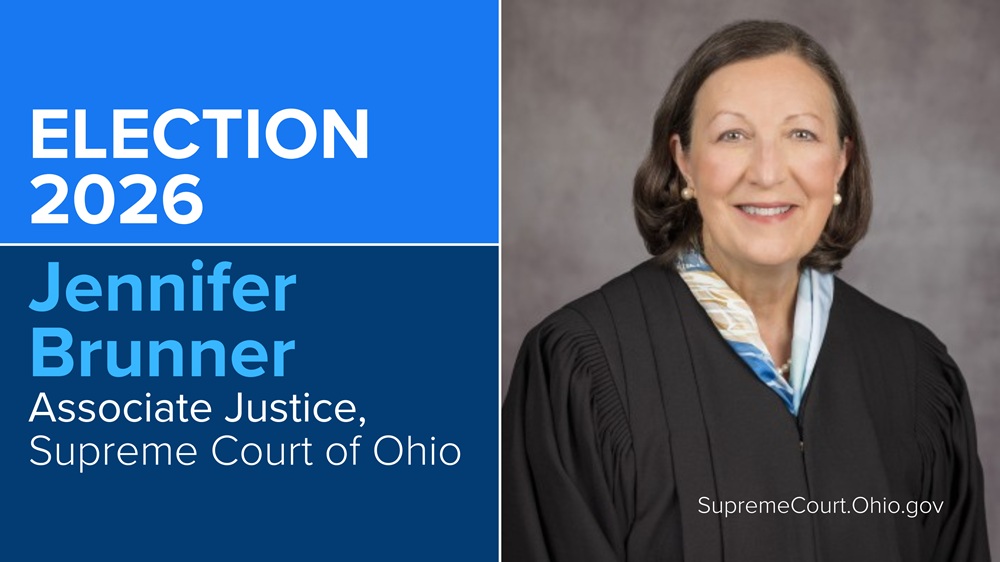
TOLEDO – This year, Ohioans will be deciding the result of a number of races: one for governor, another for U.S. Senate, and plenty of others that receive less attention, such as those for attorney general, secretary of state, treasurer, and auditor. Voters will also be electing their state and congressional representatives. And while some of these contests have been contentious, there’s another high-profile race that, so far, hasn’t really been: the one for a seat on the Ohio Supreme Court.
In fact, there are two state Supreme Court seats on the ballot this year: that of incumbent Republican Justice Dan Hawkins, who’s up against Democratic candidate Marilyn Zayas, and that of incumbent Democratic Justice Jennifer Brunner, who faces Republican candidate Colleen O’Donnell.
This story, however, will focus on the latter. The Toledo Free Press recently spoke with Justice Brunner to gain a better understanding of:
- – her judicial philosophy,
- – the working relationship she maintains with her colleagues (all of whom are Republican),
- – her thoughts on the strength of our country’s institutions,
- – and the challenges, she believes, the judiciary faces.
We began with what she’s learned about the court as an institution in her first term on the bench.
Noting her prior experience as a common pleas judge in Franklin County, justice on the bench of Ohio’s 10th District Court of Appeals, staffer in the state senate, and secretary of state, Brunner says serving on the state’s highest court has brought her a “deeper understanding” of how it integrates with those other parts of state government.
“As an attorney for 43 years, I’ve always noticed the last word on state law, in cases in the state of Ohio, but I’ve been really interested [in] learning about how it blends into the work of the other two branches,” she said.
Jaden Jefferson, Toledo Free Press: The court’s makeup is something that’s often talked about. It’s composed of seven justices: six of them Republican, and one a Democrat — that, of course, being you. And while justices are expected to exercise impartiality, which is why my next question won’t be a political one — there is still a political component — in that, since 2021, party labels have appeared beside judicial candidates’ names on the general election ballot. So, what should Ohioans know about the working relationship you have with your colleagues?
Jennifer Brunner — Associate Justice, Supreme Court of Ohio: I have a good, collegial working relationship with my colleagues. I focus on trying to get the law right. We don’t always agree, but we agree to disagree and it’s important to be collegial, so that the public sees what the court does and not who the individual justices on the court are or whether they get along or not.
Jefferson: Do the ideological differences that exist between yourself and your colleagues add a level of complication? Or would you say they make for more well-rounded conversations?
Brunner: Both, and when you say “ideological,” I would say, if there’s an ideological difference, it really is more in the approach that we take to how we reach our decisions.
Brunner pointed to a couple of challenges on which she and her colleagues have found consensus: rural Ohio’s limited/nonexistent access to legal services, as well as the undefined role of artificial intelligence in the courtroom.
“The fact we are elected has meant that we had to campaign and we had to actually spend time throughout the various parts of Ohio, which is an extremely diverse state. And so, I think it’s easier for us to share views on those issues because we’ve all experienced much of the same as we’ve campaigned for office.”
Jefferson: Do you find it to be a challenge when the law may be very specific, and there’s still disagreement between judges?
Brunner: What I see as problematic with the court, at this point in time, is the overruling, within a two-year period, of an earlier decision — not because of any change in circumstances — but because of a change in the makeup of the members of the court. That’s a problem.
As traditionally independent government agencies, such as the Federal Reserve and Federal Trade Commission, face new challenges to their insulation from politics, the TFP asked Justice Brunner how the nation’s institutions — like its courts — can maintain trust in the face of political pressures. She said that the best way is “to not be partisan or even appear partisan.”
Another test of the courts’ independence has been from individual threats against judges.
Crediting the court’s “very strong and well-operated” security apparatus, Justice Brunner said that she herself hasn’t faced these kinds of attempts at intimidation while on the bench. Rather, she said her biggest threats came as secretary of state, in the wake of 2008’s presidential election.
Brunner pointed to rhetorical choices she believes public figures should make, in order to keep discourse civil: “People can disagree with what the court does, but as I said before, it really should not be personalized to any particular judge, because — even if it’s a trial court judge — that decision is reviewable by a court of appeals and, potentially, by the Ohio Supreme Court,” she said. “When it’s a decision by the Ohio Supreme Court, it’s not a single judge who made a decision, it’s at least four — sometimes up to seven.”
For those who might not assign the court’s decisions much importance in their day-to-day lives, she cited a few examples of how it has an outsized impact on Ohioans, including cases involving the legal process for beginning data center construction, ones involving solar farms, and others that have dealt with what public utilities can charge their customers for infrastructure upgrades.
In other words: While state Supreme Court races may not always be the center of attention, their outcomes can be consequential and greatly affect the very issues that are in the spotlight.
The Toledo Free Press has reached out to Colleen O’Donnell’s campaign, and we intend to share her thoughts in a future article, after an interview is arranged.








, who faces Republican candidate Colleen O’Donnell.)