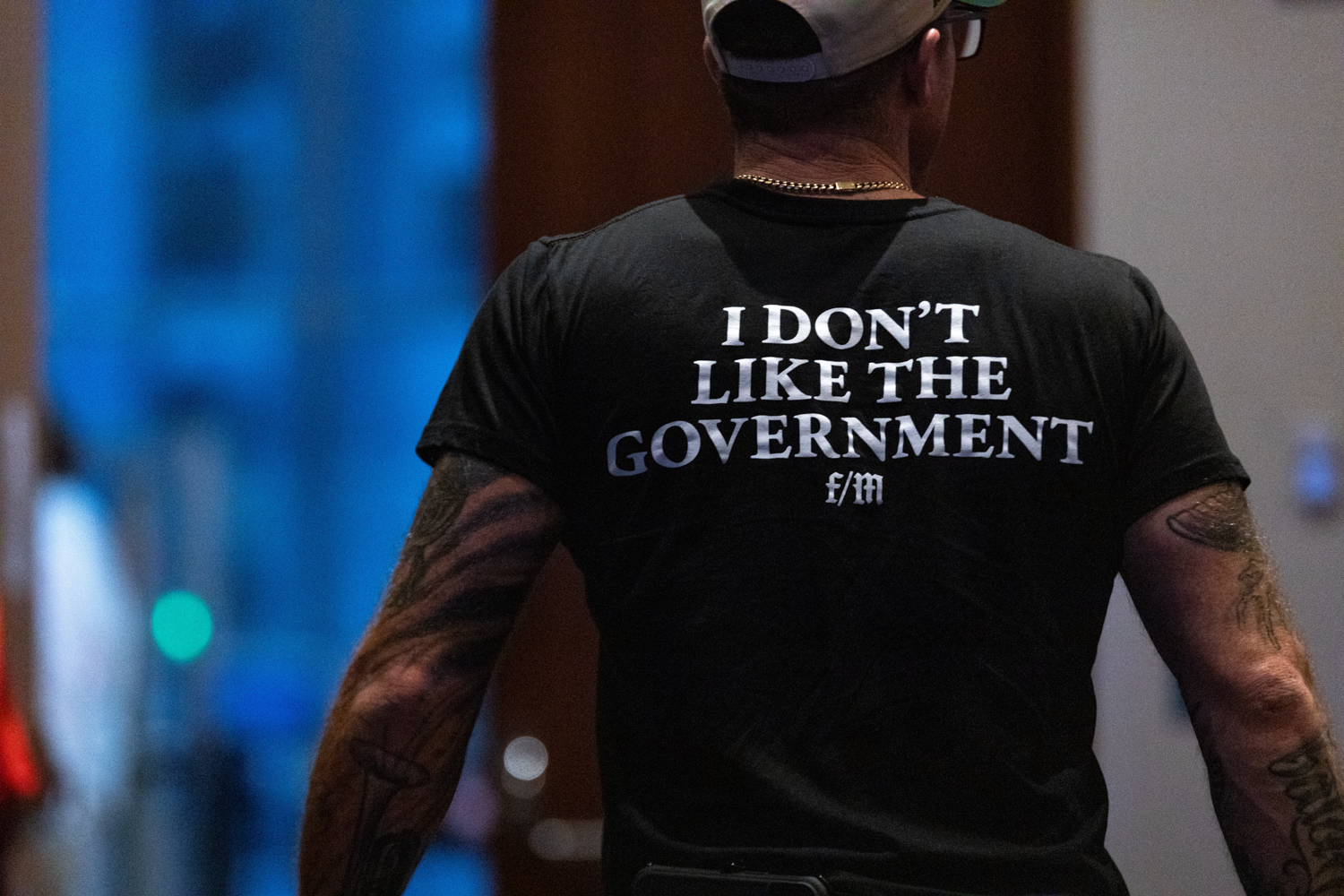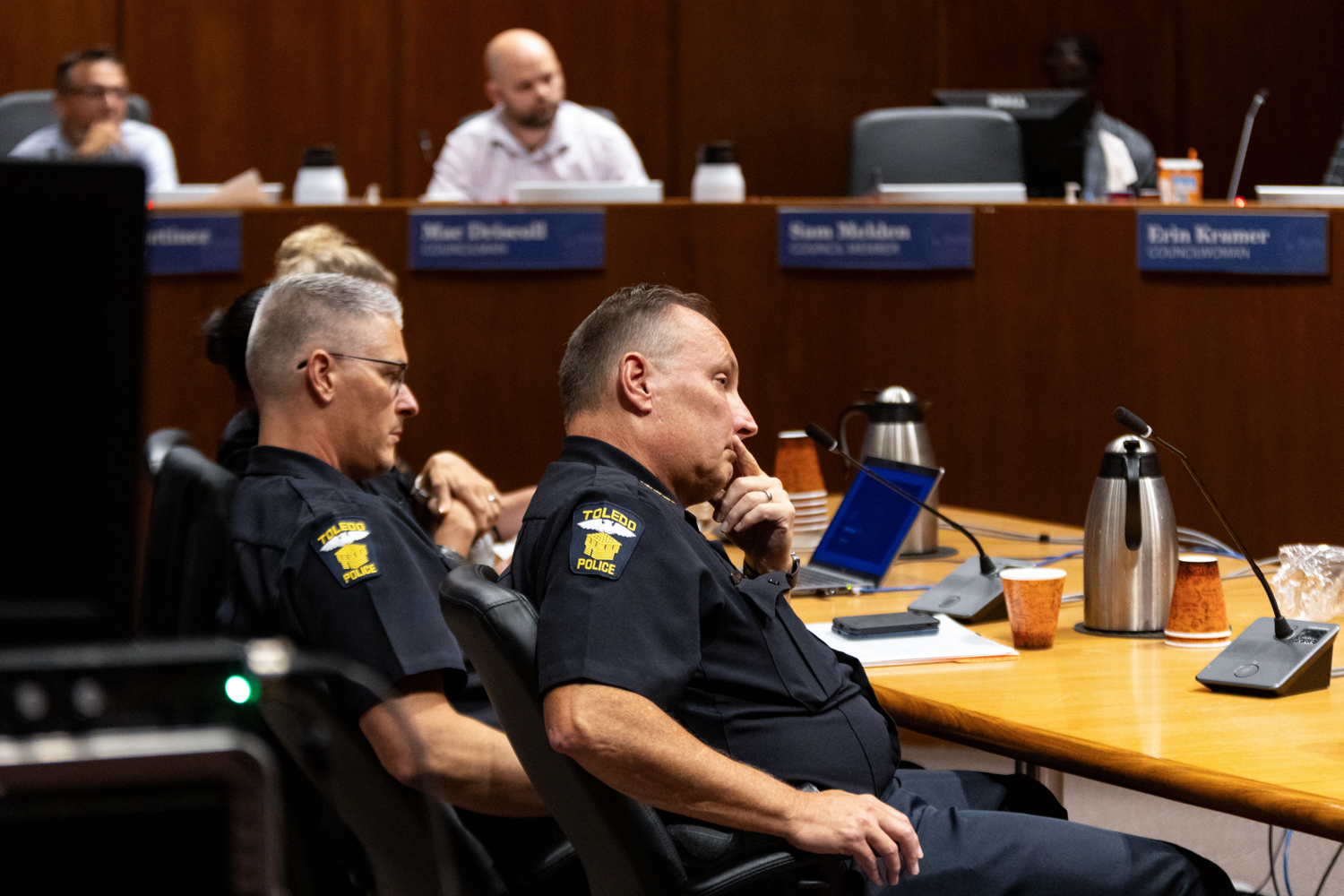
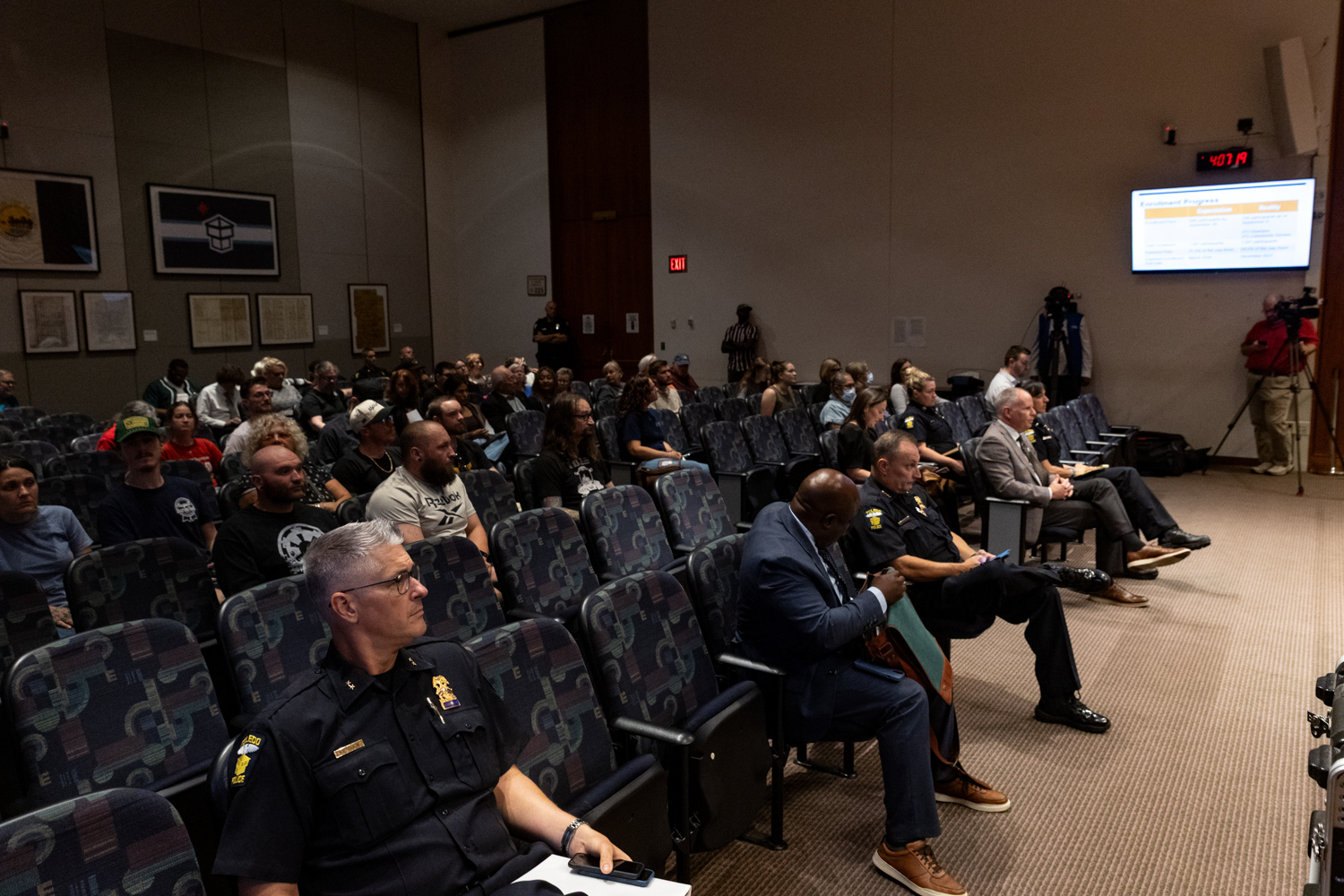
TOLEDO – During a Sept. 17 Public Safety & Criminal Justice Reform Committee meeting, public comments were centered on the use of Flock cameras. Specifically, the meeting was about the possibility of an extra year of funding for a mobile command center and an expansion of cameras into District 2 Schools and thoroughfares.
Most speakers criticized the demeanor of council members and the structure of the meeting, which allowed council members to speak and ask questions before public comment. They saw the format and some of the questions as leading, condescending and not dealing with the Flock critics’ actual concerns.
Council remained split on Flock, with Vanice Williams, Adam Martinez and George Sarantou firmly in favor, Theresa Gadus and Erin Kramer firmly against, and Mac Driscoll somewhere in-between. The police panel gave more information on Flock, and the basic pro-Flock stance was that it was an effective tool for solving crimes. Those in opposition generally were concerned about how and where mass location data could be sold/used against them.
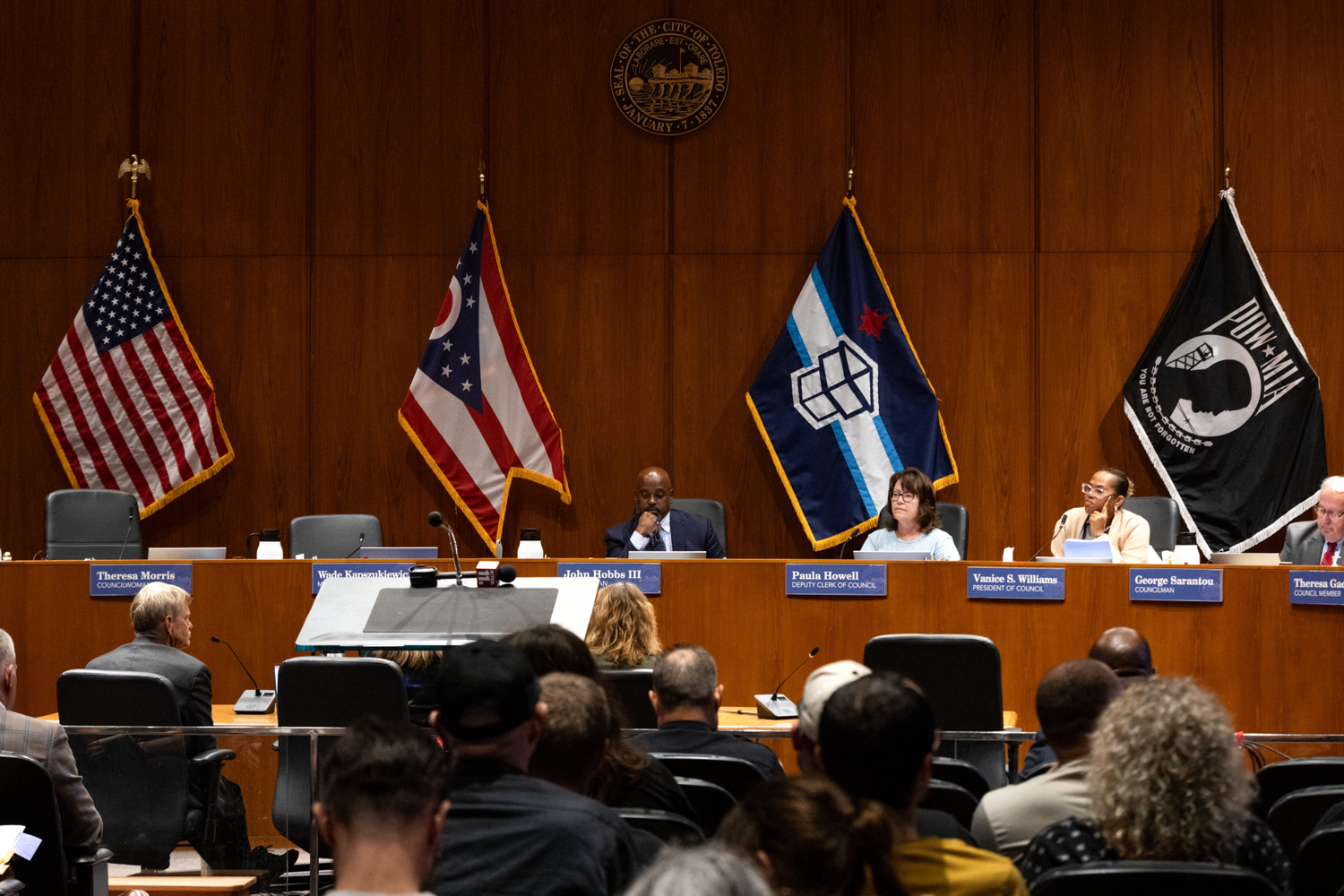
The majority of the public comment was opposed to the use of Flock cameras due to the risk for immigrant communities, the overreach of federal government, the lack of an independent audit and the potential misuse of the tool.
Both those for and against the use of Flock cameras agreed that an independent audit was necessary to keep Toledoans safe.
Nationwide backlash against Flock Group, Inc.’s automated license plate reader (ALPR) cameras led to this public meeting.
Criticisms of the meeting
In full, the meeting spanned roughly three hours and 20 minutes, causing many attendees to accuse council of “filibustering” against the public comment for the first two hours of the meeting.
Generally, council interacts with a panel, giving their expertise, and public comment comes afterwards. However, the time taken by council to hear from ranking police and a judge left multiple members of the public disgruntled at the very least.
Most outspoken against how the meeting was conducted was local progressive organizer Sean Nestor, who spoke loudly as he communicated his dissatisfaction.
*Disclosure: Nestor is the board president of the Toledo Free Press.
“I come here offended,” he said. “I’m deeply offended at the way this council has handled this issue. You know that there are dozens of people waiting to speak today who have waited two hours through a filibuster that is essentially a public relations effort…”
Nestor accused the council of using the time before public comment to change the minds of those in attendance to be in favor of the Flock system.

The chair of the committee, Councilman John Hobbs III, District 1, was also scrutinized for some of his opening remarks before the discussion about the Flock ALPR cameras.
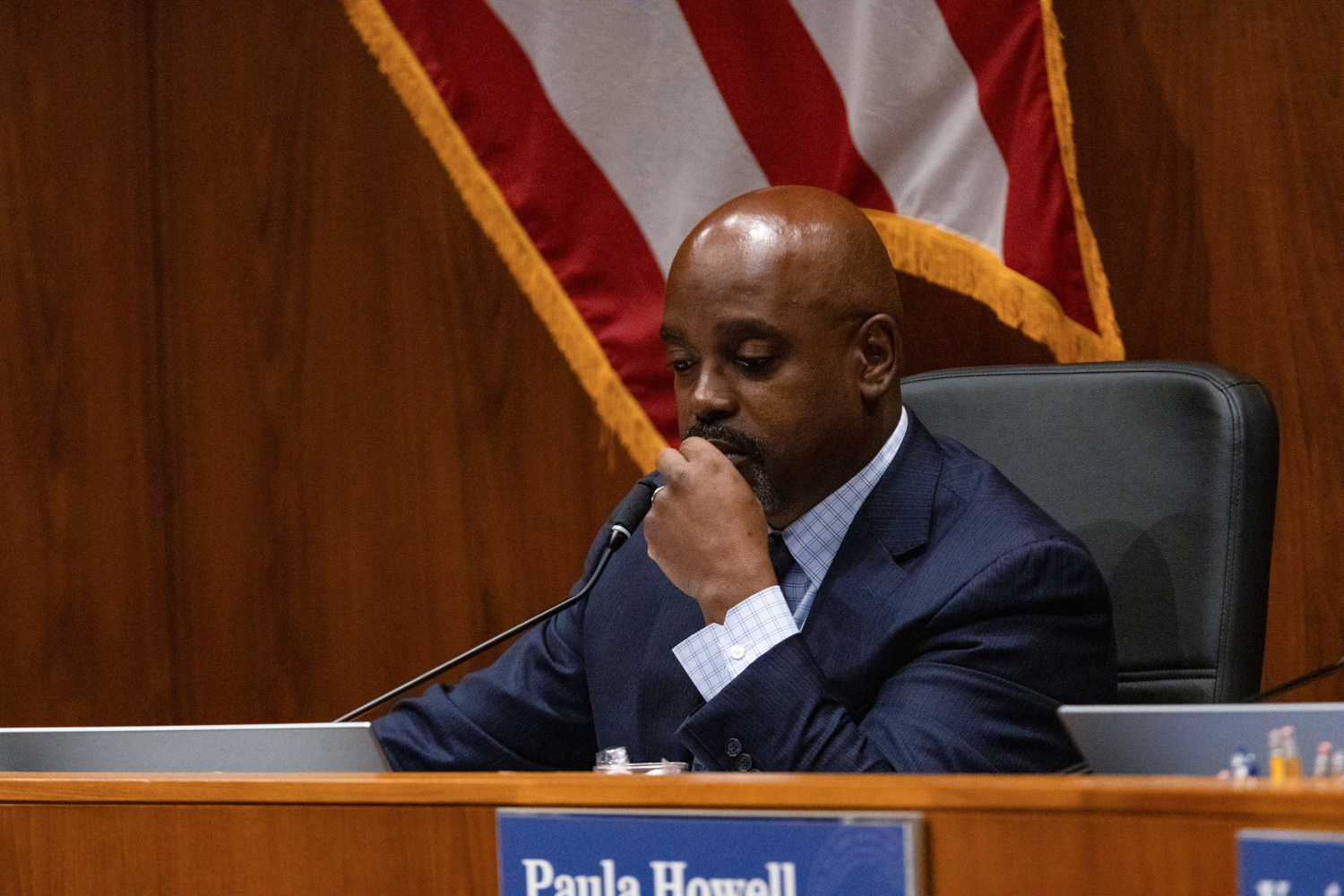
“I want to say before we start this meeting tonight…We did not have to have this discussion at all,” he said. “But I wanted to have a discussion where we can have a public meeting where we can talk about this issue, talk from both sides [to] those that are for and those that are against.”
This tone and perspective seemed to be an attempt to maintain order and respect during the meeting, but was received by some of the public as condescending.
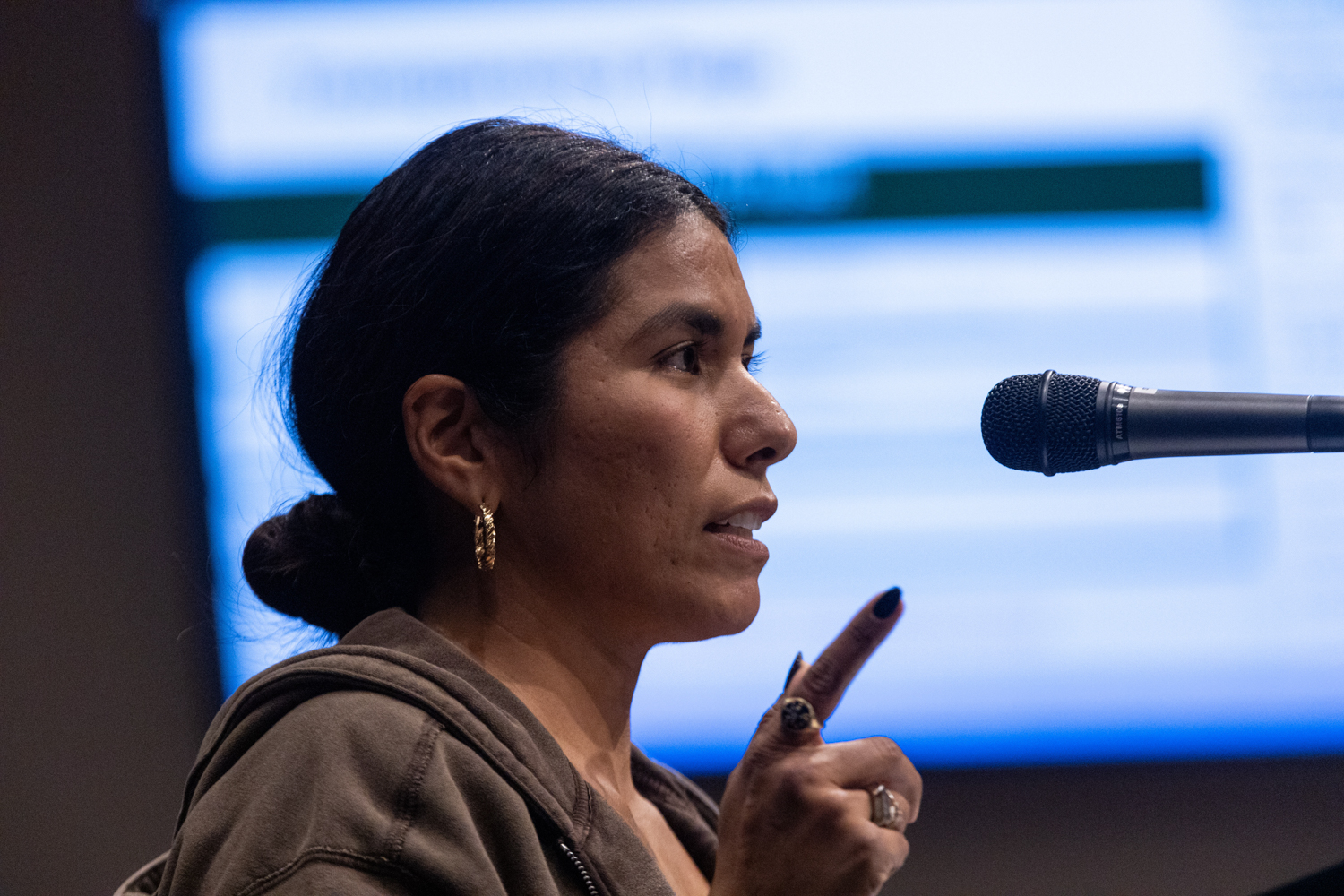
“I appreciate the time to talk today. Although, like Sean said, it is actually really offensive to say, ‘We didn’t have to have this public hearing.’ It just doesn’t sit well with constituents,” said Jessica Molina, a local advocate for immigrants, when she started her public comment.
Two new Flock items
Adding a year
Public comment on the Flock system was previously fielded on June 22 after a vote failed to pass funding through O-240-26 – $14,000 annually for TPD’s Real Time Crime Center (RTCC) – for two years.
Just days after the original ordinance for that funding failed, another ordinance was drafted, O-286-26, an ordinance that specified funding for one year as opposed to the annual renewal outlined in the first ordinance.
On the June 23, O-286-26 passed funding for one year, and now the Flock discussion is fielding comment on extending funding for the RTCC for another year. This would make O-286-26 identical to O-240-26, which failed, mainly due to a lack of Flock supporting council members present for the vote. All who voted against Flock for O-240-26 were in attendance for the O-286-26 vote, but were outnumbered when more council members were present.
Expanding into District 2
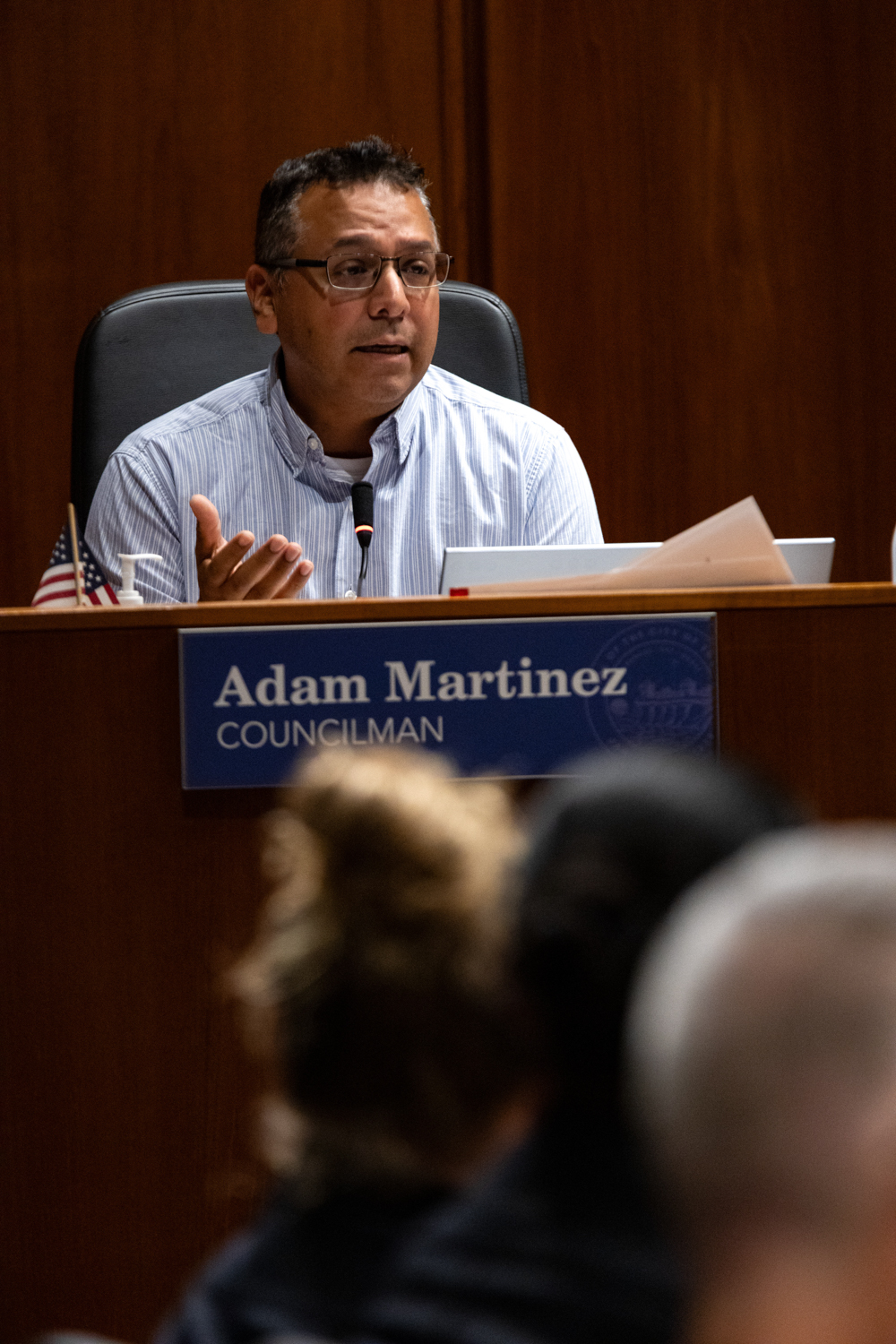
The other issue debated at the committee meeting was an expansion of Flock cameras into District 2, at the request of Martinez, Toledo city councilman for District 2.
A brief to the committee describes the proposed ordinance, O-307-26: “This project will purchase cameras, gateway system to give TPD access to camera footage at partner schools and pay for first year of subscription.” $85,000 was requested in the ordinance for 16 locations, and the ordinance notes that schools do not have to participate if they did not want to.
Martinez, Toledo City Council Chief of Staff and Council President Proxy Lucy Frank, and Director of Economic Development Brandon Selhorst were all named as contributing planners to the initiative, which seeks to prevent school shootings.
The brief to the committee explained that “locations for cameras included a review of where crime is most prevalent, types of schools and spaces, and what was already in use at that school, including camera blind areas. The Flock cameras will go around high school football fields with large athletic events.”
Unfortunately, Martinez only explained his proposed ordinance in the last ten minutes of the three-hour-and-20-minute meeting. Much of the earlier comment and panel discussions functioned as a broader support or criticism for the Flock system as a whole, instead of the specific additions proposed in O-307-26.
“We’ve had three major murders in the last eight months,” Martinez said, explaining his thinking behind the ordinance. “I have an eight and 10-year-old now, and I am very concerned about their safety…District 2 has the least amount of cameras in the entire city of Toledo” at 37 cameras.
Specifically, Martinez pointed to added cameras at Rogers High School, Bowsher Stadium (not Bowsher High School) and “gaps in our coverage where individuals can go in and out of different municipalities…” Cameras would only be activated with a 911 call, according to Martinez, and their main purpose would be to improve emergency response times for first responders.
The $85,000 covers the first year of hardware/software installation, as well as the first year subscription fee.
Certain schools have chosen to be a part of this initiative, and Martinez said those schools could opt out after the first year. Going forward, after the first year, schools would be responsible for the subscription fee, and because it is from the capital improvement fund, Martinez said the contract had to be for five years.
“Any funds that aren’t used will go back into the District 2 DIP [District Improvement Program] allocation,” he said.
District 2 expansion comment
Only two of the many people with public comment specifically addressed O-307-26: Molina and Nestor.
“We reached out to every single organization and school that was listed as a partner. They are not publicly committed to being partners, none of them,” Molina said, and criticized an earlier meeting where the ordinance was discussed with a similar format – two hours followed by comments.
At the time of publication, the Toledo Free Press was not able to independently verify either Molina or Martinez’s claims about open cooperation with the camera expansion into District 2.
“I’m offended that earlier today, when these law enforcement officials talked about this, they downplayed the reality that part of Martinez’s proposal is the introduction of more PTZ [Pan, Tilt, Zoom] cameras, which are not just monitoring vehicles; they are monitoring people,” Nestor said as a direct criticism of Martinez’s proposal.
Given the nature of Martinez’s initiative to curb school shootings, the introduction of the PTZ camera, designed to monitor individuals, makes sense, although it raises further questions about surveillance.
During her overview of the Flock system, Lieutenant Leslie Cook, a Toledo police officer who works extensively with the Flock system, explained “live view cameras.”
“We have three live view cameras. I think this is where some of the additional concerns may come up when people talk about cameras tracking people’s movements,” she said. All three of these cameras are positioned at intersections and have ALPR functions, but she assured those in attendance that the mode that tracks movement, human or otherwise, is kept “off at all times.”
Cook added that part of keeping the movement tracking mode “off” is because the cameras are positioned at intersections, and would not be effective for monitoring with so much movement.
No information was given on how live view cameras might be implemented in coordination with D2 schools or the areas described in O-307-26.
Panel
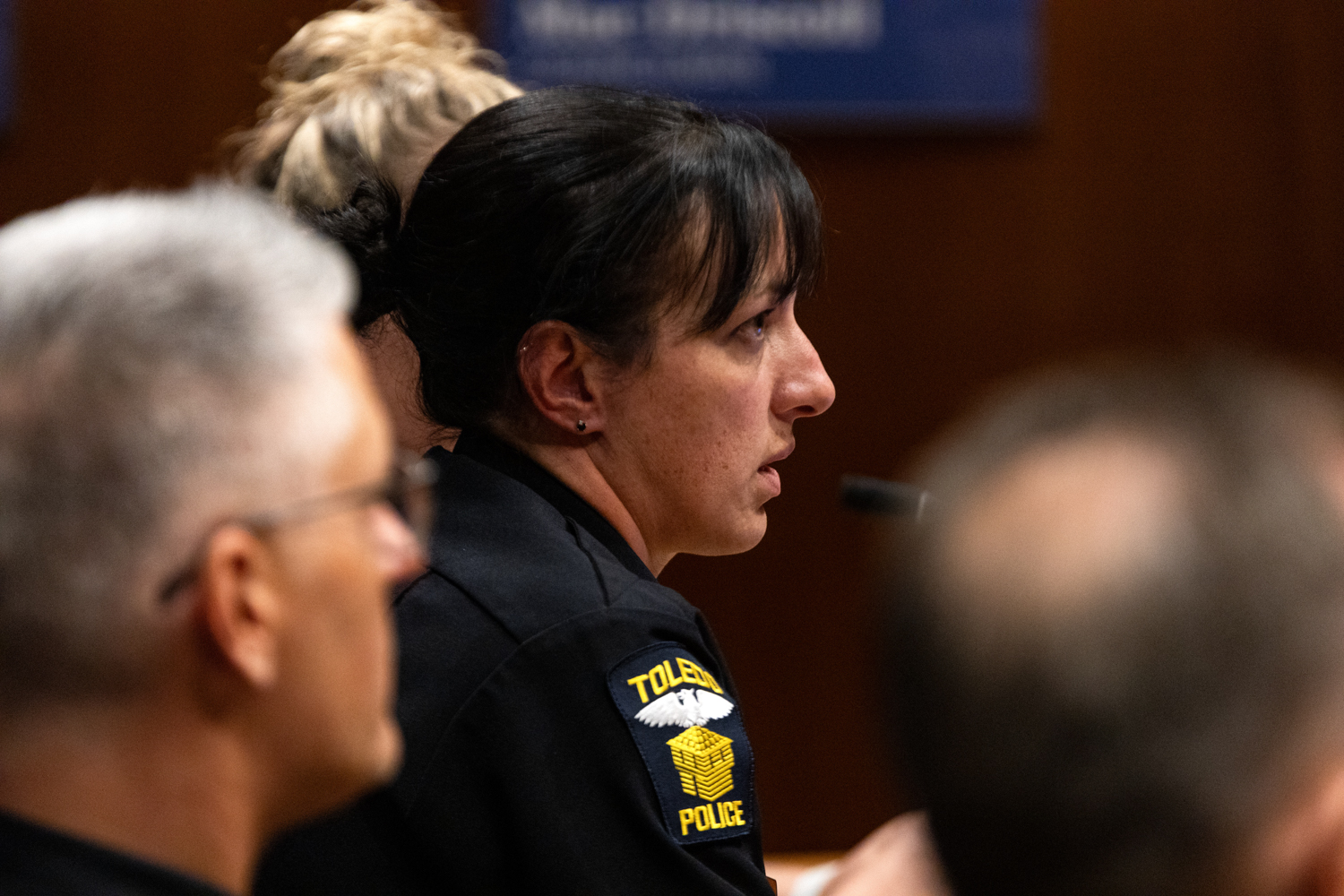
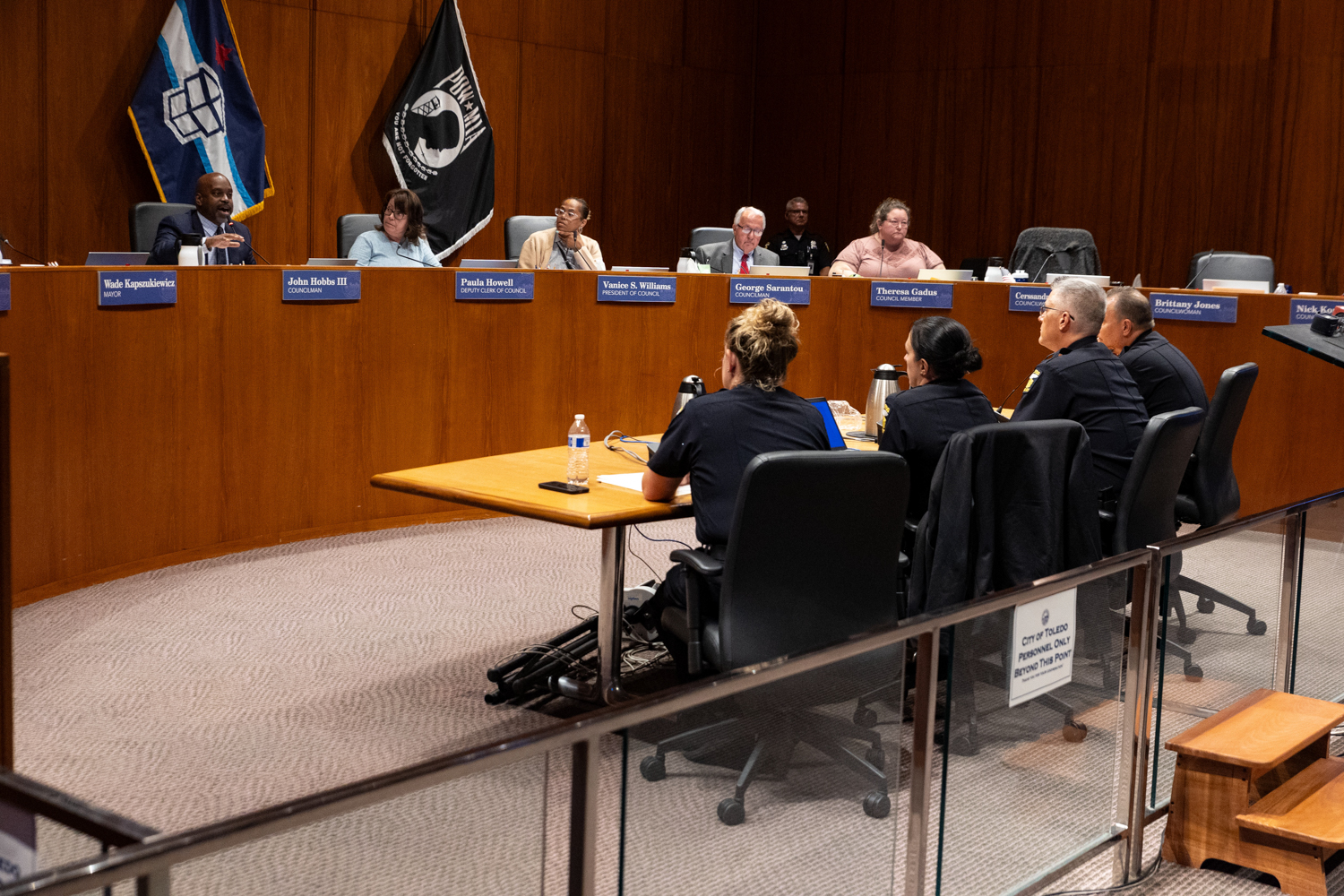
More broadly, Toledo City Council members addressed their comments and concerns in front of the public to a police panel, which included Police Chief Michael Troendle, Assistant Chief Kevin Braun, Lieutenant Cook and Captain Kellie Lenhardt.
Before questions were asked, Troendle explained his hopes in addressing the council and public: to help people understand the effectiveness of the Flock system in solving crimes, to dispel any misinformation about how the system works and create trust between the police and the public through showing safeguards in the Flock system.
He ultimately said that disbanding the Flock system would be “a shot against our own community. We’ll have more victims. We’ll have more victims that don’t get justice because we’re unable to arrest the perpetrators.”
Braun then shared anecdotal cases where Flock had been helpful in locating missing persons and solving homicides, noting the clearance/solve rate for homicides since the use of Flock began in 2022.
Braun said that in 2021, before Flock was implemented, the clearance rate for homicides was 59 percent, near the national average of 61 percent. He reported that 2024 had an 87 percent clearance rate for homicides. Just last year, TPD had an 81 percent clearance rate for homicide. Braun did not say what 2022 or 2023’s rates were.
Braun also shared the process of searching the Flock system. “When the database is searched, we receive a photo of the vehicle, a photo of the license plate, and the time and location that the photo was taken. That’s it.
“The overwhelming majority of images captured by the system are never viewed by a police officer. They remain in the system during the retention period [30 days] and are ultimately deleted without ever becoming part of an investigation,” he said, and later Cook would confirm that a maximum of 0.4 percent of images taken are viewed.
“Officers who have access to sensitive investigative systems should absolutely be accountable for how they use them. We agree with those principles,” Braun added before leaving it to Cook to explain more.

Access and searches of the network are always logged, according to Cook, and certain behavior is flagged for review if deemed suspicious by the system:
- – If someone searches an individual 30 days after searching them
- – Only searching outside of Toledo
- – Searching the same plate with multiple case numbers
- – If only one person searches a plate and does so more than 10 times
- – Certain time windows for searches could also flag a search
These flags are manually reviewed by ranking police officers, Cook said.
TPD shares Flock data with 2,235 organizations, 437 of which are in Ohio. 1,283 of those organizations are sharing their data with TPD, 371 of which are in the state of Ohio.
Federal sharing is turned off, so federal agencies cannot request TPD’s data. Immigration and reproductive care searches have been turned off in TPD’s Flock system, meaning TPD cannot search for those subjects explicitly, and Toledo’s cameras cannot be used explicitly for those kinds of searches.
Similarly to what Lucas County Sheriff Michael Navarre said about Flock, Cook mentioned most searches are nationwide, and have nothing to do with Toledo.
“They’re searching the entire United States. They’re doing a lookup on their plate to see where their plate has gone, and very rarely is that plate here in Toledo,” she said.
Lastly, TPD launched a Flock transparency page.
Council’s questions
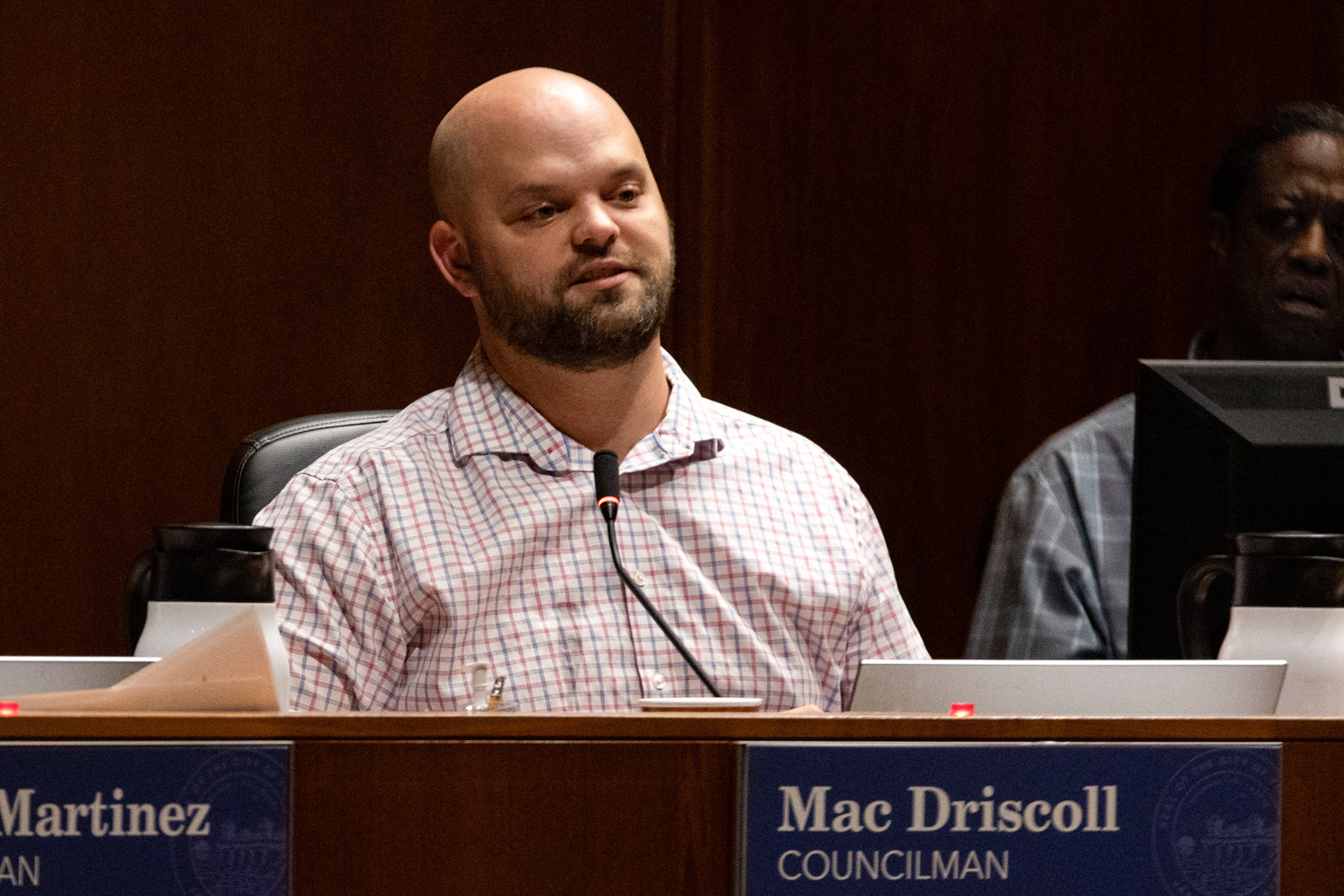
Driscoll
When estimating TPD’s searches in reply to a question from Driscoll, Cook said a month yields roughly 22,000 searches from TPD. However, Cook mentioned that refreshing a computer page could read as another search inside the Flock system, skewing the numbers higher than they actually are.
Driscoll asked if TPD was independently auditing the Flock system, or if they were relying on the Flock system to flag individuals and search for abuse.
Cook said TPD did not have an independent audit structure at the time of the hearing.
“Does it flag suspicious searches from other communities?” Driscoll asked, and Cook said the system does not flag suspicious outside searches for review.
Towards the end of his questions, Driscoll asked for a list of all the ways Flock has been useful in police work and how.
Braun said he would love to provide cases where Flock has been helpful. Cook said there are examples on the transparency page, but Troendle said the specifics of how Flock was used in each case are not logged.
“We don’t keep a log that we say, ‘Hey, every time you use this, please go into the spreadsheet and tell us you used it’ because that would actually then take a lot of work from the officers,” Troendle said and stressed the amount of work police do. Troendle then encouraged all council members to come see how Flock works in real time with TPD.
Driscoll then asked if TPD had any instances of Flock misuse.
“At this time, we are not aware of any misuses,” Troendle said.
After his inquiry, Driscoll was unsure of where he stood exactly with Flock.
“Look, you can weed your garden bed by setting it on fire, and you’re going to kill all the weeds. But is that too imprecise of an action?” he asked. “We’re collecting all this data. We don’t really have control of it…I’m not sure we can necessarily guarantee the safety of it in light of this. I want to know for a fact that those people’s data is not accessible from a third party, and I’m not quite sure on that.
“I do feel we should pause our Flock system,” he said, at least until better regulations for AI are available. Then he ended his questions and resolution saying he fully supported TPD.
Gadus
During the first Flock hearing, District 3’s council representative, Theresa Gadus, had a long list of questions for the public relations director from Flock.
But this time around Gadus was brief.
“What they share with you [TPD] is not what they’re collecting, and there’s a dissonance in there that I think is part of where I share the concern of what it means to be mass surveilled,” she said.
On July 1, Gadus said she put in a 10-point public records request concerning Flock to TPD. “That was 78 days ago,” she said. “I still haven’t gotten any information.”
When explaining that she didn’t need to see all records on Flock, Gadus said she could have looked over just one month’s worth of information to help inform her constituents.
“I could have seen June, I could have seen July, I could have seen August. I could have given information that my district is asking for, redacted, safe and I could have answered questions for them, but because I haven’t received anything in 78 days, it’s very difficult for me to do my job.”
Visibly frustrated in her final statements, Gadus said, “The people that I govern for right now have a lot of questions, and they want this paused, and they they do not want to be mass surveilled.”

Sarantou
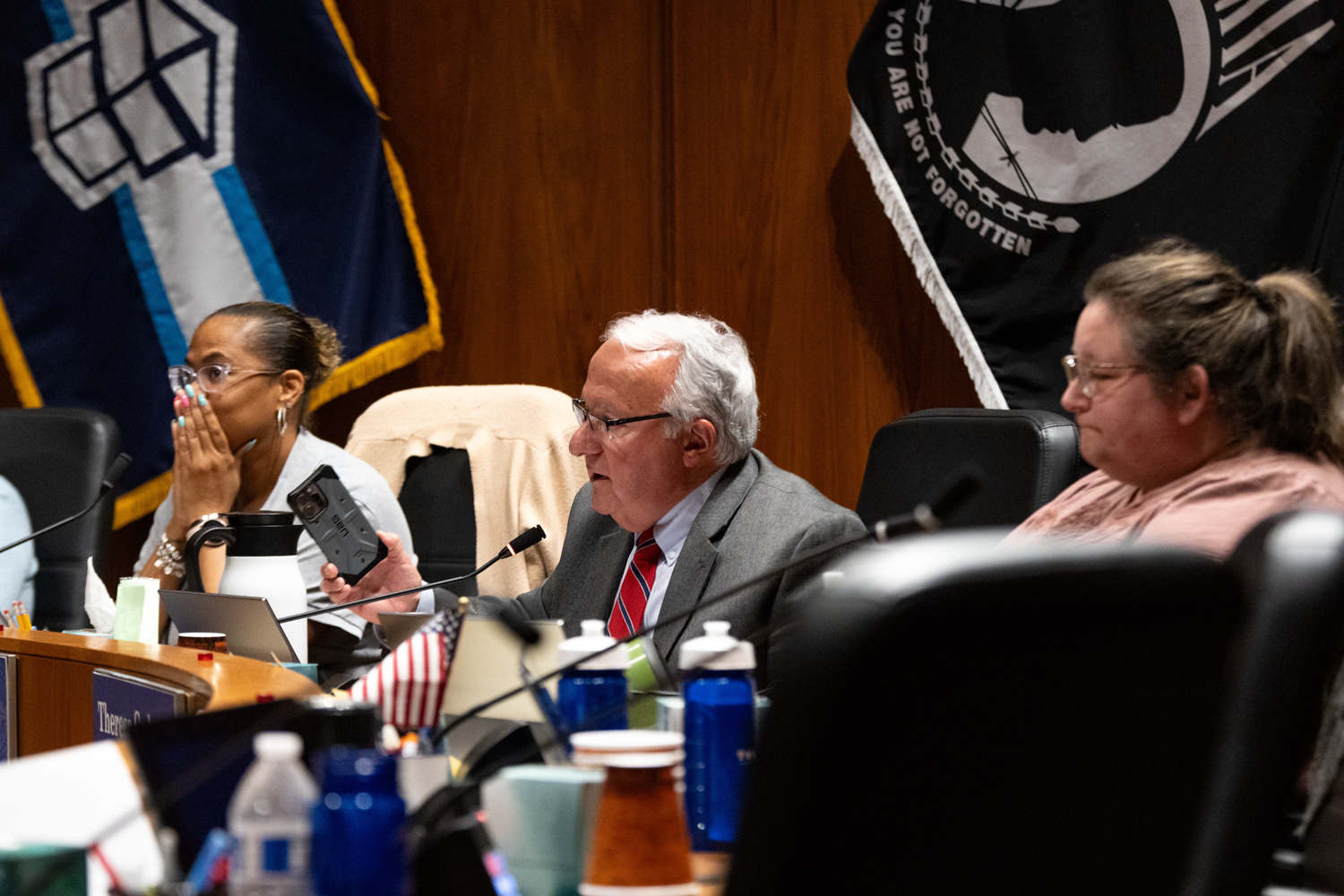
Delving into repercussions, Councilman At-Large George Sarantou wanted to be clear on the penalties for abusing the system, which was the one question he asked the panel.
Officers could end up losing their jobs and, depending on the abuse, face prosecution for abuse of the system.
Sarantou then equated the privacy given up by using cell phones and the internet with going out into the public.
“I just think that it’s unfortunate [the loss of privacy], but we’ve also seen a tremendous amount of crimes solved, and we’ve seen bad actors apprehended as a result of that and brought to justice,” he said.
“I hear a lot about privacy concerns. What about the victims of crime? Don’t the victims have rights?”
With that, Sarantou yielded his time.
Kramer
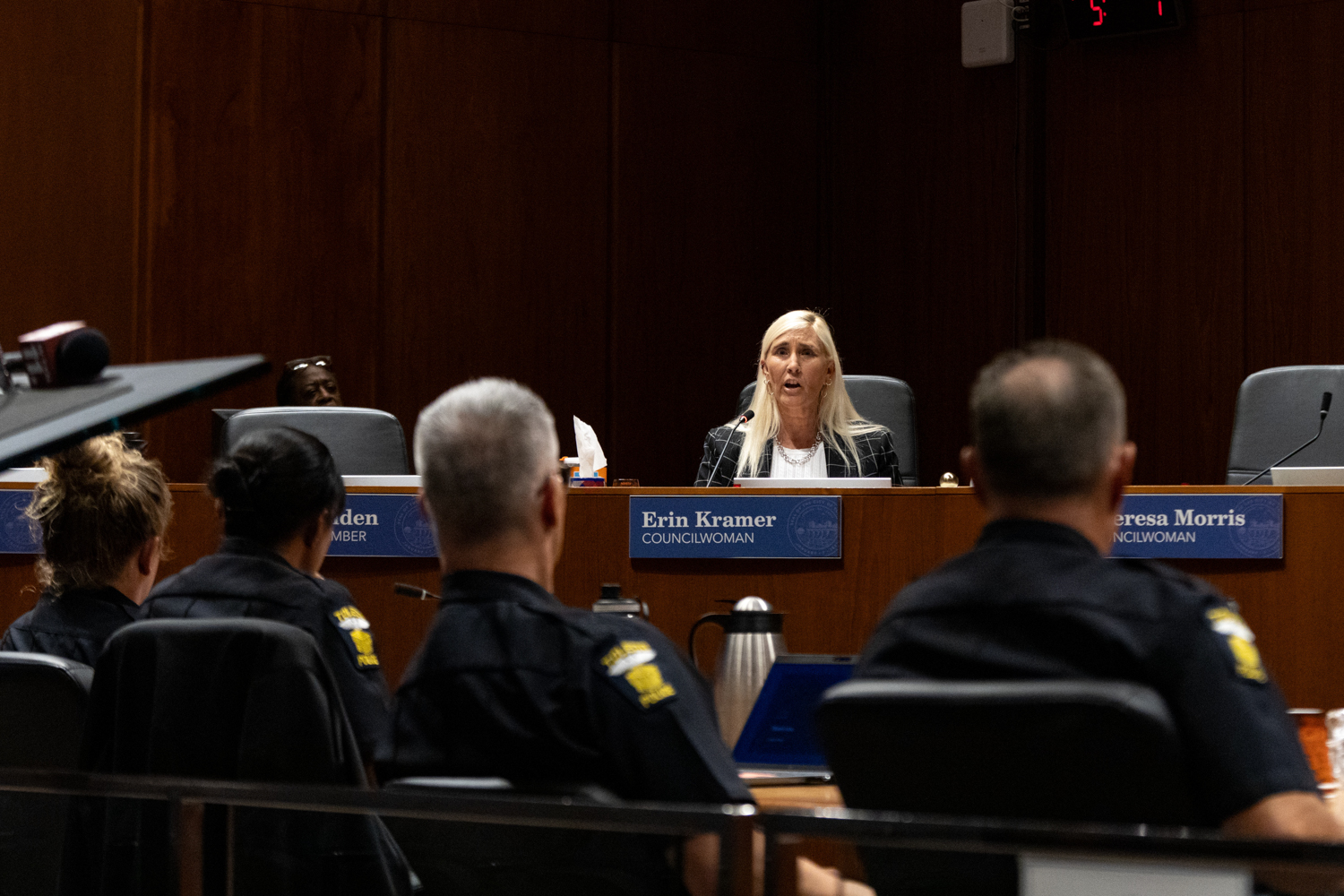
“We should have oversight if we are going to be passing this over and over again, giving the police department money for this system. We should have oversight,” said Erin Kramer, council member at-large, echoing Gadus’ complaint and trying to keep her questions and comment brief.
“I’ve looked at the transparency page; it’s not very transparent. I don’t get a lot of information from looking at that, so that is my concern,” she said, and then asked if more cameras in D2 would deter a school shooting.
Troendle could not say it would deter a shooting, but said it would help police do their job better.
In response to Sarantou having read an email from a supporter of Flock, she said, “We have all received hundreds of emails that oppose those Flock cameras,” and ended her time speaking.
Williams
“I just want to say, as the district that has the most license plate readers and cameras, I am in support of them,” said Williams, vice chair of the Public Safety & Criminal Justice Reform Committee, president of Council and representative for District 4.
“District 4 is the highest crime area in the city of Toledo. That crime has decreased significantly, and crimes have been solved faster. The quality of life in our neighborhoods in District 4 has been better over the years that I’ve been on Council. In conjunction with me a couple years ago purchasing two Flock cameras, this discussion didn’t come out.”
Williams then revealed she had purchased the cameras to decrease crime in the Greenbelt Apartments on the other side of Cherry Street, and dared her colleagues to walk over there with her.
The council president then pointed to an instance of an 8-month-old who was killed, and Joseph Johnson, 16, who was murdered, and whose murder was solved with surveillance cameras.
“I will not advocate for a pause when I have a baby dying and a 16-year-old dying,” she said. “We are doing an audit. Once that audit comes back, if we find out it’s a mess, we’ll take action from there.”
Martinez
Without going over the specifics of his ordinance, Martinez began asking questions about Flock in a broad view. “Everyone is at a heightened awareness now because of the abuse that we’re seeing at the federal level on technology into our residents,” he said, and then asked his first question.
“Is there a way for ICE to utilize TPD?”
Troendle answered that “there is no legal way for them to access our system.”
Martinez also asked, “Other federal agencies that do not have our sharing permissions, how would they access information for whatever reason?”
The FBI, DEA and ATF have working relationships with TPD, Troendle said, “So, depending on what they’re looking for, as long as it doesn’t violate any of our policies or anything else like that, and it’s a legitimate law enforcement purpose, and usually specifically that impacts the City of Toledo, then we do share information with them.”
Martinez then invited Judge Lindsay Navarre to speak on her interactions with Flock, where she lauded the successes of the system as effective for fighting crime, naming individual volatile cases where the system was used to solve heinous crimes.
Weighing-in from a legal perspective, she said, “There is no reasonable expectation of privacy in a license plate on a public roadway, and I do think there is an important distinction to be made between mass surveillance of people and the use of a vehicle-based investigative tool after a crime has occurred.”
It is likely Navarre is referring to a year-old case, Commonwealth v. Church (Va. Ct. App., decided Oct. 14, 2025), where a federal judge ruled a warrant was not necessary to use the Flock ALPR system.
While this indicates the courts are leaning towards the Flock system being legal, there is still debate, and it is likely this will not be settled case law without a ruling from the Supreme Court.
A small back-and-forth exchange occurred after Navarre’s time, where Gadus brought up Brandon Upchurch, who was wrongly flagged by Flock and bitten by a police dog. The city was forced to pay $35,000 to settle the lawsuit.
The Public’s comment
Arnold
First to speak was a regular to city hall meetings, Richard Arnold. During his first public comment at a previous meeting, Arnold had begged Council not to muddy the waters around Flock, and make a firm decision, so as not to decrease public trust.
This time, Arnold begged Council not to make a “rash” decision, and to simply go through with an audit, and deal with things from there.
“Any termination or disruption that would be a rash decision, and I don’t think that would be in the best interest of the city’s safety,” he said.
Flahiff
A Point Place resident, Janice Flahiff, politely spoke against Flock cameras.
“With all due respect, Flock cameras are not like cell phones or going into stores. When it comes to privacy, we choose to have cell phones. We choose to go into stores. We do not choose to be monitored by the state without legal and constitutional justification.”
Flahiff then said Flock cameras were unconstitutional, more so than red light or speed cameras, because they track movements, beyond a singular point in time.
“At the very least,” she recommended the necessity of a judicial warrant to access the Flock database. “It’s really not about solving crimes or finding missing people…It’s all about what kind of surveillance is constitutional. Flock cameras are against our Fourth Amendment rights.”
Dorn
John Dorn said he thought some of the arguments made by police and Council were “disingenuous,” and that he was concerned about police abuses of the system.
He made the point that, when putting information in for an investigation, an officer could put any reason in for a search, and he called the ALPRs “facial recognition for the vehicles.”
In opposition to the proposed expansion he said, “This is for additional license plate readers – Flock cameras. Toledo already has Flock cameras. Okay?”
Viafranco
“I’m speaking on behalf of Abriendo Puertas para Soluciones (APPS) and Privacy First,” said Paul Viafranco, who thought Flock cameras set a “dangerous precedent” of guilty until proven innocent.
Quickly moving past smaller criticisms he had with lack of transparency, the lack of oversight and the lack of “guardrails” or coherent AI policy, Viafranco chose to focus on investment. Funding for afterschool programs, job training, food security, drinkable water, mental health services and community policing, he said, were all investments in the community of Toledo.
“Investing in surveillance technology that enriches the cynical corporation is not security,” he said, and was given a generous amount of applause upon finishing his thoughts.
Garcia
“Voting to extend a one-year extension to allow the use of these cameras, you’re showing us that you’re siding with the agencies that use the cameras, not with the community that have concerns,” said Enrique Garcia. “We’ve seen many mistakes in the country. We can’t have any of these mistakes here in Toledo.”
Then Garcia expanded on the totality of the camera surveillance tracking audio, video and movements, and accused the council members of not fully understanding the technology.
Kuehn
On behalf of the Northwest Ohio Peace Coalition, Susan Kuehn, read a prepared statement that brought tears to her eyes.
“We strongly oppose Council Member Martinez’s proposed ordinance for the expansion of Flock’s surveillance license plate readers and pan-tilt cameras in District Two’s intersections and on school campuses,” she said.
Flock, she said, violates the Fourth Amendment of the Constitution of the United States.
“If this ill-conceived ordinance proposal at issue today is allowed to move forward in this committee, it will prove to be an irreputable betrayal of Toledo’s immigrant communities, and a severe breach of Toledo Ordinance O-095-26…” an ordinance designed to separate Toledo’s resources from Immigration Customs Enforcement (ICE).
“TPD shares its Flock camera data with 269 jurisdictions across the country, involving 27 states that have 287G agreements with ICE, effectively creating a functional side door, back door, for federal immigration enforcement to track and locate members of our Toledo immigrant community,” she said, tearing up.
287G agreements allow local law enforcement to help in immigration enforcement on behalf of the Department of Homeland Security.
“This means routine driving, even in a city with welcoming local policies, carries a continuous risk of automated detection by an interconnected statewide and national network of ICE deputized local police,” Kuehn said, and accused TPD of being in violation of O-095-26, before being cut off from speaking further.

Velasquez
“I represent the other FLOC,” said Baldemar Velasquez, the founder and president of the Farm Labor Organizing Committee (FLOC). Velasquez recommended outlawing Flock cameras outright, because, “the benefits don’t outweigh the risks.”
“I appreciate the local law enforcement. Since 2017 we signed a code of conduct,” he said, to increase the rapport with local law enforcement and help them solve crimes.
“We have 189 families that are associate members that got mixed immigration status in the city, and they are worried,” Velasquez said. “We have heard reports here from access to this data from national law enforcement agencies that are running roughshod over our constitution.”
Referring to DHS, the FBI and CIA, he said, “You don’t think they can get into the information of these Flock cameras?”
Previously, Velasquez said the agreement with law enforcement allowed his community to teach its people to respect and work with the police, but he said they expect the same in return.
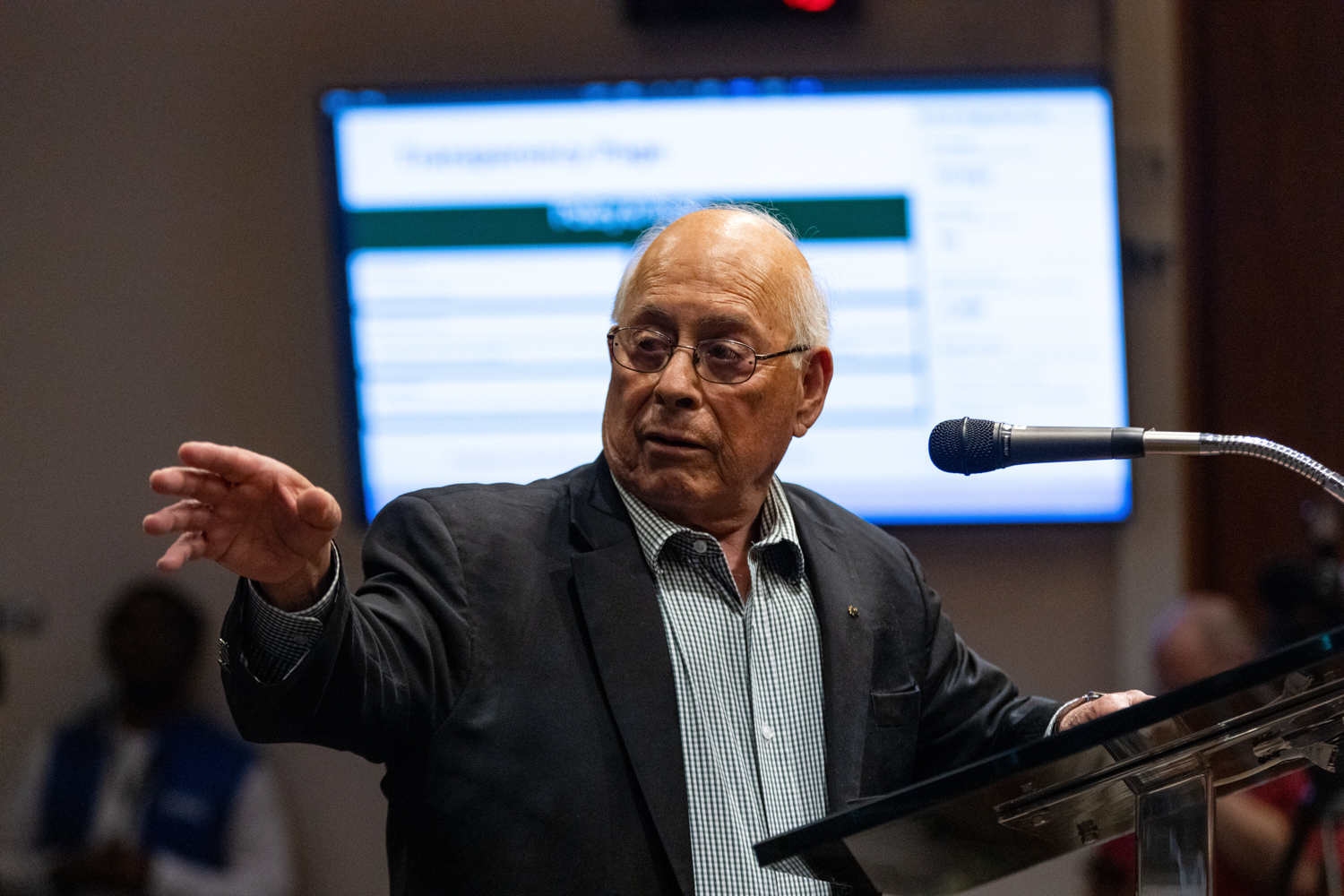
Nestor
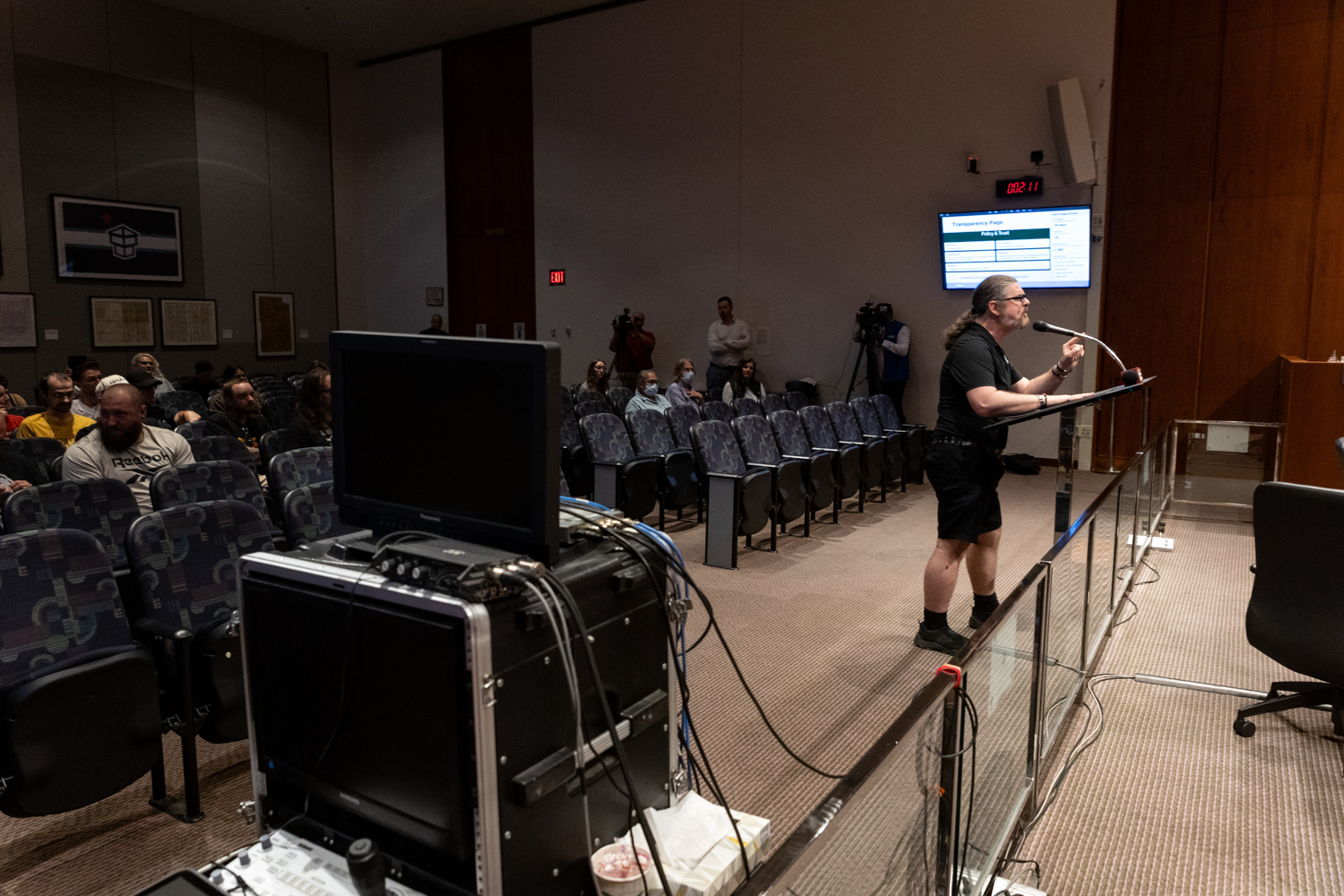
Perhaps the most fiery speaker in the public comment section, Nestor immediately said he was speaking against the Flock proposals, and chastised the council for forcing the public to wait two hours to give public comment.
“I’m offended at the way there is constant misrepresentation of the concerns…There is a federal government that is deciding what crime is,” he said.
“That quorum is saying that if you overstay a visa, if you look like an immigrant, we will hunt you down. We will break open your door without a warrant. We will throw you in the streets. We will throw you in incarceration without representation. We will move you across this country. We will torture you, and in some cases, we will murder you in the streets. That is happening. That is reality. That is not misinformation.”
Nestor accused the council of “handpick[ing]” the choices for government, misrepresenting concerns and ignoring constituents, and told the council they needed to do some deep “soul searching.”
After the heated rebuke, the room erupted in applause.
Pritchard
Following Nestor was a woman named Alison Pritchard who identified herself as part of APPS, Toledo’s advisory audit committee, and as a certified internal auditor.
“This is not a one-and-done activity. Strong governance requires regular, ongoing, and frequent controls and independent audits,” she said. “This is particularly critical for any schools that may be using this technology, given the risk to minors.”
Furthermore, Pritchard said as an auditor, vendor-developed filters or audits fall short of independent evaluations of the system.
Pritchard accused the council of shirking their responsibilities by potentially leaving communities open to risk.
Covarrubias
Belinda Covarrubias took to the podium, and introduced herself “as Hub Director of the Centro Hub, a member of APPS, and the proud daughter of immigrant parents.”
Immediately she cited O-095-26, the same ordinance referenced by Kuehn, and began to quote it. “No department employee, public official, or public servant of the City of Toledo shall use city monies, equipment, or personnel for the sole purpose of detecting or apprehending any person based on the person’s suspected immigrant status.”
When O-095-26 passed, it was done unanimously, and Covarrubias reminded the council of their promise to defend the people of Toledo. She pointed out that through the Flock system, 269 jurisdictions across 27 states have 287G agreements with ICE.
“You cannot put limits on data that you cannot hold,” Covarrubias said, and pointed to Dayton, Columbus and other Ohio areas who had stopped or paused using Flock because they could not control where the data went.
In light of the insecurity of the data, she urged Council to keep their promise, cease expanding Flock, pause the use of Flock and cancel contracts with “mass surveillance” companies.
Molina
Molina took the podium next, telling Hobbs it was offensive that he said the council didn’t have to hear from the public and then told Williams, “You don’t understand our plight. Our fathers with legitimate visas are being arrested, detained, deported by the local law enforcement in this city.”
“In March, we were grateful that the ordinance [O-095-26] passed. In May, we came back with concerns,” she said. “Please pause the Flock surveillance. Please conduct an audit. Just reassure us that that you’re not violating the ordinance.”
Molina referenced the 287G jurisdictions with access to TPD’s Flock data, and she referenced Cook’s admission during the panel that TPD is not able to audit outside organizations using the Flock audit tools. By putting these two pieces of information together, Molina concluded that an independent audit was necessary to reestablish trust, and assure her community that outside organizations were not using Flock against immigrants in Toledo.
She ended her time by opposing the expansion of Flock into D2, and said no schools publicly wanted to partner with the Flock expansion.
Rios
Anita Rios introduced herself as a lifelong Toledoan and addressed President Williams.
“I live in your district, Vanice,” she said, and shared that she lived a block away from where the Old West End Festival shooting took place earlier this year.
“I’m not safer in my house that I have lived in for 30 years. I’m not safer now because of those cameras,” Rios said. “Maybe if somebody kills me or shoots me, they’ll be able to catch the person, but I’ll still be dead.”
The longtime Toledoan called the Flock cameras “an illusion of a solution,” which received applause. “We live in the United States of America. That’s supposed to mean something,” she said and added that it means liberty and freedom.
Rios said to Councilman Hobbs, “You really didn’t have an option but to do this [hold public comment on Flock], and maybe you think you didn’t have to do this, but you did.” And then she reminded him that, “…it’s only meaningful that you sit in those positions if you listen to us as your constituents and you do the right thing.”
Daly-Masternak
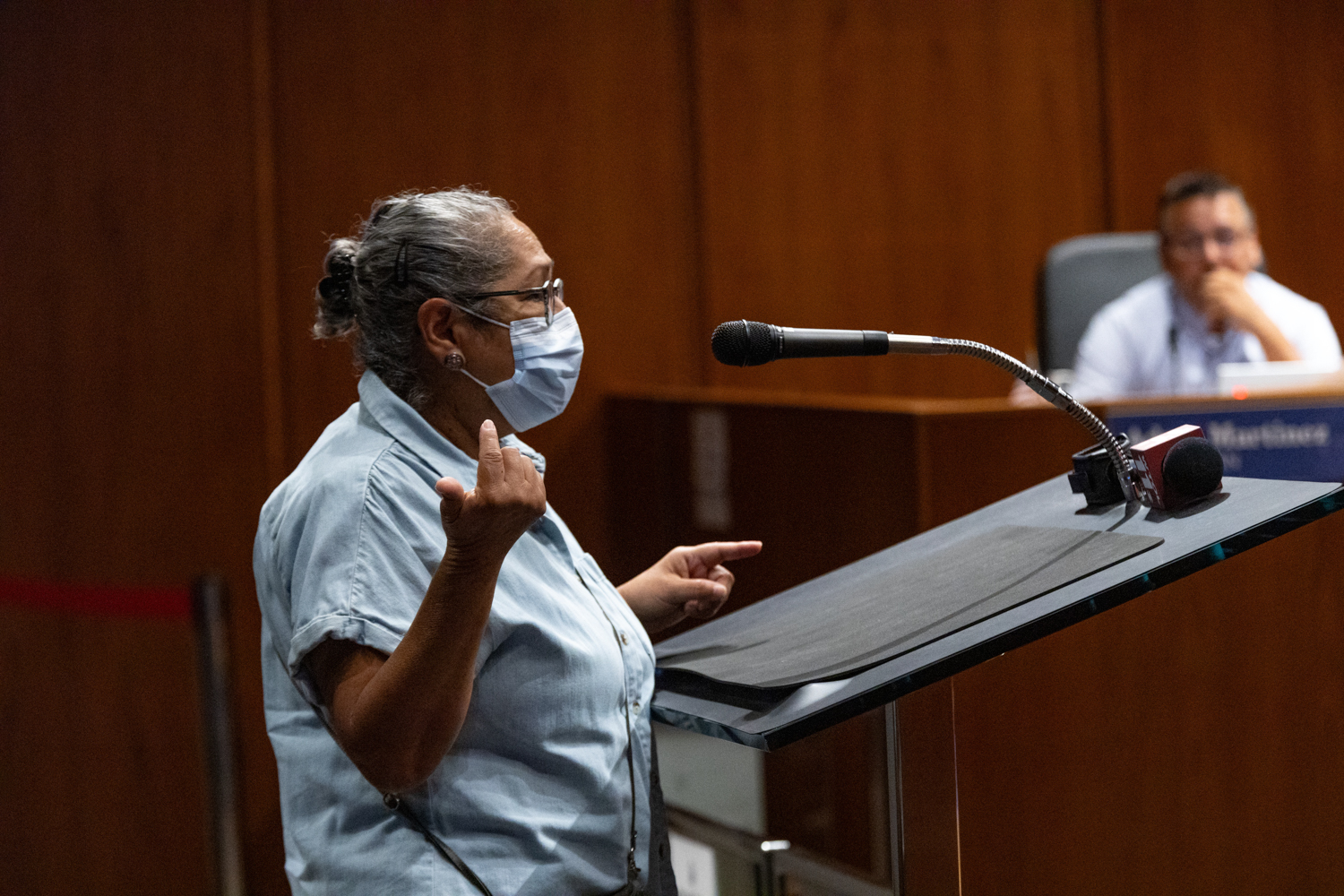
Railing against billionaires, and quoting George Orwell’s 1984, Peggy Daly-Masternak spoke of the prevalence of surveillance in the 21st century and how it has not made life safer.
“’It was terribly dangerous to let your thoughts wander when you were in any public place or within range of a telescreen. Big Brother is watching you,’” she read from the novel, and spoke about baby monitors, Alexa and Meta Glasses to drive home the point that surveillance is everywhere.
“Every one of these surveillances will likely be justified by someone,” and then she pointed to school shootings, porch pirates and retail theft to show the surveillance did not stop crime.
Daly-Masternak ended her time saying liberty dies by 1,000 cuts, not by one edict.
Gray
A young Oregon, Ohio resident with a degree in computer science and engineering, Austin Gray presented information on his community’s 11 Flock cameras.
“I’ve been conducting my own audit of Oregon,” he said. “I just wanted to come up here and say that today I submitted my own FOIA (Freedom of Information Act) request to the City of Toledo [which he had not heard back from]. Oregon got back to me in five days. That’s a lot better than 78 days.”
Over the course of a year, Gray said 8,515,574 searches had been performed by 5,036 different organizations across the cameras in Oregon.
Then Gray listed the top organizations that accessed those cameras. “The U.S. Postal Service is at number one at 39,000 [searches]. The FBI is at number two at 36,000 and ICE is at third with 3,700.”
“I really didn’t expect this,” he said, and offered to go over the data with any council members, even though they did not directly represent him as a resident of Oregon. He then thanked the council for letting him speak.
Gedert
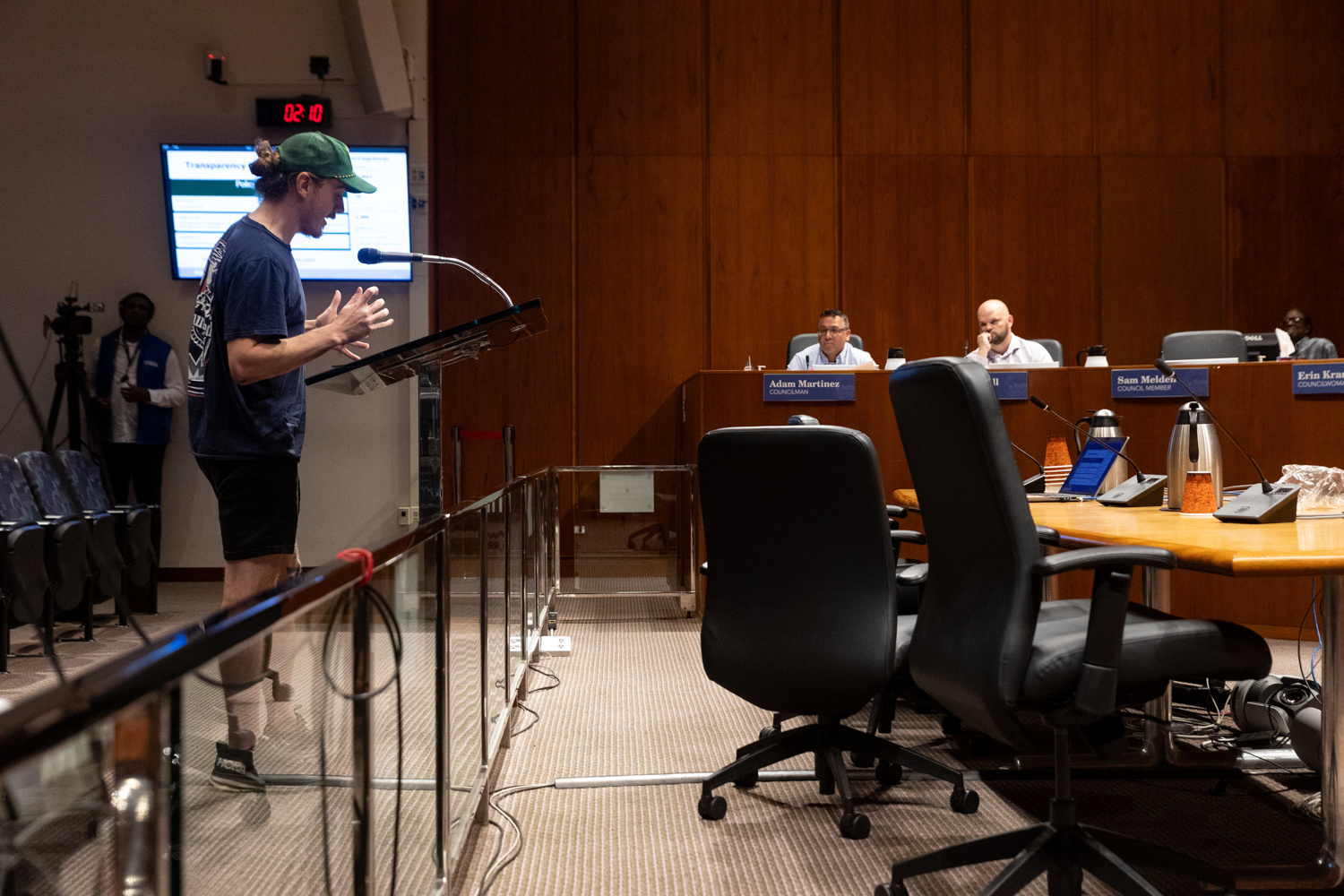
Toledo’s own food truck drag queen, David Gedert (Sugar Vermonte) said the first two hours of the meeting was Flock PR, and pointed out that Flock cameras have people tracking capabilities.
“Any system that can track or search by bumper sticker is a system that can track or search by belief,” he said.
Citing Supreme Court cases in support of privacy, Gedert listed off the years 1928, 1958, and 2021.
“Justice Brandeis said that the right to be left alone was the chief and most fundamental of American rights,” he said, referencing an article from Supreme Court Justice Louis Brandeis in 1890 and subsequently from a dissenting opinion from Brandeis on Olmstead v. United States (1928). The Supreme Court ruled in a 5-4 ruling that wiretapping did not violate the fourth and fifth amendment of the United States Constitution.
The 1958 court case Gedert referred to was when the court upheld in NAACP v. Alabama that the NAACP did not need to disclose its members list, and Gedert said what was happening then and now was tracking through association.
“The basic argument that I heard presented was ‘trust us,’ and let me say, I do trust you. I do trust law enforcement to solve crimes the old-fashioned way,” he said. “This was not voted on, and you do not have the consent of the governed.”
Gedert threatened a ballot initiative to stop Flock cameras if Council did not listen, and left the podium with a hair flip and applause.

Morris
Maurice Morris then addressed Judge Navarre.
“What she failed to mention – the United States Supreme Court has recognized the modern surveillance technology can create significant privacy concerns in Carpenter v. The United States,” he said, citing the 2018 case dealing with locating suspects by using cell phone tower data.
The court ruled police using cell phone location data violated the reasonable expectation of privacy.
“City council should take seriously the constitutionality and the privacy implications of creating a database capable of documenting people’s movement,” Morris said.
With the phrase “Search and Delete” Morris made his point. “You need a search warrant if you’re going to find out anything about me…If you delete anything in a database, we can find it.”
Identifying himself as someone with forensic training he said, “If you delete something, you can bring it back,” and called for safeguards and transparency surrounding Flock.
Moss
A young man from Scott Park, Gavin Moss, gave a short comment.
“There is a lot of really punchy anecdotes,” he said, and criticized the arguments for Flock. “There is no discernible evidence for any kind of reduction in crime caused by Flock cameras in any area.”
Then he said, “About 1/3 of the Flock cameras in LA [Los Angeles] have been false positives,” and called for an audit and data-based decisions to be made concerning the cameras.
Vullhorst
Louis Vullhorst, said, “I just want to say it doesn’t seem like there’s a clear vision for what the city council has in terms of what they want Flock to be.” Vullhorst was confused by the comments that Flock was purely ALPR tech, and about its proposed expansion into D2 schools.
“Do we want Flock purely as a license plate reader, or do we want Flock as a way to help in surveillance situations?” he asked.
“At the end of the day, Flock is a technology company,” he said. “What they really want is people’s information.”
“Information is the actually valuable thing,” Vullhorst said, and didn’t think of Flock as good or bad. “They just want money, and that’s how they’re going to make their money.”
Rosales
Moss’ roommate, Joe Rosales, said, “Personally, I would rather this whole Flock business be gone.”
“I don’t want every place I drive being tracked by any department across the country,” he said, and admitted that he thought there was a good chance the cameras would stay up.
If they stay up, he advocates for strong ongoing oversight.
Haynes
Michael Haynes was one of the few voices among the public commenters who wasn’t against the use of Flock. “I represent the Toledo Police Patrolmen’s Association. This will probably go over like a lead balloon, but I’m actually kind of split both ways,” he said.
Haynes said his police side was strongly for the Flock cameras as an effective tool to fight crime, but he said this was weighed against his conspiracy theorist side.
“Is this just another piece in the cog?” he asked, and then answered, “Yeah.”
With a waning number of police officers, Haynes mentioned the need for technology to fill the gap pragmatically.
“If we get rid of Flock cameras, essentially we’ll be blowing us back into the Stone Age as police officers,” he said, and mentioned that law enforcement has to catch up to the new criminal methods employed.
Addressing Council, Haynes asked them to do their job, and make sure the technology wasn’t abused, and then said, “My law enforcement side says the Flock cameras are very good, and we should keep them.”
Layman
The last speaker was Mandy Layman.
“I am a victim of crime,” she said. “Part of what keeps me protected from the people that harmed me is my privacy, my right to privacy.”
Layman grew up in Lucas County’s foster care system, and was penalized and judged for who she was throughout her life.
“If these cameras are invading people’s private lives, tell me, what is it that’s going to protect them from being penalized for minor things?” she asked, and then said she had a problem with sharing data between jurisdictions when officers do not have authority across jurisdictions.
An audit on Flock
At the next Toledo City Council meeting on Sept. 22, the council voted unanimously to perform an independent audit of the Flock system.
According to The Blade:
“Auditor John Rivalsky is independent of the city and works for Toledo City Council.
Some of the other items Mr. Rivalsky could review as authorized by the legislation include:
● Searches performed by city personnel.
● Searches of the city’s Flock network or data by outside agencies.
● Network-sharing arrangements and controls governing access by outside agencies.
● Data-retention requirements.
● Policies, procedures, training, and other requirements governing use of the technology.
● Controls designed to identify unauthorized or inappropriate use.
● Compliance with the city’s policies.”