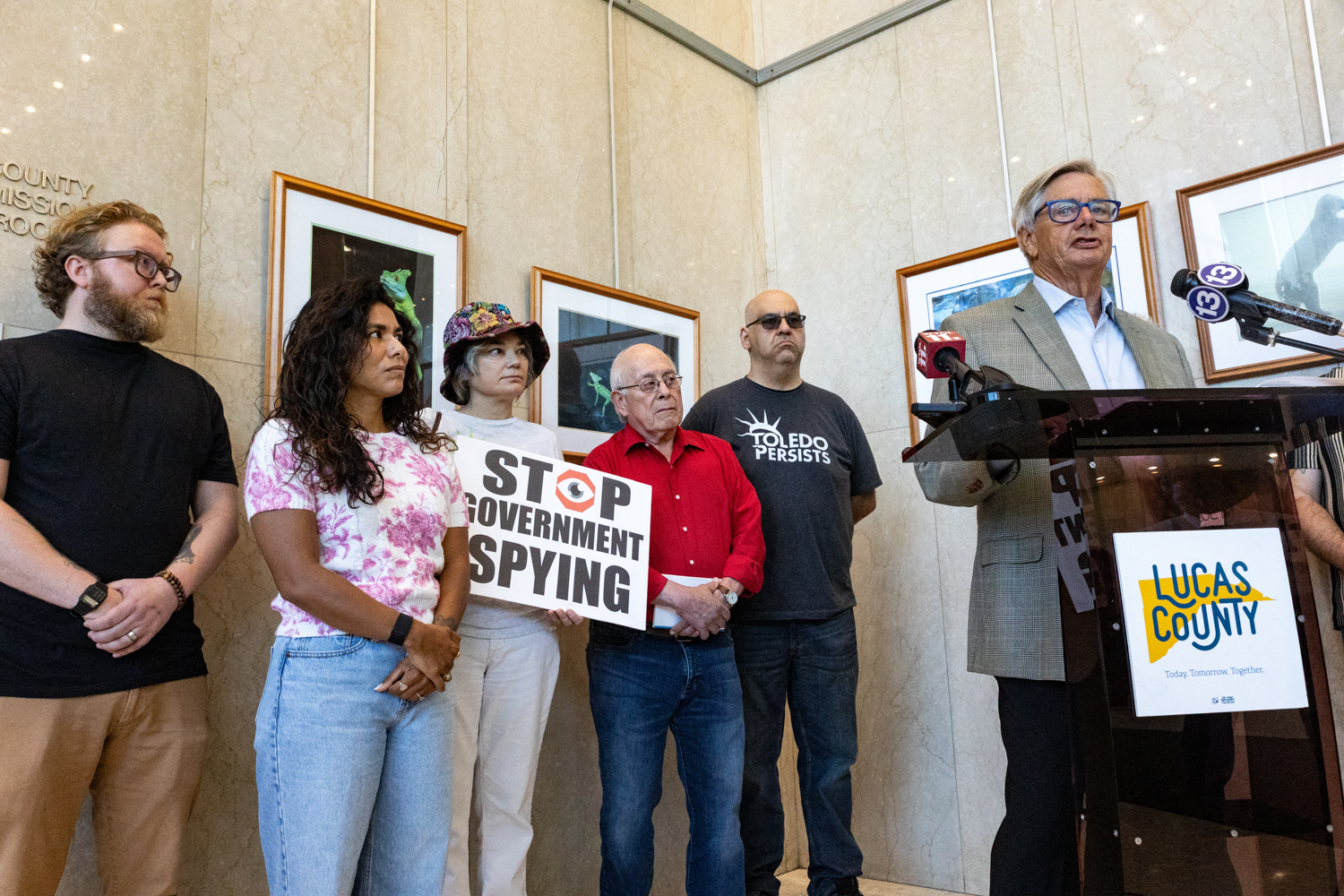
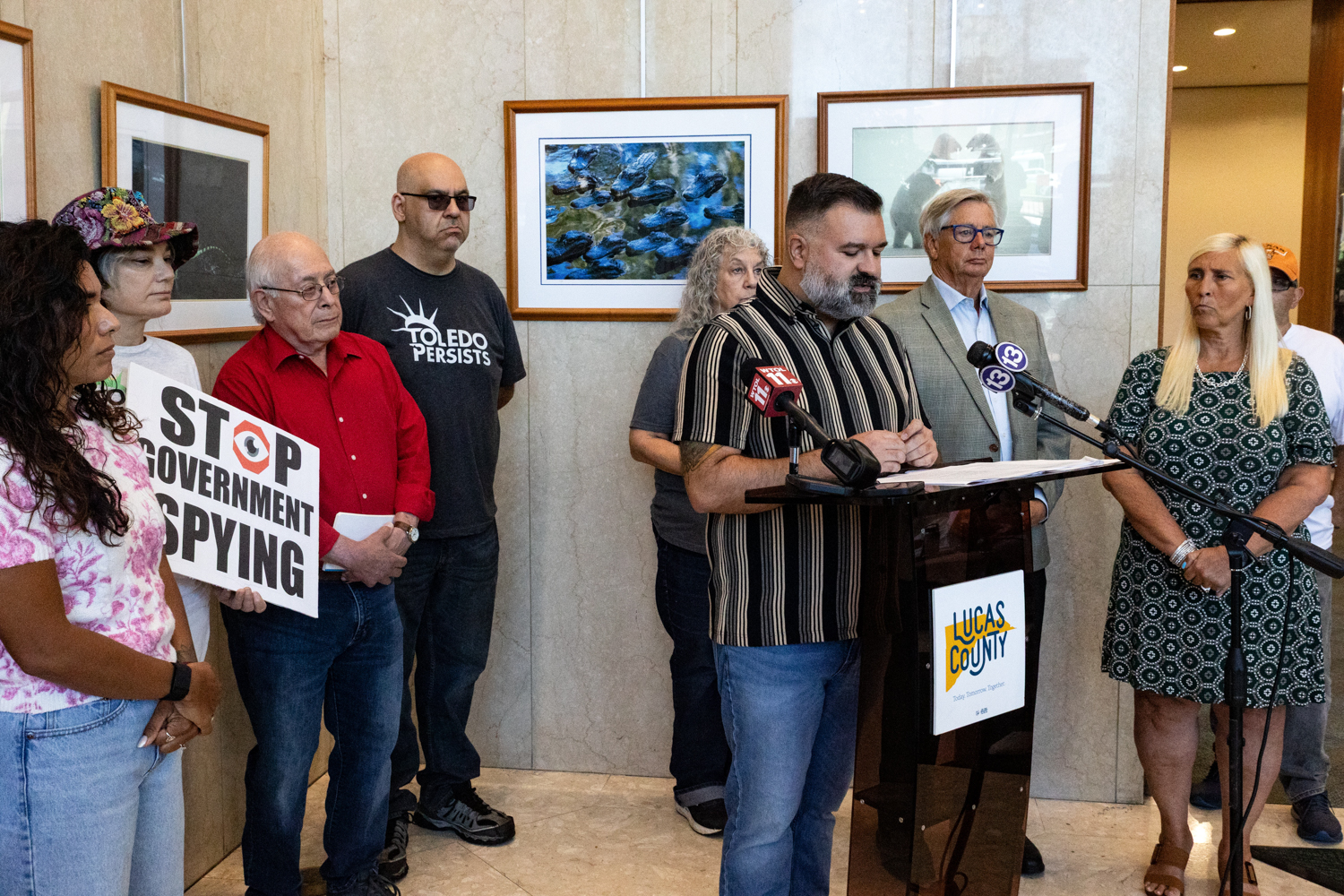
TOLEDO – Following a weekend where a total of five Automatic License Plate Reader (ALPR) cameras made by Flock Group, Inc. were vandalized between East Toledo and Oregon, Lucas County Commissioner Pete Gerken called a special press conference Tuesday morning asking for a pause on the use of Flock ALPR cameras and an audit of the data obtained by those cameras.
Call for audit/oversight on Flock
“I’m calling for an audit,” Gerken said. “I think an audit by an outside third party is fair. It’s reasonable. I will make no conclusions of what it might come to.
“I understand that Flock safety cameras can and should be used as a legitimate law enforcement tool…where it tends to cross the line into mass surveillance and how quickly we’ve done that without regulatory or control, that is what concerns me.”
With the use of national sharing, law enforcement entities across the country are able to share data obtained by Flock ALPR cameras, and Gerken drew attention to who had accessed Lucas County’s Flock data.
“These are communities outside of Toledo, outside of the state,” he said. “They’re searching for our data without explanation [about] why or what context that they’re looking for. That is troubling to me.”
According to a limited release of the sheriff’s Flock information from June 20, 2026 to July 20, 2026, Houston, Texas was the top law enforcement jurisdiction to access Lucas County’s Flock data, and they searched that data 71,389 times from June to July.
In total, Lucas County had 904,642 searches of its Flock ALPR camera data.
Columbus, Ohio searched Lucas County’s data 18,405 times, securing the number two position on the top 20, and the Federal Bureau of Investigation (FBI) made the third highest number of searches with 17,481 searches.
Toledo Police were ranked number 18 for number of searches of Lucas County’s system at 6,019 searches of the system.
Of the top 20 law enforcement entities that accessed Lucas County’s Flock data, only four were from organizations that operate inside of Ohio, the other 16 were from out of state entities, counting the FBI as an in-state operating entity.
Gerken’s main point was that there should be more oversight into who can gain access to Lucas County’s Flock data.

Sheriff weighs-in on Flock
Lucas County Sheriff Mike Navarre said this assessment was a fundamental misunderstanding of how the Flock system works.
“Houston is not accessing our data; Houston is accessing everyone’s data,” he said, explaining why they searched the data so many times. “Wouldn’t it make sense if you’re looking for a vehicle involved in a homicide that you’d want to search everywhere” instead of limiting the search parameters?
“That’s why our data is being accessed so many times, because we’re all part of the national database that Flock maintains. That’s the beauty of the system. That’s why it’s so effective. Because if you commit a crime in one state and flee to another state, this database is still going to track your movements, and we’re going to find you.”
Navarre said Lucas County searches the entire national database when looking to solve a crime. “When we put a plate in, we put it [the setting to] ‘All.’ That’s what everybody’s doing. There’s no reason not to.”
On the issue of privacy, Navarre said, “I could put a police officer on a street corner and take pictures with a camera of license plates. And they’re not breaking any law. That’s pretty much what Flock does, but it does it in mass scale. It would cost me millions of dollars to do what this Flock system is doing.”
When asked about the public unrest surrounding surveillance by Flock cameras, Navarre said, “I don’t quite understand it. I don’t think the average person knows what these Flock cameras are doing.”
“We’re not getting video. We’re not getting drivers. We’re not keeping data. We’re not selling data,” he said.
When asked about adding a safeguard like getting a warrant to access the Flock system, Navarre said, “This isn’t on private property. This isn’t in people’s houses. We’re not even doing private parking lots. We’re doing streets. These are cars on streets. When you choose to drive a vehicle down a public street with a license plate number, people have the right to look at the back of that car and memorize that license plate, or take a picture of it.”
When speaking to the Toledo Free Press, Navarre stressed the value of the Flock ALPR readers as effective tools for solving a wide breadth of crimes, from missing persons to high-profile murders, through the tracking of license plates across multiple areas.
In a public written statement, Navarre drew attention to the fact that Lucas County has a contract with Flock until 2029.
Flock as database
It is precisely the mass tracking of movements that makes certain politicians and community members uneasy about the Flock system.
“We’re not simply talking about a camera taking a picture. We’re talking about a database that can tell any person searching where your car has been, when you were there, and the forms and patterns to monitor your everyday movements,” said Nick Komives, Toledo City Council Member At-Large. “Flock is about surveillance, not just cameras. Being visible in public should not automatically mean permanently being tracked.
“The Constitution protects more than our right to avoid being arrested; it also protects our ability to live, associate, speak, worship, organize, and move through our community without unnecessary government surveillance.”
Concerns by those in opposition to Flock without restriction cited these following concerns in a “Policy White Paper” released at the press conference. Those concerns are:
- Mass collection and movement reconstruction
- False positives and dangerous escalation,
- Insider misuse and stalking
- Policy laundering across jurisdictions
- Immigration and reproductive-care enforcement
- Security and vendor-control risk
- Public-records and discovery risk
- Unequal burden and trust erosion
- Mission creep and vendor lock-in
- Roadside installation hazard
“Concerns over misuse of the Flock system is not just a ‘what-if’ anymore,” Komives said. “We now have evidence of how authorized users have abused the technology for their own personal gain,” he said, and cited three instances of police officers across the country using the Flock system to stalk women.
The sheriff admitted that with any system there are abuses of those systems, but that there’s no sense in throwing out a system because of “a few bad apples.”
“Officers have to log into the system, and if it’s used for improper reasons, it should be easy to track and find out who is doing that for the wrong reasons and discipline them,” he said.
Toledo City Council Member At-Large Erin Kramer spoke after Komives against the vandalism of government property through the destruction of Flock cameras, but acknowledged citizens’ concerns.
“I work for the citizens of Toledo, and I have heard them loud and clear that they do not want these cameras.”
Gerken and Navarre
During the conference, Gerken said getting the one-month audit of Flock data was “met with some obstruction” by Sheriff Navarre.
Reading from a document, Gerken said, “‘Disclosure of this information requested by Commissioner Gerken is prohibited by law.’ That wasn’t true. Very quickly, the county prosecutor intervened and told the sheriff that he could not shield this public data from the public under Ohio Revised Code Section 1.149.43.”
When Navarre was reached for comment, he told the story differently.
“That is not true. I got the prosecutor involved,” Navarre said. “I didn’t deny his request. The state of Ohio denied his request because they passed a law that says that that data is not a public record, and I can’t make exceptions for for elected officials.”
According to Navarre the point of contention surrounding the Flock log audits was the actual license plate numbers themselves.
When reached for comment, Steven Slivka, the public information officer for the Lucas County Prosecutor’s Office said, “The Lucas County Prosecutor’s Office did advise Sheriff Navarre and Commissioner Gerken that some, but not all, of the Flock data is a public record.”
When asked if Navarre would be open to a Flock data audit or an oversight committee, he said, “As long as it doesn’t violate the state law,” and as long as it doesn’t pause the Flock system while the audit is performed.
Policy proposal
In the Policy White Paper, Gerken recommended four options moving forward, with the top option, “A.” being to stop use of the Flock system altogether.
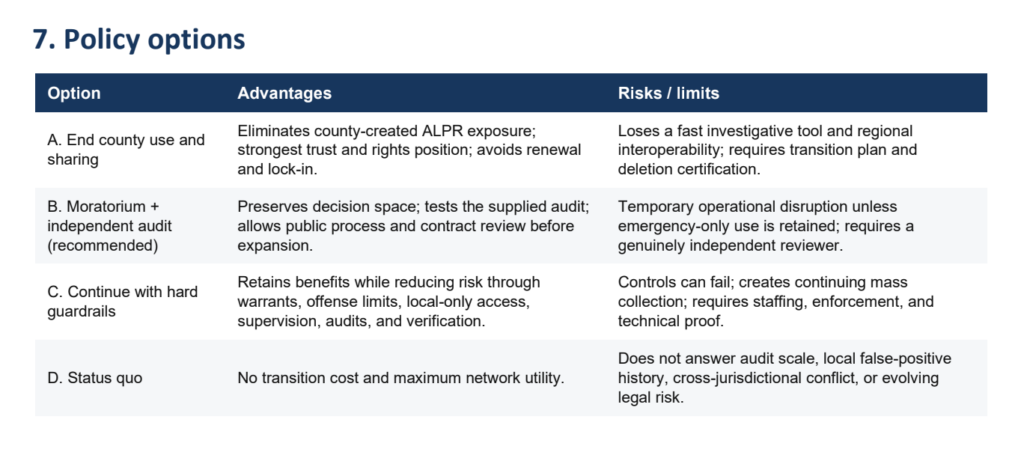
Here are the minimum conditions if any use continues directly pulled from the Policy White Paper:
• Limit searches to violent felonies, specified serious offenses, stolen vehicles, AMBER/Silver Alerts, and documented exigencies. Expressly prohibit immigration-only, reproductive-care, protest/First Amendment, civil, code-enforcement, and debt-collection uses.
• Require a valid case number, enumerated purpose selected from a closed list, user identity, supervisor approval for historical or out-of-jurisdiction queries, and a written jurisdictional nexus.
• Disable national lookup, federal access, and all one-to-one sharing by default. Approve exceptions individually through written agreements that impose Lucas County rules and audit rights.
• Require officers to visually compare the captured image, full plate, state, make/model/color, and current stolen/wanted record before a stop. An ALPR alert alone must never establish probable cause.
• Use the shortest technically feasible retention period. Require a warrant for historical movement searches beyond a narrow emergency window and for pattern-of-life analysis.
• Commission quarterly independent audits with public aggregate reporting: searches, users, purposes, outside agencies, hits, false alerts, stops, arrests, prosecutions, complaints, and policy violations.
• Provide automatic anomaly detection plus immediate suspension for repeated personal-name/plate searches, off-duty access, missing case numbers, prohibited reasons, and unusually high volume.
• Require county ownership of complete audit logs, immediate breach notice, vendor and subcontractor disclosure, deletion certification, litigation-hold procedures, cyber insurance, indemnification, and a no-training/no-secondary-use clause.
• Require public notice, hearing, camera-location criteria, civil-rights impact assessment, transportation-safety review, and commission approval before new cameras or capabilities.
• Adopt a fixed sunset date. Renewal must be based on independently verified outcomes and a fresh public vote, not automatic continuation.