TOLEDO – Toledo’s path towards revitalization has not been a straight line, and in the wake of the infamous Bitwise Industries’ fraud scheme, other leaders in Toledo have pivoted to make good on promises unkept to the city.
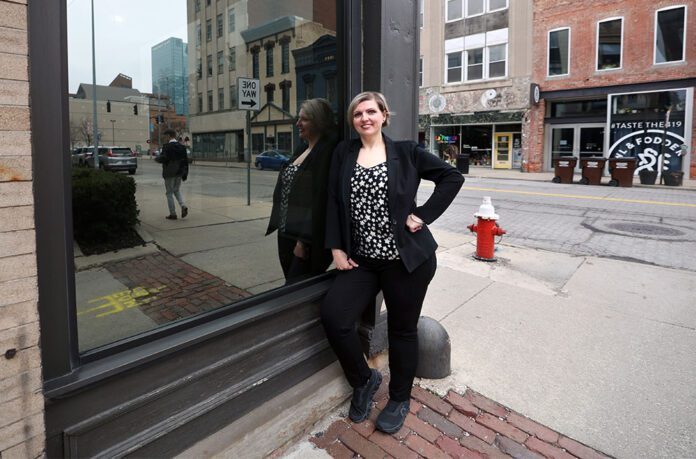
“My efforts right now are to get people on the sidewalks like we used to have, and I’m trying to get bodies down here and get energy and activity,” noted businessman David Ball.
“I own a lot of property down here,” he said, referring to downtown. “I bought my first building in downtown Toledo in 1985. This September 3 will be 40 years ago.”
Since the first acquisition Ball made in his 20s, he’s grown his real estate in downtown significantly, owning the Ohio Building, among others.
“I am from Toledo. I’m based in Toledo. I’m passionate about Toledo.”
Ball kept his plan to revitalize the city simple.
“There’s a few ways that I think make the most sense to do it. One is tech, because I think they’re [tech professionals are] creative people. And the other is the arts,” he said with a matter-of-fact confidence.
So, when Bitwise announced their $38 million investment to renovate the Jefferson Center to make Toledo a viable tech hub, Ball pitched in with his own money to create a makeshift office space for the company in one of his properties at 336 N. Superior Street.
“I spent a half a million bucks building that for Bitwise, knowing that when they leave, I would have great space that I would attempt to bring in a tech company to backfill the space and do something really good for downtown,” he said.
Unfortunately, Bitwise fell through, and the hope that the Fresno-based company would be able to energize Toledo towards a viable technology-based job market disappeared after the infamous scheme.
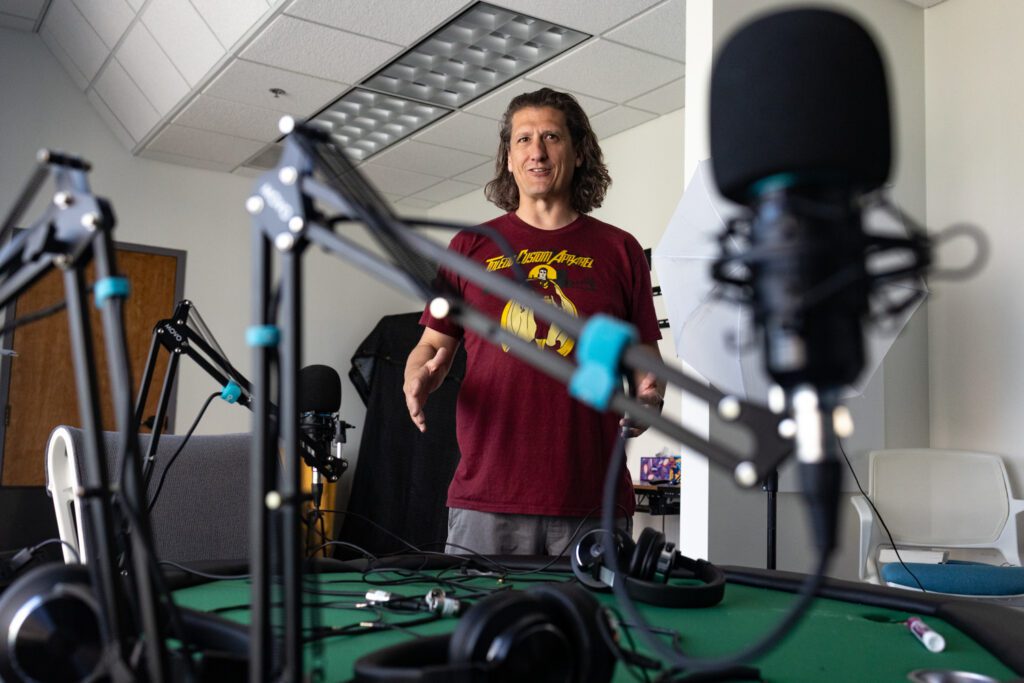
Before Bitwise was known in Toledo, “we were doing a thing called Code City,” said Chris Eischen, a local entrepreneur.
Code City began meeting at Rustbelt Coffee, at 119 N. Ontario Street, and ran from late 2016 up until the advent of the pandemic with, “bootcamps, intense immersives, workshops and TedTalk® style conferences that condense a wealth of information, tools and genius insight into a relatively short time span,” according to their Facebook page.
The URL CodeCity.Co, which appears on their branded videos and promos, no longer exists.
According to Eischen, “the pandemic kind of shut that down,” which can be corroborated by the online list of speakers. 2019 seemed to be a pretty active summer for the collaborative group, and Code City even posted in 2021 saying, “Still here. brb” without a continued response afterward.
Without an active tech-based, entrepreneurial community in Toledo, Eischen began to search for a way to cultivate a tech following of his own in Toledo, and he found an ally in Ball.
“He put a bunch of money into renovating the space for Bitwise, and really wanted to see it get utilized for that [tech],” said Eischen.
After Bitwise’s founders faced prison time for fraud, Eischen and Ball put together a plan for the downtown space, already curated for a tech company.
“He had kind of the same vision as I had for this building,” Ball said. “So after some conversation about it, I said, ‘All right, I’ll make you a deal. Let’s see if we can build some traction in the tech world in our downtown. And the commitment that I’ll make is: I will cover all the overhead and space and everything for one year.’”
November 1, 2024 was the official launch date for the new tech company, Toledo Tech Loft, with a soft launch in August. Ball agreed to pay the expenses for one year’s use of the space to get the Tech Loft off the ground.
“I made that commitment of about $300,000 to support the tech world, to see if we can get some traction; to get some bodies into downtown that are creative, smart people,” Ball said.
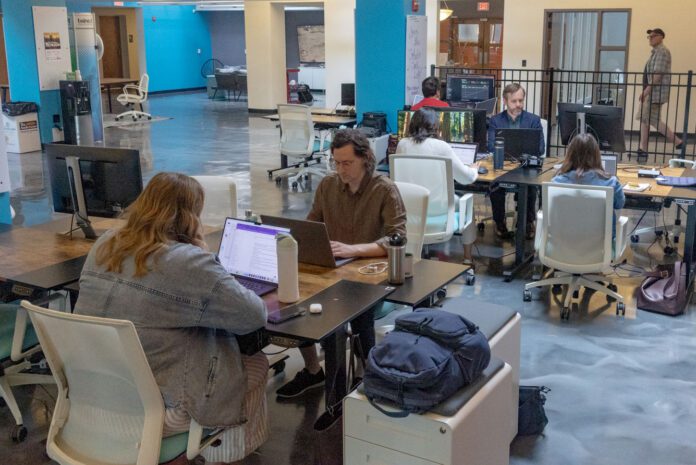
Today, the Loft has 40 members, with the largest buy-in coming from a local integrated marketing communications agency, Hanson Inc., who has their employees meetup at the Tech Loft once a week.

“We help clients with their web infrastructure creation, building management, taking care of their websites,” said Hanson founder and CEO Steve Hanson.
Hanson has used the Tech Loft as a hybrid remote working space since October 2024, but used to occupy 17,000 square feet of office space at the Tower on the Maumee.
Then the pandemic helped Hanson innovate. “We found out very quickly that remote was a very good way to work.”
But as people returned to the office, Hanson still wanted to offer a space to build company culture and relationships, settling on the Tech Loft, specifically for its location in downtown.
“Previously I didn’t have ‘real’ relationships,” said Ronni Gschwind, a new front-end developer for Hanson Inc., who said she didn’t have in-person interactions at her previous remote work job.
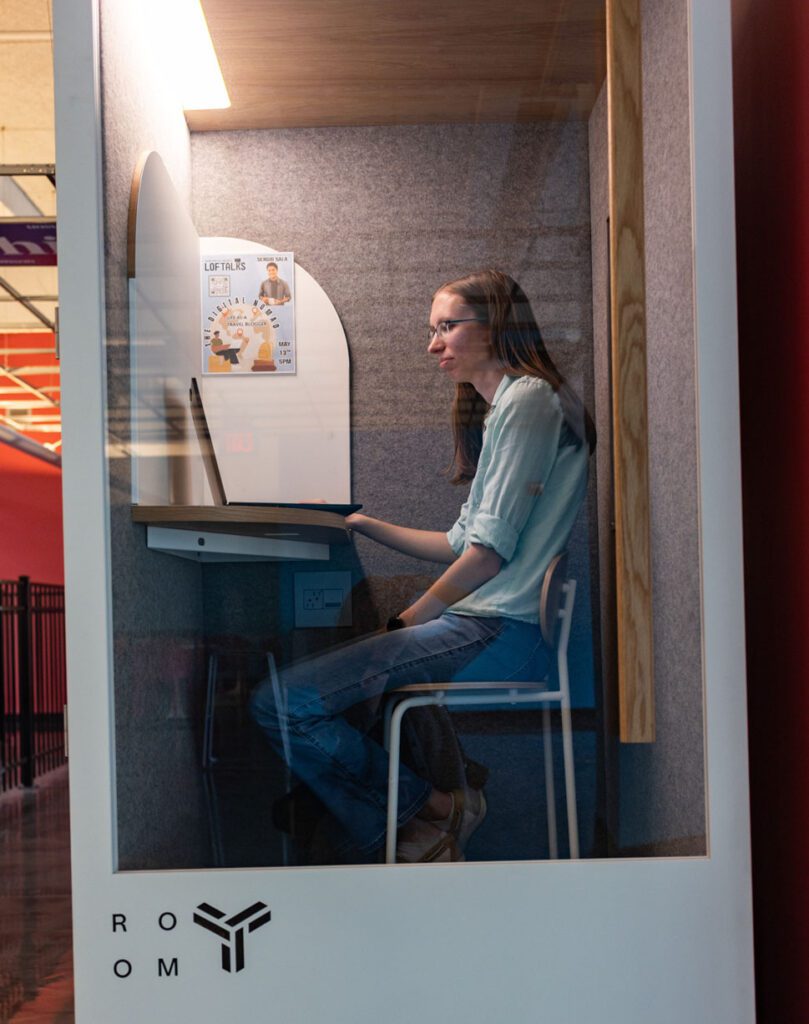
The hybrid work method set by Hanson, blending remote and in-person work, seemed to set a better rhythm for Gschwind.
“People actually cared a bit more,” than in a fully remote scenario, Gschwind said, and added that it’s been nice to go to lunch with her coworkers when they come in to work on Tuesdays.
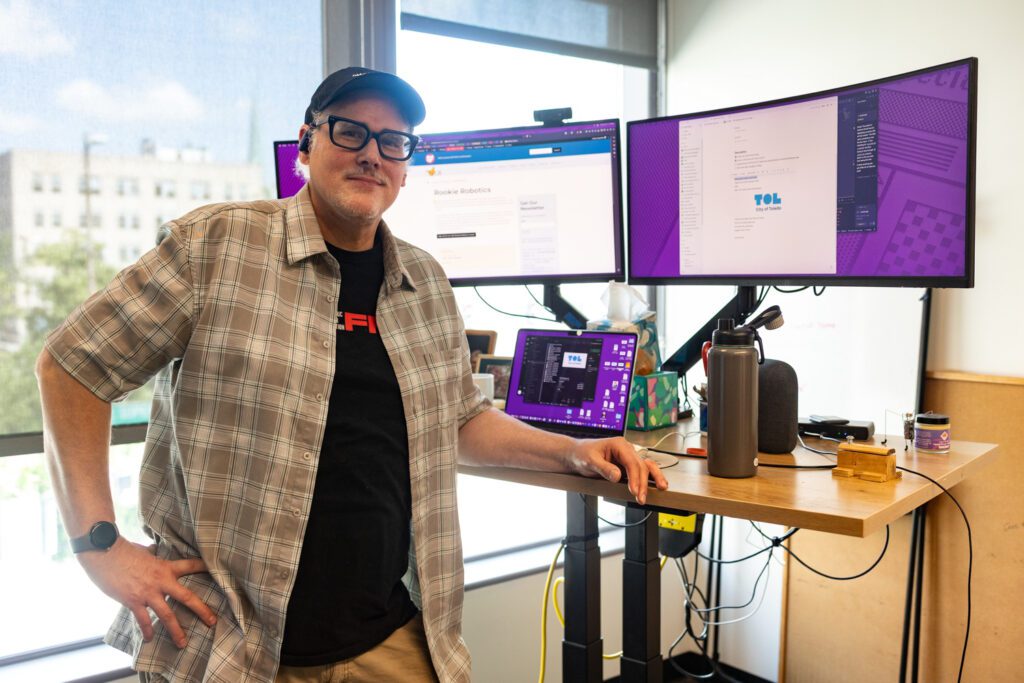
The Loft’s environment is set up for community, with board games on the side of the main room and an open floor layout.
Individuals and companies are invited to interact organically, and periodically Eischen invites speakers from multiple disciplines to present in the space.
A brief sampling of May in the Tech Loft featured a travel photographer, Sergio Sala, presenting his work, an esports tournament, and a comedian, Aaron Kozbial, performing in the space.
Bumping into people and ideas is an extremely crucial value to Eischen because he sees the interchanges as essential to innovation.
“When I would travel, I’d be in San Francisco, I could turn a corner and, boom, just start collaborating with somebody on something,” Eischen mused, but found the local tech market in Toledo hard to get going.
“When I was in Toledo, it felt like, you know, I’m searching for people,” he said.
There was not a natural ecosystem built into Toledo for creative tech entrepreneurs to meet or collaborate easily.
Experiences in tech
Crowdfunding of an inexpensive charging accessory called “Thingcharger” jumpstarted Eischen into the tech/online marketing space during the mid-2010s.
On thingcharger.com, Eischen’s position is listed as “Facebook Fiend” in service to boosting the hubbub on the simple product, eventually picked up by retailers.
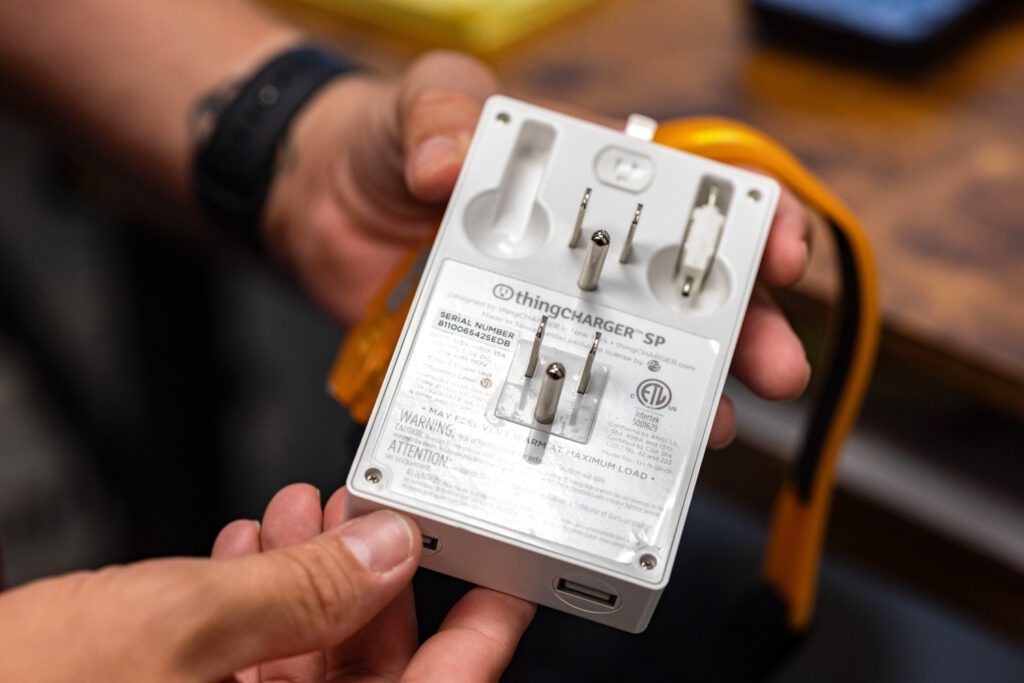
“It was sold at Bed Bath and Beyond and Sam’s Club,” Eischen said, but it’s easy to find listings on Walmart and other retailers for Thingcharger, as well.
After leaving Thingcharger, “I started working as a consultant on new project launches, and that’s where I got connected with Poo Pourri and Squatty Potty and the Crest Whitening Strips.
“Those were all new products that this company was launching digital campaigns for, and so I managed those digital campaign launches.”
During this time, Eischen said he was flown all around the U.S. to help companies with marketing or as a consultant, but said when he came to Toledo he was stymied in his hometown’s reluctance to adapt to changing standards.
“If I had to say it the simplest way, the Toledo region, this region of Ohio, is like four years behind what’s actually happening right now.”
Outside of Toledo, Eischen said he was rewarded and trusted for new ideas, “whereas what I dealt with here was, ‘This is how we do it.’”
For Eischen, pushback on new ideas came in the form of stiff structures, overly-monitored projections and a lack of breathing room to let plans develop.
“And it’s like, well, wait a minute. You’re tying my hands behind my back and then dictating how it’s supposed to go.”
Part of what Eischen hopes will come from the Tech Loft is an updated, forward thinking work culture.
“And I believe that if you can create some energy with these tech people that are kind of scattered all over, doing all their own little things … if we can put them all together and create some energy, I think we have the ability to bring tech companies into Toledo,” Ball said.
At present, the Tech Loft has a membership model, offering monthly student memberships for $50, standard memberships for $150 and 24-hour access to the space for $250 a month. Meanwhile, Eischen has been planning events, speakers and generally trying to get more people to populate the space.
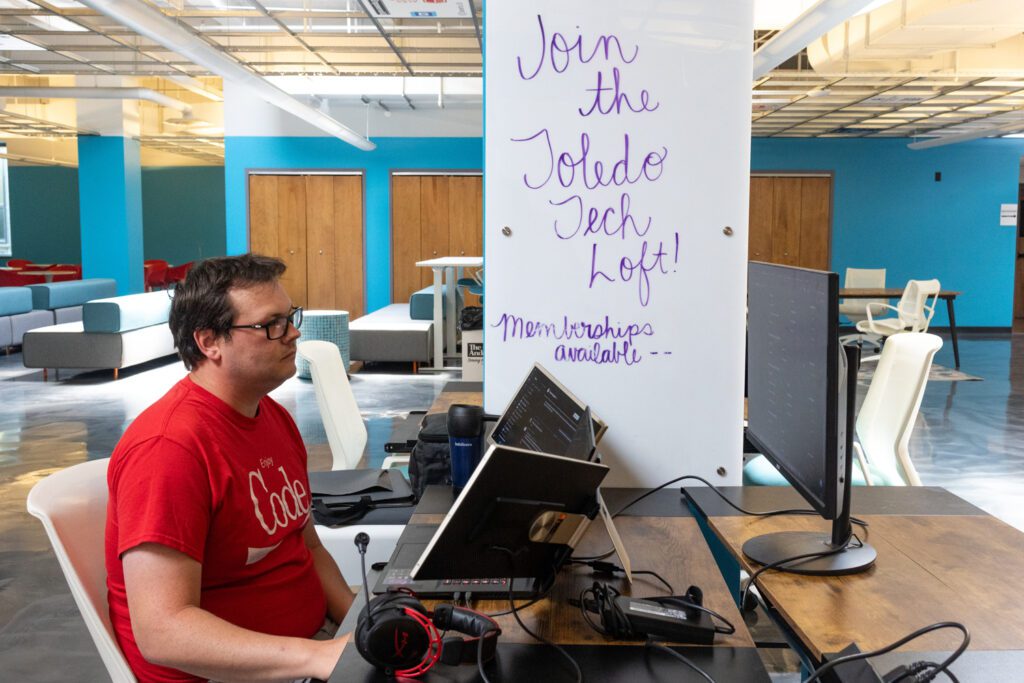
“We hosted some Capture the Flag cyber security events,” Eischen said. Buckeye Broadband supplied the internet, the University of Toledo supplied students and the Tech Loft supplied the space.
“In that collaboration of us all working together, we attracted this company looking at Toledo now to build a new center of operations around cybersecurity that would generate 200 new jobs in our region.”
Eischen and Ball wouldn’t speak to any specific company in the mix, but Ball corroborated Eischen’s claim about Toledo potentially getting some traction in cybersecurity.
“We already are having some really good conversations with some tech security companies from out of town that are considering Toledo as a as another location. I am already having those conversations with some significant people. Those things are already coming to the surface because of what we’re doing at the Tech Loft.”
In a couple months, August will see the end of the first subsidized year of the Tech Loft by Ball, who said he is still “all-in” on Toledo, “but at some point I got to have some help in supporting the financial side of this idea.”