LUCAS COUNTY – Measles cases in the United States have reached their highest level in several years. As of June 5, 2025, health officials have reported 1,168 cases, including three deaths. This is the largest outbreak in a single year since 2019. The Ohio Department of Health reported 34 cases in six Ohio counties on May 8.
So far, Lucas County has not reported a case of measles.
Since we have not seen much of the disease since the ’70s and ’80s, most people are unaware of how severe measles can be or the harm it can cause. This lack of awareness undermines the motivation to get family members vaccinated. It puts people at risk, especially children and those who aren’t vaccinated.
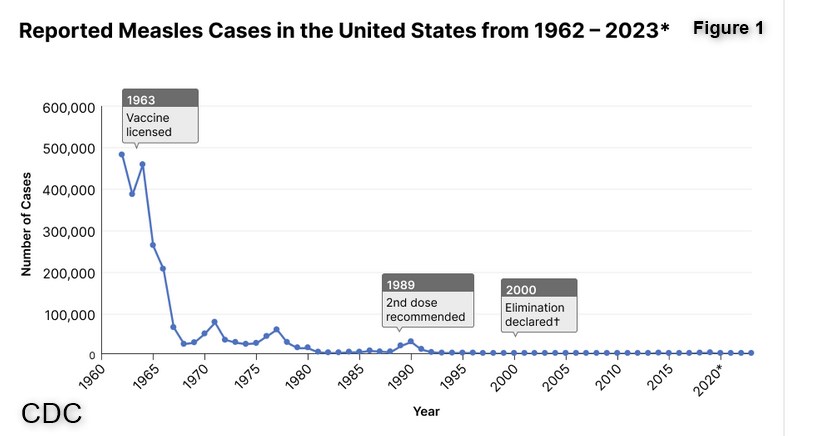
Before vaccine availability in 1963, most children in the U.S. got measles by age 15. Between 3 and 4 million people were infected annually during that time. Each year, about 400 to 500 people died from the disease, 48,000 people needed hospital care, and 1,000 developed encephalitis, according to the Centers for Disease Control and Prevention.

Dr. Lawrence Monger, Jr., medical director at the Toledo-Lucas County Health Department (TLCHD), said in a March 11 WTOL interview that “it absolutely is a serious virus. It’s highly contagious. It can stick around in a room two hours after someone has been there with measles. So, it can stick around for quite a while. It’s a virus and causes all the viral symptoms.
“After the virus takes hold, you start to develop bumps, measles and red bumps. You can get a lot of complications. You can get encephalitis, which is swelling of the brain. You can get pneumonia, infection of the lung. So, it attacks [the] immune system. It attacks the memory cells that help you remember how to fight other viruses, and it partially destroys them so you can develop all kinds of other infections post-measles. So, it can be deadly. And we’ve already had two deaths: one in New Mexico, one in Texas. It is a very deadly, highly contagious virus.”
So, getting measles is not a trivial issue, which is why the MMR (Measles, Mumps and Rubella) vaccine is so important. The American Medical Association, the American Academy of Pediatrics and the Centers for Disease Control strongly support young people getting vaccinated for measles. Figure 1 shows how effective the vaccine has been in getting rid of the disease – up until recently.
The CDC reports that 96 percent of recent measles cases occurred in unvaccinated individuals or whose vaccination status was unknown.
According to the CDC, children need two doses of MMR vaccine – one at 12-15 months and the second at 4-6 years of age. To be fully protected, older children and teenagers should receive two doses of the MMR vaccine, given at least 28 days apart.
Most adults only need a single dose of the MMR vaccine. Two doses are recommended for
adults who face a higher risk, such as college students, people traveling abroad, healthcare
workers, or anyone exposed to outbreaks. If a second dose is needed, it should be given no
sooner than 28 days after the first to ensure complete protection.
The MMR vaccine has been proven to be very effective and safe and for stopping measles. After a single dose, about 93 percent of people are safe from measles. Getting both recommended doses bumps that number up to around 97 percent.
Unfortunately, according to CDC data, between the 2019–2020 and 2023–2024 school years, MMR vaccination rates for kindergartners in the U.S. fell from 95.2 percent to 92.7 percent. This drop in coverage is important because it has led to the breakdown of herd immunity, which is necessary to prevent outbreaks.
According to the Cleveland Clinic, herd immunity means that when enough people in a group are immune to a disease—thanks to vaccines or having been sick before—the illness has a harder time spreading. Herd immunity helps protect everyone, even those who aren’t immune, because the disease finds it tough to move from person to person. Since measles is so contagious, a vaccination rate of 95 percent is preferred for herd immunity.
Many U.S. jurisdictions have seen measles (MMR) vaccination rates fall below the 95 percent threshold. The Shots 4 Tots program’s goal here in Lucas County is to increase the childhood immunization rate to 90 percent.
At a press briefing on March 18, Dr. Bruce Vanderhoff, director of the Ohio Department of Health, reported a decrease in MMR vaccination rates across Ohio. The percentage of
kindergartners who received the MMR vaccine dropped from 89.2 percent during the 2023-2024 academic year to 88.3 percent in the current school year.
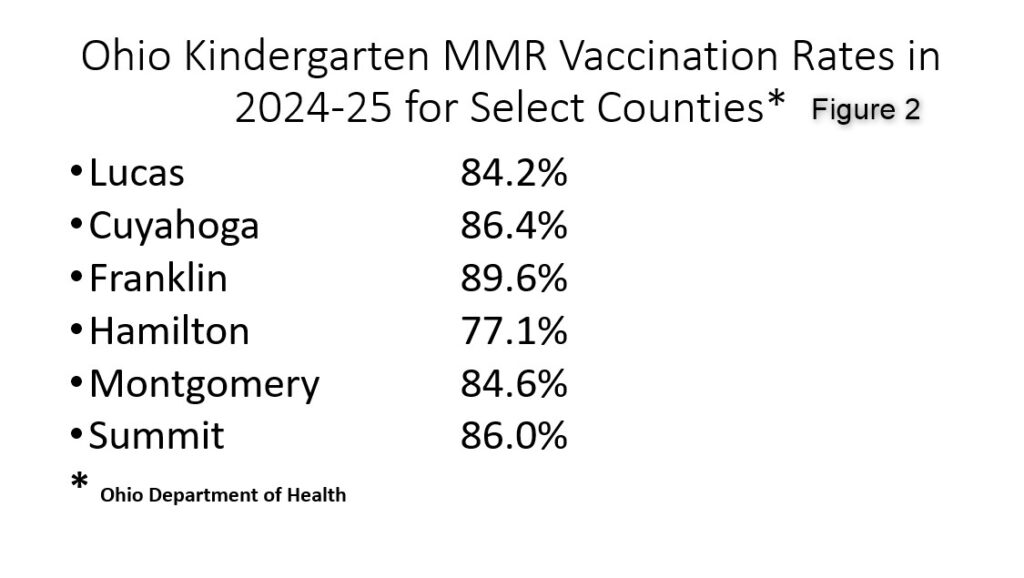
According to ODH, while several counties in the south and southeast are above 95 percent, many Ohio counties fall below 90 percent. (See Figure 2.)
This drop in immunization has been followed by a sharp rise in measles cases. In the first 16 weeks of 2025, the U.S. saw 800 reported measles cases—a 180 percent jump compared to all of 2024.
So, considering the seriousness of measles and the effectiveness of the vaccine, why have
vaccination rates gotten so low?

Angie Bauman MSN, RN, director of Nursing & Health Services at TLCHD, said, “I think there’s a lot of barriers, and it depends on things like how hard is it to get to the doctor’s office? It can start with, you know, do we have easy access? Do we have to take a bus to get to the doctor’s office to get our kids up to date on their vaccines? Do we have a provider that has got hours that are easy for us to work our schedules around? You know, just really basic social determinants of health factors that can impact whether or not
families get their children vaccinated.
“In addition to that,” she continued, “there are children who are immune compromised and aren’t able to get the vaccine for various health reasons. And then there are some people that have religious exemptions who prefer not to due to faith-based reasons. And then there are people who really just don’t have a trust in the vaccine and prefer not to have their children vaccinated. So, you know, we kind of have multiple barriers that can impact a family’s decision to vaccinate their children.”
Mary Apodaca, RN, a public health nurse with Shots4Tots, stated that “there’s a lot of
misinformation out there, and parents are bombarded with information from all different
sources, and they don’t know which to believe. So even some of our local doctors have a hard time getting parents to say yes to some of the vaccines.”
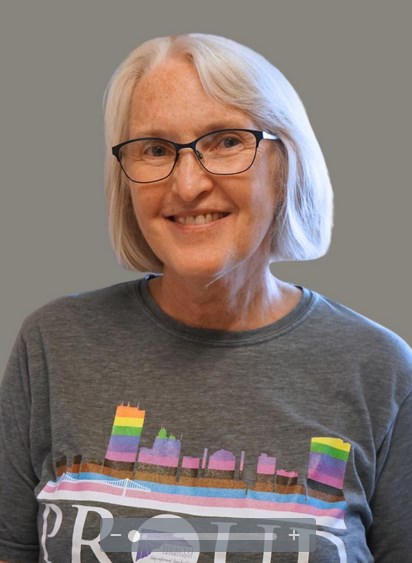
The staff at the Toledo Lucas County Health Department, through its Shots for Tots program, is working to get as many children vaccinated as possible.
Bauman emphasized the following points about vaccination delivery:
- If people have questions, they can talk to one of our nurses without making an
appointment. They can talk through their concerns and get good information from a
trusted, reliable source. - To get an MMR (measles, mumps, and rubella) vaccination at the Toledo Lucas County Health Department, schedule an appointment at 419-213-2013.
“We always focus on being easy to reach,” said Bauman. “That’s our top priority. If parents want to vaccinate their child but don’t have an appointment or can’t get to a doctor’s office,
they can come to us any day. Someone is always here to help. We see everyone, no matter their insurance or ability to pay.
“We try to make things even easier with late hours on Mondays and by holding clinics in
different places around town. We set up at local libraries, community centers and
YMCAs so people don’t have to travel far.
“When back-to-school time gets closer, we add more hours, bring in extra staff, and show
up in more locations. We want to be where families need us most. If you need a
schedule of our upcoming clinics, just ask,” Bauman said.