Roberto Torres, Toledo City Mayoral Candidate, speaks with Bill Hoag, a local businessman with properties in South Toledo, and Blair Johnson, a Toledo City Council candidate, after Toledo City Council tabled Ordinances 223-25, 224-25 and 225-25 at 1 Government Center outside of City Council Chambers in Toledo, Ohio on Tuesday June 3, 2025. (TFP photo by Stephen Zenner)
Over the past few months, I have been proud to work alongside residents and business owners of South Toledo, as well as Mayoral Candidate Roberto Torres and Former Mayor Carty Finkbeiner, to bring attention to the mining operation threatening our neighborhoods.
Thanks to the persistence of the community and a unified effort, Toledo City Council voted to stop the rezoning and shut it down. I want to thank Council for doing the right thing and listening to the people. Now it is time to restore the land and work toward a future that reflects what South Toledo truly needs.
I also commend Council for approving the contracts for our firefighters and police command officers. These men and women have served our city with dedication and deserved to be treated with fairness and respect. It is good to see that recognized.
Last week was a big week for Toledo. We stood up for our neighborhoods and showed our public safety workers that they matter. That is the kind of progress we need more of.
Pete Gerken, Lisa Sobecki and Anita Lopez, all Lucas County Commissioners during a Lucas County Commissioners’ meeting while they talk about a proposed new jail in their Hearing Room at 1 Government Center in Toledo, Ohio on Tuesday July 15, 2025. TOLEDO FREE PRESS/STEPHEN ZENNER
TOLEDO – Lucas County Commissioners resolved not to finance a new County Corrections Center on Tuesday, though Pete Gerken, Lucas County Commissioner, said it was something he had been pushing towards for the past decade.
“Today is heartbreaking for me,” he said, but added that “it is unwise, at this point, to incur 300 million dollars worth of debt in an uncertain economy where federal and state supports are being pulled away and being attacked.”
Pete Gerken, Lucas County Commissioner, speaks on the proposed new jail for Lucas County during a Lucas County Commissioners’ meeting. (TFP photo by Stephen Zenner)
The Lucas County Management and Budget Director, John Wenzlick, presented the new jail project for the commissioners to discuss, and said the new facility would cost $273 million. Wenzlick said $54 million on the jail could be paid with cash and grants up front, but $219 million of the project would have to be financed over 35 years. Lucas County would pay a $15.7 million every year for the next 35 years, for a total cost of somewhere around $549.5 million, if the current new plan for the correctional facility went through.
New Lucas County jail costs posted on a large television during a Lucas County Commissioners’ meeting in their Hearing Room at 1 Government Center in Toledo, Ohio on Tuesday July 15, 2025. (TFP photo by Stephen Zenner)
“One of the biggest challenges that we have is the impacts that the debt service for 35 years will incur on future generations and Lucas County as a whole,” said Jessica M. Ford, the county administrator. “This is the largest project that the county will undertake if we decide to move forward.”
Touting the savings a new jail would offer and lamenting the ills of continuing with the current facility downtown, Lisa Sobecki, Lucas County Commissioner, made convincing arguments for the new correctional facility.
Lisa Sobecki, Lucas County Commissioner, speaks about the proposed new jail during a Lucas County Commissioners’ meeting. (TFP photo by Stephen Zenner)
“Without a new facility, our sheriff will be unable to implement the best practices in inmate management that we all know are safer and more cost effective,” she said. “This facility is old. Its systems are failing, and we cannot continue to live along with Band-Aid solutions.”
Then Sobecki reminded those in attendance that the people who enter the jail could very well be innocent and guilty of no wrongdoing.
But ultimately, the financial mountain of debt the new project would potentially incur was too great for any of the commissioners to fully embrace.
“Right now, we’re operating in a deficit,” said Lucas County Commissioner Anita Lopez. “We are still operating in a deficit. So for us to again spend when our revenue is going flat and our population is decreasing, that means we’re going to have to make significant cuts.”
Anita Lopez, Lucas County Commissioner, speaks on the proposed new Jail for the county during a Lucas County Commissioners’ meeting. (TFP photo by Stephen Zenner)
“Cuts,” she elaborated, could be extended to county staff, and she anguished over the thought of letting go of county employees in this job market in order to build a jail.
After considering the matter, Sobecki said, “We can and we should do better with the current conditions in our pre-trial detention facilities. I’m going to ask…that we embark on a plan to assess what it will take to rehabilitate and look at the current jail that we have to make it better than what it is.”
Following the commissioners’ meeting, Gerken said he grieved not having a new jail, but resolved to work in the new direction of improving the current Lucas County Corrections facility.
Pete Gerken, Lucas County Commissioner, speaks to press after voting against funding a new jail during a Lucas County Commissioners’ meeting. Gerken expressed a desire for the new jail, but said it didn’t make financial sense to put forth $300M for a new jail at this time. (TFP photo by Stephen Zenner)Lucas County Commissioners honor Michael Veh, the senior project liaison for Lucas County, as he enter into retirement from his position at the county. (TFP photo by Stephen Zenner)Tom Kralovic, sanitary engineer for Lucas County, is honored by Lucas County Commissioners, as he retires from his position for the county. (TFP photo by Stephen Zenner)
Toledo City Council gets ready before a meeting in Toledo, Ohio on Tuesday July 15, 2025. TOLEDO FREE PRESS/STEPHEN ZENNER
TOLEDO – Following a brief summer break for Toledo City Council, representatives jumped back in on Tuesday, July 15, voting on ordinances 223-25, 224-25 and 225-25.
Controversy has surrounded these ordinances, which proposed the rezoning of areas west of Byrne Road and Airport Highway to general industrial. The past two times the ordinances came up for a vote, all three were tabled.
Rocky Ridge Development LLC proposed the rezoning back in May at the planning and zoning committee, but began to suffer backlash from the South Toledo neighborhood the proposed rezoning would affect.
Mayoral hopeful Roberto Torres initially made headlines for interrupting a Toledo City Council Agenda Review by presenting petitions from South Toledoans, and on Tuesday was able to celebrate a small win as all three ordinances were voted down.
Adam Martinez, Toledo City Council Member for District 2, asks his fellow council members to vote against ordinances 223-25, 224-25 and 225-25 during a Toledo City Council Meeting in Toledo, Ohio on Tuesday July 15, 2025. The ordinances dealt with rezoning areas to general industrial zoning near Angola Road, South Byrne Road and Airport Highway. (TFP photo by Stephen Zenner)
Before voting commenced, Toledo City Council representative for District 2, Adam Martinez, admonished his fellow council members to vote against all three ordinances.
“I would encourage all of my colleagues to vote this down,” he said, and was not disappointed.
Only two council members—Vanice Williams, District 4, and John Hobbs III, District 1— voted for ordinance 223-25, which proposed rezoning on 4004 Angola Road, where Rocky Ridge Development admitted it had begun mining without the proper zoning. And according to residents, the company had increased their mining activity in the months preceding the vote.
Williams was available for comment after the meeting. “I voted on the first one, because I wanted the project to be finished and cost effective and be done with it at the end of the year. Just getting it finished,” she said.
The City of Toledo had contracted with Rocky Ridge Development to dispose of spent lime, used in the water purification process.
The other two ordinances, which proposed an expansion to the mining were unanimously voted down. Williams said, “I don’t want them to expand; y’all causing too much trouble. Just finish it and get out the way.”
Jason McKown, a resident on Angola Road, is all smiles with his wife, Kelly McKown, after Toledo City Council voted down a group of three ordinances that would introduce general industrial zoning near their home. (TFP photo by Stephen Zenner)
Residents affected by the mining stepped outside of the council chambers to celebrate after the voting was finished on the three ordinances.
“We came in here thinking it would be held off again,” said Jason and Kelly McKown, two South Toledo residents.
“I think they finally listened to the residents. That we don’t want it [the mining development] in that area,” Kelly McKown said. “It’s not good for a residential area.”
Torres could be seen hugging affected citizens in the foyer of 1 Government Center.
Roberto Torres, a candidate for mayor of Toledo, congratulates residents of South Toledo after Toledo City Council voted down three ordinances allowing for general industrial zoning near residential housing. (TFP photo by Stephen Zenner)
When asked about the city council vote, Torres said he was excited for the community, and continued on to say, “I ran [for mayor], because in this city, it tends to be a politics that’s governed by the special interests.”
When Rocky Ridge Development went before the planning and zoning committee, they admitted to beginning mining as far back as 2021-2022.
Bill Hoag, who grew up near the area and owns property near the mining development, said he reported the mining to the city four years ago. “They were told right in the very beginning and still kept going,” he said.
Bill Hoag, who grew up in South Toledo and owns a number of properties near the areas up for rezoning, is relieved after Toledo City Council voted down three ordinances allowing for general industrial development near his hometown neighborhood during a meeting in Toledo, Ohio on Tuesday July 15, 2025. (TFP photo by Stephen Zenner)
“Why you letting them break the codes for three years? Who was telling them not to do anything?” Hoag said, and called for accountability. “It’s somebody in the city. Who told them it’s okay in the first place? Who allowed it [the mining] to go on without stopping it?”
WTOL reported that the FBI had been looking into the circumstances surrounding the mining near Angola Road for years without proper zoning.
“I think this was a well organized fight from the residents, and that’s what service is about,” Martinez said after the meeting.
Hoag mentioned an effort to find a different use for the land that escaped rezoning.
We’re actively involved right now as a group to try to find developers to step in to do something better with the area,” he said.
13 ABC reported the stop work order was posted on the 4004 Angola Road property Wednesday, which should stop the mining in the area.
The cast of Heathers sings “The Me Inside of Me." (Courtesy photo by Photo Dave Photography)
Riley Runnells weighs in on this month’s show at the Collingwood Arts Center
TOLEDO — There’s nothing like the flood of emotions when taking the stage and the curtain lifts for your opening night.
You’re jittery in full hair, makeup and costume, knowing that months of hard work have led to this moment. When the lights come up on the stage, you’re not only ready—you’re confident.
Only this time, instead of feeling the warm lights on your face and trying to block out the individual faces of the crowd, you’re one of those audience members. This time, you’ve spent months training your cast on choreography, so when the time comes for an audience, you can sit back, relax, and watch your friends shine.
This is the unusual thrill you get from working as a choreographer: your creativity, passion for the art, and love for teaching come to life on stage, all while you get to witness the excitement. My current experience choreographing Heathers: The Musicalwith Stone Productions.
The show itself follows Veronica, a high school loser who strikes up a popularity deal with Westerburg’s most popular divas, the Heathers. But when Veronica gets a sour taste from the so-called “sweet life,” and teams up with her boyfriend to teach the “populars” a lesson, her high school angst develops a body count.
What makes this show so special is that everyone can resonate with the story in some way, though not from the murders (I hope). Audiences will see themselves in the characters being bullied, the characters learning compassion, and the effort of these characters to work through their trauma, big or small.
Now, this isn’t my first rodeo as choreographer. I choreographed my first show (Seussical The Musical with Waterville Playshop) in April 2024, and since then have completed six total shows as choreographer. Heathers is my seventh, and it’s my third time choreographing a show for Stone Productions.
Heathers lead Maggie Titus (playing Veronica Sawyer) dances with the cast during “Dead Gay Son.” (Courtesy photo by Photo Dave Photography)
I’ve been grateful for all of my choreography experiences, but there’s something truly special about Heathers. Not only is it one of my favorite shows—my neighbors are seconds from filing a noise complaint thanks to my belting in the shower—but it’s also a choreographer’s dream. I went into this show equipped with a witty, biting, and overwhelmingly fun score, along with a cast full of Toledo’s finest community theatre staples to bring it to life.
Our director, Jaymes Gregory Mull, and assistant director, Lizzie Schmitz, had their work cut out for them with the staging and vision for this iconic show. Our music director, Ben Tittl, dealt with intense, advanced harmonies and was tasked with whipping our cast into shape vocally. Our crew, lead by Stage Manager Brad Arps, had to find ways to construct croquet mallets, fake guns and bombs, and a torturous high school scenery, all while keeping the scene changes short and sweet.
As for me? I’m the lucky one on the production team. My role never felt like a job; it only ever felt like a privilege. Bringing to life iconic numbers like the Heathers’ battle cry, “Candy Store,” and the nostalgic teen party anthem, “Big Fun” was nothing short of a gift. I pulled influences from the original Winona Ryder flick, paid homage to the original West End cast version, and studied the characters and their relationships to create the most authentic picture possible.
I could drone on and on about the gratification I receive seeing my own vision come to life. After almost seven shows, it never ceases to amaze me that what I envisioned in my head and wrote down in the notes app of my iPhone (I’m a professional, what can I say) turns out as incredible as it does on stage.
This is all thanks to our Toledo talent: the cast of Heathers. I am forever in awe of the way they study the choreography, take to the material, and always find the fun in the process— even after I’ve drilled them on the same section for the 40th time, it’s 10 p.m. and there’s no air conditioning, so we are all drenched in sweat. Dancing in this show brings them joy, and I couldn’t be more grateful and proud.
So when we talk about the flood of emotions from opening night? For me, every emotion falls to the wayside save for one: pride. I am so proud of this team for the work we’ve done and the production we’ve put together—and you will be, too.
Heathers: The Musical runs at the Collingwood Arts Center July 18, 19 and 26 at 8 p.m., and July 27 at 3 p.m. This production, though featuring teen characters, has adult themes, so viewer discretion is advised.
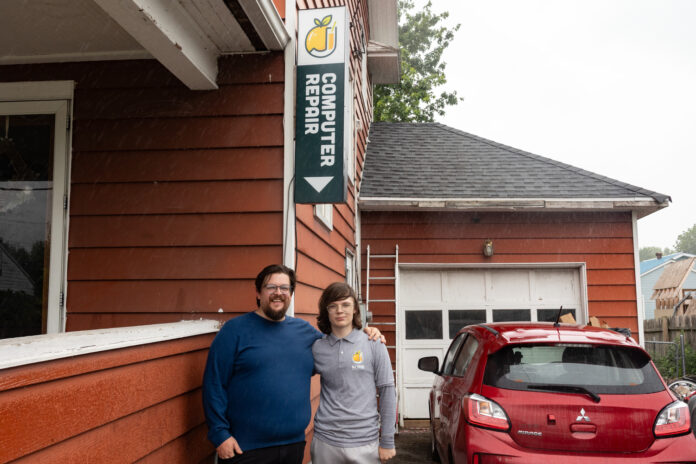
Jeremy Schroeder with his son Ollie Schroeder, 14, outside their home where Ollie Schroeder works on computers out of the basement of the house in Weston, Ohio on July 7, 2025. TOLEDO FREE PRESS/STEPHEN ZENNER
WESTON — Basement and garage startups are baked into the mythology of the tech industry, and one such basement in Weston, Ohio has been loaned to 14-year-old Ollie Schroeder.
Ollie Schroeder, 14, stands behind his main desk in his father’s basement, where he runs OJ Tech in Weston, Ohio on July 7, 2025. TOLEDO FREE PRESS/STEPHEN ZENNER
Jeremy Schroeder, Ollie’s father, made a deal with his son.
“Hey, you get the basement completely cleaned out, and we’ll build some benches down there,” Jeremy said, alluding to making a space to work on computers.
Shortly after making the deal, Jeremy said his son “had that sucker cleaned out and all of the tech stuff moved down there.”
A server rack, some tools and a logo later, the father-son duo launched OJ Tech— where the “O” stands for Ollie and the “J” for Jeremy.
Against the rural normalities of Weston, the OJ logo, an orange overlapped with a glass of orange juice, hangs off the side of the red home with the words “Computer Repair” falling vertically below it.
Out front, Jeremy Schroeder’s nephew rides a bicycle in the street, while Ollie Schroeder pulls apart a computer a few feet underground.
Let’s get to work
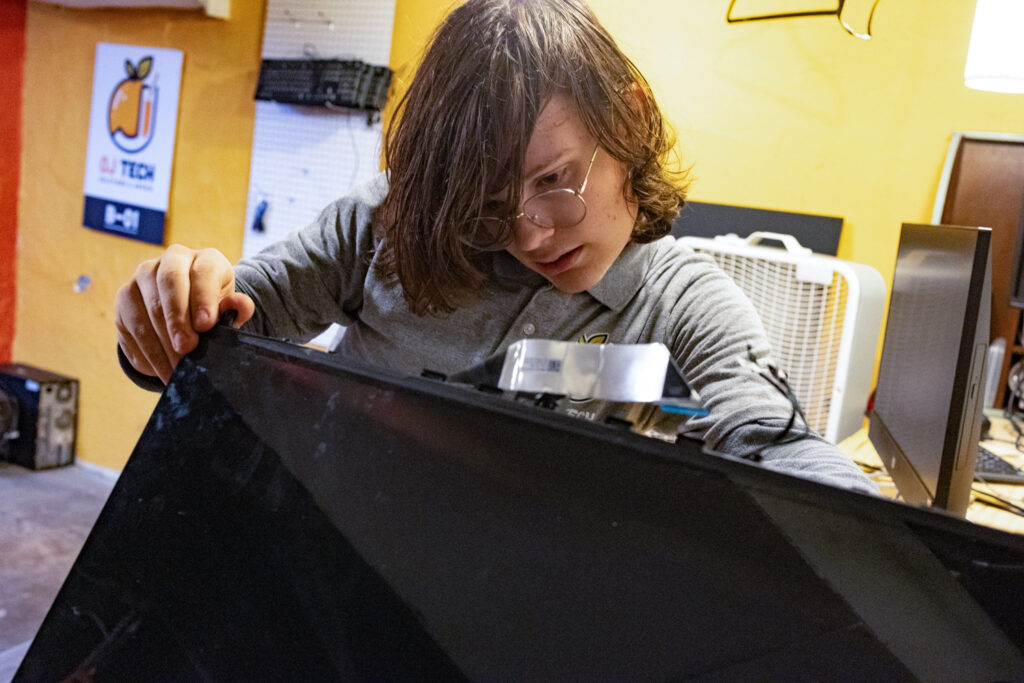
In less than 30 seconds the 14-year-old dismantled a computer, showed the machine’s insides.
Ollie Schroeder, 14, disassembles a computer in the Schroeder household basement where he runs OJ Tech. TOLEDO FREE PRESS/STEPHEN ZENNER
“I was replacing the bad SSD [Solid State Drive],” Ollie Schroeder said. “One [hard drive] just went bad, and so I just replaced it and installed a new operating system of Windows.”
This fall, Ollie Schroeder will enter high school as a freshman, but with a working knowledge of Windows, Mac and Linux operating systems.
Software is his dad’s side of things, where Jeremy works full-time as a web developer for MadAveGroup, but Ollie likes to blaze his own path on the hardware side of tech.
When people come to Ollie he said it’s usually a simple hardware issue people are afraid of fixing themselves. Converting hard drives to solid state drives, a basic backup maneuver improving speed and resilience of the data, is what Ollie said he gets the most requests for.
Ollie Schroeder, 14, disassembles a computer in the basement. TOLEDO FREE PRESS/STEPHEN ZENNER
“It’s pretty much just like adult Legos,” Ollie said. “Because everything has a specific place, and everything goes in one place, like building an actual desktop computer. Super easy.”
Connecting computers
More challenging for Ollie’s inquisitive mind was managing servers.
In the OJ basement, behind the workspace desk and next to the sump pump, a metal rack holds information accessible to the outside world, two gaming servers for Minecraft, a router and a few data host servers the father and son made functional.
Ollie Schroeder, 14, points to his oldest server on his server rack in his father’s basement. TOLEDO FREE PRESS/STEPHEN ZENNER
Much of the technology a layman might struggle understanding was bought used from GovDeals, a website that sells old government surplus items, including computers, parts and servers.
A sticker reading “Indiana Family & Social Services Administration,” still is attached to a hard drive in the basement, indicating its origins.
Jeremy Schroeder simplified the website as “Ebay for governments,” and these used parts were enough for Jeremy and his son to cobble together a workable network.
“When you go toOJTech.net [the company website] this is literally talking to that computer right there,” Jeremy Schroeder said, pointing to one of the boxes in the server rack.
Processing chips the father/son duo uses to run their servers.Much of the equipment Jeremy Schroeder and his son Ollie Schroeder, 14, use are items bought from government auctions.
Honing skill
For now, Ollie Schroeder is just following his curiosity and making a quick buck here or there.
“Last year, we did like $5,000,” his father said, and mentioned they had done some work for Monnette’s Market for their deli queue system this year. Because of that work, Jeremy Schroeder said they might do around $15,000 this year, which is a good start for the teenager who already has a good handle on what he might want to do in the future.
Multiple hard drives on the server rack in the basement of the Schroeder household. TOLEDO FREE PRESS/STEPHEN ZENNER
On the docket for the almost high-schooler is making a 10gb ethernet.
This next school season, Ollie will begin his studies at PENTA Career Center, studying IT. He then plans on going to Owens Community College, followed by a bachelor’s degree in IT or server maintenance at the University of Cincinnati.
Learn more about the father son duo on their website and Facebook page.
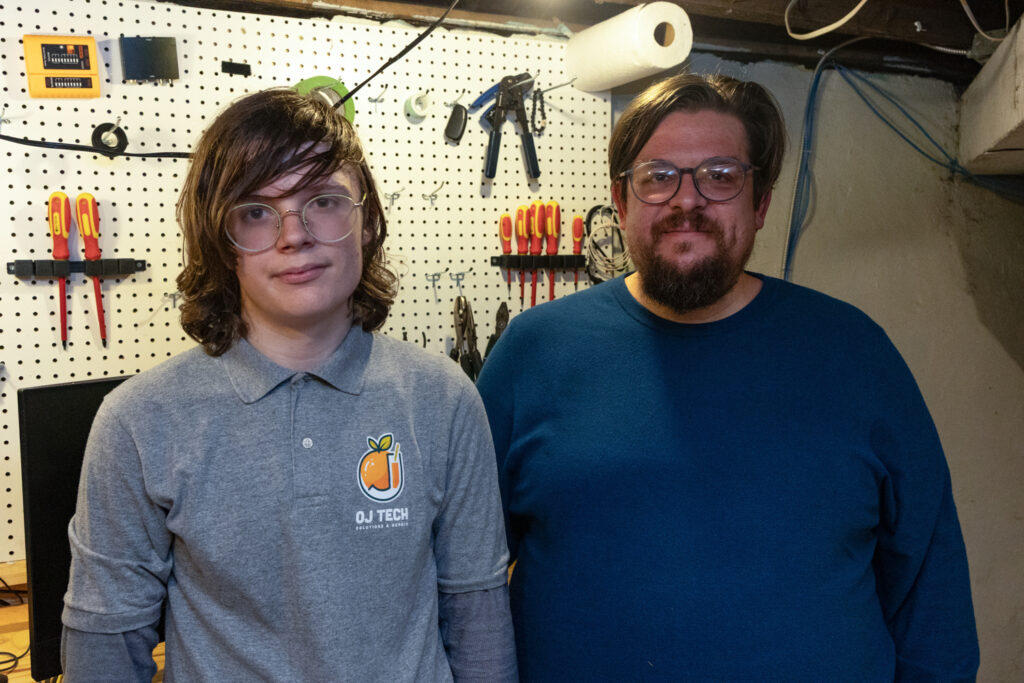
Ollie Schroeder, 14, with his father Jeremy Schroeder in their tech workshop for their company, OJ Tech, in Weston, Ohio on July 7, 2025. TOLEDO FREE PRESS/STEPHEN ZENNERBusiness card for Ollie Schroeder, the owner of OJ Tech, in his father’s basement. TOLEDO FREE PRESS/STEPHEN ZENNER
The mayor of the City of Toledo is complicit regarding every illegal activity Rocky Ridge is committing, whether he acknowledges it or not.
Rocky Ridge continues to ruin the environment and the lives of its residential neighbors with its overweight trucks spewing diesel exhaust, dust, dirt, oil and debris while dumping whatever/wherever they want. Digging and dumping who knows how much or what possible toxic chemicals and heavy metals…
No city permits. No proper zoning. No restrictions. Completely decimating acres of perfectly good farmland.
All of this should be halted immediately.
Every five minutes, Rocky Ridge continues to have free rein as each dump truck rumbles in to gather or dump without any oversight. What’s buried there? No one will say exactly, while toxic contamination on the land and local water sources are inevitable.
There is no question that Rocky Ridge has been given a green light by the weak leadership of Toledo City Council, and a silently snoozing mayor who has no regard for Toledo residents who are at their wits end.
Camilo Villa, lead negotiator of SEIU Local 1, listens to Local 1 member Tanya Staples as she declares her support for the union's efforts to fight for better pay. (TFP Photo/Lori King)
TOLEDO — As negotiations continue between SEIU Local 1 and janitorial contractors, workers throughout Toledo say they’re scraping by while adhering to their duties of keeping essential buildings clean.
The Toledo Master Janitorial Agreement, which covers about 400 janitors, expires today, July 14. Camilo Villa, lead negotiator of SEIU Local 1, says that a new contract is being negotiated, with talks of an extension.
Camilo Villa, lead negotiator of SEIU Local 1, explains why the union is fighting for better pay. (TFP Photo/Lori King)
The SEIU Local 1 unites 50,000 workers across the Midwest, including five states and 10 cities. These workers include janitors, security officers, school service workers and more.
Local 1 began in Chicago in the early 1920s by residential maintenance workers with the goal of maintaining high labor standards for property service workers everywhere.
Tanya Staples, a Local 1 member who works at ProMedica’s Wildwood facility, said her current wages barely cover necessities. Staples has more than 25 years of experience in janitorial work – four years at ProMedica – and earns just under $15 an hour.
“I love my job,” Staples told the Toledo Free Press. “I give them my number one, but it’s sad because even with my number one I’m making pennies. My check sometimes makes me want to cry. I don’t even buy a full dozen of eggs.”
Local 1 member Tanya Staples explains her financial situation and why she supports the union. (TFP Photo/Lori King)
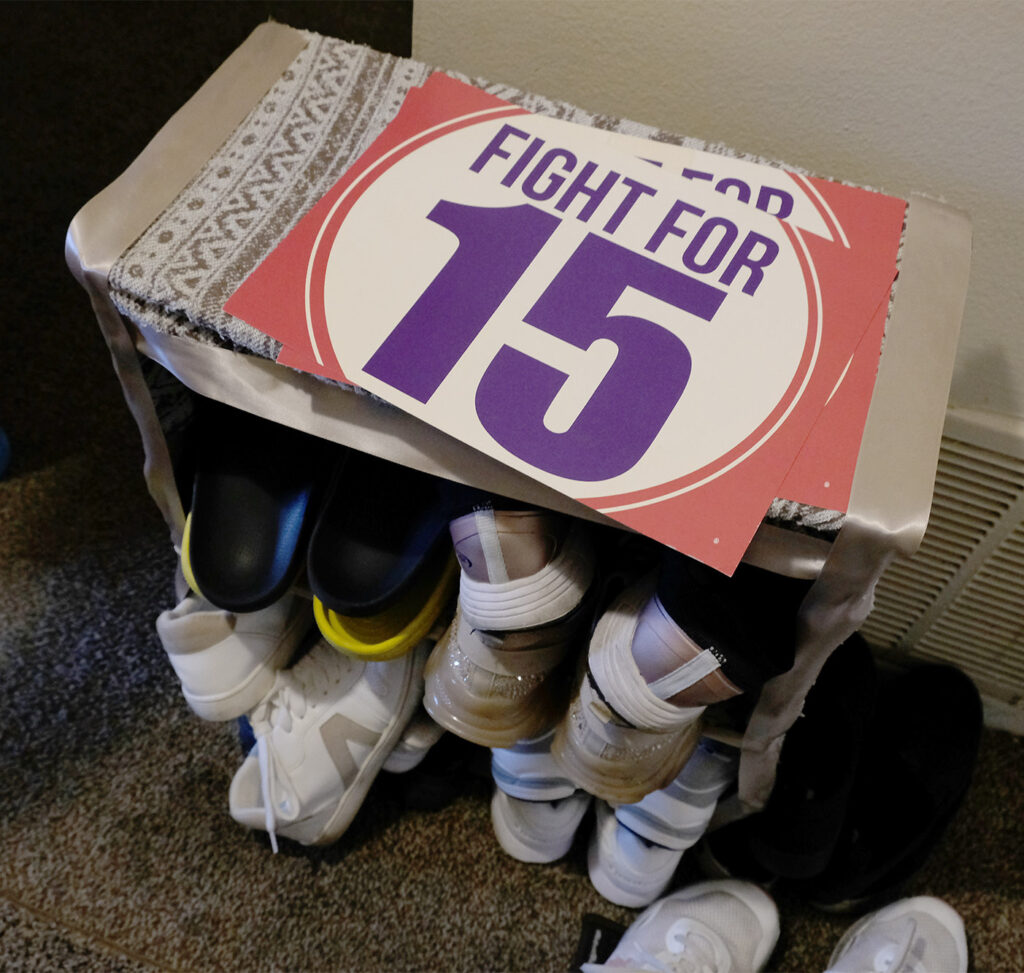
A Fight for 15 sign sits on a shoe stand inside the Toledo home of Tanya Staples. (TFP Photo/Lori King)
Union organizers are pushing for a $15 minimum wage as a baseline, though that figure still falls short in today’s economy.
“We know these institutions have the resources to pay the janitors a living wage,” Villa said about ProMedica. “They are not only very successful; they also receive a lot of public assistance for various things.”
For a workforce that is predominantly Black, the union is also hoping for the recognition of culturally significant holidays, specifically Juneteenth and Martin Luther King Jr. Day.
“Juneteenth represents the end of enslavement of black Americans,” Villa said. “If you’re making $13.75 or $14.90 trying to survive, you’re not really free, right? The symbols matter when we’re talking about the dignity of our members, and it’s tricky because often the buildings don’t close for those days, but they close for the Fourth of July.”
Staples disclosed she wanted to wear a Juneteenth shirt to work one day but didn’t for fear of offending coworkers and patients. “There’s no Black doctors, no Black nurses,” she said. “I didn’t want to offend anybody.”
Michael Evans, a janitor who works the evening shift at Owens Community College, cleans buildings from 6 p.m. to 2:30 a.m. Monday through Friday. He transports supplies across campus in his own vehicle, without mileage reimbursement. He makes $13.90 per hour.
“You better have some gas,” Evans said.
Dana Sammour, lead negotiator of SEIU Local 1, represents Michael Evans, a janitor who works the evening shift at Owens Community College. (TFP Photo/Lori King)
Local 1 member Michael Evans talks about pay inequity, and how he uses his own vehicle to transport supplies across campus without mileage reimbursement.(TFP Photo/Lori King)
Evans, a single father who’s recovering from a surgery he had in June, said he provides for his daughter by working nights.
“She gets off at five and I try to get her,” Evans said. “I get her to my mom and then go in at 6. It’s just that I’m trying to keep her hair done, clothes, shoes, everything else to go along with that, and the financial end is really rough sometimes.”
Although working in schools and hospitals can make janitors like Evans and Staples more prone to illnesses, janitors like Evans can’t afford to get sick.
“You don’t even get your one paid sick day until you’ve completed your first year,” said Dana Sammour, SEIU Local 1 internal organizer and grievance representative. That’s the case for Evans, who has over 20 years of work experience in the janitorial field.
Amidst the struggles, Evans says he loves the work itself — especially when it comes to creating squeaky-clean floors.
“My work reflects who I am, what I am, what I do, and how I do it,” he said. “When you look at that floor, that floor represents me because it has a heck of a shine on it. I want you to wear sunglasses walking down that hallway because I want that floor to blind you, and if I was waxing the floor you’re gonna need hand rails because you’re gonna think it’s wet.”
He recalled restoring a classroom floor at a medical college that hadn’t been touched in 23 years. He was awarded by the hospital for his effort.
With all the hard work janitors like Evans and Staples put in, they say they still face unwanted stigma in the workplace.
“I always find that over the years I’ve done this job, they always treat the janitors like a lower class of people, unfortunately,” Sammour said. “If something comes up missing from the building, the first person they’ll suspect is the janitor.”
Under the current structure, wages vary by location and client contract, Sammour noted. While some members of the SEIU Local 1 make more than other janitors, they still need to be paid the minimum pay of the contract. The average remains below $15 an hour. Former employees from previous contractors may retain seniority and higher pay rates when accounts are taken over, but newer hires often start at the base.
The union’s next negotiation session is scheduled for July 22. Leaders, including Villa and Sammour, say they hope to finish contract talks, but will extend talks further if needed.
“Our members across the country and here have fought for a long time to get what they deserve,” Villa said. “There’s urgency — but also patience. We want to get this right.”
More information about the SEIU Local 1 can be found on their website.
Camilo Villa, lead negotiator of SEIU Local 1, left, and Dana Sammour, SEIU Local 1 internal organizer and grievance representative, talk about the contract and negotiation plans. (TFP Photo/Lori King)
A blue dasher, photographed at Oak Openings Preserve by Metroparks Toledo. (Photo by Art Weber)
NORTHWEST OHIO — Dragonflies are out and about these days. Zipping, dipping and darting, performing high-speed maneuvers, feasting on thousands of insect pests — especially mosquitoes.
Look for them in flight or on open perches where they can scan and locate prey, all while monitoring other dragonflies entering their territory.
Thousands of species of dragonflies are known worldwide; 164 have been recorded in Ohio. Look for them in and around the typically still or slow-moving waters where most of them and their aquatic larva feed — often on mosquito larva. They’ll emerge to shed larva skin and take flight as adults.
The adults often sport beautiful iridescent colors and have great names to go with them. There are dashers, dancers and darters. Skimmers, pondhawks, cruisers, forktails, pennants and gliders. And then there are meadowhawks. Great names for well-adapted predators.