
Julie Inkster, Karrie Webb to compete at Greater Toledo Classic in July

SYLVANIA – The Greater Toledo Classic Hosted by Stacy Lewis announced the commitment of two of the most celebrated names in women’s golf – Julie Inkster and Karrie Webb.
These World Golf Hall of Fame members will compete in the reformatted event, set to take place July 21–27 at the Highland Meadows Golf Club.
The Greater Toledo Classic, which celebrated its 40th anniversary in 2024, enters a new era this year by combining the Legends of the LPGA and the Epson Tour in a one-of-a-kind dual-tournament format, featuring 42 LPGA Legends and 102 Epson Tour players.

“Having Julie and Karrie in the lineup is a tremendous honor and a true celebration of the legacy of women’s golf,” said Judd Silverman, tournament director of the Greater Toledo Classic.
“They started their careers playing in Toledo, and now they’ll do it again alongside the next generation.”
Inkster, a seven-time major champion, is a beloved ambassador for women’s golf. Webb captured eight major titles during her Hall of Fame career. She is one of Australia’s greatest athletes with over 130 professional wins worldwide.
Their commitment reinforces Toledo’s place as a beloved stop for legends of the game.
Building on a proud legacy of giving back, this year’s tournament continues its deep commitment to the community, having already raised over $14.3 million to support more than 200 local children’s charities.
Ticket information is available at ToledoClassic.com.

CCNO board keeps immigration contract
DEFIANCE – Rev. Dr. TK Barger, of First Unitarian Church of Toledo, made a case for the spiritual side against the Correction Center of Northwest Ohio’s (CCNO) contract to house federal immigration detainees.
“Jesus and the Buddha did not stay in their childhood homes to perform their ministry,” he told the regional jail’s board at its meeting on Wednesday. “They were immigrants.”
The response to his plea – and that of three others who spoke at the facility’s board meeting – was disappointing, he said.

“It was no way a conversation or a dialogue; it was simply ‘Let’s get this over with.’”
The board voted down a motion to cancel the contract and steamrolled a secondary proposal to alter it.
Melissa Portala is a self-described activist from Toledo. She said she understands why the board approved the contract in February, based on the federal government’s statements that they would round up and deport violent criminals.
But now there is no excuse for letting the contract continue, she said.
“I can only hope they are surprised that they’re not seeing gang members, rapists and criminals – that they’re seeing day-laborers and gardeners and restaurant workers,” she said. “People that are part of the fabric of our everyday lives are being basically kidnapped off the street and imprisoned there.”
She was the first to address the board during the public comments at the beginning of the meeting.
“Now that you know that many of these innocent people are being sent to notorious foreign prison camps without due process, do you regret your vote?” she asked the board.
Evidently, they don’t.
CCNO, located in Stryker, which is about 62 miles west of Toledo, is overseen by representatives from Defiance, Fulton, Henry, Lucas and Williams counties. It includes one sheriff and one county commissioner from each county. These counties jointly fund its operations.

After the public comments, Lucas County commissioner and CCNO board member Pete Gerken motioned to cancel the contract within 90 days.
The vote was 6-2 against the idea, the same split as the vote that approved the contract in February. Gerken and a deputy representing Lucas County Sheriff Mike Navarre were the two who voted against it.
After the board’s regular business, Gerken once again made a motion–or attempted to. This time he suggested they modify the contract to limit it to violent offenders.
“Are we beyond motions?” another board member asked.
“Yeah, we’re done,” board chairman and Fulton County Sheriff Roy Miller replied.

No chance for a second, and no vote.
“There certainly felt like a little bit of an eyeroll moment,” Liam Walsh said. The Rossford native also spoke directly to the board to ask them to reconsider.
“I’m disappointed that they don’t know Robert’s Rules of Order and tried to say I can’t make a motion,” Gerken complained. “They could have tabled it.”
Barger pointed out another departure from standards.
“They did not have a vote to adjourn, they just adjourned,” he said. “They said, ‘We’ve had enough.’”
The money
U.S. Immigration and Customs Enforcement pays the jail $117 dollars a day per person, plus mileage for transportation and some personnel costs.
“They’re making a profit off this; let’s be clear,” Gerken said. “I don’t think it’s the business of a regional jail to be in the for-profit business of detaining our citizens… because they don’t have documented papers.”
After the meeting, Barger said, “It’s wrong to be looking at the bottom line rather than considering the people,” In his address to the board, he argued the money the contract brings is far less than the economic effect of losing workers to detainment.
While ICE is providing this additional funding, Toledo city council candidate Erin Kramer said most of the money that keeps CCNO running comes from Lucas County.
“So, it would be nice if we had more of a say in terms of the detainees…but we have to rely on the rules that are in place,” she said after the meeting, in which she also made public comments.
“Even independent of who’s paying the most, who’s here the most, who has the most votes — I think at the end of the day, it’s still a human rights and a humanity issue,” Walsh said.
In at least one aspect of humanity concerns, all of those who pushed for change agreed that the detainees are being treated with dignity in the jail. Many of them, along with all three Lucas County commissioners and several immigration attorneys, toured CCNO a few weeks ago.
The chance to visit and have some questions answered demonstrated the cooperation and professionalism despite the differences of opinion, Gerken noted.
“[But] being nice around making a bad decision doesn’t mean it’s not a bad decision.”
The detainees
Of the 78 detainees being held at CCNO at the time of the meeting, 73 are considered minimum security, Gerken said. One detainee has been held since March 10 – more than 100 days, and the longest of them all.
In its contract, ICE estimated the average stay would be around 40 days.
The reason for their lock-ups are a national security issue, according to ICE, and board members are not privy to those charges – if there are any. An attorney for the Lucas County Commissioners plans to file Freedom of Information Act requests in an attempt to get that information.
“It’s a misdemeanor to… enter into the U.S. in a non-official border entry,” said Toledoan Dar Goatley, who wrote letters of support to detainees.
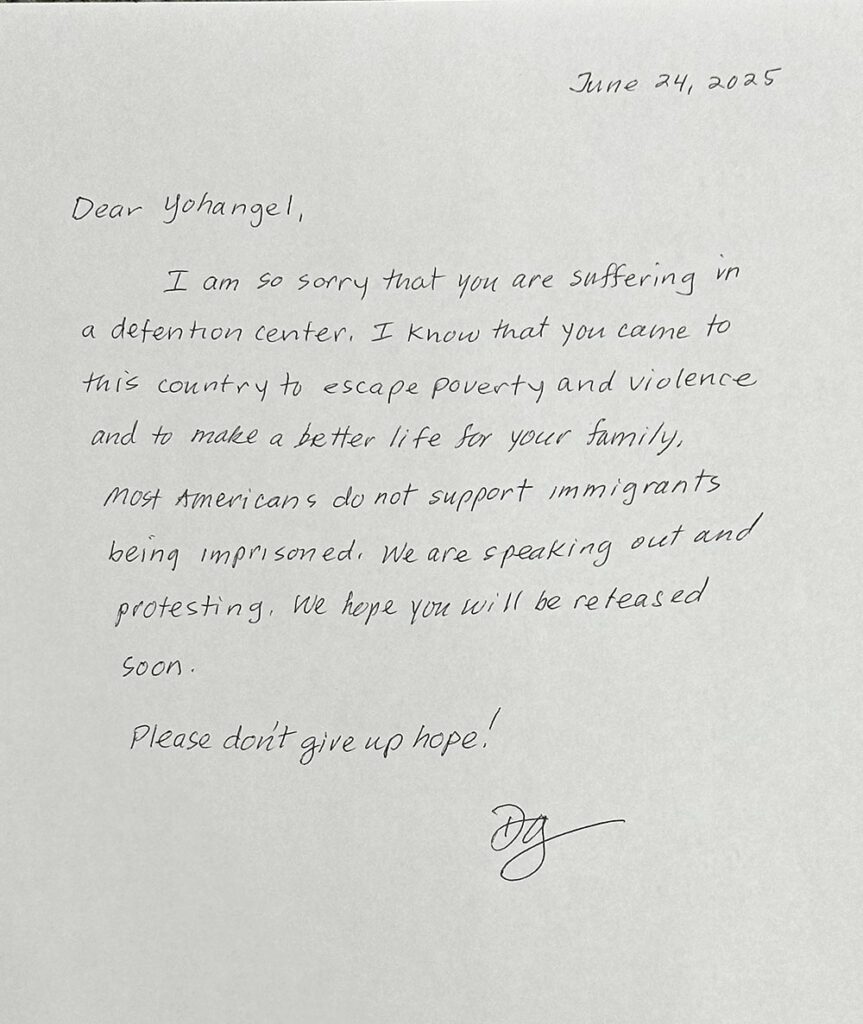
She recently moved back from Arizona, where she saw the immigration crisis from the frontlines and worked with organizations to help immigrants.
Being a misdemeanor, “it’s similar to a traffic violation,” she said. “So we’re pretty much all criminals, if that’s what you’re going to call a criminal.”
Walsh is especially concerned that federal enforcement policies hurt those trying to address issues with their citizenship status.
“Maybe they’re trying to go through the correct process; they’re gonna go to immigration court, but if you go to immigration court, you’re going to get picked up,” he said. “So what is the best way to go about it and do this ‘legally,’ if that’s even a thing anymore?”
Like the charges, details on where the detainees were taken into custody are not being shared.
“It’s difficult to know if their families have even found out that they’ve been taken and imprisoned there,” Portala said.
That’s one of the reasons she and others wrote more than 170 letters, cards and postcards to the detainees during a group gathering on Tuesday at the Downtown Toledo library. The letter writers checked names off the official list as they addressed each envelope.
“It’s important for the detainees to know that we know they’re there, we care about them, they’re not alone, and there’s people out here fighting for them,” Portala explained.
She was hoping the board would accept the letters at the meeting and deliver them right away, but jail procedures require them to be screened at an out-of-state facility. There, the messages will be scanned so the detainees can read them on issued tablet devices.
What’s next?
The community speakers all agreed: the plan is persistence.
“This may take years,” Portala said. “Every social justice movement is a long haul. You cannot expect miraculous results when you first start.”
“People are mad,” Kramer said, citing her discussions she’s had as a council candidate. “We need to keep registering our disgust with how things are happening. And hopefully, eventually, change will happen.”
One-on-one conversations with the board members are on Gerken’s agenda.
But will any of it change the other board members’ minds?
“I don’t know, honestly,” Kramer said.

Oppose SB 172: Ohio home for all

Editorial Independence: Letters to the editor represent the personal opinions of the writers and are independent from our newsroom’s reporting. We welcome diverse viewpoints. See our Opinion Policy here.
People move — it’s a part of life as old as time, as basic as breathing. But U.S. immigration laws have been written through scapegoating, not sensible debate. They are not logical, and do not work the way they did over a century ago, when my relatives came to this country. They also do not work the way most people think they should, or want them to.
SB 172 is more of the same. It’s up to Congress, not the Ohio Statehouse, to provide a better set of immigration laws, and the Executive Branch to administer them in a logical way. Right now we have chaos. President Trump is not implementing immigration laws efficiently; he’s making the system more dysfunctional.
SB 172 is in the same vein. It would turn Ohio into a police state, facilitating the masked abductions of more community members in all sorts of public places. This bill would cause more Ohio children to lose the daily presence of mothers and fathers, instead of creating pathways to legal status or allowing people who are already following a process to continue it.
We need lawmakers to bring people together and call on the federal government to enact sensible solutions. And for those who claim to be following traditions of faith, it’s a good time to evaluate what their traditions truly teach.
No one — immigrant or U.S. born — feels safer today. No one is helped when President Trump takes legal status away from Haitians, Venezuelans, Nicaraguans, Cubans, Cameroonians and others in Ohio who currently have it. No one benefits when masked ICE agents arrest immigrants at their immigration court hearings, while they are following the process. When ICE tricks a high school soccer star into showing up for an appointment, and arrests him on the spot, that doesn’t help anyone at all.
Emerson Colindres has a U.S. visa waiting for him. One branch of the federal government is processing it, while another branch of the same government is trying to deport him. And U.S. tax dollars are paying to incarcerate this 19 year-old, recent high school graduate in a jail, where he is NOT being charged with a crime, while his mother, sister and entire community are rallying for his release.
SB 172 is unworkable and must not pass. The other immigration bills under consideration in Ohio’s legislature, like the racist measures restricting property ownership by national origin, HB 1 and SB 88, and the citizenship status bill HB 42, must also be rejected. It’s hard to believe we are even having these debates in 2025. Ohio has to be bigger than this.
Immigrants bring energy, hard work, strong families, and so much more to Ohio. Alongside native-born Ohioans, they are helping small towns and key industries survive.
We can’t keep demonizing people and then counting on their labor, purchasing power, presence at houses of worship, school enrollment, tax contributions and more to help our communities stay strong. Let’s value each other and come together as one Ohio family. Because Ohio is home — for all of us.
Toledo Tech Loft: Convergence of collaboration, innovation

TOLEDO – Toledo’s path towards revitalization has not been a straight line, and in the wake of the infamous Bitwise Industries’ fraud scheme, other leaders in Toledo have pivoted to make good on promises unkept to the city.
“My efforts right now are to get people on the sidewalks like we used to have, and I’m trying to get bodies down here and get energy and activity,” noted businessman David Ball.
“I own a lot of property down here,” he said, referring to downtown. “I bought my first building in downtown Toledo in 1985. This September 3 will be 40 years ago.”
Since the first acquisition Ball made in his 20s, he’s grown his real estate in downtown significantly, owning the Ohio Building, among others.
“I am from Toledo. I’m based in Toledo. I’m passionate about Toledo.”
Ball kept his plan to revitalize the city simple.
“There’s a few ways that I think make the most sense to do it. One is tech, because I think they’re [tech professionals are] creative people. And the other is the arts,” he said with a matter-of-fact confidence.
So, when Bitwise announced their $38 million investment to renovate the Jefferson Center to make Toledo a viable tech hub, Ball pitched in with his own money to create a makeshift office space for the company in one of his properties at 336 N. Superior Street.
“I spent a half a million bucks building that for Bitwise, knowing that when they leave, I would have great space that I would attempt to bring in a tech company to backfill the space and do something really good for downtown,” he said.
Unfortunately, Bitwise fell through, and the hope that the Fresno-based company would be able to energize Toledo towards a viable technology-based job market disappeared after the infamous scheme.

Before Bitwise was known in Toledo, “we were doing a thing called Code City,” said Chris Eischen, a local entrepreneur.
Code City began meeting at Rustbelt Coffee, at 119 N. Ontario Street, and ran from late 2016 up until the advent of the pandemic with, “bootcamps, intense immersives, workshops and TedTalk® style conferences that condense a wealth of information, tools and genius insight into a relatively short time span,” according to their Facebook page.
The URL CodeCity.Co, which appears on their branded videos and promos, no longer exists.
According to Eischen, “the pandemic kind of shut that down,” which can be corroborated by the online list of speakers. 2019 seemed to be a pretty active summer for the collaborative group, and Code City even posted in 2021 saying, “Still here. brb” without a continued response afterward.
Without an active tech-based, entrepreneurial community in Toledo, Eischen began to search for a way to cultivate a tech following of his own in Toledo, and he found an ally in Ball.
“He put a bunch of money into renovating the space for Bitwise, and really wanted to see it get utilized for that [tech],” said Eischen.
After Bitwise’s founders faced prison time for fraud, Eischen and Ball put together a plan for the downtown space, already curated for a tech company.
“He had kind of the same vision as I had for this building,” Ball said. “So after some conversation about it, I said, ‘All right, I’ll make you a deal. Let’s see if we can build some traction in the tech world in our downtown. And the commitment that I’ll make is: I will cover all the overhead and space and everything for one year.’”
November 1, 2024 was the official launch date for the new tech company, Toledo Tech Loft, with a soft launch in August. Ball agreed to pay the expenses for one year’s use of the space to get the Tech Loft off the ground.
“I made that commitment of about $300,000 to support the tech world, to see if we can get some traction; to get some bodies into downtown that are creative, smart people,” Ball said.
Today, the Loft has 40 members, with the largest buy-in coming from a local integrated marketing communications agency, Hanson Inc., who has their employees meetup at the Tech Loft once a week.

“We help clients with their web infrastructure creation, building management, taking care of their websites,” said Hanson founder and CEO Steve Hanson.
Hanson has used the Tech Loft as a hybrid remote working space since October 2024, but used to occupy 17,000 square feet of office space at the Tower on the Maumee.
Then the pandemic helped Hanson innovate. “We found out very quickly that remote was a very good way to work.”
But as people returned to the office, Hanson still wanted to offer a space to build company culture and relationships, settling on the Tech Loft, specifically for its location in downtown.
“Previously I didn’t have ‘real’ relationships,” said Ronni Gschwind, a new front-end developer for Hanson Inc., who said she didn’t have in-person interactions at her previous remote work job.
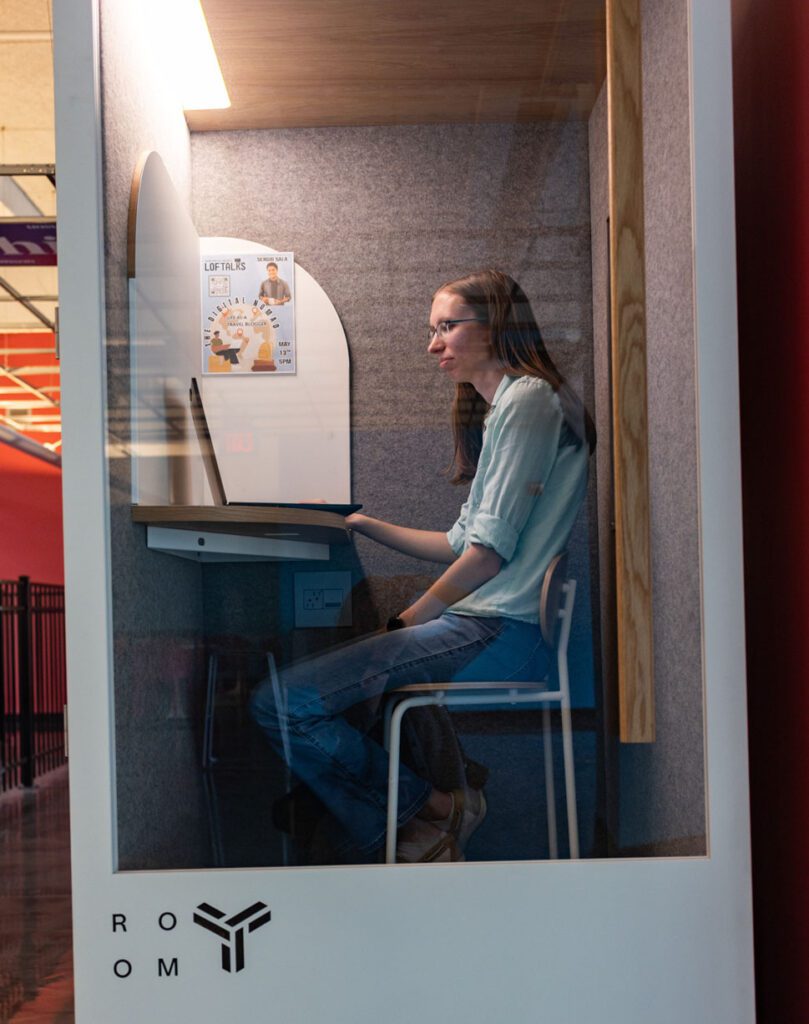
The hybrid work method set by Hanson, blending remote and in-person work, seemed to set a better rhythm for Gschwind.
“People actually cared a bit more,” than in a fully remote scenario, Gschwind said, and added that it’s been nice to go to lunch with her coworkers when they come in to work on Tuesdays.
The Loft’s environment is set up for community, with board games on the side of the main room and an open floor layout.
Individuals and companies are invited to interact organically, and periodically Eischen invites speakers from multiple disciplines to present in the space.
A brief sampling of May in the Tech Loft featured a travel photographer, Sergio Sala, presenting his work, an esports tournament, and a comedian, Aaron Kozbial, performing in the space.
Bumping into people and ideas is an extremely crucial value to Eischen because he sees the interchanges as essential to innovation.
“When I would travel, I’d be in San Francisco, I could turn a corner and, boom, just start collaborating with somebody on something,” Eischen mused, but found the local tech market in Toledo hard to get going.
“When I was in Toledo, it felt like, you know, I’m searching for people,” he said.
There was not a natural ecosystem built into Toledo for creative tech entrepreneurs to meet or collaborate easily.
Experiences in tech
Crowdfunding of an inexpensive charging accessory called “Thingcharger” jumpstarted Eischen into the tech/online marketing space during the mid-2010s.
On thingcharger.com, Eischen’s position is listed as “Facebook Fiend” in service to boosting the hubbub on the simple product, eventually picked up by retailers.

“It was sold at Bed Bath and Beyond and Sam’s Club,” Eischen said, but it’s easy to find listings on Walmart and other retailers for Thingcharger, as well.
After leaving Thingcharger, “I started working as a consultant on new project launches, and that’s where I got connected with Poo Pourri and Squatty Potty and the Crest Whitening Strips.
“Those were all new products that this company was launching digital campaigns for, and so I managed those digital campaign launches.”
During this time, Eischen said he was flown all around the U.S. to help companies with marketing or as a consultant, but said when he came to Toledo he was stymied in his hometown’s reluctance to adapt to changing standards.
“If I had to say it the simplest way, the Toledo region, this region of Ohio, is like four years behind what’s actually happening right now.”
Outside of Toledo, Eischen said he was rewarded and trusted for new ideas, “whereas what I dealt with here was, ‘This is how we do it.’”
For Eischen, pushback on new ideas came in the form of stiff structures, overly-monitored projections and a lack of breathing room to let plans develop.
“And it’s like, well, wait a minute. You’re tying my hands behind my back and then dictating how it’s supposed to go.”
Part of what Eischen hopes will come from the Tech Loft is an updated, forward thinking work culture.
“And I believe that if you can create some energy with these tech people that are kind of scattered all over, doing all their own little things … if we can put them all together and create some energy, I think we have the ability to bring tech companies into Toledo,” Ball said.
At present, the Tech Loft has a membership model, offering monthly student memberships for $50, standard memberships for $150 and 24-hour access to the space for $250 a month. Meanwhile, Eischen has been planning events, speakers and generally trying to get more people to populate the space.
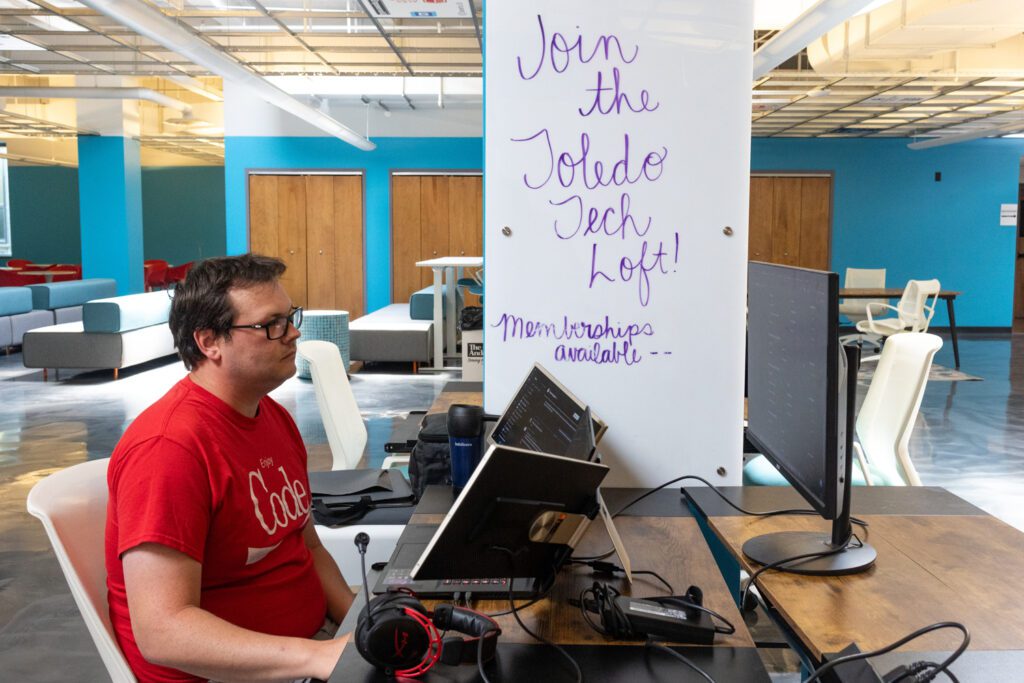
“We hosted some Capture the Flag cyber security events,” Eischen said. Buckeye Broadband supplied the internet, the University of Toledo supplied students and the Tech Loft supplied the space.
“In that collaboration of us all working together, we attracted this company looking at Toledo now to build a new center of operations around cybersecurity that would generate 200 new jobs in our region.”
Eischen and Ball wouldn’t speak to any specific company in the mix, but Ball corroborated Eischen’s claim about Toledo potentially getting some traction in cybersecurity.
“We already are having some really good conversations with some tech security companies from out of town that are considering Toledo as a as another location. I am already having those conversations with some significant people. Those things are already coming to the surface because of what we’re doing at the Tech Loft.”
In a couple months, August will see the end of the first subsidized year of the Tech Loft by Ball, who said he is still “all-in” on Toledo, “but at some point I got to have some help in supporting the financial side of this idea.”
JD Vance touts foreign policy, ‘big fat tariffs’, immigration

LIMA — With a political backdrop of U.S. strikes on three of Iran’s nuclear sites, immigration crackdown and an ongoing—and contentious—spending bill debate on Capitol Hill, Vice President JD Vance spoke to a sold-out crowd of Ohio Republicans on Tuesday in Allen County.
The vice president’s visit to Northwest Ohio was the center of the GOP Dinner event put on by the Ohio Republican Party, where attendees were served dinner and speeches from prominent state Republicans, including Secretary of State Frank LaRose (now running for auditor) and treasurer Robert Sprague (running to replace LaRose).

Vance began his opening remarks with anecdotes about his time in the White House thus far, while also lauding what he views as the administration’s successes.
On tariffs, Vance told the crowd, “On April the 2nd, he [President Donald Trump] said, ‘If you try to undercut the wages of American workers, if you try to bring in this crap, if you try to expose the American worker to an economic unfairness – that you don’t force your own countries to deal with – we are gonna slap a big, fat tariff on what you bring into this country.’”
He was referring to the “Liberation Day” tariffs that caused a steep drop across markets and sent bond yields up as a “penalty” on other nations that “has saved the American economy.”
Vance also received applause from the crowd when discussing a drop in illegal crossings at the southern border, an issue he and Trump campaigned on.
Sen. Sherrod Brown, Ohio’s three-term Democrat, lost his reelection to Republican Bernie Moreno in November. It put an end to a tradition of the state electing a Democrat and Republican to serve concurrently in the chamber.
“Sherrod Brown was a tough candidate; he always did better than national Democrats … the president was skeptical that anybody could beat Sherrod Brown.”
Vice President JD Vance
The vice president believes Brown’s loss in November was part of a larger political shift in the state.
“While we had a reputation for a very long time as a ‘purple’ state or even a ‘blue’ state, thanks to the hard work of people—many of whom are in this room—I think Ohio is now solidly ‘red’ and is gonna stay ‘red’ for a very long time.”
The issues
Tariffs: Ohio Republican Party chair Alex Triantafilou, in an interview with the Toledo Free Press, took an optimistic tone on the pressing policy issues of the second Trump administration.
In Northwest Ohio, a region in which agriculture is big business, tariffs are certainly a policy concern. When asked about his message to farmers, he stated, “Wait and see: This president has a plan. He’s working that plan. The plan here is to work better trade deals that help people in Northwest Ohio, help farmers, help our workers here in Ohio.

“With these tariffs, people just need to be patient. Let the president work his magic, and this is gonna work out for working class people in this state and every other state in America.”
But when it comes to one’s bottom line, patience doesn’t come naturally. When asked about a timeline as to when those promised results will become tangible, he answered that he “would argue that we haven’t seen the widespread inflation everybody threatened. We haven’t seen those things happen yet. I think what you’re gonna see is a president focused on helping them. I think once this bill passes, that’s pending, Americans are gonna get tax relief; you’re gonna see an explosion in the economy—you’re already seeing the economy begin to hop into overdrive,” he opined.
However, government data shows the economy did the opposite in the first quarter of this year, contracting by 0.3 percent. There was a notable increase in imports, which economists cite as the result of businesses front-loading ahead of tariffs.
The Middle East: Asked about the U.S. strikes on Iran’s nuclear program, which have created concern about another war in the Middle East, Triantafilou responded that “they [those concerned] should listen carefully to what the vice president and the president have said, and that is: We’re not at war with Iran.”
He added, “We’re not at war with the Iranian people. The goal here is limited … and that is to keep Iran from achieving nuclear weapons.”
Triantafilou asserts that the “consistent message” has been that this isn’t a repeat of what the general public has seen with Middle East policy. Defense Secretary Pete Hegseth told reporters on the Sunday following the strikes that “this mission was not and has not been about regime change.”
However, the president floated the idea on his Truth Social platform that same day, when he posted, in part, that “if the current Iranian Regime is unable to MAKE IRAN GREAT AGAIN, why wouldn’t there be a Regime change???”
In context: 2026
While priorities on the national level can change from day-to-day, those seeking elected office next year have to be in it for the long haul. Coinciding with this event is the run-up to next year’s midterm elections, in which three Republicans are vying to unseat Rep. Marcy Kaptur.
Included in that group: Air Force veteran Alea Nadeem, Sylvania-area State Rep. Joshua Williams, and former state representative and Waterville Mayor Derek Merrin (who ran against Kaptur in 2024).
There’s also the race for governor, in which Republican Vivek Ramaswamy—who was to co-lead the Trump administration’s Department of Government Efficiency (DOGE)—has been handed the state party’s nomination. He faces opposition from the lone Democrat in the race, Dr. Amy Acton, former director of the Ohio Department of Health.
On his level of confidence, in the face of these big races ahead, Triantafilou said, “I think the president is popular here in Ohio. We have a strong nominee for governor, Vivek Ramaswamy, so we feel very good about where we are in this country.”
Events, such as Tuesday’s with the vice president, don’t just play a role in fundraising. They have an underlying purpose: turning what party officials, such as Triantafilou, say is enthusiasm, into turnout by their registered voters.
Outside the event venue at Lima’s Veteran’s Memorial Civic & Convention Center, protestors held signs opposing Vance’s visit. They read “Stop pretending your racism is patriotism;” “This presidency has been anything but peaceful;” and “No sign is big enough for all the reasons we’re here.”
Speaking to the Toledo Free Press, protest lead marshal Seb Baughn said the Allen County Democratic Party led the charge in organizing it. Baughn works with the Ohio 50501 protest movement out of Columbus.
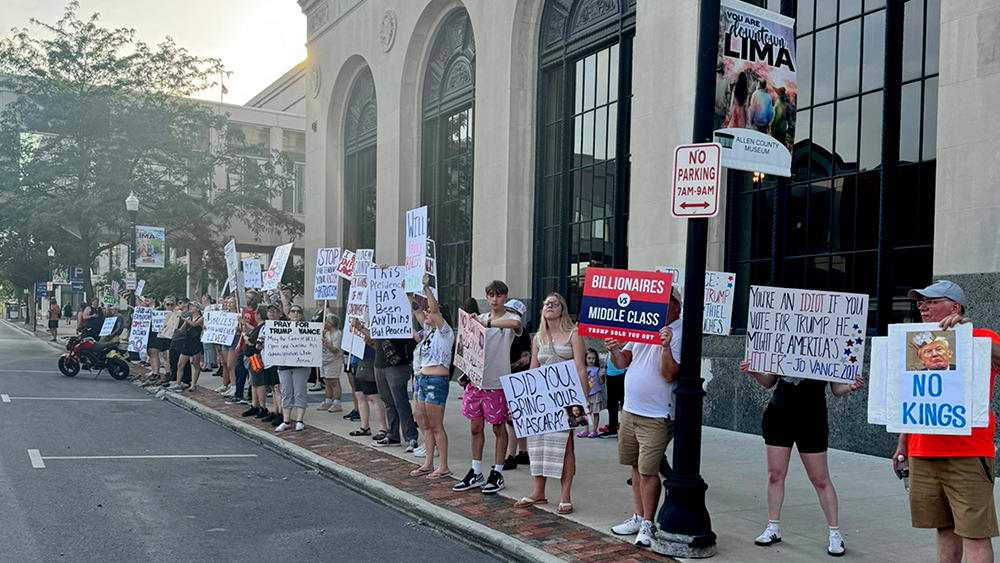
Asked what the group’s message was for Vance and those who came to hear him speak, Baughn said, “We’re trying to express our dissent for the way they’re treating people, like immigrants, LGBTQ people, people of color—they’re all being oppressed against.”
Baughn said that while some Republicans believe Democrats to be indifferent to the issue of illegal immigration, the reality is they just want due process before someone is deported.
“We want everyone to go to their court date, we want them to be allowed to speak to a judge, and enjoy their freedoms—like a lawyer—because they’re on U.S. soil, as the Constitution states,” he said.
April Welch: Toledo’s ‘champion’ of economic development
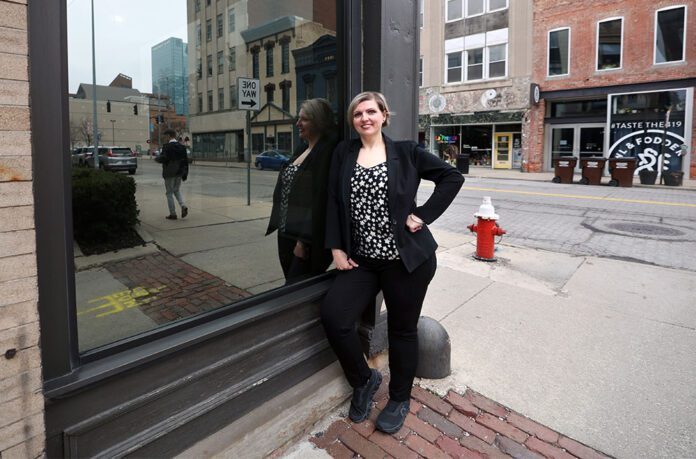
This week on Behind the Byline, host Jaden Jefferson talks with April Welch, deputy director of economic development for the City of Toledo.
Welch talks about how small businesses are shaping the city’s economy and neighborhoods, and shares how her team helps business owners navigate city processes, connects with free technical resources and taps into programs, like the White Box and Facade grants—designed to revitalize vacant buildings and strengthen local corridors.
Hear how she describes small shops as more than just employers—they’re key to community identity, neighborhood vibrancy, and long-term economic growth.
Welch highlights her office’s efforts to support small businesses through personalized guidance and resource connection. One major tool is The BEAT (Business Empowerment Alliance of Toledo), which provides no-cost technical assistance.
Listen as she emphasizes how small businesses create jobs, contribute to neighborhood identity and stimulate local economies through the multiplier effect, and how the city is actively addressing challenges, like vacant and outdated commercial properties through its Vibrancy Initiative.
Welch discusses the domino effect these investments have, inspiring neighboring businesses to upgrade their properties or launch new ventures. The programs also help improve property values and community pride. The city tracks job creation, business openings, and private investment spurred by these programs, and offers tax abatements for qualifying property improvements.
Welch also discusses:
- how the pandemic reshaped how local businesses reach their audiences
- the hidden gem helping them do it better: the Toledo-Lucas County Public Library’s business support team.
- how Toledo draws inspiration from other cities while shaping a unique identity through community feedback, grassroots ideas, and homegrown innovation.
📱 To learn more, go the City of Toledo’s Economic Development website.
New episodes of the Behind the Byline audio news podcast drop every week on the Pod Station.
Behind the Byline is a production of the Toledo Free Press.
(Recorded on June 24, 2025)
Measles cases rise as immunizations fall
LUCAS COUNTY – Measles cases in the United States have reached their highest level in several years. As of June 5, 2025, health officials have reported 1,168 cases, including three deaths. This is the largest outbreak in a single year since 2019. The Ohio Department of Health reported 34 cases in six Ohio counties on May 8.
So far, Lucas County has not reported a case of measles.
Since we have not seen much of the disease since the ’70s and ’80s, most people are unaware of how severe measles can be or the harm it can cause. This lack of awareness undermines the motivation to get family members vaccinated. It puts people at risk, especially children and those who aren’t vaccinated.
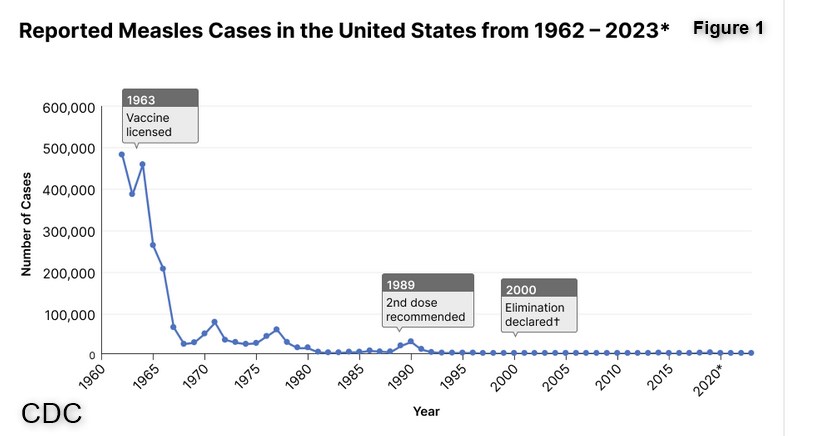
Before vaccine availability in 1963, most children in the U.S. got measles by age 15. Between 3 and 4 million people were infected annually during that time. Each year, about 400 to 500 people died from the disease, 48,000 people needed hospital care, and 1,000 developed encephalitis, according to the Centers for Disease Control and Prevention.
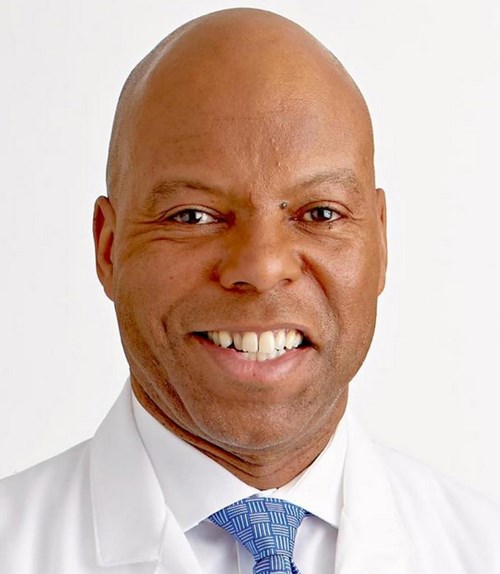
Dr. Lawrence Monger, Jr., medical director at the Toledo-Lucas County Health Department (TLCHD), said in a March 11 WTOL interview that “it absolutely is a serious virus. It’s highly contagious. It can stick around in a room two hours after someone has been there with measles. So, it can stick around for quite a while. It’s a virus and causes all the viral symptoms.
“After the virus takes hold, you start to develop bumps, measles and red bumps. You can get a lot of complications. You can get encephalitis, which is swelling of the brain. You can get pneumonia, infection of the lung. So, it attacks [the] immune system. It attacks the memory cells that help you remember how to fight other viruses, and it partially destroys them so you can develop all kinds of other infections post-measles. So, it can be deadly. And we’ve already had two deaths: one in New Mexico, one in Texas. It is a very deadly, highly contagious virus.”
So, getting measles is not a trivial issue, which is why the MMR (Measles, Mumps and Rubella) vaccine is so important. The American Medical Association, the American Academy of Pediatrics and the Centers for Disease Control strongly support young people getting vaccinated for measles. Figure 1 shows how effective the vaccine has been in getting rid of the disease – up until recently.
The CDC reports that 96 percent of recent measles cases occurred in unvaccinated individuals or whose vaccination status was unknown.
According to the CDC, children need two doses of MMR vaccine – one at 12-15 months and the second at 4-6 years of age. To be fully protected, older children and teenagers should receive two doses of the MMR vaccine, given at least 28 days apart.
Most adults only need a single dose of the MMR vaccine. Two doses are recommended for
adults who face a higher risk, such as college students, people traveling abroad, healthcare
workers, or anyone exposed to outbreaks. If a second dose is needed, it should be given no
sooner than 28 days after the first to ensure complete protection.
The MMR vaccine has been proven to be very effective and safe and for stopping measles. After a single dose, about 93 percent of people are safe from measles. Getting both recommended doses bumps that number up to around 97 percent.
Unfortunately, according to CDC data, between the 2019–2020 and 2023–2024 school years, MMR vaccination rates for kindergartners in the U.S. fell from 95.2 percent to 92.7 percent. This drop in coverage is important because it has led to the breakdown of herd immunity, which is necessary to prevent outbreaks.
According to the Cleveland Clinic, herd immunity means that when enough people in a group are immune to a disease—thanks to vaccines or having been sick before—the illness has a harder time spreading. Herd immunity helps protect everyone, even those who aren’t immune, because the disease finds it tough to move from person to person. Since measles is so contagious, a vaccination rate of 95 percent is preferred for herd immunity.
Many U.S. jurisdictions have seen measles (MMR) vaccination rates fall below the 95 percent threshold. The Shots 4 Tots program’s goal here in Lucas County is to increase the childhood immunization rate to 90 percent.
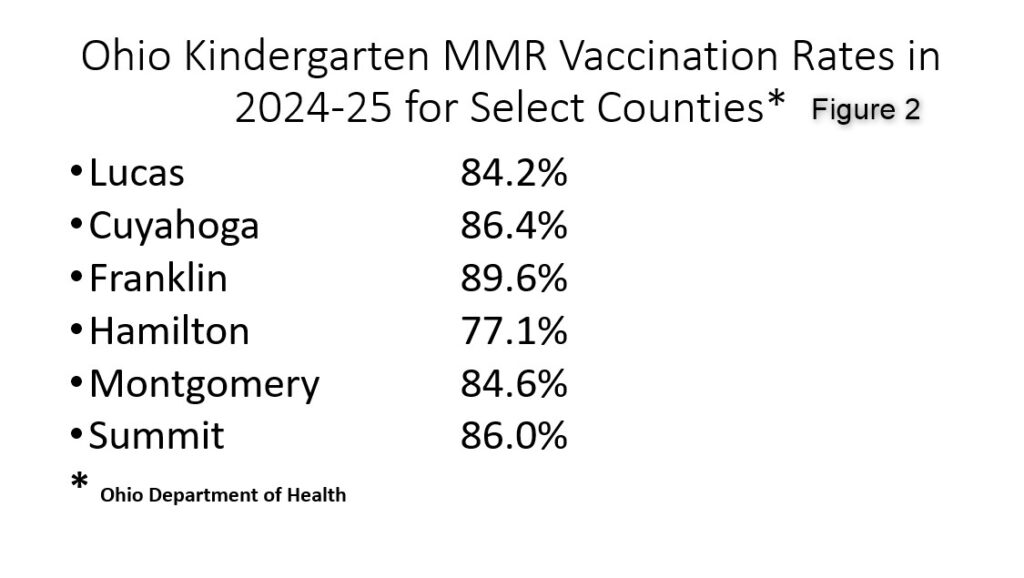
At a press briefing on March 18, Dr. Bruce Vanderhoff, director of the Ohio Department of Health, reported a decrease in MMR vaccination rates across Ohio. The percentage of
kindergartners who received the MMR vaccine dropped from 89.2 percent during the 2023-2024 academic year to 88.3 percent in the current school year.
According to ODH, while several counties in the south and southeast are above 95 percent, many Ohio counties fall below 90 percent. (See Figure 2.)
This drop in immunization has been followed by a sharp rise in measles cases. In the first 16 weeks of 2025, the U.S. saw 800 reported measles cases—a 180 percent jump compared to all of 2024.
So, considering the seriousness of measles and the effectiveness of the vaccine, why have
vaccination rates gotten so low?
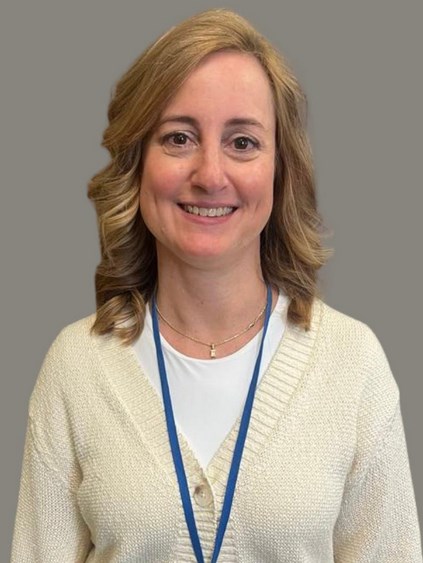
Angie Bauman MSN, RN, director of Nursing & Health Services at TLCHD, said, “I think there’s a lot of barriers, and it depends on things like how hard is it to get to the doctor’s office? It can start with, you know, do we have easy access? Do we have to take a bus to get to the doctor’s office to get our kids up to date on their vaccines? Do we have a provider that has got hours that are easy for us to work our schedules around? You know, just really basic social determinants of health factors that can impact whether or not
families get their children vaccinated.
“In addition to that,” she continued, “there are children who are immune compromised and aren’t able to get the vaccine for various health reasons. And then there are some people that have religious exemptions who prefer not to due to faith-based reasons. And then there are people who really just don’t have a trust in the vaccine and prefer not to have their children vaccinated. So, you know, we kind of have multiple barriers that can impact a family’s decision to vaccinate their children.”
Mary Apodaca, RN, a public health nurse with Shots4Tots, stated that “there’s a lot of
misinformation out there, and parents are bombarded with information from all different
sources, and they don’t know which to believe. So even some of our local doctors have a hard time getting parents to say yes to some of the vaccines.”
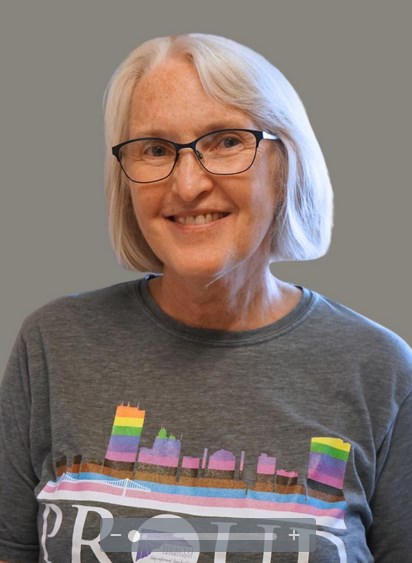
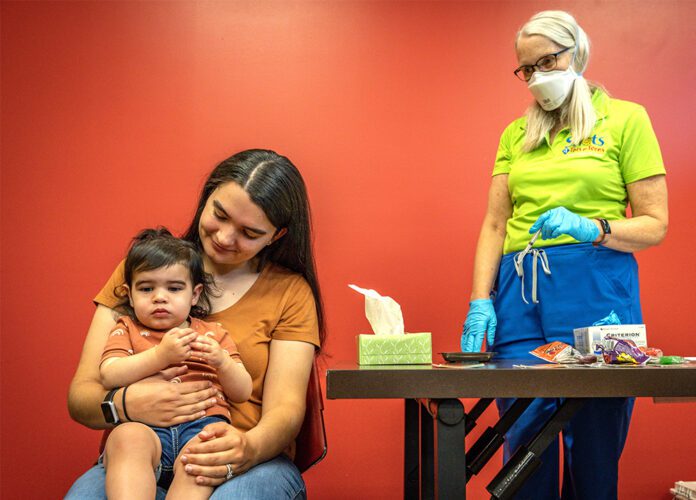
The staff at the Toledo Lucas County Health Department, through its Shots for Tots program, is working to get as many children vaccinated as possible.
Bauman emphasized the following points about vaccination delivery:
- If people have questions, they can talk to one of our nurses without making an
appointment. They can talk through their concerns and get good information from a
trusted, reliable source. - To get an MMR (measles, mumps, and rubella) vaccination at the Toledo Lucas County Health Department, schedule an appointment at 419-213-2013.
“We always focus on being easy to reach,” said Bauman. “That’s our top priority. If parents want to vaccinate their child but don’t have an appointment or can’t get to a doctor’s office,
they can come to us any day. Someone is always here to help. We see everyone, no matter their insurance or ability to pay.
“We try to make things even easier with late hours on Mondays and by holding clinics in
different places around town. We set up at local libraries, community centers and
YMCAs so people don’t have to travel far.
“When back-to-school time gets closer, we add more hours, bring in extra staff, and show
up in more locations. We want to be where families need us most. If you need a
schedule of our upcoming clinics, just ask,” Bauman said.