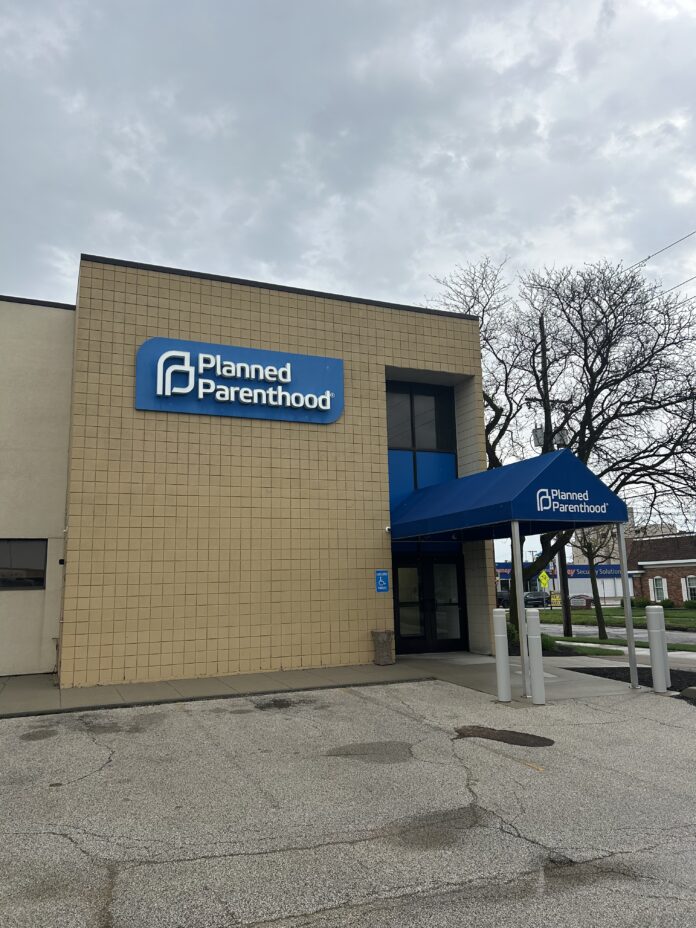
Planned Parenthood, Toledo location. (TFP photo by Samantha Heywood)
TOLEDO– Planned Parenthood is often derided as simply an abortion clinic, but 25 percent of their 600 locations nationwide don’t even offer abortions. The Toledo location is one such example. Instead, the Toledo Planned Parenthood provides a range of reproductive and sexual health services to all demographics—services that foster safe, healthy lives.
An anonymous spokesperson from the Toledo Planned Parenthood health center further clarified their boundaries of care, emphasizing the organization’s attention to diverse services.
“We have abortion centers in Cleveland and Columbus, but do not perform the procedure in Toledo. Though it is often assumed that we only provide care to women, in reality, we provide a litany of services important for a healthy life, regardless of gender.”
These services include different types of birth control. The pill, the ring, IUDs, and the Nexplanon implant are available to patients via a scheduled visit. STI testing, pap smears, and gender-affirming care are also available during a scheduled appointment.
The Toledo location provides free condoms and Plan B to individuals on a walk-in basis. They are available for pickup at the health center or via a discreet mail-order program for Ohio residents aged 16 and older, with a limit of one order per 30 days. No parental consent is required for individuals 16 and older.
The organization’s vice president of community engagement seconded the misconceptions, highlighting that people often think that the Toledo Planned Parenthood does not provide parental support.
“We work with parents when it comes to assisting with reproductive health conversations. We support parental involvement… Anecdotally, we see a lot of patients for gender-affirming care. Approximately one-fourth of our total patient volume in January was here for gender-affirming care services.”
The Toledo Planned Parenthood offers gender-affirming care services to adults aged 18 or older. Puberty Hormone replacement therapy is provided to patients, and mental health support is a common practice too. The Toledo Planned Parenthood does not perform surgical procedures, including gender-confirmation surgery, but staff can refer patients to their preferred clinic if that is what they are looking for. Information on gender-affirming care services is available on their website.
Funding
Despite fighting back against these misconceptions, the Toledo Planned Parenthood and other Ohio-based Planned Parenthood health centers continue to face funding cuts. In January, The Toledo Free Press spoke with Erin Thompson, director of communications for Planned Parenthood Greater Ohio, argues that funding has been in flux due to targeted attacks from the Trump Administration.
“For example, we’ve been a recipient of Title X funds since 1971, just a year after the program was established, and have only been blocked from receiving those funds twice: during Trump’s first term and again last summer. Though these funds have been released to us again, there is uncertainty around whether we will receive them past March.”
Planned Parenthood was cut from the Medicaid program through Trump’s “Big Beautiful Bill” last summer, significantly impacting patients in the Toledo area and thousands of other patients in Ohio.
With the loss of Medicaid and other funding cuts, many patients in Toledo cannot access the healthcare that they need. The spokesperson from the Toledo location says that their staff have had to turn patients away daily.
“We have been referring patients elsewhere when possible, and we try to accommodate what we can.”
When patients are unable to be accommodated, Toledo Planned Parenthood refers them to the Toledo Lucas County Health Department—an organization that also offers affordable reproductive health care and birth control.
The Toledo Planned Parenthood still accepts private insurance, Medicare, and has a sliding fee scale for most services. The sliding fee scale is based on income and household size, which can significantly reduce costs for uninsured or low-income patients. The Toledo Planned Parenthood typically charges less than hospital-affiliated clinics, which often charge higher fees for office visits. They have more information on insurance and price of care on their website.
Community involvement
Although the national dialogue surrounding Planned Parenthood can be confusing, the staff the Toledo location say that simply paying attention to local changes, volunteering, and donating when possible helps them to continue their services. Their vice president of community engagement emphasizes:
“Donate, share your stories, pay attention to legislation and policy changes that impact us and ultimately harm patient access.”
The team at the Toledo Planned Parenthood is continually accepting patients when they can. Thompsonreiterates that their ultimate goal is to provide people with the comprehensive healthcare they deserve.
“We are here. Our doors are open. We remain as committed to providing healthcare to the communities who need us as we ever have… we’ve introduced new services, such as menopause care, ultrasound dating, pharmacy delivery, and more in 2025. This year, we look forward to providing these services to all of our patients.”
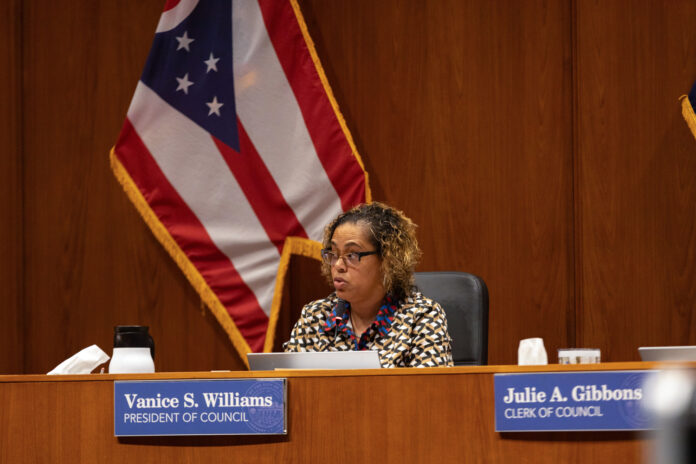
Vanice Williams, president of council and representative council member for District 4, speaks about the work that went into making the budget cuts during a special session of Finance, Debt and Budget Oversight Committee to approve the 2026 Toledo City Budget at 1 Government Center in Toledo on Tuesday, March 31, 2026. (TFP photo by Stephen Zenner)
TOLEDO – On March 31, the $1,009,612,154 total operating budget for 2026 Toledo city budget was approved after about a half hour of deliberation by Toledo City Council, and millions in cuts.
All members of Council were present for a special session of the Finance, Debt & Budget Oversight Committee to deliberate on amendments for the 2026 Budget Ordinance (O-125-26), with the exception of Council Member John Hobbs III, who was absent due to work commitments.
Clerical update, Exhibit A
First on the agenda, Exhibit A passed with unanimous approval.
The amendment was proposed from the mayor’s administration, and it moved an administrative assistant position, $103,633, from Building Inspection to Code Compliance and carried over the remaining funding for the Choice Neighborhood Planning Grant Consulting Services for the Vistula Neighborhood.
A bookkeeping measure was also part of this first amendment, and it corrected the Road and Bridge Maintenance projects to reflect amended budgeting within Street Construction Maintenance, Special Assessment Services Fund, and the Capital Improvement Fund.
Council Member Vanice Williams, District 4 and president of council, sternly addressed council after passing exhibit A, in the opening of the meeting.
“The biggest thing for us as a body is we did not recommend the removal of any positions that are currently filled,” she said. “We were not in the mind frame to take on laying off any staff that is currently working for the City of Toledo.”
This clarification from Williams came at the request of Council Member Adam Martinez, District 2, who wanted the objectives of the council to be clearly known before voting on Council’s proposed amendment, Exhibit B.
“No services lines were cut,” Williams said. “We cut an additional $120,000 out of the office supplies of various departments, and those are listed.”
In jest, Williams summed up her response and said the council did not cut positions but “we did cut pens,” referring to office supplies cuts.
Exhibit B was unanimously approved by all present council members.
$3,489,930.50 was cut from the General Fund through this amendment, which made good on Williams’ claims of cutting office supplies.
Fire & Rescue had 10 different items cut, the most separate designated cuts for a department, for a total of $422,599.00 reduction to their budget, including $30,788.00 of office supplies cut.
But even with less separate specifications the Police Department lost the most money of any department through this amendment. $943,801.00 was cut from the Police Department, which downsized an incoming police class of recruits from 25 to 20 ($526,600.00), got rid of funding for new uniforms ($150,000.00) and cut contractual services ($107,000.00), which included grass/snow removal expenses and GrayKey/Cellbrite software, used for unlocking and accessing data on cellphones.
Amendment for historical buildings
Council Member Theresa Gadus, District 3, proposed Exhibit C, $125,000 for a consultant for local landmark designations.
“The proposal is a community led initiative,” she said before voting began on this amendment to the budget. “Hundreds of residents, stakeholders and community leaders came together to ask this Council to take a proactive approach to preserving our historical structures, those architectural anchors that represent pride and identity across our neighborhoods.”
The loss of historical structures, Gadus said, go far beyond just losing a building, and negatively affect housing stability, public safety and economic development.
“Due to the transition in leadership within the plan commission, there was not sufficient time to bring forward the necessary legislation to authorize this expenditure before the end of the year,” Gadus said. “This amendment simply provides the commission the time and space needed to carry that work forward.”
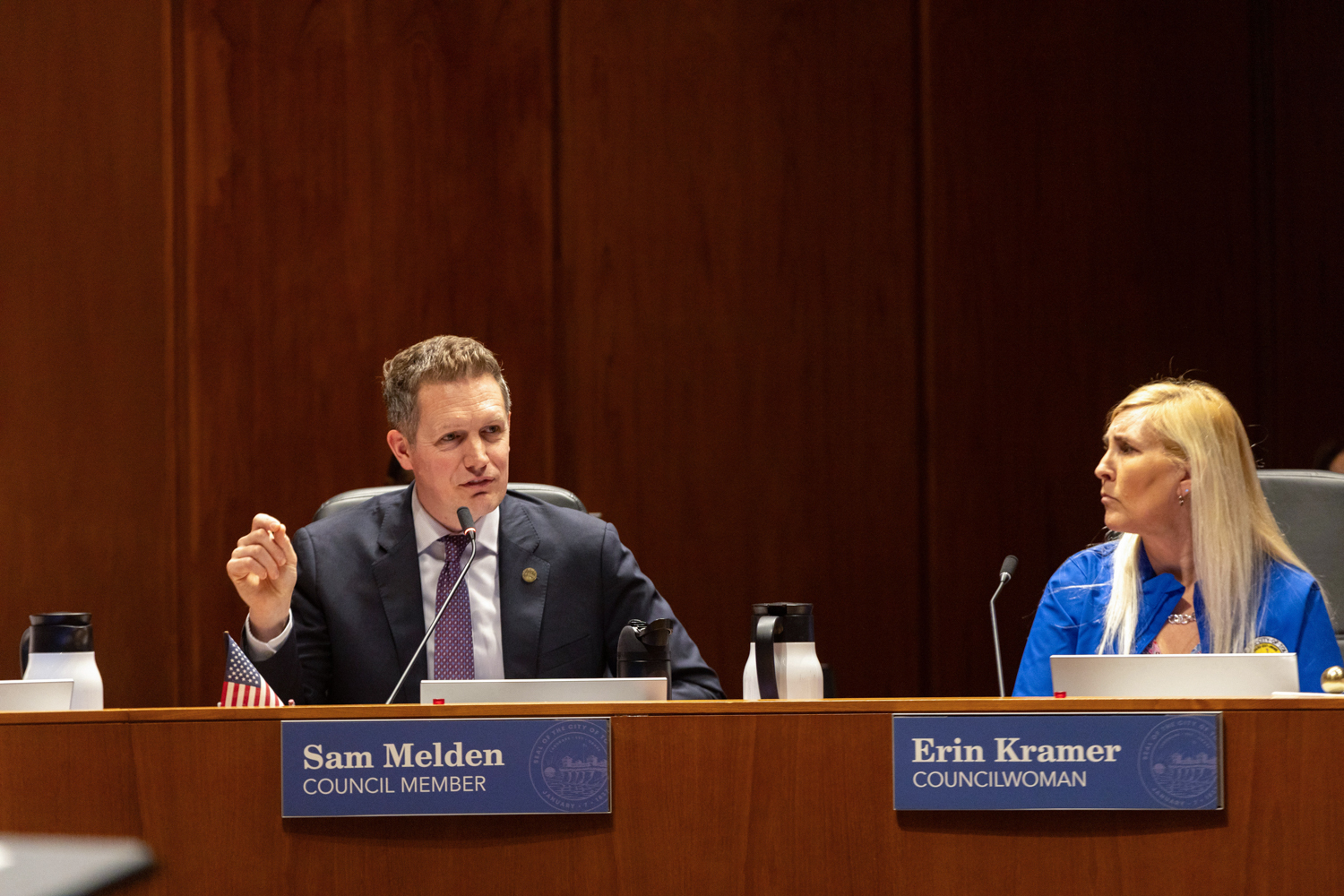
Sam Melden (left), council member for District 5, backs up President of Council and Council Member for District 4, Vanice Williams, as she asserted that cutting the budget this year was hard work. (TFP photo by Stephen Zenner)
Exhibit C passed as an amendment, but was opposed by Council Members Sam Melden, District 5, George Sarantou, At-Large, and Williams.
Jazz Fest
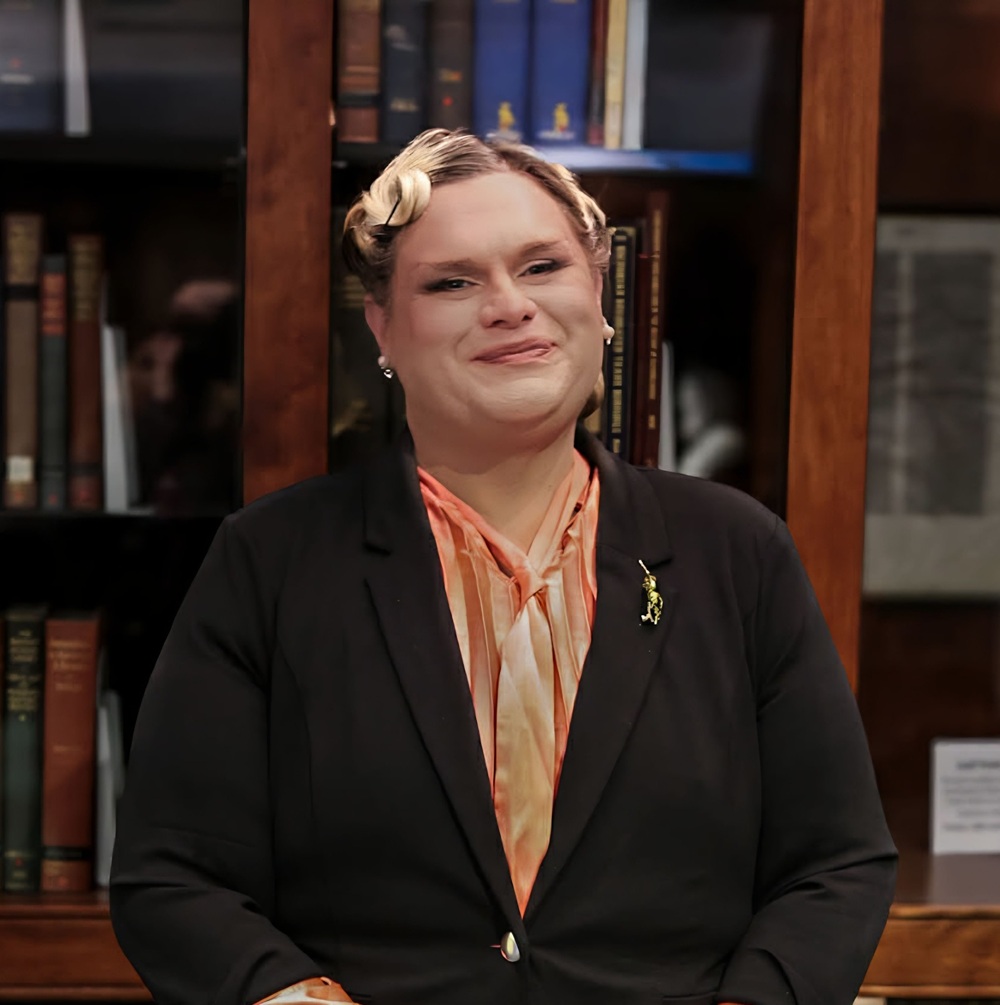
Funding for Jazz Fest was the subject of the next amendment to the budget, Exhibit D, proposed by Council Member At-Large Cerssandra McPherson.
Cerssandra McPherson, council member At-Large, speaks on getting funding for Jazz Fest through Exhibit D and amendment to the budget. (TFP photo by Stephen Zenner)
McPherson told council that Jazz Fest usually gets $50,000 from the city, but she cut the amount to $40,000 to help the budget.
The money for Jazz Fest, McPherson said, came from “the interest that we have from the ARPA [American Rescue Plan Act] dollars.”
Shortly after the amendment passed with all members voting yes except Council Member Melden.
Police substation
“Exhibit E is for the community police station to fill the gap left by the closing of the Northwest substation closure in 2025 that’s $500,000 by Council Member Melden,” said Julie Gibbons, the clerk of Toledo City Council.
Melden introduced this amendment, and told Council that it was not an initiative to replace the substation.
“This is about establishing a new community police presence, not just in District 5, not just in west Toledo, but in a strategic area,” Melden said, and defined the area as where districts one, four, five and six all come close to one another.
Maintaining a police presence in west Toledo was important for Melden, but he went further and said, “this is the potential pilot, a new way of having these outposts throughout the community.”
After Melden shared his thoughts, McPherson opposed Exhibit E, because she said it did not have enough structure.
“We should not approve monies without a plan,” she said, and compromised that the council could come back to this idea during the budget’s mid-year adjustments.
Both she and Martinez said they thought the police presence there was important, but wanted more definition for how money should be used. He also recommended bringing this issue back up at the mid-year budget review.
Defending the amendment, Melden said either council members could speak with the chief of police about their ideas, and resolved, “The beauty of this idea is that it is actually a new approach to community policing.”
Melden argued that not all the details in development are ironed out at the same time. “I’m not going to name a location and then have the price go up,” he said.
The amendment passed with four council members opposing it, Brittany Jones, At-Large, Martinez, McPherson and Williams.
ShotSpotter
Another police tool was the subject of the last amendment to the budget, Exhibit F, which Theresa Morris, District 6, sponsored in hopes of funding the city’s ShotSpotter, a surveillance technology by SoundThinking Inc.
Exhibit F would add $225,000 to the budget, but the claims made by SoundThinking about ShotSpotter include faster response times to dangerous situations and better evidence recovery after shootings.
“It’s one more tool that we can have in our toolbox to keep us safe in Toledo,” Morris said, and shared that this amendment doesn’t affect her district significantly. Morris said, “We don’t want to have [this summer], ‘Let’s name that sound: Is it a firework or a gunshot?’”
Council Member At-Large Nick Komives was the first to oppose ShotSpotter, after voting for the money to fill the gap left by the police substation.
“$225,000 is a lot of money,” Komives began, and said there was a good “feeling” of security that comes with ShotSpotter. But maybe $225,000 is not worth the feeling, he said.
“Since 2022, more than 45 cities have rejected or canceled their contracts with ShotSpotter,” he said, the foremost of these cities are Chicago, Dayton and Durham. “Public safety officials have determined the level of effectiveness of gunshot detection technology was incommensurate with the costs associated.”
Dayton’s decision to go without ShotSpotter was cited by Komives, and he said, “I believe that our police department felt the same, which is why they did not bring it forward, and I would encourage this body to reject the amendment. Thank you.”
At-Large Council Member Erin Kramer echoed Komives’ sentiments, and said that while she wants better gun safety, ShotSpotter might not be the best use of the city’s funds.
This is the only amendment on the agenda that failed, and was supported by Jones, Martinez, Morris and Gadus.
After the meeting, Morris expressed remorse at the amendment failing.
“I think that a lot of the neighborhoods that see high numbers of gunshots, I think they will continue and probably increase now that they know that there isn’t that monitoring system,” she said.
“So whether it’s a drone, whether it’s ShotSpotter, whether it’s a Flock camera, honestly, these are the things that when something happens, somebody says, ‘Where are the cameras?’”
Kramer spoke on her vote to not renew ShotSpotter.
“We have a lot of tools in our toolbox to prevent gun violence, and ShotSpotter is not one that we need to invest in anymore,” she said, and cited the efficacy of the technology and cost as restraints.
“We had to make a lot of really hard cuts in this budget, and so I don’t feel like it would have been responsible for us to then say, ‘Yes, we want to spend $225,000 on the software through this product.’”
The Toledo Free Press reached out to the Toledo Police Department for comment, and received this reply from Sargent Mohamad Nasser, the public information officer, on the cut to ShotSpoter.
“ShotSpotter will continue operating through the end of June. While that service will conclude at that time, our commitment to responding to gun violence remains unchanged. We will continue to use multiple tools and strategies, and we encourage residents to call 911 immediately if they hear gunshots so officers can respond quickly.”
Roads
Unanimous approval was given by all present to pass O-126-26. This ordinance approved the 2026-2030 Capital Improvement and Road Improvement Budgets, and authorized the appropriation of $77,447,820 for capital projects.
Reduce the budget
Last on the agenda for the special meeting of council was R-110-26, a proposal by all members of council “urging” the mayor to reduce the budget by $10 million per year for 2027 and 2028.
Sarantou spoke on behalf of this resolution. “I think it’s very important that we have this resolution passed unanimously, because we have some real budget challenges…and asking the administration to focus on $10 million of cuts from now for next year’s budget is absolutely critical.”
Public safety is Council’s number one responsibility, he said, but added, “We need to send a message to our taxpayers that we are serious about reducing expenditures in all the budgets as much as possible.”
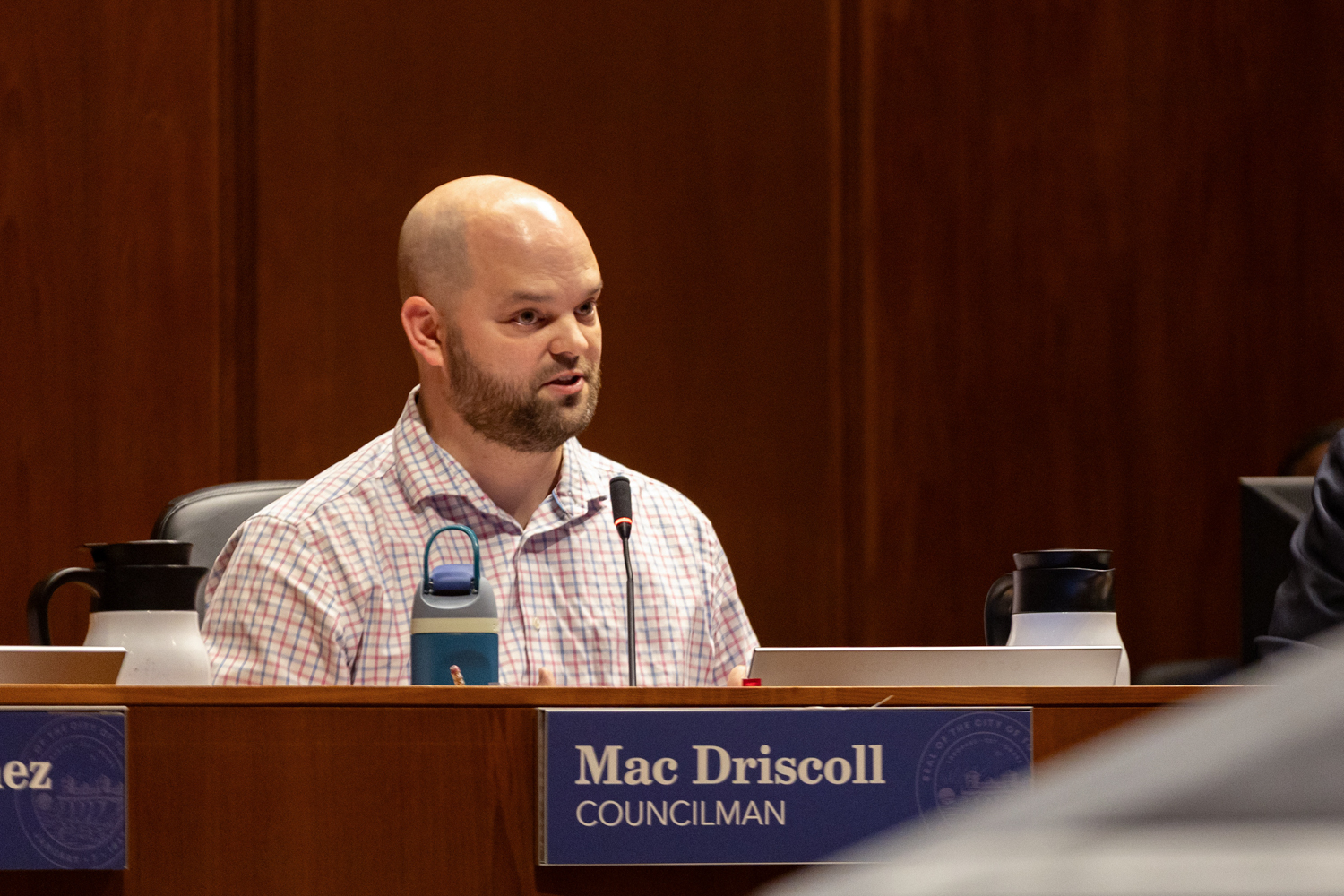
Mac Driscoll, council member At-Large, addresses council about resolution 110-26, an effort to decrease the budget each year by $10 million for two consecutive years. (TFP photo by Stephen Zenner)
Council Member At-Large Mac Driscoll weighed in on the heels of Sarantou, and cautioned about the budget next year.
“I would say much of the additional cuts that we found, that Council has found, working alongside the administration, represent really one time options,” Driscoll said, and warned that the same “low hanging” fruit would not be available to cut next year.
Driscoll warned that next year the city will be facing a structural deficit, and, “within three years, we will not have a rainy-day fund any longer.”
2025’s city budget came off of fresh American Rescue Plan Act (ARPA) dollars from the federal government, some of which have been cut, but a large feature of the mayor’s budget at that time was the $60 million “rainy-day” fund, allowing for an improved bond rating for the city.
“I want to be clear that we are having these conversations in a time of, at least at this point in time, a time of economic expansion, and also a time when we’re projecting revenue growth,” Driscoll said.
“If you’re expecting revenue growth, you should be banking money, not borrowing from our savings account to balance the budget.”
Driscoll was clear that Council has the power of the purse for the city, but that the budget document comes from the mayor and sets up the template for expenditure, with the oversight of Council.
With positive revenue growth, and the decrease of $10 million a year for the next two years, Driscoll was confident the stabilization fund would be secure.
President of Council, Williams, pushed back on the idea that the council waited until the last minute to pass the budget, and instead said that the council combed through the document from the mayor thoroughly.
She stated that it was a difficult year all-around, speaking as an owner of a small business, and said the same difficulties for her business were present in the city’s budget. And that it was work to go through it with the administration, while not cutting human labor.
“Just because you can do something doesn’t mean you should, and just because we can pass it early doesn’t mean that we should,” Melden said, defending Williams’ claim and the rest of Council passing the budget on the last day for it to be approved.
Instead, Melden said what happened with this year’s budget was a great effort to make the most of the taxpayers’ money, and said, “We took the time to get it [the budget] as right as we could.”
The resolution passed unanimously for all present, but without Hobbs III’s vote.
Williams said before the vote, “We have to put forth how serious we are to take on this task with the administration, and that’s what this resolution is saying.”
This special financial meeting started at 2 p.m., and Hobbs III and Mayor Wade Kapszukiewicz were present for the 4 p.m. city council meeting.
In this episode of Toledo Works, Jaden Jefferson speaks with Yaz Abu-Adiyeh, owner and proprietor of Baba’s Eats, a food truck that got its start during the early days of the pandemic. Then he speaks with Anneke Kurt, corporate manager of Kengo Sushi & Yakitori, about her work in the restaurant industry that inspired her memoir. Finally, he ends with a chat with Ray Orra, a barista from House of Coffee who speaks to the value of coffee shops for finding community.
Everywhere in Toledo, you’ll find people who play a role in making our city tick – from hospitals and factories to restaurants and art galleries – and behind every person is a story. Our program, Toledo Works, highlights those stories from workers’ firsthand accounts. Each week, Toledo Free Press hosts Jaden Jefferson and Stephen Zenner focus on a different topic within the Toledo workforce, exploring their day-to-day challenges and triumphs.
Below is a more detailed look at all of the candidates voters will get to choose from on their respective ballots during the May 5 primary election for Ohio’s 9th Congressional District.
Democrats for Representative to Congress (9th District)
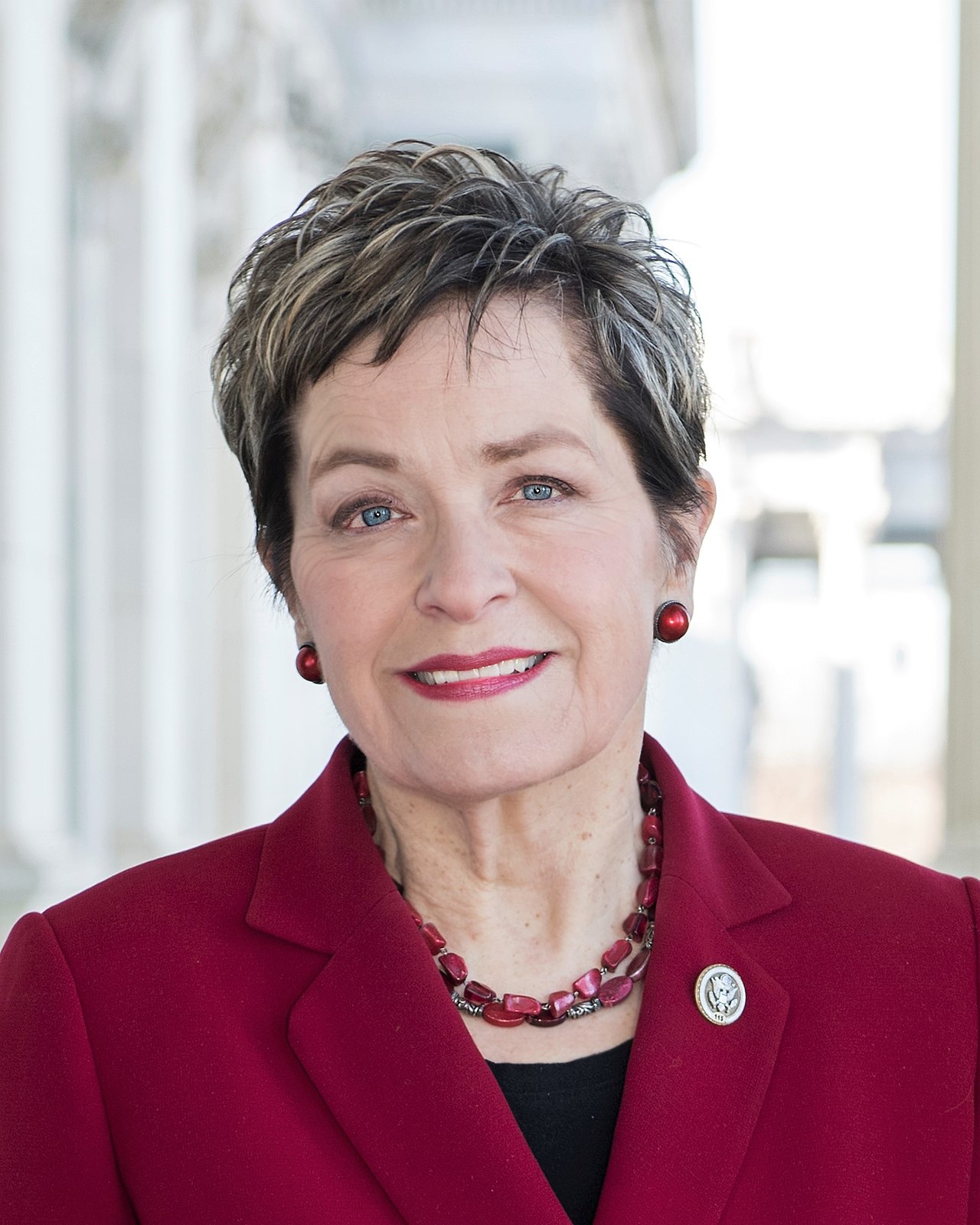
Marcy Kaptur for Representative to Congress for Ohio’s 9th District * Kaptur is the only Democrat on her party’s ballot.
Marcy Kaptur
Lives in Toledo; from Toledo
Political Experience:
1983-Present U.S. Representative for Ohio’s 9th Congressional District
1977-1979 Urban Policy Advisor for the Jimmy Carter (D) administration
1975-1977 Director of Planning at the National Center for Urban Ethnic Affairs
1969-1975 Urban Planner for the Toledo-Lucas County Plan Commissions
Education:
1974 Master’s in Urban Planning from the University of Michigan
1968 Bachelor’s Degree in History from the University of Wisconsin
Professional experience:
1977-1979: Urban Policy Advisor for the Jimmy Carter (D) administration
1975-1977: Director of Planning at the National Center for Urban Ethnic Affairs
1969-1975: Urban Planner for the Toledo-Lucas County Plan Commissions
Jaden Jefferson sits down with Libertarian David Gedert, who goes by Sugar Vermonte while performing, to discuss his campaign to represent Ohio’s 9th Congressional District.
Matthew Althaus for Representative to Congress for Ohio’s 9th District
Matthew Althaus
Lives in Toledo
Political Experience:
No prior political experience
Education:
Bachelor of Business Commerce from Miami University
Associate’s Degree in General Business Administration and Management from Sinclair Community College
Professional experience:
2022-Present: Manufacturing Manager and previously H/E Supervisor for NSG Group in Rossford
2020-2026: Area Manager for Amazon in Toledo
2015-2020: Operations Manager for Unique Tool and Manufacturing in Temperance, Mich.
2011-2015: Inventory Specialist for International Laser Group in San Diego, Calif.
2010-2011: Chief Executive Officer for Smartcarts Inc. in San Diego, Calif.
Website and links: None
Republicans for Representative to Congress (9th District)
Josh Williams
Josh Williams for Representative to Congress for Ohio’s 9th District
Lives in Sylvania Township; from Toledo
Political Experience:
2023-Present: Ohio House Representative for Ohio’s 44th District
Volunteerism:
2008-Present: Board of Directors Member for South Toledo Area Rec Society
2008-Present: Program Director and Head Football Coach for South Toledo Area Rec Society
Education:
2018-2020: Doctor of Jurisprudence from the University of Toledo College of Law
2014-2017: Bachelors of Science in Paralegal Studies, Paralegal Studies/Prelaw from the University of Toledo
Professional experience:
2016-Present: Criminal Defense/Personal Injury Associate with Groth and Associates
Derek Merrin for Representative to Congress for Ohio’s 9th District
Derek Merrin
Lives in Monclova; from Monclova
Political Experience:
2024: Ran for Ohio’s 9th Congressional District. Merrin lost to Marcy Kaptur (D), and received 47.6 percent of the vote. Kaptur received 48.3 percent of the vote. Tom Pruss (L) received 4.1 percent of the vote.
2023-2024: Ohio House Of Representatives for Ohio District 42
2016-2022: Ohio House Of Representatives for Ohio District 47
2014-2015: Regional Liaison for the Ohio Auditor of State
2012-2013: Senior Performance Analyst for the Ohio Auditor of State
2008-2011: Mayor of the City of Waterville
2006-2007: Councilman for the City of Waterville
Education:
2012-2014: Public Performance Measurement Certificate from Rutgers University, Newark
2008-2009: Master of Public Administration, International Relations from Bowling Green State University
2005-2008: Bachelor of Arts from the University of Toledo
Professional experience:
2015-Present: Owner of Merrin Property Holdings, LLC
Jaden Jefferson speaks with Alea Nadeem, a Republican candidate for Ohio’s 9th Congressional District, as part of the Toledo Free Press Voter’s Guide. This interview is a part of our May Primary coverage for 2026.
Madison Sheahan for Representative to Congress for Ohio’s 9th District
Madison Sheahan
Lives in Columbus; from Curtice, Ohio
Political Experience:
2025-2026: Deputy Director of Immigration and Customs Enforcement (ICE) in Washington, D.C.
2024-2025: Secretary for the Louisiana Department of Wildlife and Fisheries in Baton Rouge, La.
2023-2024: Executive Director for the South Dakota Republican Party in Pierre, S.D.
2021-2024: Executive Director for South Dakota Governor Kristi Noem in Pierre, S.D.
2019-2021: State Election Operations Director for the Ohio Victory Campaign in Columbus
Education:
2015-2019: Bachelor’s Degree in Public Affairs, Public Management, Leadership and Policy from The Ohio State University
Professional experience:
All of Sheahan’s experience intersects with the Government/Politics
Nonprofit organization teams up with Toledo Spirits
TOLEDO -Earth Day (April 22) is an environmental movement designed to raise awareness, promote sustainability, and protect the planet’s natural resources. First initiated in 1970, it now mobilizes over 1 billion people every year.
One organization is getting a head start: Keep Toledo/Lucas County Beautiful (KT/LCB) and Partners for Clean Streams are teaming up for an Earth Day Litter Cleanup and Green Drinks Event on Tuesday, April 21. They hold numerous events like this throughout the year.
KT/LCB is a nonprofit 501(c)(3) organization that aims to provide a cleaner Toledo and Lucas County through services such as litter cleanup, recycling programs, educational programs, and tree planting and landscaping.
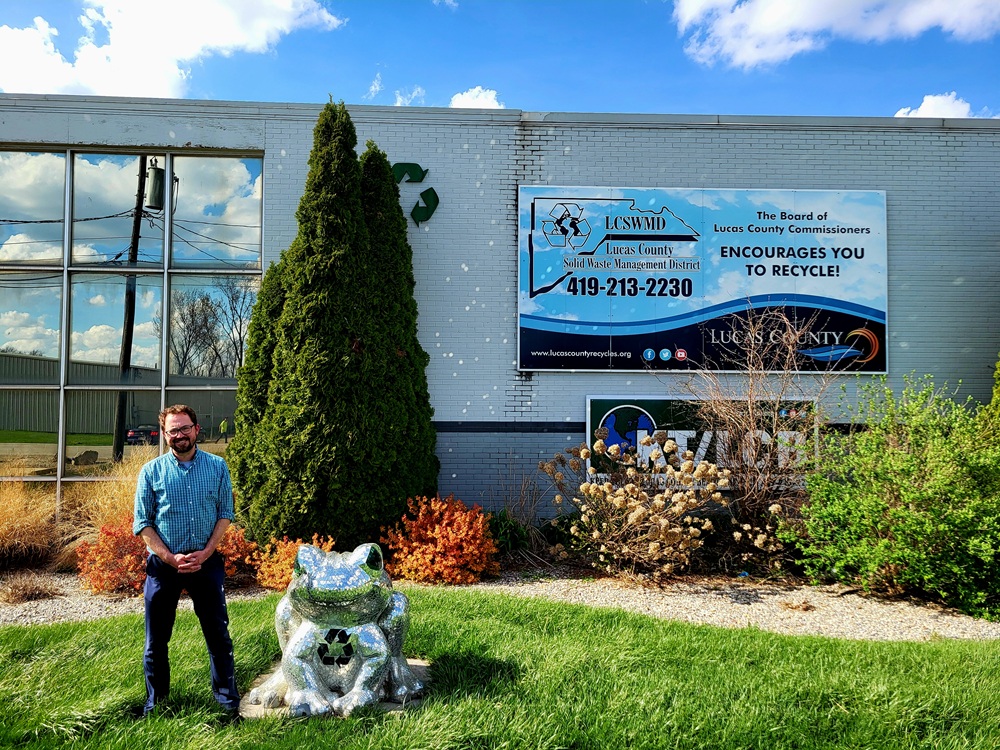
Adam Cassi, Executive Director of Keep Toledo/Lucas County Beautiful, standing outside their headquarters. (TFP photo by Steven Bieber)
Adam Cassi, Executive Director of Keep Toledo/Lucas County Beautiful, explained that these events are typically just social events, but the organization decided to take a step further and have a litter cleanup before the social event. Cassi explained that this time of year is litter season for the organization.
“Lots of litter builds up over the wintertime. Nobody likes to go out and pick up litter in the winter. So now that it’s warming up, there’s litter everywhere, especially if you drive around 475, 75, all the on-ramps and off-ramps. But that area along Summit Street in front of Toledo Spirits and TolHouse always collects a lot of litter, and we’ll be going along there and cleaning that up.”
According to a study from Keep America Beautiful, there are nearly 50 billion pieces of litter along U.S. roadways and waterways, and 88 percent of it is smaller than four inches.
While we hear about plastic in the oceans, the problem can be felt in our backyard. Cassi says that the goal is to collect the litter before it finds its way to the Maumee River and/or into Lake Erie. He also said that an estimated 2,500 tons of plastic flows into Lake Erie every single year.
While litter is bad for the environment, it is also an economic issue. Cassi explained that a city full of litter will see less business development and tourism. He also explained the socioeconomic impact of littering.
“You know, if a community is clean, they’ve typically got everybody a little bit more passion, and they are more connected.” He said, “They know that that’s socially unacceptable to litter there, and there’s a lot of pride in that neighborhood. There’s also a lot of research that says if an area is clean, it’s easier to keep it that way.”
On the other hand, if there is litter everywhere, people will be more inclined to think it is okay to throw out one more piece of litter.
Lastly, littering also poses a health risk, particularly when it comes to plastic. Cassi noted a study from the University of New Mexico that found that brain tissue carries about 4,800 micrograms per gram, which is equivalent to the amount found in a plastic spoon. Events like the one on April 21 are beneficial for the environment, the economy, and our overall health.
Cassi says that the Litter Cleanup and Green Drinks events are open to the public. He simply asks that people register ahead of time because Toledo Spirits is not usually open on Tuesdays. There is information available on their social media and on their website. He also noted that you do not have to go to the Litter Cleanup to attend the Green Drinks Event. If the cleanup is too early in the day, you are still welcome at the Green Drinks Event.
The event will be held on Tuesday, April 21, at Toledo Spirits (1301 N. Summit St.) from 4 to 5 p.m. for a litter cleanup, followed by a Green Drinks networking event from 5 to 7 p.m. There will be alcoholic and non-alcoholic beverages available. You can register for the event here.
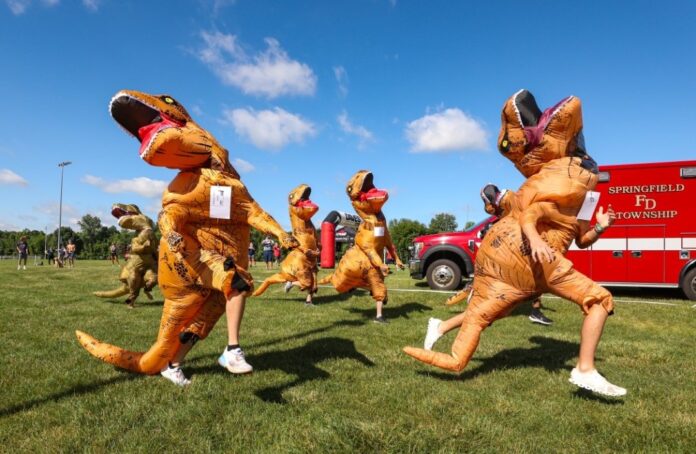
The HEROhustle, an event where local celebrities dress up in dinosaur costumes to race for their chosen charities. (Courtesy photo)
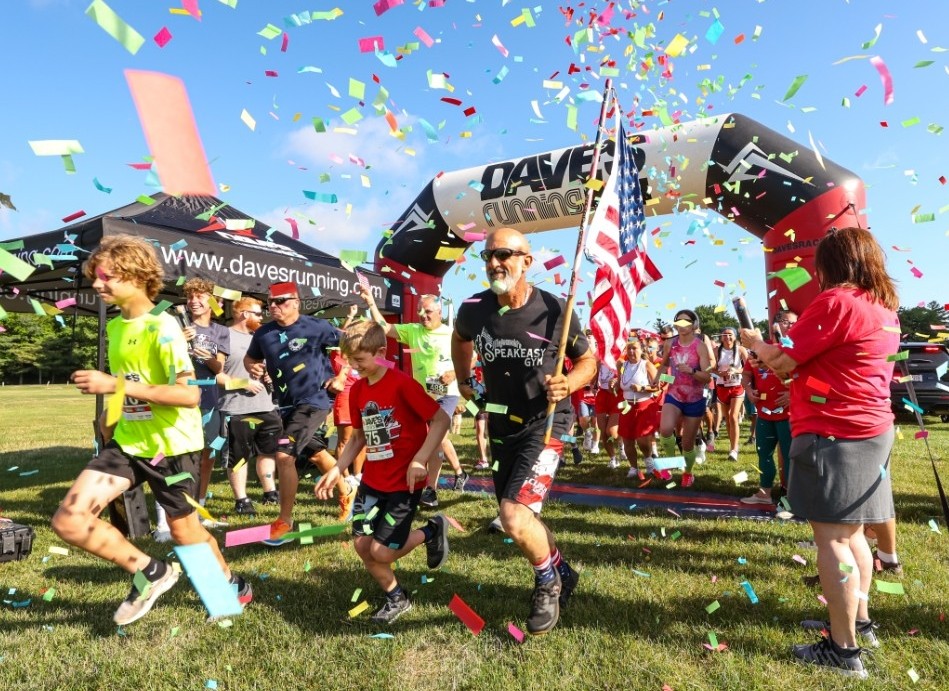
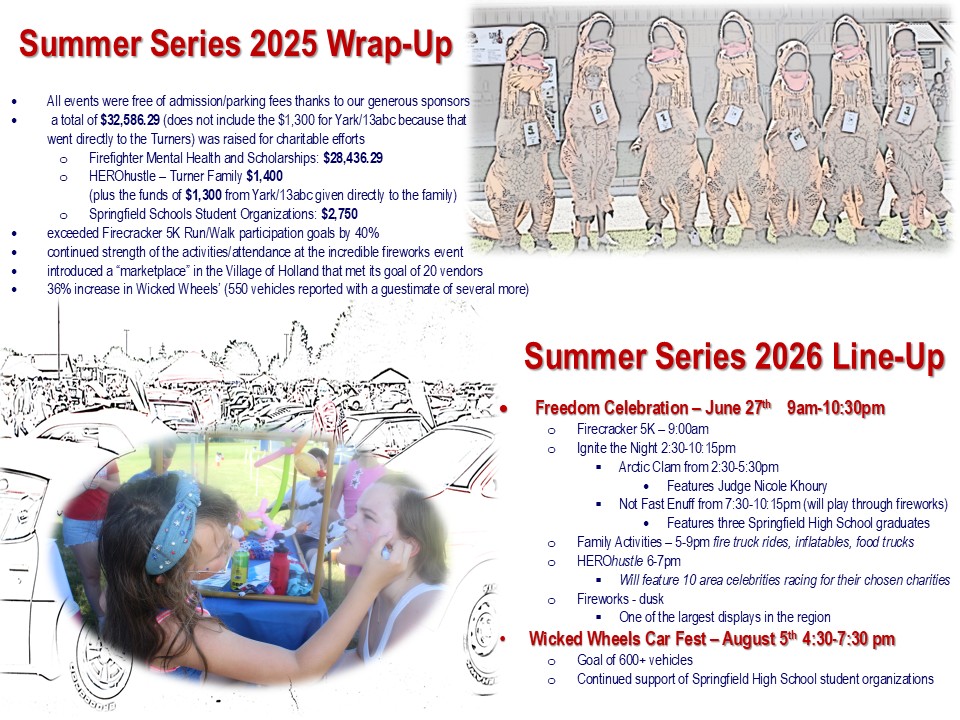
SPRINGFIELD TOWNSHIP – For 20 years, Springfield Township has held fundraising events all summer long. From car shows to fireworks, each year holds engaging activities in order to raise money for charities and get people invested in the township. This year appears to be no exception.
This year, festivities begin on June 27 at 9 a.m. with the Firecracker 5K, a run/walk activity for all ages. Following the run, Ignite the Night will include live music performances from bands like Arctic Clam and Not Fast Enüff. In between there will be the HEROhustle, an event where local celebrities dress up in dinosaur costumes to race for their chosen charities. The night is capped with a famous firework celebration.
The Summer Series festivities begin on June 27 at 9 a.m. with the Firecracker 5K. (Courtesy photo)
Since the ’90s, the township has held Annual “Freedom Celebrations,” where the township has put on firework displays and other activities for residents. Eventually, the board of trustees in Springfield decided to try and lure in people who might have never heard of the area. Kristina White, Director of Event Operations, was tasked with bringing attention to Springfield Township through these events.
“We know that there are individuals that drive through and drive past some incredible amenities that exist in Springfield Township,” remarked White. “And the trustees said, ‘What can we do to get them to stop?’ So, I proposed to them a summerlong series of events that would get people into the [township].”
Through these events, White hopes that people who are driving through stop by in an area that can be sometimes overlooked. Bringing attention to these events also helps the township fundraise for numerous charities. Since the beginning of the tradition of summer events, the township has raised funds for charities, and this year alone, the township is donating to six primary charities. With this year celebrating the 250th anniversary of the nation, the township is looking to give back to an often overlooked population of the community: veterans.
“As we were looking at Summer Series 2026, we also realized that it’s a celebration of the 250th anniversary,” noted Tommy Anderson Jr., a Springfield Township Trustee, referring to the 250th anniversary of the United States.
“So… it had to be those organizations that serve veterans in our community, that interact with the youth in our community, or can provide character building, or some type of activity that’s relevant, right in Springfield Township.”
A sense of community is the most important part of what makes these events matter to the trustees. Apart from summer events, the township also holds activities in other seasons, like a polar plunge during the winter months. A story that the trustees reminisced about involved an 82-year-old man who had wanted to come out to the event as a sort of bucket list item. The board suggested he should be around his community, and in response the man said, “If I come out, I’m getting in the water.”
Sponsors are often a marker for success in events like this, and for the township, it has become an obvious sign that the event has exploded in popularity. The trustees remarked that in the beginning, they had to ask for local businesses to sponsor the event, but now, they often have sponsors reaching out to them.
Wicked Wheels Car Fest 2025. (Courtesy photo)
A sense of community is not something that appears out of thin air, and oftentimes it takes a monumental amount of effort in order to connect people. But in Springfield Township, it comes naturally to those who seek out connection in a community that gives back just as much as they celebrate.
Mark your calendars for the events in the summer series, which is sponsored in part by the Toledo Free Press, along with other sponsors.
In this episode of Toledo Works, Stephen Zenner discusses what it is like to maintain and promote the Metroparks Toledo system. He speaks with Lorenzo Melchor, the Park Services Manager who oversees day-to-day operations at Glass City Metropark; Ashley Smith, Manager of Public Programs; and Scott Carpenter, Director, Public Relations. From maintaining the Glass City Metropark skating ribbon to leading mindful polar plunges in winter, it is an eye-opening discussion of what makes our vast system of parks such an integral part of daily life for Toledoans.
Everywhere in Toledo, you’ll find people who play a role in making our city tick – from hospitals and factories to restaurants and art galleries – and behind every person is a story. Our program, Toledo Works, highlights those stories from workers’ firsthand accounts. Each week, Toledo Free Press hosts Jaden Jefferson and Stephen Zenner focus on a different topic within the Toledo workforce, exploring their day-to-day challenges and triumphs.
Photo courtesy of Ohio Department of Natural Resources
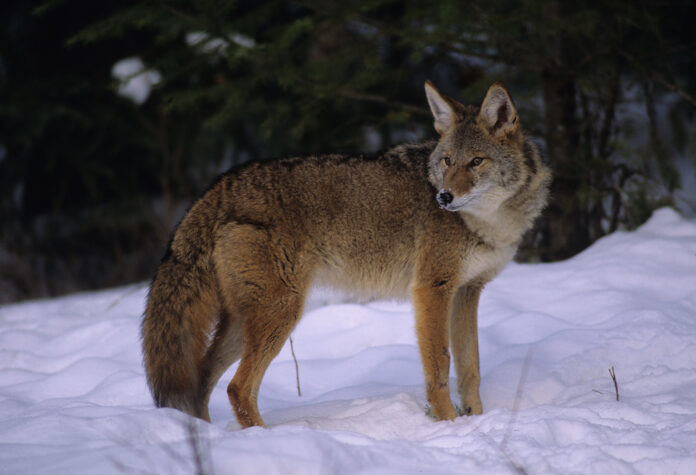
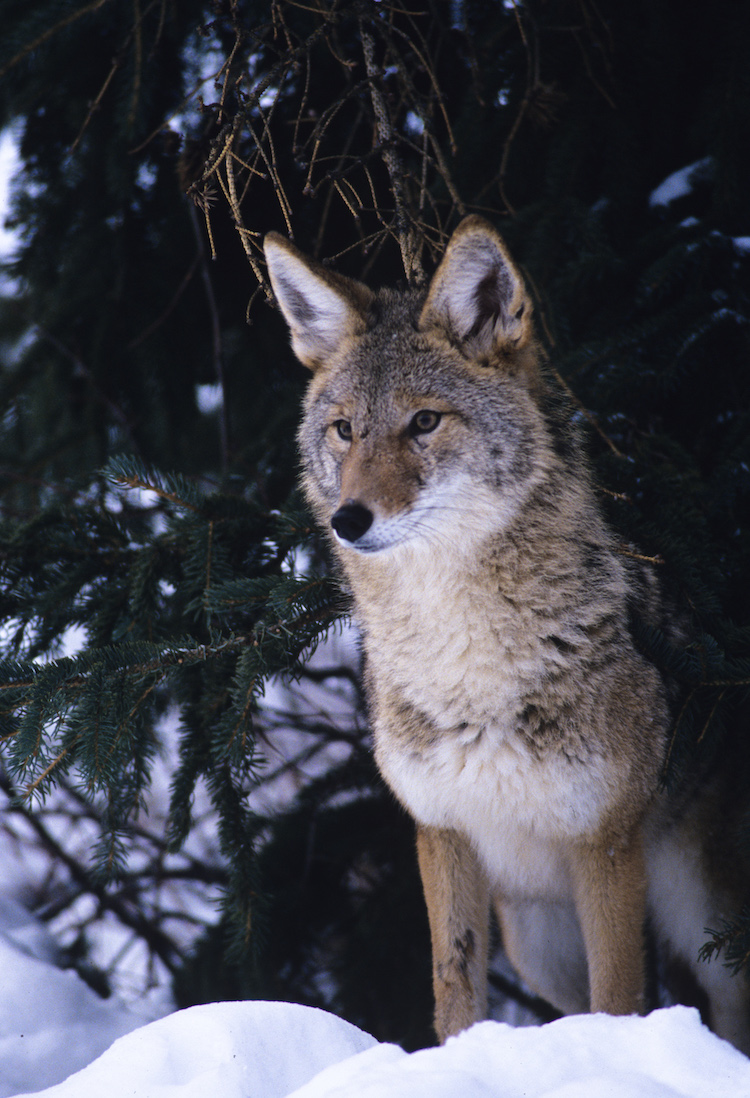
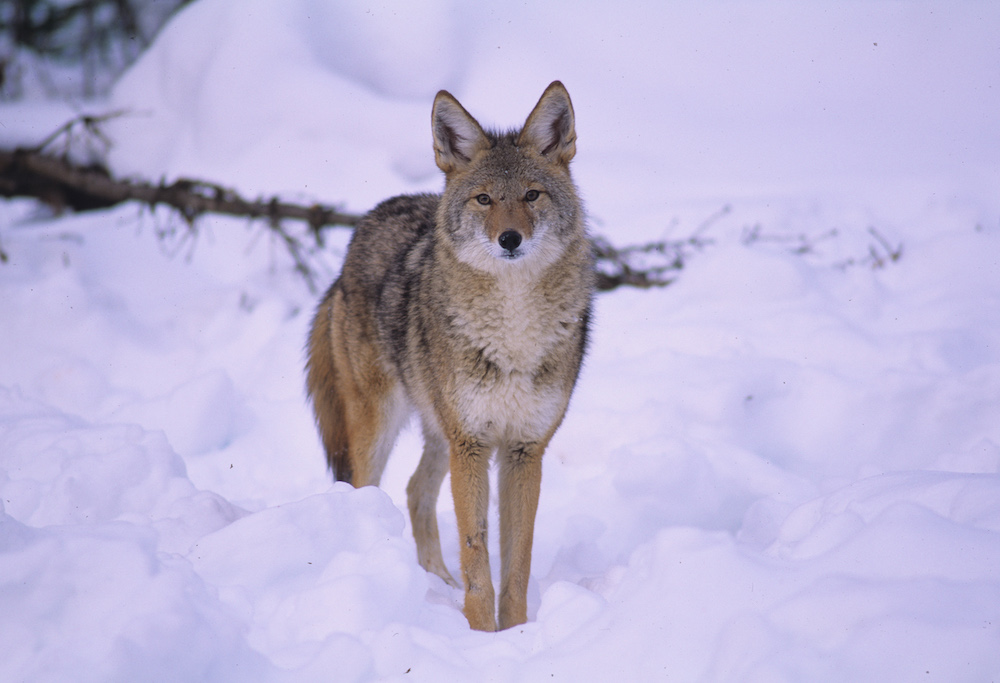
Whether it’s a pawprint in the mud, a pile of fur-filled scat or a photo on a trail cam, coyotes leave evidence of their presence all over northwest Ohio, and not just in rural areas.
“Most people don’t realize how closely they live around coyotes,” said Mike Ohlrich, the Ohio Department of Natural Resources (ODNR) wildlife officer for Lucas County. “Coyotes are very adaptive and can thrive in green spaces, not only in more rural areas but in cities.”
Mike Ohlrich. Photo courtesy of Ohio Department of Natural Resources
Metroparks personnel see signs of coyotes, and the mammals themselves, on occasion, said Scott Carpenter, director, public relations, noting that neighbors to several parks often report hearing coyote calls at night.
“Coyotes are likely present in every Metropark, but are reclusive and avoid contact with people, so it’s not very common to get a glimpse of one,” he said. “Coyotes are beneficial predators, and we would be concerned if they were not found in parks. They play an important part in the balance of the ecosystem.”
In the past, coyotes were often associated with the open deserts and prairies of the west, but as land was cleared for agriculture and larger carnivores were removed from the landscape, coyotes began expanding their territory eastward, according to the ODNR. By the 1930s, coyotes were in Ohio and, by 1988, were in every county. Bowhunter observations show that the coyote population steadily grew through the 1990s and 2000s, but has remained steady over the past 10 to 15 years.
Ohlrich believes one reason the coyote population increased is due to the decline in the number of hunters and trappers, as the interest in fur-bearing animals has waned.
Photo courtesy of Ohio Department of Natural Resources
Slender and weighing about 20 to 50 pounds, coyotes are monogamous breeders that usually mate January through March. Litters are born in March and April, with five to 10 pups each. The female maintains the den, which is often dug into the ground or utilizes a hollow log or brushy thicket. Both parents hunt for food for their offspring, but the male usually takes the lead during the pups’ early months.
Around three weeks, the young leave the den with parents, and are weaned at six weeks. By 8 to 12 weeks, the pups are taught to hunt. The coyote family stays together through the summer and mid-fall. While some young coyotes will stay with the family until the next litter comes along, most will leave and develop their own territory anywhere from 10 to 100 miles away.
According to the ODNR, coyotes are primarily nocturnal, hunting during the night. In areas where they feel less threatened, coyotes will hunt during the day. Coyotes will form a pack consisting of an unrelated alpha pair and several subordinate adults, but usually hunt alone.
While many species avoid populated areas, the coyote has adapted.
Dr. Stan Gehrt leads several coyote research projects. Both Ohlrich and Nature’s Nursery Co-Founder Laura Zitzelberger refer to Gehrt’s research as a premiere source of information on coyotes.
When she reads a comment online from someone concerned that a pack of coyotes might take out a dog, for example, Zitzelberger often chimes in with factual information.
Photo courtesy of Ohio Department of Natural Resources
“They live in packs but hunt as individuals. They barely want to take on anything that’s larger than a cocker spaniel when they can survive on something that’s much easier to catch,” she said.
In the early 2000s, Gehrt led a study in the Chicago suburbs, studying what coyotes eat, and it was found that domestic animals are just a minute part of their diet, Ohlrich said. A larger percentage is mice, rats, fruit, young whitetail deer, raccoons and other small mammals such as shrews, voles, rabbits and moles.
“The number of mice and rats they eat can be a good thing. Lyme disease is up, and the primary carrier is the white-footed mouse. Having coyotes to prey on those rodents is a good thing to keep their (the mouse) population in check,” Ohlrich noted.
He suspects that coyotes might be contributing to a declining wild turkey population, especially as these birds nest on the ground, leaving the hens – along with their eggs and polts – vulnerable to predators until they’re able to fly and roost in trees.
“We are currently doing a study on nesting turkeys and hens to learn more. So far, the limited scope of the survey shows that a lot of predation is during the nesting period,” he said. “A big part of that is mammals, but it could also be birds of prey. Coyotes are predators and definitely contributing to that.”
The Ohio Coyote Project, a collaboration between The Ohio State University’s School of the Environment and Natural Resources and ODNR, involves working with livestock producers, hunters and trappers to better understand coyotes, their diet and how they impact livestock production. One focus is how much of the coyote’s diet is domestic livestock. Another aspect being studied looks at how far coyotes travel – some up to 100 miles.
With coyotes all over, that can also result in conflict.
Several times a week, Ohlrich gets calls, and they usually fall into two categories: someone spotted a coyote where they didn’t expect to, or the coyote appears to be sick. Last year, he fielded several calls about coyotes in Maumee, including some that swam over from the islands in the Maumee River.
One woman reported that her dog was attacked by a pack of coyotes. In 2018, residents in Waterville Meadows reported that a 60-pound dog lost her tail and needed stitches on her leg. In another case, a 10-pound poodle was grabbed by the neck and had deep puncture wounds.
Research shows that the best way to avoid conflict is to leave naturally-behaving, wary coyotes alone. The signs of aggressive coyotes are similar to those of domestic dogs, such as snarling, raised hackles, lunging or growling. Making eye contact or tracking a human are not considered aggressive acts on their own, according to the ODNR.
While conflicts with humans are rare, the Ohio Coyote Project has recommendations for avoiding them:
•Do not feed coyotes, as this might cause them to lose their fear of humans and encourage them to come too close.
“They’re following a food source, whether that’s outside pet food or water bowls, or fruit trees,” Ohlrich said, noting that fruit is a decent part of a coyote’s diet.
•If a coyote is around a property too often, remove bird feeders that attract squirrels – which are another popular prey for coyotes.
•Make sure garbage and compost are properly stored.
•Do not let pets run loose, but keep them on a leash or within a yard with a six-foot fence with a roll bar on top.
•If faced with a coyote, do not run, as this triggers an instinctual response to give chase. Instead, change course and walk or back away slowly.
“Make loud noises to scare them away,” Ohlrich said, adding that If a coyote is not deterred by shouting or waving, it may be defending a den.
When he gets a call about coyotes, Ohlrich uses it as an opportunity to educate the public, but sometimes he’ll be asked how to “take care of it.” As the only wildlife officer for the entire county, Ohlrich can only provide guidance on options, the first being removing attractants. For those who live in rural areas where shooting a firearm is permitted, that is an option.
The American Veterinary Medical Association standard for humane euthanasia includes the option of a gunshot to the head, Ohlrich said. But this is only a viable option for those who are skilled and licensed, and in areas of the county where use of firearms is permitted.
Trapping is also an option in outlying areas, and is permitted year-round. Nuisance laws allow property owners to kill a coyote if it is sick, injured or causing damage or a nuisance on private property. But trapping requires an education, in order to avoid capturing an unintended target, including domestic animals or other wild animals.
The goal is to find a balance between keeping the coyote population in check, limiting conflicts and appreciating the benefits of having coyotes around.
Ohlrich points to studies showing that, in order to eradicate coyotes, 70 percent of the population would need to be removed for four consecutive years. Even missing that target for one year would allow the population to replenish in one season, as coyotes have the ability to bear more, and larger litters.
“Usually in a community, the alpha male and a female breed and the community works to raise them. If the alpha male or female is killed, all the others start breeding and the population increases,” Zitzelberger said. “One thing I’ve learned is that they do well no matter what we do. They bounce back and have more babies.”
Before taking action to remove a coyote, first determine if it’s really causing problems, Ohlrich said. If it’s not, another coyote may move into the territory – and could be likely to cause more conflict.
“It’s incredibly difficult to manage their population and lower their numbers,” he said.
When Nature’s Nursery was still located on Schadel Road, the center took in Rue – a baby coyote that someone surrendered after realizing she didn’t make a good pet, Zitzelberger said.
For the first year, Rue lived in a closet and was taken out on walks on a leash. After raising money for an enclosure, Rue lived outside and would often hang out on top of a concrete culvert or logs placed inside.
“When I was in the enclosure, we would run and play. She’d let me brush her and give her vaccines, but never once did I let my guard down,” Zitzelberger said. “I learned that coyotes are extremely intelligent, but they’re always wild. Having them as pets is insane. People think because they’re born, bred and raised in captivity that they’re domestic. They aren’t.”
For those with questions about coyotes, contact the ODNR Division of Wildlife at 800-WILDLIFE (945-3543).
Brandon Sehlhorst grew up in Toledo, studied urban planning in Cincinnati, and came back with one mission: grow this city. Now serving as Toledo’s first-ever Chief Growth Officer, he sits down with Vince Croci to talk about the bold goal of 300,000 residents by 2040, a creative $20 million shovel-ready sites fund, what happened with Southwyck Mall, and why Toledo’s tech ecosystem needs a dedicated leader.
From SimCity kid to the person reshaping Toledo’s future — this one’s worth your time.
🎙️ The Make It Happen Podcast Created & Produced by Mike Vanderpool Special Projects
Republican candidates for governor and lieutenant governor
These options are paired like president and vice president at the federal level and are in the order they appear on the ballot:
Casey Putsch and Kimberly C. Georgeton
Vivek Ramaswamy and Robert A. McColley
*Heather Hill and Stuart Moats are no longer in the race
Casey Putsch (left).
Casey Putsch for Governor
Lives in Perrysburg; from Tiffin
Political Experience:
Casey Putsch has no previous political experience.
In an interview with the Ohio Capital Journal, Putsch explained his run for governor.
“Well, the simple answer is, I looked around, and I saw options that I thought were in nobody’s best interest.”
Putsch criticized the other Republican candidate Vivek Ramaswamy for being a billionaire, and the Democratic candidate Amy Acton for locking down the state during the Covid-19 Pandemic.
“She [Acton] locked down the state — that’s a non-option. Vivek, a billionaire, he didn’t go to school in Ohio. Heck, he took a scholarship from George Soros’ money. He has no businesses in Ohio.”
Putsch has run into controversy over comments about WWII, Hitler and the Holocaust.
Education:
1999-2005 Undergraduate: Double Major from The Ohio State University
Bachelor of Fine Arts – BFA, Industrial and Product Design
Bachelor’s Degree in Industrial Design with a focus in engineering technology and robotics
Professional experience:
2018-Present: Director of Putsch Auto Media in Perrysburg
2013-Present: President and founder of The Genius Garage Racing, Aerospace and Design Programs in Bowling Green, Ohio
2008-2021: Project manager, engineer and owner of Putsch Racing based in Perrysburg and Columbus
2018-2019: Writer for Power Automedia, remote work; company based in Murrieta, Calif.
2016-2017: Manager, acquisitions and sales for Central Classic Cars in Sylvania
1997-2008: General manager of Seneca Hills Golf Course in Tiffin
2004-2005: Ferrari technician and sales at NJB Automotive in New Albany, Ohio
Vivek Ramaswamy ran as a presidential candidate in the Republican Primary 2023-2024, but lost the primary to current President Donald Trump.
Ramaswamy was part of the Department of Government Efficiency (DOGE) with Elon Musk, before stepping down from his role there to pursue the Ohio Governor’s race.
President Donald Trump endorsed Ramaswamy for the Ohio Governor.
Ramaswamy has written many books on politics and culture including:
Woke, Inc.: Inside Corporate America’s Social Justice Scam. 2021
Nation of Victims: Identity Politics, the Death of Merit, and the Path Back to Excellence. 2022
Capitalist Punishment: How Wall Street Is Using Your Money to Create a Country You Didn’t Vote For. 2022
Truths: The Future of America First. 2024
Education:
2003-2007 Undergraduate: Bachelor’s Degree in Biology from Harvard
Yale Law School Doctor of Law (J.D.)
Professional experience:
2014-2026: Founder and CEO of Roivant in New York
2022-2023: Co-Founder and executive chairman at Strive Asset Managment in Columbus
2007-2014: Partner at QVT
2007-2009: Co-Founder and president of Campus Venture Network
2017-Present: State Senator for Ohio Senate’s 1st Senate District including Defiance, Hancock, Hardin, Henry, Paulding, Putnam, Van Wert and Williams Counties and parts of Auglaize, Fulton and Logan Counties.
2015-2017: State Representative for the Ohio House of Representatives in the 81st district, which includes Henry, Putnam, Williams, and part of Fulton Counties
From Ballotpedia: McColley co-sponsored Senate Bill 23, which prohibited abortion after the detection of a heartbeat. [6] Gov. Mike DeWine (R) signed SB 23 on April 11, 2019.
Education:
2003-2007 Undergraduate: Bachelor’s of Science in Business Administration from The Ohio State University
2007-2010 J.D from The University of Toledo College of Law
Professional experience:
2017-Present: State Senator for Ohio Senate’s 1st Senate District including Defiance, Hancock, Hardin, Henry, Paulding, Putnam, Van Wert and Williams Counties and parts of Auglaize, Fulton and Logan Counties.
2015-Present: Counsel for Clemens, Korhn, Liming & Warncke, LTD.
2015-2017: State Representative for the Ohio House of Representatives in the 81st district, which includes Henry, Putnam, Williams, and part of Fulton Counties
2013-2014: Economic Development Director for Henry County Community Improvement Corporation in Napoleon
2012-2013: Associate Attorney for Leatherman & Witzler in Toledo, Ohio
2010-2011: Associate Attorney for Hyre Legal Group, LP in Columbus, Ohio
2009-2010: Law Clerk for Shindler, Neff, Holmes, Schlageter & Mohler, LLP
*Heather Hill and Stuart Moats (Republican) – WITHDRAWN * Ohio governor candidate Heather Hill was disqualified on Wednesday, April 22 after Moats dropped out as her running mate. Read the full report by WTOL11 here.