The Toledo Express Airport may be known for its four Allegiant flights to Florida destinations, or the adjacent 180th Fighter Wing, whose daily F-16 flyovers always draw attention, but the airport, which opened for air traffic in 1955, is also becoming known for its growing number of businesses.
Earlier this month, Joe Cappel, vice president of business development for the Toledo-Lucas County Port Authority, shared updates on these businesses, as well as planned capitol improvements to the airport, with members of the Toledo Express Airport Joint Economic Development District (TEA-JEDD) board.
The TEA-JEDD was founded in 2015 as an agreement between Monclova Township, Swanton Township and Toledo in an effort to spur business growth, infrastructure investment, job creation and other services in and around the airport, which spans both townships. Because townships cannot levy an income tax, Toledo is a partner and collects a 1.5 percent tax on employees, along with a percentage of net profits on businesses in the district.
The TEA-JEDD includes businesses located to the south of the runway, including Tron Air, World Wide Freight (a third-party handler for Amazon) and Willy’s Salsa, and north of the airport in the Land-Air Commerce Park, which includes Game One and Velocity.
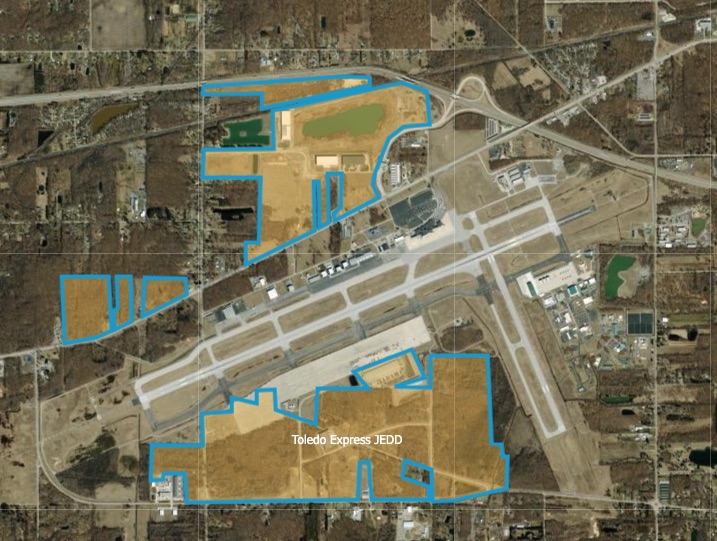
Amazon (with its third party World Wide Freight), began operations at Toledo Express in 2021 and has grown from one flight to four flights a day. Tron Air has also been successful in producing ground equipment that supports the aviation industry, Cappel said. Both companies employ between 250 and 400 people. And Willy’s Salsa is scaling up after 10 years of utilizing a refrigerated building near the airport, recently relocating to another facility on the south side of the airport.
“It’s a really cool story. They are growing in their distribution, not just locally but regionally,” Cappel said.
In 2025 the Port Authority received approximately $150,000 through the JEDD. And while that might seem like a drop in the bucket for some of the planned upgrades, the partnership helps the Port Authority leverage other grants. Those improvements will enhance the value of the airport and benefit the businesses within the JEDD, Cappel said.
“We’re reinvesting those funds into the infrastructure of the airport, and preparing undeveloped areas for additional development,” Cappel said. “The money coming back to the Port Authority is being put to work. We’re reinvesting in the airport to create more opportunities.”
In early 2026, the airport completed its master plan, with the $1.4 million cost covered by the state of Ohio capital budget, the Federal Aviation Administration (FAA), the Ohio Department of Transportation Aviation, and the Port Authority.
“The planning identifies a list of projects that the Port Authority should add to its capital improvement plan so the airport can be maintained and grown,” he said.
One of the resulting projects is the purchase of two multi-tasking snow removal vehicles for aircraft operational areas. The $1.9 million cost included $99,018 from the Port Authority.
“These will help maintain the runways and taxiways and aprons during snowy conditions,” he said.
In the next two years, the Instrument Landing System (ILS) technology will be upgraded to provide more safety during landings in low-visibility conditions like fog, snow and rain, funded through a $5 million FAA grant. The project is still in the design phase, but when finished will improve the airport from a Category I to a Category II.
“It’s a good investment for Toledo. Not every airport has this technology – only larger airports,” Cappel said.
Also in the design process are upgrades to the runway lighting system, and Cappel expects to learn about FAA grant funding by the end of the year in order to begin construction in 2027.
Also on the to-do list is the replacement of a passenger boarding bridge, at a cost of $1.9 million. The design of a new inbound baggage handling system is completed, and the $1.6 million project is expected to be underway this year.
And lastly, plans are underway to replace the HVAC system in the air traffic control tower, to make sure that employees are comfortable and have good visibility. Construction on the $1.4 million project is expected to start this year.
Managing these capital improvement plans requires coordination with the FAA, ODOT Aviation and all the stakeholders, to make sure that construction doesn’t interfere with business, he said.
“A lot of it is work that sometimes doesn’t get noticed – like plumbing or electricity or HVAC. This is an old building and it takes a lot of work to maintain and modernize it to make sure it’s efficient,” he said.
While going through the master plan, one option presented was to tear down the original structure or make significant modifications to the tune of $100 million.
“We decided to see if we can do this work in phases and steps. We believe that people will start noticing the difference,” Cappel said.