Letters to the editor and opinion submissions do not necessarily reflect the views of the Toledo Free Press.
Recently, more than 60 nonprofit organizations and mobile programs, along with community leaders, businesses and supporters, and the movement Five and Rising gathered in Toledo for the third annual IMPACT event.
The day was about collaboration. But more importantly, it was about challenging ourselves to think differently about what is possible when we stop working within the limitations of the systems we have inherited and begin imagining the systems our communities actually need.
Bert Jacobs, co-founder and Chief Optimist of Life is Good, delivered the keynote message. His message was simple, but it carries enormous implications: optimism is not about ignoring problems. It is about believing that problems can be solved, particularly when we work together.
That idea was put into practice throughout the day.
One breakout session, hosted by Social Current and RISE Northwest Ohio, brought approximately 25 community leaders together to begin a conversation about what might be required if we were to create a blueprint for the future of the social sector.
The questions were intentionally bigger than any single organization:
What does a thriving, equitable human services ecosystem look like, and what should it prioritize to meet people’s needs?
What mindsets, funding practices, policies and other barriers are keeping us from achieving that vision?
And what innovative practices, partnerships and structural changes will be necessary to create a human services system that is adaptive, community-led and adequately resourced?
These are not easy questions.
But perhaps we need to ask bigger questions precisely because the problems facing our communities are bigger than the structures currently designed to address them. Too often, the social sector is asked to solve increasingly complex problems while operating within funding models, organizational structures and assumptions that were created for a different time.
Organizations compete for limited resources. Programs are divided by funding categories. Infrastructure is sometimes treated as an expense rather than an investment. Collaboration can be encouraged in principle while the systems around organizations continue to reward competition.
The leaders participating in this gathering’s conversation offered a different perspective.
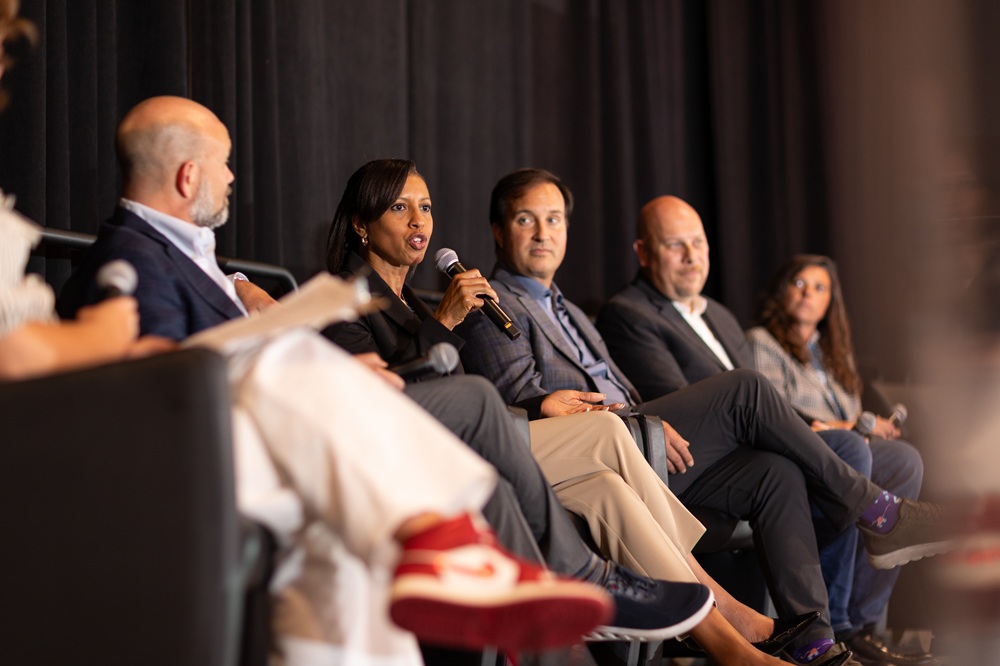
A panel of nonprofit and business leaders explored how collaboration and shared resources can drive strategic success and amplify community impact. Their advice was remarkably consistent, even though they represented different organizations and sectors.
Dream big.
Be flexible.
Don’t give up on the BHAG – the Big Hairy Audacious Goal, because someone in the community is depending on it.
Trust each other and be patient.
Recognize that every nonprofit brings a distinct perspective. Collaboration does not necessarily mean merging organizations. Complementary strengths can create more impact.
And perhaps most importantly: reject the scarcity mindset. When resources are constrained, we may need to become bigger, bolder and broader in how we think about solving problems.
That last point deserves particular attention.
There is a difference between acknowledging that resources are limited and allowing scarcity to define our imagination.
We can recognize financial realities while still asking: What would we do if we were designing this system from the beginning?
What resources already exist in our community that are not being fully connected?
What could businesses contribute beyond traditional sponsorship?
What could nonprofits accomplish by sharing infrastructure, knowledge, technology, talent or purchasing power?
What role should people with lived experience play in designing the solutions intended to serve them?
What would happen if we measured success not by how well individual organizations protect their programs, but by whether people actually experience better outcomes?
Those questions point toward a different kind of community leadership. Not leadership by one organization. Not leadership by one sector. Leadership through collaborative relationships.
The annual Care for Kids Coat Drive, which also kicks off with IMPACT, provides a wonderfully tangible example. Since the drive began in 2021, more than 11,000 coats have been collected to help children and families across the region.
A coat is a simple thing. But getting thousands of coats into the hands of children who need them requires donors, businesses, nonprofits, volunteers, transportation, distribution and community awareness. It is collaboration made visible. And that is ultimately what the conversations at IMPACT were about.
The future of our communities will not be built by nonprofits alone. It will not be built by businesses alone, government alone, philanthropy alone or individual community members alone. It will be built by all of us, bringing different resources, experiences and perspectives to the SAME table.
That does not mean we will always agree. It does not mean collaboration is easy. And it certainly does not mean that every partnership will work. It means we have to be willing to trust one another enough to try.
We have to be willing to share resources without assuming that sharing means there will be less for us. We have to be willing to challenge funding practices and policies that unintentionally reinforce the very problems we are trying to solve. And we have to be willing to imagine a future that is not simply an improved version of today’s system, but something fundamentally better.
That is where optimism becomes powerful.
Optimism is not a substitute for strategy, resources or hard work. It is what allows us to believe that change is possible long enough to do the work required to create it.
The people gathered at IMPACT were not suggesting that northwest Ohio has all the answers. They were doing something more valuable. They were asking better questions. And perhaps the most important question we can take with us from the event is this:
What could our community become if we stopped asking what each of us can accomplish alone and started asking what we can accomplish together?
Someone in our community is depending on the answer.