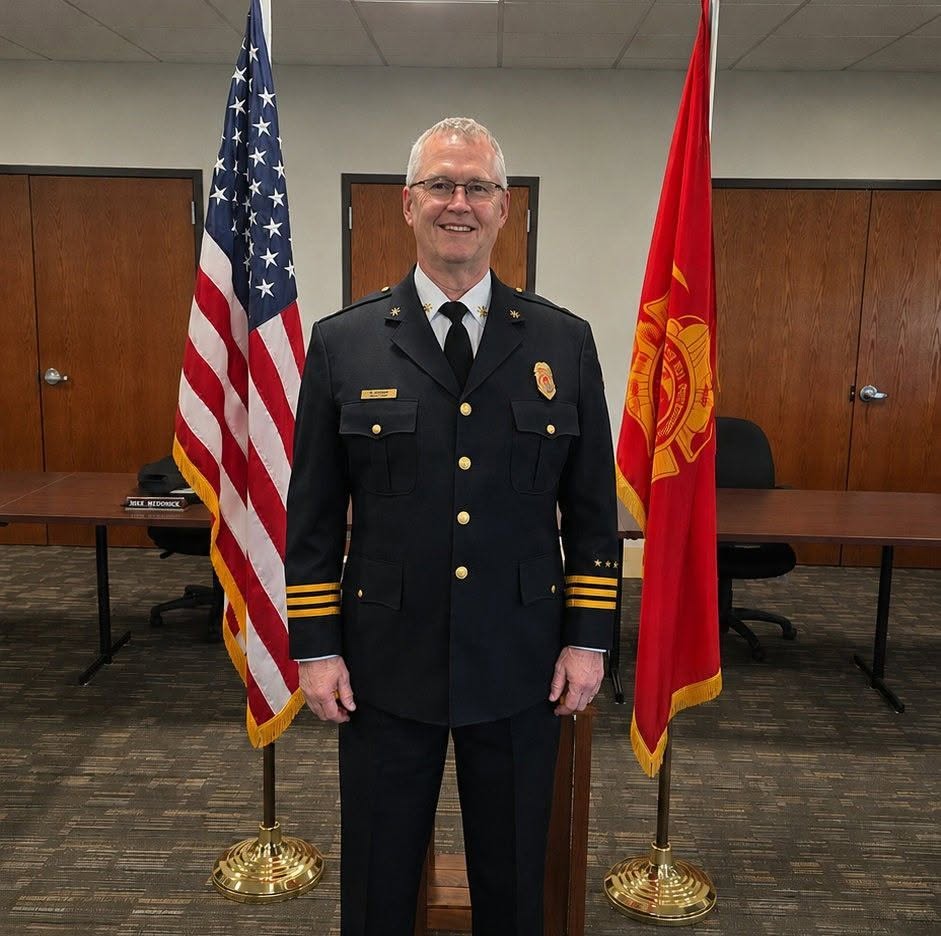
WATERVILLE – Robert Grogan Jr. may have hung up his Waterville Fire Department uniform, but his three decades with Station 77 will stay with him indefinitely.
“It has been a lot of work. But it’s not a job; it’s a passion,” said Grogan, who retired on Sept. 25 after 30 years as a volunteer firefighter. “They tell you that from the beginning – that it’s ‘Fire Department, God, Family.'”
As a locomotive engineer, husband and father, Grogan already had a full schedule when the family moved to Waterville in 1996. So when his neighbor, Kevin Noward, welcomed him to the neighborhood and asked if he wanted to join the fire department, Grogan’s initial reaction was, “I don’t have time.”
But he attended a meeting anyway, just to see what it was about – and he was hooked. With a 36-hour EMT basic and firefighter course under his belt, Grogan joined what was then an all-volunteer department. Back then, the station was located on Michigan Avenue next to the Waterville Library. The volunteers would drive to the station, don their gear and get on a truck to respond to fires, medical emergencies and vehicle accidents.
The equipment they used back then reminds him of the 1972 TV show Emergency 51.
“I started on an old LaFrance,” he said of a pumper by the now-defunct company. “And we had an old Dodge ambulance that, if you lifted up the floor mats, you could see the road.”
After a call, the firefighters would often hang out at the station and play cards or other games, and their spouses would regularly show up with food to join them. The camaraderie of the station felt like that of a second family, Grogan said.
“I have so many good stories on how the firehouse and families come together – the love and affection everyone has for each other,” he said.
As Waterville grew, so did the call volume, from under 100 to over 1300 this year. And as residents’ lives got busier, finding volunteers who were readily available all hours of the day and night got more difficult. That’s why Waterville, like many departments, transitioned to paid-per-call, then part-time and full-time staffing. Yet Grogan remained on as a volunteer, without pay, advancing from a firefighter I to a professional firefighter, commissioned as a lieutenant, then captain. Last year, he was promoted to deputy chief.
For the past 12 years, Grogan has been in charge of fleet maintenance, making sure all of the equipment and vehicles – from chainsaws and turnout gear, to fire hoses, pumps and ladders –meet National Fire Protection Association (NFPA) standards.
“There’s a lot of stuff we have to do so no one gets hurt in the line of duty due to substandard equipment,” said Grogan, who spent three days a week volunteering in that role. “Anything we use or drive was my responsibility. It’s a full-time gig.”
When the city obtained a ladder truck with a 100-foot aerial platform, many residents questioned the need. But Grogan pointed out that many of the newer houses have 20-foot vaulted cathedral ceilings, and the aerial allows firefighters to fight the flames from above without risking lives and putting people on a roof that could cave in. He also noted that many homes are at least 30 feet back from the road, and the 100-foot ladder barely makes it to the house.
“It’s a beast. It’s everything that I could ask for in a truck. You can put out fires, put a ladder on someone’s roof. It’s so universal what you can do with it. It’s an impressive piece of equipment,” he said, adding that the city’s frontline fleet is one of the best in the state.
The behind the scenes work is not top of mind for residents, who just know that when they call 911, someone will be there, said Grogan, who continued to go on calls with the department even as a deputy chief.
Many calls over the years stick with him, but he laughs at recalling an inebriated man who stepped into a plate glass window. The man was arguing with the police officer who wanted to take him to the hospital. When Grogan showed up and introduced himself, the man dubbed him “Fire Officer Bob,” and allowed him to bandage up his many lacerations.
“Then he got in the back of the police car and puked,” Grogan laughed. “And he admitted that maybe he should go to the hospital. I saw him a few weeks later at Kroger, and he called me Fire Officer Bob. Even in his worst moment, he remembered.”
As both a locomotive engineer and first responder, Grogan saw his share of death – and that’s something he doesn’t care to remember.
“We’ve all seen it and been through it. Your fellow firefighters are the ones that really understand. Having the camaraderie in the firehouse helps,” he said.
In those early years, especially, the firehouse would be the scene of practical jokes and fun times as well: such as playing water ball or hosting chicken barbecues for the community.
“I loved flipping chicken,” he said, adding that the recipe for the sauce spritzed on the chicken is a closely-guarded secret.
While Grogan loved his experience with the fire department, he acknowledged that it wouldn’t have been possible without the support of his wife, Candy, and their sons Drew and Tommy. He missed a lot of birthday parties and Christmas gatherings to leave early to help others in the community. His sons got to ride in the truck during the parade, and often came to the station.
“It’s been a good ride. I got into it to give back to the community. It was something I thought was important: neighbors helping neighbors,” Grogan said.
In retirement, Grogan hopes to continue helping the department, volunteering at events and possibly serving on the Public Safety Committee and teaching fire classes at Bowling Green State University. A certified locomotive engineer, Grogan is working on his steam locomotive certifications. He is also training his second German Shepherd, Huck, to possibly work as a therapy dog in local nursing homes.
To Assistant Fire Chief Dave Moore, who coordinated Grogan’s retirement ceremony, the newly retired volunteer set the standard.
“He exemplified what it meant to be a true volunteer. They are few and far between, those who are willing to put in that much time for absolutely zero pay,” Moore said. “He was appreciated for all his hard work.”
In his departure, Grogan left a detailed packet of information so the transition is easier. The department is planning to create a support services type of position to take over all of the duties that Grogan covered.
On Saturday, Oct. 10, Grogan will be in civilian clothes hanging out at the fire station during the Fire Prevention Week open house, held from noon to 3 p.m.