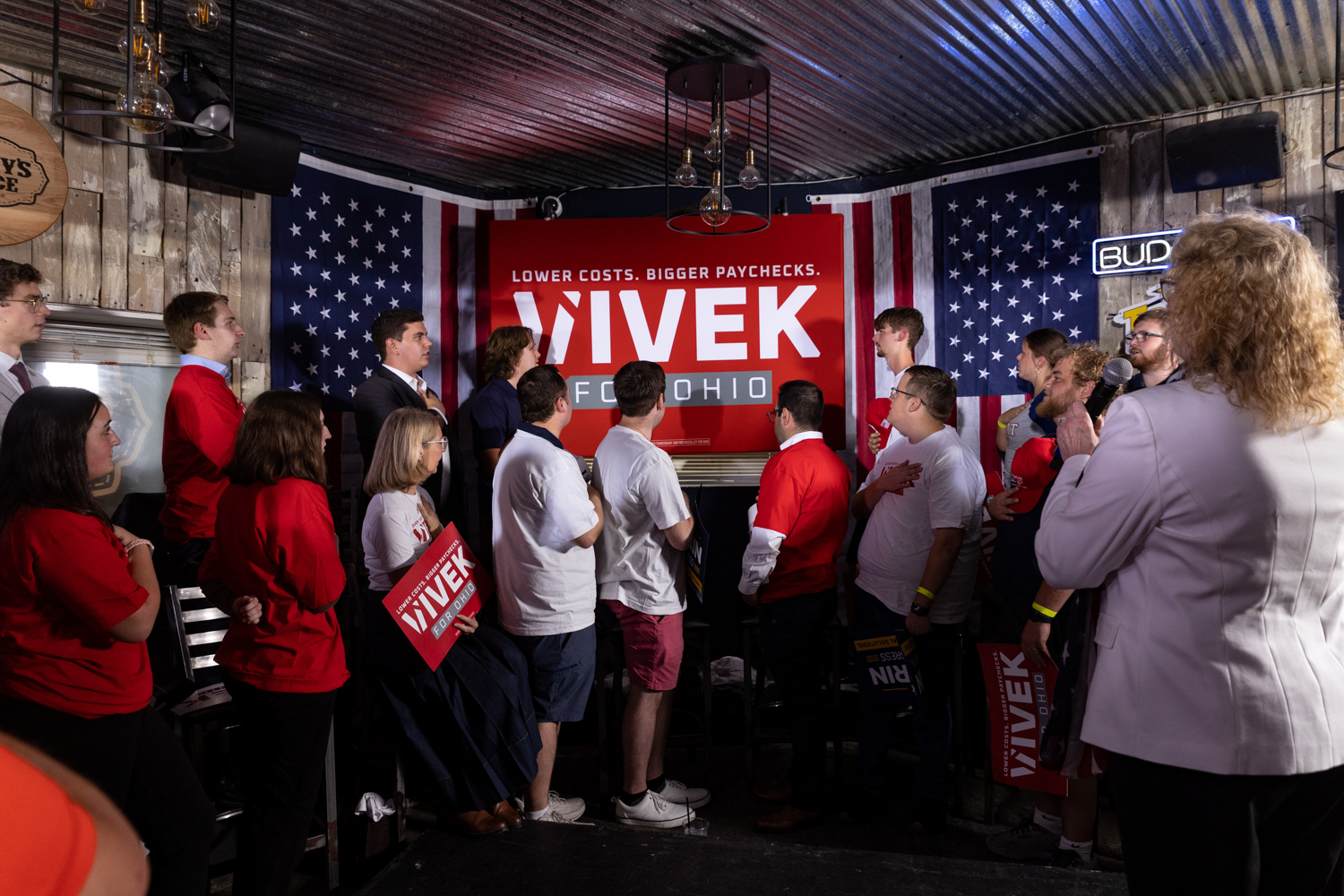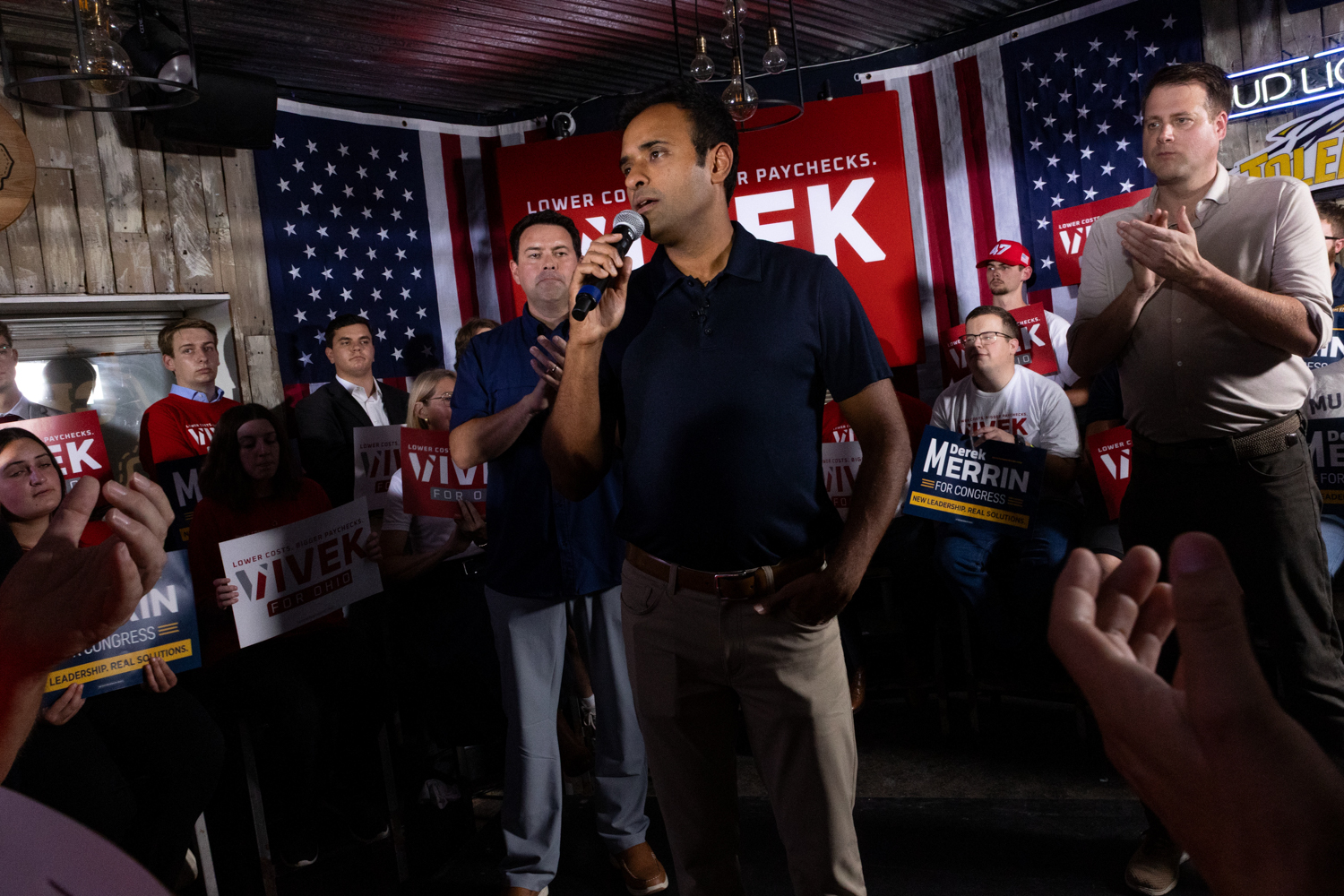
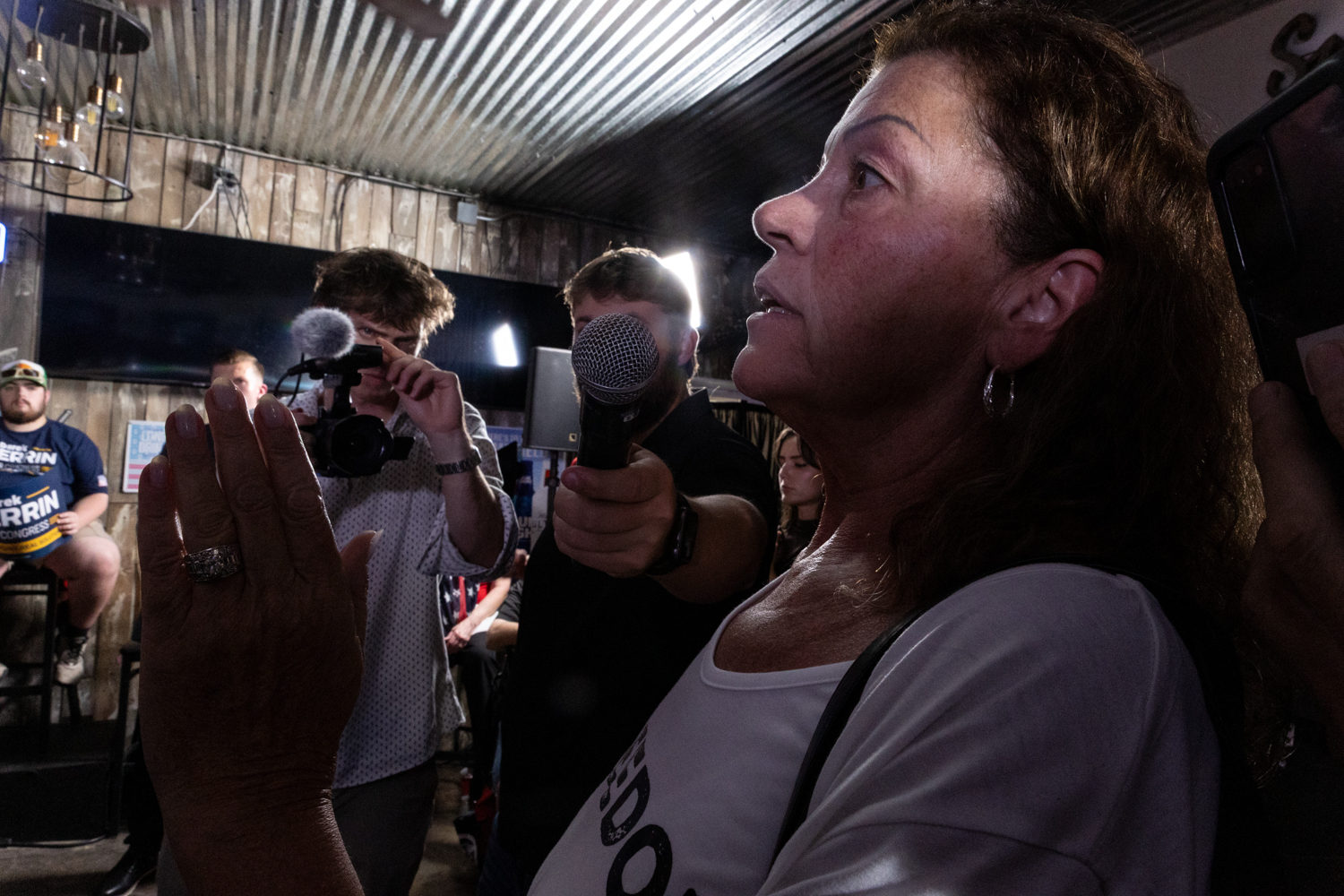
TOLEDO – Over a hundred people were crammed elbow-to-elbow inside the downtown country bar Chevy’s Place to hear Ohio gubernatorial candidate Vivek Ramaswamy speak during a recent Republican rally.
A crowd donning both red and blue eagerly waited for hours to hear from Ramaswamy, his lieutenant governor running mate – Ohio State Senator Rob McColley – and Rep. Marcy Kaptur’s challenger in Ohio’s 9th Congressional District, Derek Merrin.
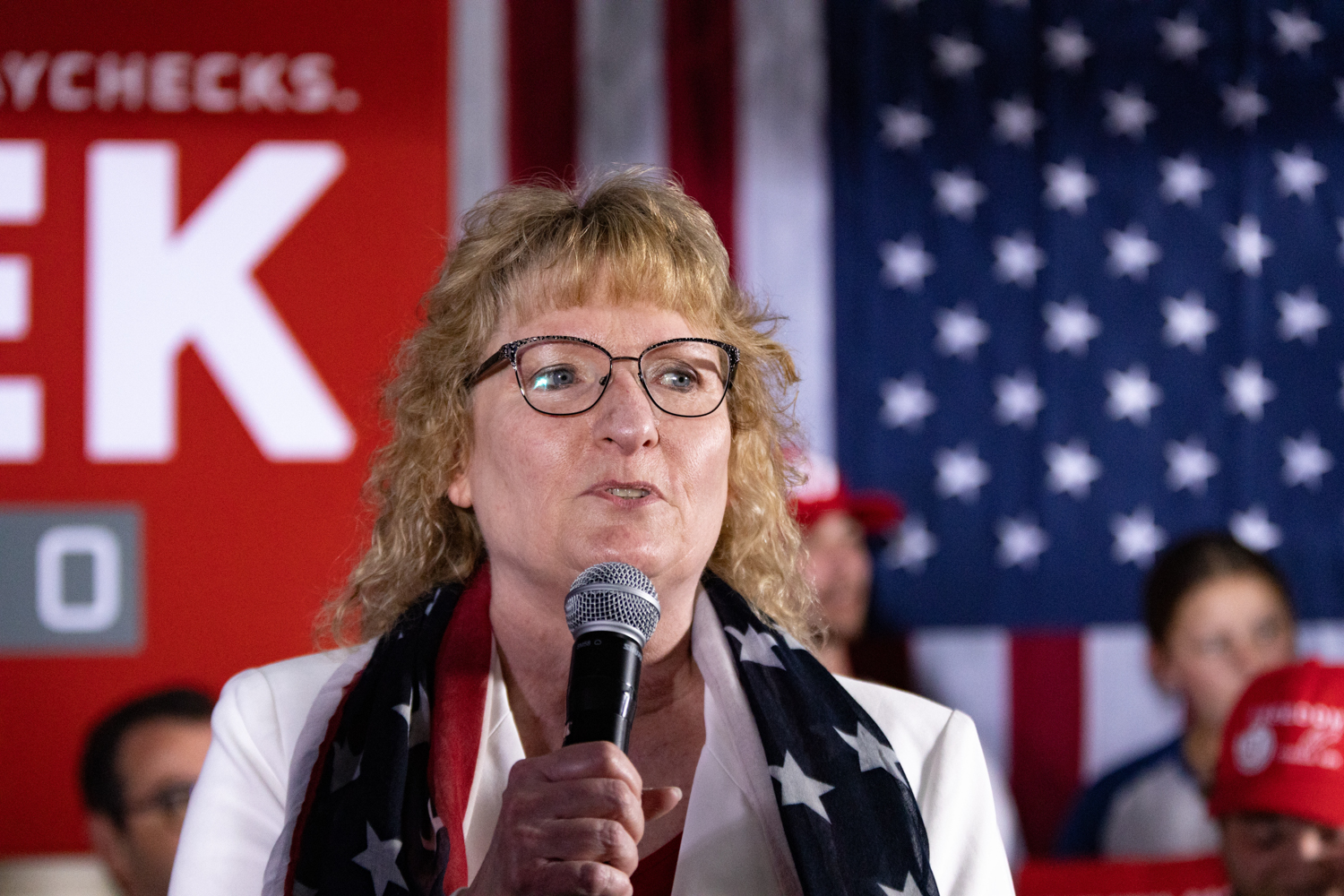
Merrin takes shots at Kaptur
Merrin began by thanking the Ohio Young Republicans, who helped organize the event along with the Lucas County Republicans.
Jacob Sargent, the chief of staff for the Ohio Young Republicans, bragged that Ohio’s chapter of the Young Republicans was the largest in the nation at 1300 members, then handed off the mic to Merrin, who warmed up the crowd by speaking against the well-established Democratic Representative Kaptur.
“We’re going to win this race,” Merrin said, and promised conservative leadership going forward.
Merrin also spoke critically of Amy Acton, the Democratic gubernatorial candidate for Ohio, and Kaptur for both refusing to debate their Republican opponents.
Kaptur has not made any statements recently about refusing to debate Merrin, but back in 2024, she criticized Merrin’s campaign funding and accused Merrin of simply attacking her instead of standing for issues. She said she did not want to platform Merrin and called him an “unserious candidate.”
“She doesn’t want to have to stand and give an explanation of why she believes men should play in women’s sports,” Merrin continued.
Merrin’s first accusation that Kaptur supports trans athletes seems to be false, as Kaptur has begun running an aggressive ad declaring that, “Boys should not play girls’ sports,” and supporting “Parents’ Rights.”
Members of the broader Democratic party and Ohio LGBTQ activists have criticized both Acton and Kaptur for not supporting trans rights.
Earlier this year, Kaptur voted with Republicans for H.R. 2616, the Stopping Indoctrination and Protecting Kids Act, requiring parental approval before changing a student’s gender markers, or the school could risk losing federal funding.
Previously, Kaptur had voted for and co-sponsored the Equality Act, outlawing discrimination based on sex, sexual orientation or gender identity, and voted against the Protection of Women and Girls in Sports Act in 2023 and 2025.
Toledo drag queen and Libertarian David Gedert, who was in the race for Ohio’s 9th Congressional District before losing in the May primary, accused Kaptur of playing politics at the expense of marginal communities in The Buckeye Flame, a pro-LGBTQ publication.
A spokesperson for Merrin had similar sentiments about Kaptur, coming from the opposite political spectrum, when talking with The Blade.
“Her record clearly shows that she is the one lying when she says she does not want men in girls’ sports,” Merrin said.
Taxes
“She doesn’t want to have to give an account for why she wants to take more money out of senior citizens’ pockets by continuing to tax their Social Security benefits,” Merrin said at the rally, continuing his attack on why Kaptur doesn’t want to debate him. “Why do you continue to tax the waiters’ and waitresses’ tips?”
Without saying it outright, it is likely Merrin is referring to tax cuts included in the One Big Beautiful Bill Act (OBBBA), which was the source of contention between Democrats and Republicans.
All Democrats opposed the OBBBA as well as Republican Senators Susan Collins of Maine, Rand Paul of Kentucky, and Thom Tillis of North Carolina, and House Republican Representatives Brian Fitzpatrick of Pennsylvania and Thomas Massie of Kentucky.
On July 3, 2025, Kaptur explained her vote against the OBBBA in a press release, and later called the legislation a “redistribution of wealth from the poor to the ultra rich.”
Her biggest criticism of the bill were its $1 trillion in healthcare cuts, followed by the $186 billion cut to Supplemental Nutrition Assistance Program (SNAP) over a number of years, the reduction in tax credits and incentives for clean energy, and adding $3.4 trillion to the deficit while continuing tax cuts included in the 2017 Tax Cuts and Jobs Act (TCJA).

Data Centers
“If you’re against data centers, why did you vote in Congress for federal tax breaks for data centers?” Merrin continued to ask of Kaptur.
Incumbent Kaptur has not outright voted for tax cuts for data centers. In fact, Kaptur is a co-sponsor for the new bill, Reverse Big Ugly Tax Breaks for Data Centers Act, which seeks to reverse parts of the OBBBA that benefit data center construction. The two main parts of the OBBBA that help companies building data centers are the 100 percent bonus depreciation deduction, allowing companies to write off 100 percent of expenses upfront, and the Opportunity Zone benefits, encouraging development in low-income areas and removing capital gains taxes on appreciating assets.
Indirectly, the Inflation Reduction Act (IRA) allowed tax breaks for clean energy in the form of solar, wind and nuclear, which Kaptur did vote for. And since data centers need power, the IRA indirectly supported data center growth in this way.
Currently, the Ohio legislature is attempting to roll back their tax cuts for data centers. The first sales tax for technology equipment was passed in Ohio in 2011 as part of an amendment to Ohio’s 2011-13 budget, to attract technology companies, in the 2011 HB 153 [not to be confused with the 2025-26 HB 153].
Later in the next Ohio budget bill, HB 59 for the years 2013-14, this sales tax exemption was widened.
On Aug. 2, 2016, Merrin was sworn into office as an Ohio State Representative, and served in the state legislature until 2024.
“I never had the opportunity to vote for a tax break for data centers, and I never did vote for a tax break for data centers,” Merrin said, pointing out the initial push for data centers happened five years prior to his term.
The campaign led by Merrin has disputed Kaptur’s assertion that Merrin voted for tax breaks for data centers, but Merrin did vote for HB 49 on Wednesday, June 28, 2017.
This was another bill amending Ohio’s operating budget and exempting data center equipment and construction materials from Ohio’s sales and use tax. HB 49 specifically goes over the eligibility of tax breaks for data centers in Section 122.175 in the bill, from pages 130-140 and lines 4066 to 4374 in the legislation text as it was introduced.
The official Ohio state analysis of that section of the bill reads on page 334: “The fees affected are those for the job creation, job retention, motion picture, small business investment, and New Markets Tax credits; community reinvestment area and enterprise zone property tax exemptions; and a computer data center sales and use tax exemption. The amounts of the fees are unchanged.”
At the time, data centers were not the same as they have become in the past two years, and this was a small extension of the tax breaks within a very large bill with many parts, unrelated to data centers.
Ironically, Merrin ended his words on data centers during the rally by attacking Kaptur, “You got some real gall to accuse someone of doing something you did.”

Decline of Ohio
During some rapid fire closing remarks, Merrin remembered the height of Ohio’s industrial power.
“We had a robust economy. We had high-paying jobs, and in 1949, Toledo was the fifth wealthiest city in America regarding median household income,” Merrin said, and then blamed Ohio’s decline on Kaptur, for the past 40+ years.
He threw out an allegation that Kaptur didn’t really live in Ohio, and instead lives in an “almost million dollar” condo in Washington, D.C.
While the value of the condo is unknown, Kaptur does own a condo in the D.C. area, but her primary residence is listed in Toledo. There is no standard for staying in the capitol city for representatives, but a story by Business Insider showed that “44 senators and 194 US House members had such [rental/additional] properties in 2020…”
Merrin said members of Congress should have term limits, and proposed making a constitutional amendment to force the change.
He then added, “We need a constitutional amendment, I believe, to force the politicians into a box to balance the budget.”
After that he said, “I believe in secure and safe elections,” and said he advocated for the SAVE America Act and against illegal immigration.
New district
Last year Ohio’s 9th Congressional District was redrawn for the third time in 20 years. The new district is thought to give Republicans an advantage of 9 percentage points.

McColley hypes Ramaswamy
After Merrin’s tirade on Kaptur, he hyped up the next speaker from Napoleon, Ohio: Ramaswamy’s running-mate, Rob McColley.
Both men traded praise for the other before McColley fully took over the stage.
“Vivek, myself, and Derek, all of us were born after Marcy Kaptur got into office,” McColley said jokingly, “that’s a sad state of affairs.”
Then he asked the rally goers, “What, Ohio, do you want to wake up to on November 4th?” the day after the general election, and juxtaposed the potential realities.
Cheers came when he described his dream of retiring Kaptur, and electing Ramaswamy, whom McColley called the most conservative governor the state has ever had, although it is unclear what would qualify him as such compared to previous Republican governors.
Boos abounded when he described having Kaptur in office for two more years, and electing what McColley called “a bona fide socialist as our next governor,” referring to Acton.
Acton is a Democrat, but has not identified herself as a socialist, as other members of the Democratic party have, most notably Bernie Sanders, the senior United States Senator from Vermont, Alexandria Ocasio-Cortez (AOC), representative for New York’s 14th Congressional District and, most recently, Zohran Mamdani, the current mayor of New York.
Without further specification, it is unclear what McColley means when he describes Acton as a socialist, but the context of his speech seem to refer to her actions during the Covid-19 pandemic, when she advised Ohio Governor Mike DeWine during the 2020 shutdown he ordered (not an explicitly socialist policy, but potentially referring to things as “socialist” as a short hand for big government).
“She was the first health director in the entire country to close down our schools, leaving these schools closed for nearly two years,” he said and referred to the “learning loss” that occurred for children during the time that schools were closed.
California issued a stay-at-home order a few days before Ohio, but Acton advised Ohio Governor Mike DeWine, who issued the first shutdown of schools, bars and restaurants. DeWine has stated he should be blamed for the shutdown, as it was his decision, not Acton’s.
Members of the crowd along with McColley accused Acton of quitting during the pandemic, referencing her stepping down from her position as the Director of the Ohio Department of Health in June 2020 and then exiting the DeWine administration altogether in August of the same year, leaving her role as his chief health adviser.
There’s not a clear-cut reason Acton has stated for her departure from DeWine’s administration, except that the time of the pandemic came in stages, and she transitioned.
Many suspect that as the pandemic became more politicized, she did not want to deal with pushback from protesters against the lockdown and political opponents to health orders.
One member of the crowd who opposed Acton explained in more detail: “Ohio’s not ready for a woman governor, not someone who is gonna’ quit when she gets death threats,” said Susan Theisen of south Toledo, and commented that Acton was going to “lock us down.”
Leaning into the difficulties of the Covid-19 pandemic, McColley described individuals who could not be with their aging loved ones in nursing homes and hospitals during the lockdown, blaming Acton, and then moved to criticize Acton’s unwillingness to debate Ramaswamy.
“If you cannot debate, you cannot run this state,” he said, and combined it with the quitter narrative he built up previously. “Amy Acton cannot handle the pressure of making decisions that impact the daily lives of Ohioans,” he said.
Closing and transitioning to his running-mate, McColley shared an anecdote about Ramaswamy’s eldest son, Karthik, who continuously interrupting Ramaswamy while political guests were at Ramaswamy’s home. McColley shared the anecdote, cementing an image of Ramaswamy as a family man, who is able to balance family and business/politics easily, eventually holding Karthik, after he interrupted multiple times, showing his son affection and continuing to talk politics.
Ultimately, McColley said he felt confident in Ramaswamy’s leadership, because he knew he was creating a better Ohio for Karthik, Ramaswamy’s son.
Ramaswamy living the American Dream
Referring to how the country had turned 250 years old this year, Ramaswamy waxed poetic about the founding of America, and what it means to be an American. Quickly recalling major moments throughout American history, he brought everything up to the present day, and focused on how the founding and ideals had directly allowed his family to succeed.
“I’m doing this because I know we can have an impact, and because I am grateful to the state where I was born and raised, to this country, for allowing me to live an American dream that is only possible in this country,” Ramaswamy said.
From southwest India to southwest Ohio, he told the story of his family’s American dream, culminating with the success of his biomedical companies.
Right now, he said, there is a “fork in the road for the future of this state. We’re at a fork in the road for the future of our country,” and he spoke out against socialism.
Equating socialism with an attitude towards success, Ramaswamy said, “What is our attitude towards success in this country? See, I believe success is something that we should celebrate…My opponent believes that success is something that we should penalize.”
Acton has not said she is socialist or wishes to penalize success, but the interpretation of her advice during the 2020 lockdown may be interpreted as a hindrance to free enterprise or as Ramaswamy has categorized it, “success.”
“Do you believe in free enterprise, or do you believe in socialism?” he asked the crowd.
Then Ramaswamy said he would, “deliver the biggest property tax cut this state has ever seen,” making Ohio a state that Texas, Tennessee and Florida would look up to.
When Ramaswamy said he would cut property taxes, a number of people in the crowd started yelling, “God bless America,” which Ramaswamy repeated, as did several others in the crowd.
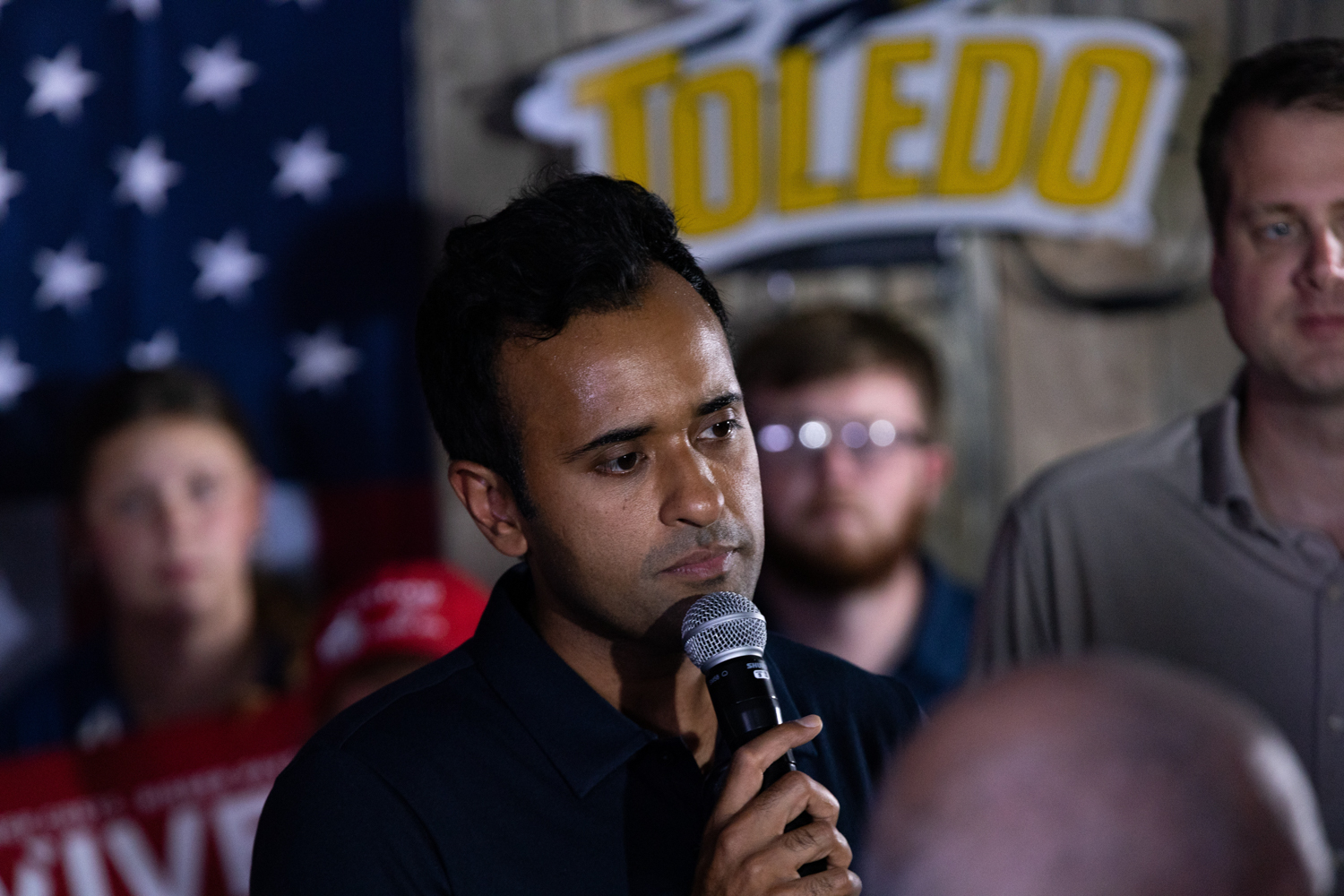
Crowd Q&A
Property taxes and education
Fielding questions from the crowd Ramaswamy began with an eight-year-old girl who said she just wanted to make everyone happy.
This crowd pleaser was followed by a woman named Kirsten, who said, “I currently pay 14 percent of our family’s incomes for property taxes…I’m facing the choice of which of my kids gets to go to preschool – $1,400 a year.”
Jumping back to one of his main campaign promises, Ramaswamy promised to have the biggest property tax cut of any state.
Since schools are funded through property taxes in the state of Ohio, Ramaswamy talked about how educational performance in Ohio has declined.
The Thomas B. Fordham Institute, a conservative think tank, saw a decline in ACT scores in Ohio from 22.0 to 20.3 between 2017 and 2018 with a continued downward trend to the present. Before 2017, Ohio was above the national average, and dropped below in 2018. National average ACT scores still remain above Ohio’s average, but the national trend mirrors Ohio’s downward trend.
“Property taxes are insanely high in the state of Ohio. And here’s the irony…educational performance has actually declined,” Ramaswamy said.
Educational decline is not limited to Ohio, and it is a nationwide problem. The Center on Reinventing Public Education (CRPE) specifically focuses on the decline in U.S. math scores, post-pandemic.
Information from the Hoover Institute indicates that math and reading scores in U.S. schools have been declining since 2013, with the pandemic accelerating math score decline and tapering reading decline.
Kirsten remarked that public schools produced an “unequal outcome” because they were forced to shut down.
Ramaswamy added, “It’s a morally wrong outcome.”
“Your income, your social security stream, has stayed flat while you owe twice as much in property tax,” he said, and said he would cut property taxes without hurting local police, fire, or schools.
Math, reading and writing were the focus of his education push to “bring back standards to public schools…get rid of woke indoctrination,” and pay teachers a higher starting salary, above $38,000 a year.
“It’s all the overhead and the bureaucracy that is choking our system and hanging our kids out to dry, while our seniors have to move out of their houses because they can’t make their property taxes,” he said.

Ramaswamy still DOGE?
Another man from the crowd asked Ramaswamy about his part in the Department of Government Efficiency (DOGE), and if he was still committed to getting rid of waste, fraud and abuse in the government.
In response, Ramaswamy said he was committed to those goals, and that he would start with Medicaid fraud, something the federal government under the Trump administration has focused on.
“$47 billion a year that we spend on Medicaid, at least 10 percent of that, $4.7 billion a year, is waste, fraud, and abuse going to home healthcare providers, nursing home providers that don’t even exist in many cases,” Ramaswamy said.
He said he would “strike a deal with the federal government that says, for at least a period of time, I’ll make this a top priority in Ohio if we get to keep a majority of the savings that we recoup.” Ramaswamy explained that “Tennessee did it first, and they have recovered billions for their state. They call it TenCare,” and proposed BuckeyeCare for Ohio.
Fixing the medical system, Ramaswamy said, was more important than forgiving medical debt.
His opponent, Acton, has focused on forgiving medical debt, drawing inspiration from JB Pritzker’s actions as governor of Illinois, to forgive medical debt. Using $10 million to forgive $1 billion in medical debt through the use of a nonprofit has been one touted success of the Pritzker administration.
Georgetown University’s Research Professor Andy Schneider wrote about Medicaid fraud at the beginning of 2025, citing Ohio’s improper payment rate at 8.2 percent.
“The December 2024 report lists examples of the different kinds of fraud against Medicaid (and Medicare) that the agencies have identified and prosecuted. Among those convicted are ambulance service providers, durable medical equipment suppliers, diagnostic labs, nursing homes, pain clinics, pharmacies, physical therapists, physicians, and substance use treatment providers,” Schneider wrote, and explained that to crack down on Medicaid fraud would be to follow the money.
Of note: Healthcare providers are the beneficiaries of Medicaid fraud, not enrollees in the program.

Ohio, land of data centers?
Expressing a bit of confusion, a member of the crowd, Jody Torok, of Holland, Ohio, asked what the truth and lies were about data centers.
Starting from basics, Ramaswamy explained. “It takes electricity, energy, literally converts electrons into what they call compute using a bunch of chips to do it,” he said. “It’s just a giant empty building that produces what they call computing power to train artificial intelligence.”
There didn’t seem to be a specific stance from the crowd. One man yelled in favor of them, but most of those in attendance listened attentively.
“Does it benefit a local community or not if it’s built there?” Ramaswamy asked, making that his criteria for whether a data center was a good fit for Ohioans.
Unfortunately, he said, “communities are seeing a lot of disruption without seeing any benefit,” and promised in the future, “you’re going to get free electricity paid for by the overage” from data centers.
He went on to talk about different policies he would put in place to regulate data centers. “No property tax abatement for the data center. Instead, you expand the base of property taxes, take their revenue, and put it directly in the pockets of homeowners.”
Clean water needs to go into data centers, and he said it should come out just as clean, and advocated for “no more NDAs [non-disclosure agreements]” for data centers.
“Vegetative insulation should be a requirement,” he said, meaning trees should be built all around the centers to insulate the noise.
No farmland was another of his requirements, and he instead recommended using abandoned industrial sites to build the centers. With these steps, Ramaswamy said he would set a national example.

Immigration
One gentleman was asked about immigration enforcement, and what Ramaswamy’s policies would be like. The individual was against letting more people in, but felt it was wrong to deport people who had lived in the United States for decades.
Ramaswamy applauded the man for having nuance, but said Ohio could not have sanctuary cities. “We have to enforce the rule of law,” he said, and felt being lax on immigration would encourage a breakdown in the rule of law.
Refresh on the American Dream
“We are a great state,” Ramaswamy reiterated. “Okay, we’re not Illinois. We’re not Minnesota. We’re one of the best in our region, and I think that’s great,” he said, and advocated for an “aggressive approach to cutting red tape and taming the regulatory state.”
“That is how we get it done in Ohio,” he said, and talked about building more 1700/1800-square-foot starter homes.
“I want you to get a high-paying job. I want six years to six figures when you graduate from high school or graduate from college,” he said, and mentioned stepping down the income tax gradually.
In closing, Ramaswamy said, “We’re going to usher in a new dawn for the American dream, a new dawn for the state of Ohio, a new dawn not for the Rust Belt, but the state that leads America back to greatness.”