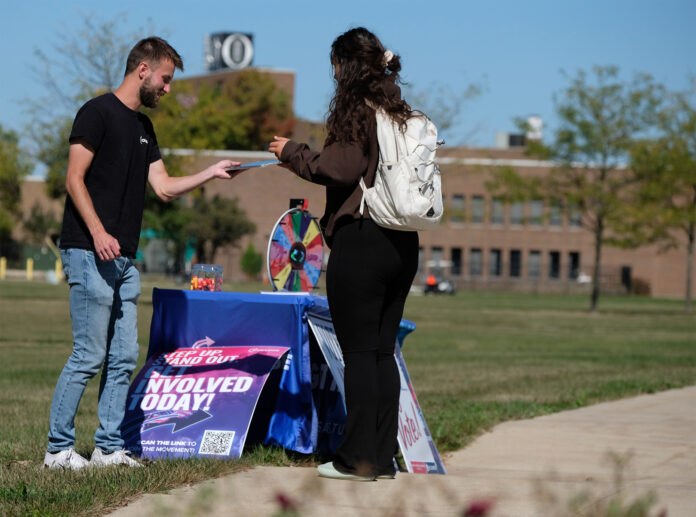
Lucas Zielinksi, with Turning Point USA, hands Amelia Mathkour, a music, business and tech major at Owens Community College, a pamphlet about voting registration. Zielinksi said he was on campus for the day to help students register to vote. (TFP Photo/Lori King)
Lucas County Board of Elections explains voting details, process
Toledo – With Election Day a month away, preparations are in full swing at the Lucas County Board of Elections office.
“We’re up and running and getting everything ready,” said Timothy Monaco, deputy director of the elections office. “It’s a wonderful time. It’s important to exercise your right to vote.”
Logistics that the staff and officers have been handling for weeks on behalf of Lucas County’s 303 voting precincts include preparing ballots, training precinct election officials, and getting early voting dates and times posted on their website.
Monaco said the most commonly asked question from voters during the past couple of weeks has been when absentee ballots will arrive in the mail.
Here’s the answer: Ohio voters can look for the absentee ballots starting Oct. 8, which is one day after registration ends for the Nov. 5 election.
The Lucas County Board of Elections staff doesn’t give predictions on voter turnout, Monaco said. But, according to state election records, 67 percent of registered Lucas County voters participated in the 2020 presidential election, and 66 percent did so in the 2016 presidential election. This participation includes absentee voting, early in-person voting and traditional Election Day voting.
Those choices are meant to help all eligible voters participate, whether they prefer going in person to a local polling site or to cast a ballot before they travel out of town.
“It’s important to make your plan as to who you are going to vote for,” Monaco said. “Make sure you make a plan and know what is on your ballot.”
While the presidential campaign is the key race of the Nov. 5 election, there are also races in Lucas County for local judges and city officials. For those who want to see the list ahead of time, ballot proofs are available for review on the election board’s website.
“Ballots will be three pages for everyone and four pages for some,” Monaco said.
While some people remember how they wish to vote when going to the polls, others find it helpful to bring paper notes or refer to a list on their phone, Monaco said. “Some folks really come prepared,” he said.
“It’s also important to be respectful at the location,” he added, referring to an Ohio law that prohibits photos of marked ballots. “We do ask that you limit cell phone use at the ballot.”
Military and overseas civilian voting: Started Sept. 20.
Voter registration deadline: 9 p.m. Oct. 7.
Early in-person voting season: Oct. 8.-Nov. 3.
Absentee ballot postmark deadline: Nov. 4.
Election Day: Nov. 5.
CAMPUS TALK
OWENS COMMUNITY COLLEGE STUDENTS SOUND OFF ABOUT VOTING
Question: How important is voting to you?
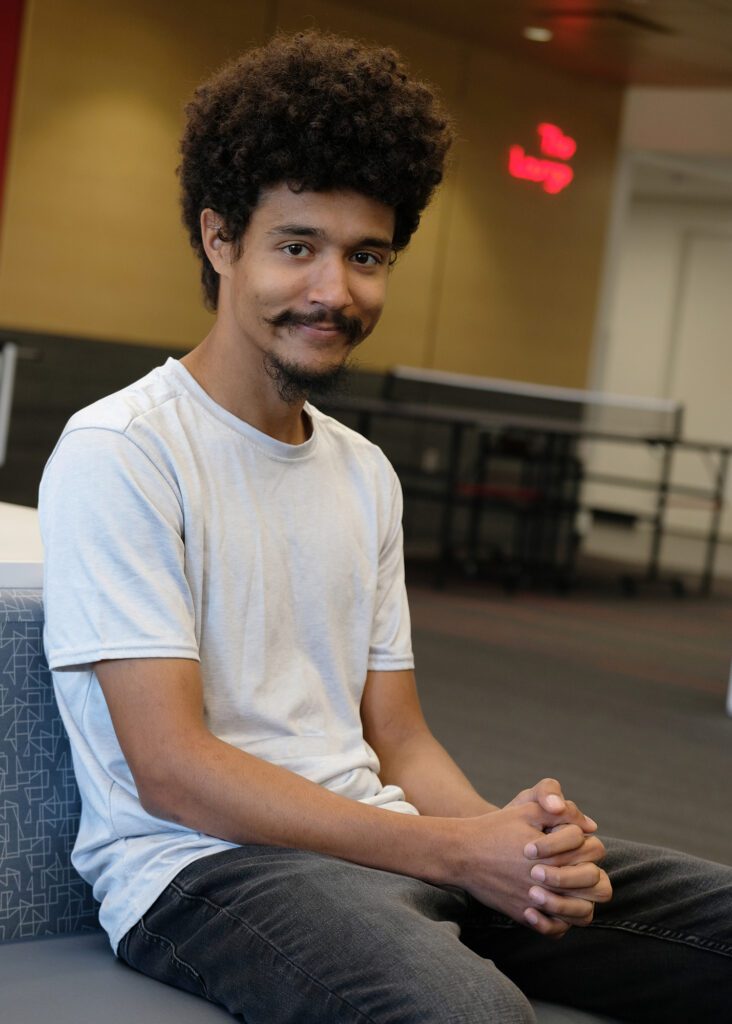
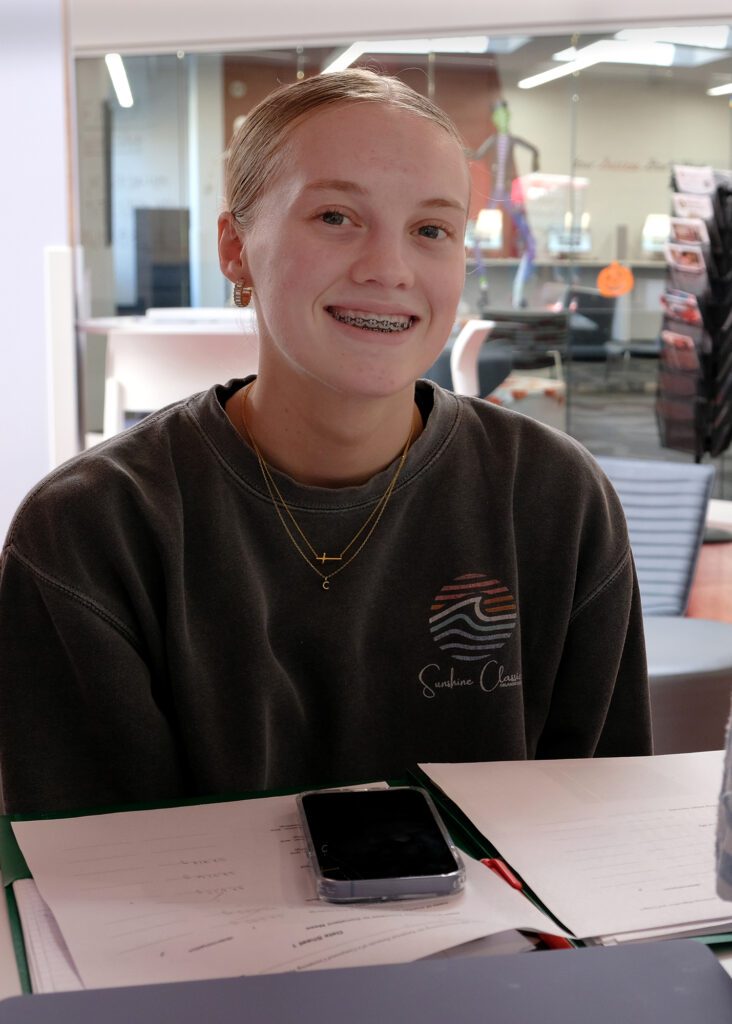
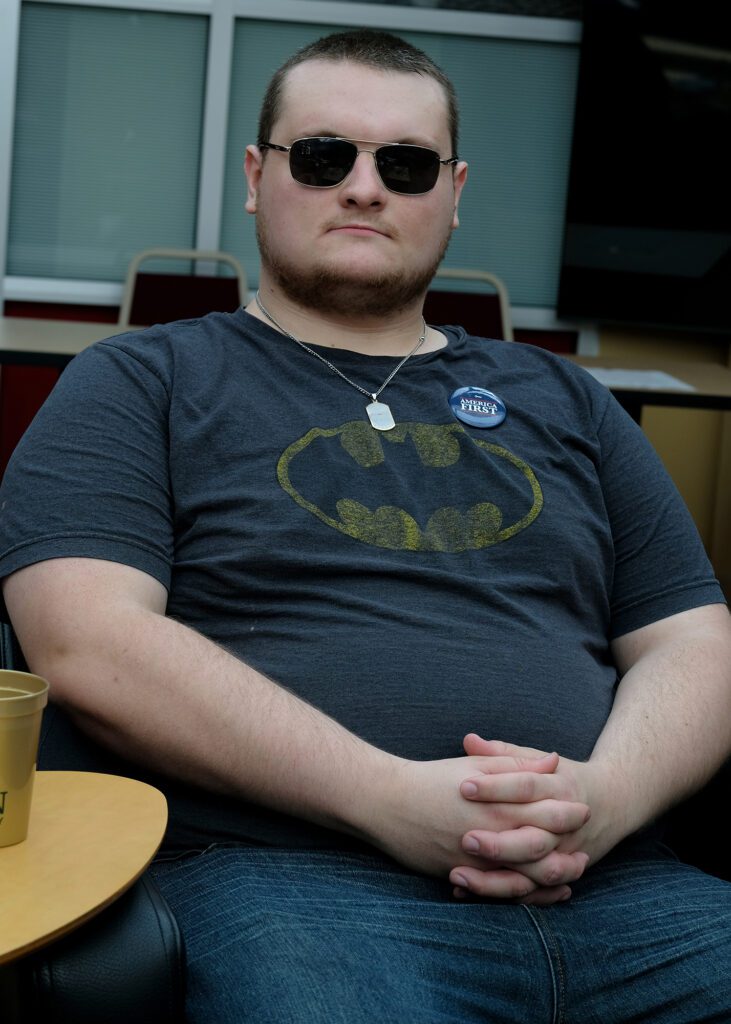
Oliver OdendahlJames JohnsonNivant DawsonSydney StanleyDavid Case III
Voting is not my main concern, but it is pretty important because it is the future of America and I would like to have a say in what is gonna be my future. I usually try to vote on voting day, if I can’t I’ll do the absentee ballot.
Oliver Odendahl | EMT Major | Tontogany Resident
I am not a registered voter. If I was to lie to you I’d say yes. But honestly, I don’t have enough time … it’s not really a main priority, even though it should be. I do plan on voting at some point, maybe when I’m in my adult phase. Even though I’m not a registered voter I do think voting is important because it basically determines the society and the rules and regulations we live by.
James Johnson | Broadcast Media Technology Major | Toledo Resident
I’d say voting is very important. There’s certain aspects of it that do feel sort of depressing, when you think about it, because a lot of people would say people voting normally wouldn’t matter because of a small majority in the Electoral College – their votes matter 100 times more than your own. That’s what it feels like at least from what I know. It does feel a little degrading knowing that’s going to happen.
Nivant Dawson | Business Major | Toledo Resident
I think voting is important, but I’m not exactly sure why it’s important. I mean, there’s a lot of things that come from it. You’re voting for someone that you’re putting your trust and you’re faith into to guide us all in the right direction, but we just all don’t know what that direction is yet. So, we’re just kind of free-balling it, in a way. So, I don’t know … I’ve never voted before but this will be interesting. I really don’t know what all is involved. I just have a lot to learn about voting – like what I should be looking for in the leader I’m going to be voting for. So, yeah, it’s coming up soon. There’s a lot to learn.
Sydney Stanley | Chemistry Major | Millbury Resident
Voting is very important, especially in this day and age, when everything’s going on.
David Chase III | Literature Major | Toledo Resident
Registration details

Ohio voters must be registered by 9 p.m. Oct. 7 to be eligible to vote in the Nov. 5 election.

Residents can register to vote, look up voter registration, change their address, find an early voting location, look up Election Day polling location or track an absentee ballot at VoteOhio.gov.

Photo ID requirement

Bring your photo ID when voting. The options are:

- Current Ohio driver’s license or State of Ohio ID card.

- Interim ID form issued by Ohio Bureau of Motor Vehicles.

- U.S. passport or U.S. passport card.

- U.S. military ID card, Ohio National Guard ID card or U.S. Department of Veterans Affairs ID card.

A registered voter who has changed his or her name since the photo ID was issued will need to show proof of legal name change and sign a form. A photo ID card can show a former address if a current address is on file with the voting records. If you forget a photo ID, you can request a provisional ballot.

How to vote absentee

An absentee ballot in Ohio needs to be requested, signed, dated and submitted for each election. Military personnel and civilian overseas voters can file one application for all elections happening in a given year.

The application asks for the number on your Ohio driver’s license or Ohio ID card, last four digits of your social security number, or a photocopy of other eligible ID such as a U.S. passport or military ID.

Mailed absentee ballots must be postmarked by Nov. 4 and can be hand delivered to the Board of Elections on Nov. 5.

Additional instructions are on the Ohio Secretary of State’s website.

In-person early voting

Ohio’s in-person early voting season begins Oct. 8 and ends Nov. 3.

The Lucas County Early Vote Center is at 3737 W. Sylvania Ave. Suite 121 Entrance C (at the rear of the Lucas County Board of Elections building) in west Toledo.

Voting times and dates can be found at LucasCountyOhioVotes.gov.

Election Day voting

Polling sites are open in Ohio from 6:30-7:30 p.m. on Nov. 5. You can look up your polling location at VoteOhio.Gov.

What’s on the ballot?

A “ballot proof” is available for review on the Lucas County Board of Elections page. It lists candidates and ballot issues by precinct, so voters know what to expect.

For example: Six president/vice president candidate teams have declared in Ohio, with an additional write-in option available. Other candidate races include U.S. Senator, Lucas County Sheriff and openings on Toledo City Council.

Ohio Issue 1 is a proposed state constitutional amendment that has gained a lot of attention. This issue, if approved, would designate a redistricting commission to draw state legislative and congressional districts.

There are other issues locally, such as a proposed bond issue for the Toledo-Lucas County Public Library and a tax renewal request from the Toledo-Lucas County Port Authority.

Are ballot “selfies” allowed?

Ohio does not permit photos to be taken of a marked ballot. It’s actually a fifth-degree felony should that take place, according to Ohio law.

The “I Voted” Sticker

A traditionally popular way to showcase voter participation is through an “I voted” sticker, picked up on Election Day at the polling site.

Ohio’s current “I Voted” sticker design was adopted in 2019 through a student art contest. A red squiggle depicts a map of Ohio, nestled in a blue circle outline, with the phrase “Ohio Voted.”

Voters are invited to download the image to share on social media at the Ohio Secretary of State website. That website also has also a “future voter” coloring page for children available for download.

Is campaigning allowed at election sites?

Ohio does not allow election campaigning, also known as electioneering, within 100 feet of a voting site. This means no campaigning messages on attire such as shirts or hats, Monaco said.

Two small United States flags are placed at each voting site to designate the “neutral” zone where this applies.

Where is the Board of Elections office?

If you need to visit the Lucas County Board of Elections regarding a voting matter, that office moved about two years ago from its former location at One Government Center to 3737 W. Sylvania Road in West Toledo.

When are election numbers official?

Ballots cast on Election Day will be delivered in person to the Lucas County Board of Elections for the counting procedures.

There will be numbers reported after that count is complete.

The Ohio Secretary of State does not consider voter counts to be official until two or three weeks later, after provisional ballots are accounted for and to give time for absentee ballots to arrive that met the postmark deadline.
(All events are compiled from press releases and other public announcements)
The Toledo area always has something going on, from live shows and family-friendly activities to protests and community meetings. Here are some of the events to check out. If you have something you’d like us to consider adding, please reach out!
Saturday, Oct. 3 –10 a.m. – 5 p.m. – Dundee DDA Presents the 9th Annual Pumpkin Palooza/ Great Pumpkin Commonwealth Certified Giant Pumpkin Weigh-Off. The weigh-off will be held in the Municipal Parking Lot on the north side of the River Raisin, just across the river from the Old Mill Museum. These pumpkins can weigh well over 1,500 pounds!
Visitors can also expect to see an assortment of impressive giant produce, including watermelons, squash, long gourds, mammoth tomatoes, towering cornstalks, and enormous sunflowers. Registration for growers and items being weighed will take place from 9 – 10:30 a.m., with the official Giant Pumpkin Weigh-Off beginning promptly at 11 a.m. Ample off-site parking will be available throughout Dundee.
FREE family fun begins at 10 a.m. with pumpkin carving, a vendor and craft show, Black Swamp Ghostbusters, a balloonist, a Meet & Greet with Bluey & Stitch, and more!
Saturday, Oct. 3 – Levis Commons Town Center invites the community to its Pink Party from noon – 2 p.m. in honor of Breast Cancer Awareness Month. The FREE event includes live music, mocktails, nail painting, balloon twisting, face painting, friendship bracelet making and giveaways, and will benefit the Breast Cancer Research Foundation in its efforts to support those in the community impacted by breast cancer. Come early for an outdoor Pilates class led by instructors from Body Alive at 11 a.m. outside Yankee Candle. Participation is available with a suggested $10 donation.
Wednesday, Oct. 14 – At 7:30 p.m., the Music Business Technology students from Owens Community College present the first performance of the 11th Annual, 2026-27, Accent on the Arts concerts, featuring Warren & Flick. Jacob Warren plays double and tenor bass and Grant Flick plays violin, tenor guitar, and nyckelharpa, drawing from classical, jazz, and folk traditions. Learn more about them at WarrenandFlick.com.
Accent on the Arts is a FREE concert series designed, booked, promoted, and presented by Music Business Technology students. The concert will be at the Mainstage Theatre in the Center for Fine and Performing Arts on the Owens Community College Toledo Campus, 7270 Biniker Rd., Perrysburg.
Thursday, Oct. 15 – the Lucas SWCD is offering Vermicomposting 101 Class at 5:30 p.m. Registered participants will learn about composting, how to compost using worms, and leave with a vermicomposting tub and starter pack of worms to take home. The class is $50 per participant and space is limited. Register online at LucasSWCD.org/vermicomposting.
Thursday, Oct. 15 – Sunday, Oct. 18 – North American Tour launch of THE BODYGUARD at The Stranahan Theater (4645 Heatherdowns Blvd.). Purchase tickets at BroadwayInToledo.com and StranahanTheater.com. Group ticket savings for 10+ are available by contacting [email protected]. Ticket prices vary by showtime and seating.
Based on the 1992 film starring Whitney Houston and Kevin Costner, THE BODYGUARD is a thrilling, romantic musical that combines high-stakes suspense with unforgettable music. Former Secret Service agent turned bodyguard, Frank Farmer, is hired to protect superstar Rachel Marron from an unknown stalker. Both expect to be in charge of their situation – what they don’t expect is to fall in love. Read more about the show in David Yonke‘s TFP article here.
Friday,Oct. 16 – Party in the Park (Promenade Park) – From 6-9:30 p.m., enjoy Party in the Park on the Road in Uptown District featuring Funk Factory & Not Fast Enuff.
Saturday, Oct. 17 – Lucas County Children’s Services Trunk or Treat will take place from noon to 2 p.m. at the Believe Center (1 Aurora Gonzalez Dr.). At this FREE event, kids can enjoy receiving free candy and seeing mascots and costumed characters.
Friday, Oct 16 – Sunday, Oct. 18 – The Toledo Opera presentsAida by Giuseppe Verdi at the Valentine Theatre. Torn between love and duty, Aida stands at the center of a tempest of passion, loyalty, and impossible choices. Captive in ancient Egypt, the Ethiopian Princess must navigate her love for the heroic Radamès, her devotion to her homeland, and the schemes of the jealous Princess Amneris. Toledo Opera’s original production brings Verdi’s unforgettable arias, soaring duets, and breathtaking choruses to life, immersing audiences in a story of desire, sacrifice, and destiny.
Tickets can be purchased at toledoopera.org or by phone at 419-255-7464. To learn more about the season, visit toledoopera.org. Read more about the productions in a behind-the-scenes TFP story here.
Sung in Italian with English Captions
Friday, Oct. 23 – Anne Grady Services and Courageous Community Services host Enchanted Evening, creating opportunities for individuals with developmental disabilities. The event will be held at Parkway Place, 2592 Parkway Plaza, Maumee, from 6 – 9 p.m. Guests will enjoy dinner and a live and silent auction, all while supporting the programs and services that support individuals with disabilities. Tickets are $125 and can be purchased here.
Tuesday, Oct. 27 – As a part of International Bat Week, Lucas SWCD in partnership with Inspired Lumber Workshop is hosting a Build a Bat House Workshop from 5:30-8:30 p.m. Participants will learn the value of bats, bust some myths, and build a bat house to take home and install on their property. Space is limited! Register online here.
Thursday, Nov. 5 – Lucas SWCD’s 62nd Annual Meeting – Lott Industries in Toledo. Doors will open at 5 p.m. and dinner will begin at 5:30 p.m. Tickets can be purchased online at LucasSWCD.org/annual-meeting.
Thursday, Nov. 12 – Lucas SWCD invites all to a Seed Bombs and Pollinators class! Participants will learn about the power of pollinators through fun, interactive activities, and get to make a native seed bomb to take home and plant! Class is from 4-5:30 p.m. Register online here.
H.M.S. Pinafore by Arthur Sullivan & W.S. Gilbert
February 19 & 21, 2027
Valentine Theatre
After more than four decades, H.M.S. Pinafore returns to Toledo Opera, bringing Gilbert & Sullivan’s signature wit, music, and high-seas hijinks to life. Onboard, the captain’s daughter Josephine hopes for love with the humble sailor Ralph Rackstraw, despite her father’s plans to marry her to the pompous Sir Joseph Porter. Mischievous sailors, scheming relatives, and the bumbling Little Buttercup, whose long-held secret turns everything upside down, ensure laughter, surprises, and joyous music throughout. This original production combines rousing choruses, clever wordplay, and unforgettable characters for an evening of nautical fun the whole family will enjoy.
Tickets can be purchased at toledoopera.org or by phone at 419-255-7464. To learn more about the season, visit toledoopera.org. Read more about the productions in a behind-the-scenes TFP story here.
A whitetail buck. (Photo by Art Weber, nature photographer for Metroparks Toledo)
The shortening days trigger change for our male whitetail deer. It’s time for the males – the bucks – to shed the soft velvet that’s nurtured antler growth through the summer months and start showing off their stuff.
With the velvet gone, the bone-hard antlers are ready to be strutted to impress the does, to rub trees and shrubs to mark territory, and to battle any rival bucks that challenge their turf. No two sets of antlers are created equal. Larger and more intricately branched antlers signal dominance and are favored over challengers in battle. They’re also said to show strength and strong genetics to impress the does.
This conceptual rendering of an inclusive playground shows how the equipment and the setting is designed for use by children and families of all abilities. The Metroparks and the city of Waterville are teaming up to build an inclusive playground in Farnsworth Metropark by Spring 2028. (Courtesy rendering)
WATERVILLE – What started as a request for a single swing has evolved into plans for an entire playground that will serve children of all abilities.
When Haley Voigt saw that her daughter, who is on the autism spectrum, wasn’t able to fully enjoy her visits to the playground, the Waterville resident asked Mayor Tim Pedro if the city would install a swing with a back and a buckle in one of the local parks.
Within a few months, a swing was added to Conrad Park, but Pedro took it a step further, forming an ad hoc committee – with Voigt’s involvement – that would look into funding and building an inclusive playground somewhere in the city.
Two years later, Voigt is now celebrating the recent announcement that Waterville and Metroparks Toledo are teaming up to build an estimated $1.1 million inclusive playground on the site of an existing play area at Farnsworth Metropark.
“I really started this for my family. As a parent, you want to give them everything so they will thrive,” Voigt said of her children, Joan and Henry. “This all started as an act of love from a mother to her kids. And now everyone else benefits from it.”
Pulling up a presentation on his laptop during the Sept. 28 Waterville City Council meeting, Metroparks Chief External Relations Officer Matt Killam shared conceptual renderings of a playground designed for universal access: wheelchair-accessible play equipment with transfer-accessible options; sensory play, including tactile, auditory and visual; a layout that lets every ability play side by side; sheltered, quiet spaces for visitors with sensory sensitivities; unitary poured-in-place surfacing without curbs, stairs or barriers; and an ADA restroom and expanded ADA parking. It’s a plan that meets the needs of not just the children, but the families who want to play alongside them or watch comfortably nearby, Voigt said.
The existing equipment was due for replacement in five years, but the timeline was moved up to meet the needs outlined by the Inclusive Playground Committee and to mark the Metroparks’ Centennial in 2028, Killam said. He expects a groundbreaking later this fall, with a spring 2028 completion.
With the Metroparks in the midst of upgrading all of its facilities over the next several years – including Farnsworth Metropark – it only made sense to work together to bring the park to fruition, Killam told council. A memorandum of understanding between the Metroparks and Waterville will be among the documentation shared as the Metroparks apply for a $500,000 Land and Water Conservation Grant from the Ohio Department of Natural Resources. If the grant is awarded, it would cover nearly half of the cost, Killam said.
The Metroparks have already invested into a topographic survey, conceptual site plan, and equipment and design rendering. In total, the Metroparks are expected to invest nearly $850,000 in cash, in-kind and ongoing maintenance, he said, and this is committed regardless of the result of any capital campaigns.
Both the Metroparks and the city will share responsibility for fundraising, and both Voigt and Pedro are confident in bringing in what’s needed to support the project. When she initially began looking at the park, Voigt called her uncle Vince DiPofi, CEO of the engineering firm SSOE, for ideas and connections. DiPofi was the first donor to a fund held by the Greater Toledo Community Foundation for the project. Of the 50 potential donors identified, 10 have been contacted and all agreed to support the project at some level, Pedro added.
The mayor credits the work of the committee, which includes Voigt, Dawn Bentley, David Vrooman, Steve Schult and Jennifer Van Horn – a Waterville resident who is also chief planning officer for the Metroparks.
Having Van Horn on the committee was an asset, as she is not only a Waterville resident but understands the needs of both the Metroparks and the city, Voigt said. Getting the Metroparks to collaborate on the project was always the most ideal scenario, although the committee looked at other sites within the city parks, she said.
“This is what the Metroparks do: they know how to maintain the equipment and the grounds,” Voigt added.
Farnsworth has an estimated 100,000 visitors a year, and Killam expects that an accessible playground will attract whole families, who will enjoy playing on a site with parking, restrooms, seating and a shelter – all with a view of the Maumee River. In addition to serving families whose children have differing abilities, Pedro sees an additional benefit.
“This is more than building a play structure for kids. It’s a way to teach kids at a young age to play with kids of all abilities,” Pedro said.
Inclusive playgrounds also provide a benefit to the surrounding communities, as families come to town for the playground then stay for a meal, ice cream, gas and shopping, Voigt added.
Killam agreed.
“We want to make this a destination for many people,” Killam said.
This Flock Safety camera on the bridge over the Maumee River is one of five installed in the City of Waterville – although one is currently out of service after being cut down and damaged. (AWFP photo by Karen Gerhardinger)
WATERVILLE – Flock Safety cameras, ebikes, the Roche de Boeuf Interurban bridge and a zoning change to expand Farnsworth Industrial Park were among the topics discussed during the Sept. 28 Waterville City Council meeting. So was a memorandum of understanding with Metroparks Toledo to build aninclusive playground in Farnsworth Metropark.
Flock cameras
After learning that Toledo City Council requested an independent audit of its Flock Safety cameras to evaluate how data from the license plate readers is stored and shared, Whitehouse resident John Neff came to the meeting to urge that Waterville do the same.
“I am not anti-technology. I am not anti-police. And I am not anti-public safety,” Neff said. “Having seamless access to the movements of residents can be a powerful tool for law enforcement. But the ability to retroactively search where people have been, who they were near, and how often they travel certain routes – all without probable cause or a warrant – fundamentally changes the relationship between citizens and their government.”
He pointed out that the city doesn’t require third-party safety testing before deploying software that tracks citizens. Eventually, there will be one on every road, making it difficult to leave home without having movements being “recorded, analyzed and categorized,” Neff said.
“The intent behind municipal cameras might be different, but the everyday effect on residents is exactly the same,” he said. “Waterville should feel welcoming. Right now, it feels watched. It feels monitored, and it feels uncomfortably close to a system designed for containment rather than community.”
Council did not comment on Neff’s request, but Police Chief Joe Valvano, responding to previous comments about Flock cameras, submitted to council a Sept. 25 report on the department’s use of five cameras in the city – one of which was damaged and awaiting replacement.
In the report, Valvano said he’s aware of, and understands, the concerns that community members have about Flock Safety cameras, but that some of the information shared online has resulted in misunderstandings of the purpose, capabilities and use by Waterville Police Department.
“The system is intended as an investigative and public safety tool, not as a means of routinely monitoring law-abiding residents,” Valvano stressed.
Flock Safety cameras are not continuous video surveillance systems, nor do they identify people inside the vehicle or the speed it is traveling, he said. The cameras capture still images of vehicles as they pass these five locations, recording the vehicle’s license plate number, make, model, color and other characteristics such as bumper stickers or damage. These are details that can be seen by anyone standing on a public street; a Flock camera simply provides a limited still photograph, Valvano said.
Later, Valvano said he’s had just a few questions from the public, although he acknowledged that he sees comments online. He encouraged anyone with questions to contact him at 419-878-8184 and to view a portal at transparency.flocksafety.com.
E-Bikes
After hearing residents complain about riders on e-bikes speeding, running stop signs and even riding through Kroger one night this summer, council members are asking Valvano what can be done to address the issue.
Officers have spent the summer stopping young riders and educating them on the rules of the road for ebikes, Valvano said.
“We don’t want to be heavy-handed. We’re trying to make contact in a polite way,” Valvano said.
But with continued complaints about ebike users not obeying traffic laws, he’s set up a meeting next week with police chiefs from Whitehouse, Holland and Ottawa Hills, as well as prosecutors to discuss ideas – including the possibility of civil citations – to get a handle on an issue that is also being discussed at the state level. He’s hoping to have options to present to council within the next few months, with a goal of having something in place when more riders are back on the road, shared use paths and sidewalks again in the spring.
Roche de Boeuf Interurban Bridge
Since July, Kokosing has been carefully removing dirt and pieces of the 118-year-old Roche de Boeuf Interurban Bridge, with the goal of keeping the arches intact for a future bike and pedestrian bridge to be suspended over the top, connecting Waterville to Wood County.
A Sept. 18 Rock de Boeuf concert raised more than $3,000 for the Save the Bridge Association (STBA) to help the city in paying for historic bridge engineer Bill Vermes and hiring professional grant writers, said STBA member Rex Childers.
Vermes recently conducted tests on four of the most vulnerable looking arches and determined that they average 6,000 psi (pounds per square inch) – much higher than expected. Kokosing operators will be working on removing more of the side walls in precision work once the causeway, which was underwater last week, has areas filled in.
STBA is now preparing for another fundraiser on Nov. 14. More details will be coming soon, Childers said.
Historic bridge engineer Bill Vermes inspects a section of the Roche de Boeuf Interurban Bridge. (Courtesy photo by Rex Childers).
Farnsworth Business Park
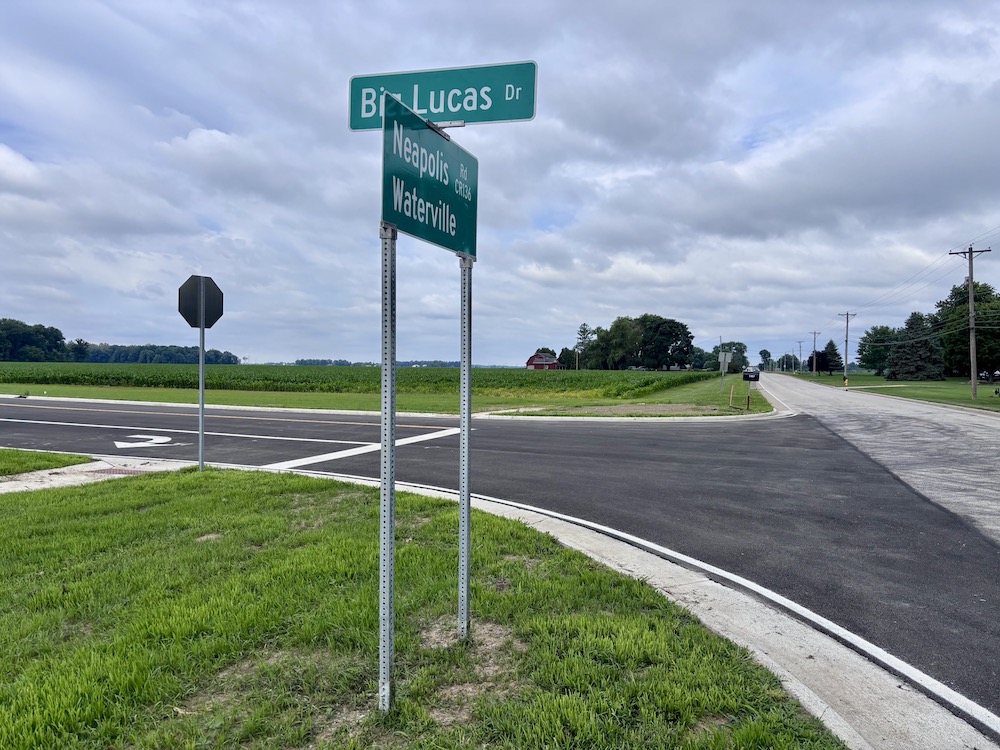
Waterville City Council formally approved the annexation of 50 acres of land into the city from Waterville Township, with all members but Wayne Wagner voting yes. The land, owned by the Toledo-Lucas County Port Authority, is on the south side of Neapolis-Waterville Road and adjacent to 100 acres of Port-owned land in Farnsworth Business Park.
“This is an opportunity that only comes along in decades,” said Administrator Jon Gochenour, explaining that the land will be where the city grows financially. As business and industry locate in the park, that further reduces the burden on residential taxpayers to cover city services, he said.
Gochenour said that 74 percent of the city’s tax base comes from nonresidential sources, including manufacturers in the business park. The township has a tax-sharing agreement with the city and, in 2025, received $132,372 from the city.
“As this property develops, it will only increase property sharing to the township,” Gochenour said.
The Port also requested a zoning change for 8451 and 8551 Neapolis-Waterville Rd. from Agricultural to Light Industrial District (M-1). This was referred to the Planning Commission for review on Monday, Oct. 5 at 7 p.m.
Farnsworth Industrial Park now includes another 150 acres owned by the Toledo-Lucas County Port Authority, after the city approved the annexation of an additional 50 acres from Waterville Township. (AWFP photo by Karen Gerhardinger)
During the meeting, council also:
-Heard resident Terri Massucci ask about the pedestrian crossing sign on Waterville Monclova at Pray Boulevard, as it only has a flashing light on one side. Gochenour said the existing light meets ODOT standards, but he will look into options for upgrading the light.
-Listened to Waterville United Methodist Church member Laurie Schofield outline plans for a Saturday, Oct. 10 Community Fall Festival, which will be held at 7115 Waterville Monclova Rd. and the fire station from noon to 4 p.m. The free event will include food trucks, crafts, games, music, a trunk-or-treat and bounce houses, as well as first responders from Waterville, Waterville Township and Ohio Highway Patrol. Weather permitting, helicopters from Mercy and ProMedica will land in the lawn, and Perrysburg Police will bring their K9 unit for demonstrations.
-Shared that the citywide bulk pickup is Saturday, Oct. 10 beginning at 7 a.m.
-Heard that the Christmas celebration is planned for Saturday, Dec. 5 from 5:30 to 8 p.m. in downtown Waterville.
-Learned that Waterville will host the National Prescription Drug Take Back Day on Saturday, Oct. 24 from 10 a.m. to 2 p.m. in the fire department, 751 Waterville Monclova Rd., in order to provide a drive-thru for residents to dispose of prescription and over-the-counter medications.
-Heard that police officer Wyatt Saylor was chosen to represent northwest Ohio on the Ohio Association of Chiefs of Police Community Relations and Engagement Committee.
-Heard that a group of educators is interested in installing a bench in Waterville to honor the late David Hillborn, who served as principal of Waterville Primary School from 1972-1996.
-Set a Fallen Timbers Cemetery District joint meeting for Monday, Oct. 12 at 6 p.m. in council chambers to appoint a new member from Whitehouse.
-Authorized Gochenour to work with Proudfoot Associates on engineering services for the Waterville Historical Society parking lot project. An $85,000 grant will help pay for paving the lot, which will have 35 parking stalls, screening and landscaping, Gochenour said. Work will begin in the spring.
-Thanked Robert Grogan Jr., who retired on Sept. 25 after 30 years of serving as a volunteer firefighter, ending his career as deputy chief.
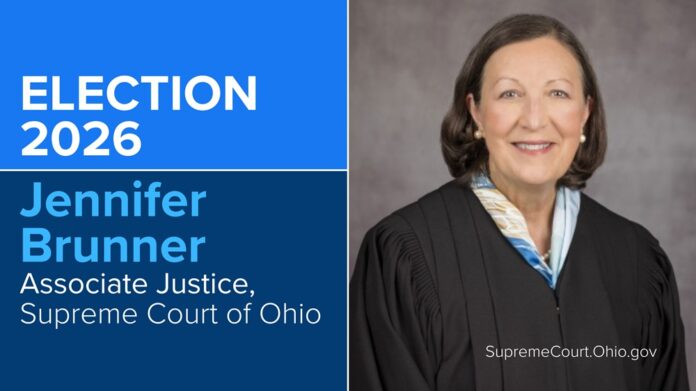
Election 2026: Jennifer Brunner: Associate Justice, Supreme Court of Ohio. (TFP image by Jaden Jefferson)
TOLEDO – This year, Ohioans will be deciding the result of a number of races: one for governor, another for U.S. Senate, and plenty of others that receive less attention, such as those for attorney general, secretary of state, treasurer, and auditor. Voters will also be electing their state and congressional representatives. And while some of these contests have been contentious, there’s another high-profile race that, so far, hasn’t really been: the one for a seat on the Ohio Supreme Court.
In fact, there are two state Supreme Court seats on the ballot this year: that of incumbent Republican JusticeDan Hawkins, who’s up against Democratic candidate Marilyn Zayas, and that of incumbent Democratic JusticeJennifer Brunner, who faces Republican candidate Colleen O’Donnell.
This story, however, will focus on the latter. The Toledo Free Press recently spoke with Justice Brunner to gain a better understanding of:
– her judicial philosophy,
– the working relationship she maintains with her colleagues (all of whom are Republican),
– her thoughts on the strength of our country’s institutions,
– and the challenges, she believes, the judiciary faces.
We began with what she’s learned about the court as an institution in her first term on the bench.
Noting her prior experience as a common pleas judge in Franklin County, justice on the bench of Ohio’s 10th District Court of Appeals, staffer in the state senate, and secretary of state, Brunner says serving on the state’s highest court has brought her a “deeper understanding” of how it integrates with those other parts of state government.
“As an attorney for 43 years, I’ve always noticed the last word on state law, in cases in the state of Ohio, but I’ve been really interested [in] learning about how it blends into the work of the other two branches,” she said.
Jaden Jefferson, Toledo Free Press: The court’s makeup is something that’s often talked about. It’s composed of seven justices: six of them Republican, and one a Democrat — that, of course, being you. And while justices are expected to exercise impartiality, which is why my next question won’t be a political one — there is still a political component — in that, since 2021, party labels have appeared beside judicial candidates’ names on the general election ballot. So, what should Ohioans know about the working relationship you have with your colleagues?
Jennifer Brunner — Associate Justice, Supreme Court of Ohio: I have a good, collegial working relationship with my colleagues. I focus on trying to get the law right. We don’t always agree, but we agree to disagree and it’s important to be collegial, so that the public sees what the court does and not who the individual justices on the court are or whether they get along or not.
Jefferson: Do the ideological differences that exist between yourself and your colleagues add a level of complication? Or would you say they make for more well-rounded conversations?
Brunner: Both, and when you say “ideological,” I would say, if there’s an ideological difference, it really is more in the approach that we take to how we reach our decisions.
Brunner pointed to a couple of challenges on which she and her colleagues have found consensus: rural Ohio’s limited/nonexistent access to legal services, as well as the undefined role of artificial intelligence in the courtroom.
“The fact we are elected has meant that we had to campaign and we had to actually spend time throughout the various parts of Ohio, which is an extremely diverse state. And so, I think it’s easier for us to share views on those issues because we’ve all experienced much of the same as we’ve campaigned for office.”
Jefferson: Do you find it to be a challenge when the law may be very specific, and there’s still disagreement between judges?
Brunner: What I see as problematic with the court, at this point in time, is the overruling, within a two-year period, of an earlier decision — not because of any change in circumstances — but because of a change in the makeup of the members of the court. That’s a problem.
As traditionally independent government agencies, such as the Federal Reserve and Federal Trade Commission, face new challenges to their insulation from politics, the TFP asked Justice Brunner how the nation’s institutions — like its courts — can maintain trust in the face of political pressures. She said that the best way is “to not be partisan or even appear partisan.”
Another test of the courts’ independence has been from individual threats against judges.
Crediting the court’s “very strong and well-operated” security apparatus, Justice Brunner said that she herself hasn’t faced these kinds of attempts at intimidation while on the bench. Rather, she said her biggest threats came as secretary of state, in the wake of 2008’s presidential election.
Brunner pointed to rhetorical choices she believes public figures should make, in order to keep discourse civil: “People can disagree with what the court does, but as I said before, it really should not be personalized to any particular judge, because — even if it’s a trial court judge — that decision is reviewable by a court of appeals and, potentially, by the Ohio Supreme Court,” she said. “When it’s a decision by the Ohio Supreme Court, it’s not a single judge who made a decision, it’s at least four — sometimes up to seven.”
For those who might not assign the court’s decisions much importance in their day-to-day lives, she cited a few examples of how it has an outsized impact on Ohioans, including cases involving the legal process for beginning data center construction, ones involving solar farms, and others that have dealt with what public utilities can charge their customers for infrastructure upgrades.
In other words: While state Supreme Court races may not always be the center of attention, their outcomes can be consequential and greatly affect the very issues that are in the spotlight.
The Toledo Free Press has reached out to Colleen O’Donnell’s campaign, and we intend to share her thoughts in a future article, after an interview is arranged.
"Lake Titicaca" (1935). By Alejandro Mario Yllanes (1913–c. 1960). Oil on canvas, 176 x 240 cm. (Image courtesy of Toledo Museum of Art and Ben Elwes Fine Art, London)
(All announcements are 100% compiled from press releases, or otherwise shared by our media partners as credited)
Community
The Toledo Museum of Art (TMA) announced the acquisition of Lake Titicaca (1935), a significant painting by Bolivian artist Alejandro Mario Yllanes (1913–c.1960), marking a major step in TMA’s ongoing efforts to broaden the narrative represented within its collection. The acquisition marks the first work by Yllanes to enter TMA’s collection and positions the museum as one of the few U.S. institutions to hold one of the artist’s paintings. Yllanes’s works, both across painting and works on paper, have only recently reemerged following decades of relative obscurity.
Education news
Owens Community College
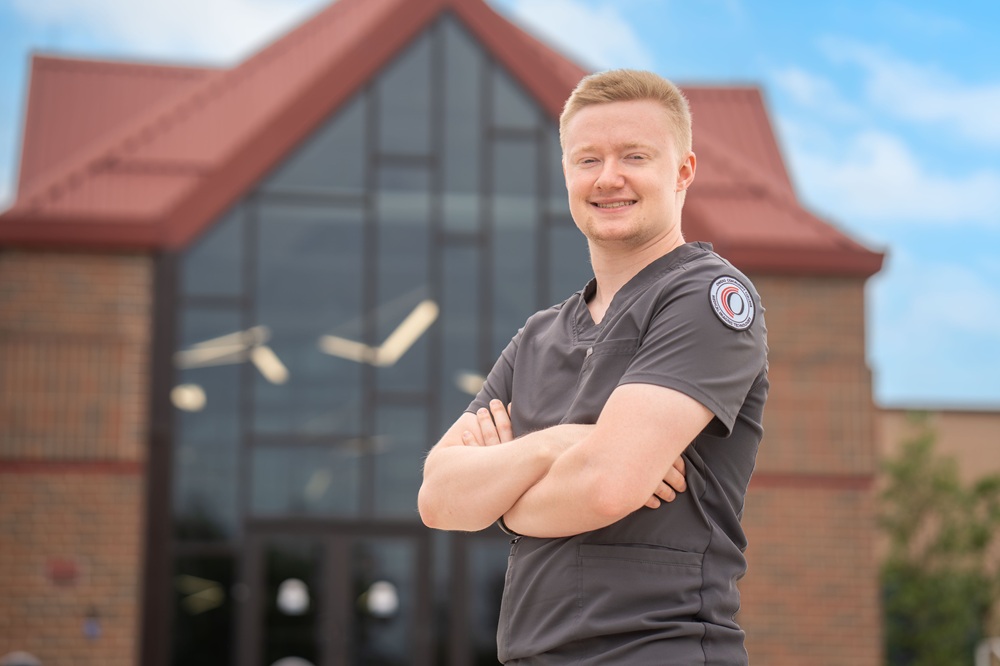
Owens student Austin McHenry. (Courtesy of Owens Community College)
Owens student Austin McHenry, of Wauseon, was chosen to serve as Student Director for the Society of Vascular Ultrasound (SVU), a national organization of more than 4,200 vascular technologists, surgeons, cardiologists, lab directors, academics and students. As Student Director, McHenry will represent the student voice on the SVU Board of Directors.
In other news, visits to the Owens Community College food pantry more than doubled from fall to spring semester last year. Now a $2,500 grant from the Food Recovery Network (FRN) will help the college get more food, including leftovers from campus events, into students’ hands. The grant will allow the Center for Campus and Community Connections to purchase a new double-door cooler, which director Krista Kiessling said will be called the “Community Fridge,” filled with donated and reclaimed food available for students.
Bowling Green State University
BGSU has been named the No. 1 public university in Ohio and No. 3 in the Midwest for first-year experiences in the 2027 Best Colleges rankings by U.S. News & World Report, recognizing the University’s comprehensive approach to helping students transition to college, build community, engage in campus life and define their path forward.
University of Toledo
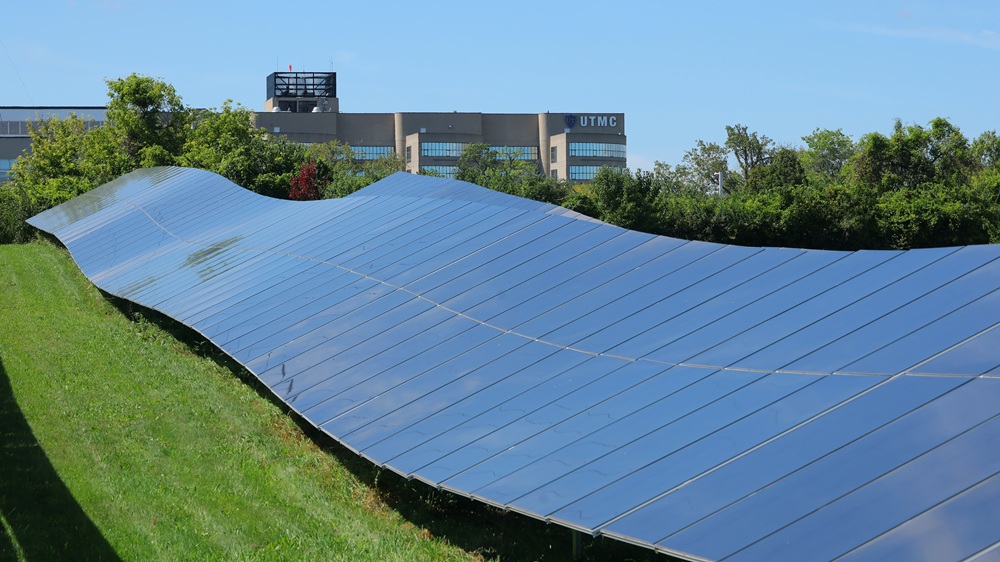
Expanded solar array near UToledo Medical Center. (Courtesy photo)
With the recent expansion of a solar array near the University of Toledo Medical Center, UToledo is more than doubling its capacity for solar energy production on Health Science Campus while creating opportunities for student learning and research.
“This project is an exciting, real-world demonstration of the importance of the ground-breaking advances being made at First Solar and the strong connection to our work at the Wright Center for Photovoltaics Innovation and Commercialization,” said Dr. Michael Heben, a Distinguished University Professor and the Helen and Harold McMaster Chair and Director of UToledo’s Wright Center for Photovoltaics and Commercialization.
Maritime Academy
Maritime Academy of Toledo is celebrating significant progress reflected in the latest Ohio State Report Card, including a substantial increase in its graduation rate and a 3-star Progress rating.
Maritime Academy’s 4-year graduation rate increased from 68.4% to 82.1%, an improvement of nearly 14 percentage points. The school also earned 3 stars in Progress, reflecting academic growth in multiple tested subjects.
The school also reduced chronic absenteeism from 91.2% to 87.4%, exceeding the state’s goal of a 3% reduction.
Health & Environment
ProMedica will hold a groundbreaking ceremony for its new Emergency and Urgent Care facility in Perrysburg. The approximately 12,000-square-foot facility will expand access to high-quality emergency and urgent care services for residents, businesses and visitors in Perrysburg and the surrounding communities.
The facility will combine a full-service emergency department and urgent care under one roof, enabling patients to receive the appropriate level of care in a single location. Staffed by board-certified emergency medicine physicians, it will serve as the second freestanding location of the ProMedica Toledo Hospital emergency department and build on the successful model established at ProMedica Emergency and Urgent Care in Maumee.
Government & Politics news
Lucas County Prosecutor’s Office News – On Sept. 18, Ezekiel James pleaded no contest to four felony offenses and agreed to serve 30 to 35.5 years in prison for the Dec. 2025 shooting death of Haiden Babiuch and his efforts to make her death appear to be a suicide. James, 20, of Oregon, Ohio, pleaded no contest in CR2026-00055 to one count each of involuntary manslaughter and felonious assault, along with two counts of tampering with evidence.
*Courtesy of This Week in Toledo:
– On Sept. 22, Toledo City Council voted unanimously to audit the city’s Flock cameras; unanimously to add a local licensing requirement for hotels and motels; and voted 1-8 against a recycling audit contract with GT Environmental Inc., with Melden casting the lone vote in favor. Jones, Komives, and McPherson were absent.
– On Sept. 24, Toledo City Council’s Housing, Community Development, & Public Health Committee held a public hearing regarding an ordinance (O-399-26) protecting tenants from landlord retaliation. The ordinance, if passed, would require landlords to provide good causes for evictions and rent increases against tenants who report property issues or form tenant unions, under penalty of a second degree misdemeanor.
– Also on Sept. 24, the Toledo Area Regional Transit Authority (TARTA) board voted to designate Monroe Street as a rapid transit corridor. If developed, dedicated lanes for busses would be created on Monroe Street with platform-level boarding at stops and service occurring as frequently as every fifteen minutes.
– On Sept. 25, the Ohio Department of Transportation (ODOT) announced that TARTA will receive a $1.36 million grant from its Workforce Mobility Partnership program, allowing it to add 27 new bus-stop shelters and renovate 28 others.
– Local Democratic Party organizations, including the Lucas County Democratic Party, the Wood County Democratic Party, the Lucas County Stonewall Democrats, and the Lucas County Young Democrats have published statements condemning recent television ads by Democratic U.S. Representative Marcy Kaptur that use anti-transgender talking points.
-Toledo Fire Chief Allison Armstrong was seriously injured in a car accident in Colorado on Sept. 18 while attending an annual memorial for fallen firefighters. Armstrong’s injuried included a fractured sternum, fractured back, whiplash, and bruises. Assistant Chief John Kaminski is running operations while she recovers.
– Lucas County residents can determine how much upcoming property tax levies will cost them using the the Lucas County Auditor’s levy estimator. To use the tool, visit https://www.lucascountyohioauditor.gov/areis, search for your property by address under “Property search”, and click “Levy Estimator” on the left-hand side.
Business & nonprofit news
The Toledo-Lucas County Port Authority announced last month that it has been awarded $32.34 million through the U.S. Environmental Protection Agency’s (EPA) Great Lakes Restoration Initiative (GLRI) to complete the remediation of the Lower Maumee River Sway Bridge Project, a significant milestone in the ongoing restoration of the Maumee River.
The funding will support the removal of approximately 121,000 cubic yards of contaminated sediment from a one-mile section of the Lower Maumee River along Front Street between the Seneca Petroleum Marine Terminal and the Ironville Marine Terminal. The project represents one of the largest sediment remediation efforts currently underway in Northwest Ohio and is a critical step toward improving water quality, restoring aquatic habitat, and advancing the long-term revitalization of Toledo’s waterfront.
Maumee– CMS Corporation (CMS) has been awarded a $1.3M task order at Marine Corps Air Station (MCAS) Iwakuni, Japan, under its $2.5 billion US Air Force Petroleum Oil Lubricant (POL) Worldwide Multiple Award Task Order Contract (MATOC). This project will carefully remove and replace several components within the existing fuel system to enhance its reliability and safety. CMS is currently performing a $60M bulk storage tank project at MCAS Iwakuni. Read more at cmscorp.com.
Courtesy of This Week in Toledo:
On Sept. 23, the Metroparks Toledo board voted unanimously to approve $300,000 to Kokosing Construction Company for preconstruction work on Vistula Metropark, a $24 million project set to begin construction next year; $168,000 for new tasers for park rangers; and $81,680 to improve habitat at Howard Marsh Metropark.
The Toledo Area Regional Transit Authority (TARTA) is just the 10th transit agency in the nation to roll out an apprenticeship program for operators endorsed by the International Amalgamated Transit Union. New operators undergo 300 hours of instruction time, split between classroom training and road training. Read more about the program here.
*Courtesy of This Week in Toledo:
– FOX 36/WUPW began airing news and weather coverage from 13ABC on Sept. 28. WUPW previously aired news and weather from WTOL 11 through a shared services agreement signed in 2012.
Sports
Walleye News – Goaltender Matt Jurusik returns to the Pond for his first full season in Toledo and second overall after agreeing to terms for the 2026-27 ECHL season.
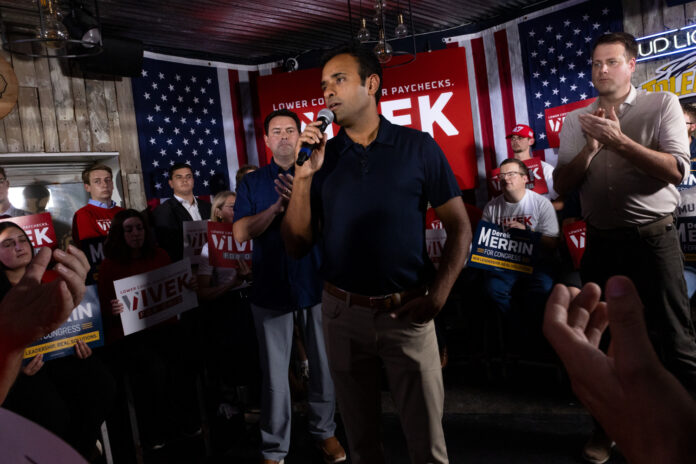
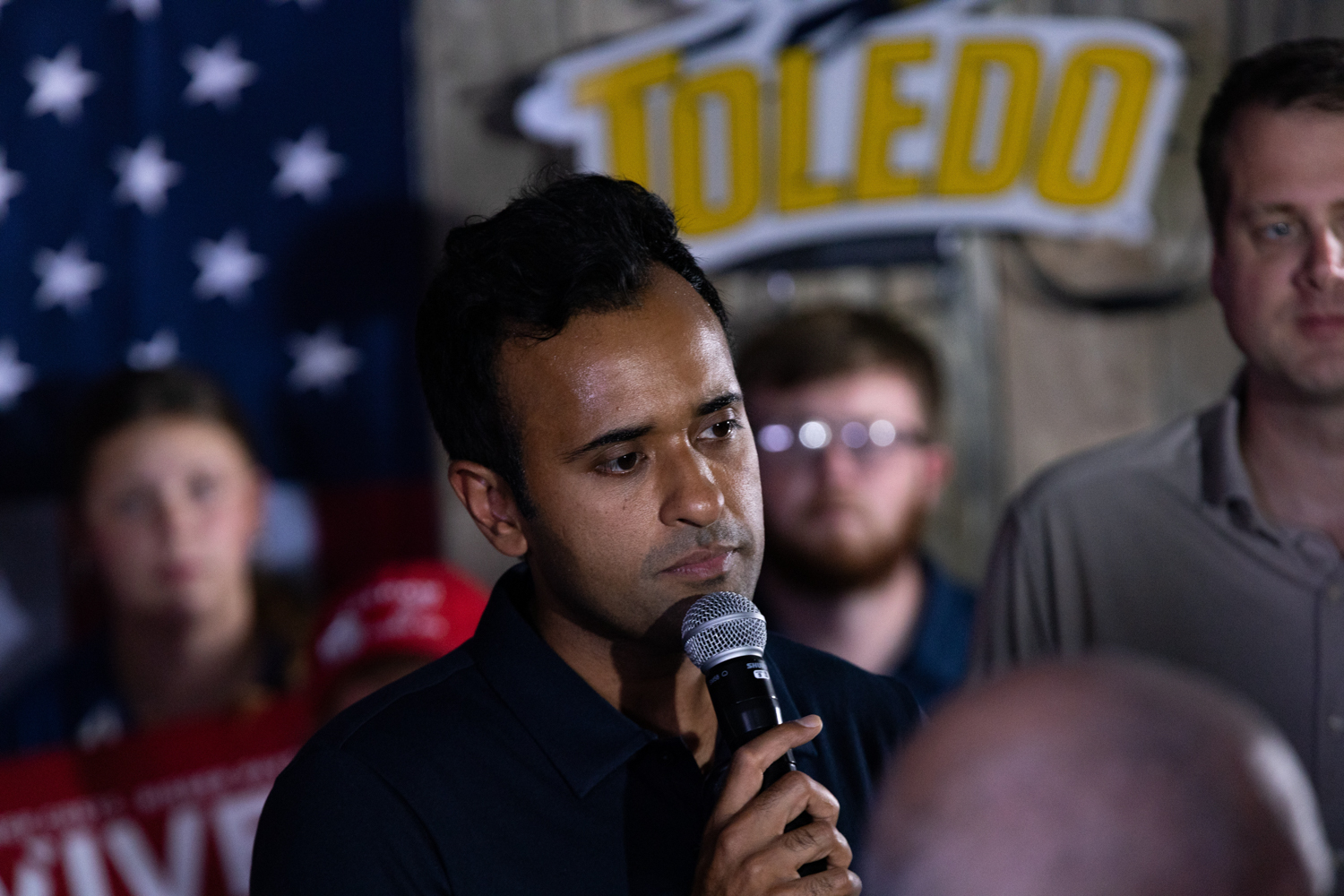
Ohio Republican gubernatorial candidate Vivek Ramaswamy speaks while onstage with congressional candidate Derek Merrin and Ohio lieutenant governor candidate Rob McColley, during a Republican rally at Chevy’s Place, 702 Monroe St., in downtown Toledo on Friday, Sept. 18, 2026. (TFP photo by Stephen Zenner)
TOLEDO – Over a hundred people were crammed elbow-to-elbow inside the downtown country bar Chevy’s Place to hear Ohio gubernatorial candidate Vivek Ramaswamy speak during a recent Republican rally.
A crowd donning both red and blue eagerly waited for hours to hear from Ramaswamy, his lieutenant governor running mate – Ohio State Senator Rob McColley – and Rep. Marcy Kaptur’s challenger in Ohio’s 9th Congressional District, Derek Merrin.
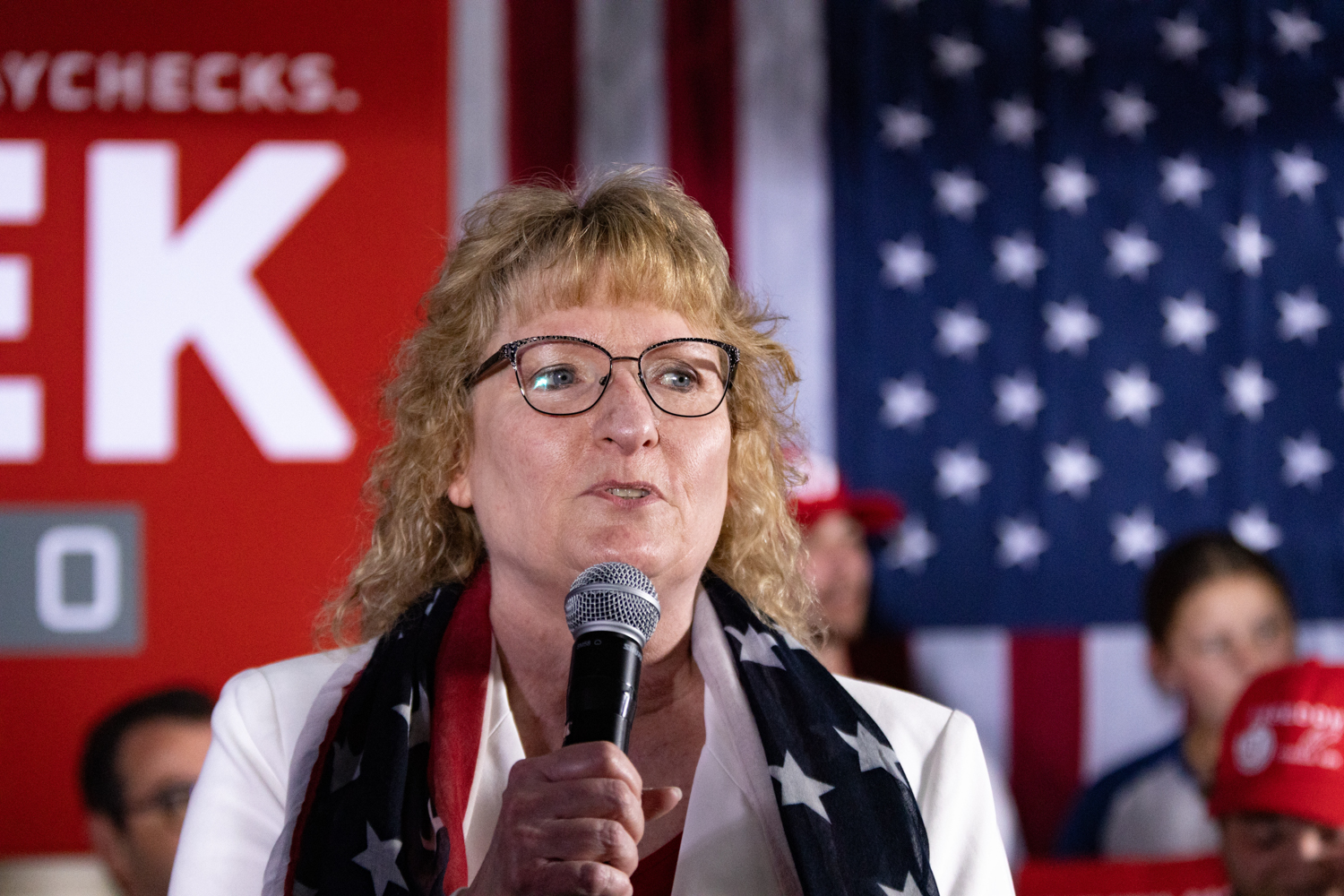
Executive Chair for the Lucas County Republican Party Barbara Orange kicks off the rally. (TFP photo by Stephen Zenner)
Merrin takes shots at Kaptur
Merrin began by thanking the Ohio Young Republicans, who helped organize the event along with the Lucas County Republicans.
Jacob Sargent, the chief of staff for the Ohio Young Republicans, bragged that Ohio’s chapter of the Young Republicans was the largest in the nation at 1300 members, then handed off the mic to Merrin, who warmed up the crowd by speaking against the well-established Democratic Representative Kaptur.
“We’re going to win this race,” Merrin said, and promised conservative leadership going forward.
Merrin also spoke critically of Amy Acton, the Democratic gubernatorial candidate for Ohio, and Kaptur for both refusing to debate their Republican opponents.
Kaptur has not made any statements recently about refusing to debate Merrin, but back in 2024, she criticized Merrin’s campaign funding and accused Merrin of simply attacking her instead of standing for issues. She said she did not want to platform Merrin and called him an “unserious candidate.”
“She doesn’t want to have to stand and give an explanation of why she believes men should play in women’s sports,” Merrin continued.
Merrin’s first accusation that Kaptur supports trans athletes seems to be false, as Kaptur has begun running an aggressive ad declaring that, “Boys should not play girls’ sports,” and supporting “Parents’ Rights.”
Members of the broader Democratic party and Ohio LGBTQ activists have criticized both Acton and Kaptur for not supporting trans rights.
Earlier this year, Kaptur voted with Republicans for H.R. 2616, the Stopping Indoctrination and Protecting Kids Act, requiring parental approval before changing a student’s gender markers, or the school could risk losing federal funding.
Previously, Kaptur had voted for and co-sponsored the Equality Act, outlawing discrimination based on sex, sexual orientation or gender identity, and voted against the Protection of Women and Girls in Sports Act in 2023 and 2025.
Toledo drag queen and Libertarian David Gedert, who was in the race for Ohio’s 9th Congressional District before losing in the May primary, accused Kaptur of playing politics at the expense of marginal communities in The Buckeye Flame, a pro-LGBTQ publication.
A spokesperson for Merrin had similar sentiments about Kaptur, coming from the opposite political spectrum, when talking with The Blade.
“Her record clearly shows that she is the one lying when she says she does not want men in girls’ sports,” Merrin said.
Attendee to a Republican rally holds a sign for congressional candidate Derek Merrin at the downtown rally. (TFP photo by Stephen Zenner)
Taxes
“She doesn’t want to have to give an account for why she wants to take more money out of senior citizens’ pockets by continuing to tax their Social Security benefits,” Merrin said at the rally, continuing his attack on why Kaptur doesn’t want to debate him. “Why do you continue to tax the waiters’ and waitresses’ tips?”
Without saying it outright, it is likely Merrin is referring to tax cuts included in the One Big Beautiful Bill Act (OBBBA), which was the source of contention between Democrats and Republicans.
All Democrats opposed the OBBBA as well as Republican Senators Susan Collins of Maine, Rand Paul of Kentucky, and Thom Tillis of North Carolina, and House Republican Representatives Brian Fitzpatrick of Pennsylvania and Thomas Massie of Kentucky.
On July 3, 2025, Kaptur explained her vote against the OBBBA in a press release, and later called the legislation a “redistribution of wealth from the poor to the ultra rich.”
Her biggest criticism of the bill were its $1 trillion in healthcare cuts, followed by the $186 billion cut to Supplemental Nutrition Assistance Program (SNAP) over a number of years, the reduction in tax credits and incentives for clean energy, and adding $3.4 trillion to the deficit while continuing tax cuts included in the 2017 Tax Cuts and Jobs Act (TCJA).
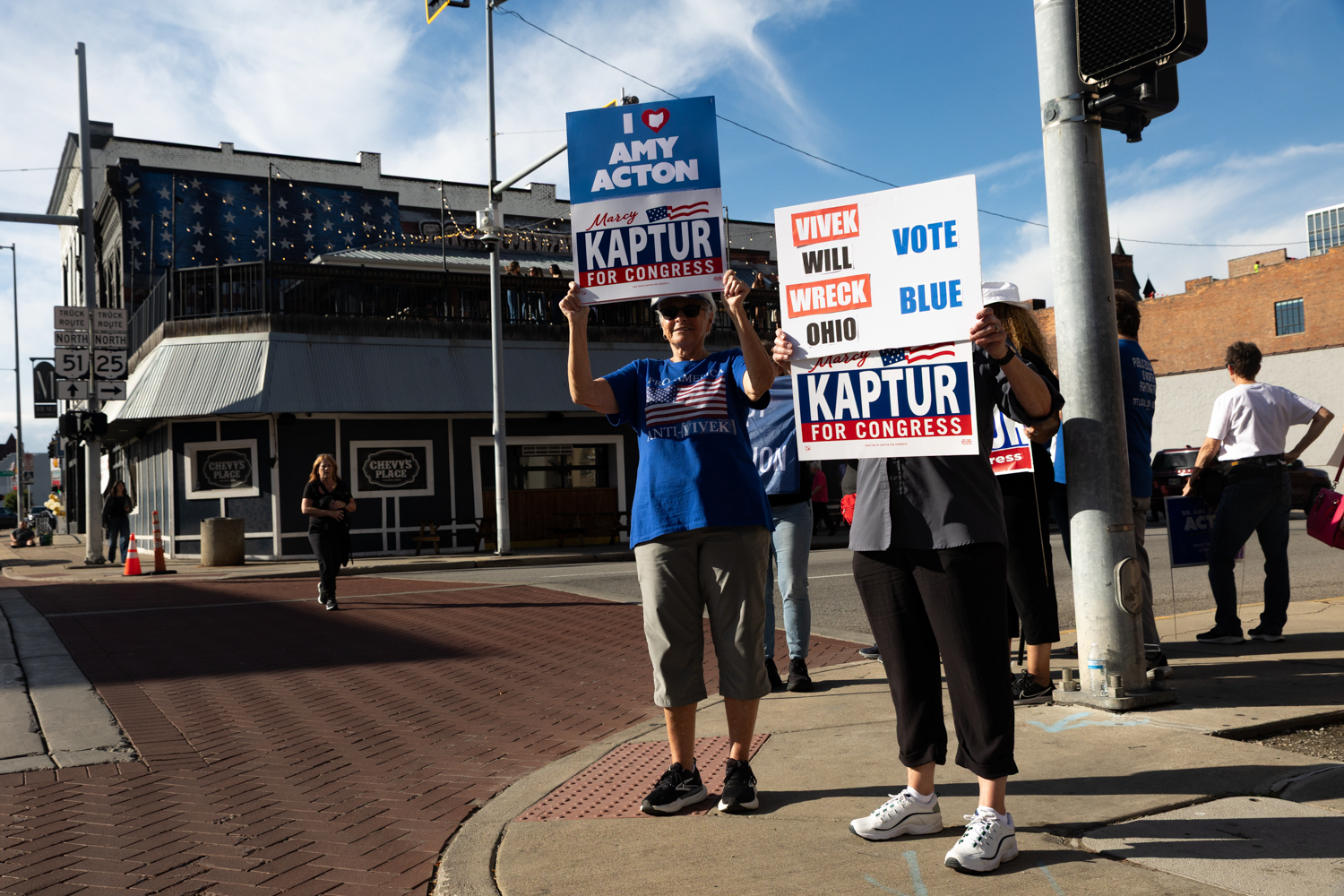
Democratic supporters protest across the street from Chevy’s Place, where Ramaswamy, Merrin, and Rob McColley held a rally. (TFP photo by Stephen Zenner)
Data Centers
“If you’re against data centers, why did you vote in Congress for federal tax breaks for data centers?” Merrin continued to ask of Kaptur.
Incumbent Kaptur has not outright voted for tax cuts for data centers. In fact, Kaptur is a co-sponsor for the new bill, Reverse Big Ugly Tax Breaks for Data Centers Act, which seeks to reverse parts of the OBBBA that benefit data center construction. The two main parts of the OBBBA that help companies building data centers are the 100 percent bonus depreciation deduction, allowing companies to write off 100 percent of expenses upfront, and the Opportunity Zone benefits, encouraging development in low-income areas and removing capital gains taxes on appreciating assets.
Indirectly, the Inflation Reduction Act (IRA) allowed tax breaks for clean energy in the form of solar, wind and nuclear, which Kaptur did vote for. And since data centers need power, the IRA indirectly supported data center growth in this way.
Currently, the Ohio legislature is attempting to roll back their tax cuts for data centers. The first sales tax for technology equipment was passed in Ohio in 2011 as part of an amendment to Ohio’s 2011-13 budget, to attract technology companies, in the 2011 HB 153 [not to be confused with the 2025-26 HB 153].
Later in the next Ohio budget bill, HB 59 for the years 2013-14, this sales tax exemption was widened.
On Aug. 2, 2016, Merrin was sworn into office as an Ohio State Representative, and served in the state legislature until 2024.
“I never had the opportunity to vote for a tax break for data centers, and I never did vote for a tax break for data centers,” Merrin said, pointing out the initial push for data centers happened five years prior to his term.
This was another bill amending Ohio’s operating budget and exempting data center equipment and construction materials from Ohio’s sales and use tax. HB 49 specifically goes over the eligibility of tax breaks for data centers in Section 122.175 in the bill, from pages 130-140 and lines 4066 to 4374 in the legislation text as it was introduced.
The official Ohio state analysis of that section of the bill reads on page 334: “The fees affected are those for the job creation, job retention, motion picture, small business investment, and New Markets Tax credits; community reinvestment area and enterprise zone property tax exemptions; and a computer data center sales and use tax exemption. The amounts of the fees are unchanged.”
At the time, data centers were not the same as they have become in the past two years, and this was a small extension of the tax breaks within a very large bill with many parts, unrelated to data centers.
Ironically, Merrin ended his words on data centers during the rally by attacking Kaptur, “You got some real gall to accuse someone of doing something you did.”
Ohio Gubernatorial Candidate Vivek Ramaswamy. (TFP photo by Stephen Zenner)
Decline of Ohio
During some rapid fire closing remarks, Merrin remembered the height of Ohio’s industrial power.
“We had a robust economy. We had high-paying jobs, and in 1949, Toledo was the fifth wealthiest city in America regarding median household income,” Merrin said, and then blamed Ohio’s decline on Kaptur, for the past 40+ years.
He threw out an allegation that Kaptur didn’t really live in Ohio, and instead lives in an “almost million dollar” condo in Washington, D.C.
While the value of the condo is unknown, Kaptur does own a condo in the D.C. area, but her primary residence is listed in Toledo. There is no standard for staying in the capitol city for representatives, but a story by Business Insider showed that “44 senators and 194 US House members had such [rental/additional] properties in 2020…”
Merrin said members of Congress should have term limits, and proposed making a constitutional amendment to force the change.
He then added, “We need a constitutional amendment, I believe, to force the politicians into a box to balance the budget.”
After that he said, “I believe in secure and safe elections,” and said he advocated for the SAVE America Act and against illegal immigration.
New district
Last year Ohio’s 9th Congressional District was redrawn for the third time in 20 years. The new district is thought to give Republicans an advantage of 9 percentage points.
Congressional candidate Derek Merrin. (TFP photo by Stephen Zenner)
McColley hypes Ramaswamy
After Merrin’s tirade on Kaptur, he hyped up the next speaker from Napoleon, Ohio: Ramaswamy’s running-mate, Rob McColley.
Both men traded praise for the other before McColley fully took over the stage.
“Vivek, myself, and Derek, all of us were born after Marcy Kaptur got into office,” McColley said jokingly, “that’s a sad state of affairs.”
Then he asked the rally goers, “What, Ohio, do you want to wake up to on November 4th?” the day after the general election, and juxtaposed the potential realities.
Cheers came when he described his dream of retiring Kaptur, and electing Ramaswamy, whom McColley called the most conservative governor the state has ever had, although it is unclear what would qualify him as such compared to previous Republican governors.
Boos abounded when he described having Kaptur in office for two more years, and electing what McColley called “a bona fide socialist as our next governor,” referring to Acton.
Acton is a Democrat, but has not identified herself as a socialist, as other members of the Democratic party have, most notably Bernie Sanders, the senior United States Senator from Vermont, Alexandria Ocasio-Cortez (AOC), representative for New York’s 14th Congressional District and, most recently, Zohran Mamdani, the current mayor of New York.
Without further specification, it is unclear what McColley means when he describes Acton as a socialist, but the context of his speech seem to refer to her actions during the Covid-19 pandemic, when she advised Ohio Governor Mike DeWine during the 2020 shutdown he ordered (not an explicitly socialist policy, but potentially referring to things as “socialist” as a short hand for big government).
“She was the first health director in the entire country to close down our schools, leaving these schools closed for nearly two years,” he said and referred to the “learning loss” that occurred for children during the time that schools were closed.
California issued a stay-at-home order a few days before Ohio, but Acton advised Ohio Governor Mike DeWine, who issued the first shutdown of schools, bars and restaurants. DeWine has stated he should be blamed for the shutdown, as it was his decision, not Acton’s.
Members of the crowd along with McColley accused Acton of quitting during the pandemic, referencing her stepping down from her position as the Director of the Ohio Department of Health in June 2020 and then exiting the DeWine administration altogether in August of the same year, leaving her role as his chief health adviser.
There’s not a clear-cut reason Acton has stated for her departure from DeWine’s administration, except that the time of the pandemic came in stages, and she transitioned.
Many suspect that as the pandemic became more politicized, she did not want to deal with pushback from protesters against the lockdown and political opponents to health orders.
One member of the crowd who opposed Acton explained in more detail: “Ohio’s not ready for a woman governor, not someone who is gonna’ quit when she gets death threats,” said Susan Theisen of south Toledo, and commented that Acton was going to “lock us down.”
Leaning into the difficulties of the Covid-19 pandemic, McColley described individuals who could not be with their aging loved ones in nursing homes and hospitals during the lockdown, blaming Acton, and then moved to criticize Acton’s unwillingness to debate Ramaswamy.
“If you cannot debate, you cannot run this state,” he said, and combined it with the quitter narrative he built up previously. “Amy Acton cannot handle the pressure of making decisions that impact the daily lives of Ohioans,” he said.
Closing and transitioning to his running-mate, McColley shared an anecdote about Ramaswamy’s eldest son, Karthik, who continuously interrupting Ramaswamy while political guests were at Ramaswamy’s home. McColley shared the anecdote, cementing an image of Ramaswamy as a family man, who is able to balance family and business/politics easily, eventually holding Karthik, after he interrupted multiple times, showing his son affection and continuing to talk politics.
Ultimately, McColley said he felt confident in Ramaswamy’s leadership, because he knew he was creating a better Ohio for Karthik, Ramaswamy’s son.
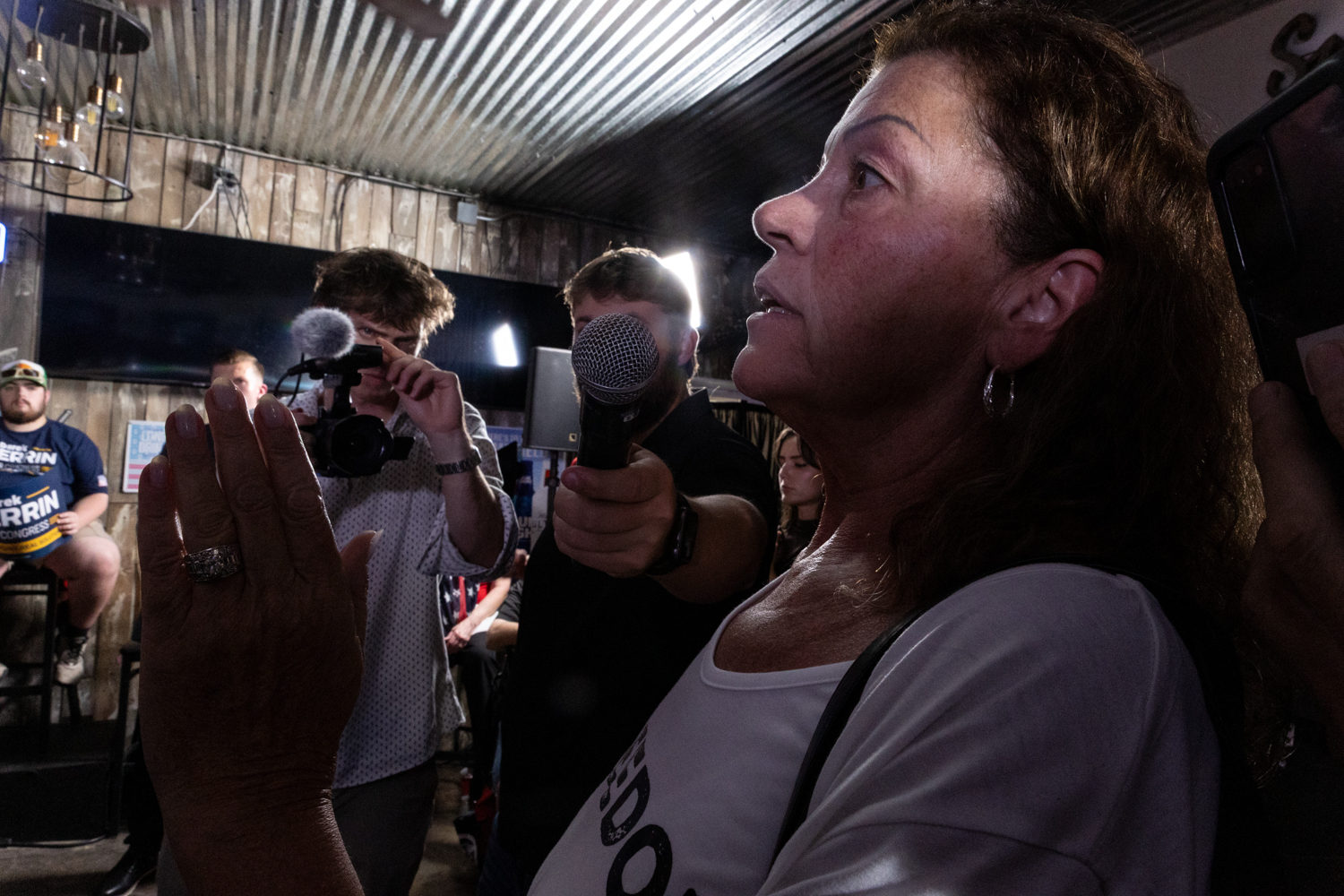
Jody Torok of Holland, Ohio asks Ohio Gubernatorial Candidate Vivek Ramaswamy a question the Q&A session portion of the rally. (TFP photo by Stephen Zenner)
Ramaswamy living the American Dream
Referring to how the country had turned 250 years old this year, Ramaswamy waxed poetic about the founding of America, and what it means to be an American. Quickly recalling major moments throughout American history, he brought everything up to the present day, and focused on how the founding and ideals had directly allowed his family to succeed.
“I’m doing this because I know we can have an impact, and because I am grateful to the state where I was born and raised, to this country, for allowing me to live an American dream that is only possible in this country,” Ramaswamy said.
From southwest India to southwest Ohio, he told the story of his family’s American dream, culminating with the success of his biomedical companies.
Right now, he said, there is a “fork in the road for the future of this state. We’re at a fork in the road for the future of our country,” and he spoke out against socialism.
Equating socialism with an attitude towards success, Ramaswamy said, “What is our attitude towards success in this country? See, I believe success is something that we should celebrate…My opponent believes that success is something that we should penalize.”
Acton has not said she is socialist or wishes to penalize success, but the interpretation of her advice during the 2020 lockdown may be interpreted as a hindrance to free enterprise or as Ramaswamy has categorized it, “success.”
“Do you believe in free enterprise, or do you believe in socialism?” he asked the crowd.
Then Ramaswamy said he would, “deliver the biggest property tax cut this state has ever seen,” making Ohio a state that Texas, Tennessee and Florida would look up to.
When Ramaswamy said he would cut property taxes, a number of people in the crowd started yelling, “God bless America,” which Ramaswamy repeated, as did several others in the crowd.
Ohio Gubernatorial Candidate Vivek Ramaswamy, answers the crowd’s questions at the end of the event. (TFP photo by Stephen Zenner)
Crowd Q&A
Property taxes and education
Fielding questions from the crowd Ramaswamy began with an eight-year-old girl who said she just wanted to make everyone happy.
This crowd pleaser was followed by a woman named Kirsten, who said, “I currently pay 14 percent of our family’s incomes for property taxes…I’m facing the choice of which of my kids gets to go to preschool – $1,400 a year.”
Jumping back to one of his main campaign promises, Ramaswamy promised to have the biggest property tax cut of any state.
Since schools are funded through property taxes in the state of Ohio, Ramaswamy talked about how educational performance in Ohio has declined.
The Thomas B. Fordham Institute, a conservative think tank, saw a decline in ACT scores in Ohio from 22.0 to 20.3 between 2017 and 2018 with a continued downward trend to the present. Before 2017, Ohio was above the national average, and dropped below in 2018. National average ACT scores still remain above Ohio’s average, but the national trend mirrors Ohio’s downward trend.
“Property taxes are insanely high in the state of Ohio. And here’s the irony…educational performance has actually declined,” Ramaswamy said.
Educational decline is not limited to Ohio, and it is a nationwide problem. The Center on Reinventing Public Education (CRPE) specifically focuses on the decline in U.S. math scores, post-pandemic.
Information from the Hoover Institute indicates that math and reading scores in U.S. schools have been declining since 2013, with the pandemic accelerating math score decline and tapering reading decline.
Kirsten remarked that public schools produced an “unequal outcome” because they were forced to shut down.
Ramaswamy added, “It’s a morally wrong outcome.”
“Your income, your social security stream, has stayed flat while you owe twice as much in property tax,” he said, and said he would cut property taxes without hurting local police, fire, or schools.
Math, reading and writing were the focus of his education push to “bring back standards to public schools…get rid of woke indoctrination,” and pay teachers a higher starting salary, above $38,000 a year.
“It’s all the overhead and the bureaucracy that is choking our system and hanging our kids out to dry, while our seniors have to move out of their houses because they can’t make their property taxes,” he said.
Ohio Gubernatorial Candidate Vivek Ramaswamy. (TFP photo by Stephen Zenner)
Ramaswamy still DOGE?
Another man from the crowd asked Ramaswamy about his part in the Department of Government Efficiency (DOGE), and if he was still committed to getting rid of waste, fraud and abuse in the government.
In response, Ramaswamy said he was committed to those goals, and that he would start with Medicaid fraud, something the federal government under the Trump administration has focused on.
“$47 billion a year that we spend on Medicaid, at least 10 percent of that, $4.7 billion a year, is waste, fraud, and abuse going to home healthcare providers, nursing home providers that don’t even exist in many cases,” Ramaswamy said.
He said he would “strike a deal with the federal government that says, for at least a period of time, I’ll make this a top priority in Ohio if we get to keep a majority of the savings that we recoup.” Ramaswamy explained that “Tennessee did it first, and they have recovered billions for their state. They call it TenCare,” and proposed BuckeyeCare for Ohio.
Fixing the medical system, Ramaswamy said, was more important than forgiving medical debt.
His opponent, Acton, has focused on forgiving medical debt, drawing inspiration from JB Pritzker’s actions as governor of Illinois, to forgive medical debt. Using $10 million to forgive $1 billion in medical debt through the use of a nonprofit has been one touted success of the Pritzker administration.
Georgetown University’s Research Professor Andy Schneiderwrote about Medicaid fraud at the beginning of 2025, citing Ohio’s improper payment rate at 8.2 percent.
“The December 2024 report lists examples of the different kinds of fraud against Medicaid (and Medicare) that the agencies have identified and prosecuted. Among those convicted are ambulance service providers, durable medical equipment suppliers, diagnostic labs, nursing homes, pain clinics, pharmacies, physical therapists, physicians, and substance use treatment providers,” Schneider wrote, and explained that to crack down on Medicaid fraud would be to follow the money.
Of note: Healthcare providers are the beneficiaries of Medicaid fraud, not enrollees in the program.
Attendee listens to Ohio lieutenant governor candidate Rob McColley. (TFP photo by Stephen Zenner)
Ohio, land of data centers?
Expressing a bit of confusion, a member of the crowd, Jody Torok, of Holland, Ohio, asked what the truth and lies were about data centers.
Starting from basics, Ramaswamy explained. “It takes electricity, energy, literally converts electrons into what they call compute using a bunch of chips to do it,” he said. “It’s just a giant empty building that produces what they call computing power to train artificial intelligence.”
There didn’t seem to be a specific stance from the crowd. One man yelled in favor of them, but most of those in attendance listened attentively.
“Does it benefit a local community or not if it’s built there?” Ramaswamy asked, making that his criteria for whether a data center was a good fit for Ohioans.
Unfortunately, he said, “communities are seeing a lot of disruption without seeing any benefit,” and promised in the future, “you’re going to get free electricity paid for by the overage” from data centers.
He went on to talk about different policies he would put in place to regulate data centers. “No property tax abatement for the data center. Instead, you expand the base of property taxes, take their revenue, and put it directly in the pockets of homeowners.”
Clean water needs to go into data centers, and he said it should come out just as clean, and advocated for “no more NDAs [non-disclosure agreements]” for data centers.
“Vegetative insulation should be a requirement,” he said, meaning trees should be built all around the centers to insulate the noise.
No farmland was another of his requirements, and he instead recommended using abandoned industrial sites to build the centers. With these steps, Ramaswamy said he would set a national example.
Attendee holds a Make America Great Again (MAGA) hat at Chevy’s Place during the Republican rally. (TFP photo by Stephen Zenner)
Immigration
One gentleman was asked about immigration enforcement, and what Ramaswamy’s policies would be like. The individual was against letting more people in, but felt it was wrong to deport people who had lived in the United States for decades.
Ramaswamy applauded the man for having nuance, but said Ohio could not have sanctuary cities. “We have to enforce the rule of law,” he said, and felt being lax on immigration would encourage a breakdown in the rule of law.
Refresh on the American Dream
“We are a great state,” Ramaswamy reiterated. “Okay, we’re not Illinois. We’re not Minnesota. We’re one of the best in our region, and I think that’s great,” he said, and advocated for an “aggressive approach to cutting red tape and taming the regulatory state.”
“That is how we get it done in Ohio,” he said, and talked about building more 1700/1800-square-foot starter homes.
“I want you to get a high-paying job. I want six years to six figures when you graduate from high school or graduate from college,” he said, and mentioned stepping down the income tax gradually.
In closing, Ramaswamy said, “We’re going to usher in a new dawn for the American dream, a new dawn for the state of Ohio, a new dawn not for the Rust Belt, but the state that leads America back to greatness.”
Rally attendees say the Pledge of Allegiance. (TFP photo by Stephen Zenner)
Sparky welcomes a visitor during the 2025 Whitehouse Fire Department Open House. This year's is slated for Wednesday, Sept. 30 from 5 to 8 p.m. (AWFP photo by Karen Gerhardinger)
Wednesday, Sept. 30 – Whitehouse Hosts Open House – The Whitehouse Fire Department is hosting an open house from 5 to 8 p.m. Families are welcome to check out the fire trucks, ambulances and firefighting and EMs equipment, tour the station, see demonstrations on fire safety and ask firefighters questions. The event is FREE.
Haunted Waterville Tours – Visitors will meet a ghost hunter or medium in Robbins House Museum for the first half of the program and will then board a horse-drawn trolley to travel through old Waterville hearing tales of hauntings both old and new. Tours last for an hour and a half. Tours begin at 5:15, 6, 6:45, 7:30 and 8:15 p.m. Tickets are $30; kids receive a free t-shirt.
Upcoming tours:
Thursday, Oct. 1
Thursday, Oct. 8
Saturday, Oct. 17
Thursday, Oct. 22
Saturday, Oct. 31
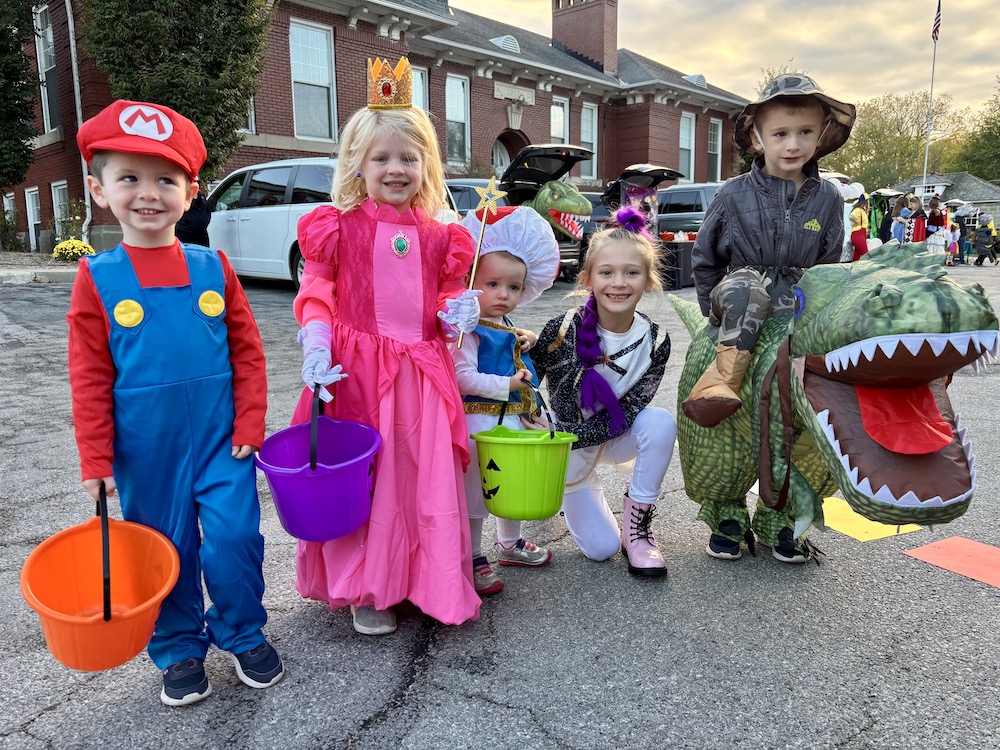
Thursday, Oct. 1 – Monclova Community Center Hosts Trunk or Treat – The Monclova Community Center is hosting a Trunk or Treat from 6 to 7 p.m. at 8115 Monclova Rd. Children are invited to put on their Halloween costumes and stop by decorated vehicles staffed by local businesses and community organizations to pick up some candy.
The Oct. 1 Trunk or Treat at Monclova Community Center gives children an opportunity to dress up and visit decorated vehicles in a safe environment. (AWFP photo by Karen Gerhardinger)
Saturday, Oct. 3 – Monclova Township hosts Open House – Monclova Township is hosting its Public Service Open House from 11 a.m. to 2 p.m. at 4335 Albon Rd. Residents are invited to check out the fire trucks, farm animals and more than a dozen tables hosted by community organizations. Children are invited to write a note or color a picture to send in a care package from the Anthony Wayne Purple Star group to deployed military personnel. Food trucks will be on site, and guests can sign up for raffles. For information, visit monclovatwp.org or download the MyMonclova app.
Saturday, Oct. 10 – First responders honored in Community Fall Festival – Waterville United Methodist Church is hosting a FREE Community Fall Festival from noon to 4 p.m. at 7115 Waterville Monclova Road. The focus is on honoring first responders from Waterville and Waterville Township, and will include an opportunity to check out fire trucks and police cruisers. Food trucks, games, crafts, music and a trunk or treat are on the lineup.
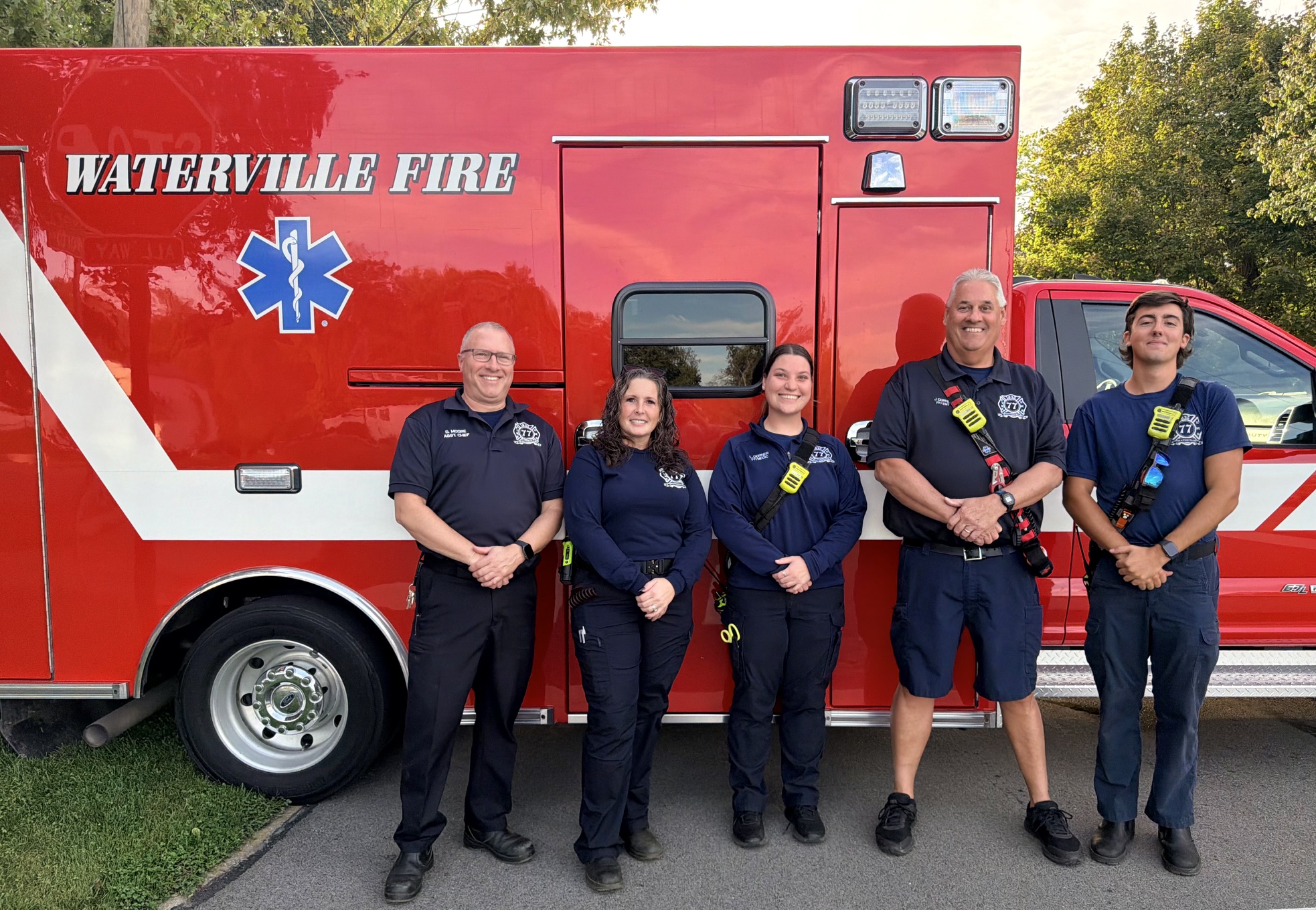
Members of the Waterville Fire Department are among the first responders who will be honored during the Oct. 10 Community Fall Festival. Pictured are assistant chief Dave Moore, Sarah Frederick, Lexi Dorner, Jeff Dorner and Rocco Armentrout. (AWFP photo by Karen Gerhardinger)
Sunday, Nov. 8 – Benefit for Sean Griewahn – From 3-7 p.m., the Swanton American Legion Hall will host a benefit for Sean. November is Pancreatic Awareness Month, and this event is to support Sean during his battle with cancer. The event includes food and drinks, raffle baskets, and a silent auction. For more information and to donate, visit gofundme.com/f/AnswerTheCallForSean.
Records provided by Toledo Fire and Rescue show firefighters responded to five fires at the facility between 2021 and 2025. (Photo courtesy of WTOL 11)
Public records reviewed by WTOL 11 show five fires since 2021, inspection violations, delinquent taxes and more than $861,000 owed in city utilities.
Originally published by our media partner, WTOL 11, and written by Faith Zochowski. Find the original broadcast here.
TOLEDO — More than a month after the deadly explosion and fire at a Brent Industries facility in south Toledo, public records reviewed by WTOL 11 indicate previous fires, inspection violations, delinquent property taxes and a six-figure utility balance.
The cause of the Aug. 18 explosion remains under investigation.
The Brent Industries location in Toledo was an industrial laundry and recycling company that cleaned and reprocessed workplace materials such as industrial rags, gloves and other used safety equipment.
Fire reports document multiple incidents
Records provided by Toledo Fire and Rescue show firefighters responded to five fires at the facility between 2021 and 2025.
Several of those reports identified overheating dryers as the cause of the fire.
In one of the reports, fire officials noted they had dealt with previous issues involving the dryers.
The records do not indicate whether any of those earlier incidents are connected to the explosion that destroyed much of the facility last month.
WTOL 11 also obtained a fire inspection report from 2025 showing Brent Industries was cited for five violations. According to the report, inspectors found missing documentation showing required testing of emergency lights and exit signs. The inspection also identified a sprinkler system deficiency that required repairs.
The report said a follow-up inspection would occur after June 6. However, Toledo Fire and Rescue told WTOL 11 the May inspection report was the latest report they had.
Property tax records show years of delinquencies
According to records from the Lucas County Auditor’s Office, the property currently carries nearly $20,000 in delinquent property taxes.
County records also show a history of tax delinquencies in previous years, including:
2024: $61,521.50
2023: $18,406.32
2022: $18,265.60
2021: $18,859.12
Records indicate the property taxes were last paid in full and on time in 2020.
Delinquent water bills
City of Toledo utility records reviewed by WTOL 11 show an outstanding balance of more than $861,000 associated with the South Avenue property.
City officials told WTOL 11 the account is currently on a payment plan.
According to the city, no additional legal action is planned as long as the required payments continue to be made.
Earlier this year, WTOL 11 reported the city was owed tens of millions of dollars in delinquent utility bills. A city spokesperson said updated figures are being compiled.
Environmental testing still pending
WTOL 11 also received an update from scientist Scott Smith, who conducted testing at the Brent Industries site following the explosion.
A member of Smith’s team said it has been approximately three and a half weeks since samples were collected and that results are expected by the five-week mark.
WTOL 11 has repeatedly attempted to contact Brent Industries for comment. The station submitted messages through the company’s online contact form, called both the Ohio division and corporate offices and attempted to contact company representatives by email.
As of publication, WTOL 11 had not received a response.
Madison and Troy Murphy browse books with their 1-year-old daughter, Bailey, at the $0 Book Fair in Rossford. (TFP photo by Laurie Bertke)
ROSSFORD — It had all the trappings of a classic school book fair: table after table snaking around a gymnasium, heaped with children’s books, bookmarks, fidget toys, stickers, keychains, colorful pencils and gel pens.
Families eagerly loaded up on books and other goodies inside Rossford United Methodist Church, but there was no cash register at the exit. Everything was free, even the tote bags distributed on the way in and slices of pizza offered on the way out.
The Neighbors Coffee and Books, a shop located across from the church on Superior Street in downtown Rossford, organized and sponsored the “$0 Book Fair” Sept. 20 in honor of Dolly Parton, the late country music legend who gifted more than 300 million books to young children through her Imagination Library program.
After Parton’s passing last month, the coffee shop and used book store held “A Day for Dolly” to raise money for the singer’s Imagination Library program. The owners concocted a special “Dolly inspired refresher” with coconut, strawberry, vanilla lemonade with pink glitter and posted on the shop’s Facebook page that $1 from every “Cup of Ambition” would be donated in Parton’s honor.
That day, three customers made monetary donations in honor of Dolly to purchase books for kids from the shop’s used book store. The first two donations were for $20 and $25, and then a third customer donated $204 — the equivalent of 408 books, at the shop’s price point of 50 cents apiece.
“After that it’s just like, we can’t sell these books anymore. They became free and we want to just keep them free,” said Chris Murphy, who owns the shop with his wife Elise Murphy and their friends and next door neighbors Ron and Lauren Rasberry.
The $0 Book Fair included bookmarks, stickers, notebooks, pens and other tiny treasures known to delight young shoppers at the traditional book fair. (TFP photo by Laurie Bertke)Shoppers at the free book fair were also invited to take home bookmarks, stickers and other small treasures. (TFP photo by Laurie Bertke)
Hoping to expand their small children’s section, they put out a call on social media for donations of kids’ books. The response from the community was so immediate and overwhelming, however, that the owners quickly hatched a bigger idea.
Reminiscing about school book fairs, they recalled the excitement of circling the items they wanted in the flyers and the disappointment of not having enough money to afford those items when it came time to shop. ”It was a bummer,” said Chris Murphy.
The owners came up with a plan to throw a free book fair, complete with all the stickers, notebooks, pens and other tiny treasures known to delight young shoppers at the traditional school event.
“We’re putting this together for the community,” said Ron Rasberry. “They’ll get whatever they want. There’s no limit; there’s no price tag.”
When rain threatened plans to set up the book fair in the parking lot of Rossford United Methodist Church, a member of the congregation invited owners of The Neighbors Coffee and Books to set up the event inside its gymnasium. (TFP photo by Laurie Bertke)
Someone gifted them a storage unit where they accumulated children’s books over the past several weeks. When rain threatened their plan to set up the fair in the church parking lot across the street, one of their regulars who belongs to the congregation offered them a space to use inside the church.
The Murphy’s daughter, Elowyn, 10, was among the helpers who organized the books and trinkets for the fair. She was also excited about her own finds: four books from the Heartbreaker series, a “cool gem pencil” and a “cute cat keychain.”
“I think this event is a very helpful event for people and also for helping the community,” said Elowyn.
Chris and Elise Murphy and Ron and Lauren Rasberry, who are friends and next door neighbors, opened The Neighbors Coffee and Books in Rossford in June. (TFP photo by Laurie Bertke)
Ron Rasberry said they will most likely do another free book fair because they still have about 1,000 more books in storage. The Neighbors Coffee and Books has a few other events in the works first, though, including a “friendsgiving” potluck for the community and a Christmas tree giveaway around the holidays. They are beginning to accumulate Christmas trees in their storage unit now for families who cannot afford a tree.
It’s been a whirlwind for a shop that has only been open for about three months and for two couples who just celebrated their one year “friend-versary” in August.
“This would have never happened if me and my wife hadn’t bought the house next door to these guys,” said Ron Rasberry. “We are literally next door neighbors, and that’s why we named it the Neighbors Coffee Shop.”
The business has been successful enough that they have already outgrown their space and are targeting Nov. 1 to expand by moving next door.
”There’s so much negative going on in the world,” said Chris Murphy. He said their goal is simply to bring back some positivity and return to a time when people were neighborly. “We make a really good cup of coffee, we make a lot of really good drinks, but people come in because it’s a community.”
The owners of The Neighbors Coffee and Books in Rossford sponsored the $0 Book Fair in honor of Dolly Parton. (TFP photo by Laurie Bertke)