Home Blog

How to vote in 2024

0
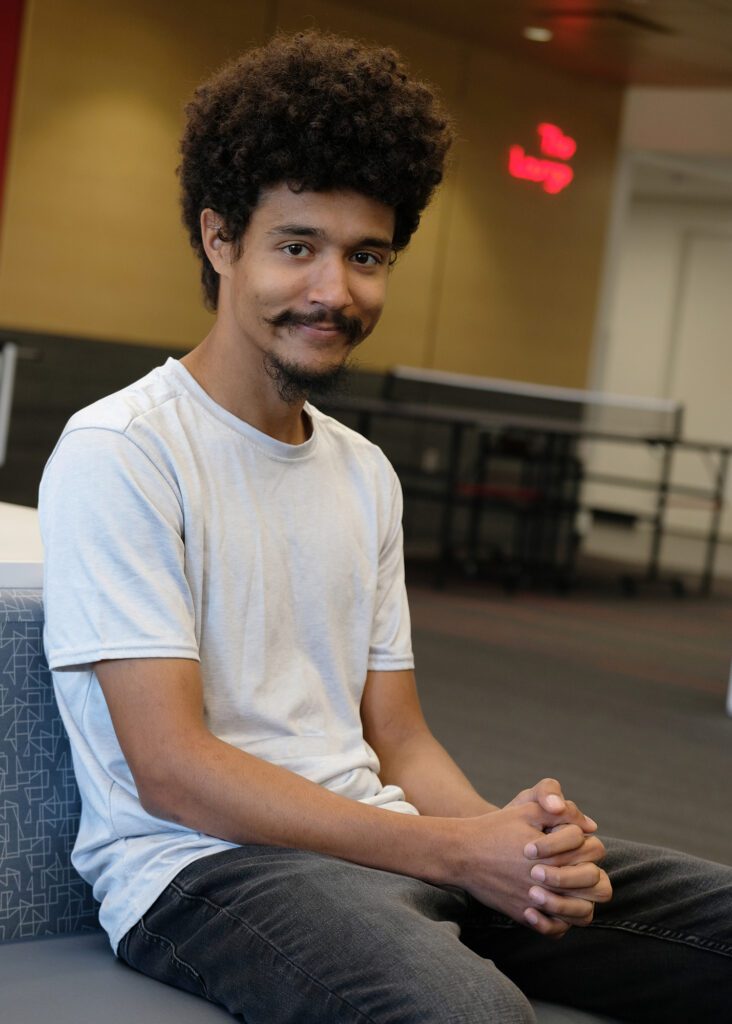
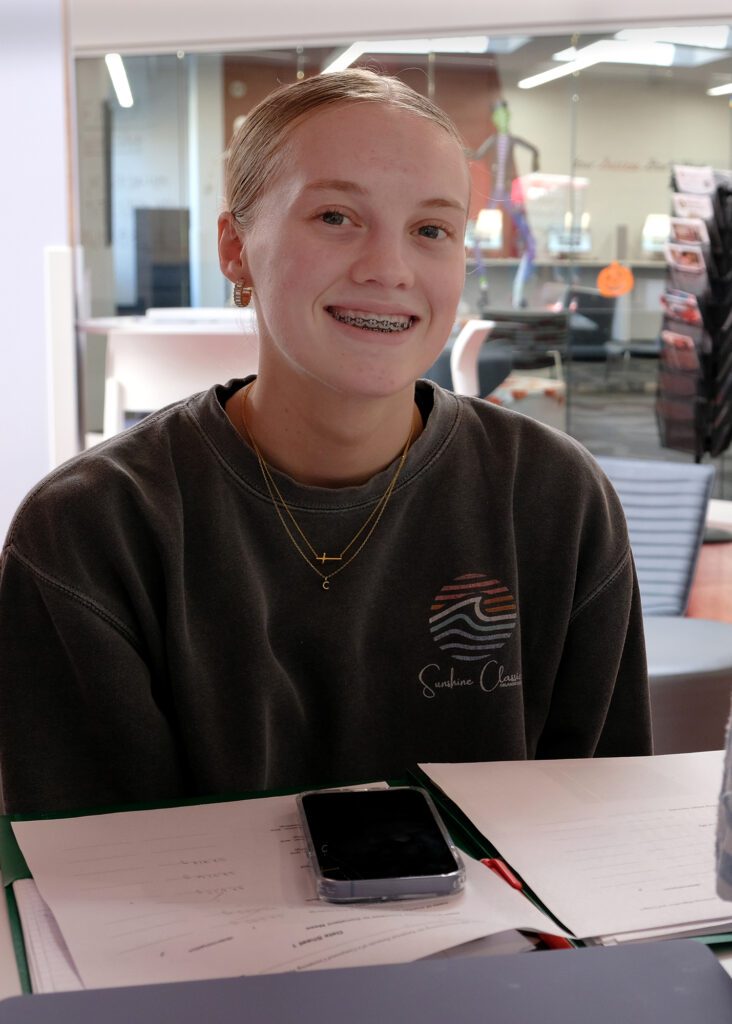
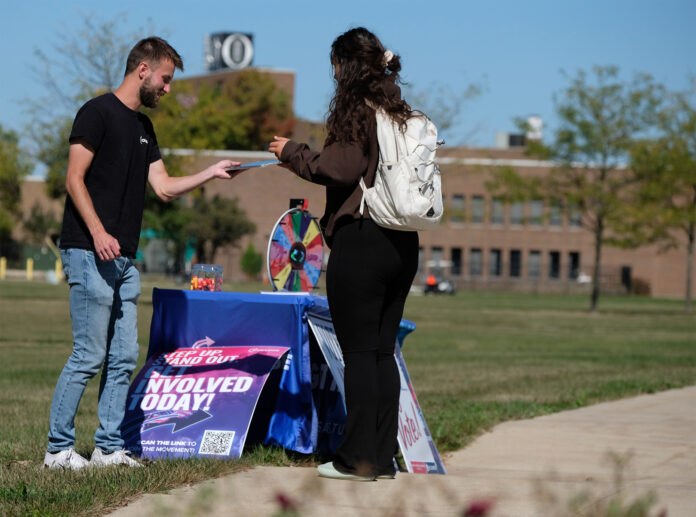
Lucas Zielinksi, with Turning Point USA, hands Amelia Mathkour, a music, business and tech major at Owens Community College, a pamphlet about voting registration. Zielinksi said he was on campus for the day to help students register to vote. (TFP Photo/Lori King)

Lucas County Board of Elections explains voting details, process

Toledo – With Election Day a month away, preparations are in full swing at the Lucas County Board of Elections office.

“We’re up and running and getting everything ready,” said Timothy Monaco, deputy director of the elections office. “It’s a wonderful time. It’s important to exercise your right to vote.”

Logistics that the staff and officers have been handling for weeks on behalf of Lucas County’s 303 voting precincts include preparing ballots, training precinct election officials, and getting early voting dates and times posted on their website.

Monaco said the most commonly asked question from voters during the past couple of weeks has been when absentee ballots will arrive in the mail. 

Here’s the answer: Ohio voters can look for the absentee ballots starting Oct. 8, which is one day after registration ends for the Nov. 5 election.

The Lucas County Board of Elections staff doesn’t give predictions on voter turnout, Monaco said. But, according to state election records, 67 percent of registered Lucas County voters participated in the 2020 presidential election, and 66 percent did so in the 2016 presidential election. This participation includes absentee voting, early in-person voting and traditional Election Day voting.

Those choices are meant to help all eligible voters participate, whether they prefer going in person to a local polling site or to cast a ballot before they travel out of town.

“It’s important to make your plan as to who you are going to vote for,” Monaco said. “Make sure you make a plan and know what is on your ballot.”

While the presidential campaign is the key race of the Nov. 5 election, there are also races in Lucas County for local judges and city officials. For those who want to see the list ahead of time, ballot proofs are available for review on the election board’s website.

“Ballots will be three pages for everyone and four pages for some,” Monaco said.

While some people remember how they wish to vote when going to the polls, others find it helpful to bring paper notes or refer to a list on their phone, Monaco said. “Some folks really come prepared,” he said.

“It’s also important to be respectful at the location,” he added, referring to an Ohio law that prohibits photos of marked ballots. “We do ask that you limit cell phone use at the ballot.”

Many other election details are explained at lucascountyohiovotes.gov.

Election calendar

Key dates for the November 5 election:

  • Military and overseas civilian voting: Started Sept. 20.
  • Voter registration deadline: 9 p.m. Oct. 7.
  • Early in-person voting season: Oct. 8.-Nov. 3.
  • Absentee ballot postmark deadline: Nov. 4.
  • Election Day: Nov. 5.

CAMPUS TALK

OWENS COMMUNITY COLLEGE STUDENTS SOUND OFF ABOUT VOTING

Question: How important is voting to you?

Voting is not my main concern, but it is pretty important because it is the future of America and I would like to have a say in what is gonna be my future. I usually try to vote on voting day, if I can’t I’ll do the absentee ballot.

Oliver Odendahl | EMT Major | Tontogany Resident

I am not a registered voter. If I was to lie to you I’d say yes. But honestly, I don’t have enough time … it’s not really a main priority, even though it should be. I do plan on voting at some point, maybe when I’m in my adult phase. Even though I’m not a registered voter I do think voting is important because it basically determines the society and the rules and regulations we live by.

James Johnson | Broadcast Media Technology Major | Toledo Resident

I’d say voting is very important. There’s certain aspects of it that do feel sort of depressing, when you think about it, because a lot of people would say people voting normally wouldn’t matter because of a small majority in the Electoral College – their votes matter 100 times more than your own. That’s what it feels like at least from what I know. It does feel a little degrading knowing that’s going to happen.

Nivant Dawson | Business Major | Toledo Resident

I think voting is important, but I’m not exactly sure why it’s important. I mean, there’s a lot of things that come from it. You’re voting for someone that you’re putting your trust and you’re faith into to guide us all in the right direction, but we just all don’t know what that direction is yet. So, we’re just kind of free-balling it, in a way. So, I don’t know … I’ve never voted before but this will be interesting. I really don’t know what all is involved. I just have a lot to learn about voting – like what I should be looking for in the leader I’m going to be voting for. So, yeah, it’s coming up soon. There’s a lot to learn.

Sydney Stanley | Chemistry Major | Millbury Resident

Voting is very important, especially in this day and age, when everything’s going on.

David Chase III | Literature Major | Toledo Resident
Registration details

Ohio voters must be registered by 9 p.m. Oct. 7 to be eligible to vote in the Nov. 5 election.

Residents can register to vote, look up voter registration, change their address, find an early voting location, look up Election Day polling location or track an absentee ballot at VoteOhio.gov.

Photo ID requirement

Bring your photo ID when voting. The options are:

- Current Ohio driver’s license or State of Ohio ID card.

- Interim ID form issued by Ohio Bureau of Motor Vehicles.

- U.S. passport or U.S. passport card.

- U.S. military ID card, Ohio National Guard ID card or U.S. Department of Veterans Affairs ID card.

A registered voter who has changed his or her name since the photo ID was issued will need to show proof of legal name change and sign a form. A photo ID card can show a former address if a current address is on file with the voting records. If you forget a photo ID, you can request a provisional ballot. 

How to vote absentee

An absentee ballot in Ohio needs to be requested, signed, dated and submitted for each election. Military personnel and civilian overseas voters can file one application for all elections happening in a given year.

The application asks for the number on your Ohio driver’s license or Ohio ID card, last four digits of your social security number, or a photocopy of other eligible ID such as a U.S. passport or military ID.

Mailed absentee ballots must be postmarked by Nov. 4 and can be hand delivered to the Board of Elections on Nov. 5.

Additional instructions are on the Ohio Secretary of State’s website.

In-person early voting

Ohio’s in-person early voting season begins Oct. 8 and ends Nov. 3. 

The Lucas County Early Vote Center is at 3737 W. Sylvania Ave. Suite 121 Entrance C (at the rear of the Lucas County Board of Elections building) in west Toledo.

Voting times and dates can be found at LucasCountyOhioVotes.gov.

Election Day voting

Polling sites are open in Ohio from 6:30-7:30 p.m. on Nov. 5. You can look up your polling location at VoteOhio.Gov.

What’s on the ballot?

A “ballot proof” is available for review on the Lucas County Board of Elections page. It lists candidates and ballot issues by precinct, so voters know what to expect.

For example: Six president/vice president candidate teams have declared in Ohio, with an additional write-in option available. Other candidate races include U.S. Senator, Lucas County Sheriff and openings on Toledo City Council.

Ohio Issue 1 is a proposed state constitutional amendment that has gained a lot of attention. This issue, if approved, would designate a redistricting commission to draw state legislative and congressional districts.

There are other issues locally, such as a proposed bond issue for the Toledo-Lucas County Public Library and a tax renewal request from the Toledo-Lucas County Port Authority.

Are ballot “selfies” allowed?

Ohio does not permit photos to be taken of a marked ballot. It’s actually a fifth-degree felony should that take place, according to Ohio law.

The “I Voted” Sticker

A traditionally popular way to showcase voter participation is through an “I voted” sticker, picked up on Election Day at the polling site.

Ohio’s current “I Voted” sticker design was adopted in 2019 through a student art contest. A red squiggle depicts a map of Ohio, nestled in a blue circle outline, with the phrase “Ohio Voted.”

Voters are invited to download the image to share on social media at the Ohio Secretary of State website. That website also has also a “future voter” coloring page for children available for download.

Is campaigning allowed at election sites?

Ohio does not allow election campaigning, also known as electioneering, within 100 feet of a voting site. This means no campaigning messages on attire such as shirts or hats, Monaco said.

Two small United States flags are placed at each voting site to designate the “neutral” zone where this applies. 

Where is the Board of Elections office?

If you need to visit the Lucas County Board of Elections regarding a voting matter, that office moved about two years ago from its former location at One Government Center to 3737 W. Sylvania Road in West Toledo.

When are election numbers official?

Ballots cast on Election Day will be delivered in person to the Lucas County Board of Elections for the counting procedures.

There will be numbers reported after that count is complete. 

The Ohio Secretary of State does not consider voter counts to be official until two or three weeks later, after provisional ballots are accounted for and to give time for absentee ballots to arrive that met the postmark deadline.

Toledo Free Press Voter’s Guide: 2026 General Election

0

The midterm general election is fast approaching; early voting began on Oct. 3, and Election Day is coming up on Nov. 3. For those who haven’t already, it’s time to familiarize yourself with what is on the ballot. Our Toledo Free Press Voter’s Guide covers statewide elections, as well as those specific to Lucas County. We do not cover any other county elections at this time, though we will be expanding in future election years to cover more.

This guide is updated frequently through Election Day, so make sure to check in for links to new stories, updates on campaigns, and more.

Below you’ll find a description of the candidates, what the role entails, and linked resources to learn even more about those candidates. The Voter’s Guide is constantly growing up until election day as we cover the candidates and ballot issues, so make sure to refer to it often as you consider how to cast your vote this election.

Statewide candidates


Governor and Lieutenant Governor 

The governor is the chief executive of the state. Their powers and/or responsibilities include managing state departments, cabinet members, agencies, and state military forces; proposing the state budget; signing/vetoing bills passed by the Ohio General Assembly; convening and adjourning legislatures; and the ability to pardon criminal convictions.

The lieutenant governor serves as successor if the governor can no longer serve. Their powers and/or responsibilities also include representing the governor at meetings as needed, leading major departments as needed, and generally carrying out executive orders from the governor and what is mandated by state law.


Amy Acton and David Pepper (Democratic)

Quick facts about Amy Acton:

Relevant experience:

-Served as Director of the Ohio Department of Public Health from 2019-2020

  • -Graduated Northeast Ohio Medical University 
  • -Master’s in Public Health from The Ohio State University 
  • Website: actonforgovernor.com

Quick facts about David Pepper:

– Served as Chairman of the Ohio Democratic Party from 2015-2021

  • – Ran for Ohio Attorney General, lost to Mike DeWine (R), Pepper received 38.5 percent of the vote
  • – Ran for Ohio Auditor; lost to Dave Yost (R), Pepper received 44.9 percent of the vote
  • Websites: davidpepper.com and actonforgovernor.com
  • Learn more about Acton and Pepper here.


Don Kissick and James L. Mills (Libertarian)

Quick facts about Don Kissick:

  • – Has served as County Development Coordinator for the Libertarian Party of Ohio since 2018
  • – Ran for United States Senate in Ohio in 2024 and lost to Bernie Moreno (R); Kissick received 3.4 percent of the vote. 
  • – Ran for Ohio’s 5th Congressional District in 2018 and lost to Bob Latta (R); Kissick received 2.6 percent of the vote.
  • Website: donkissick.com
  • Quick facts about James L. Mills:
  • – Has served as vice chair for a third party political party for Ohio and Warren County since 2024
  • – Has served as brokerage director at Brokerage Solutions since 2025
  • – Co-founded Mills Residential, a construction company, with his brother in 2018
  • Website: donkissick.com
  • Learn more about Kissick and Mills here.

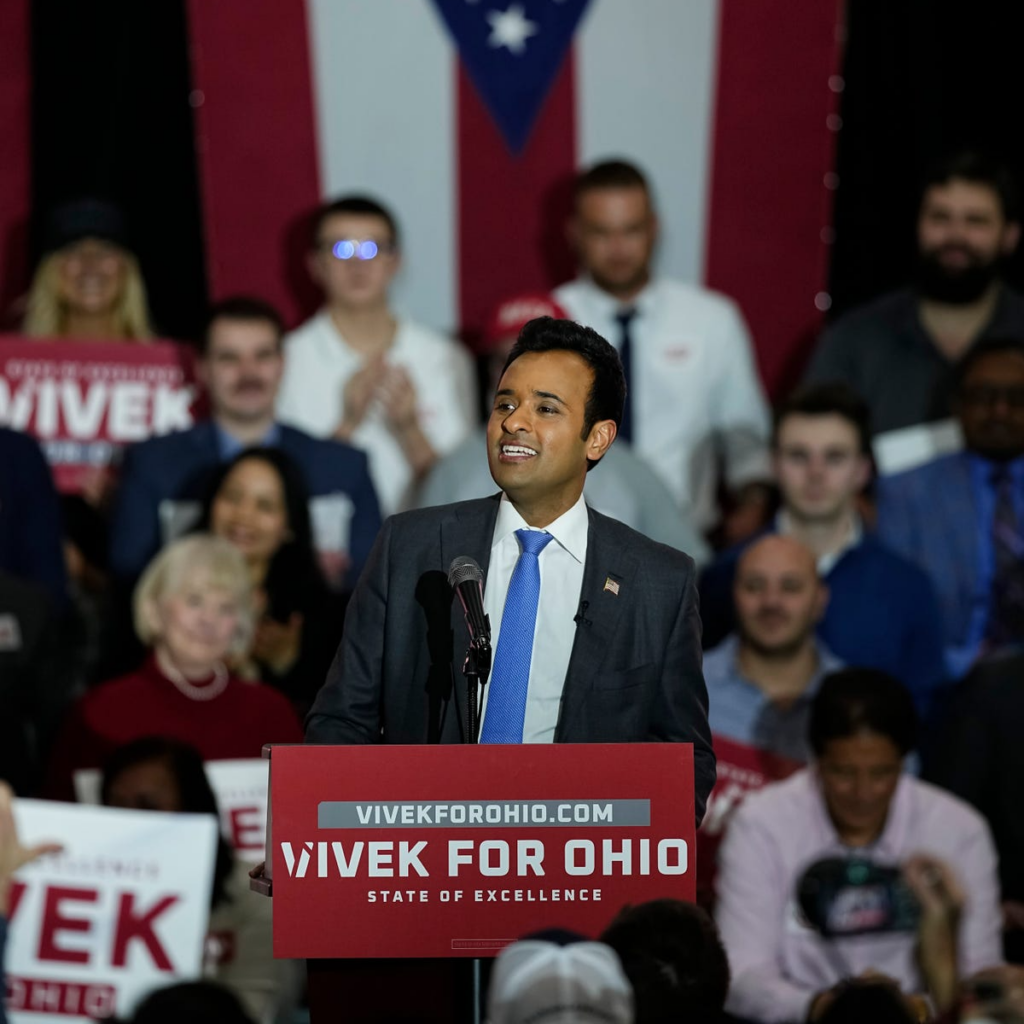
Vivek Ramaswamy and Robert A. McColley (Republican)

Quick facts about Vivek Ramaswamy:

  • – Vivek Ramaswamy ran as a presidential candidate in the Republican Primary 2023-2024, but lost the primary to current President Donald Trump.
  • – Ramaswamy was part of the Department of Government Efficiency (DOGE) with Elon Musk, before stepping down from his role there to pursue the Ohio Governor’s race.
  • – Trump endorsed Ramaswamy for the Ohio Governor. 
  • Website: vivekforohio.com
  • Quick facts about Robert A. McColley:
  • – Since 2017, he has served as State Senator for Ohio Senate’s 1st Senate District including Defiance, Hancock, Hardin, Henry, Paulding, Putnam, Van Wert and Williams Counties and parts of Auglaize, Fulton and Logan Counties.
  • – From 2015-2017, he served as State Representative for the Ohio House of Representatives in the 81st district, which includes Henry, Putnam, Williams, and part of Fulton Counties.
  • – Co-sponsored Senate Bill 23, which prohibited abortion after the detection of a heartbeat. [6] Gov. Mike DeWine (R) signed SB 23 on April 11, 2019.
  • Related Story: Republican rally at Chevy’s: Ramaswamy, McColley, & Merrin

Write-in Candidates

Tim Grady and Andrea Neutzling (Independent)

Quick facts about Tim Grady:

  • – Served as chair of the Ohio Forward Party
  • – Was the Libertarian nominee for state representative of Richland County in 2018
  • – Working toward his MA in Public Administration at Ohio State University, Glenn College of Public Affairs
  • Website: timgradyforohio.com
  • Quick facts about Andrea Neutzling:
  • – Served in the Army as an active duty Intelligence Analyst at Camp Essayons, South Korea, and Fort Gordon, GA from 2001-2004
  • – Currently serving as District Senior Vice Commander at VFW District 12
  • – After serving in Iraq and being exposed to the Burn Pit on Camp Bucca Iraq, she advocate with others to get the PACT Act passed in 2022
  • Website: timgradyforohio.com

Heather Hill and Patrick Manley (Republican)

*Though Ohio write-in candidate Heather Hill was disqualified on April 22 after her running mate, Stuart Moats, dropped out as her running mate, she reentered the race on June 10 with a new running mate, Patrick Manley.

Quick facts about Heather Hill:

  • – Was appointed by Gov. Mike DeWine in 2023 to serve on the Ohio Dr. Martin Luther King, Jr. Holiday Commission
  • – Described on her campaign website as “the only gubernatorial candidate who has actively protested for the last 25 years to end abortions throughout the United States.”
  • – Formed a branch of the Morgan County Martin Luther King Scholarship Foundation, where she served as president from 2005 – 2013
  • Website: heatherhillohio.com
  • Quick facts about Patrick Manley:
  • – Has worked as an adjunct instructor in the Construction Sciences Department at Columbus State Community College for more than 20 years
  • -Has served for more than 20 years on the board of directors for Dave Fox Design Build
  • – Served a 10-year term as president of the Ohio Chapter of the Association of Licensed Architects
  • Website: heatherhillohio.com

Renea Turner and Jalen Turner (Independent, Republican Party)

Renea Turner is a write-in candidate (independent, Republican Party) running for Ohio governor. (Courtesy photo)

Ron Ula and Michael Lehnerd (Independent)


U.S. Senator

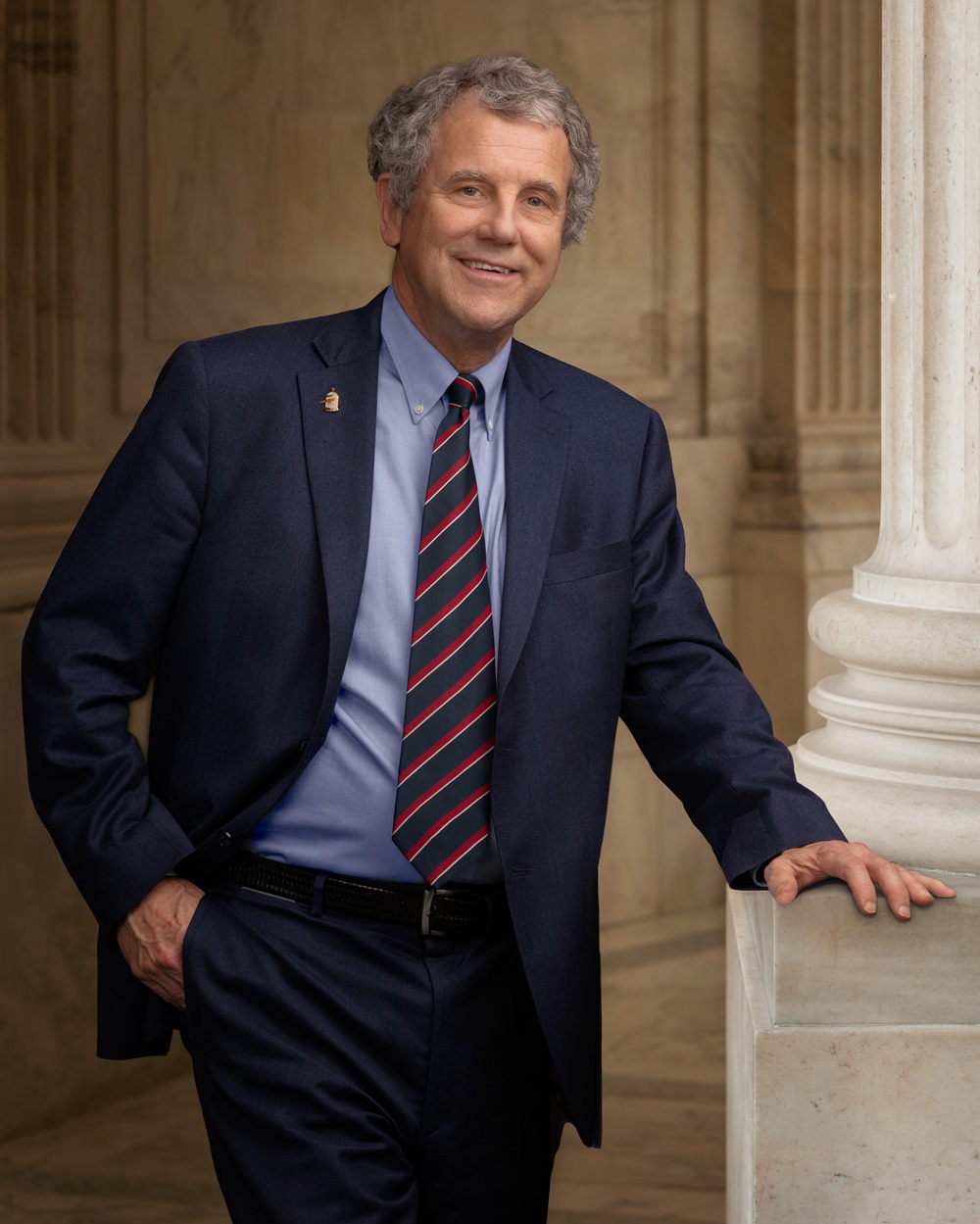
Senate terms last six years with elections being staggered so that no two U.S. senators in Ohio are seeking election at the same time. This year, Sherrod Brown (D) is facing incumbent Senator Jon Husted (R). U.S. Senators’ roles are legislative, meaning they are responsible for proposing and voting on federal bills. They are also charged with approving U.S. presidential appointments (cabinet members), convicting or exonerating impeachment cases, and can approve or reject treaties. The U.S. Senates is the upper house of Congress.

Sherrod Brown (Democratic)

Sherrod Brown. (Official U.S. Senate photo by Rebecca Hammel)

Quick facts about Sherrod Brown:

  • – Ran in the General Election for U.S. Senate for Ohio in 2024 and lost to Bernie Moreno (R). Brown received 46.5 percent of the vote.
  • – Served as Ohio U.S. Senator from 2007-2024
  • – Served as a U.S. Congressman from 1993-2007
  • Website: sherrodbrown.com
  • Learn more about Brown here.

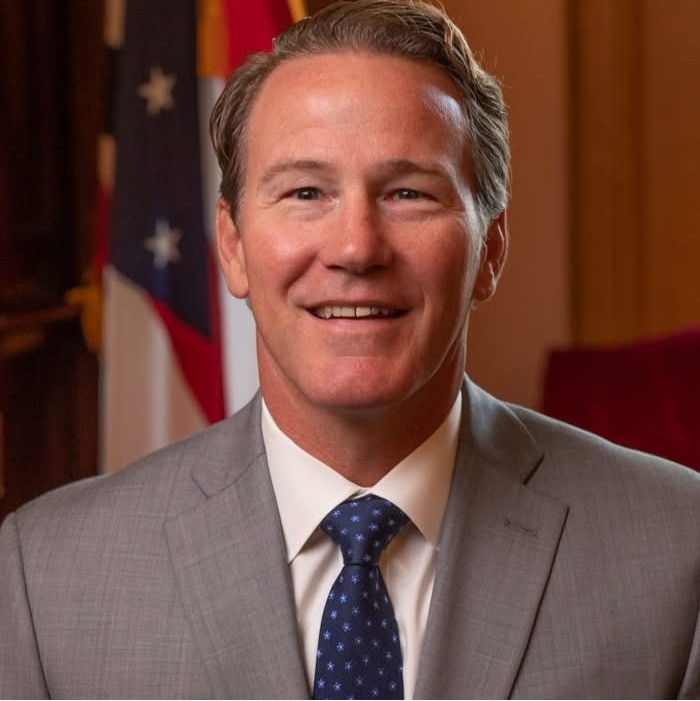
Jon Husted (Republican)

Jon Husted (Courtesy photo)

Quick facts about Jon Husted:

  • – Has served as Ohio U.S. Senator since 2025. Appointed by Mike DeWine to replace J.D. Vance, as Vance took on his new role as Vice President of the United States. 
  • – Served as Lieutenant Governor of Ohio from 2019-2025
  • – Served as Ohio Secretary Of State from 2011-2019
  • Website: husted.senate.gov
  • Learn more about Husted here.

  • • Gregory Levy (Independent)
Gregory Levy (Independent). (Courtesy photo)

Quick facts about Gregory Levy:

  • – A member of the Party for Socialism and Liberation (PSL)
  • – Military veteran
  • – A community organizer from Akron
  • Website: greg4senate.com

William B. Redpath (Libertarian)

Bill Redpath

Quick facts about William Redpath:

  • – Ran for Illinois U.S. Senate in 2022. Redpath received 1.7 percent of the vote and lost to Tammy Duckworth (D). 
  • – Ran for U.S. House to represent Illinois’s 6th District in 2020. Redpath received 1.7 percent of the vote and lost to Sean Casten (D).
  • – Ran for the U.S. House to represent Virginia’s District 10 in 2014. Redpath received 1.5 percent of the vote and lost to Barbara Comstock (R).
  • Website: billredpath.com
  • Learn more about Redpath here.

Attorney General

The attorney general serves as the primary legal counsel for the state of Ohio. The position supports law enforcement, consumers, and heads up the following divisions under the Attorney General’s office: antitrust, appeals, Bureau of Criminal Investigation, charitable law, civil rights, collections enforcement, constituent services, constitutional offices, consumer protection, court of claims defense, crime victim services, criminal justice, education, employment law, environmental enforcement, executive agencies, health & human services, health care fraud, Ohio Organized Crime Investigations Commission, Ohio Peace Officer Training Academy, policy and legislation, public utilities, special prosecutions, taxation, and workers’ compensation. Read more about the specifics of these AGO sections here.

Keith Faber (Republican)

Quick facts about Keith Faber:

  • – Has served as Ohio’s Auditor of State since 2019.
  • – Served as Ohio’s U.S. Congressman representing District 84 from 2016-2018.
  • – Served in the Ohio State Senate representing District 12 from 2007-2016.
  • Website: keithfaber.org

John J. Kulewicz (Democratic)

John Kulewicz (left) was interviewed by Jaden Jefferson in late May. (TFP photo by Jaden Jefferson)

Quick facts about John J. Kulewicz:

  • – 44-year member of the Columbus law firm Vorys, Sater, Seymour and Pease LLP, where he argued cases against the U.S. Supreme court and other state courts.
  • – Wrote An Ohioan’s Odyssey: Lessons in Leadership, Law, and Public Service
  • – Currently serving his second term on City Council for Upper Arlington.

Website: john4ohioag.com

Learn more about him in TFP’s coverage here.


Auditor of State

• Annette Blackwell (Democratic)

• Frank LaRose (Republican)

Secretary of State

• Tom Pruss (Libertarian)

  • • Allison Russo (Democratic)
  • • Robert Sprague (Republican)

Treasurer of State

  • • Jay Edwards (Republican)
  • • Seth Walsh (Democratic)

Justice of the Ohio Supreme Court (Term commencing Jan. 1, 2027)

• Daniel R. Hawkins (Republican)

• Marilyn Zayas (Democratic)

Justice of the Ohio Supreme Court (Term commencing Jan. 2, 2027)

• Jennifer Brunner (Democratic)

• Colleen O’Donnell (Republican)

LUCAS COUNTY

U.S. Representative – 9th District

• Matthew Althaus (Libertarian)

Matthew Althaus. (Courtesy photo)

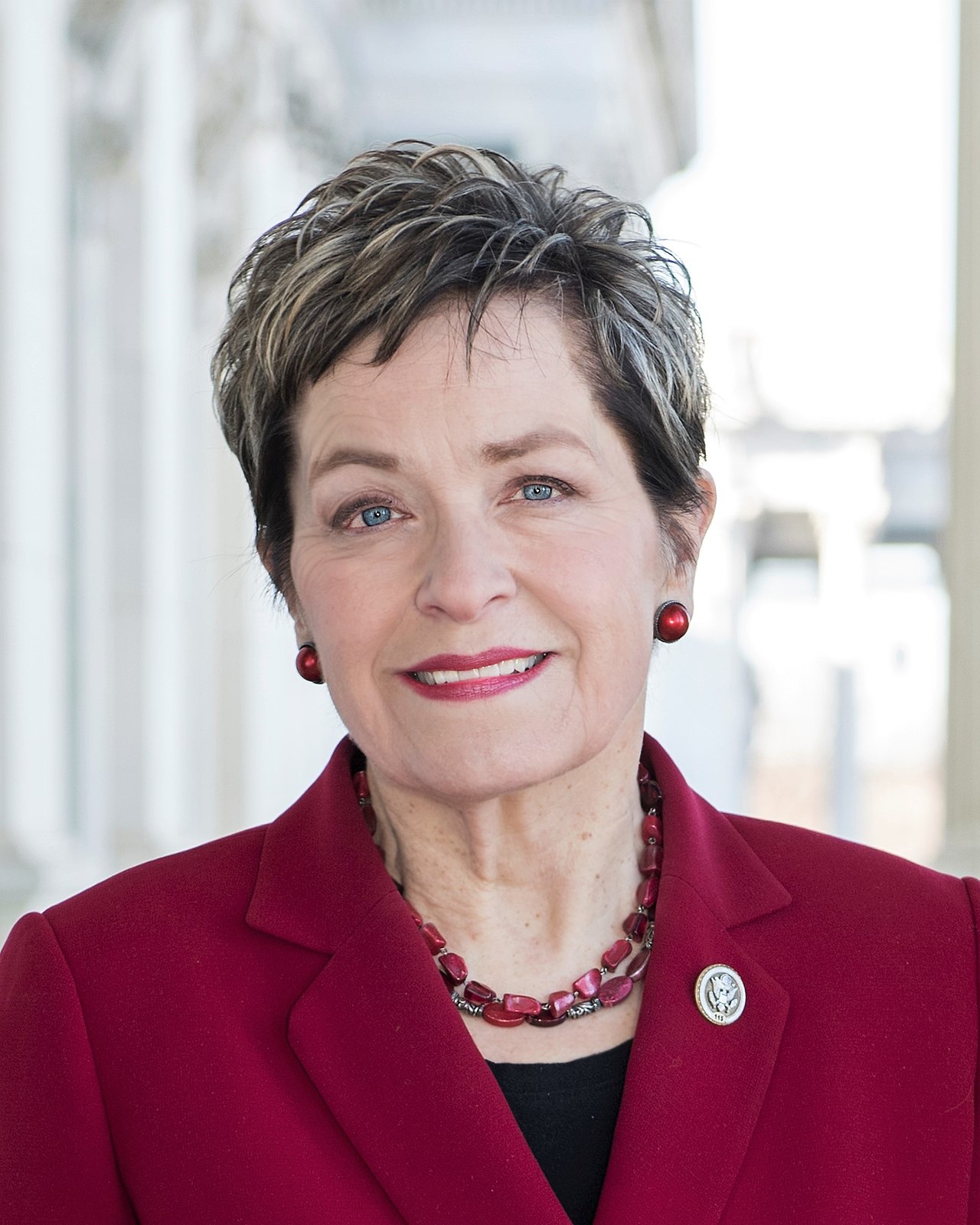
• Marcy Kaptur (Democratic)

Marcy Kaptur. (Courtesy photo)

• Derek Merrin (Republican)

Derek Merrin. (Courtesy photo)

State Senator – 11th District

• Paula Hicks-Hudson (Democratic)

• Kenneth W. Sharp (Libertarian)

• James Nowak (Republican)

State Representative – 41st District

• Ian Chamberlain (Republican)

• Erika White (Democratic – Write-In)

State Representative – 42nd District

• Elgin Rogers Jr. (Democratic)

• Robert McMahon (Republican – Write-In)

State Representative – 43rd District 

• Michele Grim (Democratic)

• Zach Hall (Libertarian)

• David Karmol (Republican)

State Representative – 44th District

Two attorneys and an architect are on the ballot to replace outgoing Rep. Josh Williams (R-Sylvania) in Ohio House District 44. The 119,000 population district is dubbed “the sliver on the river” because just a small section of the Maumee River connects portions of Sylvania, Berkey, Whitehouse, Waterville, Monclova, Providence Township and Swanton Township to the west with and portions of Perrysburg Township, Rossford, Northwood, Genoa and Curtice to the east.

Dave Fournier is running as a Democrat, Ed Schimmel as a Republican, and Lyndsey Stough as an Independent.

• David J. Fournier (Democratic)

• Edward L. Schimmel (Republican)

• Lyndsey Stough (Independent)

Court of Common Pleas – Domestic Relations

• Lisa D. McGowan (Republican)

• Nedal Adya (Democratic – Write-In)

Court of Common Pleas – Probate

• Tom Puffenberger (Democratic)

• Jaime Agnew (Republican)

Court of Appeals – 6th District

• Myron C. Duhart (Democratic)

• Michael R. Goulding (Republican)

• CJ Kamm (Republican)

Lucas County Commissioner

• Lisa A. Sobecki (Democratic)

• Brenden Johnson (Libertarian – Write-In)

• Laura Brown (Republican – Write-In)

Lucas County Auditor (Vote for 1)

• Katie Moline (Democratic)

• Carolyn Munn (Republican – Write-In)


Issues on the ballot

Issue 3

Statewide, voters are deciding whether or not to enshrine Ohio’s existing requirement of photo ID to vote in the state constitution. Issue 3 would define approved forms of photo ID as:

• an unexpired Ohio driver’s license or state identification card; 

• a United States passport or passport card; 

• or a United States military identification card, Ohio National Guard identification card, or United States Department of Veterans Affairs identification card.

Issue 8

Issue 8 is about a five-year levy to cover the Toledo Lucas County Public Library’s operational costs.

If passed, Issue 8 would provide the TLCPL with an estimated $34.2 million each year. At an annual cost of about $105 for every $100,000 in taxable property value, this proposed levy is for $12.42 more than the one it’s intended to replace.

Related Story: Toledo Free Press Voter’s Guide: Issue 8 for the Library

Issue 9

Toledo Public Schools is putting before voters an ask of new funding “for the purpose of current expenses.” This five-year, 6.9 mills levy would cost taxpayers $242 for every $100,000 of their property’s county-estimated value. State cuts to public school funding, along with fewer students being enrolled, have resulted in increased financial pressure on TPS — a story playing out in school districts large and small throughout the state of Ohio.

Issue 13

The Imagination Station is seeking a renewal of its existing 0.17 mill levy for a period of five years. The cost to taxpayers is $3 per $100,000 of county-evaluated property value. Issue 13 would collect an estimated $1.3 million annually for the downtown Toledo science center.

Issue 16

For residents of the City of Toledo, there are a few things they, exclusively, will see on their ballot. 

To begin, Issue 16, which is being billed as a new source of funding for “neighborhood safety expenditures,” including the city’s police and fire departments, as well as “criminal gang disruption” (a term Issue 16’s ballot language leaves to the imagination).

Issue 17

Issue 17, if passed, would amend the City of Toledo charter in the following ways:

• Expand the definition of a city “employee,” which currently reads as “one who serves the City in the classified civil service,” to also include “members of the unclassified service.”

• Increase the power delegated to city council members over personnel decisions. Currently, the charter allows members to choose a clerk and “such other officers as are necessary.” This proposed amendment would allow members to also determine “the conditions of employment for its officers and employees, including matters such as hiring, discipline, and termination.”

• Change the classification of council officers and employees as members of the “classified civil service” to the “unclassified service.” 

Issue 18

Issue 18, if passed, would amend Toledo’s charter in these ways:

• Remove the requirement that candidates who’ve filed a nominating petition for a primary election provide written acceptance of their party’s nomination with election authorities.

• Require any potential write-in candidate to declare their intent to run on state-prescribed forms. 

• Increase the number of allowable days, from which an election must be held on a ballot initiative or referendum, from 75 to 90.

• Require that petitions to initiate a city ordinance, hold a referendum on an existing ordinance or council resolution, or amend the city charter, be filed “consistent with forms prescribed by the state.”

Issue 19

Issue 19, if passed, would amend the city charter to require that city council members approve proposed charter amendments in the form of an ordinance, rather than a resolution. It would also rewrite the city’s current charter amendment process, laid out here, and replace it with language proposed by city council in this ordinance, #305-26.

Read more details about all of the issues for Lucas County here.

TFP Voter’s Guide: Ed Schimmel (R) runs for Ohio House 44

0
Ed Schimmel Shares Plans for Ohio House 44. (AWFP photo by Karen Gerhardinger)

From farming, e-bikes and Flock cameras to school funding, state taxes, and data centers, Republican candidate Ed Schimmel has heard from House District 44 residents about a wide range of topics.

Schimmel, a practicing attorney and fifth-generation farmer, has served as mayor of Northwood since 2016. It’s experience he believes that will aid him if elected as state representative. When asked if he supports President Trump’s policies and plans, Schimmel said he prefers to focus on local issues.

“State reps don’t touch many of those federal issues. I’m just trying to stick with what issues are before the state,” he said. “I try to get the viewpoints of as many people as I can and form my own viewpoint. Several issues the party doesn’t have a stand on, or won’t take a stand on.”

One of those issues is Flock Safety cameras. Schimmel said he understands the need for Toledo Police, which he describes as understaffed, to use them as a tool. Flock is a private company in Texas, and he believes more control is needed on who can access the information gathered by the license plate readers.

“Most people are so distrusting of Flock cameras, they don’t want them,” he said. 

In Northwood, as in all over the district, e-bike riders not obeying the laws has caused problems.  The Ohio Municipal League recently came out with guidelines on how to regulate e-bike usage. 

“What I’ve found, going around the district, is that the issues in every community are relatively the same,” he said.

Data centers, of course, remain a hot topic, and Schimmel said he’d like to encourage developers to look beyond farmland.

“We have a lot of brownfields sitting idle that we could utilize for data centers,” he said, noting that these are not just vacant industrial sites but also commercial spaces. Asking developers to wait two or three years for a site to be cleaned up isn’t realistic, so he suggests a proactive approach by the state to fund brownfield cleanup. Northwood obtained low-interest loans to remove the asbestos-filled, 900,000-square-foot Woodville Mall, which is now being developed into housing and a community center.

“If I’m elected, I want to make sure there’s more money to remediate asbestos, whether it’s industrial or retail sites,” he said, adding that local communities should have a say, following their master plans, on what goes into vacant properties.

Outright bans of projects like data centers or marijuana dispensaries open up communities to lawsuits, but Schimmel said adequate zoning and restrictions can minimize the impacts. Before deciding on giving tax breaks and abatements, each community should do a cost to benefit analysis and always insist on make schools whole, he added.

Schimmel said he believes the state has done a good job in economic development, citing a CNBC poll that named Ohio as the top state for business. Columbus has one of the fastest-growing markets in the U.S., but getting goods from northwest Ohio to the capital is not easy. Plans for a new U.S. 23 route and the recent completion of the Gordie Howe Bridge will benefit northwest Ohio, he said.

When it comes to schools, Schimmel said he supports the voucher program because it empowers parents and students to make the best choice based on programs or to deal with a bullying situation.

“In certain communities, they may not have a lot of options but private school, and that could be very expensive,” he said, noting that St. John’s Jesuit High School, for example, has many students who attend through scholarships or the voucher program.

“Not everyone who attends St. John’s is rich,” he said. “A lot of parents could use that help.”

The school funding program was deemed unconstitutional by the Ohio Supreme Court nearly 20 years ago, but discussions at the state level continue on how to address the issue. He noted that the two largest school districts, Anthony Wayne and Sylvania, are not being treated well by the state – getting $3,000 to $3,500 per student while others are getting upwards of $28,000 per student, he said. The process of dividing up the funding is “very unfair,” he said, noting that the average cost to educate a student is $18,000.

Anthony Wayne Superintendent Kevin Herman, who was asked to clarify for this article but does not endorse any candidate, explained more:

“Because we are a high wealth district, we only receive $3,087.94. Our local taxes support the rest of the money needed to educate our students. If you take the money we receive from the state and our local taxes and divide it by the number of students we have, you would find that our total cost to educate students is less than what many other districts spend. This is because those districts receive more state funding and have passed more millage, allowing them more operating money,” Herman said.

In his role as both a farmer and a mayor, Schimmel said he brings a unique perspective. Schimmel has taken on responsibility for the family’s 400 acres of soybeans, corn and wheat. It’s a rough business, with a small profit margin. Some costs can be attributed to tariffs, and others because of the world market, with more competition from Argentina and Brazil, he said.

Another issue with farming is real estate taxes. Schimmel notes that his farm’s taxes have doubled in the past decade, but the credit given to farmers doesn’t cover those increases. And farmland typically doesn’t use many of the services that property taxes pay for, he said.

“I go there one day to plant and one day to harvest. I’m not there using those services,” he said.

Schimmel said he’d like to see a reduction in taxes for senior citizens, who are on a limited income. As former farmland becomes housing, property valuations increase and long-time residents see their valuations, and taxes, skyrocket as new homes come in. Having those taxes linked to inflation would make more sense that throwing massive increases as homeowners all at once, he said.

At the same time, local municipalities are working to provide services to growing communities, while trying to fund aging infrastructure. In Northwood, the city has taken on debt and passed some of it on to consumers, in order to replace water lines that, in some places, are over 100 years old.  He’d like to see the state have more funding available for municipalities to upgrade.

Providing services like water, sewer, fire, EMS and police to residents is at the core of local governments. Northwood is working with Lake Township and Rossford to conduct a fire study for a possible fire district. He pointed out that the Waterville, Waterville Township and Whitehouse (W3) fire co-op was the first in the state, and other communities are working to replicate those efforts in order to provide services at a more affordable rate.

“It’s too expensive for some small communities to have a full service fire department. It’s a repetition of purchasing and equipment. You’ll see a 5,000-population village with a $2 million truck right next to another,” he said. 

Often projects that involve communities working together receive priority when it comes to grants. Schimmel acknowledges that not every municipality has an expert grant writer, but can utilize resources like the grant writer with Lake Erie West Regional Council to find those opportunities. Lake Erie West has a membership that’s affordable and based on population, and the payoff comes in sharing ideas, he said.

Schimmel said he supports local communities having more authority than the state government. He supports Monclova Township’s quest to become a limited home rule government, and he’d like to see  the state income tax reduced so more municipalities can keep funds in their own communities.

“I think people realize they get more services from their local government than their state,” he said.

Schimmel is married to Carolyn, an accountant and tax preparer who serves on Northwood Schools, and they have three children.

TFP Voter’s Guide: Dave Fournier (D) runs for Ohio House 44

0
Dave Fournier is running as a Democrat in Ohio House District 44. (AWFP photo by Karen Gerhardinger)

As he tours Ohio House District 44, attending festivals and knocking on doors, Democratic candidate Dave Fournier hears many of the same concerns: the rising costs of groceries, gas, utilities, health care and property taxes, and frustration that politicians are giving tax breaks to rich companies while working families are feeling the squeeze.

“The big topic now is affordability,” said Fournier, an attorney and lifelong resident of northwest Ohio. “People are feeling the pain in their wallets. People are aware that more cuts are coming from that One Big Beautiful Bill that were delayed until after the mid-terms.”

When the enhanced subsidies expired for the Affordable Care Act, 700,000 Ohioans dropped out, and while the healthy population rolls the dice and opts not to pay in, the ones with the most health care needs remain, driving prices up, he said.

“Taxpayer funds should be used to lower premiums and prescription costs. We need to protect rural hospitals and access to care, not finance corporate bailouts and sports stadiums,” Fournier said, referring to the $600 million that Ohio invested into a new Cleveland Browns stadium. 

Data centers continue to be a hot topic, especially in areas where farmland is available. Fournier said his goal is to halt construction on new data centers until several criteria are met. First is to eliminate tax breaks and incentives while requiring that companies make significant payments to the local tax fund that supports schools, libraries, parks and emergency services. Republicans have cut funding for local governments and schools, which need breathing room to provide quality education and economic development instead of signing NDAs and rushing through data centers, he said.

“There are better, more transparent ways to do economic development than under pressing financial circumstances,” he said. 

Second, is to require data centers to produce their own power, off the grid, in order to not increase local electric costs, and to use a closed-loop cooling system that uses minimal water.

“Everyone is upset about utilities. I think a lot of what is compounding that is data center discussions. Everyone tells me what their electric bill is. They’re worried about a data center coming in and seeing that already painful number going up even more,” Fournier said, adding that data centers are not paying their fair share of the utilities they are using.

Data center developers also need to pay for their own infrastructure, and submit to having ongoing, independent environmental monitoring to ensure compliance. Fournier added that he also believes such developments should be steered toward brownfield sites rather than on quality farmland.

“No one wants to live next to one,” he said. “There are concerns about rolling blackouts, water quality and fracking.”

As the parents of three children, including two who are Anthony Wayne Local Schools’ students, Fournier and his wife, Sarah, began attending school board meetings a few years ago.

“I saw that the district was being asked to do more with less from the state,” he said.

He also learned about private school vouchers work. A family of four earning $145,000 a year or less can receive a $6,166 scholarship for K-8 students and $8,408 for grades 9-12. Those earning more can still receive a portion of the funding.

“I’m opposed to universal eligibility for private school vouchers while the state underfunds public schools, which educate 90 percent of Ohio students,” Fournier said. “Ohio has been underfunding public schools by $2.7 billion and yet put $2.4 billion into vouchers. 

“People realize the schools are receiving less from the state, so schools have no choice but to come back and ask taxpayers for more. The vast majority of Ed Choice vouchers go to those who were already sending their kids to private schools. You lay that out, and people are salty.”

Fournier recently wrote an editorial about the impact of cuts to the Local Government fund – a portion of the state tax revenue that is shared with municipalities, townships and counties.

“Those dollars helped support police, fire, EMS, roads and other essential services,” he wrote. “Then Republican leaders in Columbus cut the state’s share from 3.68 percent to roughly half that amount. They also eliminated other sources of local revenue, shifting more responsibility and more of the cost onto local taxpayers.”

The voucher spending, the school funding gap, and the Local Government Fund cuts all end up in the same place, he said.

“When the state stops paying its share, the cost doesn’t disappear. It comes back as a school levy or a safety levy. Then the same people who made the cuts blame local officials for asking,” Fournier said.

Among the other topics that Fournier hears about from constituents are Flock Safety cameras and e-bikes. 

“In general, I oppose unrestricted mass surveillance – I think the potential for abuse is huge. That said, we give away a lot of information,” Fournier said, noting that everyone carries a cellphone with GPS trackers. “The problem is the lack of regulation. It’s like AI – the legislature hasn’t kept up and put guardrails in place. I would support a moratorium on Flock until the legislature has a chance to study the issue. I think there’s a balance between legitimate use for law enforcement purposes versus giving unrestricted access to anyone who pays a subscription.”

E-bikes also need further study, in terms of safety and traffic implications, Fournier said. Living in Whitehouse, he’s heard from many in the community about it, and knows that Whitehouse Police and other local departments are working to put parameters in place.

“We’ve got kids zipping around neighborhoods and parks at dangerous speeds. I’ve seen near misses with pedestrians,” he said.

Fournier said his goal as a representative is to be an advocate for his constituents on a variety of topics, and especially for working families.

“I’ve been knocking on doors and having really good conversations with people who have a different letter behind their name,” he said. 

Fournier grew up in a Republican, anti-union household, but as he worked in the courtroom after earning his J.D. from the University of Toledo Law School, he began seeing things differently.    

“That whole ‘pull yourself up by your bootstraps’ mentality rings hollow,” he said. 

Fournier doesn’t consider himself a traditional Democrat, and thinks the far left and far right don’t represent the majority of voters. He’s met a lot of people who share his democratic values and don’t like the direction the country is going, he said.

He’s found a shared concern that there is too much money in politics, that special interests have too much say, and that gerrymandering is diluting votes and insulating legislators from voters who are being impacted by their decisions.

“I think if you have enough face time and meet people in person, you can bridge the divide. I have no problem working across the aisle on how to expand access to health care and how to address expensive health care. I keep telling people that I want to make politics boring again. I want to make things better for people.”

TFP Voter’s Guide: Lyndsey Stough (I) runs for Ohio House 44

0
Lyndsey Stough, an architect and member of Sylvania City Council, is running as an Independent for Ohio House District 44. (Courtesy photo)

As an architect, Lyndsey Stough has designed and managed complex projects, balancing competing needs, tight budgets and deadlines while interacting with owners, local governments, community members, construction workers and engineers.

As the daughter of longtime Sylvania Mayor Craig Stough, who stepped down in 2024 after 29 years in public service, she was able to “peek behind the curtain” on what it takes to weigh different sides and make a level-headed decision to benefit the community. It’s the same attitude she carries with her as a member of Sylvania City Council today.

As an Independent, Stough has watched the divisiveness of a two-party system get in the way of finding solutions that could benefit northwest Ohioans. The time is right for an Independent to represent District 44 in the Statehouse, she said.

“As an Independent, I answer directly to District 44, not parties, special interest donors or lobbyists – just the people I represent,” she said. “I’m not an Independent that’s secretly a Democrat or a Republican. I’ve never been part of a political party. There’s a lot of discontent and hyper-partisanship that is taking away from what we have in common. Why don’t we solve the issues that are bothering us together?”

A January 2025 Gallup poll shows that 45 percent of adults in the United States identify as political independents, who outnumber the 27 percent who affiliate as Democrat and the 27 percent who identify as Republican, she said. Yet the system isn’t set up for an Independent to run. To get on the ballot, she had to collect five times the number of signatures that a party candidate had to submit.

“I’m going to draw the interest of both Republicans and Democrats: Republicans who know and don’t like that a vote for a Republican right now is probably a vote for the Trump way of doing things; and a vote for a Democrat is a vote for the same things that have been happening. I think this year, having an independent ­– especially if they (House Republicans) lose a supermajority – I become that voice of reason and a way to cut through some of the pandering and be able to bring up issues that neither party wants to talk about.”

To Stough and her constituents, the top three issues are public education, lowering costs, and voter access and integrity.

Public education

As the daughter of a retired eighth-grade science teacher, Stough understands the value of an excellent public education – and how investing in a good education turns around and benefits the community.

“Public education is valuable and important, but it needs to be properly funded,” she said.

The Fair School Funding Plan was passed by both parties as a solution to the unconstitutional plan that was in place, but the current budget bill is underfunded by $400 million – undermining the efforts to fairly distribute funds among the school districts. Stough wants to figure out why that’s the case, and hold leaders accountable to what was approved when they passed the Fair School Funding Act.

“I think the current voucher system is outside of what its original intention was…to give students in struggling school districts a chance at a better opportunity. It was not meant to discount the cost of private education for higher income families, and especially if they’re in successful school districts,” she said. “I would want to look at why we’re are at this point. It’s weakening good school systems. This is placing undue burden on local municipalities and local school systems and contributing to higher property taxes.”

Lowering costs

“We all feel it. We are stretched thin mentally, monetarily and emotionally,” she said. “I would like to find ways to lower common recurring costs.”

To do that, Stough wants to bring more money back home by restoring the Local Government Fund, which was enacted to make sure that what the state was taking away was going back into the communities paying into it. 

“The Local Government Fund has been reduced since Covid and hasn’t gotten back [to pre-Covid levels],” she said. 

Stough also plans to work on getting more state funding for local capital improvement projects, like the Sylvania bridge over I-475 and street repairs. 

“I know how big of a difference having local capital improvement dollars can make,” she said.

Bringing state dollars back to local communities reduces the burden on villages, cities and townships in District 44, and their constituents, she said.

Looking back at the state’s largest corruption case – the 2019 FirstEnergy bribery scandal – Stough said the statehouse needs to have stricter oversight on anti-corruption and consumer protection laws. 

“I think it’s necessary to keep costs down for utilities, groceries, health care and more,” she said. “Are we offering deductions or credits to things that maybe aren’t being good stewards of the public money? Are we doing a good job of ensuring that everyday people have a reasonable level of protection?”

Voting access and integrity

Voting in elections must be fair, accessible and secure, said Stough, who said she supports voter ID but opposes making it harder for eligible citizens to vote. 

“Voting by mail and ballot drop boxes are longstanding, reliable methods that are both accessible and secure,” said Stough. “I think open primaries, ranked place voting, ending gerrymandering and maintaining the ballot initiative process should be nonpartisan issues to ensure that every vote counts and that the government properly represents its citizens.”

The river-crossing C-shape of District 44 is evidence that partisan gerrymandering is an ongoing issue in Ohio, she said.

“How are we going to get the things that matter to us done if the people representing us don’t actually represent us?  If we don’t address it now, it’s only going to get worse,” Stough said.

Weighing issues, making decisions

As a member of Sylvania City Council since 2020, Stough looks at each issue independently – and plans to bring that same approach to District 44. 

“On council, there are some issues that align one way or another. I look at the facts, talk to neighbors and experts, and come up with my own conclusions,” she said. “I like diving into nuance, talking to the experts, and finding the right way forward.”

A Sylvania Southview graduate, Stough earned her B.S. in Architecture from The Ohio State University and M.A. in Architecture from the University of Michigan. She now represents the third generation in Stough & Stough Architects, and has designed notable projects including Veterans Hall at Owens Community College, the TARTA Downtown Hub, the Russell J. Ebeid Recreation Center at Lourdes University, and the Community Center for The Ability Center of Greater Toledo, which is currently under construction.

Her role is to work with owners, contractors, engineers, boards, employees and end-users, and balance that with the creative side and the government side – including permitting, fire and zoning codes – to find a solution that meets the needs of all while complementing the surrounding community.

“My job is to interpret the essence of what they want and achieve that goal by putting the pieces together. The role of an architect and the role of an independent overlap,” she said. “It’s not about being a specialist on one thing, it’s about being able to know enough to connect the dots and know who to talk to when something needs to be solved. You need to be able to work with a lot of different people and people need to want to work with you.”

Stough is recently married and, in her spare time, likes riding a Vespa, attending the Toledo Opera, and playing a ukulele on her front porch.

Toledo Free Press Voter’s Guide: Lucas County’s ballot issues

0
Election 2026: A guide to issues on the ballot in Lucas County. (TFP image by Jaden Jefferson)

TOLEDO – Early voting began this week in the state of Ohio, and as the Toledo Free Press has previously reported, there are a number of high-profile races on the ballot this year: from governor to U.S. Senate. But in addition to candidates, voters can also expect to see a few issues on their ballot as well.

Issue 3

Statewide, voters are deciding whether or not to enshrine Ohio’s existing requirement of photo ID to vote in the state constitution. Issue 3 would define approved forms of photo ID as:

• an unexpired Ohio driver’s license or state identification card; 

• a United States passport or passport card; 

• or a United States military identification card, Ohio National Guard identification card, or United States Department of Veterans Affairs identification card.

Provided state law already requires voters to show identification before casting a ballot, this constitutional amendment, put on the ballot by Republicans in the Ohio Statehouse, has been criticized for its duplication and viewed as unnecessary. 

Its supporters in the General Assembly (a group that includes only Republican lawmakers) have argued that a constitutional amendment would make it more difficult for future legislative assemblies to change the law. However, if a proposal to do just that clears the state legislature anytime soon, it will only be because a coalition of lawmakers — which would have to include every Democrat and many Republicans, or Republicans alone — voted to advance it.

Democrats in state government have no ability to pass legislation without the support of Republicans, due to the GOP having a supermajority in both chambers. In other words, eliminating voter ID is not something a party in the superminority could do on its own. (To be clear, eliminating Ohio’s voter ID requirement is not something for which Democrats have expressed support.) Issue 3 has been endorsed by Democratic gubernatorial candidate Amy Acton, as well as her opponent, Republican Vivek Ramaswamy.


Here’s a rundown of ballot issues exclusive to Toledo/Lucas County.

Issue 8 | Toledo Lucas County Public Library

The Toledo Lucas County Public Library is asking voters to approve a five-year, three-mills operational levy, which would cost taxpayers $105 for every $100,000 of their property’s county-estimated value. It’s estimated that the levy, if passed, would raise $34 million annually. TLCPL Executive Director Jason Kucsma told the TFP that Issue 8 would close the gap created by state funding cuts and allow the library to bring back hours it was forced to eliminate. A more in-depth look at Issue 8 can be found here.

Issue 9 | Toledo Public Schools

Toledo Public Schools is putting before voters an ask of new funding “for the purpose of current expenses.” This five-year, 6.9 mills levy would cost taxpayers $242 for every $100,000 of their property’s county-estimated value. State cuts to public school funding, along with fewer students being enrolled, have resulted in increased financial pressure on TPS — a story playing out in school districts large and small throughout the state of Ohio.

Issue 13 | Imagination Station

The Imagination Station is seeking a renewal of its existing 0.17 mill levy for a period of five years. The cost to taxpayers is $3 per $100,000 of county-evaluated property value. Issue 13 would collect an estimated $1.3 million annually for the downtown Toledo science center.

Issue 16 | City of Toledo’s Proposed 0.25% Income Tax

For residents of the City of Toledo, there are a few things they, exclusively, will see on their ballot. 

To begin, Issue 16, which is being billed as a new source of funding for “neighborhood safety expenditures,” including the city’s police and fire departments, as well as “criminal gang disruption” (a term Issue 16’s ballot language leaves to the imagination).

Issues 17, 18, & 19 | Proposed Amendments to the City of Toledo Charter

Issue 17, if passed, would amend the City of Toledo charter in the following ways:

• Expand the definition of a city “employee,” which currently reads as “one who serves the City in the classified civil service,” to also include “members of the unclassified service.”

• Increase the power delegated to city council members over personnel decisions. Currently, the charter allows members to choose a clerk and “such other officers as are necessary.” This proposed amendment would allow members to also determine “the conditions of employment for its officers and employees, including matters such as hiring, discipline, and termination.”

• Change the classification of council officers and employees as members of the “classified civil service” to the “unclassified service.” 

Context | Who the “unclassified service” currently includes:

(a) Officers elected by the people.

(b) The City Auditor and the secretary and the auditing assistants to the City Auditor.

(c) Directors of departments, Commissioners, and other heads of divisions.

(d) Members of boards or commissions, and the chief administrative officers thereof.

(e) The Mayor’s Executive Assistant, secretary, and assistants.

(f) One (1) secretary for each department, board or commission.

(g) The legal assistants to the Director of Law.

(h) The Clerk of the Council and one (1) secretary to the Clerk of Council.

— Toledo City Charter, Chapter I, Section 171


Issue 18, if passed, would amend Toledo’s charter in these ways:

• Remove the requirement that candidates who’ve filed a nominating petition for a primary election provide written acceptance of their party’s nomination with election authorities.

• Require any potential write-in candidate to declare their intent to run on state-prescribed forms. 

• Increase the number of allowable days, from which an election must be held on a ballot initiative or referendum, from 75 to 90.

• Require that petitions to initiate a city ordinance, hold a referendum on an existing ordinance or council resolution, or amend the city charter, be filed “consistent with forms prescribed by the state.”


Issue 19, if passed, would amend the city charter to require that city council members approve proposed charter amendments in the form of an ordinance, rather than a resolution. It would also rewrite the city’s current charter amendment process, laid out here, and replace it with language proposed by city council in this ordinance, #305-26.

(a) How an amendment is proposed. An amendment to this Charter may be proposed in either of two ways:

(1) Through an ordinance approved by a two-thirds vote of all the members of the Council, providing for the submission of the proposed amendment to the electors; or

(2) By a petition setting forth the full text of the proposed amendment, signed by not less than ten percent of the electors of the City, and filed with the Clerk of the Council.

(b) Duty of the Council upon a sufficient petition. The Clerk shall determine the sufficiency of a petition as provided in this Charter and shall certify that determination to the Council. Upon certification that a petition is sufficient, the Council shall forthwith pass an ordinance providing for the submission of the proposed amendment to the electors.

(c) Election. The ordinance shall provide that the proposed amendment be submitted to the electors at the next regular municipal election occurring not less than sixty nor more than one hundred twenty days after passage of the ordinance. If no regular municipal election will occur within that period, the ordinance shall provide for a special election to be held within that period.

(d) Notice to the election authorities. Upon passage of an ordinance submitting a proposed amendment, the Clerk shall notify the election authorities of its passage and shall request that they provide for the election.

(e) Notice to the People. Notice of the proposed amendment shall be made in the manner provided by Article XVIII, Section 9 of the Ohio Constitution, including newspaper advertising as authorized by the laws of the State of Ohio.

(f) Effect of approval. If a majority of the electors voting on a proposed amendment approve it, the amendment becomes a part of this Charter.

(g) Certification to the Secretary of State. Within thirty days after the adoption of an amendment, the Clerk shall certify a copy of the amendment to the Ohio Secretary of State.

— Toledo City Council Ordinance 305-26


Learn more here: Toledo Free Press Voter’s Guide: 2026 General Election

Providence Township seeks bids for ambulance

0
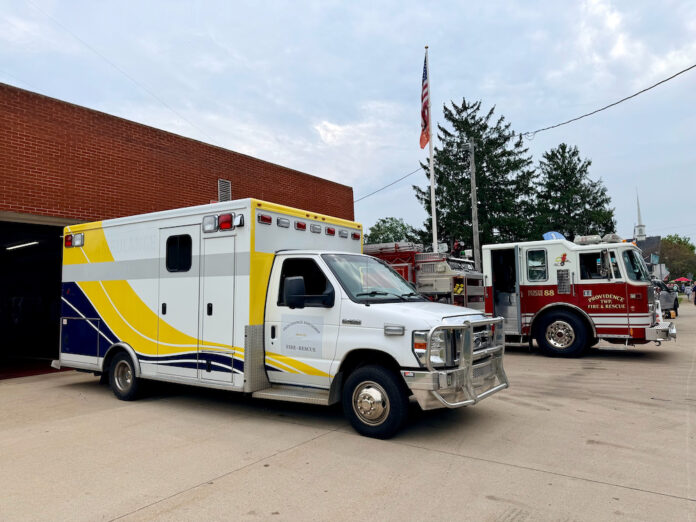
Providence Township is currently renting an ambulance while it seeks bids to replace a 2022 model heavily damaged in a February accident. Bids for building an new ambulance are due Nov. 18. (AWFP photo by Karen Gerhardinger)

Providence Township is advertising for bids to replace a 2022 ambulance that was heavily damaged during a February accident.

During the Oct. 7 meeting, trustees reviewed Capt. Ryan Grant‘s bid specs and discussed plans to advertise for bids on the website, Toledo Legal News and Anthony Wayne Free Press, with bids due by Wednesday, Nov. 18 at 6 p.m. A bid opening will be held at 6:31 p.m. that evening.

The accident occurred on Neapolis Waterville Road, and was not the township’s fault. One person filed a Worker’s Compensation claim, and a power cot and loading system damaged in the accident had to be replaced. 

Over the past few months, the trustees have heard about options for either rebuilding or getting a new ambulance and opted to have one built. The fire department is currently renting an ambulance until a new one is completed – a process that will take at least two years.

During the meeting the trustees also:

-Shared a letter from the Lucas County Board of Elections, notifying the township that it had been incorrectly levied charges for the November 2025 election. An internal error by a staff member incorrectly identified the number of precincts in the township, resulting in the overcharge. The township will receive back $19,584.29.

-Approved $15,000 for operating supplies for the fire department for the remainder of 2026.

-Heard Fiscal Officer Julie Ludwig say that the township needs to put together an audit committee to review financial records.

-Discussed the meaning of an ag exemption from the county and how it is not necessary for a property owner to receive this if they are living in an unzoned area. Half of the township is unzoned. Zoning Inspector Jim Fischer said he would talk with someone in the county building department, which has referred property owners back to the township to sign paperwork for an ag exemption.

-Heard road supervisor/cemetery sexton Kevin Keifer say that an initial quote to pave the driveway in the cemetery was $211,305 – while the total budget for the cemeteries is $142,155. He will investigate other options.

-Agreed to hire Nationwide First Responder Grants LLC for up to $2,500 to assist with writing a grant.

-Heard Fire Chief Rick Triggs say that he is getting quotes for repairing the fire department roof, which is leaking.

-Approved the purchase of up to 4,600 gallons of propane from Ludwig Propane for $1.29 a gallon.

Whitehouse flowers win America in Bloom awards

0
Petunia baskets like this one on a light pole in the State Route 64-Finzel Road roundabout in Whitehouse are first grown at Stratton Greenhouse in Bluffton. (AWFP photo by Karen Gerhardinger)

WHITEHOUSE – The pinks, reds, yellows and whites of the riotous blooms all throughout the Village of Whitehouse may be gone soon, but the innovation that Whitehouse Public Service brings to public spaces is evergreen.

James Forrest, a 26-year employee of the department and the primary planner for public landscaping, brought back from this year’s America in Bloom Symposium more than distinguished awards for Whitehouse. Tours of Old Town Alexandria and networking with experts in everything from gardening to grant writing gave him a bushelful of ideas to continue beautifying the village and encouraging other communities to do so as well. 

“I want every community in northwest Ohio to be as beautiful as Whitehouse,” he said.

James Forrest says frequent watering is the key to beautiful blooms. (AWFP photo by Karen Gerhardinger)

Forrest, who lives in Swanton Township, took his first trip to the nation’s capital in September to accept for Whitehouse the Floral Impact Outstanding Achievement Award and the Small Town, Big Impact Award, which were announced at the annual America in Bloom (AIB) national gathering and awards celebration held this year in the Washington, D.C. area.

He said it was a humbling experience to be honored as well as to be exposed to such a different culture with deep historical roots and massive metropolitan infrastructure. He said he was excited to bring back concepts and best practices that were shared by other AIB participants from all over the country.

“I’m trying to create that interest all year round,” Forrest said of his goals for Whitehouse.

Whitehouse Public Service employee James Forrest peeks through banana plant leaves growing in Village Park. (AWFP photo by Karen Gerhardinger)

Ways to bring color into the parks and along the main travel corridors after Public Service removes the live flowers are priorities for him, and possibilities include adding winter greenery to the light pole baskets and painting murals on the streets around the parks. 

“I thought that was a cool idea,” he said of the artistic projects shared at the symposium.

Whitehouse also received special recognition for Overall Impression from its AIB advisors, who toured the community this past summer, according to America in Bloom Executive Director Laura Kunkle.

“Every year our participants raise the bar, and the accomplishments and progress shown by this year’s group is remarkable. These are, without a doubt, some of the best places to live, work, and visit,” Kunkle said. “Congratulations to Whitehouse for the excellent work making your community more beautiful and vibrant.”

Banana plants spruce up the depot building restrooms along the Wabash Cannonball Trail frequented by bicycle riders and dog walkers.

America in Bloom is a nonprofit organization dedicated to promoting nationwide beautification programs and personal and community involvement through the use of flowers, plants, trees, and other environmental and lifestyle enhancements. For its 2026 award categories, participating communities from across the country were evaluated on seven criteria: community vitality, overall impression, environmental initiatives, heritage celebration, urban forestry, landscaped areas, floral impact, and community involvement.

As visitors to Whitehouse effuse on the beauty of its blooms, Forrest is quick to credit the entire Public Service department – especially the seasonal workers who do the bulk of the watering.

“It’s a full department effort,” he said, adding that he wishes the temporary hires were still here to be included in the honors.

Susie Stratton, who – along with her husband, Steve – owns Stratton Greenhouse in Bluffton where Whitehouse’s flowering baskets are grown each year, said Forrest is the fertile soil that yields village recognition.

“He is the real reason, as far as I’m concerned, why Whitehouse is as beautiful as it is. What he does every year, he just keeps improving the look of Whitehouse,” she said.

Stratton is an ardent supporter of America in Bloom and its Buds in Bloom youth initiative. She said the organization provides important support in an industry that requires such constant labor and needs thoughtful planning. 

As a sponsor and a business owner, Stratton said she too gains valuable trade tips each time she attends an AIB symposium, learning how to use a compass to help with mowing fields and how Lewis, Del. attracted a 500-member volunteer force to help with its beautification efforts.

“Our work is hard work,” she said.

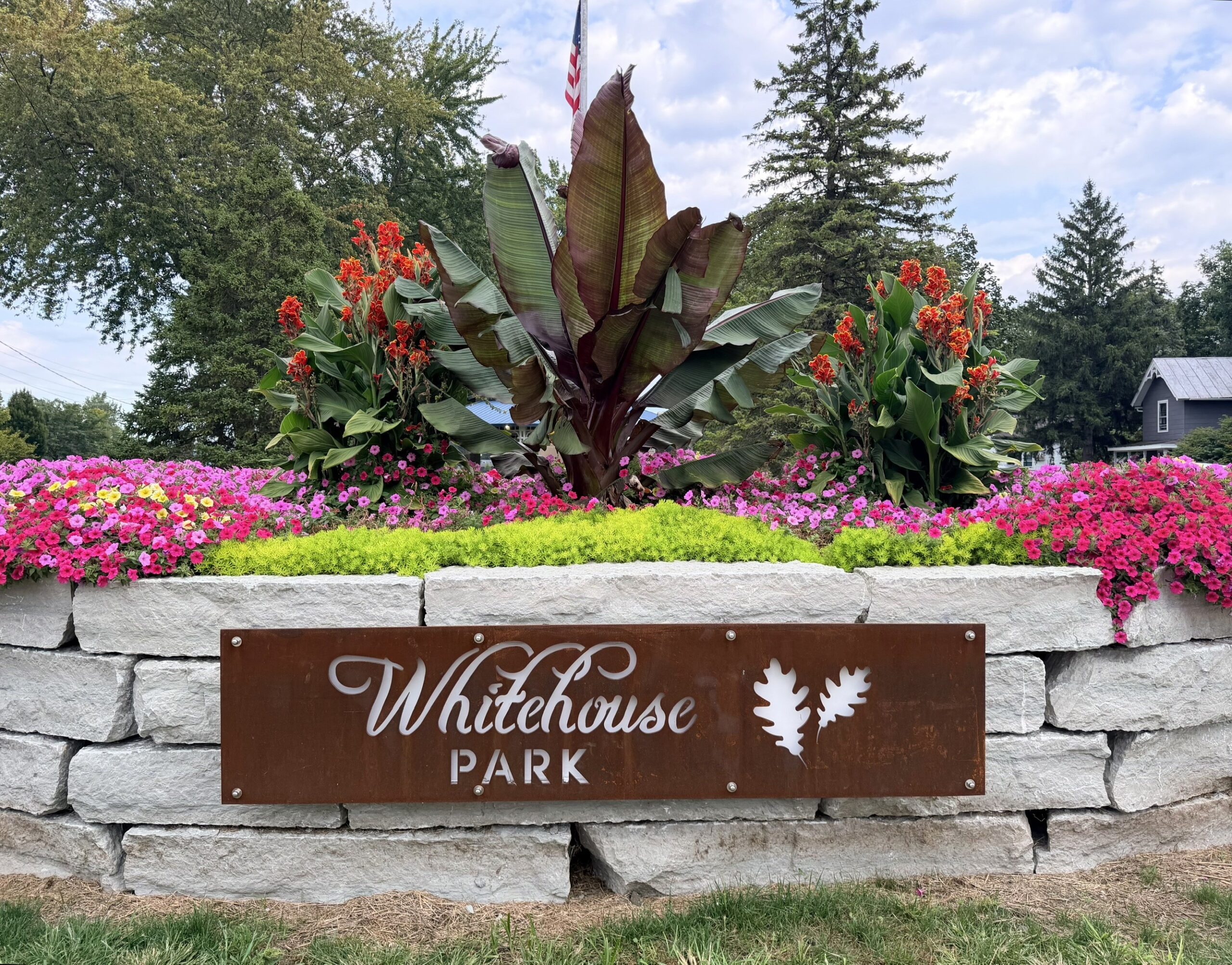
A new quarry stone feature was filled with a variety of plants for new signage at the entrance to Whitehouse Village Park. (AWFP photo by Karen Gerhardinger)

Stratton Greenhouse staff plants flowers in March and makes sure they are well rooted and established before delivering them to Whitehouse and other communities around Memorial Day. 

Forrest said Steve and Susie Stratton have acted as both a reliable vendor and a helpful resource for him, and he swears there is nothing special he adds to the petunias to get them to grow into the massive pink petal balls that hang more than 6 feet down the light poles by the end of summer.

“We just water them,” he insists. 

Dedicated tending yields results all over Whitehouse. Cannas become fiery red-tipped giants in quarry stone features along the multiuse pathway. Banana plants look like enormous green fans in the Wabash Cannonball Trail plazas. Elephant ear leaves spread wide at the Village Park shelter house. Purple fountain grasses sprouting from downtown sidewalk urns reach for the sky.

Whitehouse Mayor Rich Bingham said the village’s efforts have created a vibrant, welcoming atmosphere.

“The flowers throughout the community have become one of the most frequently praised topics on social media, and for good reason,” Bingham said. 

Forrest said he hopes more and more communities enhance their public spaces with flowers, artwork and other decorations, as well as consider joining America in Bloom. He praised neighboring City of Waterville for expanding its beautification, while acknowledging that investing in planters and landscape beds – and the labor required to maintain them – can be a significant budget impact. 

Forrest paid his own way to D.C. for this year’s AIB symposium, and he said he was sorry to see that some award winners from smaller or far-away communities were unable to attend at all. He said he intends to propose to the organization’s leadership that it build into the fee for symposium attendance enough to cover the cost of at least one representative from one other member community.

He said he already is looking forward to next year’s workshops and ceremonies, which will be held closer in Holland, Mich. – a natural location famous for its tulips – whether Whitehouse wins any more awards or not. 

Stratton said Forrest’s efforts likely will continue to earn recognition. 

“He’s thrown his heart and soul into every project,” she said. “It’s not just about him; it’s about the whole community.”

Political scientist Norman Finkelstein: Conversation with TFP

0
Pexels photo by Mibernaa.

While much of current criticism aimed at the Israeli government has stemmed from its post-October 7th military operation in Gaza, which has killed upwards of 70,000 Palestinians, according to the Palestinian Ministry of Health, there are many who’ve long taken issue with its policies.

Among this group of pre-October 7th critics is 72-year-old Norman Finkelstein, a Jewish son of Holocaust survivors, who finds himself uniquely sensitive to what a United Nations commission has classified as “genocide in the Gaza Strip.”

Ahead of a weekend speaking engagement in northwest Ohio, Finkelstein took some time to talk with the Toledo Free Press. It’s an interview that began with his thoughts on the current leadership of Israel, which includes Prime Minister Benjamin Netanyahu.

Finkelstein on today’s Israel

“I wouldn’t say that it’s a far-right government,” Finkelstein told TFP. Rather, he says, “Israel is less discreet about hiding aspects of Israeli society,” and that “it became an in-your-face, far-right — not just government — but an in-your-face, far-right society.” 

In other words, he believes that there’s always existed an appetite, and willingness to act on, the more extreme policies championed by Israel’s current government. His theory of the case includes periods in which the country enjoyed more sympathy from the global community than it does today.

However, for a short time following the October 7th, 2023 attacks on Israel by Hamas, there was an immediacy to the outpouring of support and commitment to Israel by western nations. With approximately 1,200 people having been killed, Netanyahu’s initiation of a retaliatory military response was viewed by many leaders in the western world as having a claim to legitimacy. This meant a significant amount of support from its closest ally: the United States.

Asked about the way in which Netanyahu has become synonymous with Israel, and if a different figurehead would change what he sees as the country’s faults, Finkelstein said that “the question should be, ‘Why does Israel have Netanyahu as its leader?’ After all, it’s a Democratic country for Jews. It’s Democratic. He is an accurate reflection of Israeli society.”

Good and bad press

While Finkelstein is followed by a combined 800,000+ across his Instagram and X (Twitter) accounts, he has not always had a huge megaphone to voice his viewpoints. In fact, there are many who, even before the days of social media, preferred he have no platform at all.

One such example dates back to 2007. According to a New York Times article published in February of that year, Alan Dershowitz — a prominent ally of Israel and then a law professor at Harvard University — “lobbied professors, alumni and the administration” of DePaul University to deny Finkelstein tenure. And while the university did, ultimately, do just that, its then-president denied that outside influence played any role. The school’s verdict was well-received by Finkelstein detractors, including Dershowitz, who view his rhetoric as harmful.

The larger debate about whose voices get platformed is one that remains unsettled in higher education. Asked about the current tension between free speech and academia, in the context of 2024’s campus protests in support of the Palestinian cause, Finkelstein — while not in agreement with how these schools handled student dissent — claims to understand their calculations.

“I think the big issue was alumni contributions, representation of pro-Israel Jews on boards of trustees.”

Pointing to reading he says he’s done about the culture on college campuses, when it comes to Israel-Palestine as a cultural flashpoint, Finkelstein said that professors are “terrified to say anything about Jews, Israel, Gaza— anything.”

Finkelstein is scheduled to speak at the United Muslims Association of Toledo’s annual dinner, which is being held on Sunday, Oct. 11, in Sylvania.

Local chiefs brainstorm on e-bike regulations

0
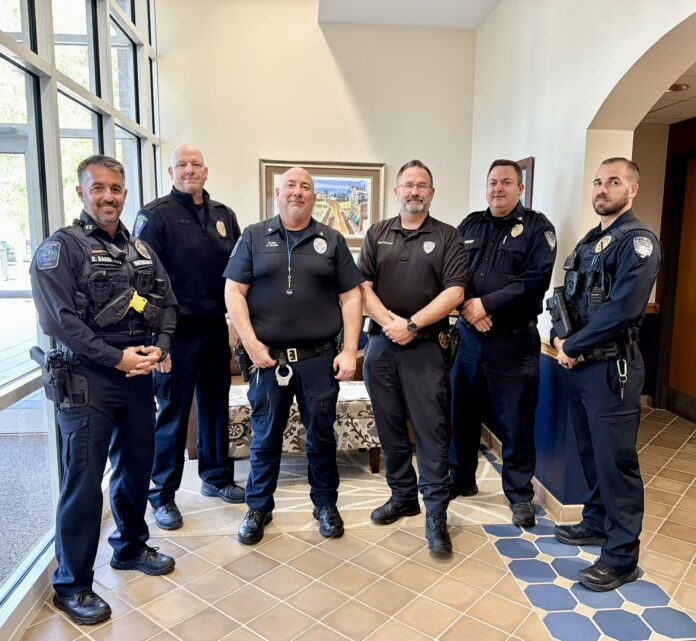
On Oct. 6, police chiefs from area municipalities gathered to brainstorm on ways to handle young e-bike users driving recklessly in their communities. Among those in attendance were, from left, Whitehouse Capt. Brad Baker, Ottawa Hills Police Chief Frederick Schnoor, Whitehouse Police Chief Allan Baer, Holland Police Chief James Piotrowski, Waterville Police Chief Joe Valvano and Waterville Police Lt. Austin Gunn. (AWFP photo by Karen Gerhardinger)

Whitehouse Police Capt. Brad Baker recently “had words” with a boy who was popping a wheelie on an e-bike in the middle of Providence Street.

“We’ve spent more than a year having words with them on the street and at school,” said Whitehouse Police Chief Allan Baer, who has heard in person and online the complaints about mostly 10- to 15-year-old boys driving e-bikes or dirt bikes recklessly on the streets, the parks and on the bike trails.

Knowing that other area police chiefs are experiencing the same problems, Baer invited area police chiefs to a brainstorming session on how to meet three shared goals: ensuring the safety of the kids on e-bikes; addressing the behavior without using the juvenile court system; and inducing parents to become more proactive in their children’s e-bike usage.

While the state legislature is currently looking at rules for e-bikes – a move that Baer said will provide consistency and guidance – the chiefs agree that working on a uniform set of ordinances for communities to put in place by spring is a priority.

Police chiefs Joe Valvano of Waterville, John Trejo of Swanton, Frederick Schnorr of Ottawa Hills, and James Piotrowski of Holland, along with law directors Paul Skaff, Austin Klapp, Kevin Heban and Law Clerk Christina Fuller discussed current regulations, what other municipalities have in place, and solutions that will work for smaller communities.

One of the suggestions is requiring all e-bikes to be registered, with color-coded stickers that will enable officers to identify the class and whether a helmet is required. A lack of a sticker may also indicate that the rider is on a dirt bike that is not permitted on public roads.

“This is not a money grab,” Baer said, explaining that the registration would be free. “We want our officers to be able to easily identify what class each bike is.”

According to the Ohio Department of Transportation, Class 1, 2 and 3 all have fully operable pedals and electric motors of less than 750 watts. In Class 1 and 2, the electric assist only reaches up to 20 mph.  In Class 3, the the motor provides assistance of up to 28 mph. 

According to ODOT, anyone riding a Class 3 e-bike must be at least 16 and wear a helmet. One of the ideas under consideration is requiring anyone under 18 to wear a helmet on any e-bike, regardless of the bike class. With e-bikes weighing 200 to 300 pounds and accelerating quickly to up to 28 mph, the brake time is longer and crashes more hazardous to riders, the chiefs noted. And with jailbreak programs enabling e-bike users to push speeds beyond 28 mph, the risks increase. Several of the chiefs spoke of serious injuries involving e-bike users in area communities.

“We’re one fatality away from being blamed,” Valvano said, agreeing that something needs to be done.

The registration and helmet requirements will help, but the chiefs agree that more needs to be done to curb the reckless operation that they’ve seen: jumping curbs, blowing through stop signs, zipping in and out of traffic, disturbing pedestrians and causing damage to public and private property. Education and warnings, as well as parent notification of behaviors, has done little to stop the reckless operation or improper use, Baker said.

“We’ve been doing warnings for years. We’re looking for more teeth,” Baer said. “I think a fee is the only thing that will have an impact. I know we’ll take some flack, but they have to understand the intent is for the safety of the children.”

In the event that a minor is seen driving recklessly, a first offense would require that the rider and parent watch a video on e-bike safety. Subsequent offenses will have civil penalties, including fines and e-bike impoundment. Those who want to contest the fine could have an opportunity to make an appeal to a hearing officer – a third-party attorney hired by all of the jurisdictions.

Julie Theroux, co-owner of CycleWerks in Whitehouse, said the issue isn’t e-bikes themselves, but boys ages 10-15 riding e-motos – electric dirt bikes that are not legal except on private property. She cautions against overregulating e-bikes, which are popular among adults who might otherwise not be able to ride as far. (AWFP photo by Karen Gerhardinger)

Julie Theroux, co-owner of CycleWerks, cautions against over regulation when 90 percent of the e-bike users are responsible adults who use them to ride farther and tackle hills with a little help.

With a view of busy downtown Whitehouse, the park and the Wabash Cannonball Trail, Theroux has seen the annoying behaviors of boys on e-motos, which are dirt bikes that are not street legal. While pedals might be put on to make them look like bikes, these are essentially motorcycles that go well over 28 mph, she said. 

“It’s the wild, wild west,” she said, describing kids riding e-motos without helmets, lights or signals, zooming in and out of traffic. “These young boys are running around like gangs. Where are the parents? The parents need to be educated that e-motos are illegal other than on private property or on confirmed motocross trails.

“It’s not the bike that’s the problem; it’s the person on the bike – the reckless person,” Theroux said. “Don’t blame the e-bikes and overregulate.”

The ideas shared by the chiefs will be researched by legal and presented to each of the local municipalities in the coming months.

“This is going to be a slow and deliberate process,” Baer said.

The Glass Wheel: Occult bookstore on Adams

0
The Glass Wheel, a new bookstore on 1505 Adams Street. (TFP photo by Steven Bieber)

TOLEDO – Bookstores offer a place where readers can explore new ideas, as well as a place to find community. But for some, the average bookstore may not cut it. Readers looking for a haven to explore their love of the occult, spirituality, and other unusual content need look no further than The Glass Wheel.

Black cat mug for sale at The Glass Wheel. (TFP photo by Stephen Zenner)

Last month, Toledo natives Lizzie Arden, 38, and Benjamin Peregoy, 45, opened The Glass Wheel opened on Adams Street, presenting an eccentric spot where visitors will find books on witchcraft, spirituality, tarot, herbalism, and more. Guests can also buy candles, tarot cards, and other merchandise, and even attend events like Witchin’ and Stichin’ (a book-and-craft club) and tarot card readings, all while being surrounded by spooky decorations, taxidermy-mounted animals, and old church pews.


Lizzie Arden, 38, co-owner of The Glass Wheel, holds a dish with various animal paws. (TFP photo by Stephen Zenner)

Peregoy and Arden were driven to open the store because of their love of books, but also because there were no bookstores for weirdos in Toledo.

“We love the macabre,” Arden explained. “We don’t shy away from the darker things in life, and we both have magical practices ourselves. We felt like there was no place for us to shop for books on magic, witchcraft, and the occult. So we just decided to open it.”

Arden avidly reads a spooky book at The Glass Wheel. (TFP photo by Stephen Zenner)

Arden says she and Peregoy, who is also her fiancé, have been interested in witchcraft and occult themes since they were teenagers. She could not offer an explanation as to why people become drawn to it; instead, she claims that it chooses you instead of the other way around.

Running a bookstore with only two hands on deck comes with several challenges. Arden says she often has to choose between processing used books and taking the time to make social media content. For her, getting to make those decisions is the best part of running the store.

She said, “When I decide, ‘Hey, I want to decorate the front window, and I want it to be spooky, and this is what I want it to look like.’ I don’t have to ask someone. I think the best part is not having to ask permission, to be honest. It’s just doing it.”

Lizzie Arden. (TFP photo by Stephen Zenner)

While the two felt it was important to open this bookstore for a niche market, Arden considers bookstores in general to be a vital community resource. Finding the perfect book, sharing that find with friends, and spending time together in a third space are all reasons to support local bookstores like theirs.

If you have a book that you are willing to part ways with, the store will buy it if the owners believe it is a good fit. If you are looking for a specific book or topic and cannot find it, Arden says they will help you find something similar or try to order it for you.

“No matter what kind of book you’re looking for, we’ve got something similar, or we will scour the Earth to find it for you,” Arden said.

The Glass Wheel, 1505 Adams St., is open Wednesday through Saturday from noon–7 p.m. and Sunday from noon–5 p.m.

Notebooks for sale at The Glass Wheel. (TFP photo by Stephen Zenner)
Arden holds a mummified possum head at The Glass Wheel. (TFP photo by Stephen Zenner)
Arden sits in her favorite part of her bookstore, The Glass Wheel on Adams St. (TFP photo by Stephen Zenner)
Candles, necklaces and other charms for sale at The Glass Wheel. (TFP photo by Stephen Zenner)
(TFP photo by Stephen Zenner)
Arden corrects the placement of a poodle skull. (TFP photo by Stephen Zenner)
Arden stands behind the front counter at The Glass Wheel, the spooky bookstore she co-owns with her fiancé, Ben Peregoy. (TFP photo by Stephen Zenner)
Incense for sale at The Glass Wheel. (TFP photo by Stephen Zenner)
A framed Atlas of the World at The Glass Wheel. (TFP photo by Stephen Zenner)
Close up of a chair at The Glass Wheel, a cozy-yet-occult bookstore on Adams. (TFP photo by Stephen Zenner)
Arden pulls different charms from a bowl at The Glass Wheel. (TFP photo by Stephen Zenner)