The opening credits to The Paper, a show about an underdog effort to revive a floundering newspaper in Toledo, are filled with iconic images representing our city in a way that gives many local viewers the feels. When TFP hosted a release party last year at The Blarney, every landmark – the “Toledo Loves Love” mural on Adams Street and “Greetings from Toledo” mural on the East Side – elicited an excited response from the audience.
For those not familiar with the premise, The Paper is a spin-off of The Office and shot in its predecessor’s mockumentary style that showrunner Greg Daniels (of The Office and Parks & Rec fame) has perfected. Its anchor to The Office universe is the presence of Oscar Martinez who now works as an accountant at the Toledo Truth Teller.
TFP had a chance to chat with one of the lead actors, Domhnall Gleason (Ned Sampson), Michael Koman (co-creator, showrunner, writer, executive producer) and Daniels (co-creator, showrunner, writer, executive producer and director) at a Peacock virtual press conference.
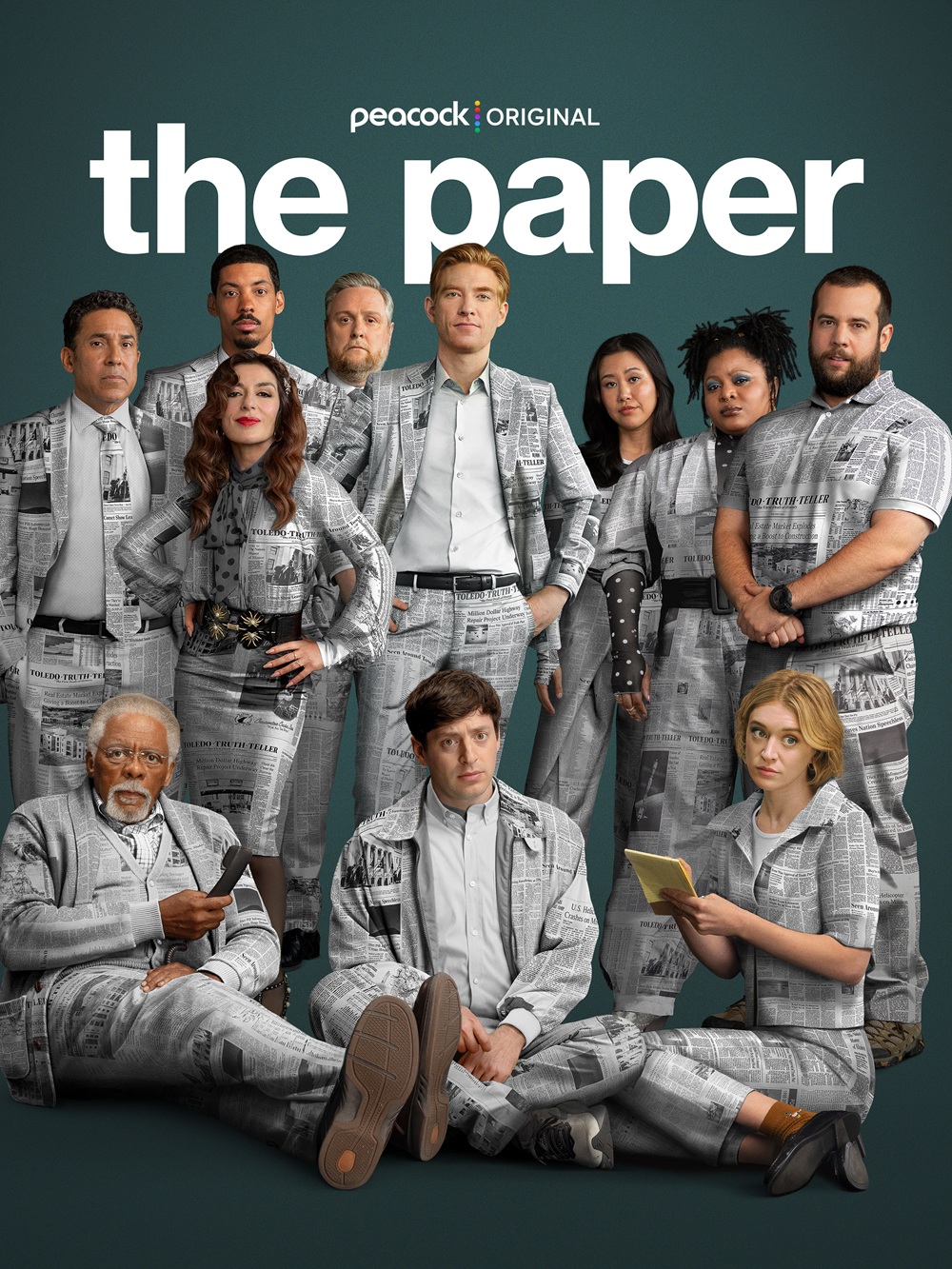
The second season of the show, which premieres in its entirety on Peacock tomorrow, Sept. 9, begins with Editor-in-Chief Ned Sampson essentially getting everything he wanted. The accolades. The validation. And a budding romance that had been steadily brewing in Season One with reporter Mare Pritti (played by Chelsea Frei).
“All of his dreams come true at the same time,” said Gleeson. “And that’s not always good for a person. You might have everything you always wanted, but what the hell do you do with them now? I think he’s sort of challenged by that and not able to handle as much as he thought he was able to handle. I think he thought could handle a throuple, you know? With Mare and the paper. And I think the reality of the situation is a little more complicated than that.”
Season Two builds on the character establishment and development by giving all of the ensemble cast members a hilarious thread to follow, and they throw in a very kooky HR director that is a real departure from Toby in The Office, but who is equally funny.
Though The Paper is a comedy series, Gleeson, Koman and Daniels expressed their respect and concern for today’s journalists.
Gleeson noted that journalists who have seen the show “seem really thrilled that there’s something that takes what they do seriously, that understands that it matters. We don’t take ourselves too seriously, but we understand that journalism is a very serious thing.”
There is a general emphasis in the show that local journalism is not exactly thriving, but that it is vital work. Ned’s blind optimism is endearing, and it also takes the Truth Teller away from simply reprinting whatever they are fed through the wireservice. He empowers their team to get out in the community and report on what they see, and that inexperience is not necessarily a barrier to doing that.
Koman added, “If nothing else, if it [the show] was just a little reminder that people have local news, and there are people in every – not every community – but the ones that are lucky enough to have it, people trying to keep track of what’s going on in the government and their schools…if people remember to check that out, it would be a lovely thing.”
After visiting local newsrooms in Toledo while developing the show (you can read about that in our initial coverage of the show here), the creators’ respect for journalists in Toledo only grew.
“It was inspiring that people cared so much about what they were doing,” said Gleeson. “There were a lot of young people from a few of the different newspapers who really cared about it and were working super, super hard in journalism. That’s what I loved about it. I think the show provides the humor. All I found was just amazing positivity and commitment and hard work. And I took a lot of that for Ned. That was my experience.”
The Paper also touches on serious issues news outlets face, like conflicts of interest; the investigative coverage of the Glass Club is an example of that in Season Two. The push-pull dynamic of reporters trying to do their jobs and some powers-that-be not wanting to rock the boat likely hits home for many journalists.
Daniels seemed to reference this when asked about one of his favorite character arcs in the show.
“At the beginning of the writers’ room, we were reading about this scandal at USC that was summarized in a book called Bad City. And there were forces to try and squelch the story inside The LA Times and they had to have a secret team of journalists working on it. So we incorporated some of those things; we hope we have kind of an exciting journalism story towards the second half of the season.”
He also shared a bit about how some of the characters were inspired by real people he met in Toledo, particularly Mare.
“We ran into a woman that felt like Mare a lot who was the compositor at The Blade. It reminded me of doing research for Parks and Rec when I had a thought that it’d be funny if there was a guy who hated government who was Leslie Knope’s boss, and we found a city manager in Burbank who was a libertarian and didn’t believe in government, and I was like, ‘Yes!’” Daniels is, of course, referring to the beloved Ron Swanson.
The wholesome optimism of The Paper was based on the pre-existing respect for journalists that the team brought to the project, and they found that same optimism and work ethic in Toledo’s newsrooms.
Koman said, “I didn’t feel like anybody there was burnt out or not genuinely enjoying the fact that they got to do this every day for a living, despite the overall atmosphere, you know, what’s happening in the country with journalism. So to me, it really reaffirmed the sense that the story is accurate in terms of what people are getting out of the work they put into this field.”
When TFP noted references like the “Macaroni Barn” in the show (unconfirmed, but – come on – it’s Spaghetti Warehouse), we also wondered if there were other Toledo references that local viewers can look for in upcoming seasons. Koman said that Jamie Farr, the Mud Hens, Hollywood Casino, and the Old West End are all contenders in the future.
“I’ve written the words ‘Old West End’ into many scripts and I don’t know if they’ve ever reached the final edit,” said Koman. “For some reason that neighborhood really made an impression on me.”
Make sure to check out Season Two of The Paper on Peacock beginning tomorrow, and let us know in the comments what references to Toledo you find.