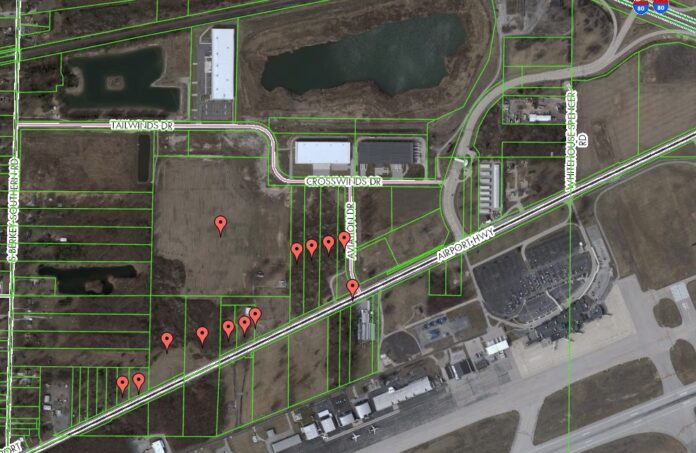
SWANTON TOWNSHIP – Land-Air Commerce Park – a development between the turnpike, airport and Berkey-Southern Road – is poised for rezoning to accommodate three large warehouses, a truck terminal and other facilities, Swanton Township Zoning Inspector Ben Mooney told township trustees during their Aug. 11 meeting.
Interstate Capital recently purchased 14 parcels and is asking to rezone 13 properties totaling 112 acres. Current zoning is a mixture of C-4, M-1 and an overlay district. The owners are asking for a uniform M-1 zoning. The proposal will be heard by the Lucas County Planning Commission during its Wednesday, Sept. 23, 9 a.m. meeting at 1 Government Center.
Land-Air Commerce Park is currently home to Game One, a 131,800-square-foot light manufacturing facility, and Velocity, a managed technology solutions provider that recently began a a $1.5 million expansion with plans to add 40 employees.
The commerce park is in a Toledo Express Airport Joint Economic Development District (TEA-JEDD) with Swanton Township, Monclova Township and the City of Toledo, with a 1.5 percent income tax used to make investments in the area.
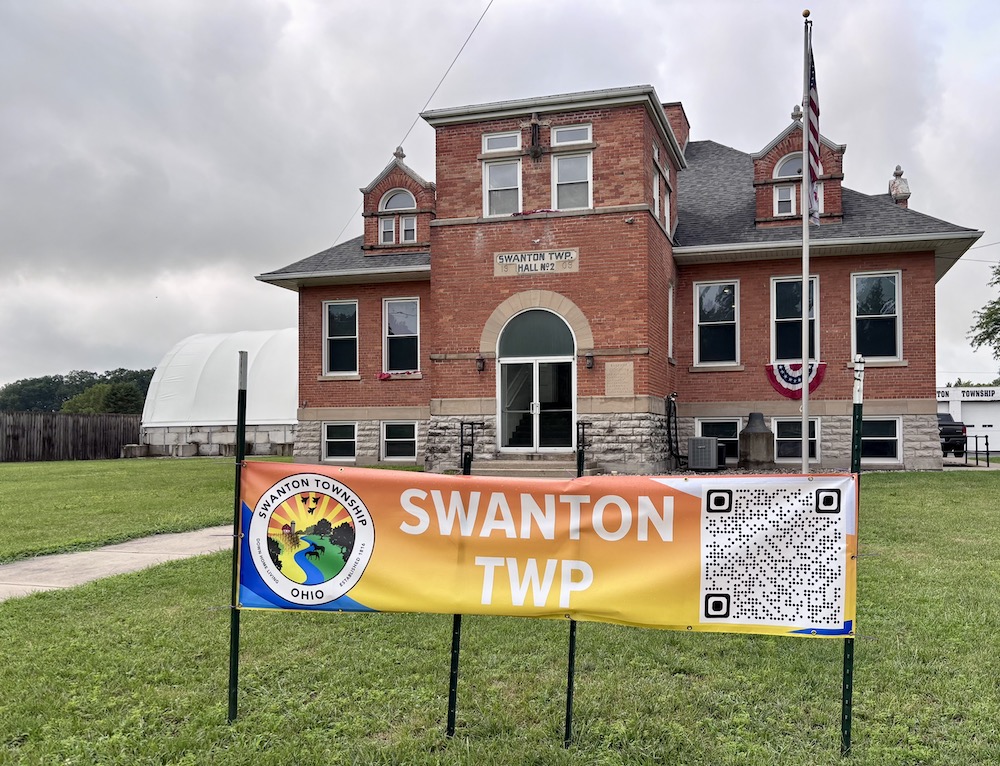
Swanton Township recently upgraded its website and email addresses. Visit swantontownshipoh.gov for more information. (AWFP photo by Karen Gerhardinger)
During the meeting, the trustees also:
-Heard Trustee Matt Beil share an update from the TEA-JEDD Aug. 5 meeting, in which members toured the airport and learned about plans for improvements in the next few years. See related article here.
-Listened to Springfield Township Fire Chief Jonathon Ziehr say that the department responded to 25 calls for service in July, including 19 EMS and six fire, and did fire prevention inspections or meetings with five of the 50 businesses in the northern part of the township. Ziehr also reported that the 25-year-old firefighter memorial housed on McCord Road is being moved and renovated for the Crissey Road station, using $20,000 in donated labor and materials, and will be unveiled in October during a public event.
-Heard Beil say that Whitehouse Fire Chief Jason Francis turned in a report for calls in the southern half of the township. In July, the department responded to 22 calls, including six fire-related incidents. Beil continues to work with Whitehouse and Swanton about a new contract for coverage for the area.
-Discussed the need to find residents to serve on the Board of Zoning Appeals.
-Listened to Beil discuss some of the topics covered during the Lake Erie West General Assembly last month, including property taxes, AI use, new developments, data centers and website accessibility. The loss of property taxes would greatly affect Swanton Township, which relies on that revenue. The website was recently updated and now meets accessibility standards, he added.
-Discussed the process for approving and posting speed limit changes on roads around the airport, based on a speed study that was recently completed at the request of the airport.
-Heard an update from Mooney on ongoing cases. He learned that it will be at least three months before the county clears the title for 11650 Airport Hwy. – an abandoned home with $22,000 in back taxes owed – and completes an investigation. The property will to go a sheriff’s auction. The process will take at least three months, he said.
-Heard Mooney say that he issued three permits in the past month: for an outdoor bathroom at 11958 Reed Rd.; an addition to 14135 Monclova Rd.; and an ag exempt for 12001 Soul Rd.
-Listened to Mooney say that The Greens at Oak Openings wants to install a six-foot fence around equipment outside the building, but the zoning resolution states that only a four-foot fence is permitted because the property is on a corner. This will need to be reviewed by the Zoning Commission for a possible variance.
-Approved a $1,200 contract with T & J to remove a crimson maple and its root base in the cemetery.
-Discussed options for roadways that could be repaved using an Ohio Public Works Commission (OPWC) grant through the Lucas County Engineer’s Office. Among the options are sections of Sager and Reed, with varying levels of township matches. Trustees agreed to review the options and set a special meeting on Aug. 25 in order to meet the Sept. 11 deadline to apply.
– Learned that 107 residents have signed up for text alerts from the township so far.
-Heard that the township will host a free bulk trash drop-off on Saturday, Aug. 22 from 8 a.m. to 4 p.m. at the maintenance garage, 6576 Manore Rd.
A new passenger boarding bridge is planned for Toledo Express Airport – one of several projects underway in the next few years. (Courtesy photo)
The Toledo Express Airport may be known for its four Allegiant flights to Florida destinations, or the adjacent 180th Fighter Wing, whose daily F-16 flyovers always draw attention, but the airport, which opened for air traffic in 1955, is also becoming known for its growing number of businesses.
Earlier this month, Joe Cappel, vice president of business development for the Toledo-Lucas County Port Authority, shared updates on these businesses, as well as planned capitol improvements to the airport, with members of the Toledo Express Airport Joint Economic Development District (TEA-JEDD) board.
The TEA-JEDD was founded in 2015 as an agreement between Monclova Township, Swanton Township and Toledo in an effort to spur business growth, infrastructure investment, job creation and other services in and around the airport, which spans both townships. Because townships cannot levy an income tax, Toledo is a partner and collects a 1.5 percent tax on employees, along with a percentage of net profits on businesses in the district.
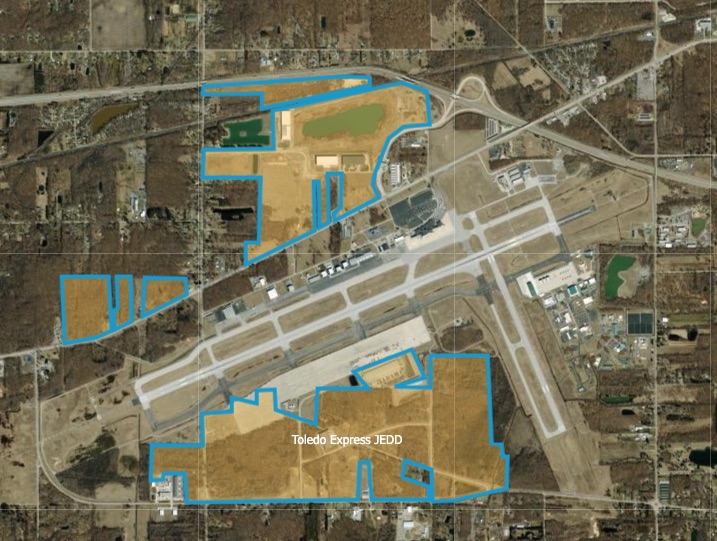
The TEA-JEDD includes businesses located to the south of the runway, including Tron Air, World Wide Freight (a third-party handler for Amazon) and Willy’s Salsa, and north of the airport in the Land-Air Commerce Park, which includes Game One and Velocity.
The Toledo Express Airport Joint Economic Development District encompasses businesses to the south of the airport and in the Land-Air Commerce Park. (Courtesy photo)
Amazon (with its third party World Wide Freight), began operations at Toledo Express in 2021 and has grown from one flight to four flights a day. Tron Air has also been successful in producing ground equipment that supports the aviation industry, Cappel said. Both companies employ between 250 and 400 people. And Willy’s Salsa is scaling up after 10 years of utilizing a refrigerated building near the airport, recently relocating to another facility on the south side of the airport.
“It’s a really cool story. They are growing in their distribution, not just locally but regionally,” Cappel said.
In 2025 the Port Authority received approximately $150,000 through the JEDD. And while that might seem like a drop in the bucket for some of the planned upgrades, the partnership helps the Port Authority leverage other grants. Those improvements will enhance the value of the airport and benefit the businesses within the JEDD, Cappel said.
“We’re reinvesting those funds into the infrastructure of the airport, and preparing undeveloped areas for additional development,” Cappel said. “The money coming back to the Port Authority is being put to work. We’re reinvesting in the airport to create more opportunities.”
In early 2026, the airport completed its master plan, with the $1.4 million cost covered by the state of Ohio capital budget, the Federal Aviation Administration (FAA), the Ohio Department of Transportation Aviation, and the Port Authority.
“The planning identifies a list of projects that the Port Authority should add to its capital improvement plan so the airport can be maintained and grown,” he said.
One of the resulting projects is the purchase of two multi-tasking snow removal vehicles for aircraft operational areas. The $1.9 million cost included $99,018 from the Port Authority.
“These will help maintain the runways and taxiways and aprons during snowy conditions,” he said.
In the next two years, the Instrument Landing System (ILS) technology will be upgraded to provide more safety during landings in low-visibility conditions like fog, snow and rain, funded through a $5 million FAA grant. The project is still in the design phase, but when finished will improve the airport from a Category I to a Category II.
“It’s a good investment for Toledo. Not every airport has this technology – only larger airports,” Cappel said.
Also in the design process are upgrades to the runway lighting system, and Cappel expects to learn about FAA grant funding by the end of the year in order to begin construction in 2027.
Also on the to-do list is the replacement of a passenger boarding bridge, at a cost of $1.9 million. The design of a new inbound baggage handling system is completed, and the $1.6 million project is expected to be underway this year.
And lastly, plans are underway to replace the HVAC system in the air traffic control tower, to make sure that employees are comfortable and have good visibility. Construction on the $1.4 million project is expected to start this year.
Managing these capital improvement plans requires coordination with the FAA, ODOT Aviation and all the stakeholders, to make sure that construction doesn’t interfere with business, he said.
“A lot of it is work that sometimes doesn’t get noticed – like plumbing or electricity or HVAC. This is an old building and it takes a lot of work to maintain and modernize it to make sure it’s efficient,” he said.
While going through the master plan, one option presented was to tear down the original structure or make significant modifications to the tune of $100 million.
“We decided to see if we can do this work in phases and steps. We believe that people will start noticing the difference,” Cappel said.
Front of Advocates for Basic Legal Equality at 525 Jefferson Avenue in Toledo. (TFP photo by Stephen Zenner)
TOLEDO – Advocates for Basic Legal Equality (ABLE) is dealing with a lawsuit from one of their former employees who alleges age discrimination and retaliation against using time off to care for her dying mother.
Between ABLE, Toledo Legal Aid Society (TLAS), a predecessor organization, and its sister organization, Legal Aid of Western Ohio (LAWO), Denise Ford Saxon, 67, has worked for the legal nonprofits for over 30 years, and was working as ABLE’s human resources director before her termination on March 20.
According to a United States District Court lawsuit filed mid-July, Saxon informed ABLE in early 2026 that she might need time off to care for her unwell mother, and in February she submitted paperwork in line with the Family and Medical Leave Act (FMLA).
Her leave was scheduled to start March 1, and Saxon was informed of her termination on March 4, “without any warning whatsoever.”
Saxon’s mother died on March 10, and the suit said Saxon worked through the termination date to train her replacement on “urgent matters.”
The lawsuit says, “Defendant [ABLE] certified that Saxon was eligible for and granted her request for a leave of absence under the FMLA,” but that ABLE violated the FMLA by “discriminating and retaliating against Saxon…by interfering with, discouraging, restraining or denying Saxon the exercise of rights provided under the FMLA.”
Part of the lawsuit is geared towards how much younger Saxon’s replacement was.
The charges in the lawsuit are one violation of the FMLA and two charges of age discrimination, one under the Age Discrimination and Employment Act (ADEA), and another under the Ohio Revised Code (ORC).
Advocates for Basic Legal Equality on Thursday, Aug. 20, 2026. (TFP photo by Stephen Zenner)
Neither Saxon or ABLE have commented on the suit, but ABLE’s union, ABLE League of Justice (ALJ), National Organization of Legal Services Workers (NOLSW), United Auto Workers (UAW) Local 2320, prepared a statement concerning Saxon’s suit against ABLE.
*Addendem: The statement to which TFP linked above and to which it refers below no longer exists, as it was an Instagram post that was removed post-publication.
The ALJ “condemns in the strongest terms ABLE’s firing of HR Manager Denise Saxon as well as the firings of Administrative Assistant De’Asia Hairston and Development Associate Dawn Colon-Stephens, all of which occurred within a short time of each other earlier this year…we view these firings as an assault on the workforce as a whole and on the union bargaining unit in particular.” Currently, ALJ is in the midst of negotiating their first contract with ABLE.
According to the statement, employees started a letter writing campaign asking the ABLE board of directors to stop “anti-worker” behavior after the firings.
The union heard that the ABLE board of directors curtailed Executive Director of ABLE MakiedahMessam’s ability to unilaterally fire employees. This development was not directly communicated to the union, and they are unsure of its substance. The Toledo Free Press was not able to confirm this development either.
*Addendum: After the publication of this article, an ABLE representative reached out to TFP on Sept. 1with a statement noting that the ABLE Board of Directors have not curtailed Messam’s authority to terminate employees.
The union alleges ABLE “spent $40k to try to bust our union campaign, so we remain vigilant against any further efforts to thwart our solidarity,” and provided a copy of an ABLE LM-10 from 2025. The Toledo Free Press verified the document with the U.S Department of Labor (DOL) Office of Labor-Management Standards (OLMS), which showed eight payments made to MPI Consulting totaling $38,938 between January and September of 2025. September was when the votes to unionize were officially counted, and the ALJ won their right to unionize.
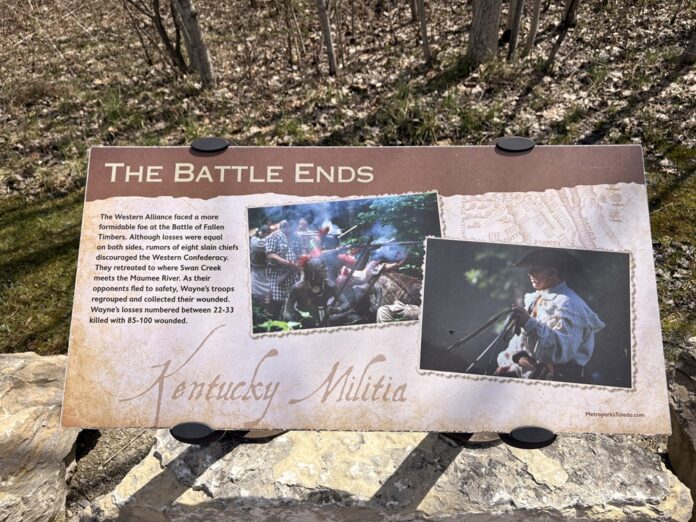
"The Battle Ends" is one of several historical markers along the trail. (TFP photo by London Dennie)
MAUMEE – The Fallen Timbers Battlefield Metropark offers more than beautiful trails. It also serves as a reminder of the area’s history and a continuous effort to protect it for the education of future generations.
“Fallen Timbers is arguably one of the most important battles to the formation of the United States of America,” said Shannon Hughes, director of education and programming for Metroparks Toledo.
The park is made up of three historical sites: Fallen Timbers Battlefield, Fallen Timbers Memorial Park and Fort Miamis. Each site holds an important history, marking locations of the Battle of Fallen Timbers in 1794 and the War of 1812.
“It’s hard to know how the country would’ve looked today had it not been for Anthony Wayne and this battle being won by the U.S. forces instead of the native forces,” said Julia Wiley, president of the Fallen Timbers Battlefield Preservation Commission.
On Aug. 20, 1794, Gen. Anthony Wayne led a trained army, along with Kentucky militiamen, into battle against a Native confederation backed by the British; it was led by Chiefs Blue Jacket, Buckongahelas and Little Turtle.
“There were a lot of different cultures involved in this battle, and yet people forget the significance of it. Without this battle, there would have continued to be constant bloodshed in all of the midwestern territories,” said Wiley, who also serves as the first vice president of the Waterville Historical Society.
According to the National Park Service, the Battle of Fallen Timbers was an important event that “demonstrated the tenacity of the American people in their quest for western expansion and the struggle for dominance in the Old Northwest Territory.”
The U.S. victory at the Battle of Fallen Timbers led to the signing of the Treaty of Greenville in 1795, and opened up parts of Ohio, Michigan, Indiana, Illinois and Wisconsin to settlement. It also resulted in loss of territory for the British military, who were ordered to abandon their forts.
Wiley credited a discovery of archaeologist Michael Pratt for saving at least part of the battlefield as plans to develop a shopping mall and apartment complexes were underway in the area. Metroparks Toledo was able to purchase land and the Fallen Timbers Battlefield Preservation Commission became a steward of its history.
“The battle was actually much larger and contained a much larger territory than what’s been saved in that original 189 acres,” Wiley said. “But that was at least a start, as a way to commemorate and honor all the lives that were lost on that battle on both sides.”
Visitors can rest on these blocks around the Battle Node area of the Northwest Territory Trail loop through the Fallen Timbers Battlefield. (TFP photo by London Dennie)
Fallen Timbers Battlefield and Fort Miamis are affiliated units of the National Park Service, and owned and managed by Metroparks Toledo. Hughes said that as an open archaeological site, there are a lot of rules governing the sites.
“We look at not only the conservation as in trees and land, but we also look at conserving any of the resources from any of the artifacts from the battle that may still be in the ground,” she said.
Hughes said they are very careful about the way they manage the site, using an approved method by the National Park Service called the dibble bar method.
“The goal is to bring land back up with the native species that would have been there, and so we do reforestation efforts, but we are very careful with the way we reforest,” Hughes said. “It is mostly hand-dug using the dibble bar method that then places the trees in and has minimal beginning-ground disturbance. That way, we are being very mindful of the artifacts, but we’re also bringing it back to what it would have looked like.”
Hughes said it’s important to preserve the Fallen Timbers Battlefield Metropark because you can’t have history without the land.
“The natural resources really informed settlement, settlement informed the land wars, and that brings us to the Battle of the Fallen Timbers,” she said.
At the Fallen Timbers Battlefield, visitors can walk along a 1.5-mile path filled with historical information called the Northwest Territory Trail.
Hughes said Metroparks Toledo is focused on remembering that there were sacrifices made, and she described the park as a place for people to reflect, learn and understand what makes northwest Ohio interesting from a historical perspective.
“As you walk it, you don’t need a guide because we’ve put interpretative signs that tell the story, the human perspective and the natural resource perspective of it,” Hughes said. “You really get a good understanding of what the battle was, why it took place here, who was involved in it and what the aftermath of the battle was.”
The Fallen Timbers Battlefield Memorial Park, located across the Anthony Wayne Trail, contains a 10-foot bronze statue of General Anthony Wayne, with an American Indian guide on the right and a settler on the left. The park also contains two stone markers, one recognizing U.S. troops killed during the battle and the other honoring the native casualties.
Fort Miamis was a British fort several miles downriver (which is northeast of the memorial, as the Maumee River flows north) that played a role in the Battle of Fallen Timbers, as well as the War of 1812. The park site there includes a tower and observation deck where visitors can see much of the earthwork used to create the fort.
Metroparks Toledo and the Fallen Timbers Battlefield Preservation Commission both have educational programs and events throughout the year. The Fallen Timbers Battlefield Metropark is open year-round, and visitors can have their National Parks Passport stamped at the Toledo-Lucas County Public Library Maumee Branch, at 501 River Road, Maumee.
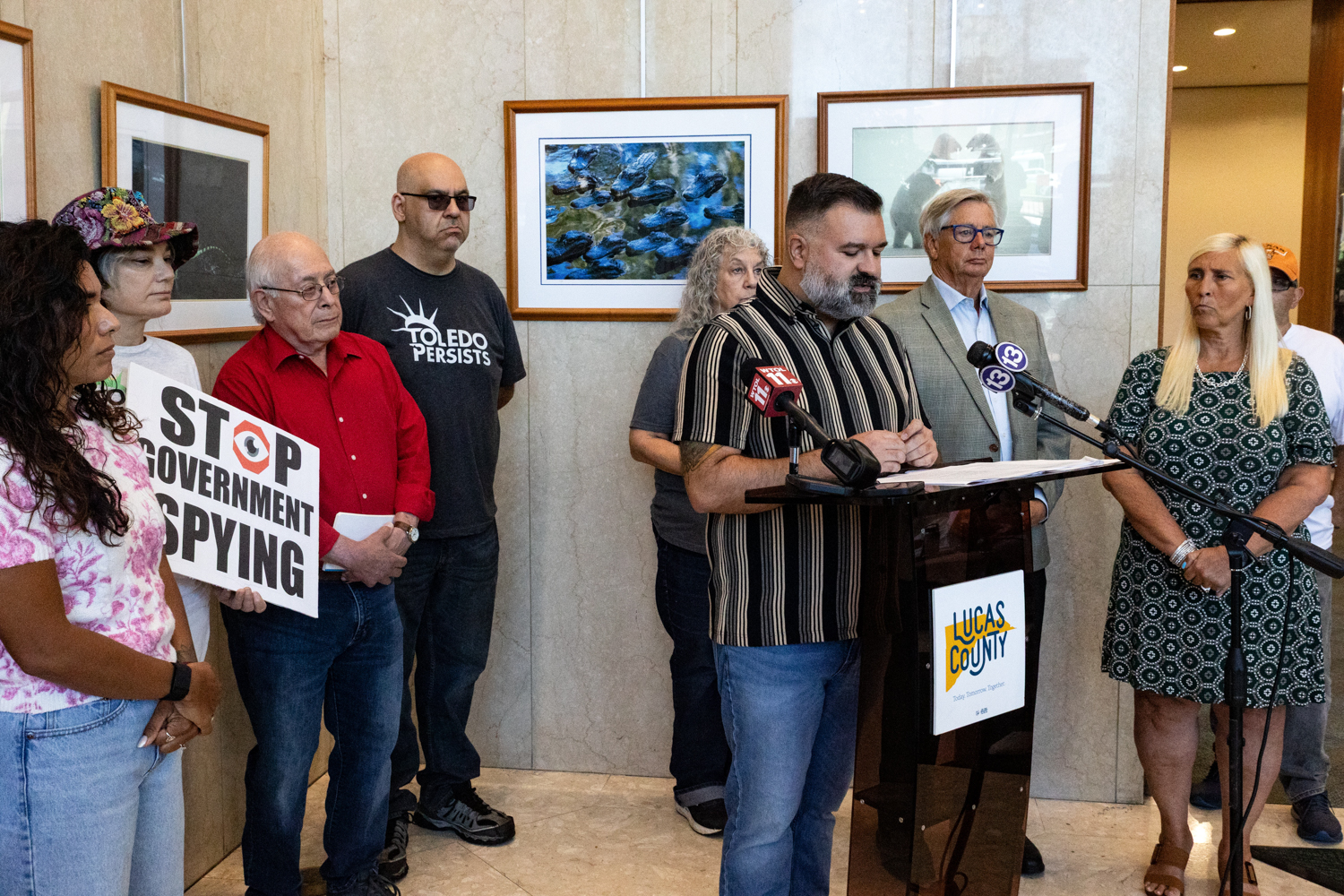
(Left to right) George Benson, a concerned citizen, Jessica Molina, the executive director of Abriendo Puertas Para Soluciones (APPS), Melissa Portala, the founder of Toledo Persists, Baldemar Velasquez, the president and founder of the Farm Labor Organizing Committee (FLOC), Salvador Pezzino, a volunteer with Toledo Persists, and Pete Gerken, Lucas County Commissioner, speak during a press conference addressing the use of Flock Group, Inc. Automatic License Plate Reader (ALPR) cameras at 1 Government Center on Tuesday, Aug. 18, 2026. (TFP photo by Stephen Zenner)
TOLEDO – Following a weekend where a total of five Automatic License Plate Reader (ALPR) cameras made by Flock Group, Inc. were vandalized between East Toledo and Oregon, Lucas County Commissioner Pete Gerken called a special press conference Tuesday morning asking for a pause on the use of Flock ALPR cameras and an audit of the data obtained by those cameras.
Call for audit/oversight on Flock
“I’m calling for an audit,” Gerken said. “I think an audit by an outside third party is fair. It’s reasonable. I will make no conclusions of what it might come to.
“I understand that Flock safety cameras can and should be used as a legitimate law enforcement tool…where it tends to cross the line into mass surveillance and how quickly we’ve done that without regulatory or control, that is what concerns me.”
With the use of national sharing, law enforcement entities across the country are able to share data obtained by Flock ALPR cameras, and Gerken drew attention to who had accessed Lucas County’s Flock data.
“These are communities outside of Toledo, outside of the state,” he said. “They’re searching for our data without explanation [about] why or what context that they’re looking for. That is troubling to me.”
According to a limited release of the sheriff’s Flock information from June 20, 2026 to July 20, 2026, Houston, Texas was the top law enforcement jurisdiction to access Lucas County’s Flock data, and they searched that data 71,389 times from June to July.
In total, Lucas County had 904,642 searches of its Flock ALPR camera data.
Columbus, Ohio searched Lucas County’s data 18,405 times, securing the number two position on the top 20, and the Federal Bureau of Investigation (FBI) made the third highest number of searches with 17,481 searches.
Toledo Police were ranked number 18 for number of searches of Lucas County’s system at 6,019 searches of the system.
Of the top 20 law enforcement entities that accessed Lucas County’s Flock data, only four were from organizations that operate inside of Ohio, the other 16 were from out of state entities, counting the FBI as an in-state operating entity.
Gerken’s main point was that there should be more oversight into who can gain access to Lucas County’s Flock data.
Pete Gerken, Lucas County Commissioner, holds a Policy White Paper titled Flock Cameras. Gerken, other local politicians and concerned members of the community talked about oversight restrictions on Flock ALPR cameras. (TFP photo by Stephen Zenner)
Sheriff weighs-in on Flock
Lucas County Sheriff Mike Navarre said this assessment was a fundamental misunderstanding of how the Flock system works.
“Houston is not accessing our data; Houston is accessing everyone’s data,” he said, explaining why they searched the data so many times. “Wouldn’t it make sense if you’re looking for a vehicle involved in a homicide that you’d want to search everywhere” instead of limiting the search parameters?
“That’s why our data is being accessed so many times, because we’re all part of the national database that Flock maintains. That’s the beauty of the system. That’s why it’s so effective. Because if you commit a crime in one state and flee to another state, this database is still going to track your movements, and we’re going to find you.”
Navarre said Lucas County searches the entire national database when looking to solve a crime. “When we put a plate in, we put it [the setting to] ‘All.’ That’s what everybody’s doing. There’s no reason not to.”
On the issue of privacy, Navarre said, “I could put a police officer on a street corner and take pictures with a camera of license plates. And they’re not breaking any law. That’s pretty much what Flock does, but it does it in mass scale. It would cost me millions of dollars to do what this Flock system is doing.”
When asked about the public unrest surrounding surveillance by Flock cameras, Navarre said, “I don’t quite understand it. I don’t think the average person knows what these Flock cameras are doing.”
“We’re not getting video. We’re not getting drivers. We’re not keeping data. We’re not selling data,” he said.
When asked about adding a safeguard like getting a warrant to access the Flock system, Navarre said, “This isn’t on private property. This isn’t in people’s houses. We’re not even doing private parking lots. We’re doing streets. These are cars on streets. When you choose to drive a vehicle down a public street with a license plate number, people have the right to look at the back of that car and memorize that license plate, or take a picture of it.”
When speaking to the Toledo Free Press, Navarre stressed the value of the Flock ALPR readers as effective tools for solving a wide breadth of crimes, from missing persons to high-profile murders, through the tracking of license plates across multiple areas.
In a public written statement, Navarre drew attention to the fact that Lucas County has a contract with Flock until 2029.
Nick Komives, Toledo City Council Member At-Large, addresses the use of Flock Group, Inc. ALPR cameras. Komives differentiated Flock’s national database of information from taking individual pictures of license plates. (TFP photo by Stephen Zenner)
Flock as database
It is precisely the mass tracking of movements that makes certain politicians and community members uneasy about the Flock system.
“We’re not simply talking about a camera taking a picture. We’re talking about a database that can tell any person searching where your car has been, when you were there, and the forms and patterns to monitor your everyday movements,” said Nick Komives, Toledo City Council Member At-Large. “Flock is about surveillance, not just cameras. Being visible in public should not automatically mean permanently being tracked.
“The Constitution protects more than our right to avoid being arrested; it also protects our ability to live, associate, speak, worship, organize, and move through our community without unnecessary government surveillance.”
Concerns by those in opposition to Flock without restriction cited these following concerns in a “Policy White Paper” released at the press conference. Those concerns are:
Mass collection and movement reconstruction
False positives and dangerous escalation,
Insider misuse and stalking
Policy laundering across jurisdictions
Immigration and reproductive-care enforcement
Security and vendor-control risk
Public-records and discovery risk
Unequal burden and trust erosion
Mission creep and vendor lock-in
Roadside installation hazard
“Concerns over misuse of the Flock system is not just a ‘what-if’ anymore,” Komives said. “We now have evidence of how authorized users have abused the technology for their own personal gain,” he said, and cited three instances of police officers across the country using the Flock system to stalk women.
The sheriff admitted that with any system there are abuses of those systems, but that there’s no sense in throwing out a system because of “a few bad apples.”
“Officers have to log into the system, and if it’s used for improper reasons, it should be easy to track and find out who is doing that for the wrong reasons and discipline them,” he said.
Toledo City Council Member At-Large Erin Kramer spoke after Komives against the vandalism of government property through the destruction of Flock cameras, but acknowledged citizens’ concerns.
“I work for the citizens of Toledo, and I have heard them loud and clear that they do not want these cameras.”
Gerken and Navarre
During the conference, Gerken said getting the one-month audit of Flock data was “met with some obstruction” by Sheriff Navarre.
Reading from a document, Gerken said, “‘Disclosure of this information requested by Commissioner Gerken is prohibited by law.’ That wasn’t true. Very quickly, the county prosecutor intervened and told the sheriff that he could not shield this public data from the public under Ohio Revised Code Section 1.149.43.”
When Navarre was reached for comment, he told the story differently.
“That is not true. I got the prosecutor involved,” Navarre said. “I didn’t deny his request. The state of Ohio denied his request because they passed a law that says that that data is not a public record, and I can’t make exceptions for for elected officials.”
According to Navarre the point of contention surrounding the Flock log audits was the actual license plate numbers themselves.
When reached for comment, Steven Slivka, the public information officer for the Lucas County Prosecutor’s Office said, “The Lucas County Prosecutor’s Office did advise Sheriff Navarre and Commissioner Gerken that some, but not all, of the Flock data is a public record.”
When asked if Navarre would be open to a Flock data audit or an oversight committee, he said, “As long as it doesn’t violate the state law,” and as long as it doesn’t pause the Flock system while the audit is performed.
Policy proposal
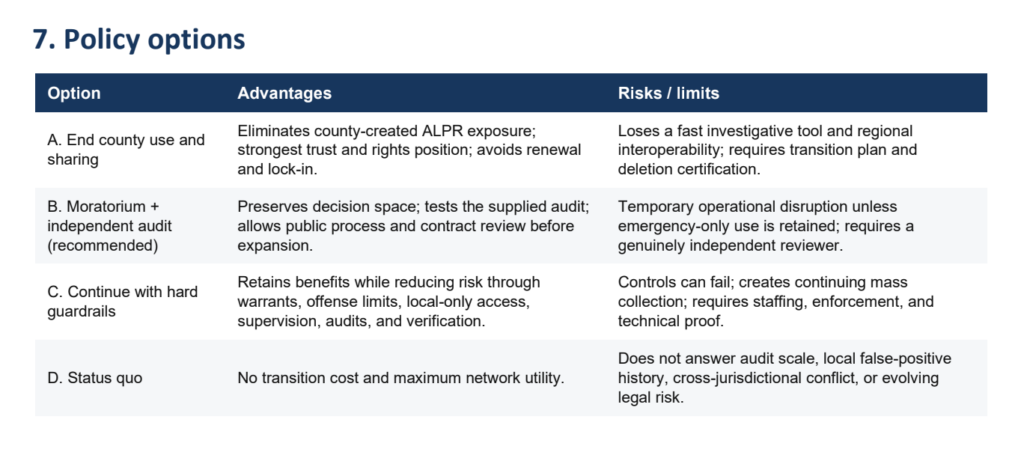
In the Policy White Paper, Gerken recommended four options moving forward, with the top option, “A.” being to stop use of the Flock system altogether.
Here are the minimum conditions if any use continues directly pulled from the Policy White Paper:
• Limit searches to violent felonies, specified serious offenses, stolen vehicles, AMBER/Silver Alerts, and documented exigencies. Expressly prohibit immigration-only, reproductive-care, protest/First Amendment, civil, code-enforcement, and debt-collection uses.
• Require a valid case number, enumerated purpose selected from a closed list, user identity, supervisor approval for historical or out-of-jurisdiction queries, and a written jurisdictional nexus.
• Disable national lookup, federal access, and all one-to-one sharing by default. Approve exceptions individually through written agreements that impose Lucas County rules and audit rights.
• Require officers to visually compare the captured image, full plate, state, make/model/color, and current stolen/wanted record before a stop. An ALPR alert alone must never establish probable cause.
• Use the shortest technically feasible retention period. Require a warrant for historical movement searches beyond a narrow emergency window and for pattern-of-life analysis.
• Commission quarterly independent audits with public aggregate reporting: searches, users, purposes, outside agencies, hits, false alerts, stops, arrests, prosecutions, complaints, and policy violations.
• Provide automatic anomaly detection plus immediate suspension for repeated personal-name/plate searches, off-duty access, missing case numbers, prohibited reasons, and unusually high volume.
• Require county ownership of complete audit logs, immediate breach notice, vendor and subcontractor disclosure, deletion certification, litigation-hold procedures, cyber insurance, indemnification, and a no-training/no-secondary-use clause.
• Require public notice, hearing, camera-location criteria, civil-rights impact assessment, transportation-safety review, and commission approval before new cameras or capabilities.
• Adopt a fixed sunset date. Renewal must be based on independently verified outcomes and a fresh public vote, not automatic continuation.
"Two Way Street" is a five-minute film created by a team of Anthony Wayne High School graduates and students, including '26 graduate Amelia Cappel, left, and senior Evan Jones. (Courtesy image)
A team of Anthony Wayne High School “theater kids” took home two awards last weekend for a five-minute film shot in and around Monclova Township, Waterville and Whitehouse.
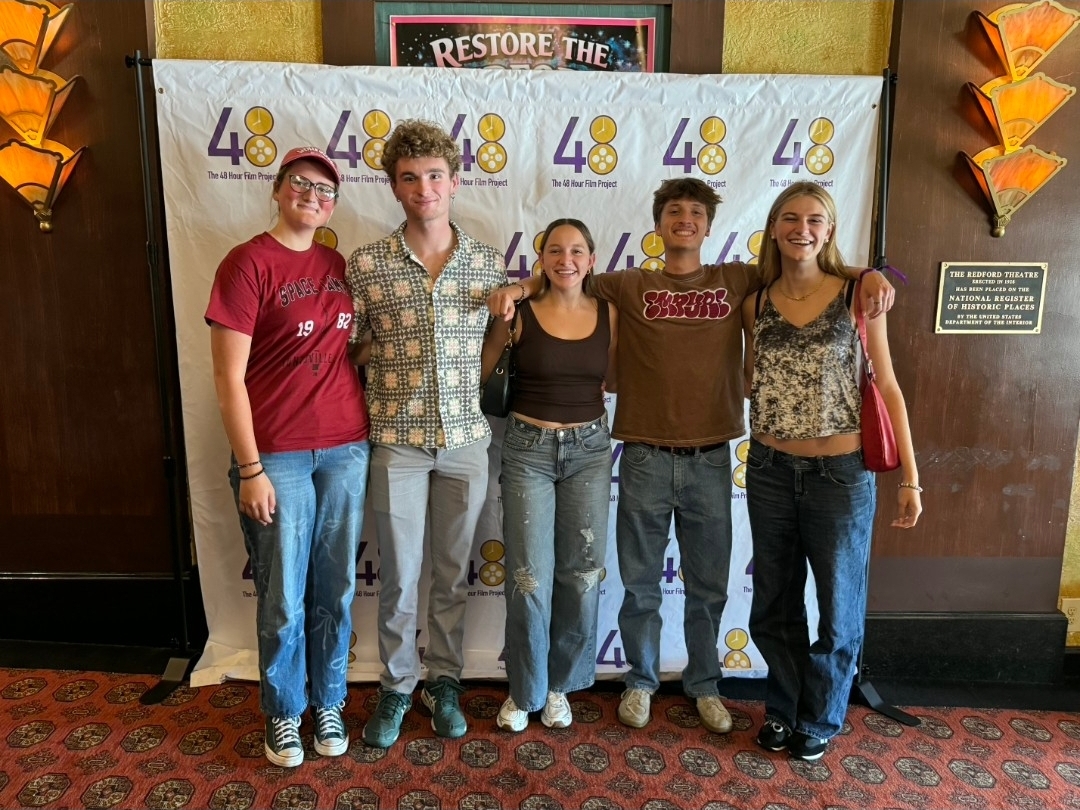
“Two Way Street” was put together for the 48 Hour Film Project between 7:30 p.m. on Friday, July 24 and 7:30 p.m. on Sunday, July 26, and debuted Aug. 2 in the Redford Theater in Detroit – where it was nominated for a Best of Screening on Aug. 16 at the Civic Theatre in Farmington, Mich. Elsa Walz, a 2026 graduate, was there to accept two prizes on behalf of her team: Best in Genre – Road Trip Movie, and Best Use of Prop.
“You’ve got to have a good team for this – a team of creative people who are willing to take the initiative,” Elsa said of the film challenge, which is held in cities around the world, including Detroit. “All of us have done theater, but none of us had any film experience. It was a fun thing to do before we all go our separate ways.”
The motivation for taking on the 48 Hour Film Project came from ’26 graduate Maya Geiger, whose father, Bill, offered to pay the entrance fee if Maya could assemble a team.
“I sent it to my friends and didn’t think anyone would take me up on it,” Maya said.
But she quickly had a chorus of “yeses” from fellow ’26 graduates Amelia Cappel, Raleigh DuShane, Griffin Greer, Jace Uresti, Victoria (Tori) Marshall and Elsa, along with seniors Elisa Liemann, Evan Jones and Layla Doyle, and sophomore Lily Greer.
Gathering at The 48 Hour Film Project during the August 2 debut at the Redford Theater in Detroit are (from left) Elsa Walz, Evan Jones, Maya Geiger, Griffin Greer and Amelia Cappel. (Courtesy photo)
In the six weeks prior to the weekend challenge, Maya read as much as she could, and sent out documents to everyone involved so they wouldn’t waste valuable time on filming days. On July 24, half the team remained at her house while Maya and four others drove to Detroit to pull a slip of paper from a jar. On it were two genres: Sports/Games or Road Film. Being a “bunch of theater kids” with no sports background, Maya said the team quickly chose Road Trip as the theme.
Soon, they were on the road headed back home, with Elsa driving and the rest throwing out ideas for a script that would incorporate three requirements: a character who is a meteorologist named Bart or Barbara Jones, the line “You have to be careful with that,” and an eraser as a prop.
“We were figuring out the plot and what locations we wanted to film in,” Maya said.
Release forms had to be signed for every person and location, so that night, the back-home team headed out to find a gas station that would give permission for the film crew to shoot the next morning. Thankfully, Ridi’s in Whitehouse was willing, and Layla’s father, homebuilder Josh Doyle, gave permission for filming in his Telluride subdivision off Dutch Road.
Still en route home, the team was brainstorming on who could realistically portray a meteorologist; after all, no one ever sees a teenager giving the weather report on TV. Elsa’s mom, Raegan Sawyer, suggested contacting her younger brother, 2010 graduate Keegan Sawyer, who was a communications major at Ohio University, where he worked on air for the college news station.
“He’s an awesome uncle who got dressed up in the middle of the night to read lines on a green screen for his niece and a gaggle of kids,” Raegan said of her brother.
In addition to Keegan playing Bart Jones – a rain-predicting TV weatherman – Elsa and Tori portray newscasters on a television show in the background during the opening scene.
Choosing the lead roles out of so many experienced actors was achieved through a democratic process – a 3 a.m. informal audition and a vote on whose performance was the best, said Evan, who was selected to play Sam.
“This was definitely different from theatrical acting,” said Amelia, who was selected to portray Wendy, the other lead. “I had to be convincing and realistic instead of over the top. I had to act like a real person.”
The opening scene shows Evan exiting a bedroom, shuffling past the TV with the doom-and-gloom forecast of rain and traffic backups, past a closed door where his parents – acted by Elisa and Griffin – are loudly arguing. Getting the shot of Evan walking involved Maya lying on a blanket holding the camera while two others pulled her backwards down the hall.
At Ridi’s two scenes were shot: of Evan coming in to purchase a pocket knife and being told by the unseen cashier that “You have to be careful with that,” and one in which Amelia drops an eraser with a smiley face as she pulls out her credit card. It took more than 90 minutes to film those brief scenes, stopping every time a customer came into the convenience store.
Other scenes are shot while both Evan and Amelia are driving, nearly colliding with one another on the road, past familiar cornfields and barns, and finally at Mary Jane Thurston State Park.
While the filming was underway, using a borrowed boom mic and camera, siblings Lily and Griffin were in the Cappel family home, recording original music. Because Amelia and Griffin are in the band Hit & Run, recording equipment was all set up.
“The coolest part of all is that the music was all original, composed and arranged by Lily and Griffin,” Maya said. “We’re not required to have original music – we could pay to have music from a library – but we have the talented, musically inclined people who were excited to make music for us.”
With filming done on Saturday, the team took turns editing, preparing the title art and last-minute details overnight and into Sunday, barely finishing in time. In the end, “Two Way Street” depicts two different outlooks on a day, and how small actions like a smile or uplifting music can turn that around.
“It shows that you don’t have to see the results of what you’re doing to positively affect people,” Elsa said.
She credits Maya for keeping everyone organized, incorporating everyone’s ideas, and moving forward in a positive way. For Maya, who has not only acted in plays and musicals throughout high school, but also managed junior high performances, doing a film was more of a stretch than she imagined. It’s a lot harder than the amateur videos students make with their phones for high school assignments, she noted.
“I learned that making a movie is less about filming and a lot of behind-the-scenes and overhead. And there’s so much paperwork,” Maya said. “This was only possible because we have a motley crew of talented, awesome and hard-working people.”
Scenes were filmed inside Ridi’s in Whitehouse. (Courtesy photo)
This week, the team is saying goodbye to Amelia and Maya, who are both headed to The Ohio State University, where they will room together. Maya plans to major in biology, while Amelia will focus on English and art history. She will also continue with Hit & Run in Columbus, teaming up with 2024 graduate and saxophonist Luke Willis to perform in local venues and parties. Tori will study mortuary science at Bowling Green State University, and Elsa is headed to Marquette University to major in biomedical sciences with a minor in theater.
Next summer, these graduates plan to return home to team up with their fellow theater friends for another 48 Hour Film Project.
“I think it will be even better because we’ll know what we’re getting into,” Maya said.
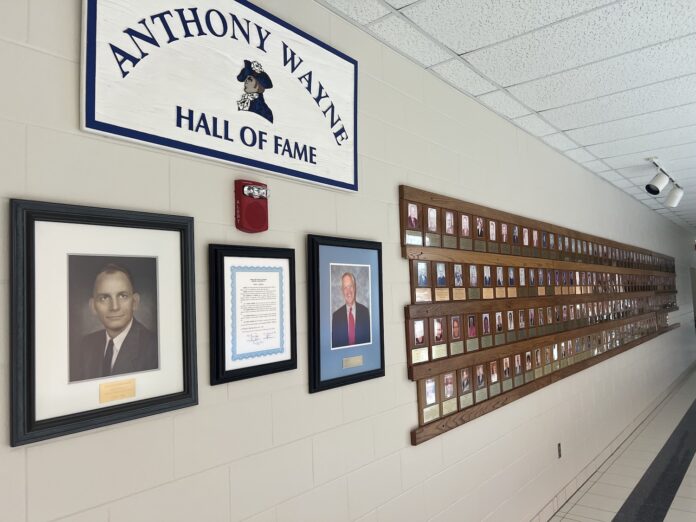
The Anthony Wayne Alumni Association Hall of Fame is located in the Roy Williamson Performing Arts Center hallway at the high school. This year, six new plaques will be added. (Courtesy of Anthony Wayne Local Schools)
The Anthony Wayne Alumni Association’s Hall of Fame – located in the hallway near the high school’s Roy Williamson Performing Arts Center – is about to gain six new plaques.
On Saturday, Aug. 22, five alumni and one retired teacher will be inducted into the Hall of Fame, and added to the existing 177 members.
The Hall of Fame is designed to recognize individuals, who through their academics, athletics, activities, art and music, have made an impact on Anthony Wayne Local Schools in their communities or in their professions.
Alumni Kevin Click, Matthew Mauro, Lisa Schaller, Debra Thompson and Charles Wiedie, along with retired teacher Steve Mossing, will be recognized during the first home football game, on Friday, Aug. 21, and during the Aug. 22 luncheon.
Kevin Click
Kevin Click. (Courtesy photo)
Kevin Click, Class of 1979, attended The University of Georgia where he received a BBA in international business and Spanish. He spent 28 years based around the world with Altria/Philip Morris International, retiring in 2014 as senior vice president of human resources.
He has served in board positions for the Rotary; the International School of Lausanne, Switzerland; the Asheville Art Museum; and Boy Scouts of America International. Today he remains on the Board for MANNA Food Bank in Asheville, N.C. and volunteers with Habitat for Humanity.
“AWHS gave me role models, a spirit of service and examples of leadership grounded in humility,” Click said. “Those experiences helped to shape the person I became and inspired a lifelong commitment to giving back.”
Click resides in Asheville and continues his dedication to helping friends, family and neighbors.
Matthew Mauro
Matthew Mauro. (Courtesy photo)
Matthew Mauro, a 2007 graduate, participated in many musical pursuits during high school, including symphonic band, marching band, jazz band, various honor ensembles, Toledo Youth Orchestra and music composition contests.
Since graduating, Mauro has earned a bachelor of music education from The Ohio State University and both a master of music and doctorate in horn performance (with a cognate in music theory) from the University of Cincinnati College – Conservatory of Music.
Mauro is currently principal horn with the Lima Symphony Orchestra, a private horn and piano instructor, and music and choir director with the Lutheran Church of the Resurrection. Continuing his passion through performance and education, Mauro also works as a freelance hornist in orchestras throughout Ohio, Kentucky and Indiana.
Steve Mossing
Steve Mossing. (Courtesy photo)
Steve Mossing spent his entire 35-year teaching career, from 1976 to 2011, with Anthony Wayne Schools, serving as a physical education instructor, coach and athletic administrator.
Mossing’s coaching duties included football, basketball, tennis and 30 years as the boys varsity golf coach. He served 15 years as an assistant athletic director, and one year as athletic director.
After his retirement, Mossing continues to serve Anthony Wayne as he works to organize the boys and girls Northern Lakes League golf tournaments and supports the Ohio High School Athletic Association basketball tournament and other events.
“Teaching gave me satisfaction, watching students and athletes mature and grow into fine young adults. AW Schools provided me with the necessary tools to continue to evolve into a dedicated and compassionate educator,” he said.
Mossing’s dedication to students, pride in the community, and a genuine passion for helping others succeed set him apart. Mossing cared deeply about his students, not just as athletes or pupils, but as individuals with potential, purpose and heart.
During his career, Mossing began a signature “Happy Friday” message each week to his email list. Now, 15 years after retirement, many still receive this small, yet powerful reminder of his positivity, humor and care.
Lisa Schaller
Lisa Schaller. (Courtesy photo)
Lisa Schaller, a 1981 graduate, was raised in a family deep rooted in the community, providing a path of education and community service.
After graduation, Schaller served in the U.S. Army, received a B.S. in construction management from ITT Technical Institute and a master’s degree of technology-construction management from Bowling Green State University.
Schaller continues to teach and mentor students as assistant teaching professor at BGSU. Mentoring college-age students is just a part of her passion, as there is a focus on technology and STEM education with students from elementary to high school. Schaller is passionate about providing experiences for the students who will become future leaders.
Schaller serves her community through leadership positions with many community support organizations, including Anthony Wayne Alumni Association, Anthony Wayne Education Foundation, Anthony Wayne Community Chamber of Commerce, Habitat for Humanity, Special Olympics, Wood County Parks and the high school career fair. She resides on her family farm in the Anthony Wayne area. Her daughter, Kierstin, is a 2026 AWHS graduate.
Debra Thompson
Debbie Thompson. (Courtesy photo)
Debra Thompson, Class of 1980, was active in the FFA, the Pep Rally Team, and Lucas County 4-H while in high school. After graduation, she started a career in floral design with Ken’s Flower Shop, and began a successful balloon and floral decorating business. In her first year as a business owner, she decorated for seven high school proms, including AWHS, which sought her out for design and decorations for many years.
Thompson became a Tupperware manager at age 20, and she advanced within other companies to sales supervisor, until a diagnosis of Multiple Sclerosis forced her retirement at age 55.
However, this only proved to move Debra into her next phase of life, which encompasses community leadership and advocacy. Today she serves as team leader of the Transportation and Mobility Action Team for the City of Bowling Green, chair of the BG Sidewalk Commission, and member of the Transportation Advisory Committee.
“AWHS taught me to be involved, to work with others, to lead when needed, and to persevere when faced with challenges,” Debra said.
Charles Wiedie
Charles Wiedie. (Courtesy photo)
Charles Wiedie, a 1986 graduate, earned a B.A. in political science from The Ohio State University in 1992. He attended the University of Toledo Law School, graduating magna cum laude in 1995. Commissioned to the United States Air Force, Wiedie launched a 30-year career that took him around the world as a military judge and judge advocate, with numerous service awards, decorations and achievements.
At AW, Wiedie served as class president and captain of the baseball team his senior year. He credits coaches, teachers and administrators for teaching him about leadership.
“Through hindsight and maturity, I am able to look back at my time at AW and better appreciate how my experiences there shaped my future decisions,” he said.
Wiedie now lives in Kailua, Hawaii where he has served as an attorney advisor to the U.S. Marine Corps Defense Services Organization since 2024.
The AWAA Hall of Fame luncheon is open to the public. Tickets are $23 and may be purchased at awalumni.org under the Donate tab. Guests may also pay at the door, but should send reservation information to [email protected].
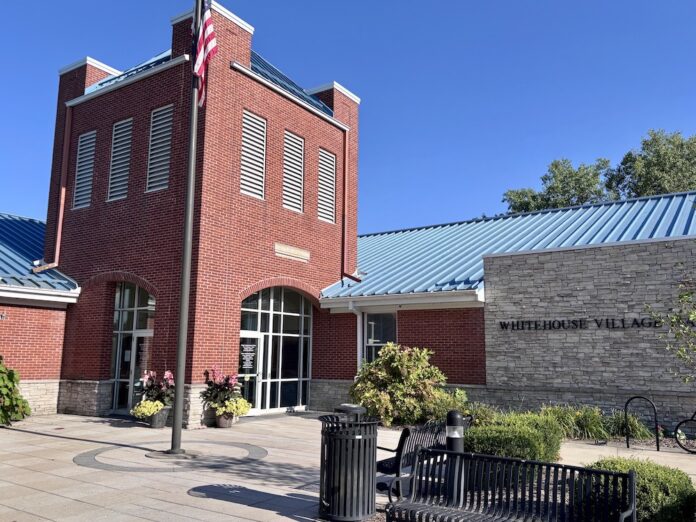
Whitehouse Village Hall. (AWFP photo by Karen Gerhardinger)
WHITEHOUSE – When Whitehouse voters headed to the polls in November 2025, their choices were simple: three candidates running for three open positions. In Waterville that same year, only one candidate was on the ballot for three open positions.
To give voters options in the November 2027 election, Whitehouse Village Council spent part of their Aug. 11 Committee of the Whole meeting brainstorming on ways to recruit council candidates, including through a podcast, social media posts, informational sessions and a “council member for the day” program with high school students.
“This is trying to get people more involved,” said Carrie Tuohy, who is serving her first term in office. Some of the challenges for those new to local government include understanding ordinances and Sunshine rules, and even how to file petitions with the Lucas County Board of Elections, she added.
“Before we go into the details of how to be a council member, we should talk about what is the purpose of Council and why does the village need one,” said Larry Yunker. “When I was running [for office] and talking to people, a lot of people don’t know what happens in this building at all. That’s a good starting point: why it’s important that we have representatives of the community that meet three to four times a month on their behalf – and the kind of decisions that we make.”
Getting residents to come to Council meetings to see how local government works would be an ideal start, agreed Tuohy, joking that it would be nice to serve up hot dogs to lure people to attend.
“I wish people would come. To see that their voices matter,” she said. “We want people to feel welcome, and we want them to run. Even if it’s to replace us. That’s what democracy is all about. We want different voices.”
In 2024, voters approved a charter amendment imposing term limits for council members and the mayor, in order to open up the Council for new people, she added. Tuohy, Yunker and Dave Riggenbach, along with Mayor Rich Bingham, have terms ended Dec. 31, 2027 and will need to seek reelection if desired.
Council directed Administrator Jordan Daugherty to have staff work on ideas for podcasts or informational pieces to post online, and to draft a letter to the schools about partnering to get high school students involved.
Blue Creek Metropark. (AWFP photo by Karen Gerhardinger)
During the meeting, council also:
-Discussed a request from Metroparks Toledo for the village to participate in development plans for Blue Creek Metropark, which is within the village, and to help cover the cost of hiring a firm that specializes in engaging the community to get input on the plan.
Council members pointed out that the plan included with the Metroparks request, dated Feb. 13, 2026, includes the concept of a library and conservation center – a project that has since been removed. Daugherty surmised that this was a draft that would be a launching point for community and village to refer to while exploring ideas for the Metropark.
Water tower with quarry. (AWFP photo by Karen Gerhardinger)
The plan states a goal of turning Blue Creek into a “premiere year-round destination for outdoor adventure” including a possible swimming area in the quarry, an improved sledding hill with artificial snow, a cafe and dog park and a small amphitheater, as well as enhanced restoration of habitats.
“I think the concept plan is amazing and exciting. It would bring a lot of people to the area – who would stay and eat and spend money. I like the idea,” Bublick said.
“We absolutely have to participate, at least in the conversation on the vision of the park. It’s within the village. It is going to affect our residents. It will affect the economic development of the village going forward,” said Council Member Louann Artiaga.
Council agreed to move forward with investing in the plan update, and will vote on the amount during the next regular council meeting, which is Tuesday, Sept. 1 at 6:30 p.m.
–Heard Artiaga announce her resignation, effective immediately. Council has 30 days to name her replacement, or the mayor would make the appointment. An application and information on how to apply for the position are posted on the village’s website at whitehouseoh.gov.
A katydid. (Photo by Art Weber, nature photographer for Metroparks Toledo)
Every summer night there’s a free concert performed by a chorus of insects. They’ve been joined by a new performer with a scratchy “voice.”
That voice is the call of male katydids rubbing their wings together in hopes of attracting a mate. There’s a rhythm to the song, and if you use a little imagination, you’ll hear it repeatedly saying its name – “ka-ty-did.”
These tree-dwelling relatives of grasshoppers are easy to hear but rarely seen. They spend their days quietly hiding in trees and bushes, their green bodies and leaf-like wings helping them blend nicely into surrounding foliage.
Come nighttime, you know they’ve been hiding nearby all day. Their nighttime serenade is scratchy and repetitive, but at the same time welcome and soothing.
Crickets provide the background, a constant trill that’s also created by rubbing their wings together.
Enjoy the performance through these weeks of late summer. Have a seat outside and enjoy it while we can.
In this episode, Erin Holden heads to a park she has never visited before – Fallen Timbers Battlefield Metropark – to take a walk with historian David Westrick. David wrote a book about the battle, and he has much to say about the park’s history and the significance of the beautiful trails visitors will find there. After the interview, Erin talks with her friend Wendy DeBord about all the insight they gleaned from David’s tour.
This is the sixth episode of A Walk in the Park with, a WGTE Public Media and Metroparks Toledo collaboration hosted and produced by Erin. Join her as she explores everyday life in Toledo’s Metroparks. In each episode, Erin interviews different park visitors – runners, teachers, artists, parents and more – revealing the many ways people connect with nature. You’ll hear personal stories about people’s relationships with our parks and the activities they cherish. Erin also documents her journey along the way, reflecting on the insights she gains from each experience.