Home Blog Page 6

Gerken calls for audit and pause on Flock cameras

0
(Left to right) George Benson, a concerned citizen, Jessica Molina, the executive director of Abriendo Puertas Para Soluciones (APPS), Melissa Portala, the founder of Toledo Persists, Baldemar Velasquez, the president and founder of the Farm Labor Organizing Committee (FLOC), Salvador Pezzino, a volunteer with Toledo Persists, and Pete Gerken, Lucas County Commissioner, speak during a press conference addressing the use of Flock Group, Inc. Automatic License Plate Reader (ALPR) cameras at 1 Government Center on Tuesday, Aug. 18, 2026. (TFP photo by Stephen Zenner)

TOLEDO – Following a weekend where a total of five Automatic License Plate Reader (ALPR) cameras made by Flock Group, Inc. were vandalized between East Toledo and Oregon, Lucas County Commissioner Pete Gerken called a special press conference Tuesday morning asking for a pause on the use of Flock ALPR cameras and an audit of the data obtained by those cameras. 

Call for audit/oversight on Flock

“I’m calling for an audit,” Gerken said. “I think an audit by an outside third party is fair. It’s reasonable. I will make no conclusions of what it might come to.

“I understand that Flock safety cameras can and should be used as a legitimate law enforcement tool…where it tends to cross the line into mass surveillance and how quickly we’ve done that without regulatory or control, that is what concerns me.”

With the use of national sharing, law enforcement entities across the country are able to share data obtained by Flock ALPR cameras, and Gerken drew attention to who had accessed Lucas County’s Flock data.

“These are communities outside of Toledo, outside of the state,” he said. “They’re searching for our data without explanation [about] why or what context that they’re looking for. That is troubling to me.”

According to a limited release of the sheriff’s Flock information from June 20, 2026 to July 20, 2026, Houston, Texas was the top law enforcement jurisdiction to access Lucas County’s Flock data, and they searched that data 71,389 times from June to July.

In total, Lucas County had 904,642 searches of its Flock ALPR camera data.

Columbus, Ohio searched Lucas County’s data 18,405 times, securing the number two position on the top 20, and the Federal Bureau of Investigation (FBI) made the third highest number of searches with 17,481 searches. 

Toledo Police were ranked number 18 for number of searches of Lucas County’s system at 6,019 searches of the system.  

Of the top 20 law enforcement entities that accessed Lucas County’s Flock data, only four were from organizations that operate inside of Ohio, the other 16 were from out of state entities, counting the FBI as an in-state operating entity. 

Gerken’s main point was that there should be more oversight into who can gain access to Lucas County’s Flock data. 

Pete Gerken, Lucas County Commissioner, holds a Policy White Paper titled Flock Cameras. Gerken, other local politicians and concerned members of the community talked about oversight restrictions on Flock ALPR cameras. (TFP photo by Stephen Zenner)

Sheriff weighs-in on Flock

Lucas County Sheriff Mike Navarre said this assessment was a fundamental misunderstanding of how the Flock system works. 

“Houston is not accessing our data; Houston is accessing everyone’s data,” he said, explaining why they searched the data so many times. “Wouldn’t it make sense if you’re looking for a vehicle involved in a homicide that you’d want to search everywhere” instead of limiting the search parameters? 

“That’s why our data is being accessed so many times, because we’re all part of the national database that Flock maintains. That’s the beauty of the system. That’s why it’s so effective. Because if you commit a crime in one state and flee to another state, this database is still going to track your movements, and we’re going to find you.”

Navarre said Lucas County searches the entire national database when looking to solve a crime. “When we put a plate in, we put it [the setting to] ‘All.’ That’s what everybody’s doing. There’s no reason not to.”

On the issue of privacy, Navarre said, “I could put a police officer on a street corner and take pictures with a camera of license plates. And they’re not breaking any law. That’s pretty much what Flock does, but it does it in mass scale. It would cost me millions of dollars to do what this Flock system is doing.”

When asked about the public unrest surrounding surveillance by Flock cameras, Navarre said, “I don’t quite understand it. I don’t think the average person knows what these Flock cameras are doing.”

“We’re not getting video. We’re not getting drivers. We’re not keeping data. We’re not selling data,” he said. 

When asked about adding a safeguard like getting a warrant to access the Flock system, Navarre said, “This isn’t on private property. This isn’t in people’s houses. We’re not even doing private parking lots. We’re doing streets. These are cars on streets. When you choose to drive a vehicle down a public street with a license plate number, people have the right to look at the back of that car and memorize that license plate, or take a picture of it.”

When speaking to the Toledo Free Press, Navarre stressed the value of the Flock ALPR readers as effective tools for solving a wide breadth of crimes, from missing persons to high-profile murders, through the tracking of license plates across multiple areas. 

In a public written statement, Navarre drew attention to the fact that Lucas County has a contract with Flock until 2029.
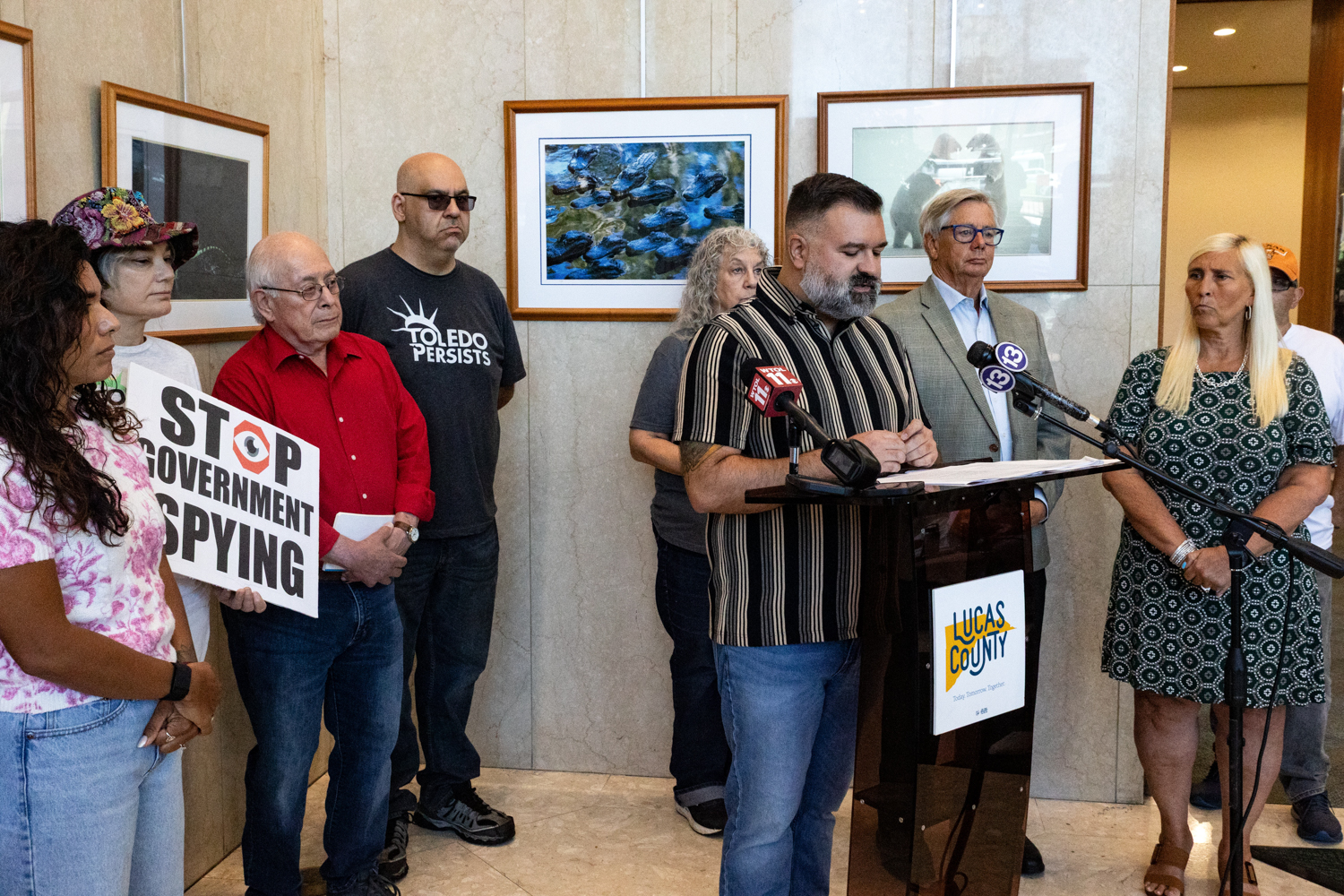
Nick Komives, Toledo City Council Member At-Large, addresses the use of Flock Group, Inc. ALPR cameras. Komives differentiated Flock’s national database of information from taking individual pictures of license plates. (TFP photo by Stephen Zenner)

Flock as database

It is precisely the mass tracking of movements that makes certain politicians and community members uneasy about the Flock system. 

“We’re not simply talking about a camera taking a picture. We’re talking about a database that can tell any person searching where your car has been, when you were there, and the forms and patterns to monitor your everyday movements,” said Nick Komives, Toledo City Council Member At-Large. “Flock is about surveillance, not just cameras. Being visible in public should not automatically mean permanently being tracked.

“The Constitution protects more than our right to avoid being arrested; it also protects our ability to live, associate, speak, worship, organize, and move through our community without unnecessary government surveillance.”

Concerns by those in opposition to Flock without restriction cited these following concerns in a “Policy White Paper” released at the press conference. Those concerns are:

  • Mass collection and movement reconstruction
  • False positives and dangerous escalation,
  • Insider misuse and stalking
  • Policy laundering across jurisdictions 
  • Immigration and reproductive-care enforcement
  • Security and vendor-control risk 
  • Public-records and discovery risk 
  • Unequal burden and trust erosion 
  • Mission creep and vendor lock-in
  • Roadside installation hazard

Concerns over misuse of the Flock system is not just a ‘what-if’ anymore,” Komives said. “We now have evidence of how authorized users have abused the technology for their own personal gain,” he said, and cited three instances of police officers across the country using the Flock system to stalk women.  

The sheriff admitted that with any system there are abuses of those systems, but that there’s no sense in throwing out a system because of “a few bad apples.” 

“Officers have to log into the system, and if it’s used for improper reasons, it should be easy to track and find out who is doing that for the wrong reasons and discipline them,” he said.

Toledo City Council Member At-Large Erin Kramer spoke after Komives against the vandalism of government property through the destruction of Flock cameras, but acknowledged citizens’ concerns.

“I work for the citizens of Toledo, and I have heard them loud and clear that they do not want these cameras.”

Gerken and Navarre

During the conference, Gerken said getting the one-month audit of Flock data was “met with some obstruction” by Sheriff Navarre. 

Reading from a document, Gerken said, “‘Disclosure of this information requested by Commissioner Gerken is prohibited by law.’ That wasn’t true. Very quickly, the county prosecutor intervened and told the sheriff that he could not shield this public data from the public under Ohio Revised Code Section 1.149.43.”

When Navarre was reached for comment, he told the story differently. 

“That is not true. I got the prosecutor involved,” Navarre said. “I didn’t deny his request. The state of Ohio denied his request because they passed a law that says that that data is not a public record, and I can’t make exceptions for for elected officials.”

According to Navarre the point of contention surrounding the Flock log audits was the actual license plate numbers themselves.

When reached for comment, Steven Slivka, the public information officer for the Lucas County Prosecutor’s Office said, “The Lucas County Prosecutor’s Office did advise Sheriff Navarre and Commissioner Gerken that some, but not all, of the Flock data is a public record.”

When asked if Navarre would be open to a Flock data audit or an oversight committee, he said, “As long as it doesn’t violate the state law,” and as long as it doesn’t pause the Flock system while the audit is performed. 

Policy proposal

In the Policy White Paper, Gerken recommended four options moving forward, with the top option, “A.” being to stop use of the Flock system altogether. 
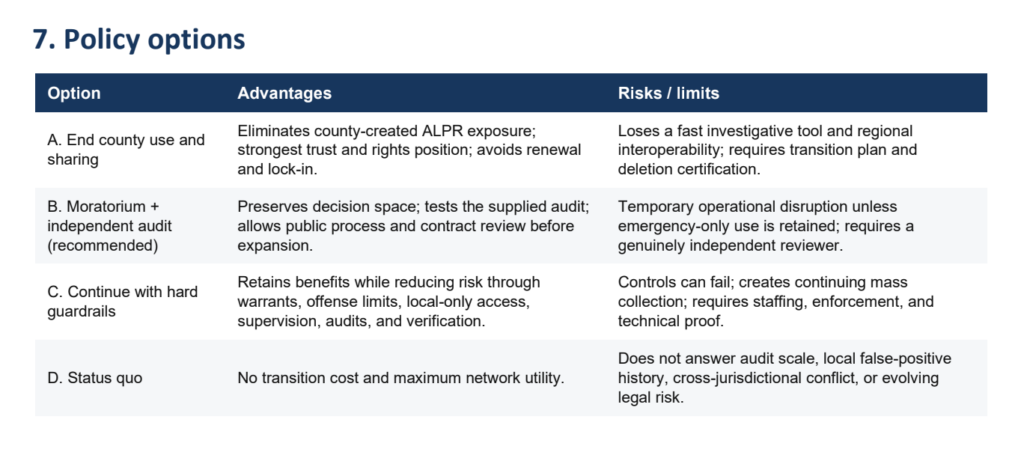
Here are the minimum conditions if any use continues directly pulled from the Policy White Paper:

• Limit searches to violent felonies, specified serious offenses, stolen vehicles, AMBER/Silver Alerts, and documented exigencies. Expressly prohibit immigration-only, reproductive-care, protest/First Amendment, civil, code-enforcement, and debt-collection uses.

• Require a valid case number, enumerated purpose selected from a closed list, user identity, supervisor approval for historical or out-of-jurisdiction queries, and a written jurisdictional nexus.

• Disable national lookup, federal access, and all one-to-one sharing by default. Approve exceptions individually through written agreements that impose Lucas County rules and audit rights.

• Require officers to visually compare the captured image, full plate, state, make/model/color, and current stolen/wanted record before a stop. An ALPR alert alone must never establish probable cause.

• Use the shortest technically feasible retention period. Require a warrant for historical movement searches beyond a narrow emergency window and for pattern-of-life analysis.

• Commission quarterly independent audits with public aggregate reporting: searches, users, purposes, outside agencies, hits, false alerts, stops, arrests, prosecutions, complaints, and policy violations.

• Provide automatic anomaly detection plus immediate suspension for repeated personal-name/plate searches, off-duty access, missing case numbers, prohibited reasons, and unusually high volume.

• Require county ownership of complete audit logs, immediate breach notice, vendor and subcontractor disclosure, deletion certification, litigation-hold procedures, cyber insurance, indemnification, and a no-training/no-secondary-use clause.

• Require public notice, hearing, camera-location criteria, civil-rights impact assessment, transportation-safety review, and commission approval before new cameras or capabilities.

• Adopt a fixed sunset date. Renewal must be based on independently verified outcomes and a fresh public vote, not automatic continuation.

Anthony Wayne ‘Theater Kids’ win 48 Hour Film Awards

0
"Two Way Street" is a five-minute film created by a team of Anthony Wayne High School graduates and students, including '26 graduate Amelia Cappel, left, and senior Evan Jones. (Courtesy image)

A team of Anthony Wayne High School “theater kids” took home two awards last weekend for a five-minute film shot in and around Monclova Township, Waterville and Whitehouse.

“Two Way Street” was put together for the 48 Hour Film Project between 7:30 p.m. on Friday, July 24 and 7:30 p.m. on Sunday, July 26, and debuted Aug. 2 in the Redford Theater in Detroit – where it was nominated for a Best of Screening on Aug. 16 at the Civic Theatre in Farmington, Mich. Elsa Walz, a 2026 graduate, was there to accept two prizes on behalf of her team: Best in Genre – Road Trip Movie, and Best Use of Prop.

“You’ve got to have a good team for this – a team of creative people who are willing to take the initiative,” Elsa said of the film challenge, which is held in cities around the world, including Detroit. “All of us have done theater, but none of us had any film experience. It was a fun thing to do before we all go our separate ways.”

The motivation for taking on the 48 Hour Film Project came from ’26 graduate Maya Geiger, whose father, Bill, offered to pay the entrance fee if Maya could assemble a team.

“I sent it to my friends and didn’t think anyone would take me up on it,” Maya said.

But she quickly had a chorus of “yeses” from fellow ’26 graduates Amelia Cappel, Raleigh DuShane, Griffin Greer, Jace Uresti, Victoria (Tori) Marshall and Elsa, along with seniors Elisa Liemann, Evan Jones and Layla Doyle, and sophomore Lily Greer.

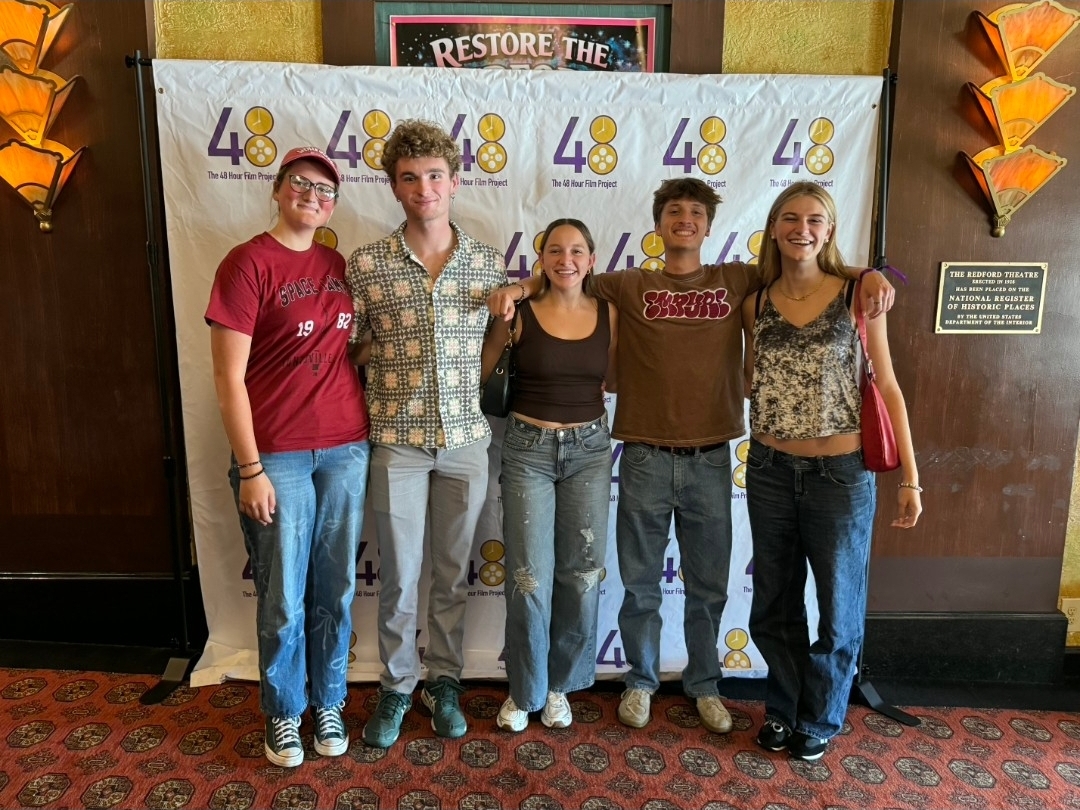
Gathering at The 48 Hour Film Project during the August 2 debut at the Redford Theater in Detroit are (from left) Elsa Walz, Evan Jones, Maya Geiger, Griffin Greer and Amelia Cappel. (Courtesy photo)

In the six weeks prior to the weekend challenge, Maya read as much as she could, and sent out documents to everyone involved so they wouldn’t waste valuable time on filming days. On July 24, half the team remained at her house while Maya and four others drove to Detroit to pull a slip of paper from a jar. On it were two genres: Sports/Games or Road Film. Being a “bunch of theater kids” with no sports background, Maya said the team quickly chose Road Trip as the theme.

Soon, they were on the road headed back home, with Elsa driving and the rest throwing out ideas for a script that would incorporate three requirements: a character who is a meteorologist named Bart or Barbara Jones, the line “You have to be careful with that,” and an eraser as a prop.

“We were figuring out the plot and what locations we wanted to film in,” Maya said.

Release forms had to be signed for every person and location, so that night, the back-home team headed out to find a gas station that would give permission for the film crew to shoot the next morning. Thankfully, Ridi’s in Whitehouse was willing, and Layla’s father, homebuilder Josh Doyle, gave permission for filming in his Telluride subdivision off Dutch Road.

Still en route home, the team was brainstorming on who could realistically portray a meteorologist; after all, no one ever sees a teenager giving the weather report on TV. Elsa’s mom, Raegan Sawyer, suggested contacting her younger brother, 2010 graduate Keegan Sawyer, who was a communications major at Ohio University, where he worked on air for the college news station.

“He’s an awesome uncle who got dressed up in the middle of the night to read lines on a green screen for his niece and a gaggle of kids,” Raegan said of her brother.

In addition to Keegan playing Bart Jones – a rain-predicting TV weatherman – Elsa and Tori portray newscasters on a television show in the background during the opening scene.

Choosing the lead roles out of so many experienced actors was achieved through a democratic process – a 3 a.m. informal audition and a vote on whose performance was the best, said Evan, who was selected to play Sam.

“This was definitely different from theatrical acting,” said Amelia, who was selected to portray Wendy, the other lead. “I had to be convincing and realistic instead of over the top. I had to act like a real person.”

The opening scene shows Evan exiting a bedroom, shuffling past the TV with the doom-and-gloom forecast of rain and traffic backups, past a closed door where his parents – acted by Elisa and Griffin – are loudly arguing. Getting the shot of Evan walking involved Maya lying on a blanket holding the camera while two others pulled her backwards down the hall.

At Ridi’s two scenes were shot: of Evan coming in to purchase a pocket knife and being told by the unseen cashier that “You have to be careful with that,” and one in which Amelia drops an eraser with a smiley face as she pulls out her credit card. It took more than 90 minutes to film those brief scenes, stopping every time a customer came into the convenience store.

Other scenes are shot while both Evan and Amelia are driving, nearly colliding with one another on the road, past familiar cornfields and barns, and finally at Mary Jane Thurston State Park.

While the filming was underway, using a borrowed boom mic and camera, siblings Lily and Griffin were in the Cappel family home, recording original music. Because Amelia and Griffin are in the band Hit & Run, recording equipment was all set up.

“The coolest part of all is that the music was all original, composed and arranged by Lily and Griffin,” Maya said. “We’re not required to have original music – we could pay to have music from a library – but we have the talented, musically inclined people who were excited to make music for us.”

With filming done on Saturday, the team took turns editing, preparing the title art and last-minute details overnight and into Sunday, barely finishing in time. In the end, “Two Way Street” depicts two different outlooks on a day, and how small actions like a smile or uplifting music can turn that around.

“It shows that you don’t have to see the results of what you’re doing to positively affect people,” Elsa said.

She credits Maya for keeping everyone organized, incorporating everyone’s ideas, and moving forward in a positive way. For Maya, who has not only acted in plays and musicals throughout high school, but also managed junior high performances, doing a film was more of a stretch than she imagined. It’s a lot harder than the amateur videos students make with their phones for high school assignments, she noted.

“I learned that making a movie is less about filming and a lot of behind-the-scenes and overhead. And there’s so much paperwork,” Maya said. “This was only possible because we have a motley crew of talented, awesome and hard-working people.”

Scenes were filmed inside Ridi’s in Whitehouse. (Courtesy photo)

This week, the team is saying goodbye to Amelia and Maya, who are both headed to The Ohio State University, where they will room together. Maya plans to major in biology, while Amelia will focus on English and art history. She will also continue with Hit & Run in Columbus, teaming up with 2024 graduate and saxophonist Luke Willis to perform in local venues and parties. Tori will study mortuary science at Bowling Green State University, and Elsa is headed to Marquette University to major in biomedical sciences with a minor in theater.

Next summer, these graduates plan to return home to team up with their fellow theater friends for another 48 Hour Film Project. 

“I think it will be even better because we’ll know what we’re getting into,” Maya said.

Anthony Wayne adds six to Hall Of Fame

0
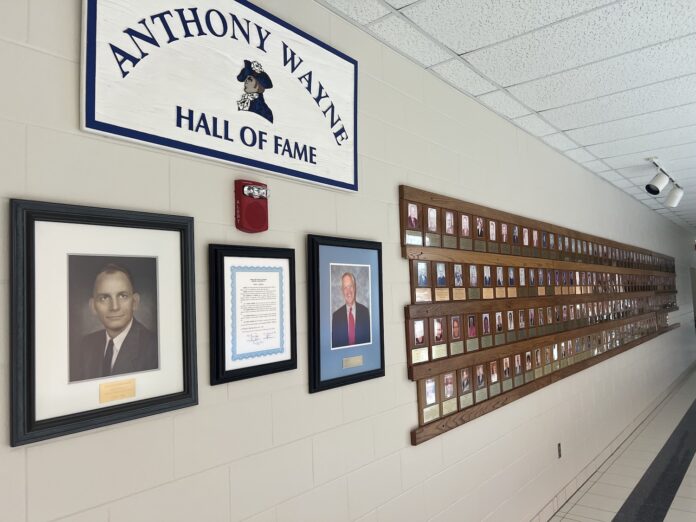
The Anthony Wayne Alumni Association Hall of Fame is located in the Roy Williamson Performing Arts Center hallway at the high school. This year, six new plaques will be added. (Courtesy of Anthony Wayne Local Schools)

The Anthony Wayne Alumni Association’s Hall of Fame – located in the hallway near the high school’s Roy Williamson Performing Arts Center – is about to gain six new plaques.

On Saturday, Aug. 22, five alumni and one retired teacher will be inducted into the Hall of Fame, and added to the existing 177 members.

The Hall of Fame is designed to recognize individuals, who through their academics, athletics, activities, art and music, have made an impact on Anthony Wayne Local Schools in their communities or in their professions. 

Alumni Kevin Click, Matthew Mauro, Lisa Schaller, Debra Thompson and Charles Wiedie, along with retired teacher Steve Mossing, will be recognized during the first home football game, on Friday, Aug. 21, and during the Aug. 22 luncheon. 

Kevin Click

Kevin Click. (Courtesy photo)

Kevin Click, Class of 1979, attended The University of Georgia where he received a BBA in international business and Spanish. He spent 28 years based around the world with Altria/Philip Morris International, retiring in 2014 as senior vice president of human resources.    

He has served in board positions for the Rotary; the International School of Lausanne, Switzerland;  the Asheville Art Museum; and Boy Scouts of America International. Today he remains on the Board for MANNA Food Bank in Asheville, N.C. and volunteers with Habitat for Humanity.   

“AWHS gave me role models, a spirit of service and examples of leadership grounded in humility,” Click said. “Those experiences helped to shape the person I became and inspired a lifelong commitment to giving back.”

Click resides in Asheville and continues his dedication to helping friends, family and neighbors.  

Matthew Mauro 

Matthew Mauro. (Courtesy photo)

Matthew Mauro, a 2007 graduate, participated in many musical pursuits during high school, including symphonic band, marching band, jazz band, various honor ensembles, Toledo Youth Orchestra and music composition contests.

Since graduating, Mauro has earned a bachelor of music education from The Ohio State University and both a master of music and doctorate in horn performance (with a cognate in music theory) from the University of Cincinnati College – Conservatory of Music.

Mauro is currently principal horn with the Lima Symphony Orchestra, a private horn and piano instructor, and music and choir director with the Lutheran Church of the Resurrection. Continuing his passion through performance and education, Mauro also works as a freelance hornist in orchestras throughout Ohio, Kentucky and Indiana.
Steve Mossing

Steve Mossing. (Courtesy photo)

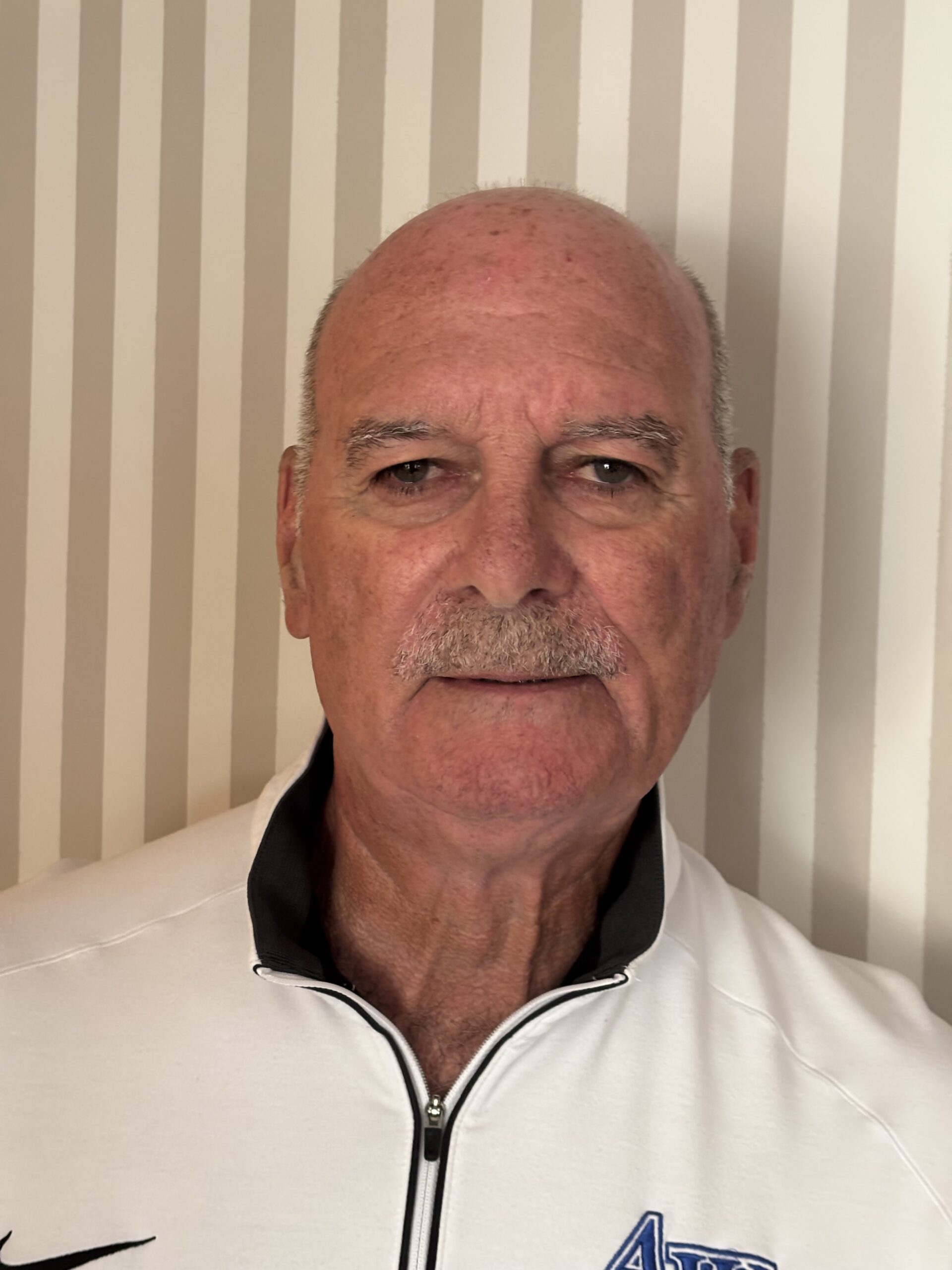
Steve Mossing spent his entire 35-year teaching career, from 1976 to 2011, with Anthony Wayne Schools, serving as a physical education instructor, coach and athletic administrator.

Mossing’s coaching duties included football, basketball, tennis and 30 years as the boys varsity golf coach. He served 15 years as an assistant athletic director, and one year as athletic director.

After his retirement, Mossing continues to serve Anthony Wayne as he works to organize the boys and girls Northern Lakes League golf tournaments and supports the Ohio High School Athletic Association basketball tournament and other events.

“Teaching gave me satisfaction, watching students and athletes mature and grow into fine young adults. AW Schools provided me with the necessary tools to continue to evolve into a dedicated and compassionate educator,” he said.

Mossing’s dedication to students, pride in the community, and a genuine passion for helping others succeed set him apart. Mossing cared deeply about his students, not just as athletes or pupils, but as individuals with potential, purpose and heart.  

During his career, Mossing began a signature “Happy Friday” message each week to his email list. Now, 15 years after retirement, many still receive this small, yet powerful reminder of his positivity, humor and care.  

Lisa Schaller 

Lisa Schaller. (Courtesy photo)

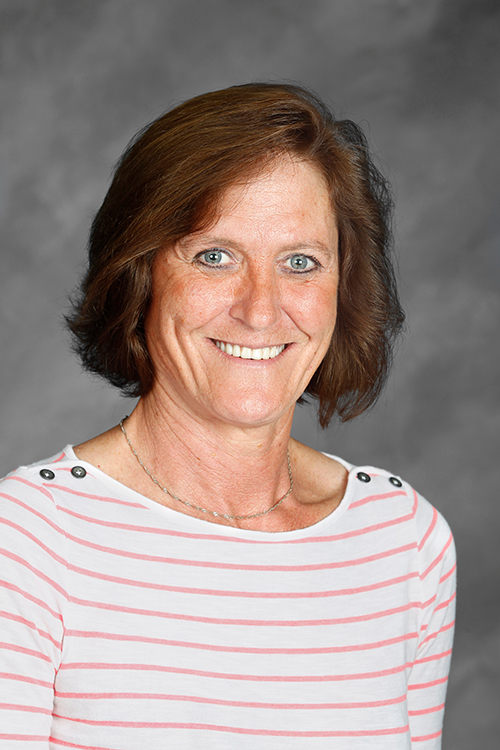
Lisa Schaller, a 1981 graduate, was raised in a family deep rooted in the community, providing a path of education and community service.

After graduation, Schaller served in the U.S. Army, received a B.S. in construction management from ITT Technical Institute and a master’s degree of technology-construction management from Bowling Green State University.

Schaller continues to teach and mentor students as assistant teaching professor at BGSU. Mentoring college-age students is just a part of her passion, as there is a focus on technology and STEM education with students from elementary to high school. Schaller is passionate about providing experiences for the students who will become future leaders.

Schaller serves her community through leadership positions with many community support organizations, including Anthony Wayne Alumni Association, Anthony Wayne Education Foundation, Anthony Wayne Community Chamber of Commerce, Habitat for Humanity, Special Olympics, Wood County Parks and the high school career fair. She resides on her family farm in the Anthony Wayne area. Her daughter, Kierstin, is a 2026 AWHS graduate.

Debra Thompson

Debbie Thompson. (Courtesy photo)

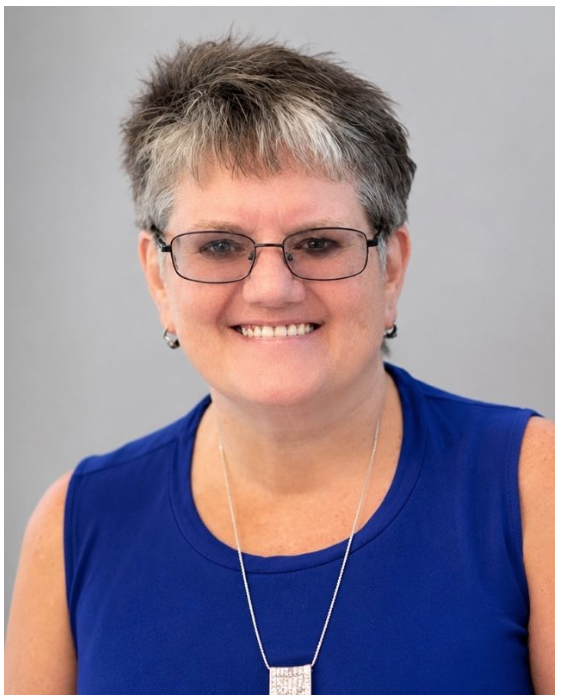
Debra Thompson, Class of 1980, was active in the FFA, the Pep Rally Team, and Lucas County 4-H  while in high school. After graduation, she started a career in floral design with Ken’s Flower Shop, and began a successful balloon and floral decorating business. In her first year as a business owner, she decorated for seven high school proms, including AWHS, which sought her out for design and decorations for many years.

Thompson became a Tupperware manager at age 20, and she advanced within other companies to sales supervisor, until a diagnosis of Multiple Sclerosis forced her retirement at age 55.   

However, this only proved to move Debra into her next phase of life, which encompasses community leadership and advocacy. Today she serves as team leader of the Transportation and Mobility Action Team for the City of Bowling Green, chair of the BG Sidewalk Commission, and member of the Transportation Advisory Committee.  

“AWHS taught me to be involved, to work with others, to lead when needed, and to persevere when faced with challenges,” Debra said.

Charles Wiedie

Charles Wiedie. (Courtesy photo)

Charles Wiedie, a 1986 graduate, earned a B.A. in political science from The Ohio State University in 1992. He attended the University of Toledo Law School, graduating magna cum laude in 1995.  Commissioned to the United States Air Force, Wiedie launched a 30-year career that took him around the world as a military judge and judge advocate, with numerous service awards, decorations and achievements.  

At AW, Wiedie served as class president and captain of the baseball team his senior year. He credits coaches, teachers and administrators for teaching him about leadership.  

“Through hindsight and maturity, I am able to look back at my time at AW and better appreciate how my experiences there shaped my future decisions,” he said.

Wiedie now lives in Kailua, Hawaii where he has served as an attorney advisor to the U.S. Marine Corps Defense Services Organization since 2024.  

The AWAA Hall of Fame luncheon is open to the public. Tickets are $23 and may be purchased at awalumni.org under the Donate tab. Guests may also pay at the door, but should send reservation information to [email protected].

Whitehouse wants to recruit Council candidates

0
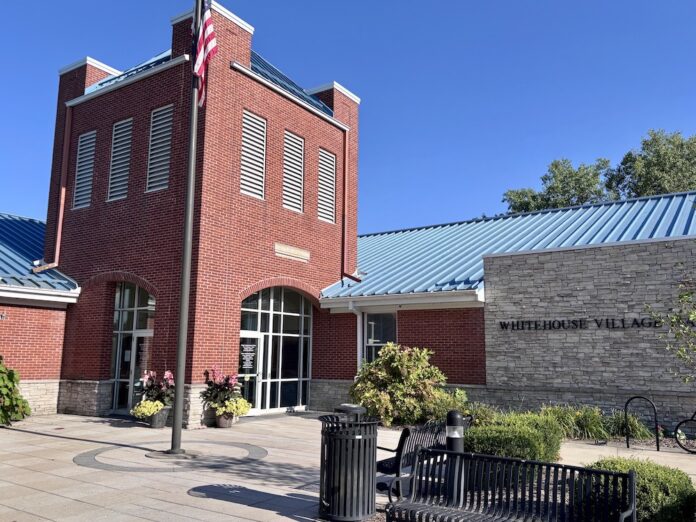
Whitehouse Village Hall. (AWFP photo by Karen Gerhardinger)

WHITEHOUSE – When Whitehouse voters headed to the polls in November 2025, their choices were simple: three candidates running for three open positions. In Waterville that same year, only one candidate was on the ballot for three open positions.

To give voters options in the November 2027 election, Whitehouse Village Council spent part of their Aug. 11 Committee of the Whole meeting brainstorming on ways to recruit council candidates, including through a podcast, social media posts, informational sessions and a “council member for the day” program with high school students.

“This is trying to get people more involved,” said Carrie Tuohy, who is serving her first term in office. Some of the challenges for those new to local government include understanding ordinances and Sunshine rules, and even how to file petitions with the Lucas County Board of Elections, she added.

“Before we go into the details of how to be a council member, we should talk about what is the purpose of Council and why does the village need one,” said Larry Yunker. “When I was running [for office] and talking to people, a lot of people don’t know what happens in this building at all. That’s a good starting point: why it’s important that we have representatives of the community that meet three to four times a month on their behalf – and the kind of decisions that we make.”

Getting residents to come to Council meetings to see how local government works would be an ideal start, agreed Tuohy, joking that it would be nice to serve up hot dogs to lure people to attend.

“I wish people would come. To see that their voices matter,” she said. “We want people to feel welcome, and we want them to run. Even if it’s to replace us. That’s what democracy is all about. We want different voices.”

In 2024, voters approved a charter amendment imposing term limits for council members and the mayor, in order to open up the Council for new people, she added. Tuohy, Yunker and Dave Riggenbach, along with Mayor Rich Bingham, have terms ended Dec. 31, 2027 and will need to seek reelection if desired. 

Council directed Administrator Jordan Daugherty to have staff work on ideas for podcasts or informational pieces to post online, and to draft a letter to the schools about partnering to get high school students involved.

Blue Creek Metropark. (AWFP photo by Karen Gerhardinger)

During the meeting, council also:

-Discussed a request from Metroparks Toledo for the village to participate in development plans for Blue Creek Metropark, which is within the village, and to help cover the cost of hiring a firm that specializes in engaging the community to get input on the plan. 

Council members pointed out that the plan included with the Metroparks request, dated Feb. 13, 2026, includes the concept of a library and conservation center – a project that has since been removed. Daugherty surmised that this was a draft that would be a launching point for community and village to refer to while exploring ideas for the Metropark.

Water tower with quarry. (AWFP photo by Karen Gerhardinger)

The plan states a goal of turning Blue Creek into a “premiere year-round destination for outdoor adventure” including a possible swimming area in the quarry, an improved sledding hill with artificial snow, a cafe and dog park and a small amphitheater, as well as enhanced restoration of habitats.

“I think the concept plan is amazing and exciting. It would bring a lot of people to the area – who would stay and eat and spend money. I like the idea,” Bublick said.

“We absolutely have to participate, at least in the conversation on the vision of the park. It’s within the village. It is going to affect our residents. It will affect the economic development of the village going forward,” said Council Member Louann Artiaga.

Council agreed to move forward with investing in the plan update, and will vote on the amount during the next regular council meeting, which is Tuesday, Sept. 1 at 6:30 p.m.

Heard Artiaga announce her resignation, effective immediately. Council has 30 days to name her replacement, or the mayor would make the appointment. An application and information on how to apply for the position are posted on the village’s website at whitehouseoh.gov.

Wild Side: The scratchy sound of summer

0
A katydid. (Photo by Art Weber, nature photographer for Metroparks Toledo)

Every summer night there’s a free concert performed by a chorus of insects. They’ve been joined by a new performer with a scratchy “voice.”

That voice is the call of male katydids rubbing their wings together in hopes of attracting a mate. There’s a rhythm to the song, and if you use a little imagination, you’ll hear it repeatedly saying its name – “ka-ty-did.”

These tree-dwelling relatives of grasshoppers are easy to hear but rarely seen. They spend their days quietly hiding in trees and bushes, their green bodies and leaf-like wings helping them blend nicely into surrounding foliage.  

Come nighttime, you know they’ve been hiding nearby all day. Their nighttime serenade is scratchy and repetitive, but at the same time welcome and soothing. 

Crickets provide the background, a constant trill that’s also created by rubbing their wings together. 

Enjoy the performance through these weeks of late summer. Have a seat outside and enjoy it while we can.

A Walk in the Park with a Historian

0

In this episode, Erin Holden heads to a park she has never visited before – Fallen Timbers Battlefield Metropark – to take a walk with historian David Westrick. David wrote a book about the battle, and he has much to say about the park’s history and the significance of the beautiful trails visitors will find there. After the interview, Erin talks with her friend Wendy DeBord about all the insight they gleaned from David’s tour.

This is the sixth episode of A Walk in the Park with, a WGTE Public Media and Metroparks Toledo collaboration hosted and produced by Erin. Join her as she explores everyday life in Toledo’s Metroparks. In each episode, Erin interviews different park visitors – runners, teachers, artists, parents and more – revealing the many ways people connect with nature. You’ll hear personal stories about people’s relationships with our parks and the activities they cherish. Erin also documents her journey along the way, reflecting on the insights she gains from each experience.

Anthony Wayne Local Schools hosts Back-to-School job fair

0
Anthony Wayne Local Schools, like many districts nationwide, is in need of substitute and contract bus drivers. An Aug. 25 Back-to-School Employment Fair will give community members to learn more about opportunities and apply for positions. (AWFP photo by Karen Gerhardinger)

Going back to school isn’t just for K-12 students:  Anthony Wayne Local Schools has openings for substitutes in a variety of positions throughout the district, with flexible hours, competitive pay and opportunities for growth.

On Tuesday, Aug. 25 from 11 a.m. to 3 p.m., the district will hold a Back-to-School Employment Fair at the Central Administrative Offices, 9565 Bucher Road. Candidates can fill out an application and learn more about teaching (certified) and non-teaching (classified) substitute opportunities. Anyone applying during the fair will have the background check fee waived.

The goal of the fair is primarily to recruit classified substitutes to fill positions in areas like operations, food service and transportation, as well as aides for the classroom, playground and lunchroom, said Superintendent Kevin Herman.

“These positions are every bit as important in our daily operations,” Herman said. “I consider every person in this district to be part of the educational process. Whether they’re working directly with a child’s education or not, they have an opportunity to make a difference to students.”

Bus drivers are the first school representatives to greet a child each morning and often set the tone for that child’s mood throughout the day, he noted. And the cafeteria workers make connections with the students as they go through the lunch line.

Joining the district as a substitute is often the first step to getting into a contract position, Herman said.

“A high percentage of our subs, if they do a great job and want to be full-time, are able to get into those contracted positions,” Herman said. “As we have positions open up, most of the time we hire someone who has subbed first.”

That was the case for bus driver Mike O’Shea and cashier Sharon Hill.

O’Shea, who is lead pastor at Waterville Community Church, first started subbing in the classroom, but decided to help fill a need for substitute bus drivers.

“I love kids and big cars, so it’s been a good fit,” said O’Shea, who now has a contract position as a bus driver with a regular route. “My initial plan was just to sub, but the district’s need was so high that I was getting called almost every day. I realized it would be easier and more helpful to pursue a contract route.”

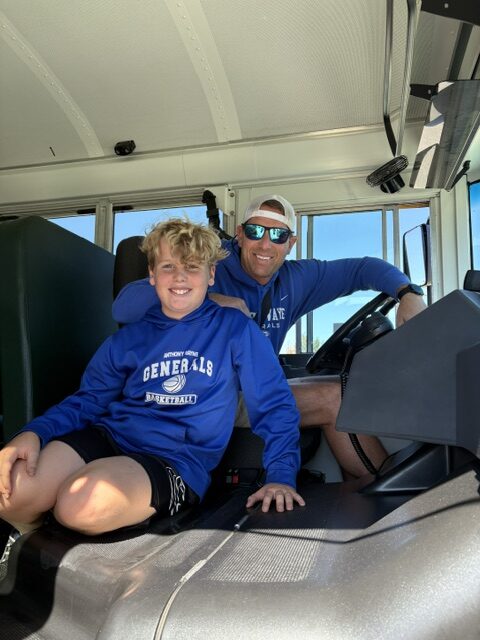
Bus driver Mike O’Shea, with his son, Ryder. O’Shea started out as a substitute teacher, then a substitute bus driver before taking on a regular route for Anthony Wayne Local Schools. (AWFP photo by Karen Gerhardinger)

Initially, O’Shea thought that most bus drivers viewed the position as a hobby or second job to earn some extra cash – not necessarily pursuing the job as a way to care for the kids and the community.

“I was very wrong,” he said. “The drivers and staff in the Transportation Department are highly professional, work incredibly hard and care deeply about what they’re doing.”

Having a regular route fits well with O’Shea’s schedule and still allows him six or more hours a day in the office. But the best part, he said, is the people: the drivers, the office staff and, most of all, the kids.

Finding enough bus drivers is a nationwide problem, in part because of the time it takes to train and get a CDL to drive a bus, Herman said, but the district will pay for that training and the time it takes to earn the certification. 

When Hill signed up to sub for the district in 2016, she didn’t know anyone other than a few teachers and coaches she’d met before her daughter, Abbey, graduated in 2007. 

“I was in the banking industry for 24 years. They downsized my department, so I took a year off, but I was bored. I saw they were looking for subs and I decided to check all of them,” she said of a form she filled out indicating what areas she’d like to work in. 

She served as a special education aide, playground aide and food service worker and decided she liked working in the cafeteria the most. So when a position opened up, she took it.

“I only work 4-1/2 hours a day, but it’s perfect,” she said, explaining that she arrives at 9 a.m. to help prep lunches and then works the register at the high school. “They train you – they don’t just throw you in there. We all help each other. If something needs to be done, we just do it. I work with a lot of good people.”

Unlike teaching positions, which are typically not open during the school year, classified positions tend to open up as employees retire or move on to another position. Subs are especially needed for special education aides, custodial staff and bus drivers. These positions do not require a degree, but teaching substitutes do.

While subbing is an ideal path to get into a contract position, many choose to stay as a substitute because of the flexibility. Often subs are parents who want to work while their children are in school, but need the flexibility to take off when a child is sick or to handle other responsibilities, Herman said. 

Others do want to ease into a contract position, especially when realizing the benefits are excellent. 

“If its someone who is looking at getting back into the workforce, subbing is a great way to start,” Herman said.

Candidates identified during the fair will be added to a list for approval by the Anthony Wayne Board of Education during its Sept. 14 meeting. For more information, visit anthonywaynelocalschools.org.

*Note: The high school is in need of a second shift building engineer. Learn more about the position and apply here.

Anthony Wayne Board of Education welcomes new staff members

0
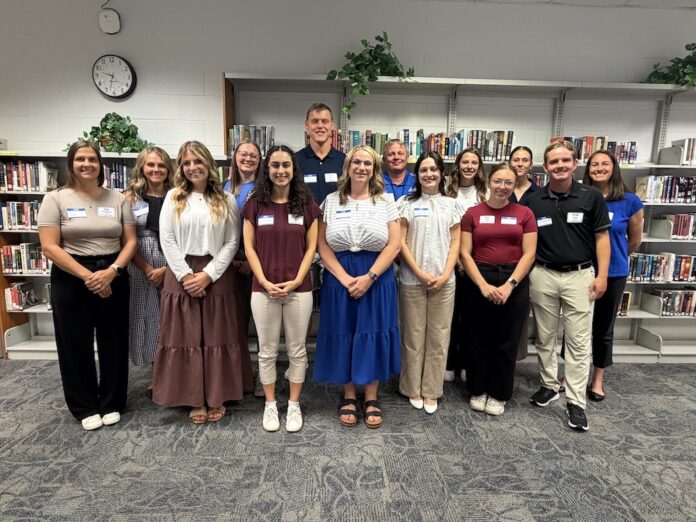
Anthony Wayne Local Schools is welcoming new staff members, including back row (from left) Tori Owen, Kama Wathier, Jack Hursh, Jason Biniker, Molly Rutkowski, Ellie Fleischer and Tracy Greene, and front row (from left) Amy Brinthaupt, Autumn Cornell, Kaylee Lu, Alyssa Fisher, Anthony Wayne Local Schools is welcoming new staff members, including back row (from left) Tori Owen, Kama Wathier, Jack Hursh, Jason Biniker, Molly Rutkowski, Ellie Fleischer and Tracy Greene, and front row (from left) Amy Brinthaupt, Autumn Cornell, Kaylee Lu, Alyssa Fisher, Maya Fleck, Clare Black and Drake Furey. (Photo courtesy of Rebecca Sanford of Anthony Wayne Local Schools)

The Anthony Wayne Board of Education welcomed 14 new staff members during its Aug. 10 meeting – including teachers and specialists who are AW graduates. 

Superintendent Kevin Herman and Assistant Superintendent Kevin Pfefferle welcomed and introduced the new staff members.

Joining the high school are science teacher Ellie Fleischer and business technology teacher Tracy Greene.

Fleischer is a Bowling Green State University graduate who did student teaching at Genoa High School and is an experienced lacrosse player and coach.

Greene brings extensive teaching experience from North Carolina, Holgate, Rossford, Evergreen, Fostoria and Ottawa Hills. She graduated from BGSU and Anthony Wayne High School, where she was a member of the 2003 state title-winning softball team. In 2021 she was inducted into the Tiffin University Hall of Fame.

Penta Career Center employee Jason Biniker is taking over the position of marketing and DECA teacher at the high school, following the retirement of Becky Stutz. He has 22 years of experience in the position, including 11 years at Penta and 11 years at Start High School.

The junior high is gaining four new staff members, including:

-Intervention Specialist Amy Brinthaupt, a Cincinnati State and University of Toledo graduate who previously served as a paraprofessional and ran a cottage bakery.

-Social studies teacher Drake Furey, who previously was an in-game host for Toledo Mud Hens and Walleye, an OHSSA varsity football and basketball referee, and an Ottawa Hills basketball coach. He is a BGSU graduate.

-Physical education and health teacher Jack Hursh is a Bowling Green State University graduate.

-Intervention Specialist Tori Owen is an AW alumna with degrees from the University of Toledo and BGSU. She previously worked at Rogers High School.

Fallen Timbers Middle School is welcoming four new staff members, including: 

Kaylee (Prall) Lu, a sixth grade English Language Arts teacher, graduated from Capital University and previously taught English as a Second Language.

-Intervention Specialist Maya Fleck is a BGSU graduate with experience in Lakota Schools.

-Intervention Specialist Clare Black, is a Bowling Green graduate who previously worked in child care and in educational summer camps.

-Intervention Specialist Kama Wathier has experience in schools in Indiana and in gifted intervention at Springfield Local Schools. 

Autumn Cornell is an intervention specialist at Waterville Primary School. She is a BGSU graduate with experience from Springfield Local Schools.

Molly Rutkowski is a BGSU graduate who will serve as an intervention specialist at Whitehouse Primary School – a role she filled as a long-term sub. She also has previous experience as a summer academy teacher for the district. 

Alyssa Fisher is filling a new district-wide position as a behavior specialist. Fisher has degrees from Ball State University and Bowling Green State University and brings experience from several school districts, including Springfield Local Schools, Findlay City Schools and the Center for Autism and Dyslexia. She will help build and define the position as she works with all of the directors and the schools throughout the district, Pfefferle said.

Meagan Conroy, assistant treasurer, was hired earlier this year but was welcomed with the new staff during the meeting. A University of Findlay graduate, she previously worked for the Auditor of State and for Rossford City Schools as assistant treasurer. 

Meagan Conroy. (AWFP photo by Karen Gerhardinger)

During the meeting, the board also:

-Approved the hiring of S. Christopher Goyer as a cafeteria/playground aide in Whitehouse; Megan Wright, a special education aide; Austin Bellmore, high school custodian; and Bethany Cotner, Whitehouse food service worker.

-Held a moment of silence in honor of Tiffany Prayter, who lost her battle with cancer on Aug. 8. She served as a third-grade teacher at Waterville Primary School for 17 years.

(Courtesy photo)

“She has had an impact on this staff, an impact on all the students she has served, and she has had an impact on this community,” Herman said.

He praised the staff members who have provided aid and comfort to the family during her illness.

“It makes me so proud to be a part of this district and and see the lengths that people go to to assist people when they are in need,” Herman said, noting that the district plans to continue working with the family and providing assistance with grief counseling. 

-Learned that some staff members attended a training at the 180th Fighter Wing to learn how to support families and students in the event of a deployment.

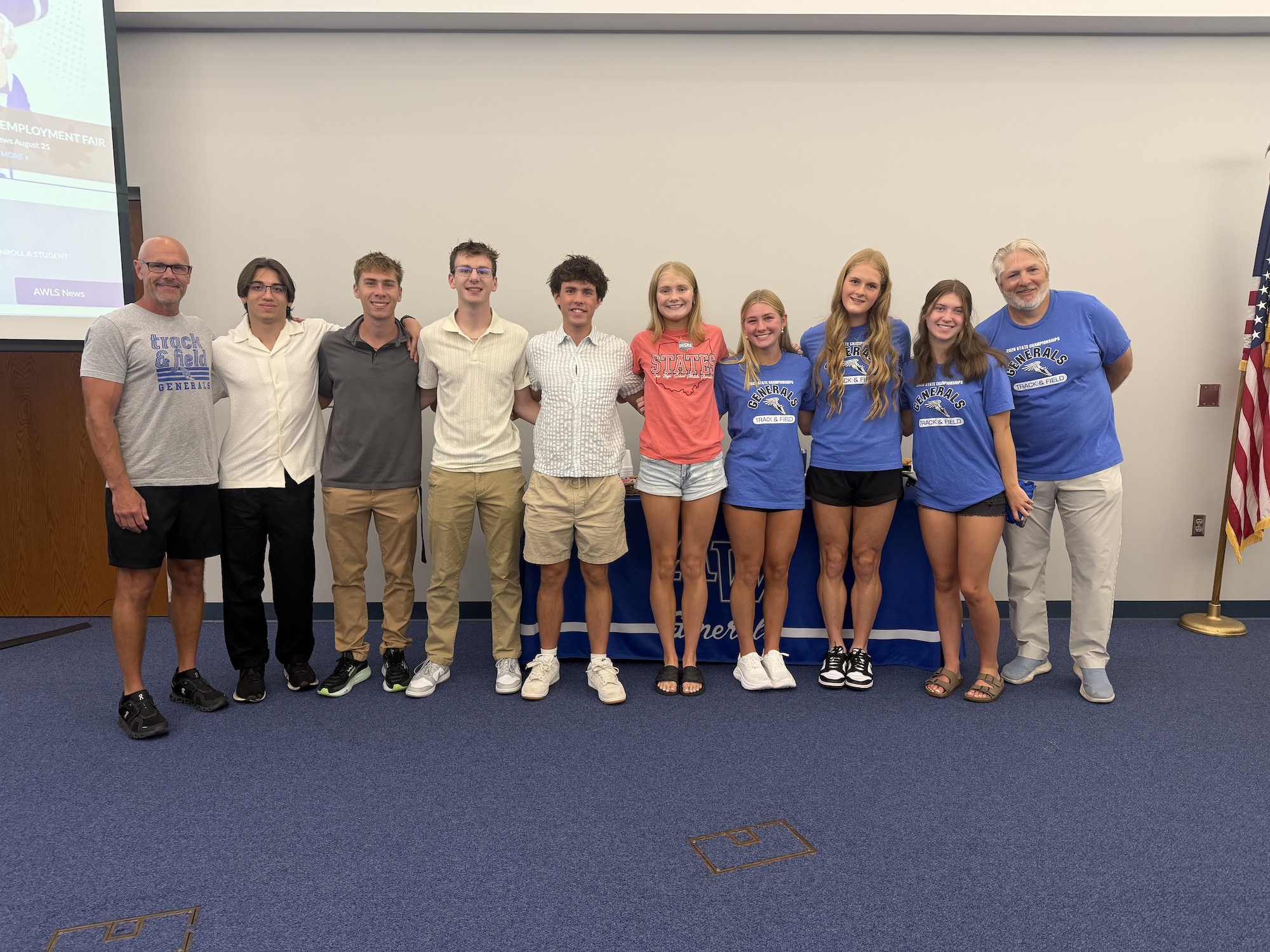
-Congratulated the spring track athletes who competed at the state level and received All-Ohio honors last spring. This includes the 4×800 boys relay team of Joshua Bighouse, Benjamin Gasiorski, Ethan Rozick and Jacob Proctor, and the girls 4×200 team of Madeline Householder, Iliana Smith, Kamryn Smith and Madeline Zimmerman.

The Anthony Wayne Board of Education congratulated the state-winning relay teams during its August 11 meeting. Pictured are coach Craig Smith and the boys 4×800 team of Joshua Bighouse, Benjamin Gasiorski, Ethan Rozick and Jacob Proctor, and the girls 4×200 relay team of Madeline Householder, Kamryn Smith, Madeline Zimmerman and Ilana Smith with coach Kevin O’Connor, who is retiring from coaching. (Photo courtesy of Rebecca Sanford of Anthony Wayne Local Schools)

“We’ve never had one relay team in the history of the school on the All-Ohio wall. In one year, we got two teams. It’s been quite a spring,” said Athletic Director John Snyder, thanking coaches Craig Smith and Kevin O’Connor, who is stepping down after several years of coaching.

-Approved Piper Phillips as an early graduate of the Class of 2027, as she plans to continue her educational and athletic goals at Eastern Illinois University.

-Approved resignations and retirements, including those of bus drivers Mike Lutton and Walt Wilhoyte, both of whom Herman praised for always being wonderful employees who will be greatly missed.

-Listened to Herman say that while all positions are currently filled, the district is seeking substitutes for all areas – including playground, bus and cafeteria aides, groundskeepers, maintenance and bus drivers. When hiring full-time, the district often fills those positions from the list of people who have begun as substitutes. An employment fair to recruit substitutes is slated for Tuesday, Aug. 25 from 11 a.m. to 3 p.m. at the Central Administrative Offices, 9565 Bucher Road.

-Heard that Anthony Wayne High School senior Curtis Vollmar, who has been serving as a bus mechanic this past summer, will continue to work full-time for the district while reporting to supervisors at Penta Career Center, where he has been taking classes. His father, Gary, has been employed by AWLS since 2004 – while still a student at Penta – and has served as head mechanic for 5 years. 

-Approved the $16,280 agreement with Red Rover to replace the district’s Frontline software for absence, time tracking and employment service management. Staff will undergo training before it is launched on Jan. 1.

Approved the donation of a 2025 Look trailer, valued at $6,899, from the AW Band Boosters, and $800 in donations from Whitehouse Parents Club for a gaga pit floor.

-Listened to Treasurer Ray Greene share the general fund financial forecast and assumptions for fiscal years 2027 through 2030. This year, Greene projects revenues of $55,314,934 from property taxes, income taxes, state and federal grants and reimbursement for property tax credits. Expenditures are projected at $54,290,267, with the largest being salaries and benefits, purchased services and supplies.

Ray Greene. (AWFP photo by Karen Gerhardinger)

When added to the carryover, that leaves a cash balance of $4,149,385 as of June 30, 2027. The cash balance for fiscal year 2028 is projected at $4.5 million, but – with expenditures for fiscal years 2029 and 2030 expected to be slightly more than revenues – that cash balance will be reduced to $4.4 million for 2029 and $3.7 million at the end of fiscal year 2030. 

Greene noted that mall revenue is not included in his report as the property was recently purchased and includes $2.5 million in back taxes owed to the district. Nexus Pipeline has confirmed that it will provide the district with $3.17 million over the next few years as its public utility tax. The forecast is shared in detail at anthonywayneschools.org under the Board of Education Aug. 11 meeting.

The next regular meeting of the Board of Education is scheduled for 6 p.m. on Monday, Sept. 14 at the Central Administrative Offices, 9565 Bucher Rd., Whitehouse.

Louann Artiaga reflects on Whitehouse changes

0
Louann Artiaga, who has served for more than 16 years on Whitehouse Village Council, stepped down on August 11. Applications are being sought to fill her term. (AWFP photo by Karen Gerhardinger)

WHITEHOUSE – It takes just a drive down Providence Street to remind Louann Artiaga of the impact her decisions have had on the Village of Whitehouse. The downtown flowers and streetscaping, park shelterhouse and caboose improvements, and the addition of two new mini-parks are the results of council decisions that she’s been part of since taking the oath of office in April 2012.

On Aug. 11, Artiaga surprised her fellow council members by announcing that she was stepping down immediately. Council now has 30 days to select a candidate to fill her position until candidates can run in the November 2027 general election, said Council President Steve Fine

“Between the 1990s and today, I have served over 16 years. And I’ve learned a lot and enjoyed all the people I’ve gotten to know,” Artiaga said during the meeting. “This will be my last night as a council member. I’ve loved working with everybody, but it’s time for me to concentrate on my business and my family.”

Shortly after moving to Whitehouse in 1988 with her husband, Ricardo, and their four school-aged children, Artiaga got involved in the village by serving as council clerk. In that role, she took minutes during meetings and got to see behind the scenes how government is run. 

At the time, Diane McGilvery had just been elected as the village’s first female mayor, and was fighting to prevent the county from building a new prison facility near where the old Toledo House of Corrections was still in operation on Schadel Road. Opening in 1918, the “workhouse” was a place where inmates  grew vegetables, raised hogs and cattle, and quarried limestone while serving their sentences. The workhouse was later torn down and is now home for Blue Creek Metropark and a native seed nursery.

In 1990, Artiaga began serving as a council member, working alongside longtime members Dick Lehman and Bea Ludwig, among others. But after two years, she decided to step down, as the position demanded a lot more time than she expected – and prevented her from attending her children’s school activities. While she stepped away from council, Artiaga continued to be involved in other facets of Whitehouse, including the Whitehouse Library and the Pythian Sisters.

By 2012, her children were out of college, and when an opening on council came up, Artiaga said she realized she missed it, and she had time. She was appointed and has remained on council ever since, winning a spot in the three elections since. 

Her goals from the start were to improve the parks and downtown and to bring in new business. Early on, she formed Destination Whitehouse, a nonprofit intended to support economic development. But when then-mayor Angie Kuhn formed a committee to look at transforming the tiny BLT Park into what is now Veterans Memorial Park, Destination Whitehouse became an integral part of the process, serving as a collection point for donations that were used along with village funds.

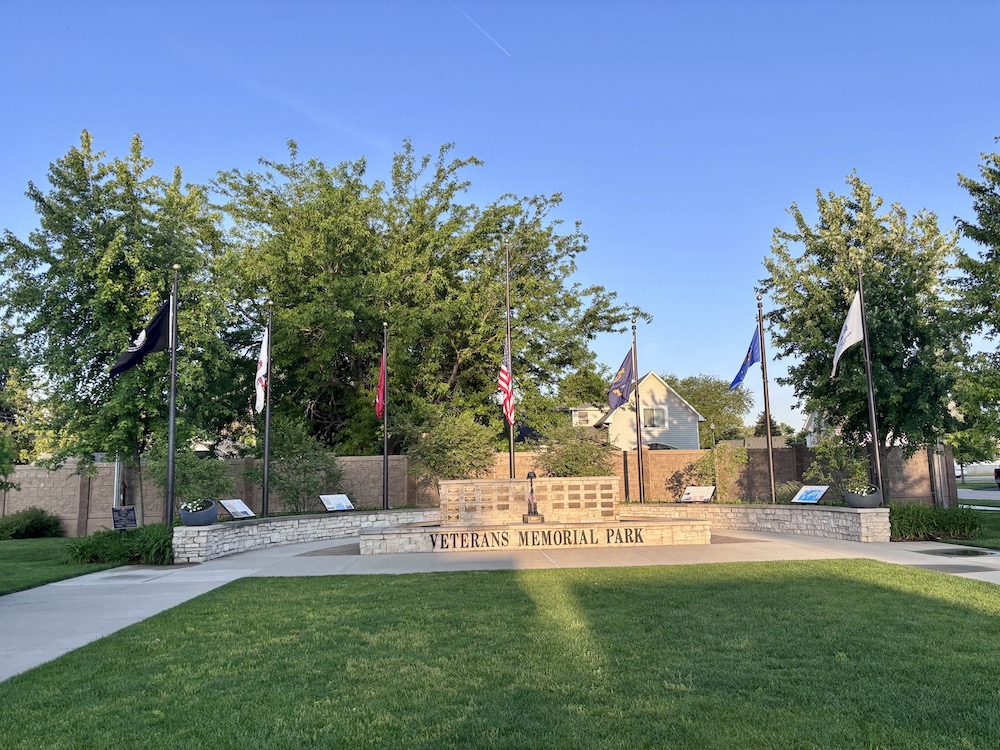
Veterans Memorial Park was dedicated in 2019, filling a space that was once known as BLT Park. (AWFP photo by Karen Gerhardinger)

Veterans Memorial Park was dedicated in 2019, and now serves as a space to honor and reflect on Anthony Wayne area military veterans and first responders, with a fountain holding plaques containing the names of those who died in service to their country. Whitehouse Primary students visit the park every Veterans Day, and Destination Whitehouse continues to handle the engraved bricks that are placed on the walkway twice a year.

“I’m very proud of that park. It’s one of my favorite projects,” Artiaga said.

Once Veterans Memorial Park was finished, council set its sights on another small park just across the alley: what is now Village Social. Public Works crews installed the outdoor fireplace, pergola and furniture for the pocket park a few years later.

Village Social is a small park on Providence Street that was completed in 2023. (AWFP photo by Karen Gerhardinger)

During her tenure, Artiaga has seen other downtown improvements, including the completion of streetscaping with new benches, waste receptacles and limestone features, updates to the park shelterhouse to make it rentable year-round, and the addition of flower pots and hanging baskets along the main streets.

“We still get complaints about how much those flowers cost,” she laughed. “But they don’t realize that those flowers affect more than the beauty of the downtown. They lure people here. If you’re a new business looking to move someplace, where do you want to locate? To someplace like Whitehouse with the planters and the roundabout all spruced up, or one of the other communities that doesn’t have the same aesthetics?”

She notes that the addition of Promed Pharmacy, Adventure Spirits Distilling, the AW Heating and Cooling building and several new tenants at the Shops at Blue Creek – plus regular phone calls to the village asking about available space – show that businesses want to locate in the village and will be welcomed and supported by residents.

“We’ve always wanted to attract more businesses, but I think there’s been more of a push to accomplish this,” Artiaga said.

Being a bedroom community can be a challenge, as the cost to provide services to residents has risen faster than the amount of property tax revenue coming in. Grants have helped pay for projects, but it’s business revenue that helps support ongoing services, she noted.

Whitehouse replaced the entryway sign to Whitehouse Park earlier this year. Plans call for the formation of a parks committee to look at other upgrades, including accessible playground equipment. (AWFP photo by Karen Gerhardinger)

During her time on council, Artiaga said she’s learned more than she ever imagined, from finances and policies to sanitary sewers, law enforcement and fire department regulations.

“I remember in 2014 when we had the algae bloom and couldn’t drink the water. We were handing out five gallons of water at the fire station to our residents. I  don’t think people here know how much it takes to keep a village running and people happy,” she said.

She’s also gained an appreciation for the staff, many of whom innovate to improve services. Former fire chief Josh Hartbarger led efforts to form the W3 Fire Co-op with Waterville and Waterville Township, and that’s resulted in a system of providing fire and EMS coverage that is being emulated by other departments around the state.

“Communities all over are trying to copy that,” she said of the co-op.

One benefit of serving on council has been the opportunity to meet people throughout the community and in neighboring areas. 

“I have made so many friends over the years because of the connections I’ve made through council,” she said.

Of course, having six council members and a mayor with varying backgrounds means each person arrives with their own set of ideas and knowledge base.

“Some people are more easy to agree with than others, but I’ve always respected every single person who has sat on council,” she said. “I respect them for taking the time and effort to bring things forward. I like people who think outside of the box. In order to grow, you constantly need to be looking for something new and a way to make things a little bit better. If that means throwing out ideas that don’t stick, that’s okay. If ideas are not floated, you’re never going to find something that’s going to work.”

While she’s no longer on council, Artiaga has plenty of work to do in the village. As the president of the Whitehouse Library board of directors, she is preparing to close the nonprofit library that was created over 20 years ago and has since been run by volunteers. With plans for the Toledo-Lucas County Public Library to build a new branch at the roundabout, the Whitehouse Library will be vacating its space sometime in 2028. The board will need to find a way to disperse 20,000 books and other materials, as well as the building and furniture, before clearing the property, which is owned by the Metroparks. 

Artiaga also remains active with the Pythian Sisters, and during the national convention a few weeks ago was elected to serve as the treasurer for the United States and Canada, and to represent Ohio at all the meetings. 

And she’ll continue running her Whitehouse-based business, which provides tax preparation, bookkeeping and payroll for clients.

“This past year, my business has bloomed. I’m struggling to have the time to keep up with it and concentrate on my family,” said the 71-year-old Artiaga. “And I’m starting to be a dinosaur up there. I’m the longest sitting council member up there. It’s an opportunity for someone else to step in and get a taste of it [to] be a good council member.”

The deadline for submission of applications to be considered for appointment to the current open council seat is Tuesday, Aug. 25 at noon. Forms are available at Whitehouse Village Hall, 6925 Providence St., and on the village website: whitehouseoh.gov.

According to a Village of Whitehouse, Ohio statement, applicants must be an elector of the Village of Whitehouse at least two uninterrupted years to be eligible for consideration. Application submissions also must include a resume and a letter of interest. Completed applications should be remitted to Administrator Jordan Daugherty at Village Hall or via email at [email protected] by the deadline. Call Daugherty at 419-877-5383 with any questions.

Zebrafish testing yields possible opioid reversal agent

0
Casper Fish, a type of fish that has a translucent external membrane, at the College of Pharmacy and Pharmaceutical Sciences on the campus of the University of Toledo on Tuesday July 21, 2026. Casper Fish are useful for observing how compounds bond inside the body of the fish. (TFP photo by Stephen Zenner)

TOLEDO – Early research by the University of Toledo shows promise for identifying new compounds effective in reversing opioid overdose, specifically fentanyl. 

“This might not work, but if it does, it’ll have a huge impact,” said Isaac Schiefer, professor and vice chair of Medicinal and Biological Chemistry for UToledo. 

Schiefer is the project leader for the university’s research dealing with opioid overdose reversal, and secured the grant from the National Institutes of Health (NIH). 

“Drug discovery is what I do, but ultimately what I work on is dictated by my ability to get money to pay for my research,” he said.

“What they [NIH] were looking for is first novel countermeasures for first responders,” Schiefer said, adding that “there’s certain types of molecules that they list as being chemical threats, and the idea is that, if something was to get aerosolized on the subway in Chicago, is there anything we can come up with, as a countermeasure, that first responders could use in a mass casualty event.”

Synthetic opioids were listed as molecules to test, and Schiefer came up with a model to test for new compounds using zebrafish as test subjects. 

Isaac T. Schiefer, Ph.D., professor and vice chair of Medicinal and Biological Chemistry for the University of Toledo, the director for the Center for Drug Design and Development (CD3) and the associate director for the Shimadzu Laboratory for Pharmaceutical Research Excellence. Schiefer said the moment he bought into chemistry was when he was able to create a molecule that had never existed before. (TFP photo by Stephen Zenner)

Fishing for compounds

In the basement of the College of Pharmacy and Pharmaceutical Sciences, 3000 Arlington Ave., rows of aquariums filled with zebrafish are bred for various tests and experiments. 

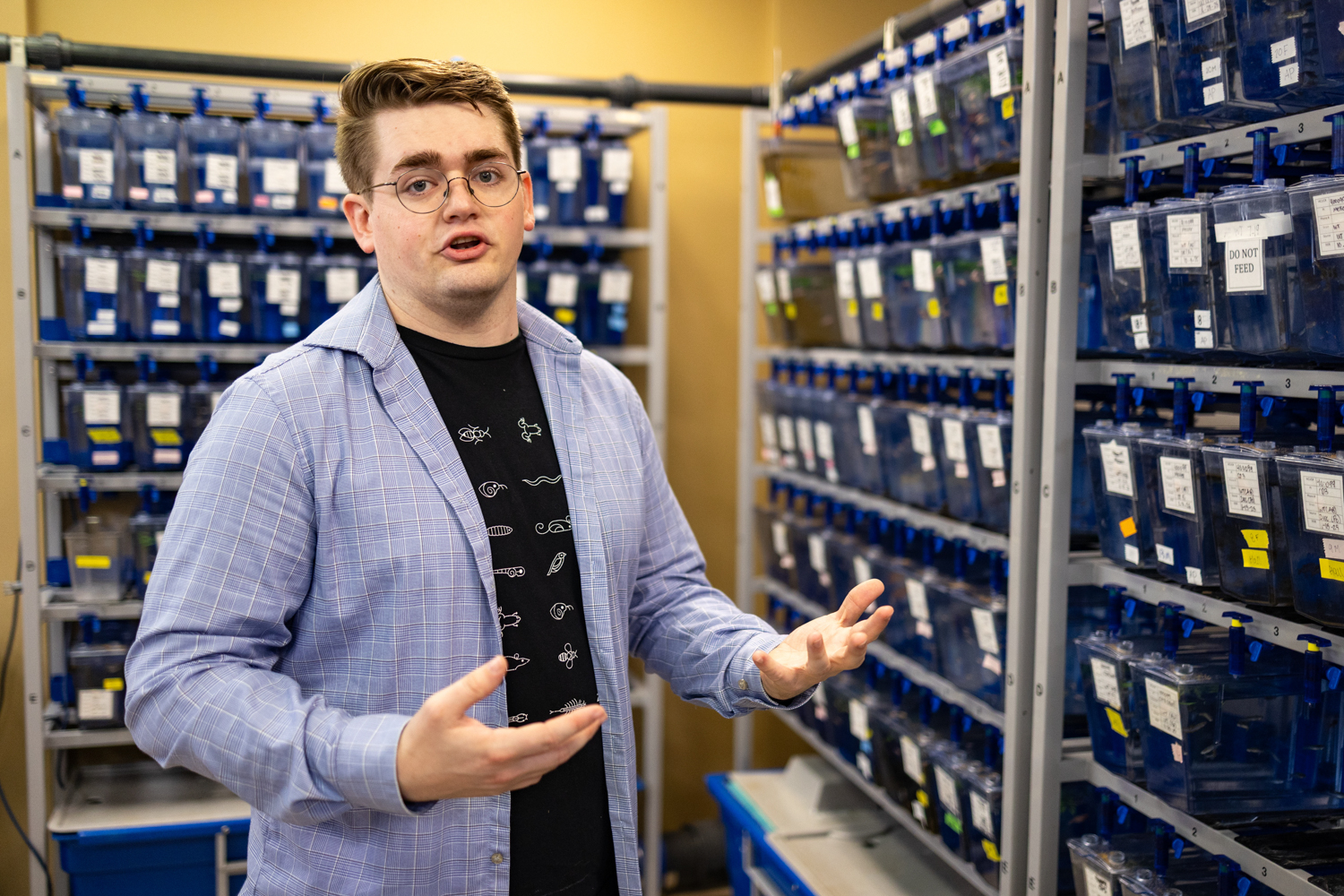
“I test mine at seven days,” said Medicinal Chemistry Doctoral Candidate Henry Stalnaker, who is there testing compounds to find one that will reverse the effects of fentanyl overdose on zebrafish. Other candidates in his cohort test different classifications of drugs on zebrafish, and are currently working with dimethyltryptamines and cathinones.

“Most of it is just measuring their movement,” Stalnaker said, peeling back a bit of the veneer on the experiment.  

“A normal [zebra]fish, they move around like crazy, but when I give them fentanyl, they don’t move as much,” Stalnaker said. “When I give them fentanyl and naloxone, that movement is recovered a little bit.”

Henry Stalnaker, a doctoral candidate at the University of Toledo specializing in Medicinal Chemistry, shows the lab filled with zebrafish, used for research. (TFP photo by Stephen Zenner)

Zebrafish have been identified as a useful test species in scientific research for decades, because of their quick reproductive and maturity rates, the ability to observe the fish’s internal body parts with clarity and their diploid genetic organization. 

In the early 1970s, George Streisinger of Eugene, Ore. identified zebrafish as a good species to assist in the study of genetics, and in 1981 cloned a zebrafish, the first cloned vertebrate. 

Since then, scientists have been discovering different uses for zebrafish, and – for the purpose of Stalnaker’s tests – zebrafish contain the same receptor fentanyl binds to within humans, the mu-opioid receptor. 

“The mu-opioid receptor is responsible for that euphoric feeling,” Stalnaker said. When the active ingredient in Narcan, naloxone, is employed to reverse opioid overdose, it binds with the mu-opioid receptor, and begins to reverse fentanyl’s effect. 

The problem with narcan 

“Naloxone works really well,” Stalnaker said. “But there’s one issue, one main issue, I guess I should say.”

Fentanyl has a longer half-life than naloxone. “So it gets into your brain, or it gets into your body, binds to the receptor, and it’s going to be there for a set amount of time, like a few hours,” Stalnaker said. 

“So while fentanyl’s still there, naloxone left, and now you can just re-overdose again.”

As a substance, naloxone is a synthetic derivative from morphine, a compound developed to reverse opioid overdose, but fentanyl is about 100 times stronger than morphine and isn’t as perfectly tailored for fentanyl. 

Because naloxone is derived from morphine, the two substances share similarities in their chemical structure, but fentanyl has a different composition.

Stalnaker and Schiefer are less interested in the effectiveness of a one-off molecule that happens to work, and more interested in a pattern that reveals a chemical structure underlying a potential fentanyl reversal agent.  

To discover molecules that might be suitable, Stalnaker tests thousands of novel compounds. “The bottleneck is just physical labor,” he said. 

A visual showing the similarities in the chemical structure of morphine and naloxone. (TFP photo by Stephen Zenner)

Testing

“I’ll put a fish in here, and then I’ll put it into that machine; I have a system that tracks them,” Stalnaker said. From there, he observes a batch of fish’s movements after exposing them to one of the compounds.

When light is shone on the fish, they stay still, regardless of the chemicals they’re exposed to, but in the dark the fish move around quite a bit. 

Fentanyl significantly reduces movement of the zebrafish, and the compounds Stalnaker is looking for in the study will bring the fish back to zipping around.  

“A lot of these [chemical] libraries are just molecules that people can make easily, but they really don’t have much drug potential,” Schiefer said. “So you screen 1400 molecules, and you have these…looks like there’s about six things that work.”

From there, Schiefer said the process is an analysis of the molecular structures of what seems to get the zebrafish moving again. “Let’s say you take the best four of those [six molecules]…three of them look very similar to each other.”

“Maybe that’s a type,” he said. “We call this rigor. It’s the amount of evidence.” 

“Finding one molecule that reverses the effects of fentanyl might not be a big deal…If you find several that are very similar that reverse the effects, it lends more evidence to it,” Schiefer said. 

Stalnaker holds a 96-well microplate used to measure the different pharmacological assays. (TFP photo by Stephen Zenner)

And while the two scientists weren’t specific about how many compounds/molecules they identified as effective or more effective than naloxone at reversing fentanyl overdose, they ranged the effective molecules somewhere between five and ten. 

But more importantly, both scientists said they had identified a chemical structure they were investigating. This structure might eventually lead to a drug patent, and for this reason, they asked the Toledo Free Press not to publish it in the meantime. 

Long road to rigor 

With an idea of what the chemical structure might look like to reverse fentanyl overdose, the two worked backwards from that point. 

“In the 9,000 [compounds] we purchased, how many had this kind of structure? It was like 32,” Schiefer said. “So Henry went back and pulled from our library all the other ones and tested them. Some of them work, some of them don’t. And then he has started re-synthesizing them and making new derivatives.”

Schiefer called this process compound design

“We slowly develop what’s called a structure-activity relationship, where we try and understand how does the activity of molecule change when you change its structure,” he said. 

Naloxone is effective for reversing overdose, because it outcompetes other opioids for their place on the mu-opioid receptor. Deaths from fentanyl result from respiratory failure, which is caused by an activation of the mu-opioid receptor in the brain.

When naloxone is introduced it takes up space on the mu-opioid receptor, does not activate it, stopping the overdose by allowing the brain to regulate breathing. 

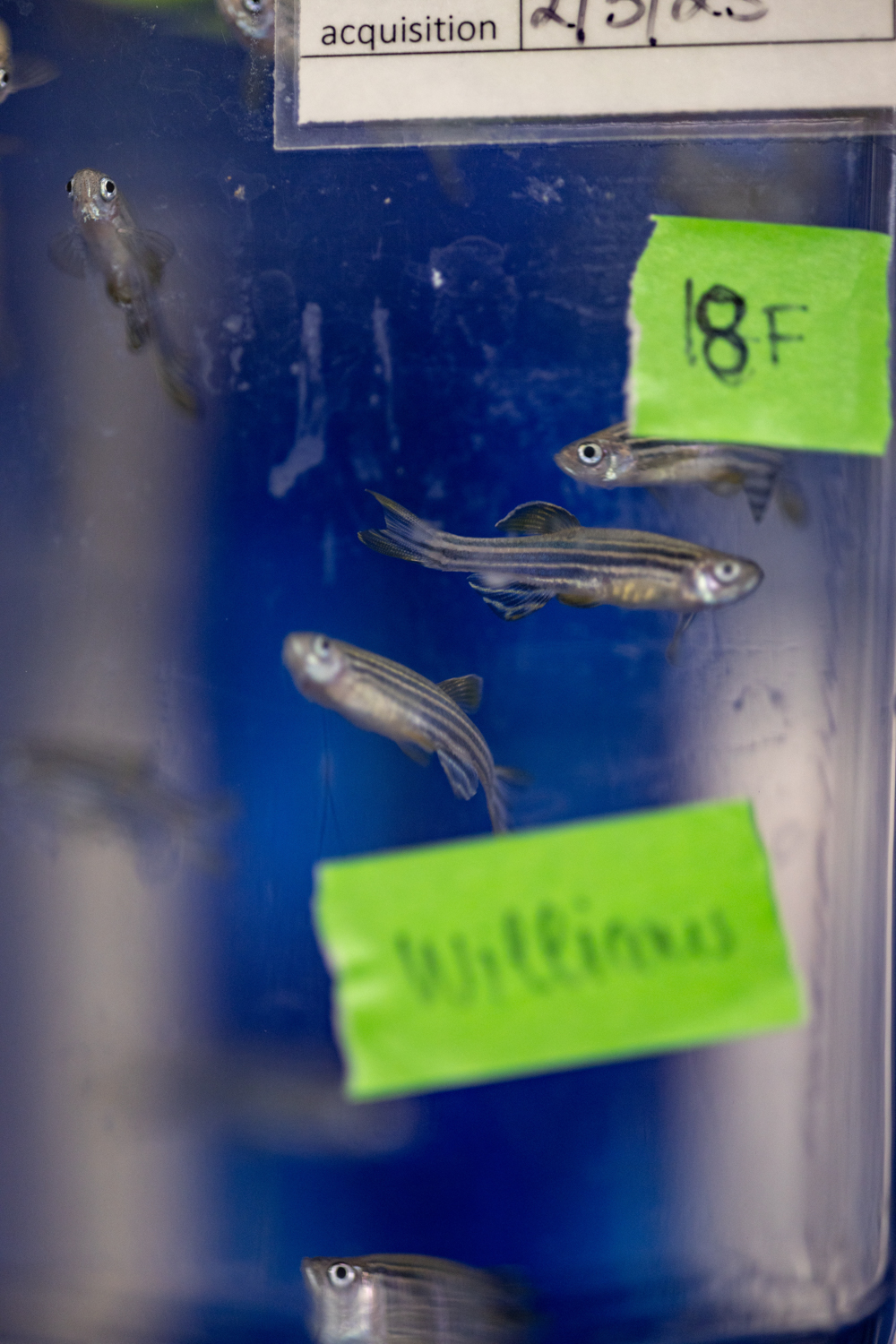
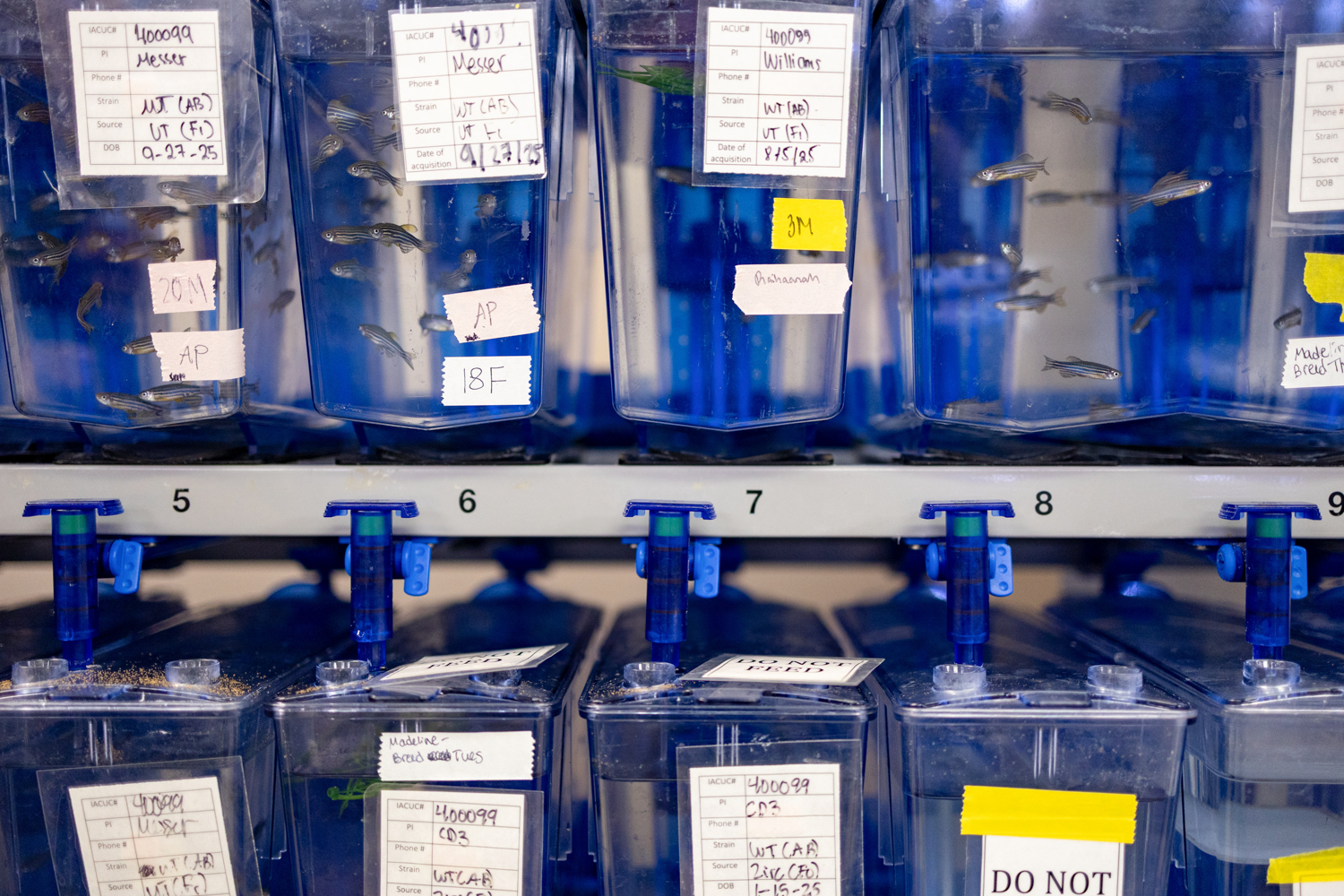
Zebrafish used in the research of fentanyl. (TFP photo by Stephen Zenner)

Locomotion has been the main variable Stalnaker has been observing, so it’s unclear what is causing the zebrafish to resume movement after being exposed to fentanyl, just that the fish are moving again. The movement of the fish is suppressed due to fentanyl, but the mechanism that allows them to move again is unknown.

Truly Stalnaker cannot say the compounds he has found have “reversed” fentanyl overdose, only that they have allowed zebrafish to resume their movement after being exposed to fentanyl. 

Heart rate and respiration will be the next variables Stalnaker will observe in tests, as orthogonal assays. If things go well with those studies, tests will continue on other animals, like mice and rats, but both Stalnaker and Schiefer were clear that this was only the beginning of the research on these possible reversal agents. 

“For me to say my research is going to go to clinical trials, that’s 20 years,” Stalnaker said, while the Principal Investigator (PI) on the research, Schiefer, was more optimistic, estimating seven years with good fortune or more realistically 10 years. 

A bar graph showing different unnamed compounds and their efficacy on reversing the effects of fentanyl on the locomotion of zebrafish. (TFP photo by Stephen Zenner)

Assay it ain’t so

“The novel thing is trying to use them [zebrafish] as a screening assay,” Stalnaker clarified, and talked about how the research was able to happen much faster with the use of zebrafish. “It’s just cheaper. You can get more test subjects with very minimal work, so it’s just a really good model to test.”

“For me to do what I did with mice, it would have taken me years to do. I would have had to [have] a whole facility for it.”

Isaac T. Schiefer, Ph.D., professor and vice chair of Medicinal and Biological Chemistry for the University of Toledo, the director for the Center for Drug Design and Development (CD3) and the associate director for the Shimadzu Laboratory for Pharmaceutical Research Excellence, explains opioids and their treatment at the College of Pharmacy and Pharmaceutical Sciences on the campus of the University of Toledo in Toledo, Ohio on Wednesday July 29, 2026. TFP Photo/STEPHEN ZENNER

Zebrafish, as stated before, have been used for a number of things, but never in this way. 

“People had demonstrated that the fish respond to fentanyl, but they’d never went to try and use it to discover novel fentanyl reversal agents,” Schiefer said. “The implementation and the way we’re doing it is kind of our brainchild.”

Clarification is still required to find how the compounds are actually achieving the limited desired effect in the fish, and part of that ambiguity revolves around not being able to see what the compounds are binding to. 

“We’ll have to study, like do these molecules bind to the mu-opioid receptor?” Schiefer said, or do they work in a different way entirely. 

But the movement of the fish is a good start. Already Schiefer and Stalnaker are working on improving the zebrafish model with what they call casper fish, fish with skin permeable to ultraviolet (UV) light. 

“If you hit them with UV light, the light can get through their skin because they don’t have pigmentation, so you can actually tag certain molecules inside of the fish,” Schiefer said. 

Schiefer explains a method for testing compounds to treat opioid overdose using zebrafish and casper fish. (TFP photo by Stephen Zenner)

Molecule variants with a photo affinity have already been custom made, so that they can track the molecules through the casper fish to more accurately see what they are binding to. 

These molecules do not bind inside the fish until they are exposed to UV light

Schiefer’s hope is that with an acceptance of a grant authorizing the use of casper fish, the assay process might move quicker and with greater accuracy. 

“There’s a couple instances where people, there’s not many, but there’s a few instances where people have taken drugs from academic settings and made big bucks with them. And that’s ultimately my goal,” Schiefer said. 

In the event that Schiefer’s drug went to market and were to be patented, he clarified the patent percentage split would be 60 percent to the university, for bearing all the upfront costs, and 40 percent to the team that helped create the patent. 

“I want students to join my lab knowing that if you do well and produce things, your names go on patents, if I can justify it,” he said. 

Zebrafish used in the research of fentanyl. (TFP photo by Stephen Zenner)