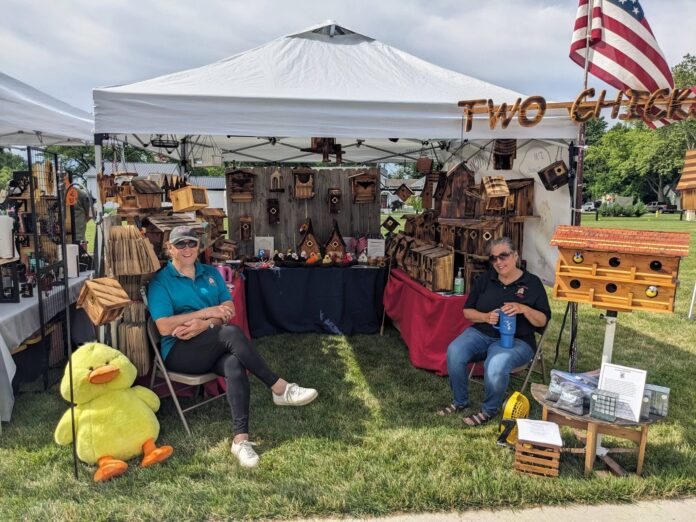
Two Chicks Birdhouses and Feeders will return to the flea market on Aug. 16. (Courtesy photo)
WATERVILLE – When Meredith Parker directs the set-up for the finale Parker Square Community Flea Market on Aug. 16 – a large event with more than 70 vendors, food trucks, music and a bounce house – she’ll be thinking of her grandmother.
As a member of the Waterville Historical Society, Maryann Parker rallied volunteers and led efforts to raise funds and restore some of Waterville’s earliest homes and structures in order to preserve and promote the city’s history.
When she passed in 2015, Maryann’s estate donated $150,000 to a project that continued her legacy: restoring the riverfront site back into a public square.
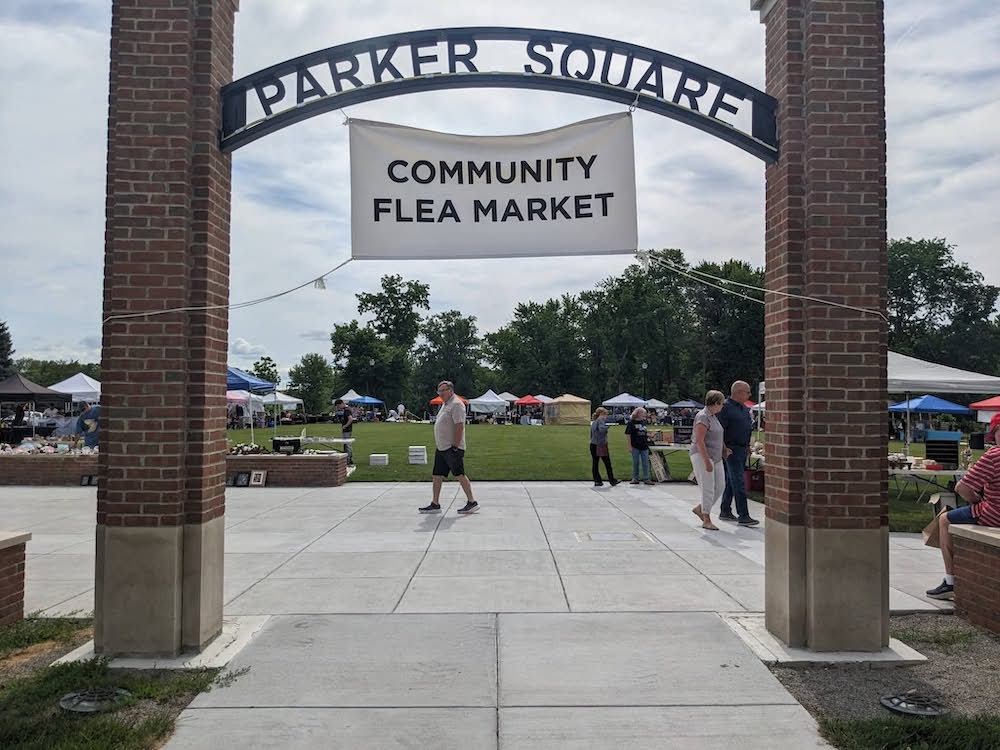
Parker Square (AWFP photo by Karen Gerhardinger)
Parker Square, named for Maryann, now has a scenic overlook, swings, a large green space bordered by sidewalks, and an arched entryway. But before 1886, when the first Waterville School was built on the site, the land was used for residents to meet up and sometimes graze cattle. When the last school was razed in 2017, the city began working on plans to renovate the property into a passive park for public use.
In the years since its completion, Parker Square has provided much-needed green space along the river, with guests of the Roche de Boeuf Festival and holiday events utilizing the area. But the flea market – launched last year by Old House proprietor Aggie Alt, is the first regular use of the space. Parker Square is an ideal location for the flea market, because customers pushing wheelchairs, walkers or strollers can visit all of the booths while on an even sidewalk, she added.
“I wanted to create an opportunity for local businesses to showcase their products and services to the community, and for people to come see the park while doing some shopping,” Alt said.
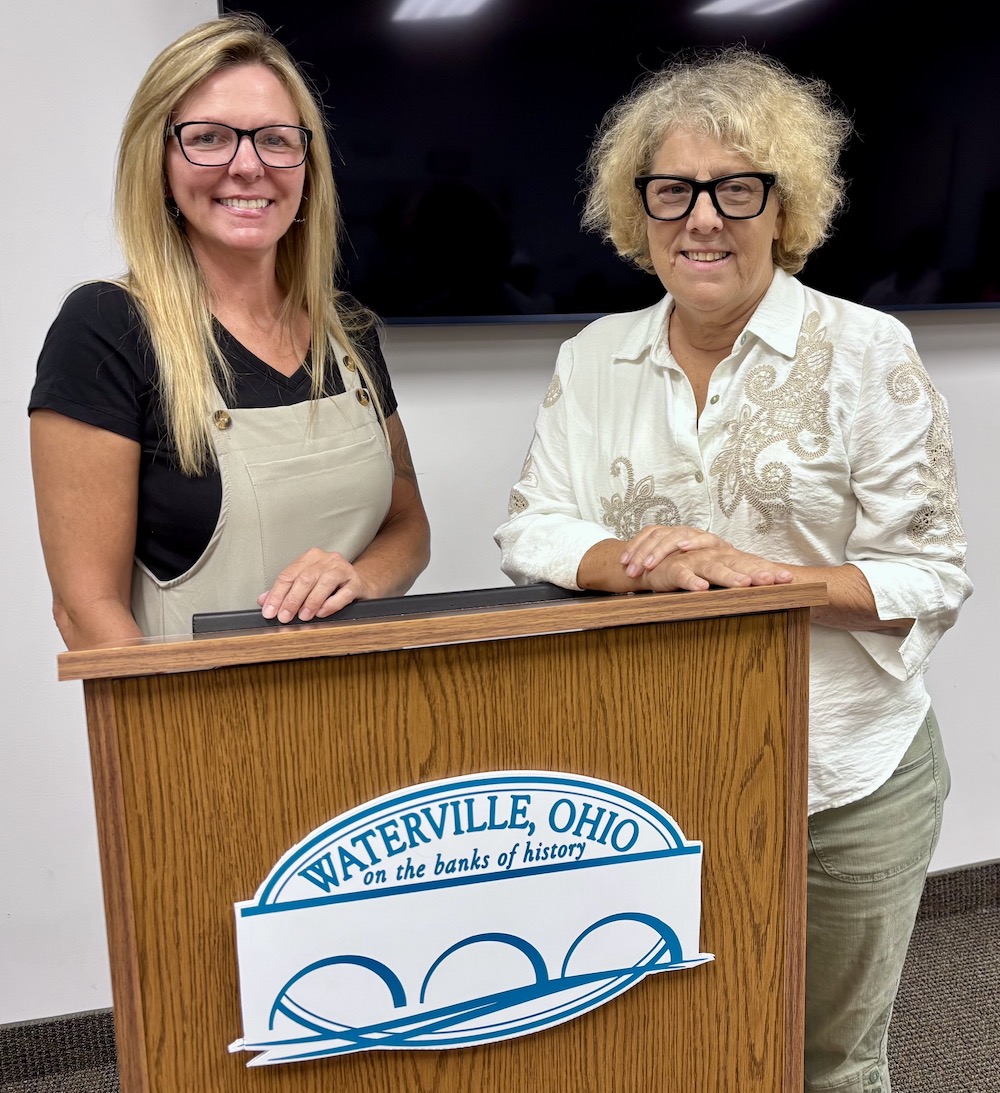
Meredith Parker and Aggie Alt spoke to Waterville City Council about the Parker Square Community Flea Market during the July 27 meeting. (AWFP photo by Karen Gerhardinger)
Soon after its launch, Meredith joined the effort, leading the marketing, promotion and coordination of vendors and entertainment for the flea market, which features vendors ranging from produce and flowers to artisan-made gifts.
Teaming up with Meredith has expanded the reach of the market, Alt said.
It’s grown to 67 vendors and four food trucks set up during the July event. The final market of the season is Sunday, Aug. 16 from 10 a.m. to 4 p.m., and Meredith said she expects it to be the best yet.
Five food trucks will be on site: Leanna’s Bananas, Turk Farms Produce, Koral Hamburg, Big Mealz on Wheelz and First Sip Coffee. Also on the lineup, a bounce house and music by Sugar Mountain Band.
“They play classic rock, folk and country music,” Meredith said.
For the vendors, the market provides valuable exposure to the community.
“A lot of the vendors have returned because sales have been good,” she said.
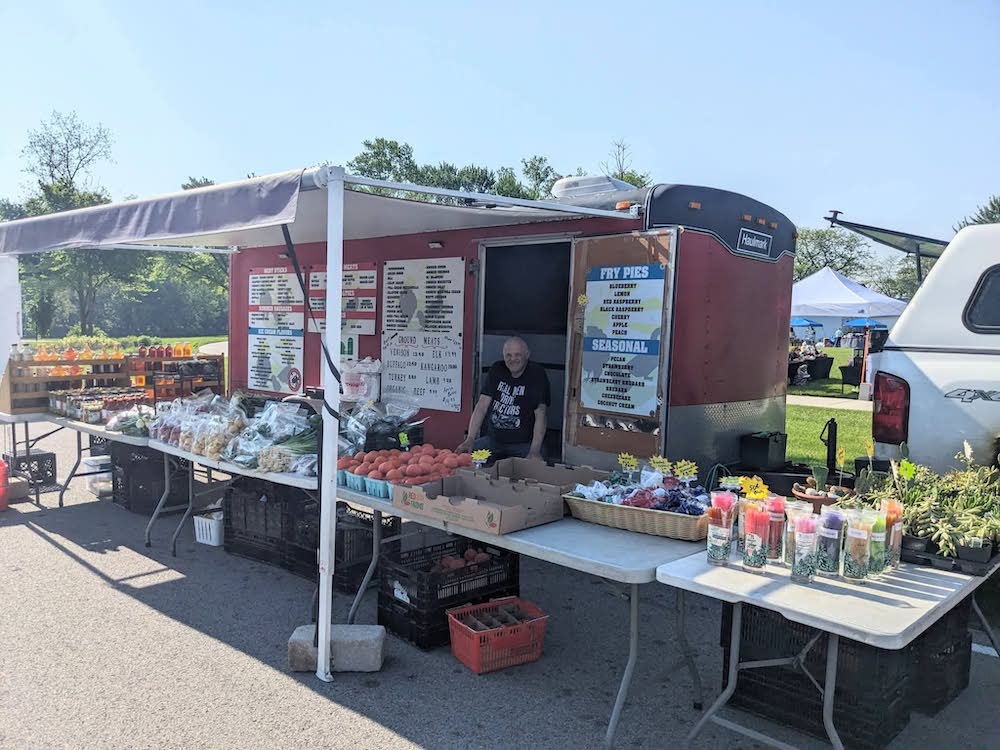
David Turk of Turk Farms, will return with fresh fruit, honey, maple syrup, jarred goods, meat sticks and fry pies. (Courtesy photo)
Some of the items for sale include antiques and collectibles, custom birdhouses, holiday decor, handmade soap and body care items, jewelry, 3D printed toys, laser-cut items, woodworking, rocks, paintings and photography, metal designs, glass garden flowers, hand-poured candles, chainsaw carvings and a Tarot card reader. Three local bread bakers and two local dessert makers always sell out, Meredith added.
While the market is an attraction in itself, the visitors who come from all over the area are also dining in local restaurants and patronizing local businesses.
“And they’re checking out our beautiful downtown,” Alt said.
During the July 27 Waterville City Council meeting, Meredith presented a $500 donation from the proceeds of this year’s events as a gesture to help with further improvements to the park that bears her grandmother’s name.
“The goal is to use the new park or town square as it was originally intended nearly 200 years ago,” Meredith said. “I hope this small gesture of sharing the wealth from our event might serve as a catalyst for other organizations to make donations.”
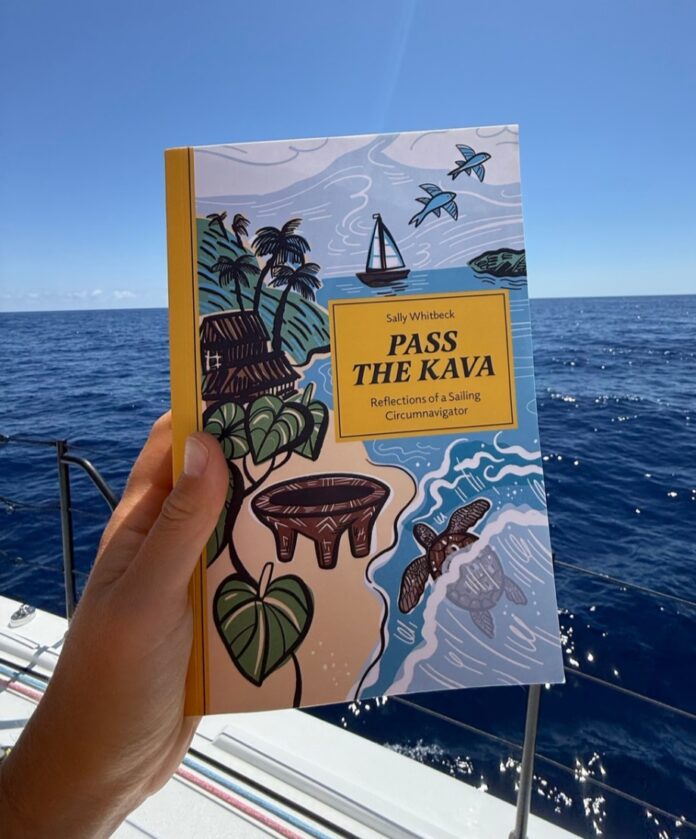
Sally Whitbeck holds a copy of her book, Pass the Kava, as she sails in the Bahamas. The 1975 Anthony Wayne High School graduate recounts the first year of a four-year circumnavigation of the world by sailboat in the early 1990s. (Courtesy photo)
“Long before the existence of cell phones, laptops, YouTube, Instagram, Google Earth, Starlink, drones, weather apps, navigation software, email, texts, or even digital cameras, we went to sea in a small boat,” writes Sally Whitbeck in the preface of Pass The Kava – Reflections of a Sailing Circumnavigator.
In December 1993, Sally and her husband Jon left their careers, sold their home and possessions, and boarded a 37-foot sailboat, the Argonauta, to begin a four-year circumnavigation of the world. Pass the Kava takes readers on the first year of that journey: from the seasickness, sleepless nights, killer whales and failing equipment to the tranquil sunsets, locally-sourced meals, hikes to stunning vistas and the snorkeling and fishing from both the boat and the shore.
But what stands out most about Pass the Kava are the friendships Sally and Jon formed with the people living on remote South Pacific islands and in villages along the coasts of Central America, Mexico and New Zealand. With Sally’s limited French and Spanish and Jon’s universal language of humor, the two befriended not only fellow “cruisers” they would see on the water, but dozens of locals.
Pass the Kava tells of teenage brothers Roddy and Ismael who were working their father’s black pearl cultivation business on Toau, a small coral atoll in the Tuamotu Atolls of French Polynesia. The brothers’ constant giggling antics and contagious laughter provided hours of amusement, Sally wrote, but the brothers also led them on excursions to spearfish, harvest coconut and test “biere locale” with fermented bananas.
Often spending nights sleeping on the deck of the Argonauta, Roddy and Ismael became enthralled with the VCR tape of Beverly Hills Cop, even though they couldn’t understand English. The brothers also laughed hysterically when Sally recorded them on her camcorder and played it back for them to see.
On Mopelia, a Leeward atoll in the Society Islands, they met Teamo, Geneviere, Leon and Carl, who ran an oyster farm and shared meals with the Whitbecks aboard the Argonauta and in their home. With their new friends, Sally and Jon hiked and played bocci ball and shared stories about their lives. On Niuatoputapu, a volcanic island in Tonga, they learned the “Tongan way” of open-hearted hospitality, through Vatau, his wife Vika and their extended family, who invited Jon and Sally to feasts and celebrations – including a kava ceremony.
Kava is the root of a Pacific Islands shrub and is made into a drink that relaxes without alcohol. “Sharing a bowl of kava creates a calming sense of well-being, allowing one to fully engage in the present moment,” Sally explains. “This culturally valuable ritual can bring about profound contentment and an understanding of the interconnectedness of all beings.”
The Kuna people of the San Blas islands row out to meet Sally and Jon Whitbeck aboard their sailboat, the Argonauta. (Courtesy photo)
The daughter of Phyllis and Jim Witzler, Sally was four when the family moved to Waterville from Ann Arbor so that her father, known as Dr. Jim, could join the medical practice of Dr. Allen Borger. She recalls him building a tandem kayak from a kit, and using it on the Maumee River. In Pass the Kava, Sally reflects on the impact of her father’s death when she was 14 – a tragedy compounded by her only friend moving out of town.
As an Anthony Wayne High School student, Sally ran track, but didn’t get to engage in sports that taxed her mentally and physically, so after graduating in 1975, she took a course offered to incoming freshmen at Earlham College: wilderness survival training. The experience has carried her through some difficult experiences both on the boat and off, she said, explaining that at one point she had to spend three nights alone in the mountains with limited resources.
She recalls that at one point an instructor saw her struggling while ascending a mountain, weighed down by a heavy backpack.
“He told me that, even when I think I can’t go any further, ‘to push through and your mind and body will surprise you,'” she said.
Jon also grew up in the Anthony Wayne area, but graduated from Maumee Valley Country Day School in 1973. Their first dates hinted at their mutual love of adventure: climbing the water tower in Conrad Park and rappelling into the quarry by sneaking through the back of Wakeman Cemetery one night. It was Jon who introduced her to sailing.
“I might have sailed a little Sunfish at Camp Storer, but I had zero sailing experience before the Venture on Lake Erie,” she said, noting that later they took Venture to the Bahamas, and that gave them a taste of what it might be like to go further.
Stocking the Argonauta with food and equipment for departure on their circumnavigation took months of planning. On that first day, they visualized making it miles down the east coast from Annapolis. But driving winds, big waves and little visibility left them frozen and a little disheartened, as they made it only eight miles that first day.
In times of foul weather out on the sea, they often brought cushions out of the berth and slept on the floor of the main salon, near to the helm but further from the violent motions that would aggravate her nausea. Other times they didn’t sleep at all until the seas were more calm.
Sally and Jon Whitbeck celebrate with champagne as they cross the equator in 1994. (Courtesy photo)
No matter what the weather, Sally always found time to journal the experiences – the sights, smells and sounds, along with interactions with other boaters and residents of islands and villages, where upon arrival they were often welcomed by boats with children, seeking a glimpse of the visitors and a chance to say hello. Often they were bestowed with gifts of food. In return, the couple shared food, drink, T-shirts and even some of Jon’s mechanical know-how.
In the process of that first year, they helped find a midwife for a woman in labor, a dentist for a teen with a broken tooth, and help for a young girl with an infected foot.
Sally tells of taking a bus across Antigua, Guatemala on a winding, hairpin-curved road, past roadside markers for those who had died. The bus broke down and the driver departed on a motorcycle without saying a word, leaving the riders by the side of the road, not far from the odor of a nearby rotting animal carcass. And no one complained. The driver returned an hour later with a repaired bus part.
“I have learned to be patient in situations where being impatient isn’t going to help anything,” she said. “When traveling, as in life, stuff happens. A sense of humor, perspective and the flexibility to roll with things do help. Also, our travels taught us that many of the problems we deal with in our wonderful country pale in comparison to what people in other countries experience.”
Upon returning from their four-year voyage, Sally and Jon sold the Argonauta to buy a home in Montague, Mich., which has the same small-town, community feel as Waterville – only with sailboats, White Lake and Lake Michigan, Sally said. They had a daughter, Phoebe, who grew up with sailing stories and a room filled with photos of boats and of children from around the world. When Phoebe was old enough to sail, they became involved in a youth racing club, and Jon bought a Laser sailboat to race on the weekends, and later they chartered catamarans in the Caribbean, Bahamas and Puerto Rico.
Through the years, Jon has worked as a software engineer while Sally has written for travel and sailing magazines. Phoebe, now 26, has degrees in marine biology and French, and was able to do coral restoration research through the University of North Carolina Wilmington’s Center for Marine Science. She’s certified in advanced open water SCUBA, earned her U.S. Coast Guard captain’s license and Royal Yachting Association yacht master certification and has worked all over the world, including captaining a 50-foot performance catamaran in the Bahamas last winter and New England this summer.
Jon and Sally are sometimes hired as temporary crew for Phoebe on multi-day, offshore passages when taking the boat back and forth between the Caribbean and East Coast. Phoebe is building experience to circumnavigate the globe just as her parents did in the early 1990s – only with more modern technology.
Sally plans to begin working on writing the story of the other three years of their experiences aboard the Argonauta, but for now, she’s enjoying the positive feedback from not only experienced sailors and boaters, but from those who want a mental escape on a trip that most will never make.
The book is available through Amazon, Barnes and Noble and at sallywhitbeck.com.
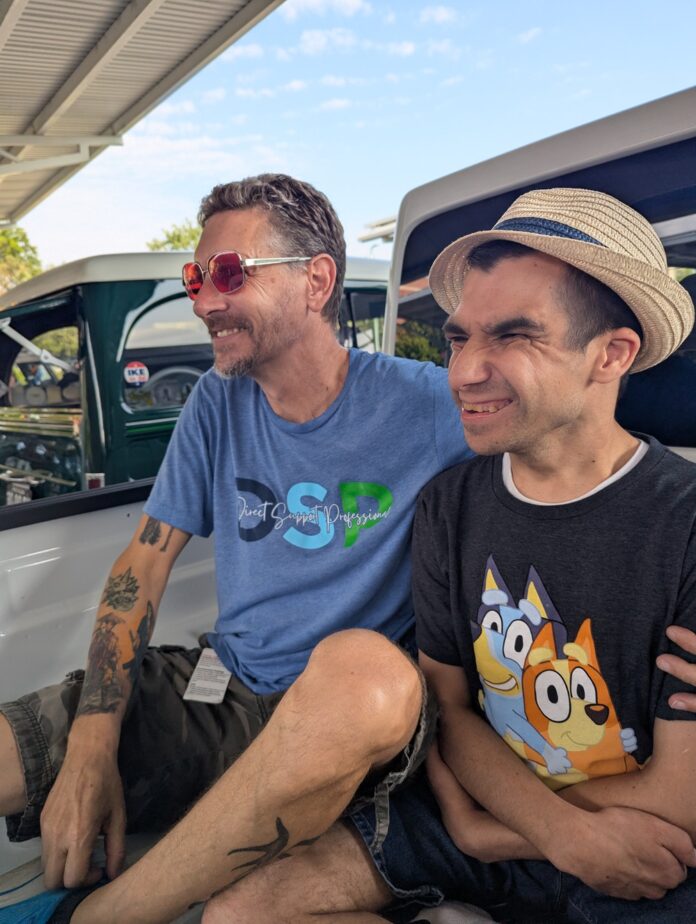
Michael Bauder (left), direct support professional for Sunshine Communities, and Ryan H., a member of the vocational day program at Sunshine. (TFP photo by Erin Holden)
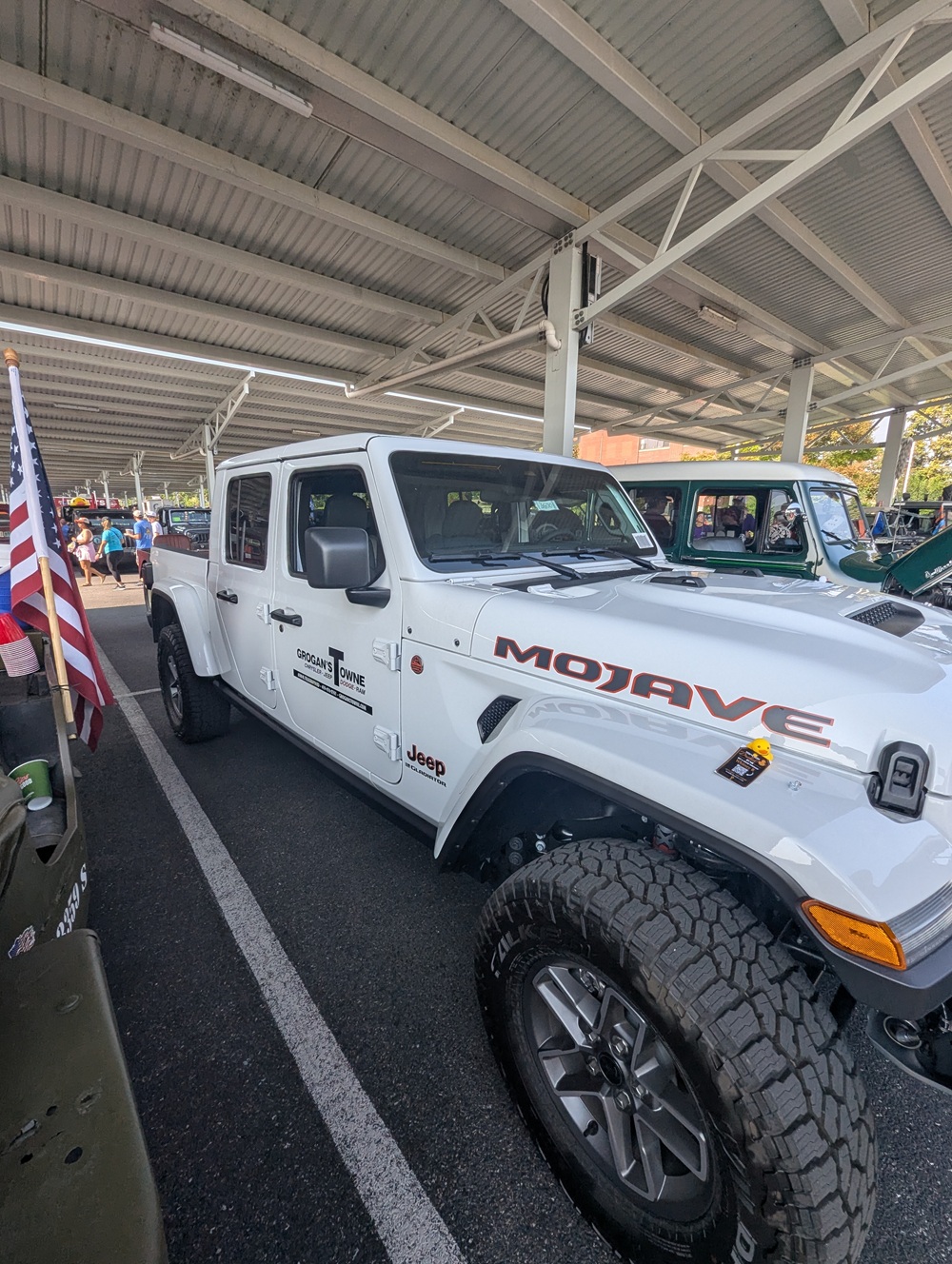
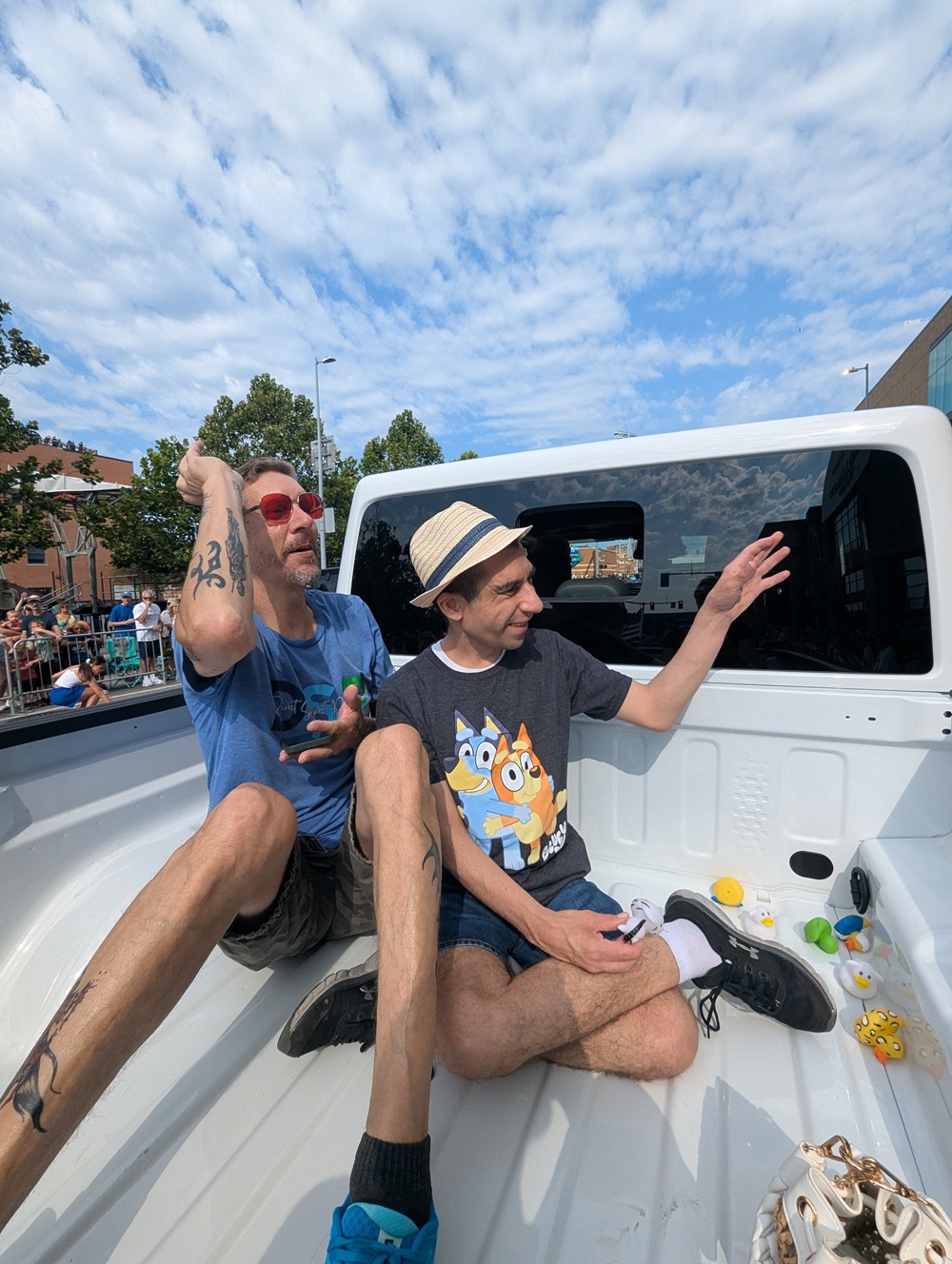
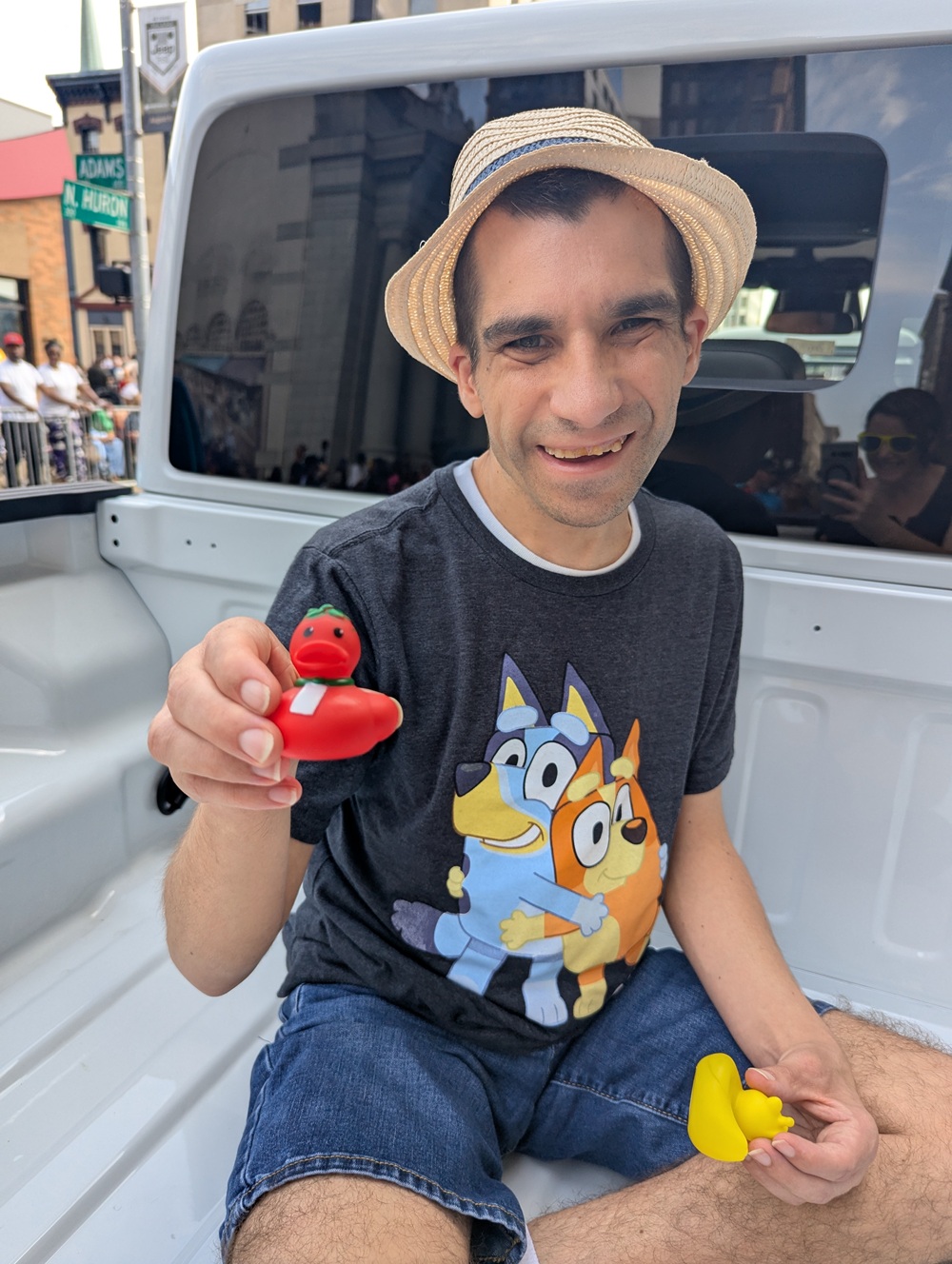
TOLEDO – When we met up with Ryan H. in the Owens Corning Parking Lot where hundreds of Jeeps were waiting to line up for the 2026 Jeep Fest parade, he was wearing a Bluey t-shirt and fedora. He was ready to throw rubber ducks to the many parade attendees with the assistance of Michael Bauder, a senior direct support professional who works with Ryan and many other individuals with developmental disabilities benefitting from Sunshine Communities.
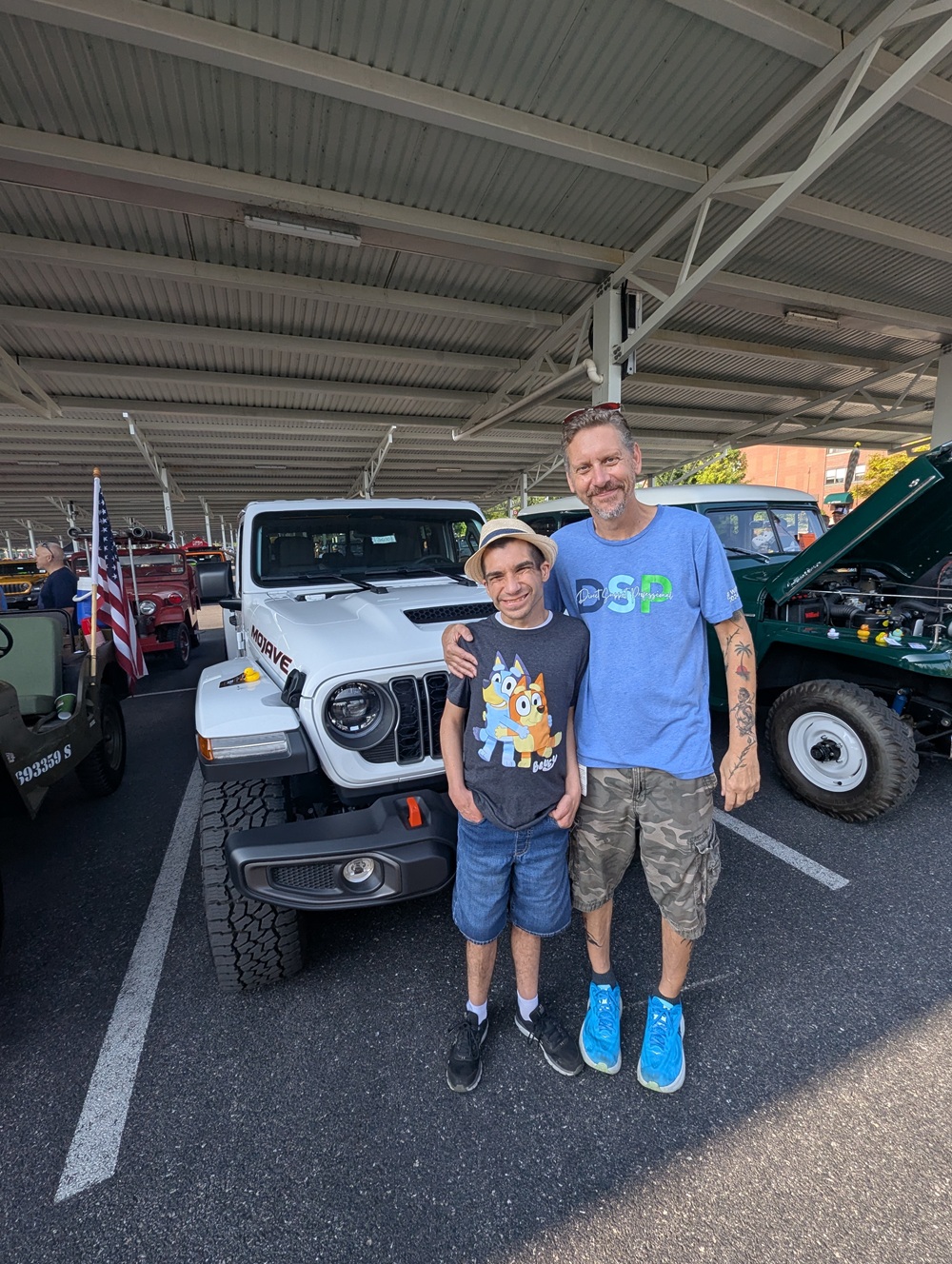
A Maumee native, Ryan graduated from Maumee High School and Penta Career Center. He currently attends Sunshine Communities’ Vocational Day Program where he works on the housekeeping crew. Though he was quiet at first, he quickly opened and was all smiles, chatting with Bauder after we all climbed into the back of the white Mojave Jeep provided by Grogan’s.
“We really like to get the individuals [at Sunshine] out doing stuff, especially like this,” said Bauder. “You can’t be in the community any more than this, right?”
Ryan H. (left) and Michael Bauder pose in front of the Jeep they would soon ride in for the Jeep Fest Parade on Saturday, Aug. 8. (TFP photo by Erin Holden)
Bauder and Ryan chatted about all the things they like to do as part of Sunshine’s outings, like going to the movies, Dunkin’ Donuts, and pretty much anywhere that Ryan can get his favorite beverage: a “dirty soda,” which is a soda with ice cream and Cool Whip.
Groups from the organization often have outings in downtown Toledo, and Bauder says many of the folks from Sunshine love to check out any of the big events going on. They also do volunteer work.
“We deliver mobile meals on Fridays,” Bauder said, and Ryan interjected that those are the days they get to enjoy Dunkin’ Donuts, where he gets his dirty Dr. Pepper.
“You let me get a large one,” he said to Bauder. “[Only] on Friday. We go out and eat on Friday.” The night before he had enjoyed a meal at Rooster’s.
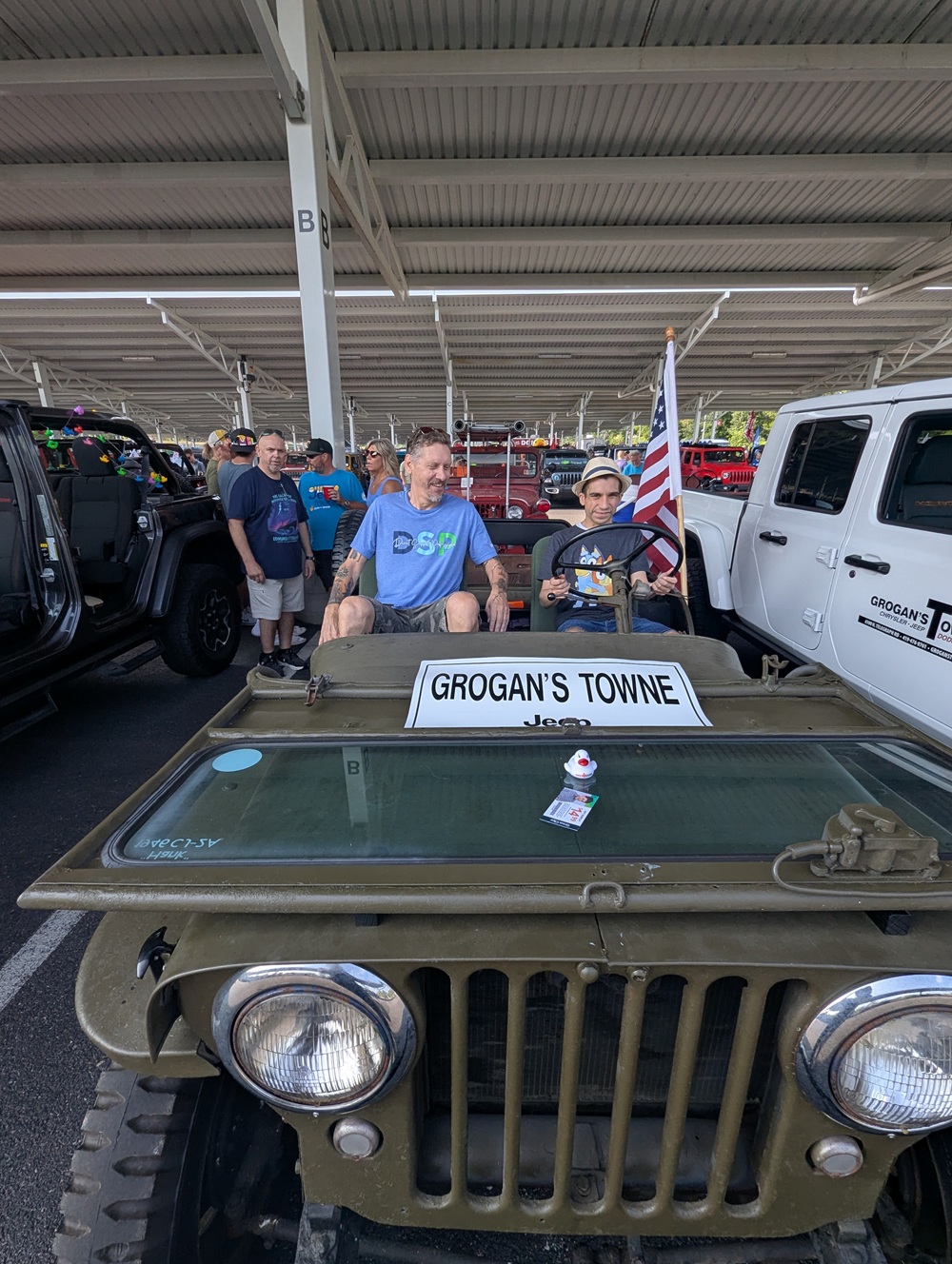
Bauder and Ryan pose for a photo in another Grogan’s Jeep that would soon be put in line for the parade. (TFP photo by Erin Holden)
Ryan also noted another aspect of his routine, which is that he gets “one-on-ones” on Tuesdays.
“…which means someone comes to pick them up and take them out for three hours,” said Bauder.
“I get Lee on Tuesdays,” explained Ryan. “That’s my new one-on-one staff.”
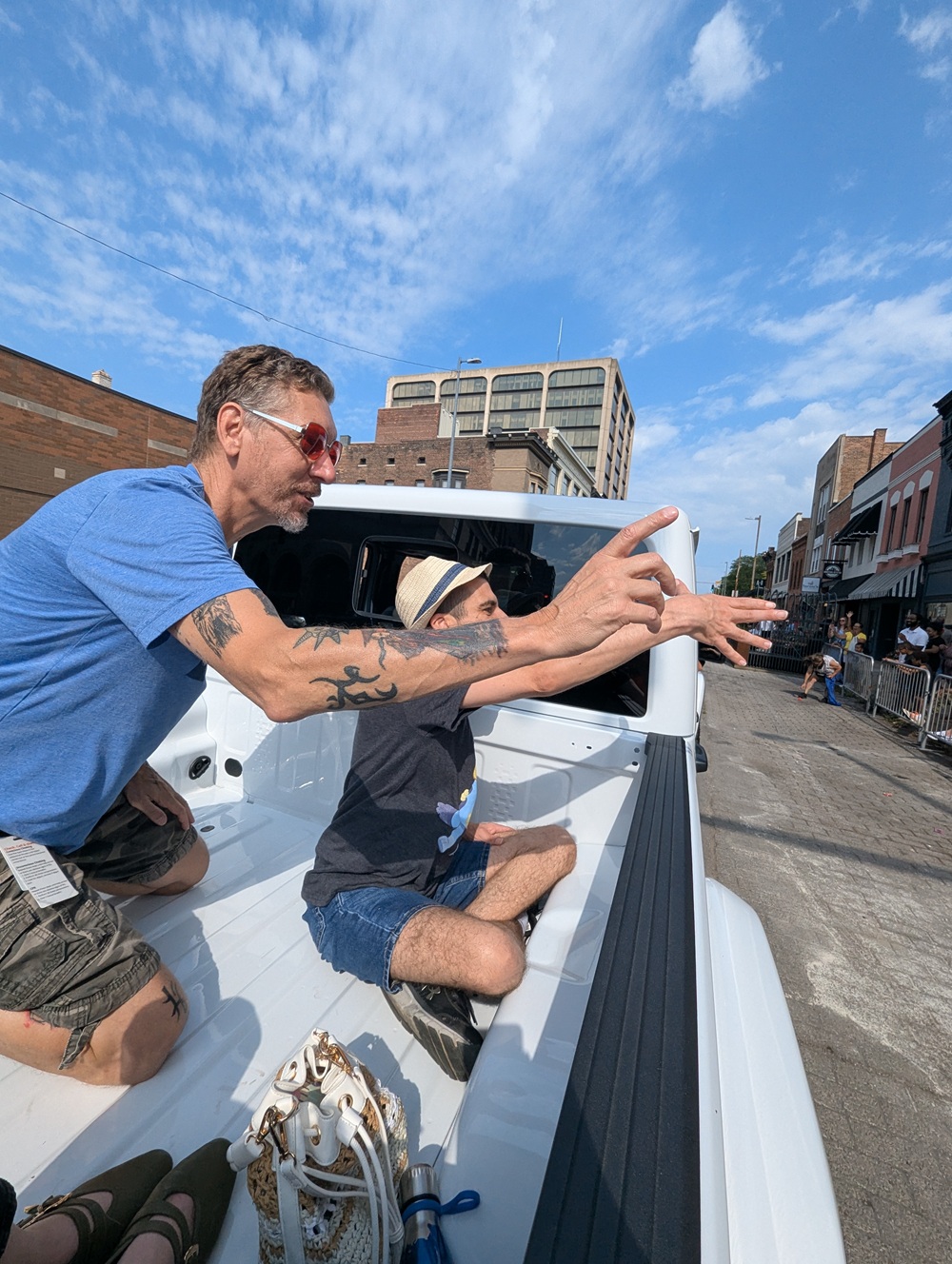
As we talked about the enrichment and structure that Ryan gets from these weekly outings and routines, our Jeep made it into the throws of the parade festivities, and Ryan seemed to thoroughly enjoy himself.
When it concluded, Ryan said that his favorite thing about the parade was “throwing the ducks” and that he particularly liked “the birthday one.” As we said our goodbyes, and we asked if he would like to be a part of Jeep Fest again, Ryan nodded yes.
To learn more about Sunshine Communities and their programs, visit their website at sunshine.org.
TOLEDO – This year, Ohio has not one, but two toss-up races, according to the Cook Political Report. They are the state’s gubernatorial race between Democrat Amy Acton and Republican Vivek Ramaswamy, and the U.S. Senate race between incumbent Republican Jon Husted and Democrat Sherrod Brown.
The “anyone’s game” nature of these contests is an unignorable incentive for campaigns and super PACs (political action committees) to spend … and spend big. It’s money that materializes in the form of ads across broadcast television, radio, cable, and social media platforms. And already, Ohioans are seeing the impact of those dollars in a number of places.
In the race for governor, candidate Ramaswamy has an early lead on the airwaves. While super PACs and campaigns are prohibited from coordinating with one another, that doesn’t mean they can’t act strategically on their own. In the case of Ramaswamy’s campaign and V-PAC: Victors, Not Victims, a super PAC supporting him, each has managed to hone in on a clearly-defined message.
One of the Ramaswamy campaign’s initial statewide, multiplatform ad buys — an investment of $10 million, according to a March press release — is built around two, thirty-second spots: one featuring his wife and another with a sheriff’s endorsement. The ads, intended to paint Ramaswamy as both personable and electable, create quite a contrast with those being run by the flush super PAC supporting him.
Those spots, while varying in length, have a throughline in their negative depictions of his opponent. One of the V-PAC ads brands Acton “the liberal who shut down Ohio” and accuses her of running on a “radical left” platform. The ad’s COVID claim is undercut by none other than the state’s sitting governor, Republican Mike DeWine. Back in December, DeWine told Columbus TV station WCMH that “the decisions that were made during COVID, they were my decisions, so no one should blame someone else if they don’t like it.” As for the accusation of Acton “running on a radical left platform,” she promised voters, in a June 4 announcement, “to appoint a Republican to her cabinet.”
That same ad, citing a speech Acton delivered on June 25 of 2025, claims she supports “woke ‘DEI’ racial preferences at Ohio colleges and universities.” She’s taken no such position, though the attack isn’t unfamiliar. It’s reminiscent of Republican messaging in 2022, which often centered culture war issues — and in some cases —was effective. It’s unclear whether these kinds of attacks will have the same rallying effect, four years later, on an electorate that’s more concerned about the economy and personal finances, polling shows, than it is with cultural debates.
Acton, meantime, is currently absent from the airwaves. She can instead be found on the web. The campaign’spost-primary filing, from June, shows it spent hundreds of thousands on digital advertising in May of this year. Its annual filing for 2025, from January, lists thousands of dollars of digital advertising expenditure last year, particularly in October, November, and December.
However, Acton’s ad presence won’t be confined to online spaces for the entirety of this race. It’s expected that the campaign will begin traditional advertising at some point. In a June 30 interview with the Toledo Free Press, Acton’s running mate, David Pepper, said “we’ll have ads, and our ads will tell our story. Our ads will also point out what a flawed candidate Vivek Ramaswamy is.” He claimed that “we will have more than any Democratic candidate has ever had” and insisted that “we’re not panicking like he [Ramaswamy] is.” Pepper cited effectively unmoved polling numbers, even since the attack ads began, as reason not to rush a competing message to air.
The campaign did, back on July 28, debuted its first ad of the cycle, though it’s unclear how much is being spent or where it’s being promoted. The spot, which goes by the title “Tent,” is in reference to Acton’s Youngstown upbringing and seeks to introduce her as focused on lowering costs for Ohio families.
Money, of course, plays a big role in a candidate’s ability to ensure their message reaches voters. Post-primary financial reports show the Acton and Ramaswamy campaigns raised $5.3 million and $4.5 million, respectively, between April 16 and June 5 of this year. While Acton took the lead in that particular period, Ramaswamy possesses a stronger war chest overall, with a cash advantage of $26.7 million to Acton’s $8.1 million. He also has an advantage in his personal wealth, being a billionaire, to self-fund at an exceptional degree. His campaign’s pre-primary filing shows he’s already done that this year, pouring in $25 million of his own money.
Democrats, while outraised in the gubernatorial race, are seeing better fortunes in the U.S. Senate race. Filings with the Federal Elections Commission show Brown’s campaign with $16.2 million on hand. Husted’s campaign account, by comparison, has a cash balance of $9.4 million. But Husted’s fundraising underperformance is effectively offset by a $79 million ad investment, in support of his campaign, by the Republican-aligned Senate Leadership Fund. The Senate Majority PAC, a Democratic group, announced $40 million in ad support for Brown.
And in Ohio’s 9th Congressional District, incumbent Rep. Marcy Kaptur (D-Toledo) is seeking reelection under district lines that were redrawn in 2025. She again faces Republican Derek Merrin, who she narrowly defeated in 2024, by 2,382 votes. This time around, the district is redder than it was before (with Trump at +11), even as the national environment has become bluer. And while it’s unclear exactly how much Kaptur’s campaign has spent on its initial ad buy, which includes an affordability-focused spot, the Democratic House Majority PAC plans to support her with $3 million in ad reservations for the Toledo market.
While the age-old wisdom of elections heating up after Labor Day is likely to hold up, it’s worth paying attention to how campaigns allocate their resources, as that can be a statement of the worry — or lack thereof — they have about November. And remember: it’s early. Things will almost certainly intensify closer to the fall, as more outside groups begin kicking in their own share of ad money.
RELATED: An interview with Jessica Taylor, U.S. Senate and governors editor for the Cook Political Report, on the state of Ohio’s gubernatorial race.
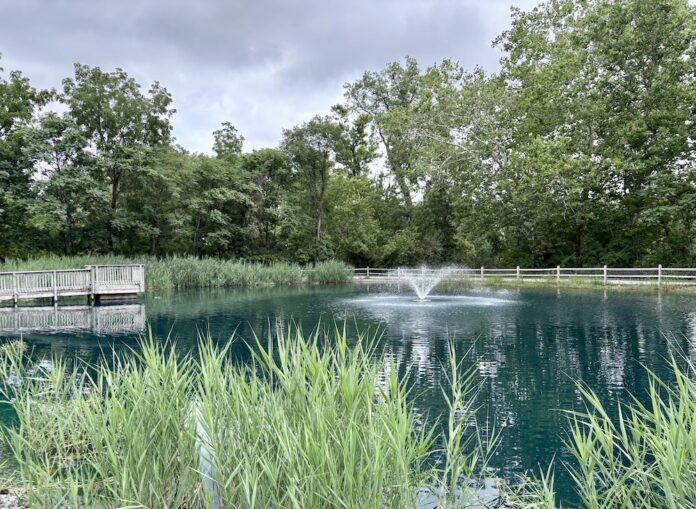
Blair Pond at Waterworks Park in Waterville is the site of the 20th and final Waterville Fishing Derby on Saturday, Aug. 29 from 8 a.m. to 1 p.m. (AWFP photo by Karen Gerhardinger)
WATERVILLE – In 2005, the village of Waterville hosted its first fishing derby – a free, family-friendly event that guaranteed each child would receive a prize.
On Saturday, Aug. 29, the city of Waterville – along with Anthony Wayne Area Rotary Club –will host its 20th and final fishing derby at Waterworks Park, said organizer Jodi Shaneyfelt.
Open to children ages 6 to 14, this year’s derby promises to be the best yet, as remaining funds will be used as cash prizes in a raffle, in addition to the gift certificates, fishing rods, tackle and other goodies donated by area businesses.
This year’s event will include a drone demonstration by the Waterville police and fire departments, a rope making activity led by members of Scout Troop 101 members, plus plenty of food and fishing.
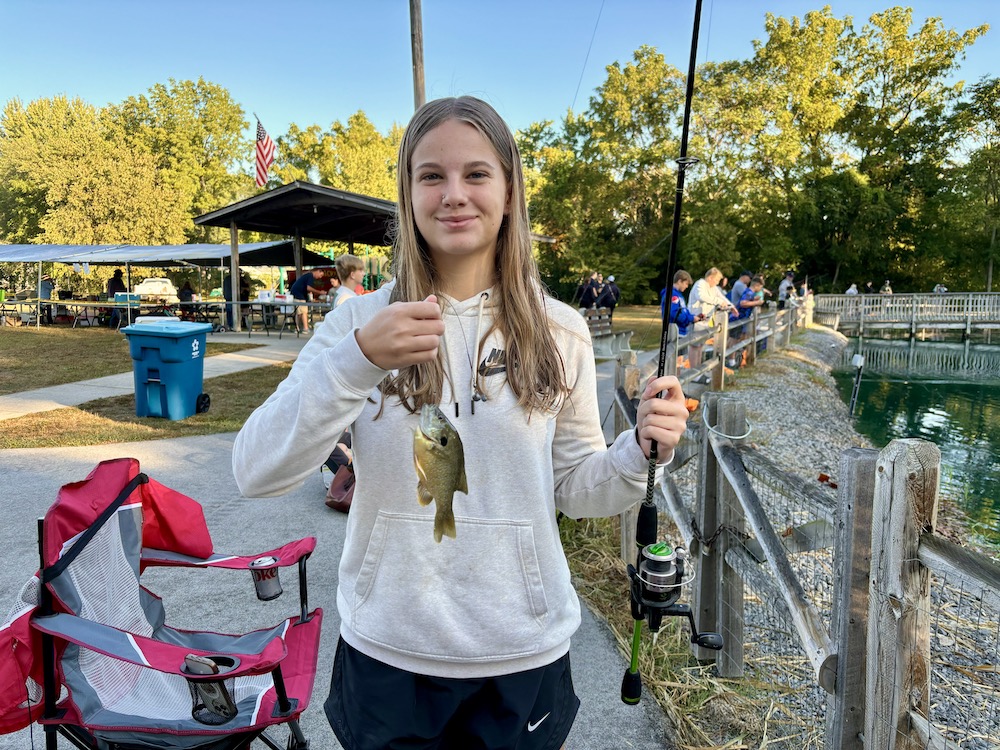
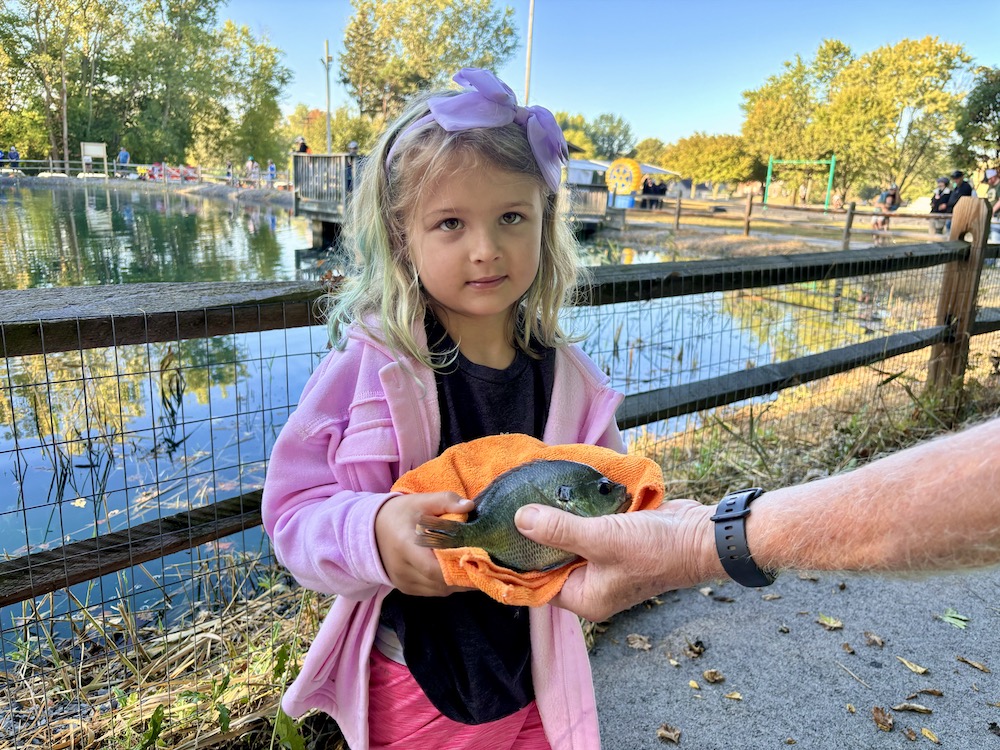
Taylor Canon held up one of the fish she caught in the 2024 derby. (AWFP photo by Karen Gerhardinger)
“Please come and enjoy. It doesn’t cost anything. And even if you don’t catch anything, you will get a prize,” she said.
The idea for a derby came up in 2004, when now-retired Public Works Director Kenny Blair heard about Perrysburg’s derby. He and his wife, Tammy, along with Shaneyfelt, went to check it out.
“We really liked it, so we came back and began planning,” she said.
That first year, prizes were given to the top three – based on the number of fish caught and biggest fish caught – in each age category.
“And it poured like a monsoon,” Shaneyfelt recalled. “So we decided that we would give prizes to anyone who stayed until the end, even if they didn’t catch a fish.”
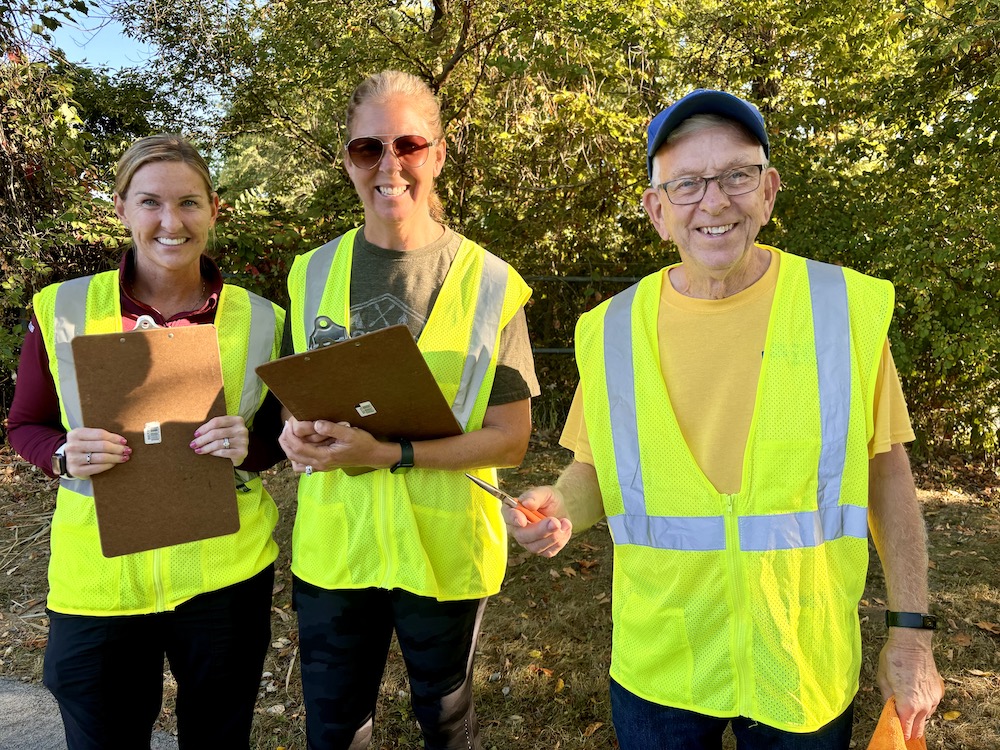
Anthony Wayne Area Rotary Club members Crystal Tollstam, Jennifer Harder and Randy Box were among the volunteers during a previous fishing derby. (AWFP photo by Karen Gerhardinger)
From Day 1, Waterville Bodyworks, Waterville Gas Company, Waterville Family Physicians, Waterville Hardware, Franklin Ice Cream, Maumee Bait and Tackle, and Pisanello’s Pizza have been supporters. The second year, the derby got a boost from dozens of businesses who provided more donations. When Shawn’s, Biggby and other new businesses opened in Waterville, they joined in supporting the event as well.
Anthony Wayne Area Rotary joined in helping out with the event a few years in, with members wearing bright yellow vests and carrying clipboards fanning out around Waterworks Park to measure and record each angler’s catch before the fish is thrown back in.
The fenced-in pond is safe for children but easily accessible for fishing. The Public Works Department, in addition to setting up and working the event, keeps the pond clean and stocked for year-round catch and release fishing. The pond, which was named Blair Pond last year after Kenny’s retirement, is stocked with blue gill, largemouth bass, sunfish, crappie and catfish. A few lucky anglers have nabbed a rare white catfish or a turtle, and those catches earn them a special prize, Shaneyfelt said.
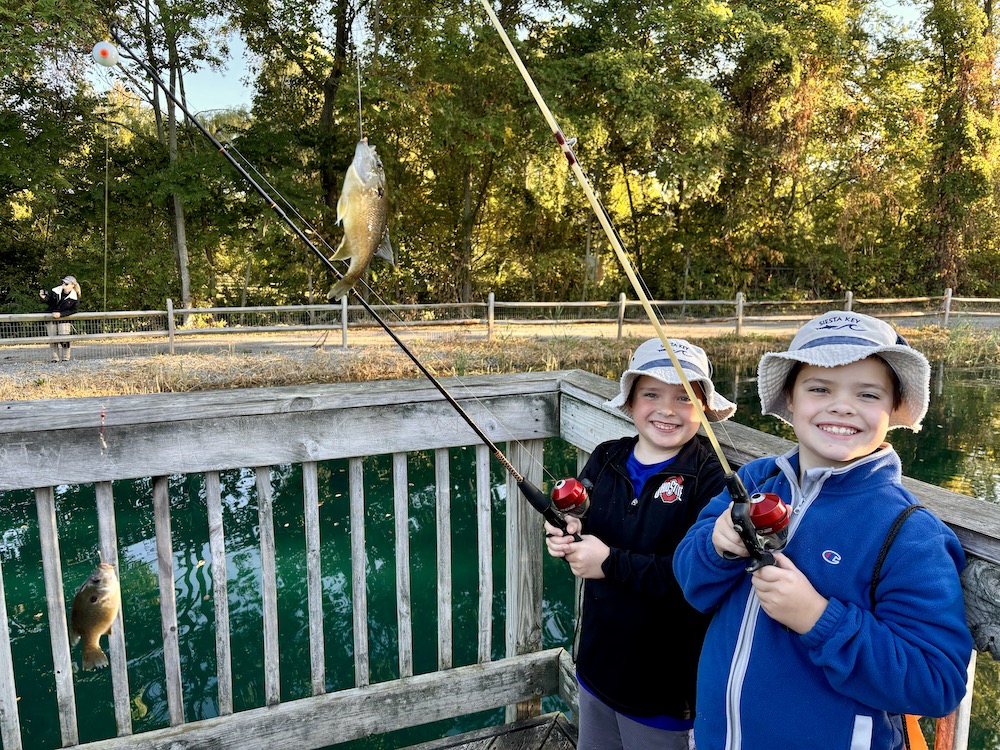
Brothers Mason and Aiden Cortez fished off the deck during a previous derby. (AWFP photo by Karen Gerhardinger)
Over the years, the event has drawn children from as far as Toledo, Wauseon and other communities, but many Waterville residents, including the Bayly, Bowen, Drees, Entenman, McManus and Meyers families, have made the derby a tradition. Last year, Wyatt Drees won the grand prize of a kayak. This year’s grand prize is a kayak donated by Muddy Waters Outdoor.
Signing up early is important. One year, 75 kids showed up, resulting in snagged lines, so registration was capped at 60. Attendance has fluctuated over the years, and Shaneyfelt believes the increase in Saturday sports practices and tournaments is one reason why. That’s one reason for ending the derby after 20 years. The event takes a lot of planning by Shaneyfelt and a team of volunteers throughout the year, but she believes it’s been worth it.
“The best part is seeing these kids smile when they catch a fish or win a prize,” she said.
In addition to fishing, families can enjoy a playground and access to the Maumee River. The event takes place at Waterworks Park, 231 S. River Rd. Families should bring their own fishing rod and tackle, but bait will be provided. To register, visit waterville.org.
Mackenzie Van Horn had some help holding a slimy fish. (AWFP photo by Karen Gerhardinger)
Huron Yards in downtown Toledo on Wednesday, Aug. 5. (TFP photo by Stephen Zenner)
TOLEDO – Sunshine welcomed the ribbon cutting for Huron Yards, 27 N. Huron St., on Wednesday morning.
A small group gathered at what used to be a parking lot and loading dock, across from the Mud Hens’ Fifth Third Field, as business and political leaders held a short ceremonial session to mark the completion of the finished gathering area.
“Where we’re standing used to be lined up with diesel trucks, fencing…we were blocked off from access from the alleyway,” said Matt Rubin, a principal for Crane Development Ltd., who were the main force behind the rebuild of the area.
“To be able to transform this space into a place where people are going to come gather…we are just absolutely ecstatic,” he said, and emphasized the space as a “family-friendly” alternative to bars.
Kylie Crouse, a baby sitter, plays with Frank, 4, after the ribbon cutting for Huron Yards. (TFP photo by Stephen Zenner)
Huron Yards is the first downtown Toledo beer garden, and is outfitted with games, picnic benches, a pergola, food trucks and some kid friendly seating and activities.
“It’s a flexible community-based gathering space. It’s designed to bring residents, workers, and most importantly, families together,” said Julia Randles, another principal who worked on this project for Crane Development. “The Yard transforms what was once an underutilized corridor into a vibrant destination where people can connect, eat, drink, and enjoy the energy of downtown Toledo.”
“We invite and encourage the entire Toledo community to visit the yard and experience the yard on Fridays and Saturdays, weather permitting, from 4 p.m. to 10 p.m. on Fridays and from noon to 10 p.m. on Saturdays.”
Julia Randles, a principal for Crane Development Ltd., described Huron Yards as a “vibrant destination where people can connect, eat, drink, and enjoy the energy of downtown Toledo.” (TFP photo by Stephen Zenner)
The space has hosted a few select events, has been open since the beginning of the 2026 summer, but now with T’s crossed is ready for its grand opening, this Friday, in the middle of Jeep Fest.
People and entities named with the project included Edge Design Group, Klumm Bros., contractors employed by Crane Development, the City of Toledo, Karen Poore, the development navigator with the Lucas County Department of Economic Development and Mike Stancati, a local restaurateur who is in charge of operating Huron Yards.
Wade Kapszukiewicz, the mayor of Toledo, watches a putt he made right before the ribbon cutting. (TFP photo by Stephen Zenner)
“I guess those late night dancing sessions at mayoral conferences paid off after all,” said Wade Kapszukiewicz, the mayor of Toledo, as he spoke from the podium about securing the liquor license for the beer garden through Lydia Mihalik, the director of the Ohio Department of Development.
According to Kapszukiewicz, Mihalik was a dancing partner with him during a networking event, and he was able to call her to cut through some red tape around Huron Yards’s liquor license.
Afterwards the mayor talked about the space. “This wasn’t just a parking lot, this was a gravel pit, basically, and now it is just a wonderful place where you can miss putts for five or 10 minutes while cameras are snapping you doing it,” he said referring to the two putts he missed prior to the ceremony.
Kapszukiewicz brought attention to downtown as the fastest growing neighborhood in Toledo, and talked about how the space would enhance the neighborhood aspect of downtown.
Come September, Stancati, who also operates Hannon’s Block Restaurant, said the former venue known as The Alleyway, 28 N Erie St., would open as a sports bar called The Station, and would coordinate with Huron Yards, a few yards away.
Technically, since The Station and Huron Yards are operated by the same owner, Stancati said drinks brought between the two areas wouldn’t require Toledo’s Downtown Outdoor Refreshment Area (DORA) cups, but he said, “for cautionary purposes, we are encouraging the DORA cups throughout [The Station patio and Huron Yards].”
“We’re just excited that we have a space here that can be community driven, can support other businesses like the food trucks and just a fun space for people to hang out,” Stancati said of Huron Yards.
Olive, 6, and Frank, 4, play in Huron Yards. Matt Rubin of Crane Development Ltd. described the space as a “family-friendly” alternative to bars. (TFP photo by Stephen Zenner)
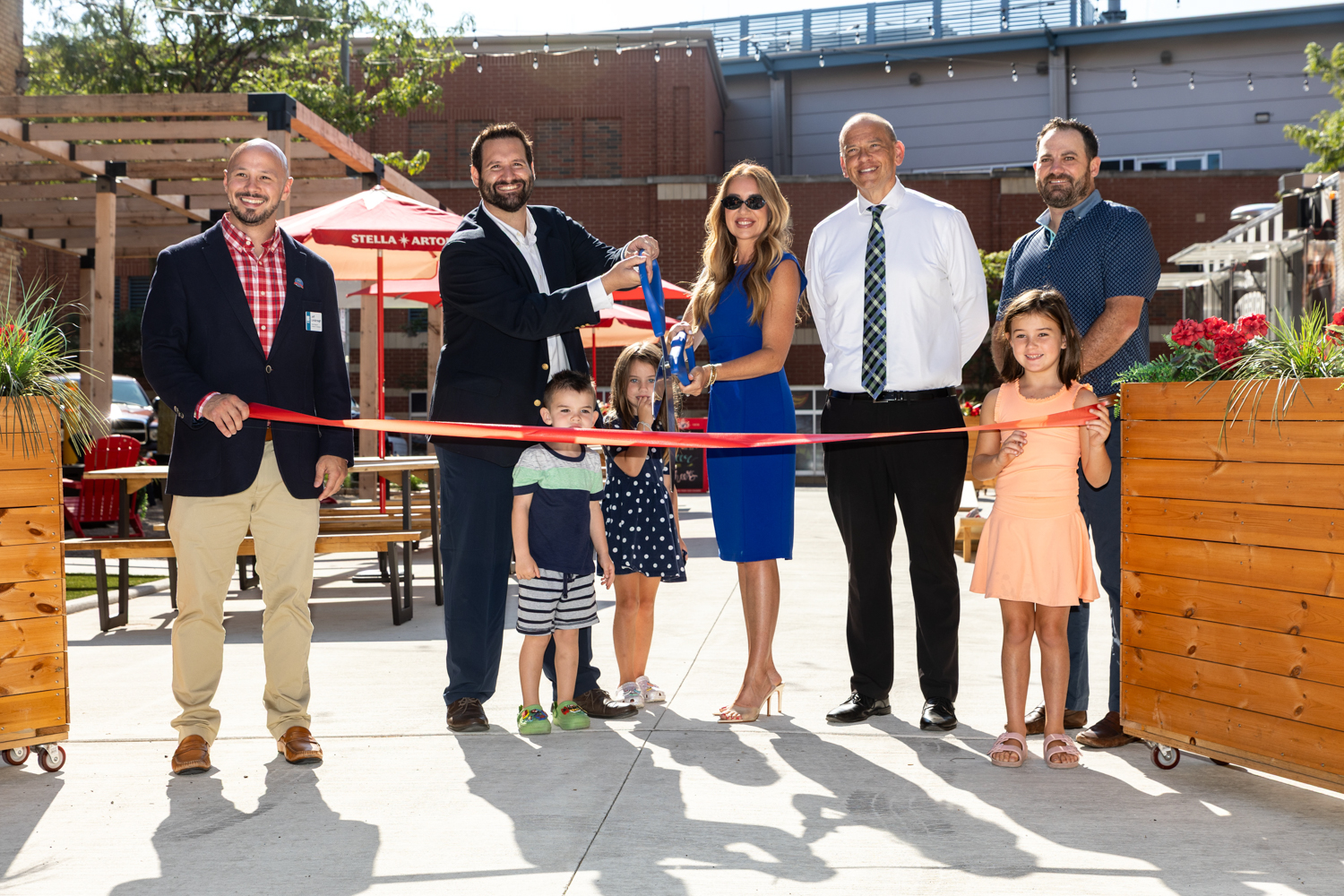
Jeff Lonsbrough, the vice president of membership for the Toledo Chamber of Commerce, was on hand with the traditional giant scissors for the ribbon cutting, and said a few words as a frequenter of downtown for a decade and a half.
“I was just saying, ‘What’s going to come first? The storefronts…or the people?’” he said. “It’d be great if they could both come at the same time, because that’s what they both need.”
(Left to right) Jeff Lonsbrough, the vice president of membership for the Toledo Chamber of Commerce; Matt Rubin, a principal for Crane Development Ltd.; Julia Randles, a principal for Crane Development Ltd.; Wade Kapszukiewicz, the mayor of Toledo; Mike Stancati, local restauranteur and operator of Huron Yards; Frank, 4; Olive, 6; and Ida, 8, pose during the ribbon cutting. (TFP photo by Stephen Zenner)
Having long given up the idea of being a runner, Erin Holden revisits the idea with local running coaches Bob Masters and Joan Mathews, both of whom share some tips on how to get started.
This is the fifth episode of A Walk in the Park with, a WGTE Public Media and Metroparks Toledo collaboration hosted and produced by Erin. Join her as she explores everyday life in Toledo’s Metroparks. In each episode, Erin interviews different park visitors – runners, teachers, artists, parents and more – revealing the many ways people connect with nature. You’ll hear personal stories about people’s relationships with our parks and the activities they cherish. Erin also documents her journey along the way, reflecting on the insights she gains from each experience.
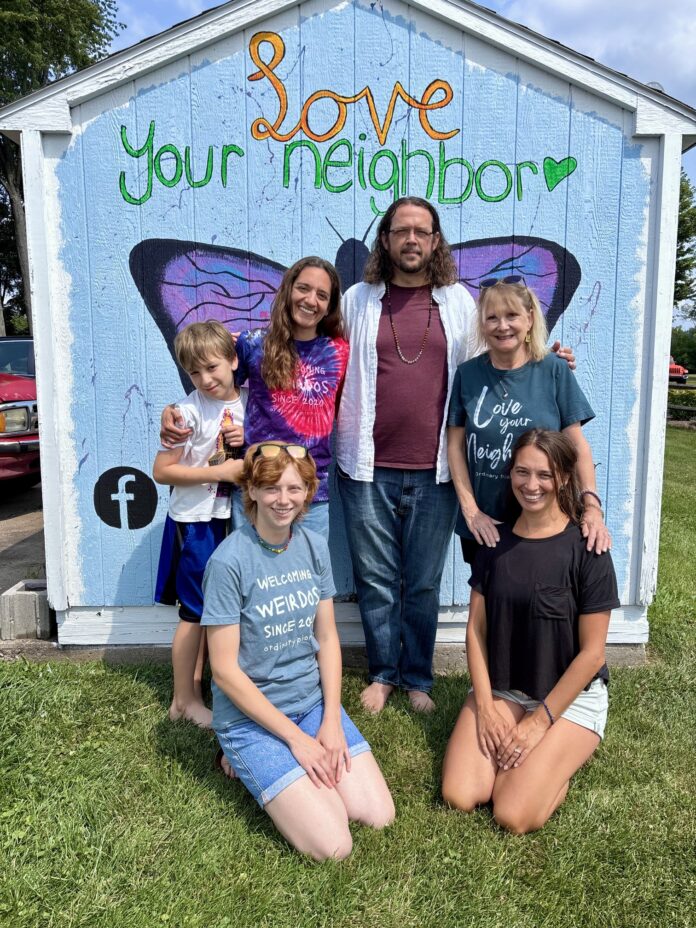
Among those hosting the event are back row (from left) Brody Schriefer, Halina Schriefer, Paul Narus and Carol Sarkan and, front row, Linzi Jenkins and Kelsey Burke. (AWFP photo by Karen Gerhardinger)
WHITEHOUSE – Every day since opening in 2020, Ordinary Pioneer Spiritual Healing Community has focused on its mission to create a harmonious world of love and unity, by providing a safe, welcoming environment where individuals can thrive physically, mentally and socially.
For some, that means taking a class on meditation, yoga, Reiki, qigong or tarot. For others, the Whitehouse-based community provides a comforting space to relax and connect with community members.
The name Ordinary Pioneer comes from the idea that it doesn’t take superhuman qualities to make an impact in a world that seems a little wild and scary at times.
“It’s ordinary acts of kindness that are creating a great impact in the world,” said Halina Schriefer, co-founder of the nonprofit.
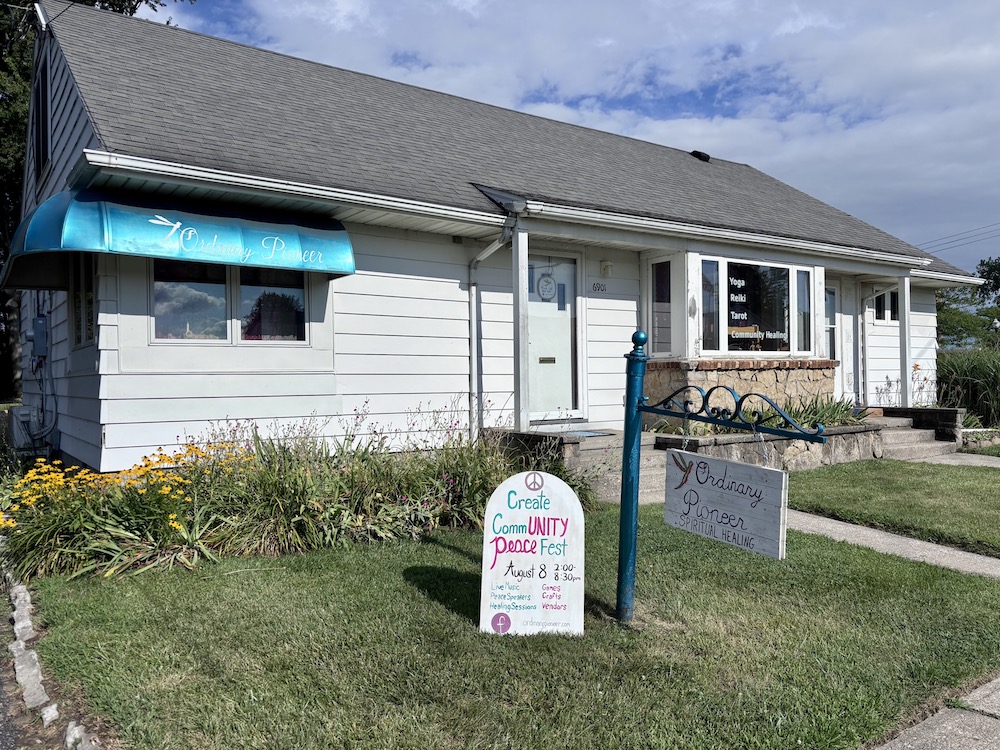
Ordinary Pioneer is hosting a Create Community Peace Festival on Saturday, August 8 from 2:00 to 8:30 p.m. at 6901 Providence St. in Whitehouse. (AWFP photo by Karen Gerhardinger)
In 2022, Schriefer hosted the first Create Community Festival – a one-day event that merges creativity, spirituality and community through art, music, food and family-friendly activities.
This year has an additional focus: peace.
“The world has changed a little since 2022. Peace seems to be what people are seeking – and hope. So we added the word ‘peace.’ Our mission at Ordinary Pioneer is to bring people together with one intention of creating peace through unity,” she said.
The Create Community Peace Fest will be held Saturday, Aug. 8 from 2 to 8:30 p.m. at 6901 Providence St. in Whitehouse. New this year is more live music, an ongoing meditation space with crystal sound bowls, and an outdoor cooling tent with misters and water play for all ages. From 1:30 to 5 p.m., massage, Reiki and tarot sessions will be offered by Ordinary Pioneer healing facilitators.
From 2 to 5 p.m., vendors will be set up and craft activities offered, along with peace demonstrations, including:
Joe Sparks, poetry at 2:15 p.m.
Dr. Guldal, “Walk Sacred” at 2:45 p.m.
Kerry Patrick Clark, musician, at 3:30 p.m.
Jon Schoonmaker, musician, at 4:15 p.m.
Halina Schriefer, “Breathe Love” at 5 p.m.
From 5:30 to 6:30 p.m., enjoy a community meal and live music from Humble Cannon.
At 6:30 p.m., Sound Voyage will lead a drum circle – inviting guests to use buckets and sticks or drums to join in.
A closing ceremony will be held at 8:15 p.m.
Musician Kerry Patrick Clark will perform at 3:30 p.m. during the August 8 festival. (Courtesy photo)Dr. Guldal, a spiritual leader and medicine woman, will present “Walk Sacred” at 2:45 p.m. during the Create Community Peace Festival on Saturday, Aug. 8 in Whitehouse. (Courtesy photo)
The festival is free and open to everyone. Since Ordinary Pioneer is involved with the Center for Conscious Living, the Multifaith Council of Northwest Ohio and Unity of Toledo, Schriefer anticipates many members of those communities will attend.
“It’s not just one group putting on this day, but multiple communities coming together. Which is kind of the whole point. I think we will see it taking on a tone of a music festival with spiritual and wellness communities,” Schriefer said. But, she added, it attracts many local people as well, including the group of teenagers that happened to be walking to the park last year when they saw the festival and decided to stay.
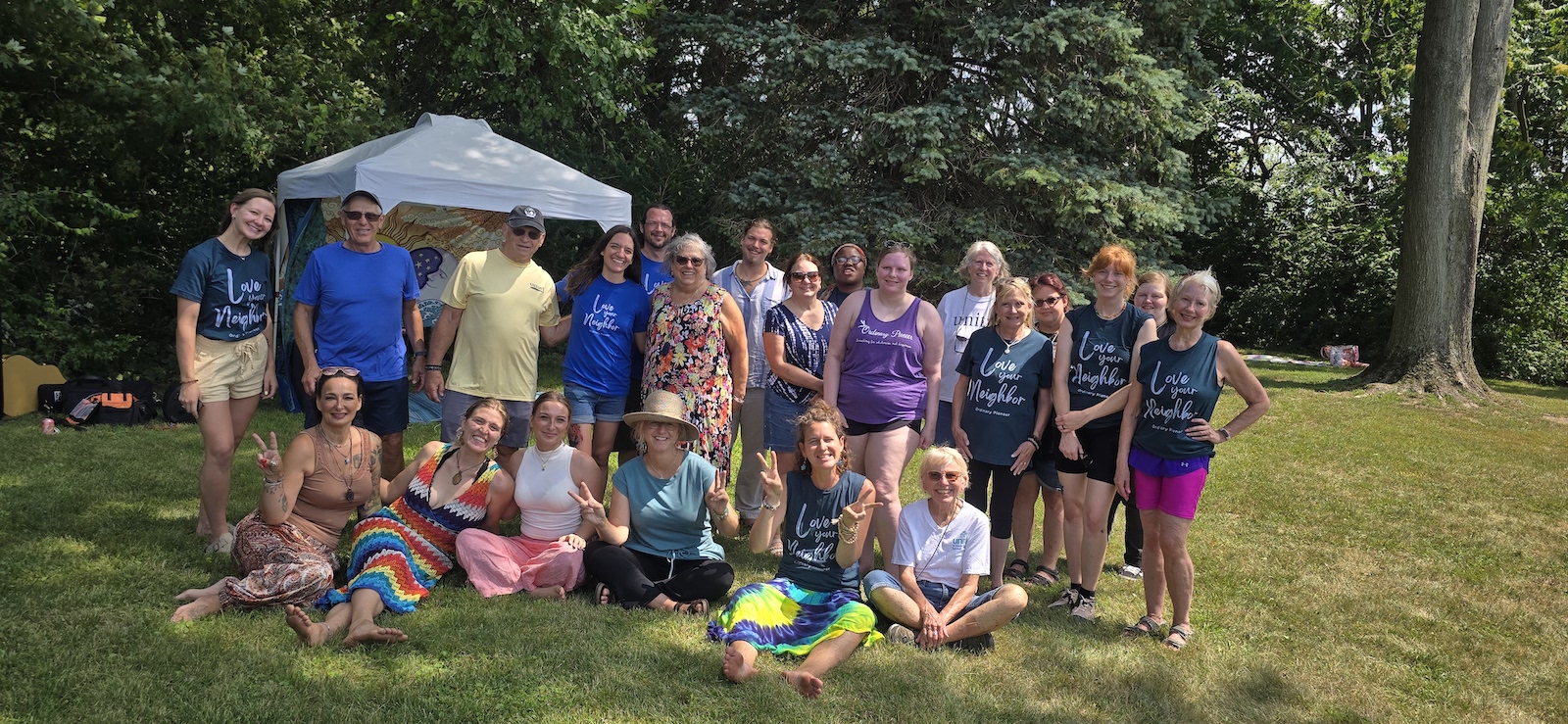
Volunteers and healing facilitators who collaborated on the 2025 festival gathered on the lawn. (Courtesy photo)
Over the years, Ordinary Pioneer Co-Founder Paul Narus has seen the gathering take on a more “festivaly” feel, with people just hanging out, listening to live music, talking to vendors and enjoying an atmosphere that is open and accepting of everyone.
Wearing a “Welcoming Weirdos” t-shirt, Schriefer smiles as she speaks about the people who have become part of the Ordinary Pioneer community.
“We had a man come in and tell us that he had a lot of social anxiety, and he was terrified to be around people. He said no one accepted him – that he was the black sheep in the family,” she recalled. “I said, ‘You’re in the right place; we welcome weirdos here.’ People are not always accepted in their families or communities. We welcome them all with open arms. People are here because they can relax here.”
Both have seen a transformation in many of the community members, who pop in for a class, a chat or just to be.
“People come in here with multiple intentions and problems. We provide space to solve them. We don’t really give them direction, just opportunity,” Narus said.
“We direct them back to their most authentic selves,” Schriefer added. “We have a lot of people that demonstrate individuality. For me, that’s inspiring. For individuals who are quirky and express themselves out of the norm, it takes the edge off and lets others know that it’s okay to be themselves.”
The Ordinary Pioneer space allows people to relax and share the burdens they’ve been holding onto, she said.
“Everybody is going through something. No one is more advanced or has it more figured out than another person. We come together and share,” she said.
The Ordinary Pioneer community members work together, sharing their gifts for the benefit of all. It could be tending the garden, cleaning, bringing food, mowing the lawn or donating monetarily, Narus said.
“We rely on each other for the health of the community,” he said.
Most of the classes and services operate on the gift economy, which means donating what feels right, rather than having a set price, Schriefer said.
“Where one person isn’t able to give or can just give a few dollars, someone else is able to give more,” she said.
A raffle during the Create Community Peace Fest will raise funds for a Gifts of Healing Program, which supports those with little or no income who are in need of healing services. Narus and Schriefer are also up to an ice bucket challenge: the jar with the most money in it by the end of the event will determine which one gets to endure having ice poured on their head.
For more information about the event or services, visit ordinarypioneer.com.
The northwest corner of the S.R. 64 and Finzel Road roundabout is being considered for sale by the village of Whitehouse to the Toledo Lucas County Public Library for a Whitehouse Branch. (AWFP photo by Karen Gerhardinger)
WHITEHOUSE – The Village of Whitehouse’s plans to sell the six-acre property on the northwest corner of the Finzel Road roundabout to the Toledo Lucas County Public Library for a new Whitehouse Branch took many residents by surprise, including Rebecca Rude.
“It was like a punch in the gut,” Rude told village council during its Aug. 5 meeting.
Rude, like many residents, thought the new Whitehouse Branch would be located in Blue Creek Metropark. But changes in funding at the state level impacted that decision, explained Library Public Information Officer Stephanie Elton, who also attended the meeting. So the Library and village began looking for a new location, with at least five acres, on which to build.
Rebecca Rude, at the podium, addresses Whitehouse Village Council members during the August 4 meeting. Also in attendance was Charlie Grass, left, from Artisan CraftBuilt Homes. Council members include Dave Riggenbach, Carrie Tuohy, Mayor Rich Bingham, Steve Fine, Joe Bublick and Larry Yunker. (AWFP photo by Karen Gerhardinger)
As council held a first reading on an ordinance that would allow administration to sell the property to the Library for $620,000, Mayor Rich Bingham asked for citizen comments. Both Rude and Jeff Heaney shared concerns about the location.
Rude, who moved to the area in 1978, complimented the village on the improvements she’s seen over the years: the revitalized downtown, beautiful flowers, limestone planters and the well-landscaped roundabout.
“Every time I drive through, I’m so proud of what Whitehouse has become,” she said.
But with the village being a gateway to the Oak Openings Region, she believes the pollinator area at the roundabout should remain in place, to reflect the natural areas in the Metropark.
Pointing out the window to Blue Creek Metropark behind village hall, Rude said it’s the perfect spot for a library, with the trails and proximity to the quarry.
She recalled being in council chambers in March 2025 for a listening session with the Metroparks and Library representatives, sharing ideas for what was to become a combination library and conservation center.
“We voted for that library to go there. It’s like a bait-and-switch. All these people voted for it,” she said.
Heaney echoed her sentiment, and asked what changed.
In 2024, voters approved a 1-mill bond to fund capital projects throughout the library system, including a new Whitehouse Branch. But in 2025, the Ohio state legislature cut the Public Library Fund, resulting in a $2 million cut in funds used for operational expenses. So TLCPL made several decisions, including closing a branch and reducing hours at several locations, including Waterville, Elton explained.
“These operational challenges have also affected the timing and direction of the Library’s capital plans. Originally slated to be built within Blue Creek Metropark, the Library made the difficult decision to pursue a different location for the Whitehouse Branch due to budget and timeline constraints. While the location has changed, the Library’s commitment to bringing a new branch to Whitehouse has not,” she said. “Our goal is to create a branch that reflects the community it serves and provides greater access to services for residents of Whitehouse and the surrounding areas.”
Listening sessions will be scheduled again to give the community an opportunity to provide input on the design and services for the branch, which will alleviate pressure on the Waterville Branch – which served 88,000 customers and circulated 287,000 items in 2025. The area has grown tremendously since the TLCPL first considered a branch in the village. In the time since, the independent Whitehouse Library was installed at Blue Creek Metropark and run by volunteers for over 20 years, demonstrating a need. Once the new branch is open, the Whitehouse Library will close.
“A new Whitehouse branch will help address that demand while expanding access to library services for a growing community,” Elton said. “Locating the branch within the village also means residents will have the opportunity to access their library by walking, biking and other forms of transportation, not just by car.”
The village has owned the 6-acre, commercially zoned property since purchasing the land for the roundabout, built in 2015, and has been actively looking for the right fit. Bingham noted that other possible users have approached the village about purchasing the property, including a hotel and gas station. While the Library plans to hold community listening sessions to inform the design and offerings at the branch, developers of a gas station or hotel would not do that, Bingham told Rude after the meeting.
Rude also wondered what would happen with the Whitehouse Library, which sits on land owned by the Metroparks, once the new branch opens. The Metroparks is open to working on improvements to Blue Creek, including more pollinator areas, Bingham said.
Daugherty said he spoke with Library Executive Director Jason Kucsma earlier in the day about the opportunity to incorporate botanical features into the landscape of the new branch. And the Metroparks are advising the village as it works on its S.R. 64 corridor plans, which include bringing more botanical life and pollinator areas.
Council held a first reading on the ordinance authorizing Daugherty to sell the the property to the library. A second reading will be held on Sept. 1, and a third and final reading on Sept. 15.
Council member Joe Bublick expressed gratitude for the citizens who came to the meeting to share their concerns in person. After reading dozens of comments on the article posted on the Anthony Wayne Free Press Facebook page on Aug. 3, Bublick said he understands the frustration.
“Everyone on village council hears you and are committed to maintaining a balance between community growth without sacrificing what makes us special. Have faith,” he said. “I believe that economic development is something that can happen hand-in-hand with retaining the things that make Whitehouse unique, like our beautiful botanical areas.”
During the meeting, council also:
–Held a first reading on an ordinance to purchase 10125 Waterville St. for $200,000.
-Held a first reading on two ordinances relating to Country Meadows South, a housing development that had a site plan approved by the Planning Commission. One ordinance would void the site plan, while another would substitute it with another plan. Developer Charlie Grass of Artisan CraftBuilt Homes was in the audience but did not comment.
-Held first readings on ordinances related to pay classifications and benefit steps, vacation accruals and comp time.
-Heard that Ice Cream with Mayor and Council will be held at Whitehouse Park on Saturday, Aug. 15 from 1 to 2:30 p.m., with ice cream and an opportunity for conversation with village leaders.
-Learned that Village Council will not have a meeting on Tuesday, Aug. 18. A Committee of the Whole meeting is scheduled for Tuesday, Aug. 11.
-Heard Bingham say that a resident contacted him about possibly putting a fence up in front of the recycling center to prevent trash from blowing in neighbors’ yards.
-Approved the purchase of a 2026 Ford F550 4×4 Braun Select ambulance.
-Heard that new police officer Jon LeGrand took the oath of office.
With construction of the roundabout delayed due to utility line delays in the roundabout just to the west at Albon and Monclova roads, work on the roundabout in front of Monclova Primary School is estimated to last until September 17. (AWFP photo by Karen Gerhardinger)
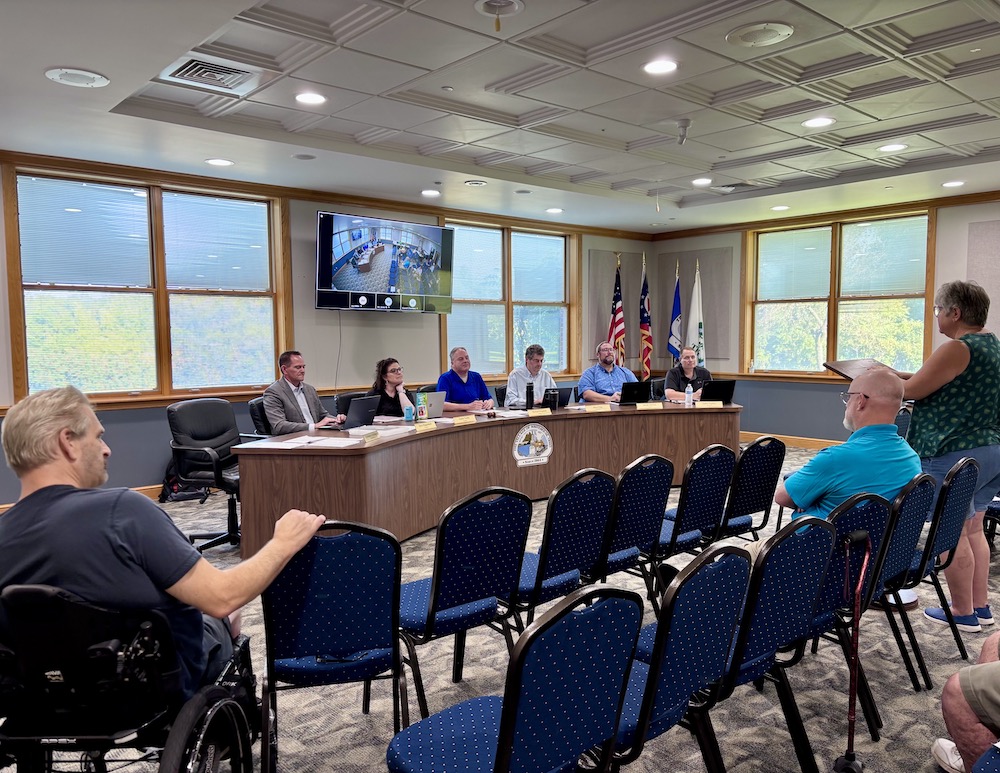
Construction of a mini roundabout at Monclova and Waterville Monclova roads began on Monday, Aug. 3. And so did the illegal use of a gravel path designed for use by emergency vehicles only, Monclova Township Administrator Mike Hampton told trustees during their Aug. 3 meeting.
“I did make a call to the Lucas County Sheriff today, our good friend Lt. [Jon] Leach, and told him there is quite a bit of non-emergency traffic going through there, and to ticket them appropriately,” Hampton said. “They’re putting people’s lives at risk. They shouldn’t be going through there.”
With construction of the roundabout delayed due to utility line delays in the roundabout just to the west at Albon and Monclova roads, work on the roundabout in front of Monclova Primary School is estimated to last until Sept. 17. The school opens on Aug. 17.
Anthony Wayne Local Schools, the Lucas County Engineer and Monclova Township coordinated plans for emergency vehicle access through the intersection during construction. The north parking lot is closed to staff and parents, but a gravel drive was installed so that emergency vehicles – including police, fire and EMS, as well as a few buses – can get through. No other traffic is permitted through that drive or into the north lot.
Parents should utilize the south parking lot and entrance for drop-off and pickup of students. Additional law enforcement support will be on site to help maintain the safe and efficient passage of vehicles. A link to the detour was shared by the schools as well.
Resident Ryan Bauman said some parents and staff may still believe they can use the gravel driveway as well, so Hampton said he would work with the district to reinforce that it is only for emergency vehicles.
Construction of the roundabout at Albon and Monclova was wrapped up and opened on July 31. Plans for a roundabout at Albon and U.S. 20A are now delayed until April 2027, because utilities will not be ready for nine weeks, which is too late in the season for paving. This is actually a relief, Hampton said, as the Ohio Department of Transportation will begin construction of a roundabout at U.S. 20A and Strayer beginning Aug. 17. Having two intersections on the same road closed concurrently would cause issues, he noted.
Roundabouts are shown to save lives and move traffic, Hampton said, adding that many of these intersections get clogged at peak times. Roundabouts will alleviate that congestion.
During the meeting, the board also:
-Listened to Lucas County Commissioner Lisa Sobecki detail the strategic plan that will guide decisions over the next five years. This is the first time for the county to implement a strategic plan, which included input from a consulting firm, residents, elected officials, employees, businesses, unions and community partners. The plan includes operational goals, advocacy areas, and mission, vision and values statements. The plan is posted at co.lucas.oh.us.
-Approved $71,750 for a new monument sign with an LED display area to replace one that was removed for the Albon and Monclova road roundabout. The county paid the township $60,000 for that sign, leaving the balance to be paid by the township.
-Heard that a Notre Dame Academy student is interested in shadowing members of the Public Works Department, and that Hampton is working through steps to get parental permission. Trustee Chuck Hoecherl suggested adding shadowing opportunities as a policy, as students may be interested in learning more from the fire department personnel as well.
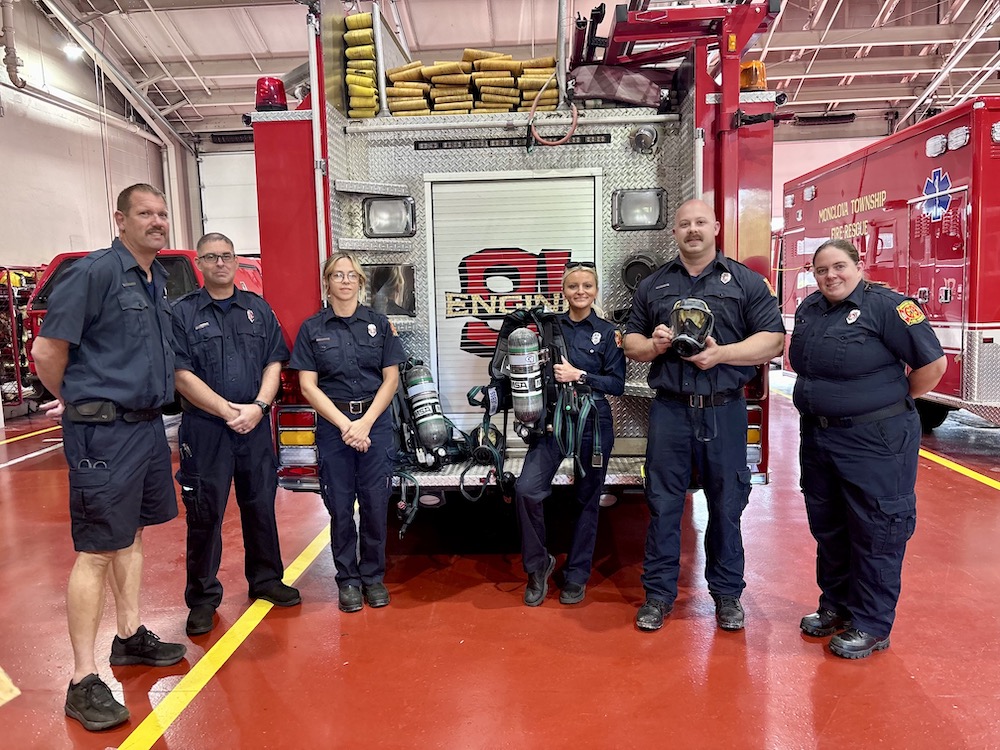
-Heard that the fire department received the SCBA equipment and accessories that were purchased through the FEMA Assistance to Firefighter’s Grant (AFG). The 27 SCBA packs come with two breathing air cylinders and a facepiece. The grant covered additional facepieces so that everyone on the department gets issued their own facepiece, rechargeable battery packs for the SCBA units, and three battery chargers, Homik said. The award also included updates to our two Rapid Intervention Team Packs that are compatible with the new SCBA packs. The department conducted mask fit testing and in-service on each shift last week. The AFG award covered 95 percent, or $266,852.38 while the township covers 5 percent, or $13,342.62.
Monclova Township Fire and Rescue team members show the new SCBA equipment and accessories paid for with a FEMA Assistance to Firefighter’s Grant covering 95 percent of the cost. Pictured are (from left) Bill Schultz, Josh Stagner, Tracy Robertson, Carolyn Hinde-Grzechowiak, Mike Harris and Meagan Beaudry. (AWFP photo by Karen Gerhardinger)
-Discussed a request by Sylvania City Schools for the township’s old SCBA equipment, which would be used for training in a new career tech program in the district. Trustees agreed that supporting the program would be beneficial for the township as well, with opportunities to recruit graduates of the program. MTFD may also assist with instruction and offering a clinical site or field work, Homik said.
-Approved the purchase of a Stryker Power Pro 2 cot, batteries and charger for $39,811.98. In May, the board approved the purchase of a power load system to replace 14-year-old units, as well as the replacement of the 2012 medic unit.
-Heard Hampton say that he is working with a consultant to create informational pieces about the pros and cons about limited home rule, which is on the November ballot. “We’re trying to be transparent about what limited home rule means,” he said.
-Listened to resident Risa Sindel ask what the township is doing to protect the township from bit coin operations, which can operate on as little as five acres but create havoc to those who live in the area because of noise and vibrations.
-Learned that the staff is working with Design Entertainment to post audio from the meetings, for which minutes are generated by an AI program.
-Heard that the zoning administrator, Eric Wagner, will share more about plans for improving its zoning resolution around data centers, as well as a text amendment about generators, during the Aug. 17 meeting. The township is working continuously to put new guidelines in place before the one-year moratorium on data centers expires at the end of the year, said Trustee Barbara Lang.