TOLEDO – On this episode of TFP Weekend, Toledo Public Schools Superintendent Dr. Romules Durant sits down for a wide-ranging conversation on issues from the district level to education at large.
On its latest state report card, TPS received two out of five stars from the state, with challenges including early literacy and graduation, among others. With regard to early literacy, Dr. Durant says “We are one of the only urban districts to not have universal pre-K,” adding, “the United States is one of the only industrialized countries to not support early childhood education in the way they do in other places.” He says there are nearly 10,000 kids in this area who are eligible for pre-K — but only around 3,000 are being served.
Among the other challenges facing the district is chronic absenteeism. TPS’ current rate is 38.9 percent, though Dr. Durant says it was higher in the years that directly followed the pandemic. As a result of COVID-19 concerns, he says, “people started to look at school as not necessarily being mandatory and treated it that way.”
Asked about the relationship between TPS and the state, and if the district is receiving the support it needs, Dr. Durant pointed to funding. He said legislators in Columbus, by not following 2020’s Fair School Funding Plan in the last budget cycle, left “Toledo Public Schools with a 24 million-dollar deficit that we have to balance.”
An ongoing debate about education, not only in Ohio but nationwide, has been school vouchers: if students should be able to take the dollars supporting their education at a public school to a private one. On the question of if private school vouchers can coexist with traditional public school funding, the superintendent said, “If you’re going to allow it, to have it coexist, then it should coexist on the same playing field.”
He said, “I’m all for school choice,” but added that private schools should be subject to the same scrutiny as public districts, including assessments and transparency requirements.
Outside of the challenges that face TPS, Dr. Durant says the district’s ‘magnet’ schools — schools that have a specific career focus — are yielding positive results. He also has optimism about the future of the years-long partnership between TPS and the University of Toledo. The district is transforming the university’s former Scott Park campus into educational and recreational facilities.
Another issue covered in this ‘TFP Weekend’ episode was socioeconomic factors, and how they affect the lived experiences — and in turn, performance — of students. To hear more on that, and other matters, listen or watch the full interview at our YouTube and Spotify channels.
*Edited by Stephen Zenner; special thanks to the Toledo Tech Loft for use of their space to produce this podcast episode.
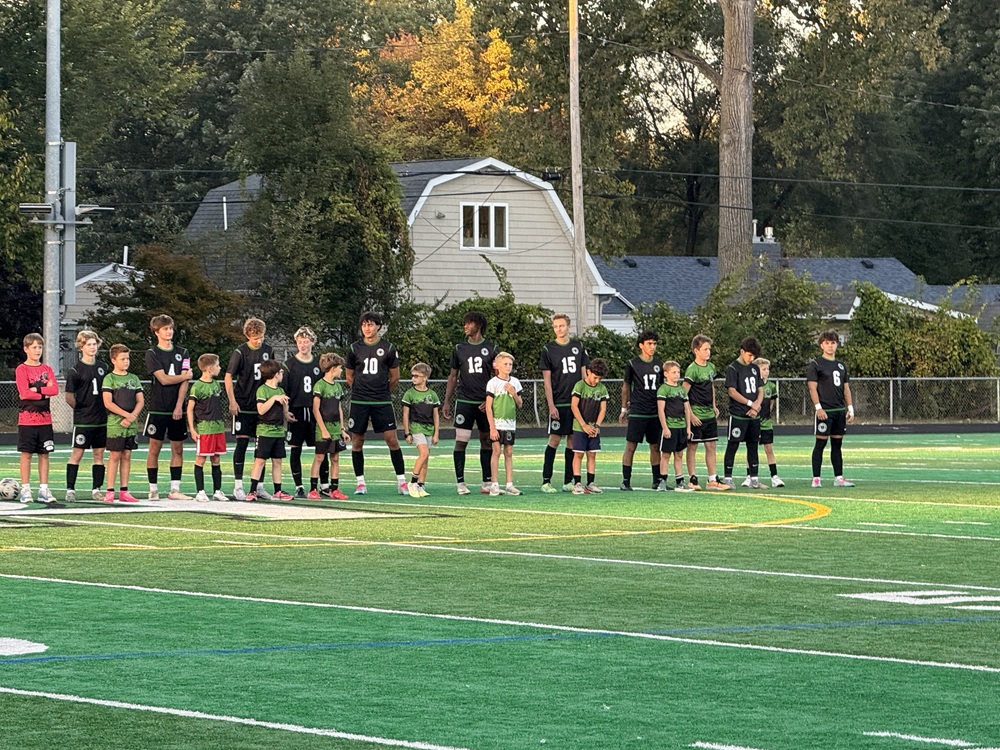
Ottawa Hills High School players and coaches pose for a photo following the Green Bears' 5-1 loss to top-ranked Cincinnati Summit Country Day in the Division V state championship match Nov. 10 at Historic Crew Stadium in Columbus.
(Photo courtesy of Ottawa Hills Senior High School)
Preparation was key to Ottawa Hills’ boys run to state soccer championship match
OTTAWA HILLS – The old guy whose face is pictured on the $100 bill once said, “By failing to prepare, you are preparing to fail.”
Second-year head coach JR Hall and his coaching staff on the Ottawa Hills High School boys soccer team made sure BenjaminFranklin’s famous quote never applied to the Green Bears this fall, particularly when they entered the postseason tournament.
“We were definitely prepared and we knew what we had to do,” junior defensive midfielder Gabe Grimm said. “We knew our positions, where to be on the field … they really got us ready for that in practice. They weren’t too hard on us. We wanted to have fun. We enjoyed our time at practices and we got the job done when we needed to.”
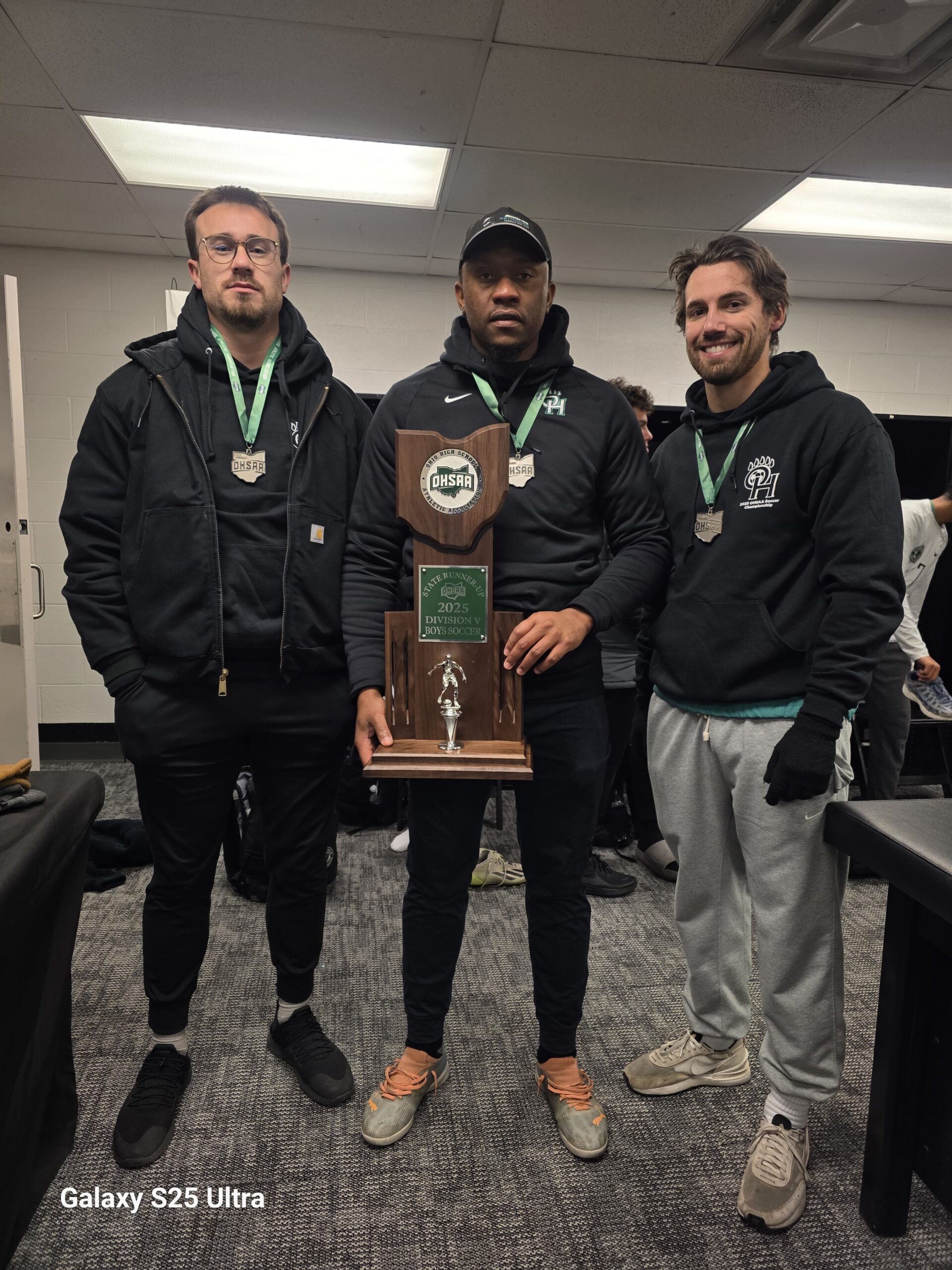
Ottawa Hills head coach Rodclif “JR” Hall, center, and assistant coaches Drew Hoffman, right, and Jakob Walther after the Green Bears’ state championship match against Cincinnati Summit Country Day on Nov. 10 in Columbus. The Green Bears have competed in the state semifinals or finals eight times in the past 17 years. (Photo courtesy of Ottawa Hills Senior High School)
Ottawa Hills, a Division V program, played a challenging schedule during the regular season. Close losses or ties against bigger D-I programs like St. John’s Jesuit, St. Francis de Sales, Southview, Northview, Springfield, and Findlay contributed to the Green Bears’ 6-9-2 record.
It also got them prepared for what was to come.
“It toughened us up,” senior center-back Jaiden Dubois said. “We played great competition. We did end up losing most of those games, but playing against better teams, we were prepared for being down and playing in harder circumstances. In the tournament, we were prepared for those circumstances.”
Ottawa Hills’ boys soccer tradition is well known around the state and Northwest Ohio in particular. The Bears, competing in the smallest school division, have advanced to the state semifinals eight times in 17 years. The 2008 team, coached by Greg McElroy, finished 20-3-0 and capped off that season with a 1-0 win over Worthington Christian in the D-III state championship match.
The Bears lost in the D-III state finals in 2017 and 2022, and lost in the semifinals in 2010, 2012, 2020 and 2021.
“There definitely is pressure, knowing we have such a good program that has been successful in the past,” Dubois said. “In the preseason we often see (former) players come back and they play with us.”
Grimm said every Ottawa Hills player is “more than aware” of the school’s past soccer success in the postseason. He said the current players feel like it is their job to “keep it rolling.”
“We know Ottawa Hills has been a great soccer school for many years,” said Grimm, who also plays shortstop on the baseball team. “Going into this year, we didn’t think we were going to live up to that. We went up against all odds. We didn’t think we had the strongest team, but when we played St. Francis and St. John’s, that showed us we can compete with these teams.
“They were all very close games until the very end. They definitely knew what Ottawa Hills soccer is. They don’t think of us as an easy game at all.”
(Photo courtesy of Ottawa Hills)
One game at a time
In Hall, the Green Bears have a coach who embraces that tradition.
A native of Jamaica, Hall’s hometown was battered by Hurricane Melissa on Oct. 28. He moved to the U.S. in 2009 and played forward at Owens Community College and Bowling Green State University.
Hall was an assistant coach at Ottawa Hills from 2021-23 and last season, in his first year as head coach, took the Bears to the regional semifinals where they lost 1-0 to Van Buren. Hall said his goal this season was “to take it one game at a time.”
“My sole concentration is the game we are playing,” Hall said. “My experience is to play it game by game. In the postseason we had fairly good information on the teams we were playing, and I was able to set up our team in a way we could be competitive.”
The Green Bears had four seniors, three of whom were starters, but two of those seniors were injured at some point during the season. Ottawa Hills relied on its defense the entire time.
“Defense was the thing that carried our team,” Hall said. “The games we lost big are the games where our defense made mistakes. Defense was definitely a strong point of our season.”
Hall said the fact that the Green Bears, who took second place in the Toledo Area Athletic Conference behind Maumee Valley Country Day School, earned a No. 1 seed in the Northwest 2 sectional/district was a sign of respect.
“We weren’t surprised,” Hall said. “We played St. John’s, St. Francis, Findlay, Northview, and Southview and it helped us a lot. Playing those tough games at the end really encouraged the boys.”
The Green Bears opened the postseason with an 8-0 rout of Woodmore on Oct. 18. The Wildcats never had a chance.
“The coaching staff did an amazing job,” Dubois said. “For that first game, we did so much to prepare and went through so many drills for our shooting, and it showed.”
The Bears followed that with wins over Mansfield Christian (1-0), Ottoville (2-1), and Fort Jennings (5-1) before avenging a regular season loss to Maumee Valley with a 3-2 win over the Hawks in the regional finals.
(Photo courtesy of Ottawa Hills)
Know who you’replaying
Ottawa Hills beat Kidron Central Christian, 1-0, in the state semifinal match in Sandusky, setting up the title match against top-ranked Cincinnati Summit Country Day, which needed overtime to beat Milford Center Fairbanks, 2-1, in the other state semifinal.
“We knew who we were playing,” Grimm said. “They were a great team and we had to come out hard. We already did the hard job by making it to that game. We just had to go out there and try to win it now.”
Hall said he knew what the Green Bears were up against. Summit Country Day had outscored its previous three opponents 8-1, and the Silver Knights’ girls’ team won the D-IV state title, its third straight, three days earlier.
“We were playing against a team where 80 to 90 percent of their players play Club,” Hall said. “We don’t have a lot of players who play Club. We have a school where players run track or play baseball after soccer is finished. We were happy that our boys could do this against a school that has 80 to 90 percent of their players in Club.”
Summit Country Day, which won its ninth state title, scored twice in the 20th minute of the match to take a 2-0 lead. The goals came 27 seconds apart. Ottawa Hills went on to a 5-1 loss and avoided a shutout when junior midfielder Ibraheem Alaani converted a free kick into the upper right corner in the 74th minute.
“Ibraheem had been practicing that kick in the postseason, either before or after practice,” Hall said.
Sophomore keeper Burke Pfeiffer made eight saves for the Bears, who had a 14-1 disadvantage in shots on goal.
“Summit was way ahead of us that game,” Grimm said, “but we didn’t give up. We got that one goal. After the game, no one was really devastated. We were all proud of ourselves and we were happy to be playing in that game.”
Dubois said playing for a state championship “meant everything,” and he and his teammates never sulked after falling short in the finals.
“It was a major accomplishment, even though we didn’t win it,” he said. “It was an amazing season. We had to work together to accomplish our goals. It really is a brotherhood and we all love each other.”
Senior forward Avi Hanusz led the Bears (12-10-2) with 14 goals this season, while sophomore right wing Savio Deigar and junior attacking midfielder Andy He had eight goals apiece.
Grimm and right/left wing Archie Talbott scored five goals each, Talbott had a team-high nine assists, Deigar had six assists, and Pfeiffer had 82 saves in goal. The Green Bears posted seven shutouts.
“I will remember the joy and togetherness and bond from the boys at practice and in games,” Hall said. “The final was just the cherry on top, to have that bond and family from what I saw every day. They know how hard they worked during the season and they did everything they had to during the season.”
Grimm said the team became “a complete family” during the season.
“With every win or loss, we knew we would come together and we knew what to do to get the job done,” Grimm said. “We had the most fun this year and that helped us go far in the playoffs.
“It’s one thing to take things seriously, but you have to have fun while you’re doing it.”
American beech, Secor Metropark. (By Metroparks Toledo nature photographer Art Weber)
All the leaves are down. Or are they?
We usually think of fall as the last hurrah for leaves. And it’s true that by now most of our leaves have fallen and the woodlands have a barren look. But there are hangers-on. Oaks and beech mostly, trees that have an extra strong connection to their leaves, even when they’re trying to let them drop.
Fall is transition time for deciduous trees, a time to prepare to go dormant for the winter months by absorbing and storing the nutrients in chlorophyll. Once that’s done, the tree forms a layer of scar tissue at the base of each leaf, which results in the leaf detaching and eventually falling to the ground. Losing leaves is an amazing adaptation for surviving the freezing temperatures of the winter months.
Some leaves, notably those of oaks and beech, can remain stubbornly attached until spring. Even though these leaves have been cut off and dried, the connection remains strong enough to hang on much longer than other species.
Oaks and beech are important trees in our forests, providing beechnuts and acorns as well as excellent den and nesting sites for wildlife. On winter woodland walks, look for the leaves hanging on, especially the copper-colored beech, like this one photographed after a January snowfall in Secor Metropark.
Jerry Anderson emceed “Under the Spotlight: Data Centers In Our Backyard” on Nov. 20
at Anthony Wayne High School. (AWFP photo by Karen Gerhardinger)
WHITEHOUSE – Just the facts – that’s what many community members were seeking as they prepared to listen to a panel of experts during the Nov. 20 “Data Centers In Our Backyard” forum.
“I’m going to keep an open mind and listen. It’s easy to come up with notions…when you haven’t read all the facts,” said Matt Reed as he sat in the Anthony Wayne High School auditorium awaiting the start of a panel discussion hosted by WGTE, Regional Growth Partnership and Lucas County Economic Development Corporation.
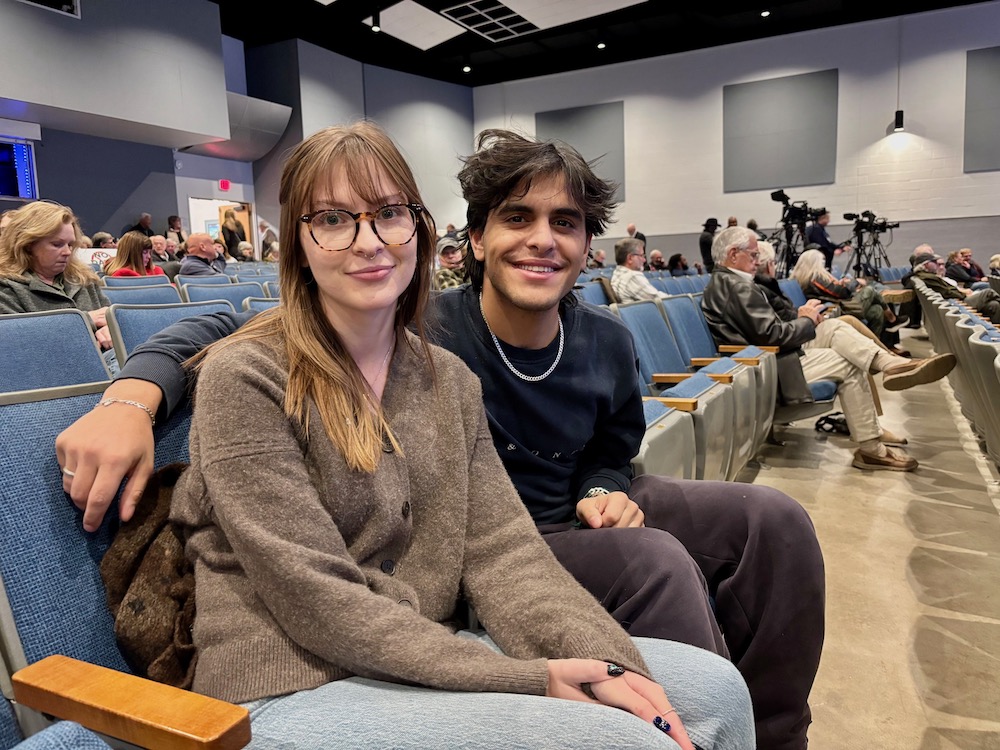
Matt and Meghan Reed, of Monclova Township, prepared to listen to a variety of viewpoints on data centers. (AWFP photo by Karen Gerhardinger)
Matt and his wife, Meghan Reed, moved from South Toledo to Monclova Township in March, and a few months later heard about data centers being proposed in the area.
“It’s so hard to differentiate fact from opinion. I was hoping this would have more unbiased fact,” said Meghan, noting that she has no preconceived notion on data centers.
Dale Knepper has seen, during the 18 years he served as Waterville’s finance director, how emotional issues can prevent people from seeing the facts.
“When it comes to financial issues, sometimes you can lay the facts in front of people, but if they have their mind made up, there’s nothing you can do,” he said. “We have to look at everything. If a data center isn’t here, and moves to Fulton County, it’s still using the water and electrical sources, but we’re not going to get the benefits.”
“I heard some rumors, but I want to get clarification,” said Waterville Township resident Steve Eberly, who has property along Noward Road, noting that he was particularly interested in the impact of data centers on water and electricity – especially since he has a well.
“Right now, I’m not holding up a sign protesting, but I’m more than a little interested in what that could mean.”
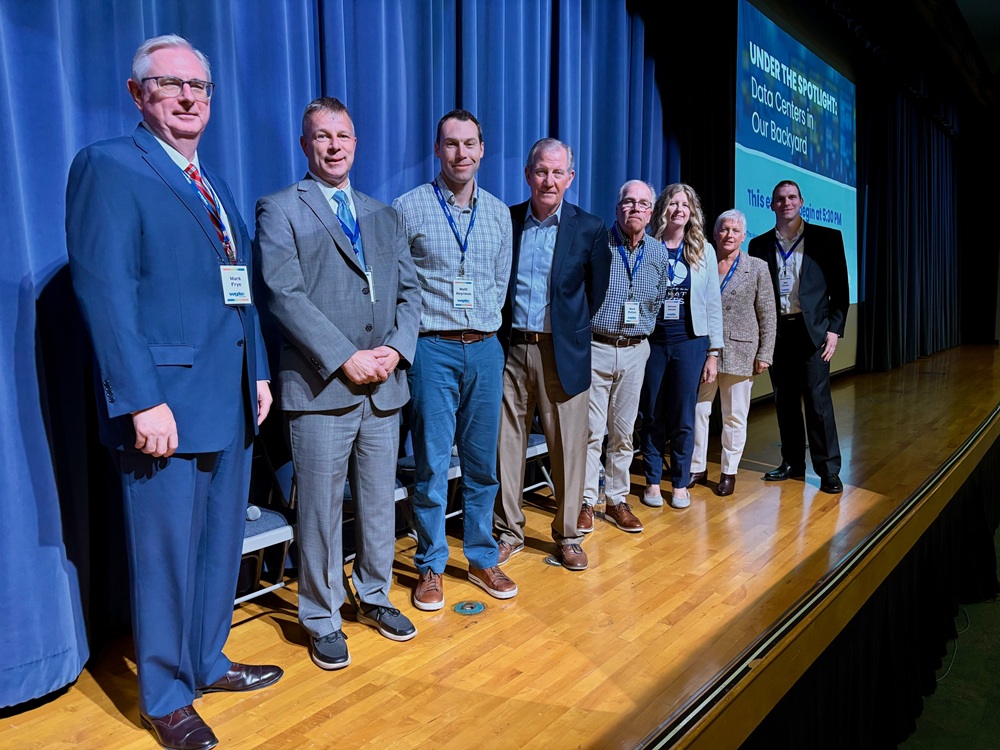
The panel for the data center forum included (from left) Mark Frye, Gary Thompson, Matt Heyrman, emcee Jerry Anderson, Mark Patton, Helena Volzer, Karen Winn and Will Turner. (AWFP photo by Karen Gerhardinger)
While opponents of data centers have hosted town halls and crammed local municipal meetings to voice their opinions, the Nov. 20 forum was the first of its kind to include representatives sharing multiple perspectives: Mark Frye, Palmer Energy; Gary Thompson, Regional Growth Partnership (RGP); Matt Heyrman, Lucas County Economic Development Corporation (LCEDC); Will Turner, a site selector for data centers; Helena Volzer, Alliance for the Great Lakes; Karen Winn, a Richfield Township property owner; and Middleton Township resident Mark Patton.
The forum was emceed by former WTOL11 anchor Jerry Anderson, a Bowling Green resident who often drives by the giant Meta data center development taking a square mile on S.R. 582 between S.R. 25 and I-75 in Middleton Township. The community wasn’t aware of the project until dirt was being moved, Anderson said.
“We didn’t have forums like this one,” Anderson said.
During the 90-minute meeting, Anderson asked questions about the impact data centers would have on the electrical grid and bills, water quality and sustainability, home values, farmland and the economy.
When it comes to water, Turner said the older model data centers used millions of gallons a day, but the centers in development will use just 20,000 to 30,000 gallons a day.
“When you look up data centers and water, you’re getting old technology – water guzzlers. There’s a tremendous advantage in closed loop systems. They’re more efficient, and quieter.”
At least two members of the audience remain concerned about water – especially upon hearing Volzer say that more studies are needed to see the long-term impact of data centers on the Great Lakes.
Christina Egan, a Monclova Township resident, said Taylor’s explanation of a closed loop water system didn’t assuage her concerns about the need to have enough clean water for future generations. Water is also on the mind of University of Toledo sophomore Kylie Woodward.
University of Toledo sophomore Kylie Woodward and Abbas Kondil came to the forum to hear about the impact of data centers on the Great Lakes. (AWFP photo by Karen Gerhardinger)
“I’m against AI to begin with. It’s threatening the Great Lakes if we build a data center near it,” Woodward said. “Once it’s gone, it’s gone. It’s not an infinite source.”
Data centers need water for cooling the servers inside, but also to cool the turbines that generate power to run the data centers, Volzer said.
“Every Great Lakes state is adding data centers,” she said, noting that other high tech industries and agriculture are the biggest users of water. “Whether we have enough water to sustain them is a good question. Demand studies are a good way to look at the question. We need more research.”
Data centers use a lot of electricity, said Frye, explaining that a hyper-scale center could use up to 500 megawatts, or the amount needed to power 500,000 homes. Most of the existing data centers are connected to the grid, but the trend now is BYOG – bring your own generation. Before connecting to the grid, data center developers need to go through detailed load studies to determine if the project will adversely impact other users on the grid.
American Electric Power (AEP) in Columbus asked the Public Utilities Commission of Ohio (PUCO) to create a data center tariff to pay for transmission infrastructure, and Frye suspects that First Energy will do the same.
“This is part of the protections being built into the regulatory infrastructure,” Frye said.
Anderson cited a detailed Ohio Chamber of Commerce report on the economic impact of data centers in 2024: supporting 95,000 jobs and contributing $11.8 billion to Ohio’s GDP. The industry is projected to support over 132,000 jobs and contribute $20.2 billion to the Ohio economy by 2030.
Members of the International Brotherhood of Electrical Workers Local 8 gathered prior to the forum, where they sought confirmation that any large project would use union labor. (AWFP photo by Karen Gerhardinger)
Terry Short, a 2000 Anthony Wayne High School graduate and an electrician with the IBEW Local 8, said he’s dismayed when he reads people who dismiss those jobs as just temporary.
“We choose these careers. It’s what we do for a living. We’ve all made a career out of a temporary job,” Short said.
Short was joined by several members of the IBEW, including Tom Enright and Josh Abernathy, who sat in the front row to listen to the presentation. Finding projects for new apprentices and experienced electricians is a priority, they said. The Meta project, as an example, employees 300 to 400 electricians and 280 low voltage workers – those who install cabling, fire alarm and camera systems, for example.
“This will allow us to take in more apprentices and give them a great job, a great education and great benefits,” Enright said.
As the economy ebbs and flows, so do opportunities for apprentices, Abernathy said.
Is there a way to grow jobs in a state with a declining population – Anderson asked – one that’s heavily reliant on the automotive and agricultural sectors?
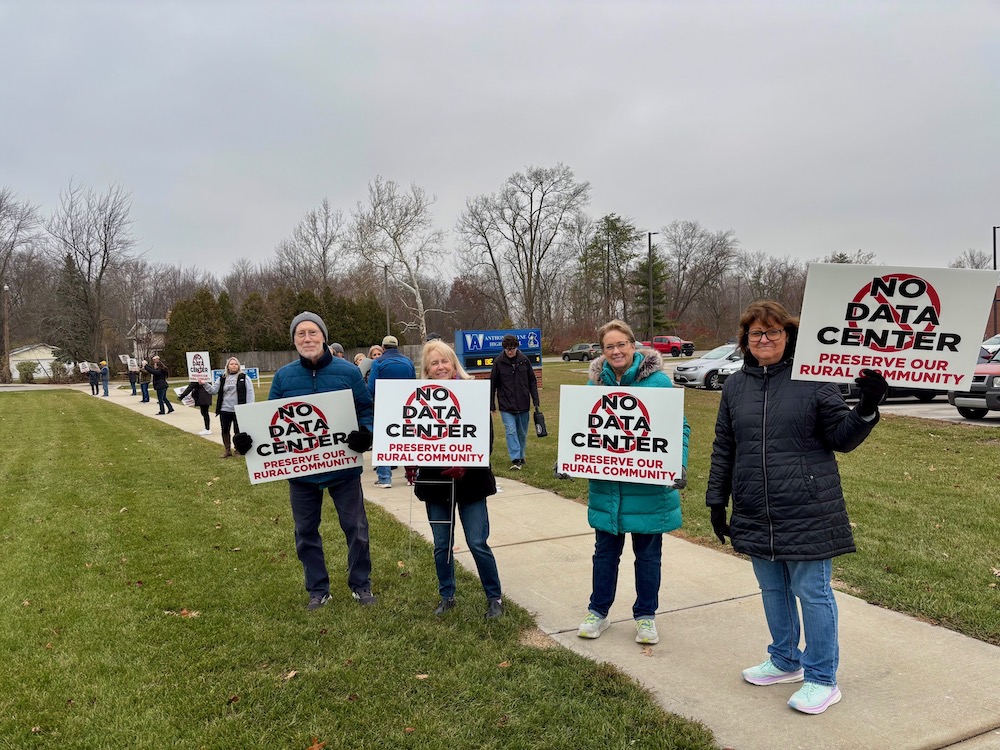
“It’s really up to the community,” Thompson said, noting that data centers will not locate where they’re not welcome. That comment brought jeers from the audience members holding ‘No Data Center’ signs.
“Society and the economy is changing. We are a manufacturing society. All manufacturers are putting AI into their process. They need computation power to do that,” Thompson continued. “Manufacturers need data centers or we will lose our manufacturing base.”
The county and RGP work with communities to look at how to balance quality of life with wealth creation, Heyrman said. That can be done with proper zoning and negotiating an agreement that ensures tax benefits come to the community.
For Winn, who is part of a six-generation farm family in Richfield Township, even a $200,000 an acre offer couldn’t pay for the value of rich farmland and a sense of family and community.
Richfield Township is now moving away from zoning to allow data centers and advanced manufacturing, but several local jurisdictions have adopted language to allow and regulate the projects. The final decision comes down to township trustees, boards and councils.
Waterville City Council approved a conditional use permit for Meijer to begin work on a 159,935-square-foot store near the intersection of U.S. 24 and S.R. 64. (Rendering courtesy of Meijer)
And Whitehouse Fire response times drop
ANTHONY WAYNE – Waterville City Council approved a conditional use permit for a new Meijer store and gas station at the corner of Pray Boulevard and S.R. 64 during its Nov. 10 meeting. In Whitehouse, Mayor Rich Bingham honored long-time Tree Commission member Sheri Luedtke, employees James Forrest and Mike Hill. In addition, Fire Chief Jason Francis reported a drop in response times over the past decade. Here is a recap of the two AW-area meetings.
Waterville
Meijer will begin site work for a 159,935-square-foot retail store and 3,660-square-foot gas station and convenience store at the southwest corner of Pray Boulevard and S.R. 64, after Waterville City Council unanimously approved a conditional use permit for the project during its Nov. 10 meeting.
Brian Smallwood of Wolpert, Inc., an agent for Meijer Stores, presented updates to the site plan, facade and traffic study, based on prior input from council and the city’s Planning Commission. The main store will have two main entrances for the grocery and home good areas, as well as a garden store, e-commerce pickup and customer service area.
“I think you will be a great addition to this community,” said Anthony Bruno. “It will be nice to give our citizens options.”
During the meeting, council members asked questions and made suggestions for how Meijer could best fit into the community. Wayne Wagner suggested that Meijer consider accommodating the county recycling bins that were displaced by the construction of Auto Zone in the Kroger out lot several years ago. He also asked if the lights could be dimmed in the evening so as not to affect the growth rate of the nearby soybean field, as growth typically occurs at night.
“We have the ability to shut off or dim a significant number of lights,” said Smallwood, explaining that while the store will not be open 24 hours a day, some lights will need to be left on for the safety of employees who do overnight stocking.
Both Wagner and John Rozic shared concerns about adding another fuel station to the city – which already has Speedway and Kroger gas stations at the same corner, plus a Circle K downtown.
“This will be a huge hurt to their business,” Wagner said about the existing fuel centers.
The M Express gas station is a significant portion of the Meijer business now, Smallwood said, explaining that about 25 to 30 percent of Meijer customers cross shop, using their M Perks credits for discounts on fuel.
Resident Scott Jahns spoke in favor of the gas station.
“The competition will drive the cost down,” Jahns said, noting that Waterville tends to have higher prices than elsewhere in the area.
Rozic also urged Meijer to create a facade that is distinctive to Waterville.
“It’s a beautiful store, but it’s a Meijer store – not something that’s Waterville or Anthony Wayne,” Rozic said, suggesting that Smallwood look into utilizing Carruth designs or materials used throughout the city. “I want it to look like it belongs here, not just dropped in from Maumee or Sylvania.”
Meijer takes a lot of pride in building stores with high-quality construction and believe in the look of the store, but will incorporate local landmarks and history inside its community area, Smallwood said.
“Meijer truly does want to be a part of the community and puts a lot of emphasis on trying to do that,” he said.
Another one of Rozic’s suggestions – to ban overnight parking of semis and campers – was accepted and included in the permit during the vote.
As part of the permit, Meijer agrees to complete traffic improvements as recommended by a traffic impact study, including a right-in, right-out driveway on S.R. 64 similar to the one at the Kroger gas station; three driveways on Pray Boulevard; a 480-foot westbound right-turn lane on the north side of S.R. 64 onto northbound U.S. 24; and, when approved by the Ohio Department of Transportation, the installation of an eastbound U.S. 24 ramp traffic signal within 24 months after an occupancy permit.
The Meijer signage will be smaller than the Kroger sign, blending in with the site, said administrator John Gochenour. Lighting will be downward directed to prevent light spillage in the 526-space lot. Site work is expected to begin soon and includes filling in the current pond and constructing two stormwater detention facilities.
“I’m thrilled you are coming,” said Council Member Mary Duncan, noting that many have asked for a pharmacy.
Council members asked about two outlots available for development. Smallwood said Meijer is in discussion with a possible tenant but cannot reveal the name at this time.
Resident Nick Sargent asked about security to prevent thefts. Meijer has onsite security, as well as cameras that continuously monitor the parking lot, front of store and interior, but will work with local law enforcement on prevention.
Pointing to the recent land use plan update, resident Paul Miller said that those who responded to a survey of wants answered that they didn’t want townhomes, apartments or industrial.
“Meijer we want,” he said.
During the meeting, council also:
-Listened to Mayor Tim Pedro say that Waterville residents who are interested in filling two seats on council that will be vacant as of Jan. 1 should send in a letter of interest by Friday, Dec. 5. Anthony Bruno decided not to run for a third term, and John Rozic is term limited. Mary Duncan was the only candidate for the three open seats and will serve a third term.
–Listened to residents Paul Miller and Lisa Urie speak about community planning and data centers. Miller said the area proposed for a data center doesn’t fit in with what he read in the recently updated land use plan. He urged council to consider a ban rather than a moratorium, which is up for discussion during the Monday, Nov. 24 meeting. Urie compared Waterville to the town in It’s A Wonderful Life and pointed out that wealth doesn’t necessarily bring joy to a community.
-Heard that Helms and Sons of Findlay was the low bidder, at $1.5 million, for the Waterville-Monclova Road widening project slated for 2026. The city will pay just 6 percent, or $88,339, for construction, as a federal grant of $1.1 million and Ohio Public Works Commission grant of $293,283 will cover the majority.
-Learned that the Ohio Department of Taxation has approved, after several months, the city’s plans for a downtown redevelopment tax incentive district. The first payments should come through in March 2026.
Whitehouse Council Nov. 4
Whitehouse Fire Department response times have dramatically dropped in the past decade, Fire Chief Jason Francis announced during the Nov. 4 Whitehouse Village Council meeting.
In figures comparing 2015 to 2025, both the turnout time – how long it takes between dispatch until a vehicle is on the way – and the response time, which is from the dispatch to arrival on scene, dropped significantly. The turnout time for fire dropped from 4:18 to 1:10 and for EMS from 3:19 to 1:09. Response times went from 9:52 to 5:57 for fire and from 6:40 to 5:13 for EMS.
“These improvements aren’t just numbers – they represent real outcomes in our community,” Francis said.
A 3-4 minute reduction in fire response time can mean the difference between a small, contained fire and a fully involved structure.
“That’s tens of thousands of dollars in property save and, more importantly, lives saved,” Francis said.
Saving 1-2 minutes on EMS calls can double survival chances for cardiac arrest victims and dramatically improve outcomes for trauma patients.
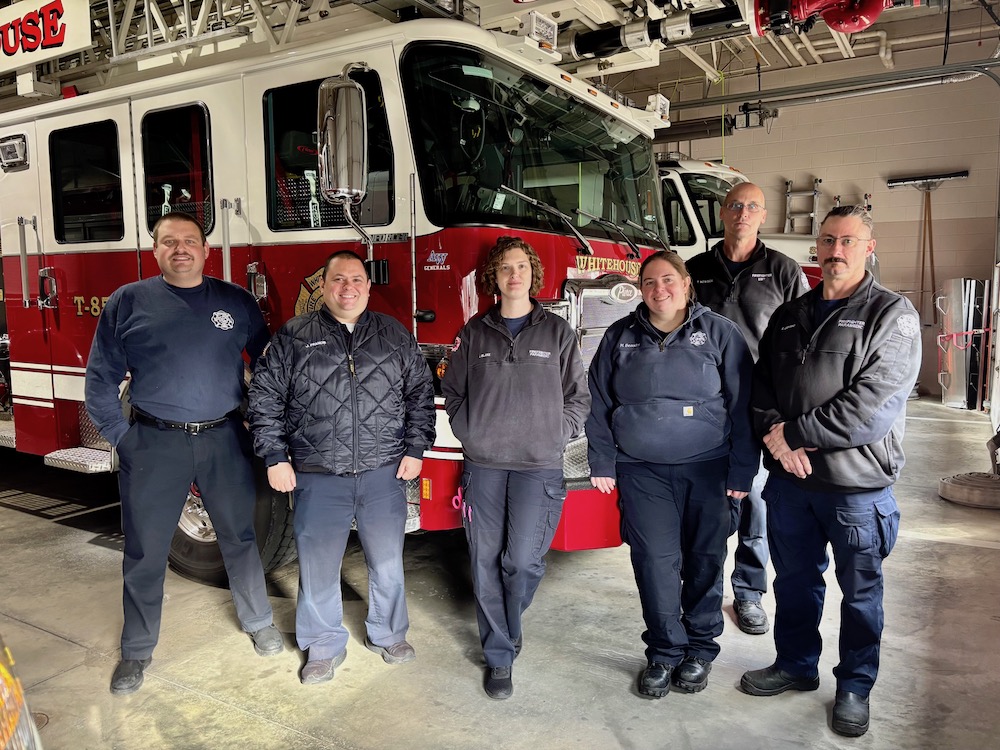
Whitehouse Fire Department has seen significant reductions in response times over the past decade, reported Fire Chief Jason Francis (second from left), who is joined by (from left) Zach Bingham, Jamie Blake, Megan Beaudry, Tim Newsom and Eric Leonard. (AWFP photo by Karen Gerhardinger)
“These are minutes that matter. And they’re minutes we earned through strategic operational investments, not by chance,” he said.
He thanked council for supporting improvements in staffing and deployment enhancements; increased Advanced Life Support personnel; investing in training and readiness; upgraded technology and station alerting systems; and co-op partnerships and mutual aid improvements that expand response capacity and regional support.
“These changes have cut precious minutes off every phase of response, improving our performance and strengthening public trust,” Francis said.
During the meeting, council also:
Sheri Luedtke was recognized during the Nov. 5 Whitehouse Village Council meeting. (AWFP photo by Karen Gerhardinger)
-Recognized Sheri Luedtke for her years of serving the community, as a member of the Tree Commission and other boards. Mayor Rich Bingham said her quiet leadership has made a difference in the village. With the Tree Commission, Luedtke was integral in securing Tree City USA status and annual Growth Awards, and actively educated the community on invasive species, proper tree planting and other topics. Over the years, she has served on the Whitehouse Library board of directors, organized the summer farmer’s market and volunteered with the Anthony Wayne Community Food Ministry.
-Heard about plans for the Saturday, Dec. 6 holiday celebration that is estimated to bring in 4,000 residents and guests for a 5k race, parade, tree lighting, vendors, crafts for kids and a visit from Santa Claus. The event takes place from 3:30 to 7:30 p.m. The 5k, hosted by Run Toledo, will benefit Hospice of Northwest Ohio.
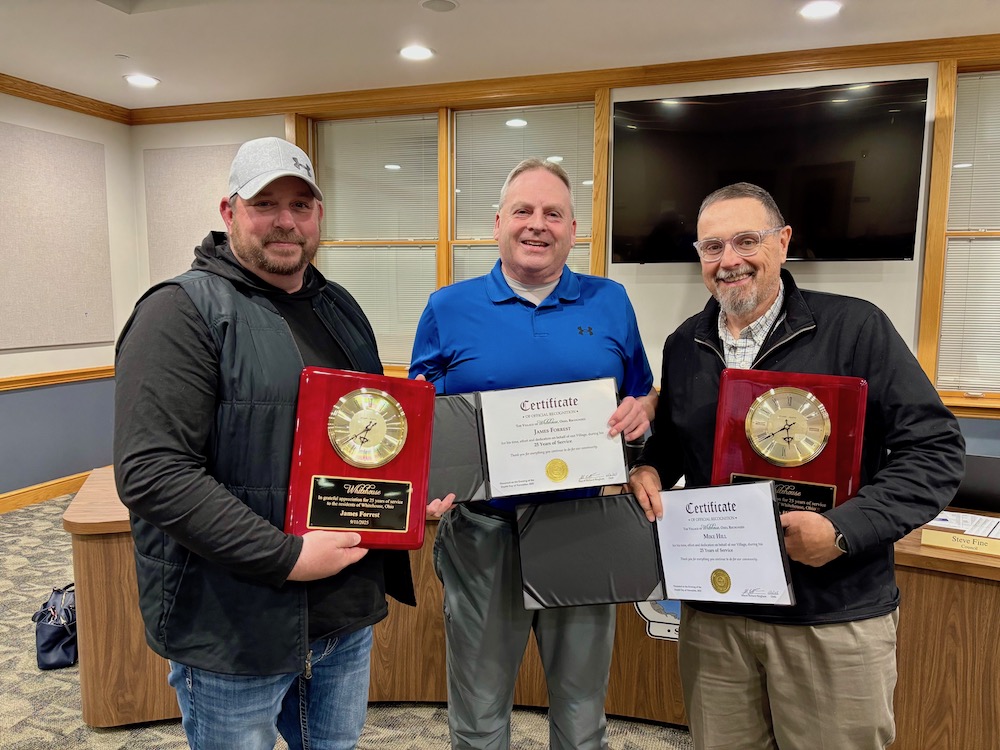
-Recognized Public Service Director Mike Hill and employee James Forrest for their 25 years of service to the village.
Whitehouse Mayor Rich Bingham (center) presented clocks and certificates to Public Service Department employee James Forrest and director Mike Hill for their 25 years with the village. (AWFP photo by Karen Gerhardinger)
-Learned that RX Solutions will be opening a pharmacy in early 2026, based out 6729 Providence St. The pharmacy will offer free delivery of medications. Contact them at 419-558-0800.
-Heard that a Toys For Tots collection competition between Whitehouse and Waterville is underway as of Nov. 10.
-Listened to Bingham say that he met with representatives of Carlyle Group, which is purchasing BASF Coatings, to discuss growth opportunities for the Industrial Drive business. Carlyle will take over in the second quarter of 2026.
-Discussed options for assisting residents impacted by the loss of SNAP benefits and government workers, including those at the 180th Fighter Wing, who had not been paid. Council authorized administrator Jordan Daugherty to look at options and use up to $2,500 to provide assistance either through local food banks or other methods.
-Agreed to move forward with plans to have murals painted on walls in town.
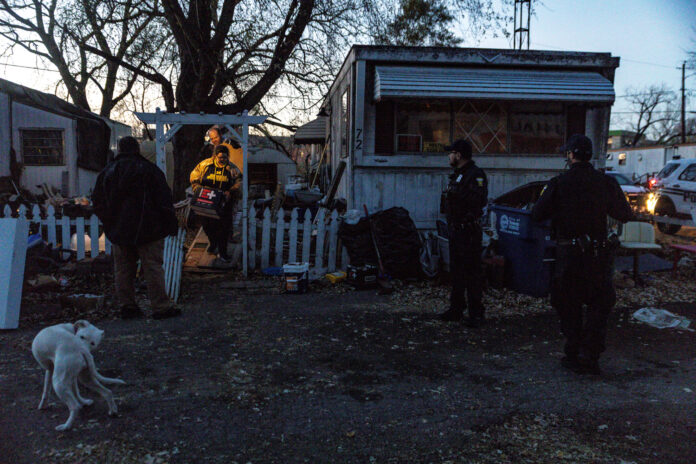
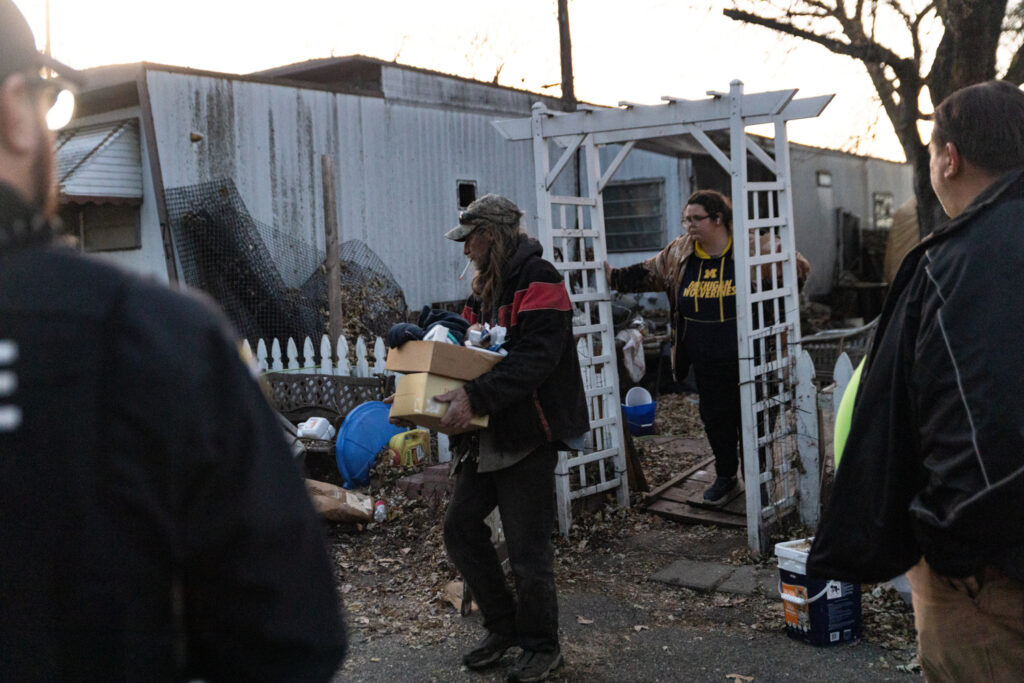
Angel Smith, 31, carries items to the moving truck with Lee Kastel, a friend helping Parker’s family move, in front of Toledo Police Officers and Jim Molnar, the director of building and code compliance for the City of Toledo, at Riverside Mobile Home Park at 18 City Park Avenue in Toledo on Monday, Nov. 17, 2025. (TFP photo by Stephen Zenner)
TOLEDO – This past Monday marked the beginning of the end for the Riverside Mobile Home Park, notorious for its poor conditions and proximity to downtown Toledo (18 City Park Avenue off the Anthony Wayne Trail).
Somewhere around 9 a.m. to 9:30 a.m. on Nov. 17, Toledo Edison came with trucks to disconnect power to the park, but were waylaid by Charles “Chuck” Parker, 66, Susan Luttrell, 70, and their respective households who were still present on the park’s grounds.
Toledo Edison truck leaves Riverside Mobile Home Park after residents of the park were supposed to have vacated the premises. (TFP photo by Stephen Zenner)
In the days leading up to their removal from Riverside, the Toledo Free Press spoke with Luttrell and Parker, both of whom maintained they were trying to get out of the park by the deadline of Monday, Nov. 17.
Sunday, the day before, Luttrell said she attempted to rent a UHaul, but said she ran into a problem doing so because she didn’t own a smart phone. She resolved to try again on the Monday morning, but was met with Toledo Police and Toledo city officials before getting back to the rental service.
“They signed a contract saying that they would be off the property by the 16th of November, which was yesterday,” said Jim Molnar, the director of building and code compliance with the City of Toledo, who has been in contact with the two households over the course of months. “We were out here to confirm that that happened, and it didn’t. So we’re trying to figure out what the next step is.”
Susan Luttrell, 70, speaks with Jim Molnar, the director of building and code compliance for the City of Toledo, about leaving Riverside Mobile Home Park at 18 City Park Avenue in Toledo on Monday, Nov. 17, 2025. Luttrell said she attempted to get a UHaul truck to start moving things the day before, but was unsuccessful in obtaining the truck. (TFP photo by Stephen Zenner)
Molnar addressed press from local media outlets after Toledo Police moved through the entire park and spoke with both households.
Two officers investigated a mobile home where they had observed squatters in the days leading up to the anticipated demolition. No one was in the run down home, but a padlock had been added to the door and was locked with no one inside.
When police and city officials converged on Parker’s part of the mobile home park, he was gone, and Molnar spoke outside of his wife’s mobile home with his son Kendall Parker, 35.
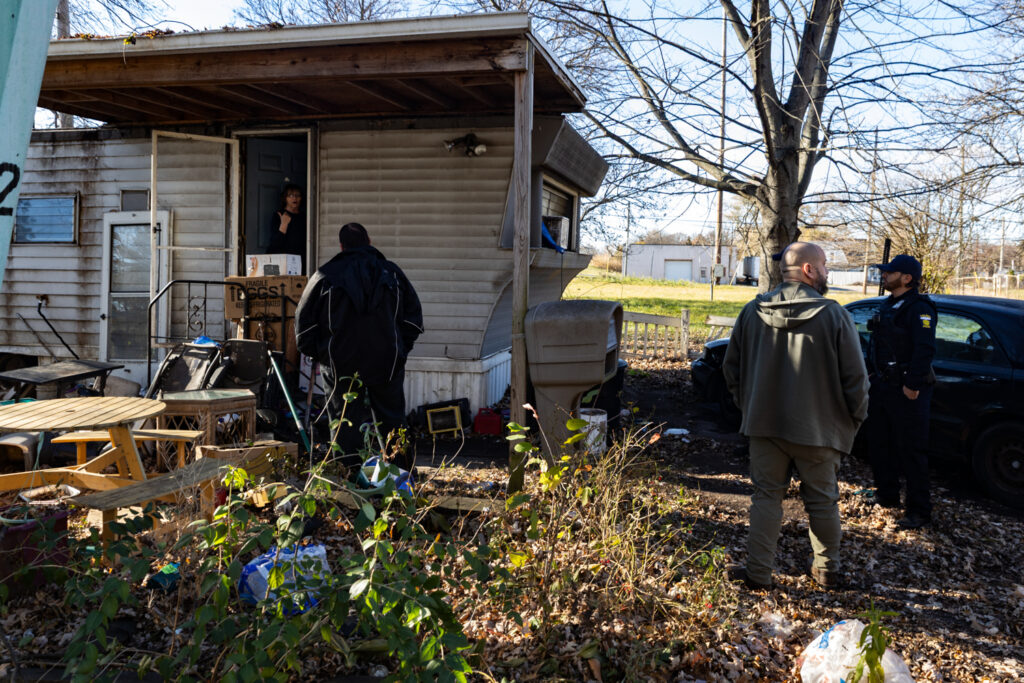
Jim Molnar, the director of building and code compliance with the City of Toledo, speaks with Kendall Parker, 35, in front of his mother’s mobile home at Riverside Mobile Home Park. Parker and the rest of his family received money from the Lucas County Land Bank to vacate the premises of Riverside, but his father and mother are disabled, making it difficult to move their things into the UHaul. (TFP photo by Stephen Zenner)
A number of minutes later, Chuck quickly rolled up in his red Ford F-150 into the midst of the half-dozen or so city officials, got out of the vehicle and placed himself in-between his family and the city as the main point of contact.
Cracking jokes and making light of a serious situation, the elder Parker tried to explain his attempts of getting out of the park to Molnar, who reminded Parker of the contract he signed for the grants offered by the Lucas County Land Bank. These grants released money contingent on Parker’s household vacating the premises of Riverside.
Charles “Chuck” Parker, 66, speaks with Jim Molnar, the director of building and code compliance for the city of Toledo, as well as a number of Toledo Police Officers at Riverside Mobile Home Park. Parker tried to make light of the situation, cracking jokes, and shared his efforts to vacate the premises, trying to convey his presence at Riverside was not for lack of trying. (TFP photo by Stephen Zenner)
“I’m gonna’ go and let them know that they need to have everything that they want to keep and themselves off the property by five o’clock today,” Molnar told press, but seemed unsure of the repercussions.
Last week, the City of Toledo had mentioned to the former residents of Riverside, that demolition work might begin, or at least equipment would begin getting moved into place starting Monday.
Kendall Parker, 35, with Toledo Police and different employees of the City of Toledo at Riverside Mobile Home Park. Parker spoke with Jim Molnar, the director of building and code compliance, who spoke about having them out by 5 p.m. later that day. (TFP photo by Stephen Zenner)
Molnar wouldn’t speak of specifics of the demolition. “Urban Beautification is a different division that does the demolition work, or that handles the contract for the demolition work, so I don’t want to try to answer on their behalf,” he said.
Molnar identified Deputy Mayor of Toledo Abby Arnold as his supervisor for this case, and he admitted he wasn’t sure of the next steps if the residents weren’t out by 5 p.m. by Monday evening.
“This has never been done in the City of Toledo, as far as I know,” Molnar said.
What to do with the owner?
The complication lies with remedying the property for “human habitation.”
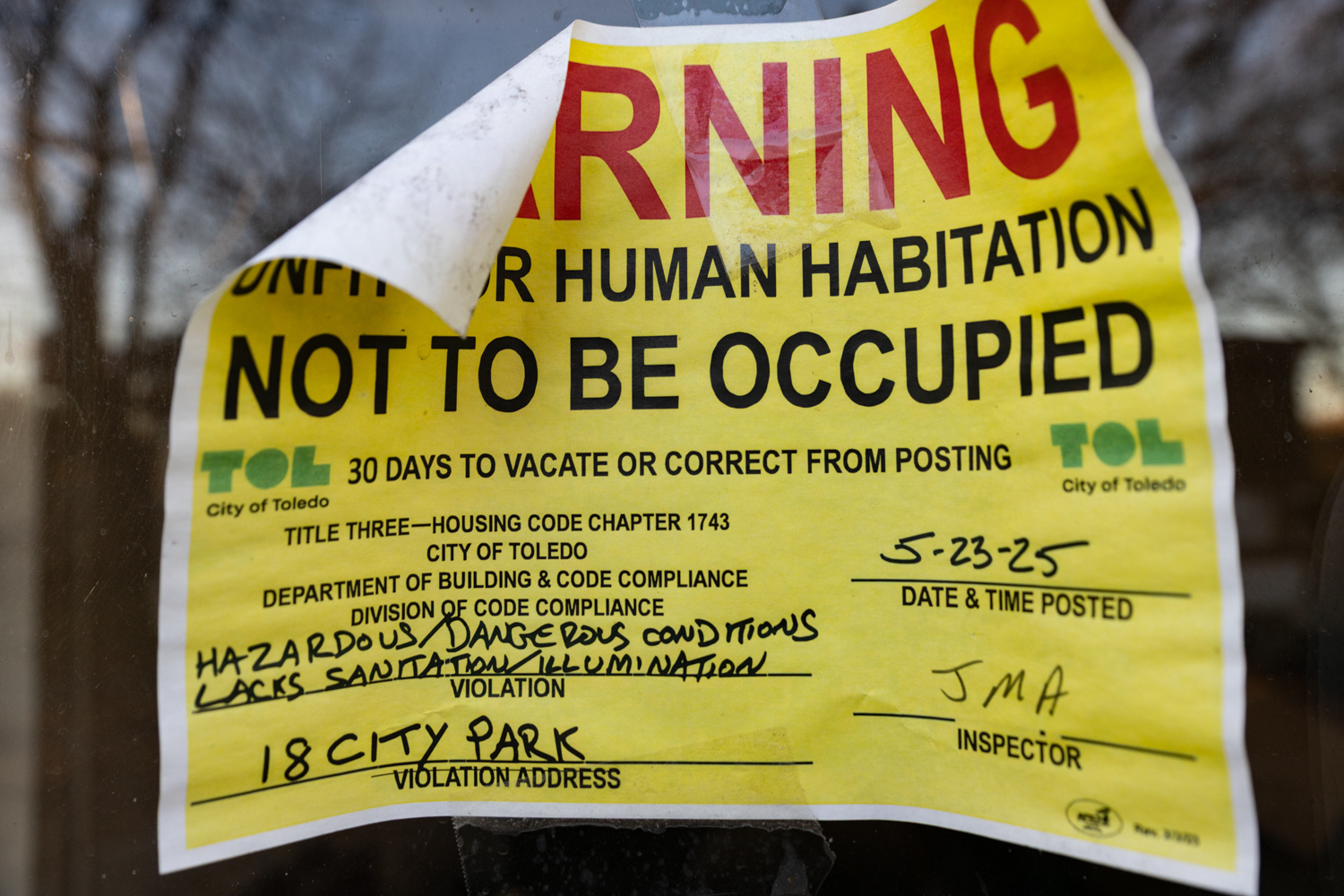
Back in May of 2025, the city identified Riverside as “unfit for human habitation,” a designation that says the property is actively a danger to anyone who lives there. And while this generally would result in fixing up the park, at this point the park is cheaper to demolish. Additionally, the owner owes Lucas County thousands in back taxes, and owes the City of Toledo tens of thousands in back property taxes and hundreds of thousands in back utility bills.
Currently, the owner of the park RIVER SIDE MOBILE HOME ESTATES LLC, which has gone through a fair share of owners since its creation in 2016 was last registered in Indiana in 2024 with Ernie Garcia.
Ohio records from 2023 name the owner as David Garcia, which coincide with Indiana records. Colloquially, Parker said he has had contact with Ernie Garcia as the owner of the park, and his wife Marissa Garcia, along with their son Sergio Garcia.
Parker said Ernie’s family lives out of Illinois, and the phone numbers Parker is in contact with for Ernie and Marissa have Chicago, Illinois area codes. But the number Parker identified with Sergio has a northwest Indiana area code.
Records from Lucas County Common Pleas court place Ernie Garcia out of Indiana, and acting on behalf of River Side Mobile Home Estates against the City of Toledo to get a restraining order against the city.
“On October 20, 2025, the Court denied Garcia’s motion for a temporary restraining order,” against the city, the county records read. A corporation “must be represented by an attorney and cannot be represented in court by a non-attorney officer,” the court ruled.
In September, $200,000 was approved for the demolition of the property.
Further attempts at restitution for the back taxes and bills have not been mentioned by city or county officials.
Down to the wire
Later in the day, Luttrell and Parker both had UHaul moving trucks with a fair amount packed into them, and they had extra help from friends.
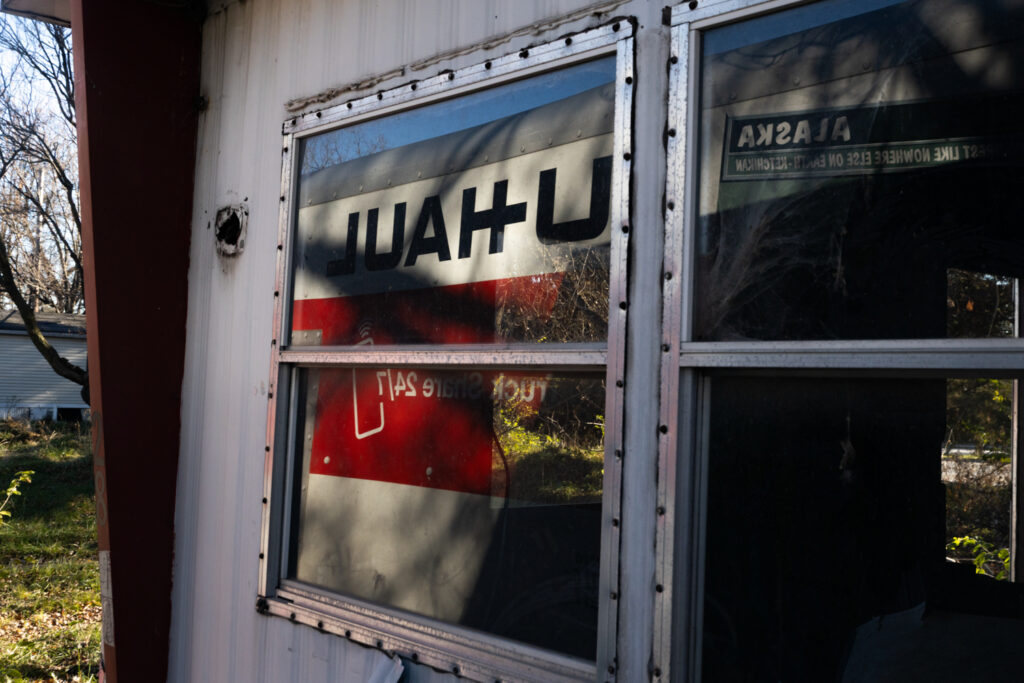
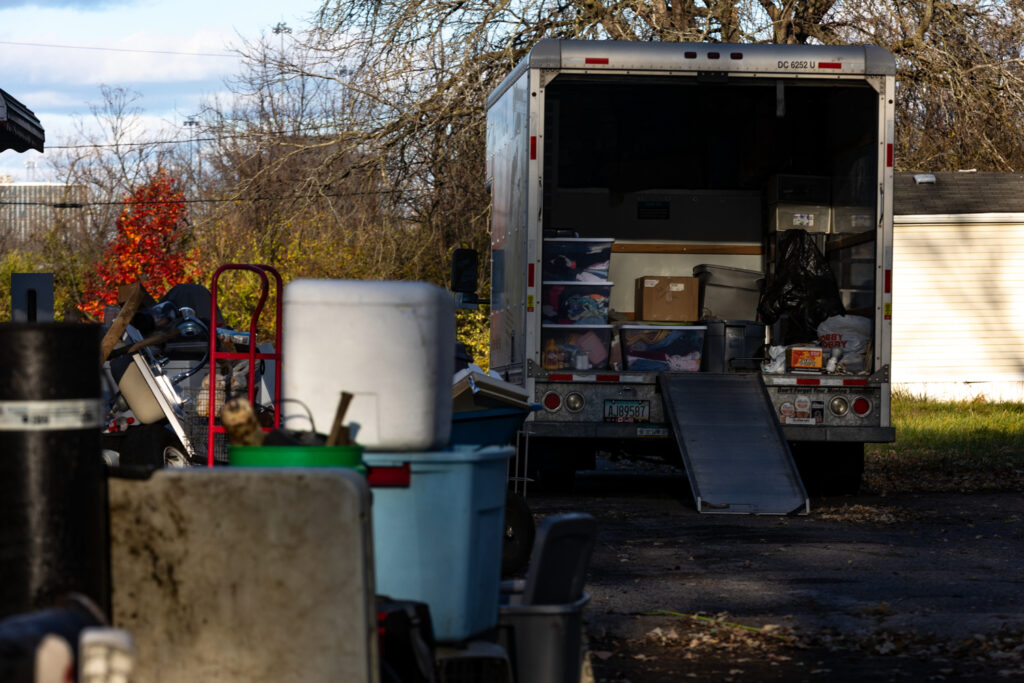
UHaul truck rented by Charles “Chuck” Parker. Parker was given money by the Lucas County Land Bank to be off the premises by Nov. 16, but has struggled to move things with the condition of his back. (TFP photo by Stephen Zenner)
Molnar stood with police at the front of the park, but dressed down from earlier in the day. He said this was because he didn’t want to impose his position on the vacating residents.
Friends of Luttrell objected to speaking with the press, but Luttrell said, “I’m leaving stuff– I’m leaving a hell of a mess for them,” and talked with her friends about looking for family pictures she couldn’t find.
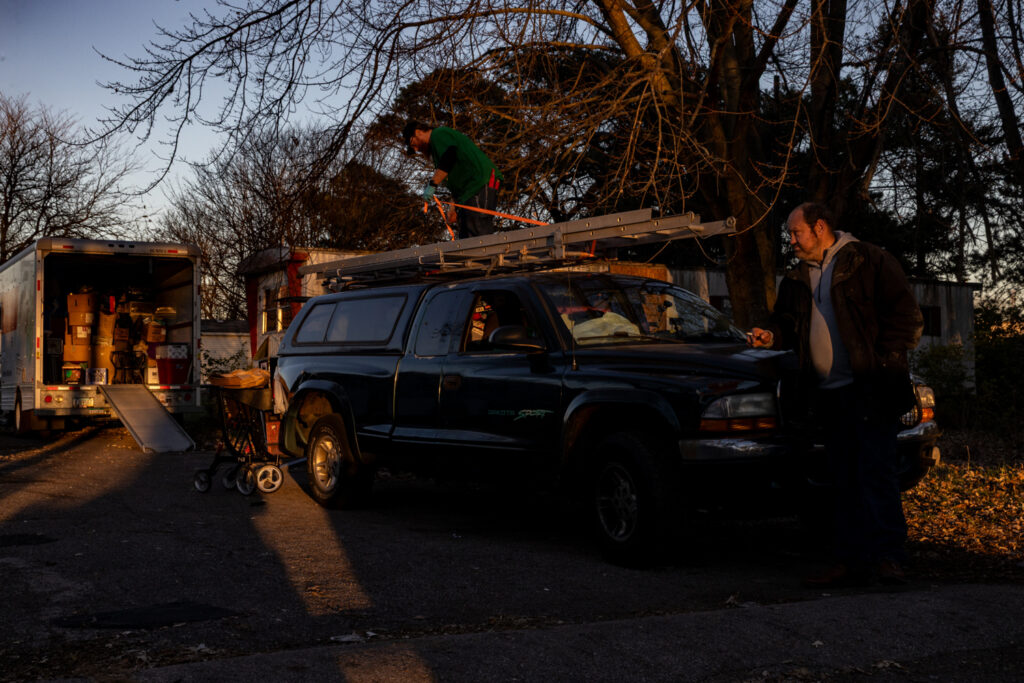
Kendall Parker, 35, straps a ladder on top of his Dakota Dodge truck, with Lee Kastel, a friend helping Parker’s family move, smokes on the hood of Parker’s car while they pack up to leave at Riverside Mobile Home Park at 18 City Park Avenue in Earlier in the day, the city came by to tell Parker and his family to be out of Riverside by 5 p.m. (TFP photo by Stephen Zenner)
She also asked Molnar if she could come back for her cats on Tuesday, which had all run off with the extra added excitement of the day. In response, Molnar couldn’t guarantee her entry to the park in the morning.
It wasn’t much past 5 p.m. when Luttrell was set to leave without her cats, but the Parker household was running behind.
Toledo Police are present for when the Parker household packs and moves their things at Riverside Mobile Home Park. (TFP photo by Stephen Zenner)
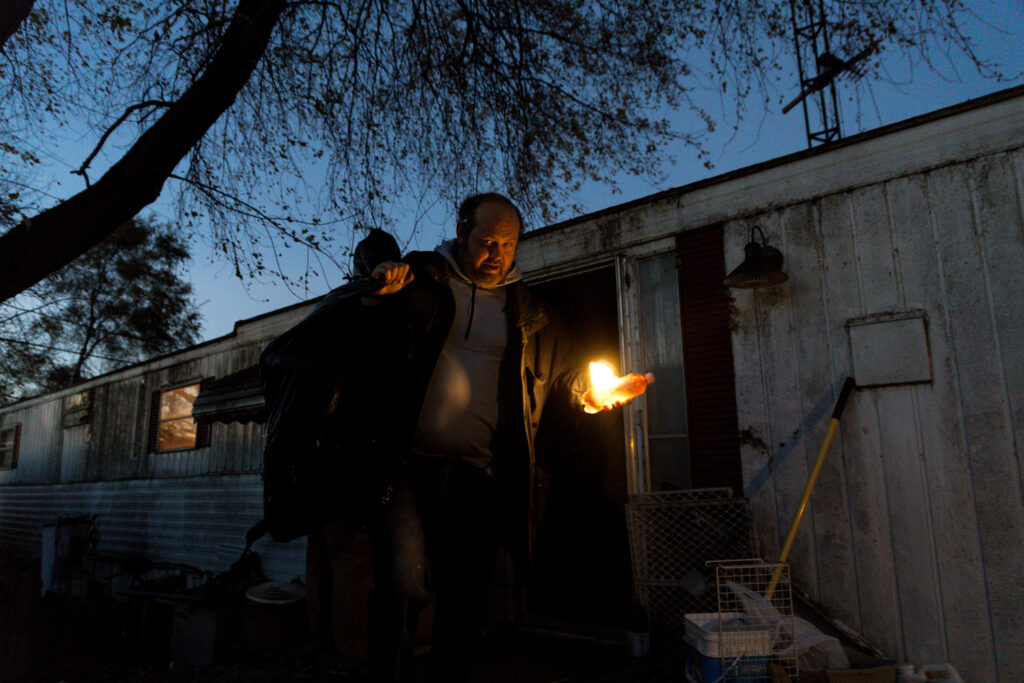
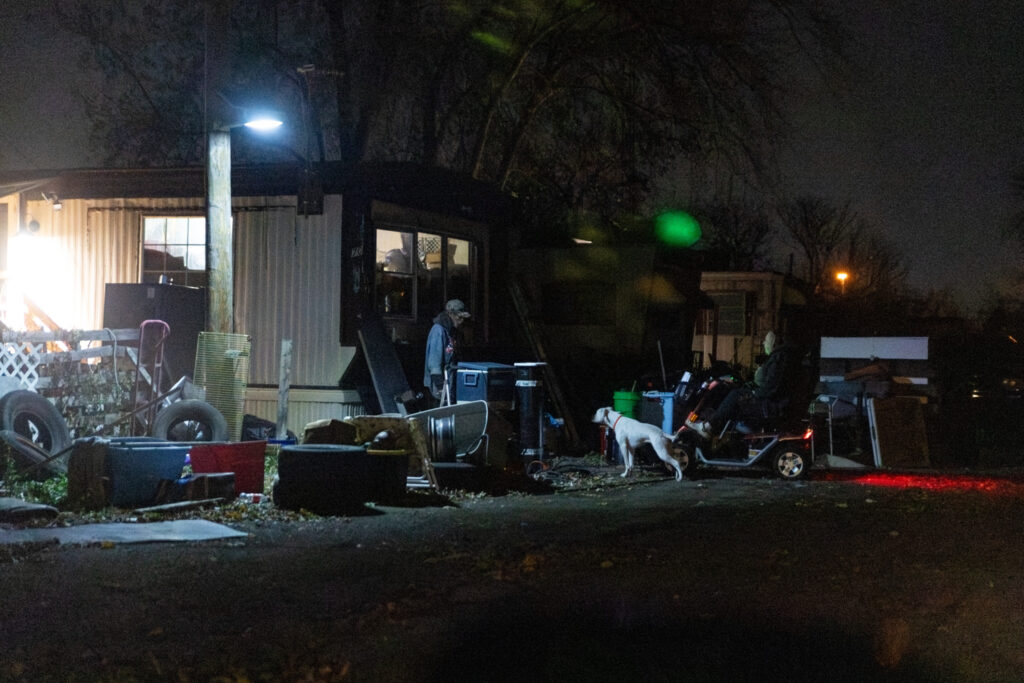
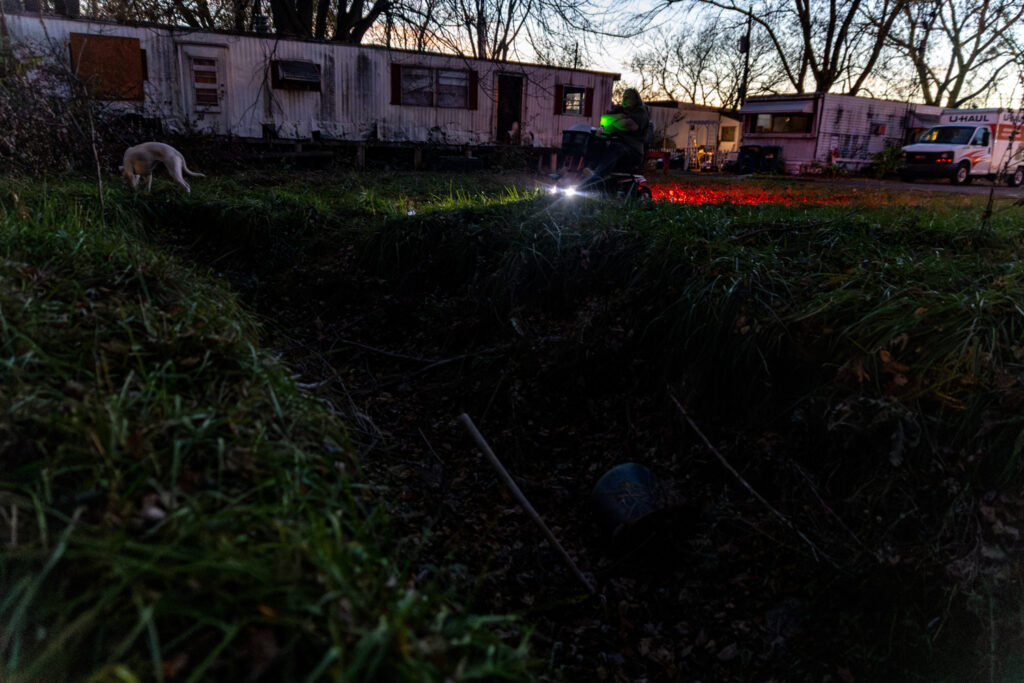
Lee Kastel, a friend helping Parker’s family move. After 5:30 p.m. the sun began to set and different members of the Parker household carried lights on their person to see. (TFP photo by Stephen Zenner)
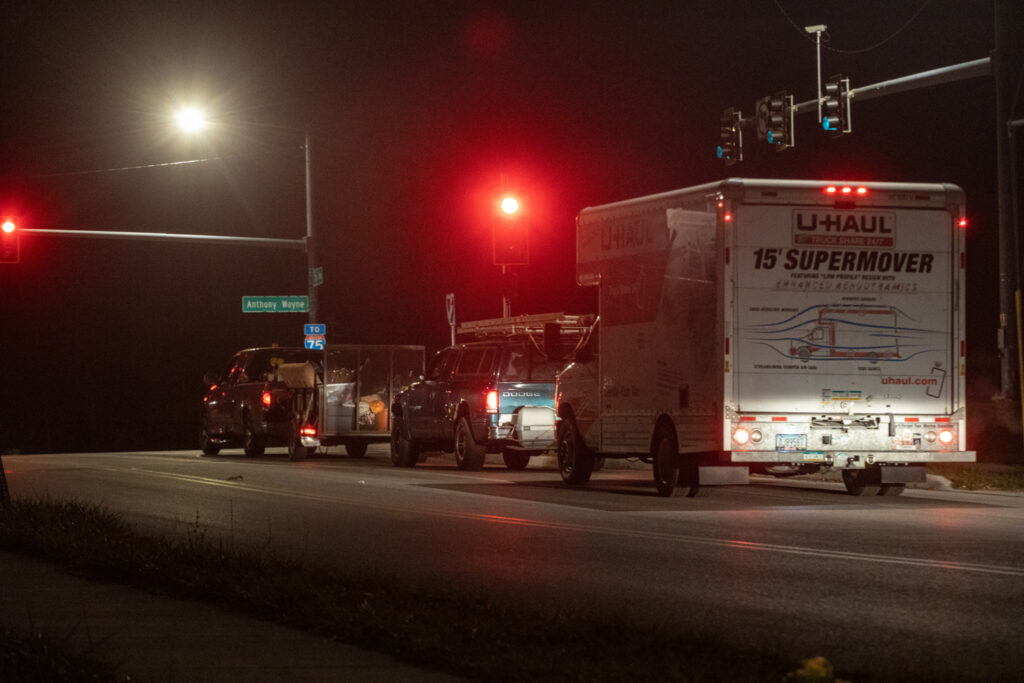
After 5 p.m., Toledo Police and Molnar approached the Parker’s who were packing three vehicles: a Ford F-150 with a trailer attached, a Dodge Dakota filled to the brim with items strapped to the roof, and a UHaul truck.
There were a few new faces loading up the trucks, but as the sun waned, the energy of the Parker household lessened as well.
Angel Smith, 31, Kendall’s significant other, expressed her fatigue, while the two Parkers continued to work quickly.
The two police officers on duty watched over the moving operation, but Molnar tried to help the Parker household. He carried a few trips worth of items from the mobile home to the trucks.
The packing night climaxed with Carol Kelly, 59, Parker’s wife, who has trouble walking, being helped into the UHaul. With a few other additions, the trucks were packed and on their way.
Parker, 66, and Angel Smith, 31, unload items from Parker’s wife’s mobile home around 5:30 p.m. in front of a Toledo Police Officer and Jim Molnar, the director of building and code compliance for the City of Toledo. Parker’s household was told to be out of Riverside by Sunday the 16th, but then was given an extension until 5 p.m. on the 17th. (TFP photo by Stephen Zenner)
The couple’s pit bulls rode with Chuck, and the family left to a monthly billed hotel around 6 p.m.
Charles Parker drives his red Ford F-150 with a trailer attached out of Riverside Mobile Home Park with his friend, Lee Kastel, who helped him move the family’s pit bulls. (TFP photo by Stephen Zenner)The small caravan of trucks carrying the Parker household’s items leaves Riverside Mobile Home Park. (TFP photo by Stephen Zenner)
Make a plan to stay for lunch or Happy Hour after you hit the court! Toledo Pickle’s restaurant, Stay Out of the Kitchen Grill, is OPEN 7 DAYS a week for both LUNCH & DINNER!
NOV. 28 ONLY…FREE 1-Hour Court Play with $50 GIFT CARD OR MERCHANDISE PURCHASE!. Plus…$0 Initiation Fees!
GIVE the GIFT of Toledo Pickle Gift Cards, Merchandise or Membership this holiday season!
BLACK FRIDAY ONLY we will be offering $0 initiation fees on ALL MEMBERSHIP LEVELS & free 1-hour court time vouchers for every $50 in gift card or merchandise purchases!
ARE YOU A TOLEDO PICKLE MEMBER HEADING SOUTH FOR THE WINTER?!
Check out the NEW Snowbird MEMBERSHIP PAUSE!
SNOWBIRD MEMBERSHIP PAUSE
(Applicable November 1st – March 31st with a maximum 90-day pause)
Players with any membership level who travel in the winter will now have the ability to pause their membership for up to 90 days. A $20 maintenance fee will be charged to hold their membership status during the pause.
Interested members should contact Brian Macionsky at [email protected] with notification of winter travel plans. The membership cycle date will remain the same.
During this maximum 90-day pause, membership benefits will be temporarily suspended. Members who book a court, open play, or an event during the paused period, will be charged non member rates.
To lift the pause, members will again email Brian Macionsky ([email protected]) and all benefits of the membership will be restored.
Once again, the cycle date for future payments will remain the same.
FREE Women’s Beginner PICKLEBALL CLINIC!
NOVEMBER 21 | 3PM – 4PM
This FREE beginner clinic is for first time female players who may or may not have ever picked up a paddle. Come learn the basics of the fastest growing sport in the world at Toledo’s newest entertainment facility! At the completion of this event, new players will understand scoring, serving, 2 bounce rule, and the kitchen. In addition, players will be provided future pickleball clinic options to continue improving their game.
Lucas County Commissioner Anita Lopez listens to constituents after the meeting. (AWFP photo by Karen Gerhardinger)
ANTHONY WAYNE – Looking around at the more than 150 people who came to a data center meeting at the Bunker Bar last week, Waterville resident Lisa Haberstock asked for a show of hands.
“Who is from Waterville? Waterville Township? Monclova?”
A large contingent from Waterside in Monclova Township cheered, while others called out the names of their communities: not just in the Anthony Wayne area, but also Maumee, Oregon, Richfield Township, Spencer Township and even Amboy Township in Fulton County.
“I think that this is a big, big issue; we can’t just work on our own. We have to work as a united front so everyone is safe from this,” Haberstock said, referring to work being done by the Lucas County Economic Development Corporation (LCEDC) and Regional Growth Partnership (RGP) to find suitable areas for potential data centers.
Richfield Township residents (from left) Ashley Garlick, Karen Winn, Vicky Loeffler and Travis Garlick listen to audience members ask questions about data centers during a November 13 town hall meeting at the Bunker Bar. (AWFP photo by Karen Gerhardinger)
The Nov. 13 event was hosted by a group of Anthony Wayne-area residents but expanded quickly, said organizer Lyn Cox, who launched the Anthony Wayne Community Response Awareness Group (AW-CRAP) on Facebook since learning of the county’s plans in late September.
“There is interest in forming a larger Northwest Ohio coalition regarding data centers and we are strategizing now. Our issues are the same, and we are sharing resources,” Cox said.
The main goal for those gathered last week is to urge local leaders to put a moratorium on data centers, advanced manufacturing, solar fields, transfer stations and related projects to give time for those involved to provide adequate transparency, and public involvement in approving or rejecting such projects, said Paul Wise, who emceed the Nov. 13 event.
Guest speakers for the evening were sisters Karen Winn and Vicky Loeffler, along with Vicky’s children, Ashley Garlick and Travis Garlick. Loeffler recalls how she received a letter on Memorial Day weekend, announcing that Richfield Township was considering a change to its Central Avenue overlay district, with a Lucas County Commissioner’s meeting slated to weigh in on those changes the following Wednesday.
The letter didn’t mention data centers, but Loeffler soon learned the intent, and was able to get a 90-day pause on the commissioner’s decision while she and her family rallied to gather as much information about data centers as possible. last week, they shared with the crowd their research on data centers including sound and vibrations, health impacts, wildlife disruptions, electricity and water use and the loss of quality farmland.
“This is about connection, vigilance and empowerment. This is about knowledge, not negativity. Together, let’s stay curious, stay united and make sure our voices shape the future, not react to it,” Loeffler said.
Lisa Webber and Paul Miller speak after the town hall meeting on November 13. Miller is running to fill Ohio House District 44 as State Rep. Josh Williams (R-Sylvania Twp.) is running for the U.S. House of Representatives. He is urging residents to sign petitions to change resolutions and ordinances that are in favor of data centers – to give communities time to become more educated on the topic. (AWFP photo by Karen Gerhardinger)
Winn and Loeffler have both been active with Richfield Township and understand smaller communities’ needs to find funds for roads, bridges, cemeteries and fire departments. Ashley Garlick admits that, at age 26, she hadn’t kept up with local government until learning about the data center proposal.
“There’s a lot of anger and confusion and sadness about what’s going on,” Ashley said. “Our trustees were trying to find a way to help the fire department and the schools. They’re also human too – they only have so much knowledge. They need us to do research and give feedback.”
Waterville Township trustee Julie Theroux voiced her frustration at not being included in discussions with the county early on. While Theroux and the other two trustees approved, on Aug. 27, adding data centers to the township’s zoning resolution – allowing them in agriculturally-zoned areas with a conditional use permit – Theroux said she later learned that the county had been mapping out potential areas for over a year, including a 1,000- acres section in Waterville Township.
Theroux made a public records request in September for all of the marketing materials and planning done by the LCEDC and shared that with Cox – her sister – who then shared it on Facebook.
“I am not anti-progress. I’m not anti-data center,” Theroux said. “I am for collaboration – local governments working side-by-side, planning thoughtfully and teaching the community early. That’s the foundation of trust and how we ensure that any growth truly benefits our residents.”
When she learned that the county has been developing plans for a 1 million square foot data center with a power plant township land, Theroux said she felt blindsided, knowing that the county had been working on plans for over a year, but didn’t inform trustees until this summer.
“When decisions are made that impact our water, land and homes…that raises serious concerns. We deserve a seat at the table on day one. We deserve transparency – to know what benefits, if any, are coming to the township, not just the county,” she told the crowd. “I’m calling on the county officials to put a pause on marketing our land to data centers. Open the book and bring the township and all of you into discussion where we belong.”
Gathering after the meeting are Waterville residents (from left) Lisa Haberstock, Shannon Bostelman and Tonya Robarge. (AWFP photo by Karen Gerhardinger)
In the audience that evening were several local officials, including Lucas County Commissioner Anita Lopez and LCEDC director Matt Heyrman. They listened as residents asked questions and spoke of their concerns.
Cheryl Nissen, a realtor, said she moved to the country with a plan to grow her own food and hunt on 20 acres.
“I came here to get away from technology. I sure as hell don’t want it sitting in my backyard,” Nissen said.
Others asked what could be done beyond attending meetings, asking questions and holding up “No Data Center” signs. Wise urged the audience to reach out to State Rep. Josh Williams (R-Sylvania Township). Paul Miller, a Waterville resident running to replace Williams – who is going to challenge U.S. Rep. Marcy Kaptur (D-Toledo) – said a referendum on local decisions is too late. Instead, Miller asked for volunteers to collect signatures on petitions to seek a change in ordinances and resolutions in area communities.
Maumee, Waterville, Monclova Township, Waterville Township and Spencer Township all have language in their zoning resolutions that would permit data centers. Harding Township voted against allowing data centers, and Richfield Township is moving away from permitting them, Wise said. Continue calling and emailing local officials, as well as the LCEDC, he and Cox recommended.
Suzanne Peats, a Waterside Monclova residents, said she’s not opposed to technology, but is against placing data centers in dense residential areas like around the Shops at Fallen Timbers in Maumee – which abuts the 602-home Waterside community. (AWFP photo by Karen Gerhardinger)
Waterside Monclova resident Suzanne Peats has done just that: emailing Heyrman with questions, attending area meetings, and asking specific questions of local officials.
“I’m a very tech savvy person. I think we have tremendous growth potential using AI, especially in the medical field. I support the evolution of technology to improve humanity,” Peats said. “What I object to is the mingling of such large, unknown industrial facilities in dense residential areas like we have in Monclova and Waterville, without knowing all of the impacts – which are significant. There is lots of remote land where these data centers, all funded by offshore money, can go to and set up.”
She and other Waterside residents are among those who plan to attend a town hall meeting on data centers hosted by the LCEDC, RGP and WGTE-TV on Thursday, Nov. 20 at 5:30 p.m. at Anthony Wayne High School, 5967 Finzel Rd. in Whitehouse.
“Under the Spotlight: Data Centers in Our Backyard,” will be moderated by Jerry Anderson and be livestreamed at wgte.org/livestream.
Sarah Gruner, Silvia Snyder, and Bill Emahiser from the Unison team won the bid for Dani’s Place and are excited to be a part of the project. They are next to the mural dedicated to Dani Leedy. (TFP photo by Gaven Hafner)
TOLEDO – A new chapter in mental health care is opening in Lucas County with the introduction of Dani’s Place, a 17,000 square foot facility designed to help individuals transition from state hospital care back into the community.
The concept behind Dani’s Place began in 2019, when Scott Sylak, executive director of the Mental Health & Recovery Services Board of Lucas County, began discussions with National Alliance on Mental Illness (NAMI) Ohio about the need to develop a step-down option to support psychiatric patients leaving the state hospital system.
“Dani’s Place was meant to take some of these most acute folks that are now on the road to recovery due to their longer term stay in the hospital, move them into a more structured environment so that they have a better opportunity to succeed once placed in the community,” explained Sylak.
(TFP photo by Gaven Hafner)
Construction of the building began in 2024 and concluded in June 2025. The facility was built with a focus on a home-like atmosphere with various resources. Dani’s Place has 16 private bedrooms along with other amenities including a library, group rooms, office space, and a small fitness area. Residents also have access to a fully equipped kitchen, laundry facilities, and outdoor courtyard.
Dani’s Place operates on a voluntary basis, meaning residents will choose whether to participate in the program rather than being required to do so. Residents will be allowed to stay for up to 90 days at the facility. During this time, residents will engage in individualized programming to help build practical skills, community interaction, and personal growth.
The facility has a full kitchen area to help individuals learn to take care of themselves in relation to making food and proper diet. (TFP photo by Gaven Hafner)
“We’re teaching them how to cook, we’re teaching them how to do laundry, we’re teaching them how to navigate the community, how to pay bills, and in addition to that, receiving mental health treatment,” said Bill Emahiser MA, LPCC-S, Director of Public Relations. The approach blends traditional therapy with hands-on learning opportunities to help prepare individuals for long term stability once they return to independent or group living.
Silvia Snyder, deputy director of Dani’s Place, described the program as a “mental health step down or rehab,” comparing it to physical rehabilitation after a serious injury. “People are going to have a little bit longer time to make sure that they have the skills that they need to be successful,” Snyder said. “We’re going to encourage group participation…activities like arts and crafts, CBT (Cognitive Behavioral Therapy), DBT (Dialectical Behavior Therapy), some of those other treatment modalities too.”
Residents will work closely with case managers, therapists, and psychiatric professionals to build confidence and life skills necessary for a successful transition back into the community. The combination of therapy, skill building, and social engagement will provide a holistic approach to the resident’s recovery.
Dani’s Place carries a deep personal legacy. The facility is named in memory of Danielle “Dani” Leedy, who lost her battle with depression in 2019. Her parents, Jeff and Donna Heck, established the 33 Forever organization and contributed their support to the creation and design of the building.
“When you go to Dani’s place, you will see tributes to Dani throughout the facility. The internal design elements were all in lockstep with the whole Heck family,” said Sylak.
Unison puts together welcome baskets for all the residents to receive upon their arrival (TFP photo by Gaven Hafner)
The facility will be operated by the Unison Behavioral Health Group who won the bid for the job. Sarah Gruner, Unison’s director of clinical projects, said, “Dani’s Place will provide a safe, stable environment for individuals to continue their healing and recovery journey before they return home.”
As Dani’s Place prepares to fully open in 2026, it stands as a collaborative effort between families, mental health professionals, and local organizations. More than just a building, it represents a bridge between hospitalization and home. A place where recovery, dignity, and hope can flourish. With its thoughtful design, supportive programs, and voluntary participation model, Dani’s Place plans to be a beacon of care for those taking their next steps.
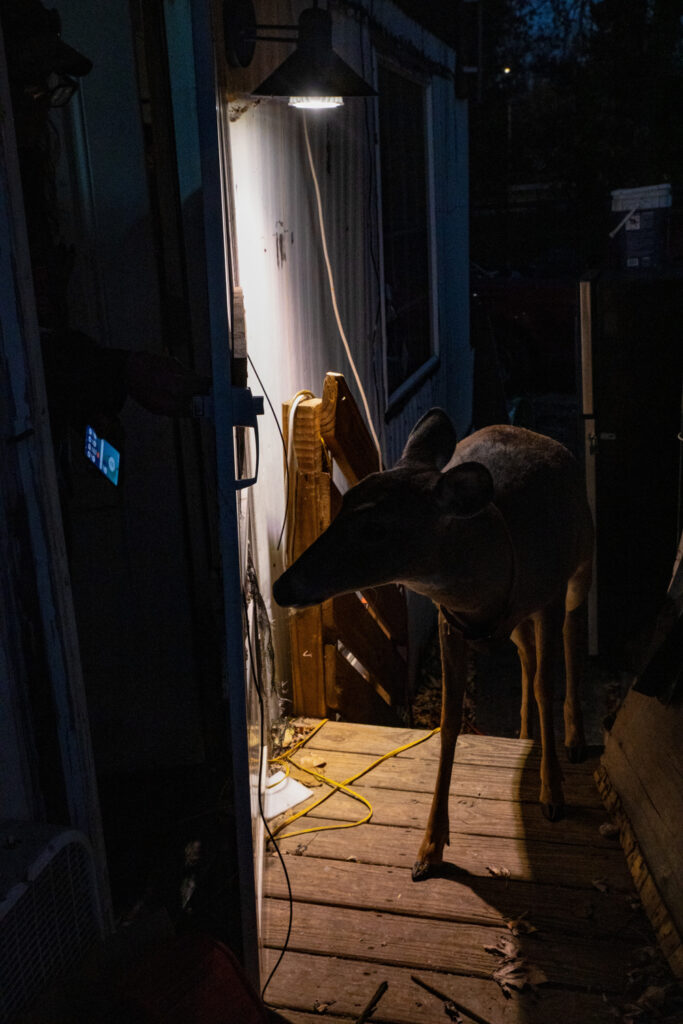
Lotus Rain, a semi-domesticated deer, touches noses with Charles “Chuck” Parker at Riverside Mobile Home Park at 18 City Park Avenue in Toledo, Ohio on Saturday November 15, 2025. Parker has fed and taken care of Rain for a number of years, and plans on transporting Rain to his new place. TFP Photo/STEPHEN ZENNER
TOLEDO – Green spray-painted letters on the side of a trailer home warn passers-by to “Keep Out” of the Riverside Mobile Home Park, just outside of downtown Toledo.
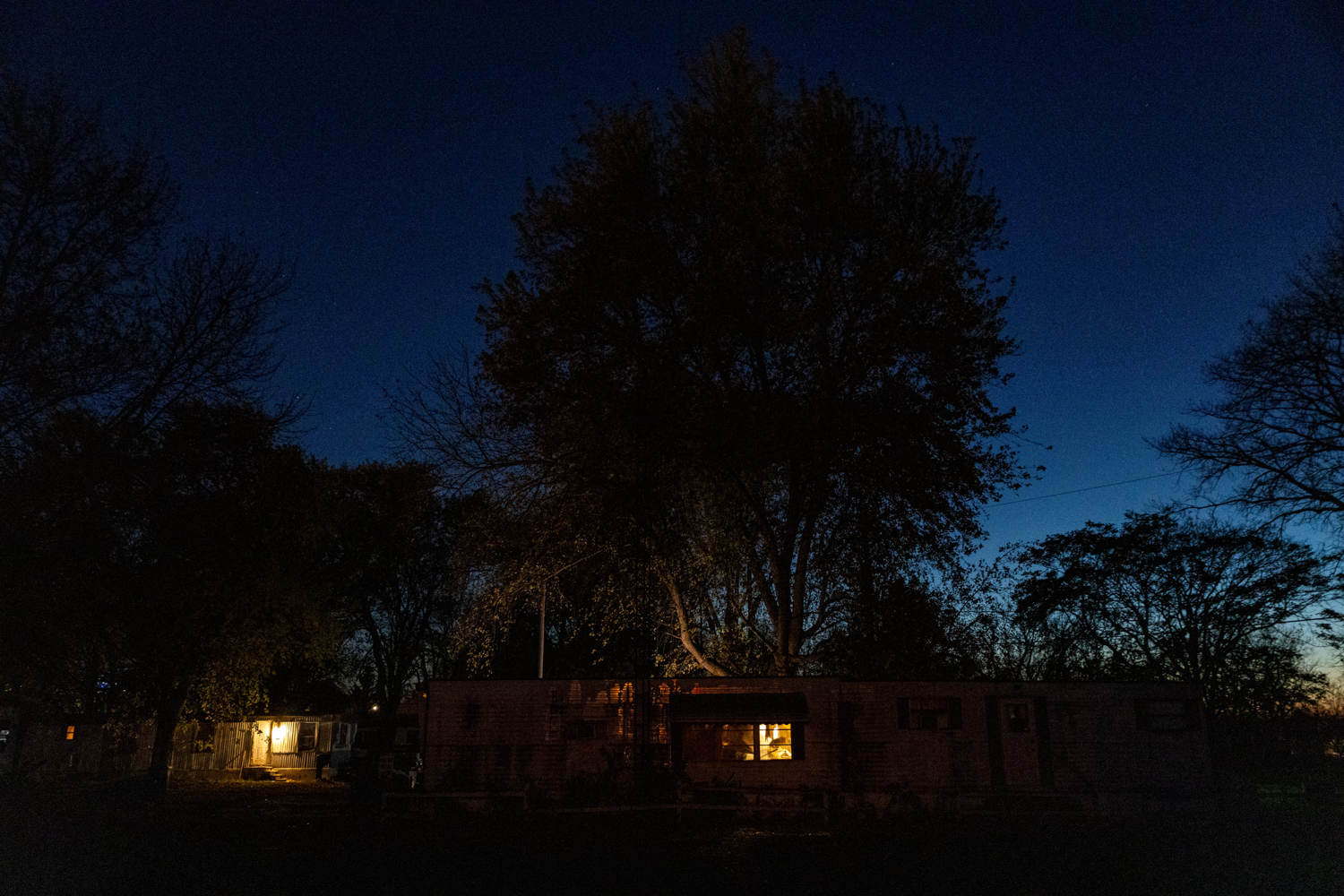
Six months on from the city shutting down the park, the graffiti speaks louder than the infinite “No Trespassing” signs across the three rows of rectangular homes laying cracked open with fiberglass insulation oozing out of them.
Lotus Rayne, a semi-domesticated deer, stands in front of one of the deteriorating trailers at Riverside Mobile Home Park. TFP Photo/STEPHEN ZENNER
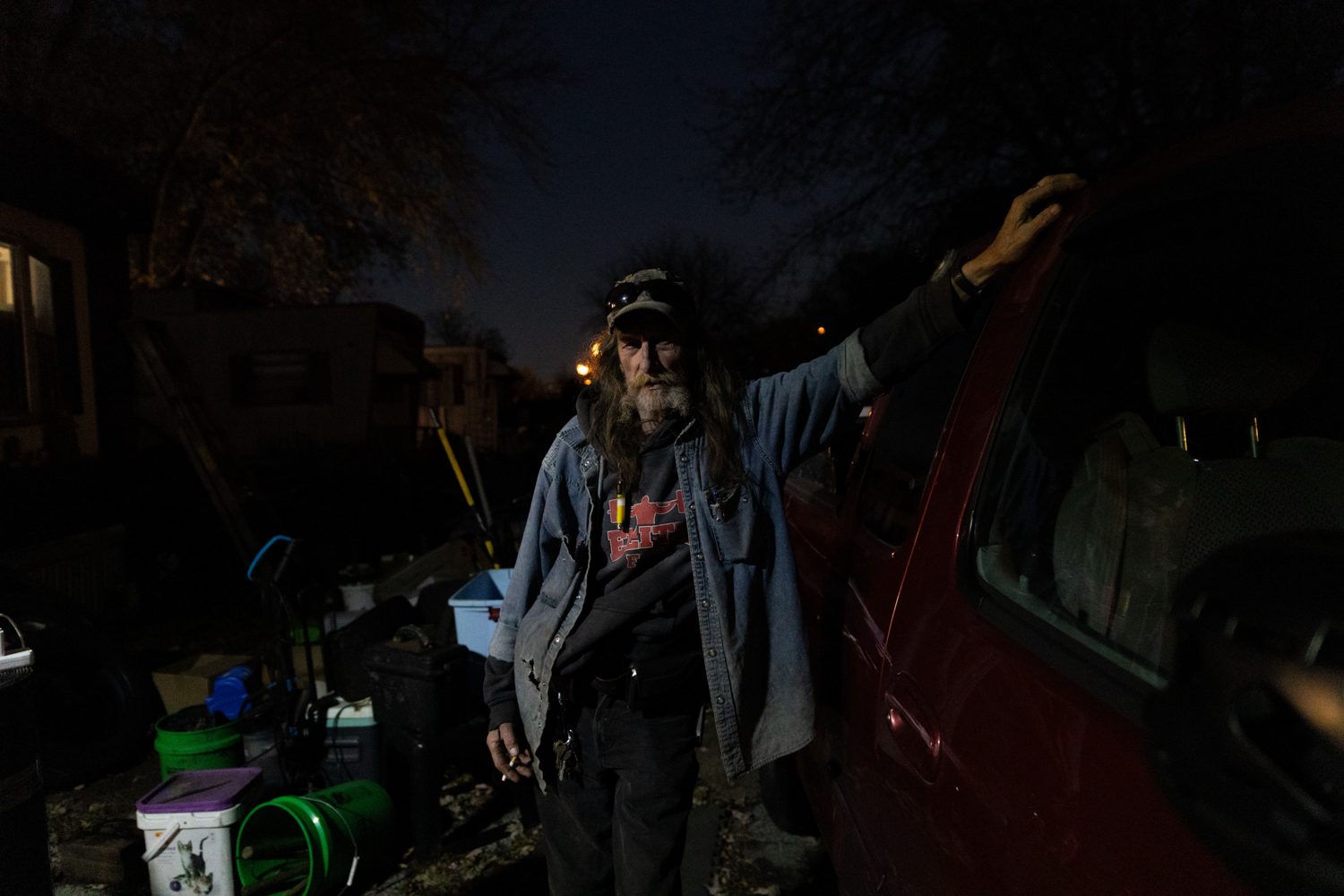
“Time is getting short for us,” said Charles “Chuck” Parker, 66, who has lived at Riverside for the past five years with his wife and adult son. “I’m just waiting for them to come knocking on the door and tell us that we gotta’ go.”
Technically the city told Parker and others to move out months ago, but have allowed Parker and other residents with more complicated living needs to stay while they look for new housing. Soon, however, the city is going to demolish the park in the latter half of November.
Charle “Chuck” Parker stands outside his mobile home, and next to his wife’s scooter at Riverside Mobile Home Park. (TFP photo by Stephen Zenner)
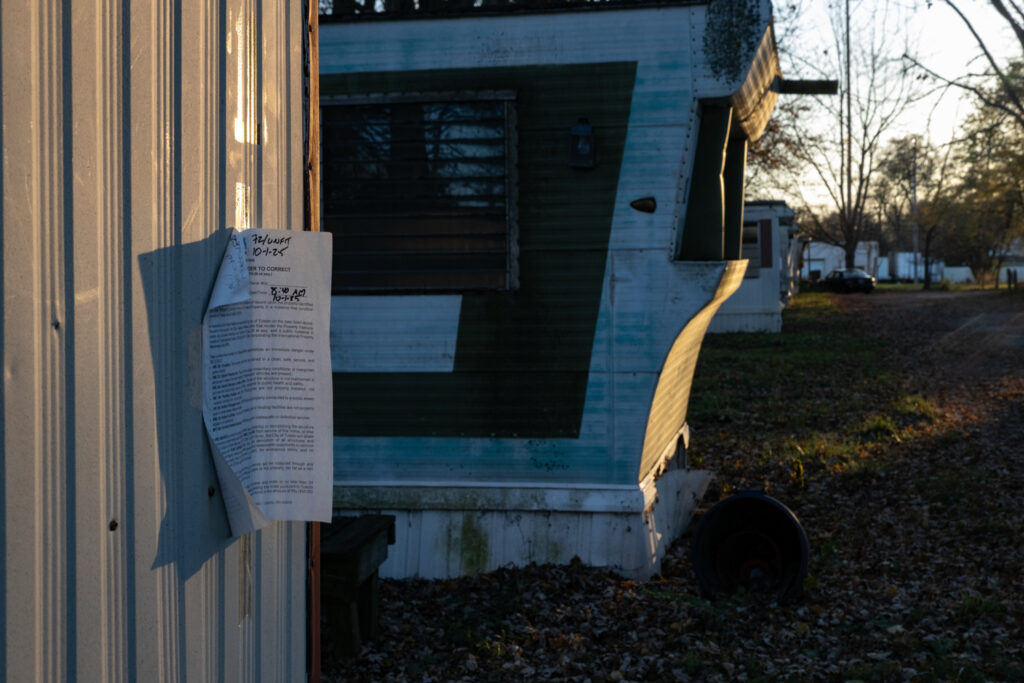
White papers are attached to just about every trailer with their own personal list of code violations: “Unsafe Conditions, Plumbing Systems and Fixtures, Sanitary Drainage System, Heating Facilities and Electrical Systems Hazards,” read some of the code violations on individual trailers.
When the city first declared Riverside uninhabitable, people stopped paying rent, and the absentee landlord, out of Illinois, attempted to evict tenants who weren’t paying to live in a condemned trailer park.
Warning from the City of Toledo placed on the leasing office at Riverside. (TFP photo by Stephen Zenner)
Parker was keenly aware of the failure of owner Ernesto Garcia to upkeep the property.
When first talking about the reason for the park’s shutdown, Parker pulled up exhibit A, a sampling of the decades-old ceramic plumbing lines running underneath each trailer home.
Parker holds a part of a sewer line. Part of the reason the city shut down Riverside Mobile Home Park was the broken sewage lines that hadn’t been replaced in decades. (TFP photo by Stephen Zenner)
“These are from the 50s,” he said, holding the piece that appeared to be made of concrete and clay. “There’s a lot of busted water lines in here…because the trees plugged it up.”
“Trees love sewage; it’s like candy to them.”
Here Parker and his partner of 38 years, Carol Kelly, 59, live off the beaten path, each with their own trailer home, and in between is a home that has collapsed in on itself, and the trees have blocked up the sewage.
Charles “Chuck” Parker, 66, walks towards Ann Marie, a pit bull, and his wife, Carol Kelly, 59, after receiving help from the Lucas County Land Bank. Parker and Kelly receive disability, but Parker takes particular care of his wife with her mobility needs. TFP Photo/STEPHEN ZENNER
Nevertheless, the homes he and his partner occupy are “in a lot better shape than when I bought it,” Parker said. A few thousand dollars for each mobile home bought the couple a place to live, but they had to put in work to make them livable.
“There was no electrical working in here. The plumbing was all messed up. Same thing with that one,” he said, motioning to his wife’s trailer.
“I put a whole new bathroom in this one,” he said. “They don’t give a shit.”
Since Riverside has been condemned and is scheduled for demolition, Parker is forced to find new housing for his family. (TFP photo by Stephen Zenner)
For years, Parker has tried to make a bad situation better, but hasn’t seen much benefit.
“This has been a very long running issue at Riverside,” said Paul Redrup, an attorney with Advocates for Basic Legal Equality (ABLE), who has been watching the residents of Riverside struggle to get help since April of this year.
“Folks kind of moved out in phases over time.”
But before people started to leave, Garcia sold the park to a woman, and then he bought it back from her, “and over the course of her ownership, and then his re-ownership it just degraded over that period of time.”
Written and unwritten code
Parker and his wife Kelly said the city got involved when the owner tried to evict a fellow tenant of the park, Willie Smith, for not paying rent. According to their retelling, Smith complained about a lack of electricity and sewage to his trailer, and then stopped paying rent.
Code violation papers placed on the trailers at Riverside Mobile Home Park on Wednesday November 12, 2025. TFP Photo/STEPHEN ZENNER
When the owner tried to evict Smith for not paying, Smith reported code violations, and the City of Toledo gave Garcia a list of updates the park needed to make to remain open.
By this time, Parker and his wife had become unofficial employees for the absentee landlord, “Basically we were being the managers, but we weren’t officially the managers,” Kelly said.
“When the city started coming down on things in here. He [Garcia] hires these people off of Craigslist to come out here,” she said, and Parker and Kelly would try to instruct them on what needed to be done, without success.
“They’re like, getting high, walking around with liquor bottles,” she said. “I mean literally, it caused more problems than what it solved.”
A trailer viewable from Collingwood Boulevard at Riverside Mobile Home Park. Much of Riverside is now vacant and abandoned, but the mobile home park is incredibly close to the center of the city. (TFP photo by Stephen Zenner)
While the couple admits some of the trailers were dilapidated over a year ago, they made the best of a difficult situation.
Both Parker and Kelly live off of disability, with Kelly barely able to walk even with the use of two canes, and Parker with intense back pain he generally works through.
Charles “Chuck” Parker, 66, talks with his wife Carol Kelly, 59, outside of his mobile home with Ann Marie, one of their dogs. TFP Photo/STEPHEN ZENNER
The couple were invested in staying in their trailers, and trying to fix up the park to make it a livable situation for their community.
Redrup said, “The owner would – I wouldn’t say continuously, but frequently – would reach out to Chuck and Carol and try to use Chuck as a conduit to, I think, try to retain ownership of the Park, but without actually fixing the issues.”
“I don’t know where he was finding folks,” he said about the hired help, but clarified that when they tried to cut the tall grass, “they would drive over it [water lines] with the lawn mower, they would break it, and now you’ve got an open, pressurized water line.”
“Now the city pressure is just pumping water out onto the ground.”
Kelly corroborated this story, and remembers significantly losing water pressure.
“The Craigslist guys hit three water lines in one day,” she said. “I couldn’t even use my sprayer.”
Carol Kelly, 59, shows a ditch where a man who was drunk dug a ditch perpendicular to a sewage line, and ended up doing more damage than good in his efforts to help with the plumbing at Riverside Mobile Home Park. TFP Photo/STEPHEN ZENNER
Three open water lines and no one coming to fix them eventually led to over $150,000 in unpaid water utilities, tens of thousands of dollars in unpaid property taxes, not to mention thousands of dollars owed to the county in unpaid land taxes with still no sign of Garcia.
Lotus Rayne, a semi-domesticated deer, walks towards the leasing office at Riverside Mobile Home Park. TFP Photo/STEPHEN ZENNER
What can be done?
Other problems with Riverside included broken sewage lines, animal infestations, trees falling on trailers and dangerous electrical lines.
“Nobody did anything to hold the ownership accountable [for] not paying the water bill,” Redrup said. “And that’s sort of a pattern of what happened here, this ownership not being held accountable for a variety of factors, and just one of them is the water situation.”
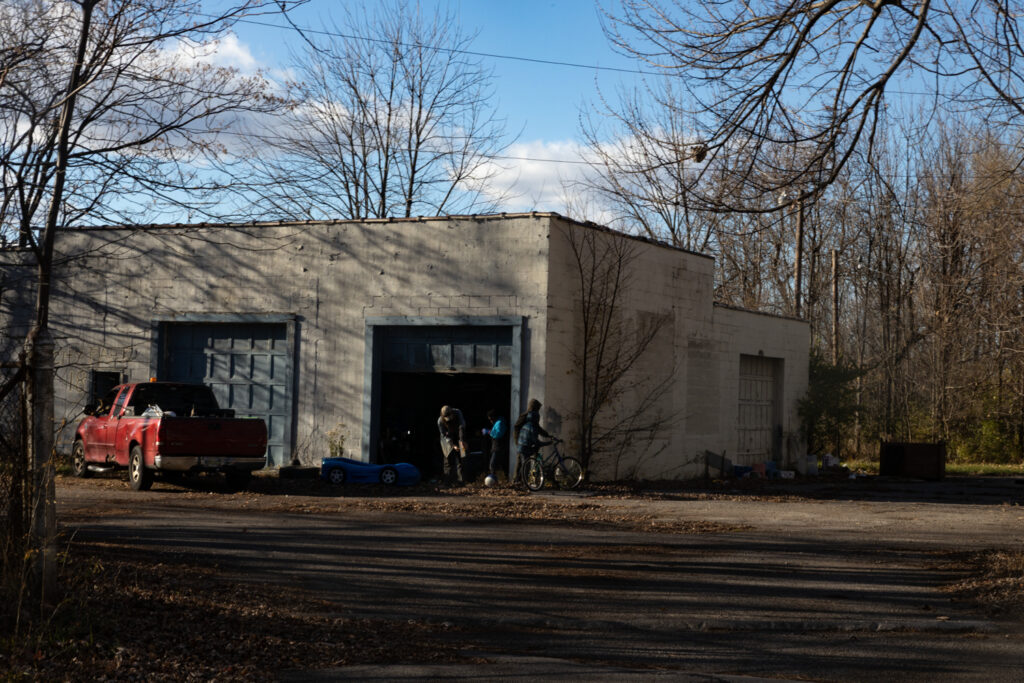
The roof is rotted in the garage at Riverside Mobile Home Park. TFP Photo/STEPHEN ZENNER
And once the media began reporting on the vulnerable nature of Riverside, Parker, Kelly and Redrup said, “scrappers and thieves” started working their way through the homes.
“There are enforcement mechanisms that are available that I don’t think are being utilized,” Redrup said. “Obviously, not enough is happening.”
Redrup referenced Ohio Revised Code 3767 as a possible way to compel property owners to do right by their tenants.
In layman’s terms, “Take it over and fix it up,” Parker said. “But don’t bulldoze it and make us homeless. You know, that don’t make sense.”
But now, with the park left in such a poor state, the only option may be to bulldoze Riverside.
“Had it been done earlier on, [Ohio Revised Code 3767] probably would have been a very useful tool,” Redrup said.
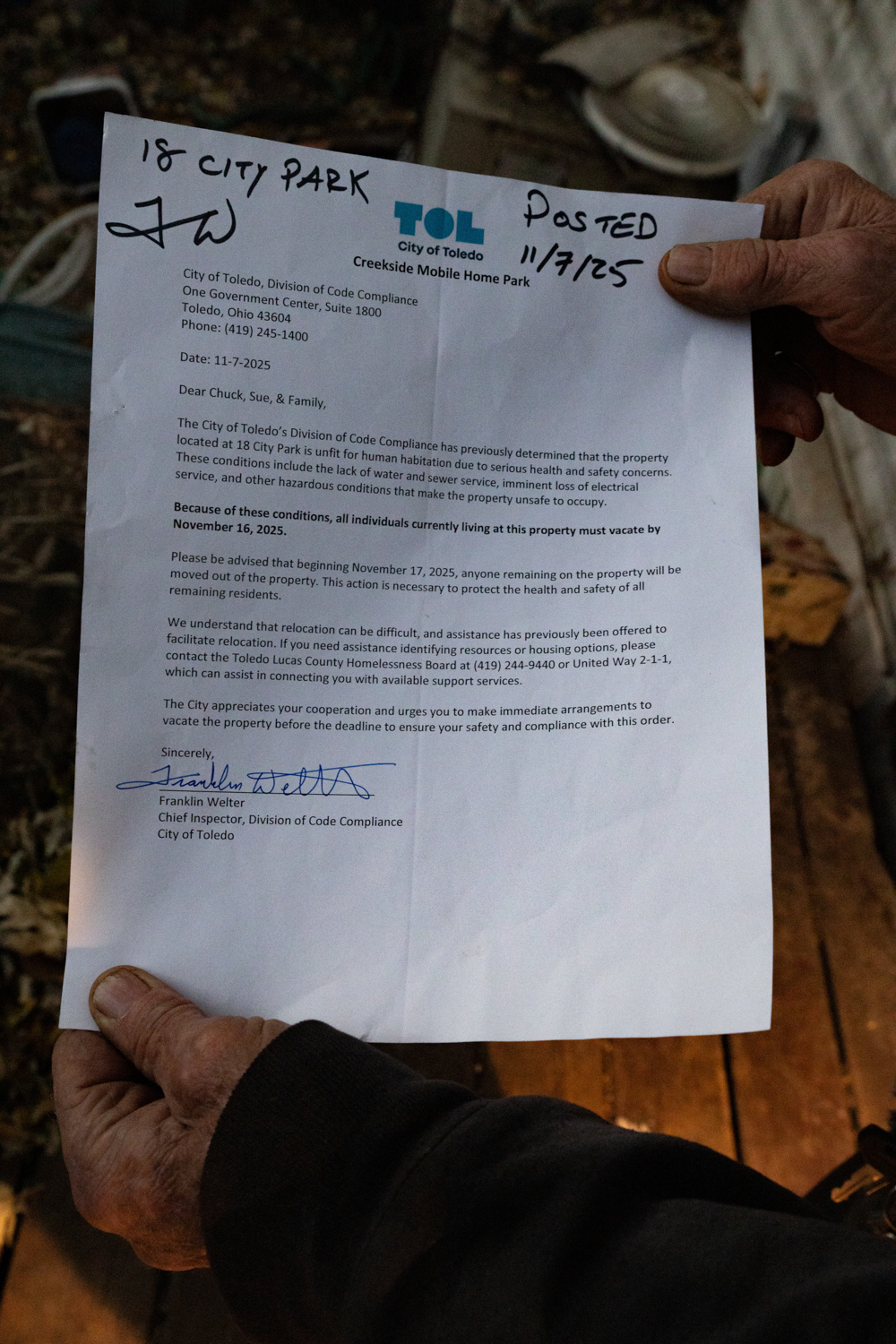
Charles Parker holds a notice from the City of Toledo urging him to vacate the premises of Riverside Mobile Home Park. Jim Molnar, the director of building and code compliance for the City of Toledo, said the city was looking to demolish the mobile home park that has been left in disrepair. (TFP photo by Stephen Zenner)
Just a week ago, Parker received a notice about the city moving to demolish Riverside.
“I know one of the reasons why they [the city] went this route,” Redrup said. “It is so bad that it is, I mean, there’s no question, it is a legitimate health and safety hazard to anyone living there.” And then added, “But it didn’t start that way.”
“This could have been handled much earlier in the process; it didn’t have to become what it is now. Could you fix it up? Sure, but the cost to do so is so outrageous at this point.”
Moving on
About a month ago, the city disconnected the water, so Parker started buying water for everyday use.
There are two main households left from the nearly 20 households estimated to be here before the park began to deteriorate at a rapid pace.
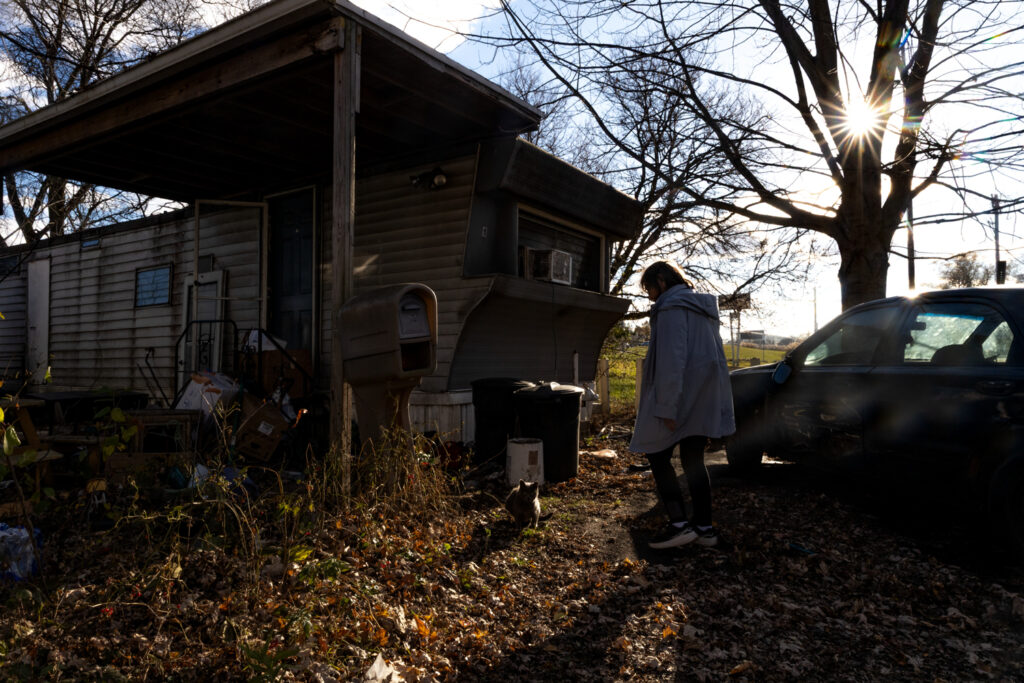
“It was nice to get together and have cookouts and birthday parties for some of the residents,” said Susan Luttrell, 70, who’d been living at Riverside since 2018, and is one of the last households left in the park. “It was just nice,” she mused.
“When I bought this [the trailer] I never planned on having to move again,” Luttrell said of her home at the entrance to the park.
Susan Luttrell, 70, stands in front of her 1958 New Moon trailer at Riverside Mobile Home Park. Luttrell moved into the park about eight years ago and has had difficulties finding an economically viable solution to her living situation. (TFP photo by Stephen Zenner)
“This is a 1958 [New] Moon,” she said, referring to her vintage trailer. Like Parker, Luttrell invested in her home, “put wiring, plumbing you name it, just about 1,000s of dollars, because it was a fixer-upper.”
Other trailers may not have had water or sewage, but Luttrell and Parker paid/or installed those amenities themselves, along with electricity.
“The problem with owning these is they’re too old to move,” Parker said, plus, “Nobody will let us bring them into their park.”
Susan Luttrell, 70, walks into her 1958 New Moon trailer past her 16-year-old cat, Blue. TFP Photo/STEPHEN ZENNER
Charles Parker and his wife’s homes are a little newer, but the fact is, the mobile homes aren’t very mobile. Both Parker and Luttrell fear the trailers would fall apart if moved.
Luttrell, like Parker and Kelly, is disabled, with back problems. Standing for long hours is difficult for her, and she takes each step up to her home with great preparation.
Back in March, right before the park was shut down, Luttrell had a stroke, but she’d received help from her community.
“I go to the grocery store on Broadway. The owners, three owners, they all know my first name,” she said. “One day, one of them pulled me aside. He said, ‘Susan, if you ever need any food on credit, we’ll do that for you.’”
“I’ve been going there for 25 years; it really surprised me,” she said. “‘We’ll run you a line of credit.’ And I never asked.”
In the meantime, Luttrell has thought about moving to another trailer park, but hasn’t mentioned specifics.
Next steps
TFP Photo/STEPHEN ZENNER
Since Parker and Luttrell owned their trailers, this move is a loss for them, which forces them into more expensive living situations.
“I can’t find a place to rent that is comfortable for me,” Luttrell said, summing up the problem current residents of Riverside have found.
Homes in Toledo cannot compare with the $350 a month the residents of the mobile home park paid for their space on the lot.
“The wife sits on the phone all day looking at housing,” Parker said. “It’d be great to find a fucking house and be done with it.”
With four dogs: Ann Marie, Sadie Lynn, Buttons and a pit bull named Dan; five cats: Fluffy, Gizmo, Missy, Princess and Theodora Ellen Bear (Ted E. Bear); and a pet deer named Lotus Rain, the couple decided that renting wasn’t really an option for them.
Buttons a small dog that originally belonged to Carol Kelly’s mother, sits on Kelly’s electric scooter, with Ann Marie, a pit bull, in the foreground. TFP Photo/STEPHEN ZENNER
“We would have been paying about $1,800 a month for the pets and everything,” Kelly said.
Unfortunately, Luttrell isn’t sure of her options, and fears she’ll have to leave her cats behind as she looks for another trailer park.
But Parker and his wife have chosen to look for a house to buy instead of renting, using the credit of their 35-year-old son, Kendall Parker, since they have no credit.
Lotus Rayne, a semi-domesticated deer, comes to visit Charles “Chuck” Parker, 66, as he feeds Rayne snacks. Rain has become a beloved pet within the mobile home park who lives off of cat food and corn for the most part. TFP Photo/STEPHEN ZENNER
“She’ll see one that’s suitable, because its bathrooms are downstairs, yards we can have the animals in,” but then Parker says the living spaces are snatched up.
Lotus Rayne, a semi-domesticated deer, feeds on cat food next to Charles Parker. TFP Photo/STEPHEN ZENNER
Kelly and Parker both believe the scarcity of housing comes from outside investors buying up all the properties, leaving everyday folks with few options to buy or rent.
“I have list after list after list after list of houses that we have looked at,” Kelly said. “About 500 [properties she’s looked at] in the last six months.” And then she estimated Parker had driven by about 100 homes in-person, but the pictures don’t always match the in-person experience.
“‘What’s the matter with it?’” Parker said, so he could answer himself. “Well, there’s no furnace, no hot water heater, and he wants us to rent it for $1050 a month.”
Initially, the couple called 211 for the United Way, and got connected with a number of resources from nonprofits and the city.
Lotus Rayne, a semi-domesticated deer, comes to visit Charles “Chuck” Parker, 66, as he feeds Rain donuts. TFP Photo/STEPHEN ZENNER
“There were discussions,” Redrup said about the different organizations that shared what they could. “But nothing that materialized.”
Most of the suggestions offered to Parker and Kelly pushed into non-negotiable areas for them.
The couple needed a bathroom downstairs, because of Kelly’s issues with her knees. They would not go to a place like a shelter where they couldn’t take their pets, and Parker was deeply worried he would be separated from his wife if he entered into some sort of welfare facility.
“‘Why don’t you just stay in the shelter until you find something?’” Parker asked himself. “Us not being legally married. [We] Can’t do that. We can’t be together [in a shelter].”
“I’m basically her caretaker,” he said.
Parker stands next to his red F-150. (TFP photo by Stephen Zenner)
Still looking
In the meantime, the city has given the few who are left in the deteriorating mobile home park a timeline to get out.
“I guess we’re screwed big time,” Parker said. “Because we just found out from our lawyer earlier today that to give me financial assistance from the land bank/the city, we had to have whatever turned in by noon.”
Fortunately, Parker, Kelly, Luttrell and Kendall Parker, were all able to access grant funding through the Lucas County Land Bank, to help them transition, even with missing some deadlines.
Carol Kelly, 59, a disabled woman living at Riverside Mobile Home Park, receives a card from Shantaé Brownlee, the senior vice president for operations and chief financial officer for the Lucas County Land Bank. Brownlee and the Land Bank were able to get grants for those left at the mobile home park, so they could move into temporary housing while they continue to look for a more permanent living situation. (TFP photo by Stephen Zenner)
Jim Molnar, the director of building and code compliance for the City of Toledo, said Monday or Tuesday, the week of Nov. 16, the city would be moving demolition equipment into the area. But he did include a caveat that there would be a willingness and patience to work with those who have been stuck in the park for the past six months.
The Toledo Free Press tried to get more in-depth explanation on the attempts made by the city to help those at Riverside, but did not hear back from the City of Toledo’s communications department.
Charles “Chuck” Parker, 66, rented a UHaul, and is loading a number of things into the truck. The park is scheduled for demolition, so Parker and his family are trying to get their things to a storage unit and will live in a temporary situation until they can find a permanent one. TFP Photo/STEPHEN ZENNER
“You got to think the folks that are still there for the last six months, have been living in a trailer park that was condemned,” Redrup said from his experience trying to help all the separate households involved to get a better living situation.
“These folks have been living in a crisis situation for easily a year. They’re tired,” Redrup said.
Over the past months, Parker has been moving items to a storage unit, and his family plans to move to a short-term living situation inside a monthly billed hotel until they can find a more permanent living situation.
Charles “Chuck” Parker, 66, stands in the back of his red F-150 pickup truck he’s loaded with items to move out of Riverside Mobile Home Park at 18 City Park Avenue in Toledo, Ohio on Sunday November 16, 2025. Tomorrow the City of Toledo has told Parker they will be attempting to demolish the park. TFP Photo/STEPHEN ZENNER
“It’s important to play up the resilience of the people that we’re talking about here,” Redrup said in summation, and praised the positivity the Parker and Luttrell households displayed.
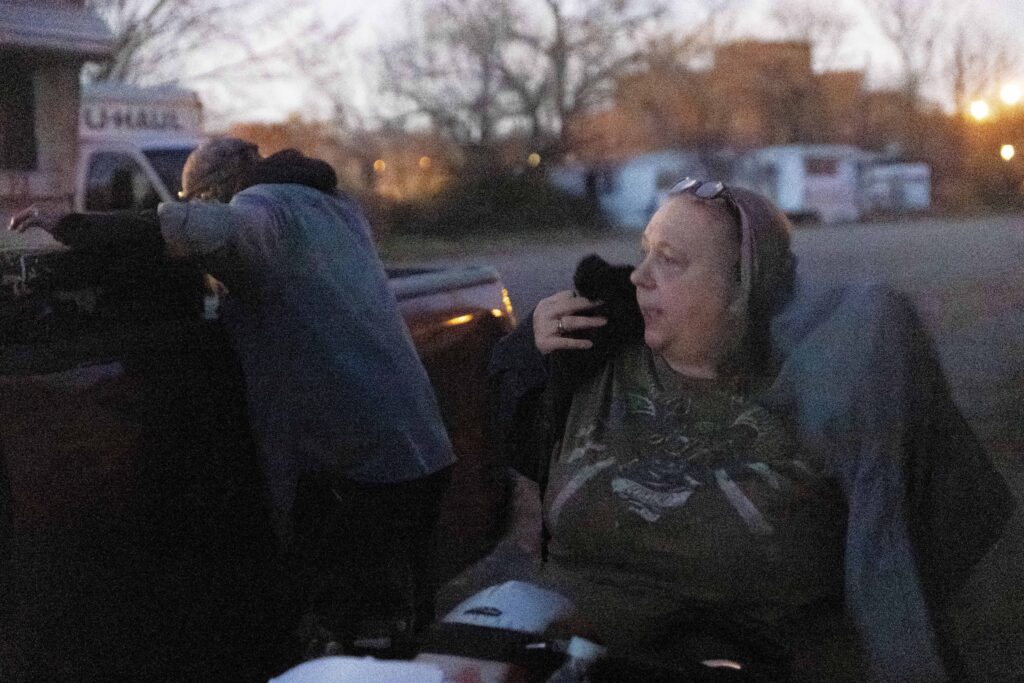
Charles “Chuck” Parker, 66, brought his wife Carol Kelly, 59, a jacket, as it gets darker at Riverside Mobile Home Park at 18 City Park Avenue in Toledo, Ohio on Friday November 14, 2025. Kelly has two bad knees and trouble walking, and Parker takes special care to make sure his wife is comfortable and cared for. TFP Photo/STEPHEN ZENNER
Leading up to the week of the demolition Kelly said she had trouble sleeping.
“This was all very, very stressful,” she said. “The last couple nights I haven’t gotten to sleep until 5 a.m.”
Parker is pessimistic about the couple’s ability to move out by Monday, but said they would do their best to get out of the city’s way.
The lights remain on at the mobile home of Kendall Parker, 35, and his mother Carol Kelly, 59, at Riverside Mobile Home Park. In November, Charles Parker, Kendall’s dad, mentioned the city went through the park cutting off power to any home that was unoccupied, as they gear up to demolish the park because the poor shape the absentee landlord left it in. (TFP photo by Stephen Zenner)Neighborhood kids stop by to look at what Charles “Chuck” Parker is doing.Lotus Rayne, a semi-domesticated deer, tries to eat the beard of Charles “Chuck” Parker. He has fed and taken care of Rain for a number of years, and plans on transporting Rain to his new place. (TFP photo by Stephen Zenner)Lotus Rayne, a semi-domesticated deer, comes to visit Charles “Chuck” Parker, 66, in his home at Riverside Mobile Home Park at 18 City Park Avenue in Toledo, Ohio on Friday November 7, 2025. Lotus Rain has been a beloved pet Parker lets come and go on her own terms, and often feeds corn or cat food. TFP Photo/STEPHEN ZENNERCharles “Chuck” Parker, 66, plays a little on an organ he kept in storage at Riverside Mobile Home Park.Lotus Rayne, a semi-domesticated deer, comes to visit Charles “Chuck” Parker, 66, in his home at Riverside. Lotus Rain has been a beloved pet that Parker lets come and go on her own terms; he often feeds her corn or cat food. (TFP photo by Stephen Zenner)