This photo was taken at a heated nectar feeder at a home near Reynolds Road and Hill Avenue. (Photo and text by Metroparks Toledo Nature Photographer Art Weber)
This beautiful female hummingbird was a surprise visitor to our area four years ago. She’s not a hummingbird we typically see here, not one of our familiar ruby-throated hummingbirds. The ruby-throateds migrated south for the winter months ago.
She’s a rufous hummingbird, a bird of the mountains of the American West. Only a handful of rufous hummingbirds have ever been sighted in our area, all of them in the fall and early winter when they occasionally wander far eastward of their usual path. It’s typically young birds that make an accidental visit like this bird did in early January 2022.
Holstein cows ruminate on feed at Bridgewater Farms. (TFP photo by Jake Zajkowski)
Agriculture and livestock production touch every county in Ohio. In Lucas County, urban sprawl continues to press against the remaining farmland, yet agriculture does persist—livestock farms too.
Summer county fairs fuel 4-H livestock projects. Local butchers depend on local meat, and an increasing share of consumers seek to buy directly from producers.
The county’s 364 farms, according to the 2022 Census of Agriculture, remain foundational to the region producing meat, milk, eggs and fiber. It also supports a thriving community of hobby farmers. While livestock numbers aren’t the highest in Lucas County, larger livestock operations bordering Toledo keep grocery shelves stocked.
One of the people operating at that scale is Chris Weaver, a dairy farmer in Fulton and Williams counties.
Farming for your gallon Weaver is a partner and operator at Bridgewater Farms, a dairy operation based in Montpelier. As a member of the Select Milk Producers Cooperative, milk from his farm ends up in national brands like Fairlife milk by Coca-Cola, in chocolates, baby formula and sometimes a Michigan cheese plant.
Bridgewater is large for northwest Ohio: nearly 6,000 cows across two locations. The farm began in 1998 with Weaver and his father, a dairyman and veterinarian originally from California, now making the 11th generation in their family to farm.
“I think there’s no better reward than helping a living being produce milk and providing a great product to people,” Weaver said.
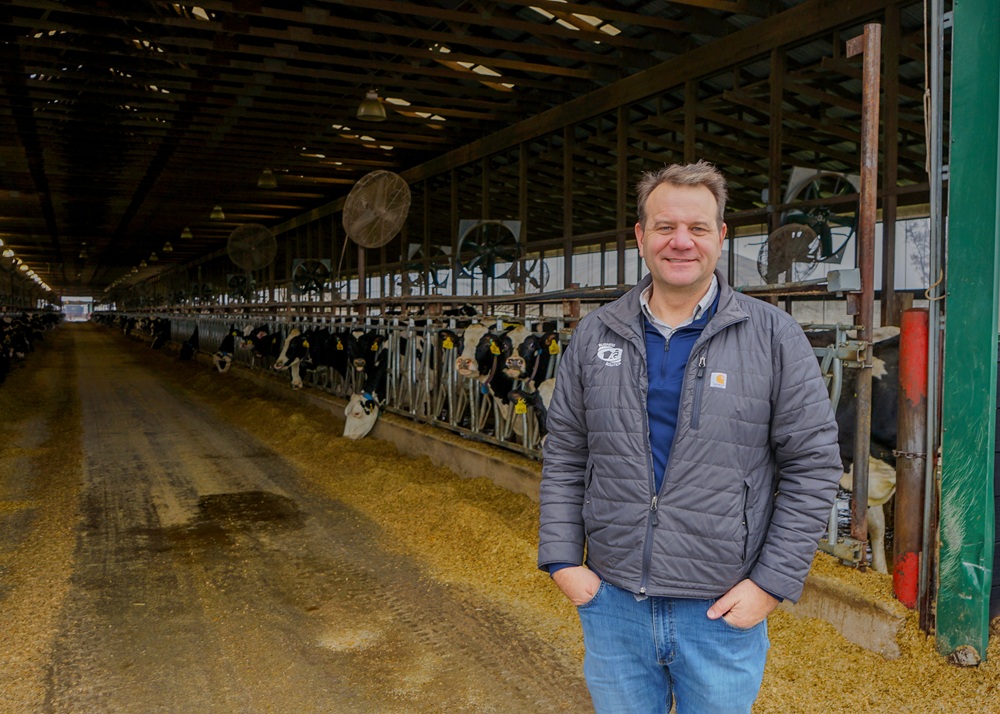
Chris Weaver stands in front of one of three free-stall barns. (TFP photo by Jake Zajkowski)
Ohio ranks 12th nationally in dairy production, with most dairy cattle located northeast of Columbus. In the northwest, only a handful of dairy farms remain—one near Swanton, a few in Wood County and in Bryan too. But Weaver said the industry isn’t built on competition.
“We’re kind of competing against ourselves, trying to be as efficient as we can possibly be,” he said.
At the Montpelier farm, about 35 employees and a veterinarian handle milking, calving and daily operations. Cows are milked three times a day in a double-42 milking parlor. The farm goes through roughly 45,000 tons of corn silage each year, along with hundreds of tons of sand for bedding.
Feed, veterinary bills, bedding, technology, water, manure systems, fertilizer and seed dominate the budget. The expenses go into animal care. “The more comfortable a cow is, the more milk she’s gonna give,” Weaver said.
The dairy uses freestall barns, one of the most common and modern farm structures, allowing cows to move, eat, drink and lie down on sand bedding year-round, while still having shelter.
Protecting animal care
Weaver emphasized his responsibility to animal welfare and public trust. “Concerned citizens worry about it, and it’s good, because it holds us accountable,” he said.
Natural improvements to the farm have strengthened animal care. Updated fans and sprinklers were installed this past summer, in addition to cow collars that collect movement and health data.
Peer-reviewed research and state oversight also shape the standards livestock farms must follow, said Dr. Grazyne Tresoldi, assistant professor of animal welfare science at The Ohio State University.
The main framework is the Ohio Livestock Care Standards Board, which writes species-specific rules enforced by the Ohio Department of Agriculture.
But a second layer comes from industry expectations.
“Many rules are industry-led,” Tresoldi said. Large buyers require farms to join animal-care certification programs such as Beef Quality Assurance or the Ohio Egg Quality Assurance Program, which trains and audits farms.
For dairy farms, the National Milk Producers Federation reports more than 99 percent of the U.S. milk supply comes from those involved in the Farmers Assuring Responsible Management (FARM) program. “In practice, those programs carry real weight,” Tresoldi said.
Bridgewater Farms also receives support through quarterly third-party audits, where two companies evaluate animal care, environmental standards, and employee care. Their end product buyer, PepsiCo, the owner of Fairlife, completes audits too.
Tresoldi, a veterinary doctor, said while there are many perceptions of what animal welfare is, she defines it by how animals are perceiving and responding to their environment — including management, disease, handling or weather.
Dr. Grazyne Tresoldi visits farms and researches animal handling in Ohio’s livestock industry. (Courtesy photo)
Scientists, farmers, and veterinarians each handle an aspect of the conversation together. The state has 3,300 veterinarians, 128,000 people employed in the animal industry and 160 faculty at The Ohio State University focused on animal science or veterinary medicine.
Environmental management and manure innovation
Regardless of the urban–rural divide, residents across the region pay close attention to how food production affects natural resources and water quality.
Bridgewater’s scale of operation is matched by its investment in manure and nutrient technology.
Everything on the farm runs on a schedule, Weaver said. “Manure takes the most time and effort to manage appropriately.”
The farm grows its own feed and monitors nutrient cycles closely.
“In the past, we saw it was easy to see manure as a waste product, but it had nutrients in it. As technology has improved, I think we’ve gotten better at utilizing the nutrient values that are existing in manure for energy,” he said.
The methane digester on Bridgewater Dairy is visible from a mile away. (TFP photo by Jake Zajkowski)
Their long-term solution for manure waste is energy. The operation separates manure liquid from sand bedding. The manure then moves into a methane digester that produces biogas, which ends up in propane tanks. The remaining material becomes fertilizer returned to surrounding fields.
“They’re harvesting the electrons for energy,” Weaver said, “and we’re still getting nitrogen, phosphorus, potash and other nutrients.” Following Ohio’s 4R Nutrient Stewardship principles, manure is applied before planting or in narrow windows after wheat harvest.
But manure is often at the center of public concern regarding its management.
When the country’s largest state-funded agriculture conservation program, H2Ohio, began in 2019 in response to dangerous levels of water nutrient pollution in 2014, Bridgewater aligned its cropping practices with the program and maintained filter strips registered with the conservation effort.
The program reached a milestone of farmer participation this year. Governor Mike DeWine announced 2.5 million acres enrolled in the conservation program. While the program has been defunded in the last state budget, phosphorus reduction has made headway in 2025. The National Oceanic and Atmospheric Administration reported the year’s bloom was the smallest the lake has seen since 2020.
Livestock agriculture, whether backyard poultry in Lucas County or dairies nearby, remains central to northwest Ohio’s identity.
The next generation of Ohio’s farmers, and milk for the fridge, is already taking shape. “My son, when he gets old enough, he’s gonna want to be on the tractor, farming too,” Weaver said.
As a former member of both the Toledo City Council and Teamsters Local 20, I understand firsthand how oppressive federal rulemakings can hurt working families. I am particularly concerned about the direction of the rulemaking for Section 1033 of the Dodd-Frank Wall Street Reform and Consumer Protection Act and its potential impact on Ohioans.
While the Dodd-Frank Act aims to protect consumers from bad actors, the rule implementing Section 1033 puts consumer data at risk. It hands Big Tech too much power over consumer data, allowing this data to be shared with aggregators who can monetize and profit from it.
It also fails to hold Big Tech liable in the event of a data breach. Under the Section 1033 rule, Big Tech can continue to accumulate wealth by expropriating working Americans’ data while consumers struggle to pay their bills.
Equally troubling, the rule lacks accountability measures if data is misused or compromised. It does not adequately address screen scraping, a known technique used by hackers.
Big Tech should not be allowed to monetize Americans’ personal financial data or repurpose it for AI. The Consumer Financial Protection Bureau needs to follow the law and protect consumers, not bend to the will of Silicon Valley billionaires.
Photo by Metroparks Toledo Nature Photographer Art Weber.
There’s symbolism in the colors of Christmas, symbolism that’s rooted in nature and reaches back centuries. Symbolic or not, the mere sight of a bright red, male cardinal against a backdrop of pure, white falling snow is simply stunning.
It’s easy enough to attract cardinals to your home with a basic bird feeder, or head to one of the six “Windows on Wildlife” in your Metroparks Toledo to enjoy watching them and a host of other native wildlife. Look for them at Wildwood Preserve, Pearson, Swan Creek Preserve, Side Cut, Oak Openings Preserve, and Secor Metroparks.
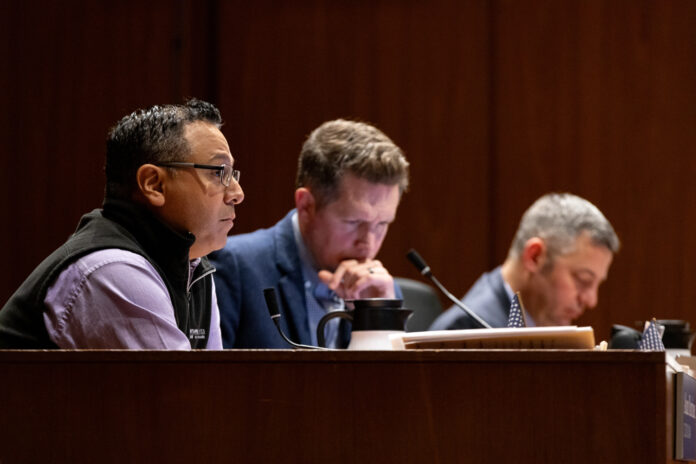
Adam Martinez, Toledo City Council Member for District 2, during a Toledo City Council meeting inside City Council Chambers at 1 Government Center on Tuesday, Dec. 16, 2025. (TFP photo by Stephen Zenner)
RECOGNITION
Local business owner Stacy Jurich was recognized during the last Toledo City Council Meeting of the year, on Tuesday.
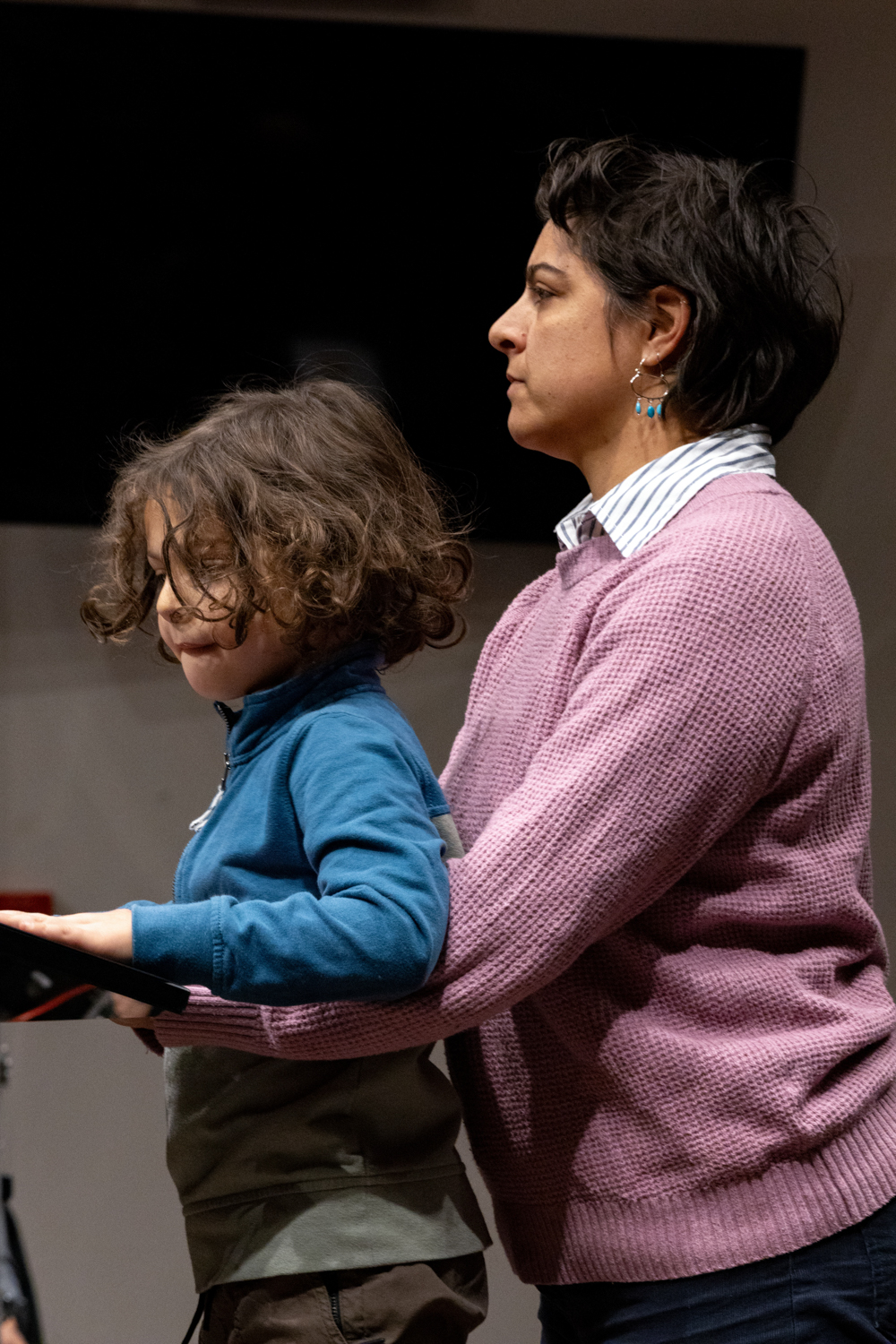
The owner of Boochy Mama’s Kombucha addressed council with her arms wrapped around her five-year-old son, Isaiah Cohen.
Jurich said that, as a businesses owner “in the trenches,” it has taken years to grow the business, and she did feel honored by the council recognizing her.
“I started in my home kitchen,” she said, adding that she grew the business out of a church basement in the Old West End. “That’s about as Toledo as you can get.”
Isaiah Cohen, 5, stands with his mother, Stacy Jurich, the owner of Boochy Mama’s Kombucha, as Jurich is recognized by Council. (TFP photo by Stephen Zenner)
District 5 Council Member Sam Melden lauded Boochy Mama’s Kombucha as an “excellent” product, and At-Large Council Member Nick Komives fondly remembered his days serving the kombucha at Black Kite Coffee when he was a barista there.
Summing up the recognition, the young Cohen said the parting words for the recognition, “Me love kombucha.”
APPOINTMENTS
Dave Zenk, the executive director of Metroparks Toledo, replaced Timothy Schlachter as an appointment to the Toledo Community Improvement Corporation.
At-Large Council Member Cerssandra McPherson opposed the appointment. While she said that Zenk was a “stand-up guy,” appointments, according to McPherson, ought to “reflect our community,” citing that Zenk was not a resident of Toledo. McPherson also said she wanted to give others opportunities to get involved with appointed positions.
The Metroparks director has a listed address in Whitehouse.
SECOND READ ITEMS
(All Ordinances on the agenda passed)
555-25: Appropriating money for current ordinary expenditures of the various departments for the City of Toledo for the first quarter (January, February and March) of 2026 and declaring an emergency. The amount of money for the total appropriation was $273,832,070.
Ordinances 556-25 to 559-25 were all declarations that provided funding for clearing or maintenance of streets.
Ordinances 560-25 to 562-25 repealed different parts of the Toledo Municipal Code (TMC) and enacted new parts to it.
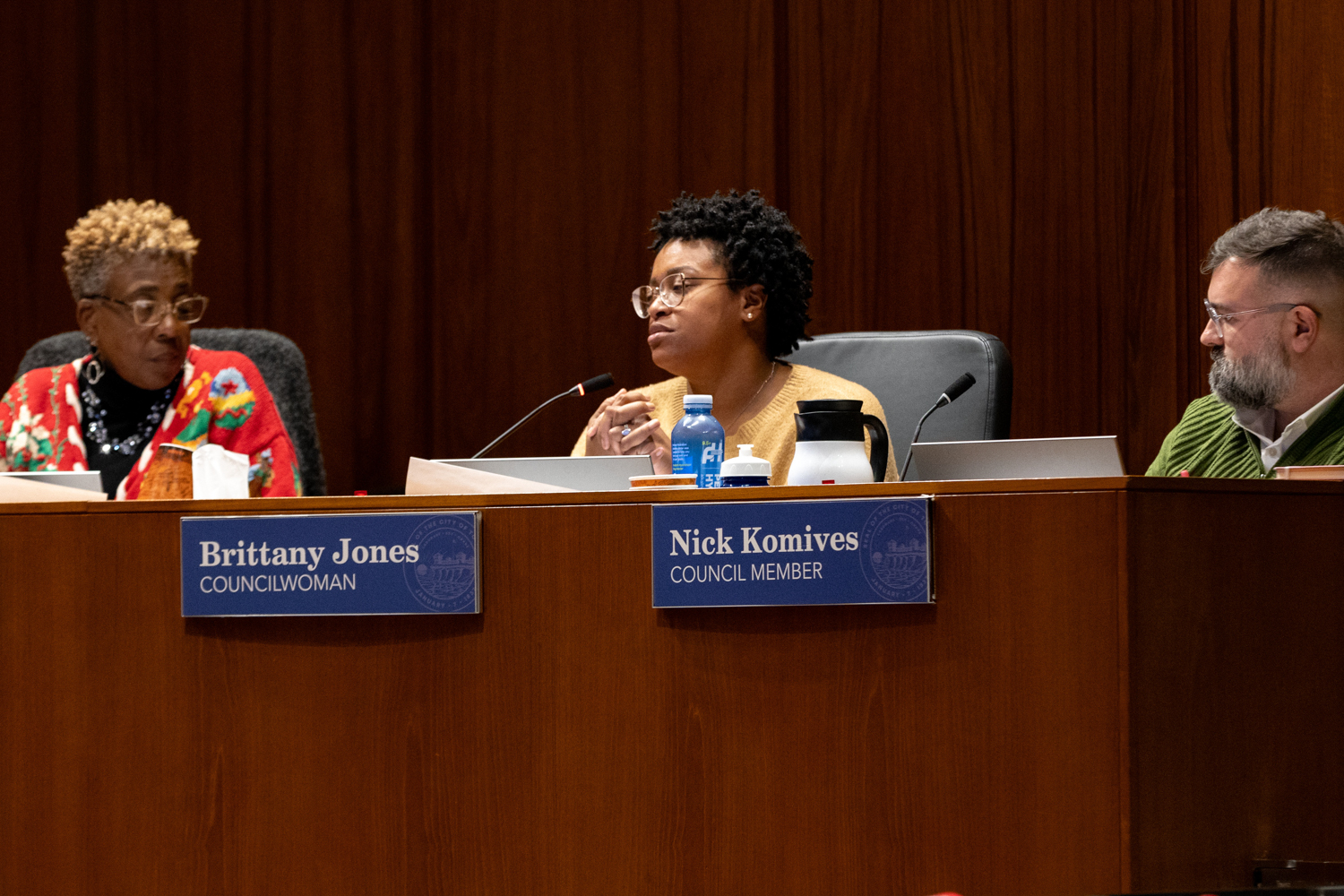
Brittany Jones, Council Member At-Large. (TFP photo by Stephen Zenner)
During the agenda review, preceding the passage of these ordinances, Adam Martinez, District 2 council member, raised questions on the changes to the TMC, and voiced concerns about the changes putting immigrants at risk.
In the week’s time, Martinez had changed his tune, and said he was, “very comfortable” with all three changes, calling the revisions “well thought out [and] well rationed legislations.”
Respectively, the changes to TMC deal with General Contractor and Subcontractor Tax Registration, Wage theft and Wage and Tip Compensation Requirements.
563-25: Expenditure for accounting services for the division of accounts in the preparation of the ACFR $75,000 General Fund.
NEW ITEMS FROM COUNCIL
566-25 DIP District 5, Westwood Park Football Fields, $42,430 CIP
567-25 DIP District 5, Sanger Branch Library HAWK Signal, $100,000
NEW ITEMS FROM THE ADMINISTRATION
Items 568-25 to 572-25 dealt with strengthening neighborhoods.
568 extended an agreement with the United Way of Greater Toledo, giving $39,520 to the Healing & Compassion Fund, for survivors of gun violence from the General Fund.
567 gave $34,400 to the Young Leaders Collective, a mentoring and exploration program for youth, through the United Way of Greater Toledo.
570 and 571 modified HOME loan agreements in South East Toledo. Home 1
In lieu of forgiveness of the South East Toledo Home 1 and 2 scattered sites’ HOME Loan current balance, the City will modify and amend the terms of HOME Loan Agreement in order to provide a measure of debt relief, as properties in the South East Toledo Home 1 and 2 portfolio are sold.
Both loans were for $370,000.00 with 5.5 percent interest rate for a 20-year term HOME Loan. Home 1 was for 28 units and started in September 2006. Home 2 was for 25 units starting in December 2007.
572: CODE BLUE, the cold weather response initiative was given $80,000 from the General Fund to open up warming centers.
“…local shelters are experiencing a 100 percent occupancy rate during summer months,” the ordinance reads, emphasizing the already burdened state of shelters for the unhoused. “The Code Blue Cold Weather Response Initiative aims to mitigate these risks by providing overnight Warming Centers along with transportation to these centers through the Ride United program.”
Two individuals have already died this year in the city of Toledo due to cold weather, prompting this response.
Warming Centers do not have beds, but provide a warm space for people to stay.
The city’s list of warming centers can be found here.
Individuals in need can also call 211 for transportation or to find locations near them.
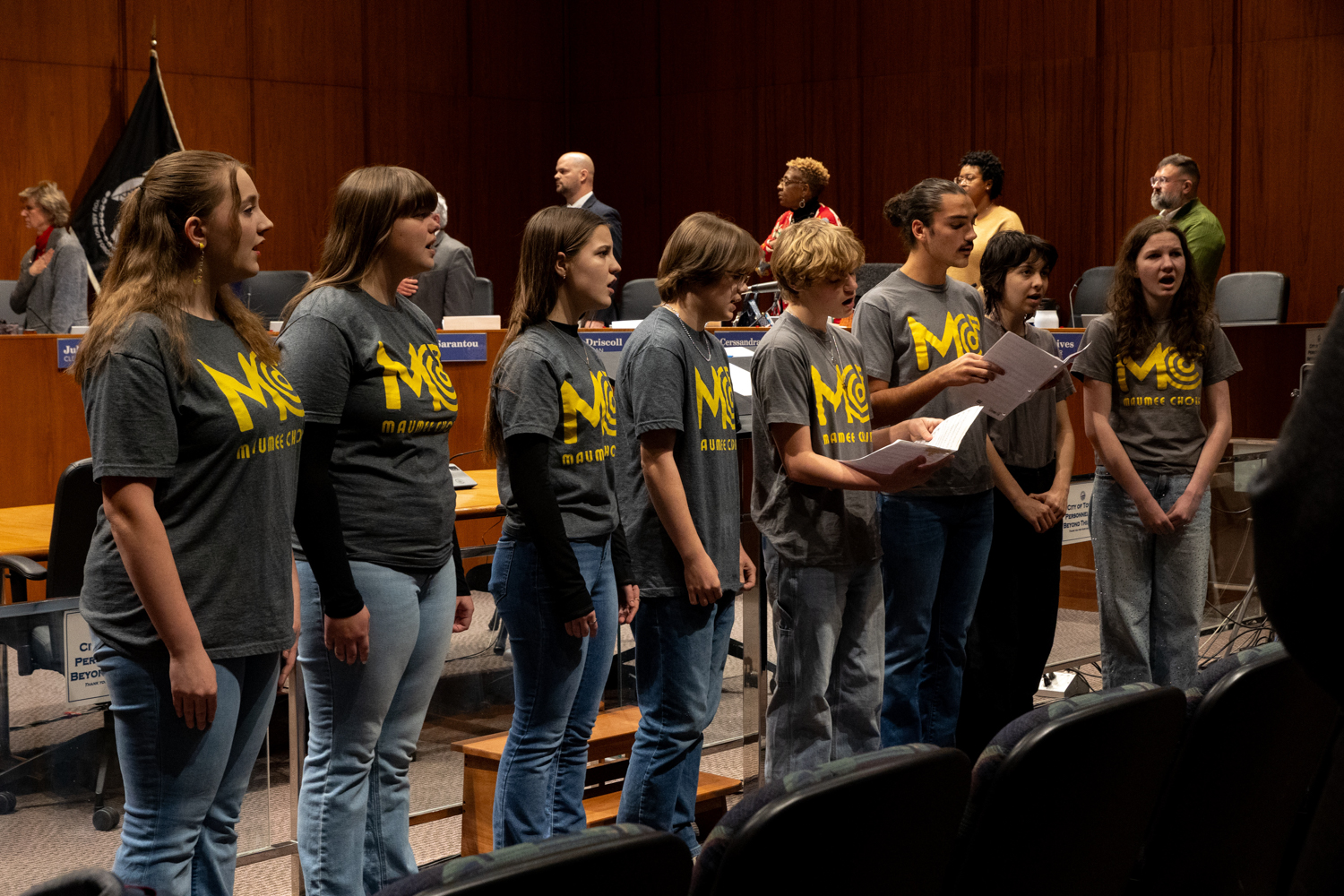
Maumee Select Choir sings the national anthem during a Toledo City Council meeting. (TFP photo by Stephen Zenner)
No notes:
573-25: Authorization and expenditure for a professional services agreement for collections efforts
574-25: Resolution- Declaring the necessity for streetlights on Brockton Dr. bounded by Imperial Dr. & Sylvania Ave.
575-25: Authorizing the acceptance of an OEPA Grant 319(h) for the Delaware Creek Restoration project $278,480 OGF
576-25: Authorizing the acceptance of the OEPA Grant H2Ohio for Detwiler Golf Course stream restoration project $400,000
577-25:: Authorizing a contract with SCS Engineers for Construction Quality Assurance GCCS at Hoffman Rd Landfill $12,100
578-25: Authorizing a sewer agreement with Northwestern Water and Sewer District for 40 years
579-25: Authorization to contract services & parts for Allen Bradley Electrical Equip. Prev. Maint proj at Water Rec $600,000
580-25: Authorization to contract parts/equipment & services for construction of digester heat exchangers. Project BVWR $100,000 SSR
581-25: Authorizing a 5th amendment for professional services w/ Black and Veatch to extend for consent decree
582-25: Authorization to contract parts/equip. & services for Roots air blower proj secondary Treatment BVWR $200,000 SSR
583-25: Authorization & expenditure to Toledo Lucas County CareNet to support healthcare access $20,000 GF
584-25: Authorizing a three-year contract for banking services 5/3.
Komives and Martinez both voted against this ordinance. Martinez had no problem with 53rd banking, but wished the city contracted with a local bank or credit union.
585-25: Authorizing year-end appropriations and budget adjustments w/in the 2025 Operating and Capital Improvements Budgets
ITEMS FROM ZONING AND PLANNING
586-25: Special Use Permit for operations building at 2162 W. Alexis Road
587-25: Zone change at 1427-1429 W. Bancroft Street
588-25: Special Use Permit for a Daycare Center at 3302 Buckeye Street
589-25: Zone change at 1336 Craigwood Road
590-25: Special Use Permit for a Type A Family Daycare at 1920 Eastgate Road
591-25: Zone change at 5820 and 5930 Hagman Road
592-25: Special Use Permit for Gasoline & Fuel Sales at 5820 and 5930 Hagman Road
593-25: Zone change at 1805 E Manhattan Blvd.
594-25: Zone change at 1321 and 1327 W. Sylvania Avenue
595-25: Special Use Permit for a Daycare Center at 2894 Tremainsville Road
596-25: Special Use Permit for Major Urban Agriculture at 648 Woodland Avenue
CLOSING REMARKS
Each council member said their closing remarks for the last meeting of the year. Most notable of the bunch were Komives’s closing remarks, where he said he had observed Toledo Police chasing the UHaul truck through the streets on Dec. 10 and was displeased with the response.
Komives said he was stopped at Monroe and Central when the UHaul sped past him.
“I do have some real concerns about the experience,” he said. “All these things cost money and it was chaotic…It was not okay.”
The At-Large Council Member said he had asked the mayor to address the police department concerning the chase.
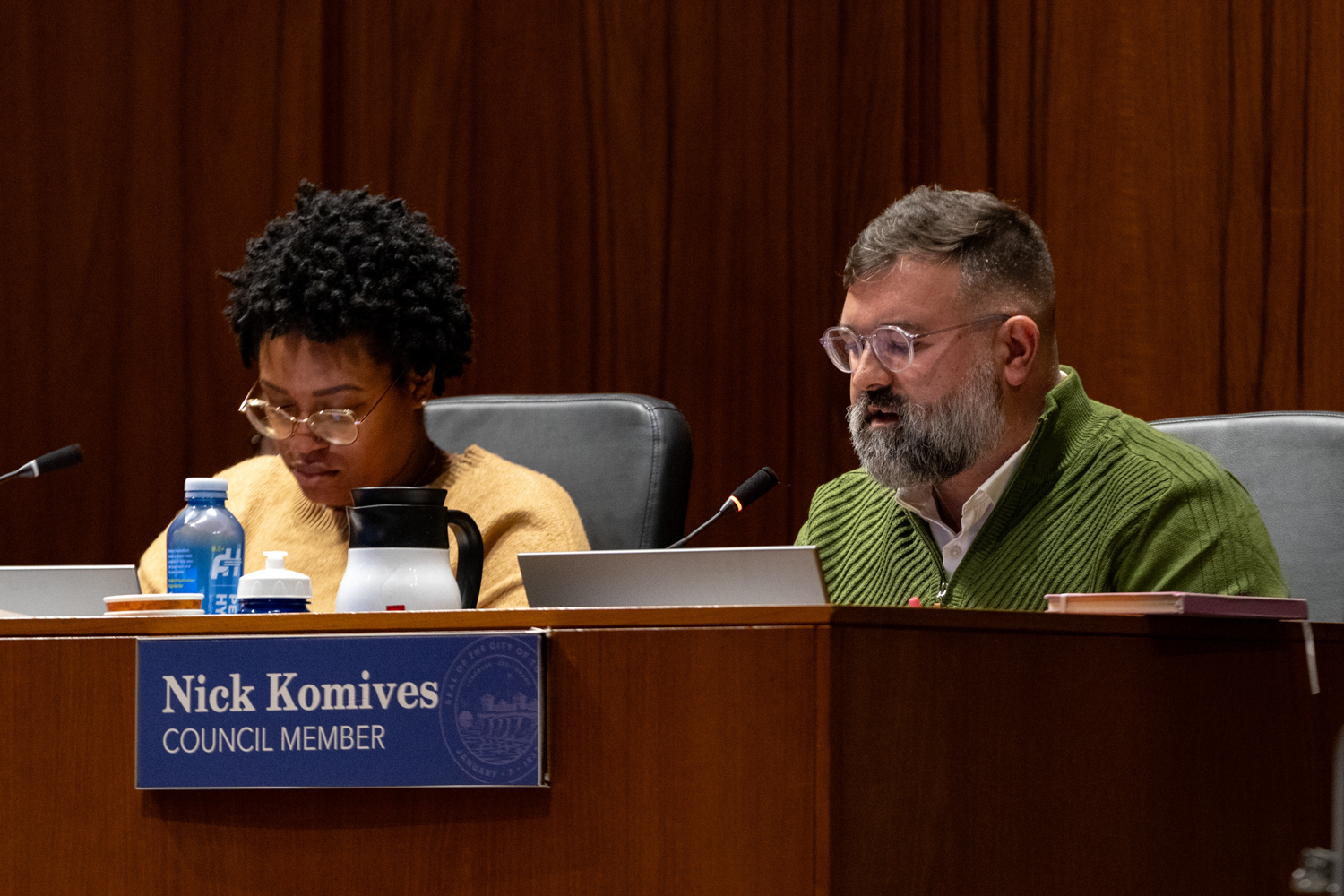
Nick Komives, Toledo City Council Member At-Large, during his closing remarks. Komives expressed concern about the use of Toledo Police during the infamous UHaul chase on Dec. 10. (TFP photo by Stephen Zenner)
U.S. Representative Adelita Grijalva and Tucson Mayor Regina Romero speaking at No Kings 2. (Photo by Phineas Anderson(
I have lived a good part of my life in Toledo, and in Tucson, where I presently live with my wife, Mitch. Our two sons graduated from Maumee Valley Country Day School, a wonderful school that I headed from 1994-2005.
I have always been an activist. I have supported civil rights and human rights in America. I campaigned to reduce nuclear weapons and eliminate female genital mutilation around the world. I have spent most of 2025 organizing protests against President Trump in Tucson, as others have in Toledo.
It has been a noteworthy year of protests in our country. It started with the TESLA protests, then HANDS OFF (3 million protesters), NO KINGS 1 (5 million) and NO KINGS 2 (7 million in 2,700 locations). NO KINGS 2 was the largest one-day demonstration in U.S. history.
People ask why are we, Mitch at 78 and me at nearly 84, organizing protests at our ages.
Our two fathers and one mother volunteered to serve in World War II. My mother, an actress, entertained troops at USO clubs and in particular, the Hollywood Canteen. They took great pride in defending the world’s oldest continuous democracy and, like our parents, we will fight to preserve it.
It is our belief that Donald Trump is moving at a rapid pace to change our democracy to an autocracy, “a system of government ruled by one person with absolute power.”
At this time, the legislative branch does his bidding. The rubber-stamping Republicans control both houses of Congress and their members on the whole (Marjorie Taylor Greene is a recent exception) have yet to challenge his most egregious and, some say, corrupt actions.
Extraordinarily, the Supreme Court, the interpreters of our U.S. Constitution, has held that the president is above the law, giving Trump a free rein. Fortunately, the district and appeal courts have issued more than 200 rulings or orders that have partly or wholly blocked Trump’s initiatives and executive orders.
What holds our democracy together, its keystone if you will, is the implementation of the Rule of Law. If a president removes guardrails that protect against corruption, the chances of corruption happening, that is, breaking the law, are high.
In his first days in office, Trump illegally fired 17 non-partisan inspectors general, whose duties include investigating corruption and fraud in the government. He fired the head of the Office of Special Counsel at the Department of Justice, the agency that protects whistle-blowers from retaliation for disclosing wrongdoing in the executive branch. It is interesting to note that Trump’s personal wealth has almost doubled to $7.3 billion since taking office.
Trump showed a marked disdain for the Rule of Law when he pardoned (let us never forget) convicted seditionists and felons who attacked and injured members of law enforcement on January 6, 2021. Since then, he has pardoned people who were convicted of bribery, tax evasion and fraud, including a number of drug dealers, and a gang member serving several life sentences for crimes, including murder.
Most recently, Trump pardoned the former Honduran president who was convicted by a jury of peers and sentenced to 45 years in a federal prison for drug trafficking that flooded our country with an estimated 4.5 billion individual hits of cocaine. Apparently, quid pro quo and loyalty, not mercy, is what motivates Trump regarding pardons. Some say, as with Trump’s constant lying, all presidents do it. Historically speaking, Trump is in a league of his own, no other president comes close.
An essential part of keeping a democracy healthy is a free press. The press have been intimidated and have been called the “enemy of the people.” Journalists worry about their safety as Trump encourages a climate of hostility towards the media. Many in the press are standing firm, and we wish more law firms and universities would do the same.
These are a few of the reasons why we and so many other Americans of all stripes are protesting. As the new year starts, we are putting our energy (what we have left!) towards winning the midterms, despite every effort by Trump and his enablers to rig the election. We know we are on the right side of history in defending our Constitution and saving our Democracy. We hope Toledo Free Press readers, particularly those of you on the fence, will join us in this fight.
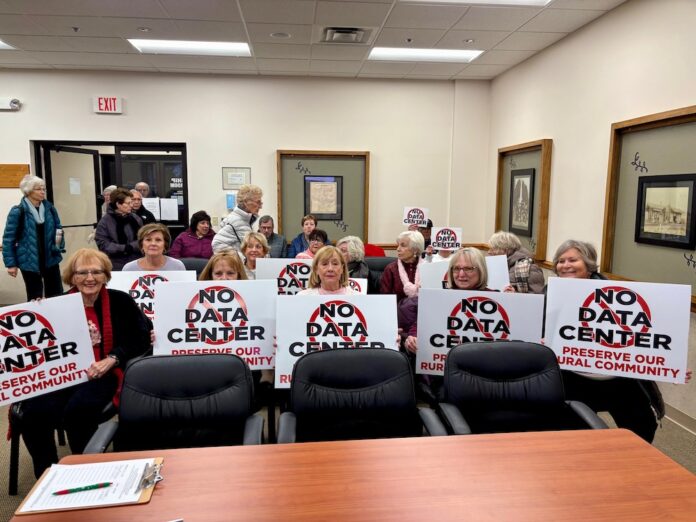
A group of Waterside residents attended the Dec. 15 Monclova Township trustees meeting to ask that a moratorium be placed on data centers. (AWFP photo by Karen Gerhardinger)
Waterville Township passed a 12-month moratorium on data centers – a move that Monclova Township trustees decline to consider. Whitehouse, in the meantime, ends the year with a farewell to council member Steve Connelly. Below is a recap of news from Anthony Wayne-area meetings. Find more Anthony Wayne area news here, where you an also sign up for the newsletter.
Waterville Township OKs 12-Month Data Center Moratorium
Citing concerns about the drain on the electrical grid and water supply, as well as the impact on quality of life, Waterville Township trustees voted unanimously on Dec. 17 to impose a 12-month moratorium on issuing permits for data centers.
“We don’t want to be behind the eight ball, scrambling to come up with conditions,” explained trustee Julie Theroux, who introduced the moratorium language as written by the Columbus law firm hired by trustees.
The year-long moratorium will give trustees a chance to consider the pros and cons and understand possible impacts in order to better prepare conditions if a data center developer applied for a conditional use permit to operate on agriculturally-zoned land.
Assistant County Prosecutor John Borell said the moratorium can be renewed, but advised the trustees that the time frame should be used to study the impact, not just use the time to “kick the can down the road.”
Lisa Haberstock thanked the trustees for the moratorium, and suggested that area communities work together to study the pros and cons of data centers. Resident Brian Gowing, who moved to Neowash Road to be in the middle of farm country, thanked the board for listening to residents. Todd Heller asked trustees to consider removing Bill Burkett from the Zoning Commission, positing that it was a conflict of interest because Burkett works for Regional Growth Partnership. A fourth man, a Providence Township resident who didn’t want to be named, questioned the trustees’ decision to only allow residents to speak.
Borell later explained that, while boards are not required to allow public comment during meetings, if they do allow it, the trustees cannot limit who speaks or the content of the comments.
During the meeting, the board also:
-Swore in trustees Toby Miller and Kyle Hertzfeld, who are each beginning four-year terms. The board also thanked Kim Anderson for her four years of service.
Assistant County Prosecutor John Borell swore into office new Waterville Township Trustee Toby Miller and returning trustee Kyle Hertzfeld during the Dec. 17 meeting. (AWFP photo by Karen Gerhardinger)
-Heard that a Land Use Plan Update Committee will be meeting in January, using input from resident surveys to guide the future of the township.
-Learned that the owner of the Dutch Road Self Storage is interested in installing a digital billboard facing U.S. 24, but the proposal is for a sign that is much larger than what’s allowed in zoning regulations. Miller said the sign owners offered to let the township to share messages about public safety or other news.
-Appointed Steve Reinbolt to the Board of Zoning Appeals.
-Agreed to extend its contract with Klumm Brothers for garbage pickup from 743 households.
Monclova Township
Dozens of Waterside residents filled the Monclova Township meeting room on Dec. 15 with one goal: to persuade the trustees to impose a moratorium on data centers.
“We have no business on data centers for you,” trustee Barbara Lang advised, later adding that “the board is giving you the courtesy to speak.”
Risa Sindel asked that the trustees honor the wishes of their constituents and not court data centers. Diane Stroshine asked trustees to “be the heroes that your constituents need.”
Lyn Cox said a moratorium would give the trustees time to weigh its options and look at its land use plan, which she said shows the highest priority as preserving agricultural land.
“When a project has the potential to fundamentally change the character of a community, we expect more. We are reviewing potential actions and remedies,” Cox said.
Mike Tyson pointed out that by implementing a conditional use permit process instead of requiring a property to be rezoned, the trustees eliminated the option for citizens to file a referendum against a decision. Instead, that decision will rest with the four members of the Board of Zoning Appeals.
“I don’t like to have my rights taken away,” Tyson said. “Seriously think about how we can have the final say.”
While emotions are running high, Colleen Neidert suggested that trustees focus on collaborating with residents and getting them involved in analyzing the pros and cons of data centers through a subcommittee or working group.
“We wish to place a one-year moratorium on data centers, to give us all a chance to breathe…to learn and discuss,” Neidert said.
Lang said a moratorium would just send a message to the owner of the 200 acres on Black Road that he should just look into annexing into Maumee.
“A moratorium is an invisible wall around our township. It doesn’t protect our township in any way. I don’t think it’s an effective tool,” she said.
During the meeting, the trustees also:
-Thanked Trudy Vicary for her four years of service and welcomed new board member Deborah Stevens-Laux.
-Heard Sgt. Chris Curley from the Lucas County Sheriff’s Office advise on the investigated complaints about an animal operation on U.S. 20A and found that it is licensed and compliant with the U.S. Department of Agriculture.
-Discussed the need for signs to be placed on private property and not on the right of way – usually between the utility poles and the roadway – or stapled to the poles. Some residents advised that their anti-data center signs have been taken, and questioned whether they were taken by township crews during monthly sweeps.
-Approved providing $6,030 to cover the cost of a sewer tap for Monclova Community Center.
-Heard zoning administrator Eric Wagner say that Mike’s Hauling provided a quote of $18,500 to tear down an abandoned house and shed, and to remove a septic tank and debris at 8830 Maumee-Western (U.S. 20A). The house was deemed a nuisance by the board earlier this year. The trustees opted to wait and see if any grants are available to cover the cost.
-Listened to road superintendent Doug Holland ask residents to be patient as crews attempt to collect leaves despite ice and snow.
-Agreed to use ProMedica for an employee assistance program.
Whitehouse
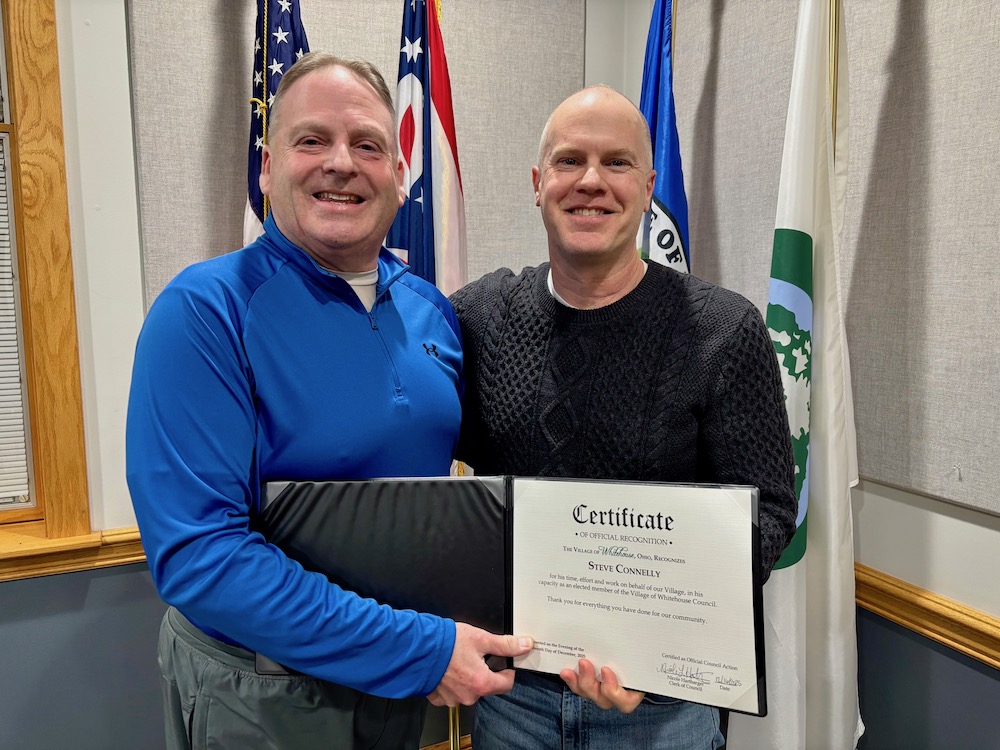
Whitehouse Village Council Mayor Rich Bingham thanked Steve Connelly for his three years of service, which included plenty of big changes – implementing term limits, a village-wide community service and even a consideration of allowing chickens.
“It’s been an honor and privilege to serve with you,” Connelly said. “I can’t think of a stronger group to work toward the future as we become a city.”
Whitehouse Mayor Rich Bingham (left) presented a certificate of appreciation to outgoing council member Steve Connelly, who served for three years. (AWFP photo by Karen Gerhardinger)
Connelly opted not to re-run for office. Instead, Joe Bublick will take his place, as he was voted into office along with returning council members Louann Artiaga and Steve Fine.
“Steve stepped in and the village is better because of his service. He is a thoughtful and collaborated colleague,” Bingham said.
During the meeting, council also:
-Appointed Rob Casaletta to the Planning Commission.
-Learned that Whitehouse won in a toy drive competition versus Waterville. A total of over 2,900 toys were collected.
-Listened to an update from Council Member Fine and Administrator Jordan Daugherty on the status of electric aggregation. The village is waiting until rates come down to an appreciable savings over Toledo Edison before locking into a rate.
-Approved the 2026 budget that council President Dave Riggenbach described as having fiscal restraint while still providing existing service levels.
Addelyn O'Shea and Madalyn Blevins stand among the 2,600 toys donated by Anthony Wayne Local Schools students to Anthony Wayne Neighborhood Bridges, which will distribute them to area children in need.
(Courtesy photo)
Filling backpacks with school supplies, coordinating a Veterans Day assembly, collecting interview clothing for the homeless – these are just a few of the dozens of projects that Dr. Justin Zemanski‘s Anthony Wayne High School students have led since a Community Engagement class was added to the curriculum in early 2021.
“I continue to be amazed at the projects my students choose, and their level of interest,” said Zemanski, who guides juniors and seniors through the process of researching nonprofit organizations, creating a fundraiser and promoting it to the community.
Last week, Zemanski’s first period class delivered 2,600 new toys collected for distribution by Anthony Wayne Neighborhood Bridges.
“Kids in poverty will benefit,” said senior Sophia Stanton.
While Stanton teamed up with Sophia Alfieri to coordinate the toy drive at Monclova Primary School, other students led the toy drive in other schools: Madalyn McKnight and Jocelyn Ryan, Waterville Primary; Meghan Donnelly and Sophia Sarkisian, Whitehouse Primary; Matheo Cottier and Sean Kolling, the middle school and junior high; and several others working on logistics and promotions within the district.
The high school students made in-person presentations, fliers, announcements and even a TikTok video to encourage younger Generals to fill collection boxes with new toys, and devised incentives – including a cookie party, donut party and house points for middle schoolers – to sweeten the deal.
“I think our schools do well with donating and coming together to give back to the community,” said Kolling.
While her peers collected from the schools, Katie Reinhard led a parallel effort through Church of the Cross in Toledo, calling area businesses and making regular announcements at the church to encourage donations.
The total result is so much more than Zemanski, and the students, expected. It also astounded Anthony Wayne Bridges Coordinator Amy Barrett, who noted that the donation will help children in need.
“We are so grateful for the students. This project is another wonderful example of how we can all work together to help each other to benefit our community,” Barrett said.
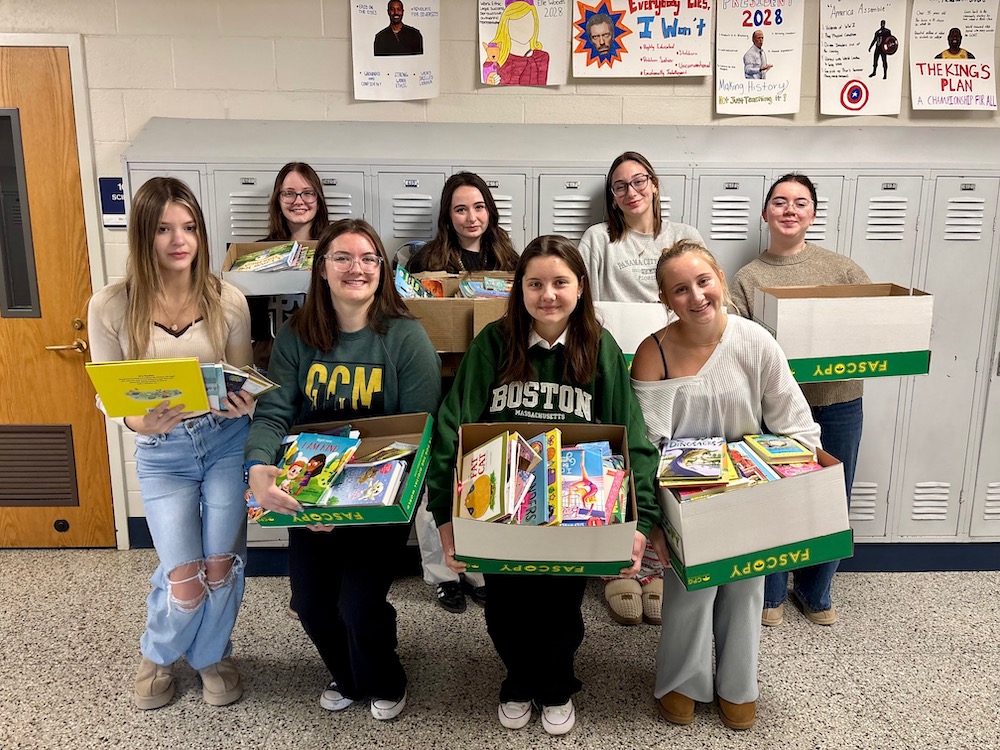
While the first period class focused on the toy drive, second period students found projects to match their interests. One team raised funds to install three Little Free Libraries stocked with over 300 children’s books donated by district teachers.
“When we were researching our project, we saw that there was a discrepancy between kids and how many books they had access to,” said senior Lila Hippert.
Anthony Wayne High School Community Engagement class members did fundraising and marketing to support the installation of three Little Free Libraries stocked with donated children’s books. Pictured are, back row (from left) Isabel Riggenbach, Madison Engle, Ava Newman and LIzzy Babcock and, front row, Katience Patchin, Sonya Beale, Maya Beale and Lila Hippert. (AWFP photo byKaren Gerhardinger)
Waterville Community Church donated funds for the boxes and plaques, and Aric Christman‘s high school construction class will help with installation, but the team needed donations for other supplies, so they hosted an hours-long bake sale in downtown Whitehouse last month.
“It went swimmingly,” said Sonya Beale, noting that the entire team stood on the four corners to encourage motorists and walkers to stop and shop the sale.
Once weatherproofed and painted bright colors, the boxes will be installed next spring in Monclova’s Homecoming Park, Whitehouse Park and near the Sylvania YMCA.
Another team, including Lydia Fabian and twins Leah and Mallory Pike, organized a gift basket raffle to raise funds for The Nest, a nonprofit that provides child care so parents can complete their education. Each member contacted multiple businesses to solicit gift cards, tickets and other goodies in baskets that were raffled off at a home basketball game.
Seniors Izzy Christopher and Will Iott collected items from area businesses for the Anthony Wayne Community Food Ministry and, during Thanksgiving Week, helped register more than 150 area families waiting in line to pick up bags and boxes of food.
“With the shutdown, a lot more people were going without pay, so there was a lot more need,” Christopher said.
Nolan Holloway and Tyler Shaw are among the team members working on a Generals sports closet – a resource for students to access gently used sports gear, like basketballs, knee pads, compression shorts, lacrosse sticks, helmets and hockey equipment.
While many of the 19 sports teams at AWHS are top-ranked, not all students have the financial backing to afford the equipment, Shaw said.
“We know how expensive sports equipment is. We want everyone who wants to play to have that opportunity,” Holloway added.
While the class is wrapping up, the project will be continued into the spring, when they will host an equipment drive and see the construction of a small shed on campus come to fruition – thanks to backing from the high school construction technology class.
One of the main objectives of the class is to connect students’ passions to a project, said Zemanski, who invites leaders from area nonprofits to speak to students. Over the past few years, many students have chosen to support Toledo Animal Rescue, a non-kill shelter.
“Research has shown that students tend to be more invested in their work when they have a choice; connecting learning to something that interests the students leads to increased engagement,” Zemanski said.
His own research for a doctoral dissertation in 2020 led Zemanski to discover the Community Engagement class as a way to show the community what’s going on in the district. Plus, he discovered that the students can also earn a State of Ohio Community Service Seal for completing over 60 hours of community service – which was one reason why Cottier, a junior, signed up for the class. He also found many other benefits.
“This class definitely helps with communication skills and how to put a project together,” Cottier said.
Reinhard agreed, adding that she’s learned how to not be scared of talking to people.
“You have to reach out and build connections,” Reinhard added.
Madalyn Blevins, who plans to study pre-med next year, said that in the process of working on the toy collection project, her team had to adapt their plans several times, and that required a lot of communication and coordination.
“Stay flexible,” agreed Sonja Beale.
For Donnelly, who is shadowing Whitehouse fourth-grade teacher Stacy Lindrup this year, the project has given her more exposure to students.
“This class has definitely taught me how to talk louder with kids. I have to be able to do that if I want to be a teacher,” said Donnelly, who plans to major in early childhood education at Bowling Green State University next year.
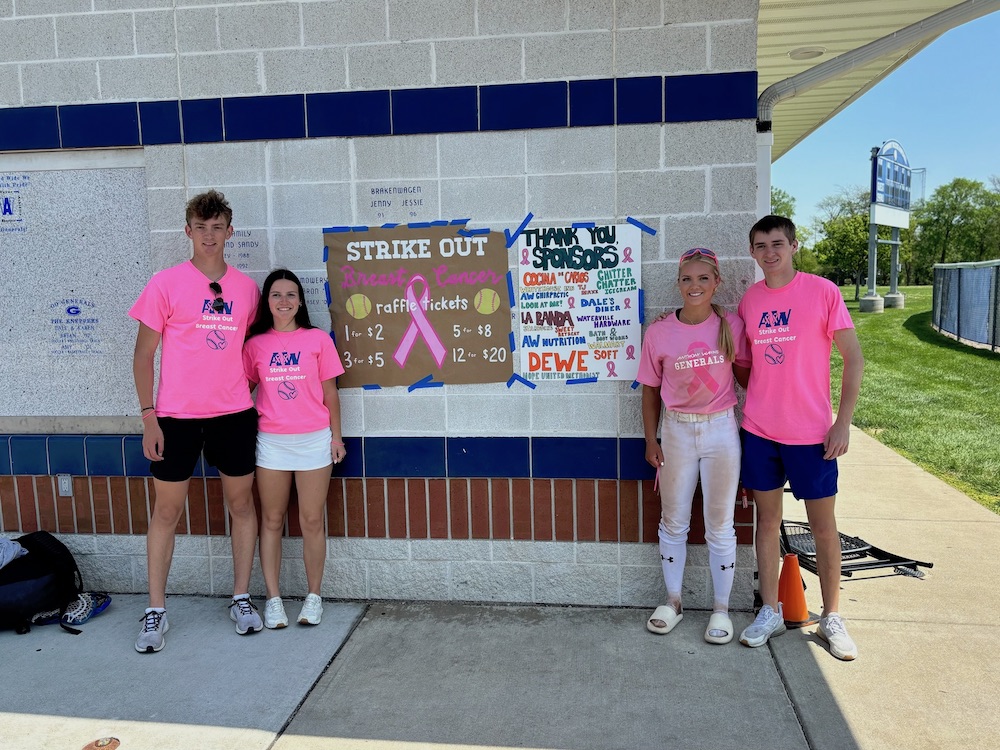
Earlier this year, 2024 graduates (from left) Ryan Shelton, Harper Clifton, Molly Conner and AJ Rea hosted a Strike Out Breast Cancer event that raised over $3,000 for a family impacted by breast cancer. (Photo courtesy of Harper Clifton)
AW Class of ’24 graduate Harper Clifton, now a freshman at Centenary College of Louisiana, said her experiences in the Community Engagement class solidified her decision to pursue a career in sports philanthropy. Last spring she teamed up with softball player Molly Conner and athletes Ryan Shelton and AJ Rea to host Strike Out Breast Cancer, a softball game and fundraiser to benefit an area family impacted by breast cancer.
“Our goal was $1,000 but we raised over $3,000,” Clifton said, explaining that her team members were on the phone daily soliciting donations and encouraging people to attend the game.
“I gained so much experience from that class – being able to see our work put into a real project that plays out through the semester,” Clifton said. “Dr. Zemanski is an amazing teacher and mentor.”
No matter how much the Community Engagement class benefits those involved, Blevins shares one piece of advice that sums up the class.
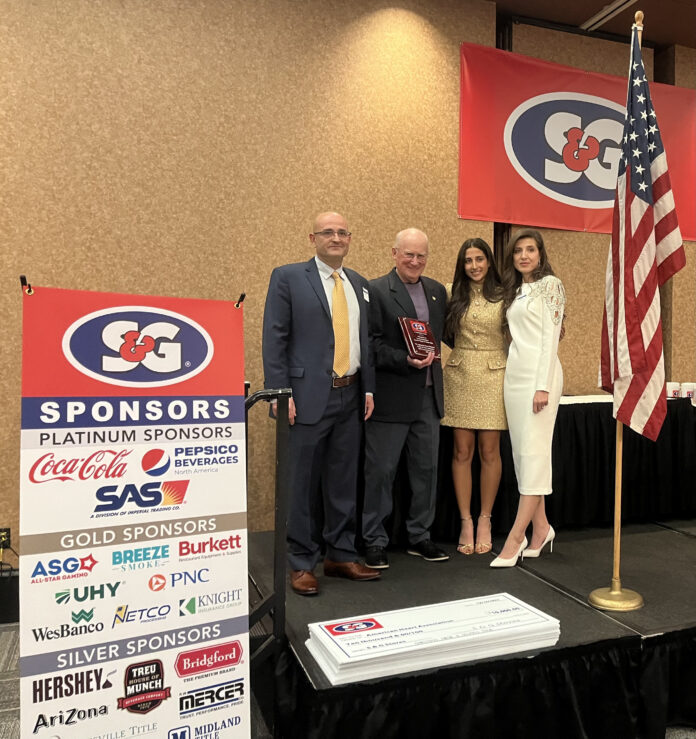
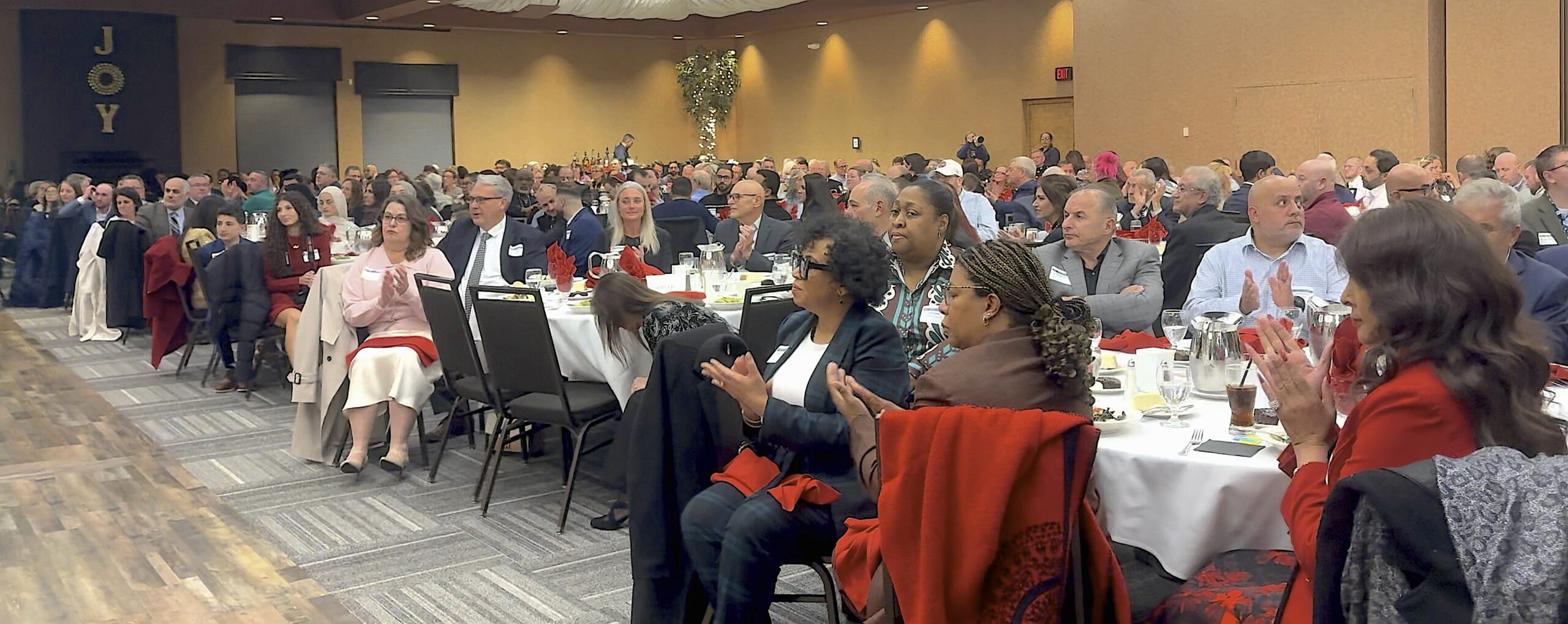
Former Toledo Mayor Carty Finkbeiner, second from left, joins the Ridi family in front of 67 checks being donated to local charities during the annual S&G Day of Thanks event in Maumee, Ohio, Tuesday, Dec. 16, 2025. The donations were distributed to 67 different organizations throughout the evening. (TFP photo by Justo Hernandez)
MAUMEE— Holiday generosity took center stage at the Pinnacle in Maumee on Dec. 16 as S&G (Stop & Go) Convenience Stores hosted its 9th Annual Day of Thanks and Giving.
In a record-breaking night for the Toledo-based company, CEO Dan Ridi announced that S&G donated more than $215,000 to 67 local charities. The evening was capped by the announcement of an additional $100,000 commitment to the Halim Clinic, to be donated over the next five years, to support free medical care for those in need.
What began as a modest $16,000 donation in 2015 has evolved into one of Northwest Ohio’s premier philanthropic events. This year’s record-breaking night marked a major milestone for the company: S&G’s lifetime contributions to the region through this initiative have now surpassed $700,000.
Dan Ridi, founder of S&G, announces a series of charitable donations to local organizations during the annual Day of Thanks event in Maumee, Ohio, Tuesday, Dec. 16, 2025. (TFP photo by Justo Hernandez)
“S&G has always been locally owned and locally committed,” said Ridi. “When we held our first fundraising event in 2015, we raised $16,000. It was a humble beginning, but it was the spark that led us toward giving back to this wonderful community. I am proud and truly moved to announce that tonight, S&G is donating $215,000 to 67 charities helping families and children throughout our region.”
Former Toledo Mayor Carty Finkbeiner was in attendance and received a Community Leader plaque, but the spotlight remained firmly on the 67 local organizations that serve as the community’s safety net. From Connecting Kids to Meals to the Islamic Food Bank of Toledo, the beneficiaries shared a common theme: they are firmly rooted in a commitment to Toledo’s families.
During his remarks, Ridi drew a sharp contrast between S&G’s business model and that of its major competitors. He emphasized that while other large chains are increasingly owned by international conglomerates or headquartered in other states, S&G’s corporate office is rooted in Sylvania.
“This is truly what it means to be locally committed—not by words but by actions. S&G Stores is locally owned. Myself, and my executive teams, and our families live here,” Ridi said. “S&G is facing fierce competition from businesses who do not live here.”
Ridi pointed out that Speedway, once a regional mainstay, was acquired by the Japanese-owned 7-Eleven (under Seven & i Holdings), while Circle K is owned by the Canadian retail giant Alimentation Couche-Tard. He expressed deep appreciation for S&G’s customers, observing that their support keeps profits within the community and directly enables the record-breaking donations announced Tuesday night.
(TFP photo by Justo Hernandez)
The emotional high point of the evening came with the surprise announcement of a $100,000 pledge to the Halim Clinic. The clinic provides primary and specialty care to patients who lack insurance, a service that is vital to the local community. The message was clear: for S&G, convenience is the business, but community is the mission. By keeping their charitable dollars within the 419 area code, the company isn’t just selling fuel and snacks—they are fueling the future of the city they call home.
In this episode of Make It Happen, Mike Vanderpool sits down with Gary Thompson from the Regional Growth Partnership to unpack one of the most talked-about topics in Northwest Ohio right now: data centers. What are they? Why are they being proposed here? Do they help or hurt electricity prices, water usage, and local communities? And what should residents actually know?
This conversation breaks down power grids, zoning, pipelines, job growth, water usage, tax agreements, and regional development in a way the public rarely gets to hear — directly from someone who has been at the center of negotiations for years.
You can find more episodes of Make it Happen here.