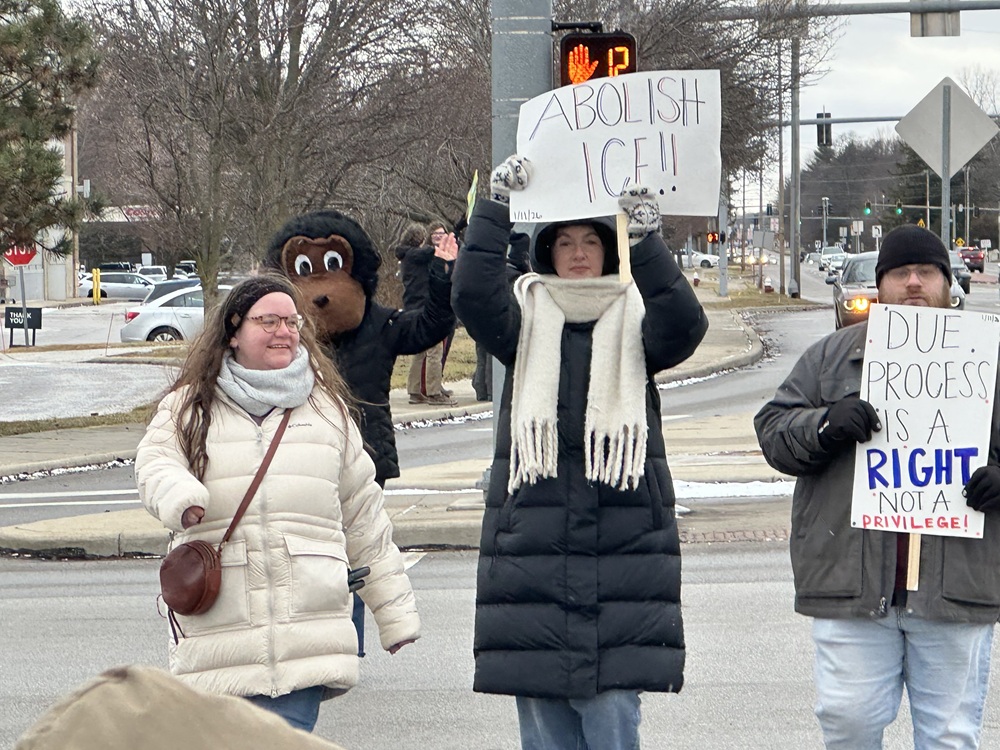
At the corner of Central and Secor, on Sunday, a protest was held by the group Toledo Persists. (TFP photo by Jaden Jefferson)
TOLEDO – The killing of 37-year-old Renee Nicole Good by an Immigrations and Customs Enforcement (ICE) agent in Minneapolis this week sparked protests – not only in Minnesota – but across the country. Good was a mother and U.S. citizen whose name is now at the center of a movement to put a check on ICE’s power. At the corner of Central and Secor on Sunday, a protest was held by the group Toledo Persists.
The Trump administration has defended the ICE agent. Officials claim he shot in self-defense as Good attempted to run him over. However, for many who’ve seen videos of the incident, they draw a separate conclusion. Among them is Christine Mesmer, a veteran of Afghanistan and member of Toledo Persists. She believes “it was murder.”
“Everybody knows you do not fire into a vehicle. Unless you are going to disable it, you fire at the wheels, you fire at the engine block – you do not shoot the person behind the wheel – that is dangerous. A real police officer knows that; anybody that’s done any sort of law enforcement knows that.”
She explained what drove her to be a part of this movement.
“We need to have our voices heard. As a member of this community, as a member of a lot of other communities, we need to have our voices heard,” said Mesmer, who added, “It’s horrible how the machine keeps chewing us up and spitting us out.”
At a time when many feel powerless, Mesmer agrees with the idea that protest is one way of reclaiming power.
(TFP video by Jaden Jefferson)
“Grassroots starts out here on the streets. This is an absolute grassroot movement. This is just the absolute beginning of what’s going to happen.”
She went on to explain that “at this point, we are going to band together and create community. We’re going to reach out. We’re going to make sure everybody has all the resources that they need, everybody knows where food banks are, where to get clothing, where to get emergency shelter.”
Mesmer said “our immigrant community is what makes this nation so great; diversity is what makes this nation great.”
Lucas County Commissioner Pete Gerken, who was among the demonstrators on Sunday, said that “ICE hasn’t been here yet, but we don’t wait until they get here.”
Gerken had a message for his fellow elected officials, the county sheriff, and police captains: that they should “keep us safe first” in the event ICE comes to Toledo.
“So they’re not here yet, but let’s let them know that ICE – and the system of deportation trauma they’ve imposed – doesn’t play in Toledo, Ohio.”
He said, “I’m proud of our community for doing this and I wanna be part of it. I’ve been doing this since 1968 – I’m not gonna quit now, and more people are joining in.”
The Corrections Center of Northwest Ohio in Williams County is one of the holding facilities for ICE detainees. According to Commissioner Gerken, “We just received 57 more detainees from ICE two weeks ago.” He said most of them, as Lucas County officials are finding out, have no criminal charges and “are just here because they didn’t have their papers with them.”
(TFP photo by Jaden Jefferson)
Immigration agents have recently been operating in Ohio’s capital city. When asked if he’s concerned that Toledo could be next, Gerken said, “We have great, strong immigrant roots here. We have many people from everywhere here. That’s to say they could come here, so we’re prepared.” He added that “the resistance will meet it when it comes.”
Lucy Frank, in addition to protesting Good’s death, was present to collect signatures on behalf of Amy Acton’s gubernatorial bid.
“I’m a local Democrat and I believe in rights for everybody. My husband, who just became a citizen this past summer – we both believe everybody has a right to be here. And so, I really appreciate everybody coming out today.”
Frank noted that Columbus, which has the second largest Somali community in the U.S. (after Minneapolis), has been feeling the presence of ICE – more so than Toledo has thus far. However, she believes that “we all have to stand beside our brothers and sisters and people who are scared.”
She said that, as an occasional protestor, Good’s death concerns her.
“The fact that I can’t go to a protest, and feel like I can come back alive…that’s not okay in the United States of America – it’s just not.”
There have been calls to abolish ICE, from Frank and others. It’s not something she expects to happen under the Trump administration, but believes the fact it’s a fairly new government agency – created in 2003 – means it’s not one that can’t be eliminated entirely.
(TFP photo by Jaden Jefferson)
Reverend TK Barger, senior minister at the First Unitarian Church of Toledo, spoke to the role of faith officials in activism.
“I don’t often wear a clerical collar, although my profession is minister. But, as I say, when you wear it for protest, you need to show that religion supports this type of action.”
He explained that “we are trying to live in ways that some of the great religious leaders have tried to demonstrate and advocate. Rather than to depend on some supreme entity to change us, it is up to the people to make that change.”
Jae Morales of central Toledo holds a sign protesting against Immigration and Customs Enforcement (ICE) prompted by an ICE agent shooting and killing a Minneapolis, Minn. woman, Renee Good. The protest was held at 1 Government Center in downtown Toledo on Thursday, Jan. 8, 2026. The protest was organized by the Party for Socialism and Liberation (PSL) Toledo, Ohio 50501, Northwest Ohio Democratic Socialists of America (NW Ohio DSA), University of Toledo Students for Justice in Palestine (UTSJP) and American Muslims for Palestine (AMP) Toledo. (TFP photo by Stephen Zenner)
TOLEDO – 80 to 100 people gathered in front of Toledo City Hall, 1 Government Center, Thursday evening to protest the actions of an Immigration and Customs Enforcement (ICE) agent, Jonathan Ross, who shot and killed Renee Good, a 37-year-old mother, in Minneapolis, Minn. Good was killed on Wednesday, Jan. 7.
Many videos, including different angles, of the shooting have spread across social media since the morning Good was killed while operating a vehicle with a number of ICE agents surrounding it.
Outrage and protests against ICE started the same day as the shooting, following Good’s death, and the protest action on Thursday is one small part of that movement.
Bryce Howard, a student at Bowling Green State University, speaks during the protest.
Nationally
President Donald Trump and Kristi Noem, the secretary of the Department of Homeland Security (DHS), immediately supported the ICE agent who shot Good saying that the agent acted in self-defense and denounced Good as a “domestic terrorist,” alleging Good was trying to attack the ICE agents with her car.
In reaction to the statements by the president and DHS, Minneapolis Mayor Jacob Frey called the claims of self-defense “bullshit” during a press conference, and said ICE was “causing chaos and distrust,” ultimately telling ICE to “get the fuck out of Minneapolis.”
Later, Minnesota Gov. Tim Walz backed Frey’s sentiments saying Trump and Noem had “done enough,” and issued a warning order to the Minnesota National Guard.
Throughout Jan. 7, ICE agents and protesters met in stalemates, and a large vigil of thousands was held for Good that night.
Nora Riggs of south Toledo holds a sign during the downtown Toledo protest against Immigration and Customs Enforcement (ICE). (TFP photo by Stephen Zenner)
Outrage over the shooting divided the country along party lines with supporters of the president largely arguing the claim of self-defense, and detractors from the president claiming the shooting was a murder.
The ongoing investigation of the shooting has been just as contentious as the federal and state leadership’s words to each other have been. The Federal Bureau of Investigation (FBI) has pushed local and state jurisdictions in Minnesota off the case, with Noem casting doubt on Minnesota law enforcement for not investigating protesters who harass ICE.
Walz has backed the state investigative bureau, and said that “Minnesota must be part of this investigation.”
Nora Riggs of south Toledo, Original Sub Shop owner Maureen Brogan, and south Toledo resident David Gedert (candidate for Ohio’s 9th Congressional District) all hold signs during the protest. (TFP photo by Stephen Zenner)
Local impact
A few Toledo Police cars actively watched the small crowd in front of city hall from 6 p.m. until it dwindled by 7 p.m., organized by Party for Socialism and Liberation (PSL) Toledo, Ohio 50501 (No Kings), Northwest Ohio Democratic Socialists of America (NW Ohio DSA), University of Toledo Students for Justice in Palestine (UTSJP) and American Muslims for Palestine (AMP) Toledo.
Toledo City Council Member At-Large Nick Komives attended the protest, but not as an organizer, speaker or leader of it. He told the Toledo Free Press he was there to “stand in solidarity against a government that will attack us in the streets.”
Bryce Howard, a student at Bowling Green State University, speaks during the protest. (TFP photo by Stephen Zenner)
Chants of “Fuck ICE” were intermittent with individual speakers from the crowd grabbing a bullhorn, and highlighting a number of different issues going on in the country.
One such speaker, LaMar Willis, pointed out that an off-duty ICE agent had shot and killed a Black father, Keith Porter, in Los Angeles, Calif. on New Year’s Eve, an incident still under investigation.
Other local community notables included the owner of the Original Sub Shop, Maureen Brogan, who said it was her patriotic duty to attend the protest. “The most patriotic thing you can do is want your country to be better,” she said, and called ICE a modern gestapo terrorizing communities.
David Gedert, made famous on the Food Network for his drag-queen-themed food truck (Maybe Cheese Born With It), announced his candidacy for Marcy Kaptur’s House seat early this week, and attended the protest.
“We do not gun down Americans in the street,” Gedert said. “This is not a partisan issue, and not up for debate.”
Other statements said Good’s death was a failure of capitalism and the two party system.
A local organizer of the event with PSL Toledo, Joshua Haggans of Point Place, told the crowd that ICE was connected to every problem in America, and emphasized that this was not a “singular issue.”
The event ended with a call to action to “do something” and get involved, as community members interacted organically.
(TFP photo by Stephen Zenner)
Nick Komives, Toledo City Council Member At-Large, stands in support of the protest. (TFP photo by Stephen Zenner)
(TFP photo by Stephen Zenner)
Joshua Haggans of Point Place speaks during the protest. (TFP photo by Stephen Zenner)
LaMar Willis, of downtown Toledo, speaks during the protest. (TFP photo by Stephen Zenner)
Bryce Howard, a student at Bowling Green State University, speaks during the protest. (TFP photo by Stephen Zenner)
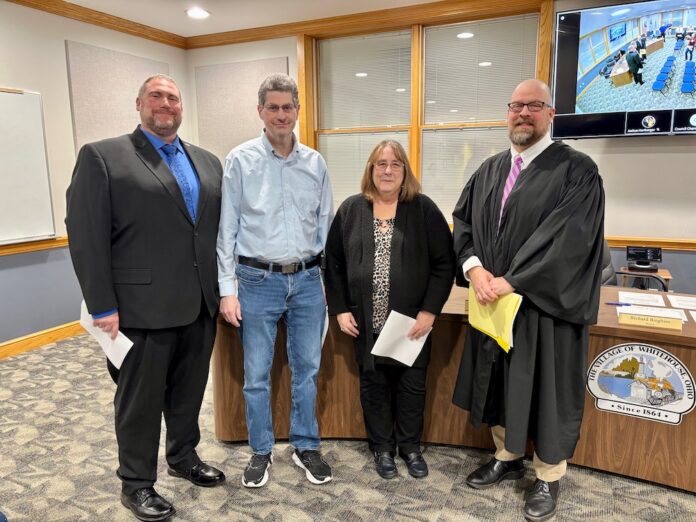
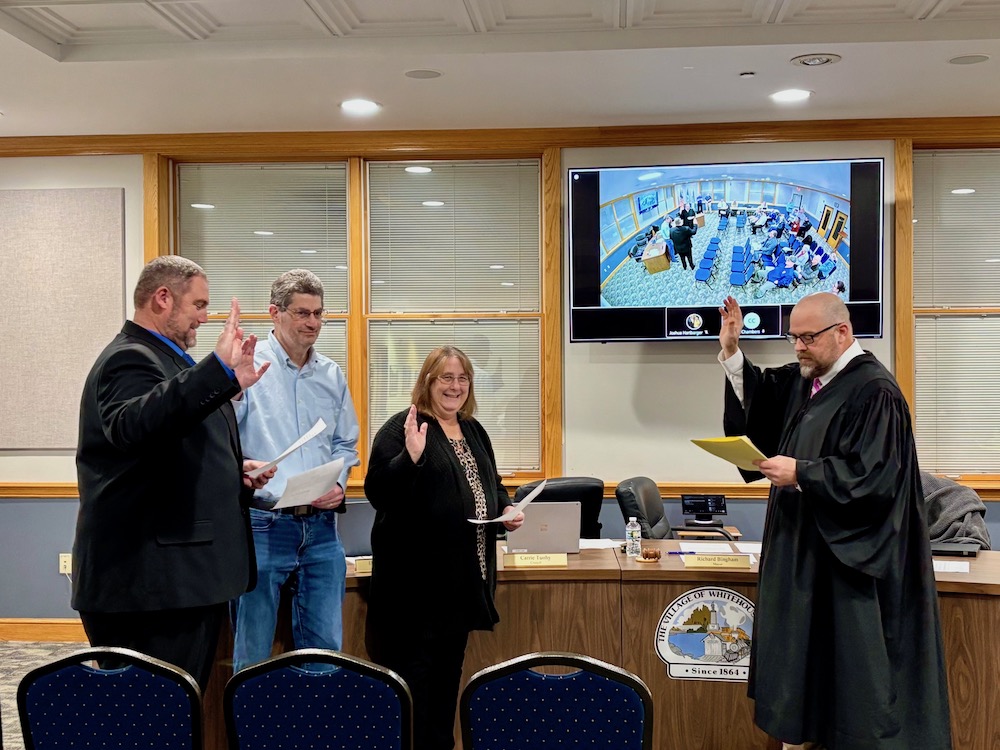
Maumee Municipal Court Judge Daniel Hazard administered the oath of office to Whitehouse Village Council members (from left) Joe Bublick, Steve Fine and Louann Artiaga. (AWFP photo by Karen Gerhardinger)
Whitehouse will consider a request to rezone 38 acres on Archbold Whitehouse Road. Monclova Township continues to hear requests for a data center moratorium. And Providence Township trustees held their first meeting of 2026. Read below for a summary of the Anthony Wayne area meetings held the first week of January. Visit anthonywaynefreepress.com for more AW stories and to sign up for our newsletter.
Whitehouse to consider rezoning 38 acres
A proposed zoning change for 38 acres at 11320 Archbold Whitehouse Rd. will be on the March 3 Whitehouse Village Council agenda, as Artisan Craftbuilt Homes owner Charles Grass seeks to build single-family homes on existing farmland.
During a Jan. 5 Planning Commission meeting, Grass presented his request to rezone the property from S-1 suburban to R-2 single family, which has lots with a minimum of 15,000 square feet.
“There were a lot of questions from the audience about the site plan and what it will mean. That’s reasonable that they want to know, but the exclusive purpose of the public hearing and the Planning Commission is the zoning itself, not to review the actual site plan,” Administrator Jordan Daugherty told Whitehouse Village Council during its Jan. 6 meeting. “There were a lot of questions on what does R-2 mean and concerns from the audience on that type of density,” he added.
Artisan Craftbuilt Homes purchased the 38-acre parcel between the Oak Brook and Lone Oak Crossing subdivisions in June for $420,000 from Kennedy Investors. Grass applied in 2024 to rezone the property to R-3, which matches the nearby Oak Brook and Westwyck subdivisions, but was turned down after neighbors shared concerns about density.
While the Planning Commission at the time suggested that Grass should come back with an R-2 request, he then submitted a request for an R-2 with a planned unit development (PUD), which gives the developer more flexibility on setbacks. That, too, was turned down.
“He came back to fulfill his promise – making it a less dense, less populous area,” said Planning Commission Chair Dennis Kennedy, explaining that R-2 lots would be about one-third of an acre.
The Planning Commission recommended approval of the rezoning, so council would need a supermajority, or five out of six votes, to turn down that recommendation, said Law Director Kevin Heban.
The village will need to give 30 days notice to the community about the public hearing, which will be held Tuesday, March 3 at 6:15 p.m. Heban said he would draft legislation that could be read during three separate meetings, but could could also choose to vote on it as an emergency.
If approved, Grass would then need to return to the Planning Commission with a site plan for approval, Kennedy said.
During the Jan. 6 meeting, Council also:
Maumee Municipal Court Judge Daniel Hazard administered the oath of office to Whitehouse Village Council members (from left) Joe Bublick, Steve Fine and Louann Artiaga. (AWFP photo by Karen Gerhardinger)
-Witnessed Maumee Municipal Court Judge Daniel Hazard administer the oath of office to re-elected council members Louann Artiaga and Steve Fine, and newly elected council member Joe Bublick.
-Unanimously voted for Fine to serve as council president for 2026.
-Heard Fine say that as a member of a Toledo Metropolitan Council of Governments subcommittee, he is working on fair scoring criteria for transportation grants.
-Approved Mayor Rich Bingham‘s appointments to committees, including: Rob Casaletta and Allen Kuck, Planning Commission; Chuck Kethel and Brian Slagle, Board of Zoning Appeals; Steve Connelly, at-large member, Tree Commission; Larry Yunker, Finance Committee; and Angie Kuhn and Phil Whaley, Charter Review Commission.
-Learned that Tom Vincent retired as a volunteer firefighter after 31 years.
-Heard that the fire department handled 1,093 incidents in 2025, a nearly 15 percent increase. Fire Chief Jason Francis said he is working on an open house to promote volunteering.
-Heard Police Chief Allan Baer say that the department will host a Citizens Police Academy in March, providing a hands-on understanding of what the department does.
Monclova residents urge trustees to work with them
Dozens of Monclova Township residents filled the Monclova Township hall on Jan. 5 meeting to deliver a message to trustees: work with the citizens, the county and neighboring communities to protect the township from data centers.
“DCs are a threat. And if it’s not now, then it will come and we need to be prepared,” said Diane Stroshine. “We need to strengthen our conditional use documents with strong restrictions on light, sound, setbacks, generators. Also, massive fines for noncompliance and escrow money to reclaim the land when they’re no longer useful.”
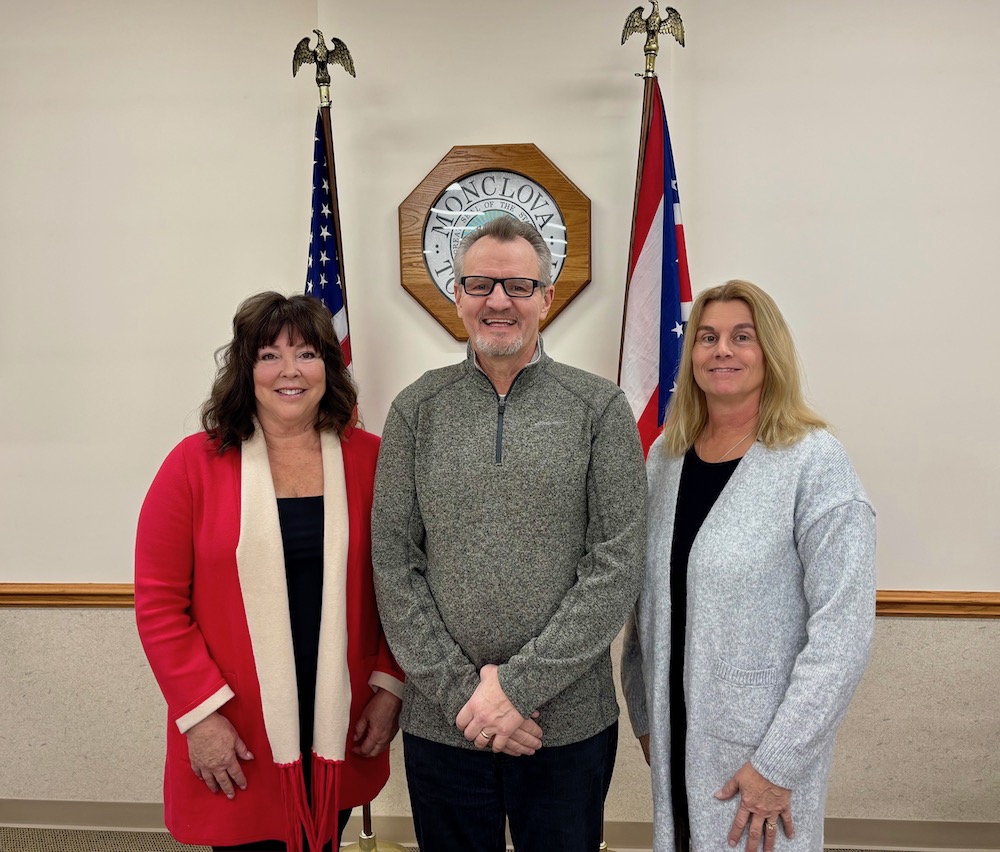
The Monclova Township Board of Trustees includes chair Barbara Lang, Chuck Hoecherl and vice-chair Deborah Stevens-Laux. (AWFP photo by Karen Gerhardinger)
She urged the board of trustees, including Barbara Lang, Chuck Hoecherl and Deborah Stevens-Laux, to issue a 12-month moratorium to allow time to modify the conditional use documents, study data centers and work alongside others who are facing the same challenges.
“Our leaders should be working with us, not against us. And remember, respectfully, that we are your bosses,” Stroshine said.
Last year, the trustees approved a text amendment to the township’s zoning resolution, allowing data centers in agriculturally zoned areas with the granting of a conditional use permit. This was the best option for protecting residents, as opposed to changing the zoning, which is a more cookie-cutter approach, said Zoning Administrator Eric Wagner. The process of issuing a permit and deciding on conditions is the role of the Board of Zoning Appeals (BZA).
“The BZA, historically, is able, for conditional uses, to look at things in greater detail and work with a particular site. It gives them a lot of authority to do what they need to do to protect the surrounding property owners,” Wagner said.
John Langevin read aloud the township’s zoning resolution section on conditional uses. Landscaping, screening, parking, hours of operation and lighting are the only five items listed in the zoning regulations when it comes to conditional uses, he said. Langevin said he believes that language does not appear to allow the Board of Zoning Appeals (BZA) the authority to require additional setbacks or other aspects of control.
“You have mega corporations that have lawyers that would pick this thing apart,” Langevin said, urging the trustees to rescind the text amendment and start over with an open process that includes citizen input, so that everything is spelled out.
Hoecherl countered that it’s difficult to spell out conditions when the township hasn’t even received an application.
Resident Marilyn Campbell asked Hoecherl, Lang and Stevens-Laux to weigh in on whether they, as residents, would personally support a data center in the township. Lang has previously advised that trustees should not make a blanket statement against any type of development, as it could open them up for legal action.
“I cannot say as a trustee, ‘I’m against apartments,’ and then the apartment person comes in and tries to build apartments, and they sue us because I’ve stated I’m against apartments,” Lang gave as an example. “I cannot come out – maybe I can as your neighbor across the fence – but I’m sitting at this desk being a trustee.”
Stevens-Laux, in her first meeting as a new trustee, said she’s not anti-data center but believes there are better places for them to locate.
“My personal opinion will never be part of this. It is always going to be about what is best for the residents,” she said.
Hoecherl said he’s not for or against data centers, but is against annexation, which remains a primary concern for the land off Black Road that is still within the township.
The law director is currently working on language to strengthen the township’s position against possible annexation of that land, he noted. In the meantime, Maumee is looking at a moratorium against data centers, which Campbell wondered if it would alleviate some of the township’s fears.
Christina Egan said she’s reached out to Maumee’s new mayor and council members, as well as the Lucas County Commissioners and State Rep. Josh Williams (R-Sylvania) about a county-wide moratorium and protecting the township from annexation.
“If you can get an annexation change, wow,” Lang replied.
Egan urged the trustees to represent the residents and ask the county for help.
“We appreciate everyone being so well-informed,” Stevens-Laux said. “We wouldn’t be able to do anything without all of your input.”
During the meeting, the trustees also:
-Named Lang as chair and Stevens-Laux as vice chair.
-Heard Hoecherl say that the township will work on updating the meeting agendas with more details prior to the regularly scheduled Monday trustees’ meetings.
-Certified that the township is responsible for the maintenance of 66.879 miles of public road, up .997 miles with the inclusion of roads in Crimson Hollow, Stonegate, Stoney Creek and the extension of Riverfort Drive.
-Learned that, per a contract between Republic Services and Lucas County Solid Waste Management District, the monthly price for trash and recycling pickup will increase from $16.44 per month to $17.26. The number of residential units has increased from 5,453 to 5,511. The annual cost will increase from $1,075,767 to $1,141,438. The township pays $522,442 out of its General Fund while residents will pay $618,995 from a special assessment on their property taxes to cover that total.
-Learned that as of Dec. 29, the township had 2,016 iOS downloads of the My Monclova app and 700 Android downloads. The app has been accessed 1,314 times through the website by users who have not downloaded the app.
Providence Township Trustees’ meeting
The Providence Township trustees include (from left) chair Steve Kendall, Lee Bialecki and vice chair Jeremiah Floyd. (AWFP photo by Karen Gerhardinger)
A Lucas County Engineer’s representative will be invited to visit the next Providence Township trustees meeting to discuss the county’s request to utilize the township’s salt storage facility.
During the Jan. 7 meeting, Trustee Jeremiah Floyd and Road Superintendent Kevin Keifer shared discussions they had with Albert Hilt, the county engineer’s road superintendent, about that possibility.
Floyd said that because the township is in the southwest corner of the county, county road crews lose up to 90 minutes in drive time by returning to the McCord Road facility to pick up salt up to six times per weather event. Allowing the county to store 30 tons in the township’s salt bin will not only ensure more efficient road clearing in the township but save the county time and the taxpayer’s dollars, Floyd added.
“Our salt bin is not in the best condition and not the biggest either,” said Keifer, expressing concern that some of the less experienced county drivers might damage their facilities, which don’t have a lot of space for maneuvering.
Floyd said Hilt assured him that the more tenured drivers – with more than 20 years of experience – request the rural routes instead of city routes, and would exercise caution. Hilt also noted that any salt removed would be replaced.
Trustees agreed to invite Hilt to come to a meeting to answer questions and put into writing any agreement between the township and the county.
The next meeting is slated for Wednesday, Jan. 21 at 6:30 p.m.
During the meeting, the trustees also:
-Watched as solicitor David Chamberlain administered the oath of office to trustees Lee Bialecki and Jeremiah Floyd.
-Heard zoning inspector Jim Fischer say that he issued four permits in 2025: two for new homes; one for a home alteration; and one for a residential solar field.
-Listened to Fischer say that a Doran Road resident was asked to remove a sign from a right of way. He did that, but now it is back up, reinforced with 2 x 4s. Chamberlain said the homeowner will need to remove the sign or the township will do it for him.
-Held a discussion about a $4,121.29 bill to pay for electrical work done on the replacement of two diesel fuel tanks at the township building. Keifer said he was in a bind after learning that Stanwade Metal Products would not do the electrical work on the new tanks, which hold fuel used by township vehicles.
He contacted John Berry of Phase Electric who recommended contacting AE Electric, which completed the work. Floyd said he was concerned about the lack of written quotes from other companies, especially since AE is owned by Bialecki’s brother. He added that he had tried to stop the work as it was in progress when he learned that AE was doing the work. Solicitor David Chamberlain advised that Bialecki doesn’t have a conflict of interest in voting on payment or the work since he doesn’t financially benefit. Bialecki and Kendall voted to issue payment while Floyd abstained.
-Heard Fire Chief Rick Triggs say that the new 3,000-gallon tanker/tender – which is replacing a 1984 unit – should be complete and delivered by May. The township received a $523,809 FEMA grant to pay for the vehicle. The department had 462 runs in 2025, including: 15 structure fires; 27 outdoor fires; three car fires; 44 motor vehicle accidents; seven calls for downed wires; 306 EMS calls; and 60 miscellaneous runs.
Yarder Manufacturing president Jeff Conlan and Vice President Matt Yarder are joined by Mosser Construction President Brian Geffe inside the new 100,000-square-foot Yarder Manufacturing facility in the Monclova-Maumee-Toledo Joint Economic Development Zone (MMT JEDZ). Construction is expected to be complete this summer. (AWFP photo by Karen Gerhardinger)
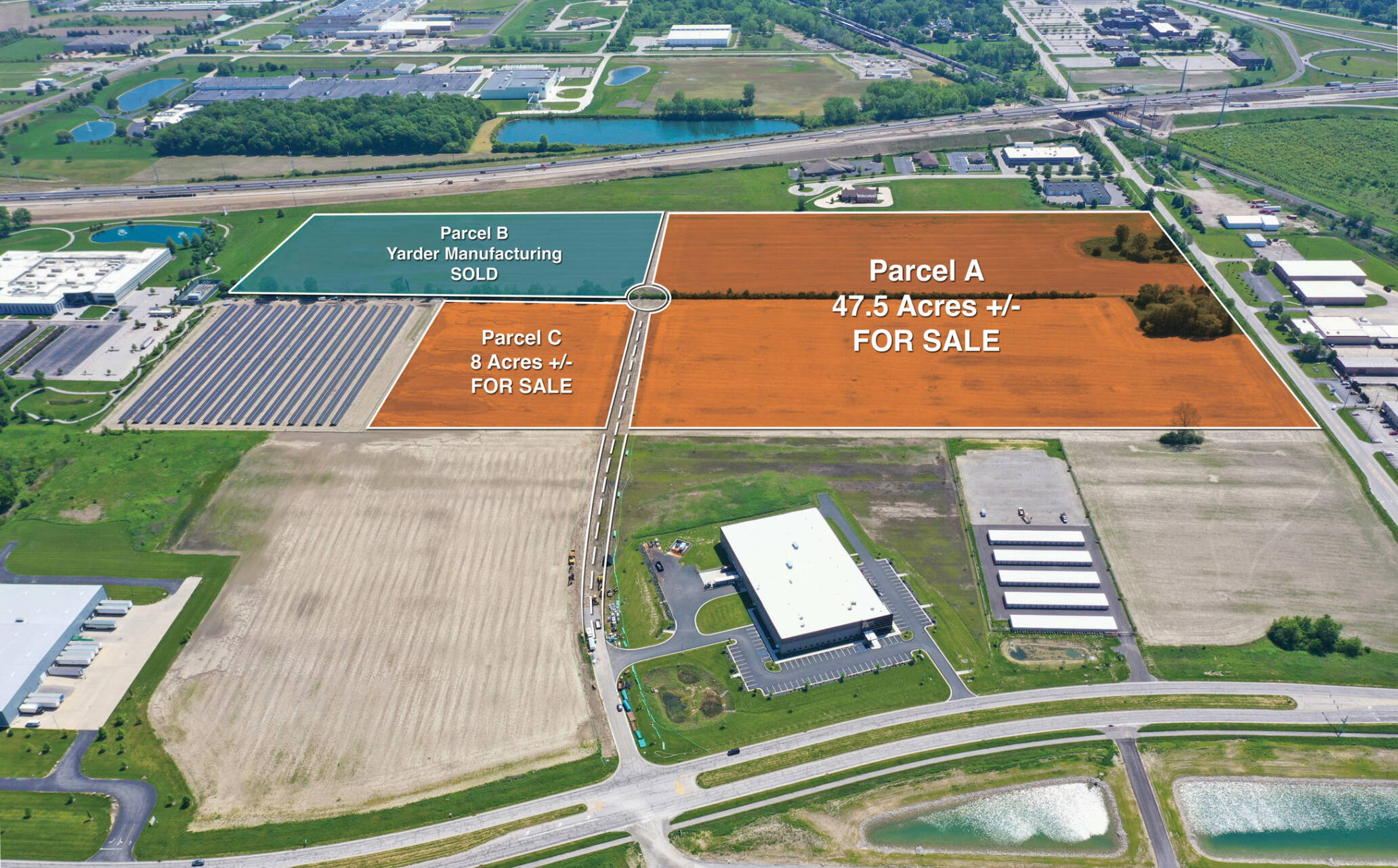
With the 100,000-square-foot Yarder Manufacturing headquarters now under roof and easily visible from I-475, Vice President Matt Yarder is getting more questions about his family’s business – and the newly-created Legacy Business Park where it’s located.
“I get calls from people who put the dots together, knowing we were planning to build in Monclova Township and then seeing it from the highway,” he said. “We’re going from a little, unassuming family business in a neighborhood in Toledo to having this kind of visibility.”
When Yarder and resident Jeff Conlan began looking at options for expansion of the sheet metal parts and product manufacturing business, they figured they would just buy a piece of land and build. In the process of looking for the right property with available utilities, Yarder teamed up with Mosser Construction to create a new business park on 70 acres in the Monclova-Maumee-Toledo Joint Economic Development Zone (MMT JEDZ).
YMG, as their partnership is known, purchased what is now Legacy Business Park and secured funding from Monclova Township, Lucas County and the state to fund the 1,200-foot extension of Riverfort Drive to access not only Yarder’s property but the north side of three other 20-acre properties and an 8-acre parcel to the west of Yarder Manufacturing.
Legacy Business Park in the Monclova-Maumee-Toledo Joint Economic Development Zone just west of I-475 has space for additional companies to locate. Yarder Manufacturing teamed up with Mosser Construction to install a 1,200-foot extension of Riverfort Drive to allow access to the interior of the property. (Courtesy image)
“This was an opportunity to help a client like the Yarders find their next home,” said Mosser Construction president Brian Geffe. “When we look at available green sites available in Lucas County, there’s only a handful of them. This has great access to the interstate with the new US 20A interchange, and Monclova Township is business friendly. Once this starts to activate, I think we’ll see a lot of opportunities.”
The YMG team is already in discussions with another family-owned business eyeing one parcel and, now that Yarder’s construction is underway, are receiving inquiries about other areas. Yarder’s project is utilizing just half of the land while reserving the other half for future generations to expand in place, Matt said.
“We’ve been in our current facility since the mid-1940s, and it’s served us well for generations, but this facility will showcase our capabilities to the level of customers that we deal with. We have some global customers who visit our shop right now, and they’re impressed with what we’ve been able to do with our current space,” Yarder said.
The current facility doesn’t have shipping or receiving docks, so employees load and unload materials in the parking lot. The production takes place in five separate buildings. And their conference room is a closet-sized space under a stairwell, jokes Conlan.
The new building will feature 88,000-square feet of open production area for lasers and brake presses, and an enclosed area for grinding. Conlan expects that having all production under one roof will enhance the work flow.
“Right now we have stuff crammed everywhere. It will be nice to spread out in one building where everything flows the proper way,” Conlan said.
Wearing hard hats and safety vests, Yarder, Conlan and Geffe were joined by Mosser project manager Tom Koepfler and supervisor Nick Fisher last month for a tour of the facility, which includes a reception area, glass-fronted offices and a large, sunlit open area for employees in sales and purchasing to view the outdoors from three sides.
“Our employees have been involved in the design from the get-go,” Yarder said.
Mosser Construction employees (from left) Grady Welker, PJ Szakovits and Samantha Teigland look out the windows from the front offices to the receiving dock at the new Yarder Manufacturing facility. (AWFP photo by Karen Gerhardinger)
Pointing to the windows facing the receiving docks that allow easy viewing of trucks coming in, Yarder explains that this was just one of several ideas shared during every phase of the design process.
On the east side of the administration building is a large breakroom that can be used to hold trainings and employee gatherings – a big step up from holding meetings in the cramped production area, Conlan said.
“It’s going to be a complete upgrade to our culture: the way that we recruit, the way we train, the way we engage with our staff. This whole project, we have had our culture in mind from Day 1. We’re family-owned and family-oriented in everything we do. We have a lot of limitations on our current site. This will allow us to expand on our culture.”
That culture also includes some downtime, Yarder said, noting that the No. 1 question he gets from employees is whether the detention pond out front will be stocked with fish. Yes, it will.
When Yarder first announced its move, the manufacturer had 62 employees. In the past year, eight more have joined the team. By the time the new facility opens, Conlan expects that number to grow to the mid 80s, including engineering, sales and purchasing positions.
If construction goes as planned and the electric is hooked up in time, Conlan expects that the transfer of machinery from the Toledo location to the new location will begin in June. Several area companies specialize in moving large equipment, including one laser that will require seven semis to move.
The Anthony Wayne Free Press is working on a series of articles about growth and projects in the Anthony Wayne area. To share information, contact [email protected].
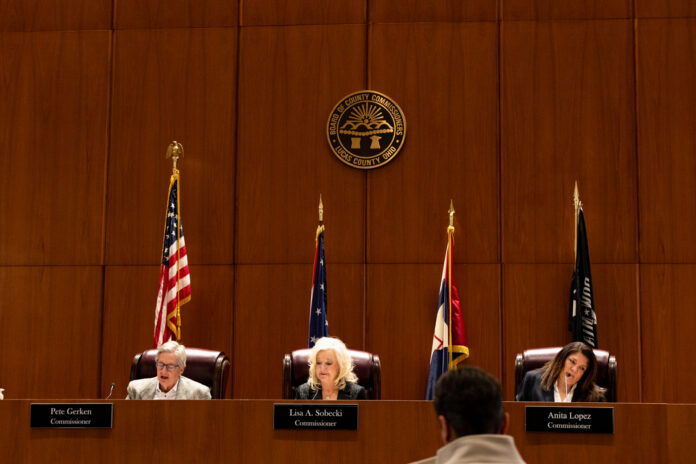
Lucas County Commissioners Pete Gerken, Lisa Sobecki and Anita Lopez during a Lucas County Commissioners Meeting at 1 Government Center in downtown Toledo on Monday, Jan. 6, 2026. This meeting appointed Sobecki as president of the Board of Commissioners for 2026. (TFP photo by Stephen Zenner)
TOLEDO – Tuesday marked the first Lucas County Commissioners’ meeting of the year, where the first order of business was electing the new president of the Board of Lucas County Commissioners.
Like last year, the three commissioners elected Lisa Sobecki to be their president, and similarly decided to continue holding their meetings on Tuesdays at 11 a.m.
The third item designated the commissioners to seats on various boards and committees.
Commissioner Lisa A. Sobecki:
County Commissioners Association of Ohio (CCAO) Alternate
Community Corrections Planning Board (CPBB)
District Advisory Council of the Lucas County Health District
Downtown Toledo Improvement District (DTID)
Family Services Planning Committee
Lucas County Criminal Justice Coordinating Council (CJCC)
Lucas County Data Processing Board
Lucas County Economic Development Corporation
Lucas County Emergency Planning Committee
Lucas County Family & Children First Council
Lucas County Land Reutilization Corporation (Land Bank)
Lucas County Plan Commission
Lucas County Solid Waste Management District
Lucas County Workforce Development Board
MacArthur Foundation’s Safety + Justice Challenge
National Association of Counties (NACo) Board of Directors Representative
Toledo Zoological Society Board of Trustees
Commissioner Pete Gerken:
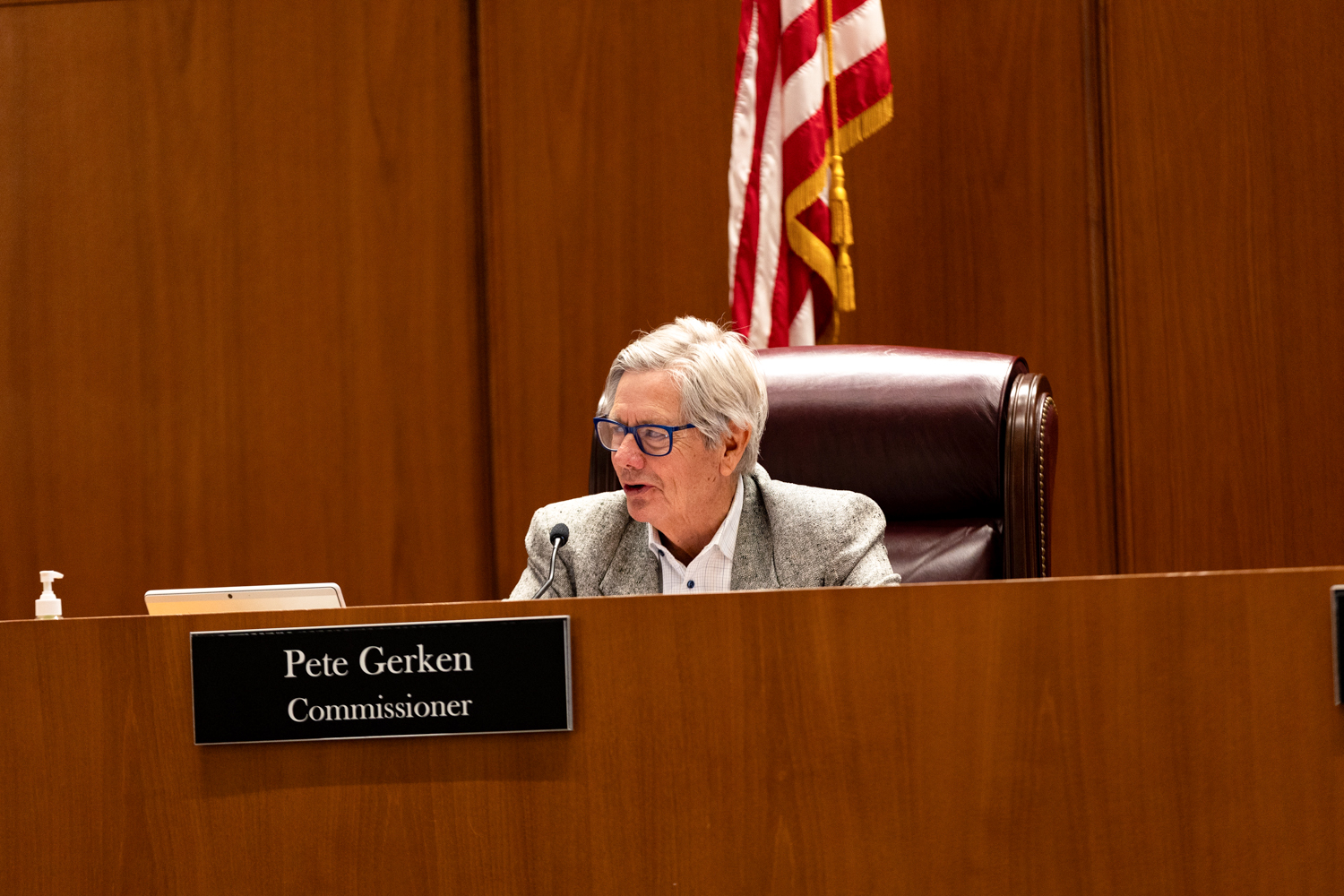
Pete Gerken, Lucas County Commissioner, questions various members of local government before giving approval to their requests. (TFP photo by Stephen Zenner)
Corrections Commission of Northwest Ohio (CCNO)
County Commissioners Association of Ohio (CCAO)
Downtown Toledo Improvement District (DTID)
Lucas County 9-1-1 Regional Council of Governments Administrators Technical Advisors Committee
Lucas County Convention & Visitors’ Bureau
Lucas County Economic Development Corporation
Lucas County Land Reutilization Corporation (Land Bank)
Lucas County Plan Commission
Lucas County Board of Revision (BOR)
Lucas County Solid Waste Management District
Lucas County Solid Waste Management District Policy Committee
Pathway, Inc. Board
Toledo Lucas County Homelessness Board
CommissionerAnita Lopez:
Emergency Food & Shelter Program (EFSP) Local Board
Healthy Lucas County Executive Committee
Lucas County 9-1-1 Regional Council of Governments Administrators Technical Advisors Committee (alternate)
Lucas County Common Pleas Drug Court Committee
Lucas County Economic Development Corporation
Lucas County Integrated Justice System
Lucas County Plan Commission
Lucas County Solid Waste Management District
Lucas County Records Commission
Toledo-Lucas County Sustainability Commission
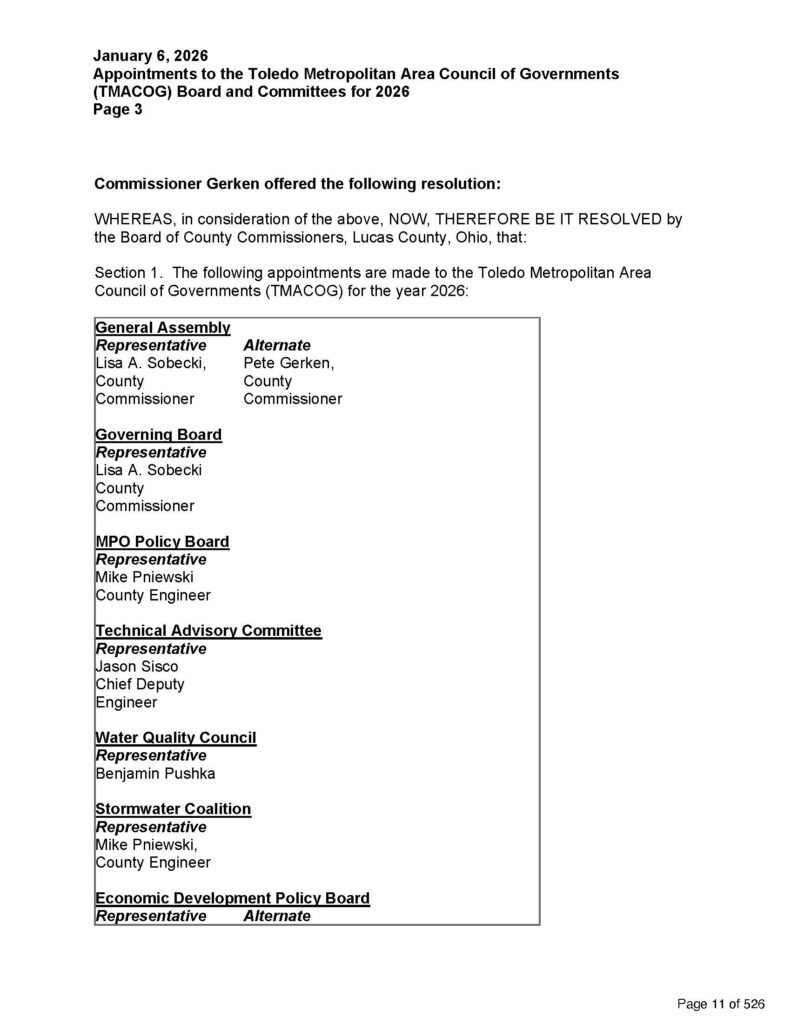
This year’s appointments to the Toledo Metropolitan Area Council of Governments (TMACOG) were as follows:
Matt Killam will serve a three-year term on the Toledo Area Regional Transit Authority (TARTA) Board of Trustees commencing immediately and expiring on April 30, 2026.
Part of the summary reads, “There is one (1) vacancy for a board term set to expire on April 30, 2028. Matt Killam has expressed interest in and has been recommended to serve on the TARTA Board of Trustees for the remainder of the current 3-year term which is set to expire on April 30, 2028.”
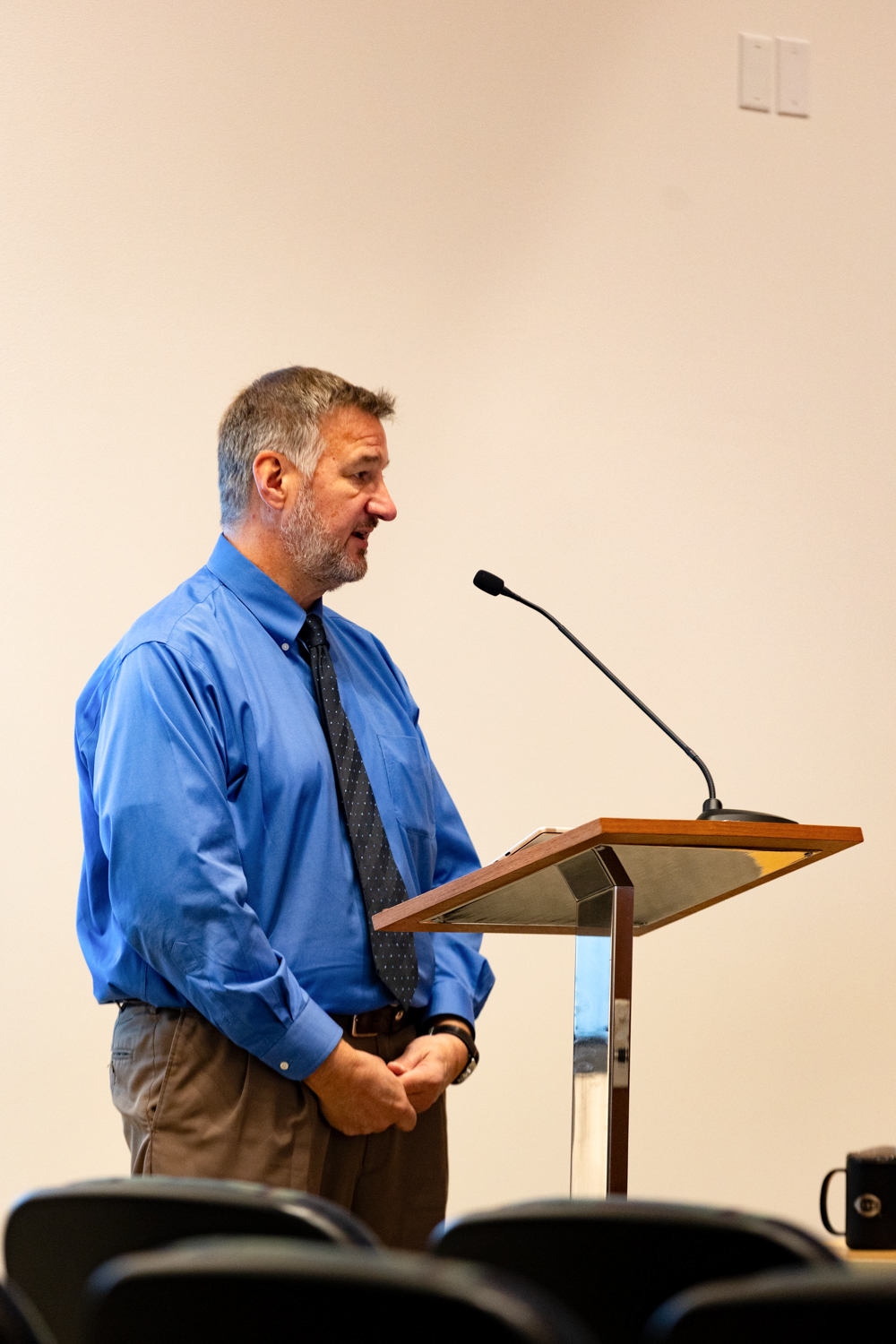
Mike Pniewski, the Lucas County Engineer, presents items for approval. (TFP photo by Stephen Zenner)
County Engineer
Lucas County Engineer Mike Pniewski set the times for the annual township meetings and then had the County Highway System Mileage Certification approved. From Dec. 2024 to Dec. 2025, the county’s highway grew from 252.605 miles of highway to 252.607 miles of highway.
Then Pniewski accepted a bridge report concerning Lucas County’s 194 bridges. When presenting the information, he warned of the county’s aging bridges. Bridges, he said, have a service life of about 75 years, and said the average age of a bridge in Lucas County was about 50-years-old.
Pniewski then said the county does have a plan to upgrade most of the aging bridges over the next ten years.
Lucas County bridges on county and township roads were rated as follows:
15 were rated as excellent.
54 were rated as very good.
42 were rated as good.
33 were rated as satisfactory.
12 were rated as fair.
5 were rated as poor.
None were rated as “serious” or “critical.”
Lucas County bridges inside municipalities were rated as follows:
1 was rated as excellent.
17 were rated as very good.
4 were rated as good.
7 were rated as satisfactory.
3 were rated as fair.
1 was rated as poor.
None were rated as “serious” or “critical.”
The County Engineer then accepted roads on the following plats:
Frank Cody of the Lucas County Sheriff’s Office presented approval for Lucas County to reinstate the Inter-Governmental Communication Tower Site Agreement with Monroe County, Mich.
Eric Zatko, the director of Lucas County Common Pleas Court, presents for approval a refund for a software system with Tyler Technologies, refunding $142,387.94 to the county. Zatko briefly mentioned the software did not cover everything the common pleas court does. (TFP photo by Stephen Zenner)
Common Pleas
Eric Zatko, the director of Common Pleas Court, presented a refund for a software system with Tyler Technologies, refunding $142,387.94.
“You wanted this and now you don’t want it?” Gerken asked, an inquiry into the reason for the refund after Zatko gave a basic overview.
Zatko explained that the software from Tyler Technologies did not have enough “functionality” to be used for the county’s pretrial bookings, despite being able to perform the functions dealing with probation adequately.
Juvenile Court
The Juvenile Court presented two items for approval:
An agreement with Unison Health for mental health services and treatment, and a memorandum of agreement with the Mental Health & Recovery Services Board to provide funding for youth mental health support.
Facilities
Asked for permission to advertise for the demolition of the Former Child Studies Institute located at 428 10th Street.
Job and Family Services
Item 16 approved a revenue generating agreement with Zepf Center.
Item 17 approved an intergovernmental contractor agreement with Lucas County Family and Children First Council for the Provision of Intersystem Coordination.
Items 18-24 approved transportation contractor agreements for non-emergency Medicaid and Title XX (TXX) transportation services.
Item 25 approved an intergovernmental agreement with Lucas County Family and Children First Council for the Bridges Out of Poverty Program.
Support Services
Two separate purchase orders were approved by the Commissioners, and travel for all three Commissioners for the year 2026 was approved.
Solid Waste Management District
$25,000 was approved for the maintenance and upkeep of four walking floor trailers, used in the recycling process.
There was some confusion initially while approving this request, as Nate Inkrott, the sanitary engineer for Lucas County, initially said the total cost was $10,000. When questioned by Commissioners Gerken and Sobecki about the price, Inkrott corrected himself, and assured the Commissioners the amount was in fact $25,000.
Administration
The commissioners authorized Keep Toledo/Lucas County Beautiful (KTLCB) to accept, hold, and administer sponsorship funds on behalf of the County for EcoFest Toledo 2026.
And the final item before going into executive session was the approving the Ohio Department of Health’s Tuberculosis Funding Agreement.
Members of the Waterville Community Foundation presented a check for $40,000 to the city of Waterville in September, to be used to purchase a drone for the fire, police and public works departments. (AWFP photo by Karen Gerhardinger)
WATERVILLE – In its 24 years, Waterville Community Foundation has been the silent partner for dozens of Anthony Wayne-area organizations – providing much-needed funding for projects that benefit children, animals, veterans, nonprofits and governmental entities.
Advocating Opportunity, Bittersweet Farms, Courageous Community Services, the Family and Child Abuse Prevention Center, HOOVES, Nature’s Nursery an Sunshine Foundation are just a few of the well-known organizations that have benefitted from WCF grants over the years.
Bittersweet Farms, a community for individuals with autism, has benefitted from Waterville Community Foundation grants many times over the past 23 years. (Courtesy photo)
In 2025, the WCF gave $40,000 for the city of Waterville to purchase a drone for use by its police, fire and public works departments and $30,000 to help launch the Anthony Wayne Free Press.
Coming this year to a wall in downtown Waterville: a mural by local artist Dean Davis. Anthony Wayne Area Arts Commission (AWAAC) just received $5,000 in matching funds from the WCF to support an 18-foot by 80-foot public mural to be painted on a building at 217 Mechanic St. – visible to all who enter town from the bridge, said AWAAC vice president Lisa Exner.
“We are super excited and will be working to make this mural a reality in 2026,” Exner said.
The idea for the Waterville Community Foundation sprouted in the early 2000s, as Tom Titus, who was city treasurer for 25 years, regularly heard representatives from area organizations asking Council for funding.
“In one council meeting, one proposal was debated for a half an hour. I thought, ‘This isn’t working. Now we’ll get more and more people asking for donations. We’ve got to do something,” Titus said.
As he researched ideas, Titus found that a local foundation could be formed under the umbrella of the Greater Toledo Community Foundation, which WCF Board Member Paul Croy describes as the “mothership” – providing support and guidance.
Starting with $10,000 in seed money from the city, the WCF was formed on Sept. 26, 2002. With the WCF in place, Council could refer those in need of funding to apply for a grant.
Even with regular fundraisers, the early WCF had just $20,000 to $30,000 in the bank – not quite enough to make any major gifts, Croy said. That was until he began talking with a church friend, Katherine R. Smith, about plans for her estate.
“She loved children, but didn’t have any of her own,” Croy said. “She wanted to set up a trust that would help area children.”
Smith decided use a good portion of her estate to set up the Katherine R. Smith Fund through the WCF, with direction to provide grants each year to organizations or programs serving children, including those who have been abused or neglected, those who are disabled, and scholarships for Anthony Wayne and Otsego graduates.
“One person with a vision can truly make a difference,” said Janice Braida, a WCF board member since 2002. “I’ve seen the foundation grow from one generous gift by one person to the organization it is today. This is Katherine Smith’s enduring legacy. And we are grateful for her.”
Along the way, the WCF has gained an influx of cash from others as well, such as when the Waterville Community Improvement Corporation dissolved. Titus and his wife set up a memorial fund through the WCF to honor their son, who died of leukemia when he was five.
“Now we’re responsibly overseeing a couple of million. That gives us the ability to give out at least $60,000 a year. This year we gave out considerably more,” Croy said.
The Anthony Wayne Rotary Club (formerly the Waterville Rotary Club) has benefitted from the WCF as well, said past president Deb Cheney. When the Rotary’s high school program, Interact, wanted to assemble thousands of nutritious meals to give to impoverished people, the WCF provided the funds.
“Kids love doing those hands-on projects, like food packs and bed builds,” Cheney said, referring to a Let’s Build Beds project in which $3,000 funded materials and mattresses to construct and outfit 40 beds for children in need.
After the annual Blues, Brews and Brats Festival – Anthony Wayne Rotary Club’s biggest fundraiser – was impacted by poor weather last July, the WCF stepped up to help Rotary continue to support its community programs.
“The Waterville Community Foundation has been a great supporter of Rotary,” Cheney said.
Choosing which organizations receive funding is a difficult decision, Croy said. A subcommittee reviews the applications with help from the Greater Toledo Community Foundation – which helps with paperwork, summaries and recommendations
“We don’t give away money lightly. We may take a long time to make a decision. We’re trying to be a good steward of the money,” Croy said.
For the board members, seeing the funds go to work in their own community over the years has had a tremendous impact.
“We all share a love and commitment to the Waterville area. But each board member brings unique interests to the post. My passion is nurturing Waterville’s rich history and preserving its rural scenic landscapes as a regional destination,” Braida said.
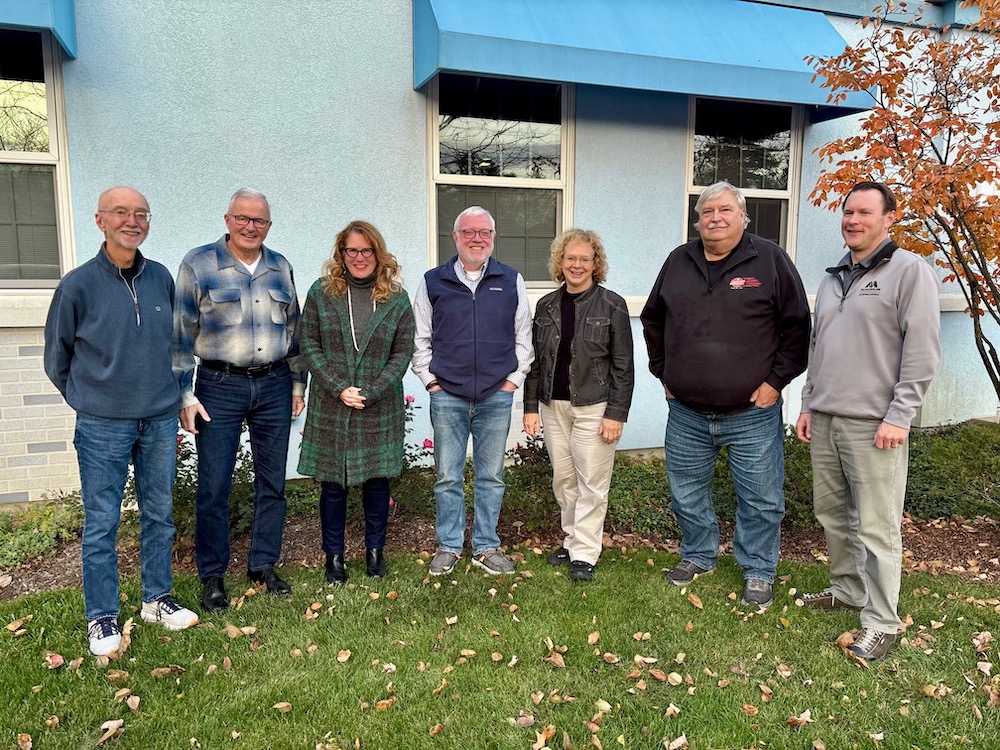
The Waterville Community Foundation’s board includes (from left) president Tom Titus, Jim Seiwert, Janice Braida, Paul Croy, Pauline Glaza, Randy Sikorski and Todd Black. (AWFP photo by Karen Gerhardinger)
Other board members include Bill Anderson, Todd Black, Pauline Glaza, Randy Sikorski, Jim Seiwert, Diana Waugh and Izzy Merkel. Merkel received a WCF scholarship when she graduated from Anthony Wayne High School in 2019.
Many outstanding students have been awarded scholarships, WCF members agree. Good grades, community involvement and high school participation – in sports, academic clubs or other activities – are factors considered by the scholarship committee. So are a good attitude and leadership potential.
“Working with the WCF is a great way to make a difference here and have your legacy continue to inspire the future of this great community,” Glaza said.
For Croy, who is an attorney aiding clients set up trusts, the WCF also provides an opportunity for retired individuals to support the community while staying in a lower tax bracket, as those ages 70-and-a-half years and older can give directly to a non-profit organization as non-taxable income as part of a required minimum distribution.
“You can set it up through a donor-directed pool fund. There are only eight community foundations in the country that can hold these kind of funds,” he said, explaining that the Greater Toledo Community Foundation – and the WCF – qualify. “This is a way to leave a legacy in our community.”
A new Waterville Community Foundation website is in the works. For information, visit toledocf.org.
St. Marys Challenger ship. (Photo courtesy of National Museum of the Great Lakes)
The delays are caused by the U.S. Coast Guard having equipment issues and unpredictable weather.
Author: Rowyn Schneider
TOLEDO — Winter may have come early for the Great Lakes this year, but neither the U.S. nor the Canadian coast guard can keep traffic moving through the ice.
The lakes’ frozen waters are currently impacting commercial traffic between ports across the Great Lakes in places like Toledo, Sandusky, and even ports in Michigan and Minnesota.
The delivery of precious cargo like iron ore, stone, coal, cement, and other dry bulk materials like salt, grain, and sand are being impacted by these delays.
The United States Coast Guard (USCG) usually conducts ice-breaking operations every year, but it has run into some issues this year.
According to a press release issued by the Lake Carriers Association, the sudden onset of winter has caused the USCG to prioritize removing buoys and navigational equipment in lake waters before they get damaged by ice.
The only heavy ice breaker ship in operation under the USGC, the MACKINAW, has been working with several other ice-breaking tug boats to move this equipment. Thus, the USGC has no icebreakers to spare for aiding cargo ships across the Great Lakes’ icy waters.
“The U.S. Coast Guard is focused on their acquisition of Arctic Security Cutters, yet they can’t even keep our internal domestic waters open. This is a major national security problem if steel mills in the U.S. cannot have a reliable supply chain during the winter” stated Jim Weakley, President of the Lake Carriers’ Association.
Canadian ports along the lakes are also fighting frozen waters, but the Canadian Coast Guard (CCG) has three icebreaker ships to help carry out its ice-breaking operations.
The CCG has only had access to two of its heavy icebreaker ships this year, as the third ship has been stuck at port in Sarnia, Ontario, due to an engineering problem.
Crews from both the USCG and CCG have been working hard to clear pathways for cargo ships, but these delays will negatively affect commercial traffic this year.
Piles of rubble next to excavator at Riverside Mobile Home Park, as the city of Toledo begins demolishing the park at 18 City Park Avenue on Tuesday December 2, 2025. TFP Photo/STEPHEN ZENNER
Chuck & Carol
TOLEDO – Nov. 17 marked the final day anyone lived at Riverside Mobile Home Park, 18 City Park Avenue.
Previous residents have, for the most part, found other accommodations, but members of the last two households of the park are still in the midst of transition.
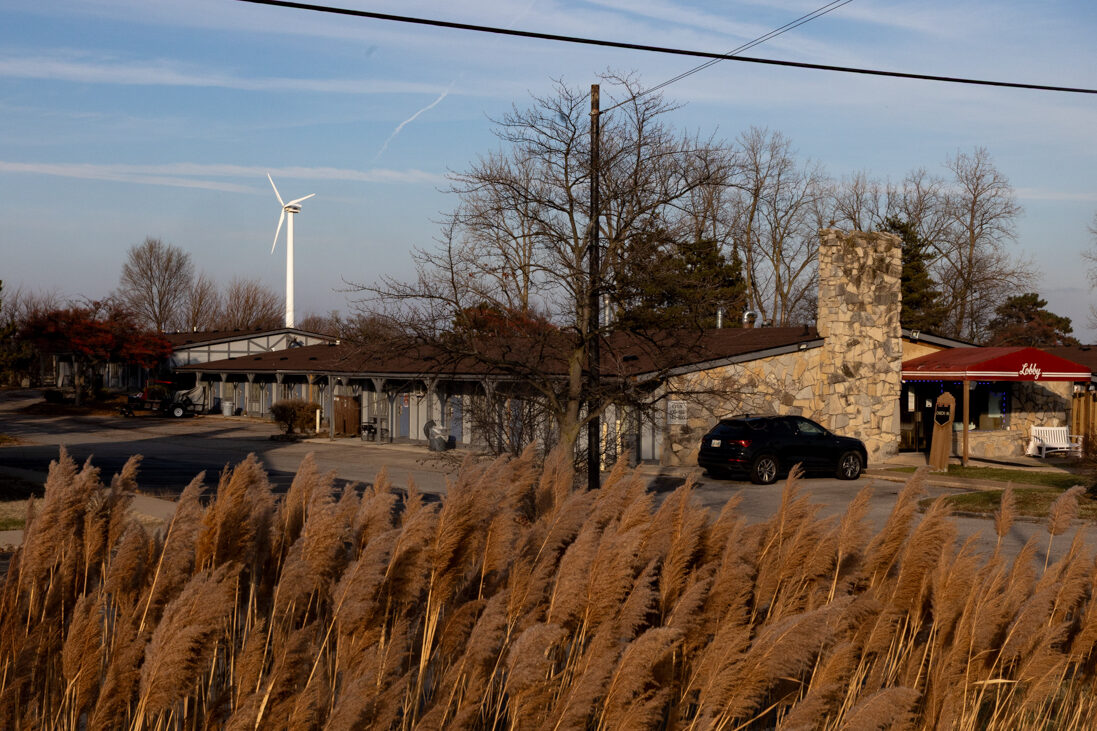
Motel in Rossford, Ohio on Wednesday December 17, 2025. TFP Photo/STEPHEN ZENNER
Carol Kelly, 59, a previous resident of the park, now sits in a motel doing much of what she did at Riverside — perusing different long-term housing options without much change.
Charles “Chuck” Parker, 66, looks through texts at a motel in Rossford, Ohio on Tuesday December 23, 2025. TFP Photo/STEPHEN ZENNER
“At least we’re not going to be homeless for Christmas,” Kelly said.
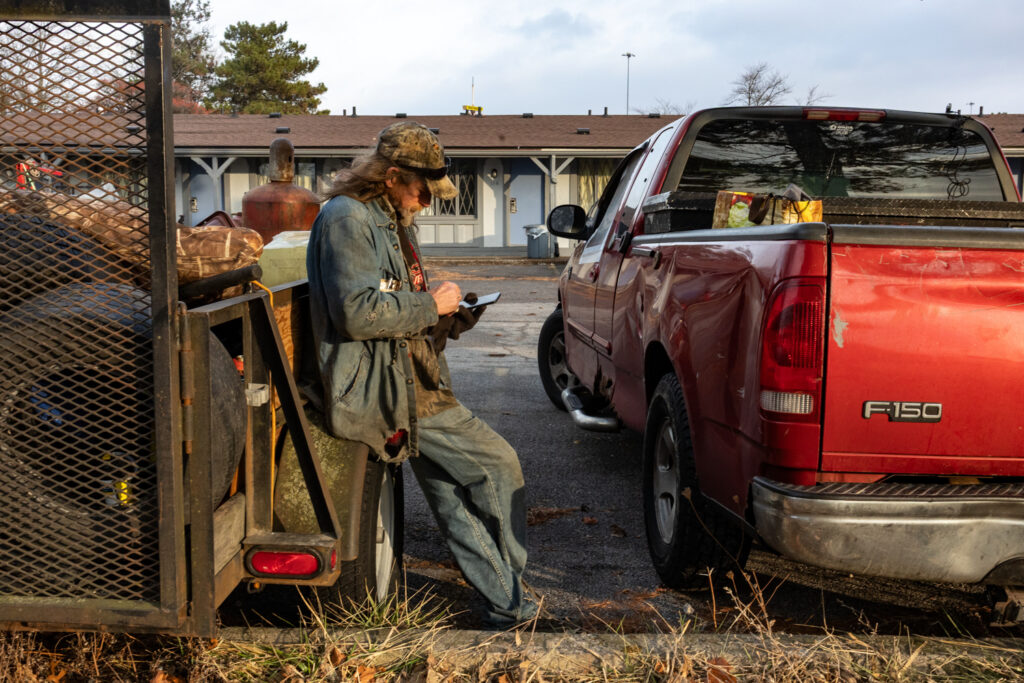
After being removed from the park, Kelly and her husband, Charles “Chuck” Parker, 66, went back to their condemned trailers to retrieve items they left behind.
For all their efforts to leave Riverside from May to November, the transition was still difficult for the couple, both of whom live with disabilities. Parker suffers from chronic back pain and Kelly has been rendered immobile, living with a number of chronic conditions.
“It was stressful, trying to get everything loaded up, and then them telling us, ‘Alright, it’s time to go,’” Parker said.
When the couple was encouraged to leave Riverside, their home for the past five years, they only took a portion of what they had stored up, and chose to come back to retrieve the rest.
“We had to leave a lot of shit behind, and come back the next day,” Parker said. “There wasn’t nothing going on, so we’re able to get another load.”
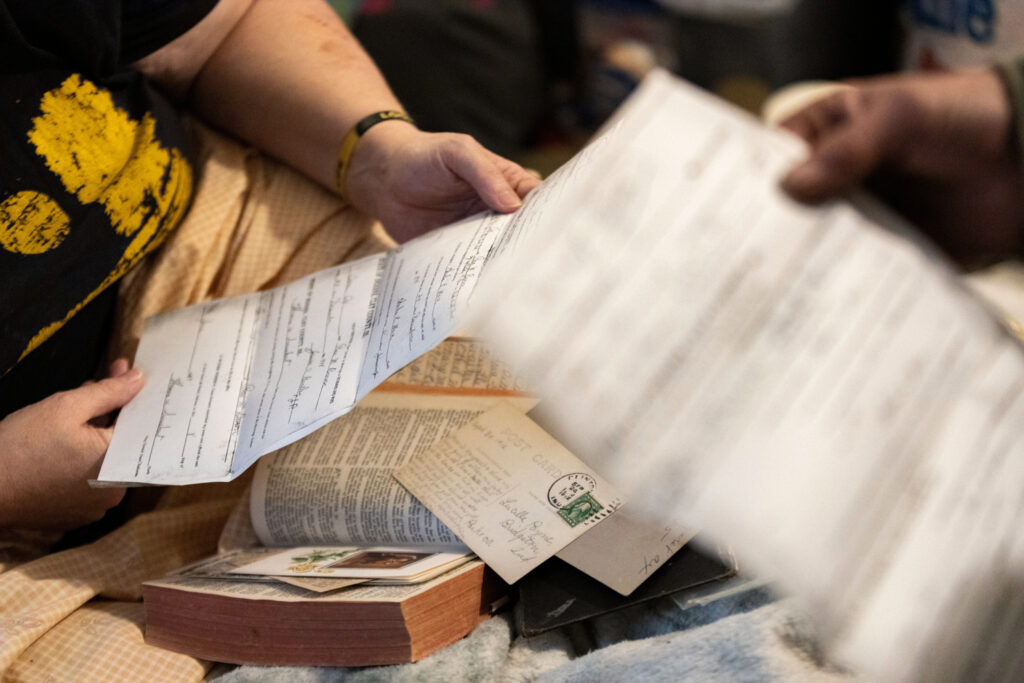
Carol Kelly, 59, sits in her bed holding old family mementos and records at a motel in Rossford, Ohio on Wednesday December 10, 2025. One of the meaningful scavenges from returning to Riverside was a box of family post cards, documents and a generational Bible. TFP Photo/STEPHEN ZENNER
Heirlooms were the most important items the couple salvaged upon their return to the condemned location, including a family Bible that was over a hundred years old.
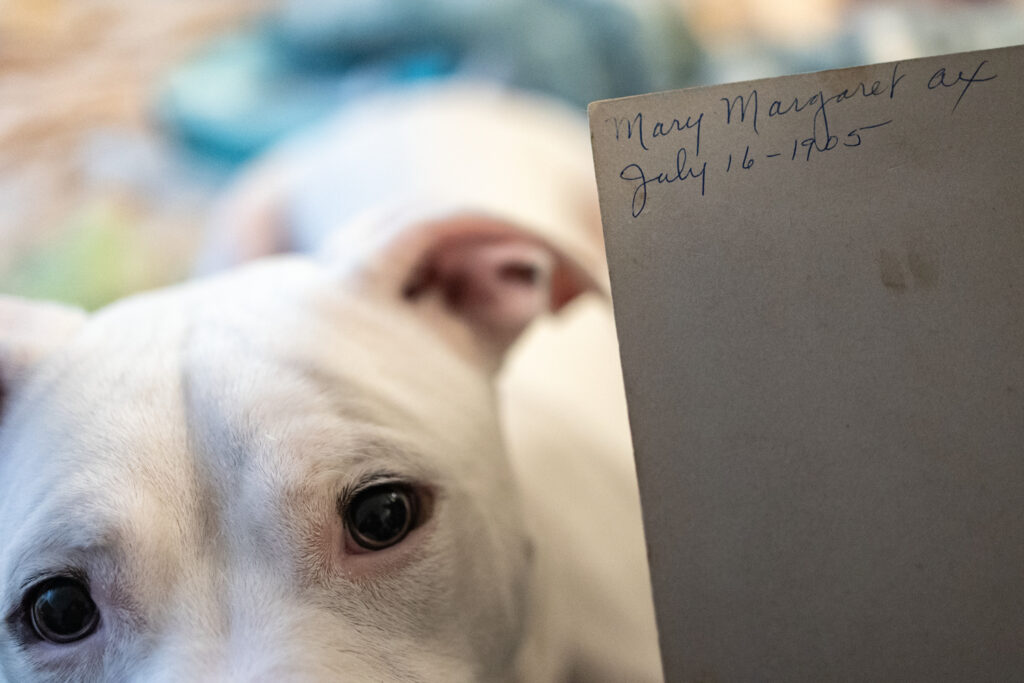
Ann Marie, Carol Kelly’s pit bull, sits on the bed, as Charles “Chuck” Parker, 66, and Carol Kelly, 59, show the date for a family picture at a motel in Rossford, Ohio on Wednesday December 10, 2025. Parker and Kelly rediscovered this item after they went back to Riverside to grab more of the items they had left behind. TFP Photo/STEPHEN ZENNER
“This was in the Bible,” Kelly said, holding up a postcard from her grandmother from 1912, with other writings and entries dating back into the 19th century.
“I mean stuff like this, we don’t know what we lost.”
Somewhere around Thanksgiving demolition began, and the homes of Parker, Kelly and their son were no more, putting an end to their off-hour salvage missions.
Motel life
Three dogs and a kitten now sleep next to Kelly in a single motel room with her husband and three other cats hidden amongst boxes of packed household items. Around mid-December, the couple grew worried about their finances, so they have tried to consolidate their space.
Ann Marie, a pit bull, lays next to other animals on Carol Kelly’s bed as she looks through mementos at a motel in Rossford, Ohio on Wednesday December 10, 2025. Personal items and pets have been the two things Kelly and her husband have fought to take with them throughout their relocation. TFP Photo/STEPHEN ZENNER
But the family’s concern has been chiefly with keeping everyone together.
One of their first objectives was to find their semi-domesticated deer, Lotus Rayne, which they haven’t located since the household was removed from Riverside.
“I’ve seen footprints,” Parker said, but admitted, “I haven’t seen her.”
Liberty Gray a growing kitten sits amongst items at a motel in Rossford, Ohio on Wednesday December 10, 2025. TFP Photo/STEPHEN ZENNER
A few doors down, Kendall Parker, the couple’s 35-year-old son, has another of the family’s dogs.
Before Kendall Parker left Riverside, his main qualm with the mobile home park was the infestation of rats.
In September, Riverside’s gas and water were turned off, with electricity as the last utility the family was able to use ahead of the demolition.
But it seems the family has moved from one uncomfortable situation to the next. At the motel, the family complains of rooms left in disrepair and also a cockroach infestation.
“We went from rats at the trailer park to cockroaches in the hotel,” Kelly said, exhausted. “I was excited to get here because we’ve been having to take showers with jugs of water,” but Parker said the showers were cold and had a leak.
The camper Charles “Chuck” Parker, 66, bought recently sits near a motel in Rossford, Ohio on Tuesday December 23, 2025. Parker hopes the camper will be a temporary living situation he and his family will be able to use until they find something more permanent. TFP Photo/STEPHEN ZENNER
“You know the old saying about out of the frying pan into the fire,” Kelly said. “Yeah, it seems like we never get out of the fire. We’re constantly in the fire.”
January is the last month the family thinks they’ll be able to afford the motel, and as a backup living situation, they have purchased a small Nomad camper to hitch to Chuck’s truck.
Charles “Chuck” Parker, 66, moves around items in his truck bed at the Knights Inn, 1120 Buck Road in Rossford, Ohio on Tuesday December 23, 2025. Parker recently purchased a live-in camper he and his family are keeping as a back-up living situation for the time being. TFP Photo/STEPHEN ZENNER
A local church has offered for the family to set up on their property until they can find another living situation.
“It’s gonna’ be quite a tight fit, but we’ll see what happens,” Chuck Parker said.
The instability with the move had the family thinking they might end up without a place to stay, but they’ve been able to work things out as best they can for now.
Environmental concerns
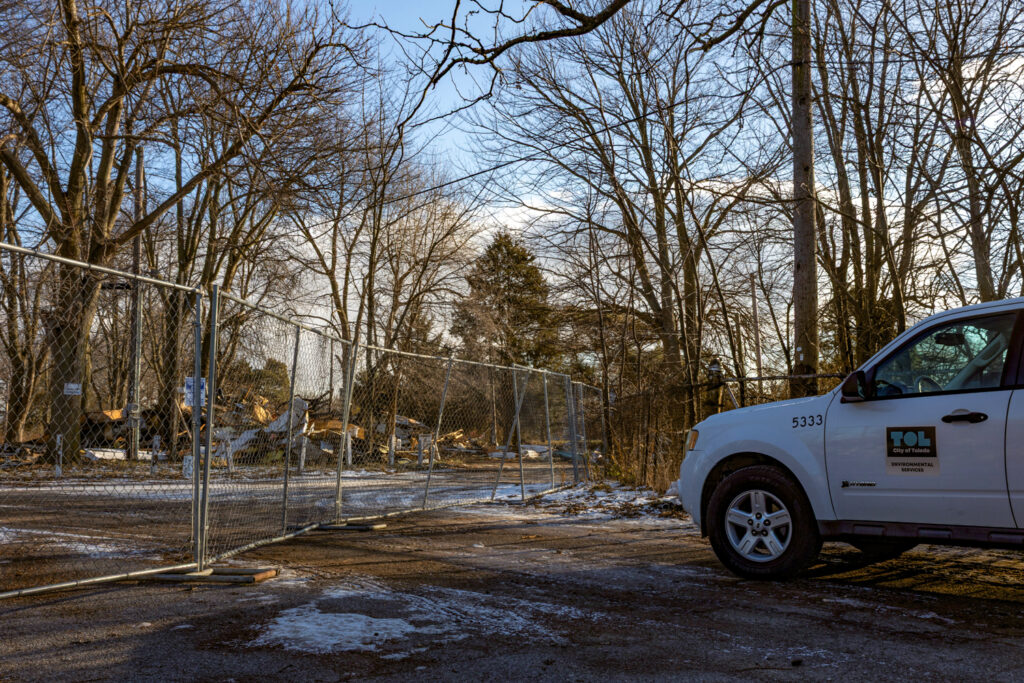
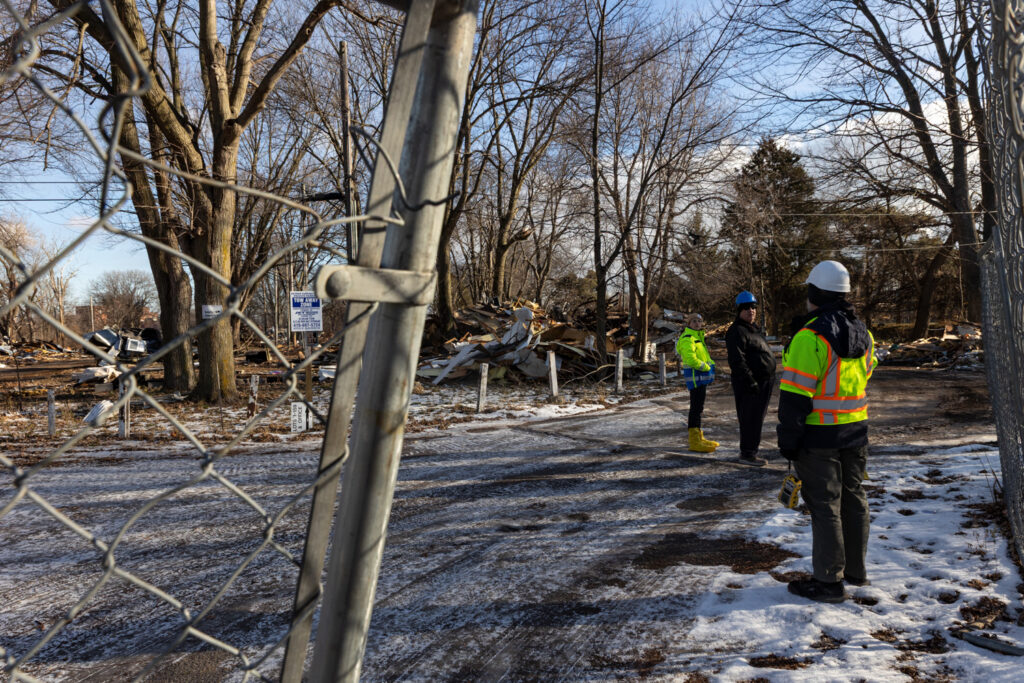
Back at Riverside, piles of rubble sat where the old mobile homes used to lay in disrepair, and an impermanent fence formed a formal barrier to warn visitors not to enter the demolition site.
The city of Toledo’s Environmental Services on site at Riverside Mobile Home Park at 18 City Park Avenue on Friday December 12, 2025. Toledo Environmental Services would not say what they were doing at the mobile home park. TFP Photo/STEPHEN ZENNER
Blue, the eldest of Susan Luttrell’s eight cats and the one she defined as the caretaker for the rest, appears at the demolished site of Riverside Mobile Home Park at 18 City Park Avenue on Friday December 12, 2025. TFP Photo/STEPHEN ZENNER
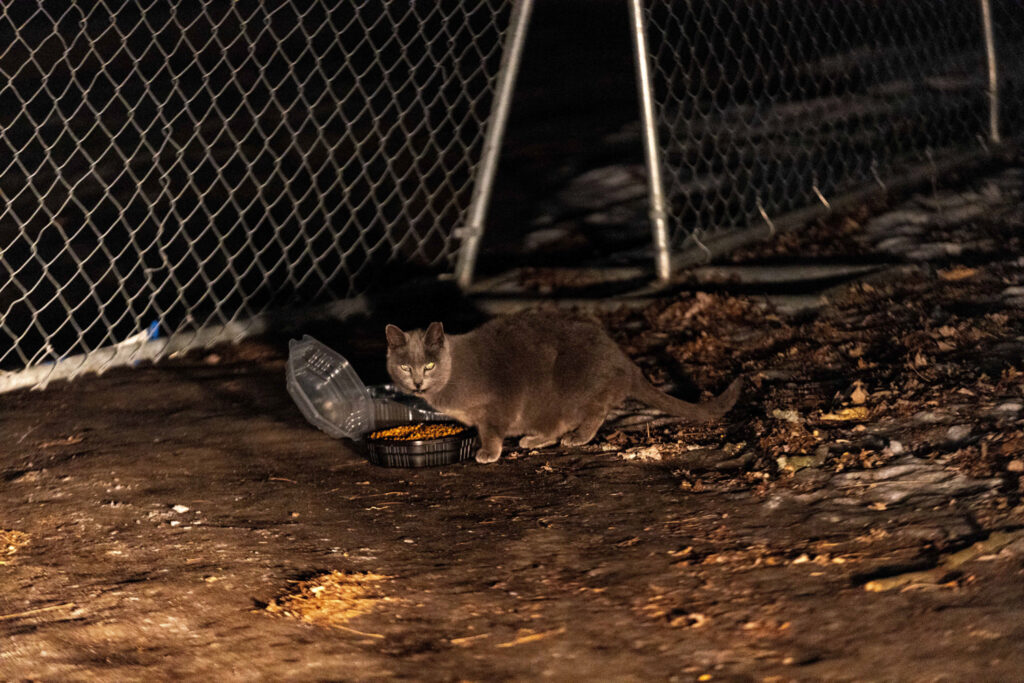
Cars with the Environmental Protection Agency (EPA) pulled up with tight lips about what they were doing, but in the stillness, a cat with a clipped ear became friendly with the government workers.
A stoic man unwilling to pet the cat, unwilling to give his name or say what he was there for, stood in silence as the gray feline rubbed against him in the cold.
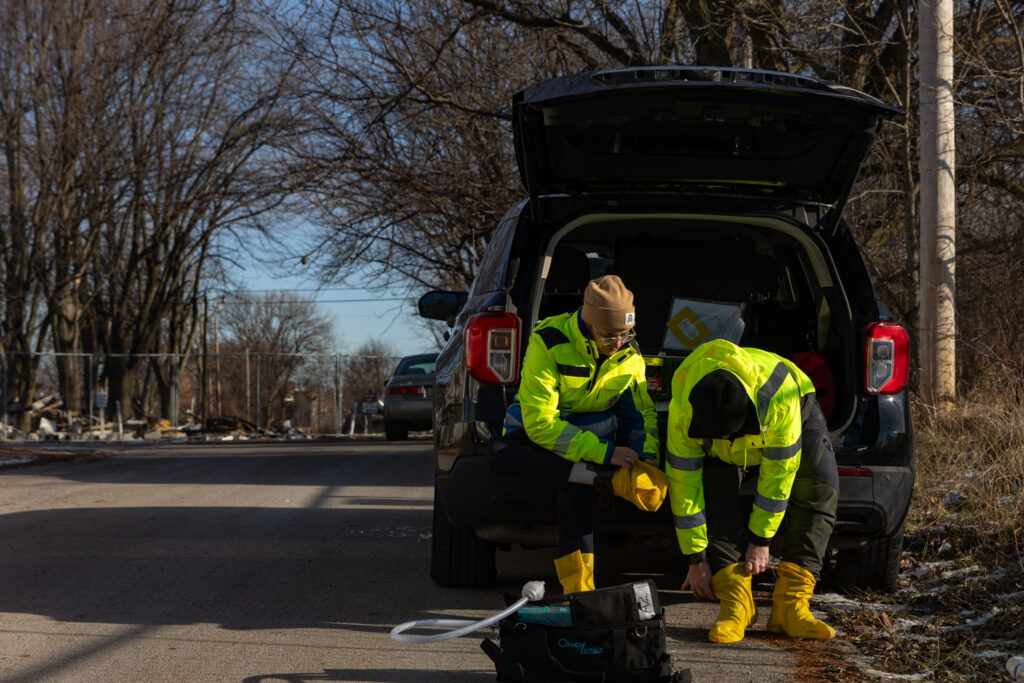
On-site-coordinators with the EPA from Ann Arbor, Mich. came down a few moments later with a Lumex mercury analyzer to test for traces of mercury amongst the rubble.
Jennifer Lavin and Mellisa Powers-Taylor, an on-scene coordinators with environmental protective services out of Ann Arbor, put on protective foot coverings in preparation to enter the Riverside Mobile Home Park demolition site with a Lumex Mercury Analyzer at 18 City Park Avenue on Friday December 12, 2025. TFP Photo/STEPHEN ZENNER
“We have this piece of equipment,” said Mellisa Powers-Taylor, one of the on-site coordinators with the Ann Arbor EPA, clarifying why they were in Toledo. After calling their direct supervisor, the coordinators from Ann Arbor freely shared that the Toledo EPA didn’t have the Lumex to test for mercury, so they were there to help out.
Days earlier, Chuck had mentioned his own worries about toxic materials in Riverside.
“I had one of them old school blood pressure cuffs; it’s got that big tube of mercury in it,” he said, and mentioned other medical supplies with mercury he wasn’t able to relocate before demolition began.
Lead paint, asbestos tiles and mercury made up the bulk of Chuck Parker and Kelly’s concerns about the mobile home park they left, “so we called the EPA,” he said.
Jennifer Lavin, an on-site coordinator for environmental protective services out of Ann Arbor, walks into the demolition site at Riverside Mobile Home Park with a Toledo environmental services individual who would not identify himself and Todd Haggard, of Toledo Environmental Services, at 18 City Park Avenue on Friday December 12, 2025. Lavin and her associate, Mellisa Powers-Taylor, told the Toledo Free Press they were testing for mercury. TFP Photo/STEPHEN ZENNER
After getting out of the space, the two reflected on the potential toxicity of what they had been living in for a number of years.
Three dogs and four cats died in the span of five years they lived at Riverside. By Kelly’s account, more pets died at Riverside in those five years than in their past 20 years of being pet owners.
“Mine got thyroid cancer. His got a cancerous tumor,” she said, referring to Kendall’s dog.
The EPA visited the park on Dec. 12, 2025.
Since then, the Toledo Free Press has reached out to the Ohio EPA, Regional EPA and the City of Toledo to hear the results of the tests on the area, but has not heard back.
Life after Riverside: Susan
Blue, the eldest of Susan Luttrell’s eight cats and the one she defined as the caretaker for the rest, appears at the demolished site of Riverside Mobile Home Park at 18 City Park Avenue on Friday December 12, 2025. TFP Photo/STEPHEN ZENNER
After seeing the gray cat interact with EPA workers, the Toledo Free Press was reminded of another previous resident of the park, Susan Luttrell, 70, who had lived towards the front of the park with her (approximately) eight cats.
“I’m not well. Too much STRESS,” Luttrell wrote to the Toledo Free Press, when asked how she was doing.
After leaving the park, her car broke down, and she was staying with a friend until she could find a better situation.
On the day of the removal, Luttrell left without any of her cats, fully intending to come back for them, but on the day of the move, she said her cats were too frightened by the commotion.
Blue, the eldest of Susan Luttrell’s eight cats and the one she labeled as the caretaker for the rest, appears to guard the other cats, as they eat at the demolished site of Riverside Mobile Home Park at 18 City Park Avenue on Sunday December 14, 2025. Luttrell mentioned that the clipped ear helped her identify her cat, and that she’d been leaving food for her cats when should could. TFP Photo/STEPHEN ZENNER
Gray fur and a clipped ear were defining characteristics of her eldest cat, Blue, which she was glad to hear about.
Every day or so, Luttrell finds a way to get to the temporary gate and call her cats loudly, “Kitties!” And then leaves them with an offering of food.
Blue, the eldest of Susan Luttrell’s eight cats appears at the demolished site of Riverside Mobile Home Park at 18 City Park Avenue on Saturday December 13, 2025. TFP Photo/STEPHEN ZENNER
“I could go without food for a few days, you know? But I can’t make them cats do that,” she said. Initially, Luttrell’s plan was to buy another trailer, then take cats with her, but when she got out to look at the trailer, “there was no furnace in it.”
Without extra money for a furnace, Luttrell, who, like Parker and Kelly, lives off of a fixed income, had to pass on getting into another trailer situation.
“I’ve looked at some other trailers too, but they need so much work that you can’t live in them,” she said. “I’m probably going to end up in an apartment building.”
Earlier in December, Luttrell mentioned she had applied for support with the Area Office on Aging, but couldn’t remember what she had applied for.
Luttrell’s situations reflects a larger trend noted during a lead and homelessness committee meeting held in Toledo City Council Chambers.
Ann Ebbert, the president and CEO of the Cherry Street Mission, speaks during a Housing and Community Development Committee meeting on lead and winter homelessness on Thursday December 18, 2025. TFP Photo/STEPHEN ZENNER
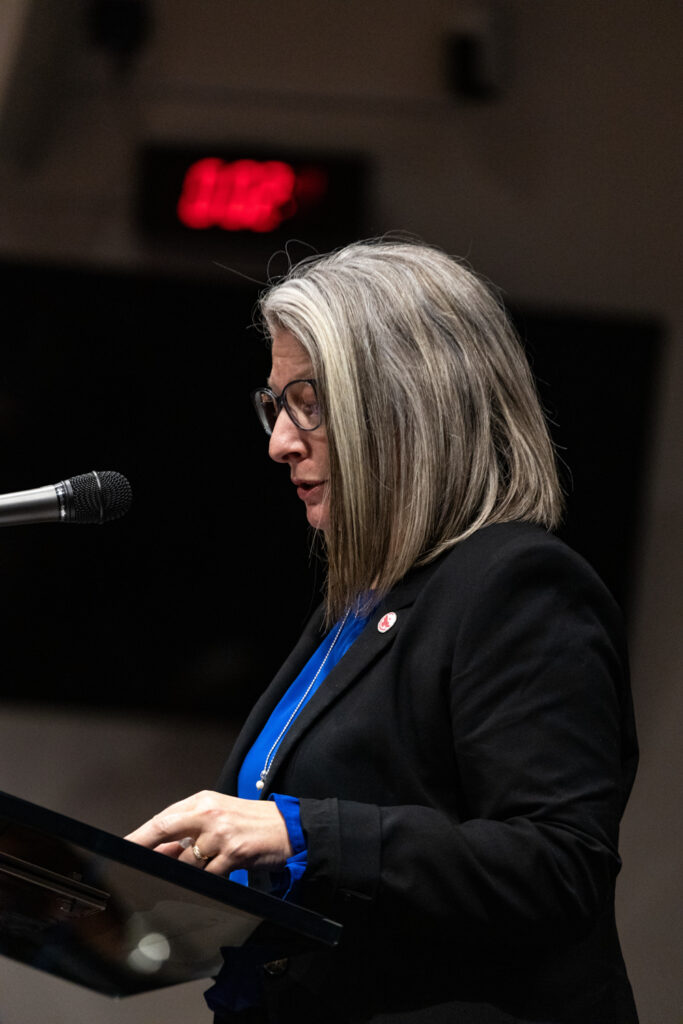
“In 2025, we are going to serve 2,325 individuals,” said Ann Ebbert, the president and CEO of the Cherry Street Mission, a major homeless shelter in Toledo, during the meeting. “That is over a 100 percent increase in people that we are serving in only four years.”
Ebbert estimated 31 percent of the new influx of homeless individuals at the mission were over the age of 55, and resolved, “senior citizens experiencing homelessness is growing faster than we can maintain.”
“85 percent of those who are new to us were first-time homeless,” she said, but Luttrell experienced this reality firsthand.
The 70-year-old has had her life fragmented, unsure of what she will be able to do next.
“I feel so bad. I feel so needy. I’ve never been homeless in my life,” she lamented, and recalled the experience of seeing what was left of her mobile home. “I just started balling like a little baby, to see that rubble like that.”
Rubble where Susan Luttrell’s old mobile home used to be at what was Riverside Mobile Home Park at 18 City Park Avenue on Friday December 12, 2025. TFP Photo/STEPHEN ZENNER
Luttrell said she’s called the Humane Society to let them know about her cats, and in the meantime, she continues to feed them until her situation changes.
Who is responsible?
In May 2025, the City of Toledo condemned the park for code violations, and since then, the Toledo Lucas County Homelessness Board, United Way 211, Unison Health and Advocates for Basic Legal Equality (ABLE) have tried to help relocate residents.
Most residents were able to find other housing, but ABLE requested an extension for relocation of the remaining households, citing disability-related needs.
By November, the only households remaining on the property were those with disabilities.
Squatters had taken up casual residence, but made themselves scarce when city officials cleared the area for demolition crews to begin their work.
“At some point, the property is either going to be purchased by somebody who’s going to have to pay all this,” said David Mann, the president and CEO of the Lucas County Land Bank, referencing the outstanding debts the owner of the park owes the City of Toledo and Lucas County.
David Mann, CEO & president of Lucas County Land Bank, speaks about Riverside Mobile Home Park at 1 Government Center on Friday December 5, 2025. TFP Photo/STEPHEN ZENNER
The city is owed $281,558.24 for past-due water, sewer and storm charges according to Rachel Hart, the director of communications for the City of Toledo.
The county is owed $70,272.24 for property taxes, not including individual trailers.
Those two totals, along with the remediation cost of $205,000 for the demolition of the mobile home park, will be rolled into a lump sum, roughly $556,830.48, and presented to the owner of the park, “RIVER SIDE MOBILE HOME ESTATES (RSMHE) LLC.”
RSMHE organized in 2016 with Gustavo Sanchez listed as a “Member” representing the Indiana based LLC. Since then, RSMHE has listed four additional names representing the company, a new one each time it needs to renew its registration with the state of Indiana.
The latest registration with the state of Indiana was for the years 2024/2025, and listed “Ernie Garcia” as an “Authorized Agent” representing the company.
“Ernie” is a familiar name to Parker and Kelly, both of whom have been in contact with the individual throughout their stay at Riverside. Parker believes the owner of Riverside to live somewhere around the Chicago area, and the phone number Parker uses to connect with Garcia has a Chicago area code.
Within Ohio, the only registration document on hand was a copy of the 2022/2023 Indiana registration document, which names “David Garcia” as a representative “Member” of the company.
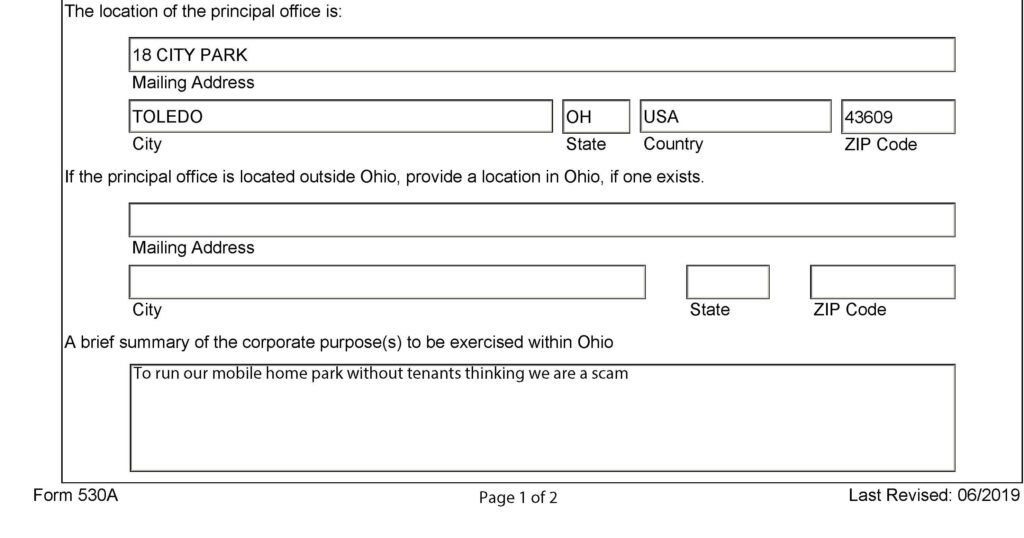
As a part of the Ohio documentation, “a brief summary of the corporate purpose(s) to be exercised within Ohio” read, “to run our mobile home park without tenants thinking we are a scam.”
The journalized dismissal of ERNIE GARCIA dba RIVERSIDE MOBILE HOME ESTATES vs. CITY OF TOLEDO reads: “On Oct. 17, 2025, Plaintiff Ernie Garcia filed a complaint, alleging the City had ‘issued baseless Notices of Public Nuisance and Orders to Correct[,]’ and were ‘threatening immediate demolition’ of ‘properties located at 18 City Park Welter, Toledo, Ohio[.]’”
A brief summation of the ruling in Lucas County Common Pleas reads, “As the City persuasively argues, Garcia ‘does not present himself to be an attorney and may not represent a corporation even if he is a member of that corporation.’”
Judge Joseph V. McNamara officially signed the ruling on the day of relocations, Nov. 17, giving some context to the potential reason why the relocations were deferred beyond earlier deadlines for residents of the park.
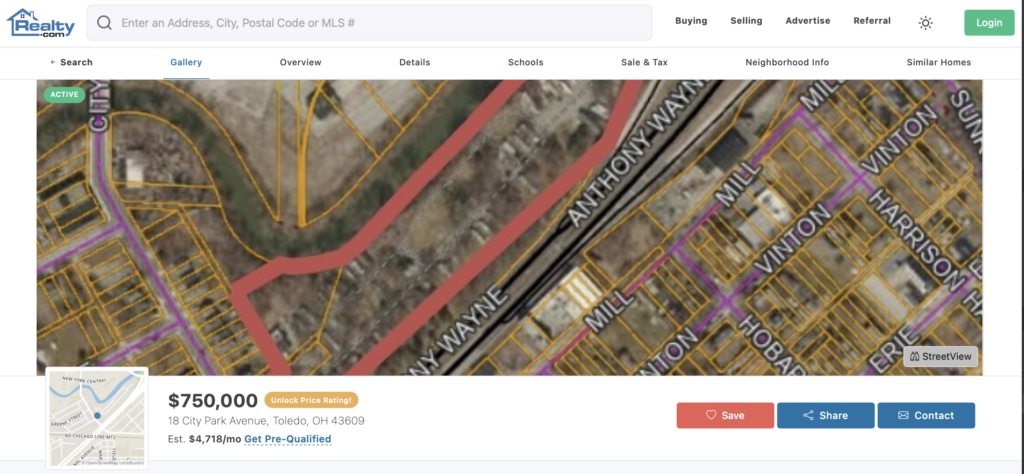
The phone numbers Chuck Parker said he used to contact the owner of the park have not been responsive to questions or comments from the Toledo Free Press, but Jon Fisher, “Mr. Landman,” a realtor out of Champaign County, Ill., said he listed the property for sale months ago, on behalf of the owner, for $750,000.
“We have two very interested parties. Unfortunately, no one from the City of Toledo has responded to any of our communication requests to begin negotiations,” Fisher said.
“Everything is 100 percent dependent upon the city, as they have to approve of the next buyer because of the fact that the property has been condemned. So when they don’t respond to us, we’re kind of just in a holding pattern.”
Fisher said the last time he reached out to the City of Toledo was in the third week of December, and he has not heard back.
At the time, both potential buyers were still interested in the property, and the demolition of the mobile home park was not a deal breaker for them. “Those trailers were probably going to be demolished anyway, so it’s not that that big of a deal,” Fisher said.
He noted that one of the parties reached out to the city investigator, one of the deputy mayors, the mayor and to the Land Bank without hearing back.
“They’re very large players that have the financial capacity to come in and redevelop,” Fisher said.
It’s unclear how the city will respond to the actions of the absentee landlord who left the property in disrepair.
Riverside Mobile Home Park, 18 City Park Avenue in Toledo, Ohio on Wednesday December 24, 2025. TFP Photo/STEPHEN ZENNER
“This is what we call the ‘pay-it-up or give-it-up strategy,’” Mann said. “This owner can pay up all the bills that he’s left delinquent, or if he doesn’t, he probably is going to give up ownership of that land.”
“If it’s foreclosed, because none of those bills have been paid, then at the end of the foreclosure, it would be transferred to us,” Mann said, speaking on behalf of the Lucas County Land Bank.
Mann did not want to speculate what the property could be used for and said, at this point, “it’s just too hypothetical.”
The Toledo Free Press reached out to the city of Toledo for comment on Fisher’s response, but at this point have not heard back.
What is left of the garage at Riverside Mobile Home Park at 18 City Park Avenue on Friday December 12, 2025. The city of Toledo demolished the mobile home park after the owner of the park left the conditions of the park in disrepair. TFP Photo/STEPHEN ZENNER
Ohio voters in the 2026 midterm elections will help decide key questions about the future of state politics. Credit: Jeff Haynes / Signal Cleveland
Ohio’s defining questions in 2026
Ohio politics news and insights from the State Signals newsletter. Plus, from the SB 1 rollout to data centers – the issues to watch in the coming year.
This was a quiet year for elections in Ohio. That’s about to change.
2026 rings in a midterm election, with races for governor, U.S. Senate, the Ohio Supreme Court and other statewide offices.
Voters will pick a replacement for term-limited Gov. Mike DeWine and decide whether Sen. Jon Husted should remain on the job.
Ohioans also will pick a new slate of statewide executive office holders, get a chance to tweak the partisan balance of the state legislature and decide whether to retain the lone remaining statewide elected Democrat, Ohio Supreme Court Justice Jennifer Brunner.
With all that in mind, here are some semi-provocative questions likely to be answered in the coming year.
How will Vivek Ramaswamy’s predictions age?
Vivek Ramaswamy has a background in business, but he apparently doesn’t subscribe to the “underpromise and overdeliver” school of thought.
Over the summer, Ramaswamy made a regular point of saying that he not only wants to be elected as Ohio’s 71st governor in November 2026 — he wants to win the race in a landslide.
“We’re running this campaign not just to win, but to win by a seismic margin,” he said during a public appearance in Columbus in July that I attended.
Ramaswamy’s comments struck me at the time as perhaps ill-advised, and if nothing else a sign of his immense self-confidence. But they’ve been on my mind lately as political polls show an increasingly tight race between him and his likely Democratic opponent, Dr. Amy Acton.
RaceTotheWH, an elections data website, currently projects Ramaswamy will win by 2.4% — a Republican-leaning tossup. We’re going to find out this year if we’re seeing another case of Ohio Republicans being underestimated by these kinds of tools.
We’ll also find out whether this campaign strengthens Ramaswamy’s political trajectory — perhaps setting him up for another run for president at his next available chance — or exposes its limits.
Will this be the year Ohio Democrats become relevant?
This remains the biggest fundamental questionfacing Democrats, who haven’t won a statewide executive office since the 2000s. The state has only trended more Republican since then.
2026 presents Democrats with the best chance they’re likely to have any time soon. They should be running under ideal national electoral conditions — an open governor’s seat and a second-term Republican president with iffy approval ratings.
Ohio clearly isn’t the swing state it once was. But I’ve been saying for years that Democrats have shown they can win in red states including Kansas and Kentucky. So there’s no reason it can’t happen here too. Democrats I talk to have grown more confident in Acton as a candidate for governor – although their failure to assemble a full statewide slate shows their actions haven’t yet met their words.
A more modest goal for Democrats would be breaking the Republican supermajority in the Ohio House. While the Senate is out of reach, they could do so in the House by flipping six GOP-held seats, ending Republicans’ ability to overturn a governor’s veto.
Republicans currently hold five House seats in districts that Trump won last year by fewer than 5 percentage points, and they hold a sixth, held by Rep. Andrea White, that Trump lost. All of these seats should be winnable, plus maybe one or two more, if the environment is less pro-Republican than it was last year.
But if Democrats can’t make progress under these conditions, it’s fair to ask when they ever will.
Did Sherrod Brown make the right call?
Sherrod Brown passed on what currently looks like a more winnable race for governor to instead challenge Husted for the senate seat. The move was a big recruiting victory for national Democrats, who will have a tough time retaking control of the U.S. Senate without wins in at least a couple of red states like Ohio. But it also was a loss of sorts for state Democrats, since winning the governor’s office would single-handedly revive the state party.
So Brown could face some big time second-guessing if he ends up losing to Husted, especially if the governor’s race turns out to be as close as it currently looks. Even if he wins, he could face similar questions if Acton doesn’t.
Will ballot measures make a comeback in 2026?
Ohio seemed as though it could be in store for plenty more left-leaning ballot measures after 2023, when voters here approved a constitutional amendment protecting abortion access and an initiated statute legalizing recreational marijuana.
But then a redistricting reform amendment with deep financial backing went down in flames in 2024. And 2025 passed without any statewide issue campaigns at all.
So will any ballot measures emerge next year?
The one that’s gotten the most coverage is a grassroots campaign to abolish property taxes, although it’s still an open question if it will get enough funding or organization to qualify for the ballot. As a reminder, amendment campaigns must collect 413,487 voter signatures, including a minimum number in 44 of Ohio’s 88 counties.
Another possibility emerged just this week. A committee of intoxicating hemp businesses turned in initial paperwork to try to repeal Senate Bill 56, which bans these companies’ products from being sold anywhere other than a state-licensed dispensary. If they can clear some state regulatory hurdles, they then would have until March to collect the 248,092 signatures – a lower number than what’s required for constitutional amendments – required to get a repeal vote on the ballot.
Managing to do so would put the law on hold until a statewide vote can be held in November. This sort of delay would be a win for the industry, regardless of what voters do, since it would buy them time to lobby the state and federal government to let them stay in business.
Dennis Willard, a spokesperson for the repeal effort, which is called Ohioans for Cannabis Choice, didn’t have much to share about the burgeoning campaign in an interview on Tuesday. He said he’s confident the group will have the resources it needs to qualify for the ballot – and suggested some of that money may come from the industry.
“There’s a natural constituency of people who have a financial stake in this,” Willard said. But, he added, the group also expects to have support from everyday Ohioans.
A few other amendment campaigns have gotten approval from state officials to collect voter signatures. They are:
All the ballot measures mentioned so far would be citizen-proposed. But the state legislature also can propose constitutional amendments, although they still need voter approval.
That’s what’s on my mind heading into 2026. Now here are a few thoughts from the rest of our team.
Jake is thinking about FirstEnergy, data centers’ future in Ohio and a few good court cases
In July 2020, Akron’s FirstEnergy Corp. was accused – implicitly, at first – of running a political bribery scheme out of the Statehouse spanning three years. It rocked Ohio’s political order, sent a House speaker to prison for 20 years, preceded the deaths by suicide of two alleged conspirators with storied legal and political careers, and cast a shadow of impropriety over the Statehouse.
In January 2026, the two former company executives accused of masterminding the operation can finally make the case of their innocence and leave it to a jury to sort out. As for me, perhaps more than anything else, I want to hear what Gov. Mike DeWine’s former chief of staff – who prosecutors say knew about a $4.3 million payment to a public official and, according to DeWine, failed to tell the governor – has to say.
Plus, will Jon Husted, a sitting U.S. senator, really schlep to a county courthouse in Akron to testify for the defense, as an early witness list has indicated?
The other storyline to watch: our political leadership is at a fork in the road on data centers. The legislature tried to erase a major tax break they receive. DeWine vetoed it. Lawmakers talked about overriding the veto, but at that point it’s just that – talk.
Local governments are facing pressure to prohibit data centers. An anti-AI fervor feels like it’s in the air. So what will the state do? Stick it to big tech? Align with the Googles and Amazons of the world and pass a “preemption” law to undermine the cities’ efforts?
Also, the Ohio Supreme Court owes a major ruling on the future of solar in Ohio, as well as on hundreds of millions of dollars in unemployment money the governor spurned, a ruling on gun prohibitions in bars, and more.
Amy’s watching the ongoing rollout of SB 1 and next steps for lawmakers
2026 marks the first post-Senate Bill 1 year (though, as I reported back in September, the full rollout of the law that overhauls how public higher education works in Ohio has a long tail). I’m now wondering about state leaders’ potential next steps for colleges and universities – and whether they may be looking towards their peers in other GOP-led states for inspiration.
That includes places such as Texas, where one of the state’s largest public university systems recently installed a policy restricting how educators can talk about race and gender in the classroom. And in Indiana, public college leaders will have to prove any new proposed degrees show “commitment to the core values of American society” in order to earn approval from the state’s higher ed commission. Will Ohio follow suit in any of these, or other, areas?
In the news
THC bill repeal effort: A group of intoxicating hemp businesses have filed initial paperwork seeking to repeal much of Senate Bill 56, the law Gov. Mike DeWine signed earlier this month that overhauls Ohio’s marijuana laws. Read more from Andrew Tobias.
Major changes: Senate Bill 1, the higher-education law, requires colleges and universities to cut programs that enroll few students. This new requirement has led schools to cut majors including Spanish and medieval and Renaissance studies, although some have managed to put off the new rules by seeking waiver requests. Read more from Amy Morona here.
*Note: Since the original publishing of this article, we’ve removed Nick Kaufman, a candidate who withdrew on Jan. 1, reducing the candidates being considered to seven.
WATERVILLE – Waterville City Council will interview seven candidates to fill two open seats – either during its Jan. 12 regular meeting or during a special meeting, said municipal administrator Jon Gochenour.
The vacancies were created after Mary Duncan was the only certified candidate for three open positions on the November ballot. Anthony Bruno decided not to seek reelection and John Rozic was term-limited.
A total of 10 candidates submitted letters of interest by the Dec. 5 deadline, but two dropped out, Gochenour said. The eight remaining include: Rob Allen, Karen Eboch, Tim Guzman, Michael Hampton III, Scott Jahns, Nick Kaufman, Nick Sargent and Amy Self.
Below are brief bios of each of the candidates.
Candidate Rob Allen. (Courtesy photo)
Rob Allen has been involved with city and county government for decades, but as he witnessed the division over a proposed amphitheater, he decided to run for Waterville City Council in 2023. While he didn’t get elected in a hotly-contested race, Allen has continued to follow city government.
As a council member, Allen said he wants to be proactive in communicating with residents about all topics of interest. Whether it’s a proposed amphitheater or discussions about data centers, the city needs to keep residents informed every step of the way, he said.
Allen said he will use social networking and media to make sure all generations are staying informed, including explanations on how city government works. He also plans to stay abreast of the budget and looking ahead to meet the financial needs of the city.
“We need experienced leadership that can look to the future, not just at the present. I hope to bridge the gap to the next generation, and at the same time improve communications with all of our residents.”
Before moving back to Waterville in 2017, Allen was elected to Geauga County Republican Central Committee and served on public works and parks committees within his township. He ran for the Ohio State Senate in 2016 and has worked on presidential and U.S. Senate campaigns. A father of three, Allen has a daughter with autism, so he supports autism research.
Candidate Karen Eboch. (Courtesy photo)
Karen Eboch believes that good local government means balancing progress with tradition – welcoming new residents and businesses while preserving Waterville’s small town character.
“As someone deeply invested in our region’s future, I want to ensure all voices are heard as we navigate growth together,” Eboch said.
Her experience includes service on the Lucas County Emergency Management Agency Supply Chain Advisory Committee, where she worked directly on critical COVID resource planning affecting the region, including Waterville.
“My extensive committee leadership across multiple organizations shows I can quickly understand complex issues, bring people together and get things done,” said Eboch, noting that she is currently serving on and leading committees for national professional organizations. “I’ve consistently shown that effective service isn’t about tenure – it’s about preparation, active listening and collaborative problem-solving.”
Her experience includes serving as president of the Maumee Schools Foundation and associate dean of Bowling Green State University’s Schmidthorst College of Business.
“Fresh perspectives combined with proven committee effectiveness often spark the innovation communities need most,” Eboch said.
Her priorities for Waterville focus on four key areas: sustainable growth management, ensuring the city’s development enhances the community’s character; creating an environment where small businesses thrive while still maintaining the city’s historic charm; enhancing local spaces including parks; and preserving the city’s heritage while enhancing innovation.
Candidate Tim Guzman. (Courtesy photo)
Tim Guzman would like to utilize his global business and leadership skills to provide sound decisions that honor Waterville’s history while at the same time leading to a strong and sustainable city for all residents.
“Waterville is a great community that families want to be a part of, and we currently have several housing developments in Waterville and the surrounding area, which is great,” he said. “However, we can’t ignore the additional population growth that this development brings on both the city services and Anthony Wayne Local Schools. If appointed, I will strive to assure balance between housing growth with additional new business and jobs growth, which will provide additional tax sources for city services and the schools.”
A 41-year resident of Waterville, Guzman and his wife, Deb, have adult children who also call Waterville home. He earned his BBA from the University of Toledo and executive MBA from Bowling Green State University. He retired as senior sales director for a global corporation, in which he managed a team of sales and engineering professionals located in several countries. He now serves as a volunteer for the American Red Cross.
Guzman previously served on city council for 16 years, from 1996-2011, during which he served as vice mayor for four years. He continues to serve on Waterville’s Public Safety Committee, a position he’s been appointed to for over 30 years, and served on the Public Works Committee and Finance Committee while he was on council.
“I believe that my leadership and dedication to the Public Safety Committee has assisted Waterville in being named one of the safest small cities in Ohio, and one of the reasons more people want to call Waterville home,” he said.
Candidate Michael Hampton III. (Courtesy photo)
Michael Hampton III is a 20-year career firefighter. His priorities include ensuring that safety forces are properly supported and held to the highest standards, and that thoughtful and responsible growth strengthens the tax base and reduces the financial burden on homeowners.
Born and raised in Springfield Township, Hampton has a bachelor’s degree in criminal justice from Tiffin University and has advanced through the fire service, currently serving as a paramedic firefighter and fire captain with Perrysburg Township Fire Department. He also is a member of the Wood County Special Response Team, serving as an armed tactical medic. In addition to earning several leadership credentials, Hampton has earned the Medal of Valor and Patriot Award from the Department of Homeland Security.
In 2018, Hampton and his wife moved to Waterville, and they now have three children.
“My family is my foundation, and it is one of the main reasons I care so deeply about the future of the community,” he said.
One of his goals is to ensure that public safety departments grow with the city. Hampton said he is concerned that many good men and women have left the fire service. He recommends that council assign a council liaison to every department head to provide oversight and support to the city administrator and department leadership.
“Our city should not be a steppingstone – it should be a career destination and a place where professionals want to retire,” he said. “There must be accountability and transparency in understanding why we are losing such dedicated personnel.”
Early communication and town hall meetings are a priority when any type of major project is being considered, such as an amphitheater or data center, Hampton said.
“Residents deserve to be informed and heard before decisions are made,” he said. “Unfortunately, this did not happen early enough with the amphitheater discussion, which led to unnecessary division within our city. While we many have differing opinions, we must remember that we are all on the same team and working toward the same goal: a better city.”
Candidate Scott Jahns. (Courtesy photo)
Scott Jahns, a retired engineer, is a regular attendee at council meetings and has served on several committees over the years.
“I have been honored to contribute thoughtful, constructive and respectful input focused on strengthening the community,” said Jahns, who has served on the Charter Review, Public Works, Waterville Comprehensive Plan and Architectural Review committees.
“I believe I bring a positive outlook, fresh ideas and a common-sense approach to local government that reflects the will of the community.”
Jahns said he supports balancing Waterville’s tax base through sensible business growth to reduce pressure on residential taxpayers, recognizing that city services and schools cannot rely solely on residential development. Committed to honesty, integrity, transparency and financial responsibility, Jahns said he has a deep love for Waterville and its future – one that includes a vibrant downtown, strong city services and a resilient infrastructure that will benefit residents for generations to come.
Jahns and his wife, Paula, have been married for 44 years with two daughters who graduated from Anthony Wayne Local Schools, as well as seven grandchildren. During his career as an engineer with Schindler Elevator Corporation, Jahns held roles including engineering, operations management, modernization, service, logistics and safety. Following retirement, he founded a local handyman business to assist elderly residents and others unable to complete basic home repairs.
Nick Sargent. (Courtesy photo)
During the 13 years he’s lived in Waterville, Nick Sargent has become involved in the community – serving on the city’s Safety Committee, the W3 Co-Op, the Anthony Wayne Education Foundation, Waterville Rotary and Zion Evangelical Lutheran Church.
“I’d like to serve on Council to give back to our community,” said Sargent.
With 20 years as owner and managing partner of S&L Cabling Solutions, Sargent said he’s gained not only a business acumen, but a unique perspective on technology sectors – including computer engineering and network infrastructure – that he believes would be an asset to Council.
His focus as a council member would be to maintain the small town feel while allowing managed growth that will help keep families safe and prosperous.
Married to Stephanie, they have two daughters who attend Anthony Wayne Local Schools. The family is involved with Zion, where he serves as administrator and treasurer.
“I believe having family within the community is essential to help stay grounded and focused on events that can affect our daily lives,” he said.
When Waterville decided to join with Whitehouse and Waterville Township to create a fire co-op, Sargent led a campaign to urge voters to support a levy to pay for EMS and fire services. It passed by 70 percent. For eight years he’s served as trustee for the Anthony Wayne Education Foundation. And as a Waterville Rotary member, he taught the STRIVE program at the high school. Sargent continues to serve on the city’s Safety Committee.
Candidate Amy Self. (Courtesy photo)
Amy Self is a 25-year Waterville resident with 40 years of experience in service, social work, public education and leadership.
“I am well prepared to contribute meaningfully to the council’s mission of fostering transparency, growth and civic leadership,” she said. “I am particularly interested in advancing initiatives that support the continued development of our downtown, improvements to shared public spaces and policies that enhance the overall quality of life for all residents.”
Self said she brings a pragmatic, collaborative approach that includes active listening, respect and consensus building, and values evidence-based solutions and meaningful community input as essential tools for addressing concerns, resolving problems and making thoughtful, effective decisions.
With a bachelor’s degree in education, Self served for over two years as a U.S. Peace Corps volunteer in Kathmandu, Nepal, followed by a nine-year career in social work. She then earned a master’s degree in mass communication from Bowling Green State University. After the birth of her son, Self began a 20-year career in education, which earned her recognition, including an Atlantik-Brücke fellowship that included two weeks in Germany collaborating with educators.
“I am deeply committed to civic service and community engagement, and bring a long-standing dedication to education, public service and improving the quality of life for Waterville residents,” she said.