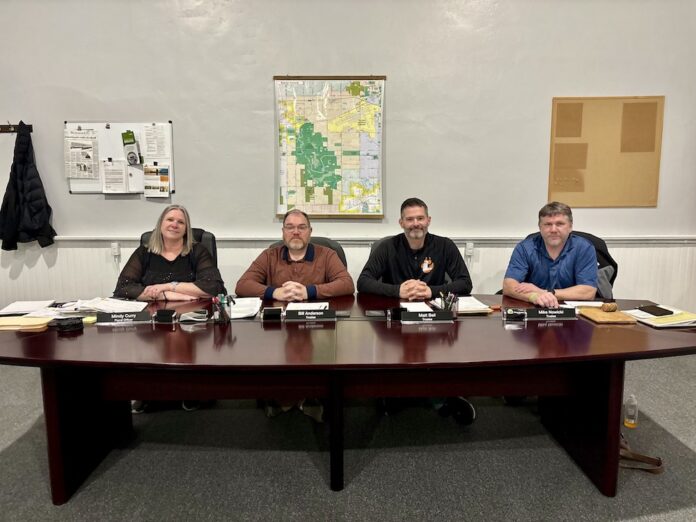
The Swanton Township Board of Trustees held its first meeting on January 13, deciding to add a public comments section to the agenda. Pictured are (from left) fiscal officer Mindy Curry and trustees Bill Anderson, Matt Beil and Mike Nowicki. (AWFP photo by Karen Gerhardinger)
Swanton Township welcomes public comments
Swanton Township residents took advantage of a new policy adopted by township trustees on Jan. 13: allowing public comments during the meeting and having those comments included in the official minutes that will be posted on the website.
Previously, comments were only permitted after the meeting and were not included in the minutes, said Fiscal Officer Mindy Curry.
New trustees Bill Anderson and Matt Beil, along with Trustee Mike Nowicki, voted unanimously to add public comments to the agenda. Questions should be directed to the board, with a limit of three minutes.
Colleen Baird, Kim Middleton, Mona Weiss and Patty Zalewski were among several dozen residents who attended the meeting, and they addressed the board with a variety of questions.
Middleton, who until Dec. 31 served as the zoning inspector, spoke about her concerns regarding Arrowhead Lake Mobile Home Park, including blight, use of a mobile home for the park office, a need for ditch clearing and tree removal, and missed deadlines with the Ohio EPA. She suggested the township look at adopting a maintenance section to the zoning code to hold commercial properties accountable for the condition of their properties.
Zalewski asked that policies – such as public records requests, records retention, cemetery rules and zoning – be placed on the website.
“We will be updating the website and getting more information on there, including calendars,” Nowicki said, adding that it would include resolutions and changes being considered.
The village of Swanton recently posted a statement asking Toledo Edison to do a better job at restoring service, and Zalewski asked if the township would join in that proclamation by the village.
“We’re all losing power. I’ve never lost so much power in one year’s time,” she said. “It’s detrimental, especially in the winter time.”
Anderson encouraged residents to contact their state representatives to ask for help, as Toledo Edison is taking longer to respond.
Weiss asked about the trustees’ decision to hold off on making two payments, for $319.50 and $624.60, to the law firm of Shumaker, Loop and Kendrick. Curry said she is seeking information on what the bills are regarding since the prior administration did not leave details.
Weiss also asked about how to get notices of special meetings, and learned these will be posted on the website. Baird suggested using signage to post at locations that are being considered for zoning changes, in order to alert residents to look to the website for information. While posting a sign is not required, Nowicki said trustees would take it under consideration.
During the meeting, the trustees also:
-Heard that Nowicki administered the oath of office to Anderson and Beil on Jan. 2.
-Named Nowicki as chair and Beil as vice chair for 2026.
-Assigned trustee areas of responsibility. Nowicki will oversee zoning, internal finance and audit, and represent the township on the health district’s advisory council and the county’s 911 Regional Council of Governments committee. Anderson will handle roads and cemetery. Beil will serve on the Northwest Advanced Energy Board and the Toledo Express Airport Joint Economic Development District (TEA-JEDD).
-Passed a series of resolutions on financials, monthly payments, check signing and public records retention, as well as cemetery rules and fees. The zoning fees will remain unchanged for 2026.
-Acknowledged the cancellation of the Dec. 23, 2025 meeting.
-Learned that the fiscal officer and trustees will attend Ohio Township Association training in early February.
-Verified the Ohio Department of Transportation’s certification of mileage in the township at 21.997 miles, down from 22.12 miles due to the annexation of land on Scott Road.
-Heard that the four bridges in the township are rated “good” and “very good” by the Lucas County Engineer.
The 44 signs that were placed, without authorization, along a section of Girdham Road in Oak Openings last year were removed last week. This opens the area up for those who travel to the area to see rare birds or to enjoy hiking in the Metropark. (AWFP photo by Karen Gerhardinger)
-Approved holding just one meeting a month, on the second Tuesday at 7:30 p.m., with the understanding that an additional meeting could be scheduled if required. Zoning meetings will be held quarterly, in January, April, July and October, on the second Tuesday at 6:45 p.m.
-Learned that Zoning Commission member Roger Thompson, whose term was set to expire on April 10, has submitted his resignation. Zoning Inspector Kim Middleton turned in her resignation effective Dec. 31, 2025. The trustees will be seeking to fill both positions.
-Heard that the 44 “no parking” signs placed on Girdham Road in Oak Openings last year have been removed, as they were never officially approved.
Vice President JD Vance speaks to a crowd at Midwest Terminals' Ironville Terminal on Thursday, Jan. 22, 2026.
TOLEDO – If it wasn’t already clear that the economy will define this year’s midterm elections, perhaps the sitting vice president delivering a speech about it — under the words “lower prices, bigger paychecks” — is a sign.
Vice President JD Vance, who previously served as one of Ohio’s two U.S. senators, spoke at Midwest Terminals’ Ironville Terminal on Toledo’s east side yesterday morning. The focus of the VP’s remarks? Selling the Trump administration’s economic agenda.
Vance’s visit, which opened with brief remarks from Senator Jon Husted, as well as gubernatorial candidate Vivek Ramaswamy, was attended by a number of other Republican candidates for office — particularly those hoping to represent Ohio’s 9th Congressional District. Former State Representative Derek Merrin, current State Rep. Josh Williams, veteran Alea Nadeem, and former deputy director of Immigration and Customs Enforcement (ICE), Madison Sheahan, are all vying for the Republican nomination to face Representative Marcy Kaptur in November.
Video by Jaden Jefferson
Vance began his speech by discussing the administration’s goal of returning jobs to the U.S. Without providing specifics, he claimed that “we’re one year into $18 trillion of new investment for the United States of America.”
Regarding the “One Big Beautiful Bill Act,” which was passed by Republican lawmakers last summer, Vance emphasized its tax cuts. He specifically promoted the bill’s provisions for no tax on tips and overtime. However, according to the IRS, the maximum annual deduction for tips is $25,000, while it’s $12,500 for overtime pay.
On inflation, the issue that drove 2024’s election cycle, Vance claimed “we have the lowest inflation that we’ve had, well, since the last Trump administration.” While the Bureau of Labor Statistics data shows that, in February 2017 and August 2018, the 12-month U.S. inflation rate was 2.7 percent – what it is now – it had been lower toward the end of President Biden’s term. It had gotten down to 2.5 percent in August of 2024 and 2.4 percent the following month, before climbing up again, beginning in October of 2024.
Discussing prescription drug costs, Vance said “for four years under the Biden-Harris administration, Americans paid the highest prescription drug costs in the world.” While it is true that Americans pay significantly more than their peers for prescription drugs, that has been the case for years – including during President Trump’s first term. Data from the Peterson-KFF Health System Tracker offers a fuller picture.
Housing costs continue to be a concern nationwide. While it’s a problem driven by high demand and a lack of affordable housing, Vance placed blame with the nation’s undocumented community.
“That is how you lower prices: focus on American workers and invest in American homebuilding – you don’t give all of our homes to illegal aliens.”
While a slowdown in homebuilding, resulting from the 2008-09 recession, is a legitimate cause of high housing prices – experts say undocumented Americans, while a contributor to demand, are not a significant contributor to prices rising.
A noteworthy line from Vance’s speech was that “you don’t turn the Titanic around overnight – it takes time to fix what was broken.” The metaphor, which was mocked by some on social media, served as a call for patience, amid some voters souring on the Trump administration. The president’s approval rating has been down in multiple polls, of multiple states, including Ohio. An October 2025 BGSU poll showed Trump underwater by 10 points, while a December 2025 Emerson College poll showed him with a 46 percent approval rating.
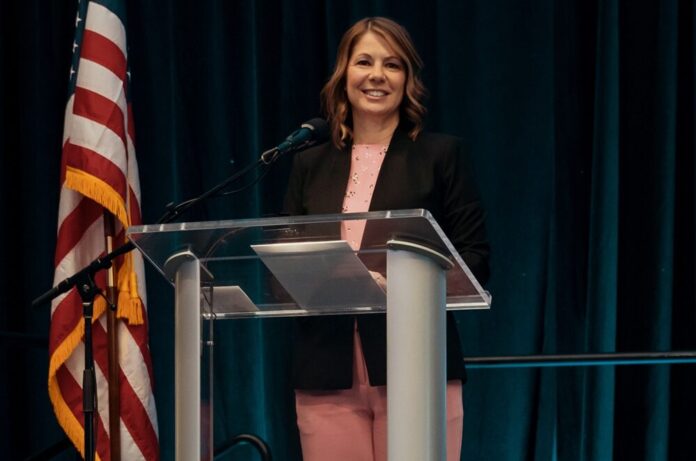
Wendy Gramza speaks at a Toledo Regional Chamber of Commerce Annual Meeting presented by Fifth Third Bank on April 29, 2025. (Photo courtesy of Creadio.)
Toledo Regional Chamber President/CEO cares about local businesses, staff
TOLEDO – Wendy Gramza grew up in Walbridge, the daughter of a father who worked for the railroad.
“You couldn’t get out of Walbridge without going over railroad tracks,” she recalled.
Gramza graduated from Lake High School in 1987 before moving on to the University of Toledo. She started working at the Toledo Regional Chamber of Commerce in 1987 while attending UToledo part-time. Gramza graduated with a degree in marketing.
She became president and CEO of the TRCC in 2014 and has held that position ever since.
“I started as an intern here,” Gramza said. “They didn’t call them interns at the time. I worked here during the day and went to school at night and took a couple leaves of absence to finish [school].”
Gramza served as an executive vice president and vice president of business development services at the Chamber before being named president and CEO. Before that, she was director of the Toledo Area Small Business Association.
“I am a certified Chamber executive, which is a program through the National Association,” Gramza said. “My peer review was based on leadership and knowledge of the industry. I received an award in 2006 and that was pretty cool.
“I got to be recognized in front of a couple thousand of my colleagues. That’s when you know you are in a position to lead and this industry is your career.”
Having such a prestigious position at the Chamber does have its perks.
On Sept. 25, 2024, Gramza signed a hot dog bun at the original Tony Packo’s restaurant on Consaul Street in East Toledo. The event was part of a celebration of Gramza’s invitation to the U.S. Chamber of Commerce Committee of 100 (CCC100).
Tony Packo’s has been a Toledo institution since 1932 and is famous for the hundreds of signed hot dog buns that cover the inside of its restaurants.
“That was pretty neat,” Gramza said. “I didn’t know it was happening. We were five minutes in, and I couldn’t figure out why I was there. There are about 7,000 Chambers in the country and they [CCC100] picked us. I’m not sure how I met their criteria.”
Gramza said her signed Tony Packo’s bun is “between two [Ohio] politicians, which I thought was appropriate because I represent the business community. It was an honor to be associated with such an iconic establishment.”
Gramza said the TRCC’s role is to represent the business community.
“Our job is to grow and help regional businesses be more successful to grow our economy,” she said. “It’s working out really well. We are one of the charter metro Chambers in the country, and we have a lot of services to help the member businesses grow.”
Asked to describe her outlook on future economic development in the Toledo area, she said, “My hope is we get on the same page and work together, and make sure this is a viable place for businesses and that we have a business friendly reputation.”
Gramza, 57, oversees 25 employees and said one of the best things about her job is the people she works with.
“I care about our members, business leaders, staff and people who care about the community,” she said. “We are always involved in cutting edge stuff. Every day – every hour – is different. People I have met from all over the country and being able to meet some really great people and see all points of view…sometimes you don’t really get a sense for how complex all these issues are.”
Gramza and her husband, Mark, have been married 33 years. They have a son, Nick, 31, and a daughter, Emily, 25, who is studying to be a nurse practitioner at Ohio State. Nick and his wife, Sarah, are expecting their first child.
The Toledo Regional Chamber of Commerce is located at 300 Madison Ave., Suite 200, Toledo, Ohio 43604. Phone 419-243-8191.
Kelsey Borcherdt is happy to see Jasper as he delivers a happy half-birthday card on Jan. 10. (AWFP photo by Karen Gerhardinger)
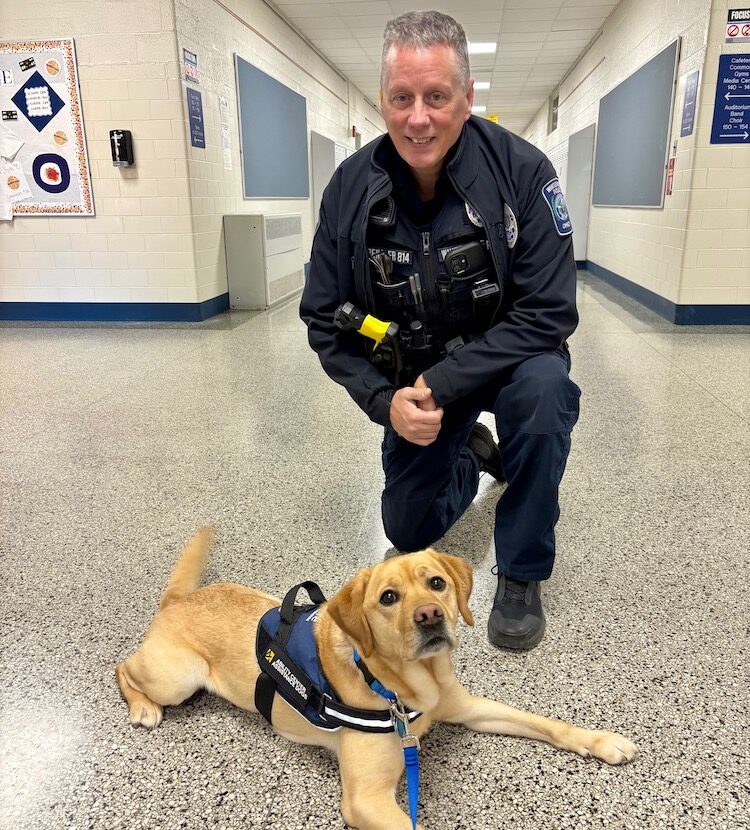
WHITEHOUSE – For his first week on the job, Jasper had it easy: delivering birthday wishes and kisses, watching a basketball game, accompanying his handlers through the hall and taking a lunchtime nap. But as Anthony Wayne High School’s first facility dog, the 49-pound, three-year-old yellow Labrador retriever is just beginning a career that will include consoling nervous students, encouraging academic, social and emotional growth, and reminding the humans in the room to “wag more, bark less.”
“He regulates the room really well,” noted Principal Jon Burke, one of three handlers for Jasper, who was thoroughly trained by The Ability Center before starting full-time at the school on Jan. 6.
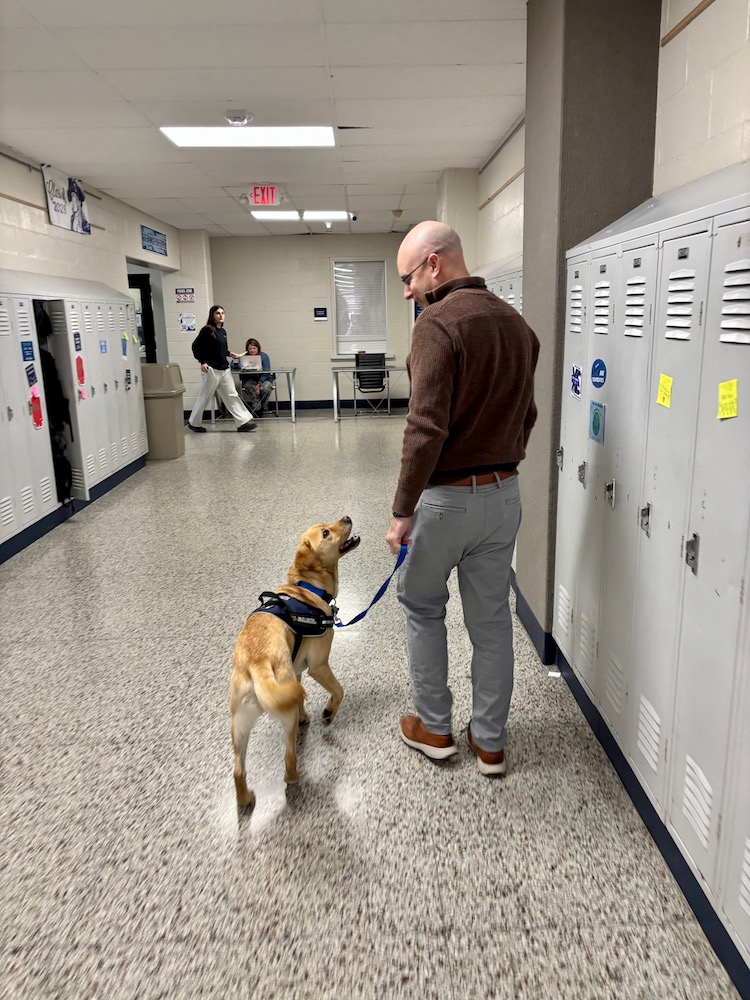
Jasper looks up at principal Jon Burke for direction as they walk the halls. (AWFP photo by Karen Gerhardinger)
Resting on a cot in the conference room earlier this week, Jasper’s ears perked up as Burke and the other two handlers – counselor Lauren Murawski and Assistant Principal Stephanie Buckenmeyer– spoke about how the school facility dog will benefit the students and staff.
The district welcomed its first dog in 2008, when Sara joined Waterville Primary School. She was replaced by Teila in 2019. Monclova’s first dog, Laney, served from 2017 to last May, when Dunkin joined the team. Luna was welcomed by Whitehouse Primary in 2019, Astro joined Fallen Timbers in 2021. It was the addition of Lorain to the junior high in 2024 that ramped up interest in having a facility dog at the high school, said Buckenmeyer, who was one of Lorain’s handlers.
“Watching the impact on the junior high students and staff was part of the catalyst. She helps a lot with emotional regulation and brings a lot of positivity. Students earn time with her as they learn appropriate behaviors in a school setting. And overall she built a sense of community in the building,” Buckenmeyer said.
Murawski, who worked with a facility dog while doing her master’s degree practicum with Tiffin City Schools, understands how a dog can help manage expectations in the classroom and hallway, lighten the atmosphere and provide emotional regulation in student and parent meetings.
School Resource Officer Jeff Siebenaler takes a moment with Jasper. (AWFP photo by Karen Gerhardinger)
“Whether it’s in a crisis situation or more frequent visits, we can use commands like ‘lap,’ ‘hug’ or ‘place’ so that Jasper can provide support to students,” Murawski said. “I also love being able to take him into classrooms as a reward. And we can have him play games to address academic, social and emotional needs. We do have to be a little more creative in how we meet our upper level students – it’s different than how a facility dog is used at the primary level.”
With a command of “paws,” Jasper will put his paws on a desk to check a student’s work. And he can be utilized to play games with curriculum-focused questions, such as tic-tac-toe, four corners or rock, paper, scissors.
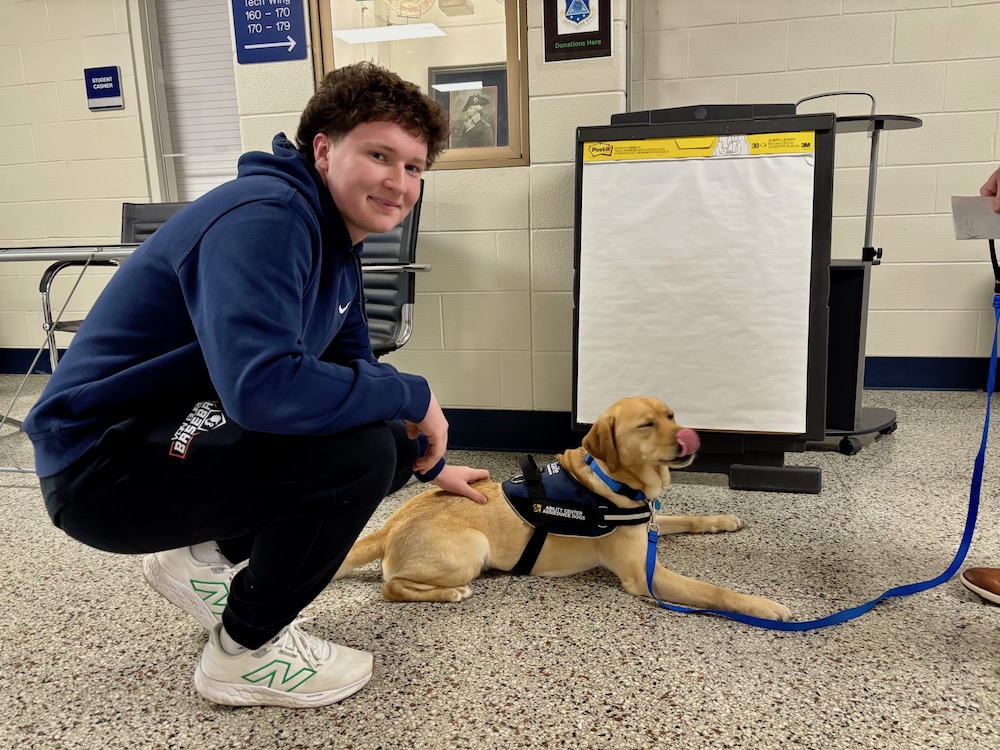
Beau Seelenbinder was awarded with a brief Jasper visit after telling principal Jon Burke about the point he scored during a recent lacrosse game. (AWFP photo by Karen Gerhardinger)
Jasper comes to the high school with a solid resume that includes Ability Center classes, training for four months – each with inmates at Gus Harrison Correctional Facility and Cooper Street Correctional Facility in Michigan – and then a semester of student teaching with St. Joan of Arc Spanish teacher Jennifer Kraus.
“Jasper thrived there,” Murawski learned, after speaking with Kraus about her experience. In November, the school informed the students, staff and parents of Jasper’s arrival, and sought input on any students with dog fears or allergies. Students were also asked about how they’d like to see Jasper utilized in the building.
“They came up with some creative ideas, but we also got some funny ones, like ‘let him run free in the halls’ or to let them schedule a naptime with Jasper,” Buckenmeyer said.
In early December, Buckenmeyer, Burke and Murawski spent a full week training at The Ability Center, to learn all of the commands and how to care for Jasper, before bringing him into the building while students were on winter break.
“We used that time for him to get used to the three of us and this space, and to learn that – out of the 1,500 people in this building – he needs to pay attention to the three of us,” Buckenmeyer said. “He does a lot of check-ins with us. He stares at us when walking down the hallway, and sometimes so much that he doesn’t look where he’s going.”
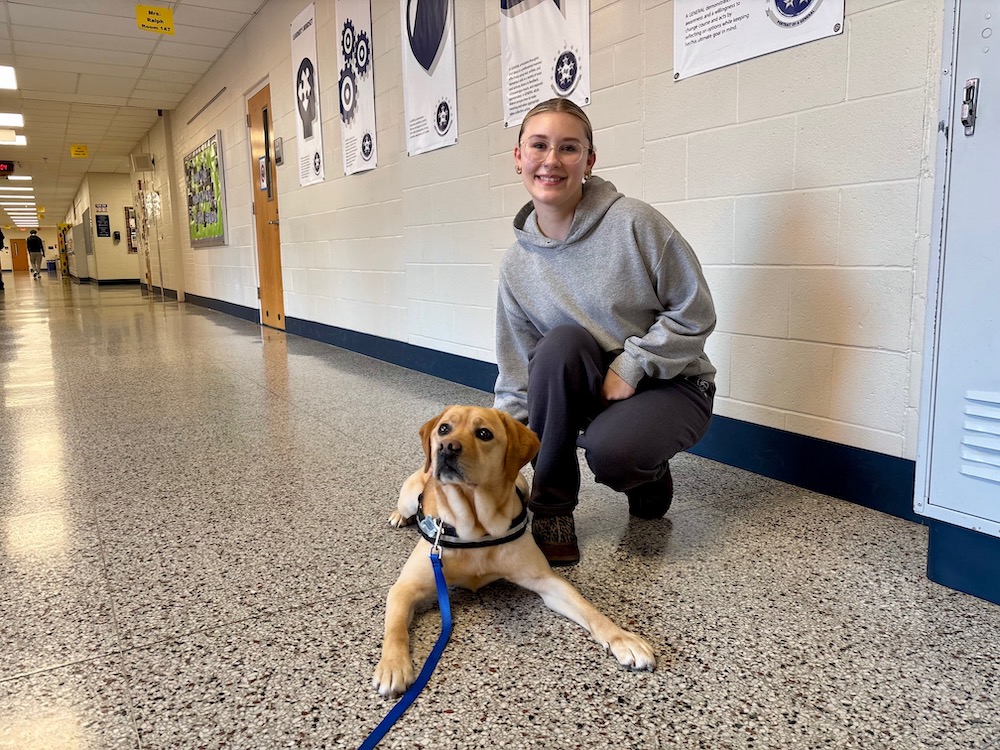
Senior Avery Eckols was thrilled to be among the first students to meet Jasper. (AWFP photo by Karen Gerhardinger)
Walking through the school early this week, Jasper repeatedly looked up to Buckenmeyer and Burke as they led him to classrooms, looking for the signs indicating if the room is dog-welcoming. Depending on the schedules of students with allergies, Jasper might not be able to enter a classroom. But for those who were open, the rewards were many.
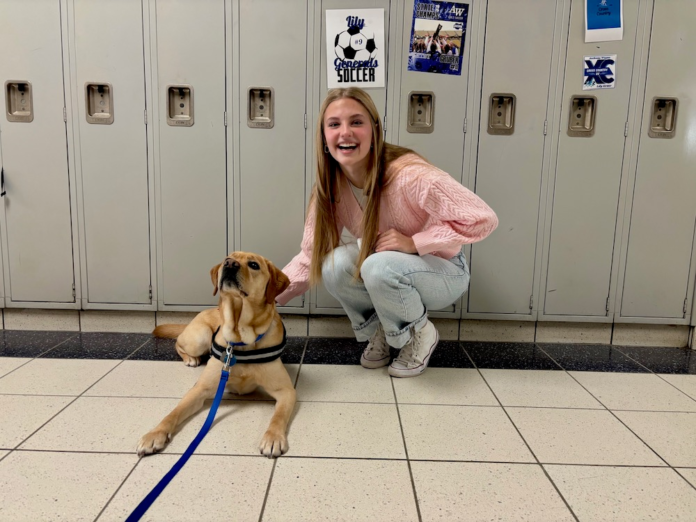
“I scored a point last night; can I pet the dog?” called out Beau Seelenbinder as he walked to the office. With permission, the teen knelt down to meet Jasper.
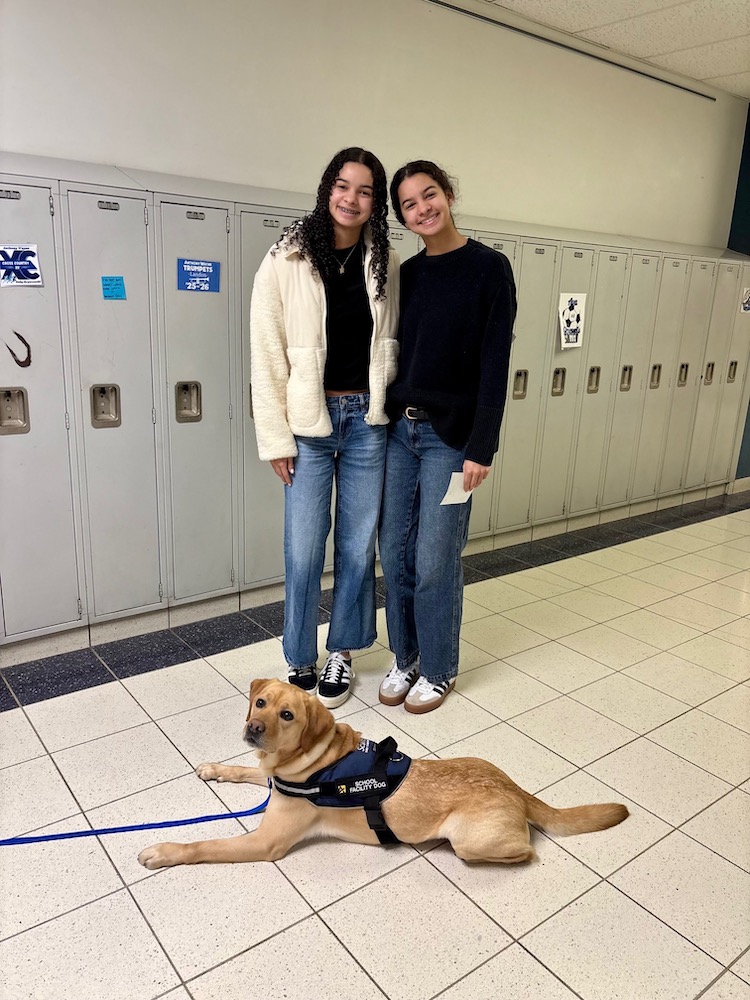
Twins Addison and Kennedi Hill were surprised when Jasper delivered a card wishing them a happy “half-birthday” – since they’re not in school on July 10 – along with an opportunity for a dog kiss.
While at school, Jasper will work most of the day but nap in a locked office in a crate during lunchtime. After school, as his energy level allows, he may attend athletic, arts and club events. On evenings and weekends, Jasper lives with the Buckenmeyer family, which includes eighth- grader Audra and sophomore CJ, along with Stephanie and her husband Mike. Jasper had a few weeks to get acclimated to the household and its routines.
Twins Addison and Kennedi Hill were surprised to see Jasper deliver a happy half-birthday greeting on January 10 to mark their July 10 birthday. (AWFP photo by Karen Gerhardinger)
Being a working dog, Jasper is eager for commands and being on the job. Too much downtime isn’t good, and he can still display some typical dog behavior, like trying to sneak off with some “stuffies” when left unsupervised, or zooming through the back yard chasing sticks.
“Though he’s highly trained, he’s still a dog. He may randomly bark or get boisterous,” Murawski said. “When he puts his vest on, he’s working. He is always going to be learning and wants to be helpful.”
While the Buckenmeyers previously had a pug, taking care of Jasper is more rigorous. The Ability Center checks in regularly to make sure his weight is steady. Jasper’s morning and evening meals are smaller because he receives treats throughout the day as he obeys commands. The family is also in charge of giving Jasper regular baths, tooth brushing, ear cleaning and nail trims, as well as practicing commands.
Jasper’s care is not financed by the school district and requires fundraising for food, bedding, toys and veterinary bills. High Point Animal Hospital has generously offered a discounted rate on services, but Burke said he hopes to establish an emergency fund.
“We don’t have a parent-teacher organization to support our facility dog like they do at the primary schools,” Burke said. “So we’re doing a lot of fundraising ourselves. We’re open to sponsorships or donations.”
Those interested in assisting can call the high school office at (419) 877-0466.
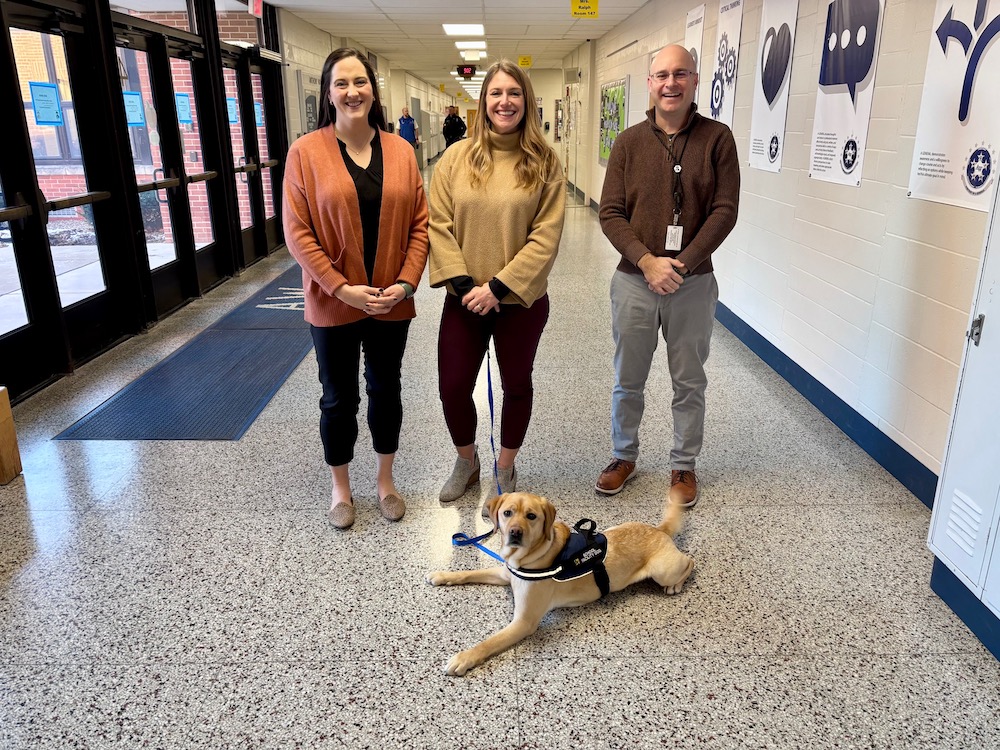
Anthony Wayne High School counselor Lauren Murawski, assistant principal Stephanie Buckenmeyer and principal Jon Burke are trained as handlers for the school’s first facility dog, Jasper. (AWFP photo by Karen Gerhardinger)
In today’s tight job market, we hear a common refrain: employers are desperate to hire.
Positions sit unfilled, help-wanted signs stay up for months, and companies compete for talent. With so much opportunity, it is easy to assume that the rules of job interviewing have loosened or disappeared altogether. They have not.
As an etiquette consultant, I often hear from employers who repeat the same message: they can teach skills, but they struggle to find candidates who demonstrate professionalism. In other words, while the job market has changed, expectations around respect, reliability, and courtesy have not.
Manners are not about being old-fashioned. Manners are about showing awareness of others, taking responsibility, and signaling that you can be trusted. In a job interview, those qualities are just as important as experience. They can make the difference between a “maybe” and a “yes.”
Consider the basics. Arriving fifteen minutes early communicates respect for the interviewer’s schedule. Making eye contact, listening without interrupting, and answering questions thoughtfully are not etiquette “extras.” These courtesies are signs of engagement and confidence. Each small choice in a professional interaction is an opportunity to show your best self, and it costs nothing.
Communication matters as well. A rushed email, a casual tone that borders on dismissive, or a failure to follow up after an interview can quietly remove a candidate from consideration. Courtesy is often the tie-breaker between two equally qualified applicants, and it is a skill every candidate can master.
Some job seekers worry that focusing on manners feels outdated or elitist. In reality, good manners are one of the most powerful tools anyone can use. Manners do not require advanced education, special connections, or expensive training. They require awareness, effort, and a commitment to showing respect. A polite greeting, a sincere thank-you, and a respectful tone are simple, universal ways to stand out.
Manners are especially important for young adults entering the workforce. Many are talented, capable, and eager, but they have grown up in a casual culture where texting replaces conversation and speed is valued over thoughtfulness. Teaching interview etiquette is not about stifling personality. Interview etiquette is about helping candidates translate their strengths into a professional setting, and seize the opportunities waiting for them.
Employers, too, have a role to play. Clear expectations, respectful interview processes, and timely communication model the same courtesy they hope to see in applicants. Professionalism works best when it flows both ways.
In a community like Toledo, where connections matter and reputations travel quickly, first impressions carry weight. A candidate who demonstrates kindness, attentiveness, and respect is remembered and often recommended. Manners build trust, and trust builds opportunity.
The job market may be competitive and fast-moving, but one thing remains constant: people want to work with people who make their day easier, not harder. Good manners signal exactly that, and can help any candidate rise, regardless of background, education, or experience.
Etiquette is consideration. In a job interview, consideration may be the most powerful qualification of all. Take the opportunity to show your best self. You never know which small act of respect could open the door to your next big opportunity.
The Cast of The North American Tour of SHUCKED (Photo by Matthew Murphy and Evan Zimmerman)
The Stranahan Theater is set to host Shucked, the Tony Award®-winning musical comedy that has been touring since 2024. Its score is written by the Grammy®-Award winning songwriting team of Brandy Clark and Shane McAnally (Kacey Musgraves’ “Follow Your Arrow”), and directed by Tony Award winner Jack O’Brien (Hairspray).
Just as corn pleases most diets, the genre-bending beats and hometown sets are sure to follow suit. Shucked is Broadway meets pop-country, playing on the best storytelling features of the mash up.
Maya Lagerstam heads the cast as part of the story-telling duo that takes the audience through the maize.
“We’re almost like a narrator, but we’re really communicating with the audience, and we guide you throughout the show,” Lagerstam said. “We also sometimes tend to hop into different roles, so sometimes we like to include ourselves into the story. We’re really right there having a dialogue with the audience.”
Maya Lagerstam as Storyteller 1 and Tyler Joseph Ellis as Storyteller 2 in The North American Tour of SHUCKED (Photo by Matthew Murphy and Evan Zimmerman)
The audience must build trust with Lagerstam and feel like they are in safe hands to be a part of the story, as the role intends. She said she takes a lot of her personal warmth and tucks it into the role to help engage folks. She also needs to put herself in several roles to make her dynamic character come alive on stage. Her approach to theater from the beginning of her career informs this ability.
“I was so excited to do theater in general when I was a kid. And any show that was happening, I was in. I wanted to play any role in any show. Wherever you need someone, I can play it, I’ll do it.”
Lagerstam’s experience in many roles plays a part in the versatility of Storyteller 1. She also comes into the role with eight off-Broadway shows under her belt, among popular titles like The Wiz and Rent. She said that this is her favorite role.
“One of the things that I really, really really love about this show is that we’re not ‘based on’ anything. Most shows that you see now on Broadway are either music that you’ve heard before on the radio, or by, or it’s a plot coming from a book or based on a movie. In Shucked, the music is original, and the plot is original.”
Shucked is a laugh for everyone.
“If you skipped the gym that day, it’s a really good ab workout. There’s at least one joke, if not 100 for anyone out there.”
When asked what advice she would give the audience, Lagerstam said, “Be ready to get shucked. I’m not much of a farmer, per se, but I do know a thing or two about shucking.”
TOLEDO – White sandy beaches, tropical blue water, warm weather and bright sunshine sound pretty good to most Ohioans this time of year. And that’s evident by the number of people who already have flown Allegiant’s new nonstop route from Toledo to Sarasota/Bradenton.
Allegiant Airlines plane. (Photo courtesy of Toledo-Lucas County Port Authority)
“We launched the Sarasota flight in November, and we just received data for our first full month, which was December, and we are just really excited to report a 93 percent load factor,” said Thomas Winston, president and CEO of the Toledo-Lucas County Port Authority. He explained that “load factor” is an airline industry term for the percentage of seats that are filled on each flight.
President and CEO Thomas Winston of the Toledo-Lucas County Port Authority. (Courtesy photo)
“We’ve demonstrated 20 years of the community supporting the service for Allegiant, and particularly for the kind of destinations for leisure and traveling like Sarasota/Bradenton.
With the addition of the Sarasota/Bradenton International Airport (SRQ), Allegiant now flies from Toledo to a total of four airports in central and Gulf Cost Florida.
“They launched the Orlando-Sanford flight in 2005, added the St. Pete-Clearwater flight in 2006, and then launched the Punta Gorda/Fort Myers flight around 2013,” Winston said. “So when you look at that Gulf Coast area of Florida, we’ve demonstrated the ability to support those leisure and travel opportunities for our residents.”
He noted that people from the Toledo area own more than 200 second homes in the Sarasota/Bradenton area.
“That’s the type of data that airlines, specifically Allegiant, will use and look at,” Winston said, adding that he and his staff meet regularly with airline and airport officials from around the country to discuss possible routes and services.
The Sarasota-Bradenton area already was a popular vacation spot for Toledo-area travelers, according to Paul Hoback, President and CEO of the Sarasota/Bradenton International Airport.
Sarasota, Fla. (Photo courtesy of the Toledo Lucas-County Port Authority)
He moved to the Sarasota area from Pittsburgh in October to take the SRQ job and said he meets so many people from Ohio, Michigan, Indiana and Pennsylvania that “it just feels like home down here.”
“It’s so exciting for people in the Toledo region to come on vacation down here, to paradise, to be able to enjoy the beaches that we have, the amazing arts and culture that we have here, you know, even the culinary experience, the foods and all of the opportunities you have with that. I mean, it’s just…it’s incredible,” Hoback said.
He said he really does consider the Sarasota-Bradenton area to be a paradise.
“I mean, it’s not just white sandy beaches. It’s boating opportunities, it’s golfing, it’s fishing, it’s the wildlife…. I’ve been exploring the state parks and seeing alligators and manatees and dolphins; it’s just unbelievable. It’s absolute paradise down here, and I think that’s why it’s so easy to sell this region to the rest of the world because it’s your chance to get away.”
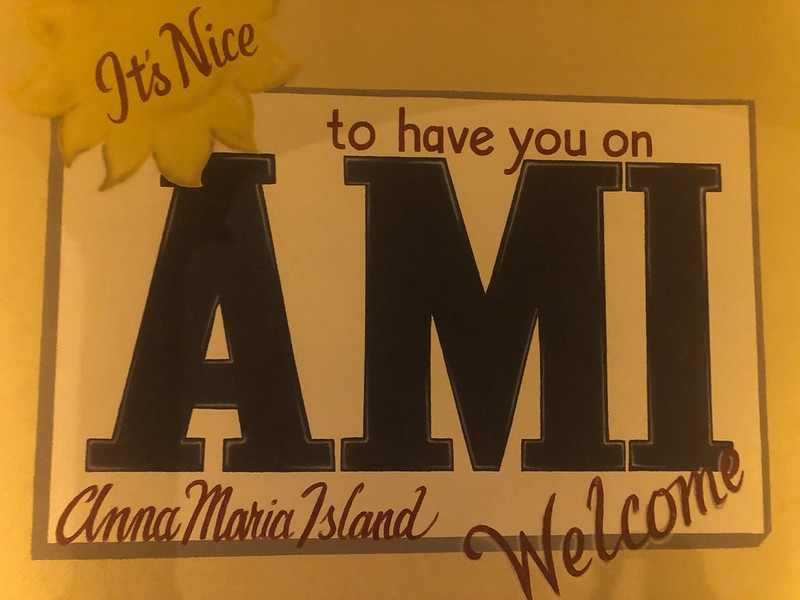
Anna Maria Island, just west of Bradenton, offers beautiful views of sunset on the Gulf of Mexico almost every day. (Courtesy photo)
Among the area attractions are the beaches of Anna Maria Island, Cortez, Longboat Key, and Siesta Key. In Sarasota, The Ringling is a museum that is “literally one minute from the airport,” Hoback said.
“There are large buildings that house a lot of memorabilia from the [Ringling Bros. and Barnum & Bailey] Circus, but it’s not just a circus museum,” he said.
The museum’s extensive art collection features Baroque masterpieces including four massive paintings by Peter Paul Rubens and an exact copy of Michelangelo’s statue of David, as well as other art from a variety of regions and eras.
Winston pointed out that Toledo Express and Allegiant have been steadily increasing their travel offerings.
“In December, we had 11 more flights than we had in December 2024. Because of the services with Allegiant and the support of the community, there were 1,800 more seats available last December than a year ago,” Winston said. He expects the new nonstop flights to Sarasota/Bradenton will continue to raise those numbers.
“At the beginning of May, we will have over 5,800 more available seats flying out of Toledo Express in the first five months of 2026 than we did in the first five months of 2025,” Winston said. And the increased numbers of travelers help the local job market in a variety of ways.
“There is certainly more of an indirect impact on jobs, like the ground handling services that service these aircraft, more opportunities for our car rental agencies, more fuel going into aircraft … there’s a ripple effect on getting this additional route,” Winston said.
Winston said it’s too early to know for sure, but the Jan. 10 announcement by Allegiant that it is acquiring Sun Country Airlines will likely be a boost for Toledo travelers.
“The future combined company airline will have over 170 destinations that they fly to, particularly around the U.S. but also in Mexico and the Caribbean,” he said. “The bottom line is that with the changes in the industry, with consolidation taking place, we believe there is clearly a niche for Toledo Express,” he said, mostly for trips to vacation destinations like Florida and Arizona.
“The community has supported that for 20 years, and we know we can continue to support that,” Winston said.
The Pale Horse, a horror-themed bar on N. Superior St. in downtown Toledo, will open on Friday, Jan. 16, at 6 p.m. (TFP photo by Steven Bieber)
Opening on Jan. 16 on Superior Street
TOLEDO — While there are already plenty of great watering holes in Toledo, one new bar aims to bring something fresh to the downtown area: The Pale Horse, Toledo’s first-ever horror-themed bar.
Owner Jessica Delgado has loved the horror genre for as long as she can remember.
“I love everything horror. I have been watching horror since I was a child, you know…Creepshow, Chucky…all those kinds of things,” she said. “I just grew up on it. I go to conventions every year – oddities conventions, horror conventions. I just love the genre, and I know there are a lot of people like me that like that too.”
Before setting her sights on opening a bar, Delgado worked as a quality technician for 10 years. During that time, she conducted her own research to determine whether there was enough interest among horror fans to pursue the project. She was also influenced by the emergence of other horror-inspired businesses, such as salons, tattoo parlors, and cafes.
Owner Jessica Delgado standing by some creepy artwork a week before opening. (TFP photo by Steven Bieber)
Any new business owner faces a series of challenges, and Delgado is no exception. Since she began planning for the January 2026 opening, she has had to navigate the many licenses and permits required to open. The most difficult license for her to obtain was the liquor license; without it, her dream would have been dead in the water. She also noted some staffing issues, as two of her chefs recently quit.
Fortunately, the process has not been all doom and gloom. Delgado said she has not had to look far to find people eager to work. When she received the keys to the building, she posted on Facebook and was met with a flood of messages from individuals seeking employment. She also offered advice to anyone looking to start their own business.
“Definitely have a plan going forward. Do all the research. Know everything that you want to know before you start, because if you’re in it and you’re learning those lessons, it’s going to be so hard. And I’d say network as much as possible because people are incredibly helpful.”
With her liquor license in hand, Delgado is free to serve drinks that are as unique as they are spooky. The Pale Horse’s menu features eight specialty cocktails, as well as slushies (alcohol optional) and six mocktails for people who don’t drink alcohol but still want to enjoy the experience. The food menu keeps things simple, with items such as burgers, chicken chunks, and sliders. Delgado also includes empanadas as an homage to her roots in Cleveland, which has a large Latin American community.
Along with food and drinks, The Pale Horse seeks to entertain its guests. In the main room, movies will play on screens throughout the space. Downstairs, guests can enjoy games such as pool, darts, and karaoke free of charge. Delgado also shared her ambition to eventually host live shows at the bar.
Delgado said her priority is for everyone to have a good time, even those who are not horror fans, and she encourages everyone to come out and try something new.
The grand opening for The Pale Horse will be held Friday,Jan. 16, from 6 p.m. to 2 a.m. at 319 N. Superior St. Learn more at The Pale Horse website.
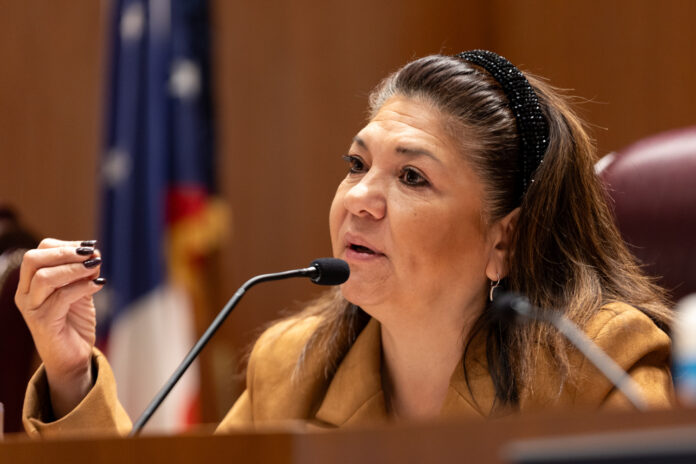
Lucas County Commissioner Anita Lopez speaks during a Lucas County Commissioners meeting at 1 Government Center in downtown Toledo on Tuesday, Jan. 13. (TFP photo by Stephen Zenner)
TOLEDO – Commissioners Lisa Sobecki and Anita Lopez appeared blindsided by their counterpart, Pete Gerken, as he made an impromptu attempt to vote symbolically against a Department of Homeland Security (DHS) grant during Tuesday’s Lucas County Commissioners Meeting at 1 Government Center in downtown Toledo.
Gerken said the grant was supposed to empower the county to stop drug runners coming down from Canada, but stated that “ICE, DHS and Border Patrol have devolved in front of the country’s eyes, as we saw clearly this last week.”
ICE in Minnesota
On Jan. 7, Immigration and Customs Enforcement (ICE) agents surged into Minneapolis, Minn. and, during neighborhood raids, killed Renee Good, a United States citizen.
A subsequent DHS action near Roosevelt High School later that same day led Minneapolis Public Schools (MPS) to close their district for “safety concerns” for the rest of that week.
Minnesota officials have claimed DHS agents are terrorizing the city and state, while DHS have maintained their actions are justified as part of their immigration raids.
Under the Trump administration, concerns about due process, detaining American citizens and other aggressive tactics used by ICE have been criticized more significantly, but the killing of Good has cemented a more intense opposition to DHS.
Operation Stonegarden
Lucas County Commissioner Pete Gerken. (TFP photo by Stephen Zenner)
For over a decade, Lucas County has received money from the Operation Stonegarden (OPSG) Grant, through the Federal Emergency Management Agency (FEMA), and the commissioners unanimously voted to receive the $70,000 grant back on Dec. 2, 2025.
An “administrative error” landed the grant back in front of the commissioners on Jan. 13, and they had to approve the amended amount, $68,250, before the Sheriff could receive the funds.
Gerken used the grant’s appearance on the agenda as an opportunity to speak on national politics, and stated outright that he began speaking without intent to rescind the grant.
“I understand this is not a rescinding of that resolution [OPSG],” he said towards the beginning of a political monologue against DHS, Customs and Border Patrol (CBP) and ICE.
“I’m not going to maintain my neutrality when it comes to taking any money for this county to do the purposes of DHS, ICE or Border Patrol…I think DHS, ICE and Border Patrol have gone from a legitimate law enforcement agency to a terrorist group.”
Then Gerken read the definition of a terrorist group: “A group who uses threats of violence to create fear, aiming to intimidate civilians or coerce governments to achieve political, religious or ideological goals, often by targeting noncombatants or property for maximum psychological impact.”
No DHS
Lisa Sobecki, president of the Board of Lucas County Commissioners. (TFP photo by Stephen Zenner)
Scrambling to pick up after Gerken’s impromptu speech, Sobecki said she agreed with Gerken, but the vote from December was still in place to receive the grant.
Sobecki stood by her vote in December to receive the funds, but said she did not condone the actions of DHS agents in Minnesota.
During both of the other commissioners’ speeches, Lopez’s face became quizzical.
When given an opportunity to speak, Lopez asked if the commissioners could turn Gerken’s symbolic words into real action, and asked if it was too late to rescind the grant in full.
Gerken responded with, “Oh, you’re going there.”
Noting that this was not a contract, like the previous Flock contract the commissioners tried to pull out of last summer, Gerken said, “This is a grant. We can un-accept at any point with the will of the board.”
A motion to right the administrative error to the OPSG was voted down, with Sobecki the only commissioner supporting the amendment to the grant.
And then Gerken made a new motion, not on the agenda, to rescind the Dec. 2, 2025 vote, unaccepting the DHS grant.
“Again, I voted for it” back in December, he said before taking the vote that would deny the funding from DHS. “Things have changed.”
Then and now
Back in December, the Toledo Free Press asked, in light of Gerken’s outspoken opposition to Trump’s immigration policy, why he accepted the grant, and received this answer from him on Dec. 8, 2025 in an email:
“This grant covers Lucas County Sheriff’s Office expenditures for overtime and vehicle use/maintenance related to border security. It is not a new grant; Lucas County has received federal funding for these operations for at least 20 years. It also is not a contract with ICE.
Lucas County is a border community. Monitoring our international border to combat drug trafficking, human trafficking, and other serious crimes is an important part of the Lucas County Sheriff’s Office’s work to keep our community safe.”
After stating things had changed, Gerken belittled the DHS patrol boat the federal government had supplied to watch Lake Erie, and said, “That was a waste of, probably, money to do that. It apprehended no drugs from Canada, but gave us a $300,000 boat to patrol Lake Erie on.”
“Given where we are today, in the history of our country, I don’t want to have monies co-mingled with our county funds,” he said, and made the motion to rescind the grant entirely.
“I don’t want the sheriff to be tainted by that, so I would make a motion to rescind the resolution for the Stonegarden grant.”
Lopez and Gerken voted to rescind the grant, while Sobecki voted to receive the grant, and the grant was rescinded.
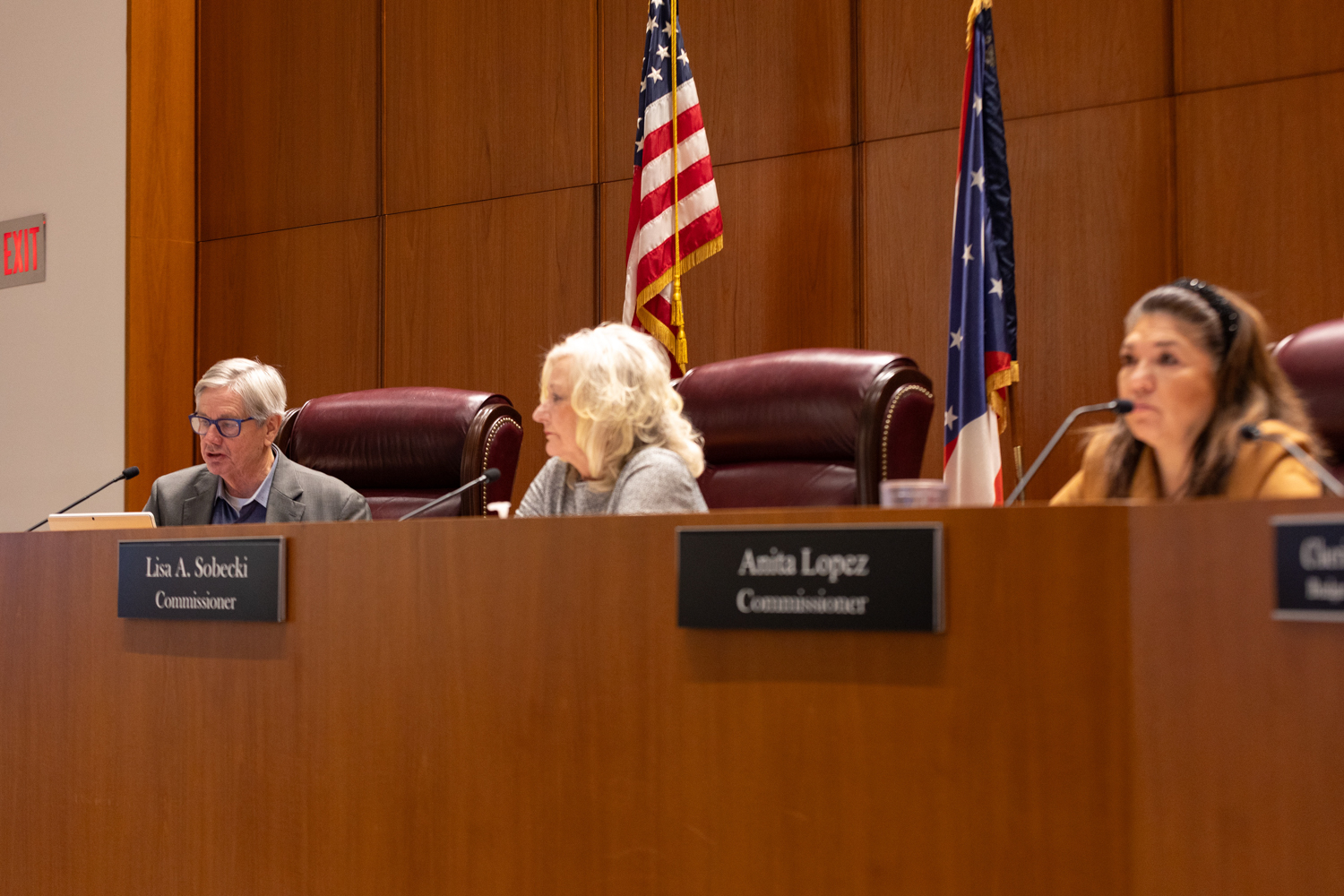
Pete Gerken, a Lucas County Commissioner, speaks on the Department of Homeland Security next to his fellow Lucas County Commissioners Lisa Sobecki and Anita Lopez. (TFP photo by Stephen Zenner)
Sheriff’s response
Back in December, the Toledo Free Press asked Lucas County Sheriff Michael Navarre about Operation Stonegarden in relation to ICE and Border Patrol, and he said in an email,
“This grant was previously called the ‘Northern Border Initiative’ and has been in place for two decades. It was historically used for patrols on Lake Erie. It pays for overtime for deputies and is intended to stop illegal drug trafficking. It has nothing to do with enforcement of federal immigration laws.”
The Toledo Free Press reached out to Navarre for comment on the rescinding of OPSG, but did not hear back.
Navarre is quoted in The Blade, in an article by Alex Bracken, responding to the Board of Lucas County Commissioners’ decision:
“‘I think it is foolish to turn away free money from the federal government with no strings attached,’ Sheriff Navarre said. ‘We’re not working with the Department of Homeland Security, we’re not working with Customs and Border Patrol, and we’re not working with ICE — they’re just the providers of the money.’”
The report file for OPSG on hand with Lucas County reads:
“The goal of this project is to enhance cooperation and coordination between Customs and Border Protection, United States Border Patrol, and Lucas County to improve overall border security.
…Lucas County law enforcement agencies will work in coordination with USBP to serve as force multipliers in a combined effort to disrupt, dismantle, and interdict transnational threats while improving communication and intelligence sharing. Lucas County will utilize their own law enforcement authorities to support the border security mission and do not receive any additional authority by participating in OPSG.
…To accomplish the Operation Stonegarden mission, law enforcement sensitive information is shared between Federal, State, and local friendly forces. This information includes intelligence sharing, CONOPS/Applications, Operations Orders, Fragmentary Orders, Daily Activity Reports, After Action Reports, and more.”
The day before the Commissioners’ meeting, the Toledo Free Press spoke with Navarre concerning another matter, during which he clarified, “My issue [with ICE] was the family separation that the federal government still has not adequately addressed.”
Navarre went on to say he is in communication with DHS entities on a regular basis, and he said, “If we get a request from ICE to assist them, we’re going to assist them. We’re not going to tell them no.”
“We’re not going to turn our backs on law enforcement. They’re taking orders from their bosses just like we are.”
Dissent
Commissioner Sobecki corroborated the Sheriff’s assessment on the grant.
“It has nothing to do, in my opinion, in my vote, that I took today, that I also took in December— it had nothing to do with what was happening across our country with ICE,” she said. “I’m supporting the ability for the sheriff to be able to have a grant that came from the federal government, to be able to offset some costs…”
“I don’t agree with the fact that ICE can come into a community, wear a mask, and you don’t know what their names are and things like that,” Sobecki said, but upheld a difference between receiving the grant and directly supporting ICE.
Limits on federal power
Lopez, who turned the symbolic gesture by Gerken into real action said, “We don’t want any of those dollars under this culture that has developed under Homeland Security.”
“If we accept those dollars, does that mean we silently approve of their actions and operations? I think that’s what it comes down to,” she said.
Specifically, Lopez talked about the practice of wearing masks, “If we’re going to accept dollars, there should be parameters, so if our law enforcement are out there with no masks in operation with Homeland Security, then their law enforcement should also be transparent and be easily identifiable.”
At that moment, a group of county parole officers walked through the first floor of 1 Government Center, and Commissioner Lopez motioned to their un-masked example as to how law enforcement should carry out their duties.
When the grant comes around next year, Lopez said she would be happy to renegotiate, but wanted assurances from DHS about their conduct in Lucas County.
“I think we need to set some parameters when they’re in our county, and if not, we shouldn’t accept the dollars.”
Everywhere in Toledo, you’ll find people who play a role in making our city tick – from hospitals and factories to restaurants and art galleries – and behind every person is a story. Our program, Toledo Works, highlights those stories from workers’ firsthand accounts. Each week, Toledo Free Press hosts Jaden Jefferson and Stephen Zenner focus on a different topic within the Toledo workforce, exploring their day-to-day challenges and triumphs.
In this episode, Jaden sits down with two workers from organizations that help Toledo kids thrive: Abbie Spencer fromToledo Day Nurseryand Katie McGuckin from WIC.