A blue jay enjoying a peanut. (Photo by Art Weber, who is the nature photographer for Metroparks Toledo)
We bundle up for the bitter cold that sometimes comes to us in the depth of winter, or perhaps just stay indoors and avoid it altogether. Our winter wildlife has no choice but to face it head-on.
For those birds who have chosen to stay here and weather the cold, survival becomes a challenge, a challenge that grows exponentially when temperatures and wind chills plunge below zero. It’s times like these that the backyard feeding stations we enjoy become extra important to our active winter wildlife.
For those who put out a single feeder, the best seed to fill it is black oil-type sunflower seed, which is favored by the widest variety of species. Other excellent choices include thistle seed, suet, and roasted unsalted peanut pieces (or those in the shell).
Pete Gerken, Lucas County Commissioner, speaks on getting funding to the sheriff, inside the Lucas County Commissioners Hearing Room at 1 Government Center in Toledo on Tuesday, Jan. 27, 2026. (TFP photo by Stephen Zenner)
Four resolutions were passed in association with the Lucas County Sheriff’s Office during the Lucas County Commissioners meeting on Tuesday, Jan. 27.
“The sheriff’s having a pretty good day at the commissioners’ today,” said Lucas County Commissioner Pete Gerken. “You have a car, you have a roof, you have a jail facilities assessment and you get money to do law enforcement in western County.”
Commissioner Gerken may have misspoken, as the sheriff and other commissioners have spoken of appropriated money being used for Jerusalem Township, on the eastern side of the county.
“Who said we can’t cooperate with the sheriff?” he said, end-capping his statements on the matter.
Lucas County Commissioner Anita Lopez. (TFP photo by Stephen Zenner)
Commissioner Gerken pointed out resources going towards the Sheriff’s Office to juxtapose against last week’s meeting, where Gerken and his fellow Lucas County Commissioner, Anita Lopez, chose to rescind funding to the Sheriff’s Office from the Department of Homeland Security (DHS).
This decision was made impromptu, during the last meeting, on Jan. 13, as Gerken railed against the behavior of Immigration and Customs Enforcement (ICE) during their heightened presence in Minneapolis, Minn.
These statements were made in reaction to ICE agent Jonathan Ross shooting and killing 37-year-old Renee Good on a neighborhood street in Minnesota.
Gerken ended his moral tirade on ICE by calling the DHS agency a “terrorist organization,” and then Gerken and Lopez voted to rescind a grant from DHS on the 13th.
This grant has been received by Lucas County for decades, and is in support of Operation Stonegarden (OPSG), with the stated objective of securing the border between Lucas County and Canada across Lake Erie.
Previously, Lucas County Sheriff Mike Navarre spoke out against rescinding the grant, stating that it was mainly used for overtime for deputies in Jerusalem Township, and didn’t bring federal agents into the area.
But on Tuesday, Gerken was happy to say the commissioners were able to “make the Sheriff whole,” by appropriating $68,250, the amount the sheriff would have received from the DHS grant, from the General Fund.
“I think the last 14 days have borne out that was probably a wise decision [not to take money from DHS],” Gerken said.
Since the last commissioners’ meeting, tensions over ICE’s deployment to the Twin Cities have escalated. These escalations have included the detaining of 5-year-old Liam Ramos by ICE – drawing outrage – a large anti-ICE protest endorsed by labor leaders that some have called a general strike in Minneapolis on the Jan. 23, and then a second U.S. Citizen, Alex Pretti, being shot to death by DHS Agents on Jan. 24.
Sheriff Navarre stood by his initial statements against rescinding the money, and called the move “illogical.”
“Moving money from one pot to another pot doesn’t eliminate the fact that, that’s $68,000 that we won’t be getting from the [federal] government,” Navarre said.
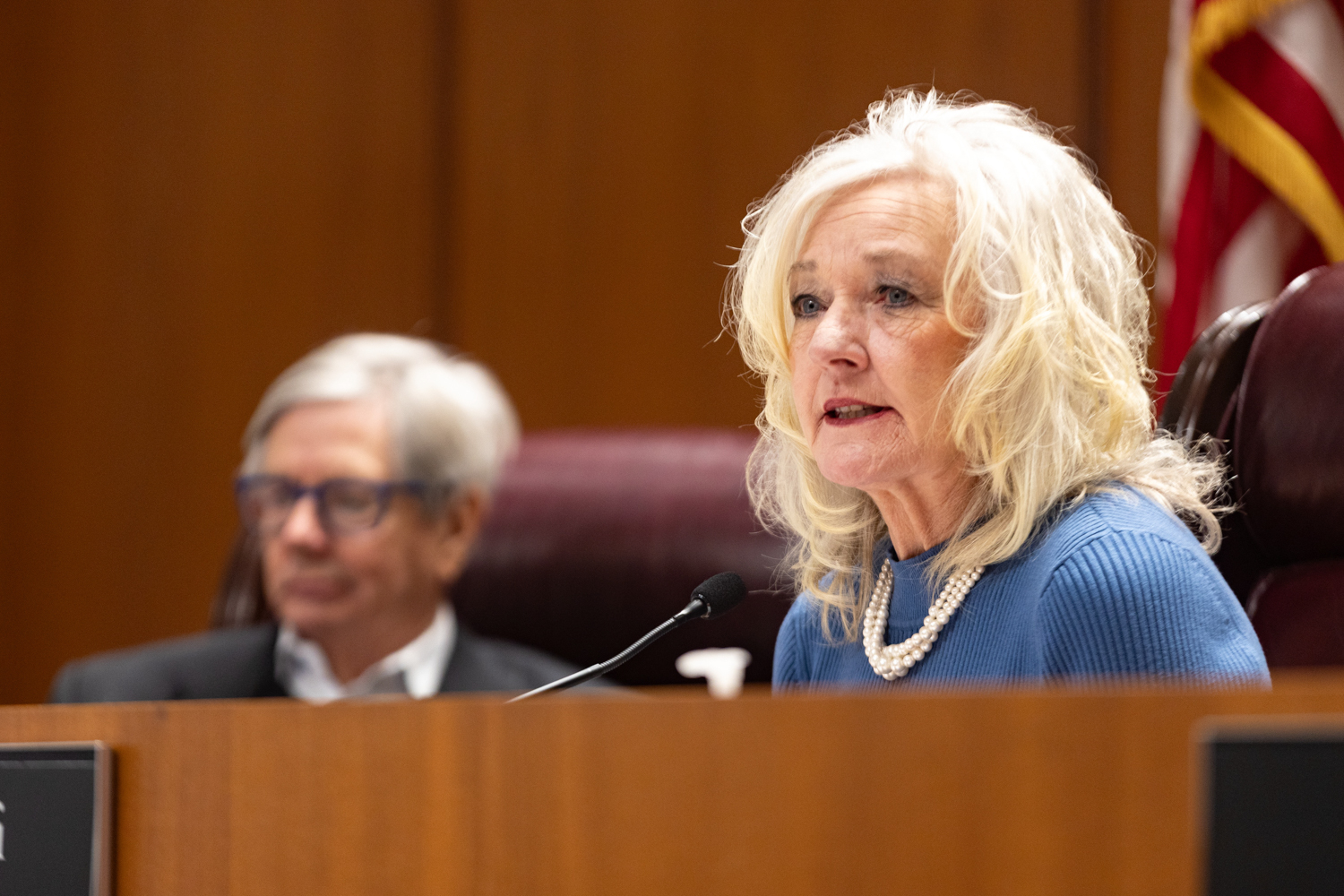
Lisa Sobecki, president of the board of Lucas County Commissioners, speaks on funding the sheriff. (TFP photo by Stephen Zenner)
All three commissioners spoke about what is happening in Minneapolis during the most recent meeting, with Lisa Sobecki, the only dissenting commissioner on rescinding the funding from DHS, calling what is happening in Minneapolis a “tragedy.”
After the meeting, Sobecki said, “We were able to come up with the resources available to be able to allow the the sheriff to do the mission out there in Jerusalem Township,” but did not speak on any objections to rescinding the funding from DHS.
When asked about financial concerns for the appropriation, she pushed back on language that insinuated the $68,250 appropriation may contribute to a strain on county’s budget projections, and said she had talked with the sheriff about his needs.
Navarre mentioned this meeting was with Sobecki and Gerken before the funds were rescinded.
Gerken and Lopez spoke of the need to differentiate the County Sheriff’s Office from the actions of ICE, to uphold trust between county law enforcement and county citizens.
Aggressive tactics used by DHS agents during the second Trump administration were condemned by Gerken and Lopez, with considerable concern specifically pointed at ICE agents’ recent and sweeping use of masks to hide their identity during their official capacity as federal agents.
The funding measure to replace the OPSG grant passed unanimously among the commissioners, and Gerken made light of funds appropriated in scope of the entire General Fund.
“Our General Fund is about $210 million a year,” he said. “I’m very confident; I’ve been doing budgets for 20 years in the county, I think we can find $68,000 in salary savings or cost benefit savings over the next year to do it.”
Appropriating the funds was worth it to Gerken, “not to get tangled up with a law enforcement that is acting inappropriately and un-American-ly,” he told press after the meeting, and pointed to the fact that DHS was not living up to the community standards in place in Lucas County, referencing the sheriff’s own Code of Conduct document signed by community organizations.
The Code of Conduct was signed by the Sheriff and other organizations in Toledo, most notably, FLOC, NAACP, Gerken himself, on behalf of the Lucas County Commissioners and the Northwest Ohio Peace Coalition.
Referencing the code of conduct, Navarre mentioned that anyone taken into county custody would require an order by a judge to transfer them into ICE custody.
Previously, Sheriff Navarre mentioned his duty to coordinate with ICE, and reaffirmed that during his communications with the federal agency, he has not been warned of an escalation of their presence in Lucas County.
He then posed this question: “Is it better to be there and and keep the peace, while ICE officers do what they’ve been charged responsibly to do? Or is it better to sit back and wait for all hell to break loose and then respond?”
Explorer for Cherokee
Further business with the sheriff involved trading a 2023 Jeep Grand Cherokee for a 2026 Ford Explorer, and the Sheriff paying the difference, $28,285.00 (Agenda Item 6).
What drew attention to the replacement was the newer Jeep trade-in, as well as higher priced features on the Explorer like “Lux Leather Package” a line item feature costing $1,695 and BlueCruise, Ford’s automatic driving software, adding $2,495 to the total cost.
“The money did not come out of the county general fund,” Navarre said. “The money came out of the sheriff’s Furtherance of Justice fund (FOJ).” This fund is designated by Ohio Revised Code 325.071, is given to the sheriff from the county’s General Fund, to use in service to his duties as sheriff, and is equal to half his salary.
After the meeting, commissioners did not push back on the purchase. Navarre mentioned he did not need the commissioners approval for the cost, but for trading in the Jeep, which was unanimously approved.
“Replace current vehicle,” was the reason written on the purchase request filled out by Sheriff Navarre. The Sheriff said he would not say anything bad about Jeep, and instead praised the company and vehicles.
“I’ve driven Jeeps for at least 25 years, maybe longer,” Navarre said. “My personal vehicle is a Jeep.”
Navarre explained that the county didn’t have the budget this year for new vehicles for the Sheriff’s Office, so instead of buying a new vehicle outright, he traded the Jeep to lower the cost of buying a new vehicle. And then he used money from his FOJ fund to split the difference.
“I wanted a nice out-of-town vehicle,” he said, and explained he travels to the Buckeye Sheriff’s State Association meetings every month, he goes to Columbus three or four times a year, he goes to statewide conferences, and employees go out of town for training in London, Ohio.
In terms of the BlueCruise and leather he said, “BlueCruise is a nice safety feature, because it has an active lane management that keeps you in your lane. It makes for safer travels. As far as leather goes, I haven’t driven a car in 25 years that didn’t have leather seats. It’s just my personal preference.”
Jail updates
Agenda items 13 and 14 dealt with the Lucas County Corrections Center at 1622 Spielbusch Avenue.
The former allowed the county to advertise for people to do the work of repairing the jail’s roof, with an estimated repair cost of $1.4 million, and Agenda Item 14 allowed the county to contract with DLZ Corporation to assess the jail facilities condition, with the assessment costing $58,500.00.
In reaction to Gerken’s comments about the sheriff getting a new roof and jail assessment, Navarre said, “This is a Lucas County building, and he’s not putting a roof on for me. He’s putting a roof on this building for the residents of Lucas County…it’s in serious disrepair, and we’ve had water infiltration for a number of years.
“If you don’t stop the water of infiltration, then it doesn’t make sense to tackle the other problems. So the DLZ group is going to come in, and they’re going to do a very thorough review on what is needed in terms of plumbing, electrical infrastructure.”
Every year since 2010, the President of the United States has dedicated January as National Human Trafficking Prevention Month. In 2015, the Ohio Advisory Committee to the U.S. Commission on Civil Rights on which I serve issued a report on human trafficking in Ohio. The testimony of one particular human trafficking victim has haunted me ever since. Indeed, her heart-wrenching account touched me so deeply that I felt compelled to write a novel about the god-awful subject. That novel is The Trafficker, and it was published this month.
I chose to write a novel—a legal thriller, in terms of genre—rather than an academic book about human trafficking because I strongly believe that fiction can often educate in a more compelling fashion than nonfiction. To Kill a Mockingbird is the classic example of how fiction can teach. In the incisive words of historian Joseph Crespino, “In the twentieth century, To Kill a Mockingbird is probably the most widely read book dealing with race in America, and its main character, Atticus Finch, the most enduring fictional image of racial heroism.”
Although I am neither foolish enough nor arrogant enough to suggest that The Trafficker is a twenty-first century To Kill a Mockingbird, like Harper Lee before me, I wanted to reach people at an emotional level to wake them up; in my case, about the horrors of the hidden world of human trafficking. The novel is not graphic in the physical sense of that word, but it is upsetting as, unfortunately, it has to be.
The novel is set primarily in Toledo, Ohio, a city that I was shocked to learn during the Ohio Advisory Committee’s investigation is a hub for human trafficking. The story is told from three alternating points of view: that of Cameron Warren, a law professor appointed by a court to serve as the trafficked girl’s guardian ad litem; that of “Jane Doe,” the traumatized teen victim who refuses to reveal her name; and “the middle-aged man,” the anonymous trafficker after whom the novel is named.
Cameron Warren, a happily married man with three wonderful children, has dedicated his life to eradicating human trafficking. He went so far in his professional life as to draft, and help get enacted into law, a federal statute punishing human trafficking. In his personal life, he frequently volunteers as a court-appointed guardian ad litem to try to save one child at a time.
Jane Doe has grown up in an abusive family environment, as many trafficking victims have, and that has led her to a series of terrible choices from which she is trying to extricate herself. She does not trust anyone, including Cameron Warren, who has more than earned her trust.
Every legal thriller needs an antagonist, and “the middle-aged man” serves that role in The Trafficker. He is driven by money, as most traffickers are, especially the large sums of money that some depraved people are willing to pay for the so-called premium product, a thirteen- or fourteen-year-old girl.
Although The Trafficker is a work of fiction, it is based in fact: the Ohio Advisory Committee to the U.S. Commission on Civil Rights’s report on human trafficking, information provided by anti-trafficking groups and law enforcement officials, and material I discovered when researching the book like a January 2024 (National Human Trafficking Prevention Month) Rolling Stone article on the subject that a friend sent me.
Does the novel have a happy ending? I will leave it to readers to find out for themselves. In the meantime, I hope as many people as possible will take National Human Trafficking Prevention Month to heart and help end what the lawyer who chaired the Ohio Advisory Committee called “an insidious scourge unfolding inside seemingly ordinary homes and neighborhoods.”
The Anthony Wayne community is fortunate to have Ryan Donley as an educator and coach. His commitment to our youth extends far beyond the baseball diamond, and I felt compelled to share a recent experience that exemplifies his remarkable character.
During Winter Break, Coach Donley and his talented high school baseball players organized a youth baseball clinic. My 7-year-old son Beckett participated, and I volunteered to help. This was my first time meeting Coach Donley, and what I witnessed left a lasting impression.
From the moment I entered the gymnasium, I noticed something extraordinary about the high school athletes. They communicated with genuine mutual respect—not the performative kind that adults sometimes coach into kids, but the authentic variety that only develops when young people are led by someone who models it consistently. The athletes clearly respected their coach, and the respect Coach Donley showed his players was equally evident.
But what happened next truly amazed me.
Coach Donley commanded the attention of dozens of energetic 7- to 14-year-olds—a feat any parent or teacher knows borders on miraculous. Then I noticed he was calling each child by name. I initially assumed he must have known these kids or their families beforehand.
My assumption changed when I heard him shout across the gymnasium, “Hey, great contact there, Beckett!” I looked over. That was MY Beckett in the batting cage. They had met just once— an hour earlier during a brief check— in when dozens of other young athletes were simultaneously introducing themselves. No name tags. No clipboard. Just Coach Donley, greeting each child personally and apparently inscribing every name into his memory.
He did this throughout the clinic, addressing every single child by name.
A youth camp led by Coach Donley. (Photo by Russ Acino)
The impact was palpable. The kids stood taller. They listened more intently. They felt seen. After the clinic, I approached Coach Donley to thank him. Before I could speak, he looked up and said, “Hey BJ! Thanks for helping out! How do you think we did?”
He remembered my name too.
When I asked how he managed to remember everyone, his response was refreshingly honest: he makes it a point to commit each person’s name to memory because it’s one small thing he can do to show respect and demonstrate that he truly listens.
That simple gesture speaks volumes about Coach Donley’s character as an educator, coach, community leader, and person.
Our community undoubtedly has countless other wonderful educators and mentors like Coach Donley. But this personal experience moved me to publicly recognize someone who is quietly making a profound difference in the lives of our children—one remembered name at a time.
This bird was photographed in the Oak Openings Region by Metroparks Toledo nature photographer Art Weber.
This tufted titmouse may look like its dreaming of warmer weather but it’s actually keeping a close eye on a hawk soaring overhead in search of a meal. It’s taking meals of black sunflower seeds offered at a wildlife feeding station in the Oak Openings Region.
It is amazing that a small songbird like this can survive the bitter cold we’ve experienced in recent days, but it’s well-adapted, provided it has adequate food and a tree cavity or similar cover for protection, especially overnight. This bird is fluffing its feathers, trapping a layer of warm air in its down, just as we do with a down jacket. Like many species, titmice will anticipate the winter by hiding seeds and nuts for food, though well-maintained backyard feeding stations can make an important difference, especially in the depths of winter.
Sisters Savannah and Violet Oliva work with Kiki Amstutz to create a house. (AWFP photo by Karen Gerhardinger)
MONCLOVA – Sitting on the floor in Monclova Primary School’s community room, sisters Savannah and Violet Oliva collaborate with Kiki Amstutz to create a house with a swimming pool.
“This has a medical box,” said Violet, opening up a tiny cabinet to display a Lego block with a first aid sign.
“This is our swimming pool,” Kiki said, pointing to a line of Legos.
Nearby, Savannah Jackson, Tess Snyder, Janie Harrigan, Charleigh Flemming and Luna Crable construct a wall out of giant blocks. Cousins Ethan Bergner and Quinn Koch, along with siblings Jordan and Kylie Garcia, focus on building two houses.
While building with Legos is a favorite pastime for many students, getting together in free play before school is a rare occurrence – but one that provides multiple benefits, said fourth-grade teacher Brianne Black and intervention coach Rachel Birt.
Paraprofessional Kelli Kilpatrick watches as students construct with Legos. (AWFP photo by Karen Gerhardinger)
It was during a break in a water aerobics class last summer that the two educators came up with Kickstart, a once-a-month, before-school free play time. Black and Birt had each been reading The Anxious Generation, How the Great Rewiring of Childhood is Causing an Epidemic of Mental Illness, by Jonathan Haidt. The two began discussing ways to facilitate rewiring brains that have been increasingly reliant on using electronics.
Birt, who helps out with the arrival of students each morning, noticed that often parents were in the parking lot at 8 a.m. waiting for the doors to open at 8:30 a.m. Parents often drop off older students at the Finzel Road campus and then head to the primary school to wait for the doors to open. It’s not unusual to see students using electronics to pass the time.
“The thought was, if we could get these kids out of their cars and doing something, then the parents could drop them off and go,” said Principal Betsey Murry.
Cousins Ethan Bergner and Quinn Koch join siblings Jordan and Kylie Garcia in play. (AWFP photo by Karen Gerhardinger)
The goal is to have students get their bodies moving while learning to socialize in an unstructured environment – whether on the playground or doing activities like December’s dance party or next month’s plans to color on giant butcher paper or posters. The staff members who volunteer take a hands-off approach, letting the students play in groups of their own choosing while ensuring their safety.
“This gives students unstructured time to play before learning in order to get the wiggles out or to get the neurons firing for the morning,” Birt said. “This way, they’re not coming in here zombified. They’re more engaged, and they’ve already had an opportunity to be social.”
Because of the structure during the regular school day, students are rarely able to play with students in different grades, or even other classes, Black noted. Often she sees siblings in different grades teaming up together or with other students to play during Kickstart.
Working together are (from left) Luca Catrera, Addison Farah, Vivian Schlageter, Faith and Paige Carder. (AWFP photo by Karen Gerhardinger)
“This also provides an opportunity for them to learn self-advocacy. They make up the rules and have to talk and bargain on what they want to play,” Birt said. “It’s the soft skills that become big skills in real life.”
Staff members volunteer their time before school but don’t intervene or lead play. Many have also provided suggestions for activities, which may incorporate yoga – as Birt is a certified yoga instructor – but when the weather is nice, free play on the outdoor playground will be a priority.
Already, the teachers have seen an improvement in the 45 to 50 students who sign up to participate each month.
“I’ve seen my students come back ready for the day. They feel special, and they’re excited. They’re more alert instead of coming in tired,” Black said. “We really want our parents to know that we care about the whole child.”
For the students, it’s also a break from waiting in the car, riding the bus or hanging out with a parent at work before school.
“I like coming in before school. All of the activities are really fun,” said Ethan Bergner.
Monclova Primary School intervention specialist Rachel Birt and fourth grade teacher Brianne Black launched Kickstart, a before-school free-play session for students to get warmed up and ready to learn.Building with larger blocks are (from left) August Lewis, Henry Ludwig-Crosby, Wells Lewis and Weston Brown.
The entrepreneur and drag performer hopes to represent Ohio’s 9th District
David Gedert, candidate for Ohio’s 9th Congressional District, poses with Jaden Jefferson, journalist with the Toledo Free Press, for an interview at the Toledo Tech Loft in downtown Toledo, Ohio on Thursday January 15, 2026. (TFP photo by Stephen Zenner)
Jaden Jefferson sits down with David Gedert, who goes by Sugar Vermonte while performing, to talk about his run for Congress to represent Ohio’s District 9. Gedert is also an entrepreneur who owns a food truck called Maybe Cheese Born With It. This is the first in our Toledo Voter’s Guide series for 2026 election coverage. You can also listen to this and other episodes of our Voter’s Guide on Spotify.
Across Ohio, researchers are achieving medical breakthroughs on what seems to be a monthly basis.
Unfortunately, proposed legislation in Congress threatens to undermine Buckeye scientists by weakening the patent protections that biotech startups rely on to raise capital and to give patients meaningful access to promising research ideas by developing those ideas into real-world therapies.
This year, the Senate Judiciary Committee advanced several such troubling bills, including the Affordable Prescriptions for Patients Act and the Drug Competition Enhancement Act.
The reason these bills would have such negative effects – despite their good intentions – is that they are based on misunderstandings of the patent system and its invaluable role in supporting biopharmaceutical research and development.
The lawmakers behind the Affordable Prescriptions for Patients Act, for instance, believe biotech companies file patents on the same biologic drug over and over again to keep biosimilar drugs from reaching the market.
This gets the patent system all wrong, however. The law already prohibits an inventor from getting more than one patent on the same invention. But complex therapies like biologics require companies to address multiple challenges, and overcoming these challenges often involves inventing new solutions. Each of these solutions represents a legitimate – and vital – scientific advance deserving of patent protection.
More generally, despite the overheated rhetoric, more patents don’t mean less competition or increased prices. A 2024 U.S. Patent and Trademark Office (USPTO) study – as well as my own research – found no evidence that the number of drug patents has anything to do with when a generic version of the drug enters the market.
The Drug Competition Enhancement Act is equally misguided. Biopharmaceutical companies often work hard to improve their products to make them more effective, easier to take, or less likely to cause side effects. The Act nonetheless would wrongly treat such innovations as anti-competitive and potential antitrust violations based on the cleverly named but misleading concept of “product hopping” – the allegation that companies create and patent new versions of their drugs merely to undercut any market share generic manufacturers might have.
Beneficial improvements to drugs should be encouraged, not punished.
Unfortunately, lawmakers are advancing these bills alongside a slate of other troubling proposals.
The Preserve Access to Affordable Generics and Biosimilars Act proposal, for example, would unnecessarily regulate settlements of patent lawsuits between innovator and generic drug manufacturers, ironically leading to the possibility that generic drugs will enter the market later than they would under reasonable settlement terms. Meanwhile, the proposed Interagency Patent Coordination and Improvement Act of 2025 would saddle the FDA and USPTO with red tape, potentially delaying both patent examination and regulatory approval of new medical treatments.
Ohio is home to nearly 4,900 life sciences businesses that depend on patents to attract investment and bring cutting-edge advances to patients. By needlessly complicating the industry’s ability to rely on the patent system, the proposed bills would endanger investment in tomorrow’s breakthrough therapies.
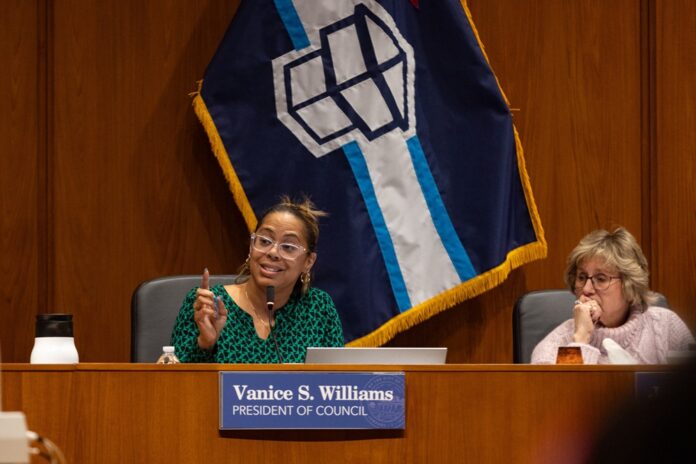
Vanice Williams, president of Council and council member for District 4, speaks against the amendment to O-024-26 during a Toledo City Council Meeting at 1 Government Center in downtown Toledo on Tuesday, Jan. 20, 2026. Williams said that, while she had voted against the initial release of millions of dollars, now the project just needed to be done. (TFP photo by Stephen Zenner)
A prayer and jazz instrumental rendition of the “Star Spangled Banner” started off a new year for Toledo City Council on Tuesday, Jan. 20, at 1 Government Center in Downtown Toledo.
LEAD
The first agenda item of 2026, R-001-26, was recognizing the Toledo Municipal Court for developing the city’s Leaders Emerging and Developing (LEAD) program, based off a similar program that originated under Lucas County’s government. LEAD’s goal is to develop leaders from within the ranks of Toledo city government employees.
Retirement
After 31 years of service to the city of Toledo, David Calzone, the superintendent of parks, was recognized, as he moves on from his position with the city.
David Calzone, the superintendent of parks for the city of Toledo, says farewell to coworkers as he is recognized for his 31 years working with the city during a Toledo City Council Meeting at 1 Government Center in downtown Toledo, Ohio on Tuesday January 20, 2026. TFP Photo/STEPHEN ZENNER
Members of the Council shared praise for Calzone. Notably, Theresa Gadus, District 3 Council Member, called him the “Blight Master” and said, “You put your heart into this job.”
Theresa Morris, Council Member for District 6, Cerssandra McPherson, Council Member At Large, and Vanice Williams, Council Member for District 4, all shared well wishes and appreciation for Calzone before he heads down to South Carolina to homestead.
“You blink, and here I am, 31 years later, ready to retire,” Calzone said as he addressed Council.
Appointments
John Ziegelhofer and Rick Burson were both re-appointed to the Electrical Board of Control, and Christopher Gaffney, was appointed to the HVAC Board of Control.
Most of Toledo City Council has remained the same after the 2025 election, with the exception of Carrie Hartman, the former president of Council and member at-large who stepped down in the middle of election season. Erin Kramer took Hartman’s open seat for the member at-large position, and Williams has been acting as president of council since Hartman stepped down.
With the new year, the following are the council members and the committees they are on:
O-581-25 passed unanimously and extended the length of the contract while amending the scope of services on an “infrastructure program to bring the city’s sewer system and wastewater treatment into compliance with federal and state law.”
O-007-26 changed the Toledo City Council Committees from:
1. Parks, Education, Recreation and Health Committee
2. Finance Debt and Budget Oversight Committee
3. Intergovernmental & Administrative Services
4. Housing and Community Development Committee
5. Public Safety & Criminal Justice Reform Committee
6. Regional Growth, Development & Small Business Enterprise Committee
4. Housing, Community Development, Public Health Policy Committee
5. Public Safety & Criminal Justice Reform Committee
6. Sustainability and Beautification Committee
7. Transportation Committee
8. Water Quality Committee
9. Zoning and Planning Committee
Data centers
R-008-26 requests a study on data centers and their effects on communities.
Council requests the study be done in a “timely manner” to study the effects of data centers on “water consumption, electricity consumption, increased greenhouse gas emissions, effect on residential water, electric, and gas rates, market volatility, as well as job creation, tax revenue, and catalyzing effects on the development of related industries.”
The resolution says the study should commence immediately, but does not have a deadline for its end.
AI
Likewise, R-009-26, resolves to create a “responsible Artificial Intelligence (AI) strategy” for the City of Toledo.
“…establishing an AI Strategy is necessary to protect residents, ensure equitable outcomes, build institutional capacity, and responsibly guide the city’s use of emerging technologies…”
Section 1 states the City will work with subject matter experts to develop the strategy, and the development of the strategy will begin as soon as possible.
Zoning
A 90-day moratorium on “zoning permits, building permits, certificates of occupancy, and other licenses or permits for storage units” was passed at Council – O-010-26.
District 3 Council Member Gadus explained the ordinance: “The plan commission did not complete their study [on storage units] in time, and they reached out to City Council and asked if we would extend it for three more months so that they could present their findings to council.”
The explanation of the plan commission’s delay, according to Gadus, were “administrative changes” that delayed the study.
Similarly, the council resolved to extend a moratorium on demolishing buildings of “historical community importance,” which extends the provisions of Resolution 293-25, with Resolution 010-26.
Loan for country club
A $251,859.04 loan was approved for the Toledo Country Club, 3900 River Rd., to update the club’s energy efficiency.
This 14-year loan was offered at a 6.15 percent interest rate as part of a regional Special Energy Improvement Project.
Toledo-Lucas County Port Authority’s Northwest Ohio Bond Fund issued the loan, and the estimated repayment over the course of the 14 years is $347,680.20.
Bus benches
O-012-26:
“Mr. Temple purchased bus benches in accordance with an agreement with the City of Toledo but was subsequently required to remove them. A settlement agreement resolving all Mr. Temple’s possible claims related to this agreement in the amount of $40,000 has been reached, conditioned on the approval of City Council and the Mayor.”
UAW agreement
O-013-26:
“UAW Local 12 reached a tentative agreement over terms that revise the current collective bargaining agreement, which will expire on December 31, 2025,” and the agreement was approved by council.
Replacements and Improvements
O-014-26:
$10,000,000 was appropriated from the unappropriated balance of the Water Replacement Fund into Account Code 6063-35000-4UC0426STDSTD and was authorized to be spent on the Water Main Program.
O-015-26:
$7,200,000 is appropriated from the unappropriated balance of the Sewer Replacement Fund into Account Code 6073-35000-4UC0526STDSTD, and the expenditure of the same is authorized for various sewer replacement and improvement projects.
O-016-26:
$3,240,000is appropriated from the unappropriated balance of the Storm Water Utility Improvement Fund into Account Code 607B-35000-4UC0326STDSTD and further authorizing the expenditure of same for various drainage improvement projects.
O-017-26:
Authorized money from grants and loans for use in four roadway projects.
Summit Street Phase 2 – Grant- $599,000
Glendale Avenue – Detroit to Charmaine – Grant – $248,457
Douglas Road – Alexis to the state line – Grant – $272,450
Telegraph Road – Alexis to Detroit – Grant – $886,210
Total Grant: $2,006,117
Glendale Avenue – Detroit to Charmaine – Loan – $248,457
$2,254,574 in grant and loan funds from the Ohio Public Works Commission (OPWC) for roadway projects
O-018-26 accepted grants from the Ohio Department of Transportation (ODOT) for specific projects:
Safe Routes to School – Sidewalk Repair – $2,608,481
Telegraph – Alexis to Detroit – $1,045,600
Telegraph/Alexis Intersection – $829,229
Glendale – Detroit to Charmaine – $500,000
Emerald Bike Path – $1,000,000
Douglas – Alexis to the State Line – $2,173,360
Safe Routes to School – $499,708
Summit Street – New York to Manhattan – $4,460,080
Total amount: $13,116,458
O-019-26 appropriated $6,500,000 from unappropriated Capital Improvement Funds for the roadway matches and planning program.
O-020-26 appropriated $36,000,000 from the Roadway Improvement Fund for the General Resurfacing program. These funds were requested from the Division of Engineering and Construction Management.
New software contract
O-021-26:
The City of Toledo entered into a contractual agreement to use SWPPPTrackPro software and servers for its environmental compliance and enforcement activities as required by the City’s NPDES permit:
“The use of this software will allow for more timely notifications of violations to property owners and/or construction responsible parties, automate documentation of correspondence of said violations and resolutions, and save staff time by working with a comprehensive software package specifically designed to handle these types of tasks.
“The first year of the three-year contract is in the amount of $26,479, including a one-time set up fee of $4,999.”
Investigation and cleanup
O-022-26:
$24,000 was appropriated from the General Fund for the Toledo Police investigation and site clean-up of the property located at 433 Baden Street. The Klumm Brothers Company was contracted for the clean-up.
O-023-26:
Hillabrand & Sons Construction was contracted for the emergency repair of three 8” water main valves, 20 feet of pipe, a service line re-tap, and restoration work at the intersection of Arco Drive and Frenchmens Road. The extent authorized for this work was $80,000 from the Water Replacement Fund.
Oversight dispute
Division sparked amongst Council Members who wished to amend O-024-26, and those who wished to keep it as originally stated. The ordinance dealt with another payment to DLZ Ohio, Inc. for installing digital meters across Toledo. The project began in 2021, but there are still 5,500 meters that need to be installed.
“What I and Councilwoman McPherson and Councilman Driscoll are asking for this ordinance is that we would basically give the administration one year to basically complete the AMI [Advance Metering Infrastructure] project, and along during that time-frame that they would make every effort to train an individual from Local 2058, or individuals, so they could properly supervise the project in The future,” said George Sarantou, council member at-large.
The amendment proposed by Sarantou, McPherson and Mac Driscoll, council member at-large, would cap appropriations for the project at $215,977 for one year, and Sarantou said if more money was needed for the project, they could come back in a year’s time to approve it. Initially the ordinance appropriated $431,954.
Sarantou’s main point was that within 10-15 years the meters would be replaced again, and that it would be cost-effective to have someone trained in-house to work on the project in the future.
“This project was supposed to be concluded in 2024,” McPherson said during her support of the amendment, and recommended a strategic plan with dates to rein in spending on the meters. “Beyond the 100 million dollars for this project, they [DLZ Ohio, Inc.] have come back to us twice for additional funds.”
McPherson pushed for greater accountability, criticized the oversight of the meter project and wanted an in-house employee to be trained on the process for oversight and future needs servicing the meters.
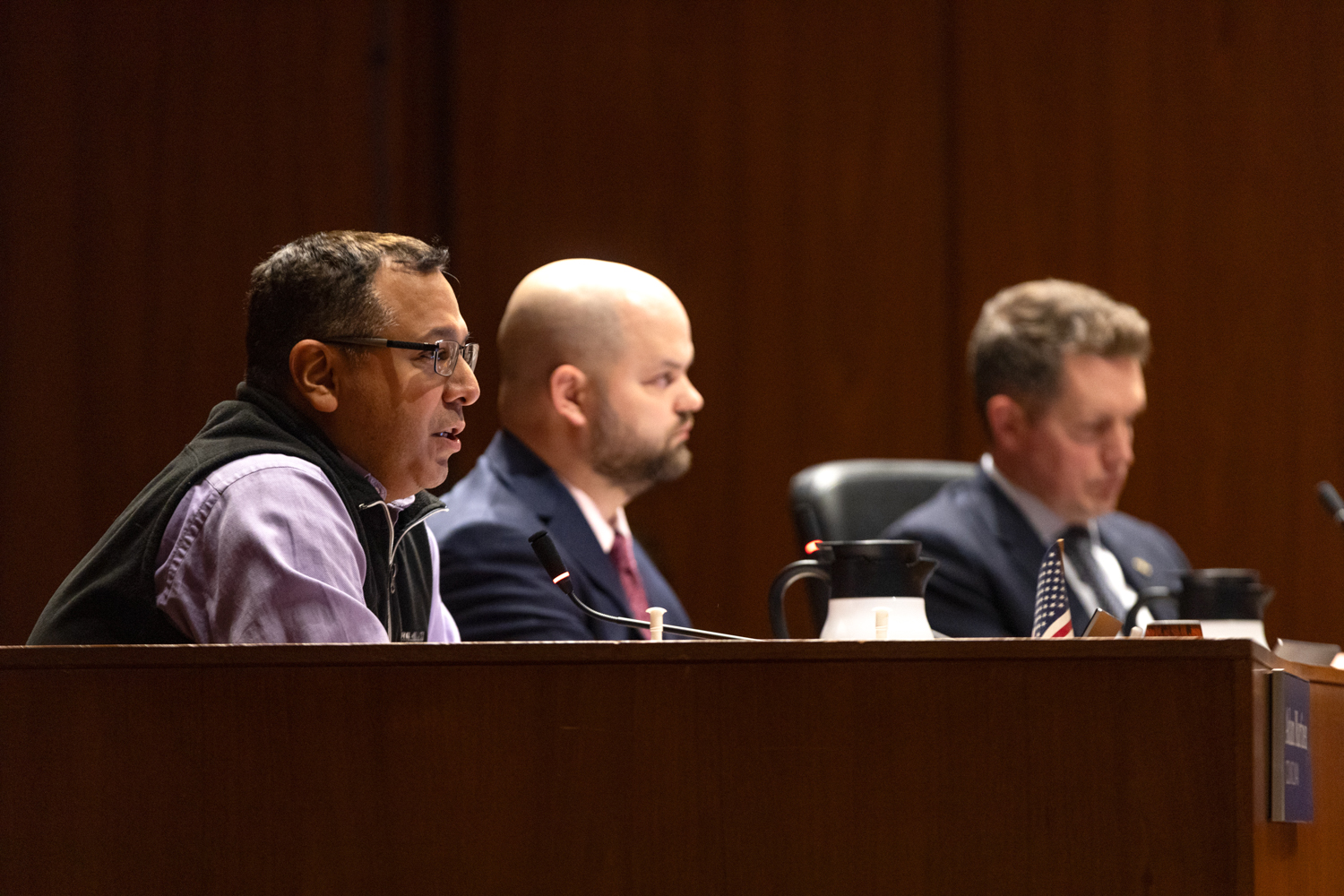
Adam Martinez, council member for District 2, speaks against the proposed amendment to O-024-26, which would rein in costs on an advanced metering infrastructure project. Martinez thought the amendment was well intentioned but would end up costing the city more in the long run by extending the timeline of the project. (TFP photo by Stephen Zenner)
Council Member Adam Martinez of District 2 offered a soft rebuttal to his fellow council members, and said he understood the desire for more accountability. He said, “but the end of the day, this has to get done.”
Martinez saw halving the money as prolonging the project by at least a year or two, and costing the city an extra $90,000 through “zombie” meters that were not yet installed. In regards to hiring in-house, “the work is already being done by our local labor forces and done well.” And by creating the position, which would be highly involved with engineering and technology, Martinez said the City would run into HR problems when crossing both domains.
When dealing with management of the project, Martinez acquiesced that there should be more oversight, and that quarterly check-ins could meet the requirement to steer the project more precisely. But Martinez said he opposed the amendment, and thought it would only delay the completion of the project, costing the city more.
Sam Melden, council member for District 5, weighed-in on the advanced metering infrastructure amendment to O-024-26, succinctly saying that the amendment was “too much in the weeds. (TFP photo by Stephen Zenner)
Sam Melden, council member for District 5, concisely opposed the amendment, saying “this amendment is getting into who does it and how we do it. I think it’s too much in the weeds, and that’s why I’m not supporting it.”
In reaction to Martinez and Melden, McPherson clarified her words.
“I’m NOT holding up the project because the amendment IS releasing money,” she said. “I’m holding up some of the money so that we can get some accountability on this, instead of continuing writing an open check and not getting anything for it.”
McPherson was clear that she was not dictating who should do the work, but her efforts were for accountability on the project.
“Initially they came to us requesting over $900,000 and then miraculously, they got to bring it down to eight,” she said. “I’m bringing it down less than that, because I want follow up.”
“We’ve let this dog run wild for too long. That’s my stance. I want the project done.”
Sarantou then repeated both McPherson and his previous remarks for clarity:
“It’s important that we get it done. It is a miracle that suddenly the administration went from $960,000 that they requested late last year to now $845,000, and again, I think we can save the rate payers money by doing it right and using our in-house people to provide that kind of leadership,” he said.
Martinez quickly remarked that the amendment was not about installing the meters, but about “back office support.”
Then President of Council Vanice Williams weighed-in quickly on the matter with a tempo that matched her resolve.
“Johnson Control started this project where we gave $100 million to which, again, I voted against. But now we’re here. We need to get this job done,” she said, and then asked Julie Gibbons, the clerk of the council, to slow walk the vote so each member could be recorded.
At-Large Council Member Nick Komives and District 3 Council Member John Hobbs III were both absent from all votes during the meeting.
The vote supporting the amendment went as follows:
Yeas: Gadus, Driscoll, Jones, Kramer, McPherson, Morris, Sarantou
Nays: Martinez, Melden, Williams
The amendment passed.
Gas pipeline
O-025-26:
Authorized a land license agreement, amended a license agreement for a gas pipeline and gas regulator station with Columbia Gas of Ohio on the Maumee Riverfront-Riverfront Northwest.
This was an amendment to a similar agreement made back in 1991 for $6,550. According to the recently passed agreement, Columbia Gas will pay the city $13,031.23 to lease the pipeline. The conditions of the agreement are for another 30 year term.
Cleveland Cliffs Foundation
O-026-26 authorized the mayor to accept and deposit a grant from the Cleveland Cliffs Foundation awarded through NeighborWorks Toledo Region in the amount of $10,000 to support the installation of visitor amenities at Pontiac Preserve into the Capital Improvement Fund.
Relieved items
Driscoll relieved items O-027-26 and O-028-26 from the agenda. If accepted, 25 S. Superior Street and 19 S. Superior Street would be designated as local landmarks.
Driscoll then relieved R-465-25 from the agenda as well, which declared intent to vacate a 25-foot alley located behind 2024 Champlain Street.
Whitehouse is set to consider two annexation requests. Monclova Township residents learn they were overbilled for garbage on the first half of their property taxes. Providence Township trustees discuss electrical work done by a company owned by a trustee’s brother. These are a few of the highlights from meetings in the Anthony Wayne area over the past few weeks.
Two property owners ask to annex into Whitehouse
Whitehouse Village Council tabled two requests for annexing property into the village, after Waterville Township trustees asked for an opportunity to discuss their concerns.
During the Jan. 20 meeting, council members discussed the two requests. One is for a two-acre parcel at 7010 Finzel Rd., purchased in Feb. 2025 by RF Asset LLC, represented by Josh Doyle. A home on the property was razed in 2018 and two outbuildings remain.
The second annexation request is from Amanda and Travis Ratcliff, whose home is on 2.18 acres at 11032 Winslow Rd., at the northeast corner of Whitehouse-Spencer Rd.
The property owners petitioned the village to annex, and the Lucas County Commissioners reviewed that request and approved it. From there, Council has until Thursday, Feb. 5 to approve the annexation, said law director Kevin Heban.
“I believe they want to annex so they can get the inside rate for water and sewer,” said Heban, explaining that the rates for those utilities are much higher for non-residents.
The question is whether the village wants the properties, said Council Member Dave Riggenbach, adding that he doesn’t believe the township should hold sway over the village.
Council Member Louann Artiaga asked Heban about the pros and cons. On the plus side, the village gains new residents, he said.
“The con: we lose money on residents because we lose money on services,” he said, referring to the cost to provide police, fire, EMS and other services – a cost that isn’t completely covered by the income taxes paid.
Council tabled ordinances to do with the annexation and resolutions that would agree to provide utilities and services, pending Mayor Rich Bingham‘s discussion with township trustees.
In the meeting Whitehouse Village Council also:
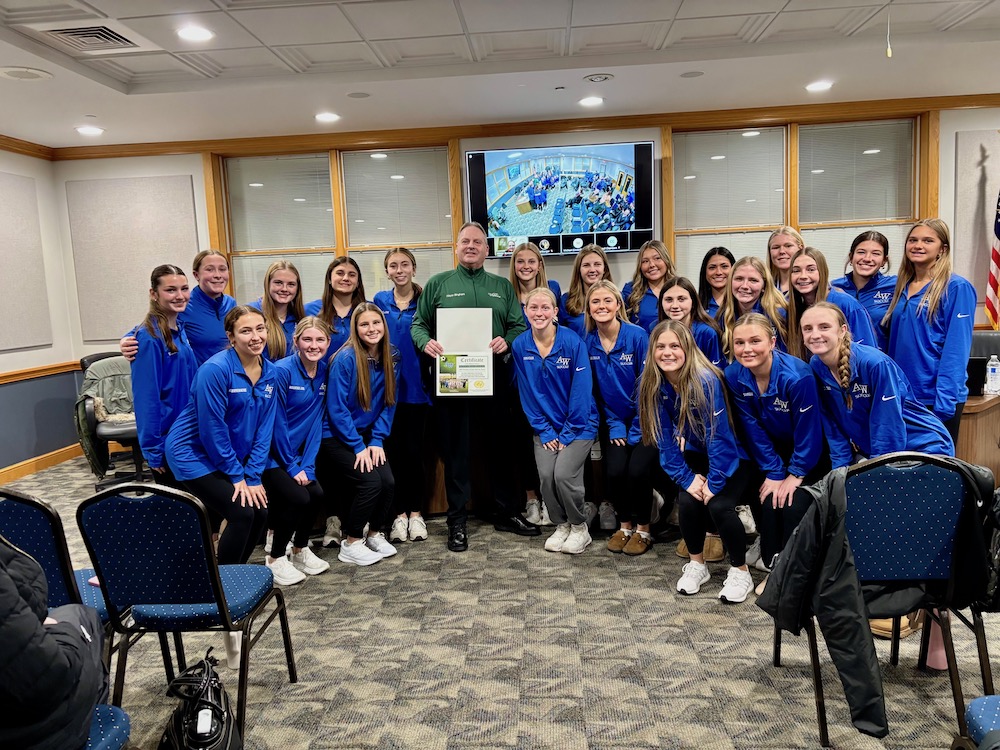
–Congratulated the Anthony Wayne High School girls soccer team, which won the 2025 state championship. Coach Lori Williams thanked the village staff for their assistance in state sendoffs and receptions, and the residents for their continual support.
-Approved the use of village streets during the Saturday, March 28 Great Black Swamp Festival of Races.
-Heard an update on electric aggregation from Council President Steve Fine and Administrator Jordan Daugherty. Since voters approved an opportunity to seek out lower rates, the market has been volatile, and the village has been waiting to lock in at a rate that would present a savings over the standard rate.
-Appointed Bob Kimball to the Charter Review Commission.
-Learned that Whitehouse will host a coffee with the mayor and council on Saturday, March 14 from 8:30 to 10 a.m. at the Buzz Diner. The village is planning an Easter Egg Hunt on Saturday, March 21.
-Discussed a request from Waterville Council Member Wayne Wagner, who is seeking two members of council, along with a representative from Waterville Township, to hold a brainstorming session on ways that the three communities can “work together for the betterment of the community” on economic development and recreational opportunities, Bingham said, reading an email he received prior to the meeting. Council Member Carrie Tuohy said she opposed the idea, preferring that any discussion take place during an open meeting when all could be present. Joe Bublick and Artiaga agreed to represent the village in discussions and to report back. No decisions will be made without Council input, Bingham said.
-Learned that Capt. Rich Snyder retired from the township. A reception will be held for Snyder and also Tom Vincent, who retired earlier this month, sometime in March.
-Congratulated Police Chief Allan Baer, who is getting married on Jan. 24.
-Listened to Tuohy ask about the process of attracting new residents to join positions on committees. Bingham said he will look at promoting those opportunities when openings on boards become available.
Whitehouse Mayor Bingham presented the Anthony Wayne High School girls soccer team, which won the 2025 state championship, with a certificate of appreciation during the Jan. 20 meeting. (AWFP photo by Karen Gerhardinger)
Monclova Township residents were overcharged for waste collection on property tax assessments for the first half of 2026, Township Administrator Harold Grim reported to trustees during their Jan. 20 meeting.
The township has a contract with Republic Services through the Lucas County Solid Waste Management District (LCSWMD) to collect garbage and recycling from 5,511 residential units. Every household is to be assessed $112.32 a year for the duration of the contract, which runs from 2023-2028.
“This year they made a mistake and asked for the wrong assessment so the amount doubled,” Grim said, noting that many residents have called the Lucas County Auditor’s office to find out about the increase.
“The first half tax duplicate had a charge of $103.56 and it should have been $56.16,” said Julie Riley, LCSWMD manager. “We apologize for the error.”
The district sent letters to the residents to explain that each household will receive a credit of $47.40 on the second half tax bill to make up the difference. That means that the second half assessment should be just $8.76, Grim said.
The township pays for roughly half of the total cost to provide refuse and recycling to its residents. In 2026, the assessments on properties are anticipated to generate $618,995.52, leaving $522,442.80 to be paid by the township’s General Fund.
During the meeting, the trustees also:
-Authorized Grim to advertise for bids for the 2026 resurfacing project, which will include Wrenwood, the Ridge at Wrenwood and Keystone Drive.
-Learned about projects scheduled in the township by the Lucas County Engineer this summer, including: a roundabout at Albon and Monclova, April 13-June 6; a roundabout at Monclova and Waterville-Monclova, June 8-July 18; a roundabout at U.S. 20A and Albon, Aug. 1 to Oct. 18; a roundabout at U.S. 20A and Strayer, Aug. 1 for 60 days (an Ohio Department of Transportation project); and a Monclova Road overlay near the sanitary sewer work that was done in the downtown area, sometime after Aug. 1.
-Approved the hiring of paid-per-call employee Nathan Reddy and part-time firefighter/EMT Chase Liskai.
-Heard Fire Chief Matt Homik say that the fire department handled 196 incidents in December, including 69 fires and 127 EMS calls. For 2025, the department responded to 2,297 incidents, including 563 fire and 1,734 EMS – about a 300 call increase over 2024.
-Learned that the Board of Zoning Appeals approved a conditional use permit for Redemption Church to build a 5,570-square-foot fellowship hall on adjacent property that was recently purchased.
-Heard Road Superintendent Doug Holland say that the switch for the lights at the pickleball courts was broken due to vandalism, as someone can be seen on camera kicking the box. Lake Erie Electric will be installing a tamper-proof box and adjusting the lights in order to prevent them from facing west, where residents have complained about light pollution. The lights are on a timer in the spring, but the broken switch caused the light to be on later than 10 p.m.
-Listened to residents Risa Sindel, Brenda Gammon, Diane Stroshine and Lyn Cox ask the trustees to consider a moratorium on data centers. John Langevin asked trustees to use the MyMonclova app to announce meetings and public hearings.
Monclova Township residents received a letter last week outlining how their first half property tax assessments were incorrect due to an error from the Lucas County Solid Waste Management District. Residents will get a credit on the second half property tax bills. (AWFP photo by Karen Gerhardinger)
Providence Township trustees discuss payment for electrical work
A $4,121.29 invoice continues to spark debate among Providence Township trustees, who, during their January 21 meeting, discussed electrical work performed on two new fuel tanks adjacent to the salt barn.
Last fall, trustees agreed to purchase a 520-gallon and 300-gallon tank from Stanwade Metal Products for approximately $16,000. But when the materials arrived, Stanwade would not do the electrical work. Road Supervisor Kevin Keifer said many companies didn’t want to get involved in working on fuel tanks, but one recommended AE Electric, which did the work in a timely manner, ensuring that Keifer and other employees had access to the fuel.
When it came time to vote on payment of the bill, listed as warrant 46965, during the Jan. 7 meeting, Trustee Jeremiah Floyd objected, citing concern about the lack of written quotes from other companies, especially since Trustee Lee Bialecki‘s brother is owner of AE Electric. During that first meeting of the year, Trustee Steve Kendall and Bialecki voted to pay AE Electric the $4,129.29 while Floyd abstained. At the time, Solicitor David Chamberlain advised Bialecki that it was not a conflict of interest, since he would not financially benefit.
Without any discussion beforehand, Kendall put a motion on the table on Jan. 21 to rescind the warrant. That motion failed for the lack of a second. Instead, Floyd offered up two additional quotes that he obtained, one from Lake Erie Electric and one from GLIC Electric, that were between $2,100 and $2,400 for the work.
“What are these quotes for? Why did we get these when the work is done?” Bialecki asked.
Floyd said he sought out the quotes to see if the prices would be comparable to AE’s, in order to justify payment. Instead, he heard from the two other companies that the work is not up to code because they don’t include explosion proof boxes and rigid conduit necessary for being used on the outdoor gasoline and diesel tanks.
A Providence Township trustee said that work done to hook up the electrical components on two new fuel tanks has been deemed “not up to code” according to two other electrical contractors. (AWFP photo by Karen Gerhardinger)
“Both contractors were concerned about how they were hooked up,” Floyd said.
Bialecki said that while he’s not an electrician and does not work for AE Electric, he has faith in the electricians who did the work, and suggested that, if Floyd has a problem, he should take it up with AE Electric. Whether the township opts to have the work removed and redone is up to the other two trustees, Bialecki added
“I’m staying the hell out of it,” he said.
Chamberlain and Kendall said Keifer made the decision to hire AE when he was in a time crunch, and it’s his job – not the trustees – to make contact with potential contractors to do the work. If the work done by AE is not right, that’s a different issue, and may impact a decision on payment – a decision that was again postponed until the Feb. 4 meeting.
In the meantime, Chamberlain said he contacted Assistant Lucas County Prosecuting Attorney John Borell for guidance, and was waiting to hear back about a potential ethics violation by Bialecki regarding the vote.
“Whether there is an ethical dilemma or whatever, that is going to be a reprimand to Lee. It’s not going to be criminal. It [the bill] hasn’t even been paid. If there’s any issue, it’s going to be on an ethical reprimand,” Chamberlain said.
Borell, contacted by the Anthony Wayne Free Press later, said he could not comment on the specific incident or Chamberlain’s comments, but did say that violations of Ohio’s ethics laws are considered criminal offenses. The severity of the crime depends on the specific violation of the Ohio Revise Code, and is determined by the Ohio Ethics Commission.
During the meeting, the trustees also:
-Heard Keifer say that Albert Hilt, the county engineer’s road superintendent, will come to the March meeting to discuss options for using the township’s salt bin to store salt for the county plow trucks to use when clearing snow in the area. The county also stores salt in Whitehouse and Waterville to reduce travel time back to the county storage area.
-Agreed to contribute $200 to the Lucas Soil and Water Conservation District.
-Approved an $85,000 contract with Swancreek Township to provide fire and EMS service.
-Heard Fire Chief Richard Triggs say that he is going to Sioux Falls, S.D. on Feb. 13 to inspect the new 3,000-gallon tanker/tender. Trustees approved up to $2,000 for two additional personnel to join him in that inspection: Nick Meko and Ray Kozina.
-Approved $18,950 for pull-out compartments for the new fire truck. This will secure the equipment better, Triggs said.
-Discussed Triggs’ recommendation to increase wages by $1.00 per hour or $1.00 per run for paid per call personnel to $16.00 per hour for basic firefighters; $17.00 an hour for intermediate firefighter/EMTs; and $18.00 an hour for paramedics; and $16.00 per run for volunteers. Triggs also asked to allow personnel to work up to 36 hours per week, but Chamberlain cautioned that as weekly hours near 40 hours, it might be considered full time and trigger a requirement to provide insurance. Currently fire personnel are limited to working 32 hours a week.
-Approved the $12,984.64 purchase of a John Deere mower from Truland Equipment in Wauseon.