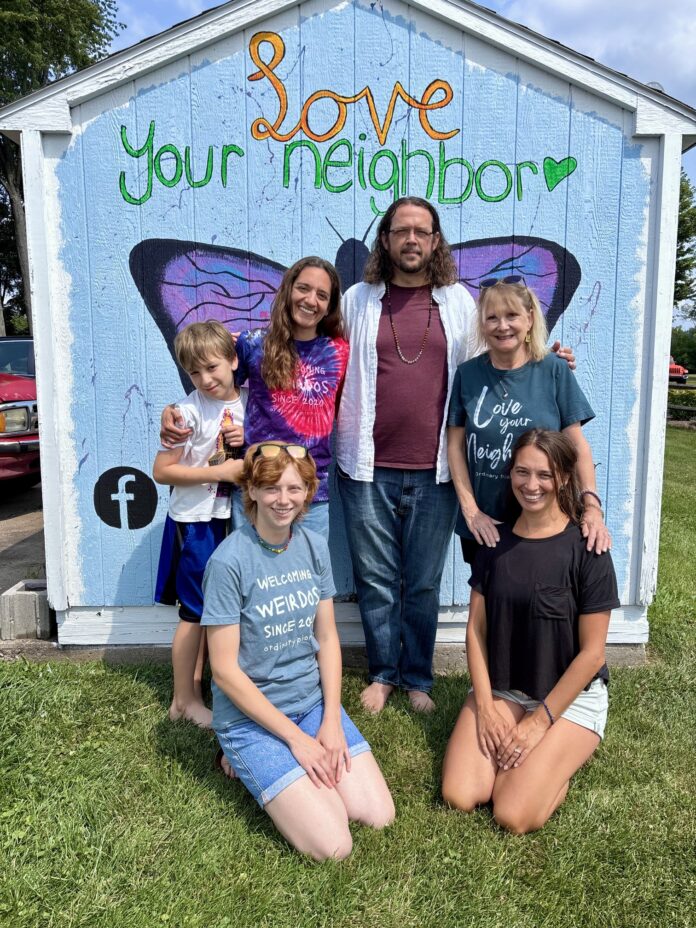
Among those hosting the event are back row (from left) Brody Schriefer, Halina Schriefer, Paul Narus and Carol Sarkan and, front row, Linzi Jenkins and Kelsey Burke. (AWFP photo by Karen Gerhardinger)
WHITEHOUSE – Every day since opening in 2020, Ordinary Pioneer Spiritual Healing Community has focused on its mission to create a harmonious world of love and unity, by providing a safe, welcoming environment where individuals can thrive physically, mentally and socially.
For some, that means taking a class on meditation, yoga, Reiki, qigong or tarot. For others, the Whitehouse-based community provides a comforting space to relax and connect with community members.
The name Ordinary Pioneer comes from the idea that it doesn’t take superhuman qualities to make an impact in a world that seems a little wild and scary at times.
“It’s ordinary acts of kindness that are creating a great impact in the world,” said Halina Schriefer, co-founder of the nonprofit.
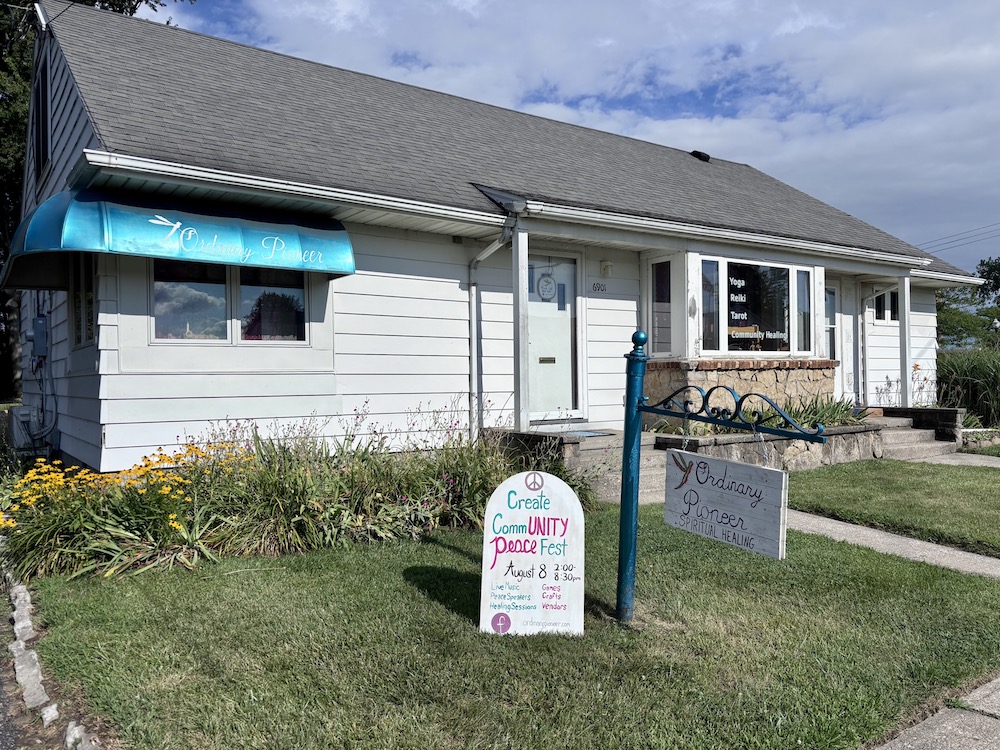
Ordinary Pioneer is hosting a Create Community Peace Festival on Saturday, August 8 from 2:00 to 8:30 p.m. at 6901 Providence St. in Whitehouse. (AWFP photo by Karen Gerhardinger)
In 2022, Schriefer hosted the first Create Community Festival – a one-day event that merges creativity, spirituality and community through art, music, food and family-friendly activities.
This year has an additional focus: peace.
“The world has changed a little since 2022. Peace seems to be what people are seeking – and hope. So we added the word ‘peace.’ Our mission at Ordinary Pioneer is to bring people together with one intention of creating peace through unity,” she said.
The Create Community Peace Fest will be held Saturday, Aug. 8 from 2 to 8:30 p.m. at 6901 Providence St. in Whitehouse. New this year is more live music, an ongoing meditation space with crystal sound bowls, and an outdoor cooling tent with misters and water play for all ages. From 1:30 to 5 p.m., massage, Reiki and tarot sessions will be offered by Ordinary Pioneer healing facilitators.
From 2 to 5 p.m., vendors will be set up and craft activities offered, along with peace demonstrations, including:
Joe Sparks, poetry at 2:15 p.m.
Dr. Guldal, “Walk Sacred” at 2:45 p.m.
Kerry Patrick Clark, musician, at 3:30 p.m.
Jon Schoonmaker, musician, at 4:15 p.m.
Halina Schriefer, “Breathe Love” at 5 p.m.
From 5:30 to 6:30 p.m., enjoy a community meal and live music from Humble Cannon.
At 6:30 p.m., Sound Voyage will lead a drum circle – inviting guests to use buckets and sticks or drums to join in.
A closing ceremony will be held at 8:15 p.m.
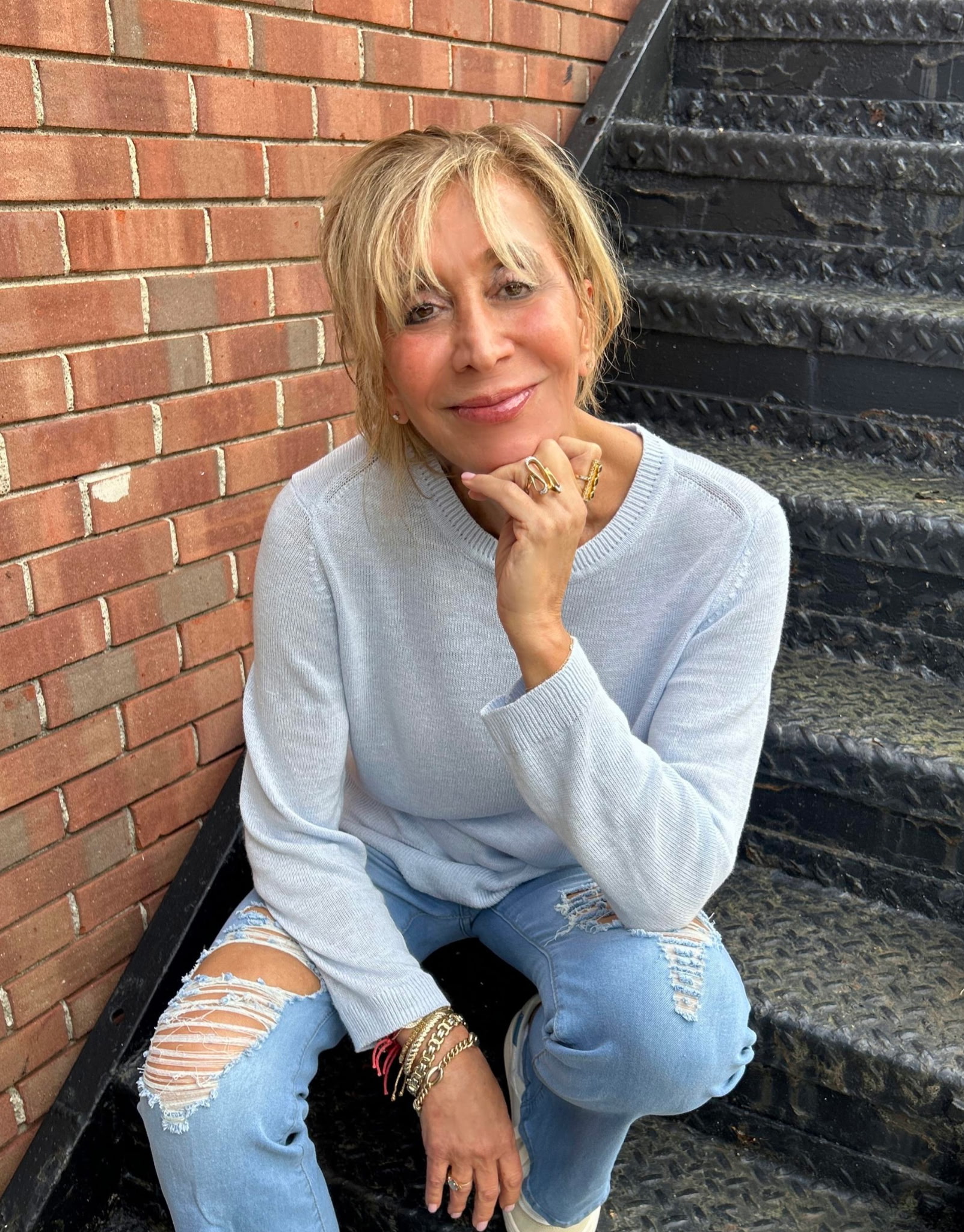
Musician Kerry Patrick Clark will perform at 3:30 p.m. during the August 8 festival. (Courtesy photo)Dr. Guldal, a spiritual leader and medicine woman, will present “Walk Sacred” at 2:45 p.m. during the Create Community Peace Festival on Saturday, Aug. 8 in Whitehouse. (Courtesy photo)
The festival is free and open to everyone. Since Ordinary Pioneer is involved with the Center for Conscious Living, the Multifaith Council of Northwest Ohio and Unity of Toledo, Schriefer anticipates many members of those communities will attend.
“It’s not just one group putting on this day, but multiple communities coming together. Which is kind of the whole point. I think we will see it taking on a tone of a music festival with spiritual and wellness communities,” Schriefer said. But, she added, it attracts many local people as well, including the group of teenagers that happened to be walking to the park last year when they saw the festival and decided to stay.
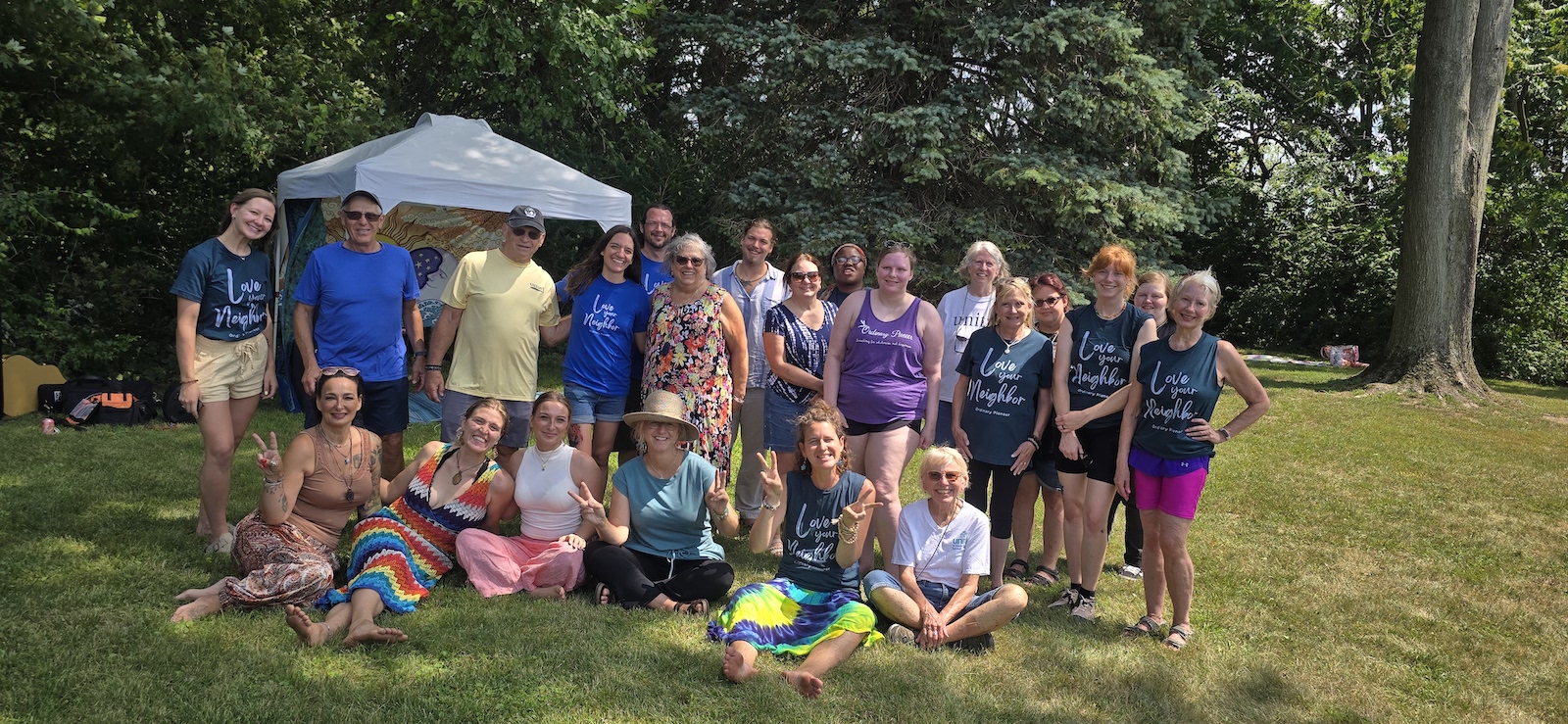
Volunteers and healing facilitators who collaborated on the 2025 festival gathered on the lawn. (Courtesy photo)
Over the years, Ordinary Pioneer Co-Founder Paul Narus has seen the gathering take on a more “festivaly” feel, with people just hanging out, listening to live music, talking to vendors and enjoying an atmosphere that is open and accepting of everyone.
Wearing a “Welcoming Weirdos” t-shirt, Schriefer smiles as she speaks about the people who have become part of the Ordinary Pioneer community.
“We had a man come in and tell us that he had a lot of social anxiety, and he was terrified to be around people. He said no one accepted him – that he was the black sheep in the family,” she recalled. “I said, ‘You’re in the right place; we welcome weirdos here.’ People are not always accepted in their families or communities. We welcome them all with open arms. People are here because they can relax here.”
Both have seen a transformation in many of the community members, who pop in for a class, a chat or just to be.
“People come in here with multiple intentions and problems. We provide space to solve them. We don’t really give them direction, just opportunity,” Narus said.
“We direct them back to their most authentic selves,” Schriefer added. “We have a lot of people that demonstrate individuality. For me, that’s inspiring. For individuals who are quirky and express themselves out of the norm, it takes the edge off and lets others know that it’s okay to be themselves.”
The Ordinary Pioneer space allows people to relax and share the burdens they’ve been holding onto, she said.
“Everybody is going through something. No one is more advanced or has it more figured out than another person. We come together and share,” she said.
The Ordinary Pioneer community members work together, sharing their gifts for the benefit of all. It could be tending the garden, cleaning, bringing food, mowing the lawn or donating monetarily, Narus said.
“We rely on each other for the health of the community,” he said.
Most of the classes and services operate on the gift economy, which means donating what feels right, rather than having a set price, Schriefer said.
“Where one person isn’t able to give or can just give a few dollars, someone else is able to give more,” she said.
A raffle during the Create Community Peace Fest will raise funds for a Gifts of Healing Program, which supports those with little or no income who are in need of healing services. Narus and Schriefer are also up to an ice bucket challenge: the jar with the most money in it by the end of the event will determine which one gets to endure having ice poured on their head.
For more information about the event or services, visit ordinarypioneer.com.
The northwest corner of the S.R. 64 and Finzel Road roundabout is being considered for sale by the village of Whitehouse to the Toledo Lucas County Public Library for a Whitehouse Branch. (AWFP photo by Karen Gerhardinger)
WHITEHOUSE – The Village of Whitehouse’s plans to sell the six-acre property on the northwest corner of the Finzel Road roundabout to the Toledo Lucas County Public Library for a new Whitehouse Branch took many residents by surprise, including Rebecca Rude.
“It was like a punch in the gut,” Rude told village council during its Aug. 5 meeting.
Rude, like many residents, thought the new Whitehouse Branch would be located in Blue Creek Metropark. But changes in funding at the state level impacted that decision, explained Library Public Information Officer Stephanie Elton, who also attended the meeting. So the Library and village began looking for a new location, with at least five acres, on which to build.
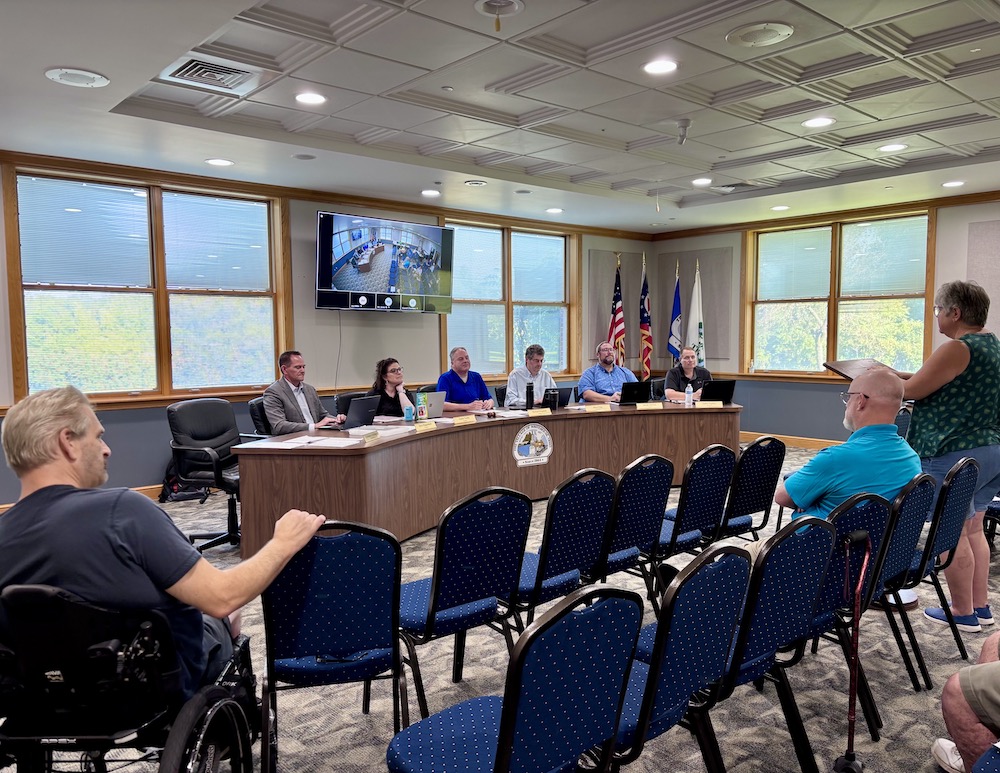
Rebecca Rude, at the podium, addresses Whitehouse Village Council members during the August 4 meeting. Also in attendance was Charlie Grass, left, from Artisan CraftBuilt Homes. Council members include Dave Riggenbach, Carrie Tuohy, Mayor Rich Bingham, Steve Fine, Joe Bublick and Larry Yunker. (AWFP photo by Karen Gerhardinger)
As council held a first reading on an ordinance that would allow administration to sell the property to the Library for $620,000, Mayor Rich Bingham asked for citizen comments. Both Rude and Jeff Heaney shared concerns about the location.
Rude, who moved to the area in 1978, complimented the village on the improvements she’s seen over the years: the revitalized downtown, beautiful flowers, limestone planters and the well-landscaped roundabout.
“Every time I drive through, I’m so proud of what Whitehouse has become,” she said.
But with the village being a gateway to the Oak Openings Region, she believes the pollinator area at the roundabout should remain in place, to reflect the natural areas in the Metropark.
Pointing out the window to Blue Creek Metropark behind village hall, Rude said it’s the perfect spot for a library, with the trails and proximity to the quarry.
She recalled being in council chambers in March 2025 for a listening session with the Metroparks and Library representatives, sharing ideas for what was to become a combination library and conservation center.
“We voted for that library to go there. It’s like a bait-and-switch. All these people voted for it,” she said.
Heaney echoed her sentiment, and asked what changed.
In 2024, voters approved a 1-mill bond to fund capital projects throughout the library system, including a new Whitehouse Branch. But in 2025, the Ohio state legislature cut the Public Library Fund, resulting in a $2 million cut in funds used for operational expenses. So TLCPL made several decisions, including closing a branch and reducing hours at several locations, including Waterville, Elton explained.
“These operational challenges have also affected the timing and direction of the Library’s capital plans. Originally slated to be built within Blue Creek Metropark, the Library made the difficult decision to pursue a different location for the Whitehouse Branch due to budget and timeline constraints. While the location has changed, the Library’s commitment to bringing a new branch to Whitehouse has not,” she said. “Our goal is to create a branch that reflects the community it serves and provides greater access to services for residents of Whitehouse and the surrounding areas.”
Listening sessions will be scheduled again to give the community an opportunity to provide input on the design and services for the branch, which will alleviate pressure on the Waterville Branch – which served 88,000 customers and circulated 287,000 items in 2025. The area has grown tremendously since the TLCPL first considered a branch in the village. In the time since, the independent Whitehouse Library was installed at Blue Creek Metropark and run by volunteers for over 20 years, demonstrating a need. Once the new branch is open, the Whitehouse Library will close.
“A new Whitehouse branch will help address that demand while expanding access to library services for a growing community,” Elton said. “Locating the branch within the village also means residents will have the opportunity to access their library by walking, biking and other forms of transportation, not just by car.”
The village has owned the 6-acre, commercially zoned property since purchasing the land for the roundabout, built in 2015, and has been actively looking for the right fit. Bingham noted that other possible users have approached the village about purchasing the property, including a hotel and gas station. While the Library plans to hold community listening sessions to inform the design and offerings at the branch, developers of a gas station or hotel would not do that, Bingham told Rude after the meeting.
Rude also wondered what would happen with the Whitehouse Library, which sits on land owned by the Metroparks, once the new branch opens. The Metroparks is open to working on improvements to Blue Creek, including more pollinator areas, Bingham said.
Daugherty said he spoke with Library Executive Director Jason Kucsma earlier in the day about the opportunity to incorporate botanical features into the landscape of the new branch. And the Metroparks are advising the village as it works on its S.R. 64 corridor plans, which include bringing more botanical life and pollinator areas.
Council held a first reading on the ordinance authorizing Daugherty to sell the the property to the library. A second reading will be held on Sept. 1, and a third and final reading on Sept. 15.
Council member Joe Bublick expressed gratitude for the citizens who came to the meeting to share their concerns in person. After reading dozens of comments on the article posted on the Anthony Wayne Free Press Facebook page on Aug. 3, Bublick said he understands the frustration.
“Everyone on village council hears you and are committed to maintaining a balance between community growth without sacrificing what makes us special. Have faith,” he said. “I believe that economic development is something that can happen hand-in-hand with retaining the things that make Whitehouse unique, like our beautiful botanical areas.”
During the meeting, council also:
–Held a first reading on an ordinance to purchase 10125 Waterville St. for $200,000.
-Held a first reading on two ordinances relating to Country Meadows South, a housing development that had a site plan approved by the Planning Commission. One ordinance would void the site plan, while another would substitute it with another plan. Developer Charlie Grass of Artisan CraftBuilt Homes was in the audience but did not comment.
-Held first readings on ordinances related to pay classifications and benefit steps, vacation accruals and comp time.
-Heard that Ice Cream with Mayor and Council will be held at Whitehouse Park on Saturday, Aug. 15 from 1 to 2:30 p.m., with ice cream and an opportunity for conversation with village leaders.
-Learned that Village Council will not have a meeting on Tuesday, Aug. 18. A Committee of the Whole meeting is scheduled for Tuesday, Aug. 11.
-Heard Bingham say that a resident contacted him about possibly putting a fence up in front of the recycling center to prevent trash from blowing in neighbors’ yards.
-Approved the purchase of a 2026 Ford F550 4×4 Braun Select ambulance.
-Heard that new police officer Jon LeGrand took the oath of office.
With construction of the roundabout delayed due to utility line delays in the roundabout just to the west at Albon and Monclova roads, work on the roundabout in front of Monclova Primary School is estimated to last until September 17. (AWFP photo by Karen Gerhardinger)
Construction of a mini roundabout at Monclova and Waterville Monclova roads began on Monday, Aug. 3. And so did the illegal use of a gravel path designed for use by emergency vehicles only, Monclova Township Administrator Mike Hampton told trustees during their Aug. 3 meeting.
“I did make a call to the Lucas County Sheriff today, our good friend Lt. [Jon] Leach, and told him there is quite a bit of non-emergency traffic going through there, and to ticket them appropriately,” Hampton said. “They’re putting people’s lives at risk. They shouldn’t be going through there.”
With construction of the roundabout delayed due to utility line delays in the roundabout just to the west at Albon and Monclova roads, work on the roundabout in front of Monclova Primary School is estimated to last until Sept. 17. The school opens on Aug. 17.
Anthony Wayne Local Schools, the Lucas County Engineer and Monclova Township coordinated plans for emergency vehicle access through the intersection during construction. The north parking lot is closed to staff and parents, but a gravel drive was installed so that emergency vehicles – including police, fire and EMS, as well as a few buses – can get through. No other traffic is permitted through that drive or into the north lot.
Parents should utilize the south parking lot and entrance for drop-off and pickup of students. Additional law enforcement support will be on site to help maintain the safe and efficient passage of vehicles. A link to the detour was shared by the schools as well.
Resident Ryan Bauman said some parents and staff may still believe they can use the gravel driveway as well, so Hampton said he would work with the district to reinforce that it is only for emergency vehicles.
Construction of the roundabout at Albon and Monclova was wrapped up and opened on July 31. Plans for a roundabout at Albon and U.S. 20A are now delayed until April 2027, because utilities will not be ready for nine weeks, which is too late in the season for paving. This is actually a relief, Hampton said, as the Ohio Department of Transportation will begin construction of a roundabout at U.S. 20A and Strayer beginning Aug. 17. Having two intersections on the same road closed concurrently would cause issues, he noted.
Roundabouts are shown to save lives and move traffic, Hampton said, adding that many of these intersections get clogged at peak times. Roundabouts will alleviate that congestion.
During the meeting, the board also:
-Listened to Lucas County Commissioner Lisa Sobecki detail the strategic plan that will guide decisions over the next five years. This is the first time for the county to implement a strategic plan, which included input from a consulting firm, residents, elected officials, employees, businesses, unions and community partners. The plan includes operational goals, advocacy areas, and mission, vision and values statements. The plan is posted at co.lucas.oh.us.
-Approved $71,750 for a new monument sign with an LED display area to replace one that was removed for the Albon and Monclova road roundabout. The county paid the township $60,000 for that sign, leaving the balance to be paid by the township.
-Heard that a Notre Dame Academy student is interested in shadowing members of the Public Works Department, and that Hampton is working through steps to get parental permission. Trustee Chuck Hoecherl suggested adding shadowing opportunities as a policy, as students may be interested in learning more from the fire department personnel as well.
-Heard that the fire department received the SCBA equipment and accessories that were purchased through the FEMA Assistance to Firefighter’s Grant (AFG). The 27 SCBA packs come with two breathing air cylinders and a facepiece. The grant covered additional facepieces so that everyone on the department gets issued their own facepiece, rechargeable battery packs for the SCBA units, and three battery chargers, Homik said. The award also included updates to our two Rapid Intervention Team Packs that are compatible with the new SCBA packs. The department conducted mask fit testing and in-service on each shift last week. The AFG award covered 95 percent, or $266,852.38 while the township covers 5 percent, or $13,342.62.
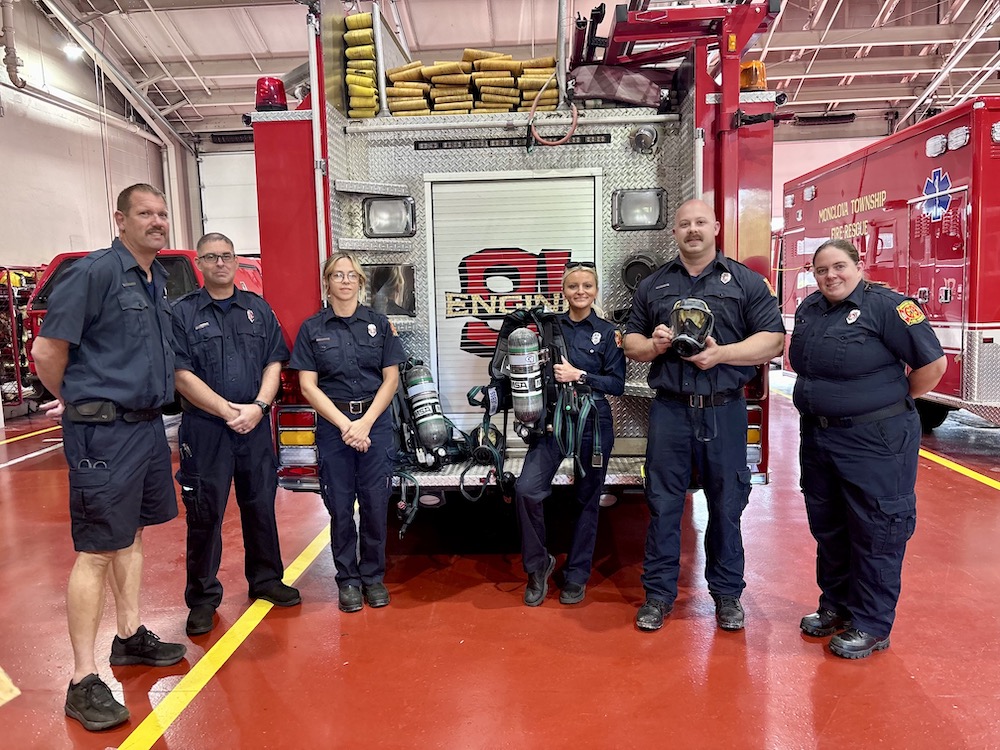
Monclova Township Fire and Rescue team members show the new SCBA equipment and accessories paid for with a FEMA Assistance to Firefighter’s Grant covering 95 percent of the cost. Pictured are (from left) Bill Schultz, Josh Stagner, Tracy Robertson, Carolyn Hinde-Grzechowiak, Mike Harris and Meagan Beaudry. (AWFP photo by Karen Gerhardinger)
-Discussed a request by Sylvania City Schools for the township’s old SCBA equipment, which would be used for training in a new career tech program in the district. Trustees agreed that supporting the program would be beneficial for the township as well, with opportunities to recruit graduates of the program. MTFD may also assist with instruction and offering a clinical site or field work, Homik said.
-Approved the purchase of a Stryker Power Pro 2 cot, batteries and charger for $39,811.98. In May, the board approved the purchase of a power load system to replace 14-year-old units, as well as the replacement of the 2012 medic unit.
-Heard Hampton say that he is working with a consultant to create informational pieces about the pros and cons about limited home rule, which is on the November ballot. “We’re trying to be transparent about what limited home rule means,” he said.
-Listened to resident Risa Sindel ask what the township is doing to protect the township from bit coin operations, which can operate on as little as five acres but create havoc to those who live in the area because of noise and vibrations.
-Learned that the staff is working with Design Entertainment to post audio from the meetings, for which minutes are generated by an AI program.
-Heard that the zoning administrator, Eric Wagner, will share more about plans for improving its zoning resolution around data centers, as well as a text amendment about generators, during the Aug. 17 meeting. The township is working continuously to put new guidelines in place before the one-year moratorium on data centers expires at the end of the year, said Trustee Barbara Lang.
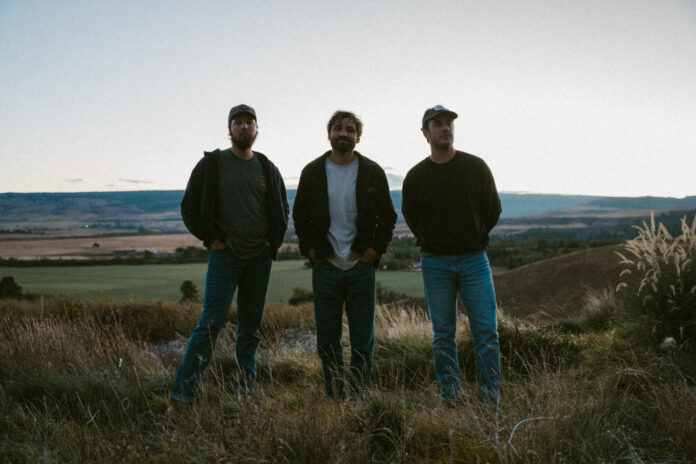
Oliver Hazard will return to Waterville on Saturday, Aug. 15 to perform a 75-minute set, beginning at 9:15 p.m. (Courtesy photo)
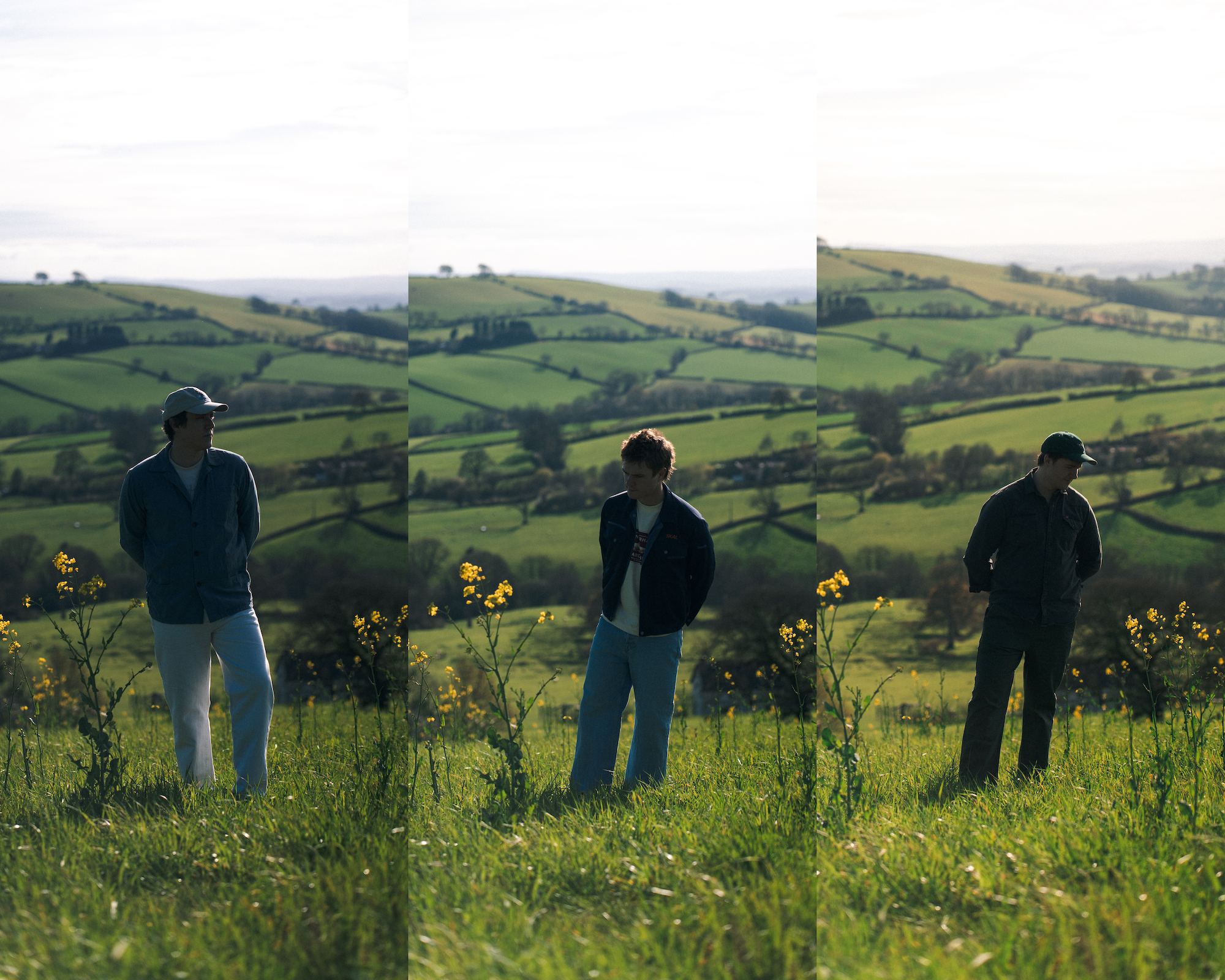
WATERVILLE – Oliver Hazard is coming home, and the indie-folk band is bringing some friends.
On Saturday, Aug. 15, Michael Belazis, Devin East and Nate Miner will wrap up The Waterville Tour – named for the five-track EP released in April – with a performance in the 8th Annual Oliver Hazard Day, held in downtown Waterville from 4:30 to 11 p.m. The band will be joined by a lineup of artists they’ve met over years of touring in the U.S., Canada and Europe.
“We started Oliver Hazard Day as a way to bring the artists we’ve met on the road back to the town that raised us,” said Belazis. “Watching people travel from all over the world – and now from overseas – to experience Waterville together has been incredibly meaningful. We can’t wait to welcome everyone back.”
The longevity of the festival has helped, as artists want to play festivals that have a great reputation, where they know fans will show up and the experience will be meaningful, Belazis said.
“Every year we’ve been able to build a little more trust, and now we’re fortunate that artists often already know about Oliver Hazard Day before we even reach out,” he said. “We love putting together a lineup that’s built around artists we’d genuinely listen to ourselves.”
Olive Klug is to to perform at 6 p.m. (Courtesy photo)
This year’s lineup includes Olive Klug, who toured with Oliver Hazard earlier this year and will take the stage at 6 p.m.
“They’re an incredible songwriter, and we’re excited to have them in Waterville,” Belazis said, noting that Olive has become a good friend. “We love watching audiences discover their songs.”
Briscoe, seen here performing at the Sagebrush in Austin, Texas, will take the stage at 7 p.m. on Saturday, Aug. 15 for Oliver Hazard Day in downtown Waterville. (Courtesy photo)
The Austin-based band Briscoe, consisting of Truett Heintzelman and Philip Lupton, was named “one of country music’s best kept secrets” by Rolling Stone. Briscoe will perform at 7 p.m.. The duo has performed for Lollapalooza, Newport Folk Festival, Bonaroo, SXSW, Austin City Limits, and more. Their songs “Sparrows” and “When the Desert” were featured on the ESPN series TrueSouth.
“Briscoe has been one of our favorite live bands over the past few years. Their harmonies and songwriting fit the spirit of the festival perfectly, and we think people who love Oliver Hazard are going to fall in love with their music too,” Belazis said.
TORS, from the United Kingdom, is Oliver Hazard Day’s first international act. The band takes the state at 8:00 p.m. (Courtesy photo)
At 8 p.m., the OHD fans will welcome TORS. Hailing from Devon, a southwest coastal county in England, TORS includes brothers Matt and Theo Weedon and friend Jack Bowden. An interesting aside: Matt and Theo’s grandfather, Bert Weedon, was a guitarist whose style of playing was influential in the 1950s and 1960s. Bert’s 1959 guitar tutorial, “Play In A Day,” influenced musicians including Eric Clapton, Brian May and Paul McCartney.
Having TORS joining the OHD lineup all the way from the UK feels really special, Belazis said.
“We’ve admired what they’re doing for a while, and it’s exciting to have an international on the lineup for the first time,” he said.
Kicking off the event at 4:30 p.m. is hometown DJ Jon Zenz, who will spin an all-vinyl soundtrack of soul, funk, roots, and classic grooves.
The OHD website, oliverhazardday.com includes a playlist featuring all four artists’ work.
“It’s an easy way for people to discover the lineup before they arrive,” Belazis said. “One of our favorite parts of Oliver Hazard Day is introducing people to artists they may not have heard before. Hopefully people come for one band they already love and leave with three or four new favorites.”
Oliver Hazard Day is returning to downtown Waterville on Saturday, August 15 from 4:30 to 11:00 p.m. Last year’s OHD filled the streets with all ages. (Courtesy photo)
Oliver Hazard has been on the road this summer and will continue performing through the end of the year, including stops on the East Coast, Canada, Denmark and the U.K. Often the bandmates stop at local diners for a meal and strike up conversations with strangers.
“Most people have no idea we’re in a band, which is kind of the fun of it. We’ll end up talking to someone over breakfast or while waiting in line for coffee, and eventually they’ll ask what brought us to down,” Belazis said. “One of the best parts of touring is getting little glimpses into places through the people who actually live there. You end up with restaurant recommendations, local history and stories you’d never find online.”
Touring can be exhausting, he admits, but stepping onto a stage and spending an evening with a room full of people singing Oliver Hazard songs back at them makes it all worthwhile.
“Touring also gives us a lot to write about. You’re constantly seeing new places, meeting new people, and collecting little moments that eventually find their way into songs,” he said.
Through Spotify for Artists, Oliver Hazard can see city-by-city listening data, and sometimes they’ll notice, for example, that someone from Boise listened to the same song 35 times in one month.
“We don’t know who it is, but it’s fun to imagine that one person carrying the flag for us in a city we’ve never been to,” Belazis said.
These artist insights are part of a promotional campaign the band shares online, and a way to remind people that independent music grows one listener at a time, he added.
While many Oliver Hazard fans may never have been to Waterville, the band’s hometown has featured prominently, not only in The Waterville Tour but in several songs., beginning with the 2018 release of their first album,34 N. Third – named for the home where it was recorded. Coming back to Waterville is a little surreal, but never stops feeling special, Belazis said.
“It’s grown into something that’s bigger than our audience. It really feels like a community event now, and we think that’s what makes the atmosphere so unique,” he said. “This festival only exists because our hometown has embraced it. This whole day belongs to the community. Whether you’ve followed the band for years or you’re just coming out for good music, local food and to see your neighbors, that’s exactly what Oliver Hazard Day is meant to be.”
This year’s food truck lineup includes Naan Stop Kebab, Los Pollo Loco, Guac Shop, Pepperoni Tony’s, Deet’s BBQ and Wandering Bean Coffee Co. Buffalo Rock Brewing Company will bring its annual OLI Session IPA, brewed especially for OHD.
Toledo mural artist Tayler Meinen will create a live mural installation, while other local artists will be on hand. Oliver Hazard Day continues its mission of giving back to the creative community by donating a portion of the proceeds to the Toledo Arts Commission to support arts programming and creative opportunities throughout northwest Ohio.
If you go, bring a lawn chair or blanket, as OHD is held on a street and seating is not provided. Tickets are available at the gate for $40 if they are not sold out. Advance tickets are available through DICE for the same price. Visit oliverhazardday.com for ticket information. Children 10 and under are admitted free with an adult.
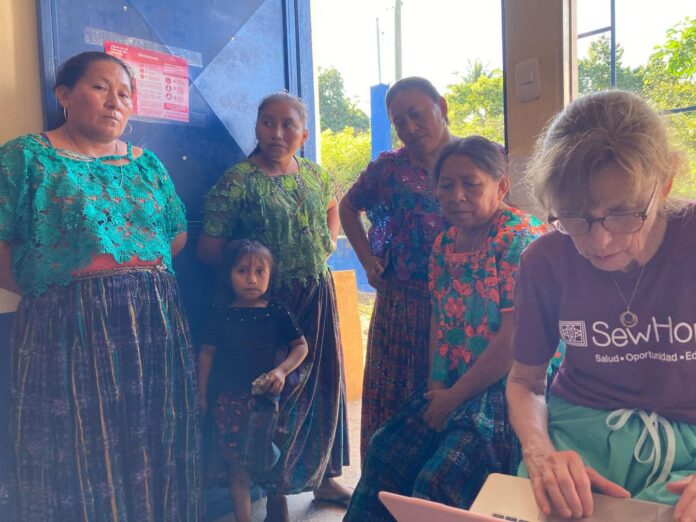
Anne Ruch (far right), an obstetrician and gynecologist (OB/GYN) from the Toledo area, seeks to meet the needs of a rural population in northern Guatemala with the nonprofit SewHope. (Courtesy photo)
TOLEDO – One Toledo doctor had a vision back in 1998, and since then, has worked towards developing it into a reality.
“So we rented a house and just started a little clinic, and then as it turned out, one of the medical students who came with us had been down there twice,” said Anne Ruch, an obstetrician and gynecologist (OB/GYN) from the Toledo area, who was trying to meet the needs of a rural population in northern Guatemala.
Dr. Ruch fondly remembers one of the trips she took to Guatemala with Shannon E. Wilson, who was a medical student at the time. “That’s where the SEW came from,” Ruch said, explaining that Wilson’s initials were where the name for the organization she helped start – “SewHope” – came from.
Initially, Dr. Ruch went to Guatemala without a context, and wasn’t sure how to help the people of the Central American country. Upon returning to the U.S. she said, “I left just thinking, oh my gosh, I’m a doctor; I need to do something.”
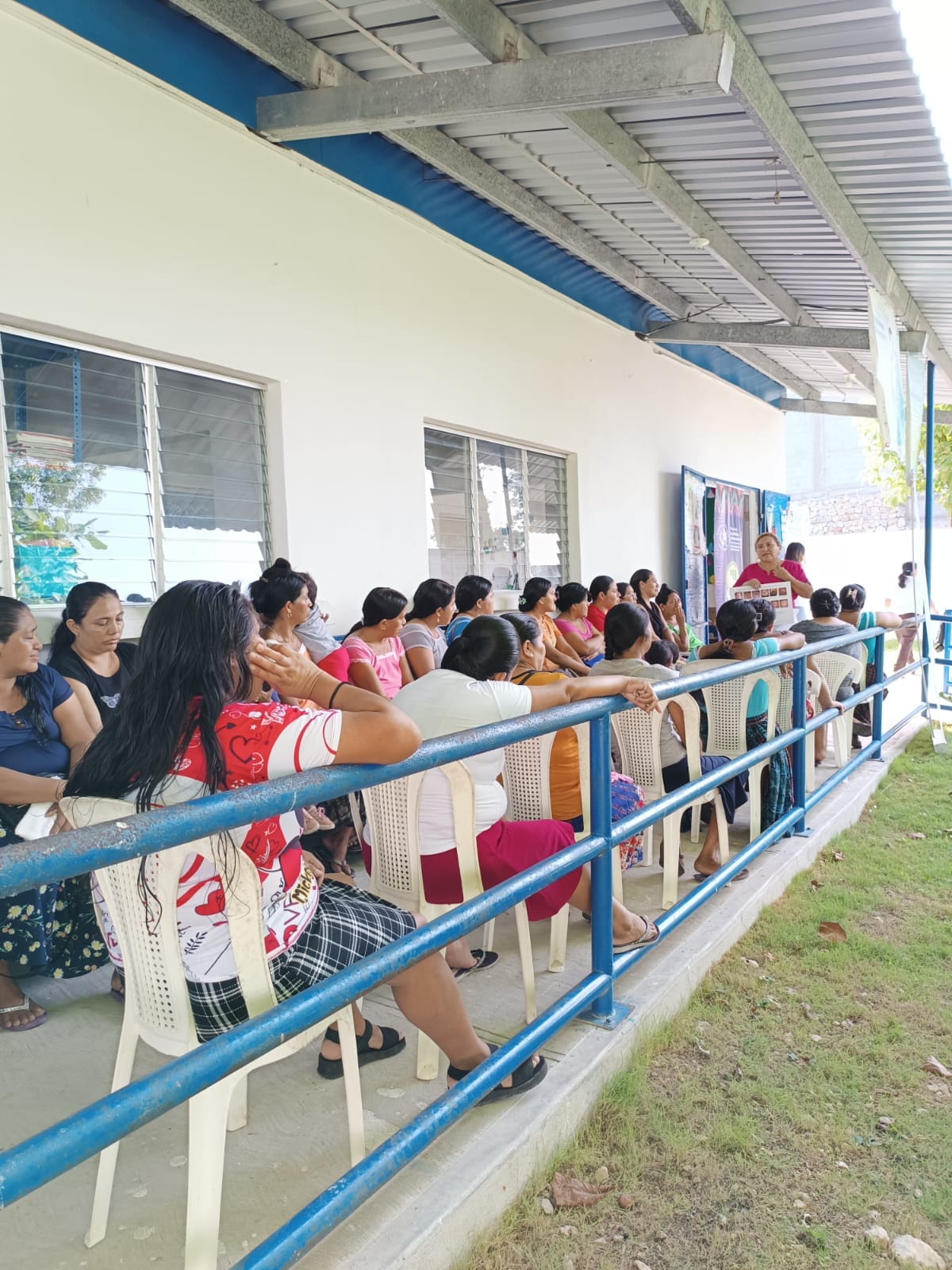
Women attending a jornada, mobile health and wellness events that travel to more remote areas of Guatemala. (Courtesy photo)
Years of mission trips to Guatemala saw Dr. Ruch treating thousands of patients, and gradually getting closer to a full vision of care for rural Guatemalans. What she began to realize was that the short term help was not enough for people with chronic conditions.
“There’s so much cervical cancer in that country. It’s rampant among young people and it’s 100 percent preventable,” she said. Eventually, the busy doctor started flying quarterly down to Guatemala and training locals there.
“We train people down there to do the pap smears and to get everything set up. So when I would go, I’d be able to do the treatments.”
Off-handedly, Randy Ruch, Dr. Ruch’s husband, asked if there was anything he could do to help the doctor’s mission.
“And I’m like, ‘Yeah, find us some land.’ And I came back at the end of the day, and he goes, ‘I found it. I bought four acres,’” she recalled of the interaction.
From there, Dr. Ruch raised money to build a permanent clinic, and would go on to build more needed infrastructure for the area.
Unfortunately, Wilson died suddenly of a pulmonary embolism, and Dr. Ruch honored her by naming the nonprofit after Wilson.
SewHope officially was founded in 2007 and has been a growing international partnership.
“Our board of trustees is made up of leaders from northwest Ohio and southeast Michigan, and we also have a board based in Guatemala,” said Cecilia Chaudhary, the development director for SewHope.
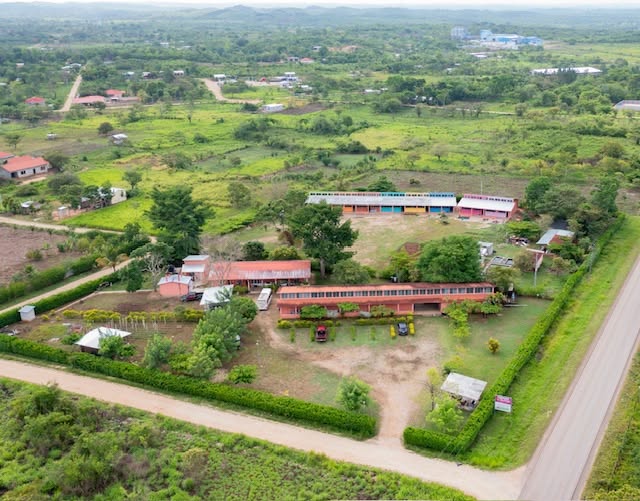
SewHope operates an accredited elementary school serving 160 students. (Courtesy photo)
“We have a strong working relationship with the Guatemalan Ministries of Health and Education,” she said, because the clinic developed a school on its campus.
The school came to fruition when Dr. Ruch realized mothers were often bringing children with them to the clinic, and then began fostering a tutoring program, eventually growing into a full school.
Students studying inside a classroom of an elementary started by SewHope in Guatemala (Courtesy Photo).
“Today, SewHope operates an accredited elementary school serving 160 students, a licensed medical clinic (and laboratory) that will provide cervical cancer screenings and care to more than 8,000 women this year, and community development programs that improve[d] health and economic stability through clean-burning Chispa stoves, water filters, poultry projects, home gardens, and women’s savings groups,” Chaudhary said. “All programs are implemented by our SewHope Guatemala staff of 18.”
A retired elementary school teacher for Washington Local Schools, Roxanne Ward, works as the director of education for SewHope. “The first time that I went there [in 2022], we stood there in front of the property, and I started crying,” Ward said, as she was overwhelmed by the impact SewHope had in Guatemala.
“This October marks one of the most meaningful milestones in SewHope’s history as our school celebrates the graduation of our very first sixth-grade class!” Chaudhary said. “These students have been with SewHope since kindergarten, making them the first group to complete their entire elementary education with us.”
The elementary school just completed their sixth grade classroom last year, according to Ward, who monitors the progress of the students through their online sources.
Each class has a teacher, but Ward raises funds for each of the 160 students.
“One of the ways our local community supports this work is through our annual summer social, which this year is Boogie for Good!” Chaudhary said.
“The disco-themed evening features music, food, auctions, and dancing, with every dollar raised helping sustain SewHope’s education, healthcare, and community development programs!”
“It’s a fun night that is made possible through the support of Taylor Automotive Family and our generous community!” she said in an email.
The event takes place from 6-9 p.m. on Friday, Aug. 14 at the Taylor Hyundai Showroom in Perrysburg. Tickets are $25, and can be purchased here.
A drone captures the elementary school run by SewHope. (Courtesy image)
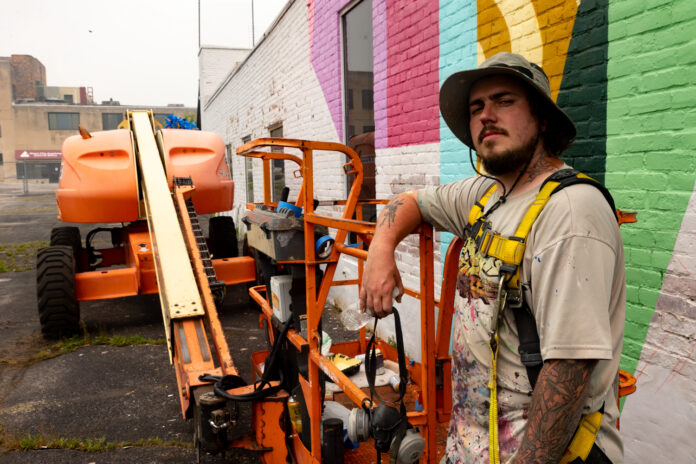
Connor Degnan, artist and muralist known as ConTron, leans against his lift next to his in progress mural at the Davis Building in downtown Toledo on Thursday, July 16, 2026. (TFP photo by Stephen Zenner)
TOLEDO – Deteriorating brick walls are getting some color, as muralists Connor Degnan and Chilly Rodriguez leave their mark on the downtown Toledo Davis Building at 151 N Michigan St.
But the murals are serving a practical reason, “water was soaking through the brick, and it was causing issues on the inside,” said Chris Eischen, a local entrepreneur hoping to percolate some interest in the Davis Building.
“We needed to seal the brick to eliminate that problem,” he said. After a quote, Eischen realized that repainting and sealing the walls would be the same price as painting a mural, so they opted for the mural.
Chris Eischen points at the lift holding artist Chilly Rodriguez, while Rodriguez primes a wall for a mural at the Davis Building. Eischen is working with the owner of the Davis Building, Elliot Katz, to create stronger community between the businesses and attract more retail foot traffic. (TFP photo by Stephen Zenner)
“I’ve been over here the past, I think three days now, scraping and just getting the wall ready,” Rodriguez said of his mural on the northwest side of the building.
“It’s going to be really bright, vibrant, and colorful,” he said, mentioning that this was going to be his biggest solo mural to date.
Connor Degnan, AKA ConTron, works on a mural on the Davis Building while Canadian wildfires pollute the air in downtown Toledo on July 16. The murals are part of an effort to seal the building’s brick exterior and to revitalize the area. (TFP photo by Stephen Zenner)
On the southwest side of the building, facing The Switchboard and Culture Clash, Degnan was doing some of the same prep work on his wall.
“Whatever paint we would use would be good enough to seal it,” Degnan said. “But for this, I am using an extra high quality exterior paint-primer combination.”
Already, Degnan completed a part of his wall, and moved on to prepping more of the southwest side.
Chilly Rodriguez, an artist and muralist, sprays primer on the Davis Building in downtown Toledo. Two murals are being painted simultaneously to reinforce the seal on the bricks and to attract more people to the Davis Building. (TFP photo by Stephen Zenner)
Both muralists are happy to be able to help refurbish the building, which they have some history with.
“Chris Rodriguez and I had studios here for about three years in, around 2018,” he said.
Now the two have invested themselves in a different studio space on the first floor of the Gardner Building, 500 Madison Avenue,Mind And Soul Gallery & Studios.
Connor Degnan, an artist and muralist, takes a break from painting. Degnan and Chilly Rodriguez are both working on painting the exterior of the Davis Building to seal the bricks and to bring more people to downtown. (TFP photo by Stephen Zenner)
Beyond the artistry, Eischen hopes to create a community hub out of the Davis Building, and channel some of the goals of previous projects into the current one.
“This provides more opportunity for expansion and growth for a lot of the ideas that I had started over at the Tech Loft, and so this is kind of an expansion of that on a larger scale,” he said.
Previously, Eischen was attempting to create a technology-centered community with the Toledo Tech Loft (334 N. Superior Street), one of David Ball’s properties. Even before that iteration, Eischen passionately worked at creating Code City, above Rustbelt Coffee at 119 N. Ontario Street, in late 2016.
Chilly Rodriguez, an artist and muralist, stands in front of a wall he has prepped for a new mural at the Davis Building. (TFP photo by Stephen Zenner)
In this latest incubator attempt, Eischen is working with Davis Building Owner Elliot Katz, the man behind Clock Tower Properties LLC.
When asked about Eischen’s previous partnerships that didn’t quite pan out, Katz said, “That’s my opportunity!”
“Sometimes people don’t realize when they have a gem looking right at them, and they could do something amazing,” he said. “Literally, I couldn’t imagine anyone better than him.”
Eischen said the focus on the word “tech” during the Superior St. project became more of stumbling block for his vision than a help. Instead, he said the focus was really on “up-skilling our community,” and doing so with the latest technologies. But for now, Eischen said he’s focused on revitalizing the Davis Building as a retail and community space people would want to spend time in, and then start cross pollinating ideas with multiple people and businesses in one space.
“I’m looking for an overall building rebrand,” he said, and threw out the name Flux Community Building.
“If you’re a startup, we can provide co-working space. If you’re established and you need a private office, we can provide that, or if you’re a larger company that needs several offices, we have some spaces that have multiple offices.”
Already, Eischen said Flatrock Distillery Bourbon Street Bistro in Fallen Timbers Shopping Center would be moving into the Davis Building to take over the vacancy left by Leaf and Seed. A health company was hinted at as another potential tenant in the building, but regardless, there are already businesses and private working folks invested in the Davis Building.
Connor Degnan, artist and muralist also known as ConTron, leans against his in progress mural. (TFP photo by Stephen Zenner)
Just like Degnan and Rodriguez before, there are people already committed to the space, and that gives Eischen more to work with as he tries to build community in downtown.
Located next to more open parking spaces, and across from The Switchboard and Culture Clash, already active community spaces, Eischen hopes the Davis Building will combine and amplify community and co-working.
As for the collaborations already happening, Rodriguez said, “I just want to give a shout out to Dean Davis for kind of making this this whole thing possible and giving other artists sharing the spaces with us…coming together for the common goal of making Toledo a better and more beautiful place.”
Progress made by Chilly Rodriguez, an artist and muralist, as he paints a mural on the Davis Building. (TFP photo by Stephen Zenner)
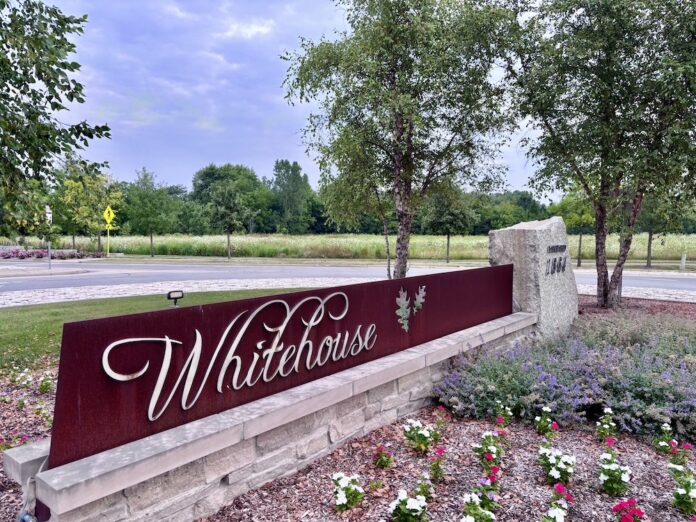
The corner of S.R. 64 and Finzel will have a new occupant in the coming years, as the Toledo Lucas County Public Library is planning to build a new Whitehouse Branch on 6 acres of land on the northwest corner. (AWFP photo by Karen Gerhardinger)
WHITEHOUSE – The Finzel and S.R. 64 roundabout is Whitehouse’s southern gateway, with more than 8,000 vehicles a day traversing the stretch between Finzel and the downtown area each day.
On Tuesday, Aug. 4, Whitehouse Village Council will vote on legislation that will allow administration to move forward on the sale of village-owned property at the roundabout, and the purchase of another property just to the west of the intersection.
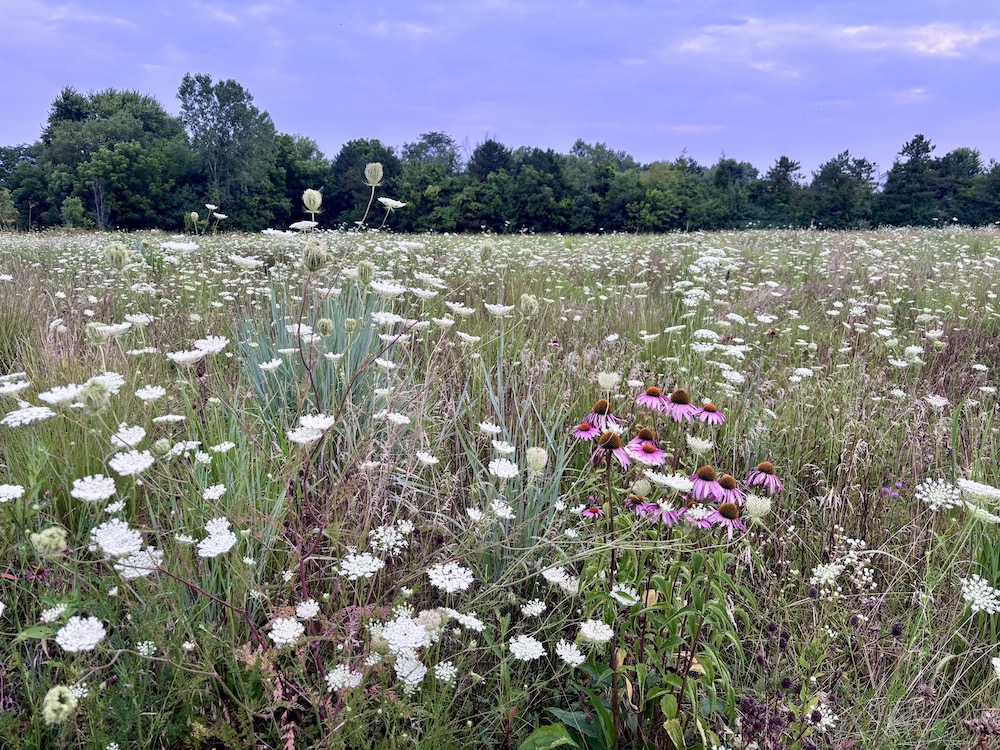
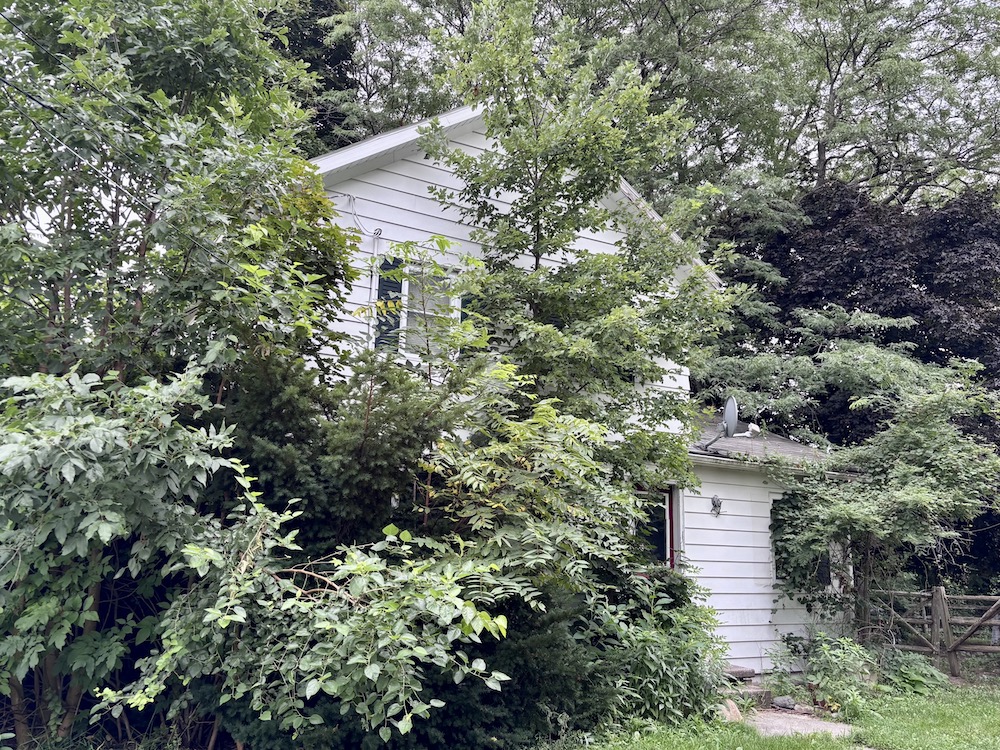
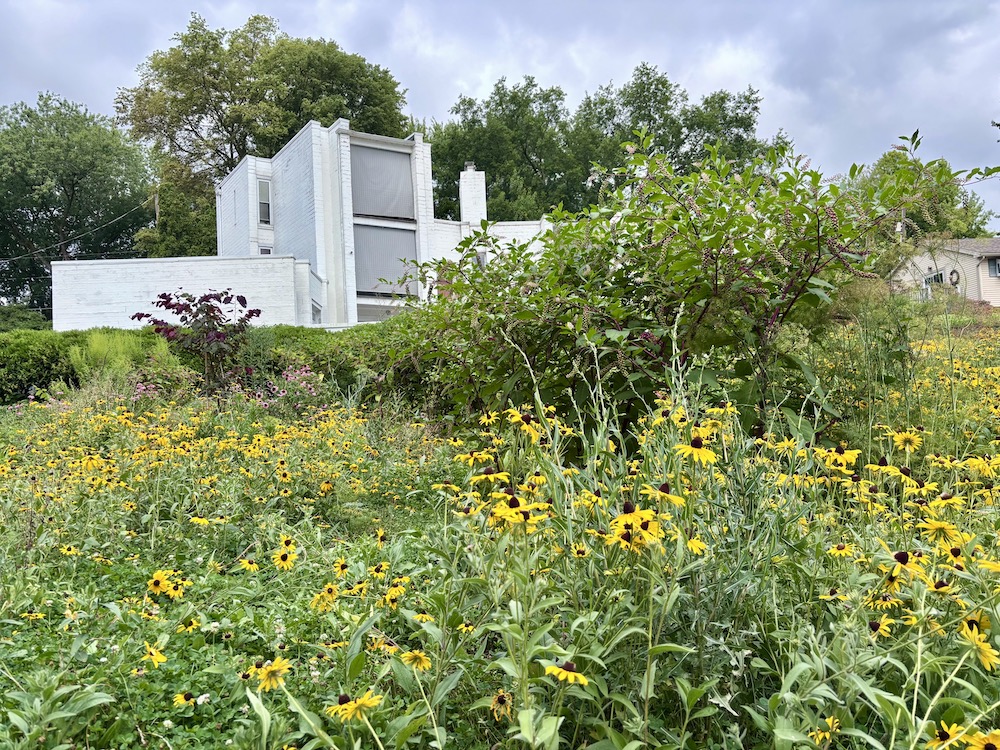
The 6-acre, village-owned land on the northwest corner of S.R. 64 and Finzel Road is currently a pollinator garden – popular with bees, butterflies and photographers. The Toledo Lucas County Public Library plans to purchase the property for $620,000 from the village to build a new Whitehouse Branch. (AWFP photo by Karen Gerhardinger)The family of the late Gary Pennell has offered to sell 10125 Waterville St. to the village of Whitehouse for $200,000. Bordering Blue Creek, the property has mature trees, a 1901 home that is hidden by greenery, and three outbuildings. (AWFP photo by Karen Gerhardinger)
The 6.5 acre parcel at the northwest corner is currently a pollinator garden, with wildflowers attracting photographers, bees and butterflies. If approved, the village will sell their land to the Toledo Lucas County Public Library (TLCPL) for $620,000. The plan is to use the property for a new Whitehouse Branch, confirmed Public Information Officer Stephanie Elton.
“The reading planned for the August 4 village council meeting is one of the first steps of the process,” she said. “We anticipate closing on the property later this fall and are working to organize community engagement opportunities to coincide with that milestone.”
In March 2025, the TLCPL held community sessions along with Metroparks Toledo to look at constructing a library branch and conservation center in Blue Creek Metropark. Those plans changed, however, due to several reasons, including reduced funding for public libraries at the state level and uncertainty around the future of property taxes as a revenue source, according to a FAQ section on the Library’s website. This prompted taking a more conservative approach.
As a result, Library leadership began looking for a different sites in Whitehouse, working with Village Administrator Jordan Daugherty and Mayor Rich Bingham.
“This will be a perfect site for the library, and a beautiful entryway into Whitehouse,” Bingham said, adding that the village-owned property had been eyed for a possible hotel or gas station. “This is a win-win for everybody. It’s open to the public. It’s right down from the schools, and accessible from bike paths, including the Sgt. Andy Eckert Memorial Bridge that was dedicated last year. We’ll have a new library and we’ll get $620,000 back for the taxpayers of Whitehouse.”
Once the sale is finalized and community input received, TLCPL will engage an architect to plan and design a structure for the site, Elton said. The volunteer-run Whitehouse Library, which is not affiliated with the public library system, remains open to the public until the new library is open. For information, visit whitehouseohlibrary.org.
While the village is selling the property to the Library, it is also looking at purchasing a 2.3-acre property just across from the Cemetery Road entrance to S.R. 64. The family of the late Gary Pennell has offered to sell 10125 Waterville St. to the village for $200,000. Bordering Blue Creek, the property has mature trees, a 1901 home that is hidden by greenery, and three outbuildings.
Once the purchase is complete, Bingham said council and administration will explore opportunities for the property, which is in the business district. Several years ago, the village rolled out a big picture vision for the future of the S.R. 64 corridor. Among those plans is an idea for a roundabout at Cemetery to provide safe access at the intersection. Whether economic development, additions to the multi-use path system or some other use, Bingham said purchasing the property will enable the village to be flexible.
Also on the agenda for the August 4 meeting is an ordinance disapproving of the Planning Commission’s July 6 decision to approve a preliminary site plan for Country Meadows South, due to the commission’s granting of variances on lot widths for the R-2 zoned property for 49 percent of the lots. During the July 7 council meeting, council members Steve Fine, Carrie Tuohy and Larry Yunker voted in favor of having Law Director Kevin Heban draw up the ordinance, while Dave Riggenbach was opposed. Louann Artiaga and Joe Bublick were absent.
Artisan CraftBuilt Homes owner Charlie Grass, who is developing Country Meadows South on land west of Oak Brook subdivision, had his attorney, Lane Williamson, present during the July meeting. Williamson asserted that the Planning Commission has sole jurisdiction over such decisions, and that council was displaying “an abuse of corporate power.”
Council will discuss the ordinance during the meeting, which begins at 6:30 p.m. at Whitehouse Village Hall, 6925 Providence St.
Rattlesnake-master in Secor Metropark. (Photo by Art Weber, Metroparks Toledo nature photographer)
We’ve got wildflowers – lots of them – right now. Look for them primarily in our meadows and prairies, which are alive with blooms of white, purple, and yellow, typically atop tall spikes that sway in the summer breeze.
Among them are some rarities, including one that is particularly fascinating.
Rattlesnake-master, shown here in the tallgrass prairie at Secor Metropark, is unusual both in appearance and in history. Don’t be confused by its yucca-like, sword-shaped leaves and round spiked flower heads, this plant is a member of the carrot family. Those flower heads are particularly attractive to pollinators, drawing in a variety of insects including bees, wasps, and butterflies.
Its unusual name speaks to its use by some Native Americans and in folk medicine to treat venomous snake bites, though modern medicine does not consider it to be effective.
Rattlesnake-master is considered to be potentially threatened in Ohio by the Ohio Department of Natural Resources.
TOLEDO – Daniel Kraus has written horror novels, a war novel that won the Pulitzer Prize and a nonfiction book about Night of the Living Dead. Earlier this summer, he brought his newest book to downtown Toledo. The Sixth Nik is his first work of science fiction.
Kraus recently appeared at the Toledo Main Branch Library as part of the Authors! Series, a ticketed event that included a copy of his new novel and a signing afterward. The visit came less than a year after Kraus won the Pulitzer Prize for Fiction forAngel Down. The new genre wasn’t really the point going in for him.
“I think, kind of in the background of everything, is a desire to try everything,” Kraus said. “I’ve done most other genres. There’s still a few I have yet to get to.”
The Sixth Nik started much smaller, Kraus said, closer to a two-character play than a novel, built around a scene where the book’s young protagonist is held hostage by a robot. That scene survives in the finished book, but only as a minor plot.
“I wanted to do something that was sort of in the vein of Whatever Happened to Baby Jane?, kind of this battle of wills between two characters,” Kraus said. Working forward and backward from that scene, he kept running into a bigger story.
“It just sort of, as I came up with this idea and that idea and began to put the pieces together, it just sort of grew into that,” he said. The world grew piecemeal, only as the story needed it.
Daniel Kraus has built a career on refusing to repeat himself, moving between horror, war fiction and now science fiction. (Courtesy photo)
The novel follows Sisilla, a 9-year-old girl implanted with technology called “niks” as an infant and raised by a cult, the Nunavik, based in Greenland. She’s the 55th girl in a line bred for a short, “highest utility” life, usually ending between ages 9 and 11. After that, her head is removed and the technology is reused in the next girl.
“She’s someone who comes of age with her destiny sort of already locked, and is trained to look forward to a very short, eventful life in sacrifice to a better world,” Kraus said.
The character grew out of ideas about control: who gets to decide what happens to another person’s body and how young that control can take root.
“There’s really not anyone who would go into that willingly,” he said, “but there are various reasons that one would fall into it. The most basic one being that it happens too young for them to have a say in the matter, and that’s probably the greatest form of mind control of all.”
Reviewers have called the book horrifying on multiple levels: physically, emotionally, ethically. That was intentional, Kraus said, even though he thinks of it as science fiction first, not horror.
“I wanted it to be very visceral,” he said. “…There’s nothing that hits home more than things of the body, your own body. There’s nothing more visceral, so I thought it deserved a very visceral book.”
Sisilla is altered before she’s old enough to understand what’s happening to her and bodily autonomy runs through her story from there.
“In a sense, she’s been impregnated with other people’s desires and wants and goals,” Kraus said.
Kraus has built a career on refusing to repeat himself, moving between horror, war fiction and now science fiction.
“Any time I start a book, the main thing that guides it is that it’s as different as possible from the last book,“ he said. “That’s a horrendous way to run a career, because that’s the opposite of what most people want and most editors want and publishing in general wants.”
Early on he recognized the feeling of writing something too familiar.
“It made me feel like I was in danger of heading down a road where I would be producing content instead of art,” he said. “I’ve always wanted to stay hungry, as silly as that sounds, and stay on the edge.”
Despite that, he’s already working on the next one.
A sequel to The Sixth Nik is due out next June, the second of two planned books.
“I’ve never really written a real sequel before… But I just had so many ideas when I was working on this that I just started amassing this giant log of ideas for a second book, if I should ever do it. I did it.”
The Authors! series continues through the fall, with suspense writer Karin Slaughter appearing Aug. 13 and horror author Clay McLeod Chapman on Aug. 27.
A drone shot of the progress on the Roche de Boeuf Interurban Bridge is one of several that will be shared on an ODOT YouTube channel during the construction.
WATERVILLE – The Roche de Boeuf Bridge, mayoral term limits, the fire chief’s administrative leave, native landscapes and flowers were among the topics discussed during a lengthy July 27 Waterville City Council meeting.
Roche de Boeuf Bridge
Waterville City Council made a heroic move in agreeing to take ownership of the 118-year-old Roche de Boeuf Interurban Bridge, said Save the Bridge Association (STBA) Board Member Rex Childers, adding that the transfer from the state to the city was complete July 14. That’s a quick turnaround from three months prior, when it looked like the bridge would be torn down.
Using state funds set aside for demolition, Ohio Department of Transportation contracted with Kokosing, which has begun installing a causeway under the structure. Childers said the specialized project is a team effort with ODOT, the city and STBA, which has a team of experts that includes engineers Bill Vermes and Jim White and retired concrete contractor John Pautz II. These three will work closely with Kokosing to monitor the progress and advise as top operators carefully remove the dirt and spandrel walls to reveal the arches.
During the meeting, Childers said STBA will work with the city every step of the way, from the partial demolition through fundraising for a pedestrian and bike bridge over the arches to connect the two counties.
“Vision, fundraising, engineering, testing, designs – that’s what we’ll keep doing for you,” Childers said.
STBA has pledged $5,000 to pay for annual inspection fees, but Childers said they will also be raising funds. Recently, the city and STBA members met with U.S. Rep. Marcy Kaptur to look at funding opportunities that Mayor Tim Pedro called “very encouraging.”
“So many contacts are coming out of the woods it’s been astounding. This isn’t just a Waterville bridge; this is a northwest Ohio bridge,” Childers said, noting that collaborations are already in place with the Bowling Green State University history department and school of engineering and design.
South River Road is closed while Kokosing has gravel for the causeway hauled in, but ODOT District 2 has launched a YouTube channel to share drone footage of the progress each week. Dubbed Roche de Boeuf Timelapse, the short videos will not be a live feed but different angles to capture moments in time of the progress, explained ODOT District 2 public information officer Kelsie Hoagland.
Term limits
In June, Mayor Pedro surprised council with an unexpected agenda item: whether to place on the November ballot a charter amendment that would allow a mayor to serve three terms, just like council members. Without a second to the resolution, no action was taken and the proposal died.
But during the July 27 meeting, the subject was resurrected after both Rod Frey and Scott Jahns informed Pedro that some residents had expressed a wish to at least have an opportunity to vote on term limits.
Wayne Wagner said he’d be fine with letting it go to the voters – as long as any change took effect on Jan. 1, 2028, after Pedro’s second term expired. In order to run for a third term, the charter change would need to be approved in November 2026 and put into place before the February filing deadline for candidates running in November 2027.
“That would alleviate any look of doing this for one person up here. It would affect the next mayor, not the current,” Wagner said.
Todd Borowski said he wouldn’t be opposed to extending the effective date to 2028, but would like to see the voters decide on term limits for the mayor.
Borowski and other council members suggested having the Charter Review Commission debate the issue and make a recommendation to council, as they did in 2017. Jahns noted that term limits weren’t even discussed when he was on that committee in 2023.
Nick Sargent suggested that if citizens wanted to put a third term for a mayor on the ballot, they could do a grass roots initiative and collect signatures and ask the board of elections to include it.
“That’s a lot of work,” said Mary Duncan, adding that, in the last election, she was the only candidate to have her petitions certified for three open seats. As a result, Jahns and Sargent were appointed to council in January to fill those two open positions.
Mayor Tim Pedro. (AWFP photo by Karen Gerhardinger)
Pedro said he brought up the topic of term limits because voters approved allowing three terms for council, and it makes sense to ask if the mayor should also be able to serve three terms.
“I’m not wanting to be in the center of this. It’s not about me. It’s about the office. We should listen to the citizens that want to make that vote,” Pedro said, asking that the effective date of Jan. 1, 2027 remain in the resolution.
A voice vote was held and Duncan, Jahns and Pedro voted in favor, while Borowski, Frey, Sargent and Wagner voted no, so the motion failed.
Duncan, who was elected to her third and final term in November 2025, has two more years to serve. Both Wagner and Borowski have terms that are ending on Dec. 31, 2027. Frey, Jahns and Sargent were all appointed since the last election and would need to run again if interested. The deadline to file is in early February.
Fire Chief on administrative leave
Fire Chief Doug Meyer has been on administrative leave since June 15, but the city has remained silent on the reasons why. On Monday, Law Director Austin Klapp read a statement about Administrator Jon Gochenour’s decision to initiate what he called a “temporary step.”
Doug Meyer. (AWFP photo by Karen Gerhardinger)
“My office has made every effort to ensure that all municipal actions, procedures and legal requirements have been strictly followed regarding the decision to place City Fire Chief Doug Meyer on administrative leave,” Klapp read. “An administrative leave is a standard administrative tool used to ensure a neutral, objective environment while personnel matters are reviewed. It does not constitute a disciplinary finding, a termination of employment or a final determination of any kind.”
Waterville has prioritized due process, confidentiality and the preservation of public trust, he continued, adding that the steps ensure that the rights of the employer are protected while maintaining the operational integrity and leadership continuity of the Waterville Fire Department, which is currently being led by Assistant Chief Dave Moore.
Meyer, attired in civilian clothes, sat throughout the meeting and declined to speak based on the wishes of his attorney. He has been on administrative leave since June 15. He has served as chief since January 2020.
Native landscape
Are native-planted yards a nuisance? That’s a question that S. River Road resident Donna Maxwell asked during the July 27 Waterville City Council meeting, after receiving a July 8 letter informing her and her husband, Jamie, that they needed to mow down their yard in 15 days or be billed to let the city do it.
“We have put a lot of work into that property,” she said.
It was while hauling leaves to the curb one year that Jamie commented how crazy it is to throw out something that provides rich nutrients in the soil. Now, instead of spraying the grass with fertilizer and pesticide, mowing and watering, the couple pulls weeds by hand and waters minimally. The black-eyed Susans, pokeweed, dill, cone flowers and clover create a positive ecosystem that attracts birds, rabbits, snakes, butterflies and dragonflies, which have reduced the number of mice and mosquitoes.
“We are bringing back what belongs in that area,” she told council, explaining that she and Jamie did research and bought native plants from Lucas Soil and Water Conservation District.
“I would really like the nuisance ordinance to be looked at. There is so much gray area in that it deems our property a nuisance,” Maxwell said, adding that she’s seen other native gardens in the city that do have weeds and grass. “I would like to find a way to respectfully and amicably move forward. I would be devastated if anything happens to our front yard. This is something we’ve worked for.”
Maxwell provided Mayor Pedro with a National Wildlife Federation booklet for mayors and city leaders to better understand native landscapes, along with copies of ordinances from area communities that understand the importance of native plants. She encouraged council to visit her yard to check it out. Pedro said he would look into the ordinance.
The owners of 462 S. River Rd. received a notice from the city advising them to mow down their native landscape. Instead, the Maxwells are asking the city to review the ordinance and consider the benefits of native plants. (AWFP photo by Karen Gerhardinger)
During the meeting, council also:
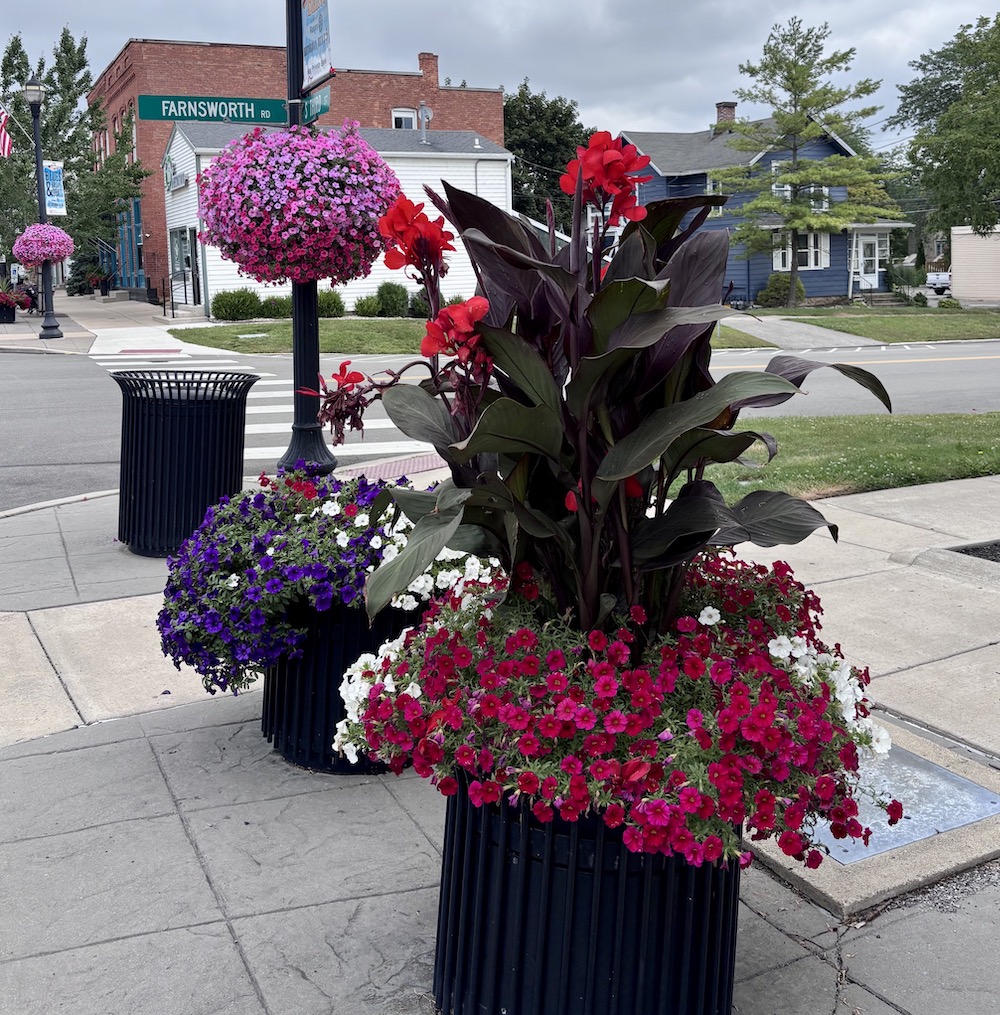
-Approved adding up to $25,000 in the 2027 budget to expand the downtown flower program. This year, the city placed 11 buckets of flowers from a Bluffton greenhouse on light pole brackets on Farnsworth, explained Terri Massucci. That has received many positive comments from citizens. The cost to refill those 11 will be $1,320. Hanging buckets on 44 additional poles throughout downtown is estimated at $19,360 while filling the 40 sidewalk planters along Third Street, the area next to Mad Anthony’s and the entryway to Parker Square is estimated at $3,000. Public Works Director Rob Binkley estimates it takes employees about 20 minutes to install each bracket for the buckets.
Waterville added hanging buckets of flowers and planters to the downtown area this year. City Council approved expanding the program to include all of downtown for next year. (AWFP photo by Karen Gerhardinger)
-Thanked Meredith Parker for donating $500 to the General Fund – proceeds from the Community Flea Markets held this summer at Parker Square. A last one is scheduled for Sunday, Aug. 16 from 10 a.m. to 4 p.m. at 1 S. River Rd. Launched last year by Old House owner Aggie Alt and Parker, the event has grown from a few dozen to nearly 70 vendors, kids activities, music and food trucks. Alt said she hoped the funds would go toward improvements in the park, including better internet and electrical connections or a shade structure.
-Held a moment of silence for Verna Rose, a Waterville Historical Society member who was instrumental in creating, expanding and maintaining the Wakeman Archives, which houses thousands of photos, documents and items from the area’s history.
-Listened to Wagner ask Police Chief Joe Valvano to explain the use of Flock cameras, after he’s read a lot of social media posts opposed to the use of the license plate readers. Valvano said Flock cameras read license plates and can alert local law enforcement of someone who is in the area and has an outstanding warrant – such as sexual predators and those violating a protection order. The information used in Flock cameras comes from national and state databases. Officers know that it cannot be used for personal issues, and are audited on the camera’s usage. Klapp said as a prosecuting attorney that he can see how the system can be used for criminal investigation and prosecution, and he believes it makes the community safer.
-Learned that two police officers and one fire department employee are now certified to use the city’s drones. Recently one was used over the Blues, Brews and Brats and also to check to make sure the light bulb on top of the water tower is lit.
-Discussed the frequent water main breaks near Waterville Primary School. The 8-inch pipe installed in the 1980s is failing and has caused seven incidents in three months, Binkley said. The district superintendent is aware that the city is seeking bids for replacement of the line.
-Encouraged people to sign up their children or grandchildren for the 20th and final fishing derby, set for Saturday, Aug. 29 from 8 a.m. to 1 p.m. in Waterworks Park.
-Approved, in a third and final reading, the rezoning of 3.9 acres of land at 7551 Dutch Road (Duvall Woodworking) from Planned Business Park District to M-1 Light Industrial District. After selling off land for the Riverbend Flex Industrial Park, the Duvall property no longer meets the 15-acre minimum for PBP and is non-compliant.
-Agreed to apply, on behalf of the owner of 137 S. River Rd., for an Individual Flood Mitigation Project Reconstruction or Elevation Grant with the Federal Emergency Management Agency (FEMA). The property, owned by Rob and Barb Bruno, has had a history of flooding. The city would apply on behalf of the Brunos and provide grant administration on behalf of FEMA, as required.