Home Blog Page 273

Retirement Guys: What to do when the stock market crashes

0

In our April 27 column, we talked about two steps to take in good markets.

The first step we recommended was to rebalance portfolios in all markets and the second step was to avoid chasing performance. Since that time, the U.S. stock markets have suffered around a 10 percent drop in price.

The media and the news outlets have quickly turned their attention back to Greece causing a possible global armageddon. After such a quick drop, many investors are wondering if we are heading back into a recession and what they should do.

Today we are going to give our readers two more tips on what to do now.

The first thing investors need to do is stay disciplined. One of the best things I, Nolan, got from serving in the U.S. Marine Corps is discipline. In listening to most of the financial media outlets, it can be easy to fall into a trap of making a financial move at the wrong time.

Gene Fama Jr., an economist, once said “Your money is like soap: The more you touch it, the less you have.” And we would agree. Again, it is important for investors to rebalance their portfolios but making major changes in a portfolio on a short-term basis can be a costly mistake.

Instead of thinking short-term is the next month or three months, an investor should look at short-term changes as the next two or three years. Remember to focus more on the long term.

Mark Twain said “History doesn’t repeat itself, but it rhymes.” That saying holds true when looking at our economy and the stock market.

According to BTN Research, bull markets, which are periods of times when the stock market is generally going up, have lasted, on average, for 58 months since 1950. The S&P 500 index started the current bull market back in March of 2009, about 40 months ago.

If history holds true, we could still have several more months of good times. The summer months can be periods of time when the stock market doesn’t do as well as other months. We saw this happen last year (2011) and the year before when the stock market went down in the summer, only to rally at the end of the year.

Election years, as we pointed out in our previous column, have also historically been good years in the stock market for the remaining months of the year.

Let’s say that this time it’s different and the global problems we see on the nightly news do push our U.S. economy back into a recession. That also isn’t cause to call for armageddon.

Recessions are a normal part of our economic cycle.

During the economic expansion companies and consumers borrow and spend too much.Then, as the cycle changes, everyone decides to borrow and spend less.

The recession then occurs when the borrowing and spending goes too low. If an investor is prepared with a plan, a recession can turn into an opportunity. Remember, the cycle repeats itself.

The other step an investor should be taking after the recent sell-off is to look for current opportunities and cherry pick stocks, bonds and investments from good quality companies. The younger an investor is the better the long-term opportunity is in more growth-focused strategies.

As an investor gets closer to or into retirement, the more the focus can turn towards cash flow strategies. If you are a retiree, we would recommend that you add up the yield of your current accounts and become educated about ways to increase yield.

Let’s say an investor has a current yield of 1 percent. By making some small changes, if the yield is increased to 3 percent that investor can immediately see an increase in cash flow making the day to day noise of Wall Street less relevant.

For more information about The Retirement Guys, tune in every Saturday at 1 p.m. on 1370 WSPD or visit www.retirementguysradio.com. Securities and Investment Advisory Services are offered through NEXT Financial Group Inc., Member FINRA / SIPC. NEXT Financial Group, Inc. does not provide tax or legal advice.

The Retirement Guys are not an affiliate of NEXT Financial Group. The office is at 1700 Woodlands Drive, Suite 100, Maumee, OH 43537. (419) 842-0550.

An index is a composite of securities that provides a performance benchmark. Returns are presented for illustrative purposes only and are not intended to project the performance of any specific investment. Indexes are unmanaged, do not incur management fees, costs and expenses and cannot be invested in directly.

Rathbun: GM (Government Motors)

0

General Motors has become the poster child for government bailouts and the intrusion of
government in the business process.

Back in 2008, President Bush issued an executive order permitting the Treasury Department to utilize TARP under the Emergency Economic Stabilization Act to support the carmaker.

TARP gave GM $13.4 billion and eventually, including the Obama administration endorsement, received $50.2 million total of taxpayer money. This amount initially gave the government a 60.8 percent ownership stake.

The Canadian government owned 11.7 percent, the employees’ VEBA trust owned 17.5 percent and finally the bondholders had the remaining 10 percent.

GM eventually had an initial public offering (IPO) which reduced the government’s ownership to 32 percent, which created a realized loss. In order for the government, and the American taxpayer, to break even, the government must sell its remaining stake in GM for $52 a share.

The stock is trading (in mid-June 2012) around 22 dollars a share. In 2005 there were 111,000 hourly workers at GM; in 2010 it had 50,000 hourly workers. A little simple math tells us that the government spent a little over $1 million for each job it “saved” at GM.

Now if you are a GM worker and your job was saved and you are still able to pay your bills and feed your family, good for you. But if you have no trouble with the fact that the money was taken from other working taxpayers, essentially at gunpoint, to provide this to you
and if you have no trouble with the fact that the amount of money was used very inefficiently then I guess you and, unfortunately, I, will get the government system we deserve.

The bondholders, who would normally be first in line in a corporate bankruptcy, not only got screwed but also vilified for wanting what was contractually theirs. Those investors lent their money in good faith to GM, knowing that if everything went south they would get most of their money back; now those investors will be very hesitant to loan money to a public corporation again.

What would have happened if the government had let GM fail and essentially restructure through normal bankruptcy rules? Would 50,000 people have been out of work? Would we no longer be able to buy GM cars and trucks? Would the economy go to zero? Would cats start sleeping with dogs?

The answer is, eventually the economy and the country would have been better off . With any growth there will be some sort of destruction. The invention of the car destroyed the buggy industry, in more modern times the invention of the CD destroyed the vinyl record industry.

I could name a thousand other industries that were destroyed because of obsolescence or poor management of the company.

If GM had gone under, other companies would have picked up any slack demand in the marketplace and maybe even a new car company would have been created. At the very least, there would still be GM cars and trucks to buy from a leaner and maybe smarter company.

The problem is that now we have yet another precedent of government providing a safety net where none is needed. When I was in college Chrysler got bailed out by government loans. I disagreed then even though Lee Iacocca took only $1 in salary (although he did get a fortune in options if he succeeded) and paid back all of the money with interest to Uncle Sam. He turned the company around and made it profitable.

Big banks, green energy, oil companies, automotive companies, farming, airports, lumber companies, obsolete industries, where does it end?

The problem is that it doesn’t end! We are all worse off for it even though the temporary fix feels good.

Gary L. Rathbun is the president and CEO of Private Wealth Consultants, LTD.

Business owner wins $100,000 at casino

0
Martin Halka invested his $100,000 casino winnings in his business, Bay Area Concrete. Photo courtesy Hollywood Casino.

Martin Halka has been running the Bay Area Concrete Company with a dying Bobcat machine and three work trucks dating back to the ’80s and ’90s.
The recession slowed his projects to 107 driveways last year, down from the usual 170 in years prior. He couldn’t afford to replace his old equipment.

But on June 4, that changed. The 41-year-old walked into Hollywood Casino Toledo with $400 and came out with $100,000. His win is the biggest since the casino opened May 29, topping a Richfield resident’s $20,000 win and a Toledo resident’s $15,000 win days prior.

Halka has invested most of his winnings in his business already, purchasing a new Bobcat, two new work trucks and a trailer. The $100,000 night was his first stab at casino gambling since 2007.

He started out with Texas Hold ‘em and won $1,400, moved to a dollar slotmachine and  won $680, took that to a $10 slot machine and hit $8,000 and inserted $1,000 in a $25 slot, winning his final earnings of $100,000, he said.

“I about had a heart attack,” he said.

Wine tasting marks 40th anniversary of Watergate

0

Most people will let the 40th anniversary of Watergate pass without a second thought — not Joe Mosier, manager of the wine department at the Andersons’ Woodville Road location.

Mosier has organized “Th e Watergate Break-in 40th Anniversary Commemorative Wine Tasting” at the store for 1-3 p.m. June 16, 2012.

“I actually thought about this five years ago for the 35th anniversary, but I didn’t do it,” he said. This time, Mosier rolled with the idea to commemorate Watergate in a fun way.

Watergate refers to the scandal that broke when five men were found attempting to wiretap the national Democratic headquarters at the Watergate Hotel on June 17, 1972. The subsequent events culminated in President Richard Nixon’s resignation in 1974.

“I thought, ‘Let’s have some fun with this,’” Mosier said of the tasting. When Mosier saw a chardonnay called “The Chardonnay Conspiracy” in one of his catalogs, he knew he was on to something.

“That kind of tied it together,” he said. The other wines are “Sinister Hand” Grenache, “Plungerhead” Old Vine Zinfandel and “The Prisoner” red. Mosier chose the wines based on the names and “they also happen to be very good wines,” he said.

Samples are priced individually, but patrons can taste all four for $4. The Andersons on Woodville Road hosts beer and wine tastings every Saturday, with beer from 11 a.m. to 1:00 p.m. and wine from 1-3 p.m.

Kuron: A matter of respect — The Second War of Independence

0

Respect — Rodney never got any, Aretha spelled it out and most of us just expect it.

Probably one of the most flagrant examples of disrespect is bullying, and like some of you, I received my share as a kid. It made me angry, resentful and retaliatory. However, in a strange way it forced me to toughen up and stand my ground.

Perhaps retaliation is not always a wise move, but I have to admit that one day in high school biology, when I put hydrochloric acid on the seat of one clueless bully, the result was a glorious hole in his trousers and a whole lot of satisfaction in me.

Well, when bullying happens on a national level it usually stirs those same emotions. Two hundred years ago, on June 18, the young United States of America had had enough bullying from Great Britain. The Brits were placing embargoes on our foreign trade. Money was lost and vital goods were not received.

They boarded our ships, uninvited, and kidnapped our sailors, forcing them to work on British vessels — it was called impressment. And in order to protect their lucrative trading posts, they incited Native Americans to wreak havoc on the frontier. We decided to stand our ground and retaliate with our first-ever declaration of war.

First approval came from the House of Representatives and then from the Senate. Only then did President James Madison, the “Father of the Constitution,” sign the historic document. The war that ensued is forever remembered by the year in which it commenced, but it actually lasted into January 1815.

Few people think about the War of 1812 in the same honored light that shines on the American Revolution or World War II, but it did produce its share of extraordinary historic events.

At Fort McHenry, Francis Scott Key wrote what became our national anthem, Washington, D.C., was burned by British hands and Commodore Oliver Perry did the unthinkable when he defeated a British fleet on Lake Erie.

Great leaders on all sides gave their lives in this fight. Arguably one of the greatest Native Americans, Tecumseh, was killed at the Battle of the Thames. Sir Isaac Brock, the revered British General, was killed at the Battle of Queenston Heights, and Zebulon Pike, after whom that mountain peak is named, fell while attacking York (Toronto).

Also, up-and-coming stars of history were born out of this conflict. Andrew Jackson, in the Battle of New Orleans, and William H. Harrison, leader of the Northwestern Army, both went on to the highest office in the land. Richard M. Johnson, leader of the Kentucky militia, went on to the second highest. And get this — dozens of elected men, politicians, got out of their cushy chairs, strapped on a powder horn and went to fight in the war they voted for. Can you imagine any politician, anywhere, today, ever putting his own life on the line in combat while still in office?

Tributes to the men who served during this two-and-a-half year conflict will begin soon across our country, as well as in Canada. Locally, the Way Public Library
in Perrysburg starts things off by joining a statewide observance of this war’s commencement on June 18 at 11:30 a.m.

The outdoor ceremony will take place around the library’s flagpole, and at noon the historic Perrysburg Exchange Hotel bell will be rung, echoing simultaneously with others across the state. Join the mayor for a special 15-star flag-raising, a bagpipe performance and a reading of the war declaration.

You can even grab a free hot dog and soft drink — that’s better grub than the soldiers ever had to eat!

On June 20 at 7 p.m. Perrysburg’s native son, Douglas Brinkley, prominent historian and author, will speak about the significance of the War of 1812 and Northwest Ohio’s role in it at Way Library. (He’ll also talk about his new biography of Walter Cronkite, selling and signing copies of the book afterward.)

Then on Sun., June 24, at 4 p.m. you can take a guided walk through Fort Meigs Union Cemetery. Reenactors will be featured at the gravesites of 15 War of 1812 veterans. Have some free fun and learn why the heroes of 1812 deserve your respect! ✯

Frank Kuron is author of the War of 1812 book, “Thus Fell Tecumseh.” E-mail him at [email protected].

Ground broken on Alzheimer’s facility in Waterville

0

Ground was broken last month in Waterville for a new assisted living community for people living with Alzheimer’s.

The $3.7 million facility will be called Pathways at Browning Memory Care Center. Ground was broken May 17, 2012, and construction should begin by mid-June, said David Subleski, president of Browning Masonic Community, a nonprofit retirement and assisted living facility in Waterville.

Browning’s new 20,000-square-foot facility will offer 24 private apartments with private bathrooms.

Various design elements will aid withresident safety and independence, Subleski said.

The bathroom light, for example, is set to go on as soon as a motion sensor detects the resident getting out of bed. The light helps to “cue” memory, prompting the resident to use the bathroom, Subleski said.

Heated bathroom floors make the room feel welcoming even on bare feet, encouraging good hygiene, he said.

“We want people to live as independently as possible and function as well as they can and  we’ve incorporated some technologies that help with that,” Subleski said.

The facility will consist of two “neighborhoods” of 12 apartments each, with the two wings connected to allow free movement between. A courtyard in the center of the complex is also enclosed.

“Some people just need to move,” Subleski said. “We wanted to give them places to go where they could be safe.”

The dining area will look, feel and smell like a home kitchen, Subleski said.

“All that is important in terms of stimulating appetite and having conversations,” Subleski said. “We never know where the next connection is going to come from.”

Programming will be available around the clock to cater to each resident’s natural bodily rhythm.

“Not everyone is an 8 to 5 Monday through Friday individual,” Subleski said. “Our trademark program is called Rhythm of the Day. It ties into the natural rhythms we all have. We all have portions of the day we are more physically active and portions we are more mentally active.”

Person-centered care is important with Alzheimer’s patients, said Salli Bollin, executive director of the Alzheimer’s Association, Northwest Ohio Chapter.

“People are not one-size-fits-all. Anything you can do to make theenvironment supportive  of the individual is great,” Bollin said. “Routine and structure is really important as well as familiarity.”

Activities will adhere to a Montessori-style philosophy, Subleski said.

“If they are part of a group and see something else that looks interesting, they can decide to do something with that or they can come back and be in the group,” Subleski said. “It allows them to have choice. That’s what this is about.”

The facility will also include two respite rooms available for area caregivers to place their family member for a night or weekend.

“Roughly 40 percent of caregivers pass away before those they are caring for because they neglect their own physical and mental health,” Subleski said. “We wanted to be able to provide resources and support for those out in the community to be able to leave their loved one with us and get the attention they need personally and not feel guilty or worried Mom or Dad are not being properly supported and cared for.”

More than 5.4 million Americans are living with Alzheimer’s disease, including more than 9,000 in Lucas County and 38,000 in Northwest Ohio, Bollin said.

“The numbers are high and unfortunately the numbers are growing, because what we also know is age is the most common risk factor for developing this disease and we have an aging demographic in this country,” Bollin said. “This disease impacts people of all educational levels, all economic situations, all backgrounds. It’s a devastating disease.”

The response to Pathways has been excellent, Subleski said.

“We’ve had enough inquiries already to fill it, but we will wait until closer to the true open date to take applications,” Subleski said. “We know we can’t extend the life of somebody with this disease, but our goal is to try to make that time that remains a better quality of life.”

For more information, visit browningmasoniccommunity.org or www.alz.org or call the Alzheimer’s Association at (800) 242-3900. ✯

Miller: Thinking bigger

0

In September 2008, Toledo Free Press published a cover story, “Think Big,” that asked readers which major-market attractions would boost Northwest Ohio’s entertainment and retail quality of life. One of those wish list items, a casino, is now a glorious reality. We don’t have an official IMAX screen, but Rave Motion Pictures has introduced its “Rave Xtreme Big Screen Experience” to Fallen Timbers. Another popular request, IKEA, is being mentioned for the former Southwyck Mall site. What is the progress on the rest of that 4-year-old list?


Culver’s: We love our burgers in Toledo, but unless you have been to Culver’s, you are missing one of the greats: Culver’s ButterBurger. Not fast food so much as high-end diner food prepared quickly, Culver’s also offers frozen custard and desserts to envy. There’s a busy Culver’s in Adrian, Mich., 38 miles away. If Adrian can support a Culver’s, surely Toledo can.

Online: www.culvers.com

Progress update: Toledo does have a Five Guys at Westgate, but still no Culver’s.

Common Ground Festival: Each summer, Lansing, Mich., dedicates both sides of its modest riverfront to three days of country, rock, rap and pop music. Top names draw thousands of people to an event that could be on our Downtown river banks. A conversation about bringing such a festival started a few years ago, but did not gain momentum. Bowling Green’s Black Swamp Arts Festival has the idea, but imagine that event transferred to the riverfront and you’ll have an inkling of the vision.

Online: www.commongroundfest.com

Progress update: None. And it looks like the only major summer concert weekend Downtown, the rib fest Smoke on the Water, has been retired.

Buca di Beppo: This restaurant chain, named “Joe’s Basement,” specializes in “family style” Italian cuisine. That means when you order lasagna, you get a brick that can feed five people. The specialty is a “meatball the size of a baby’s head.” The nearest Buca is 60 miles away in Livonia, Mich.

Online: www.bucadibeppo.com

Progress update: None. But a new Italian restaurant reportedly being built on Monroe Street near the Blarney/Table Forty4/PizzaPapalis triumvirate, looks promising.

Dave & Buster’s/GameWorks: With its casino atmosphere and ADD approach to entertainment, Dave & Buster’s is a video arcade addict’s heaven, with the latest in interactive and virtual technology. There’s a Dave & Buster’s in Westlake near Cleveland, 97 miles away, and one in Utica, Mich., 81 miles away. GameWorks, a similar franchise, has locations in Columbus and Auburn Hills, Mich.

Online: www.daveandbusters.com, www.gameworks.com

Progress update: None. Hollywood Casino Toledo is the adult version, but families with kids are still waiting.

Howl at the Moon: This is a dueling-piano bar that specializes in crowd singalongs. It’s ultimate karaoke, one of the safest ways you can give your date a sore throat.

Online: www.howlatthemoon.com

Progress update: Cleveland seems to have lost its Howl at the Moon location, so the nearest ones are in Chicago and Indianapolis.

Apple Store: This store offers the latest gadgets for computers, iPods and gizmos you haven’t heard of yet. The Apple Store in Aventura, Fla., gets so busy, customers have to make appointments to get in. The closest Apple Store is at Briarwood Mall in Ann Arbor.

Online: www.apple.com/retail

Progress update: None. There are Apple Stores in Ann Arbor, Akron, Lyndhurst, Westlake and two in Columbus,.

Trader Joe’s: This was by far the most popular reader request, with more than 150 mentions. It’s a specialty grocery store that features imported cheeses, organic produce and hand-tossed pizza from Italy.

Online: www.traderjoes.com

Progress update: Though the closest Trader Joe’s is in Ann Arbor, the franchise does have several locations in Ohio. A group of Downtown businesspeople is reportedly lobbying the franchise to consider a local location.

Crate & Barrel: Crate & Barrel is a retail store that specializes in furniture, housewares and home accessories.

Online: www.crateandbarrel.com

Progress update: The closest location is in Troy, Mich.

Cheesecake Factory: The Cheesecake Factory specializes in just about everything, be it pizza, pasta, seafood, steaks, salads, sandwiches or cheesecake.

Online: www.thecheesecakefactory.com

Progress update: Again, Columbus has two, but the closest Cheesecake Factory is in Westlake. There were reports a few years ago that a Cheesecake Factory was headed to Levis Commons, but that rumor died quickly.

Urban Outfitters: Urban Outfitters could be described as a retail store that sells clothing with a hipster or vintage look. Its closest location is in Ann Arbor.

Online: www.urbanoutfitters.com

Progress update: None, but those hipster artists Downtown are getting the gear from somewhere.

One-shots: There were dozens of one-request franchises: O’Charley’s; Cinema Grill; Pinkberry; California Pizza Kitchen; Shooters; Bahama Breeze; Sweet Tomatoes; The Container Store; Nordstrom; Saks Fifth Avenue; and Marshalls. What else are we missing? Send your shoot-for-the-moon wish list to [email protected].


Michael S. Miller is editor in chief of Toledo Free Press and Toledo Free Press Star. Email him at [email protected].

Fifth Third names Belle manager of Investor Advisory Division

0

As a 22-year-old, recently graduated, idealistic financier, Ron Belle came to a realization. In his one-on-one conversations with his clients, it dawned on him that “people don’t understand. They don’t understand how important it is to know what’s on their credit report, to know how to responsibly use credit.”

At that point, Belle knew he would eventually embark upon a banking career.

Nineteen years later, Belle has accepted a position at Fifth Third Bank as senior vice president and manager of the Investment Advisors Division. He is responsible for the overall management of the division, which provides personal trust, investments, wealth planning and private banking services.

Belle readily admits all the “bankspeak” sometimes makes banking unattractive for the common person.

“To most people, their banking is personal. And yet we hear the news about J.P. Morgan and Wall Street. And let’s face it, not all of us know and understand the huge headline, the big splashes. That thing about J.P. Morgan and what’s going on there is that’s not in most of our worlds. You hear it. You get scared by it.

“But, really, that kind of banking, it’s not going to affect people or their accounts or their relationship with their bank here in Toledo. And I think that’s probably the one piece that people forget.

“It’s easy to say, “Oh, man, what’s going on in Wall Street?’ Well, we’re a long way from Wall Street. Not to say that what happens there doesn’t affect everybody’s life to some degree. But it’s not what the average person who does their banking every day gets. It’s their relationship, the conversation sitting across the table.”

Belle’s insight into the fear that Wall Street headlines generate fits perfectly into Fifth Third Bank’s approach to serving its clients, said Bob LaClair, president of Fifth Third Bank Northwestern Ohio.

“Banking is a relationship business,” LaClair said. “We take that very seriously. We are a one-on-one kind of company where we’re sitting across the table, whether it is in a branch or a customer’s office or down in our main office. It’s very much a relationship business.”

Belle credits his parents’ guidance and the values he learned growing up in Syracuse, N.Y., for his career success.

The oldest of four children, Belle spent his childhood dreaming of being an FBI or Secret Service agent. However, watching his father, who worked in the beverage industry, spend his evenings preparing hand-written reports made an indelible impression on the young Belle.

“Talk about work ethic and things of that nature,” Belle said. “Working hard. He’s been the role model for that.”

Belle and Diane, his wife of two years, moved to Toledo in mid-May from their home in Metro Detroit, just east of Rochester Hills. The couple has one son, Ronald III, who they call Ronny. Diane Belle works as an accountant with a background in hospitals and nonprofit organizations.

When he was being considered for the Fifth Third Bank job, Belle researched living conditions in the Greater Toledo area. To his surprise, he discovered that Toledo is very much like his childhood hometown.

“Growing up in Syracuse, I found out Toledo is very much like Syracuse, size-wise,” he said. “But there are much better winters here. Believe me, 100-plus inches a year — it’s much better here.”

Belle sees Toledo as a vibrant community and is pleased that it offers a lot of support for the arts.

“And as I leave here, there’s a Mud Hens game,” he said. “At 6, 6:30 in the evening, it’s amazing to see the crowds there.”

“What Toledo offers is the ability to get involved. Both my wife and I have a history of being on boards [of trustees], being involved in the community.

“And Toledo offers that. And I think that we’re very excited about being in the community, and being involved.”

Although Belle said there is no such thing as a typical day in the banking world, he said he split his time between “working with my team, ensuring that what we do and how we do it are done well” and “the real fun part of the job — getting in front of and talking with clients.”

Belle is most pleased when he and his team “do a very good job in the relationship side of things. At the end of the day, that’s the differential.

“It’s how you deliver services to customers, and we do that through relationships, not through pricing. Not through maybe bells and whistles. And while those are important, it’s the relationship … that makes the difference with the customer.”

Interfaith Blood Drive ‘postponed indefinitely’ amid strike concerns

0
Devorah Shulamit -- photo by Shena Kaye

Devorah Shulamit never thought she’d see the day when an event celebrating life would become what she says is just one of many casualties of a workers’ strike.

As founder and chairwoman of the Interfaith Blood Drive, Shulamit has spent the past 12 months preparing for the organization’s 25th anniversary blood drive. The Interfaith board hoped to collect 300 useable units of blood during the two-day event, in preparation for the July 4 holiday weekend. The drive also serves as a spiritual celebration of unity among people of all faiths.

Those preparations were dashed May 29, when the organization’s board of directors voted 8-1 to postpone the blood drive indefinitely, pending the outcome of the management/union conflict at the Western Lake Erie region of the American Red Cross.

The Interfaith board took the vote when the host of the event, Grace Lutheran Church, withdrew its offer to Interfaith for the use of its Monroe Stree building, until after the United Food and Commercial Workers (UFCW) Local 75 union workers’ strike against the American Red Cross was settled.

Grace Lutheran Church Pastor Holli Burkard told Interfaith board member and blood drive co-chairman Phil Meuser and Toledo Free Press that she was opposed to the blood drive for reasons of social justice.

“I recommended that we not host it,” she told Toledo Free Press. “I believe in justice for all people. There are many issues here.”

Among the issues Burkard mentioned were her concerns that employees were working for a business that she believes does not offer reasonable health care coverage, the church members’ possible opposition to not respecting the rights of union workers, and the possibility of picketing outside the church building.

Burkard said the decision not to host the event was made by the church’s governing body.

Concerns about picketing

Robert Haaf, Grace Lutheran Church’s council president, serves as the chairman for the church’s governing body. Haaf said the 18-member governing body, elected to three-year rotating terms, “acted on behalf of the congregation.” He said he could not remember the result of the vote and could not provide that tally “because the minutes of that meeting have not yet been accepted.” He did say the vote was not unanimous.

Haaf echoed some of the same issues his pastor, cited, including concerns that there may be picketing in front of the church, an event he said “no one ever wants to see at their church.” He also expressed concerns about safety of the volunteers and donors because “there have been national media reports in the past where people who picket and people who cross the picket line end up in a physical confrontation, and then there are times when nothing happens at all.”

Haaf said the governing body’s ultimate concern came down to “the unknown” — not knowing what could happen if it permitted a blood drive where striking workers may picket.

Haaf said the governing body had “an awareness that Toledo has the reputation of being a pro-union city and had concerns that some church members may not be comfortable hosting an event that may lead to people being asked to cross a picket line.”

Haaf did not say whether the governing body discussed any of the social justice issues his pastor raised.

Disappointment, sadness

Interfaith board members expressed disappointment and sadness over the decision, the timing of the decision and the reasons they were given for the decision. Grace Lutheran Church has hosted the Interfaith Blood Drive for 20 consecutive years, and the Interfaith board had been given a verbal commitment for its continued use in 2012 just 12 months earlier. It was not informed of the withdrawal of that permission until May 15, five weeks before the June 23-24 event.

Despite their frustration with Grace Lutheran’s decision, Interfaith board members Evelyn and Hindol Ghatak stressed their appreciation for the church’s pastor.

“We all agree that Pastor Holli has been very graceful,” Hindol said. “We live in a democracy. And obviously, their congregation, the board, has decided they don’t feel comfortable doing it now. And I think that this is their prerogative. Over the years, they have been very, very nice, and they have been very generous.”

Evelyn agrees.

“Grace Lutheran, in the community, is awesome,” she said. “They’re very, very, very open to anything. They’re always very accommodating.”

Not all Interfaith board members were as supportive or understanding of Grace Lutheran’s decision as the Ghataks.

When the blood drive board learned of the loss of Grace Lutheran as its host, Shulamit said she tried to focus on the positive and encouraged members to inquire at other area houses of worship as to the possibility of hosting the June 23-24 event. The reports of those last-minute inquiries at the May 29 meeting proved discouraging to Shulamit. Board members had contacted and had been turned down by five Toledo-area houses of worship: Epworth United Methodist Church, Hope Lutheran Church, Memorial Lutheran Church, Monroe Street United Methodist Church and Temple Shomer.

None of the clergy who rejected the Interfaith Blood Drive’s last-minute request raised the issue of socially unjust treatment of Red Cross employees. All rejections were based on logistical issues, including scheduling conflicts, the possibility of interrupting religious services, traffic issues, parking issues, room size issues and the lack of air conditioning.

Not being fair

Dale Parker, UFCW Local 75 union representative, said he was pleased to hear that the Grace Lutheran governing body rescinded its offer to host the blood drive.

“I applaud Grace Lutheran Church for standing up for what is right and just in the world,” Parker said. “The Red Cross is not being fair. They are proposing an increase by a large amount in the employees’ contribution to health care costs.”

Parker said the employee contribution is currently 15 percent, but the Red Cross is proposing a 10 percent contribution for single employees and a 20 percent contribution for a single employee plus one and/or a family going into the 2013-2014 year and beyond. Parker said employees are being asked to accept a contract that does not spell out health costs beyond just one year.

“We don’t consider it fair or just either,” he said. “We can’t sign a contract without knowing what the terms of the contract will be, and this contract is forever. We are being asked to sign a contract where we give up our right to bargain for health coverage forever. This is not just for one or two years. It’s forever.”

Bill Dudley, Director of Strategic Campaign for UFCW Local 75, said, “It doesn’t surprise me at all that faith leaders and people of faith would stand with the workers because this is a social issue. It’s an issue of economic justice and fairness.”

Dudley said the striking workers are willing to pay a little more than they have paid in the past, but are not willing to give up the right to bargain. Dudley said Red Cross management is asking its workers to give up all rights to collective bargaining forever.

“We’ve already decided that issue in Ohio,” Dudley said. “Ohio Senate Bill 5 appeared on the Ohio ballot as Issue 2 last year. It was defeated by 62 percent. Ohioans have spoken clearly that they don’t expect public sector employees to give up the right to collective bargaining.

“But that’s exactly what the Red Cross expects union workers to do.”

No compromise

Ian Thigpen, communications program manager for the Western Lake Erie Region of the American Red Cross, the region that provides blood to 18 hospitals in 10 Northwest Ohio counties and Monroe County, Mich., said the Red Cross wants the striking employees to return to work “as soon as possible” but cannot “compromise what we offer all Red Cross employees.

“We cannot offer Western Lake Erie employees something that we don’t offer Red Cross employees in other parts of the country.”

Thigpen said the American Red Cross has signed 21 union contacts across the United States since July 2011, three since the Toledo-area strike started four months ago. He said that only three unions remain on strike: those that represent workers in Cleveland, Lansing, Mich., and Toledo.

Parker disputed Thigpen’s claim that 21 unions across the nation have accepted the contract Toledo-area workers have rejected.

“They have not responded to us in good faith,” Parker said. “They say that 21 other unions across the country have accepted the same offer we won’t accept. We have asked for a list of those 21 other unions they say have accepted the offer. Although we have asked for that list, they have failed to provide it.”

Parker said the union has filed a complaint with the National Labor Relations Board, contending that Red Cross management does not provide the union with the information it requests. Dudley said a hearing to investigate the union’s accusation is tentatively scheduled for August.

Thigpen said he is personally troubled with the predicament that the Interfaith Blood Drive faces.

“I have met some of the people involved in the Interfaith Blood Drive, and they are good people,” he said. “And I am sad — and I’m confident that this is the official opinion of the Red Cross — I am sad that we could not celebrate the 25th anniversary of their blood drive with them.”

The Interfaith board issued a statement concerning the Red Cross labor/management dispute after it decided to postpone the blood drive until after the strike.

“The Interfaith board takes no sides with the management/labor dispute between the American Red Cross and its union employees. The Interfaith board’s sole goal

in life is to generate as many units of blood as possible. To do so, we need the support of the community, and, because of the strike, we do not currently have the support of the community.”

Mercy implements robotic surgery center

0
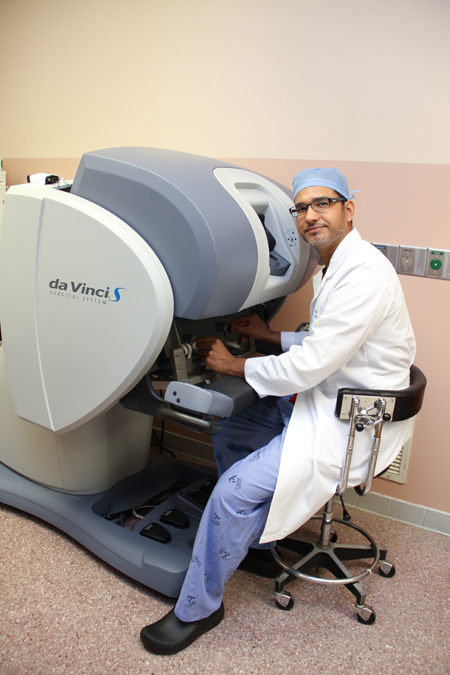
Dr. Mirza Baig, robotics director at Mercy Health, at the controls of the DaVinci SI surgical station. Photo courtesy Mercy Health Partners.

Mercy Health Partners recently opened two new surgical suites with amenities specifically for robotic surgical procedures.

The $2.5 million da Vinci Si will be used at St. Vincent Mercy Medical Center on Cherry Street along with one of Mercy’s older da Vinci models.

In 2002, Mercy was the first hospital in the area to acquire the da Vinci robotic surgical system and is now the only area hospital to use the Si, which Mercy acquired in 2009.

With the da Vinci Si, surgeons maneuver instruments at a console, while instruments at the patient-side cart perform movements in sync with the physician.

Director of Robotics Dr. Mirza Baig, who specializes in urology and pediatric urology, said the cutting-edge da Vinci Si is used for gynecology, urology, cardiovascular and some general surgical procedures.

“We’ve sort of collaborated all the specialties and took an integrated comprehensive approach to robotic surgery here,” Baig said. “When patients come, regardless of the specialty, regardless of the case, it’s a similar type of experience that they end up getting.”

Baig said this is done through a nurse navigator, who walks the patient and family through the entire process and is there before, during and after surgery. He said another is a full-time robotic supervisor who is constantly behind the scenes working with the technology and patient care.

Also, Mercy has implemented new ways for surgeons to track their results and increase their expertise.

Baig said the Si’s camera distinguishes the system in robotic surgery technology.

Director of Robotics Dr. Mirza Baig

“What’s unique about the Si is the visual acuity, the camera that it uses,” Baig said. “The optics are unmatched. It’s 3-dimensional, high definition and … it’s the clearest picture you can get.

“It’s also magnified by 10 times, so you can imagine the technology of magnification and precision you can get from these types of surgeries.”

One of the other differences between the da Vinci Si and its elder counterpart is that the da Vinci Si has two consoles, allowing two physicians to collaborate and use the system during surgery.

“We take training and medical education very seriously here,” Baig said. “I sort of equate it to driver’s education, where the teacher has the emergency brake. They’re able to switch controls back and forth.”

Baig said the No. 1 reason Mercy purchased the da Vinci Si was for its single-port technology.

“All of this is minimally invasive, all of this is through small tiny incisions, [and] now you can take it a step further and just do it through one incision,” Baig said. “Through a belly button incision you’ll get surgery without a scar, that’s the idea. That’s specific to this robot. We purchased this technology and we’ve performed the first single sight robotic surgery in town, and we’ve done several now and it’s gone well.”

Mercy is also using Firefly technology as part of the da Vinci Si. Firefly technology allows physicians to inject the patient with a dose of green dye. Normal organ tissue is colored green while tumor tissue isn’t. This allows surgeons to more precisely determine what to remove.

Baig said since the da Vinci’s implementation at Mercy almost 10 years ago, about 1,700 robotic surgeries have been performed.

“We have approximately 21-22 surgeons that are actively doing cases and others that have showed interest in learning robotic surgery, because the benefits are clear to the patients: smaller incisions, less blood loss, quicker recovery time, quicker return to work, all compared to open surgery,” Baig said.

Baig said measuring the success of the da Vinci can be misleading because of the common misconception that the robot is doing the surgery, not the surgeon. Baig is quick to clarify that the Si is a tool and cannot replace the surgeon.

“If the surgeon is capable and well trained, then the robotic surgery, compared to open surgery, is safer,” Baig said. “So the success sort of has different variables that affect it. There are many studies that were performed where the same surgeon has compared his open surgeries to his same robotic surgeries and the benefits and success have been clear.”

ProMedica acquired its first da Vinci in 2008, Director of Surgery and Endoscopy Michelle Ziegler said. ProMedica now has two da Vincis that are used for urology, gynecology and vascular surgeries.

“As we see that robotic surgery is increasing along with the need for it, we have a committee continuing to look at it and the options for the new technology,” Ziegler said.