A student in the DEWESoft USA three-day camp takes a go-kart for a test drive, later checking the results of sensors on the kart. (Courtesy photo)
WHITEHOUSE – A dozen students had an opportunity to test drive a career field that blends engineering, science and technology, during a three-day camp at DEWESoft USA – a world-class provider of data acquisition (DAQ) systems, based in Whitehouse.
The camp gave students an opportunity to see the day in the life of a test engineer, said Dave Gallop, director of training for DEWESoft USA.
“We wanted to demonstrate how fulfilling a life in these fields can be. The majority of scientists and engineers start with curiosity,” he said.
DEWESoft USA in Whitehouse hosted a three-day camp to introduce students to data acquisition systems, science and engineering careers. (AWFP photo by Karen Gerhardinger)
Gallop’s presentation on the history of measurement was particularly interesting to Anthony Wayne High School senior Ryan Parker, who noted that thousands of years ago the Japanese were using a seismic measuring device that looked like a large bowl.
“The act of measuring has been longstanding throughout human history,” said Parker, who signed up for the camp to learn more about DAQ and career opportunities.
DAQ samples signals that measure real-world phenomena and converts them into a digital form that can be used to develop innovative hardware and software solutions used across industries globally, including automotive, aerospace, defense and power.
Looking out on a test track behind DEWESoft’s Logan Street headquarters, Parker watched as a group of campers prepared to drive go-karts wired with DEWESoft measuring devices – for vibrations, speed and temperature – through a bumpy course. The goal: to see who could finish the course and spill the least amount of water from a cup in a holder near the driver.
“They’ll collect data from all of the sensors on the kart and do an analysis of the data to see how the cart performed and see if there’s any improvements they could suggest on the carts,” said Owen Maginity, a DEWESoft application engineer working at the camp.
The camp was the first for DEWESoft, which tailored the program for both high school and college students who are interested in engineering, science and technology. DEWESoft purchased the go-karts and installed many of the sensors ahead of time, but had the students help with final instrumentation.
“We walked them through installing some of the basic sensors and how to diagnose and troubleshoot any issues. We knew some issues existed, and left them for the students to discover,” Maginity said. “That’s the reality of test engineering – it never goes to plan. Now we’re having them execute the testing on the durability course.”
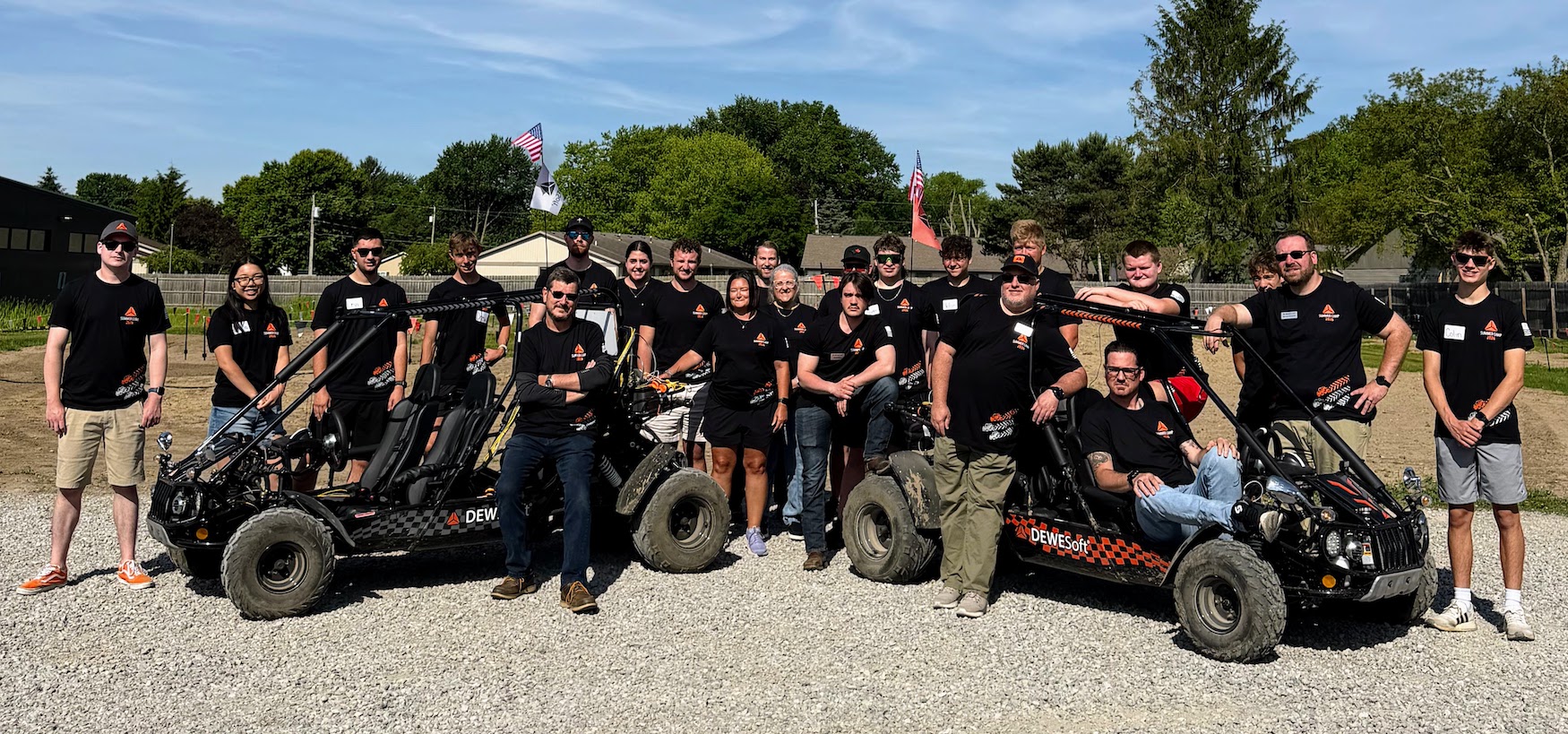
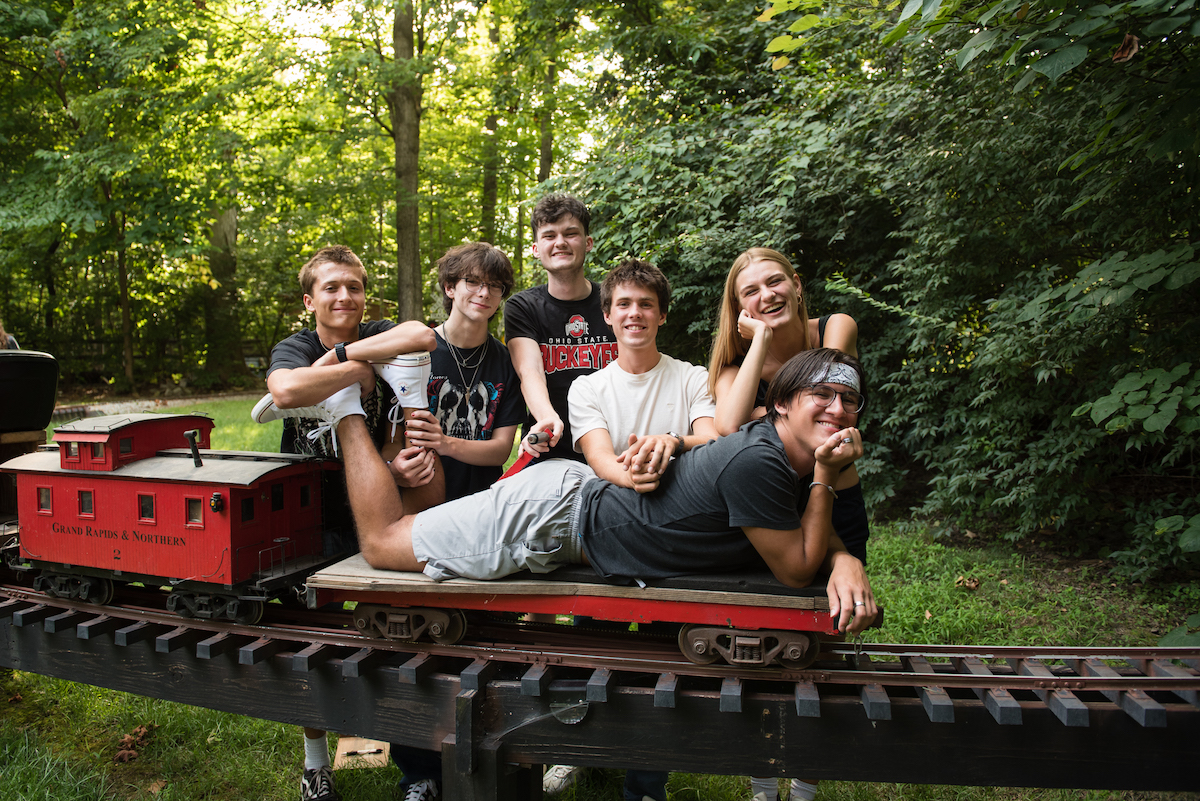
The 12 high school and college students attending a three-day camp gather around go-karts near a test track at DEWESoft USA’s Whitehouse headquarters. (Courtesy photo)
Before hitting the course – modeled after some of the proving grounds used by big automotive manufacturers – students also tested out the go-karts’ brakes by rapidly accelerating and braking on asphalt and gravel, to get an idea of reaction time, said Academy Coordinator Selena Hooks.
Wearing helmets and seatbelts, the students then took turns on the dirt course, usually following Magnity’s advice to aim for a smooth and consistent speed. That’s what he learned after rolling one of the karts during a test run.
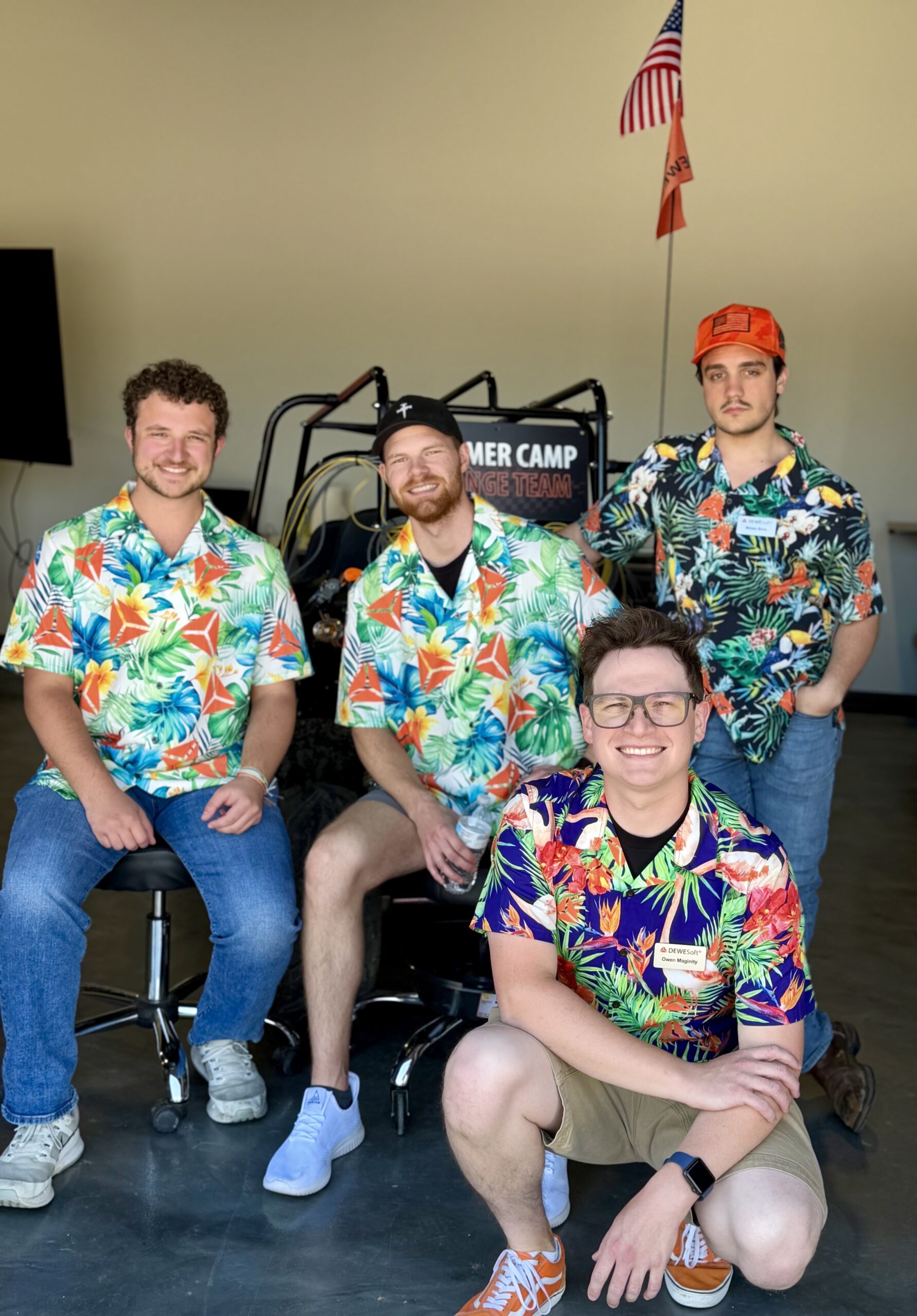
The camp was led by DEWESoft employees including, standing (from left) Jake Skaff, Hayden Fox and Simon Born and, kneeling, Owen Maginity. (Courtesy photo)
“We’re having them drive the course, collect data from all the sensors on the car, and do an analysis of the data to see how the cart performed, how the comfort was, and see if there were any improvements they could suggest.”
Parker noted that some of the results gave the students insight on all of the factors that need to be measured.
“We looked at technical aspects, like turning and strain on certain pieces. It shows that certain outside forces, like temperature, can impact your results,” Parker said.
While Parker said he’s often thought about engineering in terms of building and design, he can now see how data acquisition dovetails into the design of products in a number of industries. He was surprised to see the number of big companies, including SpaceX and Ford that utilize DEWESoft.
Measuring the success of the camp was easy, based on the enthusiasm and questions from students, said Hooks.
“For the first go-round, it’s been off the scale. We’ve had talented students here that really have exceeded our expectations,” she added.
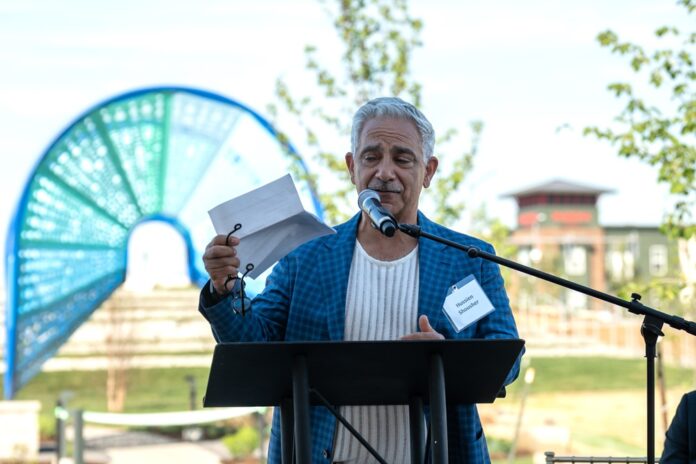
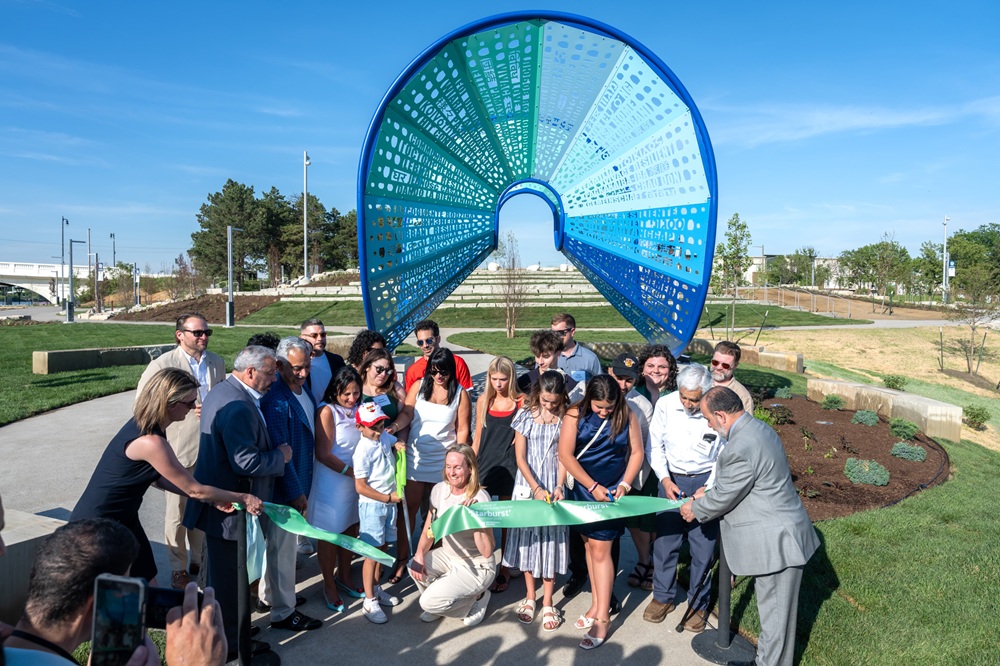
Hussein, son of John and Emney Shousher, speaks at a dedication in Glass City Metropark. (Photo courtesy of Metroparks Toledo)
TOLEDO – The family and friends of the late Yehia Hussein “John” and Emney Shousher gathered on June 5 at a recently opened party patio on the Maumee to recognize the sculpture, “Starburst,” dedicated in their honor. Refreshments were served as the guests enjoyed conversation before the dedication ceremony began. The event was accompanied by warm notes of acoustic, traditional Lebanese music played by a trio, complete with an oud.
The gathering was hosted at the “Starburst” sculpture location in International Cove, a piece of the Glass City Metroparks Riverwalk at The Docks. The Riverwalk project is celebrating its 50 percent goal marker as Watershed Week kicked off, running until the 14th. The June 5 dedication was the first private event to begin the celebration, which is fitting considering the legacy of the Shousher family.
Ribbon cutting unveiling the “Starburst” sculpture in Glass City Metropark. (Photo courtesy of Metroparks Toledo)
John Shousher “was a community leader in every sense of the word,” said Metroparks Toledo Director, Public Relations, Scott Carpenter. Shousher was a business man who helped to establish essential organizations like the Islamic Center of Greater Toledo, Toledo’s first Mosque and more. Regarded as a man with great wisdom and a servant’s heart, he acted as an ambassador to the Islamic community and a bridge across cultures, maintaining friendships with rabbis and mayors alike. His wife, Emney, always stood beside him with endless support and kindness. She worked to bring their dreams to life, striving to cultivate spaces where all could visit and feel welcomed.
Many of their life’s themes are woven into “Starburst” and the area itself. Having worked to develop the river in volunteer board roles and business development efforts for over 40 years.
The sculpture, Riverwalk development, and dedication itself are the combined effort of Metroparks Toledo, The Arts Commission, and the Shousher family. The Arts Commission and Metroparks Toledo having established their relationship in previous projects intended to engage and serve areas of the city that have not received proper funding and attention, such as the East Side and the Vistula neighborhood.
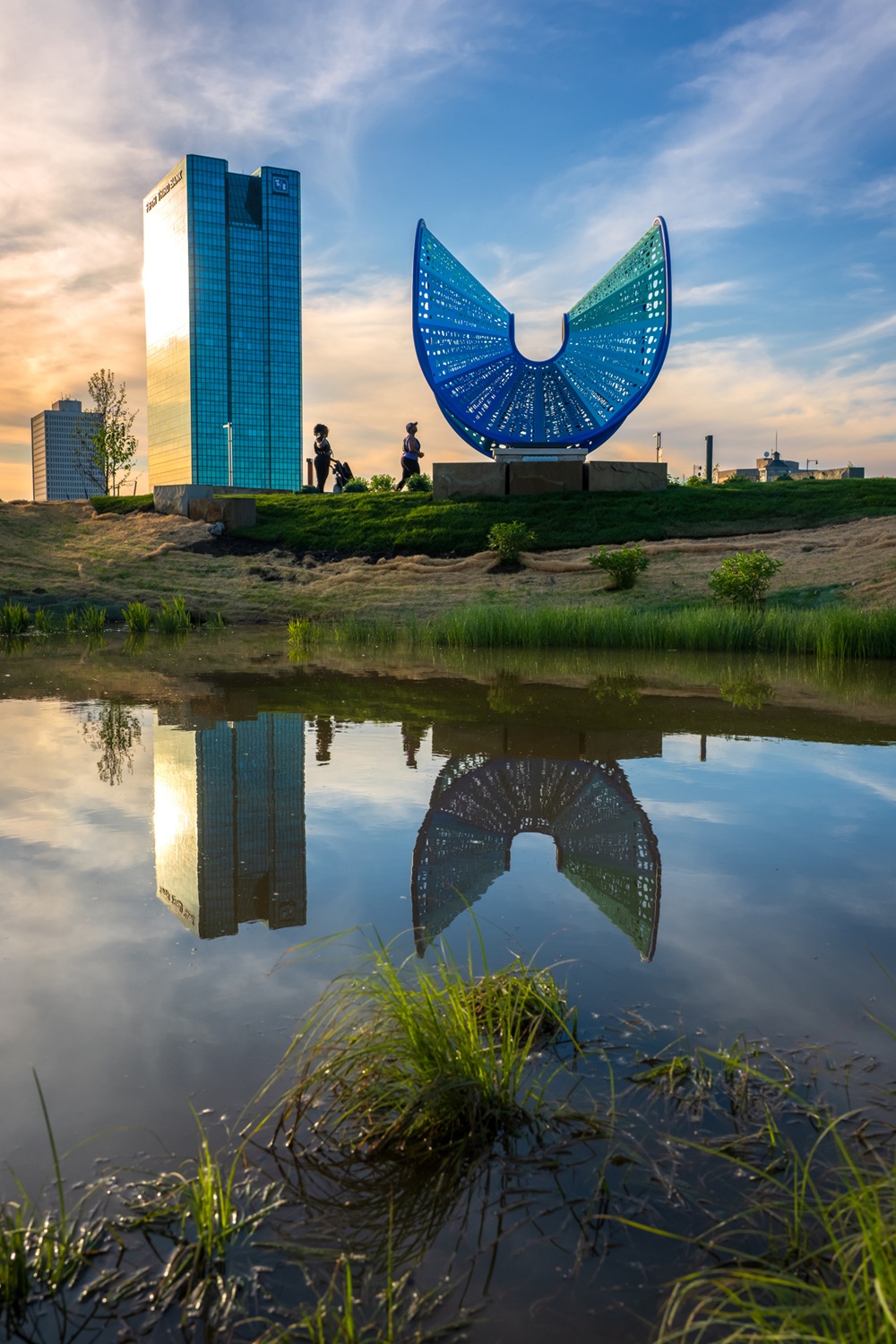
The sculpture is raised on platforms that allow visitors to walk under it, standing at the center of Riverwalk paths. Looking under the sculpture allows the viewer to better see the collage of words that were selected by the community.
(Courtesy of Metroparks Toledo)
Toledo Design Collective started the event intending to collect neighborhood feedback on the construction of the park and artwork. They worked with MidStory, as well as a couple other partners in creating a space to gather words describing these immediate areas by the residents. They also conducted interviews with folks like the Shousher family. Blessing was involved in the process.
Blessing, an artist known for standing community-based sculptures around the world, was selected as part of a previous application to another interactive sculpture project headed by The Arts Commission, “Field of Histories.” A few feet from “Starburst,” the exhibit consists of glass globes encased in chrome pedestals, containing pieces of Toledo history donated by residents.
“We’ve really paid homage to ‘international,'” said Nathan Mattimoe, Director of Art in Public Places at The Arts Commission, who worked with these groups and sculpture artist Blessing Hancock to bring this project to life. “The original intention of international parks was to reflect on the many international connections Toledo has, including the many people who came from numerous countries to make up neighborhoods in our city.” The event produced many words that were narrowed down before being added, with the main qualifier being that the words must be translatable in all of the selected languages.
“This [sculpture] is going to be a really important centerpiece of the park; it’s going to be important for the community, but it’s especially important to the folks that folks gathered here tonight, because this was done by the Shousher family in honor of John Shousher, who knew so many people and meant a lot to so many people,” Carpenter said.
The dedication event was a beautiful and wholistic celebration with folks from all backgrounds. It was truly a reflection of the dreams the Shousher family always pushed for.
“This is an example of John’s legacy and how his family continues to give back to the community,” added Carpenter. “I’m sure he would be proud.”
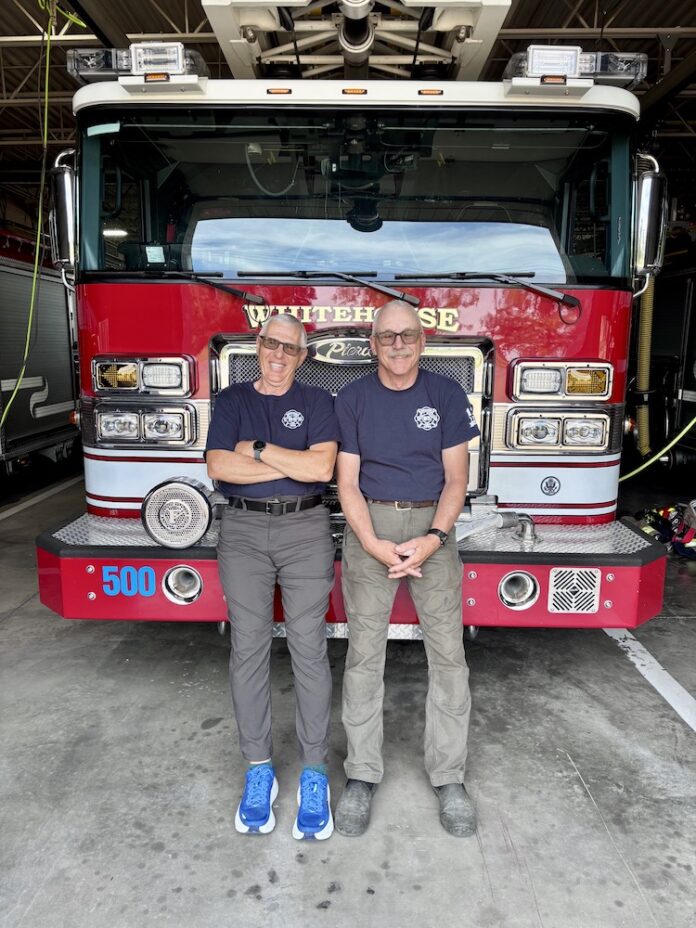
Tom Vincent and Richard Snyder both retired after 31 years of volunteering with the Whitehouse Fire Department. They will serve as the grand marshals in the Cherry Fest parade, which steps off at 1:00 p.m. on Saturday, June 13. (AWFP photo by Karen Gerhardinger)
WHITEHOUSE – When Richard Snyder and Tom Vincent ride in a ladder truck at the front of the Cherry Fest parade as grand marshals on June 13, the two longtime volunteer firefighters will represent not just themselves, but all of the men and women who have volunteered throughout Whitehouse Fire Department’s 130-year history.
“Neither of us have done this for the glory. It’s basically for the love of the community,” said Snyder, whose 43-year firefighting career included 31 years as a volunteer first responder with Whitehouse.
Vincent, a retired physical education, science and health teacher, joined the department as a volunteer in 1995, shortly before Snyder, and retired after serving as a firefighter/EMT for 31 years.
“To me it was very interesting. I’m a person who looks for the next adventure. I’ve had a lot of great opportunities over the years,” Vincent said of his experience as a volunteer.
For Snyder, joining the fire service was a continuation of a family tradition. His grandfather, Lawrence Swick, was one of the founders of the Neapolis Fire Department in the early 1950s. A few years later, his father Robert joined. Snyder has fond memories of sitting atop a fire truck and watching the parade of trucks during the Northwest Ohio Volunteer Firemen’s Convention, and attending other events with his family.
“I’m third generation,” said Snyder, who joined after graduating from Anthony Wayne High School in 1982.
Snyder stayed with the department as it changed names to Providence Township Fire and Rescue, then joined Whitehouse in 1995 when he and his wife – 1981 AW graduate Chris – moved to the village. He brought with him experience from his full-time job as a state firefighter with the 180th fire department, a position he held for 31 years before retiring as a lieutenant in 2021.
Continuing to volunteer with Whitehouse even after retiring from the base allowed him to use his experience to help the community.
“I was the last captain on the volunteer side,” said Snyder, who retired in January 2026. As an officer, he often served as a liaison between the department staff and volunteers.
Vincent said he appreciated Snyder’s ability to explain all facets of the fire service in a way that’s easy to understand.
Growing up on the East Side, Vincent graduated from Cardinal Stritch High School and served six years in the U.S. Marine Corps. The first in his family to graduate from college, Vincent earned a degree in education and began teaching physical education, science and health at Franklin Elementary. That was the beginning of a 35-year career with Toledo Public Schools, during which time he also earned his master’s degree.
“I never left the eighth grade,” he joked.
In addition to teaching, Vincent coached at the junior high and high school levels, including football, baseball, soccer, track and cross country for the now-closed DeVilbiss High School.
Early in his career, he worked for the Chesapeake and Ohio Railroad at the coal docks, unloading ore carriers and loading coal onto lake freighters – including the famed SS Edmund Fitzgerald that sank in a storm in 1975.
“I started at the coal docks in 1966,” Vincent said. “I’ve been at the bottom of the Edmund Fitzgerald pulling ore away from the sides and loading coal. When the Fitz came in, you knew you were going to be there all night if you were a shoveler.”
While he and his wife, Debra, had lived in Toledo most of their lives, it was during an extended house-hunting search that they came across their new home and community. They moved to Whitehouse in December 1991, and a few years later, a neighbor suggested he look into volunteering at the fire department.
“I had no fire experience at all,” he said. “To me it was very interesting. I’m a person who looks for the next adventure. I’ve had a lot of great opportunities over the years.”
With regular training, plus opportunities to take specialized classes, Vincent earned his EMT certification in addition to becoming a firefighter.
Both found a family within the Whitehouse Fire Department, they agreed.
When Snyder and his wife moved from Neapolis to Whitehouse in 1995, a team of fellow volunteers showed up one Saturday morning to help put on new roof.
“I didn’t even ask. Someone asked me if I was working on my roof, and the next morning, six to eight people showed up,” Snyder said.
It was the people that have made the difference in being a volunteer firefighter, Vincent agrees.
“The camaraderie was just super. It was a unique group and it was tight knit and if you needed help you just asked,” he said.
Both men say they’ve witnessed a big change in the fire service, as departments in bedroom communities like Whitehouse struggled to find enough volunteers to cover shifts. More families are busy with children in multiple sports and travel teams, so giving up evenings and weekends to volunteer became a challenge. As the department transitioned to hiring full-time staff, the volunteers continued to fill in for empty shifts due to vacations or illness, and to help out at special events, like Cherry Fest.
This weekend, in between riding in the parade, they’ll help out with the Whitehouse Fire Company’s 73rd annual Chicken BBQ on Saturday from noon until the chickens are gone. The secret recipe for the chicken came from former chief Kenny Rupp‘s in-laws, who ran Vollmar’s Park.
For the two long-time volunteers, retirement will bring new adventures. The Snyders will hit the road in an RV and travel, and Rich is looking forward to not missing family gatherings due to work. Vincent often watches his grandkids, will continue to offer science lessons monthly in Whitehouse Primary School to kindergarteners, and hopes to convince his wife to get an e-bike so they can ride together. And rail or train travel is also on his bucket list.
The parade steps off at 1 p.m. on Saturday, June 13, leaving from Oakbrook Drive and traveling east on Waterville, then north on Providence.
The Anthony Wayne Neighborhood Bridges team includes Amy Barrett, Anne Stevens and Rebekah Hrcka. Stevens shared news of the nonprofit organization during the June 1 Monclova Township Board of Trustees' meeting. (AWFP photo by Karen Gerhardinger)
MONCLOVA TOWNSHIP – The community is bridging the gap for students in need, including in Monclova Township, Anthony Wayne Neighborhood Bridges’ Co-Director Anne Stevens told the audience attending the June 1 Monclova Township trustees’ meeting.
Launched in 2023, the nonprofit, led by Stevens and Amy Barrett, receives support from a steering committee that includes representatives from every AW community – including Kathleen Kuns, the township’s administrative assistant.
Last year, Bridges filled 160 needs for students – everything from coats, shoes and band uniforms to a water heater, furnace, and restarting utilities, Stevens said. And this is all provided by community members who donate.
“We’re trying to level the playing field for kids, so they can gain an education without battling insecurities,” she said, explaining that students are unable to focus at school, for example, if they’re not sleeping well due to lack of a bed or other necessities.
Teachers, counselors, clergy and the school resource officer report perceived needs to District Social Worker Rebekah Hrcka, who then verifies that those needs are real. Hrcka sees if any agencies can help first, then contacts Barrett and Stevens to seek support from the community.
“I know we don’t think there are needs in the Anthony Wayne district, but the needs are amazing,” Stevens said. “When Amy and I started this, we thought we’d be getting coats and boots. At this point, we have gotten hot water heaters and furnaces, paid for [preventing] eviction, restarted utilities and repaired a mobile home that had no floor.”
Those needs are shared with Neighborhood Bridge’s 735 local subscribers, who are notified with one email, sent at 10:02 a.m. Often those needs are met by donors within hours of the email, Stevens said. Directions on how to donate anonymously are shared through the email.
“This is all done confidentially. No one knows who these people are,” Stevens said. “We’ve dealt with helping when utility bills are in the thousands and they don’t have water. We work with the utilities to get the amounts down. Neighborhood Bridges is an emergency relief, not something that will pay the rent every month.
“This has grown so much. It’s been such a blessing to be able to work with Neighborhood Bridges,” she said. “Our mission is to bridge the gap with the community and schools.”
Neighborhood Bridges also has a weekend food bag program in which volunteers get together weekly to pack snacks and other basic food for students to have when they’re not at school receiving a breakfast or lunch. Last December, the group also served 140 students with needed items on a wish list, such as clothing, for a special holiday drive. Recently, Neighborhood Bridges opened General’s Place at Waterville Community Church, which offers cleaning supplies, toiletries and other items not typically available from a food pantry.
AW Neighborhood Bridges receives support from throughout the community, who host collection drives and make donations.
“The AW district is taking care of its people,” she said.
-Heard an update from Administrator Michael Hampton on the roundabout at Albon and Monclova roads. After the meeting, he learned that construction is delayed until Monday, June 15.
-Approved a $1,200 a month maintenance agreement with TrioTech to provide services ranging from emails to cybersecurity to replacing hardware.
-Approved to upgrade the technology in the public meeting room by hiring TrioTech for $3,172 and Design Entertainment at $11,935.93 to upgrade the system.
-Approved the purchase of a 2026 Horton ambulance for $402,852 to replace Medic 93.
-Heard that the Lucas County Engineer is in favor of holding informational meetings at the township hall to answer questions about the ditch petition process.
-Thanked road superintendent and maintenance supervisor Doug Holland for quickly getting someone on scene to handle a grinder pump failure that resulted in a sanitary sewer backup in the fire department bays.
-Set a public hearing for Monday, June 15 at 5:30 p.m. to hear comments about four proposed zoning text amendments that were reviewed May 26 by the township zoning commission – and the Lucas County Planning Commission in the weeks prior. Resident John Langevin expressed concern that the Ohio Revised Code was violated in the timing of those meetings, and provided documentation for the trustees and law director to review.
-Approved increasing the pay for Ryan Grant, the fire prevention officer, by 3 percent.
-Offered the position of assistant fiscal officer to Claire Evans, who has a bachelor’s of business administration from the University of Cincinnati, for $50,000 a year.
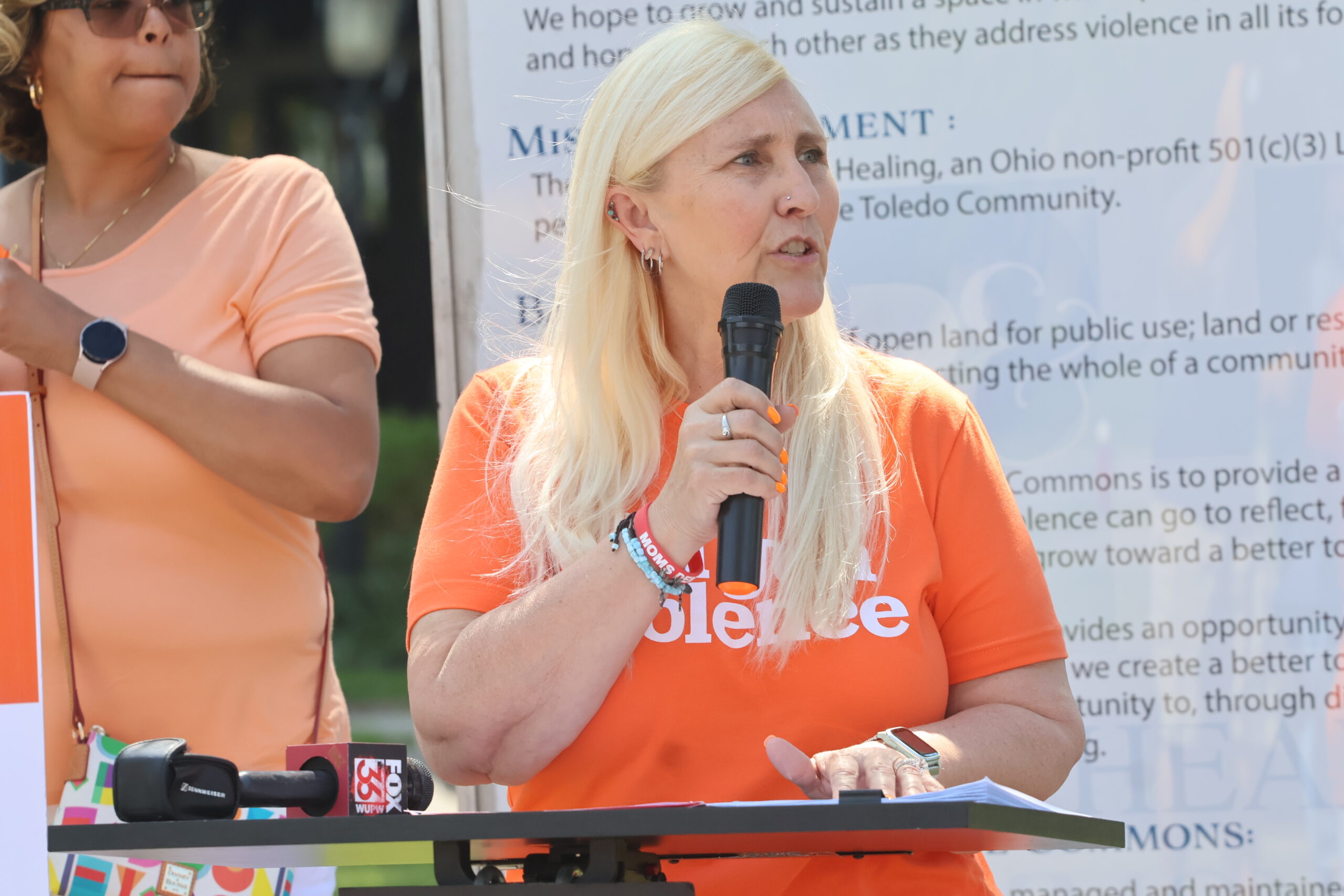
Sherin Henly of Moms Demand Action for Gun Sense in America speaks at a remembrance ceremony in Toledo June 5 to mark Gun Violence Awareness Day. The organization is helping coordinate a gun buyback event on June 13 in Toledo. (TFP photo by Laurie Bertke)
Dismantled firearms to be turned into art and garden tools
TOLEDO — Area residents are invited to safely dispose of unwanted firearms June 13 from 11 a.m. to 3 p.m. at a drive-through event hosted by Monroe Street United Methodist Church.
Organized by the Multifaith Coalition to Reduce Gun Violence and other partners, the event gives community members a secure and responsible way to remove unwanted guns from their homes. Trained staff will handle the disposal of firearms on site, with guns to be dismantled by chop saws or melted down in forges.
Disarmory Ministries, a nonprofit based in Berkley, Mich., is providing technical assistance for the event. Once the guns are dismantled by chop saws, volunteers will be creating artwork on site by reassembling the parts into peace signs or words such as “peace,” “hope” or “love.”
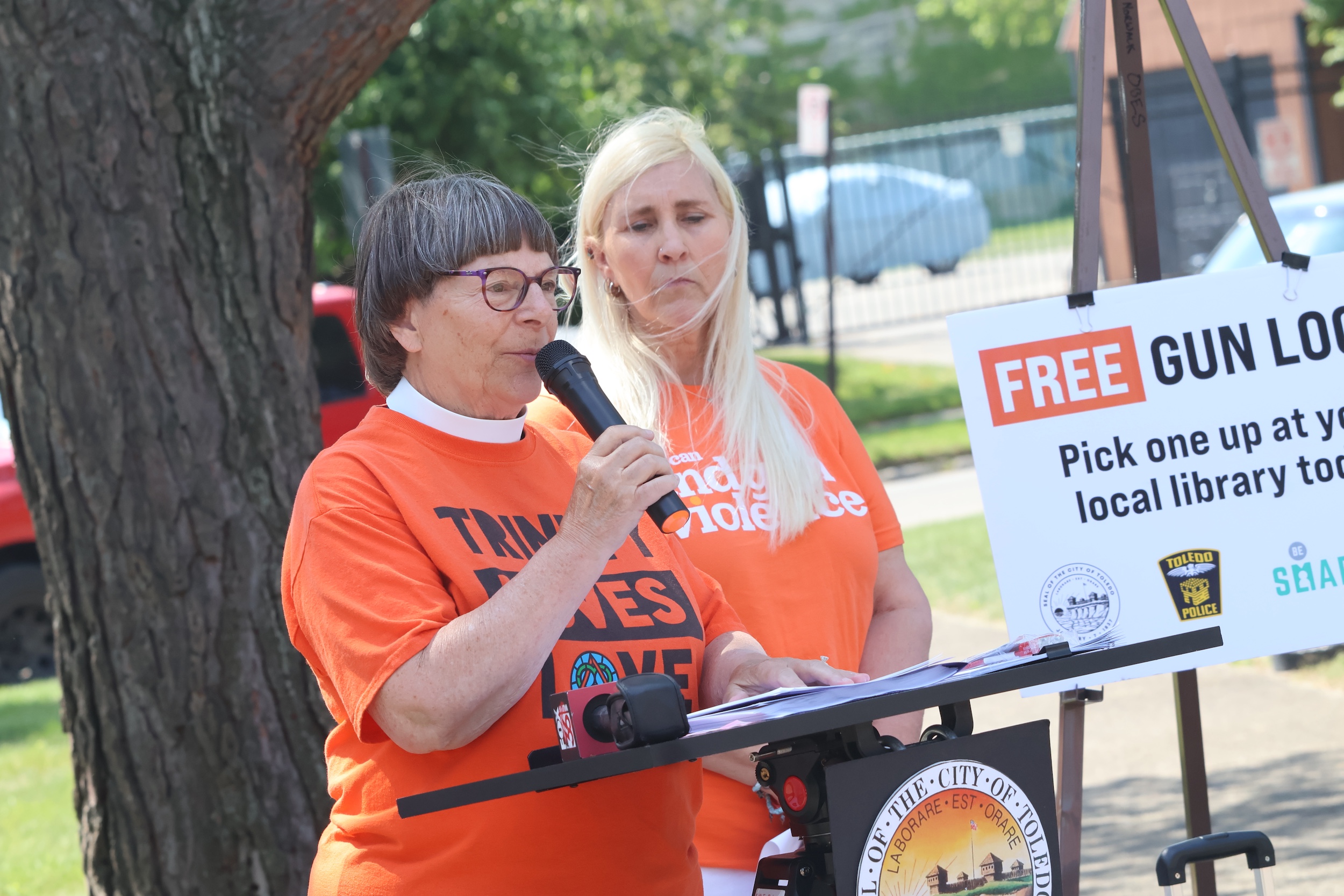
Rev Meribah Mansfield of Multifaith Coalition to Reduce Gun Violence speaks June 5 at a remembrance ceremony for victims of gun violence in Toledo. The coalition has organized a gun buyback event for June 13 in Toledo. (TFP photo by Laurie Bertke)
Pastor Joel Shenk of Toledo Mennonite Church and Rev. Rosalind Hughes of the Episcopal Diocese of Ohio will also be at the event using mobile forges to melt down gun parts and create garden tools in connection with the national Guns to Gardens movement. The concept draws inspiration from the biblical passage in Isaiah 2:4 that describes beating “swords into ploughshares” and “spears into pruning-hooks.”
Gun owners are asked to ensure firearms are unloaded and secured in the back of their vehicles as they drive through the line. When they exit, they are eligible to receive a gift card for Meijer or Kroger in the following amounts, at a maximum of $300 per person:
$50 for long guns
$100 for handguns
$200 for assault-style rifles
Free gun locks and information about safely storing firearms will also be available from the Toledo chapter of Moms Demand Action for Gun Sense in America. Other partners include Northwest Ohio Parents of Murdered Children and Sisters 4 Unity, a local support group for mothers who have lost children to gun violence. A grant from Cities United, a fund of Tides Center, provided support for the event.
Mike Linehan and Rev. Meribah Mansfield co-founded the Multifaith Coalition to Reduce Gun Violence three years ago. (TFP photo by Laurie Bertke)
Sherin Henley, lead survivor for Moms Demand Action, said many young people have become desensitized to seeing guns and even gravitate toward them. “It’s very concerning. It’s an uphill battle, but someone has to fight it,” said Henley. Her son, Darrin Smith Jr., was killed at 20 years old after he stood up to a young man who was shooting a gun in the neighborhood.
“So I picked up that torch. I stand on the hill for fighting gun violence,” said Henley. “If my son can do it, I can do it.”
Approximately 40 volunteers from at least 10 local faith communities are expected on Saturday, according to Rev. Meribah Mansfield, a deacon at Trinity Episcopal Church in Toledo and co-founder of the Multifaith Coalition to Reduce Gun Violence.
The Coalition is a grassroots network of more than 30 faith communities across northwest Ohio working together to promote education, awareness and action around gun violence prevention.
Rev. Mansfield founded the coalition three years ago with Mike Linehan, a layperson from Olivet Lutheran Church in Sylvania. While marching in the Old West End Festival parade with members of Moms Demand Action and representatives from other faith communities, the two realized that many churches already have gun violence task forces in place and thought it made sense to coordinate their efforts.
“Reducing preventable harm bridges across all faiths,” said Linehan.
The coalition has hosted educational forums at churches and built a mailing list with more than 200 people that shares information about local events. They collaborate on the issue with other organizations including the Mayor’s Office of Neighborhood Safety and Engagement (MONSE).
Linehan said the group is not anti-gun, but rather is focused on getting unwanted firearms off the street and out of homes. “It’s about creating a safer community,” he said.
“It’s also about raising awareness about gun safety and gun violence prevention,” added Rev. Meribah.
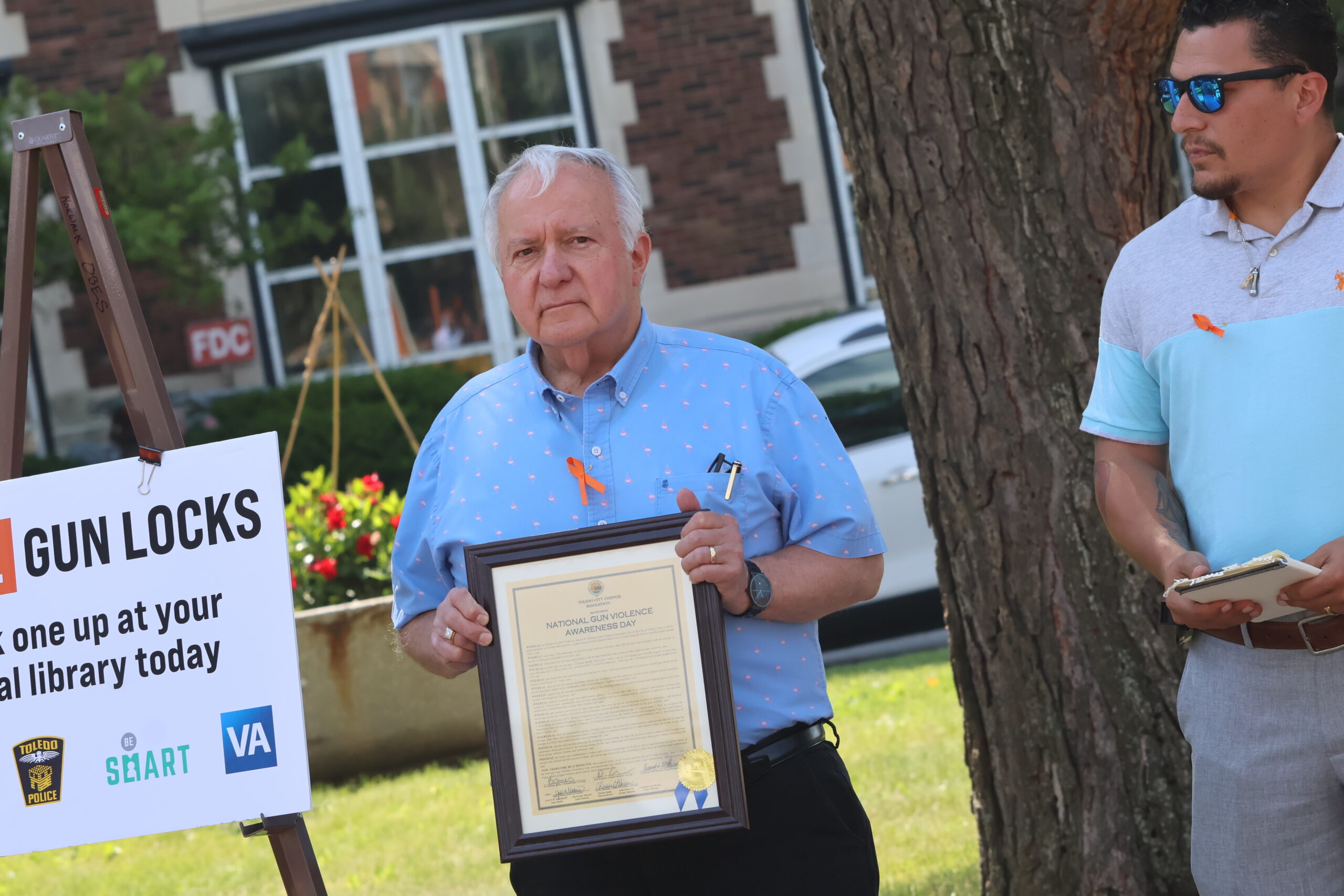
Toledo City Councilman George Sarantou holds a resolution declaring June 2026 Gun Violence Awareness Month during a remembrance ceremony for victims of gun violence on June 5. (TFP photo by Laurie Bertke)
Saturday’s event coincides with Gun Violence Awareness Month. Other related upcoming events include:
Gun Violence Prevention panel at the Main Library on Thursday, June 18 at 5:30 p.m. featuring speakers about the impacts of gun violence and how to get involved to be a part of the solution.
Cease Fire event at the Glass City Picnic Pavilion on Thursday, July 2 from 2 to 6 p.m., a community barbeque and peace-building event planned by the MONSE Save Our Community program.
Save Our Community is hosting summer outreach barbecues focused on violence prevention, youth engagement and summer activities from 12-5 p.m. on June 10 at Willys Park, June 14 at Wilson Park, June 23 at Navarre Park, July 28 at Roosevelt Park and Aug. 5 at Jamie Farr Splash Pad.
In addition, Toledo City Council has partnered with the Toledo Lucas County Public Library to hand out free cable gun locks at all branch locations. According to the Locks Save Lives initiative, safe firearm storage is one of the most effective ways to prevent accidental shootings, youth access to firearms and gun theft. Library patrons can request up to two free gun locks.
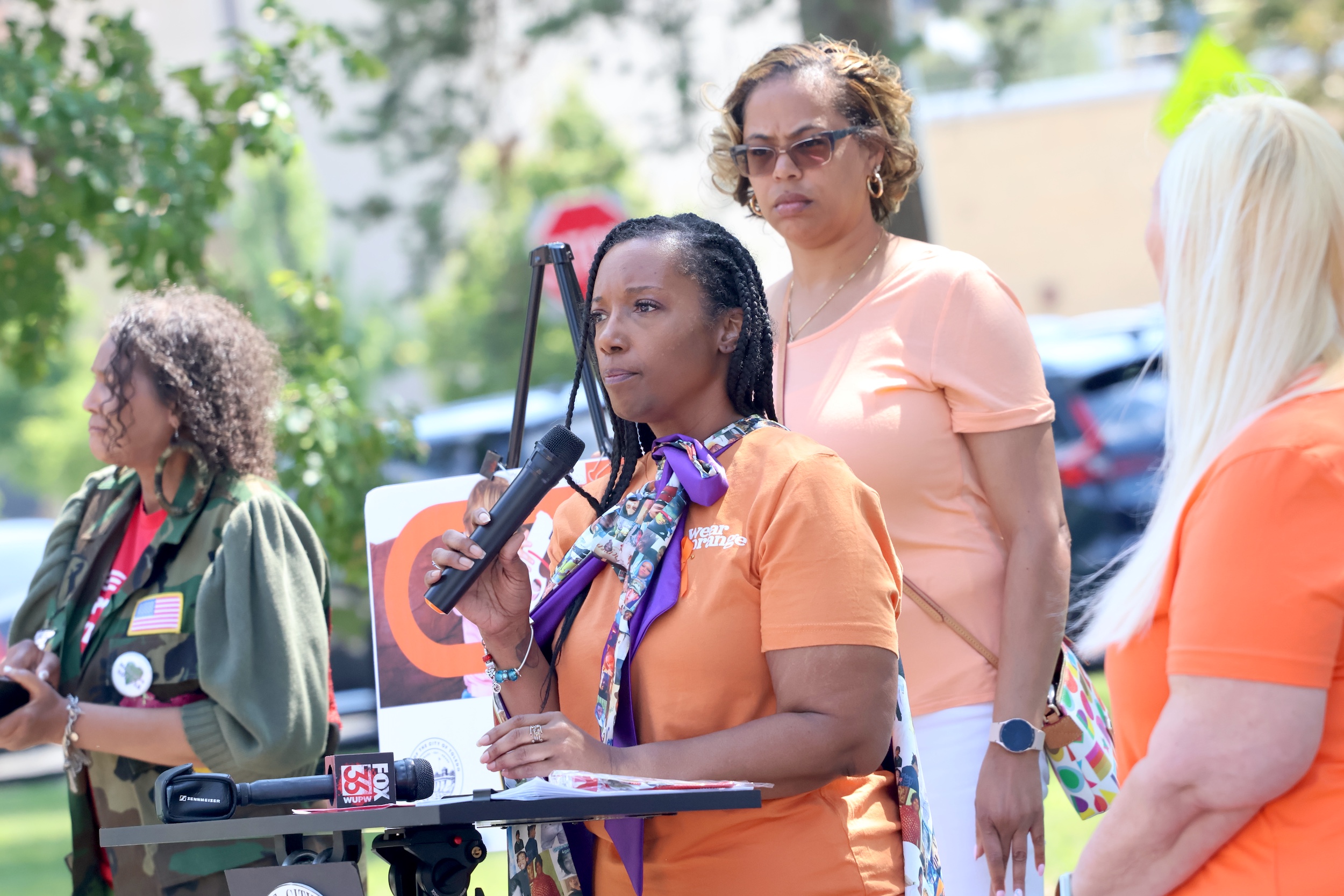
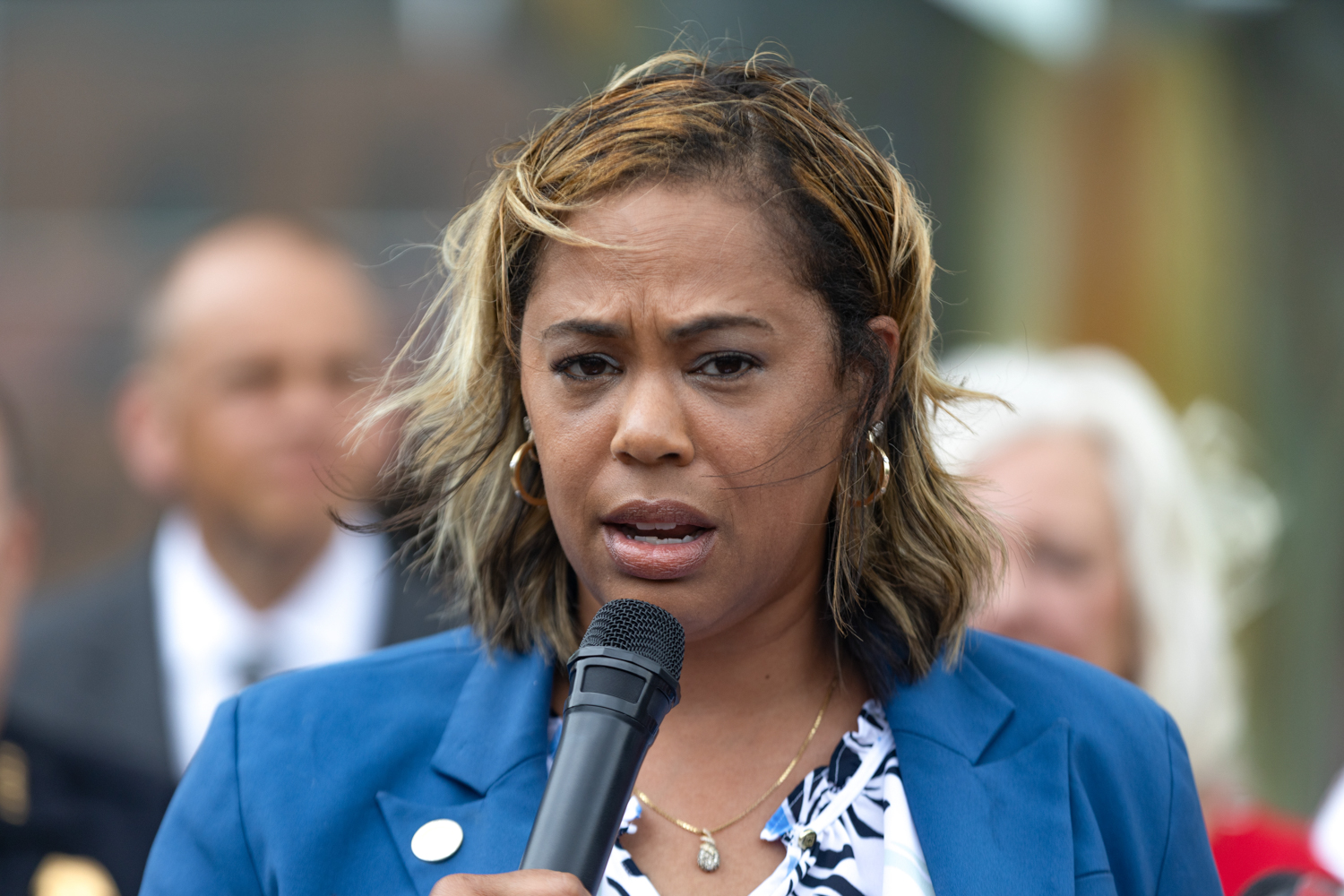
Toledo City Councilwoman Erin Kramer speaks at a remembrance ceremony for victims of gun violence in Toledo June 5 to mark National Gun Violence Awareness Day. (TFP photo by Laurie Bertke)Aviance Hill of Northwest Ohio Parents of Murdered Children speaks at a remembrance ceremony for victims of gun violence June 5, which was Gun Violence Awareness Day. (TFP photo by Laurie Bertke)
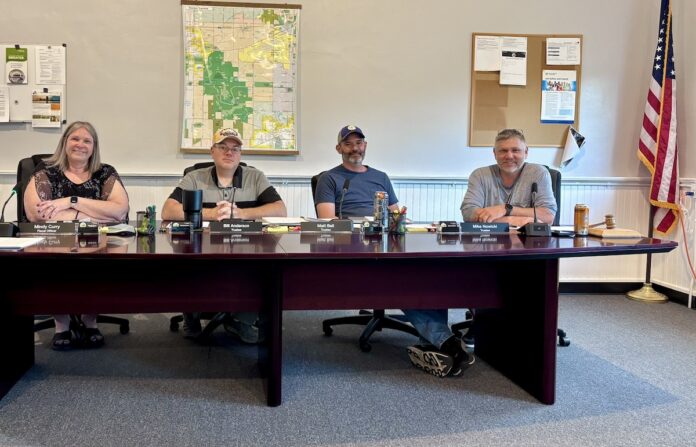
Swanton Township fiscal officer Mindy Curry and trustees Bill Anderson, Matt Beil and Mike Nowicki, discussed the rollout of the new website, http://swantontownshipoh.gov. The trustees and committee members will also have new emails, listed on the site, that have a .gov domain. (AWFP photo by Karen Gerhardinger)
SWANTON TOWNSHIP – Swanton Township’s website and email domain has switched from .org to .gov., Trustee Matt Beil announced during the June 1 meeting.
The new website will be swantontownshipoh.gov, which is more secure and gives people more confidence that the site is a government entity, he said.
The site will have a sign-up for a texting feature that will allow residents to receive text messages regarding meetings, special events, safety issues and road closures, Beil said.
“We want to be transparent and communicate fully,” said Beil, asking Fiscal Officer Mindy Curry about sending post cards to send to all residents to notify them of the change. “We want to provide as many options for notice as practical.”
The website re-design was suggested and recommended by the board to make the site more in line with current standards, such as ADA requirements, and to allow the board to make daily changes to the site, he said. A webmaster will be contracted for reviews and ADA compliance, he added.
The township has also implemented steps to become compliant with Ohio House Bill 96, which outlines steps for local governments to address cybersecurity. FalconForge AI is preparing the township to be compliant by July 1, while TrioTech of Whitehouse will manage IT on an ongoing basis. The township will continue to undergo mandatory training for cybersecurity throughout the coming months.
During the June 1 meeting, the trustees also:
-Agreed to look into offering a bulk drop-off for larger refuse items by having dumpsters placed somewhere in the township for a day. The rate quoted to Beil was $500 per rolloff per day. He will look into other quotes and possible days to offer that service and announce it on the website and Facebook pages.
-Held a public hearing on the 2027 budget that Curry will submit to the county auditor. Residents, including Colleen Baird, asked about some changes she noticed in the funds from one year to the next. Curry explained that she worked with the state auditor to make sure funds were assigned to the correct fund, such as placing the garbage fees in the General Fund not the Roads and Bridges Fund as it was previously. Curry noted that the state auditor does not review the full budget, but just a sample, when doing an audit of the books – someone one resident pointed out was disconcerting.
-Heard that work on a roundabout at Providence-Neapolis-Swanton and Archbold-Whitehouse is set to start on Monday, June 15 with a 45-day closure. The start date of a roundabout at Monclova and Wilkins has not yet been set.
-Listened to Springfield Fire Chief Jonathon Ziehr say that the department responded to 13 calls for service in the northern half of the township in May, including two fire-related incidents and 11 EMS. The department has undergone training at the Baymont Inn in Spring Meadows, which is set to be demolished. Crews trained with breaching doors and walls, search and rescue and other exercises.
-Heard a resident ask Ziehr about training with the railyard, in light of a 2023 train derailment in East Palestine, Ohio that led to the spill of hazardous chemicals. Ziehr said that as a result of that incident, all departments now train continuously. Norfolk Southern offers local training and railyard training in Texas. Ziehr made the railroad aware of issues with rail cars that were filled with coal and sitting in the local railyard. If the stock is not being rotated as needed, this can pose a fire risk. Since his discussion with Norfolk Southern, changes have been made to lessen that risk, he said.
-Discussed a need to chip and seal Sager Road and the east side of Reed Road.
-Learned that Interstate Capital acquired 15 parcels totaling 112 acres in the Land-Air Commerce Park and is interested in changing the zoning. The township zoning board is requesting that the rezoning be done for each of the parcels rather than as a whole.
-Heard that Zoning Inspector Ben Mooney is working with the owner of 12565 Airport Hwy. to address issues.
-Learned that a ditch near Brindley Road is washing out the pavement and undermining the integrity. Trustee Bill Anderson is working with the county to come up with mitigation solutions. One resident asked whether Brindley was a village property – a matter that Anderson will check with the county.
-Approved policies that require the township zoning board and Board of Zoning Appeals to post any public hearings or meeting dates 24 hours in advance online and on Facebook, as well as a posting at the township hall.
-Discussed how none of the members of the BZA have responded to requests to see if they are still interested in serving on the board. The terms are five years and the BZA has not met in several years. The BZA will now be required to meet every January in an organizational meeting. Mike Nowicki said he will try to contact the members via letter.
-Heard a resident ask that the crews mowing the cemetery look out for the poles holding flags for military veterans, as she noticed some that were bent.
-Learned that Mooney is beginning the process to update the township zoning resolution to bring it up to standards. It was last updated in 2008.
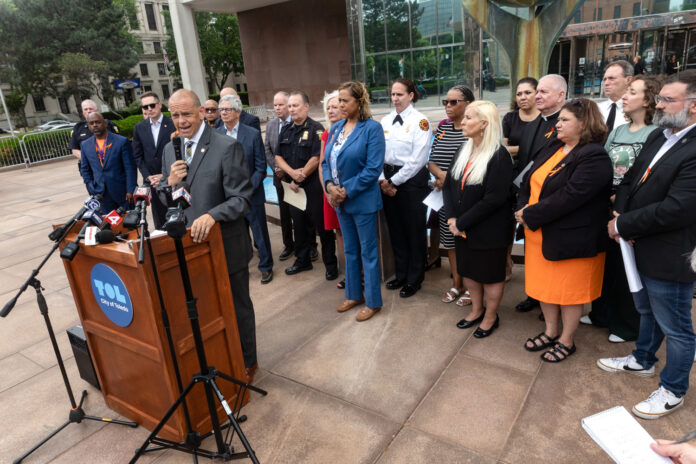
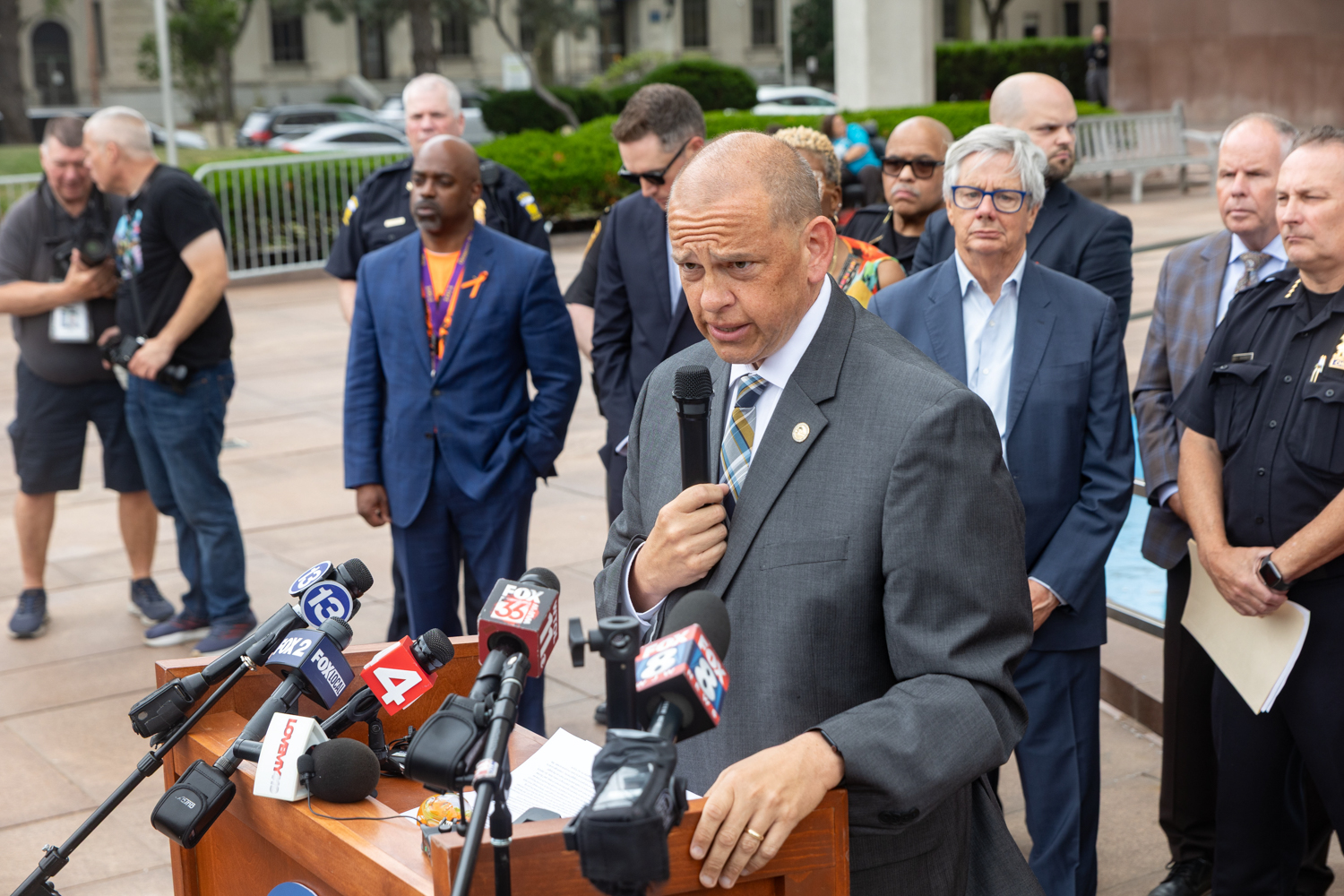
Wade Kapszukiewicz, mayor of Toledo, speaks during a press conference updating the public on the Old West End Festival shooting with Toledo leaders on the steps of City Hall, 1 Government Center, in Toledo, Ohio on Tuesday, June 9, 2026. The mayor touched on preventative solutions for gun violence and the resilience of Toledo as a city. (TFP photo by Stephen Zenner)
*Latest news on the story as of Wednesday morning, June 10: The Toledo Police Department released a statement that they have issued a warrant for Ka Nye Taylor, 20, Black male, 5’11, 130 lbs., with black hair and brown eyes, in connection with the June 6 shooting at OWEF. The police also have photos of a second shooter and are looking for tips on his whereabouts.
A statement from TPD reads: “Following numerous interviews and investigative leads, arrest warrants have been issued for Ka Nye Taylor, who is wanted on 11 counts of Felonious Assault in connection with the June 6, 2026, shooting at the Old West End Festival.”A statement from TPD reads: “Investigators have also obtained photographs of a second shooter and are seeking the public’s assistance in identifying him.”
Anyone with tips can call Crime Stoppers at 419-255-1111. An award of up to $10,000 through Crime Stoppers is on the table for information provided leading to an arrest. Find the full TPD Facebook post here.
TOLEDO – In his first in-person appearance to the press since the Old West End Festival (OWEF) shooting on Saturday, Mayor Wade Kapszukiewicz talked about taking a multifaceted approach to curb gun violence and about finishing the OWEF later this year.
“What happened on Saturday is not normal…It’s something that we have to address, so we welcome the scrutiny, and look forward to telling Toledo’s full story,” Kapszukiewicz said at the conclusion of his planned address concerning the OWEF shooting.
Grateful that there was no loss of life amongst the 12 shot, Kapszukiewicz confirmed that none of the individuals who were hospitalized because of the shooting are in critical condition anymore. But even without the loss of life, Kapszukiewicz said Toledo is hurting due to a loss of innocence over the weekend.
Wade Kapszukiewicz, mayor of Toledo, speaks during a press conference updating the public on the Old West End Festival shooting with Toledo leaders on the steps of City Hall, 1 Government Center, in Toledo, on Tuesday, June 9, 2026. The mayor touched on preventative solutions for gun violence and the resilience of Toledo as a city. (TFP photo by Stephen Zenner)
Gun reform
“There are a number of things that need to happen as a result of Saturday,” he said, and contextualized the shooting as the 174th mass shooting in the United States this year.
“One,” of the main things Kapszukiewicz said needed to be addressed was that “we are the only country in the world where mass shootings happen with any sort of regularity.”
“We are the only country in the world where there are more guns than human beings,” he said and began to lay out stats on mass shootings, gun-to-people ratios and how much more prolific guns are in the United States than in any other country in the world.
Politically, the mayor doubted gun reform would happen at the national level, but painted gun reform as the easiest, most pragmatic solution.
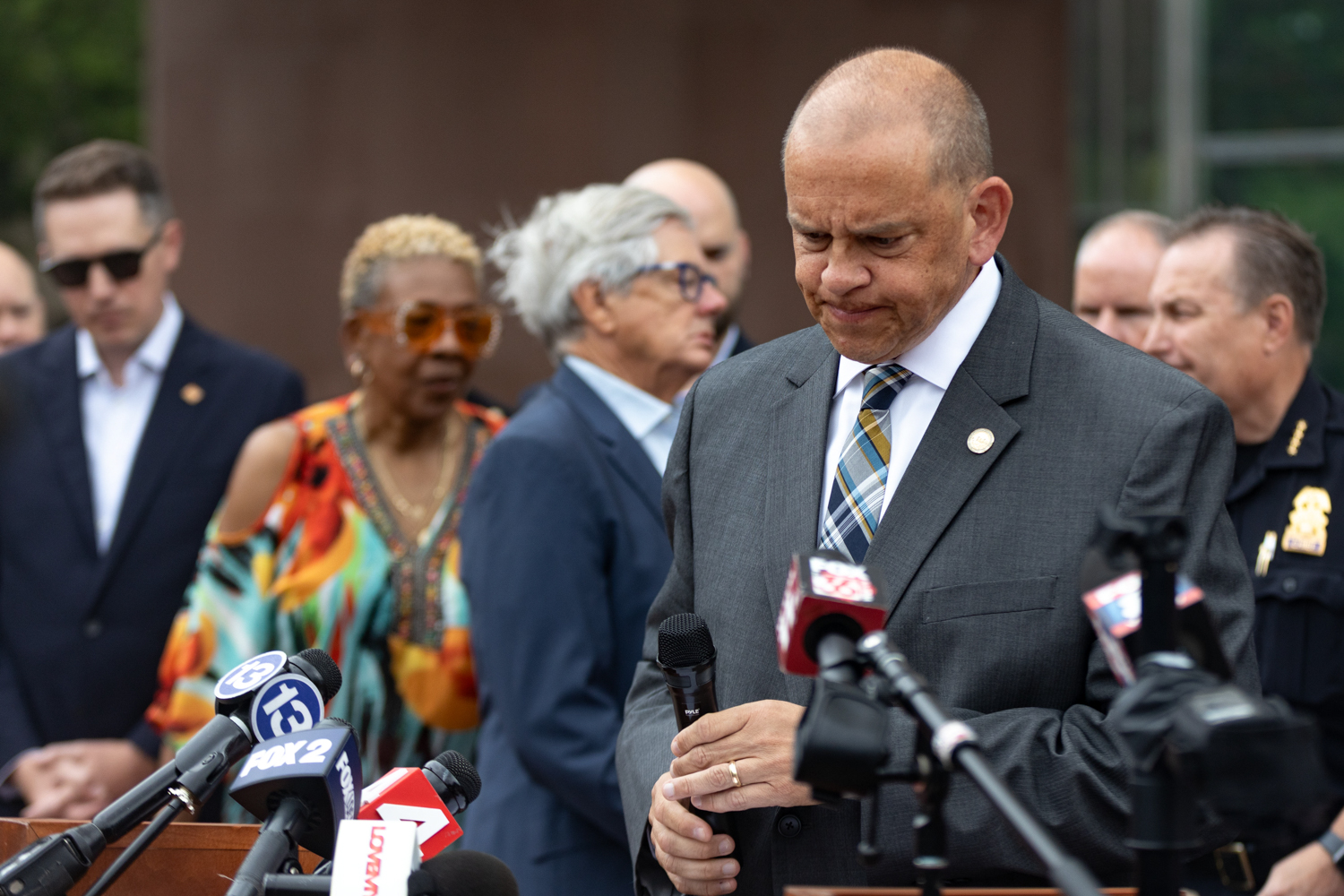
Wade Kapszukiewicz, mayor of Toledo, pauses before answering a question during a press conference updating the public on the Old West End Festival shooting. (TFP photo by Stephen Zenner)
Community approach
“There are local actions that we can and need to take, and actually all of us need to take them,” the mayor said.
Community responsibility was alluded to for parents, young people, faith leaders, police and local government.
“We are two hours into the second business day since this event happened, and so we don’t have any policies or procedures or ordinances that we’ve passed, but we’ve already begun to debate them,” Kapszukiewicz said.
Wade Kapszukiewicz, mayor of Toledo, prepares to speak during a press conference updating the public on the Old West End Festival shooting with Toledo leaders on the steps of City Hall, 1 Government Center, in Toledo, Ohio on Tuesday June 9, 2026. TFP Photo/STEPHEN ZENNER
“And I think going forward, you are going to see some change in how we handle certain events.”
Wristbands to confirm a 21-and-older age, more opportunities for cameras and more searches of bags were pragmatic steps the mayor suggested concerning events.
Ultimately, Kapszukiewicz put a limit on the ability of these reforms to effectively curb gun violence, pointing out that a curfew wouldn’t have stopped the shooting that happened around 5:30 p.m., and that “the series of events that produced Saturday all began when a police officer checked a book bag.”
“In other words, even when the policies that we imagine may be put in place to address something like this, the exact same things could have happened.”
Forward
Transitioning away from countering gun violence, Kapszukiewicz focused on making Toledo a better place.
He highlighted an economic development conference on Wednesday, and also said, “I think we should finish the old West End festival” in late summer or early fall.
“I think if the national media sticks with us long enough to see how we respond, they will see a resilient, tough, gritty city.”
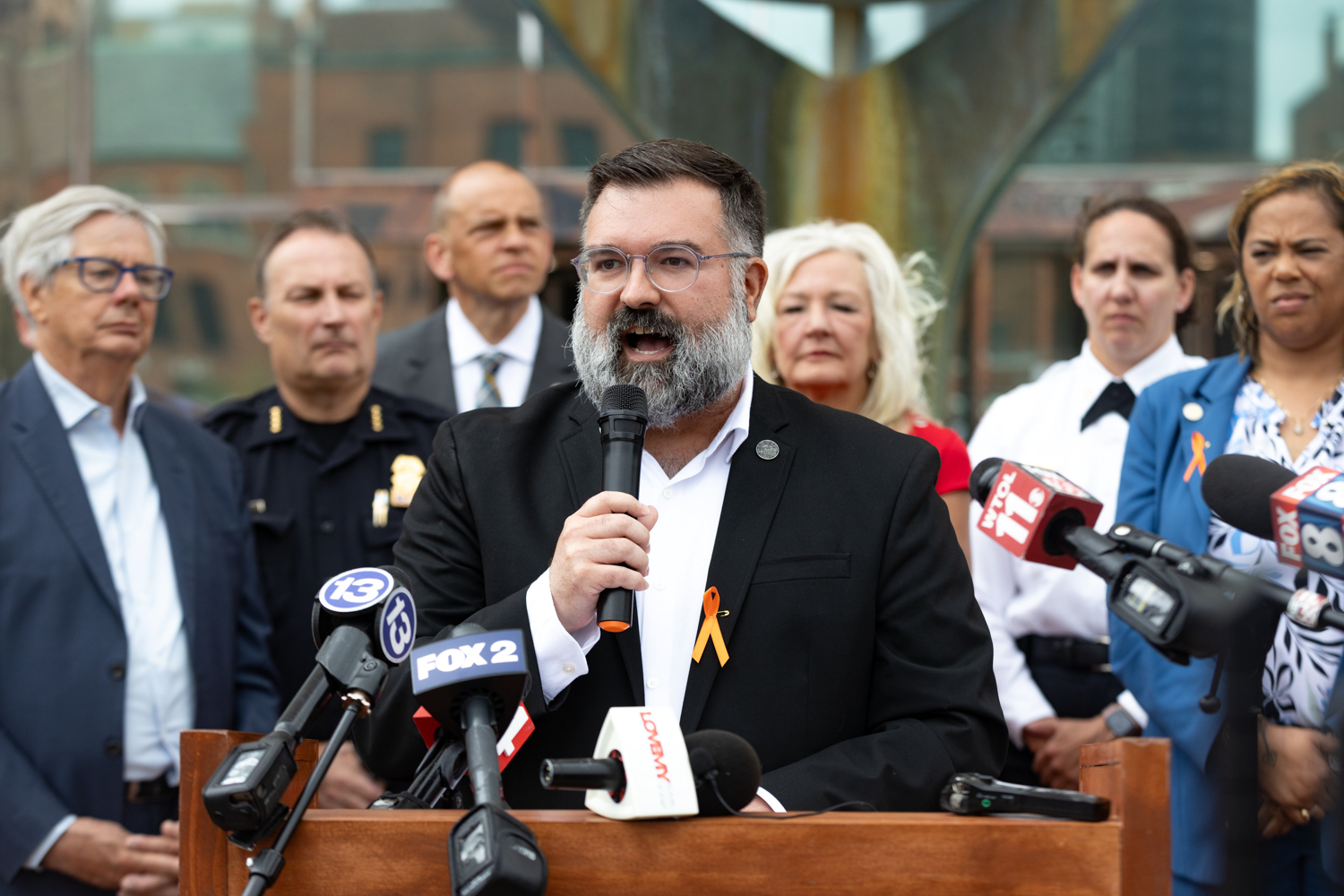
Michael Troendle, Toledo police chief, updates the public on the investigation into the Old West End Festival shooting. (TFP photo by Stephen Zenner)
Updated investigation
Toledo Police Chief Michael Troendle spoke expressing gratitude to a series of different groups and law enforcement entities assigned to the Old West End during the festival, and interspersed new information on the shooting.
“Investigators believe this incident stemmed from a dispute involving two rival groups,” Troendle said, and spoke with confidence during the Q&A about this as a fact based on video evidence. “This is most definitely two groups that were disrespecting each other, and that led into a little bit of a foot chase,” he said later.
Three of the 12 victims appear to have been involved with the responsible parties.
“Investigators have also recovered two firearms believed to be connected to this incident, which are currently being processed and examined as part of the ongoing investigation.”
During the Q&A, Troendle said those two firearms were recovered through interviews with several people of interest.
Regarding the incident with the backpack, Troendle provided this clarity: “One of the deputy sheriffs actually grabbed the bag and was going to check the bag, and another kid snatched it and ran off with it. Because there was a firearm inside the bag.”
No one has been arrested yet, and from the law enforcement side, Troendle said they did not have any indication that the shooting was about to happen. But at the end of questions, Troendle identified the suspects as Black men between the ages of 18-24 years-old.
Troendle said on staffing for the OWEF, “We had an adequate number of officers at this event to try to maintain safety at the event. Unfortunately, you know, there are incidents that happen rapidly, and unfortunately, we are not clairvoyant.”
Troendle went over the safety precautions in place at the festival.
“17 law enforcement officers were specifically assigned to the old West End festival,” an additional “30 officers working throughout the district, including four officers assigned to the perimeter surrounding the festival,” two mobile cameras were deployed inside the festival and 14 Ohio State Highway Troopers were deployed after the shooting occurred.
Old West End advocates
A heartfelt address was given by At-Large City Council Representative Nick Komives, a resident of the Old West End.
“Governor DeWine has expressed concern after the shooting, as he has after others, but concern is not a policy; sympathy is not a solution,” he said, and offered more pragmatic steps towards gun regulation.
“Families deserve more than statements after tragedies. They deserve leadership before tragedy occurs. Ohio needs action. We need stronger penalties for illegal gun trafficking and straw purchasing. We need investments in violence interruption programs to identify conflicts before they become shootings.
“We need greater support for community-based intervention efforts that connect young people with mentors, jobs, and opportunities. We need safe storage requirements to keep firearms out of the hands of those who should not have them.
“We need stronger tools for our law enforcement and courts to intervene when credible threats of violence emerge, and we need sustained funding for mental health services, trauma recovery, and neighborhood-based prevention efforts.
“None of these measures alone will end gun violence, but doing nothing guarantees that it will continue.”
Nick Komives, Toledo City Council representative At-Large, speaks on preventing gun violence and the impact and resilience of the Old West End neighborhood. (TFP photo by Stephen Zenner)
President of Council and Representative for District 4, which includes the Old West End, Vanice Williams offered a few short words following Komives.
“There’s an event on June 13, this Saturday, at 11 o’clock at Monroe United Methodist on Monroe Street. They are having a gun buyback program,” she said.
Additionally she referenced, “The Healing and Compassion Fund, you can give to the Healing and Compassion Fund that helps survivors of gun violence at the United Way.”
All present expressed gratitude for the first responders, solidarity with the affected community and a firm resolution that the shooting would not define the people, community, neighborhood of the Old West End or the city of Toledo.
Vanice Williams, president of Toledo City Council and representative for District 4, which includes the Old West End, speaks of her experience the day of the shooting and some practical steps against gun violence. (TFP photo by Stephen Zenner)
Monsieur William Kubacki, a resident of the Old West End for 18 years and the Rector of Rosary Cathedral for 14 years, closed the press conference in prayer.
“May God’s gracious blessing fill us with hope, peace, and joy,” he said.
The Cherry Fest will take place in Whitehouse Park Thursday, June 9 through Saturday, June 11 with rides, food and plenty of music. (AWFP photo by Karen Gerhardinger)
WHITEHOUSE – With 15 musical acts, and the Anthony Wayne Marching Generals leading the parade, the three-day Whitehouse Cherry Fest promises a toe-tapping good time.
“This year, our festival is a music-lover’s celebration and a chance to gather with neighbors, family and friends while enjoying the great vendors, events, food and rides you’ve come to love,” said Zak Weimer, president of the Anthony Wayne Community Chamber of Commerce, which hosts the event.
Held Thursday, June 11 through Saturday, June 13 in Whitehouse Park, the Cherry Fest is open rain or shine, with free parking and free admission. Opening ceremonies are Thursday at 6 p.m. in the park pavilion.
Thursday
Thursday is Military Appreciation Night, raising funds for Task Force 20. Founded by 1998 AW graduate and Army veteran Jason Graven, the nonprofit TF20 provides one-year, paid-in-full gym memberships, personal training and camaraderie-building events for military veterans. Head over to the Beer + Wine Garden at 6:30 p.m. to enjoy food by Big Qs BBQ and music by Baja Fog at 6:30 p.m. and the Justin Marchand Trio at 8 p.m. Tickets are $5 and proceeds benefit Task Force 20.
Rides are open from 6 to 10 p.m. with wristband specials. At 7 p.m., Little Miss Cherry Blossom, Junior Miss Cherry Blossom and Cherry Fest Queen will be crowned in the pavilion, followed by a demonstration with Turner Martial Arts at 8 p.m.
The Skittle Bots will perform on Friday, June 10 at 7 p.m. in the Beer + Wine Garden at Cherry Fest. Tickets are $5. (Courtesy photo)
Friday
Festival hours are noon to 11 p.m. with street vendors open until dusk and rides open from 1 to 11 p.m.
Four bands are on the lineup for the Pavilion Stage: Jon Breyfogle, 1 p.m.; Terry & Charlie, 3 p.m.; the Ben DeLong Band, 5 p.m.; and the JT Hayden Band, 7 p.m.
Hit & Run will perform on Friday, June 10 at 4:00 p.m. in the Beer + Wine Garden at Cherry Fest. (Courtesy photo)
The Beer + Wine Garden is open from 4 to 11 p.m. with Hit & Run performing at 4 p.m. and the Skittle Bots at 7 p.m. Tickets are $5. Purchase a commemorative wristband for $5 and gain admission into the Beer + Wine Garden both nights at no additional cost.
For those entering a cherry dessert in the competition, drop off is by 6:15 p.m. with judging beginning at 6:30 p.m.
Saturday
Festival hours are 9 a.m. to 11 p.m., with vendors open from 9 a.m. to dusk and rides open from noon to 11 p.m.
Stop by the Whitehouse Historical Society’s 1840s log home for a tour from 11 a.m. to 4 p.m. Along the way, also visit Ludwig Watch, Clock and Jewelry at 19094 Maumee St. from 10 a.m. to 5 p.m. Kids can search the sand for a gem to take home on an elastic necklace or bracelet.
Whitehouse Fire Company is hosting its 73rd annual Chicken BBQ in the park, with delicious grilled chicken from noon until the meals sell out. Just follow your nose to the park shelterhouse. Meals are $14 and chicken only is $9. Bring cash, or pay a 5 percent additional fee for credit cards.
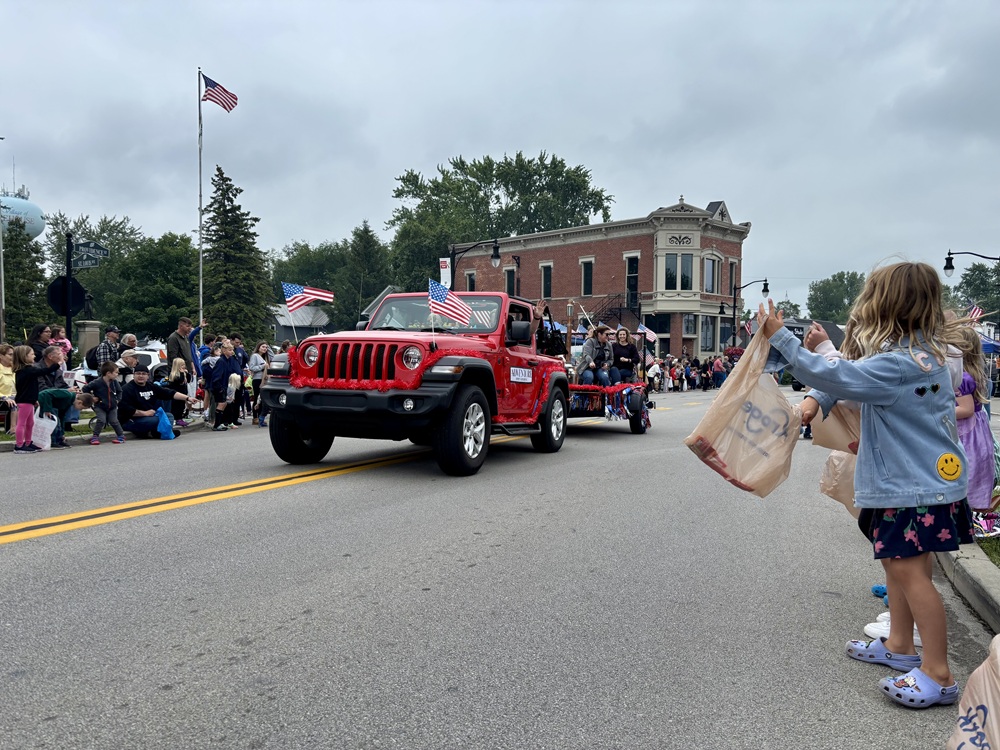
The Cherry Fest parade, sponsored by Adventure Spirits Distilling, steps off at 1:00 p.m. on Saturday, June 11. (AWFP photo by Karen Gerhardinger)
Bring a chair, blanket and a bag to hold candy for the Cherry Fest Parade, presented by Adventure Spirits Distilling, which steps off at 1 p.m., leaving Oakbrook Drive, heading east on Waterville Street and north on Providence Street by the park, ending at Whitehouse Primary School.
Among the more than 50 parade entries will be grand marshals Richard Snyder and Tom Vincent – who recently retired after more than 30 years of serving as volunteer firefighters with the village. The Whitehouse American Legion Post 384 Color Guard, the Anthony Wayne Marching Generals, churches, local organizations, sports teams and the village mayor and council, along with kid mayor and council, are among the participants in the parade.
Following the parade, sign up to get your fill of cherry pie, with a pie-eating contest in the park pavilion at 2 p.m.
Jackson Price will present a tribute to Michael Jackson at noon on Saturday, June 11 in the Whitehouse Park Pavilion. He will be joined by Silent M. (Courtesy photo)
Throughout the day, expect to be entertained. At noon, Jackson Price pays tribute to the King of Pop, Michael Jackson, on the Pavilion Stage. The Shutters Trio, featuring Chris Shutters, Muddy Shutters and their four-year-old son, Bowen, on drums, will entertain beginning at 3 p.m., followed by Kaiden Chase at 5 p.m. and Vinyl on Tap at 6 p.m.
The Beer + Wine Garden is open from 2 to 11 p.m. and will feature three bands on its main stage: Strawberry Kush at 2 p.m., EZ Pickenz at 4 p.m. and Distant Cousinz at 7 p.m. Tickets are $5, or free for those who purchased a $5 commemorative wristband on Friday.
Throughout the event, the village police and management will be focused on the safety of residents, visitors, vendors and event staff, said Police Chief Allan Baer. Expect significant law enforcement presence, with officers patrolling the festival grounds, surrounding neighborhoods, parking areas and other high-traffic areas.
“Our officers will be proactive in addressing unruly, disorderly or unlawful behavior to ensure that everyone can enjoy a safe and family-friendly atmosphere,” Baer said. “While our officers will be working diligently throughout the festival, public safety is a shared responsibility. We encourage everyone to remain aware of their surroundings and immediately report any suspicious activity, concerning behavior, unattended items, or situations that appear out of place. By working together, we can make this festival a safe, enjoyable, and memorable event for everyone.”
U.S. Senate candidate Sherrod Brown (D-Ohio) speaks to supporters and the press, in Toledo, on June 2, 2026. (TFP photo by Jaden Jefferson)
TOLEDO — After former Ohio U.S. Senator Sherrod Brown lost reelection to a fourth term back in November of 2024, it would be a few months before he re-entered the political scene. But in August of last year, the Democrat announced that he was going to give it another go.
His 2024 loss, by 3.6 points, was noteworthy in the context of President Donald Trump’s 11-point victory in the state. Brown’s margin of defeat, by Republican Bernie Moreno, is indicative of ticket-splitting, a phenomenon in which voters don’t entirely vote along partisan lines. In this case, many Republican-leaning voters who chose Trump for president also voted for Brown in the U.S. Senate race rather than going with GOP nominee Bernie Moreno.
While 2024 was likely a major disappointment for Brown, it is from that same source that he derives confidence about his chances this time around. Speaking to a group of supporters in Toledo one week ago, the three-time U.S. senator pointed to his overperformance that year as a sign that, in 2026, things will be different, particularly as a result of the president’s unpopularity in his second term.
What could also be different for Brown this year is the strength of his Republican opponent. While then-candidate Moreno lacked statewide name recognition and faced negative publicity over lawsuits filed against him from his time as a car salesman, Husted’s fortunes, thus far, have been a bit kinder.
While his name recognition doesn’t quite match Brown’s, despite years in the role of lieutenant governor and other statewide elected offices, Husted hasn’t seen as much negative publicity — though the Brown campaign and Ohio Democrats have criticized him for comments he made about those experiencing poverty, namely that “they’re not very experienced at navigating the real world.”
Cleveland’s WJW reported that Husted, in an interview, “explained that he was relaying a conversation he had with a woman who spent nearly three decades on food stamps.”
As the Brown campaign seeks to characterize this race as being between a candidate who knows the struggles of working people and an incumbent who’s out of touch, Husted’s campaign aims to characterize Brown as a Washington insider who overstayed his welcome and Husted as the face of something fresh.
Regardless of the candidate whose story voters find most convincing, that person won’t serve a full term after being elected in November. Husted, who currently occupies the senate seat Brown is seeking, was appointed to it by Gov. Mike DeWine, following then-Senator JD Vance’s ascension to the vice presidency. This is a special election that will determine who finishes out the last two years of Vance’s term. The seat will be up for grabs again in 2028, an election that will decide who gets to serve out a full, six-year term. That could, again, be a contest between Brown and Husted, or different candidates.
Returning to Brown’s Tuesday remarks, he also expressed confidence in the Democratic candidate for governor, Dr. Amy Acton, who polling has shown to be in a tight race against Republican Vivek Ramaswamy.
With regard to his own race, he spoke of wanting “to get this country back on track,” but “not to go back exactly to what we were.” On the same day of his event in Toledo, Brown’s campaign debuted a new ad in which he calls for a ban on stock trading by members of Congress and their spouses. During his senate career, Brown has been a part of bipartisan efforts to ban congressional stock trading, including in 2023, though without success. Despite a lack of success in the past, Brown told the Toledo Free Press that he’s “seen the number of votes [in support of a ban] grow” each time the issue has come up.
This AI-generated rendering from ODOT shows what the bridge may look like after the spandrel
walls and dirt are removed. (Courtesy rendering)
WATERVILLE – In a unanimous vote, Waterville City Council approved the purchase of the 118-year-old Roche de Boeuf Interurban Bridge on June 8.
“Heroes, all of you,” said Save the Bridge Association member Janice Braida, leading a round of applause from the audience.
The city will pay the state $1.00 to purchase of the bridge once it is stabilized – and therefore insurable. Kokosing won the Ohio Department of Transportation (ODOT) contract to remove the bridge at a cost of $3.1 million, but after working with STBA, the city and Gov. Mike DeWine, ODOT asked Kokosing for a change order on the project. That new scope includes a partial demolition –removing the spandrel walls, fill dirt and the chunks of concrete in the river. That estimate came in around $4.2 million. Federal funds for the state to have the work done will cover up to $4.4 million.
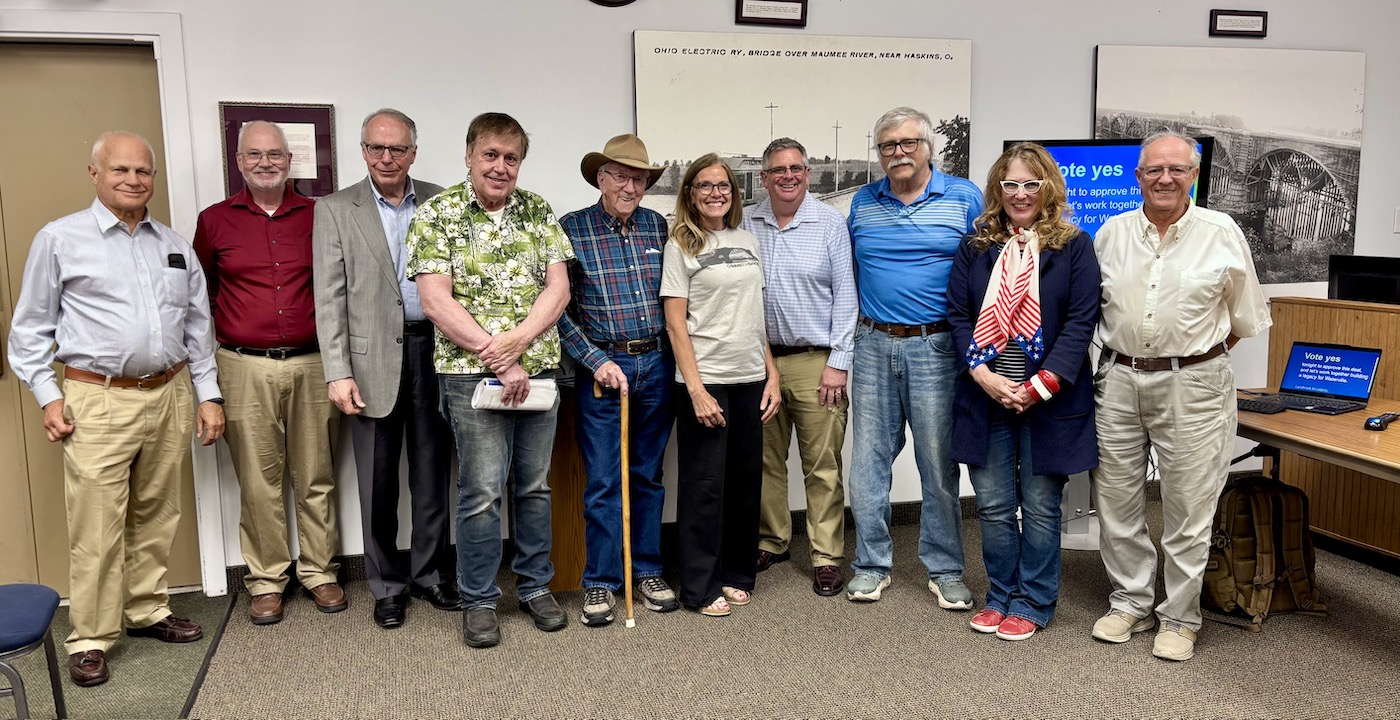
Those who were involved in saving the bridge gathered after the meeting, including (from left) John Wasserman, Bill Vermes, John Rozic, Dave Weber, Dave Myerholtz, Barb Bruno, Rex Childers, John Pautz II, Janice Braida and Frank Butwin. (AWFP photo by Karen Gerhardinger)
Most of the cost is in installing a causeway and hauling out debris, said Municipal Administrator Jon Gochenour. If the bridge doesn’t collapse and is stable after the process, the city will take ownership and move on to the next step – working with STBA to raise funds to install a pedestrian and bike path on top of the remaining structure.
“We still have to work out the details of the transfer and purchase agreement,” Gochenour said of the sale.
ODOT District 2 Deputy Director Pat McColley said that, while he hasn’t seen the proposed changes to the agreement, he is encouraged by the progress made.
“We understand the city’s sentiment for this historic structure and their passion to continue looking for solutions” he said. “In the last couple months, there has been renewed energy and productive conversations with the mayor and his team. The option that we are talking about today was not an option anyone explored prior to the last 60 days.”
Waterville City Council unanimously approved the purchase of the 1908 Roche de Boeuf Interurban Bridge for $1.00 from the state. Work on removing the spandrel walls and fill dirt, as well as fallen concrete submerged in the river, will begin in July. (AWFP photo by Karen Gerhardinger)
Civil engineer Bill Vermes, who is experienced in saving historic bridges, and retired concrete contractor John Pautz II stepped in to help STBA come up with a plan. During the June 8 meeting, Vermes answered multiple questions from council members as to the condition of the bridge and potential life span of the piers and arches that would remain.
Council members Rod Frey, Scott Jahns and Wayne Wagner admitted that they all struggled with the idea of taking responsibility of the bridge, but credited what council member Nick Sargent called “the dream team” for addressing their concerns.
“As a body here, we didn’t take this lightly for our citizens. This was a tough decision,” said Jahns, who was one of several council members to tour the bridge a few weeks ago.
Wagner said he, too, was concerned about liability and funds, but in the end, the opportunity to see if the bridge can be saved – as the majority of citizens he spoke with want to happen – outweighed some of those risks.
Former mayor David Myerholtz was among the citizens to address council, and he noted that the bridge offers an opportunity to create a unique destination.
“When opportunity knocks, open the door,” Myerholtz advised council.
“Tonight is the starting point,” said Mayor Tim Pedro, referring to plans for a pedestrian and bike bridge across the exposed arches.
STBA member Rex Childers said many potential partners are waiting in the wings to take part on that project once the bridge is stable. Gochenour pointed out that it will not be a “bridge to nowhere” as the path would connect Lucas County and Farnsworth Metropark to the Slippery Elm Trail that runs along S.R. 65. The bridge purchase will include land in Wood County with access to S.R. 65.
Work on the selective demolition on the bridge is expected to start next month and wrap up in July 2027. After that, work will begin on the Roche de Boeuf Overlook and Shared Use Path Improvement Project, in which two of the existing bridge abutments – on the north and south sides of South River Road – will be used to create an overlook of the Maumee River and the Roche de Boeuf Island. The city received a $557,652 grant to cover 80 percent of the project. That will tie into efforts to raise funds to complete the pedestrian and bike bridge, Gochenour said.
During the meeting, council also:
-Listened to Jennifer Atkinson-Minni ask the city to consider lowering the speed limit on Waterville-Monclova Road between Dutch Road and Michigan Avenue. Her son was struck by a vehicle in front of the fire station, where it decreases from 45 mph to 35 mph, in May 2025, as he entered the crosswalk in front of the fire station. Atkinson-Minni believes speed was a factor. She shared aerial photos of the area over the past 7-13 years, showing the increase in the number of homes and businesses. Pedro asked staff to take a look at her request.
-Heard Waterville Area Chamber of Commerce Director Michelle Smith ask for $9,000 to help fund this year’s Roche de Boeuf Festival, which was moved to Saturday, Sept. 19 in order to not interfere with Anthony Wayne High School’s homecoming. Other upcoming events include a Tuesday, June 16 presentation at 11:30 a.m. at Browning Masonic Community by Gochenour, who will share details on what’s happening in the city. A golf outing is slated for Friday, July 17 at Stone Ridge.
-Heard Lisa Haberstock thank those involved in adding more public art to the city, including the recent mural by Dean Davis on Mechanic Street. Jahns asked whether the city would consider lighting the mural up at night.
-Heard Terri Massucci share that 3-D printed keychains with the AW General will be hidden around the district during Family Week, which is June 28-July 5.
-Listened to Gochenour explain that the switchover for trash providers from Republic to ARS is complete, with new carts delivered and old ones picked up. He is working with ARS on a proposal to provide yard waste pickup as well.
-Heard Jahns ask about options for maintaining the roundabouts on Dutch Road – even though they are both in the township – in order to keep them weed-free.
-Approved a 15 mph speed limit on shared use paths in order to discourage reckless behavior by e-bike riders around pedestrians and joggers.
-Heard that Browning will host a celebration – open to the public – on Friday, June 26 with activities and fireworks.
-Held a first reading on the rezoning of 3.9 acres at 7551 Dutch Rd. from Planned Business Park to M-1, which reflects the current use by Duvall Woodworking. A third and final reading is set for Monday, July 27.