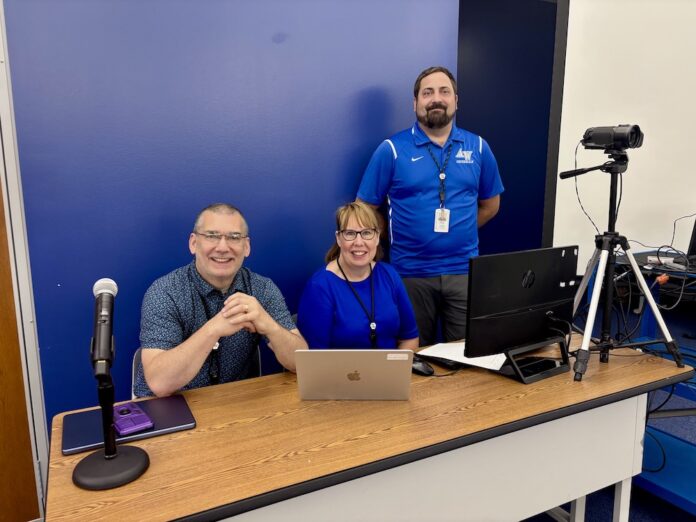
In this episode of Toledo Works, Stephen Zenner discusses what it is like to maintain and promote the Metroparks Toledo system. He speaks with Lorenzo Melchor, the Park Services Manager who oversees day-to-day operations at Glass City Metropark; Ashley Smith, Manager of Public Programs; and Scott Carpenter, Director, Public Relations. From maintaining the Glass City Metropark skating ribbon to leading mindful polar plunges in winter, it is an eye-opening discussion of what makes our vast system of parks such an integral part of daily life for Toledoans.
Everywhere in Toledo, you’ll find people who play a role in making our city tick – from hospitals and factories to restaurants and art galleries – and behind every person is a story. Our program, Toledo Works, highlights those stories from workers’ firsthand accounts. Each week, Toledo Free Press hosts Jaden Jefferson and Stephen Zenner focus on a different topic within the Toledo workforce, exploring their day-to-day challenges and triumphs.
Photo courtesy of Ohio Department of Natural Resources
Whether it’s a pawprint in the mud, a pile of fur-filled scat or a photo on a trail cam, coyotes leave evidence of their presence all over northwest Ohio, and not just in rural areas.
“Most people don’t realize how closely they live around coyotes,” said Mike Ohlrich, the Ohio Department of Natural Resources (ODNR) wildlife officer for Lucas County. “Coyotes are very adaptive and can thrive in green spaces, not only in more rural areas but in cities.”
Mike Ohlrich. Photo courtesy of Ohio Department of Natural Resources
Metroparks personnel see signs of coyotes, and the mammals themselves, on occasion, said Scott Carpenter, director, public relations, noting that neighbors to several parks often report hearing coyote calls at night.
“Coyotes are likely present in every Metropark, but are reclusive and avoid contact with people, so it’s not very common to get a glimpse of one,” he said. “Coyotes are beneficial predators, and we would be concerned if they were not found in parks. They play an important part in the balance of the ecosystem.”
In the past, coyotes were often associated with the open deserts and prairies of the west, but as land was cleared for agriculture and larger carnivores were removed from the landscape, coyotes began expanding their territory eastward, according to the ODNR. By the 1930s, coyotes were in Ohio and, by 1988, were in every county. Bowhunter observations show that the coyote population steadily grew through the 1990s and 2000s, but has remained steady over the past 10 to 15 years.
Ohlrich believes one reason the coyote population increased is due to the decline in the number of hunters and trappers, as the interest in fur-bearing animals has waned.
Photo courtesy of Ohio Department of Natural Resources
Slender and weighing about 20 to 50 pounds, coyotes are monogamous breeders that usually mate January through March. Litters are born in March and April, with five to 10 pups each. The female maintains the den, which is often dug into the ground or utilizes a hollow log or brushy thicket. Both parents hunt for food for their offspring, but the male usually takes the lead during the pups’ early months.
Around three weeks, the young leave the den with parents, and are weaned at six weeks. By 8 to 12 weeks, the pups are taught to hunt. The coyote family stays together through the summer and mid-fall. While some young coyotes will stay with the family until the next litter comes along, most will leave and develop their own territory anywhere from 10 to 100 miles away.
According to the ODNR, coyotes are primarily nocturnal, hunting during the night. In areas where they feel less threatened, coyotes will hunt during the day. Coyotes will form a pack consisting of an unrelated alpha pair and several subordinate adults, but usually hunt alone.
While many species avoid populated areas, the coyote has adapted.
Dr. Stan Gehrt leads several coyote research projects. Both Ohlrich and Nature’s Nursery Co-Founder Laura Zitzelberger refer to Gehrt’s research as a premiere source of information on coyotes.
When she reads a comment online from someone concerned that a pack of coyotes might take out a dog, for example, Zitzelberger often chimes in with factual information.
Photo courtesy of Ohio Department of Natural Resources
“They live in packs but hunt as individuals. They barely want to take on anything that’s larger than a cocker spaniel when they can survive on something that’s much easier to catch,” she said.
In the early 2000s, Gehrt led a study in the Chicago suburbs, studying what coyotes eat, and it was found that domestic animals are just a minute part of their diet, Ohlrich said. A larger percentage is mice, rats, fruit, young whitetail deer, raccoons and other small mammals such as shrews, voles, rabbits and moles.
“The number of mice and rats they eat can be a good thing. Lyme disease is up, and the primary carrier is the white-footed mouse. Having coyotes to prey on those rodents is a good thing to keep their (the mouse) population in check,” Ohlrich noted.
He suspects that coyotes might be contributing to a declining wild turkey population, especially as these birds nest on the ground, leaving the hens – along with their eggs and polts – vulnerable to predators until they’re able to fly and roost in trees.
“We are currently doing a study on nesting turkeys and hens to learn more. So far, the limited scope of the survey shows that a lot of predation is during the nesting period,” he said. “A big part of that is mammals, but it could also be birds of prey. Coyotes are predators and definitely contributing to that.”
The Ohio Coyote Project, a collaboration between The Ohio State University’s School of the Environment and Natural Resources and ODNR, involves working with livestock producers, hunters and trappers to better understand coyotes, their diet and how they impact livestock production. One focus is how much of the coyote’s diet is domestic livestock. Another aspect being studied looks at how far coyotes travel – some up to 100 miles.
With coyotes all over, that can also result in conflict.
Several times a week, Ohlrich gets calls, and they usually fall into two categories: someone spotted a coyote where they didn’t expect to, or the coyote appears to be sick. Last year, he fielded several calls about coyotes in Maumee, including some that swam over from the islands in the Maumee River.
One woman reported that her dog was attacked by a pack of coyotes. In 2018, residents in Waterville Meadows reported that a 60-pound dog lost her tail and needed stitches on her leg. In another case, a 10-pound poodle was grabbed by the neck and had deep puncture wounds.
Research shows that the best way to avoid conflict is to leave naturally-behaving, wary coyotes alone. The signs of aggressive coyotes are similar to those of domestic dogs, such as snarling, raised hackles, lunging or growling. Making eye contact or tracking a human are not considered aggressive acts on their own, according to the ODNR.
While conflicts with humans are rare, the Ohio Coyote Project has recommendations for avoiding them:
•Do not feed coyotes, as this might cause them to lose their fear of humans and encourage them to come too close.
“They’re following a food source, whether that’s outside pet food or water bowls, or fruit trees,” Ohlrich said, noting that fruit is a decent part of a coyote’s diet.
•If a coyote is around a property too often, remove bird feeders that attract squirrels – which are another popular prey for coyotes.
•Make sure garbage and compost are properly stored.
•Do not let pets run loose, but keep them on a leash or within a yard with a six-foot fence with a roll bar on top.
•If faced with a coyote, do not run, as this triggers an instinctual response to give chase. Instead, change course and walk or back away slowly.
“Make loud noises to scare them away,” Ohlrich said, adding that If a coyote is not deterred by shouting or waving, it may be defending a den.
When he gets a call about coyotes, Ohlrich uses it as an opportunity to educate the public, but sometimes he’ll be asked how to “take care of it.” As the only wildlife officer for the entire county, Ohlrich can only provide guidance on options, the first being removing attractants. For those who live in rural areas where shooting a firearm is permitted, that is an option.
The American Veterinary Medical Association standard for humane euthanasia includes the option of a gunshot to the head, Ohlrich said. But this is only a viable option for those who are skilled and licensed, and in areas of the county where use of firearms is permitted.
Trapping is also an option in outlying areas, and is permitted year-round. Nuisance laws allow property owners to kill a coyote if it is sick, injured or causing damage or a nuisance on private property. But trapping requires an education, in order to avoid capturing an unintended target, including domestic animals or other wild animals.
The goal is to find a balance between keeping the coyote population in check, limiting conflicts and appreciating the benefits of having coyotes around.
Ohlrich points to studies showing that, in order to eradicate coyotes, 70 percent of the population would need to be removed for four consecutive years. Even missing that target for one year would allow the population to replenish in one season, as coyotes have the ability to bear more, and larger litters.
“Usually in a community, the alpha male and a female breed and the community works to raise them. If the alpha male or female is killed, all the others start breeding and the population increases,” Zitzelberger said. “One thing I’ve learned is that they do well no matter what we do. They bounce back and have more babies.”
Before taking action to remove a coyote, first determine if it’s really causing problems, Ohlrich said. If it’s not, another coyote may move into the territory – and could be likely to cause more conflict.
“It’s incredibly difficult to manage their population and lower their numbers,” he said.
When Nature’s Nursery was still located on Schadel Road, the center took in Rue – a baby coyote that someone surrendered after realizing she didn’t make a good pet, Zitzelberger said.
For the first year, Rue lived in a closet and was taken out on walks on a leash. After raising money for an enclosure, Rue lived outside and would often hang out on top of a concrete culvert or logs placed inside.
“When I was in the enclosure, we would run and play. She’d let me brush her and give her vaccines, but never once did I let my guard down,” Zitzelberger said. “I learned that coyotes are extremely intelligent, but they’re always wild. Having them as pets is insane. People think because they’re born, bred and raised in captivity that they’re domestic. They aren’t.”
For those with questions about coyotes, contact the ODNR Division of Wildlife at 800-WILDLIFE (945-3543).
Brandon Sehlhorst grew up in Toledo, studied urban planning in Cincinnati, and came back with one mission: grow this city. Now serving as Toledo’s first-ever Chief Growth Officer, he sits down with Vince Croci to talk about the bold goal of 300,000 residents by 2040, a creative $20 million shovel-ready sites fund, what happened with Southwyck Mall, and why Toledo’s tech ecosystem needs a dedicated leader.
From SimCity kid to the person reshaping Toledo’s future — this one’s worth your time.
🎙️ The Make It Happen Podcast Created & Produced by Mike Vanderpool Special Projects
Republican candidates for governor and lieutenant governor
These options are paired like president and vice president at the federal level and are in the order they appear on the ballot:
Casey Putsch and Kimberly C. Georgeton
Vivek Ramaswamy and Robert A. McColley
*Heather Hill and Stuart Moats are no longer in the race
Casey Putsch (left).
Casey Putsch for Governor
Lives in Perrysburg; from Tiffin
Political Experience:
Casey Putsch has no previous political experience.
In an interview with the Ohio Capital Journal, Putsch explained his run for governor.
“Well, the simple answer is, I looked around, and I saw options that I thought were in nobody’s best interest.”
Putsch criticized the other Republican candidate Vivek Ramaswamy for being a billionaire, and the Democratic candidate Amy Acton for locking down the state during the Covid-19 Pandemic.
“She [Acton] locked down the state — that’s a non-option. Vivek, a billionaire, he didn’t go to school in Ohio. Heck, he took a scholarship from George Soros’ money. He has no businesses in Ohio.”
Putsch has run into controversy over comments about WWII, Hitler and the Holocaust.
Education:
1999-2005 Undergraduate: Double Major from The Ohio State University
Bachelor of Fine Arts – BFA, Industrial and Product Design
Bachelor’s Degree in Industrial Design with a focus in engineering technology and robotics
Professional experience:
2018-Present: Director of Putsch Auto Media in Perrysburg
2013-Present: President and founder of The Genius Garage Racing, Aerospace and Design Programs in Bowling Green, Ohio
2008-2021: Project manager, engineer and owner of Putsch Racing based in Perrysburg and Columbus
2018-2019: Writer for Power Automedia, remote work; company based in Murrieta, Calif.
2016-2017: Manager, acquisitions and sales for Central Classic Cars in Sylvania
1997-2008: General manager of Seneca Hills Golf Course in Tiffin
2004-2005: Ferrari technician and sales at NJB Automotive in New Albany, Ohio
Vivek Ramaswamy ran as a presidential candidate in the Republican Primary 2023-2024, but lost the primary to current President Donald Trump.
Ramaswamy was part of the Department of Government Efficiency (DOGE) with Elon Musk, before stepping down from his role there to pursue the Ohio Governor’s race.
President Donald Trump endorsed Ramaswamy for the Ohio Governor.
Ramaswamy has written many books on politics and culture including:
Woke, Inc.: Inside Corporate America’s Social Justice Scam. 2021
Nation of Victims: Identity Politics, the Death of Merit, and the Path Back to Excellence. 2022
Capitalist Punishment: How Wall Street Is Using Your Money to Create a Country You Didn’t Vote For. 2022
Truths: The Future of America First. 2024
Education:
2003-2007 Undergraduate: Bachelor’s Degree in Biology from Harvard
Yale Law School Doctor of Law (J.D.)
Professional experience:
2014-2026: Founder and CEO of Roivant in New York
2022-2023: Co-Founder and executive chairman at Strive Asset Managment in Columbus
2007-2014: Partner at QVT
2007-2009: Co-Founder and president of Campus Venture Network
2017-Present: State Senator for Ohio Senate’s 1st Senate District including Defiance, Hancock, Hardin, Henry, Paulding, Putnam, Van Wert and Williams Counties and parts of Auglaize, Fulton and Logan Counties.
2015-2017: State Representative for the Ohio House of Representatives in the 81st district, which includes Henry, Putnam, Williams, and part of Fulton Counties
From Ballotpedia: McColley co-sponsored Senate Bill 23, which prohibited abortion after the detection of a heartbeat. [6] Gov. Mike DeWine (R) signed SB 23 on April 11, 2019.
Education:
2003-2007 Undergraduate: Bachelor’s of Science in Business Administration from The Ohio State University
2007-2010 J.D from The University of Toledo College of Law
Professional experience:
2017-Present: State Senator for Ohio Senate’s 1st Senate District including Defiance, Hancock, Hardin, Henry, Paulding, Putnam, Van Wert and Williams Counties and parts of Auglaize, Fulton and Logan Counties.
2015-Present: Counsel for Clemens, Korhn, Liming & Warncke, LTD.
2015-2017: State Representative for the Ohio House of Representatives in the 81st district, which includes Henry, Putnam, Williams, and part of Fulton Counties
2013-2014: Economic Development Director for Henry County Community Improvement Corporation in Napoleon
2012-2013: Associate Attorney for Leatherman & Witzler in Toledo, Ohio
2010-2011: Associate Attorney for Hyre Legal Group, LP in Columbus, Ohio
2009-2010: Law Clerk for Shindler, Neff, Holmes, Schlageter & Mohler, LLP
*Heather Hill and Stuart Moats (Republican) – WITHDRAWN * Ohio governor candidate Heather Hill was disqualified on Wednesday, April 22 after Moats dropped out as her running mate. Read the full report by WTOL11 here.
The 118-year-old Roche de Boeuf Interurban Bridge. (AWFP photo by Karen Gerhardinger)
On Tuesday, April 14, Gov. Mike DeWine granted the Save The Bridge Association’s request for additional time to complete an alternative professional engineering report, on the Interurban Bridge at Roche de Boeuf, by a licensed bridge inspector specializing in historic structures.
The private meeting occurred following the governor’s address to the Bowling Green State University Democracy and Public Policy Network at BGSU. New late-breaking information has come to light which supports the case for preservation of the historic bridge and iconic Northwest Ohio landmark.
During Tuesday’s meeting with DeWine, Waterville Mayor Tim Pedro and representatives of Save The Bridge requested an additional year pause on demolition of the Interurban Bridge at Roche de Boeuf. Although this full request was denied by the governor, after further discussion, he opened a 30-day window of cooperation between ODOT District 2 Director Pat McColley and Bill Vermes, a professional civil engineer and bridge inspector with 40 years experience and a track record of saving historic bridges in the U.S.
Vermes has inspected the Interurban Bridge at Roche de Boeuf and is completing an alternative professional engineering report on the bridge and an adaptive reuse plan for it. Vermes reuse plan for the historic Interurban Bridge at Roche de Boeuf features a pedestrian path across the Maumee River. Per the governor’s directive, McColley will coordinate with Vermes, Pedro and STBA on the new engineering report and potential preservation option.
Save The Bridge representatives emphasized that the proposed future pedestrian and bike path would offer panoramic views from the Maumee River and make an ideal storybook trail, featuring the many layers of history present at the landmark site. Vermes asked STBA to share highlights of his initial ratings with the governor, stating that he believes the structure could be the foundation for “the most impressive dedicated pedestrian and biking bridge in Ohio, if not the entire United States.”
The Interurban Bridge at Roche de Boeuf has been on the National Register of Historic Places since 1972. It is a National Park Service registered historic place and a State of Ohio designated historic place. Completed in 1908, the Interurban Bridge was the longest reinforced concrete bridge in the United States when it opened. Designed by Daniel Luten of Indianapolis, the bridge featured a revolutionary design of reinforced concrete.
Save The Bridge Association is a grassroots citizens’ group working to save the historic and nationally significant Interurban Bridge from demolition and to preserve it as a Waterville cultural and scenic icon for future generations.
Marcella Di Maria, a chef for SOFO Foods, originally of Catania, Sicily, grabs a bowl of fresh mozzarella balls at SOFO Italian Market at 5400 Monroe Street in Toledo on Friday, April 3, 2026. (TFP photo by Stephen Zenner)
Authentic Italy approachable on Monroe
TOLEDO – Corporate consumer landscapes dominate most of the United States, whether it’s coffee, groceries or restaurants. Shoppers can expect, for the most part, the same selection and the same interactions at stores across the board. But there’s one Toledo business with four generations of experience delivering authentic products with a vintage approach.
Brian O’Shea, of the Knights of Columbus, asks for donations for individuals with disabilities outside SOFO Foods, as Alice Taylor leaves the store. (TFP photo by Stephen Zenner)
SOFO Italian Market at 5400 Monroe Street, is the great-grandchild of Antonio Sofo, an Italian immigrant who saw an opportunity back in 1920s Toledo to supply the Italian community here with authentic food from Italy.
Since then, the business has expanded with three distribution centers, one in Ohio, another in Georgia and another in Texas, but headquartered here in Toledo, which hosts their only retail location.
“I am a native Italian,” said Tony Cardone, 64, of Petersburg, Mich., who often makes the 20-minute drive to continue the tradition of Italian cooking in the United States. “I was born there [Italy], grew up there and still have a lot of that tradition.”
“Going to the market everyday,” is part of the Italian tradition, he said, adding that, “your food is your local food,” but also that it’s becoming more difficult in America to get fresh food here.
That’s why Cardone is willing to make the 20-minute trip to get fresh meat, cheese and the Sicilian olives at SOFO.
Carl Lewandowski, 64, Tecumseh, Mich., inspects Gouda cheeses at SOFO Italian Market. Lewandowski makes the drive down to SOFO multiple times a year. (TFP photo by Stephen Zenner)
Here customers have grown to expect high-quality imported Italian foods that aren’t as readily available in other grocery stores.
“This place is awesome,” said Carl Lewandowski, 64, Tecumseh, Mich., as he inspected various pieces of smoked Gouda cheese. “It may be a little pricey, but you pay for what you get.”
Seven years ago, Lewandowski was told about SOFO’s prosciutto, about which he said, “Damn, that stuff is good,” after trying it. Now the Lewandoskis make a point to grab any number of items, notably the bread and pizza.
“100% Italian means clean flour, no chemicals,” bragged Marcella Di Maria, a native Italian on staff with SOFO Foods, serving as their chef.
Di Maria’s job is wide ranging, but one of things she specializes in is sharing authentic Italian recipes for customers to recreate at home.
“I try always to make simple recipes to show people [that] with good ingredients you can make a great meal,” she said.
Carl Lewandowski holds a ciabatta bread roll at SOFO Italian Market. (TFP photo by Stephen Zenner)
When Lewandowski heard about good prosciutto, he heard right according to Di Maria, who took special attention to pointing out the Italian brand name San Daniele prosciutto they had on hand.
“San Daniele is one of the best brands of prosciutto in Italy,” she said. Other items she wanted customers to know about included fresh mozzarella balls, gelato, and Sicilian-style bread crumbs. A Sicilian herself, Di Maria hails from the eastern side of the island, the city of Catania, and takes pride in the food she provides at SOFO’s Italian Market.
Joe Sofo Sr. originally opened the retail location at 5400 Monroe Street back in 1985, but most of SOFO is dominated by wholesale distribution. To this day, SOFO operates their warehouse on Waggoner Boulevard, and is headquartered at 4444 Bennett Road in Toledo.
Fresh mozzarella balls.
Brittany Cherry, assistant manager at SOFO Italian Market.
San Daniele Prosciutto imported from Italy. The in-house Chef Marcella Di Maria, originally of Catania, Sicily, spoke well of the Italian brand name San Daniele.
The American flag next to the Italian flag on the uniform of Marcella Di Maria, the chef at SOFO Foods.
Carl Lewandowski inspects Gouda cheeses at SOFO Italian Market.
20260403 SOFO 10030
Marcella Di Maria, a native Italian and chef for SOFO Foods, speaks Italian with customer Tony Cardone, 64, Petersburg, Mich., a native Italian who comes to SOFO Italian Market to get authentic ingredients like back in Italy.
Marcella Di Maria, a chef and native Italian, shows off some of the Italian pasta at SOFO Italian Market.
Angela Hughes, the delil clerk at SOFO Foods, holds up the large San Daniele prosciutto.
Cappuccino made by Marcello Di Maria at SOFO Italian Market.
What you need to know about the issues on your ballot for the primary
Between now and May 5, voters have the opportunity to choose which candidates will show up on the November 3 ballot through voting in the already underway, spring primary.
But even if the candidates or parties in question don’t pique interest for voters, there are two levies on the ballot for Lucas County that concern all of its residents.
When voting in the primary, voters will choose a Republican, Democrat, Libertarian or an Unaffiliated ballot. Regardless of that choice, Issues 7 and 8 will be on the voter’s ballot, and they pertain to two separate property tax levies.
Issue 7
Exactly how Issue 7 is phrased on the ballot:
“A majority affirmative vote is necessary for passage.
An additional tax for the benefit of the County of Lucas for the purpose of the operation of a 9-1-1 system and a countywide public safety communications system, that the county auditor estimates will collect $9,230,891 annually, at a rate not exceeding 0.8 mill for each $1 of taxable value, which amounts to $28 for each $100,000 of the county auditor’s market value, for five (5) years, commencing in 2026, first due in calendar year 2027.
For the tax levy ____
Against the tax levy ____”
This levy was approved to be on the ballot in January 2026 to maintain the 9-1-1 emergency services system.
It is a 0.8 mill tax for each $1 of taxable value, on property.
It is about $28 for each $100,000 of estimated property value within Lucas County.
The levied tax will begin in 2026, it will begin to be collected in 2027 and will last until 2031.
Annually, the levy is estimated to bring in $9,230,891.
Commissioners’ discussion on Issue 7
Commissioners spoke during a board of commissioners meeting on Jan. 13 about adding the 0.8 mill.
Lucas County Commissioner Pete Gerken spoke openly about his concern about only putting on a 0.7 mill levy, the recommendation from the Sheriff and Technical Committee, and said the 0.8 mill was required.
“The point seven millage would not generate enough money over five years to operate the infrastructure in the system,” he said.
The millage for this levy is based on 2005 property tax values, which was one issue raised by Gerken. It should also be noted that the 0.8 mill levy was recommended by the Levy Review Committee.
Commissioners Lisa Sobecki and Anita Lopez also supported the 0.8 mill levy, and Lopez said she had done so after conversations with Sheriff Mike Navarre and Stacey Mitchell, the executive director of the Lucas County 911 Regional Council of Governments (RCOG), who runs the emergency system.
“The point seven levy request includes making potential cuts, cuts to a very strong system that we have,” Lopez said. “There was a discussion to whether or not we need all the towers in our area, and that is a little scary to me…I surely don’t want to have to consider years later, there’s an emergency out there, and the reception is not good for us to identify and find someone in need.”
Issue 8
Exactly how Issue 8 is phrased on the ballot:
“A majority affirmative vote is necessary for passage.
An additional tax for the benefit of the County of Lucas for the purpose of the provision and maintenance of zoological park services and facilities, that the county auditor estimates will collect $10,384,752 annually, at a rate not exceeding 0.9 mill for each $1 of taxable value, which amounts to $32 for each $100,000 of the county auditor’s market value, for ten (10) years, commencing in 2026, first due in calendar year 2027.
For the tax levy ____
Against the tax levy ____”
This levy was approved to be on the ballot in January 2026 to maintain the Toledo Zoo.
It is a 0.9 mill tax for each $1 of taxable value, on property.
It is about $32 for each $100,000 of estimated property value within Lucas County.
The levied tax will begin in 2026, it will begin to be collected in 2027 and will last ten years, 2037.
Annually, the levy is estimated to bring in $10,384,752.
Jeff Sailer, the CEO of the Zoo has said publicly that even though this issue presents as an “additional levy,” it is to replace two other levies that expire at the end of 2026. The new levy begins in 2026, but is not collected until 2027, when the other two expire.
Those old levies were for 1.1 mill and 0.6 mill.
According to Sailer, this new levy hopes to replace both previous levies, reduce the total amount the Toledo Zoo receives from taxpayers and hopefully ween the Zoo off of taxpayer support for operational costs.
The levy represents a $25 million reduction in taxpayer funds over its next ten years, and Sailer said any potentially additional levies would only be for capital projects for the maintenance of historic buildings or expansions.
Monclova Township resident Lisa Daggett signs a petition to put a constitutional amendment on the November ballot – one that would ban new, large data centers in the state if passed by voters. Volunteers Risa Sindel and Lyn Cox hosted training and signing events during the week. (AWFP photo by Karen Gerhardinger)
MONCLOVA TOWNSHIP – Road closures, data centers and trail connections were among the topics covered during the Monclova Township Trustees’ April 6 meeting.
Roundabouts
Four roundabouts are being constructed in the township this summer, resulting in road closures of 40-90 days each:
•In mid-May, construction will begin on a roundabout at Albon Road at Monclova Road, resulting in a 45-day closure.
•Late June, or as soon as work on the Albon Road roundabout is finished, crews will begin work on a mini-roundabout at the Monclova Road intersection with Waterville-Monclova, in front of the school. Work is expected to last 40 days.
•Aug. 1, Albon Road and U.S. 20A/Maumee-Western; expect a 90 day closure for a full roundabout.
In addition to those three Lucas County projects the Ohio Department of Transportation is set to begin work on a roundabout at U.S. 20A and Strayer Road, with work beginning after AuG. 1.
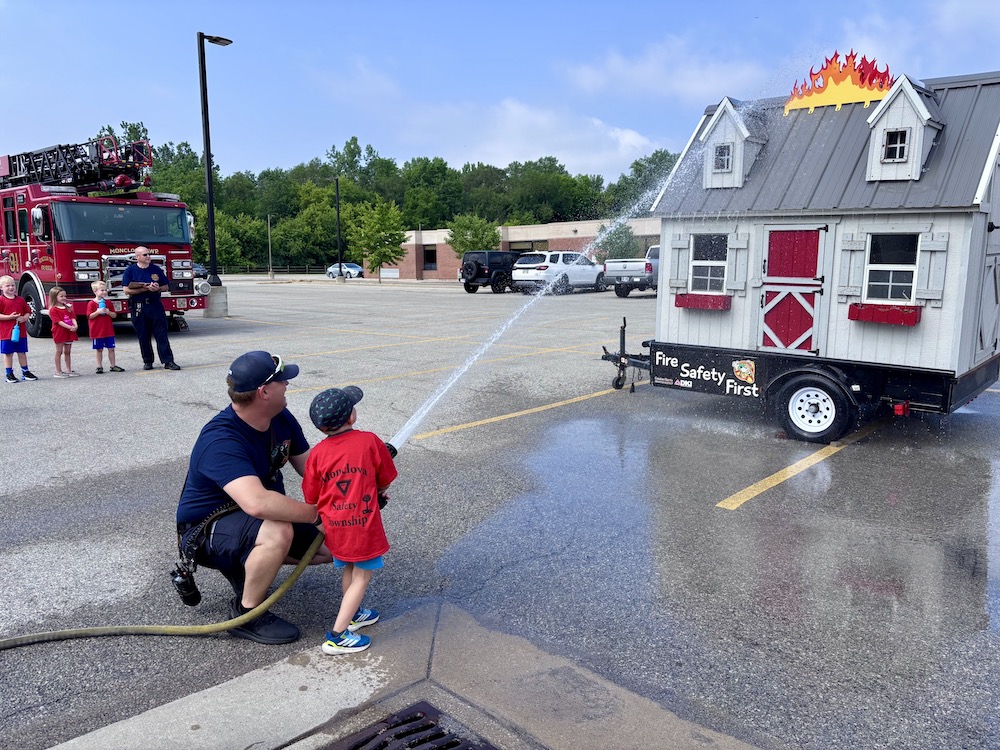
A Monclova Township firefighter backs an engine into the station. The department is preparing for taking detours as construction of roundabouts on both ends of Albon Road are slated for this summer. (AWFP photo by Karen Gerhardinger)
Fire Chief Matt Homik was asked about plans to manage calls, especially to 55-and-older communities east of the fire station, when Monclova Road is closed. He’s looking at the option of sending out a smaller, quick response vehicle that can easily traverse the neighborhoods more quickly, followed by larger rigs taking the posted detours on main routes. He also noted that the fire department has auto aid and mutual aid agreements with other communities who will help as needed.
Data centers
During the hour before the meeting, Risa Sindel and Lyn Cox set up a table outside the front door, collecting signatures for a proposed constitutional amendment that would prohibit the construction of new, large data centers in Ohio. The amendment will need more than 413,000 signatures from a minimum of 44 counties by July 1 in order to get on the ballot.
Once the meeting started, several residents asked to speak about data centers, including Cox, Marilyn Campbell, Dianne Stroshine and Donna Zibbel.
“We don’t want our adult playground to change with the data centers,” said Zibbel, referring to the activities she enjoys as a newer resident of Waterside.
Campbell thanked the trustees for imposing a 12-month moratorium on data centers, but asked that each trustee state whether they are for or against such developments – and to provide an update on data centers on each agenda.
“We want to know where we are with the study,” Campbell said, referring to work underway to see how the zoning resolution can be beefed up to protect the township if it receives a data center application.
Zoning Administrator Eric Wagner recently sent four proposed zoning text amendments to the county for review, most dealing with issues that might arise from a data center or large development. Using the MyMonclova app will ensure that residents know of any public hearings planned, Trustee Barbara Lang said. Wagner reports to the trustees the second meeting of every month, and will share updates at that time.
As far as stating an opinion about data centers ahead of time, Lang reiterated that she will not make a statement for or against any project that may come to the trustees for a vote, as she wants to remain unbiased. Trustee Debbie Stevens-Laux said she stands with the residents, and wouldn’t want a hyperscale data center next to her.
“I’m not necessarily in favor of a hyperscale data center,” said Trustee Chuck Hoecherl, adding that he would listen to proposals for smaller, underground data centers the size of shipping containers, which wouldn’t negatively impact residents.
About 39 acres of land owned by James Moline is being considered for housing, according to Monclova Township trustee Chuck Hoecherl.
He also informed that audience that about 39-acres of property between Black and Waterville-Monclova roads – an area that residents have shared concerns is targeted for a data center – may instead be used for single family homes. James Moline submitted a plan to the county for a proposed housing development, he said.
“That’s good news,” said Stroshine.
Cox said she’s been attending other township meetings, and she sees many differences in how they accept public comments, including allowing more than the two minutes allowed in Monclova.
“It’s interactive. I encourage you to attend other township meetings to see how it’s done,” Cox said.
Active Transportation
When Monclova Township residents were surveyed about their top priorities for a land use plan update, multi-use trails and connectivity were often mentioned.
“Monclova Township residents don’t want sidewalks everywhere, but they want access to our amazing bike trails,” noted Lang.
Four representatives of the Lucas County Active Transportation Plan outlined reasons why the township should join their efforts to expand all “human-power travel used for everyday transportation – not just recreation,” according to the plan’s definition of active transportation. This includes walking cycling, wheelchairs and scooters, skating and skateboarding, said Amy Abodeely, a township resident, and Creating Health Communities Coordinator for the Toledo-Lucas County Health Department.
She was joined at the meeting by Beth Deakins, executive director of healthy living for the YMCA of Greater Toledo and two representatives of Lake Erie West Regional Council – Data Resource Manager Rajesh Nagisetty and Program Manager Sean Sammon. All are on the plan’s committee and are working to bring more communities into the fold.
Some of the projects eyed for the township include: extending and marking shoulders; creating consistent sidewalks; multi-use paths; safe crossings; and wayfinding connections. The partnership will enable the township to access planning and grant funding.
The trustees agreed to join the plan, and encouraged neighboring communities to participate in order to get all of the Anthony Wayne area on board with active transportation planning together.
During the meeting, the trustees also:
-Learned that longtime administrator Harold Grim plans to retire April 29.
-Learned that Michael Hampton II is expected to begin in the new position of director of safety services, zoning and projects, effective May 1. Cox questioned the $130,000 salary and the purpose for Hampton’s hiring.
-Approved salary increases for the fire chief, assistant fire chief, maintenance supervisor and all part-time and paid-per-call fire personnel not part of the bargaining unit – which negotiates for pay increases separately.
-Heard Hoecherl thank DGL Consulting Engineers for their 100 years in business. Located on Briarfield Boulevard, the business includes civil engineering, planning and surveying. DGL has worked on township projects and won a national award for The Andersons’ parking lot design.
-Approved a joint cooperation with the county to do long line striping on roads in the township, at a cost of $28,672.
-Heard that the Ohio Department of Commerce, Division of Liquor Control, was asking if trustees had any objections to renewing liquor licenses for permit holders in the township, including: the 180th Fighter Wing NCO Club, Barr’s Public House, Beck Suppliers (Friendship Kitchen), Bob Evans, Brandywine Country Club, Carrabba’s Italian Grill, Ed’s Bar and BBQ, Fallen Timbers Fairways, Loma Linda’s, S&G Stores, The Baker’s Kitchen, Urban Pine Winery and Walt Churchill’s Market. Without any objections, those permits will be reissued.
In this episode, Toledo Free Press Editor-in-Chief Erin Holden sits down with two guests who prioritize dignity and care for all animals in our region. First, Laura Zitzelberger, co-founder of the nonprofit Nature’s Nursery, speaks about her rehabilitation work with Toledo area wildlife that she first began in 1989. Then Erin chats with Rebecca Trumbull, a local photographer and animal advocate who found her niche capturing the lives of our pets, from dogs to farm animals and everything in between.
Everywhere in Toledo, you’ll find people who play a role in making our city tick – from hospitals and factories to restaurants and art galleries – and behind every person is a story. Our program, Toledo Works, highlights those stories from workers’ firsthand accounts. Each week, Toledo Free Press hosts Jaden Jefferson and Stephen Zenner focus on a different topic within the Toledo workforce, exploring their day-to-day challenges and triumphs.
Donald, an individual served by Anne Grady Services. (Photo by Hannah Sellers)
Partnership includes inclusive summer camp for kids and adults
Submitted by Anne Grady Services
TOLEDO – Toledo is built on nonprofits that listen to the needs of the community and design solutions to provide quality of life. Anne Grady Services has continued to expand their scope of care since 1982 for individuals with developmental disabilities. A recent alliance with Courageous Community Services is designed to enhance services and programs across northwest Ohio.
Effective Feb. 1, Courageous Community Services (CCS) became an affiliate of Anne Grady Services (AGS), marking a significant step forward in the region’s continuum of care. In an effort to build a stronger, more responsive system of support rooted in community needs, CCS is now integrated in year-round support for individuals with developmental disabilities. For AGS, this is an additional program available to the over 350 individuals they provide services for daily.
Courageous Acres is an inclusive summer camp located at 1207 Waterville Swanton Rd, Whitehouse. (Photo by Hannah Sellers)
Anne Grady Services offers care and programs such as Intermediate Care Facilities, Supported Living, Therapy, Remote Support, Respite Care, and Day Services. Since the alliance, CCS brings outdoor recreation to the list of services with Courageous Acres, an inclusive summer camp for children and adults.
At the heart of the collaboration is a shared commitment to providing individuals with developmental disabilities a full, well-rounded life that goes beyond basic care to include meaningful work, social engagement, recreation, and personal growth.
“We are excited about our new alliance with Courageous Community Services. The opportunities this presents to both organizations and what we can do together,” said Steve King, CEO of AGS.
(Photo by Hannah Sellers)
By integrating services, AGS and CCS aim to create a more seamless experience for individuals and families. This includes expanding access to employment programs, residential support, day services, and life-enrichment opportunities such as community outings, travel, and creative programming.
In reference to a long-time camper, Laura Kuhlenbeck, managing director at CCS, shared, “His parents would drive up every week for five weeks. With the Anne Grady respite program, they would only have to drive up every couple of weeks which takes a lot of stress off them.” Both organizations believe that everyone deserves to live a well-rounded and fulfilling life.
A defining feature of the partnership is its emphasis on community voice. Both organizations have long histories of engaging families, staff, and individuals in shaping programs, and leaders say that commitment will only deepen moving forward.
Isaac does a bit of crafting through programming at Anne Grady Services. (Photo by Hannah Sellers)
Shelby Mallory, development manager of AGS said, “Through our strategic alliance with Courageous Community Services, we’re expanding opportunities for both children and adults with disabilities. This partnership allows us to offer more comprehensive, lifespan services, meeting individuals where they are and supporting their unique interests. From residential care, respite, and therapy to employment, transportation, leisure, and now summer camp, we’re proud to provide high-quality, full-service supports grounded in dignity and respect.”
Campers at Courageous Acres enjoy making s’mores by a campfire. (Photo by Hannah Sellers)
While CCS now operates as an affiliate of AGS, it will maintain its mission and identity, preserving the legacy it has built within the community. At the same time, the partnership provides access to greater resources, shared expertise, and operational efficiencies that position both organizations for long-term growth.
For families and individuals receiving services, the transition is designed to feel additive rather than disruptive, enhancing opportunities without losing the personal connections that define both organizations.
With a strengthened foundation and a unified vision, Anne Grady Services and Courageous Community Services are positioning themselves not just as service providers, but as partners in building a more inclusive community. A community that listens, evolves, and ensures that every individual has the opportunity to thrive.