Home Blog Page 185

Paddy Jack’s to debut food truck soon

0

Paddy Jack’s plans to debut a food truck soon that will serve 10 of its popular gourmet grilled cheese sandwiches.

The 24-foot truck is wrapped and ready to go, but is waiting for some coolers to be installed, said manager Jennifer Hurst, who estimated the truck will be ready to roll by November.

A food truck was actually the original concept for Paddy Jack’s, but that plan was put on the back burner when the chance came to acquire a restaurant location.

“Now that we have our two stores up and running, we’re just excited to put it on wheels like our original thought,” Hurst said.

Restaurant locations are 6725 W Central Ave. and 5122 Heatherdowns Blvd. For more information, visit paddyjacks.com.

Lucas: Dynamic experience

0

It’s very likely that you interact on a daily basis with a cold piece of glass or plastic you retrieve dozens of times per day from your pocket or pouch — a relatively tiny outer shell that houses a supercomputer by many standards. Into these smartphones, heartless contraptions that they are, we pour our souls. We post our most intimate thoughts into virtual notepads; we pepper questions at search engines, making inquiries on the ingredients of the contents hidden in the darkest corners of our beings. These are things we haven’t disclosed, the boxes we’re afraid to open. We tell Google and Yahoo secrets we’ve told no man and no god. We live with great joys and bitter pains — common and irregular issues of life were once shared because we knew we weren’t the only ones. The fact that we’re not alone in trials hasn’t changed; there are many still engaged in the same wars. What has changed though, are the stories we tell ourselves while we’re in the trenches. We believe that we are, in fact, alone. These are the self-inflicted isolations we easily escape to.

There are many dynamic aspects of the human experience that shape us all in different ways. Depression is currently center stage in our public discourse. The shakened trust some feel toward those sworn to keep us safe and secure. We can be quick to reason these things internally, trusting our own feelings and discounting critical thought. With mere strokes we infect the masses with potentially harmful points of view passed off as thoughtful — yet inarticulately injected via 140 characters. At the same time, life changes for the better. A baby is born into a loving home. A student passes a test she’s been dreading for weeks. A hero returns. This juxtaposition plays itself out every hour of the day. And without noticing, we easily continue to live only considering what’s on the surface.

On Sept. 18 at the West Toledo YMCA/Start High School Theater, TEDxToledo will again collect the brightest minds and leading thinkers in our area for a day full of ideas worth spreading. Attendees will enjoy new friends and local food trucks; students from Start High School will attend for free to fill unsold seats.

This year’s theme, “Human,” explores the many dynamics of the human experience. From 8:45 a.m. until about 4:30 p.m., more than a dozen speakers will take the stage for 18 minutes or less, having prepared the talk of their lives. They’ve rehearsed. They’ve been frustrated and scrapped ideas. They’ve come to revelations and fresh perspectives about subjects they thought they knew deeply. They’ve learned and they’ve grown. Most of all, they have ideas to share. Ideas that, hopefully, cause us all to consider new ways to approach our daily lives in the best ways.

TEDxToledo, a nonprofit event held under license from TED (Technology, Entertainment, Design), aims to raise the level of conversation in Toledo — literally and figuratively. Our goal is to retarget our energies toward ideas that make a lasting impact. I hope to see you there. Tickets are available now at TEDxToledo.com.

Will Lucas is CEO and Founder at Classana, CEO and Founder at Creadio and a founding organizer of TEDxToledo.

Local author publishes guide for ‘the best day of your life’

0

Even though she is a journalist and blogger, Jennifer S. White got her first smartphone less than a year ago. She is still not used to it and warns people she might mute the conversation with the side of her face.

“I’m 34 but I feel like 99,” she said.

Author Jennifer S. White includes yoga in her plan for ‘transforming the ordinary into the extraordinary.’ Photo courtesy Jennifer S. White

Many things, including smartphones, provide convenience. But with that comes the challenge of taking a healthier possibly less convenient route, something White faces daily.

“If I have a car and I can drive there, why the hell would I walk?” she said. “We have everything at the touch of our fingers and it’s hard to force ourselves to slow down and remember that the biggest changes in our lives come from small, tiny tortoise-like steps toward growth. I think it can be overwhelming for people.”

White, a former Toledo Free Press columnist, wrote about this and more in her self-published book “The Best Day of Your Life: A Guide to Transforming the Ordinary into the Extraordinary,” available on Amazon and Barnes & Noble. The book discusses everyday practices to help readers reset a bad mood, beat stress, overcome loneliness, deal with anger and more. White said the intention is for readers to first read the book in full but then go back and work on specifics “one step, one day, one moment at a time.”

She said trying to put the practices in place can be challenging.

“I wanted the book to be a personal tool,” White said. “If you’re having a day where you’re feeling angry or frustrated, there’s a chapter you might want to read.

“Or if you’re having a day where you’re feeling lonely or kind of depressed, there’s [another] chapter you might want to read.”

White has been a yoga practitioner for more than 20 years. She said she hated the first class she took.

“I was so bored,” she said. “But I think, over time, if you stick with the actual physical practice of it, the mindfulness kind of comes into it.”

In her first chapter, “Make Every Day Your Best Day,” White says there are many ways of practicing yoga — while riding a bike, taking a scenic walk or eating breakfast — by just focusing on breathing.

“The idea of practicing yoga on a mat is maybe even sexy and kind of fun with cute clothes, but it’s really about being present in ourselves,” she said. “Even though this is not a yoga book at all, it’s very yoga-flavored and that is also unintentional. [Yoga] becomes a part of who you are.”

Jennifer S. White with her daughter, Gemma. Photo courtesy Jennifer S. White

White said she caught herself focusing on her breathing when she recently got into a car accident with her 4-year-old daughter, Gemma.

“[I was] just trying to stay present with the situation at hand and that’s something that when you practice a lot physically, it comes to you naturally, I believe,” she said.

White said everything she writes is for Gemma, including this book.

“My writing changed and took on a new avenue after I had her,” she said. “As a parent … what I want for my child is for her to be confident and happy in herself and her life.”

White said her writing became more honest after she had Gemma.

“For me, being a parent is about connecting with the parts of myself that I’m supposed to be embarrassed of … like my temper or my ADHD,” she said. “I’ve written about having an eating disorder in the past. Those are the types of things that we’re supposed to feel ashamed of [and I’m] showing her that I don’t have shame.”

Run for Reece to help local family with medical bills

0

Reece Bova was not quite a year old when his parents were told he won’t live to see his fifth birthday, that his heart will fail and there was nothing else to be done.

Refusing to accept that prognosis, Matt and Shannon Bova of South Toledo set out to find a doctor who would treat their son.

Matt and Shannon Bova of South Toledo with their son Reece, 2. Reece was born with a congenital heart and lung condition. A night glow 5K run set for Oct. 4 in Perrysburg will raise money to help the family with medical bills. Toledo Free Press photo by Christie Materni

“We were told there was no one — no doctor, no hospital — who could help us, that the procedures he would need were too dangerous, that the risk far outweighed the reward,” said Shannon, 31, a Bowsher High School graduate and former Toledo Free Press employee. “We as his parents obviously were not happy with that response.”

The Bovas, who lived in Tennessee when Reece was born, sent his records to pediatric heart centers nationwide and were turned down by all but one.

They now travel to Boston Children’s Hospital a few times a year so Reece, now 2, can undergo a procedure that uses balloon catheters to temporarily widen the too-small arteries in his lungs, so his heart doesn’t have to work so hard pumping blood to his lungs.

“Because the arteries are so small, they can only dilate them so much,” Shannon said. “And once the arteries are opened a bit, they can begin closing again.

“The reason why they said it’s so risky and dangerous is because the arteries are so small that they are at risk of rupturing if they dilate them too much. If they do that, then he starts bleeding into his lungs and you may not always be able to stop the bleeding in the lungs. Obviously if your lungs fill with blood and they can’t stop it, then that’s it.”

The Bovas moved back to Toledo about a year after Reece was born to be closer to family.

Reece will likely need the artery-widening procedure for the rest of his life, but doctors are hopeful the frequency can be reduced.

“The analogy they gave us was if you take a balloon out of a package, it’s really stiff. The more you blow that balloon up and let the air out, it’s going to be stretched a little bit, and hopefully it will stay open longer,” Shannon said.

“The hope is we can do these every six months for a couple of years and then he may not need them as often, maybe once a year, maybe once every two years. We’re not there yet, so we don’t know, but we do know his body responds well to the treatment.”

The diagnosis

Reece was born with a congenital heart condition called Tetralogy of Fallot with severe peripheral pulmonary artery stenosis. He is not a candidate for a heart transplant because of his lungs and isn’t eligible for a lung transplant because of his heart. He was also born with only one kidney.

Shannon had no indication during her pregnancy that anything was wrong. But when Reece was born in March 2012, he was “silent, limp and blue,” she said.

“It was probably three minutes that passed and we finally heard him cry,” she said. “They initially thought the birth had maybe just stunned him a little bit and he would spend the night in the NICU and be fine. But he didn’t improve. That’s when they brought in the pediatric cardiologist.

“He was born at 9:23 at night and I would say by midnight we were in a tiny little conference room with the cardiologist, bawling our eyes out,” Shannon said. “We went to the hospital that day thinking we were going to experience happiness and everyone taking pictures; instead we experienced something much different. We experienced fear, the unknown.”

The new parents were told Reece had Tetralogy of Fallot, a series of four anatomical abnormalities of the heart.

“I was kind of numb at first,” said Matt, 30, a native of Dublin, Ohio. “It didn’t really sink in. I didn’t know what to think or what was going to happen down the road. Just the unknown was kind of scaring me at that point. All we knew was we had to take it day by day.”

The day after Reece was born, he was transferred to a children’s hospital in Atlanta where he spent 17 days in the NICU. He had a shunt placed in his heart at 6 months old and open heart surgery in December 2012 before his first birthday.

Reece Bova, 2, with his mom Shannon Bova share a moment at home in South Toledo. Toledo Free Press photo by Christie Materni

Doctors were puzzled when Reece didn’t show the improvements they expected after his open heart surgery and the Bovas were soon presented with more bad news.

“Typically kids with Tetralogy have their repair and grow up to lead fairly normal lives,” Shannon said. “Shaun White the snowboarder has tetralogy. There’s a couple of NFL football players. Things would be much different right now if it was only the heart.”

In February 2013 doctors discovered Reece also had severe peripheral pulmonary artery stenosis, a condition in which the arteries in his lungs are too small, putting pressure on the heart as it works hard to pump blood through the lungs.

“That was the day they told us that he would not survive to see his fifth birthday,” Shannon said.

Run for Reece

To help the family with medical costs, Shannon’s mother, Kathy Phillips, and sister, Jenna Phillips, 18, both of Maumee, have organized a nighttime 5K and one-mile fun walk fundraiser.

Run for Reece will take place at 7:30 p.m. Oct. 4 at Woodlands Park in Perrysburg, followed by a glow-in-the-dark afterparty. Cost is $25 in advance or $30 at the race. The race will not be timed and family-friendly events are planned. The organizers are also looking for corporate sponsors.

Money raised will go toward paying off existing medical bills and future trips to Boston Children’s Hospital. Reece’s next treatment will be in November or December, Shannon said.

“As a family, we just wanted to help,” Kathy said. “It’s very hard. You feel very helpless. You just try to be there for support because that’s all you really can do.”

“He’s my beautiful little nephew. I wouldn’t trade him for the world,” said Jenna, a recent Maumee High School graduate now studying nursing at Mercy College. “It’s just hard as family to sit back and listen to all the money worries and everything. We just wanted to help.”

Another way to help is to bring the flier found at the Facebook page “Run for Reece” to the Applebee’s at 531 W. Dussel Drive in Maumee on Sept. 17 to have 15 percent of your bill donated to Run for Reece. Participants will also get a $5 coupon for their next visit.

Progress

Because of his heart and lung conditions, Reece also has numerous developmental delays. He started crawling around 18 months and only recently started walking. He doesn’t talk yet and is still bottle-fed — apparently scared to eat after so many intubations during hospital stays, Shannon said.

He sees a physical therapist to work on his gross motor skills, an occupational therapist to help him learn to eat and a speech therapist to help him talk.

Frustratingly, one step forward medically often results in two steps back developmentally, Shannon said.

“From spending time in the hospital, you saw his muscles weaken a little bit so his mobility is not as good or just when we saw him start opening his mouth for a spoon, he went to the hospital and was intubated and came back wanting nothing to do with it,” Shannon said.

Matt and Shannon said they sometimes find it difficult to see other kids Reece’s age reach milestones he still struggles to attain, but then they remind themselves of everything he’s gone through and how far he’s come.

“[I feel] anger, jealousy, sadness, knowing that we are so far behind that,” Shannon said. “But then in the same breath, I think, ‘Well, you know what? Those kids have not had open heart surgery and have not been given the prognosis he was given.’”

“I just want to see him be a typical kid, just doing regular things like playing sports, playing in the grass, talking, eating food — all the things a lot of parents take for granted because their kids just start doing it on their own,” Matt said. “Just those little things are big for us.”

In other ways, Reece is like any other toddler. He loves watching cartoons, jumping on trampolines and “getting into things,” like any new walker, Shannon said.

“He’s made a significant amount of progress, but I would be lying if I said there wasn’t still a lot of fear of the future. Because while we know he responds well to the treatment, at any time something could change,” Shannon said. “At any time his heart could decide that it’s been working too hard and it doesn’t want to anymore. We’re trying to make that not happen by making these trips to Boston and continuing to be his biggest advocate.”

For more information or to register visit www.runforreece.com.

Mancy’s Steaks interior renovation nearing completion

0

The bang of hammers and whir of saws filled the air at Mancy’s Steaks on Sept. 4 as a planned two-month restoration reached its peak.

The project is the first extensive renovation at the restaurant since it opened at its current location in 1974.

“We haven’t really touched it since,” said owner Gus Mancy, whose grandfather opened the steakhouse in 1921. “Now it’s time to freshen the place up.”

Mancy’s Steaks is undergoing an interior restoration project. Toledo Free Press File Photo by Joseph Herr.

The finished restaurant will feature a renovated foyer, restored wood from floor to ceiling, restored original tin ceilings, new carpeting, tables, chairs, booths and restrooms, upgraded lighting, the addition of a second fireplace and more private dining options.

“It’s not really a remodel as much as it is a restoration,” Mancy said. “We’re restoring a very beautiful restaurant. Our goal is to make it better. It’s been a fun project.”

Track lighting being added will “put a soft glow on each and every table,” Mancy said. But don’t worry: “People say, ‘Don’t get rid of the Tiffany shades!’” he said. “We’re not.”

The walls surrounding a private table in the foyer were removed, opening the front entrance room.

A fireplace was added to the dining room facing Phillips Avenue to help accommodate guest requests to be seated in the Fireplace Room, Mancy said.

The Phillips-facing dining room will also become a little more casual, featuring butcher-block tables, taupe tablecloths and a wine closet next to the new fireplace, Mancy said.

“The music might be a little louder in here, just a little bit more casual to appeal to a younger demographic, while the main dining room will maintain the pure white tablecloths and a touch more formal feel,” Mancy said.

Work started Aug. 1. The restaurant was closed Aug. 30-Sept 5 for the most extensive portion of the work on the entryway and foyer. Work will continue for a few more weeks.

Mancy worked with Columbus-based design firm Design Collective, which specializes in restaurant and hotel design, on the project. The company also designed Mancy’s Bluewater Grille and Shorty’s True American Roadhouse, two other Mancy’s Restaurant Group properties.

“They are doing an awesome job for us,” Mancy said. “They have designed some of the best steakhouses in the Midwest and have been great to work with.”

Mancy’s Steaks was originally located where its parking lot is now, but the building was destroyed by fire in 1973. It reopened next door in its current location. Portions of the exterior were renovated last year, including a new canopy over the entrance.

“We’re definitely a destination restaurant,” Mancy said. “We’d love for you to come and check it out. Hopefully it will feel even more comfortable and people will come away happy with the ambience, the food and service.”

Mancy’s, located at 953 Phillips Ave., is known for its namesake steaks, which are aged and hand-cut on site. The menu also features seafood, house-made sauces and desserts and an extensive wine list. Banquet facilities and off-site catering are also available.

For more information, visit mancys.com.

Royal return: Toledo restaurant owner visits Jordan at invitation of king

0

A Toledo restaurant owner recently got the chance to fulfill a dream.

Mahmoud “Mac” Rafati, owner of Mac and Tong’s restaurant, has lived in the United States for over 50 years. But recently he had been tussling with the desire to see his home country of Jordan one more time. A chance meeting and an unexpected phone call made that a reality.

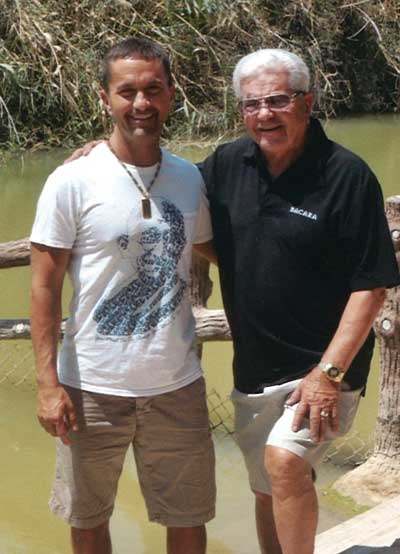
Mac Rafati, right, owner of Mac and Tong’s restaurant, pictured with his son at the Jordan River. Photo Courtesy Mac Rafati

Mac Rafati, right, owner of Mac and Tong’s restaurant, pictured with his son at the Jordan River. Photo Courtesy Mac Rafati

This summer, Rafati got a call from his son, who lives in Malibu, Calif. To Rafati’s surprise, his son told him King Abdullah II of Jordan was shopping in his organic food store. Seconds later, Rafati and the king were having a conversation.

“I thought my son was joking,” Rafati said. “[Then] I realized I was talking to the King of Jordan. It was a shock.”

The king asked Rafati about himself, and took an interest in his past in Jordan.

“He was very, very nice and polite, as a lot of people from [Jordan] are — hospitable. We talked for about four or five minutes. … He asked how long it had been since I’d been in the country, and I said ‘54 years.’

“I told him I am three days younger than his late father, and that my last wish would be to see Jordan again, and I hope I can make it.”

Three days later, Rafati received an email inviting him and his son to Jordan for a week, compliments of the king.

Born and raised in Jerusalem, Rafati joined the Jordanian army when he was 17. At 25, he went to Germany for schooling. After two years studying languages there, he came to the U.S.

Rafati found work with an engineering company in Pittsburgh, which led him to a connection that would again alter the course of his life.

“We built a paper mill for Owens-Illinois in Texas,” he said. “I came back up north to [return] to our office in Pittsburgh, but I got lost in Toledo. It’s a true story. It sounds like a joke, but it’s not.”

Some friends he met at the O-I mill in Dallas convinced him to stay in Toledo. As an added bonus, O-I gave him a job at their Toledo facilities.

Eventually, O-I asked Rafati to work on a few overseas projects. His work took him to the Soviet Union, East Germany, Czechoslovakia, Egypt and Ecuador.

While in Toledo, Rafati met his wife, Tong, who was a manager for China Gate restaurant.

After five years of travel, Mac left O-I and he and Tong opened a restaurant, Our Place, located on South Reynolds Road. They ran the popular eatery for 15 years until they decided to retire.

For a time, the couple traveled around the West Coast, but in 2006 they felt the pull to return to Toledo, where they opened Mac and Tong’s, in the Ottawa Hills Shopping Center, 4330 W. Central Ave.

In August, Rafati, his son and his son’s girlfriend departed to take the king up on his offer. Upon arrival, they were picked up in a car and taken to visit with the king and queen.

The trio then set out to see the sights, which included traveling to the Dead Sea, the Jordan River and spending a night at a camp in the desert, featuring a feast and full amenities.

“I couldn’t believe it,” Rafati said. “They had everything. Lamb meat, chicken and vegetables. It was great! When dignitaries visit the King of Jordan, they go to this camp, have dinner and see the sunset in the desert.”

Rafati’s group spent the rest of the week visiting other points of interest before returning to the U.S. Now back in Toledo running his restaurant, Rafati said he is invigorated with a renewed love for his native country.

“I have so much pride in my homeland,” he said, his voice cracking with emotion. “I almost forgot about that, living here for so long. It brought back a lot of emotions, a lot of pride.”

Shaw: Bioretention cell planned in Sylvania

0

In partnership with the Ohio Environmental Protection Agency (OEPA) and St. Joseph Parish, the City of Sylvania is ready to embark on a project to correct flood plain sedimentation and erosion problems at the westerly end of Harroun Community Park.

In July, the city learned it a Surface Water Improvement Fund grant from the OEPA. The overall cost is estimated to be $106,000, with the OEPA committing over $82,000 toward the project. The remaining project costs are to be shared between the city and parish.

In partnership with the Ohio Environmental Protection Agency (OEPA) and St. Joseph Parish, the City of Sylvania is ready to embark on a project to correct floodplain sedimentation and erosion problems at the westerly end of Harroun Community Park. Construction is scheduled to begin in October and the rain garden should be complete and in place by the end of the month. Photo Courtesy City of Sylvania Department of Public Service

The location of the project is near the Lathrop House adjacent to the easterly parking lot for St. Joseph Church on Main Street. During rain events, uncontrolled stormwater runoff from the approximately one acre parking lot flows to the park’s westerly perimeter. Large erosion channels, up to one foot deep, are cut into the side of the embankment as runoff heads down to the bottom of the Ten Mile Creek floodplain. The large furrows are safety hazards to park users and transport unwanted sediment to the floodplain. In addition, the city expends resources to restore eroded areas after each significant rainfall.

A bioretention cell, often referred to as a rain garden, has been designed to correct the problem. These facilities are usually implemented in urban developments and are sized to treat the first flush of runoff (0.5 inches or less) for small drainage basins. First-flush runoff accounts for 85 percent of the storm events in Ohio and is most attributed with distributing harmful pollutants to our watersheds.

The surface of the cell, consisting of a 3-inch layer of shredded hardwood mulch, is slightly depressed from its surroundings allowing shallow ponding as water enters the basin. The mulch layer protects the filter bed surface from erosion and creates an organic layer conducive to filtering and degrading pollutants.

The cell surface is planted with specific plants capable of withstanding both wet and dry conditions. Tickseed, coneflower, red twig dogwood, Washington hawthorn and pussy willow are scheduled to be used in this application. These species of plants have elongated vertical root systems, which can absorb moisture from deep within the cell. As the root systems mature, more water is absorbed by the cell reducing the overall runoff to the flood plain.

As runoff gradually percolates through the mulch layer it is further filtered by an engineered soil mix, usually between 2 feet and 4 feet thick. The mix is thoroughly blended and is comprised of mostly sand, some native soil and decomposed organic matter. Most of the targeted pollutant removal is achieved in this zone with enhanced microbial activity, ion exchange and plant material absorption. Any excess runoff not used by the cell can exit via an underdrain system to a storm sewer or will infiltrate into the surrounding native soils.

Construction is scheduled to begin in October and the rain garden should be complete and in place by the end of the month.

This publication was financed in part through a grant from the Ohio Environmental Protection Agency under the provisions of the Surface Water Improvement Fund and the U.S. EPA Great Lakes Restoration Initiative. The contents and views, including any opinions, findings, conclusions or recommendations contained in this publication are those of the authors and have not been subject to any Ohio Environmental Protection Agency peer or administrative review and may not necessarily reflect the views of the Ohio Environmental Protection Agency and no official endorsement should be inferred.

Toledo Free Press received no compensation for printing this column.

Joseph E. Shaw is deputy director of the City of Sylvania’s Department of Public Service. He can be reached at [email protected].

TEDxToledo conference to spread concepts of ‘human experience’

0

A group of speakers is preparing to give the “talk of their lives” in 18 minutes or less.
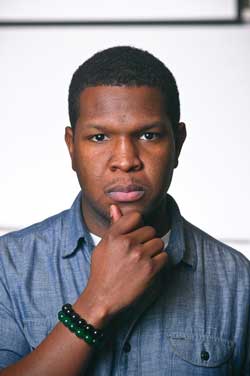
This is Will Lucas’ Third year organizing TedxToledo. toledo free press file photo by Joseph Herr

This is Will Lucas’ Third year organizing TedxToledo. toledo free press file photo by Joseph Herr

What they will talk about at the third annual TEDxToledo is being closely guarded for the first time in the event’s history, however, and will not be revealed until they appear on stage.

TEDxToledo organizer Will Lucas is keeping this year’s specific topics under wraps and will not disclose what audience members can expect at the daylong conference Sept. 18.

“We don’t reveal the subject matter of the talk until they’re on stage,” Lucas said. “Our goal, in an effort to continue to keep getting better, is to give people a chance to come and witness the event without any preconceived ideals. Come open and ready to learn and share.”

RELATED: Lucas: Dynamic experience

Lucas organized the first TEDxToledo in 2012 with the theme “You Will Do Better.” In 2013, the idea of improving the city continued with the theme “reIMAGINE.”

This year, the roster of 17 speakers will give talks on the theme “Human: Exploring the many dynamics of the human experience.” To view a listing of the speakers, go to www.tedxtoledo.com.

TEDxToledo is the local version of the international TED talks. The acronym stands for Technology, Entertainment, Design. TED is a nonprofit dedicated to spreading ideas in the form of short talks (18 minutes or less). Beginning in 1984 as a conference, today it covers a wide range of topics from science to business to global issues, according to its website.

“TED is … committed to ‘Ideas Worth Spreading,’” said Susan Zimmerman, executive assistant to TED’s curator in New York and a former Toledoan. “Those ideas vary in just about every way imaginable and can be seen in the most far-reaching corners of the globe, from the high-tech Vancouver stage of TED2014 to a chalkboard in a one-room hut in Malawi. … Our goal: to spark conversation, action and learning.”

The conference is a chance to bring people together and form connections, Lucas said.

“TED and TEDx events are the only places I know in the world where you can go to a conference and see a CEO sitting next to a farmer, and they are talking about the same thing,” he said. “For a moment in time, they are pushed in the same direction.”

Lucas and his organizing partners, Sam Melden and Molly Luetke, who started planning the event in December, decided to do something different this year based on advice from the international TED organization on ways to enhance their TEDx.

In the past, they normally would find speakers and then decide the topics of the talks. For this year’s event, they narrowed down the topics and then went in search of speakers.

“It kind of changed the way we thought. That has really enhanced it this year, “ Luetke said. “Our biggest challenge was to come up with topics. We wanted new and interesting ideas. Part of the problem was coming up with a subject that hasn’t been done before.”

That’s why organizers brought in another group of about eight people who could help identify topics and find speakers. The group gave great input and fresh ideas, Luetke said, giving organizers a conference with speakers who don’t resemble what would be considered a usual TEDxToledo event.

The speakers — seven women and 10 men — come from a broad range of professions and backgrounds.

There are professors, doctors, artists, a CEO and a mom.

“I’m super excited about the line-up and I think that they are people who do wonderful things in the community, but who are not necessarily people who have a platform on a daily basis,” Luetke said.

“Not everyone will agree with the idea the person has, but that makes for interesting conversation. We’re just hoping it causes further conversation and that’s what TED is all about. I think our speakers this year will really challenge folks.”
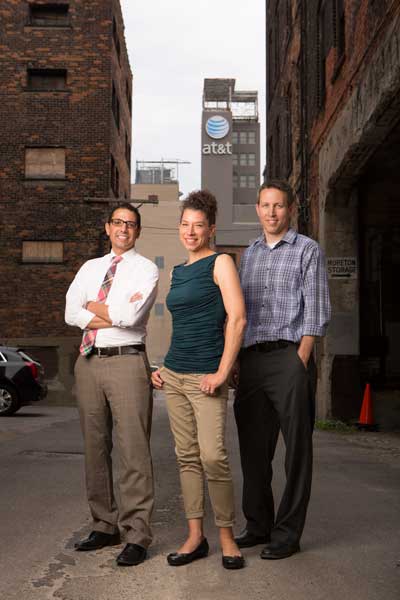
TEDxToledo speakers Eugenio Mollo, Maara Fink and Dr. Matt Roth. Toledo Free Press photo and cover photo by Michael Nemeth

TEDxToledo speakers Eugenio Mollo, Maara Fink and Dr. Matt Roth.

Toledo Free Press photo and cover photo by Michael Nemeth

TED talks have a reputation for being cutting edge and thought-provoking.

“I’m more excited about these speakers than in the first two years combined and that doesn’t take away from the first two years,” Lucas said.

Maara Fink, clinical professor of law at the University of Toledo, is one of the speakers at this year’s TEDxToledo. According to TEDxToledo guidelines, Fink could not divulge any information on the topic she plans to discuss, but said she was honored the organizers chose her.

“I hadn’t necessarily thought I would ever be able to be a part of [TEDxToledo] but was certainly honored to have been asked and it was through a wonderful group of folks who put this panel together that felt that I might have something to contribute,” she said.

She knows not everyone will agree with her ideas or see things from her perspective, but she hopes to nudge people’s minds in a way that will allow them to see things in a different light, she said.

“We all think our ideas are interesting and unique and, for me, [the goal is] to define them in a way that’s interesting for a diverse audience and you hope you touch each audience member in some way,” she said.

Organizers selected the theme “Human” was selected after picking out particular topics they wanted to hear.

“I realized that all our ideas for talks seemed to hover around the idea of the human experience, and the name ‘Human’ just came to me during our organizer meeting,” Lucas said.

Back in 2011, Lucas got the idea to organize a TEDx event in Toledo after watching a video of Steve Jobs’ 2005 Stanford University commencement address, which was linked to the TED website.

At the time, Lucas, with his technology background, felt frustrated by the lack of a technology community in Toledo.

“I was tired of it,” he said. “[I thought] if I can bring that type of energy to Toledo it would raise the level of conversation. That’s why I got involved in it.”

This year’s budget from donations and sponsors is $10,000. That money will pay for the event facility, videographers and other expenses, Lucas said. The event is nonprofit, so all money from ticket sales will go toward the event or be donated.

Last year, money raised was donated to the Young Men and Women of Excellence program at Toledo Public Schools. Speakers are not paid.

Speaker Eugenio Mollo, a local attorney, called the process of developing a TEDxToledo talk “challenging.”

As speakers develop their talks, they meet with a TEDxToledo curation committee made up of a marketing representative and theater representative, among others, Mollo said. Each critiqued parts of his speech and give him pointers on how to speak more effectively.

“There’s a lot of support and practice and there’s a lot of effort that goes on behind the scenes of a TEDx,” he said.

As an attorney, most of Mollo’s public speaking experience has come in a courtroom.

“A lot of people think, ‘You’re a lawyer and this comes naturally for you,’ but this is a different environment,” Mollo said. “It’s a different audience and a different presentation style.”

Dr. Matt Roth, a primary care practitioner and physician for the Toledo Walleye hockey team, said he doesn’t necessarily consider himself an expert on any given topic, but was excited and honored to be selected as a TEDxToledo speaker. Although he couldn’t give away details of his topic, Roth said the TEDxToledo team coached him on his presentation and that the conference will be exceptional.

“We each had our individual sessions, but you arrive when the other one is finishing up so you have some overlap … so you get a little bit of a glimpse of what’s coming,” Roth said. “It definitely encourages me. All these other talks are great and they’re doing good things — a wide variety of different subjects that fall under the human emphasis.”

Tickets to the conference the first year sold out at $100 each. The second year, they were $75 with a buffet lunch included. This year, they’re $49. Organizers figured out if they don’t include lunch, they can reduce ticket prices, Lucas said. Lunch this year will be offered by local food trucks, which will offer reduced rates, he said.

If area residents find themselves hungering for TEDx talks throughout the year, they won’t have to wait until next year before Toledo hosts another one. New this year, Lucas said he has identified four “community stewards” who will oversee four “mini” TEDxToledo events to be held during the remainder of this year and into the next, Lucas said. Some of this year’s topics could become themes for the mini TEDxToledo talks.

TEDxToledo 2014 is set for 8:45 a.m. to 4:30 p.m. at the West Toledo YMCA/Start High School Theater at 2110 Tremainsville Road.

Also speaking will be Marjory Curry, Boyd White, Saga Shoffner, Diana Patton, Fritz Byers, Jennifer Rockwood, Jelani Exum, Dr. Johnathan Ross, Dan Rogers, Larry Meyer, Leslie Adams, Jason Quick, Bona Vega and Andrew Ellis.

For tickets or more information, go to www.tedxtoledo.com.

City considering demolishing shortened smokestack

0

Editor’s note: Updated with response from HUD, comments from Marc Gerdeman and comments from Lisa Ward.

The City of Toledo received Sept. 9 the approval it sought from the U.S. Department of Housing and Urban Development (HUD) to potentially demolish the rest of the recently shortened smokestack at the former Toledo Edison power plant site in East Toledo.

The 75-foot stack will likely remain for now, but the approval from HUD gives the city the option to demolish it in the future without jeopardizing the HUD grant used to fund the project, said Marc Gerdeman, brownfield redevelopment officer with the City of Toledo’s Division of Environmental Services.

“If there’s any future redevelopment at the site, it may be removed, but for now it’s going to stay,” Gerdeman said. “I don’t really see it in the future being knocked down anytime soon. We’re keeping it until we hear otherwise from the mayor’s office.”

After two stacks at the site were imploded July 16, the city planned to shorten the remaining stack to about 100 feet. However, the Aug. 29 implosion left the 297-foot stack around 75 feet instead, including its 48-foot concrete base, said Bill Burkett, city commissioner for economic and business development.

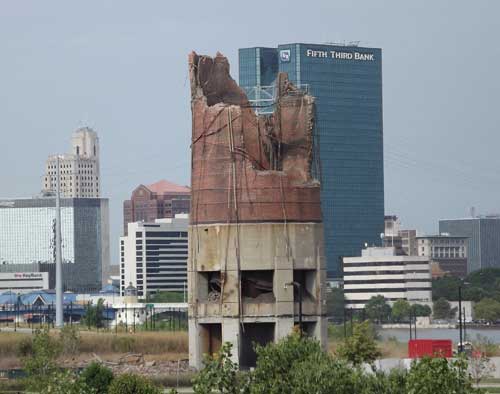
The third and final smokestack at the former Toledo Edison power plant site in East Toledo was shortened by an implosion on Aug. 29. Cleveland-based B&B Wrecking has since evened out the brick on top for a final height of about 75 feet. The city is now deciding what to do with the stack. Toledo Free Press photo by Sarah Ottney

The third and final smokestack at the former Toledo Edison power plant site in East Toledo was shortened by an implosion on Aug. 29. Cleveland-based B&B Wrecking has since evened out the brick on top for a final height of about 75 feet. The city is now deciding whether to keep the stack as is, turn it into a lighthouse motif or demolish it. Toledo Free Press photo by Sarah Ottney

“We knew there was a possibility depending on how that stack fell that there could be some additional damage,” Burkett said Aug. 29. “It looks a little short, we know that.”

Oklahoma-based Dykon Explosive Demolition Corp. was contracted by Cleveland-based B&B Wrecking by the City of Toledo to perform the implosion. A week after the implosion, B&B Wrecking returned to the site to even out the remaining brick to a uniform height.

Although the resulting height is still within the project’s planned scope, which called for stack to end up at 100 feet give or take 25 feet, many feel the shortened stack looks too short, Burkett said.

“The consensus was aesthetically we did not meet the preservation goal of keeping enough brick,” he said. “I think people thought with 50 feet of brick, aesthetically, it would look more like we were preserving a stack, but with only about 20 feet of brick you kind of lose that preservation affect.”

The city, with input from other groups including the Marina District Architectural Review Committee and the nearby National Museum of the Great Lakes, is now working to decide whether the leave the stack as it is, turn it into a lighthouse motif as has been suggested by Toledo Mayor D. Michael Collins or tear it down.

In the meantime, B&B Wrecking will return to the site to put a cap on the stack, Burkett said. The cap will be made of “marine-grade plywood,” he said, and will help protect the stack from damage caused by water seeping between bricks and then freezing and thawing over the winter.

The implosions, along with cleanup at the site and the preservation of a guard house structure, was funded by a $475,000 federal grant awarded to Toledo by HUD in fiscal year 2009.

The scope of the original project called for retaining a portion of one stack along with the guard house at the front of the site as historical preservation. The guard house, which had its roof replaced and windows boarded up, has been preserved for possible future use, Burkett said.

In order to consider demolishing the shortened stack, the city needed to request permission from HUD to modify the scope of the project.

If HUD had declined to allow the city to modify the project, the stack would definitely have remained, Burkett said, as the city would likely have been asked to reimburse the grant funding if it was demolished.

“If they want their money back, the stack will stay like it is,” Burkett said. “If we get permission from them … we’ll probably move ahead and take it down.”

The estimated cost to demolish the rest of the stack, including the concrete base, is $40,000, Burkett said. Where that money would come from has not been determined, but could come out of the city’s economic development fund if an economic development project is developed for the site, he said.

“A lot of it depends on what the plans are for that area,” Burkett said. “What we do next is figure out what’s next for the Marina District.”

The Marina District Architectural Review Committee approved the city’s plan to leave a 100-foot stack, but had preferred the preserved stack be higher than 100 feet, said City Plan Commission Director Thomas Lemon, a member of the five-person committee, which reviews developments in the Marina District overlay.

“There was a preference to keep the stack a little higher if possible,” Lemon said. “It was more in keeping with historical appearance and function.”

Lemon said there has not been another official committee meeting to discuss the site, but several members have weighed in since Aug. 29 to say they might support demolishing the stack.

“Since it turned out a little lower than what they had planned — although still within the tolerance — there is some support for removing the entire stack,” Lemon said. “At least one or two members feel that might be the best resolution at this time.”

Lisa Ward, public information officer for the city of Toledo, said the mayor still favored the idea of turning the shortened stack into a lighthouse motif, but nothing had been decided yet.

Lemon said the committee is generally not in favor of Collins’ idea to turn the remaining stack into a lighthouse motif, although there has not been an official vote.

“I think the ARC would prefer it maintain more of the original look of it as much as possible,” Lemon said.

Once the city hears back from HUD, the architectural review committee will set up a meeting to discuss, Lemon said.

Burkett and Lemon stressed no final decisions have been made.

“What we’re going to do with it, we don’t know just yet,” Burkett said. “We’ve been discussing options.”

Miller: Breaking bad

0

Raising kids is like being a full-time traffic cop. It’s watching every direction at every moment, trying to anticipate disaster before it happens, enforcing rules that should be common sense but are often ignored in the pursuit of speed.

“No” is the smallest big word in a parent’s vocabulary. Like the color red, “no” elicits an instant reaction of caution. But like any word repeated and repeated again, it loses its meaning and becomes just another strip in the numbing gauze of streaming information that must be processed.

.

.

We have tried to instill standards of civil and polite behavior in our two sons, Evan, 8, and Sean, 6. But sometimes, examples are far more effective teaching tools.

During a recent weekend away, we stayed at a suburban Embassy Suites hotel. It was set up for big events, with a massive open atrium and far more amenities than our usual stopover locations.

The hotel was hosting a reunion with scores of people meandering around in matching T-shirts. They enjoyed a Saturday night reception and dinner with music and seemingly a great deal of familial warmth. The center of the reunion seemed to be a wedding anniversary; the celebrated couple had a photo album and the bride’s wedding dress on display.

Even from halfway across the atrium, it was clear they were the proud patriarch and matriarch of the large family.

But as the weekend progressed, many members of the party brought children who were allowed to roam the hotel like packs of wildebeests, trampling over other people’s personal space and comfort with zero regard for basic civilities.

Our sons witnessed people bull-rushing the elevators before people in the car had a chance to exit. They saw people walking by reception buffet areas and scooping out munchies with their bare hands, dropping food and crunching it underfoot without looking back. They saw kids running in the halls, yelling and screaming as if the space outside room 404 were a playground.

Against our better judgment, we took Sean and Evan to the hotel pool to let them splash around and release some energy. There were eight or nine kids, none of them yet teens, none of them with parents, running around the pool’s wet tile borders, indiscriminately throwing a basketball and taking turns diving and cartwheeling into the pool, which was only 5 feet at its deepest. They were also cannonballing into a nearby hot tub, which was barely 4 feet deep and was clearly marked off-limits for anyone younger than  16. They all wore (or had discarded) the reunion T-shirts that seemingly four score other people were wearing in the hotel.

The behavior was appalling, not just for its rudeness, but for its recklessness. We tried to give our kids a small corner to splash in away from the melee, but the other kids began running and jumping in over our boys’ heads, so we soon gathered our kids and left. We talked to them on the way back about the dangerous and rude behavior they had witnessed. Sean was clearly rattled by the chaos, but Evan seemed as fascinated by the wildness as he was repulsed by it.

Part of our room arrangement was a 24-hour “refreshment center” in the form of a hallway vending machine stocked with water, soda and various candies and chips. We were supplied with a punch key code for the machine, and on the way back to our room, we used the code to get bottles of cold water and two or three munchie items. Each time we used the code, the number indicating the amount of remaining turns dropped by one —  99, 98, 97. A group of the young reunion revelers were behind us, commenting on how much they wished they could break the machine’s glass to get a bag of Skittles or Cheetos. It crossed my mind to offer to get them each something, but I would not want a stranger offering my kids a treat, so I took the few items back to our room.

About two hours later, my wife asked me to step back into the hall for more water.

As I approached the machine, the group of kids from earlier fled from me, their hands full of as many chip bags and candy bars as they could carry.

I keyed in the code for the bottle of water and saw the number: 54.

I knew I had not removed 40-plus items from the machine. As I stood there puzzling, two of the kids from the reunion came back, stepped in front of me and punched in their key code.

Which was my exact key code.

They had watched me enter the code and then kept returning to use it, just about emptying the machine. The access was a courtesy; we were not being charged per item and certainly did not plan to abscond with 50 Twix bars, but I still felt … not angry, but violated in the way one feels when something has been stolen or unfairly taken away.

The next morning, we rose early and tried to get our kids back to the pool before we left. As we passed the vending machine, I noted it was empty.

Arriving at the pool, we were dismayed to see a smaller group of the same kids from the night before were already raising hell. But this time, a hotel employee kept entering the area and ordering them out of the water, telling them they could not be in the pool without a parent. Every time the employee left, the kids literally dove back in. This game lasted about three rounds before one of the kids left and retrieved a man she identified as her father.

As soon as the employee left, the man exited to an outside area to smoke and use his cellphone, his back to the indoor pool. When he came back inside, he told the kids he had not spent hotel money to leave the bed and hang out at a pool. Without breaking stride, he left.

By this time, we had our disappointed boys in towels and were heading back to pack up and leave. Upstairs, we talked to them about the flagrant flouting of rules and open lack of respect for authority and basic manners. I was being a bit hard in my condemnation of the misbehaving kids, desperate to use them as an illustration of worst-case public behavior.

It was Evan who said, “But none of them had a mommy or daddy around. Who will teach them?”

As we were reminded in subsequent days, even some mommies and daddies do not employ manners and basic civility, but at the time, we focused on the lessons to be learned from the kids we had seen.

As I turned in our room key cards, I saw the celebrated, elderly matriarch and patriarch waiting patiently to have their luggage loaded. As they waited, reunion T-shirt-clad kids pulled a plant from its vase, ran in circles among guests in line and ran waving food they had pulled from the breakfast service.

They looked sad and slightly mortified, but remained quiet, sanctioning through silence the rude and wild behavior, monarchs to generations of impolite and hazardous people.

I know we are not raising perfect kids, but we are working to raise ones who will recognize the difference between civility and boorishness, between making the occasional wave and drowning in rudeness.

Michael S. Miller is editor in chief of Toledo Free Press and news director of Newsradio 1370 WSPD. Contact him at [email protected].