Home Blog Page 184

UT annual event to celebrate banned books

0

By Russ Axon, Toledo Free Press Staff Writer

What do “The Diary of Anne Frank,” Dr. Seuss’ “The Lorax” and the Quran all have in common? All of them can be found on lists of frequently banned books.

Each of them will be celebrated, along with hundreds of other books, at the 17th Annual UT Banned Books Week Vigil from 9 a.m. to 5 p.m. Sept. 25.

The vigil will feature 12 censorship-themed presentations from community members. Paulette Kilmer, University of Toledo communications professor who heads the event committee, said she likes to give the presenters free rein.

“I’m only strict that they keep [their presentation] under 20 minutes because I don’t want it to feel like another lecture,” she said. “Otherwise, I encourage them to discuss what they’re passionate about.”

The free event is open to both students and the public. Attendees can also expect games, door prizes, food and music. Additionally, copies of commonly banned or challenged books will be given away throughout the day.
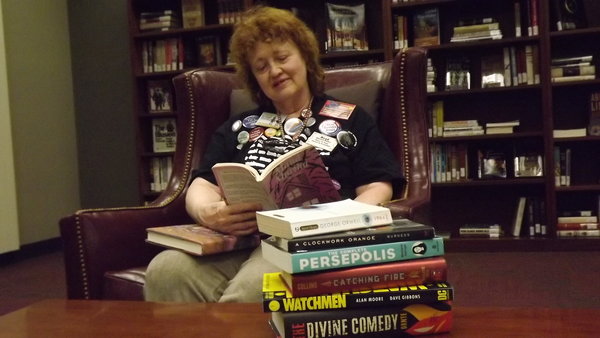
Paulette Kilmer of University of Toledo's Banned Books Week Virgil. Toledo Free Press Photo by Russ Axon

Paulette Kilmer of University of Toledo’s Banned Books Week Virgil. Toledo Free Press Photo by Russ Axon

The vigil will be held in the Carl Joseph Reading Room of the library, which is normally a quiet study area. Kilmer said it’s one of the few times the library is allowed to get noisy.

“One of our goals is to get in as many people as we can so that anyone walking outside can hear us,” she said.

Kilmer said the event is a collaborative effort, and the committee tries to make every year unique. The vigil has opened itself up to other mediums, like comic books, video games and films. Past events have included sit-ins, a Mark Twain impersonator, and viewings of select “South Park” and “The Simpsons” episodes.

“It’s very special because it’s a unique formula,” Kilmer said. “It combines the fellowship of meeting with the intellectual benefits of listening.”

Almost every department and school at UT, as well as multiple local businesses and community members, have donated either funds or door prizes this year. With all the funds, Kilmer said, she was able to purchase about $1,500 worth of banned books.

“We have more support this year than we have ever gotten,” she said. “We can make it a better event, and we can make it so that when people come over here they really have fun.”

The vigil is part of the American Library Association’s Banned Books Week, an annual campaign meant to bring awareness to censorship throughout the world and celebrate reading.

“I consider this, as much as anything, a holiday for reading,” Kilmer said. “It’s one time in our busy schedules where we can stop to reflect on what a wonderful gift reading is for all of us.”

Kilmer remembers attending the first vigil when it was held at Thackeray’s Books, a now-closed local bookstore. Originally, it was a 24-hour event where volunteers would read selections from banned or challenged books.

“It was really fun. My students and I, we took the graveyard shift, and then we’d go to breakfast afterwards,” she said.

Kilmer helped move the vigil to UT in 2000 and fought to keep it alive.

“It was four or five years that we really struggled,” she said. “Now we’re here with the library, which is where we belong.”

The vigil is very important to Kilmer, who was instilled with a love for reading as a child.

“My mother read books with me and my brother, and then we’d sit on the front porch and talk about the book while we drank lemonade,” Kilmer recalled. “That was one of the best gifts my mom gave me.”

Kilmer hopes everyone who attends the vigil has a great time and takes away a little knowledge.

“I hope they leave thinking about how incredibly fortunate we are to live in a country where we have the right to read and nobody has the right to tell us what we’re going to read,” she said. “The right to read is the right to think freely.”

The Banned Books Week Vigil is on the fifth floor of Carlson Library at UT’s Main Campus, 2801 W. Bancroft St. For more information, visit www.facebook.com/UTBannedBooks.

Toledo Free Press is a sponsor of the vigil and Managing Editor Sarah Ottney is one of the event speakers.

Miller: Life after Peggy

0

EDITOR’S NOTE: Peggy Zachel died last week.

I was beginning to think no one would ever type those words; she lived so long and so fiercely that I was beginning to believe she would outlive us all.

This unworthy portrait of her was published in October 2008; nothing about her changed to the very end. I offer these words again because I am unable to process any better ones.

Peggy Zachel grabbed the steering wheel from my hands the first time I met her and she’s never really given it back.

In July 2003, I was assigned an Adrian story that took me to Zachel’s property in Seneca Township, near Morenci, Michigan. Peggy, who was about to turn 85, had dedicated several years to restoring a one-room schoolhouse that stood on the farm she and her husband John cultivated.

.

.

I met Peggy at her house, and she slowly climbed into my car for the short drive to the schoolhouse. As we came upon a place where the path split, she tried to guide me the correct way, but I wasn’t catching on.

Suddenly, the octogenarian reached across the seat, smacked my hands off the steering wheel and began directing the car. Surprised by her speed and strength, I did not question her authority.

“Turn right! Right! I need you to be on that path,” she said, exasperated.

I worked the brakes and gas while she steered the rest of the way.

“I’ve been in the country all my life,” she admonished. “You city people just don’t do things like we do.”

Looking back at my Daily Telegram description of Peggy, I can see that my admiration and slight intimidation of her mingled from the very beginning: “Zachel’s hair and face bear the strain of squeezing each drop of life out of every day for more than eight decades. But her eyes are focused and clear, reflecting her state of mind. In blue canvas sneakers and a red cotton dress embroidered with flowers, she looks like a Norman Rockwell grandma. But she does not suffer fools lightly — or, more accurately, at all.

“Zachel climbs the concrete stairs with the concentration of a wizened Sherpa navigating Everest. A knobby, polished-wood walking stick supports her. As she opens the door of the one-room schoolhouse, the brick seems to soften and embrace her presence.”

I spent a few hours with Peggy that day, watching her soften as she walked me through the schoolhouse, which had been painstakingly restored with the help of neighbor Jack Sampson. Walking into the schoolhouse was a time-machine experience. From the late-1800s textbooks to the framed portraits of George Washington and Abraham Lincoln, the schoolhouse stood as a transporting pocket of rural America.

But as fascinating as the restoration was, it faded as I learned more about Peggy. Everything about her emanates a stability and grace rarely seen in modern people. Peggy pioneered speech therapy in the 1940s, establishing a program in Lenawee County. She and John are approaching 60 years of marriage, and their children include Alaskan adventurers Robert and Cortland and published author Gretchen.

As our tour of the schoolhouse ended, Peggy sat down for a rest on the bench of a player piano. With a little prompting, she placed a scroll in the ancient music maker and started pumping the pedals, raising a fine ruckus.

After the lengthy article was published, Peggy and I stayed in touch, and I wrote small articles as the schoolhouse neared completion. The restoration of the bell was the last major touch, and by the time Peggy rang it for the first time, more than a year had passed and I considered her to be a great resource of wisdom and guidance.

There are people in life who see things more clearly than the average person, people who have insight and sense on superhuman levels. I do not mean to turn Peggy into a caricature by invoking fictional wizards like Gandalf and Kenobi, but Peggy stands in my mind as hyper-real, someone of supernatural talent and presence.

My wife and I made several trips to the Zachel farm, to watch John herd turkeys and to share meals that consisted only of things he and Peggy grew on the farm. On one visit, as the adults talked, we opened a package of dried apple pieces to feed Evan. The snack is 100 percent apple, nothing artificial, and the package makes for easy transportation.

Without saying a word, Peggy went to her kitchen and cut up a farm-grown apple, giving Evan small slices, which he devoured.

“Nothing like the real thing,” she said, and we haven’t bought dried apples since.

Neither of my sons will know their paternal grandmother, who died more than 10 years ago. I know it is unlikely they will have decades to spend around Peggy. But if they can soak in just a few atoms of her spirit, that wise, determined, steady and no-nonsense soul, they will be better men, as I am a better man for knowing her.

A decade into our relationship, I see no need to ask Peggy Zachel to relinquish the wheel; I trust that wherever she drives us will be a good place, a safe place, and all I have to do watch, listen and learn.

Michael S. Miller is editor in chief of Toledo Free Press. Contact him at [email protected].

Residents, city give Junction neighborhood some elbow grease

0

Residents in Toledo’s Junction neighborhood decided they were going to do something. They weren’t going to stand by while people dumped trash in their vacant lots, renters grew their grass knee-high and kids walked over cracked pavement and broken glass to school.

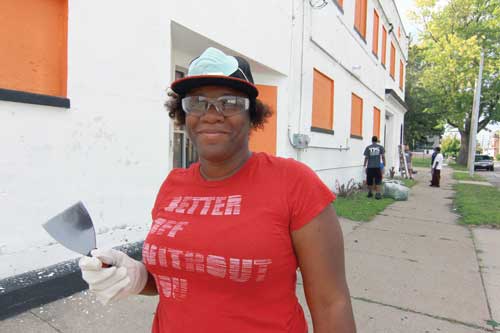
Alicia Smith is a community organizer who leads the Junction Avenue Project. Toledo Free Press photo by Kim Sanchez

Alicia Smith is a community organizer who leads the Junction Avenue Project. Toledo Free Press photo by Kim Sanchez

So they started meeting on porches. They put their heads together and tried to come up with a plan of attack. A community organizer out of Cleveland got wind of their efforts and came over to help.

Then they turned to the City of Toledo’s Department of Neighborhoods and the movement took off. The city brought in lawn mowers, and about 15 young people mowed down the tall grass. That was in 2010, and organizer Alicia Smith hasn’t looked back.

“It’s about the community; it’s about the youth,” Smith said in regard to her continual push for progress.

She calls their efforts simply the Junction Avenue Project, and it involves many different people from city departments to nonprofit programs to the average citizen. Everybody gives a little bit of elbow grease to revitalize the neighborhood and turn it into a place people want to live.

At a recent neighborhood meeting, which happen every third Monday at the Frederick Douglass Community Association, the Lucas County Land Bank, the Toledo Metropolitan Area Council of Governments (TMACOG), Toledo City Council and the Toledo Police Department (TPD) all showed up, not just to give face time, but to actively participate in the improvement of the neighborhood.

The Lucas County Land Bank is working with Smith to funnel money toward removing abandoned homes.

So far, 100 houses have been razed since about 2012.

Kari Gerwin of TMACOG is working with the neighborhood to increase green space while making more efficient use of storm sewers to combat sewage overflows and flooding.

Smith and others are conducting an early voter registration drive supported by the city in which dozens of people have signed up to vote, and they have a new newsletter to get the word out called “Function in the Junction.”

The neighbors

Oscar Hill has lived in the Junction neighborhood for 22 years and has been coming to the neighborhood meetings for the past eight.

The biggest problem living in the Junction neighborhood, he said, are transient renters who come in for months and leave before Hill and others have any clue as to who they are. By that time, they’ve let their grass grow wild or they’ve dumped trash.

The goal, he says, is to instill in the people who are “on the move” more pride in their properties and one way to do that is to lead by example.

“Getting people to buy into the pride issue of where they live and being able to sustain it,” that’s the problem, he said. “We need to stay unified to really get results.”

Harvey Savage, executive director of the MLK Kitchen for the Poor at 650 Vance St., worked with Soul City Boxing Club over the summer to keep neighborhood kids out of trouble.

Savage said the second Saturday of every month is “Dump Day” in the neighborhood to help residents clean up their homes and streets. He agreed with Hill that the biggest problem in the neighborhood is the lack of ownership. He said residents need to step up and take responsibility.

“The city can’t take care of all the gray spots,” he said. “Citizens need to be a part of that.”

Several residents were upset over ongoing illegal dumping. One man said culprits bring a different couch practically every night to one location at Belmont and Detroit avenues.

“We’ve got rats big enough to wear a field pack. You’d think they’re in the Army,” said one irate resident.

City presence

Paula Hicks-Hudson, president of Toledo City Council, said what the neighborhood needs is enforcement.

“We need more of us to call the mayor’s office,” she told the group assembled Aug. 18. “I share your frustrations.”

As for abandoned houses, Hicks-Hudson said there’s no money in the city’s demolition fund. The money is all in the Lucas County Land Bank fund.

“I’m hoping when we do the budget we’ll put money into demolition,” she said.

The Junction neighborhood is in Hicks-Hudson’s City Council district. She said during a telephone interview days after the meeting that she fully supports what the residents are trying to do.

“I’m there as a district Council-person to support them, as a citizen and a representative of them because that’s my district,” she said. “They elected me, therefore I represent them and I want to help in the success of their endeavors.

“That’s what residents should be doing, is taking leadership and self-determination as to how the neighborhood should be and what it should look like. I see my role as someone to help them achieve those decisions.”

Hicks-Hudson coordinates information about city resources and brings in city departments to the meetings to discuss solutions. Their issues have evolved from focusing on violence and police response times to illegal dumping, tall grass and rodents.

Hicks-Hudson is concerned about the lack of public transportation and jobs, the dumping that continues to plague the neighborhood and the dearth of public resources to combat vacant homes.

“Sociologists talk about the broken window,” Hicks-Hudson said. “If you allow it to stay broken and don’t fix it, it will [encourage] more disrepair and many of the residents are feeling it’s regressed to the point that their issues are not being addressed or heard. We’ve got these problems, but what is our response to them? They are banding together and becoming a powerful voice that speaks, and making these determinations of what is the No. 1 issue.”

Toledo Police

The TPD has a strong presence in the neighborhood via community policing officer Kimberly Darrington.

Darrington has been literally sifting through trash to look for objects that will help identify those who dump garbage. She called the city three times about a single location, hoping to land some prosecutions.

“I go out and see the dumping and call the city and get frustrated when I see more dumped. I hate it so much I go out there into the trash,” Darrington said. “We (the police) get frustrated. We want to be there. We want to catch people.”

In one case, she was able to catch the culprits when a neighbor who witnessed the dumping agreed to testify in court.

Smith said residents are told to take note of license plate numbers but not pursue when they see illegal dumping.

Darrington will soon move to a different district. She will be replaced by a new community officer for the Junction neighborhood, Officer Jim Below.

Days of Caring

“Dump Day” is by far the largest self-directed event in the Junction neighborhood but the largest sponsored event is the “Days of Caring” by United Way of Greater Toledo, which focuses on youth development and enrichment, Smith said.

On Sept. 12, nearly 2,000 volunteers participated in several painting, cleaning and landscaping projects meant to spruce up areas, including painting a mural at the Soul City Boxing Club, erecting a welcome sign and weeding, mulching and painting a barrier walkway at the Frederick Douglass Community Association.

United Way also partnered with Live Well through the YMCA and other partners to create safe walkways to school, including creating street islands and installing crosswalks.

To become involved in the Junction Avenue Project, call Smith at 419-215-9243, email [email protected] or send a letter to the Frederick Douglass Community Association, 1001 Indiana Ave., Toledo, OH, 43607.

Hoeflinger: Don’t fear drug testing our youth

0

Why are so many people offended by the thought of drug and alcohol testing our youth? If your child is not doing it, then there should be nothing for you to worry about. But many parents are actively against the notion of drug and alcohol testing for teenagers. Many parents cite the Fourth Amendment and say it’s a violation of our underage children’s rights.

When did the rights of children supersede the rights of adults to be parents? Even more so, when did the rights of teenagers supersede the law? It is illegal to drink alcohol before the age of 21 and it is also illegal to use recreational drugs in all states before the age of 21. Then why are we providing our kids with the power to go ahead and do these things? Alcohol and drug testing in our schools and at school-related functions is necessary and would greatly curb these illicit activities in our youth. If being caught resulted in a direct consequence then teens would think twice and consider not doing it.

.

As it stands now, our underage teens are clearly in control and constantly push the limits because they are allowed to do so with few repercussions. We have many adults whose only concern is that the kids’ freedoms to do what they want will be taken away. That attitude is where much of the problem lies.

As a parent, why would you want your underage child to drink alcohol, smoke pot or take drugs? Is there any reasonable positive benefit to any of these activities that we should know? None are good for your health. None promote a healthy lifestye. None are legal for minors. None are good for brain development. The list goes on.

On the other hand,  we know that alcohol and drugs are often linked with crime, risk-taking, lying, violent behavior, injury and/or death. I think one can safely say that the risks greatly outweigh the benefit when it comes to drugs, alcohol and our youth. Yet it continues! Which makes me wonder, are there people out there who think alcohol and drugs are beneficial for our teens?

The only logical conclusion that can be drawn about parents who do not want their teenagers to be drug and alcohol tested would be that they either know their kids are doing it and condone the behavior or that they do not want to know if their child is doing it and wish to remain ignorant to the possibility. Lastly, there are parents who are just oblivious to the whole concept of teens, alcohol and drugs. What other logical reasons could there be? Parents need to wake up before it is too late.

My wife and I have already received our wake-up call with the death of our son Brian, who died as a result of a drunk driving accident. He was the drunk driver. From this experience, we have learned that kids are drinking alcohol and smoking pot and they are not letting their parents know.

Don’t think you are above your child not telling you that they are drinking alcohol, smoking pot or taking drugs.

They don’t want you to know and why would they, since it is illegal. Then I ask you, what harm would random testing for alcohol or drugs cause your kids? Or a better way to look at it would be, what benefit would your teenager get from random testing? It certainly would help deter them from using these substances because random testing would force teens to consider the possibility of getting caught and being reported to their parents as well as to the school.  It also would give them a better reason to say no in front of their friends.

Brian Hoeflinger. Photo Courtesy Brian and Cindy Hoeflinger

Alcohol and drug testing provide a legitimate excuse for teens to say no!  In the end, random testing will undoubtedly save lives. Again, if your teens are not doing these things then they have nothing to fear.  Yet many parents remain solely focused on the individual’s rights. When you go to an airport, you are screened by security and often searched and patted down. This does not seem to stop anyone from flying. When you go to a concert and your bag or purse is searched, this does not seem to deter people, particularly teens from wanting to go to concerts.

People give up their rights every day for things our society deems necessary. Alcohol and drugs in our youth should be no different. These activities are illegal and yet a majority of teenagers blatantly disregard the law and partake in them. For the parents against testing our youth, I ask you, for instance, where is my right as a person to not have a drunk teenager disrupting a school event such as a football or basketball game? Does the right of the drunk teenager who has drank alcohol illegally supersede my right as a person to watch the game in peace? And what parent thinks it’s OK for a teenager to come to school or a school activity drunk, high or both?

Yes, many parents did these activities when they were young and turned out fine. Does that then make it right for kids today to do the same? How can things ever change for the better with that type of mentality? And when I say change things for the better, I’m referring to a future without addiction and the senseless violence, injuries and deaths that are directly associated with alcohol and drugs. These injuries and deaths are preventable with change in a forward direction. Who can argue that point?

When I was a surgical resident in 1993, there were no restrictions on how many hours a resident doctor could work in a week. One week, I logged 147 hours out of a possible 168 hours in the week. I slept about eight hours that entire week. And yet I cared for patients, sometimes alone in the middle of the night. Things have changed since 1993 and we now have a maximum 80-hour workweek for residents.  Why did it change? Because of concerns about patient safety and resident abuse. At some point, people spoke out against this practice and things changed.

Changes were made to protect innocent patients from overworked doctors who may have made unintentional mistakes due to lack of sleep. Just because I was trained in this fashion 20 years ago doesn’t make it right today. I use this example to illustrate the need for change regarding our youth. Innocent teenagers are being injured and dying every day as a result of alcohol and drugs.  We need to stop this practice unless of course you are in favor of the appalling statistics associated with teen injury and death as a direct result of alcohol and drugs.

It’s time for parents, schools, law enforcement, liquor stores, bars and society in general to step in and protect our youth from themselves. They are minors and need guidance. They need firm rules with strict consequences so that they clearly understand it is illegal to use alcohol and drugs at their young age. The law states that drinking alcohol is illegal before age 21. Why was the age of 21 picked? Because extensive research and statistics have shown that injury and death due to alcohol intoxication sharply decrease after the age of 20. Hence the legal drinking age of 21. We as parents need to reinforce this to our underage children. But a parent’s influence can only go so far.

Again, kids do not want their parents to know they are drinking and smoking pot. They will hide it and keep it a secret at all costs. Thus a parent’s ability to stop this behavior only goes so far. Schools, liquor stores, bar owners, hosting parents and the media (to name a few) all need to be involved to help take these choices away.  Schools need to alcohol and drug test as well as educate students about the dangers of these substances.

Liquor stores and bars need to consistently check IDs and not sell alcohol to minors. Stronger social host laws need to be publicly advocated in the media and set into law. Parents need to keep talking to their children, set a good example for them and enforce the rules at home.  All of these measures are needed to change things from a past that doesn’t work for our teens to a new healthier future for our children.

I would ask all of you to look at drug and alcohol testing for our youth as a positive preventive measure as opposed to a negative invasion of privacy. Drug and alcohol testing is in our teens’ best interest to protect them from what they often lack — a sense of wisdom, foresight and good judgement. Most teens are not mature enough to foresee the immediate and long-term effects of these substances.

We as adults, parents and institutions need to help our youth make better decisions by cracking down on underage alcohol and drug use. In essence, we need to take back control of our youth who so often feel that they are already adults. They want to partake in adult activities which too often result in risk-taking behavior and resultant tragedy.

If you have any doubt in your mind that a teenage alcohol-related tragedy could happen to you, then please read my book, “The Night He Died: The Harsh Reality of Teenage Drinking,” which can be found on Amazon or through our website, www.brianmatters.com.  Tragedy does not discriminate and anyone is susceptible when teens drinks alcohol. Please strongly consider what I have written with an open mind. It could be your last reminder before something that could have been prevented happens to your family.

I would ask everyone who reads this to please share it with your friends. The only way we will ever gain control of the alcohol and drug problem in our youth is to hold them accountable for their actions. Alcohol and drug testing is a first positive step in this process. Let’s not let the few people who oppose this idea stop forward progress for everyone.

If you would like to learn more about Brian N. Hoeflinger’s life or read more articles on teenage drinking, please visit our website at www.brianmatters.com.

Race for the Cure provides hope, practical help

0

Denise McCroskey will attend the upcoming Susan G. Komen Northwest Ohio Toledo Race for the Cure, three years after being diagnosed with stage 3 breast cancer. She is one of two women being honored at this year’s event.

“I was so deeply honored and it was a moment I thought, ‘Somebody has paid attention about what I’ve done and the people I’ve tried to help,’” she said. “It really was an important moment for me.”

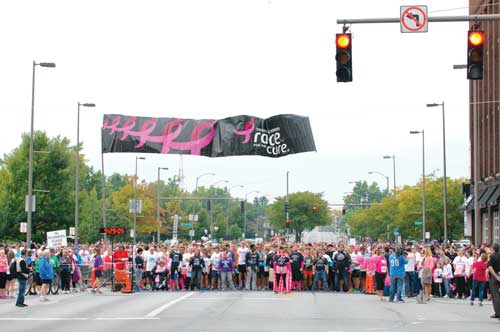
The Toledo race for the cure  will be Sept. 28 and includes a 5K chipped time run, a 5K walk and a one-mile family walk with a kids’ activity area. Photo courtesy Race for the Cure / Cover Photo by Mary Pencheff Photography

The Toledo race for the cure will be Sept. 28 and includes a 5K chipped time run, a 5K walk and a one-mile family walk with a kids’ activity area. Photo courtesy Race for the Cure / Cover Photo by Mary Pencheff Photography

Diagnosed in October 2011, McCroskey’s battle has involved a mastectomy, five months of chemotherapy, seven weeks of radiation and the drug Herceptin. She said she didn’t think she would survive three years, but when her treatment ended in September 2012, she was cancer-free.

“I knew I was going to be in a fight for my life,” she said. “I had an overwhelming outpouring of support, which really helped me.”

In the past, McCroskey said when she would face hardship, she would put her thoughts in a journal. So the night she was diagnosed, she created a blog, www.hellocourage.com, to help her cope. Through it, she has reached out to women in 132 countries, answering more than 2,500 emails, she said.

“I didn’t know I would be helping others but I just started writing,” she said. “Through my writing … people started writing me for hope and encouragement. I found my mission and that’s the biggest thing that got me through.”

She still keeps up with the blog today, which is now paired with an online store for hats, scarves and jewelry.

In memory

Also being honored this year is Linda Key, who died at age 64 in March 2011. Key was nominated by her former co-workers at Wendt Key Team Realty in Fremont.

“[We nominated her because of] her ability to live with cancer rather than die from cancer,” said Cheryl Wendt, co-owner of Wendt Key Team Realty.

Key, who was often called “LuLu,” battled breast cancer for 18 years. She was diagnosed three times, most recently in 2008. During her battle, Key participated in Susan G. Komen events. Wendt said Key was humble throughout her time dealing with cancer, something her co-workers remembered when nominating her.

“She would’ve been very excited and happy but at the same time she would’ve been very humble and feel that she wasn’t worthy,” Wendt said.

Other ways to help

The organization also offers other ways to contribute.

Sleep In for the Cure is one of those ways, for the people who won’t be showing up. This option is for anyone who will be out of town, who can’t make the race or who simply don’t want to get up early to run but still want to help. These people pay the registration fee and still receive a T-shirt in case they change their minds.

Another option is Dine Out for the Cure. Local restaurants will donate a portion of proceeds to the cause on race day. These restaurants include: Applebee’s, Bob Evans, Don Pablo’s, El Camino Real, Frisch’s Big Boy, Glass City Café, Luckie’s Barn & Grill, Manhattan’s, Max & Erma’s, PizzaPapalis, Spaghetti Warehouse, Star Diner, The Blarney Irish Pub, The Oasis, Ye Olde Cock n’ Bull and Ye Olde Durty Bird.

Advice

McCroskey said her outlook has changed from when she was first diagnosed.

“I equated breast cancer with death. I didn’t have any experience with breast cancer; I didn’t know people with breast cancer [and] the people that I did know had died from breast cancer,” she said. “The advice I give is [that] you have to live literally just hours at a time. It’s so overwhelming sometimes. The biggest thing that often women feel is they want to give up and they feel like they just want to die because it’s so grueling. I tell them those are normal feelings. No family member wants to hear about that. No friends want to hear about that. They tell you [to] stay hopeful, stay positive … and you just want to say ‘I feel like giving up.’ When I tell them that’s normal, that makes them feel better. … They just need to know that their overwhelming feelings are OK and someone else has felt those feelings.”

The Race for the Cure

The Toledo race will take place Sept. 28 and is scheduled to include a 5K chipped time run, a 5K walk and a one-mile family walk with a kids’ activity area.

Register in advance at Franklin Park Mall, 5001 Monroe St., from 10 a.m. to 2 p.m. Sept. 20 or at the Stranahan Theater, 4645 Heatherdowns Blvd., from 10 a.m. to 7 p.m. Sept. 25-26 and 10 a.m. to 4 p.m. Sept. 27. Online registration is also available until midnight Sept. 24.

The Susan G. Komen organization was founded in 1982 by Nancy G. Brinker for her sister, Susan, who died from breast cancer. It is currently the world’s largest breast cancer awareness organization. The Northwest Ohio affiliate officially formed in 1999. The the first race in Toledo was in 1994, Communications Coordinator Jill Borkowski said.

Of the money raised by Komen Northwest Ohio, 75 percent stays in a 24-county service area to provide breast cancer health and treatment programs to local women and men, Borkowski said. The other 25 percent goes to Komen’s national research program.

For more information, visit www.komennwohio.org.

Carly Kudzia parties with Caillou, gets ready to rock at Sept. 26 event

0

Excited voices emanated from the hallway as 25 students at the Hope Nursery School and Child Care Center in Whitehouse waited to meet Canadian cartoon character Caillou.

The kids filed into the room and sat down. A bit overwhelmed, Carly Kudzia was carried in by her mom, Heather, who was tearing up.

Heather and Carly Kudzia with Caillou at Hope Nursery School. Photo courtesy Heather Kudzia

“I don’t usually get this emotional over Caillou,” Heather joked, explaining that the bill of Carly’s ball cap had poked her in the eye.

Carly joined her classmates, who were full of questions when the character who loves to daydream appeared. He was quite tall for a 4-year-old.

“Do you think he fits in a car?” one boy asked.“Did his parents drop him off?”

“Do you watch ‘Caillou’ on PBS?” Amanda Grimes of DHX Media, the production company of “Caillou,” asked the class.

“No, I watch him on TV,” one student replied.

“Where are your friends?” another shouted.

Caillou was feeling shy and whispered his answers to Grimes. “At daycare like you,” she said.

Another student wanted to know: “Why is Caillou so big?”

“Because he’s outside the TV,” Grimes answered.

Thanks to Carly, each child had the chance to meet Caillou, have a photo taken with him and receive a gift bag.

The visit was a present from Katie Couric to the 4-year-old to thank her for appearing on the talk show “Katie” July 28. On that episode, Couric paid tribute to Sam Berns, who died in January at age 17. Like Carly, he had progeria. His inspiring attitude about living with the fatal genetic condition was the subject of the HBO documentary “Life According to Sam.”

On the program, Heather and Ryan Kudzia talked about the rare disease characterized by rapid aging, along with Brandon and Tina Pickard, who brought their 7-year-old son, Zach.

The families were flown to New York City and visited the Statue of Liberty the day before taping the show.

“You know how you see people standing at the airport holding up a sign? They had Carly Kudzia on a sign; that was pretty cool,” Ryan said.

“When Kaylee [Halko] heard that Katie arranged for Zach and his parents to see Queen with Adam Lambert in concert and Carly got to meet Caillou, she just shook her head,” Heather said and laughed. “She then told Carly that if she’s asked again, she’s to say she wants to meet Taylor Swift and take her best friend Kaylee.”

Carly, Kaylee and Zach are three of the 120 children in the world who have the disease, according to Audrey Gordon, president and executive director of the Progeria Research Foundation.

Those children are participating in a drug trial through the foundation, the only nonprofit dedicated to treating and finding a cure for progeria.

To help raise funds for the drug trial, the Kudzias have organized the fourth annual Carly’s Party for the Cure set for 7 p.m. Sept. 26 at the Pinnacle, 1772 Indian Wood Circle, Maumee. There’ll be auction baskets and raffle items, including sports memorabilia and tickets, as well as appetizers, a cash bar and music by 56Daze. Tickets for the 21 and older event are $30 online at teamCarlyQ.com/events and $35 at the door.

The Halkos are taking this year off from hosting Kaylee’s Course, a run and walk, as they just moved to Perrysburg.

“We’re still working on discovering new drugs because they’re treatments, they’re not cures,” Gordon said. “The more funds we have, the more people we can have working on these projects and the faster we’ll get to the cure.”

Carly’s Party raised about $50,000 last year, Ryan said.

“We’re just super blessed and lucky that we have this community support not only in Whitehouse, but Northwest Ohio and Southeast Michigan,” he said.

“I can’t go anywhere without someone recognizing Carly or having heard of progeria or lending a hand. I’m really thankful for that; I’m thankful that — I don’t know if I have the words,” Heather said.

Rossford native Jonathan Bennett competes on ‘Dancing with the Stars’

0

The tongue-in-cheek headline on the British tabloid paper The Daily Mail’s website read, “Jonathan Bennett peeks at Jenna Johnson’s derriere before DWTS rehearsals.” Not the sort of notice Bennett is used to garnering, to be sure, but when you’re doing a show like ABC’s “Dancing with the Stars,” it’s bound to happen.

Jonathan Bennett on Dancing with the Stars

Jonathan Bennett on Dancing with the Stars

“It’s very strange, and often humbling and flattering that they care so much about what we do outside of rehearsal. It’s weird to me,” Bennett said in an interview with Toledo Free Press.

“‘Dancing With the Stars’ is a different machine. Now they want to record you going in and out of the studio, and everything you do in the studio they want to pick up on camera now.”

Bennett is used to being on camera, of course. The Rossford native has worked as an actor for over 15 years now, with roles in “Veronica Mars,” “Smallville,” “Cheaper by the Dozen 2” and, of course, “Mean Girls” on his resume. But “Dancing With the Stars” is different, Bennett said.

“It’s really unnerving. There’s a lot of cameras around all the time, and we rehearse, like, five hours a day, seven days a week. And it just, it tests your limits. And every minute, there’s a camera in your face. So it’s a very unusual experience.”

Bennett has worked at throwing himself into unusual experiences for most of his adult life, though — ever since that day back home where he first fell in love with the theater. “I went and saw ‘Anything Goes’ at Rossford High School, and I was in seventh grade, and from that moment when I saw the show, I went, ‘That’s what I want to do.’”

After finishing at Rossford High, Bennett attended Otterbein University in Westerville to study theater. But soon, he decided to make the leap of moving out to New York. “It’s really scary for an 18-year-old to try and make it in the big city. But there is just some underlying comfortability about it that just made me keep going. Because I just knew that’s what I was supposed to do.

“You definitely grow up quick. And I think I can recommend that to everyone: When you’re 18 years old, go and live in New York for three months. That’ll show you how the world works, instantly,” Bennett said. “[Living] in New York, in my early 20s, in New York City, [I was] kind of maturing and coming into adulthood in a place where there’s so much stuff to learn from.”

His first major job was a role on the long-running soap “All My Children,” and from there miscellaneous roles on TV and film would follow. But none have had the staying power of the 2004 comedy “Mean Girls,” where he played Lindsay Lohan’s love interest. Wait, 10 years? Has it really been 10 years?

“Not at all,” Bennett said. “It feels like we just shot it yesterday. And I just can’t believe the reaction that all the fans have had over the years for the film. It’s incredible.

“There are a few reasons. One, it’s really well done — by [writer] Tina Fey and [producer] Lorne Michaels. They just really know how to do a show. And then number two, everyone can relate to it. No matter what year you are in high school, what grade you are — every high school is the same.”

But now, over a decade later, Bennett is putting all his energy into his run on “Dancing,” competing with his professional partner and fellow “DWTS” rookie Allison Holker. “They called me and asked me if I wanted to be part of the show, and I jumped at the chance. Because I’ve watched the show for years, and I’m really excited to get to be a part of it.”

His excitement isn’t even moderately tempered by the fact that, well, he doesn’t really know how to dance. Oh, sure, he’s done musicals and the like over the course of his career, but learning a few steps onstage is a huge step removed from doing a tango in front of a few million people every Monday.

“I have no experience [with dancing]. I have zero. I have negative experience,” Bennett joked. “Once you’re on the show, then you have to figure out how to dance.”

But in addition to the thrill of competing, Bennett noted how excited he was that folks in his hometown were so fervently behind him. Rossford residents organized a pep rally to view the show Sept. 15, and he’s been overwhelmed by the support. “I have the most amazing fans and friends in Rossford.”

After earning good notices from the judges with his performance, Bennett survived the first cut on the Sept. 16 elimination episode, meaning the journey continues for the young actor who only ever wanted to entertain.

“I just want to do my best every day, and then every week I go back I just want to push myself and do better than I did the week before,” he said.

Village Players show focuses on ‘growing old with dignity’

0
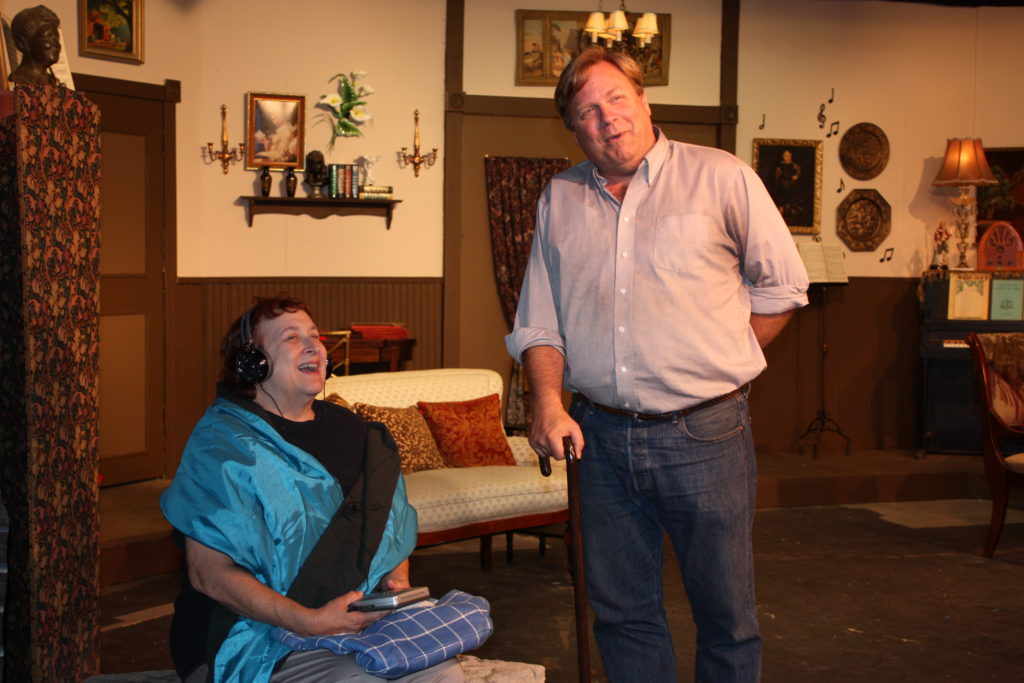
Actors Carol Ann Erford and Bill Quinlan in Village Players’ “Quartet .”

The Village Players production of Quartet will change your perception of senior citizens.

The comedic drama follows 4 retired opera singers who deal with the harsh realities of aging when an ex-wife shows up and causes friction.

“It’s a really beautiful play about growing old with dignity, which is really what drew me to it,” said Jeff Allbright, director.

“I have older parents, and I’ve always been interested in that whole process as I’m going through it with them,” said Allbright. “We often throw senior citizens to the wayside as a forgotten population, and this play really shows how vital they can be.”

According to Allbright, Toledo has a rich population of older actors who don’t get enough opportunities to showcase their abilities.

Carol Ann Erford plays Cissy, a character in the beginning stages of Alzheimer’s. Erford claims although Cissy is comic relief, she’s a very layered character who can move audiences to tears as quickly as laughter.

“It’s wonderful to see how these older characters react to each other,” said Erford. “Audiences will see bits and pieces of themselves and their parents in these roles, especially those approaching mature age.”

Erford claims that her passion for acting began in the 60s, when there weren’t nearly as many performance opportunities for younger folk.

“It was ensemble learning back then, which comes in handy with a  show like this because if one person gets hung up on a line, someone else can jump in and save them,” said Erford.

An interesting challenge for John Duvall, who plays Reginald Paget, is portraying a character 30 years outside his range.

“It’s a new thing for me. I think the majority of it is through body language and facial expressions,” said Duvall. “It’s all elevated by makeup, but we really don’t rely too heavily on that.”

Duvall claims this play explores how no senior citizen is just another face in the crowd, and everyone you see has an interesting story to tell about their life as a whole.

“You’re not always an old person. Everyone has a history, and this play talks a lot about that. For me, as a younger actor playing someone so old, it really made me think,” said Duvall.

With 30 years of directing experience, Allbright finds that his equal passion for acting gives him an advantage with his cast.

“It helps because we all speak the same sort of language, so there’s a level of intuitiveness about the process,” said Allbright.

Quartet plays Sept 12-13, 17-19 at 8pm and Sept 14 at 2pm. The Village Players are located at 2740 Upton Ave. Tickets are available at 419-472-6817.

Final Cut offers exclusive tastings

0
A recent Chef’s Table tasting at Hollywood Casino Toledo’s Final Cut Steak & Seafood featured
cabernet sauvignon paired with a smoked short rib and sous vide Wagyu ribeye with potato
soufflé, bone marrow crust, black garlic bordelaise, maple gastrique and cabernet gelée.
Toledo Free Press photo By James A. Molnar

The service was impeccable and so was the food. This was not a standard meat and potatoes kind of meal.

Rather, this was the one of the exclusive Chef ’s Table tastings at Final Cut Steak & Seafood restaurant inside Hollywood Casino Toledo.

The tasting, held Aug. 20, paired a nine-course meal with a selection of wines from the Francis Ford Coppola Winery.

Inside the private dining room where the tasting took place were seats for 20 people. The display cases on the walls featured dresses worn by Halle Berry and Toledo native Katie Holmes. The view overlooked the Maumee River with the Downtown skyline in the distance.

The Midwest representative from the winery was on hand to offer insight into each wine and answer questions.

Final Cut chef Aaron Lawson created something unique to pair with each wine. A foie gras custard and pork belly paired with the glass of sauvignon blanc. A butter poached rock lobster with popcorn gelée paired with the zinfandel.

View a photo gallery of all of the pairings at ToledoFreePress.com.

The next Chef ’s Table is scheduled for 6 p.m. Oct. 15 and will be paired with Moët Champagne. Wines, all part of the Moët House, will include Moët Champagne, Dom Pérignon Champagne and Chandon Still Wines.

Those interested in the Oct. 15 tasting can contact Final Cut manager and wine sommelier Sunwoo Choi at (419) 661-5381 or [email protected].

Collingwood Arts Center planning second food truck fest Sept. 20

0

The Collingwood Arts Center (CAC) is planning its second food truck festival for 2-7 p.m. Sept. 20.

Participating vendors will include Aunt Carla’s Boosh, Chris’ Italian Ice, Bella Dolcetti Bakery, Black Kettle Barbeque, Grumpy’s on the Go, Slammin’ Sammies, The Displaced Chef, On The Move, Toledo Hot Dog, RedRoc Taco Truck and Wanderlust, said CAC Interim Executive Director Sarah Kurfis.

The event will also feature performances from CAC’s Children’s Theater Workshop and other local artists.

Cost is a suggested $2 donation to CAC. Proceeds from beverage sales also go to CAC. Street parking is available near CAC, 2413 Collingwood Blvd., or lot parking at Compass next door. Some seating will be available, but organizers suggest bringing chairs or blankets.

The inaugural CAC food truck festival, held in July, featured eight food trucks and drew about 1,000 people.

“People thought we timed it with the food truck/mayor controversy, but really we’d been trying to pull that together for a while,” Kurfis said.

Chris Bores of Pursuit of the Paranormal will offer free ghost tours during the festival at 2:30 p.m., 3:30 p.m., 4:30 p.m., 5:30 p.m. and 6:30 p.m. Free historical tours will be offered at 3 p.m., 4 p.m. and 5 p.m. A T-Town Tassels burlesque show will take place at 9 p.m. Cost is $15 in advance or $20 at the door.

“Come hang out, drink, eat awesome food, support local businesses, support Collingwood Arts Center — and then stay for the burlesque show,” Kurfis said.

For more information, visit www.collingwoodartscenter.org