WATERVILLE – With a little more than a month left before the Ohio Department of Transportation (ODOT) seeks bids to demolish the 118-year-old Roche de Boeuf Interurban Bridge, a volunteer group is seeking another reprieve from Gov. Mike DeWine.
“We’re still fighting to save our bridge,” said Save The Bridge Association (STBA) President Barb Bruno, addressing Waterville City Council on Feb. 9. Bruno, along with STBA member Janice Braida and Secretary Dave Weber, encouraged council to sign a letter of support in asking DeWine for an extension.
On April 7, 2025, DeWine issued a one-year halt on the demolition of the bridge, just days before ODOT was set to seek bids. In following months, the STBA was formed as a 501c3, with volunteers focusing on finding alternatives to demolition, including new construction methods for preserving the 12-arched bridge, grant funding and nominating the structure for Historic Civil Engineering National Landmark Status with the American Society of Civil Engineering (ASCE).
“ODOT sees the bridge as a problem. We see it as an asset,” said Braida, adding that it has become an iconic symbol of the city, even featuring prominently on the city’s logo.
In a summary of the progress made by the STBA, Weber states that ODOT stopped helping the group find alternatives, and instead has been focused on transferring ownership to another political entity.
“We were only recently informed of the importance of ODOT not owning this bridge, so we need more time to find an owner. We spent our time mostly on evaluating alternatives,” he stated in the memo.
“It’s a heavy lift to expect a citizens group to find a new owner in eight months,” Braida added, noting that the group has contacted several organizations, including the city, to see if any would have interest in taking ownership.
“It was made clear in the first meeting that whether the bridge comes down or not, ODOT will not be the owner of the property,” countered ODOT District 2 Director Pat McColley. “A government entity needs to be identified and the transfer of the property, including the bridge, needs to take place before demolition bids open.”
The project to demolish the structure is currently scheduled to be placed out for bid in April, with demolition work beginning after June 1.
Designed by Daniel Luten of Indianapolis, the 13-arch concrete bridge includes spandrels, arches and piers – including one that rests atop an outcrop of erosion-resistant limestone named “Rock of Beef” or “Buffalo Rock” by French traders. The rock was used as a meeting place by Native Americans prior to the 1794 Battle of Fallen Timbers. About a third of its mass was removed during construction in 1908.
Originally used as an interurban trolley line for the Ohio Electric Company, the bridge was abandoned in 1937, although used briefly for automotive traffic in the 1940s when the Waterville bridge was damaged and steel for repairs wasn’t available. In 1972, the bridge was placed on the National Register of Historic Places. It is a Registered Historic Place with the National Park Service and a state of Ohio Designated Historic Space.
In the years since, the bridge served as a party spot for teenagers, a backdrop for photos and paintings, and a place to explore when the river is low. With its impending designation as the Maumee River Water Trail, Waterville City Council began discussing concerns for the safety of boaters. Chunks of the bridge rest in the river, while others dangle from rebar. The city shared its concerns with ODOT in 2017. At the time, the bridge was thought to be owned by the city. Instead, it’s owned by the state.
Through engineering studies and core samples, those concerns were confirmed: the bridge was in dire shape. In 2019, ODOT presented multiple alternatives, ranging from complete rehabilitation (removing and replacing it) for $15 million, $3.9 million to save one arch, or $2.2 million to remove it. ODOT also tried to sell the bridge at an auction, but the potential buyers were unable to prove an ability to insure and secure the bridge.
“The bridge has continued to deteriorate over the years, including since the original feasibility study was performed, as evident by the common eye,” McColley said.
Simply placing signs underneath to divert water traffic will not alleviate the state’s liability to the Army Corps of Engineers or the safety of the public, which is why the bridge is slated for destruction, he said.
Weber, a retired engineer, said other ideas were not explored in full, such as securing the bridge using a technique involving carbon fiber reinforced polymer to keep the pieces in place. A $135,000 investment into testing the strength of the bridge and designing the mothballing process would be worth the effort to save a landmark, Weber said. He estimates that the work could be done for $1.7 million.
“The reference estimate was created by a private citizen, not a professional engineer, and ODOT has a very low level of confidence in the figures proposed in the estimate,” McColley responded, adding that ODOT looked at many alternatives, including mothballing.
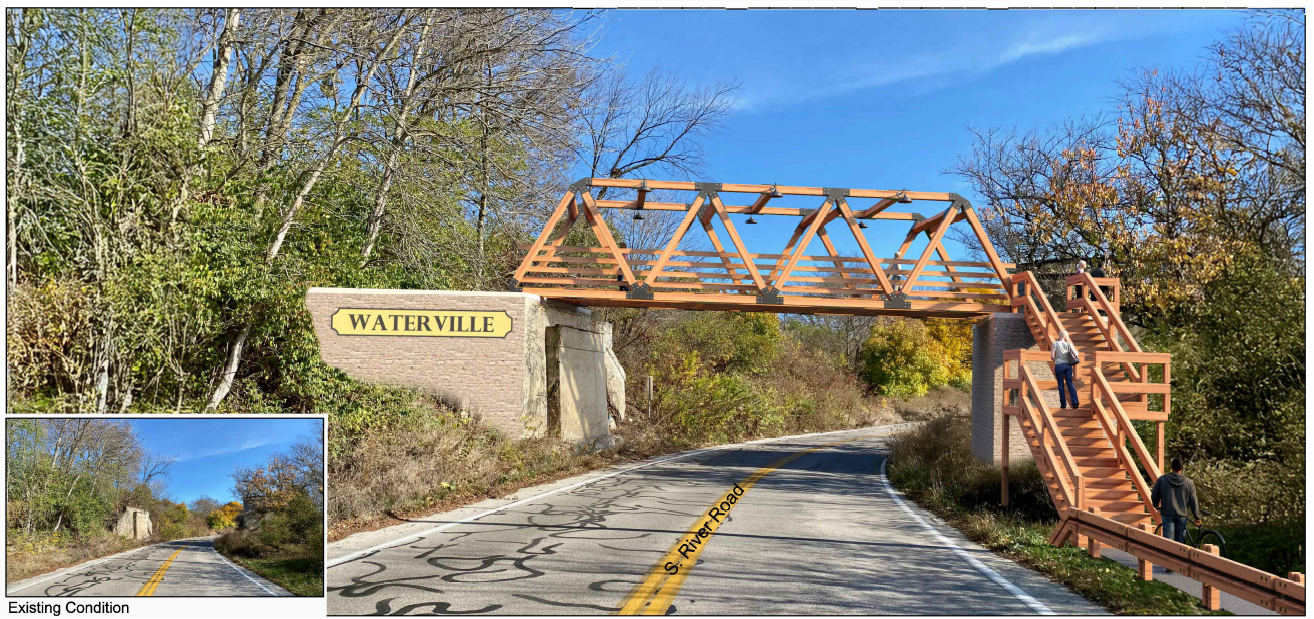
One outcome of last year’s delay is that the city had time to apply for a grant for a pedestrian bridge and overlook using two abutments. Waterville received a $557,652 federal grant to cover 80 percent of the cost of the Roche de Boeuf Overlook and Shared Use Path Improvement Project, said City Administrator Jon Gochenour. Two of the existing bridge abutments – on the north and south sides of South River Road – will be used to create an overlook of the Maumee River and the Roche de Boeuf Island.
“The project will recognize the historical and cultural significance of the site to Native Americans and the historical development of the State of Ohio and the United States,” Gochenour said. “The site will be connected to the city’s existing shared use path system on the Anthony Wayne Trail and to the pedestrian path system of Farnsworth Metropark.”
While the project will save a portion of the Roche de Boeuf Bridge, the city still supports local efforts to save the entire bridge, Gochenour said.
STBA submitted its nomination for the bridge for Historic Civil Engineering National Landmark Status with the ASCE on Feb. 6. The bridge would be the first multi-arch concrete bridge to be recognized by the ASCE and the second oldest reinforced concrete arch bridge recognized by ASCE in the world.
“The interurban bridge was an engineering first it its day,” Weber said. “This bridge deserves a preservation plan – something we are fighting to make happen.”