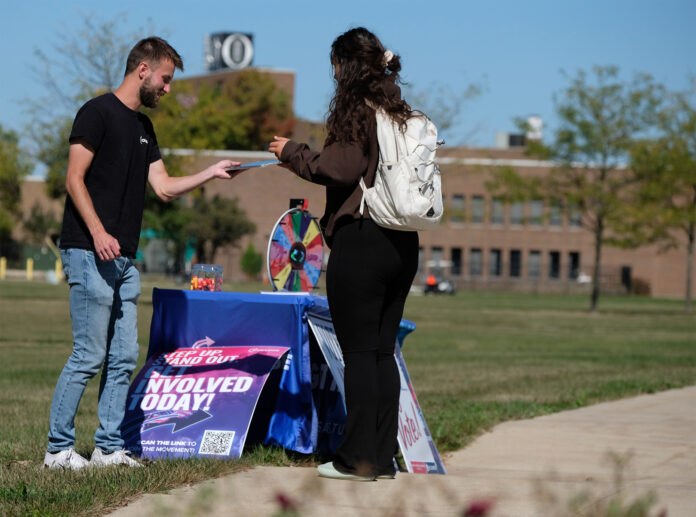
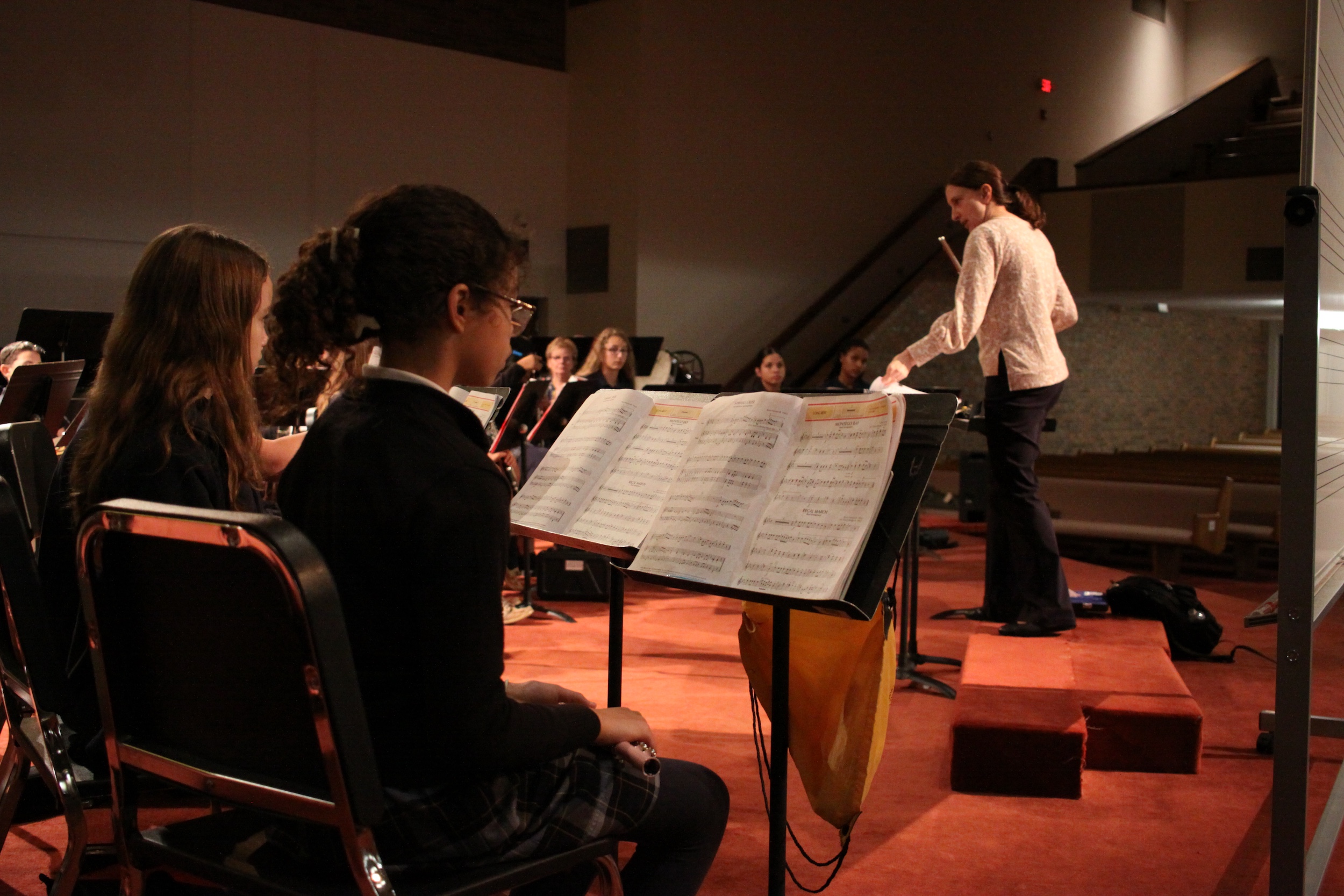
Lucas Zielinksi, with Turning Point USA, hands Amelia Mathkour, a music, business and tech major at Owens Community College, a pamphlet about voting registration. Zielinksi said he was on campus for the day to help students register to vote. (TFP Photo/Lori King)
Lucas County Board of Elections explains voting details, process
Toledo – With Election Day a month away, preparations are in full swing at the Lucas County Board of Elections office.
“We’re up and running and getting everything ready,” said Timothy Monaco, deputy director of the elections office. “It’s a wonderful time. It’s important to exercise your right to vote.”
Logistics that the staff and officers have been handling for weeks on behalf of Lucas County’s 303 voting precincts include preparing ballots, training precinct election officials, and getting early voting dates and times posted on their website.
Monaco said the most commonly asked question from voters during the past couple of weeks has been when absentee ballots will arrive in the mail.
Here’s the answer: Ohio voters can look for the absentee ballots starting Oct. 8, which is one day after registration ends for the Nov. 5 election.
The Lucas County Board of Elections staff doesn’t give predictions on voter turnout, Monaco said. But, according to state election records, 67 percent of registered Lucas County voters participated in the 2020 presidential election, and 66 percent did so in the 2016 presidential election. This participation includes absentee voting, early in-person voting and traditional Election Day voting.
Those choices are meant to help all eligible voters participate, whether they prefer going in person to a local polling site or to cast a ballot before they travel out of town.
“It’s important to make your plan as to who you are going to vote for,” Monaco said. “Make sure you make a plan and know what is on your ballot.”
While the presidential campaign is the key race of the Nov. 5 election, there are also races in Lucas County for local judges and city officials. For those who want to see the list ahead of time, ballot proofs are available for review on the election board’s website.
“Ballots will be three pages for everyone and four pages for some,” Monaco said.
While some people remember how they wish to vote when going to the polls, others find it helpful to bring paper notes or refer to a list on their phone, Monaco said. “Some folks really come prepared,” he said.
“It’s also important to be respectful at the location,” he added, referring to an Ohio law that prohibits photos of marked ballots. “We do ask that you limit cell phone use at the ballot.”
Military and overseas civilian voting: Started Sept. 20.
Voter registration deadline: 9 p.m. Oct. 7.
Early in-person voting season: Oct. 8.-Nov. 3.
Absentee ballot postmark deadline: Nov. 4.
Election Day: Nov. 5.
CAMPUS TALK
OWENS COMMUNITY COLLEGE STUDENTS SOUND OFF ABOUT VOTING
Question: How important is voting to you?
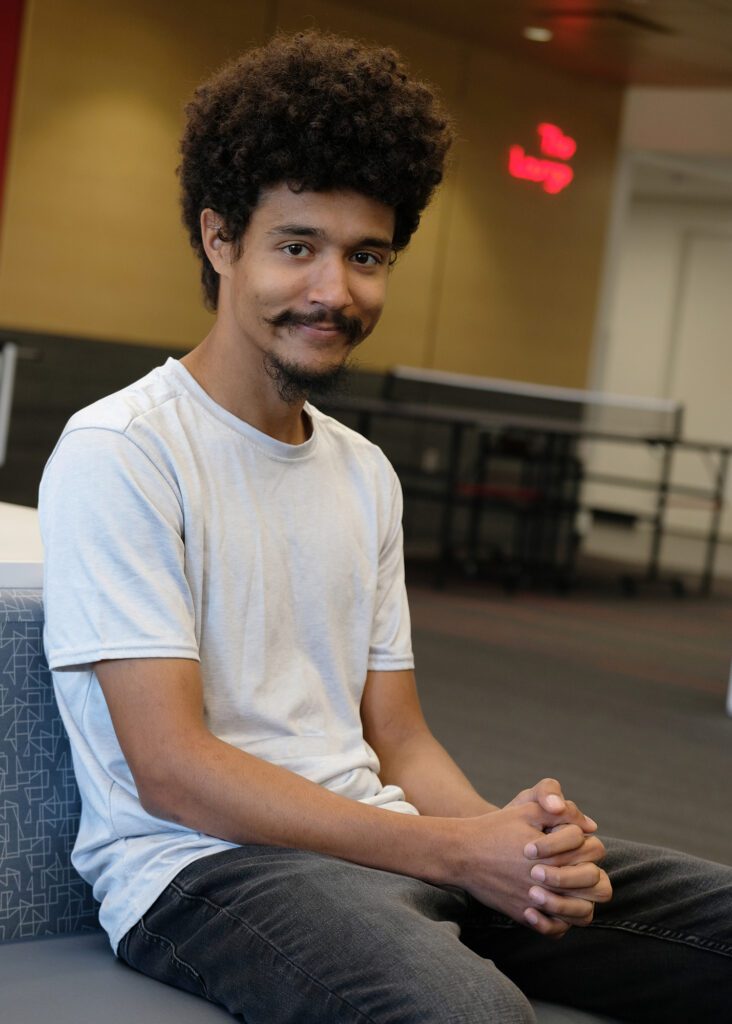
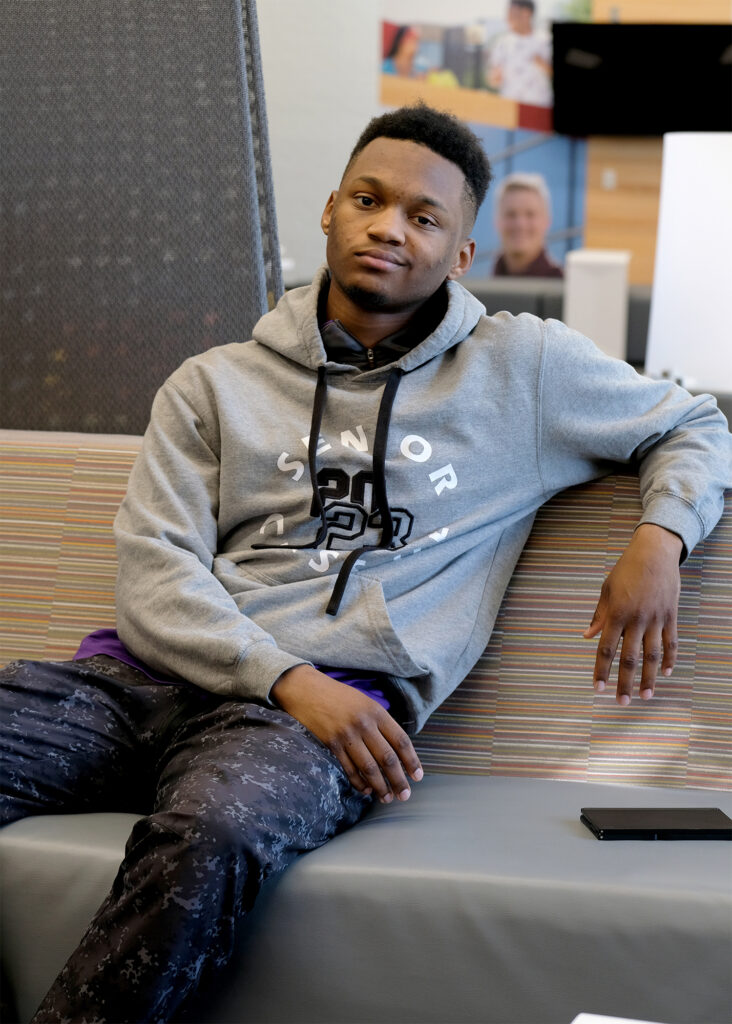
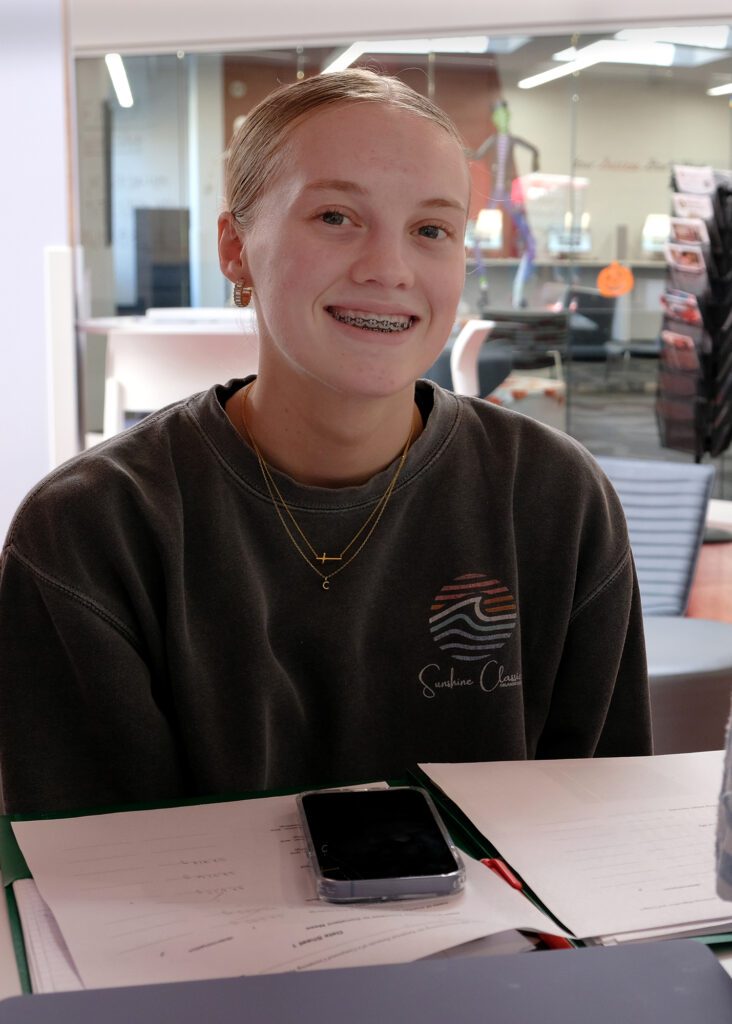
Oliver OdendahlJames JohnsonNivant DawsonSydney StanleyDavid Case III
Voting is not my main concern, but it is pretty important because it is the future of America and I would like to have a say in what is gonna be my future. I usually try to vote on voting day, if I can’t I’ll do the absentee ballot.
Oliver Odendahl | EMT Major | Tontogany Resident
I am not a registered voter. If I was to lie to you I’d say yes. But honestly, I don’t have enough time … it’s not really a main priority, even though it should be. I do plan on voting at some point, maybe when I’m in my adult phase. Even though I’m not a registered voter I do think voting is important because it basically determines the society and the rules and regulations we live by.
James Johnson | Broadcast Media Technology Major | Toledo Resident
I’d say voting is very important. There’s certain aspects of it that do feel sort of depressing, when you think about it, because a lot of people would say people voting normally wouldn’t matter because of a small majority in the Electoral College – their votes matter 100 times more than your own. That’s what it feels like at least from what I know. It does feel a little degrading knowing that’s going to happen.
Nivant Dawson | Business Major | Toledo Resident
I think voting is important, but I’m not exactly sure why it’s important. I mean, there’s a lot of things that come from it. You’re voting for someone that you’re putting your trust and you’re faith into to guide us all in the right direction, but we just all don’t know what that direction is yet. So, we’re just kind of free-balling it, in a way. So, I don’t know … I’ve never voted before but this will be interesting. I really don’t know what all is involved. I just have a lot to learn about voting – like what I should be looking for in the leader I’m going to be voting for. So, yeah, it’s coming up soon. There’s a lot to learn.
Sydney Stanley | Chemistry Major | Millbury Resident
Voting is very important, especially in this day and age, when everything’s going on.
David Chase III | Literature Major | Toledo Resident
Registration details

Ohio voters must be registered by 9 p.m. Oct. 7 to be eligible to vote in the Nov. 5 election.

Residents can register to vote, look up voter registration, change their address, find an early voting location, look up Election Day polling location or track an absentee ballot at VoteOhio.gov.

Photo ID requirement

Bring your photo ID when voting. The options are:

- Current Ohio driver’s license or State of Ohio ID card.

- Interim ID form issued by Ohio Bureau of Motor Vehicles.

- U.S. passport or U.S. passport card.

- U.S. military ID card, Ohio National Guard ID card or U.S. Department of Veterans Affairs ID card.

A registered voter who has changed his or her name since the photo ID was issued will need to show proof of legal name change and sign a form. A photo ID card can show a former address if a current address is on file with the voting records. If you forget a photo ID, you can request a provisional ballot.

How to vote absentee

An absentee ballot in Ohio needs to be requested, signed, dated and submitted for each election. Military personnel and civilian overseas voters can file one application for all elections happening in a given year.

The application asks for the number on your Ohio driver’s license or Ohio ID card, last four digits of your social security number, or a photocopy of other eligible ID such as a U.S. passport or military ID.

Mailed absentee ballots must be postmarked by Nov. 4 and can be hand delivered to the Board of Elections on Nov. 5.

Additional instructions are on the Ohio Secretary of State’s website.

In-person early voting

Ohio’s in-person early voting season begins Oct. 8 and ends Nov. 3.

The Lucas County Early Vote Center is at 3737 W. Sylvania Ave. Suite 121 Entrance C (at the rear of the Lucas County Board of Elections building) in west Toledo.

Voting times and dates can be found at LucasCountyOhioVotes.gov.

Election Day voting

Polling sites are open in Ohio from 6:30-7:30 p.m. on Nov. 5. You can look up your polling location at VoteOhio.Gov.

What’s on the ballot?

A “ballot proof” is available for review on the Lucas County Board of Elections page. It lists candidates and ballot issues by precinct, so voters know what to expect.

For example: Six president/vice president candidate teams have declared in Ohio, with an additional write-in option available. Other candidate races include U.S. Senator, Lucas County Sheriff and openings on Toledo City Council.

Ohio Issue 1 is a proposed state constitutional amendment that has gained a lot of attention. This issue, if approved, would designate a redistricting commission to draw state legislative and congressional districts.

There are other issues locally, such as a proposed bond issue for the Toledo-Lucas County Public Library and a tax renewal request from the Toledo-Lucas County Port Authority.

Are ballot “selfies” allowed?

Ohio does not permit photos to be taken of a marked ballot. It’s actually a fifth-degree felony should that take place, according to Ohio law.

The “I Voted” Sticker

A traditionally popular way to showcase voter participation is through an “I voted” sticker, picked up on Election Day at the polling site.

Ohio’s current “I Voted” sticker design was adopted in 2019 through a student art contest. A red squiggle depicts a map of Ohio, nestled in a blue circle outline, with the phrase “Ohio Voted.”

Voters are invited to download the image to share on social media at the Ohio Secretary of State website. That website also has also a “future voter” coloring page for children available for download.

Is campaigning allowed at election sites?

Ohio does not allow election campaigning, also known as electioneering, within 100 feet of a voting site. This means no campaigning messages on attire such as shirts or hats, Monaco said.

Two small United States flags are placed at each voting site to designate the “neutral” zone where this applies.

Where is the Board of Elections office?

If you need to visit the Lucas County Board of Elections regarding a voting matter, that office moved about two years ago from its former location at One Government Center to 3737 W. Sylvania Road in West Toledo.

When are election numbers official?

Ballots cast on Election Day will be delivered in person to the Lucas County Board of Elections for the counting procedures.

There will be numbers reported after that count is complete.

The Ohio Secretary of State does not consider voter counts to be official until two or three weeks later, after provisional ballots are accounted for and to give time for absentee ballots to arrive that met the postmark deadline.
While much of current criticism aimed at the Israeli government has stemmed from its post-October 7th military operation in Gaza, which has killed upwards of 70,000 Palestinians, according to the Palestinian Ministry of Health, there are many who’ve long taken issue with its policies.
Among this group of pre-October 7th critics is 72-year-old Norman Finkelstein, a Jewish son of Holocaust survivors, who finds himself uniquely sensitive to what a United Nations commission has classified as “genocide in the Gaza Strip.”
Ahead of a weekend speaking engagement in northwest Ohio, Finkelstein took some time to talk with the Toledo Free Press. It’s an interview that began with his thoughts on the current leadership of Israel, which includes Prime Minister Benjamin Netanyahu.
Finkelstein on today’s Israel
“I wouldn’t say that it’s a far-right government,” Finkelstein told TFP. Rather, he says, “Israel is less discreet about hiding aspects of Israeli society,” and that “it became an in-your-face, far-right — not just government — but an in-your-face, far-right society.”
In other words, he believes that there’s always existed an appetite, and willingness to act on, the more extreme policies championed by Israel’s current government. His theory of the case includes periods in which the country enjoyed more sympathy from the global community than it does today.
However, for a short time following the October 7th, 2023 attacks on Israel by Hamas, there was an immediacy to the outpouring of support and commitment to Israel by western nations. With approximately 1,200 people having been killed, Netanyahu’s initiation of a retaliatory military response was viewed by many leaders in the western world as having a claim to legitimacy. This meant a significant amount of support from its closest ally: the United States.
Asked about the way in which Netanyahu has become synonymous with Israel, and if a different figurehead would change what he sees as the country’s faults, Finkelstein said that “the question should be, ‘Why does Israel have Netanyahu as its leader?’ After all, it’s a Democratic country for Jews. It’s Democratic. He is an accurate reflection of Israeli society.”
Good and bad press
While Finkelstein is followed by a combined 800,000+ across his Instagram and X (Twitter) accounts, he has not always had a huge megaphone to voice his viewpoints. In fact, there are many who, even before the days of social media, preferred he have no platform at all.
One such example dates back to 2007. According to a New York Times article published in February of that year, Alan Dershowitz — a prominent ally of Israel and then a law professor at Harvard University — “lobbied professors, alumni and the administration” of DePaul University to deny Finkelstein tenure. And while the university did, ultimately, do just that, its then-president denied that outside influence played any role. The school’s verdict was well-received by Finkelstein detractors, including Dershowitz, who view his rhetoric as harmful.
The larger debate about whose voices get platformed is one that remains unsettled in higher education. Asked about the current tension between free speech and academia, in the context of 2024’s campus protests in support of the Palestinian cause, Finkelstein — while not in agreement with how these schools handled student dissent — claims to understand their calculations.
“I think the big issue was alumni contributions, representation of pro-Israel Jews on boards of trustees.”
Pointing to reading he says he’s done about the culture on college campuses, when it comes to Israel-Palestine as a cultural flashpoint, Finkelstein said that professors are “terrified to say anything about Jews, Israel, Gaza— anything.”
Finkelstein is scheduled to speak at the United Muslims Association of Toledo’s annual dinner, which is being held on Sunday, Oct. 11, in Sylvania.
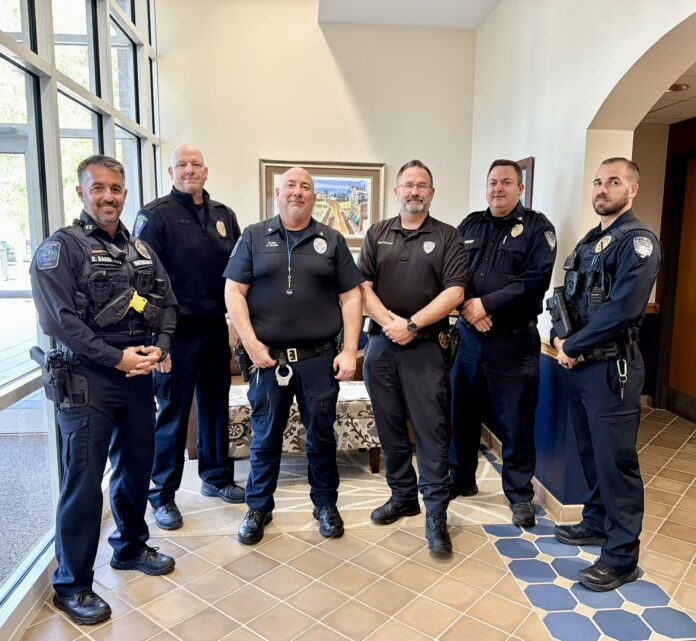
On Oct. 6, police chiefs from area municipalities gathered to brainstorm on ways to handle young e-bike users driving recklessly in their communities. Among those in attendance were, from left, Whitehouse Capt. Brad Baker, Ottawa Hills Police Chief Frederick Schnoor, Whitehouse Police Chief Allan Baer, Holland Police Chief James Piotrowski, Waterville Police Chief Joe Valvano and Waterville Police Lt. Austin Gunn. (AWFP photo by Karen Gerhardinger)
Whitehouse Police Capt. Brad Baker recently “had words” with a boy who was popping a wheelie on an e-bike in the middle of Providence Street.
“We’ve spent more than a year having words with them on the street and at school,” said Whitehouse Police Chief Allan Baer, who has heard in person and online the complaints about mostly 10- to 15-year-old boys driving e-bikes or dirt bikes recklessly on the streets, the parks and on the bike trails.
Knowing that other area police chiefs are experiencing the same problems, Baer invited area police chiefs to a brainstorming session on how to meet three shared goals: ensuring the safety of the kids on e-bikes; addressing the behavior without using the juvenile court system; and inducing parents to become more proactive in their children’s e-bike usage.
While the state legislature is currently looking at rules for e-bikes – a move that Baer said will provide consistency and guidance – the chiefs agree that working on a uniform set of ordinances for communities to put in place by spring is a priority.
Police chiefs Joe Valvano of Waterville, John Trejo of Swanton, Frederick Schnorr of Ottawa Hills, and James Piotrowski of Holland, along with law directors Paul Skaff, Austin Klapp, Kevin Heban and Law Clerk Christina Fuller discussed current regulations, what other municipalities have in place, and solutions that will work for smaller communities.
One of the suggestions is requiring all e-bikes to be registered, with color-coded stickers that will enable officers to identify the class and whether a helmet is required. A lack of a sticker may also indicate that the rider is on a dirt bike that is not permitted on public roads.
“This is not a money grab,” Baer said, explaining that the registration would be free. “We want our officers to be able to easily identify what class each bike is.”
According to the Ohio Department of Transportation, Class 1, 2 and 3 all have fully operable pedals and electric motors of less than 750 watts. In Class 1 and 2, the electric assist only reaches up to 20 mph. In Class 3, the the motor provides assistance of up to 28 mph.
According to ODOT, anyone riding a Class 3 e-bike must be at least 16 and wear a helmet. One of the ideas under consideration is requiring anyone under 18 to wear a helmet on any e-bike, regardless of the bike class. With e-bikes weighing 200 to 300 pounds and accelerating quickly to up to 28 mph, the brake time is longer and crashes more hazardous to riders, the chiefs noted. And with jailbreak programs enabling e-bike users to push speeds beyond 28 mph, the risks increase. Several of the chiefs spoke of serious injuries involving e-bike users in area communities.
“We’re one fatality away from being blamed,” Valvano said, agreeing that something needs to be done.
The registration and helmet requirements will help, but the chiefs agree that more needs to be done to curb the reckless operation that they’ve seen: jumping curbs, blowing through stop signs, zipping in and out of traffic, disturbing pedestrians and causing damage to public and private property. Education and warnings, as well as parent notification of behaviors, has done little to stop the reckless operation or improper use, Baker said.
“We’ve been doing warnings for years. We’re looking for more teeth,” Baer said. “I think a fee is the only thing that will have an impact. I know we’ll take some flack, but they have to understand the intent is for the safety of the children.”
In the event that a minor is seen driving recklessly, a first offense would require that the rider and parent watch a video on e-bike safety. Subsequent offenses will have civil penalties, including fines and e-bike impoundment. Those who want to contest the fine could have an opportunity to make an appeal to a hearing officer – a third-party attorney hired by all of the jurisdictions.
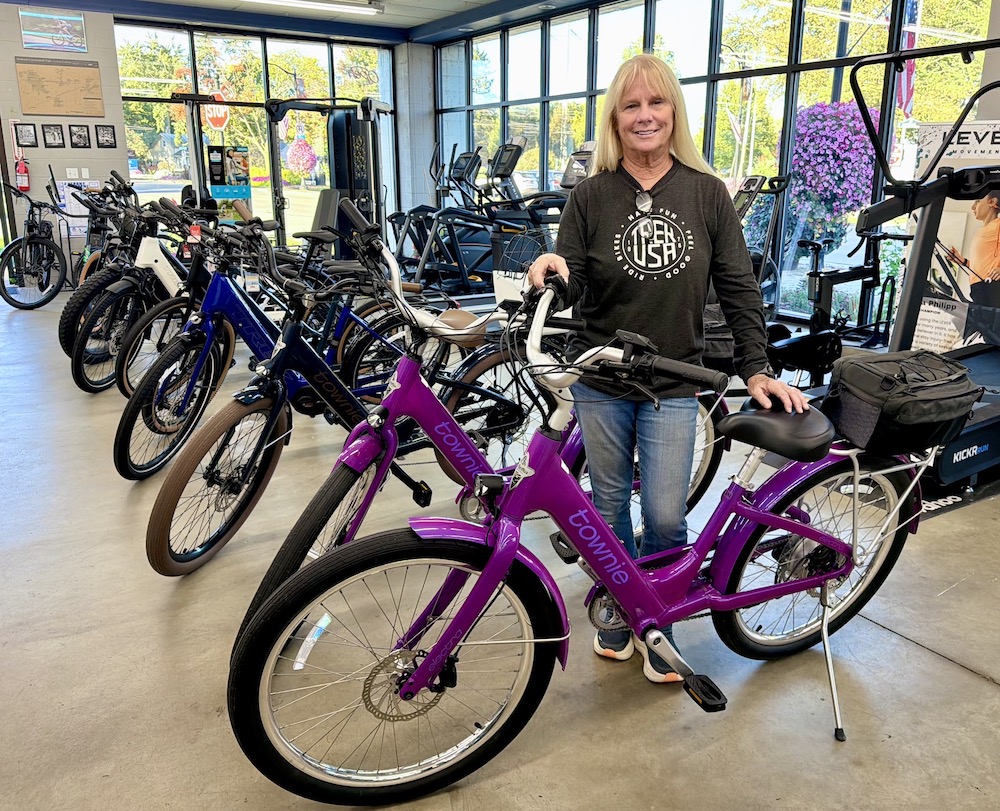
Julie Theroux, co-owner of CycleWerks in Whitehouse, said the issue isn’t e-bikes themselves, but boys ages 10-15 riding e-motos – electric dirt bikes that are not legal except on private property. She cautions against overregulating e-bikes, which are popular among adults who might otherwise not be able to ride as far. (AWFP photo by Karen Gerhardinger)
Julie Theroux, co-owner of CycleWerks, cautions against over regulation when 90 percent of the e-bike users are responsible adults who use them to ride farther and tackle hills with a little help.
With a view of busy downtown Whitehouse, the park and the Wabash Cannonball Trail, Theroux has seen the annoying behaviors of boys on e-motos, which are dirt bikes that are not street legal. While pedals might be put on to make them look like bikes, these are essentially motorcycles that go well over 28 mph, she said.
“It’s the wild, wild west,” she said, describing kids riding e-motos without helmets, lights or signals, zooming in and out of traffic. “These young boys are running around like gangs. Where are the parents? The parents need to be educated that e-motos are illegal other than on private property or on confirmed motocross trails.
“It’s not the bike that’s the problem; it’s the person on the bike – the reckless person,” Theroux said. “Don’t blame the e-bikes and overregulate.”
The ideas shared by the chiefs will be researched by legal and presented to each of the local municipalities in the coming months.
“This is going to be a slow and deliberate process,” Baer said.
The Glass Wheel, a new bookstore on 1505 Adams Street. (TFP photo by Steven Bieber)
TOLEDO – Bookstores offer a place where readers can explore new ideas, as well as a place to find community. But for some, the average bookstore may not cut it. Readers looking for a haven to explore their love of the occult, spirituality, and other unusual content need look no further than The Glass Wheel.
Black cat mug for sale at The Glass Wheel. (TFP photo by Stephen Zenner)
Last month, Toledo natives Lizzie Arden, 38, and Benjamin Peregoy, 45, opened The Glass Wheel opened on Adams Street, presenting an eccentric spot where visitors will find books on witchcraft, spirituality, tarot, herbalism, and more. Guests can also buy candles, tarot cards, and other merchandise, and even attend events like Witchin’ and Stichin’ (a book-and-craft club) and tarot card readings, all while being surrounded by spooky decorations, taxidermy-mounted animals, and old church pews.
Lizzie Arden, 38, co-owner of The Glass Wheel, holds a dish with various animal paws. (TFP photo by Stephen Zenner)
Peregoy and Arden were driven to open the store because of their love of books, but also because there were no bookstores for weirdos in Toledo.
“We love the macabre,” Arden explained. “We don’t shy away from the darker things in life, and we both have magical practices ourselves. We felt like there was no place for us to shop for books on magic, witchcraft, and the occult. So we just decided to open it.”
Arden avidly reads a spooky book at The Glass Wheel. (TFP photo by Stephen Zenner)
Arden says she and Peregoy, who is also her fiancé, have been interested in witchcraft and occult themes since they were teenagers. She could not offer an explanation as to why people become drawn to it; instead, she claims that it chooses you instead of the other way around.
Running a bookstore with only two hands on deck comes with several challenges. Arden says she often has to choose between processing used books and taking the time to make social media content. For her, getting to make those decisions is the best part of running the store.
She said, “When I decide, ‘Hey, I want to decorate the front window, and I want it to be spooky, and this is what I want it to look like.’ I don’t have to ask someone. I think the best part is not having to ask permission, to be honest. It’s just doing it.”
Lizzie Arden. (TFP photo by Stephen Zenner)
While the two felt it was important to open this bookstore for a niche market, Arden considers bookstores in general to be a vital community resource. Finding the perfect book, sharing that find with friends, and spending time together in a third space are all reasons to support local bookstores like theirs.
If you have a book that you are willing to part ways with, the store will buy it if the owners believe it is a good fit. If you are looking for a specific book or topic and cannot find it, Arden says they will help you find something similar or try to order it for you.
“No matter what kind of book you’re looking for, we’ve got something similar, or we will scour the Earth to find it for you,” Arden said.
The Glass Wheel, 1505 Adams St., is open Wednesday through Saturday from noon–7 p.m. and Sunday from noon–5 p.m.
Notebooks for sale at The Glass Wheel. (TFP photo by Stephen Zenner)Arden holds a mummified possum head at The Glass Wheel. (TFP photo by Stephen Zenner)Arden sits in her favorite part of her bookstore, The Glass Wheel on Adams St. (TFP photo by Stephen Zenner)Candles, necklaces and other charms for sale at The Glass Wheel. (TFP photo by Stephen Zenner)(TFP photo by Stephen Zenner)Arden corrects the placement of a poodle skull. (TFP photo by Stephen Zenner)Arden stands behind the front counter at The Glass Wheel, the spooky bookstore she co-owns with her fiancé, Ben Peregoy. (TFP photo by Stephen Zenner)Incense for sale at The Glass Wheel. (TFP photo by Stephen Zenner)A framed Atlas of the World at The Glass Wheel. (TFP photo by Stephen Zenner)Close up of a chair at The Glass Wheel, a cozy-yet-occult bookstore on Adams. (TFP photo by Stephen Zenner)Arden pulls different charms from a bowl at The Glass Wheel. (TFP photo by Stephen Zenner)
Whitehouse Village Council will interview three candidates for its clerk during a special meeting following the Tuesday, Oct. 13 Committee of the Whole meeting, which begins at 6:30 p.m. (Courtesy photo)
WHITEHOUSE – Whitehouse Village Council will interview three clerk of council candidates during a special meeting following its Tuesday, Oct. 13 Committee of the Whole meeting, Council President Steve Fine announced during the Oct. 6 regular meeting.
The clerk attends all council meetings and most committee and board meetings, keeping a journal of proceedings and legislation, preparing official minutes, calling the role for attendance and voting, and other duties. The pay is about $3,000 to $5,000 per year, according to the job description.
Nikki Hartbarger, who served as council clerk for three years prior to being appointed to fill Louann Artiaga‘s vacancy on council last month, will come up with questions to ask the three candidates, including Sarah Carroll, Callie Kozakiewicz and Noel Vossen.
Sarah Carroll. (Courtesy photo)
Carroll has a degree in public administration from Ferris State University and currently works from her Whitehouse home in the U.S. Customs field for a steel processor. She creates and tracks paperwork for exports and assists with coordinating logistics between plants, customers, dispatchers, brokers and freight forwarders. It’s a position that requires accurate reporting, reliable calculations and timeliness, she stated in her letter of interest. Her previous experience includes data gathering and writing newsletters, notices and website communications while working with business and neighborhood organizations in Michigan. Currently, she volunteers with the Anthony Wayne Fullbackers, but is looking for additional volunteer or part-time opportunities related to her degree.
Callie Kozakiewicz. (Courtesy photo)
Kozakiewicz is currently business operations manager for the State of Ohio’s Opportunities for Ohioans with Disabilities. During her seven years with the state, she has held several positions that have required strong organization, written communication, attention to detail and the ability to understand and follow policies and procedures, she wrote in her letter of interest. In her current role, she also supervises staff and coordinates administrative operations for offices throughout Northwest Ohio. While working for the City of Toledo Division of Building Inspection, she served as court recorder and secretary for several boards, preparing agendas and materials for meetings, maintaining records, preparing public notices and researching laws and procedures. She has a bachelor of business administration from the University of Toledo.
Noel Vossen. (Courtesy photo)
Vossen most recently served as a hearing officer for the Lucas County Board of Revision, researching and hearing cases on property values – a position that required reviewing evidence and hearing testimony from residents. While earning a B.A. in Political Science from the University of Pennsylvania, Vossen interned in the U.S. Senate, managing and archiving a large database of congressional bills, policy reports, letters and other official records. While earning her degree, she also co-authored the book Philadelphia: Capital of the Eighteenth Century. Since returning to her hometown of Whitehouse, Vossen worked as a field organizer for the Ohio Democratic Party, recruiting, training and managing 100 volunteers to do canvassing and phone banking.
During the Oct. 6 meeting, council also:
-Approved the use of the Whitehouse Park for a Trunk or Treat on Saturday, Oct. 31 from 5 to 6:30 p.m.
-Learned that Whitehouse was awarded a $438,400 grant for resurfacing Waterville Street. Work will take place between 2030 and 2032.
-Heard Mayor Rich Bingham‘s appointments of council members to serve on boards, including: Hartbarger, Tree Commission; Joe Bublick, Fire Dependency Board; and Jake Heilmann, Fallen Timbers Union Cemetery District Board. Heilmann’s appointment is pending approval by the whole FTUCD board during a special Monday, Oct. 12 meeting at 6 p.m. in Waterville City Council Chambers.
-Set a Coffee With the Mayor and Council for Saturday, Nov. 14 from 9 to 10:30 a.m. at Copper Press Roastery, 5905 Weckerly Rd.
-Noted that village offices will be closed on Nov. 11, 26 and 27 for Veterans Day and Thanksgiving.
-Congratulated the Public Works Department for winning two America In Bloom national awards.
-Heard that plans are underway to raze a 1901 home and three outbuildings at 10125 Waterville St., which the village purchased for $200,000. Once cleared, the 2.3-acre property along Blue Creek will remain green space until staff comes up with more detailed plans. The demolition completion is targeted for the end of the year, but is dependent on Toledo Edison disconnecting power lines.
-Learned that the village is applying for a zoning change for the 6.5-acre parcel on the northwest corner of Finzel and S.R. 64, which was recently sold to the Toledo Lucas County Public Library for $620,000. The Planning Commission will consider a change from C-3 General Commercial to C-4 Highway Commercial on Monday, Nov. 2 at 6 p.m.
-Heard Fire Chief Jason Francis say that 100 people came to the fire station open house, where they were able to see much of the new equipment.
-Learned that part-time firefighter Blake Reed will be on deployment for six months beginning Oct. 10.
-Listened to a recap of a meeting that Police Chief Allan Baer had with other area chiefs and legal counsel about coming up with some shared regulations on e-bikes. A proposal will be coming back to Council soon on regulations.
-Heard Baer share data from radar signs posted around the village. On Oakbrook Drive, 1,840 vehicles traveled one way during a two-week period, but speeding wasn’t much of an issue. On Finzel, a three-month snapshot during the summer months showed 147,014 vehicles traversing the roadway in one direction. He plans to move the radar sign around the village to gather more data.
-Discussed concerns about teens gathering after school at The Shops at Blue Creek, especially after seeing social media posts about one using a realistic-looking toy gun that was pointed at people. Baer said he met with the business and property owners, as well as school staff to come up with options. While that area is targeted for increased patrol, business employees need to call 911 immediately to report suspected disorderly conduct.
-Learned that 1,700 homes participated in a recent bulk pickup, for a total of 61 tons of refuse.
-Heard that leaf collection starts Oct. 19 and a map is posted at whitehouseoh.gov.
TOLEDO – This year, Lucas County residents will see a number of funding asks on their ballot. Among them is Issue 8 — a five-year levy to cover the Toledo Lucas County Public Library’s operational costs.
If passed, Issue 8 would provide the TLCPL with an estimated $34.2 million each year. At an annual cost of about $105 for every $100,000 in taxable property value, this proposed levy is for $12.42 more than the one it’s intended to replace.
The library’s executive director, Jason Kucsma, says that money would allow for the restoration of hours that were cut, in the wake of state funding reductions, and new Sunday hours at more branches.
Last year, the Republican supermajority in the statehouse shifted Ohio’s Public Library Fund from a fixed, 1.7 percent commitment of the General Revenue Fund to a line-item allocation in the state’s operating budget. That change, consequently, left library systems with less certainty, as the percentage typically set aside for their operations was replaced with a dollar amount that could fluctuate greatly between fiscal years.
At the local level, however, Lucas County voters have, historically, been quite supportive of library levies. Kucsma believes that county-level support, juxtaposed with cuts by Columbus, is indicative of a “disconnect between what’s happening in local communities” and lawmakers.
He acknowledges that the library did put an ask before voters in 2024, which may lead some confused as to why they’re doing so again this year, but noted that 2024’s Issue 24 was a bond issue to fund facility improvements — not an operational levy, as this year’s is.
Asked about the potential of some opting to vote “no” on Issue 8, not for opposition to the cause — but its cost — amid rising property taxes and larger economic headwinds, Kucsma recognized that “it’s difficult,” adding that “we’d certainly never take it lightly when we asked voters to go into their own budgets and support the public library.”
He’s adamant, however, that the library is a good value for taxpayers: “We’re returning about $7 of investment back into the community for every dollar that goes in.”
Robert Grogan Jr. retired last month after 30 years as a volunteer with Waterville Fire Department – which he'll be visiting during the Fire Prevention Week open house on Saturday, Oct. 10 from noon to 3p.m. (Courtesy photo)
WATERVILLE – Robert Grogan Jr. may have hung up his Waterville Fire Department uniform, but his three decades with Station 77 will stay with him indefinitely.
“It has been a lot of work. But it’s not a job; it’s a passion,” said Grogan, who retired on Sept. 25 after 30 years as a volunteer firefighter. “They tell you that from the beginning – that it’s ‘Fire Department, God, Family.'”
As a locomotive engineer, husband and father, Grogan already had a full schedule when the family moved to Waterville in 1996. So when his neighbor, Kevin Noward, welcomed him to the neighborhood and asked if he wanted to join the fire department, Grogan’s initial reaction was, “I don’t have time.”
But he attended a meeting anyway, just to see what it was about – and he was hooked. With a 36-hour EMT basic and firefighter course under his belt, Grogan joined what was then an all-volunteer department. Back then, the station was located on Michigan Avenue next to the Waterville Library. The volunteers would drive to the station, don their gear and get on a truck to respond to fires, medical emergencies and vehicle accidents.
The equipment they used back then reminds him of the 1972 TV show Emergency 51.
“I started on an old LaFrance,” he said of a pumper by the now-defunct company. “And we had an old Dodge ambulance that, if you lifted up the floor mats, you could see the road.”
After a call, the firefighters would often hang out at the station and play cards or other games, and their spouses would regularly show up with food to join them. The camaraderie of the station felt like that of a second family, Grogan said.
“I have so many good stories on how the firehouse and families come together – the love and affection everyone has for each other,” he said.
As Waterville grew, so did the call volume, from under 100 to over 1300 this year. And as residents’ lives got busier, finding volunteers who were readily available all hours of the day and night got more difficult. That’s why Waterville, like many departments, transitioned to paid-per-call, then part-time and full-time staffing. Yet Grogan remained on as a volunteer, without pay, advancing from a firefighter I to a professional firefighter, commissioned as a lieutenant, then captain. Last year, he was promoted to deputy chief.
For the past 12 years, Grogan has been in charge of fleet maintenance, making sure all of the equipment and vehicles – from chainsaws and turnout gear, to fire hoses, pumps and ladders –meet National Fire Protection Association (NFPA) standards.
“There’s a lot of stuff we have to do so no one gets hurt in the line of duty due to substandard equipment,” said Grogan, who spent three days a week volunteering in that role. “Anything we use or drive was my responsibility. It’s a full-time gig.”
When the city obtained a ladder truck with a 100-foot aerial platform, many residents questioned the need. But Grogan pointed out that many of the newer houses have 20-foot vaulted cathedral ceilings, and the aerial allows firefighters to fight the flames from above without risking lives and putting people on a roof that could cave in. He also noted that many homes are at least 30 feet back from the road, and the 100-foot ladder barely makes it to the house.
“It’s a beast. It’s everything that I could ask for in a truck. You can put out fires, put a ladder on someone’s roof. It’s so universal what you can do with it. It’s an impressive piece of equipment,” he said, adding that the city’s frontline fleet is one of the best in the state.
The behind the scenes work is not top of mind for residents, who just know that when they call 911, someone will be there, said Grogan, who continued to go on calls with the department even as a deputy chief.
Many calls over the years stick with him, but he laughs at recalling an inebriated man who stepped into a plate glass window. The man was arguing with the police officer who wanted to take him to the hospital. When Grogan showed up and introduced himself, the man dubbed him “Fire Officer Bob,” and allowed him to bandage up his many lacerations.
“Then he got in the back of the police car and puked,” Grogan laughed. “And he admitted that maybe he should go to the hospital. I saw him a few weeks later at Kroger, and he called me Fire Officer Bob. Even in his worst moment, he remembered.”
As both a locomotive engineer and first responder, Grogan saw his share of death – and that’s something he doesn’t care to remember.
“We’ve all seen it and been through it. Your fellow firefighters are the ones that really understand. Having the camaraderie in the firehouse helps,” he said.
In those early years, especially, the firehouse would be the scene of practical jokes and fun times as well: such as playing water ball or hosting chicken barbecues for the community.
“I loved flipping chicken,” he said, adding that the recipe for the sauce spritzed on the chicken is a closely-guarded secret.
While Grogan loved his experience with the fire department, he acknowledged that it wouldn’t have been possible without the support of his wife, Candy, and their sons Drew and Tommy. He missed a lot of birthday parties and Christmas gatherings to leave early to help others in the community. His sons got to ride in the truck during the parade, and often came to the station.
“It’s been a good ride. I got into it to give back to the community. It was something I thought was important: neighbors helping neighbors,” Grogan said.
In retirement, Grogan hopes to continue helping the department, volunteering at events and possibly serving on the Public Safety Committee and teaching fire classes at Bowling Green State University. A certified locomotive engineer, Grogan is working on his steam locomotive certifications. He is also training his second German Shepherd, Huck, to possibly work as a therapy dog in local nursing homes.
To Assistant Fire Chief Dave Moore, who coordinated Grogan’s retirement ceremony, the newly retired volunteer set the standard.
“He exemplified what it meant to be a true volunteer. They are few and far between, those who are willing to put in that much time for absolutely zero pay,” Moore said. “He was appreciated for all his hard work.”
In his departure, Grogan left a detailed packet of information so the transition is easier. The department is planning to create a support services type of position to take over all of the duties that Grogan covered.
On Saturday, Oct. 10, Grogan will be in civilian clothes hanging out at the fire station during the Fire Prevention Week open house, held from noon to 3 p.m.
Jerry Anderson, retired broadcast journalist and news anchor with WTOL 11, moderates during the Eggs & Issues: A Data Center discussion fundraiser for the Toledo Free Press at Danny’s Cafe, 600 Dixie Hwy., Rossford, Ohio on Wednesday, Sept. 30. (TFP photo by Stephen Zenner)
ROSSFORD – A bright red sunrise greeted attendees of the Eggs & Issues fundraiser for the Toledo Free Press.
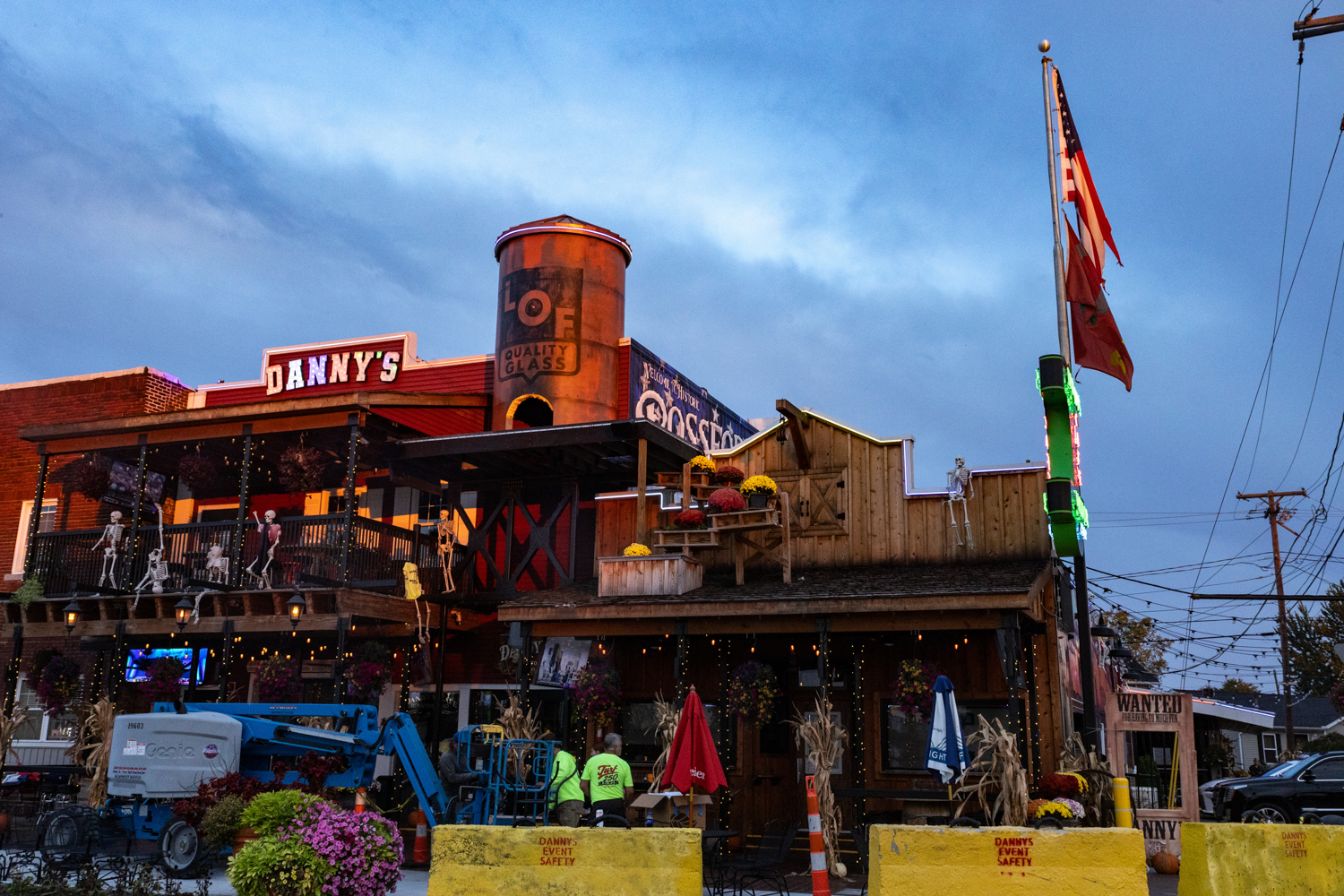
Danny’s Cafe, 600 Dixie Hwy., hosted the event in Rossford, the focus of which was data centers. The discussion was moderated by retired WTOL news anchor, Jerry Anderson.
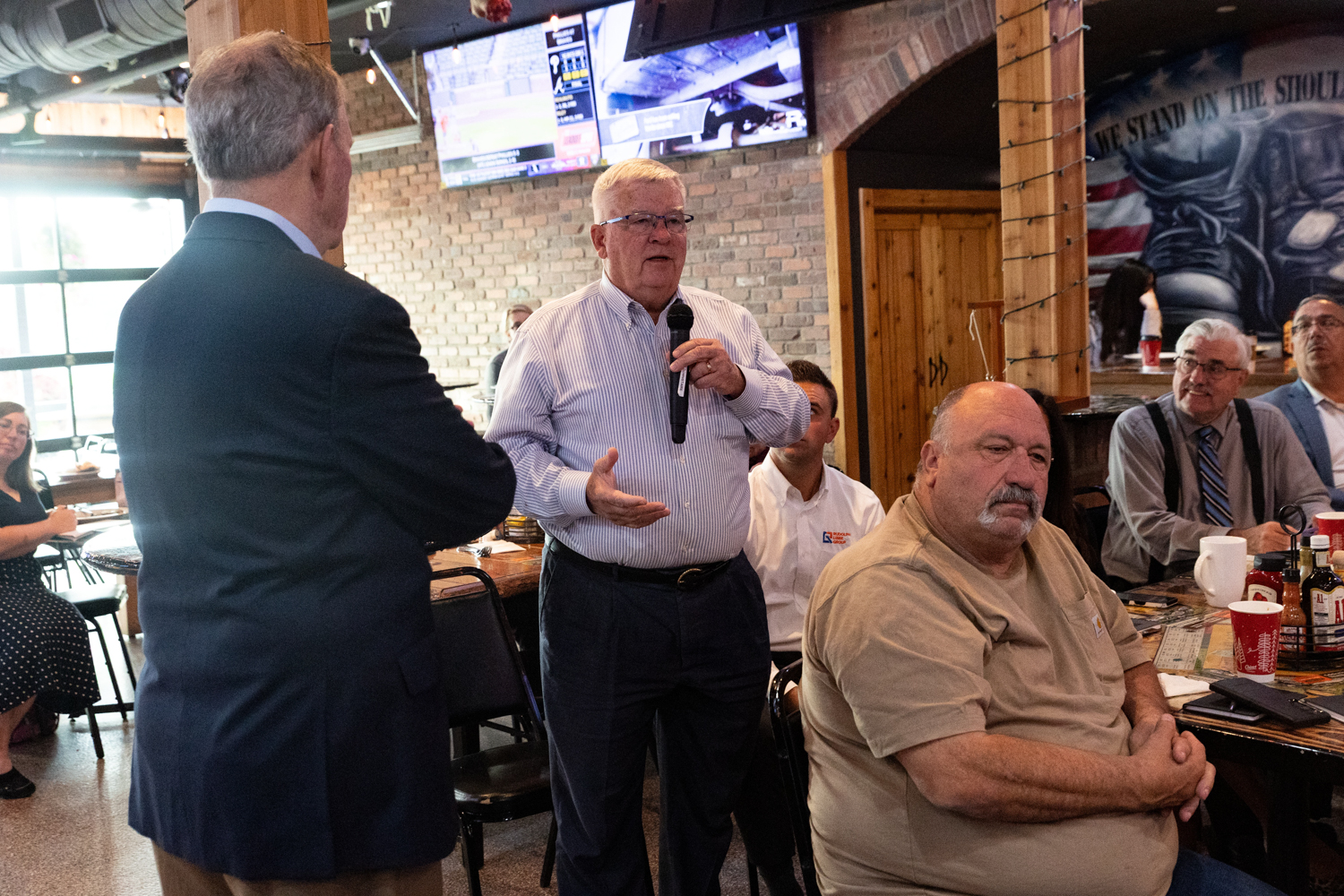
Supporters of TFP paid $50, and were served with a traditional American breakfast: coffee, eggs, sausage, bacon, toast and pastries. Attendees socialized and ate before panelists with expertise in technology, energy, zoning, business and government were able to speak on their area as it related to data center development projects.
Founder and Publisher of the Toledo Free Press, Tom Pounds, opened the event by thanking sponsors: Associated General Contractors (AGC) and Rudolph Libbe Inc.
“We’re here to talk about technology,” he said, and addressed the changing landscape of journalism from print to online and even the shift from profit to nonprofit.
Technology was responsible for the changing the industry of journalism he asserted, and thanked those in attendance for their support of TFP, expressing that with more support, the Toledo Free Press might be able to fill the shoes of the paper of record, The Blade, whose continuance has recently been called into question.
Danny’s Cafe during the Eggs & Issues: A Data Center Discussion fundraiser for the Toledo Free Press. (TFP photo by Stephen Zenner)
Anderson’s opening
“Eggs and issues!” Anderson announced. “I love the title, and we have plenty of both here today.” Poking fun at his own retirement, Anderson made light of his time outside of the spotlight.
“I’m a news guy, and I believe in people knowing. I’m not afraid of information. I endorse information,” he said, noting that he could make a pretty good argument for or against data centers, but that his goal was to shed more light on the issue itself. “Information is our friend, or should be,” he said.
Holding up a thick stack of papers that he described as the Ohio Chamber of Commerce economic study and economic impact study of data centers in Ohio, Anderson comically described the information as “light reading. If you’re ever having trouble sleeping, get a copy.”
Tim Pedro, the mayor of Waterville, speaks during the Q&A portion of the discussion. (TFP photo by Stephen Zenner)
Panel
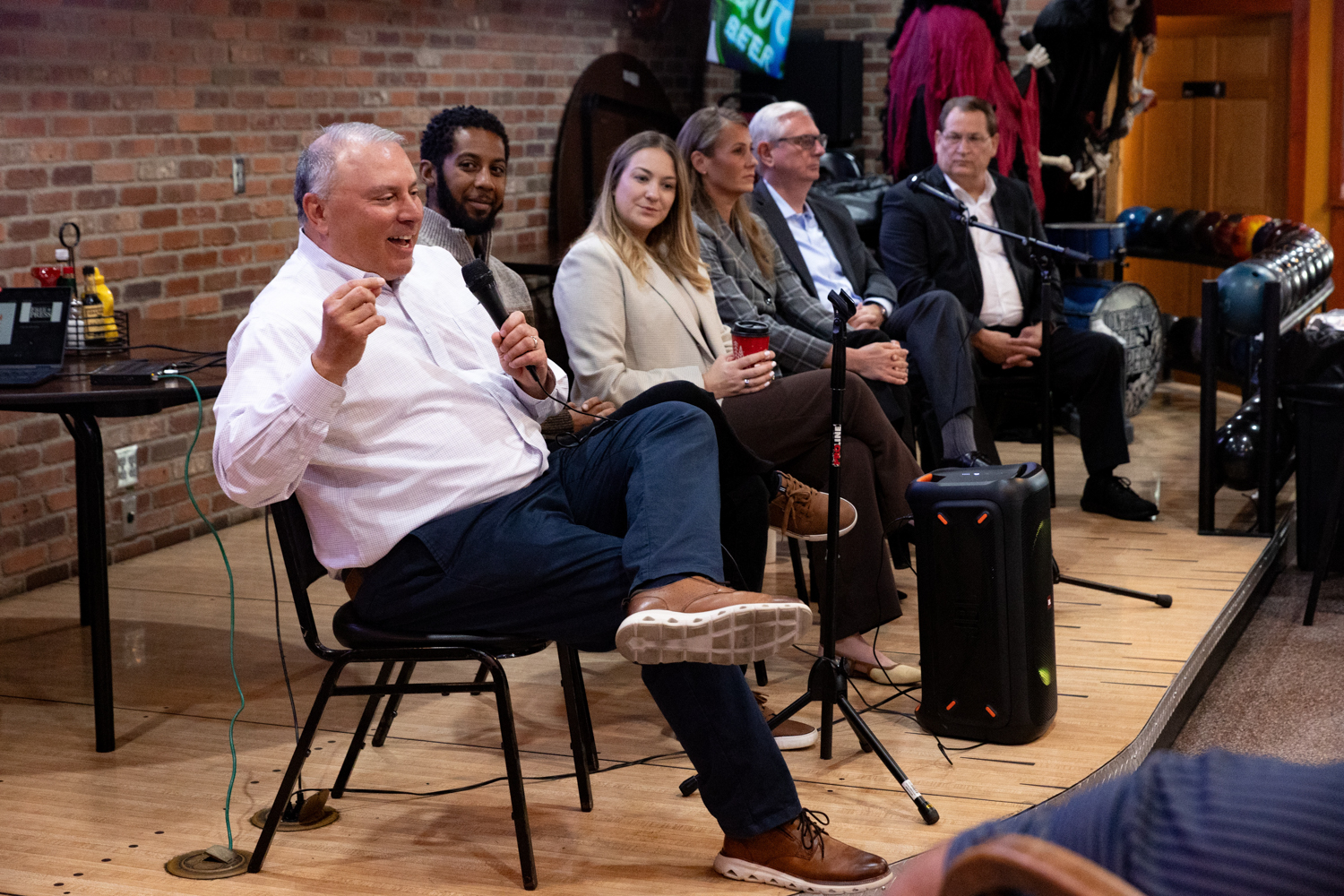
Each member of the panel was introduced and spoke a little on their expertise.
Jeffrey M. Stopar is an attorney who practices law in the areas of zoning, land use, local government law, and real estate related litigation. He is licensed to practice in the state and federal courts in Ohio and Indiana, is a cum laude graduate from the University of Toledo College of Law, and holds a BA in economics, cum laude from the University of Akron.
Stopar said he had experience on both sides of development. “I did a lot of work for developers, and then in the last 10 or so years, my practice has shifted. I represent more local governments,” he said. “So I’ve kind of seen all perspectives on that.”
“I give advice. Clients make decisions,” Stopar said and clarified that he merely works within the law to help his clients, whether they are pro- or anti-data center.
“If they don’t want data centers, there’s a way to go about that. If they do want to entertain the possibility of a data center in their community, there’s a way to go about that,” he said, and explained that banning data centers was not a strong legally defensible strategy in terms of zoning. His addendum was that whether you want or don’t want a data center, “there’s a way to go about that.”
Ohio, Stopar said, had not had a large number of cases dealing with data centers, but referenced a federal lawsuit against the city of Urbana, Ohio by developer Thor Equities, for the city passing a moratorium on data centers. The situation in Urbana is still developing.
Jeffrey M. Stopar, an attorney at Semro Henry LTD, often deals with matters of zoning. (TFP photo by Stephen Zenner)
LeSean Shaw is a technology leader, entrepreneur, and educator, who is dedicated to making artificial intelligence practical and accessible through his work with Actual Reality Technologies and Empowered AI. He helps businesses, schools, nonprofits, and community members understand how to use AI to improve productivity, support workforce development, and create new opportunities.
Addressing the difficulties in Toledo, downsizing in many sectors and population loss, Shaw referred to data centers as something that could potentially “uplift all boats at the same time” for northwest Ohio.
“I say that with a huge caveat,” he said. “I think there should be a lot of conversations before they even break ground. There should be a lot of negotiation, and there’s a lot of tactics that we can take from previous communities.”
LeSean Shaw, president of the African American Chamber of Commerce, VP of EmpoweredAI, COO at Actual Reality Technologies, and a business consultant, shakes hands with Jerry Anderson, retired broadcast journalist and news anchor with WTOL 11, who moderated the event. (TFP photo by Stephen Zenner)
Based in Columbus, Amanda Miller Bartlome is a community engagement manager at Meta, where she manages the tech company’s local community partnerships and investments across Ohio. She leads regional engagement for major local infrastructure, including the New Albany data center and Meta’s AI optimized data center facility in northwest Ohio.
Bartlome introduced her position with Meta colloquially as “making sure that Meta’s data center is being a good neighbor in the communities where we operate.” She shared that Meta broke ground on the New Albany data center in Ohio in 2017, which has been referred to as the “Prometheus” campus.
Last year, Meta broke ground in Wood County, and she said Meta was working on getting that data center operational.
“Raise your hand if you maybe checked Facebook or Instagram this morning,” she said to a room that didn’t respond very enthusiastically. “I sure did before I woke up.”
“If you’re using Threads, if you’re using WhatsApp to communicate, you might be using Ray-Ban Glasses or the Meta AI technology,” she said. “All of that is powered by the backbone of our infrastructure of our global data center footprint that happens to also exist here in the state of Ohio.”
Jerry Anderson, retired broadcast journalist and news anchor with WTOL 11, moderates. (TFP photo by Stephen Zenner)
Victoria Herring is a partner and executive vice president at Rural Strategies Group, where she partners with companies, government leaders, and associations to develop strategic engagement initiatives that build trust, shape public opinion, and deliver meaningful results in rural communities. She has worked across the country in the data center industry as economic development program manager at QTS data centers, with experience working alongside businesses, government leaders, and community stakeholders.
Adding more context to some of her credentials, Herring said she had experience as the director of attractions for the state of Indiana, and before that worked as business development director for Indiana’s Department of Agriculture.
She said of her current role, “What our firm does is advocate for responsible data center development.”
“Every industrial revolution has come with concerns from citizens,” Herring said. Her firm “helps bridge the gap between the developers and the communities to help have success and ensure that the communities really do get the most gain out of this development.”
“As was mentioned, there are opportunities for these developments to boost communities in ways that are unprecedented.”
Herring drew attention to the town of Quincy, Wash., where a Microsoft data center was built. “As a result, they’ve got a new police station, a new high school, and they’ve seen their overall poverty rate reduced by more than half,” she said.
“ ‘We will add to the tax base that funds your local hospitals, your schools, your parks, your libraries … and I think no place better illustrates this than the small town where Microsoft built its first data center,’ said Microsoft President Brad Smith during an announcement event in Washington, D.C.”
The article also notes that one of the main objections to the data center came from Former Mayor Patty Martin who was concerned about the downstream effects of the data center in 10 to 20 years.
Amanda Miller Bartlome, community development regional manager for Meta speaks on the panel. (TFP photo by Stephen Zenner)
Mark Frye is president of Palmer Energy. Since he acquired the company, Palmer has grown into a leading provider of unbiased energy consulting services. Mark has often provided expert testimony before the Public Utilities Commission of Ohio, reflecting his deep industry knowledge and experience. Under Mark’s leadership, Palmer Energy advises 1,000s of clients on energy procurement and utilization across industrial, commercial, educational, governmental, aggregation, and institutional sectors. Palmer Energy serves more than 75 Ohio counties, numerous municipalities statewide, and Power Four schools, which represents over 170 Ohio public school districts. He’s also the mayor of Sylvania.
Frye chose to open with an anecdote about the founding of Rossford by Edward Ford of the Libbey-Owens-Ford Glass Company.
“The reason he decided to build it [the Rossford glass plant] was because you had a confluence of natural gas availability from the Findlay oil fields, sand availability, you could bring labor into the market and you had land available,” he said. “That’s why this place in this town exists today.”
“Data center developers are looking at the exact same thing,” Frye said, and made the point that had there been opposition to Ford, Rossford might not exist.
“There is a confluence of flat ground, availability of fiber, high-pressure natural gas lines to generate electricity, and skilled labor force in order to build these facilities,” he said when talking about the conditions making northwest Ohio attractive for data center development.
“Are we going to reject, or are we going to manage those decisions that we’re going to make?” he asked.
Frye turned to the issue of energy and energy prices. Regardless of whether a data center is built in proximity to northwest Ohio, Frye said everyone’s energy costs would continue to go up.
“Electric consumption at these facilities [data centers] are so large that they have spooked the market,” he said, and added, “Energy markets have not seen anything, any consumption like this ever in their history.”
“Five, six years ago, people didn’t expect data centers to have this kind of an impact,” Frye said, and explained that when the market demand was flat coal plants closed and turned over to renewables with intermittent power generation.
Over the next few years, at least, “You’re going to see higher electric bills, because of this economic development,” Frye said, regardless of people push back against data centers in their communities.
Mike Tyson, an entrepreneur who is also the author of Zoning Research Project: Data Centers – The Impact on Public Health Zoning for a Safer Future & Smart Growth, speaks as part of the panel. (TFP photo by Stephen Zenner)
Mike Tyson is a graduate of Applied Business Marketing Management and has been an entrepreneur for some 50 years. He is the president of Tyson’s Inc. and author of a zoning research project, “Data Centers: The Impact on Public Health.” His awards include the League of Women Voters of Bowling Green Impact Award and the Ohio Lottery Retailer of the Week Award.
Tyson explained his work on the data center research project, which took him six months.
“I’ll be sharing with you my knowledge and opinions. A lot of this will be opinions, “ he said. “Hyperscale data centers are hazardous, heavy industrial businesses. We have to admit that,” Tyson said. Because they are complex, “I do not feel that zoning boards in 60 to 90 days could figure out all these factors to make a data center.”
“Municipalities and townships need to update their zoning regulations to address these massive businesses,” he said.
Citing a recent poll of 1,000 Ohioans he read the opinion, “75 percent oppose hyperscale data centers built in their communities.”
Referencing a conversation Tyson had with a CEO of Nvidia, Jensen Hung, Tyson recalled Hung had expressed that the industry owed communities better transparency.
“Most Ohio residents also oppose non-disclosure agreements and do not like to be kept in the dark,” Tyson said.
“We had special exceptions that stripped the citizens’ referendum rights,” Tyson continued. “That really was a major issue and needs to be addressed…The people should have the referendum rights.”
In his research, Tyson was surprised at how limited the Environmental Protection Agency (EPA) was in regulating data centers, and then he proposed that “local county health departments in Ohio should be involved in any hazardous heavy industrial zoning and business applications.”
Tyson recommended a new heavy industrial zoning classification for data centers because the projects went far beyond an industrial warehouse.
Then he drew a distinction between hyperscale data centers and smaller ones, noting that there are “11 various data center styles that I found in my research.”
Smaller data centers, Tyson said, had less impact on communities, but that “hyperscale data centers can produce loud sound vibration total noise that can travel easily two and a half miles, according to former NASA scientist from Virginia, Mr. John Liver.”
“Two and a half miles should be a minimum standard in Ohio for separation between a hyperscale density center and medium to heavy residential medical hospitals and other sensitive areas,” he assessed.
“Ohio Farm Bureau opposes the tax breaks and recommends hyper data centers be on existing industrial sites and abandoned ground brownfield sites,” he said. “In my opinion, the data center developing a mile square of farm ground and more will impact wildlife and natural drainage, create pollution in the air, soil, water runoff, and discharge.”
“People who cherish our natural resources feel saddened by this, and sportsmen who have paid for fishing, hunting licenses for decades are disturbed by this type of massive industrial development,” he concluded.
Angela Singler, director of business development at Laib Electric/Technology, talks about her experience with a data center that she said was not intrusive to a community. (TFP photo by Stephen Zenner)
Panel discussion
As a segue, Anderson specified the discussion should be addressing hyperscale data centers specifically.
“According to Synergy Research Group, there are only about 700 hyperscale data centers in existence,” Anderson said, adding that about half of those facilities had been built in the past five years, alluding to the massive development and growth of these kinds of facilities.
Inevitable?
For the first topic of discussion, Anderson made the argument that data centers were inevitable, and then asked panelists to agree/disagree with him.
The main basis for the argument was that the data centers are necessary, there is a demand for increased data usage, increased data speed and that technology companies have the money to invest in data centers, so they are going to happen inevitably.
“You are absolutely correct. My vacuum cleaner runs off of an app,” Herring said immediately. “I can turn it on right now and make sure that my floor is swept when I get home, so yes, whether you know it or not, you are using a data center in your daily life.”
And she referenced online banking, healthcare, and schools to illustrate that people use data constantly in their daily lives.
Jerry Anderson, retired broadcast journalist and news anchor with WTOL 11, moderates. (TFP photo by Stephen Zenner)
Energy consumption
Anderson then asked Frye how much electricity is needed for hyperscale data, and added “How much is my electric bill going to go up?”
Frye estimated an average hyperscale data center operates 500 megawatts of electricity a month and 4 billion kilowatt hours a year, which he compared to the entire current energy usage of Lucas County, including current industry.
“That’s the reason why the market spooked,” he said, and affirmed that the hyperscale data centers were what were required to keep up with data usage.
Clarifying Frye’s answer, Anderson asserted that the United States had not adequately expanded the electrical grid, and asked if that was correct.
Affirming Anderson’s assertion, Frye said for the past 25-30 years, the United States had not significantly expanded its power capacity.
“But keep in mind, from 2005 to 2023, the amount of electricity consumed in the country only jumped 3 percent total for that entire time frame,” Frye said, explaining the reason for the stagnation. Better energy efficient products helped keep consumption down, and “we’ve been living off of the existing grid for many decades, and not refurbishing it and expanding it at the rate necessary to feed these facilities.”
Providing information from Bloomberg, Anderson said energy prices around data centers jumped 267 percent from 2022 to now. With this information, Anderson drew attention to the fact that energy prices could go up everywhere, but posed the question that energy prices around hyperscale data centers may be significantly higher than in other areas.
Explaining the jump in prices, Frye contended that five years earlier the pandemic shut down the economy, giving the United States the lowest energy prices since the ’50s, and now prices are reaching new highs. Neither individual addressed a specific comparison of energy prices between current data center communities and non-data center communities in proximity to one another.
Paul Hubbard, a consultant, asks about constructing data centers on old industrial sites. (TFP photo by Stephen Zenner)
Power supply
Jumping off the related energy discussion, Anderson asked an adjacent question, “Should data centers be required to supply their own power?”
The representative from Meta, Bartlome, chimed into the conversation, talking about how Meta was already paying for and supplying their own power.
She said this included “infrastructure upgrade costs and anything that we would need to bring that power to our data center site.”
“We have signed the White House ratepayer pledge that ensures that Meta is paying the full cost of any energy and that…our customers are not being negatively impacted, and those rates are not being passed on to consumers.”
Bartlome also shared that northwest Ohio had an abundance of natural gas, and that Meta was working with the Ohio EPA and their regulations to create a natural gas plant. All the development and infrastructure, she said, was following local ordinances and restrictions as well, as she quickly referenced noise and decibel levels that could affect the area.
Anderson inquired if the gas plant would provide all the power for that data center, and Bartlome said she thought it was a portion of the power required for the facility.
Anderson asked if data centers should be paying the electric bills of those who live closest to them, and if that was a realistic requirement.
“That’s an amazing political soundbite that is immensely impractical,” Frye responded.
Mike Tyson, author of Zoning Research Project: Data Centers – The Impact on Public Health Zoning for a Safer Future & Smart Growth. (TFP photo by Stephen Zenner)
Transparency
Public input on data centers was the next consideration for the panel.
“The feeling that people say, ‘It was already under construction before I knew what the heck was going on,’” Anderson said, reflecting on a popular criticism of development.
Anderson presented the reality that many times officials sign non-disclosure agreements (NDAs) with companies, and that businesses may not wish to tip off their competitors to their plans for development, causing them to invest elsewhere.
Stopar took this opportunity to share from his experience working with both local governments and for developers, and said, “I have never recommended to local government to have one of those [an NDA].”
“A lot of this keeping stuff out of the public eye, I don’t like,” he said, but added that most of the time government meetings are simply not well attended.
“So people aren’t paying attention, the journalists aren’t paying attention…And next thing you know, there’s an application [for development],” Stopar said. “That’s how it happens.”
As soon as people do find out that a data center is going up, Anderson said there is an uproar to stop that kind of development, and stated that roughly 75 percent of people distrust data centers.
Speaking from the tech perspective, Shaw explained that people don’t really understand what a hyperscale data center actually means.
“I know what hyper is, I know what scale is, I know what a data center [is] potentially, I can imagine what that looks like. I have no idea what all of those words collectively mean,” he said, coming from the average layman perspective.
“We have to make sure that we’re creating advocates, even if those advocates are just able to operate from a place of information,” he proposed, so that community members in local government can make informed decisions from a place of understanding, instead of from stigma or fear.
Shaw said that when people do not feel equipped to talk about an issue, they lose their voice.
Turning to Tyson, Anderson summarized the businessman’s earlier stance on the data center issue, as a push towards getting the right amount of regulations to accommodate surrounding communities.
“When a new business comes to town, you have to earn the trust. You got to earn the respect of these people. You got to really treat them well. You got to show the community that you’re upstanding,” Tyson said. “The people need trust. You got to start right there, guys.”
Agreeing that public trust was important, Herring said that most data centers had already done away with the use of NDAs.
“I think that’s a recognition that having them was a problem,” Stopar said. “If we’re going to do something that’s going to be community changing without having public records showing the paper trail, that’s a problem.”
Municipalities, Stopar said, have more power than townships, because townships just have the power to zone. When it comes to townships, he said, “We can regulate the size and location of buildings.”
Then he clarified that much of the conversation hinges on private property owners dealing with data center developers themselves. “Usually, what happens is the data center comes in, they will talk to property owners, get an option, and that’s how that goes forward,” he said.
Private transactions are not public, but zoning is public.
Jumping back to the topic of NDAs, Herring said, “The reason that they existed in the past was because they [companies] don’t want competitors to know that they’re looking in a certain area.”
Herring went on to say that transparency isn’t always an option, because developers are working with other parties and the community. When in collaboration not all the details or terms are settled, so developers are unable to tell the public things they do not know themselves.
Vince Croci, professional public speaker, asks a question during the Eggs & Issues fundraiser. (TFP photo by Stephen Zenner)
Attendee input
The role of media
Trying to include some of the TFP supporters, Anderson opened up the conversation to those who came to hear the panel and enjoy the breakfast.
The first to make a comment was Gary Thompson, CPA, VP & Northwest Ohio Director of Regional Growth Partnership (RGP), who took the opportunity to criticize news media.
“Why doesn’t the media track down facts?” he asked, before a sound system malfunction played loud music drowning out the rest of his words.
Keeping the conversation on track, Anderson joked that the media was responsible for quite literally silencing Thompson as he was about to give an example.
When the air cleared, Thompson summarized a common stance against data centers, which has been that, “they’re going to use all this water” and drain Lake Erie. He said this was an easy fact for news media to refute and include in reporting that when dealing with Toledo’s watershed, water should not be an issue.
“The Toledo system has 70 million gallons of excess capacity a day, both on water service and sewer service,” Thompson said. TFP is unclear on where Thompson received these exact figures for excess capacity.
With the expansion of the Collins Park Water Treatment Plant in 2020 the total capacity of the plant was upgraded to 140 million gallons of water a day (mgd), and the capacity of the plant was determined by demand. Wastewater Digest estimated Toledo’s total need on a high capacity day, maxing out at 133 mgd, and so the plant was designed to meet the demand of roughly 500,000 people with a little extra.
Other improvements have been scheduled since the Digest’s report in 2021 on basins 1-6 at the plant, which if completed and running, would increase capacity by roughly 120 mgd. This would create the surplus to which Thompson alluded.
But on the City of Toledo’s own website, dated June 1, 2026, they claim, “We produce approximately 75 million gallons of safe drinking water daily for nearly 500,000 people.”
While it is clear that Lake Erie is a major source of freshwater, the United States Environmental Protection Agency has reported that “the Maumee watershed contributes the greatest phosphorus load to the lake (Maccoux et al., 2016), and to all of the Great Lakes.”
“Excessive algal growth in Lake Erie poses significant threats to the environment, human health, and the economy of the region,” the EPA wrote, and this uptick in phosphorus was caused by agricultural and municipal runoff by the surrounding region.
In short, Toledo has a significant resource in Lake Erie, potentially making it a prime area for a data center, but it is unclear specifically how data centers may affect Toledo’s watershed without knowing exactly what they require to function and what their outputs are.
Thompson’s other criticism dealt specifically with Anderson’s hosting of a different community conversation, where he accused Anderson of not fact checking an instance when he was on a panel. Anderson put the responsibility back on Thompson to say something, since Thompson was on the panel.
“The media sees this as a David versus Goliath story, and it’s selling papers or print or Facebook ads, and I think it’s irresponsible if the media doesn’t track down the facts,” Thompson said.
In response, Anderson cited his last broadcast date from 2020, and told Thompson to “Get off my ass.”
The retired broadcast host’s retort was received with laughter as he moved to the next consideration of the event.
Gary Thompson, CPA, VP & Northwest Ohio Director of Regional Growth Partnership (RGP), speaks negatively about media fact checking. (TFP photo by Stephen Zenner)
Farmland, zoning and energy
Posing a question to Herring, Vince Croci, a professional master of ceremonies, asked about developments on farmland that potentially turn one neighbor suddenly rich by selling their land, and another in a sore spot.
Pointing to planning within communities, she said, “While a lot of the properties that these developments are looking at are currently active farm ground, they are zoned industrial, and have been planned for industrial development for years.”
“Go out and look at your town’s comprehensive plan,” Herring advised those in attendance, and advised those in communities who were worried about change to invest in a new strategic plan for their area.
Frye stepped in to talk about the demand for data centers, and their effect on the economy.
“They’re going to spend 800 billion dollars in the United States this year,” he said, making the point that the economy hinged on their investment. And just as people had never encountered a boom in data centers like this, he made the point that most of the companies were some sort of technology company that had never needed to scale to an industrial level before.
His point was that the data center companies were learning in hereto uncharted territory.
At this point, Frye may have been thinking of only some data center companies. The top four data center companies in the United States are in order: Amazon, Meta, Microsoft and Google. Amazon and Google both have massive preexisting industrial capacity and understanding, while Meta and Microsoft are quickly pivoting into the industrial sphere to meet the need of data center creation.
Stopar added that the effects of hyperscale data centers were not like the negative effects of a landfill, but, he said, it is important to keep in mind the massive effect of the massive infrastructure that they are, and to also keep in mind that a data center could change a community for good or for ill.
A consultant, Paul Hubbard, asked if there was an effort to use abandoned urban areas to create data centers.
Tyson mentioned that Scottsdale, Ariz. had data centers in their city.
Mike Leidy, a chemical engineer, asks a question during the Q&A portion of the event. (TFP photo by Stephen Zenner)
Tim Pedro, the mayor of Waterville, then asked about the residual effect of the backlash against data centers for communities.
“How many other projects are going away and won’t come to that community?” because of the way they have dealt with data centers, he asked.
A local Oregon organizer against data centers, Jim Davis, spoke about his troubles trying to get information on the potential data center in Oregon, Ohio.
“We have found in Oregon there has been absolutely no disclosure,” he said. “They immediately bought the land and immediately transferred it to the Oregon Economic Development Foundation,” which he noted as a private organization unwilling to share information.
The CEO of the Associated General Contractors of Northwest Ohio and Chairman of RGP Joshua Hughes stood up in response to Davis’ accusations and began to speak against them.
“With all due respect, Mr. Davis is not correct,” he said. “This project has been in the works for more than two years.”
Hughes mentioned that the economic development agreement terms had been made public recently, and tried to explain with some of his experience, that development is a long process with many steps.
“In order to have this project in Oregon, the owner had to pay to have a load study done,” Hughes said, citing that it cost up to $300,000 for just the study. “Meta can’t just build a power plant in Middletown Township to power their project. They have to get the approval of First Energy, who has control over the grid.”
Echoing Frye’s earlier point, Hughes mentioned that power generation facilities and data centers were the main economic backing to the construction industry and to the U.S. economy. “Without these, our economy falls apart,” he said.
Backing up what Hughes was saying, Hans Rosebrock, director of power and energy systems for The Mannik & Smith Group, Inc., tried to shine some light on the norms of the industry.
“I’ve been doing this for 36 years. I’ve signed NDAs for about every project. Doesn’t have to be a data center,” he said. And then turning towards Hubbard’s earlier question about urban data center development he said, “They’re building a data center in Sandusky on the old General Motors plant, so they’re taking advantage of a brownfield site and redeveloping that. From an urban development standpoint, it makes a lot of sense.”
The Zoning Inspector for Rossford, Mark Zuchowski, then asked about how feasible it would be for data centers to run off of renewable energy sources.
“I’m 100 percent for renewable [energy],” Frye said. “But we also need to be realistic. A 500 megawatt data center would require 10,000 acres of solar,” he said, and to put the size of the solar area in context, Frye placed the Meta data center in Wood County at somewhere between 500 to 800 acres. “There’s 640 acres per square mile.”
Herring jumped in to say that requiring renewable energy for data centers would have a backlash on developers in general. “Ballot referendums, the issue with those is that it absolutely sends a signal to industry, period.” Other industries, she said, would be less likely to invest given push back or qualifications like that.
Pushing the conversation towards nuclear energy, Anderson cited a data center in Utah that is using four to five thousand small modular nuclear reactors to power it.
“All sorts of technologies will start to evolve because the demand and the money is there in order to develop it,” Frye said in reaction, but also maintained that modular nuclear reactors were first developed in things like the U.S.S. Nautilus in 1954, the first nuclear powered submarine.
Stopar chimed in to say the Ohio General Assembly would be more responsible for regulating NDAs and energy in large developments than townships or municipalities.
For the last few minutes of open discussion, people talked about how much water would be used and what percentage would be contaminated over time. Without a specific facility for context, the questions could not be answered.
Alec Thompson, of Rudolph Libbe, made the point that developments must abide by laws of the municipality, including noise ordinances, so as long as the laws are in place there shouldn’t be a problem or cause for fear.
A woman with Laibe Electric Technology, Angela Singer, then shared an anecdote about her hometown of Sandusky and the data center that was built there.
“It is very residential, and it is directly across from Sandusky High School. There is zero disruption to my hometown,” she said.
Anderson asked if he would be able to hear it if he drove by, and she answered that he would not.
A few other rapid-fire contested points were brought up without resolution before Anderson wrapped up the event, thanking everyone for coming.
Tom Pounds, publisher and founder of the Toledo Free Press, addresses attendees during the event. (TFP photo by Stephen Zenner)
NOCA, a tuition-free charter institution, was the first classical school to open in the Toledo area. Its curriculum comes from the Hillsdale College K-12 Education Office. (Courtesy Photo)
TOLEDO — For many school districts, the availability of one-to-one devices is an indicator of privilege, and that students have equal access to the latest technology to prepare them for the future.
In contrast, students at Northwest Ohio Classical Academy (NOCA) usually only see the Chromebook cart roll out a few times a year for standardized testing. The school only owns 120 devices for a student body of about 600, meaning it’s unlikely you will come across a room full of young people clacking away on laptops in the school on a typical day.
If students are taking notes, they are doing so with pencil and paper. The minimal role of technology in the school is by design, and it’s a common feature shared by schools in northwest Ohio that identify with a growing “classical education” movement.
NOCA, a tuition-free charter institution in south Toledo, was the first classical school to open in the region in September 2019. It remains the largest but is no longer the only one.
“Classical is our fastest growing school model,” said Courtney Harritt, a representative for the K-12 public charter school management organization ACCEL Schools. The organization manages Mosaic Classical Academy, an early elementary school that operated last year in Toledo’s Old South End and relocated to Rossford for the upcoming school year. The K-3 school is affiliated with the Jefferson Classical Academy, a network founded by Dr. Bill Bennett. Bennett served as U.S. Secretary of Education under President Ronald Reagan.
A market analysis of classical education published by Arcadia Education in 2024 found there were about 1,500 classical schools operating in the U.S. with an enrollment totaling a little more than 677,000. It projected that enrollment will approximately double by 2035, and the number of classical schools will climb by more than 1,000.
NOCA is a Hillsdale College Curriculum School, drawing its curriculum from the Hillsdale College K-12 Education Office. Located about 85 miles away from Toledo in southern Michigan, the small Christian classical liberal arts college has devoted itself to “the revitalization of public education” by launching dozens of classical K-12 charter schools across the country since 2012 through its Barney Charter School Initiative. The college “promotes a model of education that is rooted in the liberal arts and sciences, offers a firm grounding in civic virtue, and cultivates moral character,” according to its website.
Textbooks for third graders are stacked prior to the start of the year at Mosaic Classical Academy in Rossford. Like most classical schools, Mosaic limits the use of technology in its classrooms. (TFP photo by Laurie Bertke)
What is classical education?
According to the Arcadia Education analysis, classical schools are grounded in the Western intellectual and moral tradition and seek to cultivate individuals of virtue who can think, speak and write with clarity.
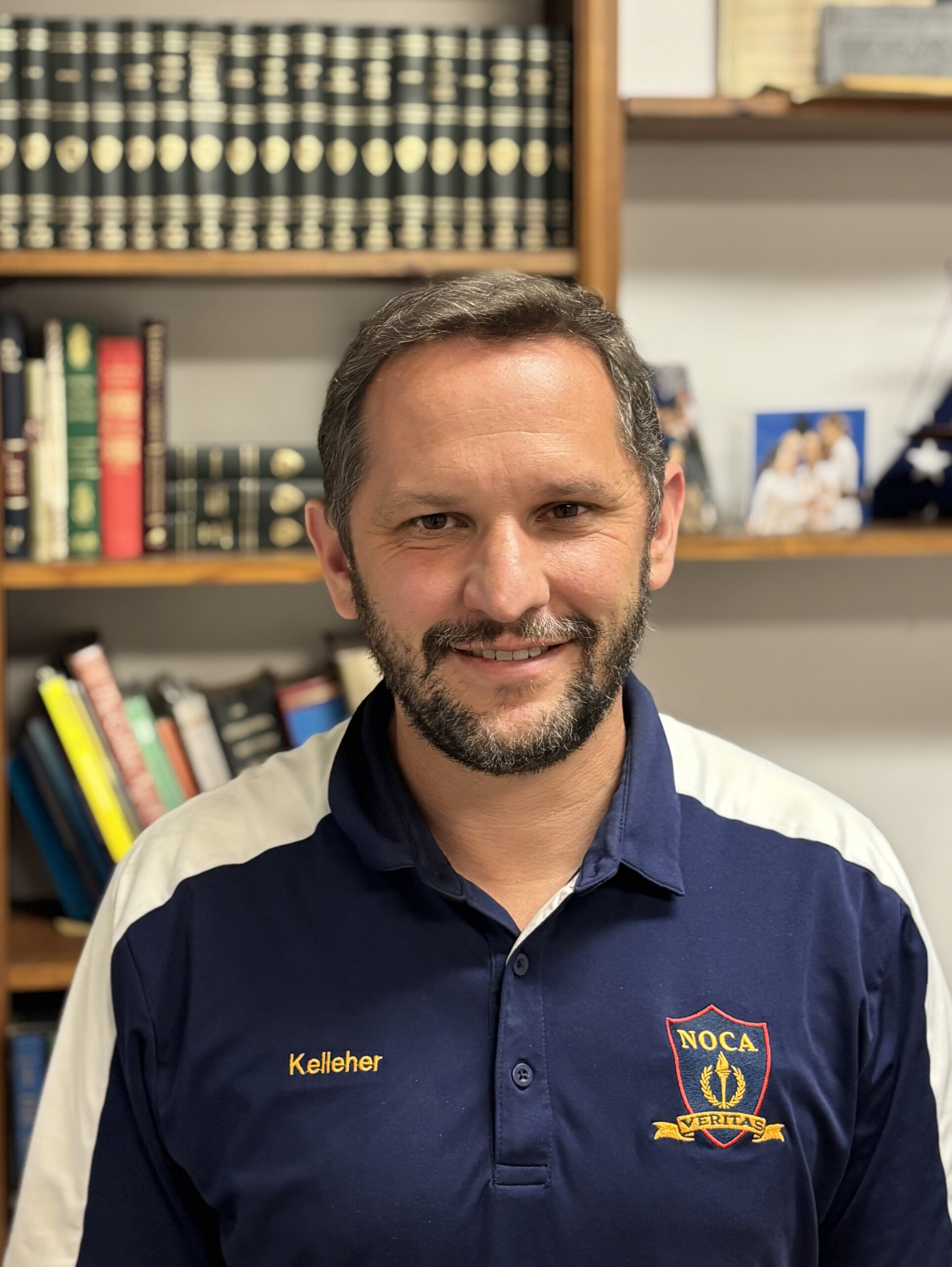
Michael Kelleher is head of the upper school for Northwest Ohio Classical Academy. (TFP photo by Laurie Bertke)
Michael Kelleher, head of upper school for NOCA, jokes that if you got 10 different classical educators in a room and asked them for a definition, you would probably get 10 slightly different answers. But most institutions that describe themselves as classical share a few things in common: an emphasis on reading the “Great books” of Western civilization, an embrace of the traditional liberal arts, and promotion of character education to cultivate positive “virtues.” At NOCA, those virtues include courage, moderation, prudence, justice, wisdom, friendship and responsibility.
Sabrina Little, an assistant professor of philosophy at The Ohio State University’s Salmon P. Chase Center for Civics, Culture and Society, is charged with developing programs to equip current and future educators and school leaders to serve in K-12 classical education settings.
Little has worked in classical schools and focused her research on moral education and virtue theory. ”In classical schools, moral formation is curricular,” said Little. The central objective of classical education “is to help form learners to love the right things” and to do good actions, be good citizens and be “curious, joyful people.”
While she said there is a big tent for classical education, it is generally based in the liberal arts tradition. “It’s about making free people who can think well and think clearly live good lives. It’s about the flourishing of the student,” Little said.
All subjects tend to be placed within the context of history to help students see where ideas come from, so you might see timelines even at the front of a science classroom. “You see yourself as the beneficiary of a tradition,” explained Little.
Sabrina Little is an assistant professor of philosophy at The Ohio State University’s Salmon P. Chase Center for Civics, Culture and Society who is working to develop programs that equip current and future educators and school leaders to serve in K-12 classical education settings. (Courtesy Photo)
While some may emphasize the novelty of classical education, Little described it as essentially reclaiming an old tradition that dates back to the ancient Greeks. “There’s a lot of Socratic dialogue where you are asking a question and clarifying definitions,” she said.
Kelleher said one of the most unique experiences in the upper school is the seminar, which he described as a “glorified book club.” After spending several days reading and listening to lectures, students are ready to discuss.
“You know a class is in full seminar mode when you walk into the classroom and the desks aren’t all facing the whiteboard and the teacher, but they’re all in a circle facing each other,” said Kelleher. “They’re talking about what they read. And, you know, asking questions of each other. My favorite seminars I walk into are the ones where the teachers really pull themselves back.”
The seminar puts the burden of learning, discussing and processing on the students, he added.
Little said students practice “imitation of the masters” with students in the lower grades focusing on memorization of great works, middle grades exploring the logic and conventions of those works and upper grade students writing their own poems, literature and senior thesis.
Natalie Culp, a mother of six who will have five children enrolled at NOCA this school year, said her fifth grader was encouraged to memorize classic works of poetry and excerpts of plays to recite at the school’s daily morning assembly last year. While she said her son is not an extrovert, the experience helped him gain confidence and he enjoyed it because his entire class participated. The capstone poem they memorized was Lewis Carroll’s “Jabberwocky.”
During the short daily morning assembly, the entire student body also sings a patriotic song and recites the Pledge of Allegiance, as well as the school motto: “I will learn the true, I will do the good, and I will love the beautiful.”
Kelleher noted that NOCA puts a strong emphasis on music and art classes to cultivate an “appreciation and awareness of the world” beyond knowing facts or how to solve math problems. “How to appreciate great music and great art throughout the ages is an essential part of the classical education experience,” he explained.
NOCA, a tuition-free charter institution, was the first classical school to open in the Toledo area. Its curriculum comes from the Hillsdale College K-12 Education Office. (Courtesy Photo)
Less tech, more pencils and paper
Classical educators favor a return to instructional methods from years past, including opting for pencil and paper over the digital devices that have encroached on traditional classrooms.
For Culp, this was an important quality that sold her on enrolling her children at NOCA when her family moved from Dallas to Toledo in 2025. While Culp said she is not anti-technology, she believes using electronic devices as a substitute for books is “terrible.” Research shows the impact of excess screentime is detrimental for young children whose brains are still growing and developing, she added.
“I just think it really kind of dumbs down the education. It’s distracting for the students,” said Culp. She is pleased that her two children in high school will have amassed a large collection of books they can revisit by the time they head off to college.
Aside from the computers they use in a Technology Essentials class, NOCA students do their schoolwork on paper. Kelleher said this also makes it easier to ensure that students do the thinking and the writing themselves in light of the growth of artificial intelligence.
Kathleen Williams, the founder of St. Thomas Aquinas Classical Academy (STACA) in Toledo, said the school offers zero technology for students and discourages its teachers from even using computers in the classroom. She said she believes technology makes it difficult and sometimes impossible for young children to think and wonder about things.
“Wonder is so important and it’s really the beginning of all education, and that’s back from Aristotle,” said Williams, who markets the school as a classical liberal arts academy in the Catholic tradition. The private school is not affiliated with the Diocese of Toledo.
STACA operated last year as a small, hybrid homeschool program with five students. This fall, it is moving to the academic wing of a Protestant church on Sylvania Avenue in west Toledo, and Williams said the school will continue its hybrid homeschool program and add a program for full-time elementary students. She plans to eventually expand to include high school grades.
Opening the school was a longtime dream for Williams, who was introduced to the Catholic liberal arts at Christendom College in Virginia. She said she has worked in education over the past 30 years in Catholic schools, homeschool enrichment programs and as a homeschooling parent herself and is excited that classical education is taking root in the Toledo area.
“It’s the formative education that every human person deserves,” she said. “It teaches according to the nature of the child. It informs the whole child.”
As more schools have opened, a parallel movement championing the classical approach to education has grown among homeschooling families.
Culp, who homeschooled prior to enrolling her children at NOCA, said she learned about the model 13 years ago from a classical Christian curriculum publishing company called Memoria Press and it checked all the boxes for her.
“I wanted an education that would be grounded in kind of the broader Western tradition and emphasize the really basic skills of writing and thinking well,” said Culp. “I found the educational model fit most with what I envisioned as the goals for my kids — just developing kind of a lifelong love of learning and having education be not only about preparing for a career some day but living a good life and developing personal character and being a responsible citizen.”
NOCA, a tuition-free charter institution, was the first classical school to open in the Toledo area. Its curriculum comes from the Hillsdale College K-12 Education Office. (Courtesy Photo)
Why the emphasis on Western tradition?
Kelleher, a Hillsdale College alum who studied the classics for his bachelor’s and master’s degrees, said classical education puts an emphasis on Western civilization, and the Hillsdale curriculum describes itself specifically as an “American classical education.”
That does not mean students exclusively study Western culture, he said, but it does mean American history and literature gets more emphasis than the rest of Western civilization, and Western civilization gets more emphasis than other cultures. Kelleher said this is not about superiority or triumphalism, but rather, he explained, the “proximity principle.”
“If you are an American citizen, it behooves you to kind of know your American heritage well — the good, the bad and the ugly,” he explained. “But then it’s worth acknowledging America as a country, its national roots, its constitutional roots, et cetera, do kind of spring out of the Western tradition.”
Kelleher pointed to the nation’s 250th anniversary as an example: understanding the significance of the Declaration of Independence becomes a richer experience for students when they have learned about John Locke, Aristotle and Plato and their thoughts on government and how it informed the signers.
Educators in classical schools such as NOCA favor students learning with pencil and paper rather than using digital devices. (Courtesy Photo)
Growing classical movement in Ohio
OSU’s Chase Center was established several years ago as part of a plan pitched by Republican lawmakers to establish five “intellectual diversity centers” on college campuses in Ohio. Its mission is to conduct teaching and research in the historical ideas, traditions, and texts that have shaped the American constitutional order and society.
The Chase Center has since become a leading promoter of classical education in Ohio and has a stated focus on supporting classical and liberal arts schools. It hosted its second Ohio Classical Schools Conference in August, bringing together educators from around the state, and the center is conducting research on classical schools and launching degree programs soon in classical education.
Lee Strang is the executive director of The Ohio State University’s Salmon P. Chase Center for Civics, Culture and Society and also a founding board member for Northwest Ohio Classical Academy. (Courtesy Photo)
Its inaugural executive director, Lee Strang, was a founding board member for NOCA and remains the president of its board. Strang previously served as the first director of another intellectual diversity center, the University of Toledo’s Institute of American Constitutional Thought & Leadership.
Strang explained the Chase Center takes a special interest in classical education because the curriculum of these schools closely aligns with the center’s emphasis on reading “great texts.” He asserted that most education “back in the day” looked like what would now be characterized as classical education: it was focused on history, reading of original texts and primary sources, conversation and discussion, writing and presentation.
According to Strang, the first revived classical schools emerged in the 1980s in the U.S. The movement has gained support from larger networks such as Great Hearts and Hillsdale College, and Strang said there has been an exponential rate of growth in classical schools both nationally and in Ohio in recent years.
The Chase Center has identified 34 classical schools in Ohio and Strang said another five to 10 are expected to open in the near future. “I won’t be surprised when more and more classical schools start opening up in northwest Ohio,” said Strang. ”It’s just exploding.”
Strang said there are no plans for the Chase Center to create a K-12 classical curriculum as Hillsdale College has done, but rather they are seeking ways to partner with other entities working in the field of classical education. The center also is creating civics education modules that any school can use, regardless of its educational model.
Why is a university interested in K-12 education? “Educating American citizens doesn’t start when they get to 18 and they come to OSU or to another college,” said Strang. ”The mission of the Chase Center at the collegiate level is reflected and enhanced by the curricula on the K through 12 level.”
Michael Kelleher, head of the upper school for NOCA, said classical education puts a strong emphasis on music and art classes. (Courtesy photo)
Emergency vehicles were parked outside the Monclova Township administration building during an Oct. 3 Safety Services Open House. (AWFP photo by Karen Gerhardinger)
MONCLOVA TOWNSHIP – Limited Home Rule public meetings, speeding tickets at the Albon and Salisbury roundabout and fire department purchases were among the topics covered during a 21-minute Monclova Township trustees meeting on Oct. 5.
Limited Home Rule
Last month, Administrator Michael Hampton launched an educational presentation on Limited Home Rule, which will be on the Nov. 3 ballot for township residents. Now he’s scheduled meetings from 7 to 8 p.m. on Thursday, Oct. 15 and Thursday, Oct. 29 at the administration building, 4335 Albon Rd.
While acknowledging that voters turned it down in 2024, Hampton, who has served as administrator for just a few months, wants to provide residents with more information.
“This year’s approach is centered on information, transparency, and the opportunity to ask questions,” Hampton wrote in a letter posted at monclovatwp.org along with a video of a Sept. 16 presentation to Waterside’s homeowners association. “Residents should understand what Limited Home Rule would allow the Township to do, what it would not allow the Township to do, and what limitations would continue to apply.”
The meetings will allow residents to learn more and ask questions, he said.
“Regardless of the outcome, our responsibility is to make certain residents have accurate information and a clear understanding of what they are being asked to consider.”
Albon and Salisbury roundabout
During the Sept. 21 meeting, several residents asked the trustees for help in dealing with speeding issues near the Albon and Salisbury roundabout. The next day, the Lucas County Sheriff’s Office had deputies monitoring the area with radar and issuing multiple tickets – much to the chagrin of many township residents who were cited, Hampton said.
Public Works Director Doug Holland is working with the Lucas County Engineer to start a speed study once the Strayer and US 20A roundabout is finished, in order to get a more accurate count of traffic that doesn’t include those using the Salisbury and Albon intersection for a detour.
Fire Department
Trustees approved the purchase of 10 sets of Globe turnout gear from Atlantic Emergency Solutions for $37,250. The gear will be used to replace sets that are reaching the 10-year expiration date and to outfit new employees, said Fire Chief Matt Homik.
Carolyn Hinde, a full-time paramedic, was approved to move to part-time, as she has accepted a full-time position with the Maumee Fire Division as a firefighter paramedic. After interviewing three internal candidates, a committee recommended Samantha Heishman to fill that full-time paramedic position vacated by Hinde.
Trustees also approved an agreement with Stryker for its EMS Plus Program, which will allow the department to replace its EMS equipment, including cardiac monitors, AEDs and power chairs and load systems. Fiscal Officer Gavin Pike recommended paying for the program up front rather than a five-year lease, and trustees agreed.
During the meeting, the board also:
-Heard Trustee Chuck Hoecherl thank the staff members involved in planning the Oct. 3 safety services open house, which provided residents with an opportunity to meet employees and check out the fire department and public works equipment.
-Approved two resolutions for the Lucas County Auditor: approving amounts and rates for property taxes; and requesting an advance on taxes collected.
-Appointed Mark Trimble for a five-year term as a member of the Zoning Commission, and reappointed Cathy Shepherd to a one-year term as an alternate on the Zoning Commission.
-Listened to resident Roy Bechtel reiterate his request that the trustees add a second public comments section at the beginning of the meeting in order for residents to comment on agenda items before the trustees take a vote. He suggested that a full packet be made available in order to provide transparency. Trustee Debbie Stevens-Laux said this is being taken into consideration.
TOLEDO – It was August last year when Ansley Hendrix got some exciting news.
“My mom was driving me home from the grocery store,” Hendrix recalled. “My twin sister, Maddie, sent me this post on Facebook from the National Federation of the Blind that said there was a casting call looking for a blind actress to star in a movie.”
Hendrix, 29, who recently moved from Atlanta to Charleston, S.C., was told the movie Strange Shapes would be filmed in Toledo, where she had never been.
“It was so incredibly fast how it all happened,” Hendrix said. “Of course, I had to do it. I auditioned with a self tape and enlisted the help of my friend Will from high school theater and found out I had a chemistry read. I ended up booking the role on that call. My family and I screamed like crazy people!”
Hendrix, who is legally blind, is a singer, dancer and songwriter. She made her musical theater debut at age 12 in Little Red Riding Hood – The Musical and has since appeared in The Sound of Music, Once on This Island, and Little Shop of Horrors.
“I was 12 when I was introduced to the musical Wicked by my best friend in middle school and I never looked back,” Hendrix said. “I knew this is what I wanted to do for the rest of my life. My twin sister is an opera singer with the most gorgeous soprano voice you’ve ever heard.”
Ansley Hendrix, 29, is the lead character and is legally blind. (Courtesy photo)
Getting the movie started
Strange Shapes tells the story of a blind woman who searches for her missing guide dog and begins to see unsettling entities that stalk her through the night.
The movie was filmed over 14 days from the end of September through mid-October in 2025. Locations included Glenwood Lutheran Church near the Toledo Museum of Art, around the shops in downtown Sylvania, and inside a residence in the Washington Local school district.
Timebomb Productions was the official studio behind the movie, in association with RAW Studios of Toledo. Samantha Ryan, an assistant director on the movie, is the CEO of RAW Studios, which specializes in the logistical side of creating cinema and photography services.
Strange Shapes was written, produced and directed by James Aponte.
“I met James through a recommendation from Film Commissioner Michael DeSanto,” said Ryan, 32, who lives just west of Toledo. “James was looking for a producer with experience in low-budget film making. Once we met, we knew we would make great business partners and could work together to bring Strange Shapes to life.”
(From left) Writer, producer, and director James Aponte; Ansley Hendrix (as Violet) and Justin Hogan (as Oscar).
Hendrix’s character, Violet, is the lead in the 70-minute horror film. Ryan said Hendrix nailed the part.
“We began our search through the Sight Center, which ultimately connected us with the National Federation of the Blind,” Ryan said. “Ansley submitted her experience and a tape for consideration, and we knew almost immediately she was perfect for the role of Violet.
“Ansley stepped right in and was an absolute shining light,” Ryan added. “The first scene we shot with her was a confrontation between Violet and Oscar, played by Justin Hogan, and she absolutely blew me away. She brought so much authenticity and emotion to the character right from the beginning.”
Hendrix said she arrived in Toledo a week before production started “to get the layout of my host family’s house and the Toledo Talent headquarters that acted as our rehearsal space.”
“I absolutely love Toledo,” she said. “There is such wonderful culture, and the people are so kind.”
Ryan said what she loves most about Strange Shapes is the opportunity she got to meet and work with Hendrix.
“It was incredibly enlightening to work with such a remarkable person and to learn how we could make the filmmaking process more accessible for her, while also showing the world what authentic representation can look like,” Ryan said. “Working with Ansley has been a really meaningful experience for me, both professionally and personally.”
Hendrix’s character, Violet, is the lead in the 70-minute horror film. (Courtesy photo)
Toledo-area native writer/producer/director
Aponte, 33, a Sylvania Northview graduate, majored in film and video at The University of Toledo. He said he began writing the Strange Shapes script in October of 2024 and finished in March of 2025.
“Looking back, I can say I was definitely influenced by The Evil Dead films, the Alien movie franchise, and Halloween (1978),” Aponte said. “I originally wanted to be a writer. When the Alien quadrilogy was released, I made a life-changing discovery: I learned that James Cameron was not only the director of Aliens, but he was the writer as well.
“Suddenly, everything changed. I thought, ‘Wait, I can make what I write real? I’m going to do that!’ I’ve wanted to be a filmmaker ever since eighth grade.”
(From left) James Aponte, Samantha Ryan and cinematographer Austin Mosher. (Courtesy photo)
Aponte said he got the idea for Strange Shapes after watching a blind YouTuber who was asked, if he could have surgery that would enable him to see, would he go through with it?
“That question made me put myself in his shoes,” Aponte said. “I concluded that if I had been blind since birth, the ability to suddenly see would be one of the most terrifying experiences I could imagine. It would completely change my interaction with and perception of the world.
“Then I thought, ‘What if I was blind from birth and suddenly saw something that was truly terrifying? And what if that was the only thing I could see?’ And so, Strange Shapes was born to explore this unsettling scenario.”
Aponte has done several short films that can be viewed on his website, jamesaponte.com. He said he is “immensely proud” of Strange Shapes.
“Everyone’s talent and skill that was poured into this film really shines through, and that’s always something to be proud of,” Aponte said. “It’s hard making movies. To make one, especially at the ultra indie level, is an accomplishment anyone should be proud of.”
A still from Strange Shapes featuring the clawed hand. (Courtesy photo)
Facing challenges as a legally blind performer
Hendrix was asked how she has faced and overcome being blind as a member of the show business profession.
“As a blind person, particularly in the visual performing arts like acting and dance, I face a lot of challenges,” Hendrix said. “Mainly with people understanding and accepting me in an industry that is often perceived as visual.
“I loved this movie because it showed a side of blindness that people don’t get to see. We are so often portrayed as disabled people who need help, but we are strong, independent individuals who are perfectly capable of living successful lives.”
Strange Shapes premieres at 7:30 p.m., with doors opening at 6:45 p.m., on Saturday, Oct. 10 at the Maumee Indoor Theater, with a cast/producer Q&A to follow. It will continue playing on the remaining Fridays in October.The one minute, 15-second movie trailer can be seen here.