TOLEDO — Long after the last employee shuts down their computer and the lights flicker off for the night, the work is just beginning.
Inside Toledo’s high-rise offices and public buildings at night, vacuums hum down empty hallways. Mop water sloshes against bucket rims. The air is thick, stale and warm. Air conditioning typically shuts off when tenants go home, so the night shift sweats through it.
They clean the messes no one sees—or cares to see—that are left behind. They disinfect bathrooms, polish glass, scrub floors, sweep salt, haul trash. Their fingerprints are wiped away before anyone notices they were even there.

Janitors, like Nadine Larde, are deep into their shifts before the Glass City wakes up.
“It consists of a lot of work—a lot of sweeping, dusting, mopping. You know, some buff, wax and strip floors…and the mirrors and the glass and the doors,” said Larde, an SEIU Local 1 member who works for Holland Building Services, and serves as a union steward and bargaining committee member. “And dusting…a lot of dusting takes place.”
But last Saturday, their work—and their worth—were brought to light as they took to the streets during the daytime.
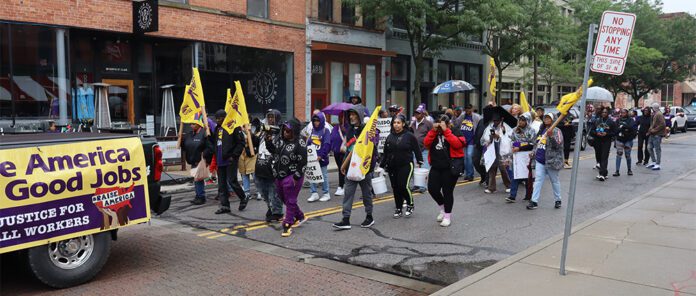
Joined by Congresswoman Marcy Kaptur and Ohio representatives Michele Grim and Erika White, more than 100 SEIU Local 1 janitors marched through downtown Toledo in the city’s Juneteenth Parade on June 14, not just to celebrate Black freedom, but to demand better pay, safer working conditions and long-overdue respect.


With their current contract set to expire in July, union members are preparing for tense negotiations, and they’re making their voices heard.
“We represented with Juneteenth the freedom, and also for liberty, and also, for the Union,” Larde said of the march. “It’s not that they’re trying to take from the business owners, but they [Local 1 workers] want to live. They want to be able to take care of their children, their home and different things.”
For SEIU Local 1, participating in the Juneteenth Parade was a deliberate choice.
“Our members live in the communities where everybody else is,” said Yanela Sims, SEIU Local 1’s Ohio state director and recording secretary. “They have jobs, but they’re also people outside of work.”

Sims said participating in community events like the Juneteenth Parade helps members share their message and break the invisibility that often surrounds night-shift workers.
“It allows our members to communicate that they’re not just the invisible workers that come in at night and make everything clean and tidy. No one ever sees them or hears their perspective,” she said.
While Juneteenth commemorates the end of slavery in the United States, the federal holiday remains relevant to today’s labor struggles—especially for Black workers, who make up the majority of Local 1 janitors in Toledo, according to union representative Camilo Villa.
They’re an integral part of ensuring that workspaces are clean, tidy and safe. But if there’s a mess in the building, you’ll know.
Yanela Sims | SEIU Local 1’s Ohio state director and recording secretary
“They’re an integral part of ensuring that workspaces are clean, tidy and safe,” Sims said. “But if there’s a mess in the building, you’ll know.”
And yet, Sims added, their needs are too often overlooked. In many buildings, air conditioning is shut off after tenants leave, often leaving janitors to clean in stifling heat.
“If it’s not safe for your tenants to work in the heat, then it shouldn’t be safe for our members, either,” she said.
The janitors clean some of the region’s most high-profile buildings—corporate offices, hospitals, manufacturing sites—but many still earn less than $15 an hour.
SEIU Local 1 represents more than 400 janitors in Toledo and Northwest Ohio. They clean buildings most residents pass by or work in every day, such as One Seagate, ProMedica buildings or Owens Corning. Though they are essential to keeping the city running, many work behind the scenes and under subcontracted conditions.
“All of them work for janitorial contractors, not for those companies,” Villa explained. One of SEIU’s key messages during this contract cycle is that employers—not just contractors—must ensure their buildings are staffed by workers who are paid a fair wage.
“For a lot of these people, this is their only source of income,” Villa added.
Many SEIU Local 1 members rely entirely on janitorial work to support their families, sometimes holding multiple part-time cleaning jobs or sharing the workload with a spouse. For some, it is a second career taken up later in life; others balance caregiving responsibilities during the day before heading to work at night.
One longtime member, Villa noted, has worked as a janitor for 47 years. A military veteran who was deployed to Iraq during his time in the reserves, he returned to the same building he’s cleaned for two decades, still making under $15 an hour.
For Larde, the story is personal. A 14-year cancer survivor, she spends her time off recovering from the physical toll of the job. “I basically try to rest up so that I can go to work for next week, “ she said. “I do spend time out in the yard or what have you. Sometimes I go and see my daughter that lives in Michigan.”
With their current contract set to expire in July, SEIU Local 1 janitors say they are entering negotiations with a clear message: Their work is essential, and it is time it was treated that way.
After years of being overlooked, the union workers say they’re ready to be heard, not just at the bargaining table, but by the communities they serve every day.