As a senior at Whitmer High School, I never dreamed of being a scientist. I was already accepted to the University of Toledo with the intent to study international business when a former Whitmer student and now-friend suggested I look into UToledo’s biochemistry program.
Biochemistry sounded really fancy, even though I didn’t really know what it was, and honestly, I had no idea what I wanted to do, so why not [look into] something that sounded cool? I emailed my academic advisor the next day to say that “I have given it a lot of thought [I had not] and I’d like to change my major to biochemistry.”
Despite the questionable reasoning, this turned out to be a great decision, and the more I learned about biochemistry, it turned out to be very cool, indeed. Biochemistry explains why naproxen sodium binds tighter, and therefore lasts longer, than ibuprofen. It is how we learned that a baby’s blood needs to be better at binding oxygen than the mom’s so that they can “breathe” through their blood instead of their lungs.
I fell in love with trying to understand our world, and I am now pursuing a Ph.D. at Northwestern University in biology.
I do National Institute of Health-funded research fulltime, trying to better understand how our cells detect changes in their environment.
There are two ways to do science: publicly and privately. Privately funded research can be done by companies to develop proprietary products, pharmaceuticals and processes. They don’t have to share their findings with the world and can set their own premiums on the knowledge they generate.
Publicly funded research, on the other hand, does have to be shared with the greater scientific community. This research is done primarily at universities and national labs and is funded in large part through the National Institute of Health (NIH) and the National Science Foundation (NSF).
When applying for this funding, there are requirements to ensure that this public funding from taxpayers produces findings that are accessible to the public. These grants are tracked transparently for anyone to see and awarded very competitively so that only the most rigorous and effective projects are funded. This is science being done by the people, for the people, for the good of the world.
Publicly funding science isn’t just “the right thing to do,” it’s also a good deal for the taxpayer. Every $1 of NIH funding generates $2.50 in return to the local economy. Funding science mostly means funding the jobs for individuals like me who do said science.
Scientists buy things, eat food, live somewhere – all those good things that stimulate an economy. In 2024, science in Ohio received a little over $1 billion dollars in research funding just from the NIH, which supported over 13,000 jobs.
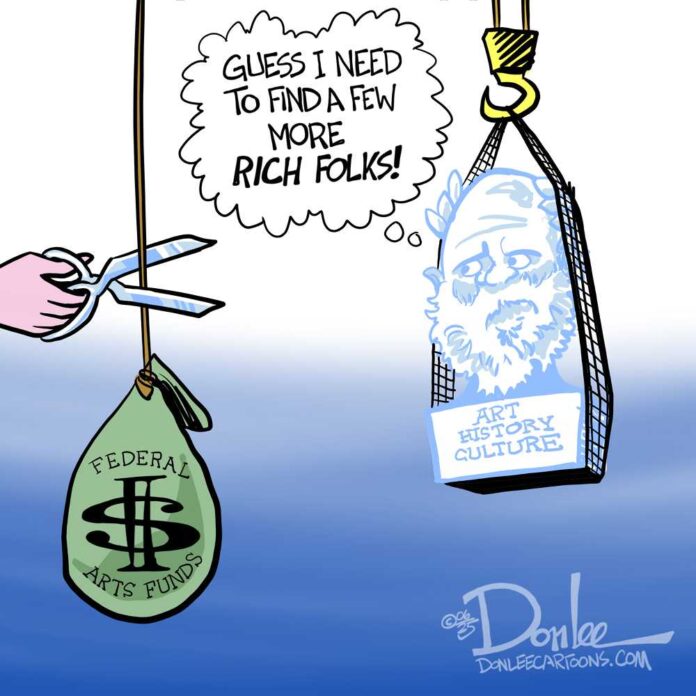
All of this good is on the chopping block right now. These people who do science for the love of knowledge and a desire for the truth rather than for profit are being fired. Funding for new grants has been decimated, peer-reviewed and approved projects have been cancelled out of the blue, and some funding has been frozen with no explanation or terms for reinstatement at all.
The funding that pays my salary has simply stopped coming, and there’s no way to know if it will come again. Right now, all of these cuts are based on executive orders, and since the funding was originally allocated by Congress, these cuts have – at best – questionable legality.
The “One Big Beautiful Bill,” now that it has passed, will damage scientific research in America in a much more permanent way. We are quickly racing toward a world where science is only done for profit and not for the greater good of the American people.
I didn’t go into science for profit: For me, science is about a desire to understand our world so that we can help people live better lives. The world needs academics who do science for the love of truth and knowledge for the greater good of the world, and we need public funding to do that. Consider calling your representatives, and stand up with scientists before it’s too late.