Home Blog Page 60

Exhibition highlights artwork by Sisters of St. Francis

0
Sister Magdala Davlin stands next to her sculpture of Mother M. Adelaide Sandusky, the foundress of the Sisters of St. Francis of Sylvania, Ohio. It is a part of the “Journey of Beauty” exhibition housed in the Main Library’s gallery space through August 2. (TFP Photo/Kelly Sankowski)

Main Library’s gallery hosts ‘Journey of Beauty

TOLEDO — This summer, visitors to the Toledo Lucas County Main Library have the opportunity to browse a collection of 59 pieces of art by 20 Sisters of St. Francis of Sylvania, Ohio.

The exhibition, titled Journey of Beauty, has never before been displayed in a public gallery, and includes a diversity of media spanning more than a century. It began on June 14 and will run until August 2.

The oldest piece in the exhibition is an oil painting of red roses dating back to 1905, painted by Mother M. Adelaide Sandusky, OSF, the foundress of the Sisters of St. Francis of Sylvania. Her legacy is reflected in the wide array of artwork spread around the Lourdes University campus and the sisters’ motherhouse, which is a combination of Mother Adelaide’s large collection from traveling, along with original pieces by the Franciscan sisters whom she encouraged to follow their creative pursuits. 

“She operated on the conviction that, if you surround yourself by beauty, it will affect you and change you, open your soul and spirit,” said Sister Magdala Davlin, OSF, the artist of seven pieces in the exhibit. She said her hope for her artwork is that “it will touch others in their search for beauty, truth and goodness.”

Davlin has been a Franciscan Sister for 59 years, the majority of which she spent as a nurse. In 2021, she completed a full-sized bronze statue of Mother Adelaide, and the exhibit includes her smaller statue of the foundress, as well. She is also the creator of the most recent piece of art—a ceramic mural of Our Lady of Perpetual Help, which she completed this year.

A sculpture of St. Francis of Assisi by Sister Magdala Davlin. (TFP Photo/Kelly Sankowski)

This piece caught the eye of Kelly O’Brien, a local artist from Toledo who visited the exhibit on July 3. 

“It is interesting to see the styles and the different eras” of the artwork, O’Brien said.

Both the Sisters of St. Francis and the staff of the library felt that the artwork by the sisters ought to be shared with the wider community.

“Main Library’s gallery space provides the Toledo Library the opportunity to collaborate with partners from across Lucas County to showcase the rich and vibrant artwork that is created in the community,” said Jason Kucsma, executive director of the Toledo Library.

“Having works from the Sisters of St. Francis’ art collection—a true hidden gem in the Toledo region—on view for customers to enjoy has been a highlight of the library’s summer programming.”

For the sisters, nearly 40 of whom gathered for the gallery’s opening reception on June 21, the exhibition has provided an opportunity for them to see pieces they didn’t know about and to share a bit of their community’s spirit with people who may not visit their campus.

“It is very humbling to see that heritage, and to bring that message of the importance of beauty and hope to a broader community,” said Sister Barbara Vano, OSF, vice president for mission and ministry at Lourdes University. She has several photographs in the exhibit.

Vano noted that art is a subset of their wider Franciscan mission of acknowledging the beauty of creation and bringing more beauty into the world. She said it is the ability to capture a detail or a moment that people would ordinarily hurry by that inspires her photography.

“It allows me, and hopefully others, to spend a little bit more time in reflection to the goodness in our world and the times when we aren’t always as attentive to what is happening in our world,” she said.

Mary Hamann, a retired art teacher from Toledo, found herself drawn toward the exhibition because of what she described as a recent “spiritual awakening” that has happened in her life. While she has largely left the Catholic religion she grew up with, “I still go back to, there is something there.

“I wish we had more spaces where people could talk about science and spirituality without religion,” she said.

Even for those who might not connect with specifically religious imagery, the Sisters of St. Francis hope there is something there to inspire everyone.

“On the small scale, this is a very talented group of sisters that can compete with other artists anywhere,” said Christine Deemer, the art and rare book curator and congregational archivist for the Sisters of St. Francis.

“Their message is religious-based most of the time, but we are all looking for beauty.”

Jerry King: Swing Set

0

Toledo enforcement targets lead risk

0
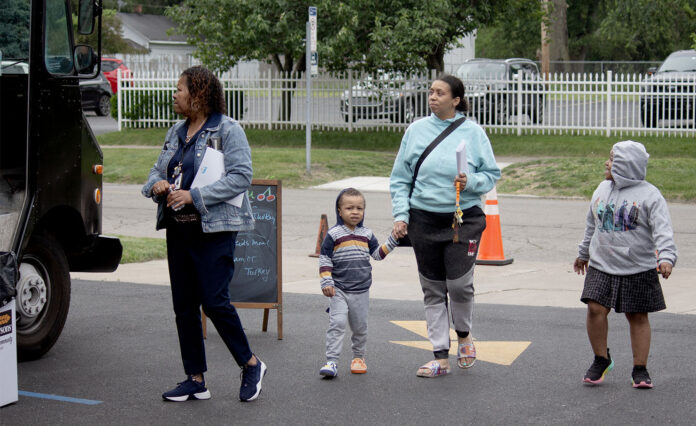
Arselia Ruiz walks with her children, Arryn Sleet, 4, and Alesanpra Nixon, 7, to get their their lead test at an event hosted by Indiana Ave. Missionary Baptist Church in Toledo. (TFP Photo/Barrett Dorner)

TOLEDO – In a mobile clinic in a church parking lot, registered nurse Gloria Smith prepped Vibe Carswell, 7, for a finger-poke lead check.

“At any given time, there are 3,400 children with lead poisoning in Lucas County,” she said, stressing each syllable of the statistic. “That’s crazy.”

Smith is the lead case manager for the Toledo Lucas County Health Department. Of the health department’s three lead caseworkers, she is the one whose sole focus is on children who test positive.

Vibe Carswell, 7, watches as Gloria Smith, of the Toledo-Lucas County Health Department, uses a “magic straw” to draw blood for a lead test. (TFP Photo/Barrett Dorner)

“My goal is to educate the parents, to help them to get those levels down as quickly as possible,” Smith said.

One child at a time, Smith works to find those who are already poisoned. When they are, the environment is prime suspect.

“About 98 percent of our cases are due to old housing stock,” she said.

One at a time, certain houses are supposed to be checked and certified by the City of Toledo. Now, for the first time in years, the city has the legal authority to hold owners to that.

On paper, the city’s lead ordinance has been in effect since 2020, but a lawsuit put enforcement on hold in 2022. After two courts heard the case and sided with the city, the Ohio Supreme Court refused to hear an additional appeal earlier this year. That left the lower court’s ruling in place.

So, the deadlines now have teeth – misdemeanor charges and fines – with the end of this year marking the cutoff for owners to register buildings in certain parts of the city.

(TFP Photo/Barrett Dorner)

For any building older than 1978 – the ones most likely to have lead-based paint – rental properties with up to four tenants and daycares are required to be inspected. When they pass, they are issued a certificate that any prospective renters can look up.

That peace of mind is something Arselia Ruiz of Toledo wishes for. She rents a home in that risky category. It has not been inspected, and her kids are sneaky.

“They’re future assassins,” she said of Arryn, 4, and Alesanpra, 7. She also has a one-year-old. 

“I have to watch my kids like a hawk,” she said. “I’m worried they’ll get a hold of it,” from peeling or chipping paint when she is not looking.

Ruiz brought the older two for tests at the same event, hosted by the Indiana Ave. Missionary Baptist Church, last month. They already get tests at annual pediatrician appointments, but until her house is checked – that’s not enough.

Kids enjoy a bounce house at a lead testing event hosted by Indiana Ave. Missionary Baptist Church in Toledo. (TFP Photo/Barrett Dorner)

Lead inspectors agree with the health department – concerns like hers are valid. In the little over two years as an inspector, Tiffany Brown said she has met families whose children were poisoned.

“More than I ever expected,” she said.

A friend she met in the lead inspector training experienced it first-hand. Lead dust made it into the vents during a renovation, and several members of the family had dangerous levels in their blood, she said. When the house was closed up for winter, their symptoms were worse; that helped track down the cause.

But “there are hardly any [specific] symptoms, so you wouldn’t know unless you’re looking,” Brown said.

And there may not be any at all, according to the Environmental Protection Agency. Children under six years old are most at risk, and any symptoms that do appear can range from fatigue to learning and behavior problems.

In addition to being a lead inspector, Walden Wilson is also a landlord. He understood the concerns about the ordinance from that perspective, but the chance to prevent lead-related illness needed immediate attention. He is relieved the legal roadblocks are out of the way.

“Because of the homes I’ve seen, I am glad they are doing it because there are some homes that I would not want to see people moving into knowing that it’s not safe,” Wilson said.

He expects his business to ramp up as enforcement kicks in.

“The property owners for the most part have been very diligent as far as ‘what do I need to do to handle it? What do I need to take care of?’” he said. There are some who do not have that same attitude, at least at first.

“When they get the reality – ‘You’ve got lead on your property – that’s when they wake up,” he said.

Ruiz wants to move somewhere newer, or at least certified. But financially, it is impossible for her right now.

“I’m going on a needle and thread,” she said before listing the cost of her most recent grocery trip. “So I’m taking that risk with that apartment.”

Her situation is a familiar situation for many residents of the Central Toledo neighborhood that’s within walking distance of the church’s event.

There, and across the community, “African Americans and the Latino community” are falling through the cracks in lead prevention and detection, associate preacher C. Jerome Graham said. 

Access and awareness were two main reasons he and the leadership put on the lead-testing event. With inflatables, a food truck and family-oriented vendors – they wanted it to feel more like an adventure as opposed to a trip to the doctor’s office.

“If you make it fun, they will come,” he said.

When they turned the corner into the parking lot, Arryn and Alesanpra rushed right over to the bounce house. It gave their mom a break from shouting at them to ‘stay close’ and to ‘get away from the street’ before their tests.

“My kids doing this – it’s important to me,” Ruiz said.

“I think everybody should do it, because there’s people out here whose kids could have a condition or illness and the whole time it’s because they’ve got lead in their system.”

Inside the mobile clinic, Nurse Gloria wrapped up the test but let young Vibe call the shots.

“You see the black line?” Smith asked. “When your blood gets to the black line, say ‘All done now!’ okay?”

When she shouted she was done, Vibe walked away with half-a-dozen stickers and kudos from the lead expert.

“Girl, you are good! You’re so brave. High five!”

Lead Resources:

For Lead Screening & Prevention in Lucas County – or call the Toledo Lucas County Health Department at 419-213-2013

For Toledo residents

Outside Toledo or Lucas County: Contact your county health department or your primary care provider.

For Toledo property owners


Toledo Day Nursery strives for affordability

0
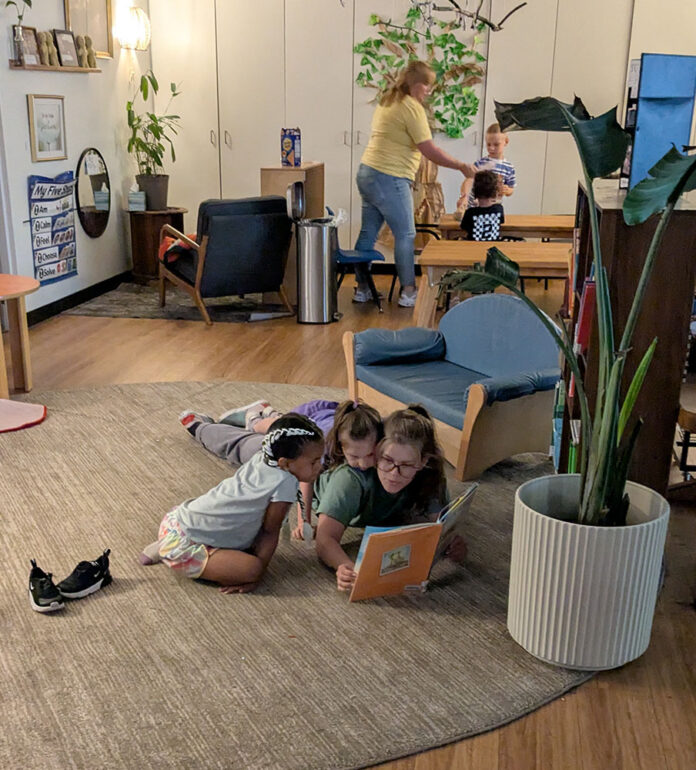
Miss Riley reads to Margaret, 4, and Baylor. (TFP Photo/Mary Helen DeLisle)

TOLEDO – Nelson Mandela once said, “History will judge us by the difference we make in the everyday lives of children.”

For most American parents, childcare is necessary for everyday life and many struggle to afford it. According to Policy Matters Ohio, the average annual cost of childcare for one infant in Ohio is $10,417.

The Toledo Day Nursery (TDN) is changing this narrative by creating initiatives that make childcare more affordable and accessible for Toledo families.

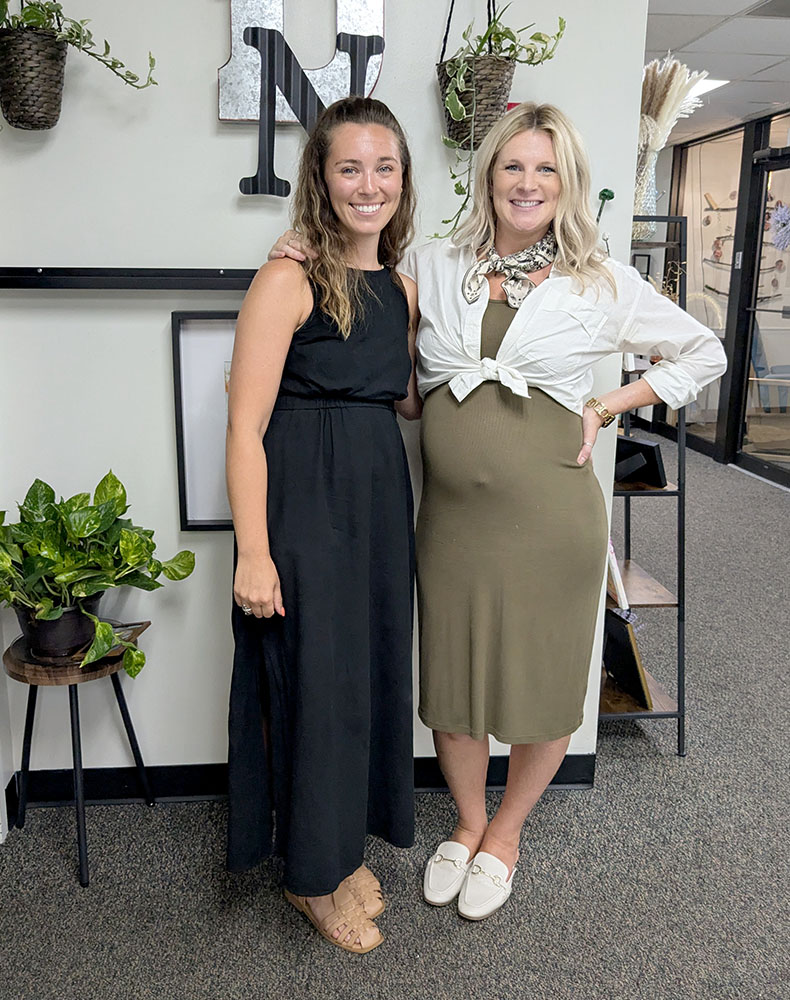
Julia Myers, left, and Chelsea Davis. (TFP Photo/Mary Helen DeLisle)

“Any family that goes on maternity leave or even medical leave does not have to pay any tuition during that time,” said Julia Myers, director of the TDN Jefferson Ave. location.

During November and December, she said no family at either the Stickney or Jefferson avenue locations paid tuition. 

“It’s a really hard time to be a parent. It’s the most beautiful time; you’ve got all these wonderful holidays, you get to spend all this time with your family, but things are very expensive,” Myers said. “We wanted parents to feel a sense of relief when it came to the holiday season.”

Chelsea Davis, director of the TDN Stickney Ave. location, added that this tuition-free initiative would not have been possible without the help of the Bainum Family Foundation, which selected TDN to be a WeVision EarlyEd Solutions Lab site.

“The hope is that by gathering enough data, we’ll be able to push policy on a national level to make childcare affordable, not just for the places that are part of this WeVision initiative, but across the entire nation,” Davis said. 

While Bainum is based in Washington, D.C., it has 22 lab sites spread throughout the U.S. 

“They [Bainum] trust and refer to the directors and the trusted caregivers as proximity experts. And through that, they’ve given their proximity experts full autonomy to decide how they’re going to meet deliverables,” Davis said. 

Marica Cox Mitchell, chief program officer at the Bainum Family Foundation, emphasized that each of the lab sites is unique.

Cox Mitchell explained that variety between test sites helps each one minister to the unique needs of the communities they serve, and this diversity helps Bainum gather data on effective childcare methodologies.

TDN was selected because it excels as a childcare facility, not only in Ohio, but also in the country at large. From affiliations with Toledo Public Schools and Hope Toledo to becoming and dissolving a charter school, TDN has been a long-standing community resource. 

Julia Myers watches children eat lunch at the Toledo Day Nursery (Jefferson Ave.). (TFP Photo/Mary Helen DeLisle)

“We’ve had so many different hats we’ve worn, but the mission has always been to positively impact children’s lives. I think the beauty of our 100 and almost 55 years is that our mission has always remained the same,” Myers said. 

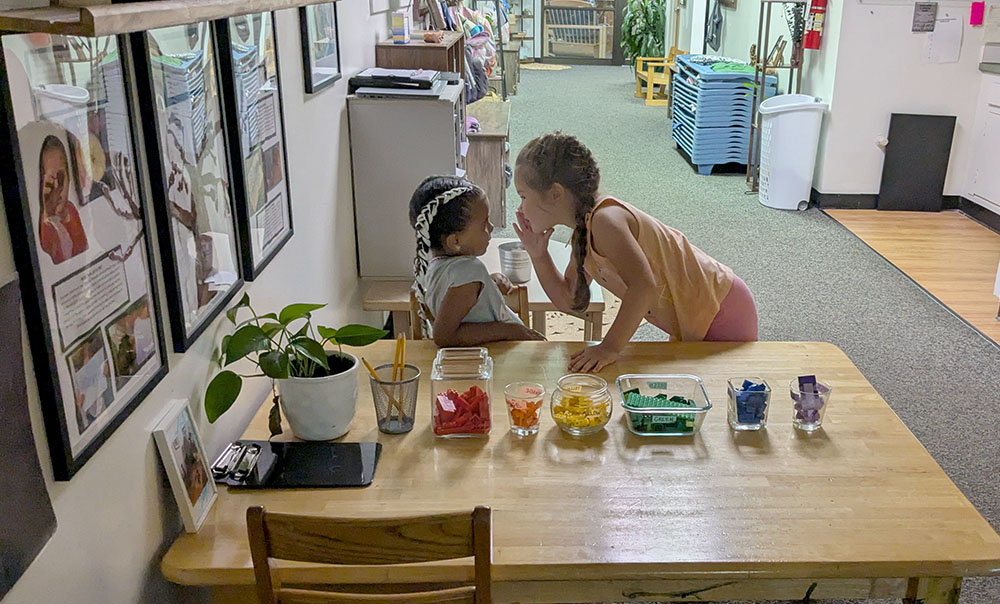
While TDN uses a state-based curriculum, it also has its own adaptive methodologies to implement in the classrooms, such as Montessori toys and conscious discipline strategies. 

“Each of our classrooms have an extra staff person in there, which gives more intentionality,” Davis said. “You’re actually hearing the things they [the kids] are wanting to do, what they’re interested in. It also gives space to plan and think outside the box.”

To foster better learning, Myers and Davis have also added their own personal touches to the center.

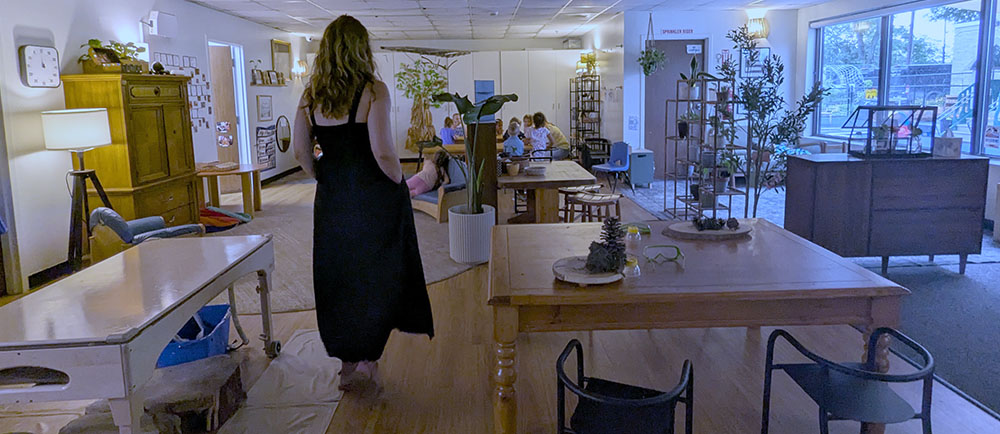
“Julie and I have vision. Aesthetically, when you walk into our buildings, you know you’re going to feel a certain way. That’s very intentional,” Davis said. “We’re very purposeful with the things that we do, but we also adapt different philosophies depending on what different classrooms may need.” 

TDN also concentrates on the well-being of its teachers, following a trickle-down philosophy that if the teachers are well-served, the children will be, as well. TDN teachers receive free tuition for their children and are invited to team outings that help teachers prosper.

“I truly believe we’re putting the teachers’ mental health first,” Myers said. 

Founded in 1871, TDN continues to evolve with the times in order to keep serving the Toledo community.

Photos by Mary Helen DeLisle

Photos by Mary Helen DeLisle

Baylor, 5, left, and Aria play.

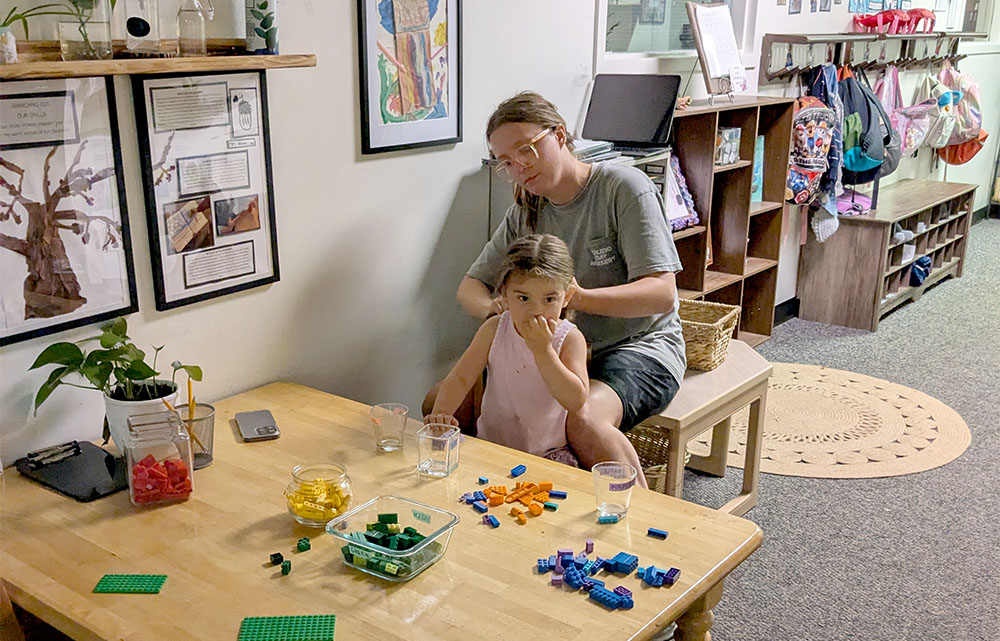
Miss Abbie braids Gwen’s hair.

Hudson (left), 4, and Nathaniel (right), 3.

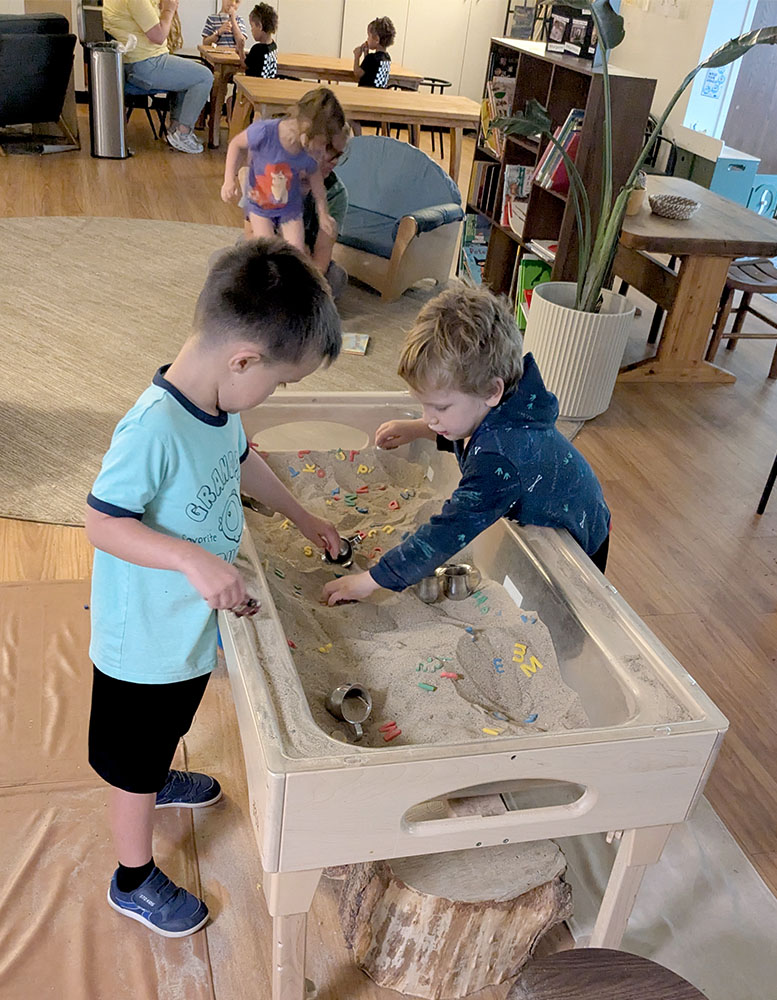
A play structure at TDN encourages exploration and creativity.

DeWine uses budget vetoes to help schools, libraries, Medicaid, newspapers

0
(Courtesy Photo/Ohio State House)
This story was originally published by Signal Statewide. Statewide is a nonprofit media partner of the Toledo Free Press.

By Andrew Tobias | Signal Statehouse

OHIO – Gov. Mike DeWine sided with public schools, libraries and local governments as he vetoed several high-profile items from the state budget on July 1.

DeWine also blocked a measure that would have potentially kicked babies off of the state’s Medicaid rolls by ending a DeWine-backed policy that ensured all newborn children deemed eligible for the program stay covered until they turn four years old.

The Republican governor announced the vetoes as he signed the two-year, $100 billion spending bill that funds basic state operations. The state legislature, where Republicans hold supermajorities in both the House and Senate, can override DeWine’s vetoes. Doing so requires support from 60 percent of the members in both chambers.

Republican legislative leaders issued statements Tuesday signaling they may try to overturn DeWine’s property tax related issues. Senate president Rob McColley and Sen. Jerry Cirino, a top Senate Republican, called DeWine’s moves “puzzling.”

“These are kitchen table issues that hardworking families understand, and the General Assembly needs to strongly consider acting on their behalf to implement these vital changes that would return the property tax system to its cost controlled guardrails as originally intended,” McColley and Cirino said.

The governor left untouched some high-profile legislative priorities tucked into the budget, including a tax cut for Ohio’s top 21 percent of earners and $600 million in state funding to help the Cleveland Browns build a new domed stadium in Brook Park.

DeWine explained his vetoes, which numbered 67 in total, in written messages that his office announced at 2:11 a.m. July 1. He and Lt. Gov. Jim Tressel also held an extended press conference at 10 a.m. Tuesday morning to go over the hundreds of fiscal and policy changes inside the 3,156-page final bill.

Property taxes related to school funding 

One major batch of DeWine vetoes reversed laws Republican state legislators passed that were meant to lower property taxes. These would have come at the expense of local governments, particularly public school districts, which get the bulk of their funding from local property tax levies. Republican lawmakers touted the laws as giving relief to property owners who absorbed huge tax increases due to the historically large increase in property values that has occurred this decade.

The most sweeping veto nixed a new “carryover cap” provision that said school districts couldn’t accumulate cash reserves that exceeded 40 percent of their annual operating budget. School districts would have to return anything more than 40 percent to local property owners via automatic tax reductions. The measure was a top priority for Republicans. GOP lawmakers billed it as an immediate multi-billion-dollar tax cut –estimated to be worth in total as much as $2.17 billion. School district officials were designing plans to circumvent it by taking advantage of an exemption for money set aside in a special fund for building maintenance and construction projects.  

DeWine also killed measures that would have:

  • Eliminated “replacement” levies, a type of property tax levy that typically results in tax increases but is distinct from an “increase” levy
  • Tightened the conditions under which schools can receive larger funding increases tied to existing levies when property values rise, via a tweak to the state’s property tax formula
  • Allowed county budget commissions, a panel consisting of the county prosecutor, auditor and treasurer, to unilaterally reduce tax rates when they felt doing so was “reasonably necessary or prudent to avoid unnecessary, excessive, or unneeded property tax collections”

DeWine echoed arguments from local government officials, school officials and teachers’ unions while explaining these vetoes. 

He said the new carryover cap would lead schools to make more frequent levy requests, prompting “levy fatigue” from voters.

“While the intention to save taxpayer dollars is understandable, this item would significantly limit the amount of funding that school districts can carry over year-to-year, resulting in more districts asking taxpayers to pass levies more often, which could very well exacerbate property tax increases instead of reducing them,” DeWine wrote. 

DeWine said that he would form a commission of administration officials, school officials, lawmakers and property tax experts to study possible property tax reforms “to ensure this critical topic is given the attention deserved.” This would add to the years of study the issue has gotten from the legislature that following the governor’s vetoes, still has yet to result in any major reform.

“I’m not going to go through each one of them, but I think that, collectively, they create a problem for the schools,” he told reporters.

The governor chopped a couple more education-related provisions from the budget. One would have required candidates for local school boards to run as Republicans or Democrats or with another political party label. He said doing so would discourage candidates who didn’t want to publicly identify with a party. 

He also vetoed a provision that would set aside $35.1 million for parents to help pay to send their children to attend religious private schools not affiliated with charter or public schools.

There’s “no accountability” for these dollars under the proposal, DeWine said when asked about the veto, as opposed to public or charter schools.

DeWine wants library adult-related material left alone

In addition, DeWine gave a win to public libraries by vetoing budget language that would have required libraries to place “material related to sexual orientation or gender identity or expression” in a special, cordoned-off section that’s not “primarily open to the view of minors.”

Libraries had urged the governor to veto the provision. They called it a form of censorship that would be expensive and potentially legally risky to implement.

The governor is a major library supporter who at times in his political career also has taken steps that were sympathetic to LGBTQ+ people. He wrote that the state’s existing obscenity laws were adequate to protect children.

“I think as parents or grandparents, no one wants their child to have a book or something that is inappropriate or obscene,” he said. “But I just felt that the language simply just did not work.”

DeWine vetoed a anti-trasngender measure dealing with children. He nixed language that would have forbidden homeless shelters from “promoting or affirming” transgender minors’ gender identities. DeWine said the provision would have limited shelters’ ability to get needy children off the streets. 

“We want homeless shelters to be open for everyone that’s coming in,” he said during his press conference Tuesday morning.

The governor kept other anti-transgender language in the budget, though, such as a measure that declared it official state policy to recognize the traditional male and female gender binary. He also left alone a measure that forbids medical providers from billing Medicaid for mental health care that affirms transgender people’s gender identities. 

Medicaid-eligible babies

One of DeWine’s vetoes preserved a measure passed in the last state budget bill two years ago. It automatically keeps children – ages three and younger already enrolled in Medicaid – covered until their fourth birthday. Medicaid is the health insurance program for the poor and disabled run by the state and federal government, and state officials currently perform annual eligibility checks on all recipients that can lead to disenrollments.

Lawmakers had decided to end “continuous enrollment” as part of a larger push to reduce the massive program’s costs. Children’s advocates sharply criticized the change, since it would have caused some babies and young mothers to lose health care coverage if families failed to comply with paperwork requirements.

In his veto message, DeWine said continuous enrollment reduces the state’s administrative burden and called it a “pro-life” policy.

“Access to needed healthcare for babies and young children is critical to early childhood development, and continuous health insurance coverage will help ensure children receive preventative care, ongoing care for chronic conditions, and hospitalization or emergency care,” he said. 

Data centers keep tax break

For about a decade, Ohio has given data centers owned by technology-sector players sales tax breaks worth hundreds of millions of dollars. The public subsidization came despite low employment at the facilities after construction and despite their enormous demand for electricity, which is on track to outpace supply.

The Senate proposed ending the tax break outright on new builds. Legislative analysts estimated this would mean $20 million in new taxes from the owners, although the figure doesn’t track with the estimated $127 million the tax break costs Ohio this year. 

DeWine said Ohio’s tax structure has been key to attracting tech and artificial intelligence companies to the state. 

Speaking to reporters, he said the data centers, even when they’re not major employers, attract other businesses here. Plus, he said data center businesses pay “significant” property tax dollars that support local schools. He didn’t mention, however, a common practice of local governments that lessens the money districts gain. That happens when local governments offer 75 percent to 100 percent tax abatements to such facilities lasting between 10 and 30 years.

“If we want Ohio to move forward, we have to move with history,” he said. “We cannot be behind history, we have to be with … the flow. And the flow is that data centers are important, and they’re important to our future.”

Newspapers keep a tax break

Along with the data centers, the budget would have hiked taxes on newspaper subscriptions and inputs used to create ad inserts. 

Lawmakers framed it as ending a longstanding tax break to make a fairer tax code and help pay for an income tax cut for the wealthy within the budget. However, the proposal came amid a broader political environment in which the right regularly attacks the press and congressional Republicans are seeking to defund public media. 

DeWine called the tax hike unnecessary and said it will “reduce civil discourse” in the state. 

“Newspapers serve a critical role in our society to inform the public about important issues, allow for civic engagement and discourse, and help bolster local communities,” he said. 

Stopping raids on account interest

To help pay for income tax cuts, lawmakers executed a macro-level hunt for stray coins lost in the couch cushions. This included transfers from certain accounts set for special purposes into the state’s general fund and sweeps of interest in certain accounts into the general fund. 

Of the cash transfers, DeWine blocked: 

  • $2.5 million per fiscal year from the Information Technology Fund
  • $20 million from the Pre-Securitization Tobacco Payments Fund 
  • $5 million per fiscal year from the Human Services Project Fund 

He also stopped lawmakers from sweeping interest on principal into the general fund from several accounts. Most of the accounts are known only to bureaucrats but help pay for things like erecting state buildings, Ohio’s tobacco-quit hotline, schools, brownfield remediation and health care.  

Signal Statewide is a nonprofit news organization covering government, education, health, economy and public safety. Sign up for Statewide's free newsletter.