How the wide-ranging radar business got off the ground
TOLEDO – Starting his own business wasn’t even on Matt Aston’s radar, but happenstance led him to found a company providing a needed service through, well, radar.
That was almost 25 years ago. Today, Ground Penetrating Radar Systems has annual revenue of $220 million, employs 900 people in 60 cities nationwide and remains true to its roots by continuing to be headquartered in the Toledo area.
GPRS also is true to its name: Its ground-penetrating radar shows where utility lines and other infrastructure is, so a client knows where to cut through concrete or dig to avoid costly peripheral damage.
Aston’s company has grown not only in scope, but also in technology services, leading to its latest offering about which he’s “bullish” for GPRS’s future.
It all started with a chance spotting of an ad in a trade magazine.
Toledo native Aston graduated from Toledo Christian Schools, enrolled at Hillsdale College, and later transferred to the University of Toledo, earning a finance degree. He began with a major Toledo-area auto parts company, but found the corporate world unappealing.
Thinking about starting his own company, he spoke with his father, Skip Aston, owner of Ohio Concrete Sawing and Drilling. “He encouraged me to go on my own,” Matt Aston said. But into what business?
Aston’s father gave him a trade magazine, in which the young Aston came upon an advertisement by a ground-penetrating radar company touting its services in finding electrical conduits before sawing through a concrete floor.
“I knew from helping my dad with jobs that this was a recurring problem,” he said, which led to chaos on the job site.
Thus, in the fall of 2001, GPRS was born.

“It was a really, really slow start,” Aston said. “People often associated ground-penetrating radar with searching for buried treasure, not to assist with safety in a construction application.” He visited job sites, contractors, and engineers explaining how this technology can benefit them, with little luck.
Aston switched his focus to Detroit, which offered more opportunities. Then in the growing darkness of Dec. 23, 2001, on his way back to Toledo, he took a chance by driving onto an open construction site at Detroit Metropolitan Wayne County Airport. There he made his pitch to the site manager, who was tasked with a major project that would benefit from knowing where to drill.
“He said, ‘If you can do what you say you can do, we’ll keep you busy for a long time.’”
After the first of the new year, Aston gave demonstrations, was hired, and was busy for eight months. “That was my first big break,” he said.
Since then, GPRS has grown into the size and scope it is today. “We’ve grown into being the largest provider of these services in the world,” he said.
“Ninety-nine percent of our work is geared to facilities and construction sites. We work in hospitals, university campuses, manufacturing and entertainment venues,” he said. “We can give them an accurate picture of what’s underground and improve safety and knowledge for planning.”
He added, “Occasionally, we get that unique call for an application out of the ordinary. We’ve worked with historical societies, and we’ve assisted police looking for homicide victims.”
Aston said, “We’ve worked on high-profile sites – almost every stadium, the White House, Pentagon, Freedom Tower, Philadelphia Mint, Disney properties.
“We do 12,000 jobs a month. Sometimes we’re on site for a few hours, some jobs for months at a time.”
In the company’s nearly 25 years, “the principles behind the technology have not changed. What has changed is data collection. More significant is how we’ve integrated other technologies.”
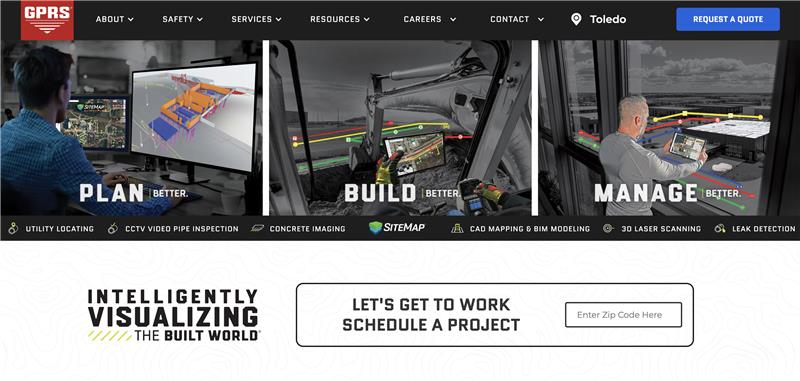
Aston said his company offers four services: ground-penetrating radar, laser scanning, cameras run through pipes to assess conditions, and leak detection. “Water infrastructure is pretty old. A lot of domestic water lines have leaks. We can map them and narrow down where the leak is coming from.”
Those four services are combined into his company’s latest feature, Sitemap. “It’s a delivery system for our data.” He said a client can “pull out Sitemap and see where all the utilities are, where we found water leaks, see what the inside of their sewers look like, all in one place at their fingertips. We’re very bullish on Sitemap.”
Reflecting, Aston said, “We’ve been blessed. I did not have a vision of this when I started. I believe that as you grow, your potential grows as well.”