Fifth-grader Addy Anderson jumps in excitement next to her Fallen Timbers Middle School teacher, Emma Rees, during a house reveal party. (TFP photo by Karen Gerhardinger)
Finding fun in the “house” rules
WHITEHOUSE – Bursting through a tunnel of balloons and streamers, Kelen Rouser yelled in excitement as members of his house rushed forward to greet him.
Kelen was one of more than 672 Fallen Timbers Middle School students gathered on the football field at Anthony Wayne High School on August 22 for a “house reveal” party that included upbeat music, cheering crowds and an announcer in the press box.
“This is a way to welcome fifth-graders, to cheer them on and tell them how fun it is here,” said sixth-grader Cora Komisarek.
Fifth-grader Kelen Rouser runs through a tunnel to meet members of his house during an August 22 “house reveal” party for Fallen Timbers Middle School students. (TFP photo by Karen Gerhardinger)
Each year, hundreds of students from Monclova, Waterville and Whitehouse converge for the first time at Fallen Timbers Middle School (FTMS). The move can be a little daunting, but the Harry Potter-like house system introduced last year by PrincipalMatt Smith has made that transition easier.
Students in both grades are placed into one of four houses – Fettari, Tigalo, Modero and Setega – that each have their own characteristics, color and symbol. As a team, each house works to earn points while displaying the school’s seven behavior expectations, including listening; utilizing excellent conversation skills; using manners; working hard; supporting, respecting and encouraging others; being honest and taking responsibility; and taking pride in the school and themselves.
Sixth-grader Peyton Altenburger saw a lot of benefits to the house system last year, and noted that she especially liked the games and competitions between houses.
“It think it brought a lot of teamwork and working together,” Peyton said.
Smith and Assistant Principal Leigh Pancoast both previously were principals at Swanton Middle School, where they saw the house system’s impact on the learning environment.
“It creates a sense of community and belonging across grade levels. It helps break down barriers between classrooms and grade levels, and we see students taking pride in something bigger than themselves,” Pancoast said, adding that she saw other long-term impacts while using the system in Swanton.
“Over time, we saw students encouraging each other to make good choices, not just for personal benefit, but because it impacted their whole house. That kind of peer accountability is powerful and often more effective than adult reminders.”
Aria Rashleigh runs through a crowd of welcoming Modero house members. (TFP photo by Karen Gerhardinger)
Having the 330 fifth graders mixed into teams with the 342 sixth-graders helps the younger students learn the FTMS culture and expectations while giving older students opportunities for leadership, Smith said.
“We teach the fifth-graders what we do in the house, and have team meetings and competitions,” explained sixth-grader Tate Conner.
Each day, students can earn points for the house through positive behavior, and each week houses have competitions and games, such as relay races, trivia games, dodgeball and scavenger hunts.
“Activities that require teamwork and allow different strengths to shine tend to be the most popular. They also really enjoy earning surprise points through acts of kindness or school spirit,” Pancoast said.
The excitement is palpable not just among the students, but for the teachers and staff as well, Smith said. The house system gives teachers a chance to connect with students outside their classroom and grade level, and collaborate with other staff members to plan house events.
“I think it helps them with classroom expectations and can also motivate students through healthy competition throughout the year,” Smith said.
Tigalo house members (from left) Addison Mayer, Stella Roberts, Kateri Doyle, Eloise Wohlfarth, Ava Kusner and Cora Komisarek prepare to greet fifth graders. (TFP photo by Karen Gerhardinger)
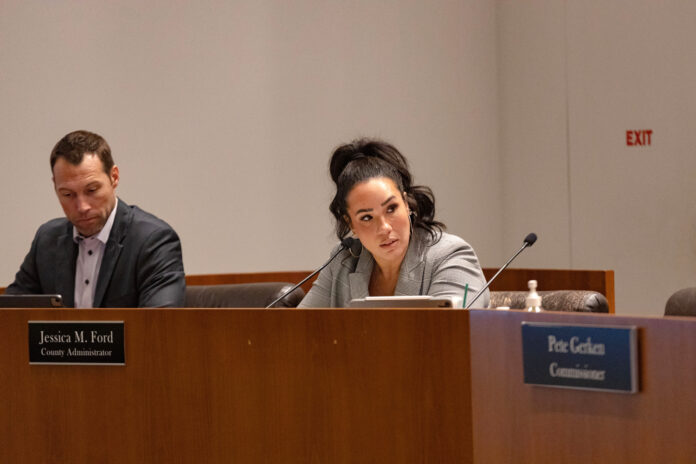
Jessica Ford, the county administrator, speaks during the Lucas County Commissioners’ Regular Meeting in the Commissioners’ Hearing Room on the first floor of 1 Government Center in Toledo, Ohio on Wednesday, Aug. 27, 2025. (TFP photo by Stephen Zenner)
TOLEDO – Both Lucas County Commissioners meetings on Wednesday went by quickly.
The 11 a.m. meeting contained the bulk of approvals and resolutions for the commissioners to consider. Lisa Sobecki and Anita Lopez were the only Lucas County Commissioners present for the meetings, but did not disagree on the business of the day.
Lily Varwig, a fourth grader at Escuela SMART Academy, led the pledge of a allegiance via a pre-recorded message before beginning the routines of the day.
Lily Varwig leads Commissioners meeting in pledge of allegiance during the Lucas County Commissioners meeting. (TFP Photo by Stephen Zenner)
“I will have to shamelessly mention that her grandmother is my assistant and in the commissioner’s office: Christine Varwig,” Sobecki said before calling the roll.
Item one on the agenda, “Reappointment of the Lucas County Public Defender Commission” was tabled by Lopez. The extension of the University Park Trail, Item Two, had its funding authorized in 2022, and Benjamin Pushka, the sustainability coordinator for Lucas County, said the only thing left was administrative approval, which was granted.
Item Three was a petition by the Sheriff’s department to apply for the FY2024 Edward Byrne Memorial Justice Assistance Grant, which was allowed.
“On behalf of the Lucas County adult Treatment Court program, I’m requesting your approval and accepting a grant from the Bureau of Justice Assistance in the amount of $678 with a cash match of $256,” Judge Ian English.
“This grant addresses two specific areas. Number one: the grant will fund home based therapists for our participants and their family,” he said. “In addition, the grant provides for peer support specialists through a certified UDL mental health condition service support; they will serve as mentors, role models and advocates, offering help and support and guidance.”
In the same vein, the next two items were from Juvenile Court and dealt with approving agreements for re-entry support services and services at the Community Treatment Center.
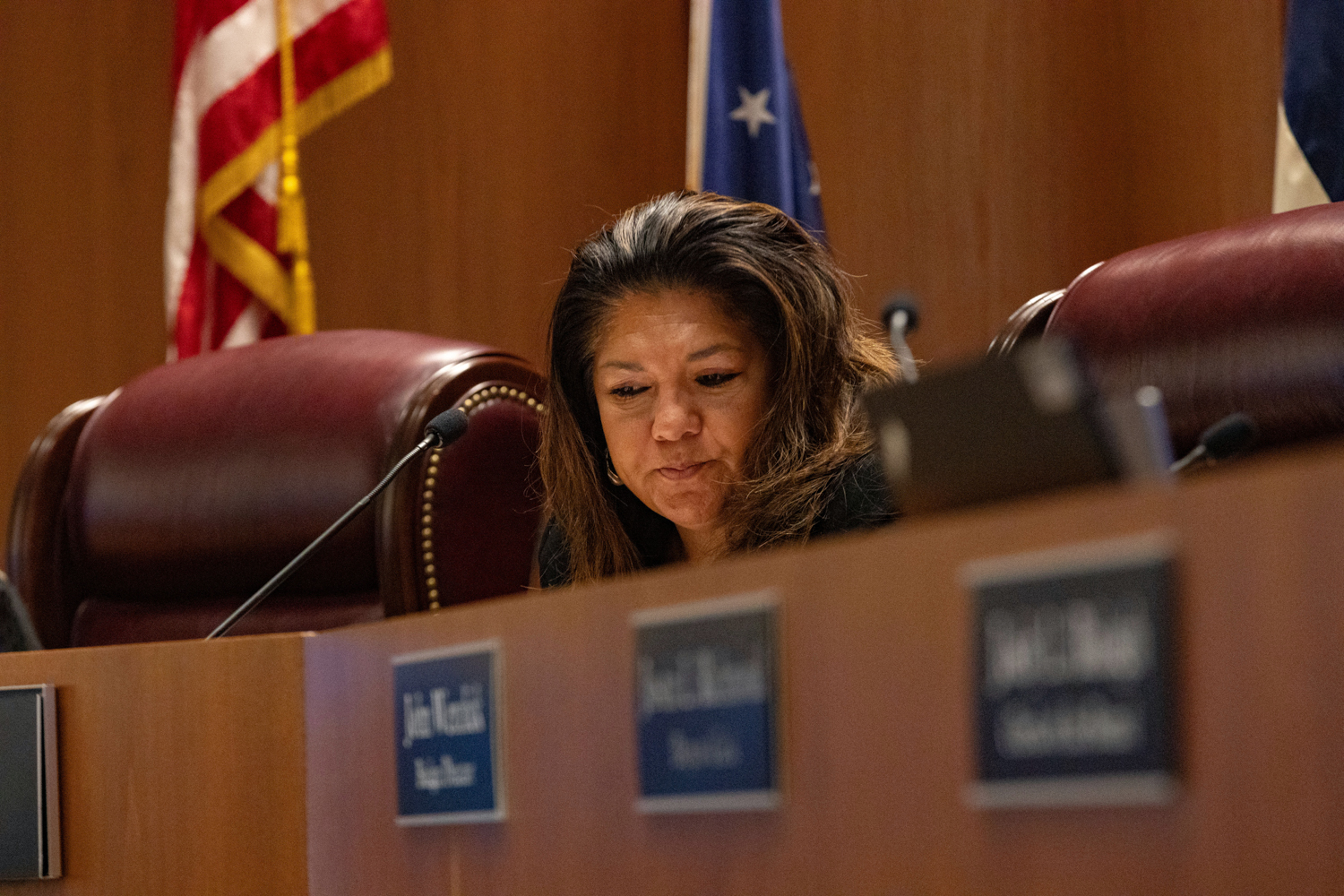
John Wenzlick, the budget director for Lucas County, introduces budget items. (TFP photos by Stephen Zenner)
4,677 square feet was approved for use by the Lucas County Coroner’s Office. Jeff Nowak, director of facilities, informed commissioners that 2595 Arlington Avenue, home to the coroner’s office, no longer housed the Lucas County Veterans Commission, so that space could be given to the Coroner’s.
“The coroner has asked for this space to improve their working conditions, maintain accreditation for their lab and increase operational efficiency, as well as complying to all standards,” Nowak said.
An amendment to the Capital Improvement Plan approved $424,882 for four projects: architectural engineering services for the jail roof replacement, architectural and engineering services for concrete repairs and mitigation of water intrusion on the jail, a heating and cooling rooftop unit on the EMS building at 2144 Monroe Street and engineering and replacement installation of the water service back flow at the fairgrounds.
Commissioner Sobecki was asked about the continued investment in the current jail, to which she said, “I don’t want to speculate until we get these dollars in, and then, amongst my colleagues, we can have a discussion about what that looks like.” In the meantime, the mitigation of water and new roof seemed to be imminent, fixes the commissioners were looking to implement once more information becomes available.
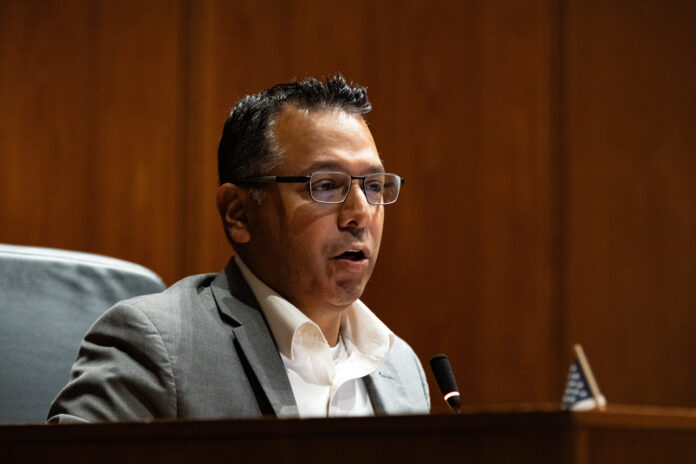
Anita Lopez, Lucas County Commissioner, hesitates before approving a work change order. (TFP photo by Stephen Zenner)
Lopez took issue with System Solutions items 11 and 12, which included a request for a change order and a contract amendment with Oracle for Human Capital Management and Recruiting.
“So Oracle actually has the audacity to try to get $1,262 from us for a few more hours,” Lopez said of the agenda items when presented. When asked about her reaction and her apparent hesitation to approve the request (she paused for a few moments before approving), she said, “I always have a concern with change orders, because change orders mean either we didn’t identify something we needed when we first implemented or we did not have maybe personnel who understood our needs.
“A lot of the customization requests need to happen while it’s being implemented. And so, if you don’t have individuals communicating what we truly need, then it gets more expensive along the way.
“$1,200 is very few hours…I can’t believe that they could not have accepted in the original contract, so it’s basically a forecast to me that, if they’re willing to bill for any little minor change, this is going to be a foreseeable cost.”
Resolutions brought forth by the Office of Management & Budget that were tabled from the last meeting passed, including item 15, providing for the issuance and sale of $37,455,000 of Lucas County bonds. These bonds provide a majority investment in the Hilton Garden Inn, connected to the Glass City Center, in downtown.
Sobecki argued for the renewal of the bond on Wednesday, and said they were just continuing to roll over the money from the last year, as they had done before.
“These are vital pieces of any big city or any city,” the hotel, Sobecki said, is important for people outside of Toledo to come, enjoy Toledo and choose to invest or come back to the city.
“You would have motels, hotels downtown, so that you attract people. They want to come into your town, they want to have a place to stay and have the experience,” she said.
The 11 a.m. meeting ended with the commissioners moving into an executive session, and then coming out of executive session at the beginning of the next meeting at 2 p.m.
The county hired one Specialist Two position at the Department of Job and Family Services at $19.50 per hour, an Elderly Specialist One position at the Department of Job and Family Services at $70.79 per hour, four Account Clerk Specialist positions at the Child Support Enforcement Agency at $18.16 per hour and Human Resource Project Manager at $34.36 per hour.
The second meeting began and then was over briefly with approval of items brought by the county and sanitary engineers.
Isaac Vacheresse, Maumee, a coach for Toledo Pickle Co., plays a game of pickleball at Toledo Pickle Co. in the Vistula neighborhood in Toledo, Ohio on Tuesday, Aug. 26, 2025. (TFP photo by Stephen Zenner)
Toledo Pickle Co. on Water St. offers more than pickleball courts
TOLEDO – A field house worth of socializing space opened up earlier this year at 1030 Water St., the new location of Toledo Pickle Co.
“I never wanted to pay to play pickleball,” said Kalen DeCant, of Sylvania, as she played a game of pickleball with her husband and two friends. “And we came to the opening and said, ‘Damnit, this place is nice.’”
Kalen DeCant, Sylvania, plays pickleball at Toledo Pickle Co. in the Vistula neighborhood in Toledo, Ohio on Tuesday August 26, 2025. DeCant once said she’d never pay to play pickleball, but said she was persuaded by the air conditioning, food and quality of the courts at Pickle Toledo. (TFP photo by Stephen Zenner)
In the middle of a live renovation of the waterfront spearheaded by Metroparks Toledo’s riverwalk project, an old building owned by the Metroparks has been given new life by tenants who wanted an indoor pickleball location in Toledo.
“The idea was to be a family entertainment center with a heavy lean on pickleball,” said Kimberly Sheldon, the director of marketing, membership and events for Toledo Pickle Co.
By “heavy lean on pickleball,” Sheldon means the old warehouse building, now completely renovated, is home to 10 indoor pickleball courts and two outdoor pickleball courts.
Before the business opened, the building “stored salt trucks and snowplows,” Sheldon said.
But the other half of the large hanger-like building has been turned into a restaurant, bar, and arcade.
What won DeCant over to Toledo Pickle Co. was the air conditioning, the good food, the well-maintained courts and the friendly staff.
Ping pong, shuffleboard and a small rock climbing wall make up some of the free group activities for those who don’t want to pay the $20 hourly (per person) charge for a court.
Bassel George, Sylvania, plays pickleball at Toledo Pickle Co. in the Vistula neighborhood in Toledo, Ohio on Tuesday August 26, 2025. (TFP photo by Stephen Zenner)
DeCant and her friends all have platinum memberships because they stop by every day. Garyck Hahn of Oregon, Ohio was in a match with DeCant. He said their group used to bounce around to different areas for pickleball, but “this is home now.”
The other activities are arranged around the championship pickleball court, where people sitting in the mezzanine of Toledo Pickle can watch finalists compete.
“You can come for the pickleball, or you can come for the party,” Sheldon said, emphasizing the multiple uses of the large spacious area on the waterfront decorated with multiple murals by local artist Dean Davis.
On tap are beers from local brewers like Earnest Brew Works, Maumee Bay Brewing, Inside the Five Brewing Company and Juniper Brewing that complement a variety of Midwestern entrees.
Live music is scheduled every Tuesday, Wednesday, Friday and Saturday, 6 – 9 p.m., with trivia on Mondays and karaoke on Thursdays.
With this variety of activities, Toledo Pickle hopes to become a communal location for downtown Toledo, while still holding space for diehard pickleball players.
Brian Macionsky, athletic director at Toledo Pickle Co., behind the front desk at Toledo Pickle Company in the Vistula neighborhood in Toledo, Ohio on Tuesday August 26, 2025. (TFP photo by Stephen Zenner)
“I only know the pickleball side,” said Brian Macionsky, Toledo Pickle Co. athletic director. “I started reading about Toledo Pickle, and thought, ‘Man, I need to be involved.’”
A pickleball fanatic since retirement, Macionsky meets players where they are, and offers training ranging from beginner clinics and one-on-ones to playing against a pro.
“Whether they’re seasoned players or brand new to pickleball, we’re trying to find something that fits everybody,” he said. “You could always play outdoors when the weather is nice; the problem was when the weather wasn’t nice.
“Once you get the bug to play pickleball, it doesn’t go away…You can play on a gym floor, you can play in a church, you can do other things. It’s not like playing at Toledo pickle,” he said.
And Sheldon mentioned the courts were made with Pro-Cushion, a material that is better on joints than other courts.
“This is state-of-the-art, the best courts, and we have now a lot of the best games right in this facility,” Macionsky said.
Toledo Pickle Co. is open 8 a.m.-10 p.m., Monday-Thursday; 8 a.m.-11 p.m. Friday-Saturday and 8 a.m.-9 p.m. on Sunday. The restaurant is open every day from 11 a.m. until the facility closes.
Photos & video by Stephen Zenner
Garyck Hahn and Lauren Duncan, Northwood, play a game of pickleball against Kalen and Tim DeCant in the Championship Court.Jenah Sayed, Monclova, hits a pickleball towards coaches Leslie Gill, Sylvania, and Isaac Vacheresse.Kimberly Sheldon, director of marketing, membership & events at Toledo Pickle Co. (TFP photo by Stephen Zenner)Sammy DeSelms, the executive chef for Toledo Pickle Co., in the kitchen of the restaurant at Toledo Pickle Company.Brian Macionsky, athletic director at Toledo Pickle Co.
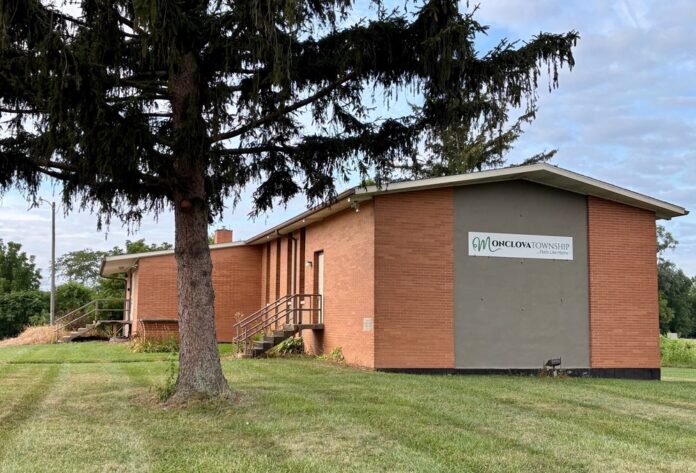
The former Hosanna Lutheran Church at 8353 Monclova Rd. was purchased by the township in early 2024. Monclova Township trustees are recommending that the United State Postal Service move its operation to the 4,794-square-foot facility. (TFP photo by Karen Gerhardinger)
Monclova seeks post office relocation, while Whitehouse begins park improvements
Monclova Township, with help from U.S. Rep. Marcy Kaptur (D-Toledo), is lobbying for the relocation of its post office from 7959 Monclova Rd. to township-owned property at 8353 Monclova Rd.
The village of Whitehouse has several park improvement slated for this fall, including the replacement of the entryway sign to Whitehouse Park.
And the Waterville Township Zoning Commission recommends adding language to its zoning book to allow data centers in agriculturally-zoned areas, with the addition of a conditional use permit. You can read more about this issue from an earlier TFP story here.
These are just a few of the news items coming out of meetings from the past few weeks in the Anthony Wayne area.
The Monclova Post Office at 7959 Monclova Rd. is just 1,160 square feet with no space to grow. Township trustees are asking the United States Postal Service to move the Monclova Post Office to a new location. (TFP photo by Karen Gerhardinger)
Monclova
Kaptur sent a letter to acting Postmaster General Doug Tulino on July 15, asking him to consider relocating Monclova Township’s post office from the 1,160-square-foot location at the southeast corner of Monclova and Waterville Monclova Road to a 4,794-square-foot former church that the township purchased in spring 2024.
The current post “lacks the infrastructure necessary to accommodate current demand,” Kaptur wrote, explaining that the lack of a drive-thru drop box, inadequate storage and restricted parking present service and safety issues. The current post office, constructed in 1961, will have traffic just 20 feet from its entrance after the construction of a roundabout at the corner of Waterville-Monclova and Monclova roads in 2026.
The township is ready to collaborate with the USPS on necessary modifications to serve the 15,000 residents, Kaptur said.
During the August 18 meeting, the trustees:
•Discussed Fire Chief Matt Homik‘s request to fill a vacant position with a firefighter/EMT unanimously recommended by all members of a hiring committee. Trustee Trudy Vicary voted no, stating a desire to hire a paramedic in order to fulfill the requirements of a three-year SAFER grant. Trustee Chuck Hoecherl voted in favor of the hire. Homik asked whether another voted could be held when trustee Barbara Lang is present to break the tie.
•Heard that the township’s Zoning Commission will review a request to rezone 8350 Stitt Rd. rear from Agricultural/Resident (A/R) to R-B Suburban Residential for developer Mark Rich to construct a housing subdivision. The property is landlocked and is designed for access through a southern, Waterville Township portion, through an existing street in Coventry Glen. The hearing was held on Monday, August 25 at 5:30 p.m.
•Set a public hearing for Tuesday, September 2 at 5:30 p.m. to hear a request to rezone 6740 Monclova Rd. from Agriculture/Residential to C-1 Neighborhood Commercial. The property owners, Marygrace Miller and Steven Chovanec, want the new zoning in order to market the property for sale.
•Heard that zoning administrator Eric Wagner recently joined discussions about preliminary site plans for a Casey’s gas station and convenience store at the northeast corner of US 20A and Briarfield Boulevard, and for a Ridi’s gas station at the northeast corner of Albon and US 20A. Wagner has also been working with Tigon Golf Carts, which is planning to open in the former Knucklehead Sports location at 10420 Airport Hwy.
•Heard that plans are under way for a Saturday, October 4 township open house, with tours of the fire station, games and other activities. The open house, set for 11 a.m. to 2 p.m., is for township residents only. The Monclova Community Center is also hosting a Maker’s Mart – open to all – that same day, from noon to 4 p.m. with local vendors and a Monclova class reunion for any former Monclova School students.
Whitehouse
The village will embark on several Whitehouse Park improvements this fall, including: a new sign and landscaping at the front of the park; the removal of the section of Gilead Street, which runs north/south through the park; renovations to convert the shelterhouse to a four-season building; and the painting and restoration of the exterior of the caboose near the train depot restrooms.
During the August 19 meeting, village council:
•Heard administrator Jordan Daugherty say that he has received several phone calls about the big increase in electric bills. This is not a local issue but one that is affecting the entire PJM grid, he said. The village is set to offer electric aggregation once it can lock in a lower rate.
•Urged residents to participate in the annual police survey that will be open during the month of September.
•Authorized a $48,000 contract with Kleinfelder Group for engineering services for Finzel Road resurfacing and a $33,125 contract for engineering services with OHM Advisors for Cemetery Road resurfacing.
Waterville Township
The Waterville Township Zoning Board recommended, during its August 18 meeting, adding language that would allow data centers to be built on agriculturally-zoned property with a conditional use permit. The next step is for the township trustees to hold a public hearing on Wednesday, August 27 at 6:30 p.m. at 621 Farnsworth Rd. in Waterville
During the meeting, the board also:
•Learned that the township’s Land Use Plan Update Committee met and is developing a 17-question survey to send out to residents. The information provided will help guide the future of the township, Moosman said.
•Heard that the Sisters of Notre Dame plan to install a solar array on its Davis Road property.
•Heard that the Lucas County Planning Commission will hear a request for a zoning change from Agricultural to RA-PUD (Planned Unit Development) 8346 Dutch Rd. The developer, Mark Rich, plans to build 71 houses on the site, with the only access through Jewel Crest Drive in Coventry Glen. An additional parcel to the north is being considered for rezoning by Monclova Township, as the Jenny Rogers property covers two jurisdictions. The county staff recommends rezoning, but a hearing is slated for 9 a.m. on Wednesday, August 27 at 1 Government Center. The township trustees will also hold public hearings at a later time.
Adam Martinez, Toledo Council Member for District 2, brings attention to O-289-25, an ordinance that would repeal an ordinance from the year 2000, O-303-00, during a Toledo City Council meeting on the first floor of 1 Government Center in Toledo, Ohio on Tuesday August 12, 2025. O-303-00 allows for the area around the intersection of Byrne Road and Angola Road to be zoned light industrial if certain criteria are met. (TFP Photo by Stephen Zenner)
TOLEDO – This is the final installment of our Toledo City Council coverage from the August 12 meeting.
Council members moved through ordinances O-300-25 to O-388-25 without incident until a last minute item, O-389-25, caused a stir with council.
Sponsored by Adam Martinez and Mac Driscoll, O-389-25 repeals legislation from the year 2000, O-303-00, which automatically facilitates rezoning over the same area disputed in the Rocky Ridge Development debacle, if certain criteria are met.
“Back in 2000, we had a rezoning process very similar to [the process with] Angola Road under a different code,” said Alex Schultz, a planner with the City of Toledo, when asked about this older ordinance.
“It was never officially rezoned, but ordinances do not expire,” Schultz said, and confirmed that if the area met the criteria in the ordinance, it could be rezoned without any input from city council.
Back in 2021 the owner of Clean Wood Recycling, Inc., Michael Kott, attempted to get the area rezoned to move their base of operations from 6505 Bancroft St, but was met with strong opposition from residents.
Back then, the city council voted the rezoning down. “They tried that before, and it didn’t go nowhere,” said Bill Hoag, a local residential property owner.
But now, a hold out against the rezoning back in 2021 sold their home at 3404 Marine Road, which may allow Clean Wood Recycling to move their base of operations to the coveted area near Angola Road, South Byrne Road and Airport Highway.
EMKOTT LTD bought the property on July 15 of this year, and that company is owned by John J. Mchugh III, a local attorney who has previously represented Kott Enterprises, Ltd., another company owned by Michael Kott.
Even though new owners may not be exactly the same, it was enough to put Hoag into action.
“He’ll be able to move his compost facility over there, which is where this all started, seven or eight years ago,” Hoag said. “We got it shot down several times, and here we are right back at this again. Well, since then, the only way to override that ordinance is to come up with a new ordinance.”
Following this line of thought, Council Member Martinez introduced the new ordinance 389-25 to quizzical faces.
“This is a unique ordinance that’s over 25 years old that will allow current residential land to be zoned light industrial, providing that a plat map is submitted and the proper setbacks and regulations are in place,” Martinez said, explaining the original ordinance 303-00.
Schultz from the plan commission confirmed that the Clean Wood Recycling mulch business would qualify to move to the area under light industrial zoning.
“This, I believe, was originally set for an industrial park from twenty-five years ago. What I’m asking for is really just to repeal this.”
Martinez assured his fellow council members that this would not prevent the rezoning of the land in the future, but that if a motion was made to rezone the area it would just have to go through the standard transparent process with city council instead of simply meeting qualifications along with a submitted plat map.
First reading on the ordinance was requested, and Martinez also requested looking through other legacy ordinances to repeal ordinances that may rezone land simply with proper submitted materials instead of an open democratic process.
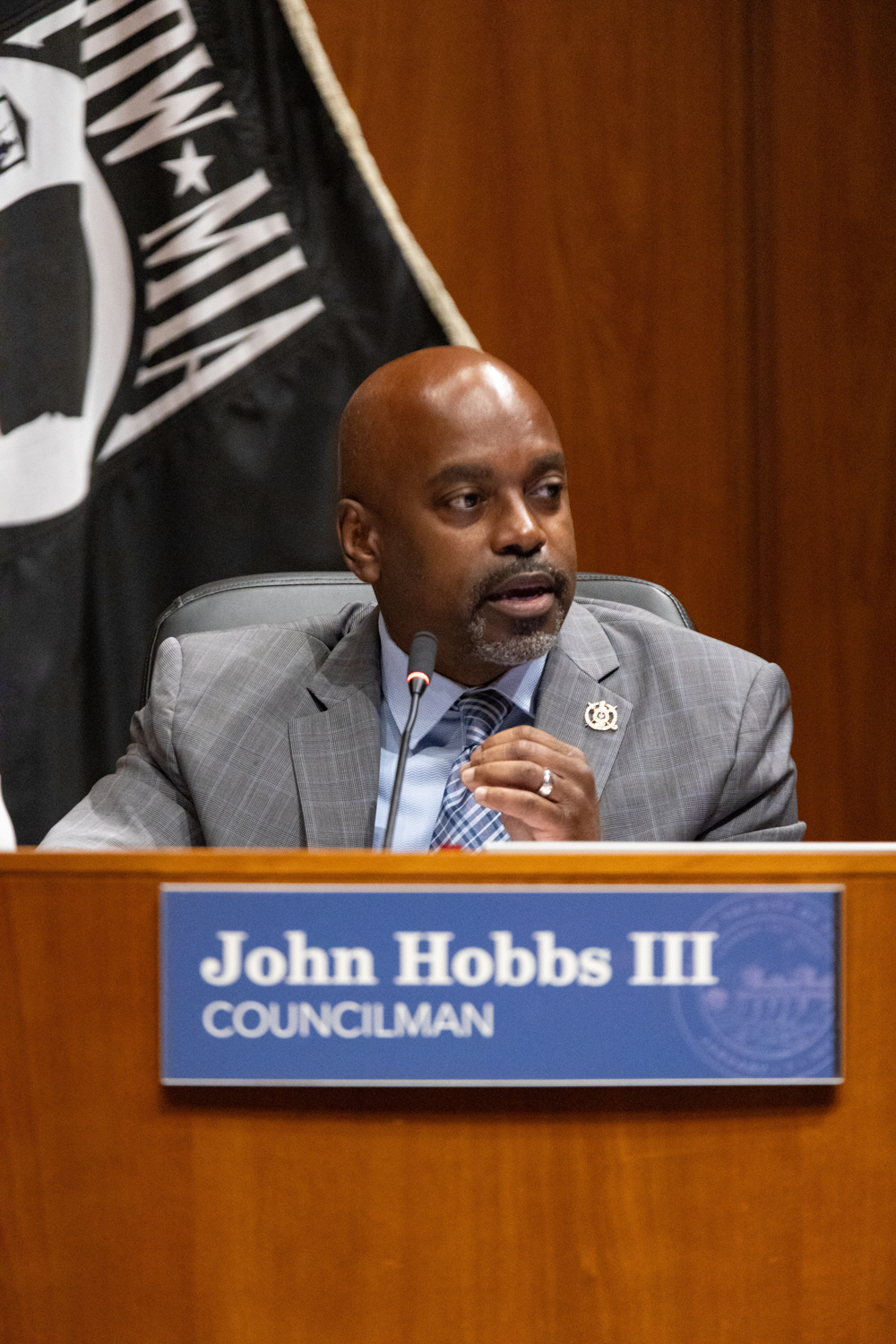
John Hobbs III, Toledo Council Member for District 1, addresses the attempted repeal of O-303-00, and said he took the attempt as “disrespect” since the ordinance addresses a platt within his district during a Toledo City Council meeting on Tuesday, August 12, 2025. (TFP photo by Stephen Zenner)
“I was going to also refer to this, go to first read, but for a different reason,” said Council Member John Hobbs III, in response to Martinez. “but because I am the district council person for this area and there has been no discussion with me, none whatsoever, about any of this.”
According to Hobbs, he received a phone call from Martinez. “He wanted to inform me that this was going to take place today, and there was no discussion with me. So if there’s anything that’s going to be led out of District One legislatively, it’s going to come from me as the district council member.”
Hobbs said, “I don’t—” then shook his head and moved his fingers, obviously frustrated, and began after a brief pause— “with anyone else’s district, and so before this goes forth…” Hobbs said he hoped he would be a larger part of the discussion before any further action was taken.
Without Hobbs being a more prominent role in the proceedings concerning his district he said, “I will take that as a strong form of disrespect.”
It should be noted that Hobbs was one of the only council members to vote in favor of changing the area in question to industrial zoning for use by Rocky Ridge Development against the grass roots Don’t Dump on South Toledo group. Residents of the area submitted over 200 signatures, mostly from Angola Road, South Byrne Road and Marine Road, against rezoning the area to general industrial, which Hobbs vocally supported.
Hoag, who owns multiple properties in the area, including the house in which he grew up, said after the council meeting, “Hobbs needs to go.”
Before Hobbs began, Martinez said that there was no rush to push the legislation, something Hoag would disagree with.
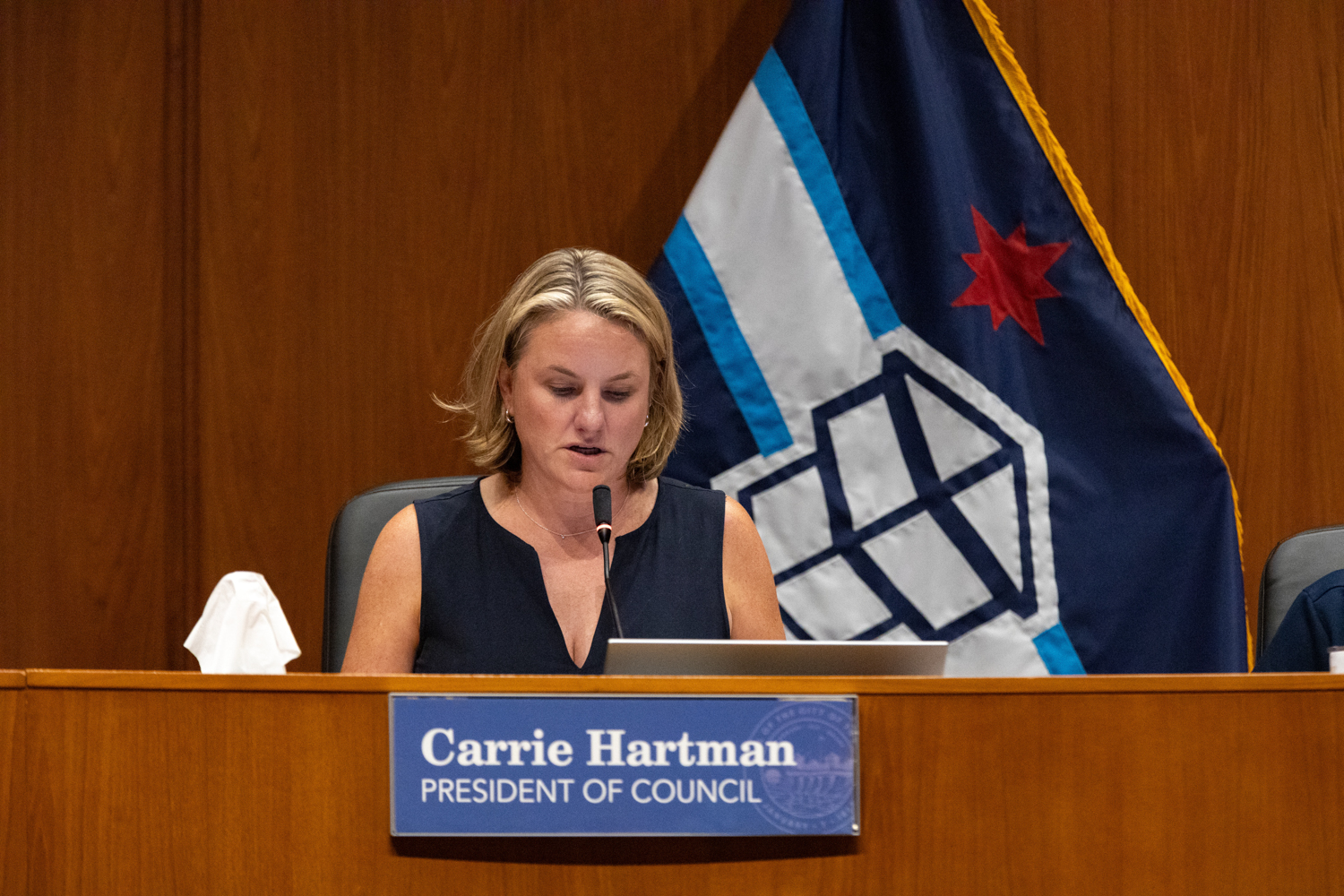
Carrie Hartman, Toledo City Council Member At-Large and president of Toledo City Council, said that since O-389-25 was not urgent, it shouldn’t have been added to the agenda at the last minute during a Toledo City Council meeting on Tuesday August 12, 2025. (TFP photo by Stephen Zenner)
Carrie Hartman, president of Toledo City Council said, “If there was no rush to this [O-389-25], I don’t know why we needed to give it immediate consideration.”
Regardless, Martinez motioned for immediate consideration, and the ordinance 389-25 moved to first read. However, the council did not vote on the ordinance then and there.
There were no objections, but council members voiced confusion about the order of operations and how to proceed with the legislation.
After the council meeting, Hoag voiced his disappointment, and wished Martinez was more adamant about voting on the ordinance.
“It’s a screwed up mess, the way they handled that,” he said referring to the council as a whole. “It was brought to their attention, and now they’re passing it off for a month. There’s no reason for that.”
“That’s what they did on Rocky Ridge. Same properties, same mess,” he said, and expressed frustration and worry about Kott’s mulch business moving into the area.
In his closing remarks, Martinez apologized to Council Member Hobbs, said he didn’t mean any disrespect, but also clarified that communication was “a two way street.”
Press talked with Martinez during which he clarified his thoughts on introducing the new ordinance.
“The whole community around it [the area] has changed [since 2000], and they should have some say in what happens there, whether it’s with this owner, the next owner…light industrial [rezoning] provides a lot of potential issues that aren’t neighborhood friendly. It does not necessarily comply with the forward Toledo plan, which earmarks that area for a combination of residential and somewhat industrial, just not as heavy intensive use as the ordinance currently allows.”
As far as Hobbs’ frustration, Martinez said, “I was not anticipating doing this this quickly, so it was my fault for not having a more robust conversation with them [all of City Council], but I alerted all the members via phone call or via text,” and he added that he had sent Council Member Hobbs multiple emails before the meeting.
The Toledo Free Press reached out to Council Member Hobbs after the meeting, but did not hear back from him. The day after the meeting the Toledo Free Press stopped by the City of Toledo Plan Commission to see if a plat had been filed to change the zoning, at the time, Wednesday, Aug. 13, and the city planners informed the Toledo Free Press there was no application at that time.
The Toledo Free Press also reached out to Clean Wood Recycling, Inc. to see if they had plans to move their facility anytime soon, but did not hear back from them.
Mike Ferner, holds the hand of his wife, Sue Carter, during a Toledo City Council meeting where he is recognized for his activism on the first floor of 1 Government Center in Toledo, Ohio on Tuesday August 12, 2025. (TFP photo by Stephen Zenner)
A lifetime of service in activism
TOLEDO – During the Toledo City Council meeting on Tuesday, Aug. 12, Mike Ferner, a local activist and veteran, was honored.
Julie Gibbons, the clerk of council, announced Ferner’s recognition for civic courage and activism, and a wave of applause followed Ferner up to the podium before city council.
Council bestowed upon Ferner the Civic Courage award in light of his dedication to compassionate causes, including his advocacy for Palestinians in Gaza, work with the Lake Erie Advocates and other anti-war advocacy during the Iraq War.
Nick Komives was the first council member to address and thank Ferner for his activism. Back in 2003 Komives’ first protest was an anti-war protest at the Franklin Park Mall, and that is where he first met Ferner.
“We all owe a debt of gratitude to you,” Komives said, and he also highlighted Ferner’s wife, Sue Carter, for her role in community activism as well.
Toledo Mayor Wade Kapszukiewicz speaks with Mike Ferner, a local activist and veteran, and his wife, Sue Carter, as Ferner is recognized for his activism and impact on Toledo during a Toledo City Council meeting. (TFP photo by Stephen Zenner)
Council Member Sam Melden thanked Ferner for his work through Lake Erie Advocates, which was his individual touchstone with Ferner.
“When someone comes in to get a resolution, and packs a room like this, that is obviously a sign. And I love that there are almost multiple different shirts and buttons that connect to what you’ve done,” Melden said.
District 6’s representative, Theresa Morris, kept her words short, and thanked Ferner for being tireless in his work to advocate on behalf of others in need.
Ferner, like Baumhower, pointed to the people surrounding him, whom he said deserved the same recognition he received.
“You will meet the best people that you’ve ever met in your life if you get involved in a progressive political movement,” he said, and then asked the sergeant at arms to bring his wife, Carter, up front to be with him.
When she joined him, Ferner said, “This is a person that has allowed me to do what I’ve done.”
Ferner expressed sadness at the state of federal politics, but said there was room for people to get involved on the local level.
“Government is the vehicle by which we express our love for each other,” Ferner said, and expressed sadness at the state of federal politics. But followed up by providing an outlet, “Here at the local level you can do that, we can do that.”
The Garage Food Hall at Bottleworks in Indianapolis, Ind. (Photo courtesy of Visit Indy)
INDIANAPOLIS – At not quite four hours away from Toledo, Indianapolis draws a lot of visitors from the Glass City, and for good reason. Indy has several large cultural institutions, a thriving grassroots arts scene, and a massive children’s museum that could keep a family occupied for an entire weekend. It also has plenty of good food. It’s a larger city than Toledo (population: about 874,000), so it is worth a trip to explore all it has to offer if you want a change of scenery for a weekend trip.
Though you could mix up this itinerary to your liking, we put together a list of ideas for enjoying Indy by season, complete with activity suggestions, lodging, and meal suggestions. For readers who have their own favorite spots to visit in Indy, reach out and let us know in the comments.
A 2023 exhibit at the Indiana State Museum featured lego renderings of the world’s most impressive skyscrapers. (TFP photo by Matt Sackmann)
For those interested in the convergence of art, history, and paleontology, the Indiana State Museum is the stop. The bottom floor of the museum is devoted to the prehistoric (Frozen Giants and Ancient Glaciers), with more mastodons and mammoths than any other museum in the Midwest. Along with meeting “Fred the Mastodon,” you can find an extensive collection of Amish quilts (Threads that Tell Stories), exhibits about industrial innovations in Indiana (Inventing a Better Tomorrow) and Indiana artists throughout history (The Art of Being Hoosier).
Interactive stagecoach in basement of the Eiteljorg. (TFP photo by Matt Sackmann)A play garden in the kids’ area of the Eiteljorg Museum. (TFP photo by Erin Holden)
Right across the Downtown Canal from the Indiana State Museum is the Eiteljorg Museum, an institution that specializes in Western and Native American art. Families can spend much of their time in the Museum’s basement, which features stories and immersive activities centered around actual individuals who live and work in the West. Kids can enjoy a stage coach, an interactive garden, and many other opportunities for hands-on learning.
Visitors interested in Great Lakes history can find textiles and artifacts from the 1800s, while others can take in more contemporary pieces that offer commentary on modern Native American life.
The Eiteljorg Museum features Western and Native American art. (TFP photo by Erin Holden)
Where to stay:
Crowne Plaza Indianapolis Downtown Union Station. (Photo courtesy of Visit Indy)
Perhaps one of the most unique hotel experiences in our region, this place has actual train cars for rooms. You’ll find a long train sitting on an old track that runs through the hotel, and there are several cars that have been converted to fully functional and very comfortable guest rooms. What’s special about this place is that you can actually feel the slight vibration of trains running in the nearby Amtrak station, making it feel very authentic (but not to the point of waking you up mid-snooze).
Grub:
Townes Sackmann (2 during this visit) sits at the Baby’s counter. (TFP photo by Matt Sackmann)Coffee at The Garden Table. (TFP photo by Matthew Sackmann)
Baby’s, offering an aesthetic that is a bit like if John Waters made the Barbie movie. Occasionally, you can enjoy trivia nights and drag shows there if you visit in the evening instead. Excellent cocktail selection.
Dinner at…
BRU Burger Bar Make sure to take a walk around downtown Indy’s Mass Ave. after your meal for the public art, people watching, and its celebrated nightlife scene.
Described as a “cultural campus” on its website, Newfields is home to the Indianapolis Museum of Art, two historic homes visitors can tour, a sculpture park, nature preserve, and vast gardens. AND a brewery. Though you can visit it throughout the year, there’s nothing like seeing its 152-acres fully in bloom during the spring. This is another site that could easily deserve a full day of exploration.
Indianapolis Museum of Art at Newfields. (TFP photo by Erin Holden)(Left to right) Townes Sackmann (4), Matt Sackmann and Erin Holden at Newfields in Indy, posing in front of the tulips in late April, 2025. (TFP photo by Matt Sackmann)
Another pleasant way to spend the weekend is a trip to Highland Park, especially for families. You can take in amazing city views, kick back while the kids enjoy some playground time and get to know a newly revitalized area of the city.
Where to stay
The Omni Severin is in the heart of Downtown Indy. (Photo courtesy of Visit Indy)
Another centrally located hotel, the Omni Severin in Downtown Indianapolis is newly renovated, features a nice cocktail bar (Bar Cardinale) and cafe, and its ambiance is very opulent 1920s, but in an approachable way (i.e., our family was comfortable having our preschooler running around in it).
Grub
8th Notch Cafe and Market. (TFP photo by Erin Holden)Dinner at Natural State Provisions. (TFP photo by Matt Sackmann)
Breakfast at…
8th Notch Café & Market has hefty servings of buttermilk pancakes and biscuits with gravy, but also healthier options, including fresh squeezed juices.
Lunch at…
Cafe Patachou (Stutz location): You’ll definitely want to go to the Stutz location, which has other vendors surrounding it, along with a mini museum filled with classic cars and other information about the rich history of car culture in Indy.
Dinner at…
Natural State Provisions has vegan and vegetarian fare, a great beer selection, and a family friendly atmosphere even in the evening.
Indianapolis Children’s Museum. (TFP photo by Matt Sackmann)
You could absolutely spend an entire weekend at this Children’s Museum, which has added even more activities to the outside portion of its campus, which is why it is listed under summer. The winter months are great at this museum as well, but the giant treehouse and sports complex are features visitors won’t want to miss.
Temporary exhibits include the Mickey Mouse Clubhouse (on exhibit until September 1) and Ruth E. Carter Afrofuturism in Costume Design (up until September 7). But their Dinosphere, All Aboard, and Beyond Spaceship Earth are just a few that are on display year round. They even have actual working labs where you can get a peek behind the scenes.
Brianna Limbruner from the Indianapolis Children’s Museum teaches Townes Sackmann (4) about different costume materials. (TFP photo by Erin Holden)One of many costumes on display at the Afrofuturism exhibit. (TFP photo by Matt Sackmann)
An incredibly emotional experience, The Power of Children: Making a Difference focuses on the contributions of Anne Frank, Ryan White, Ruby Bridges and Malala Yousafzai to change the world around them. This permanent exhibit shouldn’t be missed.
(TFP photo by Matt Sackmann)Dinosaur exhibit at Indianapolis Children’s Museum. (TFP photo by Matt Sackmann)Townes Sackmann (4) at the Ryan White portion of The Power of Children exhibit. (TFP photo by Matt Sackmann)
Vintage race car on display at the Indianapolis Motor Speedway. (TFP photo by Matt Sackmann)
There is no denying the special place Indy has in the hearts of racing enthusiasts, but even if you’ve never watched the Indy 500 in your life, there is so much history to enjoy at the Indianapolis Motor Speedway and . The exhibits include racecars through the decades placed in garages that reflect the time period, and kids who are interested in STEM (or video games for that matter), will likely have a great time here.
(TFP photo by Erin Holden)(TFP photo by Erin Holden)
Where to stay:
Bottleworks Hotel. You might as well go all in on the Bottleworks district and stay in this boutique hotel located above the historic Coca Cola Bottling Works.
Grub
Cafe Borage (Photo courtesy of Visit Indy)Gather 22. (TFP photo by Erin Holden)
Gather 22. It has beautiful outdoor seating for temperate summer days, a colorful atmosphere, and even hammocks in their backyard.
Dinner at…
The Garage Food Hall at Bottleworkshas many vendors to choose from, whether you are into sushi and poké bowls or barbecue and burgers, you’ll find something you like.
Historical reenactor at Conner Prairie. (TFP photo by Erin Holden)
If you are interested in a site just outside of Indy that has Sauder Village and Greenfield Village vibes, Conner Prairie is a place to check out. From historic reenactors, craftsmen and musicians to multiple playgrounds for the kids, it’s a family friendly destination. Some upcoming events include the Jupiter Flights Balloon Festival (Sept. 5-7 – not quite fall, but close), the Headless Horseman Festival (Oct. 2-26) and their Holiday Heritage Market on Nov. 8.
Other outings
Conner Prairie is located in Fishers, Ind., on the outskirts of Indy, so if you are making it your main destination for the weekend, you still might want to venture into the city for some urban adventures. If you do, check out the recently expanded 10-mile Indianapolis Cultural Trail.
Where to stay:
You can actually book a stay at theConner Prairie Guest House, but make sure to book early. If you are spending all day at Conner Prairie, you can extend the back-in-time feeling by staying at this bed and breakfast.
Grub
Shindig. (TFP photo by Erin Holden)
When you aren’t eating snacks or picnicking at the Prairie, venture into Indy to eat:
ShinDig, a cute place that kids will love for its colorful atmosphere, and outdoor games like corn hole, Jenga, Connect 4, and lots of other lawn games on their patio (which has firepits for cooler days as well).
*The trips that allowed us to experience many of these spots were courtesy of Visit Indy.
Tyreese Blue II receives a medal from Lucas County Commissioners Lisa Sobecki and Anita Lopez as he is recognized as the Boys and Girls Club of Ohio Youth of the Year during the Lucas County Commissioners Regular Meeting in the Commissioners’ Hearing Room on the first floor of 1 Government Center in Toledo on Tuesday, Aug. 19, 2025. (TFP photo by Stephen Zenner)
TOLEDO – One of the University of Toledo’s newest freshmen, Tyreese Blue II, was recognized Tuesday at the Lucas County Commissioners’ regular meeting on the first floor of 1 Government Center.
Earlier this year, Blue received the Boys and Girls Club of Ohio Youth of the Year award for his outstanding community involvement with the Boys and Girls Club of Toledo.
Just this past week, Blue moved into his living space on the campus of the University of Toledo (UT) with an associates degree in general studies and a GED, and is pursuing a degree in construction engineering at UToledo.
Lucas County Commissioner Lisa Sobecki read the introduction for Blue.
“We need you to stay here when you get that degree,” she said, adding, “Tyreese, we’re extremely proud of you.”
Tyreese Blue II, the Boys and Girls Club of Ohio Youth of the Year, listens to Jim Ravas, the president and CEO of the Boys and Girls Club of Toledo, after Blue was recognized for being the Ohio Youth of the Year during the Lucas County Commissioners Regular Meeting on Tuesday, Aug. 19, 2025. (TFP photo by Stephen Zenner)
The other two commissioners echoed these words with Commissioner Pete Gerken making a particular point to compliment the incoming UToledo freshman on his wardrobe.
“Is this not the sharpest dressed young man,” he said. “I’m jealous I’d never be able to pull that off.”
Then Gerken explained, “You look like the professional youth that you are,” and lauded Blue for making the time to complete his studies and invest in his community.
Afterwards, Blue recited the speech that, combined with his discipline, won him the Ohio Youth of the Year award.
“You see, I stand before you today at the same age my mother was when she brought me into this world,” Blue said, and went on to talk about surrounding yourself with good influences and to approach life with goals and discipline.
The Boys and Girls Club of Toledo, he said, is “a place where kids like me are given the tools to thrive, and no matter where we come from, we all have the potential to create change. You are seen, you are valued and you belong here.”
After a photo, the President and CEO of the Boys and Girls Clubs of Toledo, Jim Ravas, spoke.
“Tyreese is someone we can be really, really proud of,” he began, and talked about the importance of investing in kids and youth during times that can end up being unsupervised, leading to learning gaps, disengagement and, in the worst cases, juvenile crime.
“75 percent of our members advanced to the next grade on time despite entering behind their peers,” Ravas said, and asked those in attendance for more funding for the nonprofit.
“Your investment is multiplied,” he said. “For every one dollar invested into the Boys and Girls Clubs, it yields $35.16 in lifetime benefits back to Ohio communities,” according to the Voinovich School of Leadership and Public Service at Ohio University.
With stats like these, Ravas invited those in attendance to “invest in outcomes,” for kids in the Boys and Girls Clubs of America.
Retirement
Next on the agenda was the retirement of a legal secretary for the Division of Child Support, Madeline Vallejo-Welch, who worked for Lucas County for 26 years.
She will finish out August of this year, and then enter retirement, after which she will consider going back to study at university.
Bonita Johnson, the deputy director of the Child Support Enforcement Division for Lucas County Job and Family Services, said Vallejo-Welch’s career with Lucas County was defined by service, teamwork and kindness.
Commissioner Gerken said he hoped the 26-year run was a good working environment for Vallejo-Welch and commended her for her commitment to her time in government, “especially in child support; most of the people you meet are angry.”
In the past ten years, Gerken said child support has changed, and worked to be more of a support than a punishment. But his main point about working in child support for 26 years was this: “You can only do that if you have heart. It’s not easy, and you have heart.”
Jessica Ford, the Lucas County administrator, hugs Madeline Vallejo-Welch, a legal secretary for the county, as Vallejo-Welch enters into retirement during the Lucas County Commissioners’ Regular Meeting on Tuesday, Aug. 19, 2025. Vallejo-Welch mentioned that she remembered when Ford was very young and both implied during the meeting a mentorship relationship between the two. (TFP photo by Stephen Zenner)
Anita Lopez, Lucas County Commissioner, commended Vallejo-Welch for her behind-the-scenes work.
“We get elected, but it’s individuals like you that do the job in serving our public everyday, one-on-one,” Lopez said.
Multiple commissioners mentioned Vallejo-Welch’s willingness to help with the Lucas County Board of Elections on top of her regular responsibilities.
“There have been two times, because of the county and because of our union, that I have been able to go to school,” Vallejo-Welch said, and mentioned she is only a few credits off from getting her associates degree.
Ten years in the child support division got Vallejo-Welch close to being a lawyer, her dream, and she capped her statement and said, “I’m very happy. It was the best department in the whole place.”
After Vallejo Welch took a photo with the commissioners, Jessica Ford, the Lucas County administrator, gave Vallejo-Welch a hug. Earlier in the meeting Vallejo-Welch mentioned to the public that she was Ford’s teacher’s aide at St. Mary’s before working for the county.
Agenda
Most of the other agenda items passed without further consideration, except that the Office of Management & Budget tabled most of their resolutions, passing only item 16 on the agenda.
John Wenzlick, the budget director for Lucas County, asked for agenda items 17-24 to be resumed at the next meeting. When asked about the procedural holdup, Wenzlick said the financial officers involved were not able to get to all the resolutions because of scheduling conflicts and wished to pass all together.
After one other agenda item, the Commissioners went into an executive session.
Upon the county executives’ return Trent Burner, the director of human resources for Lucas County, announced the following new hires in a specialist 2 positions: Serena Davison, Sarah Toles, Jessica Stone, Camille Ochsner and Keyona Perkins. The following case managers were also hired: Megan Griffith, Jonathan Nibert, Jenny Fritsch and Rita Whitlock.
Mona Abu Shaban, a Pro-Palestinian protester, talks about her experience of losing 42 members of her family in Gaza to Israeli bombing raids during a Lucas County Investment Advisory Committee Meeting on the 8th floor of 1 Government Center in Conference Room A in Toledo on Friday, Aug. 22, 2025. Commissioner Pete Gerken led an effort to get Lucas County Treasurer Lindsay Webb to divest the county from Israeli Bonds. (TFP Photo by Stephen Zenner)
A clash over the question of investing in foreign instruments
TOLEDO – Protesters packed a heated second quarter meeting where the Lucas County Investment Advisory Committee completed a motion that advised the Lucas County Treasurer against investing further in foreign instruments.
“Foreign government bonds are code named for Israeli investment,” said Pete Gerken, a Lucas County Commissioner. “They’re the only government that we’re allowed to invest in.”
This was confirmed by Jim McCourt, the director of advisory services at Meeder, an investment advisory service that advises Lucas County in an official capacity.
Lindsay Webb, the Lucas County Treasurer, Katie Clarke-Stumbo, the Chief Investment Officer at the Lucas County Treasurer’s Office, and Jim McCourt, the director of advisory services at Meeder, an investment advisory service that advises Lucas County in an official capacity, sit surrounded by Pro-Palestine protesters demanding divestment from Israel during a Lucas County Investment Advisory Committee Meeting on Friday. (TFP photo by Stephen Zenner)
Gerken was sure to clarify his speech for the investment advisory meeting, as there were many visitors to that meeting.
About 20 Pro-Palestine protesters sat quietly as they held large pieces of paper demanding that Lucas County divest from Israel. Shoulder-to-shoulder, they took in McCourt’s PowerPoint report for the advisory committee in Conference Room A on the 8th floor of 1 Government Center.
“Thank you to our guests today. We don’t usually have this big of a crowd,” Gerken said before beginning to clarify his main points for the meeting.
Lindsay Webb, the Lucas County Treasurer, clearly felt attacked by the coordinated pressure provided by Commissioner Gerken to divest Lucas County’s investments from Israel.
“I understand that you have a lot of power in this community, but this is the power that is mine,” Webb said, as she made known to the commissioner that she ultimately decides how the county invests its money.
“Through both the voters and through the structure of county government, I’m the investing authority,” she said.
1 percent of Lucas County’s investments, or as Webb said, one $5 million bond is invested in Israel from Lucas County, and will not reach maturation until December 2026. Until that time, it is not possible for Lucas County to divest from Israel.
“But,” Gerken said. “I will not sit here and remain silent even if it’s a small piece of our pie, I’ll not sit here and remain silent without having community input on our investments. Even if it’s a penny or two in our investment, it’s still the idea our money is being invested there [Israel].”
Lucas County Commissioner Pete Gerken speaks about divesting from Israeli Bonds during a Lucas County Investment Advisory Committee Meeting on Friday. (TFP photo by Stephen Zenner)
Given the almost two years since the October 7, 2023 attack on Israel, Gerken said the Israeli government is now involved in a “…full blown genocide, starvation tactics by design, policies of violence, oppression and displacement” against the Palestinian people.
And then Gerken took special care to clarify that these were the actions of Benjamin Netenyahu‘s government, and not indicative of Jewish or Hebrew people, stressing both Netenyahu and the government as the focus of his critique.
“Had this been done in any other country in the hemisphere or Europe, we would be outraged. We would not tolerate this” from any other country, he said.
Members of the advisory board looked quizzically at one another, clarifying that the foreign investment bonds could not be divested until 2026.
Gerken’s hardball attitude ruffled feathers across multiple advisory board members including Webb and Commissioner Lisa Sobecki’s proxy for this meeting, Chris Varwig, both of whom voted against the motion advising Webb to divest the county from Israel.
Lucas County Commissioner Pete Gerken has a fiery back-and-forth with Lucas County Treasurer Lindsay Webb during a Lucas County Investment Advisory Committee Meeting on the 8th floor of 1 Government Center in Conference Room A in Toledo on Friday, Aug. 22, 2025. (TFP photo by Stephen Zenner)
Regardless, the motion passed, and did little in a direct way to change the county’s investments. But it seemed clear Webb felt this was a personal criticism from Gerken.
“We can review the policy in the next six weeks,” Webb said.
“The reality of the situation is I am doing my job very well. That’s the bottom line. I take issue that Commissioner Gerken wants to question that.”
Webb said she was doing her job to invest safely and legally, and raised the question of the legality of divesting from Israel.
“Directing me not to invest in instruments of a foreign nation by which the category is only Israel runs the risk of running afoul of state law, and I personally don’t think that that’s a wise move,” Webb said. “You’re setting the county on a collision course with the Attorney General of the State of Ohio. And I personally don’t think that that is a prudent use of time, resources or money.”
Gerken countered with the argument that they could divest based on Israel’s actions over the past two years, and Webb asked if Gerken wanted to be the test case for that line of thinking.
“I would, absolutely! I think that’s what the county needs. It needs to be tested,” Gerken said.
Mona Abu Shaban, a Pro-Palestinian protester, talks about her experience of losing 42 members of her family in Gaza to Israeli bombing raids. She spoke at a Lucas County Investment Advisory Committee Meeting on Friday, Aug. 22, 2025. (TFP photo by Stephen Zenner)
Members of the protest community, including Terry Lodge, a local attorney and peace activist, Dr. Jomana Al-Hinti, who went on a medical mission to Gaza in 2024, and Mona Abu Shaban, who said she had 42 members of her family killed by Israeli bombings in Gaza, all spoke for three minutes before yielding their time back to the meeting.
Their statements, of which Abu Shaban’s seemed most impactful, were followed by Amichai Stout, the director of the Jewish Community Relations Council for the Jewish Federation of Greater Toledo. Stout mentioned he was not notified of the meeting until a half hour before, but said he was open to discussion.
“I hope that, next time an issue like this comes up, there would be a little bit more notice for our communities that maybe we could prepare something and have more to dialogue,” Stout said.
Gerken retorted that “people who lost 42 members of their family didn’t get notice of the bombs dropped on them.”
By the end of the meeting, Gerken and Webb were at an impasse, as it seemed she would not actively divest from foreign investments, though she agreed not to invest further. Anita Lopez, Lucas County Commissioner, assured Webb that the commissioners were not trying to attack Webb, and they agreed to review procedures in the next six weeks.
But Gerken seemed to want more, and said he wished this could have been “collaborative.” The commissioner and treasurer left the issue as Gerken said he would use his authority as provided in the Ohio revised code to seek a different end to the dispute, and Webb encouraged him to do so.
The Ohio Statehouse. (Photo courtesy of Jake Zuckerman / Signal Statewide)
The new state budget includes $1 million to fund a pilot program for AI software to record and analyze the hundreds of thousands of calls made by those incarcerated in state facilities.
This story was originally published by Signal Statewide. Statewide is a nonprofit media partner of the Toledo Free Press.
By Jake Zuckerman | Signal Statehouse
Starting next year, all phone calls involving some of the 45,000 men and women in state prisons in Ohio will be recorded and analyzed by new artificial intelligence technology.
The recently passed state budget provided $1 million for the Ohio Department of Rehabilitation and Corrections to buy software that can “transcribe and analyze all inmate phone calls.” That data will be accessible to all law enforcement agencies in Ohio to support criminal investigations. The program is funded as a pilot through 2026 after the attorney general approves a location.
State policy already allows state employees and private contractors to monitor or record calls of anyone incarcerated in state facilities, either at random or on a regular basis “for cause.” Those comments can lead to disciplinary or criminal consequences.
However, manually combing through hours of calls is a tedious and time consuming process, naturally limited by the manpower to review it all. AI, via what vendors call “automated content analysis,” allows state officials to do the same thing, at a massive scale and a fraction of the cost. The technology is designed to flag for personnel any suspicious words and phrases it detects.
“Sometimes those reviews are getting information about crimes that are occurring in the prison, or outside the prison at the prisoners’ behest, threats against corrections workers, etc.” said House Finance Chairman Brian Stewart in an interview. “The potential to do what we’re already doing, in a more efficient way with less man hours and taxpayer expense, we thought was an intriguing idea.”
One vendor of such software, LeoTech, a Texas company, hired three lobbyists from two law firms to help make its case in the state budget, to House lawmakers especially. And Annette Chambers-Smith, director of the ODRC, met with state lawmakers and advocated for funding for the new system. ODRC spokeswoman Jenn Truxall said some Ohio prisons have already launched an “independent pilot program” using LeoTech software.
Lawmakers who support the technology, and the vendors themselves, say it’s a cost-effective way to cut down on drug flow into the prison and any ongoing crimes involving current inmates. But critics say it’s an invasion of privacy of both inmates and those in contact with them, leaving their data at risk of leaks or misuse by the vendors.
Plus, several companies active in the industry have been accused of improperly recording phone calls between inmates and their attorneys – calls which are typically private affairs.
Prison vendors join the AI rush
A handful of vendors nationally offer AI monitoring services for state penal systems.
LeoTech sells its Verus product, powered by Amazon Web Services’ software. The company says Verus produces transcripts, can isolate “relevant communications” among high volumes of long phone calls, cuts through slang or coded terminology, and can “visually identify patterns and connections within your data to better understand complex communication networks.”
Aventiv, another Texas company, operates subsidiaries that offer a broader set of phone, video call, and GPS monitoring services. That includes Securus, which operates AI surveillance technology in prisons across multiple states.
Rory McBryde, a prosecutor in Michigan, founded WireTap in 2019, a company that uses ChatGPT to transcribe jail calls and alert prison officials and prosecutors to possible criminal evidence. He described in a podcast his frustrations as a prosecutor that there was no easy way to surf through days worth of phone calls from suspects to get to the important stuff.
“Almost every single felony domestic violence case where the guys are locked up, we know they’re calling their girlfriends, telling them not to testify or threatening them or saying, ‘Think about the kids,’” he said. “All of this stuff is illegal. That’s another felony.”
None of the vendors responded to interview requests.
AI monitors accused of eavesdropping on attorney calls
Typically, communications between people and their attorneys are considered confidential.
However, in some states that have deployed AI systems to monitor the calls in jails as well as prisons, the vendors have been dogged by accusations of eavesdropping on inmates’ calls with attorneys, which could give prosecutors a strategic advantage in trial or plea negotiations.
For instance, the New York Department of Investigation issued a report determining that Securus inadvertently recorded about 324 privileged, attorney-client phone calls between late 2020 and early 2021. That’s a small subset of about 700,000 calls analyzed.
Securus settled a class action lawsuit in 2020 for $880,000 with California prisoners who alleged their calls with public defenders had been unlawfully recorded.
In jails in Maine, Securus’ surveillance systems recorded nearly 1,000 attorney phone calls recorded in four county jails in about a year. That affected nearly 200 defendants and 44 law firms, according to public records obtained by the Maine Monitor. The inmates and their attorneys filed a class action lawsuit against the company, later dismissed by a federal judge who found the plaintiffs failed to demonstrate the company intended to capture the attorney-client calls.
And Securus and CoreCivic, a private prison operator, paid $5.3 million to settle two lawsuits in Kansas from 500 current and former detainees who say their calls with their attorneys were improperly recorded, according to the Kansas City Star.
Privacy advocates weary of AI surveillance
Stephanie Krent teaches at Columbia University Law School and practices at the Knight First Amendment Institute there. She said there’s a yawning gap between old-fashioned call monitoring and omnipresent artificial intelligence creating a “permeating surveillance system.”
The recordings, she said, will sweep up not only the recordings of the inmates but law abiding people on the outside. From there, the vendors could sell or carelessly handle the data. And state prosecutors could gain a panopticon-level view of communication networks.
“I think those lawsuits are a lesson about trusting the intentions of these telecommunications companies and hoping that everything will work out as planned,” she said in an interview.
Will Owen is a spokesman for STOP, a New York-based public interest nonprofit focused on limiting technological surveillance from law enforcement that has studied Securus’ rollout of the technology in New York facilities.
There, he said, besides recording attorney phone calls, the technology has violated the privacy of innocent people contacting inmates, and its biased software produced disproportionate numbers of false positive flags on Black and other minority inmates.
“This software is not just a threat to people who are incarcerated, but to their friends, family, children, their entire communities,” he said. “It deepens the reach of surveillance into already over-policed communities of color. And it’s very rife with racist biases, struggling with certain accents, tones that do not fit more Eurocentric standards. It’s just a really dystopian form of surveillance and expansion of surveillance.”
Lawmakers cite public safety interest
The legislative text of the budget is vague in terms of how many facilities will be under the AI monitoring, but Stewart said his conversations with the ODRC suggested the agency would pilot the technology at one prison before rolling it out further. That’s Ross Correctional Institution, in Chillicothe.
There, prosecutors say that Rashawn Cannon, a 28-year-old serving a sentence for felony assault and possessing a weapon while prohibited from doing so, murdered a 62-year-old corrections officer on Christmas Day last year. The death came amid reports from the guards’ union of understaffing, and a significant increase in use of force incidents between officers and inmates between 2013 (259) and 2023 (736).
Stewart, an attorney, said he “assumed” the AI vendors have some means to screen out the lawyers’ calls with inmates. But he’s not worried about it, given the words would likely be found inadmissible as evidence.
Another supporter of the budget provision, Rep. Mark Johnson, a Republican whose district includes Ross Correctional, said he hadn’t heard about the attorney-client privilege problems and doesn’t think the state should be listening in on those calls.
But he said he’s heard reports from corrections officers of drugs coming into the prison with ease, fueling a rash of overdoses from people with no ostensible contact with the outside world. The $1 million investment, he said, can help clean up the facility.
“There’s so many calls, a human being can’t do it,” he said.