Many of us have watched with consternation as the Trump administration has upended policies over the past seven months. While I do not want to be an advocate for many Trump policies, it is also important that we consider how some of his policies may save money and years of wasted time for many students who are considering entering graduate school.
Over the past decade, we have all become aware of former students with crippling student debt of $200,000 and up. Much of this debt was accumulated while attending graduate programs to obtain a masters degree, a PhD or a professional degree such as law, veterinary, medical, etc. These large student loans are often obtained through the federal Grad Plus program that allows students to borrow up to $50,000 per year. Under Trump, this program will be terminated in 2026.
For years, reputable commentators from both left-leaning and right-leaning sources have pointed out the problems created by incentivizing borrowing for graduate programs. For example, in 2020, the liberal-leaning Center for American Progress (CAP) pointed out that Black students are much more likely to carry large student debt due to graduate programs than are white students.
The CAP report noted that an excess of students in “graduate school has the potential to hinder all the efforts at boosting mobility that come from undergraduate education.” It may be that encouraging too many undergraduates to continue studies in graduate programs diminishes the relative value of an undergraduate degree. This may make it more difficult for low-income students to become upwardly mobile.
The rapid development of Artificial Intelligence (AI) may also greatly diminish the value of many graduate degrees. Graduate degrees often take two to eight years to complete. It is not clear which of these degrees will have value when completed.
Recently, Dr. Jad Tarifi, who founded Google’s first AI team, discussed the value of entering a PhD program in today’s environment. He opined that many would-be PhD students should skip the “five years” and “a lot of pain” associated with earning a PhD. He suggests that those who skip a PhD will “move much faster” and “learn a lot more” by focusing “on just living in the world.”
As an educator, it may hurt to say it, but it is time for the federal government to stop encouraging too many students to take out up to $200,000 in graduate-school debt.
Douglas Oliver
While Dr. Oliver is a Professor Emeritus at the University of Toledo (UT), these views are his and not necessarily those of UT.
MAUMEE – What started with a broken left thumb led Matt Kutz on a journey of discovery and treatment of prostate cancer. To raise awareness of that cancer, there’s a journey of another kind upcoming.
That journey is a 5K run/walk at 5 p.m. on Friday, Sept. 5, at Sidecut Metropark in Maumee. The event is called Battle for the Bulge. Battle is an acronym for Be Brave, Armor Up, Trust your Team, Triumph over Fear, Lean into your Faith, and Engage Life; the Bulge refers to an enlarged prostate gland.
It is a battle Kutz has fought and is fighting, and he wants everyone to know about it so that others won’t be as surprised as he was.
Matt Kutz, left, a prostate cancer survivor who founded Battle for the Bulge, a race and awareness campaign. (Courtesy photo)
In November 2023, Kutz, of Perrysburg, was training for a triathlon. He’d always been active, and had an academic background in athletic training and sports medicine, including having been a professor at Bowling Green State University.
Kutz crashed his bicycle on a training ride, breaking his left thumb. Following up with his physician, he was told he hadn’t had a routine checkup, which he should’ve had when he turned 50; he was 51 at the time. However, Kutz, now 53, said all the while he felt fine.
The bloodwork part of that checkup revealed that Kutz had a high prostate specific antigen (PSA) number: 52.4.
“That’s super high,” he said. “High is like 4 or 5.”
Kutz then was connected to a urologist, who told him new patients are usually scheduled six months out. “But when they heard my PSA number,” Kutz said, “the doctor got me in that day after the office was closed. He stayed late just to see me. That’s the first time I felt that this was serious.”
The high number was the sign that he had prostate center.
“I had zero symptoms,” which typically are needing to urinate more often and having trouble completely emptying the bladder, and having erectile disfunction. “That’s part of the surprise,” he said. “I was active and healthy. I was fine, and all of a sudden, I wasn’t fine.”
Kutz was told prostate cancer was quite treatable and slow growing. “So I thought it would be easy,” he said of the upcoming treatment. Then it was found that the cancer was advanced and had metastasized, starting to spread into his pelvis and groin lymph nodes.
“I went from it being fine to having the worst type of prostate cancer that you can have.”
He underwent a radical prostatectomy. “They cut me open arthroscopically, and used a DaVinci robot to cut the prostate into pieces because it was too large to pull out. It was a pretty intense surgery.” He also underwent radiation to kill the cancer cells.
He’s in the midst of a two-year treatment called androgen depravation therapy, which is a pill and an injection that eliminated the androgen – testosterone – in the male body. “Prostate cancer feeds on testosterone,” he said.
During the treatment, Kutz continues his profession, as a professor of athletic training at Florida International University, a position he began during the pandemic in 2020. He teaches online, and travels to the Miami-based school on occasion. “Travel is fine,” he said, “I just have to take my meds with me.”
In the meantime, he was looking for a support group. “I found a lot of cancer support groups for women,” he said, “but not a lot for men.” Then one of his wife’s friends said he should do an awareness walk for men, but it needed a catchy name. “She called it the Battle for the Bulge, and we laughed. But then we said, ‘That’s it.’”
(Courtesy photo)
Last year was the first such walk, drawing about 80 participants.
“This year we’re adding a 5K component and people can do a casual walk, we’ve added a children’s fun run,” he said. “We have food donations, a band, and there’s a playground at the park. This is more of a family evening thing,” which is why the start time is at 5 p.m.
His oncologist, Dr. Timothy Kasunic, and other medical professionals will be there to talk about PSAs and how to screen for prostate cancer.
The registration fee is $30, with proceeds going to the Taylor Cancer Research Center in Maumee.
A participant this year will be a friend who took part in last year’s event. Sherrie Periatt, a cardiac nurse with Bon Secours Mercy Health, said she knows what Kutz has been going through in a sense because she’s a cancer survivor.
“I had breast cancer, so this hits close to home,” Periatt said. While prostate cancer affects only men, “everybody has a dad,” she said.
Prostate cancer doesn’t receive the attention that breast cancer does, so it’s good that there are events like this to bring awareness to it. “It’s best to get checked out earlier rather than later,” Periatt said.
As part of his drive to educate people about prostate cancer, Kutz wrote and published a book, Diagnosed: It’s Not Your Battle to Fight Alone.
Kutz’s message: “The big thing is to get tested when it’s time, before age 50.” He said for those who have a history of prostate cancer in their families, that age for testing is 40.
Michael Vanderpool tests the first sign protype for Batting Cleanup. (Photo by Tiernen Rice)
TOLEDO – Before the Mud Hens’ opening game on Friday, April 10, 2026, Toledo will have a new maintenance system that swings for the fences.
Batting Cleanup is a community-driven initiative to install QR codes around Toledo, allowing individuals to report overflowing trash cans and the resulting litter.
Scanning the QR code automatically reports the issue; however, users can opt to provide their contact information and receive updates when the issue is resolved.
But Batting Cleanup is more than just a way to remove trash.
“I want to build the tech community here,” said head of app development for Batting Cleanup, Justin Beaudry.
Justin Beaudry, the head of app development for Batting Cleanup. (Courtesy photo)
Beaudry added that while creating the app is simple, he hopes the project can also achieve this secondary goal, a sentiment shared by the head of Anthony Wayne Innovation and Design, Michael Vanderpool.
“It’s not necessarily what we’re building that’s the goal here; the goal is to activate some of our own community to be embraced and encouraged as problem solvers,” said Vanderpool.
Toledo Codes is a student group from the University of Toledo started by Beaudry that aims to foster more tech meetups in the Toledo area. Students in the organization play a key role in Batting Cleanup, with learning opportunities and hands-on coding experience.
“We put them [students] through a mentorship program to teach them how to write software,” Beaudry said. “Effectively, how can we create creative problem-solvers who use tech, and keep them here in the city of Toledo? That’s the goal.”
By involving students and joining Toledo’s various tech organizations, Beaudry and Vanderpool hope Batting Cleanup will help turn the tide on Ohio’s brain drain issue while also making Toledo better.
Brain drain, the departure of a workforce from the area where workers were originally trained or educated, is an issue felt particularly keenly in Rust Belt states.
Batting Cleanup is a community cleanup initiative that involves scanning QR codes like this one to report when trash is overflowing. (Photo by Tiernen Rice)
“[Batting Cleanup] is a way for us to showcase some of the talents we have locally, showcase what we can do as designers, technologists, creative problem solvers…when we get mentors together with young people to solve some of our own problems with our own people, [it’s] a way to inspire young people primarily to make positive change in the community,” Vanderpool said.
The first QR code test receptacle was placed right outside Batting Cleanup’s headquarters, the Toledo Tech Loft, on Wednesday, Aug. 13.
As more QR codes are put in place and more tech connections made, Vanderpool hopes that downtown Toledo could become what he describes as an “innovation corridor.”
“Bringing all these different groups of people together to solve these problems, that’s what it’s going to take to create a really cool future here [in Toledo],” Vanderpool said.
Matt Aston speaks at a managers' meeting for his company, Ground Penetrating Radar Systems. (Courtesy photo)
How the wide-ranging radar business got off the ground
TOLEDO – Starting his own business wasn’t even on Matt Aston’s radar, but happenstance led him to found a company providing a needed service through, well, radar.
That was almost 25 years ago. Today, Ground Penetrating Radar Systems has annual revenue of $220 million, employs 900 people in 60 cities nationwide and remains true to its roots by continuing to be headquartered in the Toledo area.
GPRS also is true to its name: Its ground-penetrating radar shows where utility lines and other infrastructure is, so a client knows where to cut through concrete or dig to avoid costly peripheral damage.
Aston’s company has grown not only in scope, but also in technology services, leading to its latest offering about which he’s “bullish” for GPRS’s future.
It all started with a chance spotting of an ad in a trade magazine.
Toledo native Aston graduated from Toledo Christian Schools, enrolled at Hillsdale College, and later transferred to the University of Toledo, earning a finance degree. He began with a major Toledo-area auto parts company, but found the corporate world unappealing.
Thinking about starting his own company, he spoke with his father, Skip Aston, owner of Ohio Concrete Sawing and Drilling. “He encouraged me to go on my own,” Matt Aston said. But into what business?
Aston’s father gave him a trade magazine, in which the young Aston came upon an advertisement by a ground-penetrating radar company touting its services in finding electrical conduits before sawing through a concrete floor.
“I knew from helping my dad with jobs that this was a recurring problem,” he said, which led to chaos on the job site.
Thus, in the fall of 2001, GPRS was born.
Matt Aston, founder of Ground Penetrating Radar Systems, a company based in Toledo. (Courtesy photo)
“It was a really, really slow start,” Aston said. “People often associated ground-penetrating radar with searching for buried treasure, not to assist with safety in a construction application.” He visited job sites, contractors, and engineers explaining how this technology can benefit them, with little luck.
Aston switched his focus to Detroit, which offered more opportunities. Then in the growing darkness of Dec. 23, 2001, on his way back to Toledo, he took a chance by driving onto an open construction site at Detroit Metropolitan Wayne County Airport. There he made his pitch to the site manager, who was tasked with a major project that would benefit from knowing where to drill.
“He said, ‘If you can do what you say you can do, we’ll keep you busy for a long time.’”
After the first of the new year, Aston gave demonstrations, was hired, and was busy for eight months. “That was my first big break,” he said.
Since then, GPRS has grown into the size and scope it is today. “We’ve grown into being the largest provider of these services in the world,” he said.
“Ninety-nine percent of our work is geared to facilities and construction sites. We work in hospitals, university campuses, manufacturing and entertainment venues,” he said. “We can give them an accurate picture of what’s underground and improve safety and knowledge for planning.”
He added, “Occasionally, we get that unique call for an application out of the ordinary. We’ve worked with historical societies, and we’ve assisted police looking for homicide victims.”
Aston said, “We’ve worked on high-profile sites – almost every stadium, the White House, Pentagon, Freedom Tower, Philadelphia Mint, Disney properties.
“We do 12,000 jobs a month. Sometimes we’re on site for a few hours, some jobs for months at a time.”
In the company’s nearly 25 years, “the principles behind the technology have not changed. What has changed is data collection. More significant is how we’ve integrated other technologies.”
Aston said his company offers four services: ground-penetrating radar, laser scanning, cameras run through pipes to assess conditions, and leak detection. “Water infrastructure is pretty old. A lot of domestic water lines have leaks. We can map them and narrow down where the leak is coming from.”
Those four services are combined into his company’s latest feature, Sitemap. “It’s a delivery system for our data.” He said a client can “pull out Sitemap and see where all the utilities are, where we found water leaks, see what the inside of their sewers look like, all in one place at their fingertips. We’re very bullish on Sitemap.”
Reflecting, Aston said, “We’ve been blessed. I did not have a vision of this when I started. I believe that as you grow, your potential grows as well.”
Fifth-grader Addy Anderson jumps in excitement next to her Fallen Timbers Middle School teacher, Emma Rees, during a house reveal party. (TFP photo by Karen Gerhardinger)
Finding fun in the “house” rules
WHITEHOUSE – Bursting through a tunnel of balloons and streamers, Kelen Rouser yelled in excitement as members of his house rushed forward to greet him.
Kelen was one of more than 672 Fallen Timbers Middle School students gathered on the football field at Anthony Wayne High School on August 22 for a “house reveal” party that included upbeat music, cheering crowds and an announcer in the press box.
“This is a way to welcome fifth-graders, to cheer them on and tell them how fun it is here,” said sixth-grader Cora Komisarek.
Fifth-grader Kelen Rouser runs through a tunnel to meet members of his house during an August 22 “house reveal” party for Fallen Timbers Middle School students. (TFP photo by Karen Gerhardinger)
Each year, hundreds of students from Monclova, Waterville and Whitehouse converge for the first time at Fallen Timbers Middle School (FTMS). The move can be a little daunting, but the Harry Potter-like house system introduced last year by PrincipalMatt Smith has made that transition easier.
Students in both grades are placed into one of four houses – Fettari, Tigalo, Modero and Setega – that each have their own characteristics, color and symbol. As a team, each house works to earn points while displaying the school’s seven behavior expectations, including listening; utilizing excellent conversation skills; using manners; working hard; supporting, respecting and encouraging others; being honest and taking responsibility; and taking pride in the school and themselves.
Sixth-grader Peyton Altenburger saw a lot of benefits to the house system last year, and noted that she especially liked the games and competitions between houses.
“It think it brought a lot of teamwork and working together,” Peyton said.
Smith and Assistant Principal Leigh Pancoast both previously were principals at Swanton Middle School, where they saw the house system’s impact on the learning environment.
“It creates a sense of community and belonging across grade levels. It helps break down barriers between classrooms and grade levels, and we see students taking pride in something bigger than themselves,” Pancoast said, adding that she saw other long-term impacts while using the system in Swanton.
“Over time, we saw students encouraging each other to make good choices, not just for personal benefit, but because it impacted their whole house. That kind of peer accountability is powerful and often more effective than adult reminders.”
Aria Rashleigh runs through a crowd of welcoming Modero house members. (TFP photo by Karen Gerhardinger)
Having the 330 fifth graders mixed into teams with the 342 sixth-graders helps the younger students learn the FTMS culture and expectations while giving older students opportunities for leadership, Smith said.
“We teach the fifth-graders what we do in the house, and have team meetings and competitions,” explained sixth-grader Tate Conner.
Each day, students can earn points for the house through positive behavior, and each week houses have competitions and games, such as relay races, trivia games, dodgeball and scavenger hunts.
“Activities that require teamwork and allow different strengths to shine tend to be the most popular. They also really enjoy earning surprise points through acts of kindness or school spirit,” Pancoast said.
The excitement is palpable not just among the students, but for the teachers and staff as well, Smith said. The house system gives teachers a chance to connect with students outside their classroom and grade level, and collaborate with other staff members to plan house events.
“I think it helps them with classroom expectations and can also motivate students through healthy competition throughout the year,” Smith said.
Tigalo house members (from left) Addison Mayer, Stella Roberts, Kateri Doyle, Eloise Wohlfarth, Ava Kusner and Cora Komisarek prepare to greet fifth graders. (TFP photo by Karen Gerhardinger)
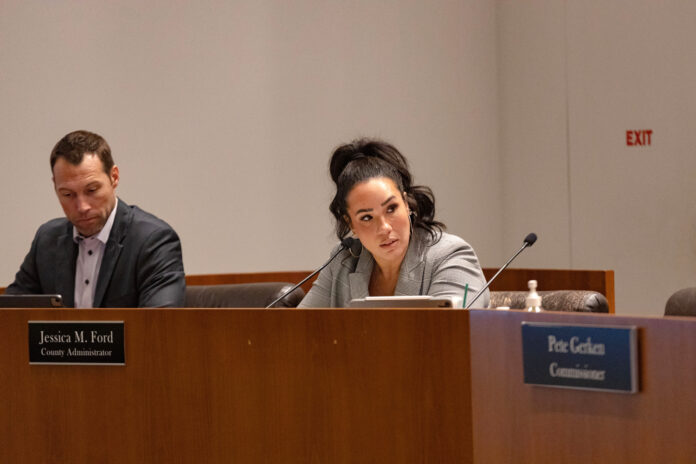
Jessica Ford, the county administrator, speaks during the Lucas County Commissioners’ Regular Meeting in the Commissioners’ Hearing Room on the first floor of 1 Government Center in Toledo, Ohio on Wednesday, Aug. 27, 2025. (TFP photo by Stephen Zenner)
TOLEDO – Both Lucas County Commissioners meetings on Wednesday went by quickly.
The 11 a.m. meeting contained the bulk of approvals and resolutions for the commissioners to consider. Lisa Sobecki and Anita Lopez were the only Lucas County Commissioners present for the meetings, but did not disagree on the business of the day.
Lily Varwig, a fourth grader at Escuela SMART Academy, led the pledge of a allegiance via a pre-recorded message before beginning the routines of the day.
Lily Varwig leads Commissioners meeting in pledge of allegiance during the Lucas County Commissioners meeting. (TFP Photo by Stephen Zenner)
“I will have to shamelessly mention that her grandmother is my assistant and in the commissioner’s office: Christine Varwig,” Sobecki said before calling the roll.
Item one on the agenda, “Reappointment of the Lucas County Public Defender Commission” was tabled by Lopez. The extension of the University Park Trail, Item Two, had its funding authorized in 2022, and Benjamin Pushka, the sustainability coordinator for Lucas County, said the only thing left was administrative approval, which was granted.
Item Three was a petition by the Sheriff’s department to apply for the FY2024 Edward Byrne Memorial Justice Assistance Grant, which was allowed.
“On behalf of the Lucas County adult Treatment Court program, I’m requesting your approval and accepting a grant from the Bureau of Justice Assistance in the amount of $678 with a cash match of $256,” Judge Ian English.
“This grant addresses two specific areas. Number one: the grant will fund home based therapists for our participants and their family,” he said. “In addition, the grant provides for peer support specialists through a certified UDL mental health condition service support; they will serve as mentors, role models and advocates, offering help and support and guidance.”
In the same vein, the next two items were from Juvenile Court and dealt with approving agreements for re-entry support services and services at the Community Treatment Center.
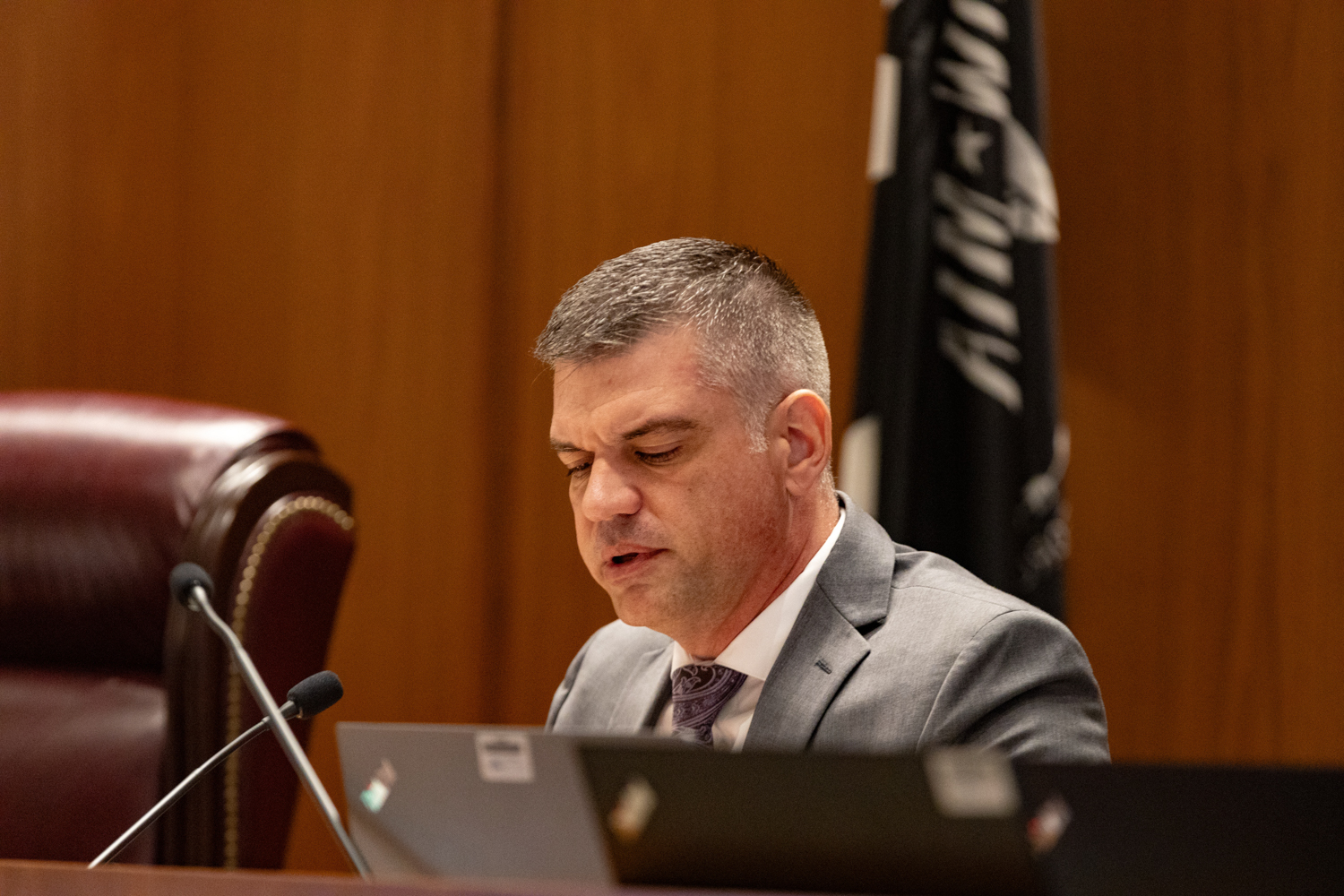
John Wenzlick, the budget director for Lucas County, introduces budget items. (TFP photos by Stephen Zenner)
4,677 square feet was approved for use by the Lucas County Coroner’s Office. Jeff Nowak, director of facilities, informed commissioners that 2595 Arlington Avenue, home to the coroner’s office, no longer housed the Lucas County Veterans Commission, so that space could be given to the Coroner’s.
“The coroner has asked for this space to improve their working conditions, maintain accreditation for their lab and increase operational efficiency, as well as complying to all standards,” Nowak said.
An amendment to the Capital Improvement Plan approved $424,882 for four projects: architectural engineering services for the jail roof replacement, architectural and engineering services for concrete repairs and mitigation of water intrusion on the jail, a heating and cooling rooftop unit on the EMS building at 2144 Monroe Street and engineering and replacement installation of the water service back flow at the fairgrounds.
Commissioner Sobecki was asked about the continued investment in the current jail, to which she said, “I don’t want to speculate until we get these dollars in, and then, amongst my colleagues, we can have a discussion about what that looks like.” In the meantime, the mitigation of water and new roof seemed to be imminent, fixes the commissioners were looking to implement once more information becomes available.
Anita Lopez, Lucas County Commissioner, hesitates before approving a work change order. (TFP photo by Stephen Zenner)
Lopez took issue with System Solutions items 11 and 12, which included a request for a change order and a contract amendment with Oracle for Human Capital Management and Recruiting.
“So Oracle actually has the audacity to try to get $1,262 from us for a few more hours,” Lopez said of the agenda items when presented. When asked about her reaction and her apparent hesitation to approve the request (she paused for a few moments before approving), she said, “I always have a concern with change orders, because change orders mean either we didn’t identify something we needed when we first implemented or we did not have maybe personnel who understood our needs.
“A lot of the customization requests need to happen while it’s being implemented. And so, if you don’t have individuals communicating what we truly need, then it gets more expensive along the way.
“$1,200 is very few hours…I can’t believe that they could not have accepted in the original contract, so it’s basically a forecast to me that, if they’re willing to bill for any little minor change, this is going to be a foreseeable cost.”
Resolutions brought forth by the Office of Management & Budget that were tabled from the last meeting passed, including item 15, providing for the issuance and sale of $37,455,000 of Lucas County bonds. These bonds provide a majority investment in the Hilton Garden Inn, connected to the Glass City Center, in downtown.
Sobecki argued for the renewal of the bond on Wednesday, and said they were just continuing to roll over the money from the last year, as they had done before.
“These are vital pieces of any big city or any city,” the hotel, Sobecki said, is important for people outside of Toledo to come, enjoy Toledo and choose to invest or come back to the city.
“You would have motels, hotels downtown, so that you attract people. They want to come into your town, they want to have a place to stay and have the experience,” she said.
The 11 a.m. meeting ended with the commissioners moving into an executive session, and then coming out of executive session at the beginning of the next meeting at 2 p.m.
The county hired one Specialist Two position at the Department of Job and Family Services at $19.50 per hour, an Elderly Specialist One position at the Department of Job and Family Services at $70.79 per hour, four Account Clerk Specialist positions at the Child Support Enforcement Agency at $18.16 per hour and Human Resource Project Manager at $34.36 per hour.
The second meeting began and then was over briefly with approval of items brought by the county and sanitary engineers.
Isaac Vacheresse, Maumee, a coach for Toledo Pickle Co., plays a game of pickleball at Toledo Pickle Co. in the Vistula neighborhood in Toledo, Ohio on Tuesday, Aug. 26, 2025. (TFP photo by Stephen Zenner)
Toledo Pickle Co. on Water St. offers more than pickleball courts
TOLEDO – A field house worth of socializing space opened up earlier this year at 1030 Water St., the new location of Toledo Pickle Co.
“I never wanted to pay to play pickleball,” said Kalen DeCant, of Sylvania, as she played a game of pickleball with her husband and two friends. “And we came to the opening and said, ‘Damnit, this place is nice.’”
Kalen DeCant, Sylvania, plays pickleball at Toledo Pickle Co. in the Vistula neighborhood in Toledo, Ohio on Tuesday August 26, 2025. DeCant once said she’d never pay to play pickleball, but said she was persuaded by the air conditioning, food and quality of the courts at Pickle Toledo. (TFP photo by Stephen Zenner)
In the middle of a live renovation of the waterfront spearheaded by Metroparks Toledo’s riverwalk project, an old building owned by the Metroparks has been given new life by tenants who wanted an indoor pickleball location in Toledo.
“The idea was to be a family entertainment center with a heavy lean on pickleball,” said Kimberly Sheldon, the director of marketing, membership and events for Toledo Pickle Co.
By “heavy lean on pickleball,” Sheldon means the old warehouse building, now completely renovated, is home to 10 indoor pickleball courts and two outdoor pickleball courts.
Before the business opened, the building “stored salt trucks and snowplows,” Sheldon said.
But the other half of the large hanger-like building has been turned into a restaurant, bar, and arcade.
What won DeCant over to Toledo Pickle Co. was the air conditioning, the good food, the well-maintained courts and the friendly staff.
Ping pong, shuffleboard and a small rock climbing wall make up some of the free group activities for those who don’t want to pay the $20 hourly (per person) charge for a court.
Bassel George, Sylvania, plays pickleball at Toledo Pickle Co. in the Vistula neighborhood in Toledo, Ohio on Tuesday August 26, 2025. (TFP photo by Stephen Zenner)
DeCant and her friends all have platinum memberships because they stop by every day. Garyck Hahn of Oregon, Ohio was in a match with DeCant. He said their group used to bounce around to different areas for pickleball, but “this is home now.”
The other activities are arranged around the championship pickleball court, where people sitting in the mezzanine of Toledo Pickle can watch finalists compete.
“You can come for the pickleball, or you can come for the party,” Sheldon said, emphasizing the multiple uses of the large spacious area on the waterfront decorated with multiple murals by local artist Dean Davis.
On tap are beers from local brewers like Earnest Brew Works, Maumee Bay Brewing, Inside the Five Brewing Company and Juniper Brewing that complement a variety of Midwestern entrees.
Live music is scheduled every Tuesday, Wednesday, Friday and Saturday, 6 – 9 p.m., with trivia on Mondays and karaoke on Thursdays.
With this variety of activities, Toledo Pickle hopes to become a communal location for downtown Toledo, while still holding space for diehard pickleball players.
Brian Macionsky, athletic director at Toledo Pickle Co., behind the front desk at Toledo Pickle Company in the Vistula neighborhood in Toledo, Ohio on Tuesday August 26, 2025. (TFP photo by Stephen Zenner)
“I only know the pickleball side,” said Brian Macionsky, Toledo Pickle Co. athletic director. “I started reading about Toledo Pickle, and thought, ‘Man, I need to be involved.’”
A pickleball fanatic since retirement, Macionsky meets players where they are, and offers training ranging from beginner clinics and one-on-ones to playing against a pro.
“Whether they’re seasoned players or brand new to pickleball, we’re trying to find something that fits everybody,” he said. “You could always play outdoors when the weather is nice; the problem was when the weather wasn’t nice.
“Once you get the bug to play pickleball, it doesn’t go away…You can play on a gym floor, you can play in a church, you can do other things. It’s not like playing at Toledo pickle,” he said.
And Sheldon mentioned the courts were made with Pro-Cushion, a material that is better on joints than other courts.
“This is state-of-the-art, the best courts, and we have now a lot of the best games right in this facility,” Macionsky said.
Toledo Pickle Co. is open 8 a.m.-10 p.m., Monday-Thursday; 8 a.m.-11 p.m. Friday-Saturday and 8 a.m.-9 p.m. on Sunday. The restaurant is open every day from 11 a.m. until the facility closes.
Photos & video by Stephen Zenner
Garyck Hahn and Lauren Duncan, Northwood, play a game of pickleball against Kalen and Tim DeCant in the Championship Court.Jenah Sayed, Monclova, hits a pickleball towards coaches Leslie Gill, Sylvania, and Isaac Vacheresse.Kimberly Sheldon, director of marketing, membership & events at Toledo Pickle Co. (TFP photo by Stephen Zenner)Sammy DeSelms, the executive chef for Toledo Pickle Co., in the kitchen of the restaurant at Toledo Pickle Company.Brian Macionsky, athletic director at Toledo Pickle Co.
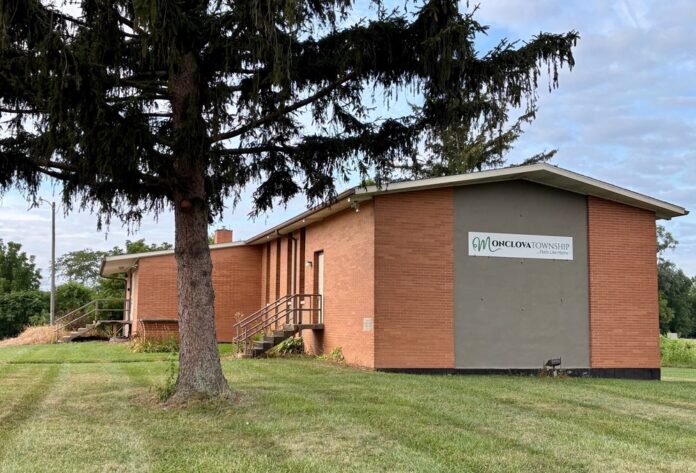
The former Hosanna Lutheran Church at 8353 Monclova Rd. was purchased by the township in early 2024. Monclova Township trustees are recommending that the United State Postal Service move its operation to the 4,794-square-foot facility. (TFP photo by Karen Gerhardinger)
Monclova seeks post office relocation, while Whitehouse begins park improvements
Monclova Township, with help from U.S. Rep. Marcy Kaptur (D-Toledo), is lobbying for the relocation of its post office from 7959 Monclova Rd. to township-owned property at 8353 Monclova Rd.
The village of Whitehouse has several park improvement slated for this fall, including the replacement of the entryway sign to Whitehouse Park.
And the Waterville Township Zoning Commission recommends adding language to its zoning book to allow data centers in agriculturally-zoned areas, with the addition of a conditional use permit. You can read more about this issue from an earlier TFP story here.
These are just a few of the news items coming out of meetings from the past few weeks in the Anthony Wayne area.
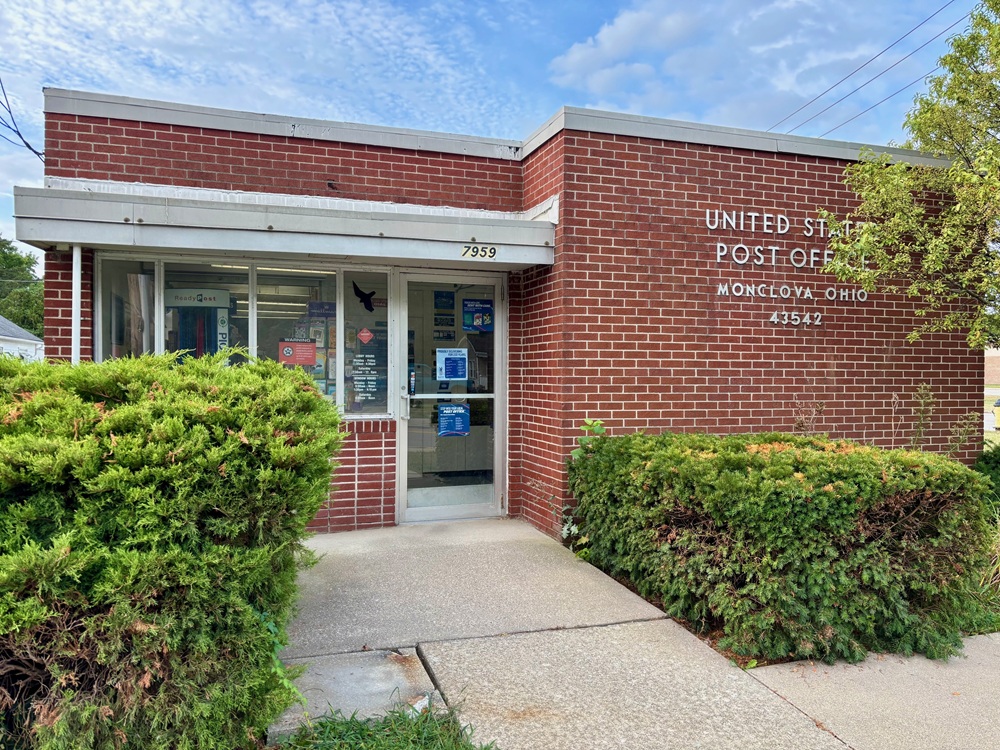
The Monclova Post Office at 7959 Monclova Rd. is just 1,160 square feet with no space to grow. Township trustees are asking the United States Postal Service to move the Monclova Post Office to a new location. (TFP photo by Karen Gerhardinger)
Monclova
Kaptur sent a letter to acting Postmaster General Doug Tulino on July 15, asking him to consider relocating Monclova Township’s post office from the 1,160-square-foot location at the southeast corner of Monclova and Waterville Monclova Road to a 4,794-square-foot former church that the township purchased in spring 2024.
The current post “lacks the infrastructure necessary to accommodate current demand,” Kaptur wrote, explaining that the lack of a drive-thru drop box, inadequate storage and restricted parking present service and safety issues. The current post office, constructed in 1961, will have traffic just 20 feet from its entrance after the construction of a roundabout at the corner of Waterville-Monclova and Monclova roads in 2026.
The township is ready to collaborate with the USPS on necessary modifications to serve the 15,000 residents, Kaptur said.
During the August 18 meeting, the trustees:
•Discussed Fire Chief Matt Homik‘s request to fill a vacant position with a firefighter/EMT unanimously recommended by all members of a hiring committee. Trustee Trudy Vicary voted no, stating a desire to hire a paramedic in order to fulfill the requirements of a three-year SAFER grant. Trustee Chuck Hoecherl voted in favor of the hire. Homik asked whether another voted could be held when trustee Barbara Lang is present to break the tie.
•Heard that the township’s Zoning Commission will review a request to rezone 8350 Stitt Rd. rear from Agricultural/Resident (A/R) to R-B Suburban Residential for developer Mark Rich to construct a housing subdivision. The property is landlocked and is designed for access through a southern, Waterville Township portion, through an existing street in Coventry Glen. The hearing was held on Monday, August 25 at 5:30 p.m.
•Set a public hearing for Tuesday, September 2 at 5:30 p.m. to hear a request to rezone 6740 Monclova Rd. from Agriculture/Residential to C-1 Neighborhood Commercial. The property owners, Marygrace Miller and Steven Chovanec, want the new zoning in order to market the property for sale.
•Heard that zoning administrator Eric Wagner recently joined discussions about preliminary site plans for a Casey’s gas station and convenience store at the northeast corner of US 20A and Briarfield Boulevard, and for a Ridi’s gas station at the northeast corner of Albon and US 20A. Wagner has also been working with Tigon Golf Carts, which is planning to open in the former Knucklehead Sports location at 10420 Airport Hwy.
•Heard that plans are under way for a Saturday, October 4 township open house, with tours of the fire station, games and other activities. The open house, set for 11 a.m. to 2 p.m., is for township residents only. The Monclova Community Center is also hosting a Maker’s Mart – open to all – that same day, from noon to 4 p.m. with local vendors and a Monclova class reunion for any former Monclova School students.
Whitehouse
The village will embark on several Whitehouse Park improvements this fall, including: a new sign and landscaping at the front of the park; the removal of the section of Gilead Street, which runs north/south through the park; renovations to convert the shelterhouse to a four-season building; and the painting and restoration of the exterior of the caboose near the train depot restrooms.
During the August 19 meeting, village council:
•Heard administrator Jordan Daugherty say that he has received several phone calls about the big increase in electric bills. This is not a local issue but one that is affecting the entire PJM grid, he said. The village is set to offer electric aggregation once it can lock in a lower rate.
•Urged residents to participate in the annual police survey that will be open during the month of September.
•Authorized a $48,000 contract with Kleinfelder Group for engineering services for Finzel Road resurfacing and a $33,125 contract for engineering services with OHM Advisors for Cemetery Road resurfacing.
Waterville Township
The Waterville Township Zoning Board recommended, during its August 18 meeting, adding language that would allow data centers to be built on agriculturally-zoned property with a conditional use permit. The next step is for the township trustees to hold a public hearing on Wednesday, August 27 at 6:30 p.m. at 621 Farnsworth Rd. in Waterville
During the meeting, the board also:
•Learned that the township’s Land Use Plan Update Committee met and is developing a 17-question survey to send out to residents. The information provided will help guide the future of the township, Moosman said.
•Heard that the Sisters of Notre Dame plan to install a solar array on its Davis Road property.
•Heard that the Lucas County Planning Commission will hear a request for a zoning change from Agricultural to RA-PUD (Planned Unit Development) 8346 Dutch Rd. The developer, Mark Rich, plans to build 71 houses on the site, with the only access through Jewel Crest Drive in Coventry Glen. An additional parcel to the north is being considered for rezoning by Monclova Township, as the Jenny Rogers property covers two jurisdictions. The county staff recommends rezoning, but a hearing is slated for 9 a.m. on Wednesday, August 27 at 1 Government Center. The township trustees will also hold public hearings at a later time.
Adam Martinez, Toledo Council Member for District 2, brings attention to O-289-25, an ordinance that would repeal an ordinance from the year 2000, O-303-00, during a Toledo City Council meeting on the first floor of 1 Government Center in Toledo, Ohio on Tuesday August 12, 2025. O-303-00 allows for the area around the intersection of Byrne Road and Angola Road to be zoned light industrial if certain criteria are met. (TFP Photo by Stephen Zenner)
TOLEDO – This is the final installment of our Toledo City Council coverage from the August 12 meeting.
Council members moved through ordinances O-300-25 to O-388-25 without incident until a last minute item, O-389-25, caused a stir with council.
Sponsored by Adam Martinez and Mac Driscoll, O-389-25 repeals legislation from the year 2000, O-303-00, which automatically facilitates rezoning over the same area disputed in the Rocky Ridge Development debacle, if certain criteria are met.
“Back in 2000, we had a rezoning process very similar to [the process with] Angola Road under a different code,” said Alex Schultz, a planner with the City of Toledo, when asked about this older ordinance.
“It was never officially rezoned, but ordinances do not expire,” Schultz said, and confirmed that if the area met the criteria in the ordinance, it could be rezoned without any input from city council.
Back in 2021 the owner of Clean Wood Recycling, Inc., Michael Kott, attempted to get the area rezoned to move their base of operations from 6505 Bancroft St, but was met with strong opposition from residents.
Back then, the city council voted the rezoning down. “They tried that before, and it didn’t go nowhere,” said Bill Hoag, a local residential property owner.
But now, a hold out against the rezoning back in 2021 sold their home at 3404 Marine Road, which may allow Clean Wood Recycling to move their base of operations to the coveted area near Angola Road, South Byrne Road and Airport Highway.
EMKOTT LTD bought the property on July 15 of this year, and that company is owned by John J. Mchugh III, a local attorney who has previously represented Kott Enterprises, Ltd., another company owned by Michael Kott.
Even though new owners may not be exactly the same, it was enough to put Hoag into action.
“He’ll be able to move his compost facility over there, which is where this all started, seven or eight years ago,” Hoag said. “We got it shot down several times, and here we are right back at this again. Well, since then, the only way to override that ordinance is to come up with a new ordinance.”
Following this line of thought, Council Member Martinez introduced the new ordinance 389-25 to quizzical faces.
“This is a unique ordinance that’s over 25 years old that will allow current residential land to be zoned light industrial, providing that a plat map is submitted and the proper setbacks and regulations are in place,” Martinez said, explaining the original ordinance 303-00.
Schultz from the plan commission confirmed that the Clean Wood Recycling mulch business would qualify to move to the area under light industrial zoning.
“This, I believe, was originally set for an industrial park from twenty-five years ago. What I’m asking for is really just to repeal this.”
Martinez assured his fellow council members that this would not prevent the rezoning of the land in the future, but that if a motion was made to rezone the area it would just have to go through the standard transparent process with city council instead of simply meeting qualifications along with a submitted plat map.
First reading on the ordinance was requested, and Martinez also requested looking through other legacy ordinances to repeal ordinances that may rezone land simply with proper submitted materials instead of an open democratic process.
John Hobbs III, Toledo Council Member for District 1, addresses the attempted repeal of O-303-00, and said he took the attempt as “disrespect” since the ordinance addresses a platt within his district during a Toledo City Council meeting on Tuesday, August 12, 2025. (TFP photo by Stephen Zenner)
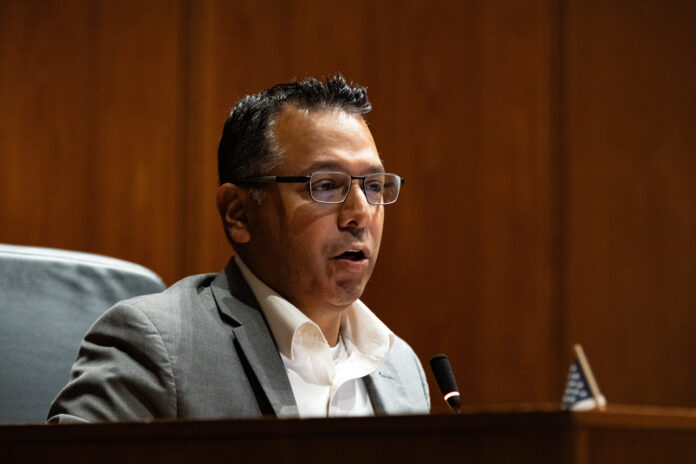
“I was going to also refer to this, go to first read, but for a different reason,” said Council Member John Hobbs III, in response to Martinez. “but because I am the district council person for this area and there has been no discussion with me, none whatsoever, about any of this.”
According to Hobbs, he received a phone call from Martinez. “He wanted to inform me that this was going to take place today, and there was no discussion with me. So if there’s anything that’s going to be led out of District One legislatively, it’s going to come from me as the district council member.”
Hobbs said, “I don’t—” then shook his head and moved his fingers, obviously frustrated, and began after a brief pause— “with anyone else’s district, and so before this goes forth…” Hobbs said he hoped he would be a larger part of the discussion before any further action was taken.
Without Hobbs being a more prominent role in the proceedings concerning his district he said, “I will take that as a strong form of disrespect.”
It should be noted that Hobbs was one of the only council members to vote in favor of changing the area in question to industrial zoning for use by Rocky Ridge Development against the grass roots Don’t Dump on South Toledo group. Residents of the area submitted over 200 signatures, mostly from Angola Road, South Byrne Road and Marine Road, against rezoning the area to general industrial, which Hobbs vocally supported.
Hoag, who owns multiple properties in the area, including the house in which he grew up, said after the council meeting, “Hobbs needs to go.”
Before Hobbs began, Martinez said that there was no rush to push the legislation, something Hoag would disagree with.
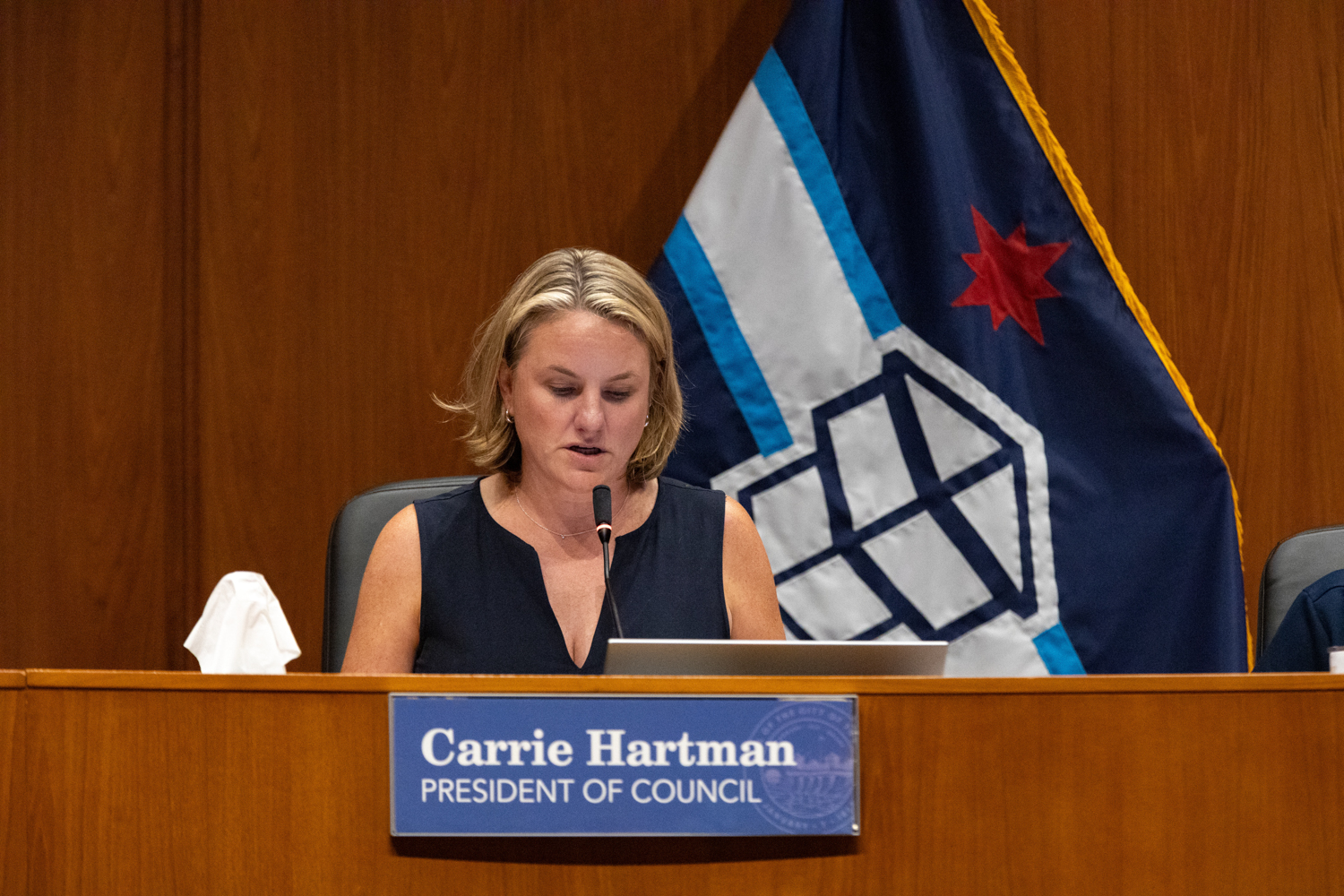
Carrie Hartman, Toledo City Council Member At-Large and president of Toledo City Council, said that since O-389-25 was not urgent, it shouldn’t have been added to the agenda at the last minute during a Toledo City Council meeting on Tuesday August 12, 2025. (TFP photo by Stephen Zenner)
Carrie Hartman, president of Toledo City Council said, “If there was no rush to this [O-389-25], I don’t know why we needed to give it immediate consideration.”
Regardless, Martinez motioned for immediate consideration, and the ordinance 389-25 moved to first read. However, the council did not vote on the ordinance then and there.
There were no objections, but council members voiced confusion about the order of operations and how to proceed with the legislation.
After the council meeting, Hoag voiced his disappointment, and wished Martinez was more adamant about voting on the ordinance.
“It’s a screwed up mess, the way they handled that,” he said referring to the council as a whole. “It was brought to their attention, and now they’re passing it off for a month. There’s no reason for that.”
“That’s what they did on Rocky Ridge. Same properties, same mess,” he said, and expressed frustration and worry about Kott’s mulch business moving into the area.
In his closing remarks, Martinez apologized to Council Member Hobbs, said he didn’t mean any disrespect, but also clarified that communication was “a two way street.”
Press talked with Martinez during which he clarified his thoughts on introducing the new ordinance.
“The whole community around it [the area] has changed [since 2000], and they should have some say in what happens there, whether it’s with this owner, the next owner…light industrial [rezoning] provides a lot of potential issues that aren’t neighborhood friendly. It does not necessarily comply with the forward Toledo plan, which earmarks that area for a combination of residential and somewhat industrial, just not as heavy intensive use as the ordinance currently allows.”
As far as Hobbs’ frustration, Martinez said, “I was not anticipating doing this this quickly, so it was my fault for not having a more robust conversation with them [all of City Council], but I alerted all the members via phone call or via text,” and he added that he had sent Council Member Hobbs multiple emails before the meeting.
The Toledo Free Press reached out to Council Member Hobbs after the meeting, but did not hear back from him. The day after the meeting the Toledo Free Press stopped by the City of Toledo Plan Commission to see if a plat had been filed to change the zoning, at the time, Wednesday, Aug. 13, and the city planners informed the Toledo Free Press there was no application at that time.
The Toledo Free Press also reached out to Clean Wood Recycling, Inc. to see if they had plans to move their facility anytime soon, but did not hear back from them.
Mike Ferner, holds the hand of his wife, Sue Carter, during a Toledo City Council meeting where he is recognized for his activism on the first floor of 1 Government Center in Toledo, Ohio on Tuesday August 12, 2025. (TFP photo by Stephen Zenner)
A lifetime of service in activism
TOLEDO – During the Toledo City Council meeting on Tuesday, Aug. 12, Mike Ferner, a local activist and veteran, was honored.
Julie Gibbons, the clerk of council, announced Ferner’s recognition for civic courage and activism, and a wave of applause followed Ferner up to the podium before city council.
Council bestowed upon Ferner the Civic Courage award in light of his dedication to compassionate causes, including his advocacy for Palestinians in Gaza, work with the Lake Erie Advocates and other anti-war advocacy during the Iraq War.
Nick Komives was the first council member to address and thank Ferner for his activism. Back in 2003 Komives’ first protest was an anti-war protest at the Franklin Park Mall, and that is where he first met Ferner.
“We all owe a debt of gratitude to you,” Komives said, and he also highlighted Ferner’s wife, Sue Carter, for her role in community activism as well.
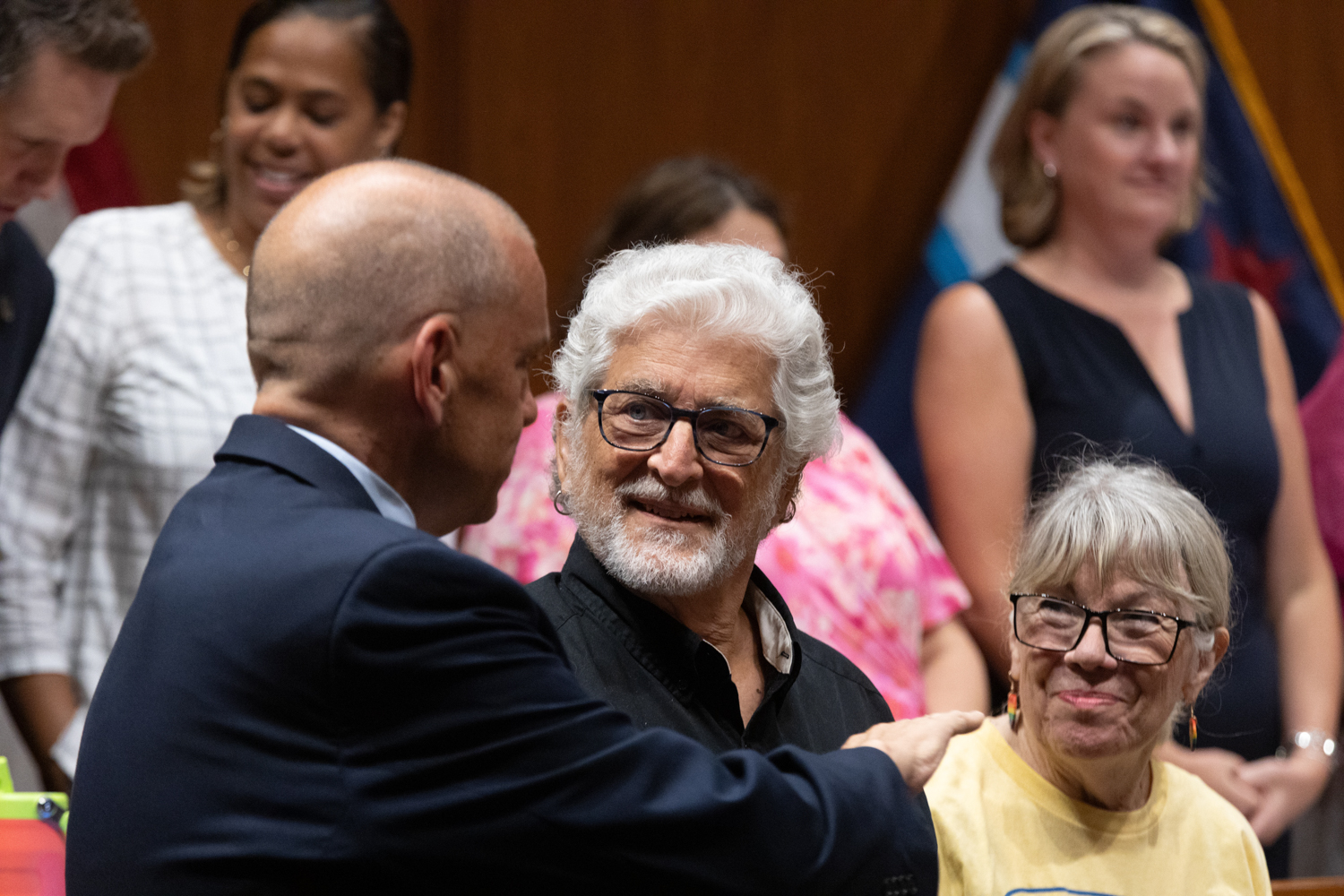
Toledo Mayor Wade Kapszukiewicz speaks with Mike Ferner, a local activist and veteran, and his wife, Sue Carter, as Ferner is recognized for his activism and impact on Toledo during a Toledo City Council meeting. (TFP photo by Stephen Zenner)
Council Member Sam Melden thanked Ferner for his work through Lake Erie Advocates, which was his individual touchstone with Ferner.
“When someone comes in to get a resolution, and packs a room like this, that is obviously a sign. And I love that there are almost multiple different shirts and buttons that connect to what you’ve done,” Melden said.
District 6’s representative, Theresa Morris, kept her words short, and thanked Ferner for being tireless in his work to advocate on behalf of others in need.
Ferner, like Baumhower, pointed to the people surrounding him, whom he said deserved the same recognition he received.
“You will meet the best people that you’ve ever met in your life if you get involved in a progressive political movement,” he said, and then asked the sergeant at arms to bring his wife, Carter, up front to be with him.
When she joined him, Ferner said, “This is a person that has allowed me to do what I’ve done.”
Ferner expressed sadness at the state of federal politics, but said there was room for people to get involved on the local level.
“Government is the vehicle by which we express our love for each other,” Ferner said, and expressed sadness at the state of federal politics. But followed up by providing an outlet, “Here at the local level you can do that, we can do that.”