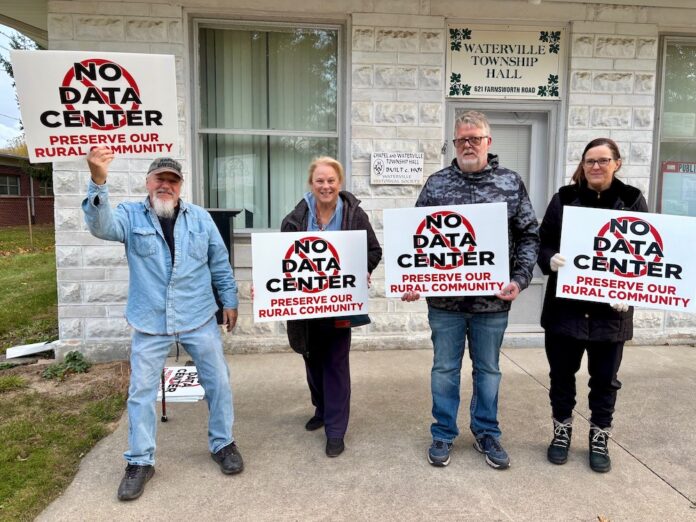
WATERVILLE TOWNSHIP – The dozens of Anthony Wayne-area residents who filled the basement of Waterville First Presbyterian Church on Oct. 29 came to share their opinions about data centers with Waterville Township trustees. While trustees Kim Anderson, Kyle Hertzfeld, Julie Theroux and incoming trustee Toby Miller fielded those questions, an overall theme beyond data centers also emerged – the future of the township.
For the fourth time in the past 18 months, the trustees have placed a levy on the ballot to generate income for the General Fund. Currently, residents pay an average of $13 a year toward the fund, which covers expenses beyond police, fire, EMS and roads. And it’s not enough to keep the township going, Hertzfeld said.
“Without the General Fund, there really is no township. We’ll be out of money in a year and a half,” he said. “We can’t take money from any other fund and put it in the General Fund; it’s illegal. I’m pleading with you to at least look at AREIS and look at what you’re paying.”
After reading what he called “totally wrong” information about the levy on Facebook, Hertzfeld suggested that residents go to the Lucas County Auditor’s website to see just how much of their property taxes go to the township and the General Fund in particular. The township receives 18.09 percent of property taxes. Of that, just .33 percent – or $22,000 a year – supports the General Fund. That’s about $20 a year for a home valued at $330,000.
A citizen committee including resident William Walborn paid for postcards to be sent out to all residents about the levy, which is Issue 9 on the ballot. The request is for a 3.5-mill levy that will cost about $10 a month per $100,000 in home value, to generate $398,800 a year.
These funds cover township hall operations, zoning and planning, legal and audit compliance and community services. It also supports the Police Department’s budget, which is strained because of increasing costs for equipment and training, even while officers are the lowest paid in the county, noted Miller.
If the township doesn’t have enough money in its General Fund, the state would place the township into fiscal emergency and the state would make decisions on funding.
“Honestly, I don’t know what the state is going to do if it doesn’t pass,” Hertzfeld said.

As costs for basic services go up, the township has three choices: raise taxes, reduce services or increase revenue by growing the economy, said Bill Burkett, a township Zoning Commission member and senior planner with Regional Growth Partnership. Burkett, along with Lucas County Economic Development Department director Matt Heyrman, spoke about how the LCEDD and RGP have teamed up with JobsOhio to look for sectors to pursue in order to grow the county’s economy – including data centers.
“Growth is inevitable. Growth can diversify our economy and pay for the services we need,” Burkett said.
“I would rather people vote for a levy than to get a data center,” said Tony Braida, one of several residents who addressed trustees.
Lisa Haberstock agreed.
“We have to get this passed,” she said, holding a flier about the levy. “What’s going to happen if this doesn’t pass? If the state takes over, will they care that people don’t want a data center? The data center will be here if we leave it to the state.”
She encouraged the township residents to band together with other Anthony Wayne area residents and leaders to fight the efforts to bring a data center to the area, whether it’s Waterville Township, Monclova Township, Waterville or Whitehouse.
In April 2024, Heyrman and RGP began digging into the pros and cons of data centers, and whether they would work in the county. Access to land, water and power, as well as the proper zoning and community acceptance, are all necessities. Some of the planning documents were shared on the AW-CRAP Facebook page, but weren’t meant for public distribution because they’re just ideas as they work on a plan to attract developers, Heyrman said.
“Data centers only want to come into communities where they’re welcome,” Heyrman said, adding that a community’s unwillingness to change zoning is a signal that data centers are not welcome.
“Didn’t we just do that?” asked Janice Braida, referring to Waterville Township’s Sept. 27 vote to allow data centers in agriculturally-zoned areas with a conditional use permit.
Mike Daum and Todd Heller both questioned the timing of how long data centers have been pursued, citing changes in zoning and realtors seeking agreements with landowners.
Last spring, Theroux began hearing from farmers that realtors were approaching them about options to sell. So the trustees hired a Columbus law firm to represent the township’s interest, and then moved forward with a text amendment to its zoning code. This allows the township to specify conditions regarding lighting, sound, landscape, buffers and other factors.
“It gives us control to make sure they’re thoroughly vetted. Without the text amendment, we face serious risk,” Theroux said, noting that the township does not currently have a proposal for a data center. “We want to make sure we have a voice in future proposals.”
Reading a list of headlines warning of the downsides of data centers – including public health, rising electric and water rates, and the consumption of valuable farmland, Janice Braida urged the trustees to represent the citizens.
“We are putting our trust in you to protect our community from big tech data centers that are stealing from everyday Americans,” Janice Braida said, encouraging trustees to look into a moratorium or ban on data centers.

Toby Miller, who is running unopposed to fill Kim Anderson‘s spot on the board of trustees, said courts have ruled against long-term moratoriums. A short-term pause for a safety or other evaluation is fine, but a ban would open up the township to lawsuits as it would be seen as an infringement on landowner rights.
“The General Fund doesn’t have enough in it to pay for legal fees,” Miller said. “If you pass a ban, they (landowners) can just file to annex their land into a neighboring community. They’ll take the land out of our jurisdiction and do what they want to do, and we’d lose the tax revenue.”
Resident Arnold Graf asked how much revenue the township or schools would stand to gain, while Tony Braida questioned the need to give tax breaks to huge tech companies. Each jurisdiction would need to negotiate its own agreement, Heyrman said, explaining that a payment in lieu of taxes (PILOT) agreement would funnel the money into the township and the schools.
For David and Amy Lindquist, who have been farming in the area for over 30 years, the news that their neighbor was looking at selling land for a data center was like a gut punch.
“I know a lot of people see dollar signs. If this was in your neighborhood or across the street would you want this for your family? Take the time to put yourselves in our shoes,” Amy Lindquist said. “People tell us that we use data. Well, we use a toilet every day, but it doesn’t mean we want to live next to a sewage treatment plant.”
The Lindquists are concerned about the ongoing hum that neighbors of some data centers report hearing constantly. Susanne Peats brought up long-term health and environmental costs, including on the Great Lakes. She asked who would clean up the data center site when it became obsolete.
Russ Schifferly urged the community to think about the impact of artificial intelligence (AI) on society, and how greed influences decisions. A Neapolis-Waterville Road resident, Schifferly said he’s often outside at night and hears drones flying over multiple times a week, collecting data to sell to the government and other entities.
“Eventually our freedoms get taken away by organizations that want to control the people,” he said. “We are helping to facilitate the takeover of artificial intelligence that will take over our society. This is a societal issue.”
“It’s Terminator from 1984,” chimed in an audience member, referring to the futuristic blockbuster movie with Arnold Schwarzenneger.
Theroux encouraged residents to stay informed, including attending a Thursday, Nov. 20 town hall meeting from 5:30 – 7:00 p.m. program at Anthony Wayne High School. Moderated by Jerry Anderson and live streamed on WGTE, the event is sponsored by RGP and LCEDD and will include a panel of experts on data centers. Questions may be emailed in advance to [email protected].
During the meeting, the trustees also:
-Encouraged residents to go to watervilletownship.com to gain access to a land use plan update survey. About 179 responses have come in so far, Anderson said, but more voices are needed as the township plans for its future.
-Approved a joint cooperation agreement with the county to pay for the Swan Creek ditch maintenance, using approximately $54,000 in storm water funds to cover the cost for residents.
-Learned that police officer Joel Turner is resigning to take a job with Norfolk Southern. Chief Kevin Smith announced the hiring of David Terry and George Roush to part-time positions.
-Set a public hearing on a request to rezone 8346 Dutch Rd. from Agricultural to R-A Suburban Residential with a planned unit development (PUD). The meeting will be held on Wednesday, Nov. 19 at 6:30 p.m. It may be moved from the township hall at 621 Farnsworth Rd. next door to Waterville First Presbyterian Church.