Home Blog Page 44

AWHS honors veterans, adds names to Military Wall Of Honor

0
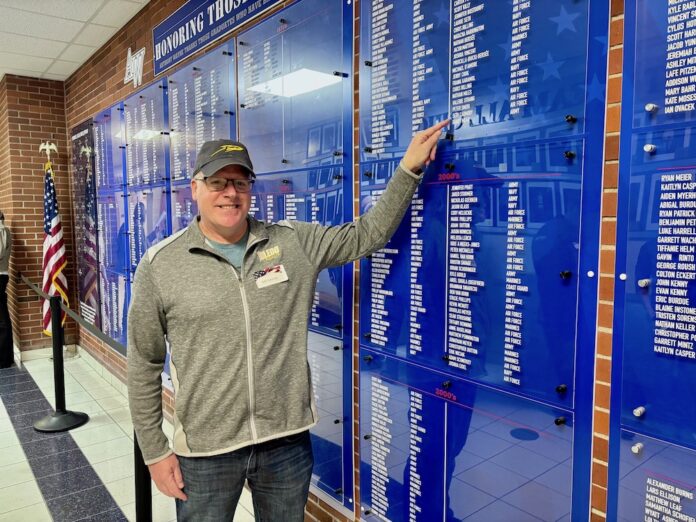
Seth Carmody, a 1992 graduate and Air Force veteran, points to his name on the school's Military Wall of Honor. (AWFP photo by Karen Gerhardinger)

It’s been over 60 years since Terrence Huebner was killed in action in Vietnam, but his fellow Anthony Wayne High School graduates – Doug Mold, Rick Myers and Ralph Whalen – remember him well.

“In a class of 150, we all knew each other,” said Myers, as he enjoyed a special Veterans Day breakfast sponsored by the school on Nov. 5. “He was a nice guy. He was quiet, taller than most, and well-liked.”

Huebner, who was in the Army, was killed in action in Vietnam in 1969. Mold, who joined the Navy and was selected for the Seabees, served a one-year tour in the Mekong Delta in Vietnam. Myers was in the Army National Guard. 

“The general feeling among the young men at that time was that it was our duty to serve our country,” Mold said of the trend to join the military in the 1960s.
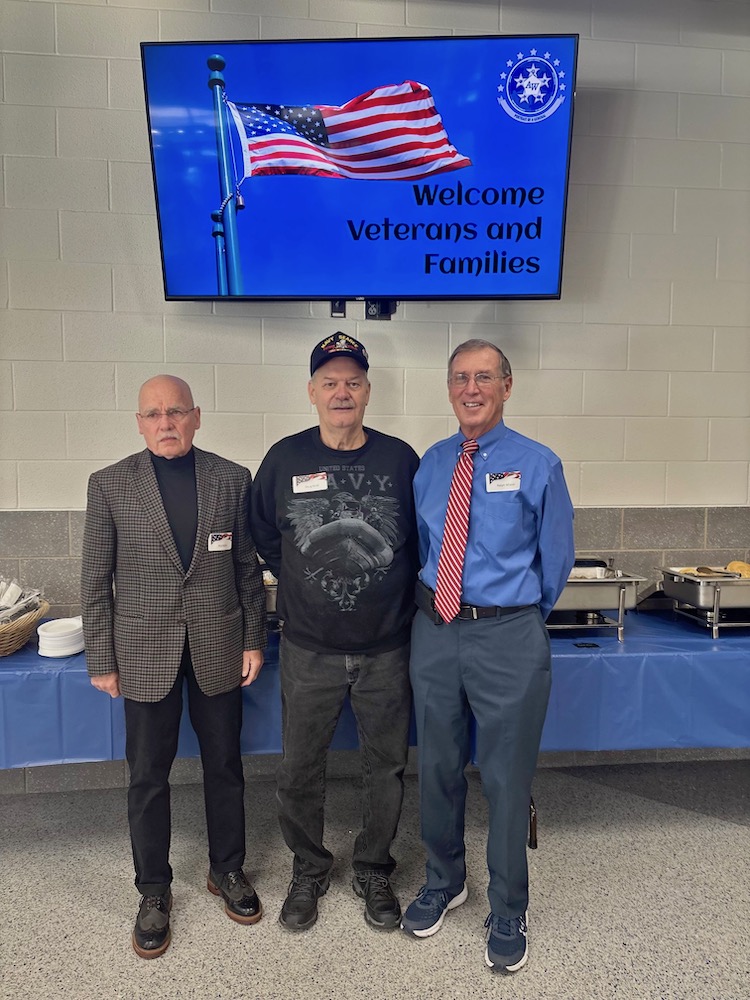
Friends of Terrence Huebner, who was killed in action in 1969 in Vietnam, gathered to see the 1961 graduate’s name added to the wall. Pictured are (from left) Rick Myers, Doug Mold and Ralph Whalen. (AWFP photo by Karen Gerhardinger)

While Whalen didn’t serve – as he was training to become a vascular surgeon – he did spend two weeks a year for five years on rotation at Landstuhl, Germany Regional Medical Center, treating soldiers who were fighting in the Middle East.

“This man supported the military and saved many soldiers’ lives,” Myers said, pointing to Whalen.

The Veterans Day ceremony hosted by the high school provided an opportunity for veterans to mingle over a hot breakfast while sharing stories of AW graduates whose names were added to the Military Wall of Honor this year. 

Sharon and LeRoy Roberts attended on behalf of their grandson, Garrett Mintz, a 2019 graduate who served in the Army National Guard and is now a teacher in Tiffin. Joshua Gerity, a 2002 graduate, joined the Army in 2010, and came to the breakfast with parents Rob and 1979 graduate Tonia (Young) Gerity. 

Jake Cope wore a United States Marine Corps hat and vest as he stood with his son, Brian, and daughter-in-law, Sarah Cope in front of the wall that now bears the name of his grandson, 2024 graduate Jake Cope. The younger Cope must have been inspired by his grandpa’s stories of the Marines, and decided his sophomore year to join “the few, the proud, the Marines.” He is now training at Camp Pendleton in California.

Ronda (Whitaker) Cobb, a 1978 graduate, wanted to go to the U.S. Military Academy at West Point, but was selected as an alternate. Instead of waiting a year, Cobb joined the United States Merchant Marine Academy, graduating with a degree in marine engineering. While at the high school to see her name added to the wall, she shared a brochure about the USMMA with counselors, in order to inform students of the benefits – chiefly that graduates can then join any military branch as an officer. 
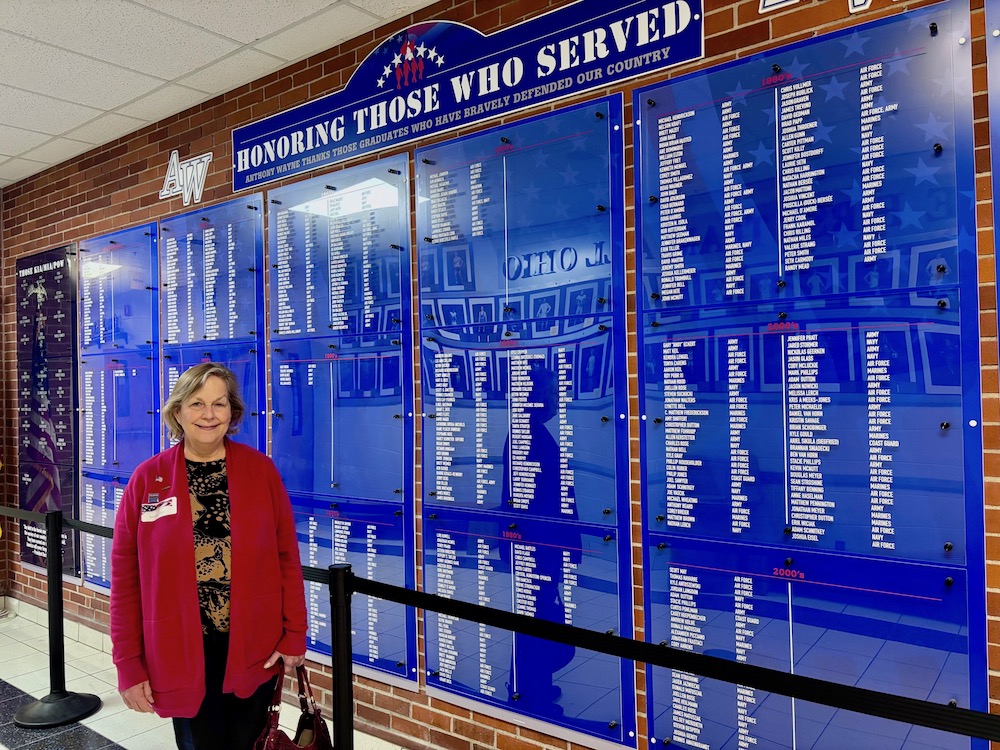
Ronda (Whitaker) Cobb, a 1978 graduate, opted for the United States Merchant Marine Academy, graduating with a degree in marine engineering. Her name was added to the wall this year. (AWFP photo by Karen Gerhardinger)

Following the breakfast, the veterans were treated to patriotic music by the band and Close Harmony Choir and a reading of the names by Principal Jon Burke. Chris and Karen Brennan came to honor Karen’s late brother, Gary Buerk. A 1961 graduate, Buerk joined the Air Force for two years, and spent most of his life involved in community theater, including his own 3B Productions.

Seth Carmody, a 1992 graduate, was among those who stood as the band played his branch’s song. He joined the Air Force because he was in need of funding for college, Carmody said after the ceremony.

“It was a great avenue for tuition assistance. And after my first enlistment, I wanted to continue,” said Carmody, who is now the deputy director of sustainment at the 180th Fighter Wing – a place that he describes as “family oriented” and “full of ordinary people doing extraordinary things.”
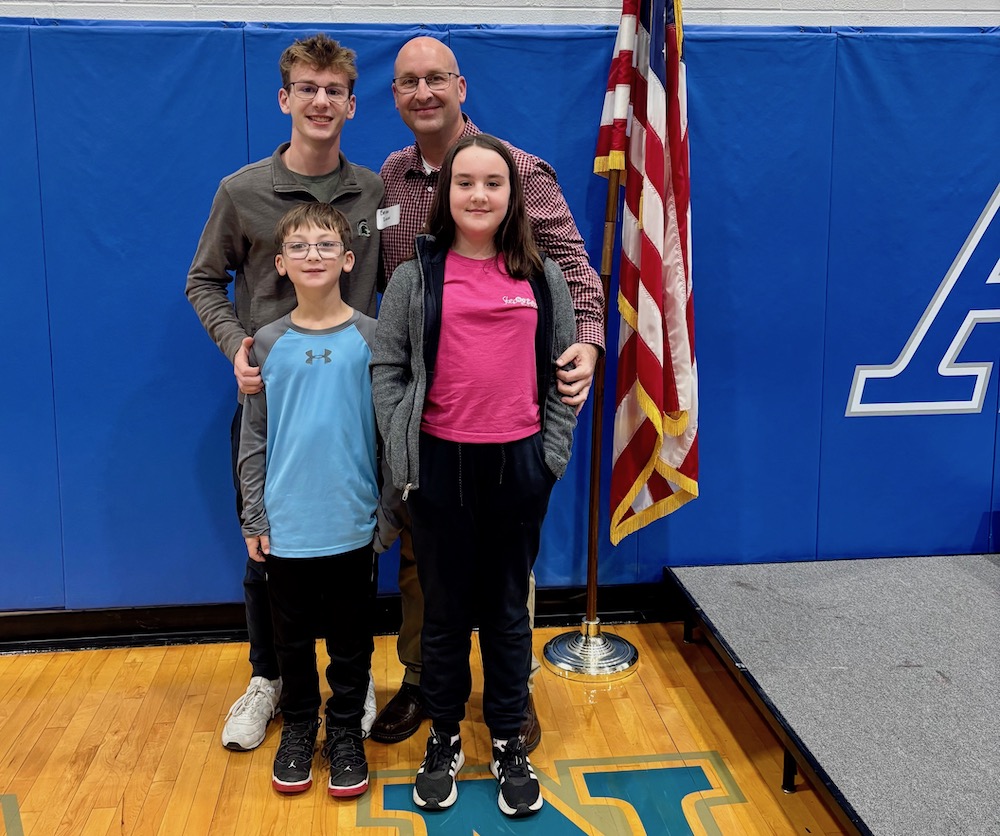
Master Sgt. Brian Rozick, the 180th Fighter Wing’s command chief, joins his children, including AW senior Ethan, sixth-grader Zoe and fourth-grader Zane after the November 5 program. (AWFP photo by Karen Gerhardinger)

The 180th Fighter Wing’s command chief, Master Sgt. Brian Rozick, was the guest speaker, telling the students his own story of military service that has taken him all over, eventually landing at the 180th as a firefighter, fire chief and now second in command. His job is to ensure that the 1,100 people are organized, equipped and ready to do their job at a moment’s notice, and that includes defending the nation.

“After traveling the world for 28 years, I have seen that the United States of America is by far the greatest country on the face of this planet. We have all been given a gift to be here. It doesn’t happen by accident. It happens by a lot of hard work,” Rozick said.

The United States is one of the few countries that has an all-volunteer force, and that means that it’s filled with people who want to serve. Even those who are not interested or able to serve in the military can do their part to give back, through volunteering, being politically active, being an educator – anything to keep the country moving forward, he said.

“You live in the greatest free country in the world. Work at it. Try to do something that makes this a better place,” he said.

The Anthony Wayne High School Military Wall of Honor, established in 2019 to recognize the sacrifices of AWHS alumni and employees who have served, or are actively serving in the armed forces, stands as a permanent testament to their dedication and courage, said assistant principal Stephanie Buckenmeyer. The wall now has 733 names of alumni or district staff who have served or are currently serving, arranged by decade and listing the names and branch of service. 
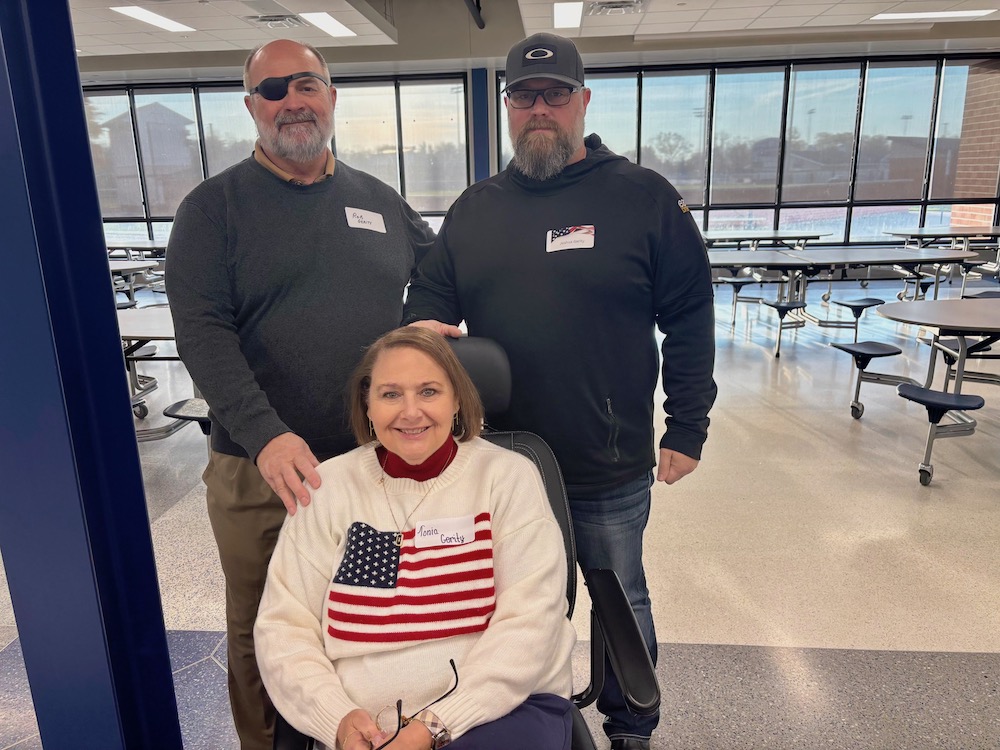
The Gerity family, including Rob, 2002 graduate and Army veteran Joshua, and 1978 graduate Tonia (Young) Gerity, enjoyed a breakfast reception at the high school. (AWFP photo by Karen Gerhardinger)

“For all of their dedication and sacrifices, we thank them, their friends and their families,”  Buckenmeyer said. “We also extend our gratitude to the troops that are currently serving both domestically and overseas.”

Names are being accepted for the 2026 Military Wall of Honor inductees. For information, email [email protected].

This year’s inductees, their graduation year and branch of service include:

Earnest James Davis, 1958, Air Force

James Young, 1958, Navy

Gary Buerk, 1961, Air Force

David Gluntz, 1964, Army

Terrence Huebner, 1964, Army

Wayne Graves, 1965, Army

William Hayes, 1966, Army

Ronda (Whitaker) Cobb, 1978, Merchant Marines

Lawrence Studer, 1978, Air Fore

Debbie (Hertzfeld) Pantle, 1979, Air Fore

Joseph Perkins, 1982, Marines

Chester Reed, 1986, Navy

LeAnne Thomas, 1987, Navy

Dawn Thomas, 1987, Navy

Seth Carmody, 1992, Air Force

Peter Smith, 1992, Air Fore

Randy Mead, 1999, Army

Joshua Gerity, 2002, Army

Dennis Ankenbrandt, 2008, Air Force

Christopher Podbielniak, 2013, Marines

Kaitlyn Casper, 2019, Air Force

Garrett Mintz, 2019, Army

Jake Cope, 2024, Marines

Abigail Rutz, 2024, Air Force

Daylight Saving Time: impact on Alzheimer’s and dementia patients

0
Pexels photo by Andrea Piacquadio

TOLEDO- Daylight Savings Time ended on Nov. 2, bringing with it an extra hour of darkness in the evening. DST can bring more than just an adjustment to sleep schedules, especially for those living with Alzheimer’s disease and dementia.

The Northwest Ohio Chapter of the Alzheimer’s Association is the largest nonprofit voluntary health organization in the world that focuses on the fight against Alzheimer’s disease and dementia.

Pam Myers, senior director, programs for the Alzheimer’s Association, oversees the Northwest Ohio Chapter and the Central Ohio Chapter. 

“Our mission is to support families and caregivers and folks living with the disease, support research, advocate for all people living with dementia and their caregivers and eventually find a cure,” Myers said. 

Pam Myers, senior director, programs for the Alzheimer’s Association Northwest and Central Ohio Chapters. (Photo courtesy of Alzheimer’s Association of Northwest Ohio)

With the time change, Myers explained the ways one can help support someone with Alzheimer’s or dementia. 

“Folks that are living with dementia…they tend to get more tired, confused, irritable, and when it gets dark sooner or when the time changes, sometimes that tendency to have confusion and agitation increases,” Myers said. 

The Alzheimer’s Association started on a national level in 1980 with the founder Jerome H. Stone

“His wife was living with dementia and he [Stone] was just looking for resources and looking for other people that were on the same journey, because this is a progressive disease,” Myers said. 

There is a wide range of services available at the association:

  • Community education programs about dementia and the symptoms 
  • Awareness presentations about Alzheimer’s and dementia updates
  • Training for caregivers
  • Guidance for transitions for home care
  • Programs emphasizing early detection and diagnosis of Alzheimer’s
  • Support groups 
  • A 24/7 Helpline 
  • Care consultation to personalize support 

All of the services provided at the Association are free of charge. 

Myers said it’s helpful when caregivers can give individuals with Alzheimer’s and dementia structured schedules so that they know what’s coming next. 

“A person living with dementia has to really think through all the different steps in a process. So in turn, they get very tired by the end of the day and so that kind of contributes to the confusion and they’re just tired after all of their day’s activities,” Myers said. 

She recommends that people should keep the lights on longer at night to keep the space bright. 

“Keep the house more well lit, keep people to their routines as much as possible, and try not to schedule over-stimulating activities late in the day, and you want to try to keep the person as calm as you can,” Myers said. 

“Think about just when you go to work in the morning; you get up and you eat and you brush your teeth and you get in your car and you walk into the office. I mean, we do that just almost automatically. A person living with dementia has to really think through all the different steps in a process,” Myers said.

Adjusting to time changes is difficult for everyone, especially those with Alzheimer’s and dementia. If you need help finding resources, visit alz.org/nwohio. The 24/7 Helpline (800-272-3900) is available for anyone who needs it.

From soldier to mentor: Bill Kieffer’s mission beyond the military

0
Kieffer has published two books and helped thousands of veterans with his work and through the website veterancareerjourney.org (TFP photo by Gaven Hafner)

ELMORE – For William E. “Bill” Kieffer, serving his country was never just a career, but a calling.

“I’ve always wanted to be a soldier,” Kieffer, an Elmore native who graduated from the University of Toledo, said. “I have a long family history. My dad was a veteran, my granddad was a veteran, my great uncle was a veteran…I had two uncles and an aunt that were veterans.”

Kieffer served nearly 12 years as an Army logistics officer, from 1985 to 1997, leading missions from Central America to Somalia. 

“I supported the Panama invasion,” he said. “When the equipment that our forces in Panama captured [Manuel] Noriega’s equipment, they shipped much of it back to Fort Ord, California, and the unit that I was second in command of, we had the responsibility to demilitarize it. It was cool.”

His service also brought him into the heart of natural disaster. 

“I was part of the military response to Hurricane Andrew in ‘92,” Kieffer recalled. “We set up in South Dade County and helped to do all the recovery and restoration work after that horrible nightmare of that hurricane.” He added, “When we went down there to do that work, I saw the best and worst in people; it was truly a society that had fallen apart, and seeing that firsthand and trying to do good work in that kind of an environment…it really left an impact.” 

Throughout his 12 years in uniform, Kieffer commanded platoons, companies, and battalions, supporting up to 5,000 soldiers at a time. 

“That was the most rewarding: knowing that I was working with and leading really good people to go do work that mattered.”

After his service, the transition to civilian life wasn’t easy.

“My transition out of the military came as a result of a divorce,” Kieffer said. “So, when I left the military, it wasn’t just leaving a job; it was loss of family, it was loss of career and loss of all that, not knowing what the future was going to look like. It was a very tough transition, and that experience motivated me to do what I do now.”

In 2018, after surviving a massive heart attack, Kieffer decided to leave corporate life to start his own business. Kieffer & Associates LLC is a leadership and career coaching firm that has a heavy focus on helping veterans transition to new careers. He later cofounded the nonprofit Veteran Career Journey, an organization dedicated to bridging the culture gap between veterans and employers. 

“Employment-related issues are a contributor to veteran suicide,” Kieffer stated. “We not only want to close that culture gap, but we want to do what we can with our skill sets to help reduce veteran suicide.”

Since founding the nonprofit, Kieffer has trained and coached over 2,000 veterans worldwide, often without taking a salary. 

“This is passion work for me,” he said. “The moments that I value most is when I get the calls, the emails, the LinkedIn messages from coaching clients that say, ‘Hey Bill, remember when we were talking about this opportunity? I got it,’ or, ‘You wrote something in your book and talked to me about this topic, and that made all the difference in my ability to transition.’ Those things are worth gold.”

In 2021, Kieffer’s book, “Military Career Transition: Insights from the Employer Side of the Desk” was a bestselling new release on Amazon in its category (TFP photo by Gaven Hafner)

“I think the work I do now as a veteran, and with veterans, is to help not just the veteran community succeed, but to help the business world succeed too, and overall society. It’s about helping people better understand each other and the value they bring and the opportunities they present; that’s really what I’m trying to do.” 

When asked what he hopes his legacy will be, Kieffer paused before answering, “I hope when I’m gone, people say, ‘He helped.’”

At its core, Kieffer’s story is one of service to his fellow man that never stopped; he only changed battlefields.

Utoledo offers in-state tuition to Michigan students

0
Statue mascots Rocky and Rocksy. (TFP photo by Steven Bieber)

Michigan enrollees now eligible for in-state benefits

TOLEDO – One of the most significant factors for students choosing selecting a college is cost. An overwhelming majority of students choose to attend college in their home state to take advantage of lower tuition rates. Thanks to a new policy change, students in Michigan will soon be able to study out-of-state while still paying reduced tuition.

The University of Toledo announced in September that starting in fall 2026, students from Michigan will pay the same tuition as Ohio residents. This initiative is expected to save students about $4,680 per semester.

Since 1978, students living in Monroe County have benefited from in-state tuition. Because of that program’s success, UToledo decided to expand it to all of Michigan, according to UToledo President Dr. James Holloway.

“It’s a great way to bring talented people into northwest Ohio and have them go to school here. Some of them will stay in the region and build their lives here, and that’s good for everybody.”

Holloway said there are no current plans to expand the initiative beyond Michigan. For now, the university is focused on attracting talent from Michigan and evaluating the program’s impact before considering expansion elsewhere.

The new tuition policy applies not only to incoming freshmen but also to transfer students and those returning to finish their undergraduate degrees. According to a press release, the university already partners with several Michigan community colleges, including Henry Ford College, Jackson College, Macomb Community College, Monroe County Community College, Oakland Community College, Schoolcraft College, Washtenaw Community College, and Wayne County Community College District.

These partnerships make transferring to UToledo easier. So far, Holloway said he has received a strong, positive response from prospective Michigan students.

New Rockets will not need to submit extra forms or applications to qualify; they will automatically receive a scholarship that covers the out-of-state surcharge.

Holloway said he hopes to see a gradual increase in enrollment from Michigan.

University Hall Tower at UToledo. (TFP photo by Steven Bieber)

“We’re hoping that in the first year of this, we get say between 50 and 100 additional students from Michigan with some growth in that number over time, and of course, that accumulates over multiple classes of incoming students, and so we’ll see how that works now, but again, we’re hoping for something in that 50 to 100 range, and if we get more than that, hey, that’s great.”

For any student in Michigan who is on the fence about enrolling at UToledo, Holloway offered some information to consider.

“Look at the programs the University of Toledo offers,” he said. “Look at the success of our students after they graduate. Our students are top five in earnings one, five, and ten years out after they graduate, Really, the University of Toledo is focused on helping students succeed, not just in college, but after they graduate, and this is a great place for a student to come who’s looking for that serious pursuit of a professional degree and the opportunities that come after they graduate.”

If a student from Michigan wants to enroll at UToledo, Holloway said the best place to start is the admissions website.

SNAP benefits: Lucas County seeks to fill the funding gaps

0
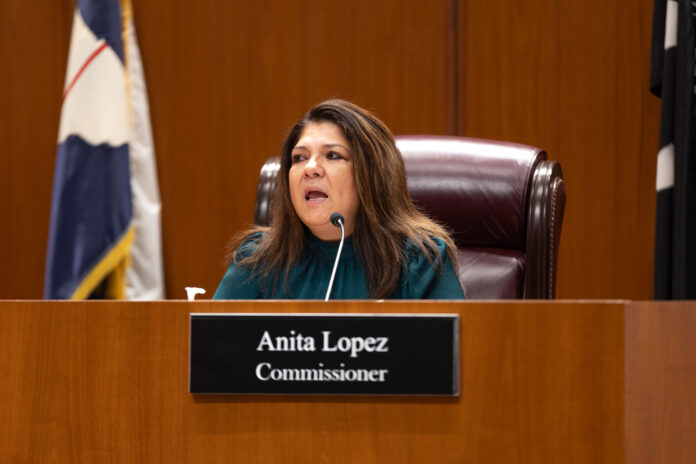
Lucas County Commissioner Anita Lopez during a Lucas County Commissioners’ meeting at 1 Government Center in Toledo on Tuesday, Nov. 4, 2025. (TFP photo by Stephen Zenner)

TOLEDO – There was a notable gulf between Lucas County Commissioners Lisa Sobecki and Anita Lopez during their Nov. 4 meeting. 

Sobecki and fellow commissioner Pete Gerken formed a majority voting unit that stopped items 3 and 4 on the agenda, brought by Lopez.  

“I make a motion to approve $1 million that will be identified for the agencies that Lisa Sobecki had recommended in her resolution, and I ask for my commissioners’ support,” Lopez said before the vote. 

As the clerk called roll, Lopez voted first, delivering the only “yes,” followed by Gerken’s “no” and then Sobecki’s “no.”

Just before the vote, Lopez clarified her stance.

“I support Commissioner Sobecki’s selection of the food things. I just believe the money needs to be larger and should be substantial.”

Item 3. was a permission to enter into agreements with community organizations for emergency food services, and Item 4. was an appropriations resolution to allocate $1 million to help fill the gap of Supplemental Nutrition Assistance Program (SNAP) benefits that have been affected by the federal government shutdown. 

Lopez presented these items together, and prefaced the vote by highlighting the need and gap left by the government shutdown, leaving people without SNAP benefits.

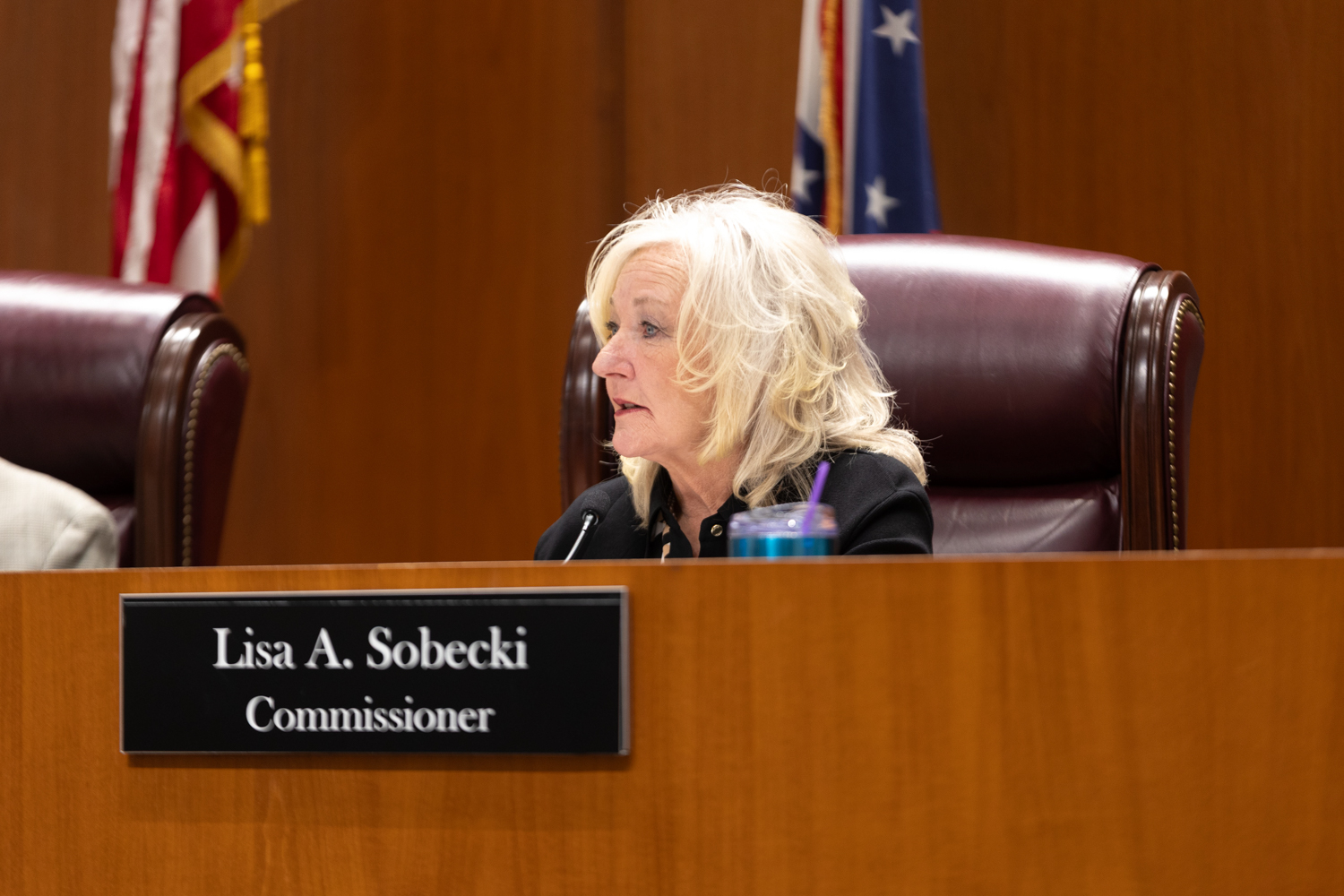
Lucas County Commissioner Lisa Sobecki. (TFP photo by Stephen Zenner)

SNAP shutdown 

On the 20th of October Sobecki led a coalition of different officials addressing the possibility of people in Lucas County losing SNAP benefits at the beginning of November. The full cost of funding Lucas County’s SNAP benefits was estimated at around $13 million for a month. 

The total value of SNAP benefits for the whole country is roughly $8 billion, and two federal judges have ruled that the Trump administration has a duty to fund SNAP with an Agriculture Department contingency fund. $4.65 billion is in the fund, and so it was thought SNAP benefits will be funded at roughly 50 percent. 

The Trump administration warned of delays in processing SNAP funds to families, as Sunday and Monday families were unable to access benefits. 

Ohio Governor Mike DeWine designated $25 million towards the SNAP crisis, but only fulfills a portion of what Ohio uses monthly – $263 million. 

Lopez said she wanted the $1 million to cut through the bureaucracy to help families immediately, and warned that the federal government’s fulfillment of SNAP could take up to a month to fulfill. 

“So for me, the million dollars is enough to put in our budget so it’s readily available to get out as soon as possible,” she said.  

This $1 million contingency may have merit, because on Tuesday, the same day as the commissioners’ meeting, President Donald Trump spoke of defying the federal judges’ order. He said SNAP “will be given only when the radical left Democrats open up government, which they can easily do, and not before!”

Congressional Democrats have taken a stand against Republicans who have cut subsidies provided by the Affordable Care Act (ACA). Democrats refuse to pass the funding bill required to run the federal government without Republicans reinstating the ACA subsidies. 

Without these subsidies, it is estimated healthcare costs will roughly double for people who access healthcare through the ACA, and neither side has been willing to make a deal so far, leading to the longest government shutdown in United States history.

The longest government shutdown prior to this one was from 2018-2019, under Trump’s first term, and lasted 35 days. 

And before that shutdown, Bill Clinton’s administration saw a 21 day shutdown in 1995-1996. 

All three of the longest government shutdowns began with Republican majorities in both the Senate and the House of Representatives. 

Lucas County Commissioners Pete Gerken, Lisa Sobecki and Anita Lopez. (TFP photo by Stephen Zenner)

What’s the plan? 

Regardless of whether partial SNAP benefits are restored or not, there is still a gap in funding that will affect Lucas County. 

Lopez’s rejected items were followed by an agreement giving $50,000 to Connecting Kids to Meals, Inc. and another $50,000 to the Islamic Food Bank to provide emergency food assistance. 

These funds were brought by Sobecki, and unanimously approved. 

Gerken explained the $100,000 brought by Sobecki had a clear plan, while Lopez’s funds did not. 

“I mean, they don’t have a plan for a million bucks,” he said. “Give us [$]100,000, work with what we established, we’ll get it where it needs, we’re gonna’ come back and get more if it’s necessary.”

After the meeting, the Toledo Free Press asked Lopez if she did have a plan for the million dollar allocation, and she said, “There was a plan. I think there is a plan. We know the United Way already identified the food pantries. We know that Toledo Public Schools have community hubs and community centers,” and she pointed out the Sofia Quintero Center as a community hub that could be involved in distributing food.  

All commissioners mentioned their commitment to help people within Lucas County weather the loss of SNAP benefits. Gerken and Sobecki highlighted conversations they’ve had with local organizers, and their approach focused on working with organizations to allocate funds as the government is told about their need. 

“There are people within our community that are working together, and we’re listening as commissioners on what is needed to be able to have out there,” Sobecki said.

Lopez called the $100,000 “a start,” but said the million dollars was necessary. 

“Having the million dollars ready to go is what we need. We need to be ready to go,” she said, and warned that it might be too late by the time the need is known. 

When asked about further withdrawals to meet the SNAP crisis, Sobecki said, “I’m going to look to those professionals that do this and understand that, and listen to them as they’re putting their plan together and how to be able to distribute [food/aid],” she said. 

Sobecki cited her time as a caseworker as proof of understanding the current SNAP crisis, and Lopez cited her time working with Lucas County Children Services giving her a similar insight.

Toledo City Council

During their meeting on Wednesday, Toledo City Council unanimously passed Ordinance 508-25, giving $100,000 from the Local Fiscal Recovery Fund for the United Way of Greater Toledo’s 211 Services in 2026. Council Member At-Large Brittany Jones abstained from the vote, because she works for the United Way as a Survey & Evaluation Analyst.

The ordinance was brought by Council Members Nick Komives (At-Large), Cerssandra McPherson (At-Large) and Theresa Morris (District 6). 

In a similar vein, Council Women At-Large McPherson and Jones presented Resolution 509-25, which passed. 

The resolution urged the Ohio General Assembly and the United States Senate to Support Senate Bill 305 and House Bill 502 that strengthens access to SNAP, TANF, and WIC Programs, and Ensures food security for Ohio families.

Ohio Senate Bill 305 was brought by former Toledo Mayor, and current Ohio Senator, Paula Hicks-Hudson, and seeks to “appropriate funds for SNAP, TANF, WIC upon lapse in federal funds.” Ohio House Bill 502 has the same purpose and wording, but is being brought in the Ohio House by Latyna M. Humphrey, Ohio House Representative for Columbus, Ohio. 

Local connections

Before leaving the commissioners’ hearing room, Sobecki wanted people to know they can call 211 to get connected to the United Way of Greater Toledo for help with their specific challenges. 

Anyone can dial 211, or text their zip code to 898211 to reach the United Way of Greater Toledo, and get connected to a database of emergency food providers, food pantries or meal sites. The operator should be able to provide locations, hours of operation and eligibility requirements for each food site.

The United Way covers three counties in northwest Ohio: Lucas, Wood and Ottawa Counties. 

And as the United Way braces for the impact of lost SNAP benefits, Jill Bunge, the vice president of impact and outreach for the United Way of Greater Toledo, said she attended a Zoom meeting a couple days ago with the food banks, Connecting Kids to Meals, the Area Office on Aging, the Health Department, Jobs and Family Services, the Lucas County Commissioners and some City of Toledo representatives. 

“We are seeing a rise in calls,” Bunge said. 

In September, the United Way received 1,111 calls concerning the need for food, the next month 1,607 and just in the first four days of November, Bunge said the United Way has already received 316 calls concerning access to food.

“The takeaway for our community is it’s past November 1, and people don’t have money on their EBT card. And they can’t go to the grocery store and feed their kids, so that’s our primary thing,” Bunge said. 

In a similar vein, the President and CEO of Connecting Kids to Meals, Wendi Huntley, mentioned her organization had seen an 18-24 percent uptick in demand in October, when SNAP benefits were still working. 

Huntley said they had not received data for the beginning of November, but said, “We’re anticipating we’re gonna see anywhere from 1,500 to 3,000 more kids.”

Connecting Kids to Meals is a nonprofit with 85 locations in the city of Toledo, and only feeds kids 18 years and younger. 

Regularly, the nonprofit spends between $250,000 and $280,000 a month on meals for kids at $6.20 a meal, roughly 40,000-45,000 meals within a month. 

Ceasing SNAP benefits is expected to impact 30,000 kids in Lucas County alone, and so Huntley has been preparing as best she can for the demand. 

“The funding that is being provided is going to help us to cover some of the gap costs for some of those meals,” she said of the commissioners’ contribution of $50,000. “But most importantly, we reached out to our city, our county, our corporate funders, [and] individuals, because we’re already seeing an increase [in need] from the time that the government shut down.”

This year was already trending more difficult to make ends meet, Huntley said, and added, “We continue to see modest but impactful inflationary costs on food, and tariff impacts on our non-food items.”

As the shutdown drags on, Huntley said, “I anticipate that we’re going to need to go back. We’re going to need to reach out, not just to the county commissioners, but again, to various corporations, to our city.”

Colloquially, Huntley shared that the children they serve generally leave some food items behind when they eat, but now she said “The kids are eating everything, and, you know, kids are picky eaters.”

“So that’s telling us they’re hungry.”

Huntley anticipates needing to hire more workers to keep pace with the organizational needs. For now they’re going to hire a few more servers, but Huntley said they’ll increase their workforce as needed. 

But still, she resolved, “We know the difference that we’re making in the lives of folks that just are struggling. You know, they’re just struggling. They’re just at a place where they need a little bit of help.”

If community members wish to help, ConnectingKidstoMeals.org has a signup to volunteer and various ways to donate. 

“We have a very strong charitable network here,” Bunge said. “The food banks get the food. They have a lot of purchasing power. The food pantries receive that food from the food banks, and then the food pantries are serving directly to people.” 

Volunteering time and donating food were the two top requests from the nonprofit leaders. 

UnitedWayToledo.org/food is the link for the local United Way food resources, and includes sign ups, ways to donate and as well as informational resources.  

Data center protestors pack Monclova meeting

0
Colin Doolittle was among the Monclova Township residents protesting data centers prior to the November 3 Board of Trustees meeting, where discussion centered around annexation and actions that trustees and residents could take. (AWFP photo by Karen Gerhardinger)

MONCLOVA – After learning that land around the Shops at Fallen Timbers could be marketed for a data center, dozens of residents converged in front of the Monclova Township administration building on Nov. 3. Many of those protesting came from the 600-home Waterside development, which is just north of the mall.

“It’s important for everyone in the area to know about,” said Waterside resident Carol Fornia, who said after reading about the impacts of data centers, “I knew I had to do something. It affects our lives and our properties.”

For nearly an hour, trustees Chuck Hoecherl, Barbara Lang, Trudy Vicary and fiscal officer Gavin Pike fielded questions and comments from dozens of residents, including Ryan Bauman, Brian Cline, Lyn Cox, Lance Daggett, Christine Egan, John Hagan, Pattie Kaczala and Risa Sindel.

The overall theme that emerged: what can residents, and the township, do to fight off a data center or stop the annexation of land into Maumee – which would then have control over the project? Except for Karnik on Black and a few houses, all of the land east of Black Road is now annexed into Maumee.

“We fought it and lost,” Hoecherl said of the years-long creeping of Maumee city boundaries into the township.

Isaac Land Development owns the Maumee land around the mall, while across Black Road to the west, Monclova Properties LLC is the majority property owner with 160 acres of agriculturally-zoned land.

When trustees learned that data centers might be interested in building in the township, trustees voted earlier this year to allow data centers in agriculturally-zoned properties with a conditional use permit. This would give the Board of Zoning Appeals the power to set limitations on lighting, sound, buffering, building height and other aspects of a project, Hoecherl said. While Maumee may determine the fate of the land around the mall, this text amendment to the zoning code gives the township some control over the land to the west, he noted.

“Do you think you opened Pandora’s box by having that text agreement?” asked Kaczala.

Cline, Daggett and Hagan also questioned why including data centers as an option through a text amendment was even considered.

“By changing it, you opened the door,” Daggett said, suggesting that trustees should have waited until an application for rezoning was presented instead of changing the zoning code first. “You’re allowing it by changing the code.”

Pike said if trustees didn’t at least put some language in its zoning code, that Monclova property owners considering a data center would have a reason to immediately annex into Maumee – taking any power to regulate the project away from the township.

“The more restrictive the township tries to be, the more likely that the land will be annexed into Maumee,” Pike said.

For now, the township doesn’t have an application for a data center, but if one comes forward, the public would be informed and welcomed to share input, said Lang, adding that every email or comment made in a public meeting is also being kept as a record that would be considered when the Board of Zoning Appeals receives an application. 

“You won’t be invited to a groundbreaking without knowing there’s an application,” Lang said.

“That’s too late,” said Sindel, noting that action needs to be taken now before a big tech company comes in.

Sindel asked the trustees what level of research they’ve done on data centers, and if that included looking at the collateral damage to communities adjacent to such projects. While they’ve read up on data centers, Hoecherl said he’s also planning to join a tour of New Albany data centers later this month. Asked to state on the record whether they were for or against a data center, Lang said elected officials have to remain impartial and not take a stance on a project that may come before them for a vote.

“We can’t be activists,” she said.

“You should be – you’re our representatives,” Cline responded.

Several in the audience asked the trustees to give them advice on how to fight the data center and annexation by Maumee. Continue the online petition against data centers, and contact State Rep. Josh Williams about Maumee annexing properties because it’s a state legislation issue, Lang suggested.

“We’ve been trying all along to protect Monclova,” Lang said, noting that the zoning code and land use plan are designed to stave off annexation, but that townships don’t have much legal recourse.

Hagan pushed back on the idea that Monclova Township is powerless.

“We’re bigger than Maumee. We have more people than Maumee,” he said. “Have we ever thought about trying to become a city?”

While Lang said that the trustees could explore that idea, Vicary noted that it comes with some setbacks, including the ability of cities to administer an income tax – which townships cannot do. 

Sindel recommended that the township seek out a law firm that’s experienced in these type of challenges – an idea that Hoecherl said he would explore.

Other audience members offered out-of-the-box ideas. Baumen asked whether residents could pool together enough money to buy the proposed property, valued at $32 million, in order to control the land. That would equal over $2,100 per person. 

“We want a seat at the table. We’re trying to buy our freedom from annexation,” Bauman said.

Diane Stroshine suggested working with Maumee to find a project that’s mutually beneficial and draws visitors to the area, such as a sports complex with restaurants. That would bring in tax dollars to help a cash-strapped Maumee, she noted.

With several new members joining Maumee City Council after the election, Vicary expressed hope that they might be more willing to “be a better neighbor” and consider the impact of a project on the township residents.

Trustees urged residents to attend a Thursday, Nov. 20 public forum on data centers from 5:30 to 7:00 p.m. at Anthony Wayne High School. It will also be live streamed on WGTE.

Anthony Wayne area election results: 2025

0
Pexels photo by element5

Three Anthony Wayne area townships will see a change in leadership in 2026, as voters approved new trustees in Monclova, Swanton and Waterville townships. 

In Monclova Township, Debbie Stevens-Laux won a seat with 1,767 votes. Incumbent Barbara Lang retained her seat with 1,604 votes. Trudy Vicary was unable to secure a second term with 1,510 votes. Turnout in the township averaged 26 percent.

In Swanton Township, turnout averaged 32 percent for hotly-contested races for two open seats for trustee and one for fiscal officer. Newcomers Bill Anderson and Matt Beil nabbed 370 and 359 votes, respectively, over incumbents Jeff Michael and Kyle McPherson. Mindy Curry won 63.25 percent of the votes over current fiscal officer Sandy Speiker.

in Waterville Township, with an average turnout of 26 percent, voters approved, 218 to 197, a 3.5-mill levy to generate $398,800 a year for the General Fund. Incumbent Kyle Hertzfeld and Toby Miller ran unopposed.

In Providence Township, voter turnout in Lucas County was 21.3 percent, and incumbent Steve Kendall was the only candidate to run for two open trustee seats. 

Voter turnout in Waterville and Whitehouse was lower than the county’s 20 percent average. In Waterville, only Mary Duncan was on the ballot. In January, council will need to appoint two people to fill open positions, as not enough valid petitions were filed for the open seats. Voters also approved two measures to allow alcohol sales at the Meijer store that will begin construction by 2026. Voter turnout was 19 percent.

In Whitehouse, incumbents Louann Artiaga and Steve Fine, along with newcomer Joe Bublick, ran unopposed. Turnout was 16.8 percent. Voters also approved three charter amendments that allow term limits for the mayor and council, as well as changes to mayoral powers.  

Anthony Wayne Local Schools Board of Education members Kyle Miller and Mike Stamm ran unopposed for two four-year terms.

Anthony Wayne graduate debuts second album

0
Amanda Reisner Worthington, a 2009 Anthony Wayne High School graduate who regularly sings in community theater and in church, will be accompanied by Community of Christ Lutheran Church music director for a Sunday, November 9 album release party for "Christmas With Amanda Worthington," now out on Spotify. (AWFP photo by Karen Gerhardinger)

Amanda Worthington’s latest album comes out on Nov. 9

WHITEHOUSE – In the 30 years since she first took the stage to sing for others, Amanda Reisner Worthington has performed in church and school choirs, on the community theater stage and even for her second-grade students at Frank Elementary in Perrysburg. 

On Sunday, Nov. 9 at 3 p.m., the 2009 Anthony Wayne High School graduate will perform 11 of the 15 songs on her second album, Christmas with Amanda Worthington, during a release party at Community of Christ Lutheran Church in Whitehouse.

She will be accompanied by the church’s music director, Eric Dickey, who encouraged Worthington to record her first album, When Words Fail, in 2023 and has played the piano alongside her for both albums.

“Amanda has such an incredible voice and style, and I had just finished recording my own album at Stone Soup and thought it would be a great place for Amanda to record,” Dickey said of the Maumee recording studio. “They have a nine-foot Yamaha grand piano – which is very unusual – and it made me very happy to play for her.”

The performance will include a variety of holiday songs, including “God Rest Ye Merry Gentlemen,” which was completely improvised and done in one take. 

“I looked at Eric in the recording studio and said, ‘let’s try this.’ It’s a jazzy version in a lower range. He added so many cool flairs. It’s a traditional song that turned into such a unique sound,” Worthington said. “We know each other’s leads and styles and read off each other really well, so we can just dive in. And Eric is a master, and so cool. I’m so grateful for all these wonderful opportunities.”

When she was 3 years old, she ran up to the front of the church, where the Kids of the Kingdom choir was performing. Her mom told her that she had to be potty-trained in order to join, so she soon complied. By the time she was in first grade, Worthington was taking piano lessons. A 2009 Anthony Wayne High School graduate, Worthington played flute and then piccolo in the band from grades 5-12 and was a valued member of the choir, earning spots with the University of Toledo Honor Choir, district events and even representing the school for the All-State Choir her sophomore year.

“I was a social butterfly but not part of the cool kids,” she said of her high school experience. “I was definitely the goody-two-shoes – but would get called out on my report cards for socializing too much in class.”

In addition to performing in junior high and high school musicals, Worthington dove into community theater. Her first role was as a Marching Munchkin General – a soldier of Munchkinland – during the “Ding, Dong the Witch is Dead” song in the Waterville Playshop production of The Wizard of Oz – when she was 8. For every summer after, she enrolled in the Playshop’s two-week summer musical school, learning the ropes. Those skills helped her land, her sophomore year, the lead role of Polly Baker in Crazy For You at the high school.

“That expanded my range from small parts to having the lead,” she said.

When St. John’s Jesuit High School was looking for females in the production of Les Miserables, Worthington won the role of the innkeeper’s mean wife, Madame Thénardier.

“She’s an evil character with a dark sound. It was fun to manipulate my voice to make it sound more villainous, growly and fun,” she said. In 2019, she was a princess in Disenchanted, a Perrysburg Musical Theater production that she described as a modern, funny take on princesses. 

“I was Snow White.  It was a huge push for me vocally, belting out high notes. I loved it,” she said.

A 2014 Bowling Green State University graduate, Worthington was a member of the Women’s Chorus and Collegiate Chorale, but switched her major from music education to early childhood education during her sophomore year. Now she sings throughout the day while teaching second graders.

“Kids react so much better to anything musical. It’s a magical thing,” she said.

Recording an album was never a thought, especially considering the cost on a teacher’s salary, she said. But Dickey kept encouraging her to bring her voice to a wider audience, so she began setting money aside for When Words Fail, her 2023 album that includes 12 songs from musicals.

“Anytime I get these moments to go into my ‘musical land,’ I feel like I can connect to my brother – as we sang together,” she said of her brother, Aaron, who died unexpectedly in 2017. 

Creating that first album took a while, and releasing it through Spotify enabled anyone to listen. While it didn’t make her rich – “I made $1.61,” she jokes – Worthington said its more about getting the music to her people.

“I don’t want to get famous. I love teaching and I don’t want to leave Ohio. I want to do this for fun,” she said.

When she’s not singing, teaching or performing, Worthington enjoys reading, playing cards and hanging out with her husband, Brian, and their poodle, Prince, aka The Floof.

The Sunday, Nov. 9 concert begins at 3 p.m. at Community of Christ Lutheran Church, 6517 Finzel Rd., and lasts about an hour. A free-will offering will be taken for the church’s building fund and to benefit its mission partner, Salem Lutheran Church in North Toledo.

EPIC Toledo plans Annual Leadership Summit downtown

0
Karen Eber, CEO Eber Leadership Group Author

TOLEDO – EPIC Toledo will gather emerging and established professionals on Nov. 7 at the Renaissance Hotel Downtown for a day of inspiration and insight at its annual Leadership Summit. 

EPIC Toledo is a young professional group that operates through the Toledo Regional Chamber of Commerce.

The event brings upward of over 250 young professionals and it is held every year in November. 

“We have our leadership summit every November, the first Friday, and it is our biggest event of the year,” said Riley Runnells, manager of EPIC Toledo. 

The event brings upward of over 250 young professionals and it is held every year in November. “They [young professionals] are able to listen to a couple of keynote speakers, hear some panels on hot-button topics right now, and find opportunities for them to network with one another,” Runnells said. 

From 9 a.m. to 5 p.m., the event will feature a dynamic lineup of speakers and panels. There will be two keynote speakers and three panels with four panelists on each. 

Karen Eber, CEO Eber Leadership Group Author, and Jameil Aossey, Grammy award winning music producer, will be the two keynote speakers. 

Jameil Aossey, Grammy award winning music producer.

The Mental Health panelists will be Dr. Phil Atkins, chief care coordination officer at Harbor, Rosie Best, artistic director at Issue Box Theatre, Marriah Kornowa, executive director at NAMI Greater Toledo, and Carissa Wott, clinical psychologist and co-owner of The Anxiety Treatment Center of Greater Toledo.  

The Downtown Development panelists will be Ambrea Mikolajczyk, owner of ARK Restoration and Construction, Stephanie Pilgrim, owner of The Mez, Scott Prephan, President of Prephan Enterprises and Meredith Soleau, President of 424 Degrees. 

“We work to serve all of the region’s young professionals through three goals: to introduce young professionals to job opportunities in the area, to introduce young professionals to one another so that they can have a better time making friends locally, and then to introduce young professionals to the community and what’s going on in Toledo,” Runnells said. 

She said there will be a time for people to ask questions to the speakers and panelists. 

“Our networking happy hour in the afternoon from 3 to 5 will have the option for young professionals to ask any questions they might not have gotten to ask during the program to our panelists and speakers that choose to stay,” Runnells said. 

Riley Runnells, manager of EPIC Toledo.

She expressed that it is important to provide different opportunities to young professionals and to make sure they gain valuable insight. 

“To have a program like EPIC Toledo where we’re providing our young professionals with these very unique and limited to other community opportunities where they can have face-to-face time with local leaders and leaders from out of our region,” Runnells said. 

She said people are able to gain a lot of insight through the professional development series and through all of the member benefits that they get.

“We at the Toledo Chamber and through Epic Toledo believe in investing in our young professionals,” Runnells said. 

Event Schedule:

9 a.m.: Leaders and Launchers Coffee Hour

10 a.m.: EPIC/Chamber Opening Remarks

10:15 a.m.: Karen Eber Keynote and Q&A

11:45 a.m.: Lunch 

12:15 p.m.: Mentor Panel 

1:15 p.m.: Breakout Sessions 

– Downtown Development Panel

– Mental Health Panel

2:15 p.m.: Jameil Aossey Keynote

3:00 p.m.: Closing Remarks with Andrew Smigelski 

3:05 p.m.: Nonprofit Board Fair/Happy Hour

Lucas County: Helen Bahlhorn honored for Child Support Services

0
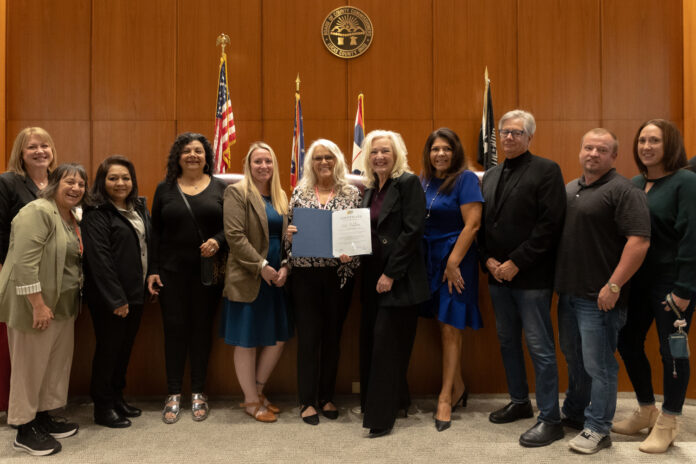
Helen Bahlhorn, an investigator III for the division of Child Support Services, is honored as she enters retirement with the Lucas County Commissioners and her family during a Lucas County Commissioners’ meeting at 1 Government Center in Toledo on Tuesday, Oct. 21, 2025. (TFP photo by Stephen Zenner)

At the Lucas County Commissioners Oct. 21 meeting, an investigator for the division of Child Support was honored, funds were allocated to a senior housing project in Lima, and the director of Lucas County Job & Family Services presented items involving partnership agreements. These are just a few of the topics covered at the Commissioners meeting late last month.

Retirement

Item one honored Helen Bahlhorn, an investigator III for the division of Child Support Services, who the commissioners congratulated on sticking with the county for three decades. 

“You don’t often find people that have been in a place for thirty years,” said Lucas County Commissioner Pete Gerken. Gerken remarked that Bahlhorn had seen a lot of transitions from her time starting with the county in the 90s. 

After the investigator had her picture taken with the commissioners, someone in her crowd of friends and family yelled out, “Florida!” the state where her daughter lives. 

Lima Towers

$25 million was allocated to a 200 unit senior housing residential project in Lima called Lima Towers, built in 1977. 

The Port Authority of Allen County reached out to Lucas County for help financing renovations, which include: new flooring fixtures, energy efficient appliances, ADA accessibility, replacing roof elevators, refurbishing the commons area, and replacing hot water heaters. 

With these improvements, it is estimated that the life of Lima Towers will be extended for another 20 years. 

Craig Teamer, the director of finance and special projects at the Toledo-Lucas County Port Authority, presented Lucas County’s role in the project as a conduit financier for the state of Ohio. 

“This is not out of our bond fund?” Gerken asked. “We’re conduit financing to Ohio?” 

Teamer confirmed that this was so, and all three commissioners approved. 

The hearing for this issue took place at the end of September. 

Lucas County Commissioners Pete Gerken, Lisa Sobecki and Anita Lopez. (TFP photo by Stephen Zenner)

Area Office on Aging

The extension of a .75 mill tax and an additional .25 mill tax levy for the Area Office on Aging was passed, for a total of 1 mill tax levy for the Area Office on Aging. 

Plat Approvals 

Bridgecreek Plat Six in Sylvania Township was approved pending improvements to be made to the plat by Sylvania Township. 

$15,500 was put into escrow for these improvements to be completed by Sylvania Cobblestone Developers, Inc., and will be inspected by the county engineer. In the contract, the improvements are described as roadway and drainage improvements. 

Next, Coventry Glen Plat Six in Waterville Township was approved. 

$36,067.50 was put into escrow for this plat for roadway and drainage improvements for this plat. J&J NW Development LLC was awarded the contract for these improvements. 

A separate contract was written up for separate improvements concerning “sediment and erosion control improvements,” and the escrow amount for J&J NW Development LLC was $76,753.00.

Eric Zatko, the director of Integrated Justice Systems, presents to commissioners for the 2026 budget hearing. (TFP photo by Stephen Zenner)

Budget Adjustment

The Lucas County Prosecutor’s Office asked for an extension and budget adjustment concerning subgrant number 2023-JG-D01-3100. 

This subgrant funds the Domestic Violence High Risk Team, and the grant money went farther than expected. The request is to extend the program and its subgrant until March 31, 2026. 

Then the other part is to adjust the budget, moving $2500.00 from consultants/contracts to the personnel line. 

This was approved. 

This leftover money was due to an individual not using health insurance. 

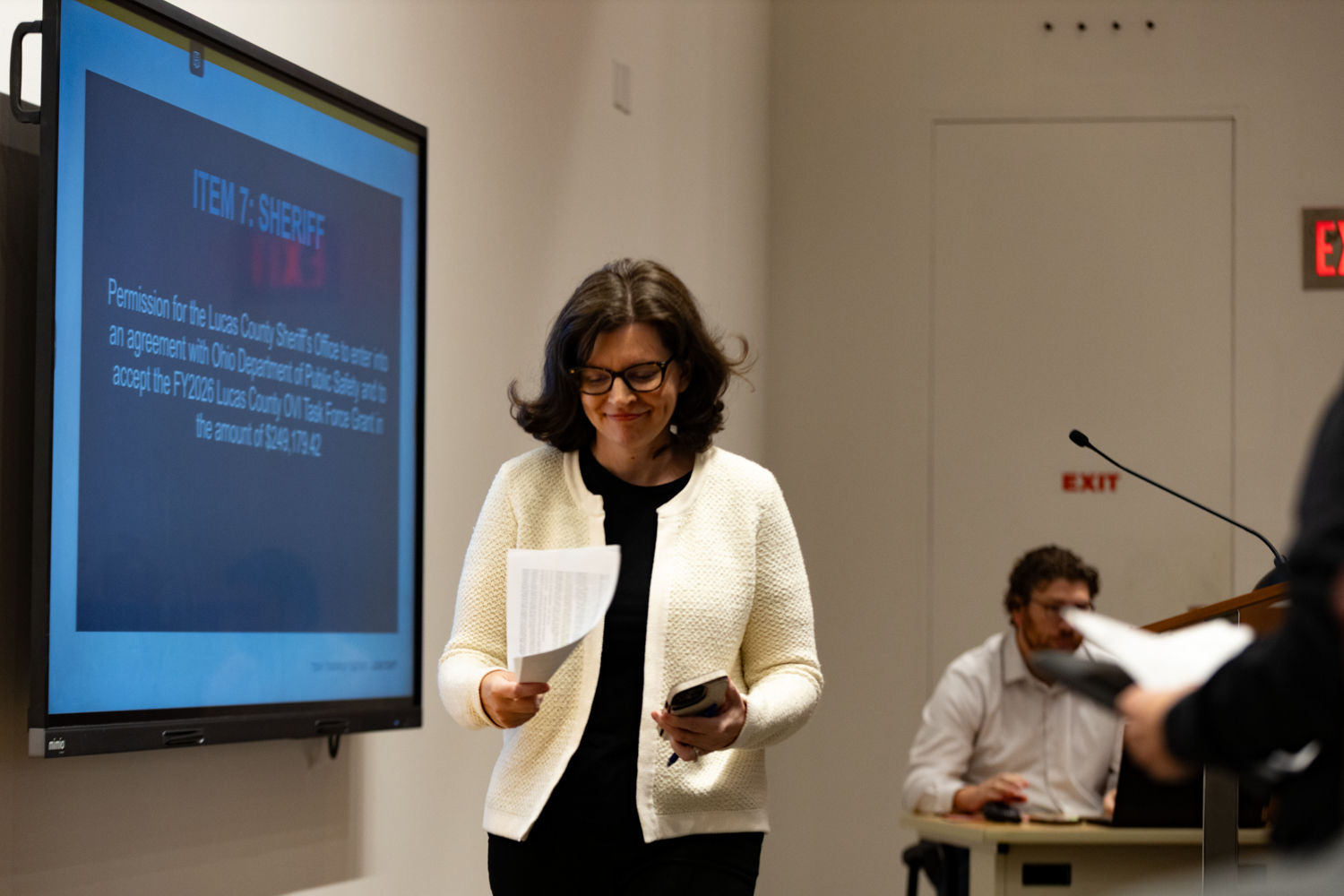
Sarah Weglian, the director of grants, management and outreach, walks away from the speaker’s podium after addressing item 6 on the agenda, a budget amendment. (TFP photo by Stephen Zenner)

Sheriff

The Sheriff’s office asked for permission to receive the Operating a Vehicle while Impaired (OVI) Task Force Grant in the amount of $249,179.42 from the Ohio Department of Public Safety.

Next on the agenda was permission to receive the Impaired Driving Enforcement Program (IDEP)/Selective Traffic Enforcement Program (STEP) Grant in the amount of $64,034.54 from the Ohio Department of Public Safety. 

Both were approved. 

Children’s Services 

Initially, Lucas County Children’s Services were hoping to get permission to purchase one (1) 2026 Chrysler Pacifica from Montrose Ford Through State Contract RDI011029, but instead tabled the issue for review at a later date. 

Facilities

Commissioners approved an amendment to the Capital Improvement Plan for work on the jail roof. According to Patrick Holland, the capital projects manager, “The original estimate was $100,000, but the contract was agreed upon for $107,000.”

When asked why they didn’t just initially write the additional $7,000 for the initial amount, Holland said he didn’t know what the sum total of the project would turn out to be. 

The plan amendment was approved. 

Job & Family Services 

Breda Osburn, the director of Lucas County Job & Family Services, presented items 11-20, which were all asking for permission to enter into agreements surrounding services and/or programs put on by Job & Family Services. 

11. Permission to Enter into an Agreement with Farm Labor Research Project, Inc. dba Campaign for Migrant Worker Justice (CMWJ) for the provision of the Employment Readiness & Youth Empowerment Program

12. Permission to Enter into an Agreement with Goodwill Industries of Northwest Ohio for Career Path Program Services

13. Permission to Enter into an Agreement with YWCA of Northwest Ohio for the provision of Reducing The Risk & Teen Pregnancy Outreach Programs

14. Permission to Enter into an Agreement with Toledo Public Schools for Truancy Prevention Programming

15. Permission to Enter into an Agreement with Legal Aid of Western Ohio, Inc. for Legal and Outreach Services

16. Permission to Enter into an Agreement with Legal Aid of Western Ohio, Inc. for the Provision of Legal and Outreach services to TXX Eligible

17. Permission to Enter into an Agreement with the Family and Child Abuse Prevention Center for the Provision of Project Access Domestic Violence Prevention Services

18. Permission to Enter into an Agreement with The Health Council of Northwest Ohio for Pathways HUB Regional Care Coordination

19. Permission to Enter into a Federal Fiscal Year 2026 Agreement with The Potter Group LLC dba Black & White Transportation for the Provision of EMS-related Medical Transportation

20. Permission to Enter into a Memorandum of Understanding with Pathway Inc., for the Purpose of Documenting Responsibilities as they Partner to Promote Responsible Fatherhood in Lucas County

All were approved. 

Support Services

Super blanket purchase orders were approved by the commissioners. 

“…super blanket purchase orders are used for the following purposes: accountant, architect, attorney at law, physician, professional engineer, construction project manager, consultant, surveyor, or appraiser by or on behalf of the subdivision or contracting authority; fuel oil, gasoline, food items, roadway materials, and utilities; and any purchases exempt from competitive bidding…”

There were three separate orders.

$10,000 to supplier AA Boos

$10,000 to Colgan-Davis

$25,000 to Warner Mechanical. 

All orders put for their reason “Recurring & reasonably predictable.” 

Item 22: Mary Kunckel, director of Support Services, then asked for permission to use the Cooperative Purchasing Master Agreement MA 758 250000416 with the National Association of State Procurement Officials (NASPO) 

“There’s no financial cost towards Lucas County,” Knuckel said. The purchasing agreement offers industrial items at a discount and does not cost the county anything. 

In the briefing attached to this item, an explanation of the cooperative agreement is as follows: “This eMarketPlace is provided by NASPO at no additional cost to Lucas County. Its purpose is to facilitate the connection of public entities with Contractors who meet the requisite needs for a good, service, or solution by that entity through a NASPO ValuePoint Master Agreement.”

Sanitary Engineer

23. William and Brenda Dodson asked the county to connect their property to the water supply line no. 1596-A on Westminster Road, and to do so with money they will pay back through a ten-year, simple interest loan through the county. 

Section 1 of Resolution 2025-772 concerning this water line reads, “The Board authorizes two of its members to execute the simple interest loan agreement as to cost recovery for connection into Water Supply Line No. 1596-A at 5022 Westminster Road.”

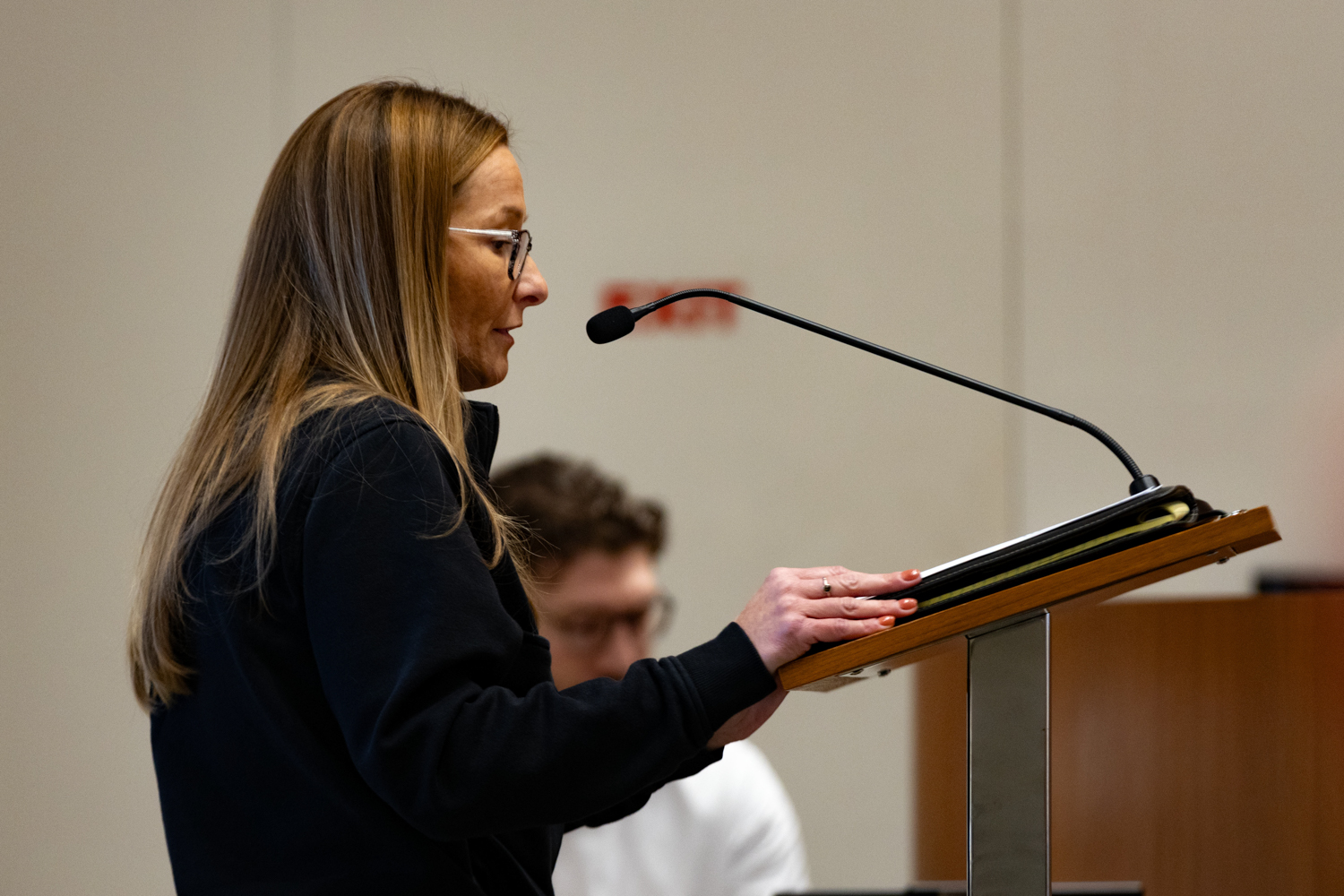
Brittany Sedlar, director of personnel and finance at Lucas County Sheriff’s Office, presents two items concerning state grants. (TFP photo by Stephen Zenner)

24. Michael and Jenifer Siegel asked for a similar loan to the one above, but concerning connecting their property to the sewer system. 

Their agreement with the county is described as “Simple Interest Loan for Pay-Cash-To-Tap on Sanitary Sewer No. 811” for “4525 Michaw Road, Parcel No. 78-02507.”

The Siegels have ten years on their loan as well. 

25. Accepted an easement and right-of-way with the City of Toledo for the Northwest Pump Station at 3945 N. Holland-Sylvania Road, Sylvania Township.

Nate Inkrott, the Lucas County Sanitary Engineer, explained the reason for this item succinctly.  In the next couple years the city plans on constructing a water tank/tower at the Northwest Pump Station. “We own that station, so we need to grant them an easement in order to construct this tower,” he said. 

Administration

26. Amended the Amount of the Clean Energy Tax Credit from the Internal Revenue Service previously approved by Resolution No. 2024-823.

Ben Pushka, the sustainability coordinator for Lucas County, presented this item, and explained that the clean energy tax credit was awarded to Lucas County initially as $6,231. Since the Internal Revenue Service (IRS) took almost a year to give that money to the county it has since accrued interest, and so the amount the county receives must be amended by an additional $604.86, for a total of $6,835.86. 

Employee Benefits

27. Commissioners agreed to enter a three year contract with Travis Software Inc. to remain in compliance with all Cobra laws, providing healthcare for employees in transition. 

Budget Impact: Year 1: $9,195; Year 2: $8,550; Year 3: $8,970

28. Commissioners renewed their agreement with Hylant Group for their benefits consulting services. 

Budget Impact: $148,000 – 6040.115002.610002

This contract is from November 1, 2025 to October 31, 2026. 

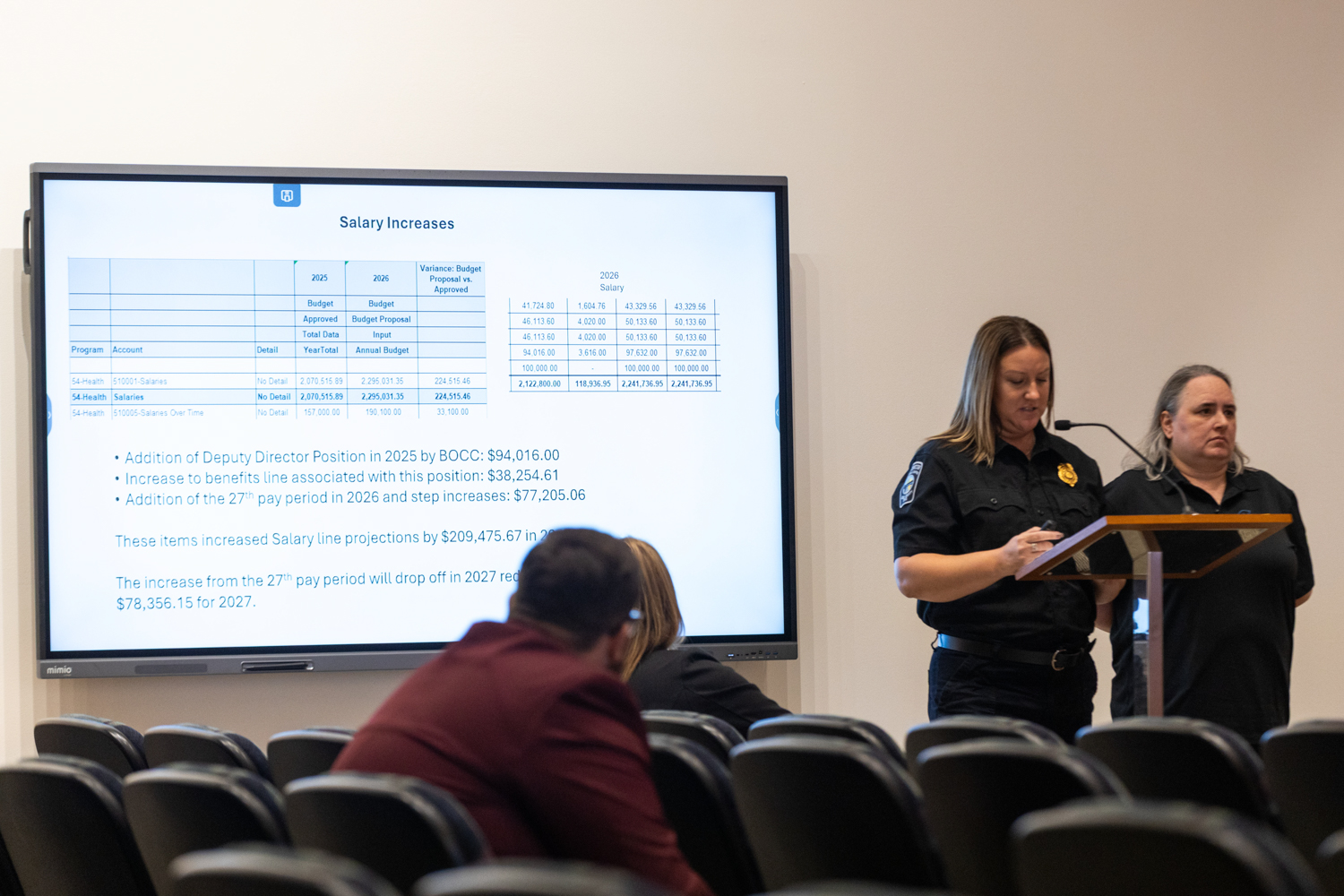
Terra Bundy, the deputy director of Lucas County Canine Care & Control, presents the budget during a budget hearing in front of commissioners. (TFP photo by Stephen Zenner)

Budget Hearings

Each department presents their progress over the past year to the commissioners, and explains their needs as the county drafts up their budget for the next year.

29. Juvenile Court

30. Public Defender

31. Integrated Justice System

32. Canine Care & Control

Executive Session

33. Commissioners entered into an executive session. 

Appointments & Restructuring

34. Jerry Allen was appointed to fill the position of Yard Site Coordinator in the Solid Waste Department.

35. Christopher Korzec was appointed to fill the position of Assistant Facilities Coordinator in the Facilities Department.

36. Five positions were cut from Lucas County Job & Family Services:

One (1) vacant, full-time, regular/permanent, non-bargaining unit, classified

Network Administrator 1 position, JFS NBU Pay Grade 26

One (1) vacant, full-time, regular/permanent, non-bargaining unit, classified

Child Support Clerical Unit Supervisor position, CSEA NBU Pay Grade 25

Two (2) vacant full-time, regular/permanent, bargaining unit, classified Child

Support Clerk II positions, CSEA BU Pay Grade 16

One (1) vacant full-time, regular/permanent, bargaining unit, classified Benefits

Verification Specialist position, JFS BU Pay Grade 27

37. Two positions were added to Lucas County Job & Family Services

One (1) full-time, regular/permanent, bargaining unit, classified Adult Protective

Services Worker position, JFS BU Pay Grade 30

One (1) full-time, regular/permanent, bargaining unit, classified Investigations

Eligibility Specialist 3/Comp Worker position, JFS BU Pay Grade 29