These big gobblers were photographed in January strutting their stuff in Oak Openings. (Photo by Metroparks Toledo nature photographer Art Weber)
Wild turkeys are big beautiful birds, and they are also our largest upland bird. It wasn’t so long ago that there were no turkeys in Northwest Ohio. They disappeared from Ohio over 100 years ago, but have made a comeback thanks to an aggressive Ohio Division of Wildlife effort to reintroduce them. They’ve thrived locally since they were reintroduced in Oak Openings Preserve Metropark in 2000.
Look for them in Metroparks Toledo, especially the Oak Openings Region.
Bishop Anne B. Jolly installed Jon M. Richardson as the 33rd rector of Trinity Episcopal Church (TFP photo by Gaven Hafner)
TOLEDO– Trinity Episcopal Church marked a historic moment for the 183-year-old church. On Nov. 8, faith leaders and the local community gathered for the formal installation of the Rev. Jon M. Richardson as the church’s 33rd rector. The celebration, rooted in long standing Episcopal tradition, served as both a milestone for the congregation and a reflection of the church’s identity of being progressive and inclusive.
The installation marks a new chapter in the church’s long and evolving history. From 2018 to 2023, the congregation was led by the Rev. Dr. Lisa Tucker-Grey, whose departure left a significant transition ahead.
“When our previous priest left, they [the bishop’s office] were very tuned into this and wanted to make sure that we weren’t essentially a ship without a captain,” said Trinity’s operations manager, Heather Meyer.
To guide the parish through that period, the Rev. Dr. Stephen H. Applegate served as interim priest from 2023 to 2025, providing stability and leadership until a permanent rector could be appointed. “He transitioned everything beautifully for Jon,” Meyer said.
(TFP photo by Gaven Hafner)
Richardson, who began his ministry at Trinity on Mar. 16, explained the significance of the ceremony.
“It is the tradition in the Episcopal Church when a priest begins a new ministry that the congregation celebrates their ministry, and particularly as it relates to having a new priest, the bishop will be present… One of the roles of the service is that she officially makes me the rector, he said. Though symbolic, the service carried weight by involving nearly 70 participants, from clergy and bishop Anne B. Jolly to musicians and choir members.
Richardson explains the Episcopal Church as “reformed Catholic,” noting that it is “very much like our Roman Catholic siblings, but we are independent and autonomous.” He adds that Episcopal dioceses are “sort of like regions,” led by bishops who are “elected by the congregations.”
Music, a defining element of Trinity’s culture, played a prominent role in the celebration. Before the event, Richardson said the program would include “all kinds of really fun things, not limiting ourselves to sacred music. We find the sacred in the secular, and we’re gonna have all kinds of music, from old fashioned hymns to a song by Jewel.”
Meyer, who has been with the church for seven years, noted that this eclectic musical identity is nothing new. “Music has always been such an incredible pillar here at Trinity… and it’s something that Trinity’s been known for,” she said.
Rev. Jon M. Richardson and Bishop Anne B. Jolly pray (TFP photo by Gaven Hafner)
Founded in 1842, Trinity Episcopal Church has long been a part of downtown’s architecture. Even during decades of urban decline, the congregation chose not to relocate.
“Back in the ’70s, the congregation had to make some tough choices as to whether they wanted to stay downtown… and they took a vote, and it was a unanimous vote that they were going nowhere,” Meyer said.
Today, much of the church’s energy centers on community and outreach. After the events ceremony, the church provided food and refreshments. Every Sunday, Trinity serves a hot breakfast to anyone in need.
“We’re averaging, I want to say, about 95 people a week. There’s no strings attached. You don’t have to come to church,” Meyer said.
Even more important than the meal, Meyer noted, is the dignity offered through personal connection. “We ask them their name… And so when somebody comes back, the ability to be able to call them by their first name….it may be some of the only interaction some folks get in a given time,” Meyer said.
After the ceremony the congregation enjoyed a meal to celebrate the momentous occasion. (TFP photo by Gaven Hafner)
For Richardson, one of the congregation’s most meaningful strengths is the diversity within worship itself. “One of the things I get most excited about is when we welcome our less secure neighbors in worship… I love the diversity that shows,” he said.
Trinity collaborates with several organizations, including Toledo Streets Newspaper, Actors Collaborative Toledo, Food for Thought pantry, and local artists and musicians who use the space for performances.
Richardson’s path to Trinity began with a search for a community that reflected his values. He recalled first reading the church’s profile. “The first words I saw were progressive, inclusive, creative…and I was like, ‘Ah, these are my people. This is who I should be with.’”
With the Rev. Jon M. Richardson now officially in place as the new rector, Trinity Episcopal Church enters its next era.
During the monthly Food for Thought pantry distribution, Toledo Refining Company (TRC) announced a $50,000 commitment to four local organizations to help fight against food insecurity.
“We know our neighbors here in East Toledo and Oregon alike face food insecurity daily,” said Erica Halada, the community relations advisor for Toledo Refining Company. But that was before the holidays, before the government shutdown. “We knew by talking to our partners…all of those who serve the community in that way have really been emphasizing that need.”
“And so we, as a company, decided that this was something we had to do for our neighbors in addressing that [food insecurity],” she said. “And a $50,000 investment came out of that conversation.”
(Photo by Doug Hinebaugh)
Monetary assistance was given to four organizations: Oregon Senior Center, East Toledo Senior Center, ProMedica Bay Park Hospital’s Food Clinic, and Helping Hands of St. Louis.
“TRC’s recent commitment to us and the other local organizations shows that they are in the community. It is not just about the donation; it is truly about making a difference for the families that we serve on a daily basis,” said Jodi Gross, the executive director for the East Toledo Family Center.
The donations affect the 43605 and 43616 area codes, Northwood and Oregon, Ohio.
Gross confirmed the rising challenges facing the area. “We have seen an increase in serving our families; this funding will allow us to meet the needs.”
ProMedica Bay Park Hospital’s President Matt Hammond also weighed in on food insecurity as reported by The Sojourner’s Truth. “Access to healthy food is as important as access to medication,” Hammond said. “Food insecurity is not just a social issue; it is a health issue.”
One day shy of a week after this commitment was made, the federal government shutdown ended on Nov. 12.
In a public statement recorded on WTOL 11Scott Hayes, the director of Midwest government relations and strategic communications for PBF Energy, the overarching company for TRC, said of food insecurity, “It’s not just happening some other place, it’s happening right here, and we’re all just a few paychecks away from food insecurity.”
In an Instagram post, the City of Oregon, Ohio @oregonohio thanked both Hayes and Halada for their community support.
“It’s one thing to say you care about the community. It’s another to show up the way this team does,” the post read, and then thanked the two representatives of TRC.
Every November, as the nation honors the service and sacrifice of its veterans and military families, it also serves as a reminder that the life of a military family is unlike most others. Frequent moves and deployments can disrupt friendships and routines. It can also affect academic continuity.
Ohio Virtual Academy (OHVA) recognizes the unique challenges that come with being part of a military family, and we are proud to be designated as a Purple Star school for our commitment to supporting military-connected students. The Purple Star designation is awarded by the Ohio Department of Education and Workforce and recognizes schools that demonstrate a major commitment to students and families connected to the nation’s military.
Adapting to military life starts with understanding
Military families know what it means to adapt because their children have often attended multiple schools before high school. Many times, that also includes moving mid-year due to relocations or new assignments.
Virtual education also provides students with a sense of consistency at a time when their lives may be filled with constant change. Instead of starting over at a new school every time their family receives new orders, the education they receive at OHVA moves with them.
Students can continue their classes, keep their routines, and stay connected to their teachers and classmates even if they relocate across the state or transition through temporary housing. This continuity helps reduce the academic and emotional disruptions that often come with frequent moves, giving military-connected students a stable learning environment no matter where they go.
How OHVA honors service
OHVA’s Purple Star recognition is also part of a broader culture of respect and appreciation. The school employs several veterans on its staff, and their experiences have helped shape the empathy and insight behind the program.
Many of the staff who have served in the military frequently share their stories of sacrifice and what military life actually looks like. That perspective has helped the school better understand the need for stronger support.
In addition, those veterans on staff also play a hands-on role in the school’s programming. For example, they often lead Veterans Day assemblies and speak directly to students about service, leadership and gratitude. That type of involvement helps bridge the gap between classroom lessons and lived experience. It also helps to inspire students to appreciate the values of commitment and community.
Celebrating those who serve as well as those who aspire to
Support at OHVA extends beyond current and former military families. The school celebrates students who plan to enter the armed forces through its “Wall of Honor.” By featuring this wall, OHVA highlights its commitment to recognizing students’ dedication to service and honoring their decision to pursue military careers.
OHVA’s recognition of military service extends to other outreach projects run by the school. Each year, members of OHVA’s Middle School National Honor Society lead a service initiative to send hundreds of thank-you cards to veterans and active-duty servicemembers. A simple gesture like that really resonates deeply with those who receive the cards and is another way students learn the importance of giving back.
A full circle of support
OHVA’s Purple Star programming has evolved to embrace even more of the extended military community. It began as a resource for active-duty families, but now includes veterans, future servicemembers, and students recognized by the daughters of the American Revolution for their academic achievement and civic engagement.
This full network of support is reflective of the school’s commitment to ensuring that every student feels seen, supported, and set up for success. For military families especially, that means helping them feel connected no matter where they are.
As we celebrate National Veterans and Military Families Month, OHVA is proud of its commitment to those who serve and sacrifice for their country. By offering a flexible and stable virtual learning environment, military-connected students can learn, thrive, and succeed, from anywhere.
I have always been fascinated by John Fitzgerald Kennedy’s 1961 inaugural address when he stated, “Ask not what your country can do for you, but what you can do for your country.”
Most historians agree this was President Kennedy’s call for Americans to do what is right for the greater good of country and community. His statement is compelling because it strongly suggests that individual Americans can and do make a significant difference in the cultural fabric of American society.
As a professor and researcher of leadership, I have had a career of exploring how to take words and translate them into actions. With that backdrop, for the past six months, I have done an informal survey of over 120 people from all walks of life asking them this important question: “What is your responsibility to make our community, and by extension our country, a better place?”
What started out as a philosophical question quickly turned into a very practical set of responses. Some were pretty obvious, while others really made me think because of their personal nature. Let’s open with “the big three do’s” mentioned by virtually everyone.
Be an informed voter and take the time to vote. Yet, U.S. voter turnout for local elections hovers around 20 percent; off-year national elections 40 percent, and around 60 percent for presidential elections. Room for improvement as a society.
Pay your taxes (as painful as that might be). We all know taxes provide revenue for federal, local, and state governments to fund essential services that include highways, police, education, the justice system, social services, and national defense, among others. We all benefit from these manifold services that we could not efficiently provide for ourselves.
Know and obey the laws. Obeying the law ensures social order, protects individuals and property, and provides a framework for resolving disputes, preventing harm, and upholding fundamental rights. Obeying vehicular laws keeps our roads safer. When people obey the law, our country is a better place for everyone.
But then responses shifted from the “big picture” to our individual lives.
Keep your marriage strong. Research shows that strong and stable marriages improve financial stability, physical/mental/emotional health, health in old age, overall longevity and healthier kids.
If you have children, intentionally nurture them. Research shows that the future of most societies is dictated by how well parents raise their children physically, emotionally, educationally and spiritually. Healthy children are our country’s future!
Practice common courtesy and be kind. Whether driving, shopping, out to eat, or in your home, common courtesy or being polite and respectful of others fosters a sense of mutual caring, cohesion, and well-being. Most people truly respect, need, and appreciate kindness, including grace or being given the benefit of doubt, which is more important today than ever. And it is free.
Help those less fortunate than yourself. Lending a helping hand to a neighbor or stranger in need or regularly volunteering to help others in our community are important/meaningful ways to share our time, talent, and treasure to serve others. This service makes the community stronger while providing us with great personal satisfaction.
Be neighborly to your neighbors. Being friendly, helpful, and respectful to those who live nearby creates a greater sense of community, neighborhood ownership, safety, and a willingness to look after each other. Friendliness is also free.
Respect diversity of opinion. Living in the information age, our society has become polarized and we have lost our ability to listen to each other and have respectful dialogue. To solve real problems and build real solutions requires open minds and meaningful discussion, whether at home, work, or in the community.
Don’t litter. Do recycle. These simple actions offer numerous environmental and social benefits, including reducing pollution, conserving natural resources, promoting a cleaner healthier environment, protecting property values and encouraging safety for everyone while requiring very little effort.
In the end, many would say that these “societal do’s” are simply common sense. But I would add if people collectively engaged in these individual activities their community would be a safer, friendlier, stronger, and more attractive place for people to live and work.
At your next family gathering, ask JKF’s question and see what you might learn. I am confident that you will have a very meaningful conversation benefiting not only the people in your circle, but also our community as a whole when we take action on these important practices. We all have the wonderful power to be better doers.
TOLEDO – On this episode of TFP Weekend, Toledo Public Schools Superintendent Dr. Romules Durant sits down for a wide-ranging conversation on issues from the district level to education at large.
On its latest state report card, TPS received two out of five stars from the state, with challenges including early literacy and graduation, among others. With regard to early literacy, Dr. Durant says “We are one of the only urban districts to not have universal pre-K,” adding, “the United States is one of the only industrialized countries to not support early childhood education in the way they do in other places.” He says there are nearly 10,000 kids in this area who are eligible for pre-K — but only around 3,000 are being served.
Among the other challenges facing the district is chronic absenteeism. TPS’ current rate is 38.9 percent, though Dr. Durant says it was higher in the years that directly followed the pandemic. As a result of COVID-19 concerns, he says, “people started to look at school as not necessarily being mandatory and treated it that way.”
Asked about the relationship between TPS and the state, and if the district is receiving the support it needs, Dr. Durant pointed to funding. He said legislators in Columbus, by not following 2020’s Fair School Funding Plan in the last budget cycle, left “Toledo Public Schools with a 24 million-dollar deficit that we have to balance.”
An ongoing debate about education, not only in Ohio but nationwide, has been school vouchers: if students should be able to take the dollars supporting their education at a public school to a private one. On the question of if private school vouchers can coexist with traditional public school funding, the superintendent said, “If you’re going to allow it, to have it coexist, then it should coexist on the same playing field.”
He said, “I’m all for school choice,” but added that private schools should be subject to the same scrutiny as public districts, including assessments and transparency requirements.
Outside of the challenges that face TPS, Dr. Durant says the district’s ‘magnet’ schools — schools that have a specific career focus — are yielding positive results. He also has optimism about the future of the years-long partnership between TPS and the University of Toledo. The district is transforming the university’s former Scott Park campus into educational and recreational facilities.
Another issue covered in this ‘TFP Weekend’ episode was socioeconomic factors, and how they affect the lived experiences — and in turn, performance — of students. To hear more on that, and other matters, listen or watch the full interview at our YouTube and Spotify channels.
*Edited by Stephen Zenner; special thanks to the Toledo Tech Loft for use of their space to produce this podcast episode.
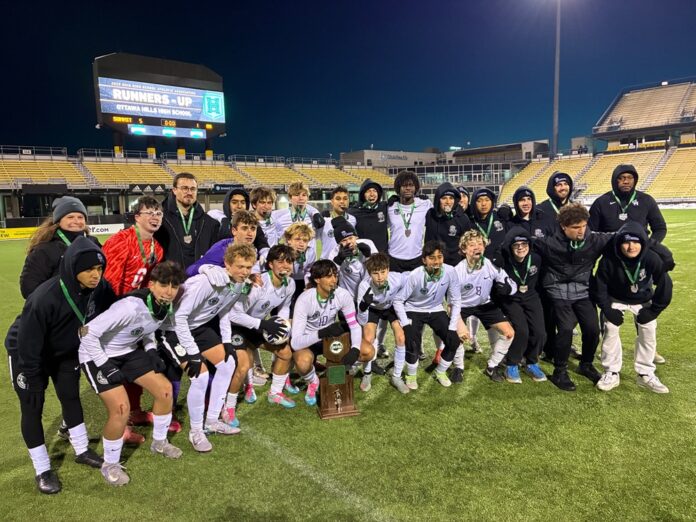
Ottawa Hills High School players and coaches pose for a photo following the Green Bears' 5-1 loss to top-ranked Cincinnati Summit Country Day in the Division V state championship match Nov. 10 at Historic Crew Stadium in Columbus.
(Photo courtesy of Ottawa Hills Senior High School)
Preparation was key to Ottawa Hills’ boys run to state soccer championship match
OTTAWA HILLS – The old guy whose face is pictured on the $100 bill once said, “By failing to prepare, you are preparing to fail.”
Second-year head coach JR Hall and his coaching staff on the Ottawa Hills High School boys soccer team made sure BenjaminFranklin’s famous quote never applied to the Green Bears this fall, particularly when they entered the postseason tournament.
“We were definitely prepared and we knew what we had to do,” junior defensive midfielder Gabe Grimm said. “We knew our positions, where to be on the field … they really got us ready for that in practice. They weren’t too hard on us. We wanted to have fun. We enjoyed our time at practices and we got the job done when we needed to.”
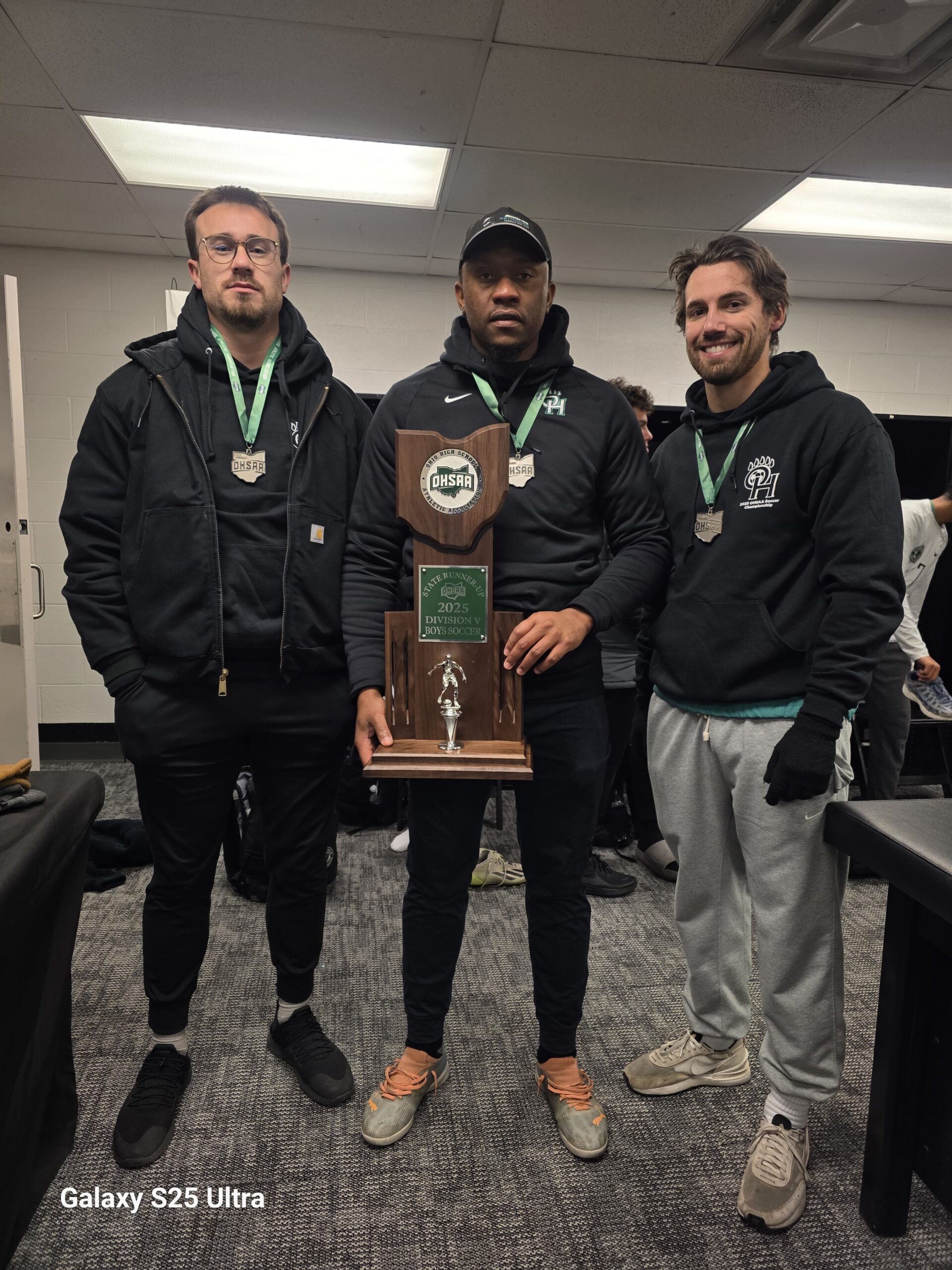
Ottawa Hills head coach Rodclif “JR” Hall, center, and assistant coaches Drew Hoffman, right, and Jakob Walther after the Green Bears’ state championship match against Cincinnati Summit Country Day on Nov. 10 in Columbus. The Green Bears have competed in the state semifinals or finals eight times in the past 17 years. (Photo courtesy of Ottawa Hills Senior High School)
Ottawa Hills, a Division V program, played a challenging schedule during the regular season. Close losses or ties against bigger D-I programs like St. John’s Jesuit, St. Francis de Sales, Southview, Northview, Springfield, and Findlay contributed to the Green Bears’ 6-9-2 record.
It also got them prepared for what was to come.
“It toughened us up,” senior center-back Jaiden Dubois said. “We played great competition. We did end up losing most of those games, but playing against better teams, we were prepared for being down and playing in harder circumstances. In the tournament, we were prepared for those circumstances.”
Ottawa Hills’ boys soccer tradition is well known around the state and Northwest Ohio in particular. The Bears, competing in the smallest school division, have advanced to the state semifinals eight times in 17 years. The 2008 team, coached by Greg McElroy, finished 20-3-0 and capped off that season with a 1-0 win over Worthington Christian in the D-III state championship match.
The Bears lost in the D-III state finals in 2017 and 2022, and lost in the semifinals in 2010, 2012, 2020 and 2021.
“There definitely is pressure, knowing we have such a good program that has been successful in the past,” Dubois said. “In the preseason we often see (former) players come back and they play with us.”
Grimm said every Ottawa Hills player is “more than aware” of the school’s past soccer success in the postseason. He said the current players feel like it is their job to “keep it rolling.”
“We know Ottawa Hills has been a great soccer school for many years,” said Grimm, who also plays shortstop on the baseball team. “Going into this year, we didn’t think we were going to live up to that. We went up against all odds. We didn’t think we had the strongest team, but when we played St. Francis and St. John’s, that showed us we can compete with these teams.
“They were all very close games until the very end. They definitely knew what Ottawa Hills soccer is. They don’t think of us as an easy game at all.”
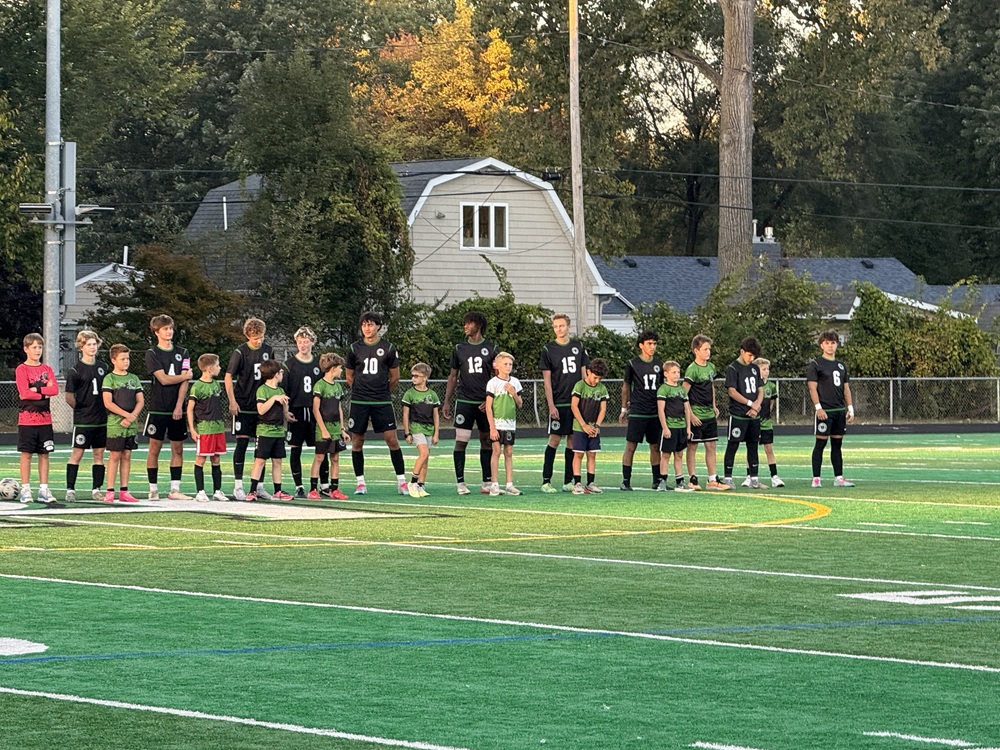
(Photo courtesy of Ottawa Hills)
One game at a time
In Hall, the Green Bears have a coach who embraces that tradition.
A native of Jamaica, Hall’s hometown was battered by Hurricane Melissa on Oct. 28. He moved to the U.S. in 2009 and played forward at Owens Community College and Bowling Green State University.
Hall was an assistant coach at Ottawa Hills from 2021-23 and last season, in his first year as head coach, took the Bears to the regional semifinals where they lost 1-0 to Van Buren. Hall said his goal this season was “to take it one game at a time.”
“My sole concentration is the game we are playing,” Hall said. “My experience is to play it game by game. In the postseason we had fairly good information on the teams we were playing, and I was able to set up our team in a way we could be competitive.”
The Green Bears had four seniors, three of whom were starters, but two of those seniors were injured at some point during the season. Ottawa Hills relied on its defense the entire time.
“Defense was the thing that carried our team,” Hall said. “The games we lost big are the games where our defense made mistakes. Defense was definitely a strong point of our season.”
Hall said the fact that the Green Bears, who took second place in the Toledo Area Athletic Conference behind Maumee Valley Country Day School, earned a No. 1 seed in the Northwest 2 sectional/district was a sign of respect.
“We weren’t surprised,” Hall said. “We played St. John’s, St. Francis, Findlay, Northview, and Southview and it helped us a lot. Playing those tough games at the end really encouraged the boys.”
The Green Bears opened the postseason with an 8-0 rout of Woodmore on Oct. 18. The Wildcats never had a chance.
“The coaching staff did an amazing job,” Dubois said. “For that first game, we did so much to prepare and went through so many drills for our shooting, and it showed.”
The Bears followed that with wins over Mansfield Christian (1-0), Ottoville (2-1), and Fort Jennings (5-1) before avenging a regular season loss to Maumee Valley with a 3-2 win over the Hawks in the regional finals.
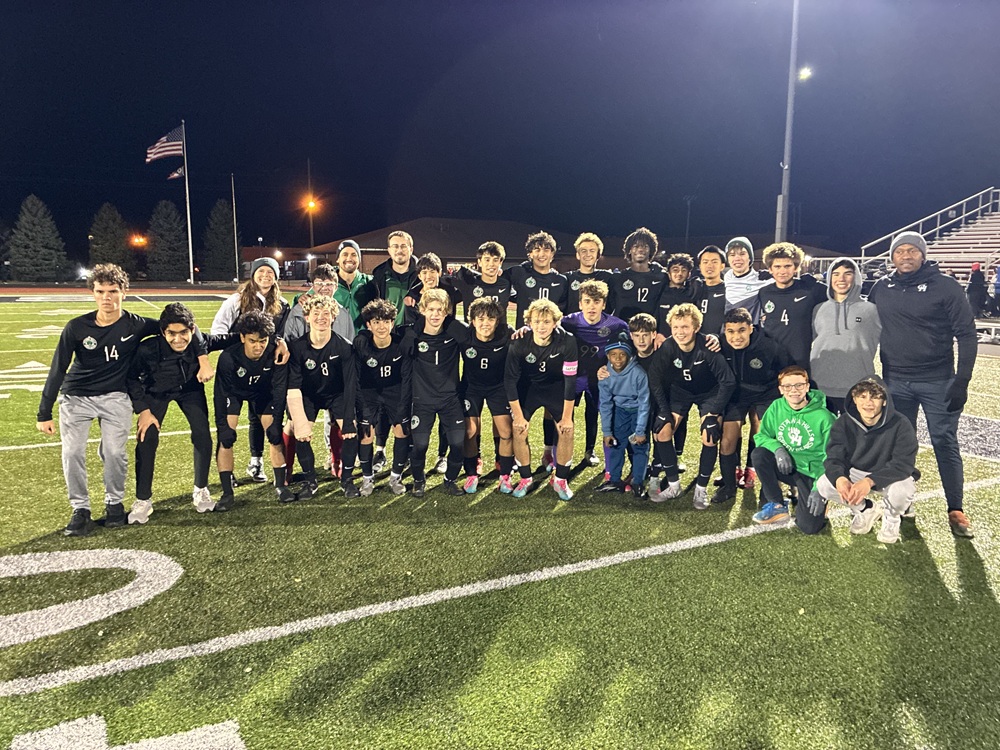
(Photo courtesy of Ottawa Hills)
Know who you’replaying
Ottawa Hills beat Kidron Central Christian, 1-0, in the state semifinal match in Sandusky, setting up the title match against top-ranked Cincinnati Summit Country Day, which needed overtime to beat Milford Center Fairbanks, 2-1, in the other state semifinal.
“We knew who we were playing,” Grimm said. “They were a great team and we had to come out hard. We already did the hard job by making it to that game. We just had to go out there and try to win it now.”
Hall said he knew what the Green Bears were up against. Summit Country Day had outscored its previous three opponents 8-1, and the Silver Knights’ girls’ team won the D-IV state title, its third straight, three days earlier.
“We were playing against a team where 80 to 90 percent of their players play Club,” Hall said. “We don’t have a lot of players who play Club. We have a school where players run track or play baseball after soccer is finished. We were happy that our boys could do this against a school that has 80 to 90 percent of their players in Club.”
Summit Country Day, which won its ninth state title, scored twice in the 20th minute of the match to take a 2-0 lead. The goals came 27 seconds apart. Ottawa Hills went on to a 5-1 loss and avoided a shutout when junior midfielder Ibraheem Alaani converted a free kick into the upper right corner in the 74th minute.
“Ibraheem had been practicing that kick in the postseason, either before or after practice,” Hall said.
Sophomore keeper Burke Pfeiffer made eight saves for the Bears, who had a 14-1 disadvantage in shots on goal.
“Summit was way ahead of us that game,” Grimm said, “but we didn’t give up. We got that one goal. After the game, no one was really devastated. We were all proud of ourselves and we were happy to be playing in that game.”
Dubois said playing for a state championship “meant everything,” and he and his teammates never sulked after falling short in the finals.
“It was a major accomplishment, even though we didn’t win it,” he said. “It was an amazing season. We had to work together to accomplish our goals. It really is a brotherhood and we all love each other.”
Senior forward Avi Hanusz led the Bears (12-10-2) with 14 goals this season, while sophomore right wing Savio Deigar and junior attacking midfielder Andy He had eight goals apiece.
Grimm and right/left wing Archie Talbott scored five goals each, Talbott had a team-high nine assists, Deigar had six assists, and Pfeiffer had 82 saves in goal. The Green Bears posted seven shutouts.
“I will remember the joy and togetherness and bond from the boys at practice and in games,” Hall said. “The final was just the cherry on top, to have that bond and family from what I saw every day. They know how hard they worked during the season and they did everything they had to during the season.”
Grimm said the team became “a complete family” during the season.
“With every win or loss, we knew we would come together and we knew what to do to get the job done,” Grimm said. “We had the most fun this year and that helped us go far in the playoffs.
“It’s one thing to take things seriously, but you have to have fun while you’re doing it.”
American beech, Secor Metropark. (By Metroparks Toledo nature photographer Art Weber)
All the leaves are down. Or are they?
We usually think of fall as the last hurrah for leaves. And it’s true that by now most of our leaves have fallen and the woodlands have a barren look. But there are hangers-on. Oaks and beech mostly, trees that have an extra strong connection to their leaves, even when they’re trying to let them drop.
Fall is transition time for deciduous trees, a time to prepare to go dormant for the winter months by absorbing and storing the nutrients in chlorophyll. Once that’s done, the tree forms a layer of scar tissue at the base of each leaf, which results in the leaf detaching and eventually falling to the ground. Losing leaves is an amazing adaptation for surviving the freezing temperatures of the winter months.
Some leaves, notably those of oaks and beech, can remain stubbornly attached until spring. Even though these leaves have been cut off and dried, the connection remains strong enough to hang on much longer than other species.
Oaks and beech are important trees in our forests, providing beechnuts and acorns as well as excellent den and nesting sites for wildlife. On winter woodland walks, look for the leaves hanging on, especially the copper-colored beech, like this one photographed after a January snowfall in Secor Metropark.
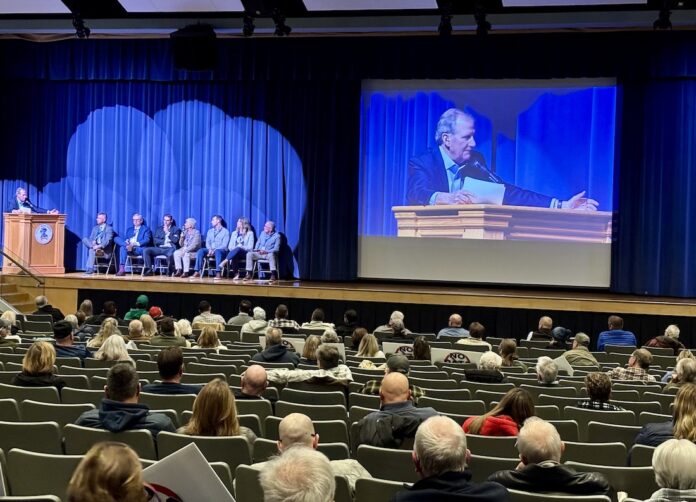
Jerry Anderson emceed “Under the Spotlight: Data Centers In Our Backyard” on Nov. 20
at Anthony Wayne High School. (AWFP photo by Karen Gerhardinger)
WHITEHOUSE – Just the facts – that’s what many community members were seeking as they prepared to listen to a panel of experts during the Nov. 20 “Data Centers In Our Backyard” forum.
“I’m going to keep an open mind and listen. It’s easy to come up with notions…when you haven’t read all the facts,” said Matt Reed as he sat in the Anthony Wayne High School auditorium awaiting the start of a panel discussion hosted by WGTE, Regional Growth Partnership and Lucas County Economic Development Corporation.
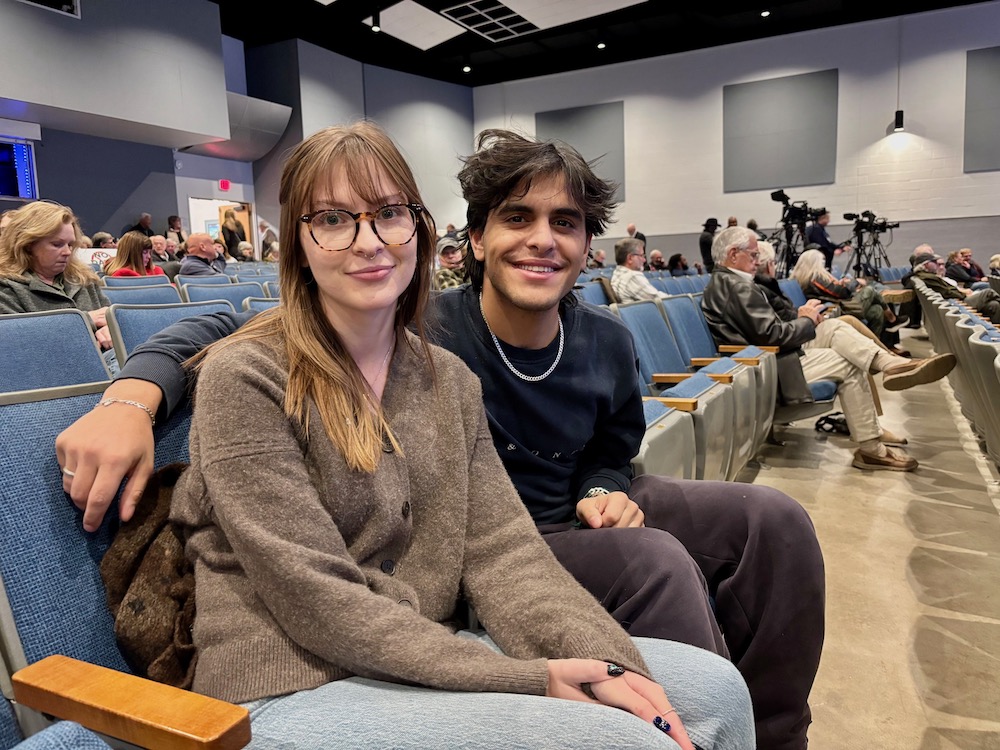
Matt and Meghan Reed, of Monclova Township, prepared to listen to a variety of viewpoints on data centers. (AWFP photo by Karen Gerhardinger)
Matt and his wife, Meghan Reed, moved from South Toledo to Monclova Township in March, and a few months later heard about data centers being proposed in the area.
“It’s so hard to differentiate fact from opinion. I was hoping this would have more unbiased fact,” said Meghan, noting that she has no preconceived notion on data centers.
Dale Knepper has seen, during the 18 years he served as Waterville’s finance director, how emotional issues can prevent people from seeing the facts.
“When it comes to financial issues, sometimes you can lay the facts in front of people, but if they have their mind made up, there’s nothing you can do,” he said. “We have to look at everything. If a data center isn’t here, and moves to Fulton County, it’s still using the water and electrical sources, but we’re not going to get the benefits.”
“I heard some rumors, but I want to get clarification,” said Waterville Township resident Steve Eberly, who has property along Noward Road, noting that he was particularly interested in the impact of data centers on water and electricity – especially since he has a well.
“Right now, I’m not holding up a sign protesting, but I’m more than a little interested in what that could mean.”
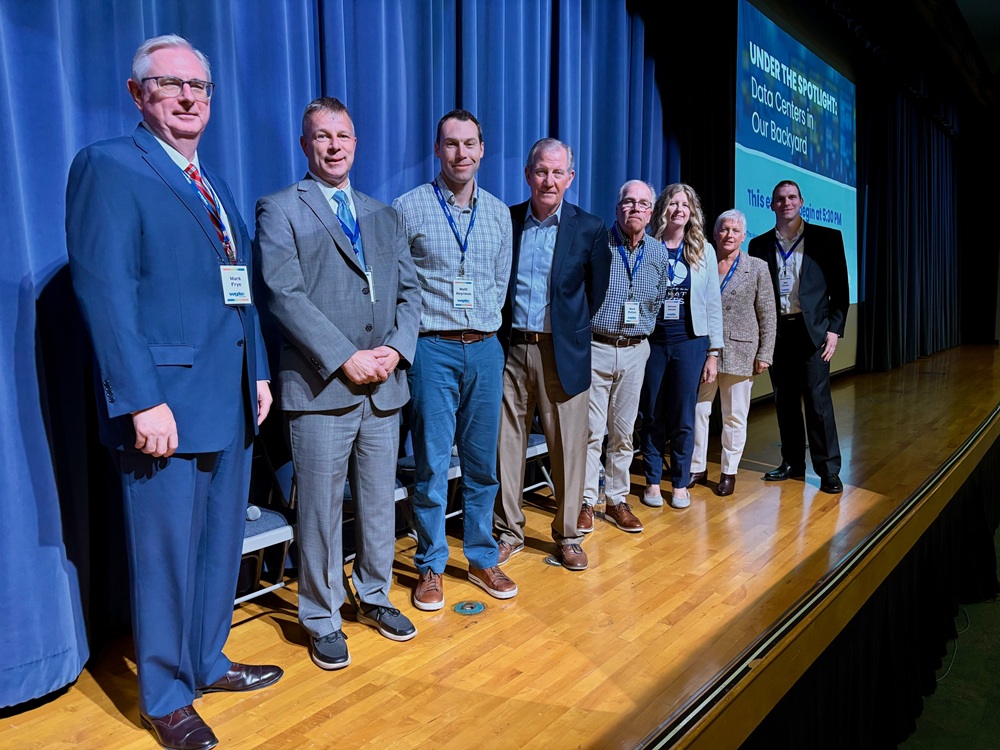
The panel for the data center forum included (from left) Mark Frye, Gary Thompson, Matt Heyrman, emcee Jerry Anderson, Mark Patton, Helena Volzer, Karen Winn and Will Turner. (AWFP photo by Karen Gerhardinger)
While opponents of data centers have hosted town halls and crammed local municipal meetings to voice their opinions, the Nov. 20 forum was the first of its kind to include representatives sharing multiple perspectives: Mark Frye, Palmer Energy; Gary Thompson, Regional Growth Partnership (RGP); Matt Heyrman, Lucas County Economic Development Corporation (LCEDC); Will Turner, a site selector for data centers; Helena Volzer, Alliance for the Great Lakes; Karen Winn, a Richfield Township property owner; and Middleton Township resident Mark Patton.
The forum was emceed by former WTOL11 anchor Jerry Anderson, a Bowling Green resident who often drives by the giant Meta data center development taking a square mile on S.R. 582 between S.R. 25 and I-75 in Middleton Township. The community wasn’t aware of the project until dirt was being moved, Anderson said.
“We didn’t have forums like this one,” Anderson said.
During the 90-minute meeting, Anderson asked questions about the impact data centers would have on the electrical grid and bills, water quality and sustainability, home values, farmland and the economy.
When it comes to water, Turner said the older model data centers used millions of gallons a day, but the centers in development will use just 20,000 to 30,000 gallons a day.
“When you look up data centers and water, you’re getting old technology – water guzzlers. There’s a tremendous advantage in closed loop systems. They’re more efficient, and quieter.”
At least two members of the audience remain concerned about water – especially upon hearing Volzer say that more studies are needed to see the long-term impact of data centers on the Great Lakes.
Christina Egan, a Monclova Township resident, said Taylor’s explanation of a closed loop water system didn’t assuage her concerns about the need to have enough clean water for future generations. Water is also on the mind of University of Toledo sophomore Kylie Woodward.
University of Toledo sophomore Kylie Woodward and Abbas Kondil came to the forum to hear about the impact of data centers on the Great Lakes. (AWFP photo by Karen Gerhardinger)
“I’m against AI to begin with. It’s threatening the Great Lakes if we build a data center near it,” Woodward said. “Once it’s gone, it’s gone. It’s not an infinite source.”
Data centers need water for cooling the servers inside, but also to cool the turbines that generate power to run the data centers, Volzer said.
“Every Great Lakes state is adding data centers,” she said, noting that other high tech industries and agriculture are the biggest users of water. “Whether we have enough water to sustain them is a good question. Demand studies are a good way to look at the question. We need more research.”
Data centers use a lot of electricity, said Frye, explaining that a hyper-scale center could use up to 500 megawatts, or the amount needed to power 500,000 homes. Most of the existing data centers are connected to the grid, but the trend now is BYOG – bring your own generation. Before connecting to the grid, data center developers need to go through detailed load studies to determine if the project will adversely impact other users on the grid.
American Electric Power (AEP) in Columbus asked the Public Utilities Commission of Ohio (PUCO) to create a data center tariff to pay for transmission infrastructure, and Frye suspects that First Energy will do the same.
“This is part of the protections being built into the regulatory infrastructure,” Frye said.
Anderson cited a detailed Ohio Chamber of Commerce report on the economic impact of data centers in 2024: supporting 95,000 jobs and contributing $11.8 billion to Ohio’s GDP. The industry is projected to support over 132,000 jobs and contribute $20.2 billion to the Ohio economy by 2030.
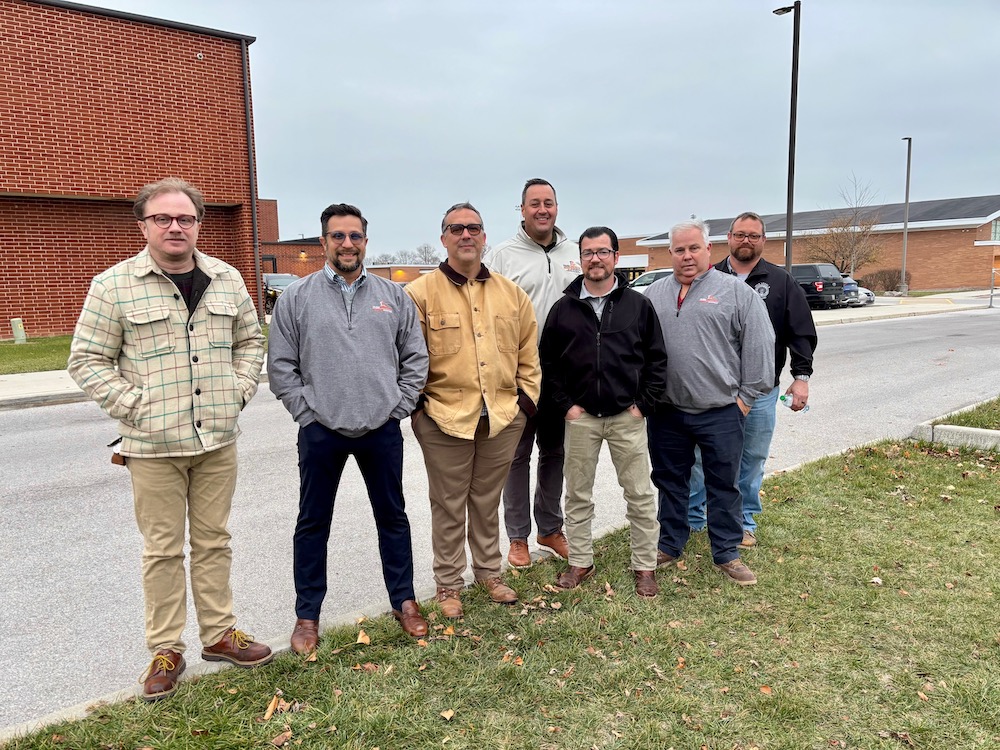
Members of the International Brotherhood of Electrical Workers Local 8 gathered prior to the forum, where they sought confirmation that any large project would use union labor. (AWFP photo by Karen Gerhardinger)
Terry Short, a 2000 Anthony Wayne High School graduate and an electrician with the IBEW Local 8, said he’s dismayed when he reads people who dismiss those jobs as just temporary.
“We choose these careers. It’s what we do for a living. We’ve all made a career out of a temporary job,” Short said.
Short was joined by several members of the IBEW, including Tom Enright and Josh Abernathy, who sat in the front row to listen to the presentation. Finding projects for new apprentices and experienced electricians is a priority, they said. The Meta project, as an example, employees 300 to 400 electricians and 280 low voltage workers – those who install cabling, fire alarm and camera systems, for example.
“This will allow us to take in more apprentices and give them a great job, a great education and great benefits,” Enright said.
As the economy ebbs and flows, so do opportunities for apprentices, Abernathy said.
Is there a way to grow jobs in a state with a declining population – Anderson asked – one that’s heavily reliant on the automotive and agricultural sectors?
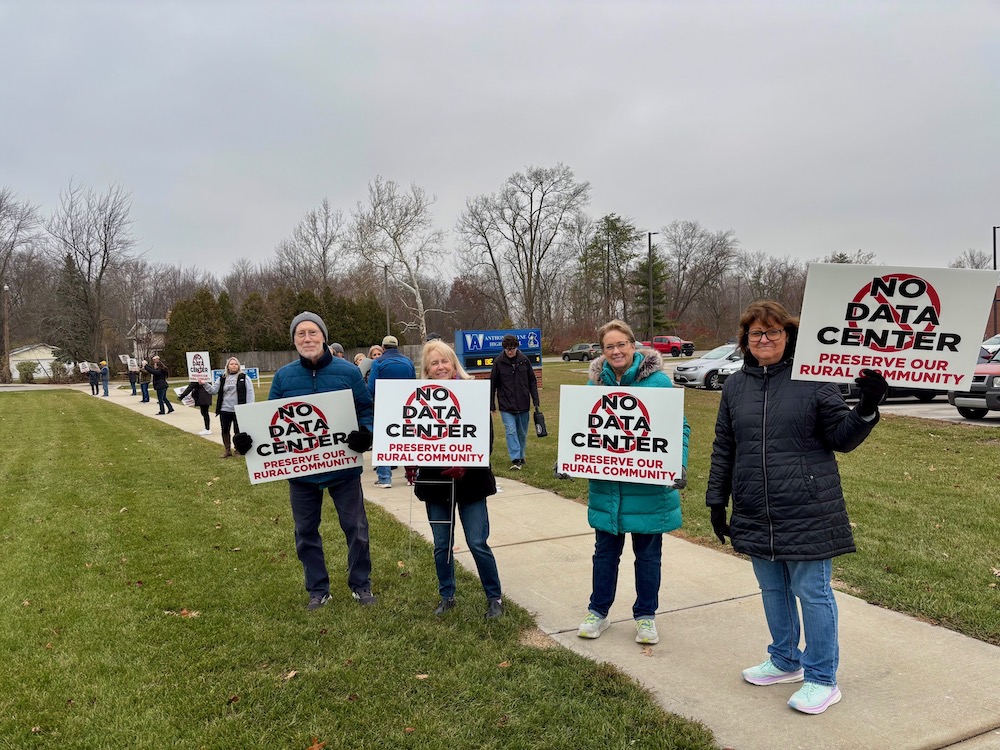
“It’s really up to the community,” Thompson said, noting that data centers will not locate where they’re not welcome. That comment brought jeers from the audience members holding ‘No Data Center’ signs.
“Society and the economy is changing. We are a manufacturing society. All manufacturers are putting AI into their process. They need computation power to do that,” Thompson continued. “Manufacturers need data centers or we will lose our manufacturing base.”
The county and RGP work with communities to look at how to balance quality of life with wealth creation, Heyrman said. That can be done with proper zoning and negotiating an agreement that ensures tax benefits come to the community.
For Winn, who is part of a six-generation farm family in Richfield Township, even a $200,000 an acre offer couldn’t pay for the value of rich farmland and a sense of family and community.
Richfield Township is now moving away from zoning to allow data centers and advanced manufacturing, but several local jurisdictions have adopted language to allow and regulate the projects. The final decision comes down to township trustees, boards and councils.
Waterville City Council approved a conditional use permit for Meijer to begin work on a 159,935-square-foot store near the intersection of U.S. 24 and S.R. 64. (Rendering courtesy of Meijer)
And Whitehouse Fire response times drop
ANTHONY WAYNE – Waterville City Council approved a conditional use permit for a new Meijer store and gas station at the corner of Pray Boulevard and S.R. 64 during its Nov. 10 meeting. In Whitehouse, Mayor Rich Bingham honored long-time Tree Commission member Sheri Luedtke, employees James Forrest and Mike Hill. In addition, Fire Chief Jason Francis reported a drop in response times over the past decade. Here is a recap of the two AW-area meetings.
Waterville
Meijer will begin site work for a 159,935-square-foot retail store and 3,660-square-foot gas station and convenience store at the southwest corner of Pray Boulevard and S.R. 64, after Waterville City Council unanimously approved a conditional use permit for the project during its Nov. 10 meeting.
Brian Smallwood of Wolpert, Inc., an agent for Meijer Stores, presented updates to the site plan, facade and traffic study, based on prior input from council and the city’s Planning Commission. The main store will have two main entrances for the grocery and home good areas, as well as a garden store, e-commerce pickup and customer service area.
“I think you will be a great addition to this community,” said Anthony Bruno. “It will be nice to give our citizens options.”
During the meeting, council members asked questions and made suggestions for how Meijer could best fit into the community. Wayne Wagner suggested that Meijer consider accommodating the county recycling bins that were displaced by the construction of Auto Zone in the Kroger out lot several years ago. He also asked if the lights could be dimmed in the evening so as not to affect the growth rate of the nearby soybean field, as growth typically occurs at night.
“We have the ability to shut off or dim a significant number of lights,” said Smallwood, explaining that while the store will not be open 24 hours a day, some lights will need to be left on for the safety of employees who do overnight stocking.
Both Wagner and John Rozic shared concerns about adding another fuel station to the city – which already has Speedway and Kroger gas stations at the same corner, plus a Circle K downtown.
“This will be a huge hurt to their business,” Wagner said about the existing fuel centers.
The M Express gas station is a significant portion of the Meijer business now, Smallwood said, explaining that about 25 to 30 percent of Meijer customers cross shop, using their M Perks credits for discounts on fuel.
Resident Scott Jahns spoke in favor of the gas station.
“The competition will drive the cost down,” Jahns said, noting that Waterville tends to have higher prices than elsewhere in the area.
Rozic also urged Meijer to create a facade that is distinctive to Waterville.
“It’s a beautiful store, but it’s a Meijer store – not something that’s Waterville or Anthony Wayne,” Rozic said, suggesting that Smallwood look into utilizing Carruth designs or materials used throughout the city. “I want it to look like it belongs here, not just dropped in from Maumee or Sylvania.”
Meijer takes a lot of pride in building stores with high-quality construction and believe in the look of the store, but will incorporate local landmarks and history inside its community area, Smallwood said.
“Meijer truly does want to be a part of the community and puts a lot of emphasis on trying to do that,” he said.
Another one of Rozic’s suggestions – to ban overnight parking of semis and campers – was accepted and included in the permit during the vote.
As part of the permit, Meijer agrees to complete traffic improvements as recommended by a traffic impact study, including a right-in, right-out driveway on S.R. 64 similar to the one at the Kroger gas station; three driveways on Pray Boulevard; a 480-foot westbound right-turn lane on the north side of S.R. 64 onto northbound U.S. 24; and, when approved by the Ohio Department of Transportation, the installation of an eastbound U.S. 24 ramp traffic signal within 24 months after an occupancy permit.
The Meijer signage will be smaller than the Kroger sign, blending in with the site, said administrator John Gochenour. Lighting will be downward directed to prevent light spillage in the 526-space lot. Site work is expected to begin soon and includes filling in the current pond and constructing two stormwater detention facilities.
“I’m thrilled you are coming,” said Council Member Mary Duncan, noting that many have asked for a pharmacy.
Council members asked about two outlots available for development. Smallwood said Meijer is in discussion with a possible tenant but cannot reveal the name at this time.
Resident Nick Sargent asked about security to prevent thefts. Meijer has onsite security, as well as cameras that continuously monitor the parking lot, front of store and interior, but will work with local law enforcement on prevention.
Pointing to the recent land use plan update, resident Paul Miller said that those who responded to a survey of wants answered that they didn’t want townhomes, apartments or industrial.
“Meijer we want,” he said.
During the meeting, council also:
-Listened to Mayor Tim Pedro say that Waterville residents who are interested in filling two seats on council that will be vacant as of Jan. 1 should send in a letter of interest by Friday, Dec. 5. Anthony Bruno decided not to run for a third term, and John Rozic is term limited. Mary Duncan was the only candidate for the three open seats and will serve a third term.
–Listened to residents Paul Miller and Lisa Urie speak about community planning and data centers. Miller said the area proposed for a data center doesn’t fit in with what he read in the recently updated land use plan. He urged council to consider a ban rather than a moratorium, which is up for discussion during the Monday, Nov. 24 meeting. Urie compared Waterville to the town in It’s A Wonderful Life and pointed out that wealth doesn’t necessarily bring joy to a community.
-Heard that Helms and Sons of Findlay was the low bidder, at $1.5 million, for the Waterville-Monclova Road widening project slated for 2026. The city will pay just 6 percent, or $88,339, for construction, as a federal grant of $1.1 million and Ohio Public Works Commission grant of $293,283 will cover the majority.
-Learned that the Ohio Department of Taxation has approved, after several months, the city’s plans for a downtown redevelopment tax incentive district. The first payments should come through in March 2026.
Whitehouse Council Nov. 4
Whitehouse Fire Department response times have dramatically dropped in the past decade, Fire Chief Jason Francis announced during the Nov. 4 Whitehouse Village Council meeting.
In figures comparing 2015 to 2025, both the turnout time – how long it takes between dispatch until a vehicle is on the way – and the response time, which is from the dispatch to arrival on scene, dropped significantly. The turnout time for fire dropped from 4:18 to 1:10 and for EMS from 3:19 to 1:09. Response times went from 9:52 to 5:57 for fire and from 6:40 to 5:13 for EMS.
“These improvements aren’t just numbers – they represent real outcomes in our community,” Francis said.
A 3-4 minute reduction in fire response time can mean the difference between a small, contained fire and a fully involved structure.
“That’s tens of thousands of dollars in property save and, more importantly, lives saved,” Francis said.
Saving 1-2 minutes on EMS calls can double survival chances for cardiac arrest victims and dramatically improve outcomes for trauma patients.
Whitehouse Fire Department has seen significant reductions in response times over the past decade, reported Fire Chief Jason Francis (second from left), who is joined by (from left) Zach Bingham, Jamie Blake, Megan Beaudry, Tim Newsom and Eric Leonard. (AWFP photo by Karen Gerhardinger)
“These are minutes that matter. And they’re minutes we earned through strategic operational investments, not by chance,” he said.
He thanked council for supporting improvements in staffing and deployment enhancements; increased Advanced Life Support personnel; investing in training and readiness; upgraded technology and station alerting systems; and co-op partnerships and mutual aid improvements that expand response capacity and regional support.
“These changes have cut precious minutes off every phase of response, improving our performance and strengthening public trust,” Francis said.
During the meeting, council also:
Sheri Luedtke was recognized during the Nov. 5 Whitehouse Village Council meeting. (AWFP photo by Karen Gerhardinger)
-Recognized Sheri Luedtke for her years of serving the community, as a member of the Tree Commission and other boards. Mayor Rich Bingham said her quiet leadership has made a difference in the village. With the Tree Commission, Luedtke was integral in securing Tree City USA status and annual Growth Awards, and actively educated the community on invasive species, proper tree planting and other topics. Over the years, she has served on the Whitehouse Library board of directors, organized the summer farmer’s market and volunteered with the Anthony Wayne Community Food Ministry.
-Heard about plans for the Saturday, Dec. 6 holiday celebration that is estimated to bring in 4,000 residents and guests for a 5k race, parade, tree lighting, vendors, crafts for kids and a visit from Santa Claus. The event takes place from 3:30 to 7:30 p.m. The 5k, hosted by Run Toledo, will benefit Hospice of Northwest Ohio.
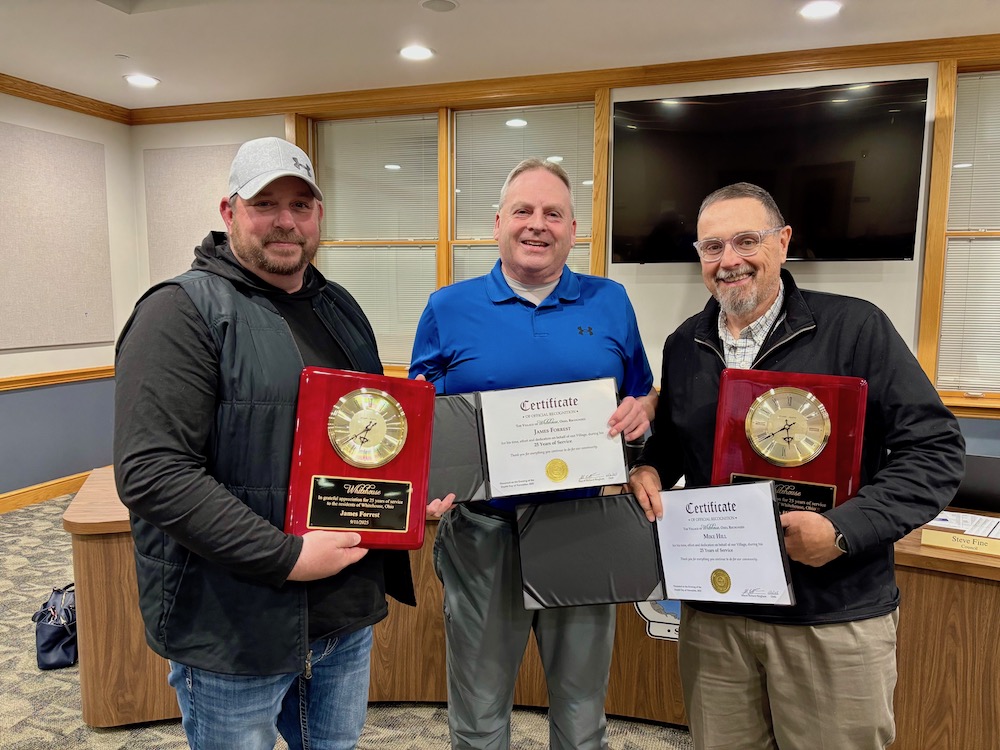
-Recognized Public Service Director Mike Hill and employee James Forrest for their 25 years of service to the village.
Whitehouse Mayor Rich Bingham (center) presented clocks and certificates to Public Service Department employee James Forrest and director Mike Hill for their 25 years with the village. (AWFP photo by Karen Gerhardinger)
-Learned that RX Solutions will be opening a pharmacy in early 2026, based out 6729 Providence St. The pharmacy will offer free delivery of medications. Contact them at 419-558-0800.
-Heard that a Toys For Tots collection competition between Whitehouse and Waterville is underway as of Nov. 10.
-Listened to Bingham say that he met with representatives of Carlyle Group, which is purchasing BASF Coatings, to discuss growth opportunities for the Industrial Drive business. Carlyle will take over in the second quarter of 2026.
-Discussed options for assisting residents impacted by the loss of SNAP benefits and government workers, including those at the 180th Fighter Wing, who had not been paid. Council authorized administrator Jordan Daugherty to look at options and use up to $2,500 to provide assistance either through local food banks or other methods.
-Agreed to move forward with plans to have murals painted on walls in town.