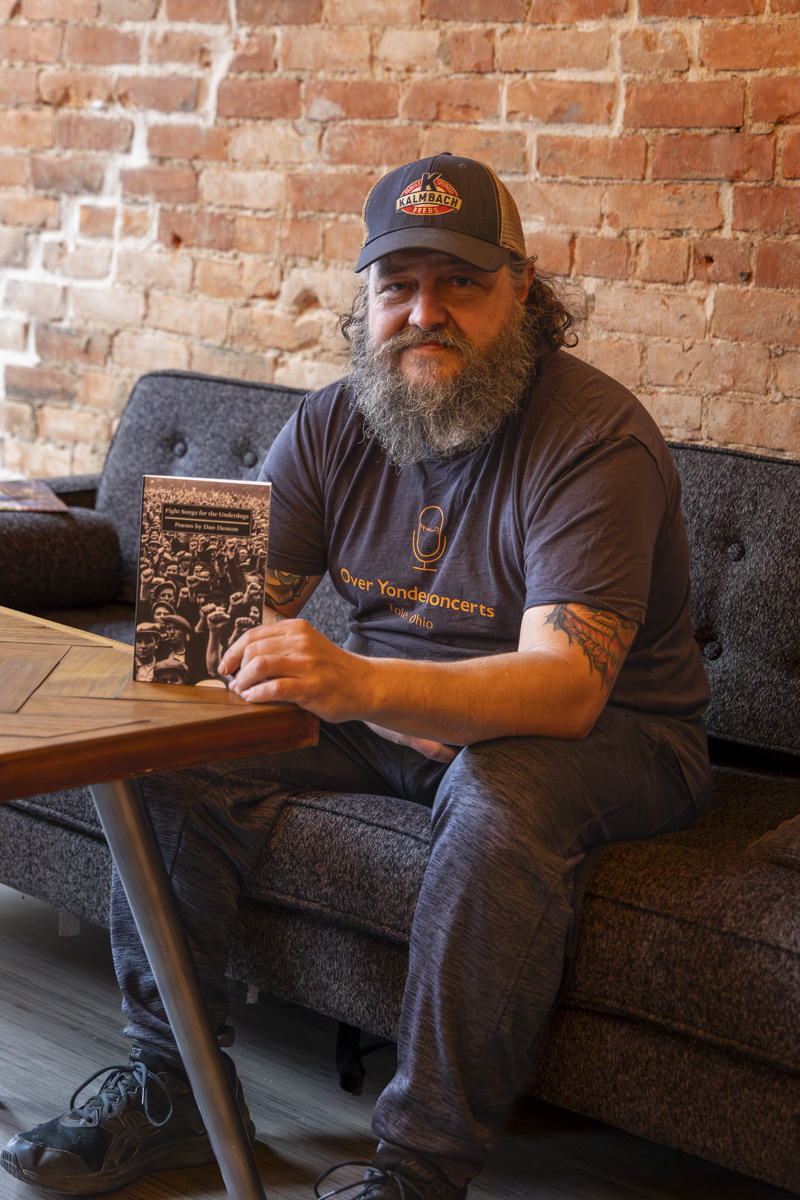
The book Fight Songs for the Underdogs takes inspiration from Dan Denton’s life and the struggles of dealing with drugs, poverty, mental health, and homelessness. (TFP photo by Gaven Hafner)
TOLEDO– Local writer and former Jeep union steward Dan Denton has released a new poetry collection titled Fight Songs for the Underdogs, a book that captures the lives, frustrations, and endurance of America’s working class through Denton’s signature raw, conversational style.
Denton’s journey to becoming a published writer was far from easy. Growing up in poverty in a small Midwestern town in Illinois, Denton dealt with a lot of hardships.
“We were like the poorest family in town… I grew up in the projects, and when I got to my teenage days, I got into drugs. But still, books were always a part of my life,” Denton said.
Addiction and homelessness marked his early adulthood, shaping the raw honesty of his writing. It wasn’t until Denton got sober in his 20s that he began writing consistently.
Dan Denton, a retired Jeep union steward turned full time published writer, has released his fourth book, Fight Songs for the Underdogs. (TFP photo by Gaven Hafner)
“When I got sober 19 years ago, I started writing pretty much every day then,” Denton said.
Even as a factory worker and union steward at Jeep, Denton continued to nurture his writing. In 2013, Denton joined Jeep and spent a decade working there, where he also served as a union steward. During his time at Jeep, Denton would write down poems any chance he got. “It wasn’t uncommon for me a lot of times to write a poem while I was on the assembly line,” he said.
Over the years, Denton has published four books. His newest book, Fight Songs for the Underdogs, is a compilation of various poems that include selections from his self-published “chat books.”
“This poetry collection isn’t all just my very best work; it’s a collection of 10 or 12 of those homemade chap books I’ve made over the years for gas money on my road trips and tours. Over the years, Jason Ryberg from Luchador Press had said, ‘Hey, man why don’t you put a group of those books together? Let’s publish it as a book.’ And so finally, this year – it took me about six months – I finally put together the ones I like and sent them to him,” Denton said.
The poems take inspiration from Denton’s life experiences, struggles with drugs, poverty, mental health and homelessness.
Denton’s new book, Fight Songs for the Underdogs, a collection of poems, was released in October of this year. (TFP photo by Gaven Hafner)
“That’s kind of like my signature poem from the early days. It’s called “Bury My Heart in the Gutter.” And that poem has actually been covered by other poets who have also performed that poem in poetry slams and won awards,” he said. “It honors my life of addiction and homelessness and my mental health, and how I grew up in the gutters and the projects, and how, even though I’ve gotten beyond that, that was the first place where I learned to love, and I learned value of work. So it kind of honors that,” Denton said.
Denton chose the title of the book based on one of the poems of the same name in the book. “It’s called “Fight Song for the Underdogs.” And I felt like that poem encapsulated what I try to do as an artist. You know, it’s a poem about…a fight song or an anthem. [About] pretty much everybody who’s been left behind or overlooked. The underdogs,” Denton said.
Denton’s poems stand as a testament to endurance, each line a small rebellion against despair. For the underdogs still out there fighting, Denton’s words are a rally cry: keep going, keep writing, keep living.
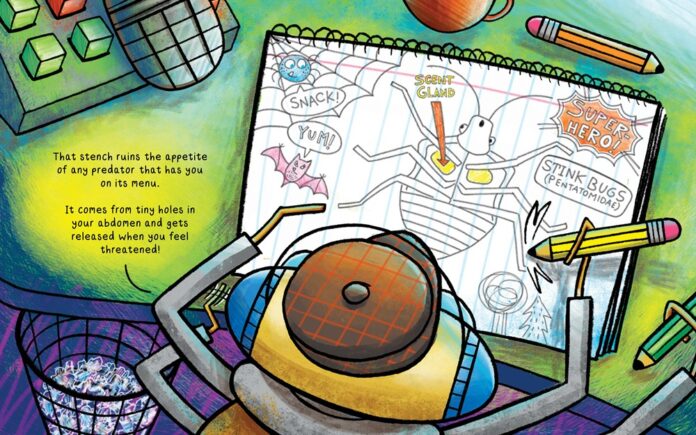
Illustration from On the Air with Doctor Doodle Bug (Art by Susan E. Goodman).
PERRYSBURG – Swanton native Merrill Rainey remembers the moment he first understood the magic of bringing a story to life with pictures. What began as a look through a senior art show at Kent State University, became a profound discovery of the importance that illustrations hold for a child’s imagination.
Rainey most recently published his children’s book On the Air with Dr. Doodlebug, which is about how different bugs can call into a radio show to talk about their problems, and Dr. Doodlebug always has an answer for them.
“This story is co-created with Susan E. Goodman, and we both kind of worked with the same editor over the last couple years on different projects: Jill Davis,” Rainey said.
Author Merrill Rainey
As of this year, Rainey has eight published books.
On Nov. 7, the bookstore Gathering Volumes in Perrysburg held a release party for Rainey’s newest children’s book.
“For storybook style books, like Dr. Doodlebug, we always do a read aloud. Then, we did a draw along. I had an activity specifically towards nature journaling because Dr. Doodlebug draws out all of his answers to the bugs in his journal,” Rainey said.
The inspiration for this book came from Rainey’s love of radio shows.
“I had the idea of the radio show, it seemed to fit in a little bit more of a modern fashion, as opposed to, written letters. But I am a big fan of radio and I listen to a lot of talk shows. In a recent interview, I talked about how this one is kind of inspired by the evening radio show “Delilah” where people call in and ask for advice,” Rainey said.
On the Air with Dr. Doodlebug took four years to complete.
“For a single illustration, it could take up to a week or more, depending on the complexity of the artwork. Traditionally, to finalize a picture book is about two years,” Rainey said.
Rainey takes his inspiration for his books from the world around him.
“I’m a big observer of the world around me. I just keep my eye on different things and I read a lot that comes into play as well,” Rainey said.
Rainey said while producing this book, he had to do a lot of research about different species of bugs.
A piece of advice that he provides to young writers is the importance of practice, discipline and having motivation.
“First and foremost is to learn to write and spell well so that you have that good foundation of how those things work. Once you are solid with that, then just practice every day with your writing. You only get better the more you do it. Reading other people’s work and how they write their stories will help you to understand how to write your own stories as well,” Rainey said.
“A lot of the time, when you tell a story, it’s about something that’s happened, has already happened to you or happened to somebody that you know. When you’re creating stories, you’re telling stories,” Rainey said.
There are a limited number of signed copies of On the Air with Dr. Doodlebug available at Gathering Volumes. You can also find copies of the book at major online retailers like Amazon.
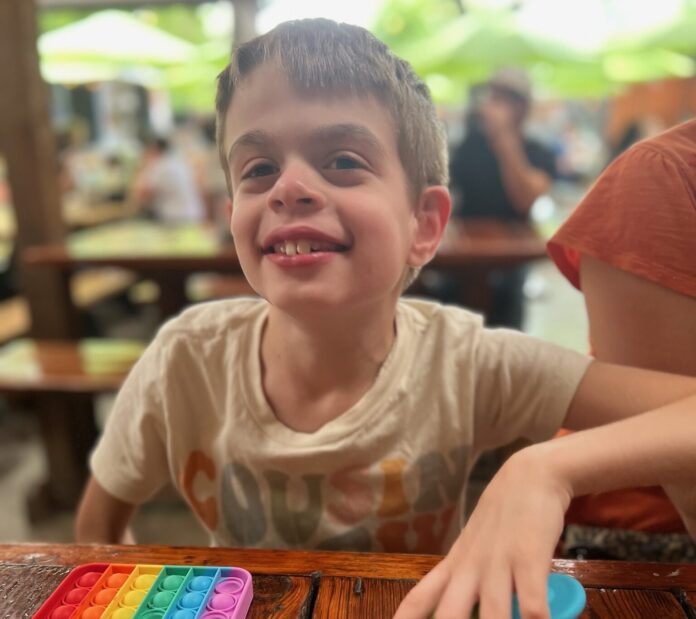
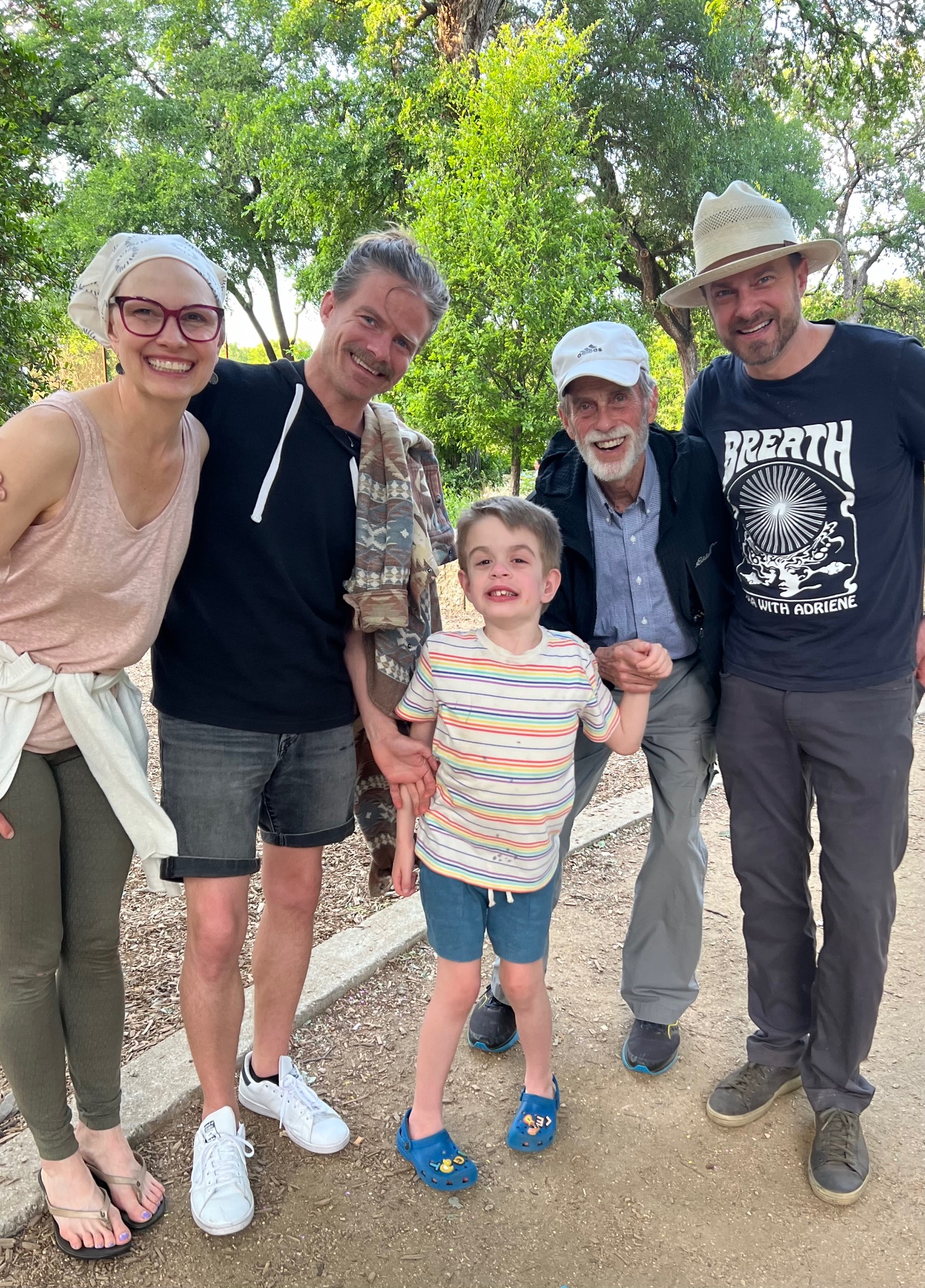
Simon has a rare, genetic condition called San Filippo Syndrome.
TOLEDO – Alina Gorniak and her husband, Jeremy Croke, both native Toledoans, were about to be parents to a brand new baby boy they planned to name Simon.
It was May 15, 2016, and the delivery went as planned. Soon after, Gorniak, a well-educated woman, could feel that some things were not adding up.
“I have that momma sense,” Gorniak said. “As soon as he was born, I thought something was not right. The initial sign was breast feeding. It was like a square peg in a round hole. Something was not working. Then, he wasn’t meeting his milestones: is he rolling over, is he babbling, is he taking his first steps?
“During that first year, going to wellness checks at the pediatrician’s office, they would say he could be on the tail end of the bell curves,” she continued. “We held onto hope for that until about 10 months.”
Around that time, Gorniak said Simon was gifted a tambourine by his uncle. It wasn’t long before Simon “started spinning the tambourine on the ground, almost like he had been doing that the previous 10 months,” Gorniak said, recalling Simon’s instant knack for the activity.
“We thought maybe he was on the autism spectrum,” she said. “The pediatrician said Simon was too young for them to make that diagnosis. By 12 months, he was just not hitting milestones.”
Ultimately, Simon was diagnosed with a rare genetic disease called Sanfilippo Syndrome (Type B). Google this disorder to learn about the disease – there are several types. It “is a form of neurodegenerative disease that typically begins showing symptoms in early childhood, such as developmental delays, behavioral problems, and sleep disturbances. That is then followed by severe cognitive decline, loss of motor skills, and a shortened life expectancy.”
Alina Gorniak is the primary caregiver and mother of Simon. A cancer survivor herself, she has learned to navigate the complexities of the healthcare system and fundraising to help find a cure.
Children diagnosed with Sanfilippo Syndrome Type B have a life expectancy of 12-17 years.
Simon, who is non-verbal, wears a Boston brace, which is primarily used for scoliosis, 16 hours a day. He attends 20-plus therapy hours and/or medical appointments a week – from geneticists to ophthalmologists, to ear, nose and throat specialists, audiologists, and orthopedic specialists.
Simon also wears hearing aids because he cannot hear high-frequency sounds. On a side note, Simon also loves blueberries, and his favorite TV show is Signing Time!
Toledo natives move to Texas
Gorniak, 49, and Croke, 46, graduated from Central Catholic and Northview high schools in 1995 and 1998, respectively. They have lived in Austin, Texas, since 2007.
“We go back to Toledo approximately six weeks each year, definitely in July and for two weeks at the end of December,” Gorniak said. “Both sets of our parents live in the Toledo area.”
Gorniak has a Master’s degree in Education from the University of Toledo and a Bachelor of Science degree in Dietetics from Bowling Green State University. She is Simon’s primary caregiver. Jeremy works in sales with NetSuite.
“We knew we had found each other after two months of dating, and then he said he’s moving to Austin,” Gorniak said of their relationship. “I told him, ‘I can’t tell you what to do, but if you hold off a while I might move with you.’ I was a teacher at Springfield High School at the time.
“We went to Austin and he proposed and we moved within a few months.”
The family, now based in Austin, Texas, still comes to Toledo for at least six weeks out of the year to see family.
Gorniak said their family is blessed to have a one-parent income and still be able to care for their son at home.
“Fortunately, my husband’s income can afford me to be to Simon’s primary caregiver,” she said. “The role I have, how expensive it would be to hire someone to take Simon to all these medical appointments…He’s 100 percent dependent on us.
“Looking at him, if you didn’t know he had this condition, you wouldn’t think about it,” she said. “He has a great smile, engaging eye contact … Unless he’s in significant pain, he’s a happy guy. We do everything we can to maintain his skills or anything he can do independently. We want to maintain that, as well as his dignity, with the absolute hope that as research catches up to the condition, it can hold him where he is, if not regain some aspects he has lost over the years.”
One painful aspect of Sanfilippo Syndrome is the fact that the disease is genetic, meaning it can be passed down from generation to generation. Gorniak and her husband did not realize this until their son was diagnosed and they were tested.
“We are carriers of the condition, a genetic condition, but we didn’t know that,” Gorniak said. “We had no symptoms that showed we were carriers of the condition; the chance of having a child that has Sanfilippo Syndrome, when both parents are carriers, is only 25 percent.”
Sanfilippo Type B fundraising deadline is Dec.1
Alina Gorniak and Jeremy Croke, along with several other families across the country who have children with Sanfilippo Syndrome Type B, are part of a fundraising effort to reach a goal of $3.8 million that would go to fund the production of the tralesinidase alfa, an investigational enzyme replacement therapy.
The fundraising effort ends Dec. 1.
“We’re not naive that there’s going to be anything miraculous,” Gorniak said. “This is a treatment, not a cure. This is the best thing available and it is proving to be safe and effective in phase 1 and 2 clinical trials for enzyme replacement.”
“Simon has been waiting nine years – his entire life – for FDA approval for treatment. This program is within reach. We are so close to our $3.8 million goal to reach by the end of the month. We only need $600,000 to reach that goal.”
Gorniak said as many as 14 children would receive treatment if the five-week fundraising goal is reached.
“If we do not make the deadline, the biopharmaceutical company won’t have the funds to help 14 kids, so the money will be held for some some future opportunity,” Gorniak said. “I am so optimistic we will make this goal. I don’t forsee that this is not going to be an option for us. I just feel we are going to hit our goal.”
Anyone wishing to donate to the fundraiser can go online to HelpSimon.com, which leads to a Go Fund Me page. Donations are tax deductible.
Lamar Advertising Company, which has offices in Toledo, is donating five billboard advertisements around Toledo for the fundraising effort. Gorniak said Lamar has also put up billboards in Austin, New York, Pennsylvania and Louisiana.
“Lamar has been so generous and amazing for us and other parents around the country,” Gorniak said.
These big gobblers were photographed in January strutting their stuff in Oak Openings. (Photo by Metroparks Toledo nature photographer Art Weber)
Wild turkeys are big beautiful birds, and they are also our largest upland bird. It wasn’t so long ago that there were no turkeys in Northwest Ohio. They disappeared from Ohio over 100 years ago, but have made a comeback thanks to an aggressive Ohio Division of Wildlife effort to reintroduce them. They’ve thrived locally since they were reintroduced in Oak Openings Preserve Metropark in 2000.
Look for them in Metroparks Toledo, especially the Oak Openings Region.
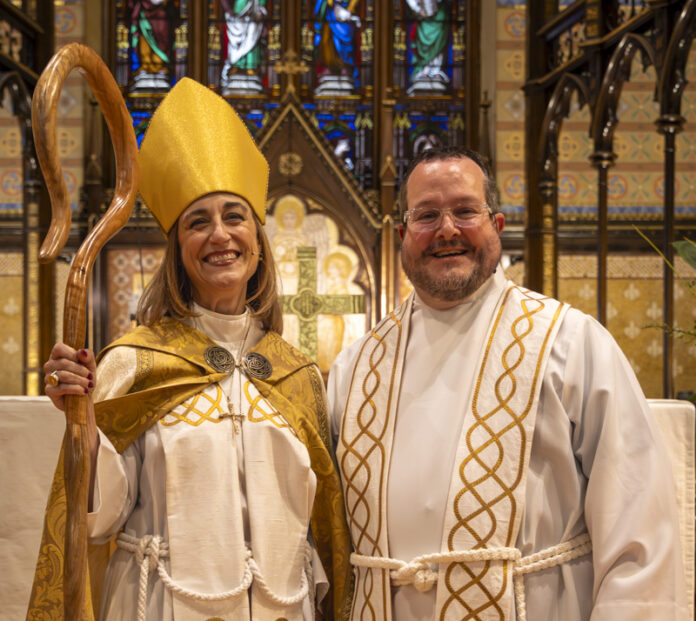
Bishop Anne B. Jolly installed Jon M. Richardson as the 33rd rector of Trinity Episcopal Church (TFP photo by Gaven Hafner)
TOLEDO– Trinity Episcopal Church marked a historic moment for the 183-year-old church. On Nov. 8, faith leaders and the local community gathered for the formal installation of the Rev. Jon M. Richardson as the church’s 33rd rector. The celebration, rooted in long standing Episcopal tradition, served as both a milestone for the congregation and a reflection of the church’s identity of being progressive and inclusive.
The installation marks a new chapter in the church’s long and evolving history. From 2018 to 2023, the congregation was led by the Rev. Dr. Lisa Tucker-Grey, whose departure left a significant transition ahead.
“When our previous priest left, they [the bishop’s office] were very tuned into this and wanted to make sure that we weren’t essentially a ship without a captain,” said Trinity’s operations manager, Heather Meyer.
To guide the parish through that period, the Rev. Dr. Stephen H. Applegate served as interim priest from 2023 to 2025, providing stability and leadership until a permanent rector could be appointed. “He transitioned everything beautifully for Jon,” Meyer said.
(TFP photo by Gaven Hafner)
Richardson, who began his ministry at Trinity on Mar. 16, explained the significance of the ceremony.
“It is the tradition in the Episcopal Church when a priest begins a new ministry that the congregation celebrates their ministry, and particularly as it relates to having a new priest, the bishop will be present… One of the roles of the service is that she officially makes me the rector, he said. Though symbolic, the service carried weight by involving nearly 70 participants, from clergy and bishop Anne B. Jolly to musicians and choir members.
Richardson explains the Episcopal Church as “reformed Catholic,” noting that it is “very much like our Roman Catholic siblings, but we are independent and autonomous.” He adds that Episcopal dioceses are “sort of like regions,” led by bishops who are “elected by the congregations.”
Music, a defining element of Trinity’s culture, played a prominent role in the celebration. Before the event, Richardson said the program would include “all kinds of really fun things, not limiting ourselves to sacred music. We find the sacred in the secular, and we’re gonna have all kinds of music, from old fashioned hymns to a song by Jewel.”
Meyer, who has been with the church for seven years, noted that this eclectic musical identity is nothing new. “Music has always been such an incredible pillar here at Trinity… and it’s something that Trinity’s been known for,” she said.
Rev. Jon M. Richardson and Bishop Anne B. Jolly pray (TFP photo by Gaven Hafner)
Founded in 1842, Trinity Episcopal Church has long been a part of downtown’s architecture. Even during decades of urban decline, the congregation chose not to relocate.
“Back in the ’70s, the congregation had to make some tough choices as to whether they wanted to stay downtown… and they took a vote, and it was a unanimous vote that they were going nowhere,” Meyer said.
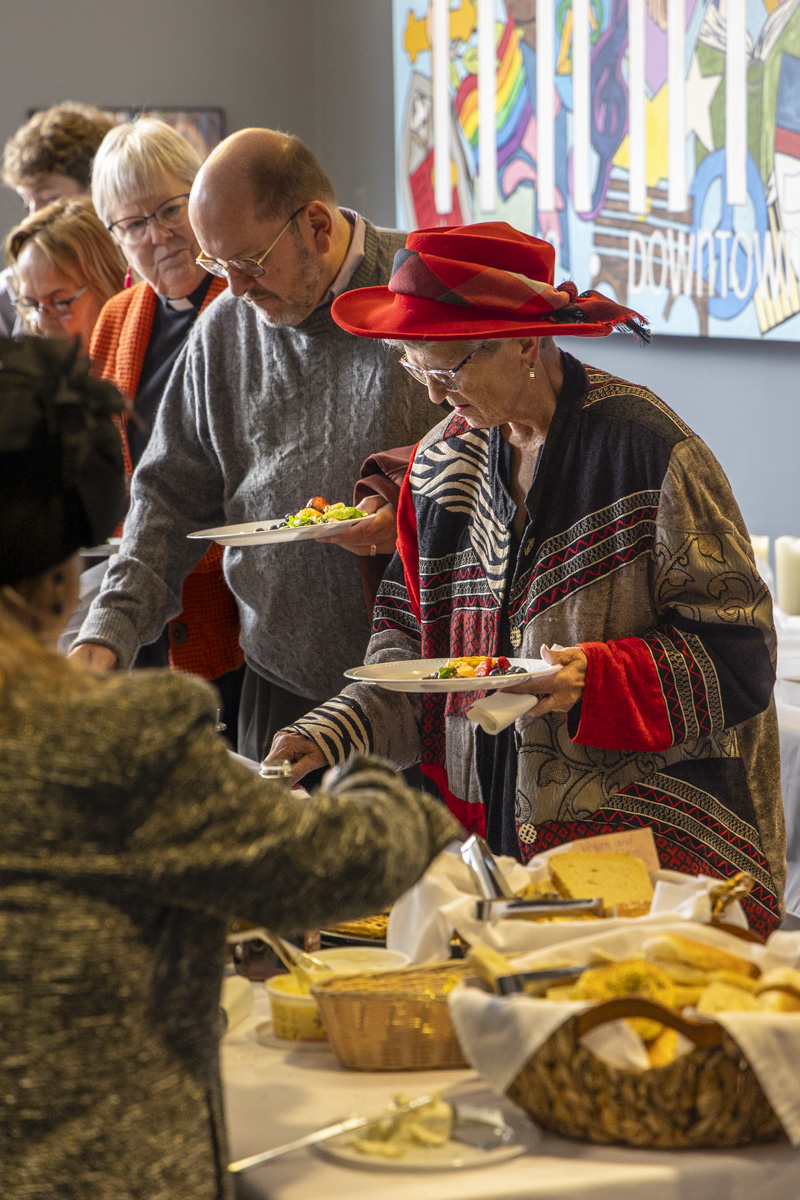
Today, much of the church’s energy centers on community and outreach. After the events ceremony, the church provided food and refreshments. Every Sunday, Trinity serves a hot breakfast to anyone in need.
“We’re averaging, I want to say, about 95 people a week. There’s no strings attached. You don’t have to come to church,” Meyer said.
Even more important than the meal, Meyer noted, is the dignity offered through personal connection. “We ask them their name… And so when somebody comes back, the ability to be able to call them by their first name….it may be some of the only interaction some folks get in a given time,” Meyer said.
After the ceremony the congregation enjoyed a meal to celebrate the momentous occasion. (TFP photo by Gaven Hafner)
For Richardson, one of the congregation’s most meaningful strengths is the diversity within worship itself. “One of the things I get most excited about is when we welcome our less secure neighbors in worship… I love the diversity that shows,” he said.
Trinity collaborates with several organizations, including Toledo Streets Newspaper, Actors Collaborative Toledo, Food for Thought pantry, and local artists and musicians who use the space for performances.
Richardson’s path to Trinity began with a search for a community that reflected his values. He recalled first reading the church’s profile. “The first words I saw were progressive, inclusive, creative…and I was like, ‘Ah, these are my people. This is who I should be with.’”
With the Rev. Jon M. Richardson now officially in place as the new rector, Trinity Episcopal Church enters its next era.
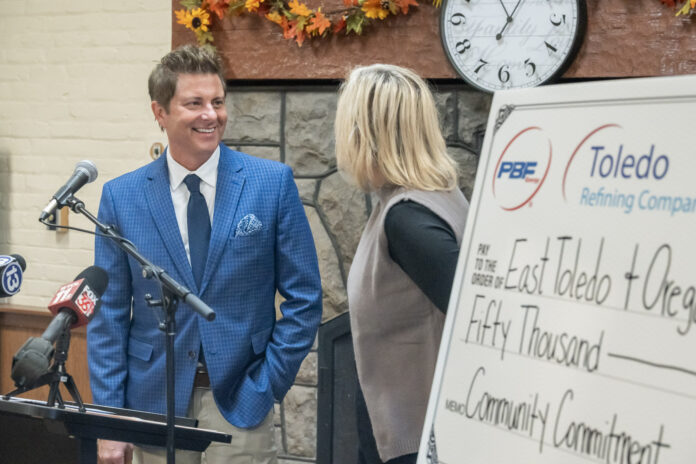
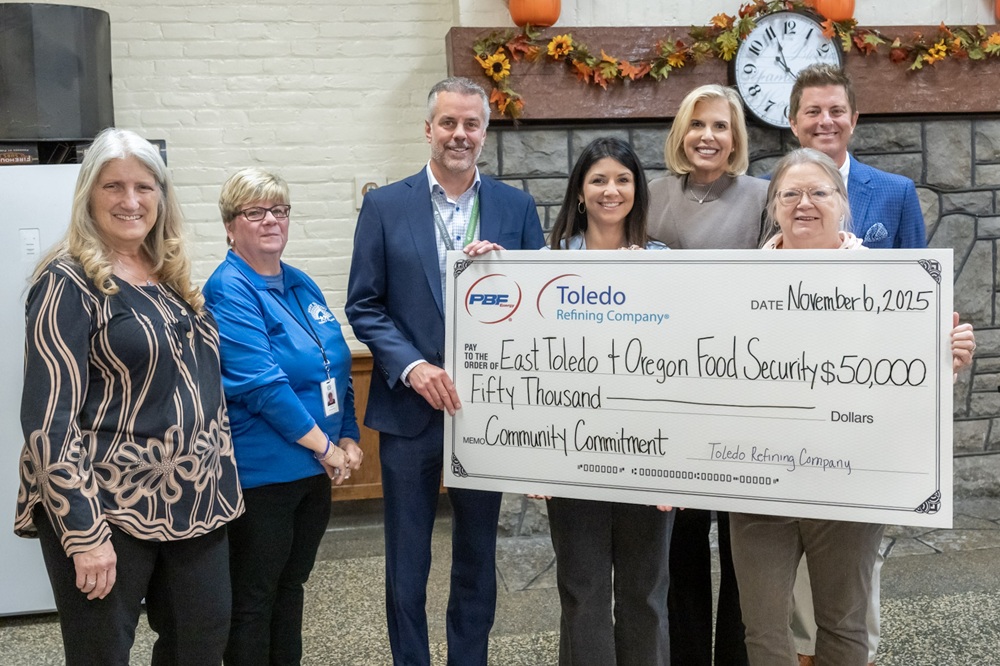
During the monthly Food for Thought pantry distribution, Toledo Refining Company (TRC) announced a $50,000 commitment to four local organizations to help fight against food insecurity.
“We know our neighbors here in East Toledo and Oregon alike face food insecurity daily,” said Erica Halada, the community relations advisor for Toledo Refining Company. But that was before the holidays, before the government shutdown. “We knew by talking to our partners…all of those who serve the community in that way have really been emphasizing that need.”
“And so we, as a company, decided that this was something we had to do for our neighbors in addressing that [food insecurity],” she said. “And a $50,000 investment came out of that conversation.”
(Photo by Doug Hinebaugh)
Monetary assistance was given to four organizations: Oregon Senior Center, East Toledo Senior Center, ProMedica Bay Park Hospital’s Food Clinic, and Helping Hands of St. Louis.
“TRC’s recent commitment to us and the other local organizations shows that they are in the community. It is not just about the donation; it is truly about making a difference for the families that we serve on a daily basis,” said Jodi Gross, the executive director for the East Toledo Family Center.
The donations affect the 43605 and 43616 area codes, Northwood and Oregon, Ohio.
Gross confirmed the rising challenges facing the area. “We have seen an increase in serving our families; this funding will allow us to meet the needs.”
ProMedica Bay Park Hospital’s President Matt Hammond also weighed in on food insecurity as reported by The Sojourner’s Truth. “Access to healthy food is as important as access to medication,” Hammond said. “Food insecurity is not just a social issue; it is a health issue.”
One day shy of a week after this commitment was made, the federal government shutdown ended on Nov. 12.
In a public statement recorded on WTOL 11Scott Hayes, the director of Midwest government relations and strategic communications for PBF Energy, the overarching company for TRC, said of food insecurity, “It’s not just happening some other place, it’s happening right here, and we’re all just a few paychecks away from food insecurity.”
In an Instagram post, the City of Oregon, Ohio @oregonohio thanked both Hayes and Halada for their community support.
“It’s one thing to say you care about the community. It’s another to show up the way this team does,” the post read, and then thanked the two representatives of TRC.
Every November, as the nation honors the service and sacrifice of its veterans and military families, it also serves as a reminder that the life of a military family is unlike most others. Frequent moves and deployments can disrupt friendships and routines. It can also affect academic continuity.
Ohio Virtual Academy (OHVA) recognizes the unique challenges that come with being part of a military family, and we are proud to be designated as a Purple Star school for our commitment to supporting military-connected students. The Purple Star designation is awarded by the Ohio Department of Education and Workforce and recognizes schools that demonstrate a major commitment to students and families connected to the nation’s military.
Adapting to military life starts with understanding
Military families know what it means to adapt because their children have often attended multiple schools before high school. Many times, that also includes moving mid-year due to relocations or new assignments.
Virtual education also provides students with a sense of consistency at a time when their lives may be filled with constant change. Instead of starting over at a new school every time their family receives new orders, the education they receive at OHVA moves with them.
Students can continue their classes, keep their routines, and stay connected to their teachers and classmates even if they relocate across the state or transition through temporary housing. This continuity helps reduce the academic and emotional disruptions that often come with frequent moves, giving military-connected students a stable learning environment no matter where they go.
How OHVA honors service
OHVA’s Purple Star recognition is also part of a broader culture of respect and appreciation. The school employs several veterans on its staff, and their experiences have helped shape the empathy and insight behind the program.
Many of the staff who have served in the military frequently share their stories of sacrifice and what military life actually looks like. That perspective has helped the school better understand the need for stronger support.
In addition, those veterans on staff also play a hands-on role in the school’s programming. For example, they often lead Veterans Day assemblies and speak directly to students about service, leadership and gratitude. That type of involvement helps bridge the gap between classroom lessons and lived experience. It also helps to inspire students to appreciate the values of commitment and community.
Celebrating those who serve as well as those who aspire to
Support at OHVA extends beyond current and former military families. The school celebrates students who plan to enter the armed forces through its “Wall of Honor.” By featuring this wall, OHVA highlights its commitment to recognizing students’ dedication to service and honoring their decision to pursue military careers.
OHVA’s recognition of military service extends to other outreach projects run by the school. Each year, members of OHVA’s Middle School National Honor Society lead a service initiative to send hundreds of thank-you cards to veterans and active-duty servicemembers. A simple gesture like that really resonates deeply with those who receive the cards and is another way students learn the importance of giving back.
A full circle of support
OHVA’s Purple Star programming has evolved to embrace even more of the extended military community. It began as a resource for active-duty families, but now includes veterans, future servicemembers, and students recognized by the daughters of the American Revolution for their academic achievement and civic engagement.
This full network of support is reflective of the school’s commitment to ensuring that every student feels seen, supported, and set up for success. For military families especially, that means helping them feel connected no matter where they are.
As we celebrate National Veterans and Military Families Month, OHVA is proud of its commitment to those who serve and sacrifice for their country. By offering a flexible and stable virtual learning environment, military-connected students can learn, thrive, and succeed, from anywhere.
I have always been fascinated by John Fitzgerald Kennedy’s 1961 inaugural address when he stated, “Ask not what your country can do for you, but what you can do for your country.”
Most historians agree this was President Kennedy’s call for Americans to do what is right for the greater good of country and community. His statement is compelling because it strongly suggests that individual Americans can and do make a significant difference in the cultural fabric of American society.
As a professor and researcher of leadership, I have had a career of exploring how to take words and translate them into actions. With that backdrop, for the past six months, I have done an informal survey of over 120 people from all walks of life asking them this important question: “What is your responsibility to make our community, and by extension our country, a better place?”
What started out as a philosophical question quickly turned into a very practical set of responses. Some were pretty obvious, while others really made me think because of their personal nature. Let’s open with “the big three do’s” mentioned by virtually everyone.
Be an informed voter and take the time to vote. Yet, U.S. voter turnout for local elections hovers around 20 percent; off-year national elections 40 percent, and around 60 percent for presidential elections. Room for improvement as a society.
Pay your taxes (as painful as that might be). We all know taxes provide revenue for federal, local, and state governments to fund essential services that include highways, police, education, the justice system, social services, and national defense, among others. We all benefit from these manifold services that we could not efficiently provide for ourselves.
Know and obey the laws. Obeying the law ensures social order, protects individuals and property, and provides a framework for resolving disputes, preventing harm, and upholding fundamental rights. Obeying vehicular laws keeps our roads safer. When people obey the law, our country is a better place for everyone.
But then responses shifted from the “big picture” to our individual lives.
Keep your marriage strong. Research shows that strong and stable marriages improve financial stability, physical/mental/emotional health, health in old age, overall longevity and healthier kids.
If you have children, intentionally nurture them. Research shows that the future of most societies is dictated by how well parents raise their children physically, emotionally, educationally and spiritually. Healthy children are our country’s future!
Practice common courtesy and be kind. Whether driving, shopping, out to eat, or in your home, common courtesy or being polite and respectful of others fosters a sense of mutual caring, cohesion, and well-being. Most people truly respect, need, and appreciate kindness, including grace or being given the benefit of doubt, which is more important today than ever. And it is free.
Help those less fortunate than yourself. Lending a helping hand to a neighbor or stranger in need or regularly volunteering to help others in our community are important/meaningful ways to share our time, talent, and treasure to serve others. This service makes the community stronger while providing us with great personal satisfaction.
Be neighborly to your neighbors. Being friendly, helpful, and respectful to those who live nearby creates a greater sense of community, neighborhood ownership, safety, and a willingness to look after each other. Friendliness is also free.
Respect diversity of opinion. Living in the information age, our society has become polarized and we have lost our ability to listen to each other and have respectful dialogue. To solve real problems and build real solutions requires open minds and meaningful discussion, whether at home, work, or in the community.
Don’t litter. Do recycle. These simple actions offer numerous environmental and social benefits, including reducing pollution, conserving natural resources, promoting a cleaner healthier environment, protecting property values and encouraging safety for everyone while requiring very little effort.
In the end, many would say that these “societal do’s” are simply common sense. But I would add if people collectively engaged in these individual activities their community would be a safer, friendlier, stronger, and more attractive place for people to live and work.
At your next family gathering, ask JKF’s question and see what you might learn. I am confident that you will have a very meaningful conversation benefiting not only the people in your circle, but also our community as a whole when we take action on these important practices. We all have the wonderful power to be better doers.
TOLEDO – On this episode of TFP Weekend, Toledo Public Schools Superintendent Dr. Romules Durant sits down for a wide-ranging conversation on issues from the district level to education at large.
On its latest state report card, TPS received two out of five stars from the state, with challenges including early literacy and graduation, among others. With regard to early literacy, Dr. Durant says “We are one of the only urban districts to not have universal pre-K,” adding, “the United States is one of the only industrialized countries to not support early childhood education in the way they do in other places.” He says there are nearly 10,000 kids in this area who are eligible for pre-K — but only around 3,000 are being served.
Among the other challenges facing the district is chronic absenteeism. TPS’ current rate is 38.9 percent, though Dr. Durant says it was higher in the years that directly followed the pandemic. As a result of COVID-19 concerns, he says, “people started to look at school as not necessarily being mandatory and treated it that way.”
Asked about the relationship between TPS and the state, and if the district is receiving the support it needs, Dr. Durant pointed to funding. He said legislators in Columbus, by not following 2020’s Fair School Funding Plan in the last budget cycle, left “Toledo Public Schools with a 24 million-dollar deficit that we have to balance.”
An ongoing debate about education, not only in Ohio but nationwide, has been school vouchers: if students should be able to take the dollars supporting their education at a public school to a private one. On the question of if private school vouchers can coexist with traditional public school funding, the superintendent said, “If you’re going to allow it, to have it coexist, then it should coexist on the same playing field.”
He said, “I’m all for school choice,” but added that private schools should be subject to the same scrutiny as public districts, including assessments and transparency requirements.
Outside of the challenges that face TPS, Dr. Durant says the district’s ‘magnet’ schools — schools that have a specific career focus — are yielding positive results. He also has optimism about the future of the years-long partnership between TPS and the University of Toledo. The district is transforming the university’s former Scott Park campus into educational and recreational facilities.
Another issue covered in this ‘TFP Weekend’ episode was socioeconomic factors, and how they affect the lived experiences — and in turn, performance — of students. To hear more on that, and other matters, listen or watch the full interview at our YouTube and Spotify channels.
*Edited by Stephen Zenner; special thanks to the Toledo Tech Loft for use of their space to produce this podcast episode.
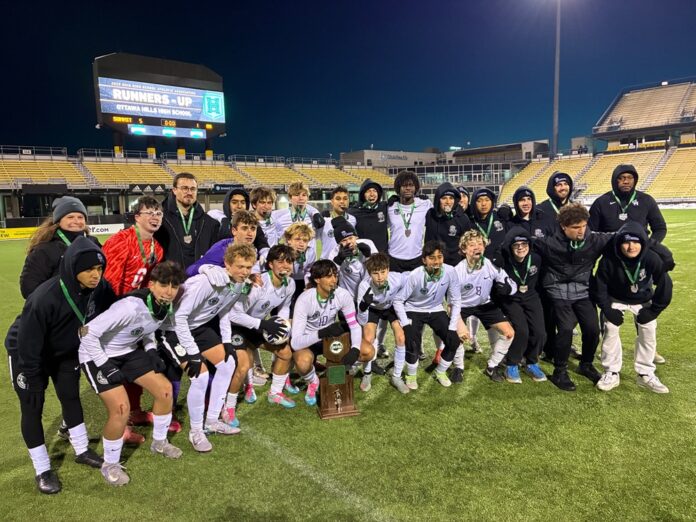
Ottawa Hills High School players and coaches pose for a photo following the Green Bears' 5-1 loss to top-ranked Cincinnati Summit Country Day in the Division V state championship match Nov. 10 at Historic Crew Stadium in Columbus.
(Photo courtesy of Ottawa Hills Senior High School)
Preparation was key to Ottawa Hills’ boys run to state soccer championship match
OTTAWA HILLS – The old guy whose face is pictured on the $100 bill once said, “By failing to prepare, you are preparing to fail.”
Second-year head coach JR Hall and his coaching staff on the Ottawa Hills High School boys soccer team made sure BenjaminFranklin’s famous quote never applied to the Green Bears this fall, particularly when they entered the postseason tournament.
“We were definitely prepared and we knew what we had to do,” junior defensive midfielder Gabe Grimm said. “We knew our positions, where to be on the field … they really got us ready for that in practice. They weren’t too hard on us. We wanted to have fun. We enjoyed our time at practices and we got the job done when we needed to.”
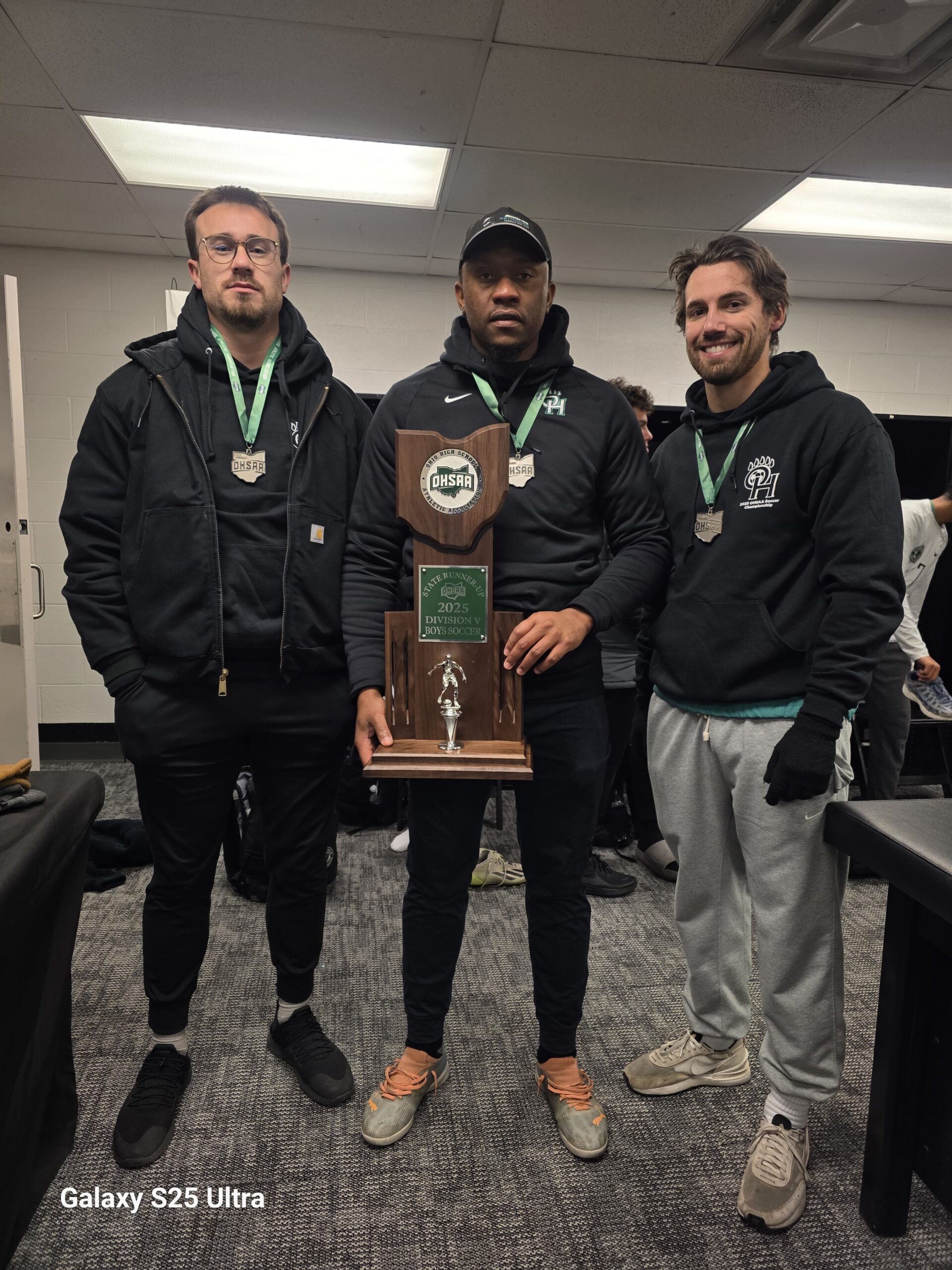
Ottawa Hills head coach Rodclif “JR” Hall, center, and assistant coaches Drew Hoffman, right, and Jakob Walther after the Green Bears’ state championship match against Cincinnati Summit Country Day on Nov. 10 in Columbus. The Green Bears have competed in the state semifinals or finals eight times in the past 17 years. (Photo courtesy of Ottawa Hills Senior High School)
Ottawa Hills, a Division V program, played a challenging schedule during the regular season. Close losses or ties against bigger D-I programs like St. John’s Jesuit, St. Francis de Sales, Southview, Northview, Springfield, and Findlay contributed to the Green Bears’ 6-9-2 record.
It also got them prepared for what was to come.
“It toughened us up,” senior center-back Jaiden Dubois said. “We played great competition. We did end up losing most of those games, but playing against better teams, we were prepared for being down and playing in harder circumstances. In the tournament, we were prepared for those circumstances.”
Ottawa Hills’ boys soccer tradition is well known around the state and Northwest Ohio in particular. The Bears, competing in the smallest school division, have advanced to the state semifinals eight times in 17 years. The 2008 team, coached by Greg McElroy, finished 20-3-0 and capped off that season with a 1-0 win over Worthington Christian in the D-III state championship match.
The Bears lost in the D-III state finals in 2017 and 2022, and lost in the semifinals in 2010, 2012, 2020 and 2021.
“There definitely is pressure, knowing we have such a good program that has been successful in the past,” Dubois said. “In the preseason we often see (former) players come back and they play with us.”
Grimm said every Ottawa Hills player is “more than aware” of the school’s past soccer success in the postseason. He said the current players feel like it is their job to “keep it rolling.”
“We know Ottawa Hills has been a great soccer school for many years,” said Grimm, who also plays shortstop on the baseball team. “Going into this year, we didn’t think we were going to live up to that. We went up against all odds. We didn’t think we had the strongest team, but when we played St. Francis and St. John’s, that showed us we can compete with these teams.
“They were all very close games until the very end. They definitely knew what Ottawa Hills soccer is. They don’t think of us as an easy game at all.”
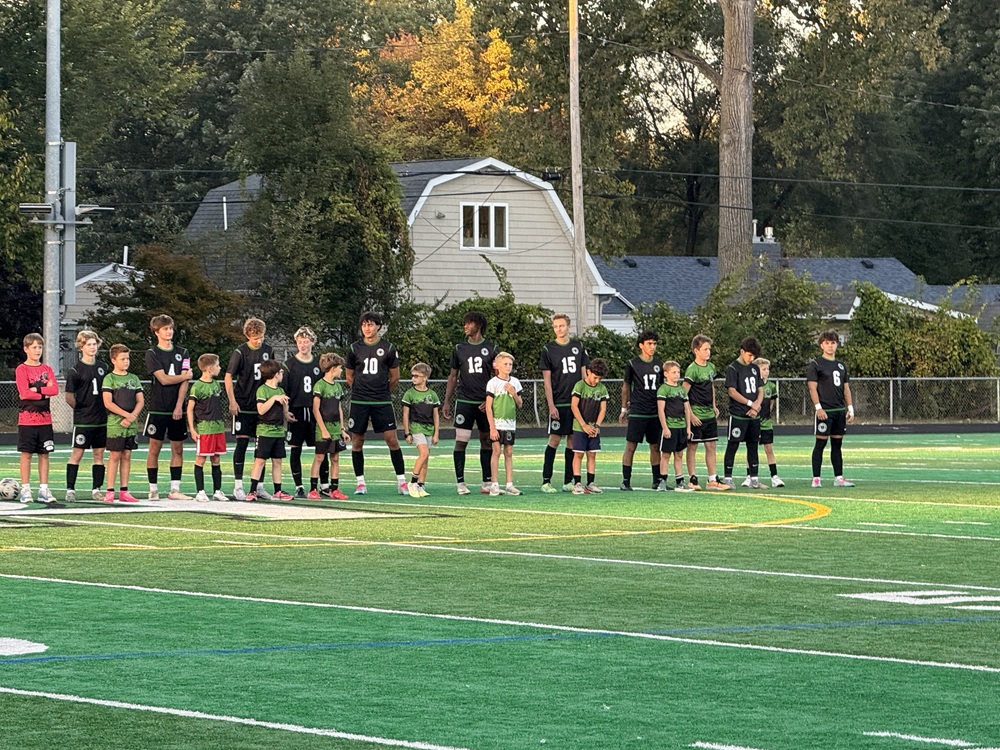
(Photo courtesy of Ottawa Hills)
One game at a time
In Hall, the Green Bears have a coach who embraces that tradition.
A native of Jamaica, Hall’s hometown was battered by Hurricane Melissa on Oct. 28. He moved to the U.S. in 2009 and played forward at Owens Community College and Bowling Green State University.
Hall was an assistant coach at Ottawa Hills from 2021-23 and last season, in his first year as head coach, took the Bears to the regional semifinals where they lost 1-0 to Van Buren. Hall said his goal this season was “to take it one game at a time.”
“My sole concentration is the game we are playing,” Hall said. “My experience is to play it game by game. In the postseason we had fairly good information on the teams we were playing, and I was able to set up our team in a way we could be competitive.”
The Green Bears had four seniors, three of whom were starters, but two of those seniors were injured at some point during the season. Ottawa Hills relied on its defense the entire time.
“Defense was the thing that carried our team,” Hall said. “The games we lost big are the games where our defense made mistakes. Defense was definitely a strong point of our season.”
Hall said the fact that the Green Bears, who took second place in the Toledo Area Athletic Conference behind Maumee Valley Country Day School, earned a No. 1 seed in the Northwest 2 sectional/district was a sign of respect.
“We weren’t surprised,” Hall said. “We played St. John’s, St. Francis, Findlay, Northview, and Southview and it helped us a lot. Playing those tough games at the end really encouraged the boys.”
The Green Bears opened the postseason with an 8-0 rout of Woodmore on Oct. 18. The Wildcats never had a chance.
“The coaching staff did an amazing job,” Dubois said. “For that first game, we did so much to prepare and went through so many drills for our shooting, and it showed.”
The Bears followed that with wins over Mansfield Christian (1-0), Ottoville (2-1), and Fort Jennings (5-1) before avenging a regular season loss to Maumee Valley with a 3-2 win over the Hawks in the regional finals.
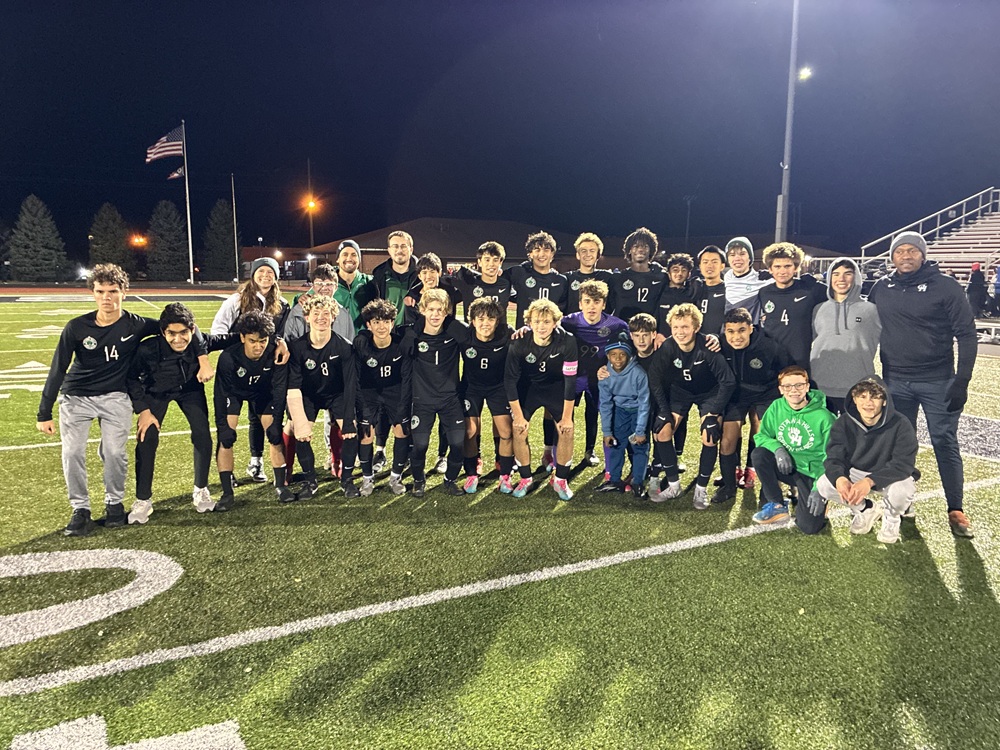
(Photo courtesy of Ottawa Hills)
Know who you’replaying
Ottawa Hills beat Kidron Central Christian, 1-0, in the state semifinal match in Sandusky, setting up the title match against top-ranked Cincinnati Summit Country Day, which needed overtime to beat Milford Center Fairbanks, 2-1, in the other state semifinal.
“We knew who we were playing,” Grimm said. “They were a great team and we had to come out hard. We already did the hard job by making it to that game. We just had to go out there and try to win it now.”
Hall said he knew what the Green Bears were up against. Summit Country Day had outscored its previous three opponents 8-1, and the Silver Knights’ girls’ team won the D-IV state title, its third straight, three days earlier.
“We were playing against a team where 80 to 90 percent of their players play Club,” Hall said. “We don’t have a lot of players who play Club. We have a school where players run track or play baseball after soccer is finished. We were happy that our boys could do this against a school that has 80 to 90 percent of their players in Club.”
Summit Country Day, which won its ninth state title, scored twice in the 20th minute of the match to take a 2-0 lead. The goals came 27 seconds apart. Ottawa Hills went on to a 5-1 loss and avoided a shutout when junior midfielder Ibraheem Alaani converted a free kick into the upper right corner in the 74th minute.
“Ibraheem had been practicing that kick in the postseason, either before or after practice,” Hall said.
Sophomore keeper Burke Pfeiffer made eight saves for the Bears, who had a 14-1 disadvantage in shots on goal.
“Summit was way ahead of us that game,” Grimm said, “but we didn’t give up. We got that one goal. After the game, no one was really devastated. We were all proud of ourselves and we were happy to be playing in that game.”
Dubois said playing for a state championship “meant everything,” and he and his teammates never sulked after falling short in the finals.
“It was a major accomplishment, even though we didn’t win it,” he said. “It was an amazing season. We had to work together to accomplish our goals. It really is a brotherhood and we all love each other.”
Senior forward Avi Hanusz led the Bears (12-10-2) with 14 goals this season, while sophomore right wing Savio Deigar and junior attacking midfielder Andy He had eight goals apiece.
Grimm and right/left wing Archie Talbott scored five goals each, Talbott had a team-high nine assists, Deigar had six assists, and Pfeiffer had 82 saves in goal. The Green Bears posted seven shutouts.
“I will remember the joy and togetherness and bond from the boys at practice and in games,” Hall said. “The final was just the cherry on top, to have that bond and family from what I saw every day. They know how hard they worked during the season and they did everything they had to during the season.”
Grimm said the team became “a complete family” during the season.
“With every win or loss, we knew we would come together and we knew what to do to get the job done,” Grimm said. “We had the most fun this year and that helped us go far in the playoffs.
“It’s one thing to take things seriously, but you have to have fun while you’re doing it.”