Home Blog Page 42

Anthony Wayne news: Waterville moratorium on data centers

0
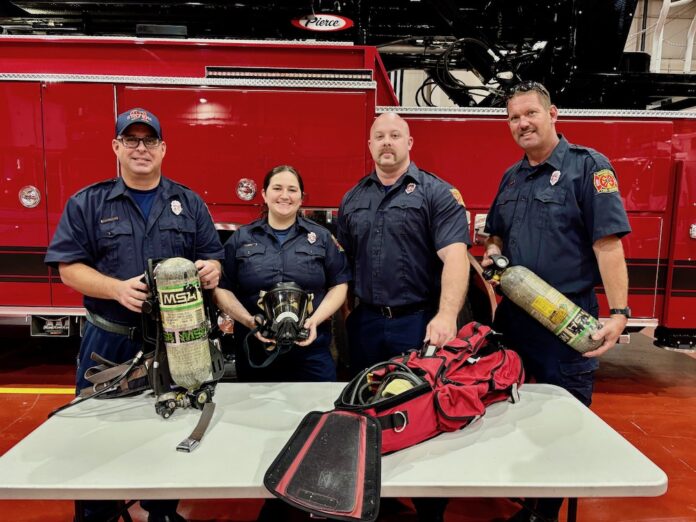
Monclova Township firefighters (from left) Josh Stegner, Kiah Macy, Mike Harris and Bill Schultz show some of the SCBA equipment that will be replaced with a $271,707 FEMA grant. Each seat on a vehicle will have a self-contained breathing apparatus, tank with 30 minutes of air and a face mask fit to each individual. (TFP photo by Karen Gerhardinger)

ANTHONY WAYNE – Monclova Fire and Rescue wins a grant to replace its SCBA equipment. Waterville City Council plans to consider a moratorium on data centers during its Oct. 27 meeting. And Whitehouse has won an award for its downtown flowers. These are just a few of the news items coming out of meetings from the past few weeks in the Anthony Wayne area. 

Monclova Township 

Monclova Township Fire and Rescue is receiving a $271,707 FEMA grant to replace its self- contained breathing apparatus (SCBA) equipment, Fire Chief Matt Homik announced during the Oct. 6 Monclova Township meeting.

The Federal Emergency Management Agency (FEMA) grant will pay for 95 percent, while the township will pay $13,585 toward upgrading all of the units, which provide breathable air in portable containers, along with face masks for each individual, rechargeable batteries and upgrades to equipment for the Rapid Intervention Team – which is called in during the event a firefighter is injured.

During the Oct. 6 meeting, the trustees also:

-Held a public hearing about 8830 Maumee-Western Rd. The 98-year-old abandoned home has a collapsed roof and was deemed structurally unsound by the fire chief. The township is working on getting the structure demolished, with the cost being placed as a lien on the owner’s property taxes. 

-Appointed Keith Trettin to another term on the Zoning Commission, and named Mark Trimble as an alternate.

-Urged residents with an interest in serving on a committee to apply at monclovatwp.org. The township is also planning to form a parks committee to plan for new equipment at Keener Road Park.

Waterville

Waterville council member Wayne Wagner wants to put a pause on data centers, so prior to the Oct. 13 meeting, he requested that a moratorium be placed on the agenda as an item for discussion. When that item wasn’t included, Wagner asked Mayor Tim Pedro why. What ensued was a lengthy back and forth between Pedro, Law Director Kati Tharp and Administrator Jon Gochenour – as well as questions from council members on procedure.

Wagner has concerns about the county’s role in economic development and the possibility of annexation from Waterville Township in order to obtain enough land for a data center since the city doesn’t have enough of its own. Pedro and Council Member Rod Frey noted that it’s the city’s job to look for economic development opportunities, and that the county is working with all communities to look at the possibility of a data center.

Corrected:

In September, City Council voted 4-2 to permit data centers in M-1 zoned land, following three readings and a public hearing. Todd Borowski and John Rozic voted against the language, while Anthony Bruno, Mary Duncan, Rod Frey and Wayne Wagner voted yes.

But Wagner believes Council didn’t have enough information when making that decision – including how a data center might require a large power generation plant. Pedro noted that no data center proposal has come forth yet, and that if it did, the project would come before the city’s planning commission and council for review and public hearings.

Council agreed to place data centers, and a possible moratorium, on the Oct. 27 meeting agenda. In the meantime, the county is planning to host a community-wide information session about data centers in November, with a date to be determined.

During the meeting, council also:

-Held a second reading on a request for a conditional use permit for Meijer to open a grocery store and gas station on the southwest corner of Pray and S.R. 64. A third and final reading and public hearing will take place on Monday, Oct. 27.

-Approved a donation of $3,500 for Wendy Gray to assemble a team to decorate the downtown area for the annual holiday celebration on Sunday, Dec. 7 at Parker Square. 

-Approved a $1,000 donation to assist the Save the Bridge Association, a nonprofit that is working to safe the historic Roche de Boeuf Interurban Bridge from demolition.

-Learned that the Waterville Area Chamber of Commerce is hosting its annual Boo to Do event in the downtown, with businesses and organizations passing out candy to trick-or-treaters from 5-7 p.m. on Thursday, Oct. 23.

-Voted 4-3 to approve a revised preliminary plat for Columbian Village plats 2-6 and Farnsworth Village plats 7-10. Originally approved in April 2023, the new plan includes smaller lot sizes, a larger pond and the removal of two cul-de-sacs.

Developer Andrea Henline and Greg Feller of Feller Finch Associates said that the smaller, 58-foot lots back up to the Waterville Place Apartments, and would allow the construction of $300,000-$350,000 homes, as most customers would not want to build a $500,000 home near an apartment complex. Dissenting Council Members Anthony Bruno, John Rozic and Wagner voiced concern about lowering property values with smaller lots and homes.

-Unanimously approved the 2025 Comprehensive Plan, an update to the 2012 plan. This will be available at the city and on the website and outlines plans for the city’s future. The Planning Commission will review the plan quarterly to make sure the city is on track to meet goals outlined in multiple areas.

Whitehouse 

The village of Whitehouse earned national recognition from America In Bloom, winning the Flower Power – Best Hanging Basket Program Award during the September symposium.

“Our flowers are definitely making news,” said Village Public Works Director Mike Hill.

The village also received special recognition for “Celebrating Heritage” after AIB advisors visited the community for two days this summer. All participants are evaluated on criteria including community vitality, overall impression, environmental initiatives, heritage celebration, urban forestry, landscaped areas and floral impact. 

During the Oct. 7 meeting, Whitehouse Village Council also:

-Heard that Vision Church has now opened at 10200 Waterville St. A ribbon cutting was held on Oct. 12.

-Learned that council members and the mayor will be available to visit with the public on Saturday, Nov. 8 from 8:30 to 10:30 a.m. at Copper Press Roastery at the corner of Finzel and Weckerly.

-Heard that the annual holiday celebration will take place on Saturday, Dec. 6 with a 4:30 p.m. race, parade, kids activities, visits with Santa and tree lighting.

-Shared that Waterville and Whitehouse employees and residents will compete in a Toys for Tots toy donation drive to launch in November. The drive collects new toys for children in need. The community to donate the most toys will get bragging rights.

-Discussed the ongoing Senior Connection program, held every Saturday at 9 a.m. at Hope United Methodist Church, 10610 Waterville St. In addition to a free continental breakfast, the program includes speakers on a variety of topics. 

Upcoming meetings in the area include:

-Whitehouse Village Council will meet on Tuesday, Oct. 21 at 6:30 p.m.

-Waterville City Council will meet on Monday, Oct. 27 at 7:30 p.m.

-Waterville Township Trustees will meet on Wednesday, Oct. 29 at 6:30 p.m. The meeting may be moved to Waterville First Presbyterian Church, 611 Farnsworth Rd., which is just east of the township hall.

Lucas County Commissioners updates: Jeep Fest in review

0
Lucas County Commissioner Lisa Sobecki speaks to press after a Lucas County Commissioners meeting at 1 Government Center in Toledo on Tuesday, Sept. 30. (TFP photo by Stephen Zenner)

TOLEDO – Whitney Rofkar presented the Jeep Fest Final Report at the Sept. 30 Lucas County Commissioners’ meeting. 

“We named the parade this year after Bruce Baumhower, a long time UAW [United Autoworkers] Local Legend,” said Rofkar, the vice president of public relations at Thread Media Group. “So from now and till forever it’ll be called the Bruce Baumhower annual Jeep Fest Parade.” 

Commissioner Lisa Sobecki thought the title was a fitting honorable title for Baumhower’s role in keeping and growing Jeep in Toledo. 

“1,400 Jeeps rolled in the parade,” Rofkar said, with 30,000 in attendance for that signature part of Jeep Fest. 

Since 2016, Jeep Fest has grown from 40,000 to 100,000 in total attendance over the Jeep themed weekend, with an economic impact of $8.3 million this year.

“Over 350 volunteers make Toledo Jeep Fest work, and many of those are retired UAW workers. We try and do our part to be an awesome downtown event,” she said, and cited the 6,000 lbs. they recycle each year as proof of holding a responsible event.

In terms of presence and reach, Rofkar took time to highlight the social media reach of Jeep Fest as well as the traditional media impact, 20+ stories directly related to Jeep Fest, with a 10 million person reach.  

“It’s rare to see everyone come together in such a big way for a success, and downtown on Toledo Jeep Fest weekend is a huge testament to that,” she said. 

Pete Gerken, Lucas County Commissioner, thought the presence of CEO of the Jeep division at Stellantis, Bob Broderdorf, at the event was significant investment in Toledo. 

“He was overwhelmed by the love of this city” and the ownership the workers took in volunteering in Jeep Fest, Gerken said, and hoped to top the 100,000 attendance number next year. 

Other news

Regional development 

Next the Toledo Metropolitan Area Council of Governments (TMACOG) released their Lake Erie West Region 2026-2030 Comprehensive Economic Development Strategy (CEDS). 

Lucas, Wood, Ottawa, Sandusky and Seneca Counties make up the region Toledo falls under. 

“We identify what the region’s priorities are, and then where the funding opportunities are and how we can make projects happen,” said Marissa Bechstein, the program manager at TMACOG. 

During Bechstein’s overview, she broke down the Strengths, Weaknesses, Opportunities and Threats (SWOT) of the region in an overview, and then went over five goals for the region. 

  1. Expand and diversify the regional economy
  2. Enhance workforce development and retention
  3. Address housing affordability and access
  4. Improve and modernize infrastructure and regional connectivity 
  5. Strengthen regional identity, quality of life and community resilience

Sandy Spang, the executive director of TMACOG, informed those present that this was the third economic development strategy Lucas County has been a part of.

“So what’s different?” she queried, and then answered herself. The first two economic strategies only included Lucas, Wood and Ottawa Counties.  

“We have a great state representative from the EDA [Economic Development Association], and he said, ‘You’re going to be stronger as a region, you’re going to be stronger with five counties.’” 

“Our CEDS is about to expire in December. This one will replace it. It’ll be this new CEDS with five counties,” Spang said. Economic Development Districts (EDDs) tend to have benefits, Spang said, including “three times per capita the dollars.”

“It opens up more opportunities to apply for more resources,” she said. 

“We will be submitting this new application in the fall,” and the new CEDS could be approved as early as January. 

Spang said it can take years to be approved, but “we’re going to try to push this along, very fast. We meet all the requirements, all the criteria.”

Sobecki spoke to Spang’s tenacious approach and passion for the CEDS, and Gerken clarified that getting approved as an EDD was the most important part of Spang’s presentation. 

“We’ve never gotten over the hump of an EDD, an Economic Development District. That’s the key that unlocks the bank,” Gerken said. “Without that you’re not gonna get CEDS funding.” 

“We’ve never done it. Maybe adding the two more counties is beneficial.”

Gerken said he was hopeful for the future, and that people in the region “never quit trying.”

Commissioners

Item 3. 

Owens Community College celebrated its 60th year and was recognized during the meeting. 

Dione Somerville, the president of Owens Community College, was there to speak with commissioners, and recalled the humble beginnings of Owens in the 1960s.

“As you mentioned, we were founded as Penta County Technical Institute, and there was always a curriculum at the high school level,” Somerville said. “From those beginnings, we’ve flourished and become a community college.”

The motion to create a proclamation celebrating the community college passed unanimously.

Item 4. 

Matthew Mullins, an attorney for Bricker Graydon LLP, presented a resolution that authorized the sale of bonds. 

“We’re acting as bond counsel,” Mullins said. The resolution approved “the issuance of bonds to Otterbein Homes.” The bonds are tax exempt and, as such, come with stipulations, but Mullins said, “Today I’m just seeking approval of the resolution,” which does three things: 

  1. Grants the Lucas County Commissioners approval to issue bonds under section 147(F) of the Internal Revenue Code of 1986.
  2. Approves the sale of bonds for improvement of healthcare facilities and authorizes their sale in Warren County, Ohio that will be spent in Lucas County, Ohio.
  3. And lets the two parties enter into an indemnification agreement. 

“This is in bold in my notes that this is not constituted as a debt or pledge of faith or credit on the taxing power of Lucas County, so, in general, this is just a win-win,” Mullins said. 

Passed unanimously.

Item 5. was Annexation Petition No. 2025-1, portions of Swanton Township to the Village of Swanton in Lucas County. 

John Borell, of the Lucas County Prosecutor’s Office, presented the petition, noting a discrepancy with the legal description that was resolved, and ended his brief to the commissioners by saying, “All of the statutory requirements have been met, and the annexation must be approved.” Borell started addressing the commissioners by reminding them that if all the statutory requirements were met, they must approve the petition. 

Gerken joked, “Always happen to approve when the word is ‘must.’”

Juvenile Court

Two resolutions concerning Lucas County Juvenile Court (LCJC) were presented. 

One approved a memorandum of the agreement between the Mental Health & Recovery Services Board (MHRSB) and the LCJC, specifically for the Family Drug Court Coordinator. 

The second approved an agreement between LCJC and the Sofia Quintero Art and Cultural Center for the Youth Works Enrichment Program. 

Job & Family Services

An extension for the Benefit Bridge Program was approved.

According to the county’s website, the Benefit Bridge Program was designed to help workers who may lose access to Supplemental Nutrition Assistance Program (SNAP) benefits due to wage increases.

Breda Osburn, the executive director of Lucas County Job and Family Services, presented a memorandum of understanding between Lucas County Job & Family Services (LCJFS) and the Ohio Department of Job & Family Services (ODJFS) to continue the Benefit Bridge Program. 

This memorandum detailed the $2.3 million that will be given to LCJFS from ODJFS in support of the Benefit Bridge Program for the current fiscal year, ending June 30. 

“The benefit bridge is something that I’m really proud of Lucas County [for] being one of the pilots [pilot programs] across the state of Ohio,” Sobecki said to press after the meeting. 

Osburn said in her presentation to commissioners that this program was being tested across the state of Ohio in a little over 10 counties.

“If you’re over income, then you’re going to be cut off [from benefits] immediately,” Sobecki said. “What’s going to happen nine times out of 10, or really almost 10 times out of 10, is people will quit their job because they can’t afford to be able to lose those benefits automatically.”

Sobecki said, “The state of Colorado has already done this, and what you see in the state of Colorado is there’s less people on government assistance. And they’re staying off of government assistance.” Over the past year of implementation, Sobecki said the same has been true in Lucas County. 

Only 54 of the 105 people who applied for the program were accepted in Lucas County, due to eligibility restraints. 

Over the past year, Osburn said participants in the program saw an increase in savings of thousands and a reduction in debt of over $10,000. Each participant is paired with a peer mentor who helps participants with financial literacy. 

Commissioners brainstormed with Osburn on how to increase participation with the program. 

Budget Hearing: Clerk of Courts

The Clerk of Courts asked for money to implement a full transition to a centralized records system for Common Pleas/Domestic Relations Courts and funds to bolster the retention for the Clerk of Courts. 

Bernie Quilter, the Clerk of the Court of Common Pleas, was emphatic about needing more money to maintain operations, and pointed out the shrinking workforce under the courts. 

At one point, Quilter threw in a line about a $30/hour rate at Costco, emphasizing the need to be competitive in the job market. 

Fees for court costs haven’t been increased since 1993, Quilter told the commissioners. While he understands no one wants higher court costs, the operations of the Clerk of Courts is dependent on the rates in 2026, he argued. 

In regards to updating the digital system, Quilter said it’s been difficult to get all parties involved with the courts to agree to a paperless system, which they now have. But Quilter said more financing will be necessary to reap the benefits of a digital system.

“We will aim to bring down costs,” Quilter said.

“Everything we’re trying to do is to help you out. But right now we need to help Adam [Hansen, the Lucas County Records Director], and we need to take care of this Case Management System (CMS).”

Gerken and Quilter had a colloquial back and forth about letting each other know “how this all works out,” as no resolution had been reached.

Risk Management

Item 9. 

Commissioners approved a primary general liability coverage through the Hylant Group for public officials and law enforcement. The coverage costs $1,526,200, which was 15 percent less than what the county paid the previous year. 

Office of Management & Budget

Item 10. listed a number of miscellaneous items that needed funds outside of the General Fund. These included water and sewer projects, debt related to those projects and prescription drug funds. 

It was approved. 

Budget Hearing: OSU

The current contributions from Lucas County to the OSU Extension are $100,000, and they are asking for the amount to increase to $158,500. 

Acting co-director of operations and area leader for The Ohio State University, Megan M. Arnold, presented the proposed budget to the commissioners for the OSU Extension for Lucas County. 

Arnold said OSU’s main cost in Lucas County was personnel, and that the county did not cover the full costs of operations in Lucas County. The county only makes up 23.2 percent of the total operating budget for OSU in Lucas County.

“We’ve been operating at a deficit for the past five years,” Arnold said. 2020 is when funding for OSU was downsized to $100,000. 

OSU supplements the costs of operations through state support, grants, sponsorships and other contracts. 

Already this year federal funding for the SNAP-Ed program was cut. 

“We will be losing the SNAP-Ed program as the result of federal cuts,” Arnold said. “As of Nov. 30, this program will be eliminated.” 

Multiple 4-H programs, financial literacy programs, food access programs, family and consumer science classes and homebuyer education classes are all part of the community impact OSU’s presence has had in Lucas County. 

Commissioner Sobecki referred to the OSU staff as a “small, but mighty team,” adding that, “It often feels like you have about 300 employees,” instead of just a few.

Questions from commissioners dealt with what the needs of the OSU extension would be beyond 2026; Arnold did not expect large budgetary changes into 2027. Deferring the longer term question, she stated outright, “Where we’re at now, we are at capacity.” 

Gerken asked if other counties have more participation with the OSU programs in their counties, where their OSU extensions have more funds. Arnold said she would follow up with that information, because she said she didn’t have it on hand. 

Bluntly, Gerken said, “We asked you to stay flat, and you came back with a 58 percent increase. Okay, we get it.” 

Afterwards, Lucas County Commissioner Anita Lopez tried to smooth over Gerken’s terse words by affirming that the programs the OSU Extension puts on are some of her favorites to invest in. 

Then the commissioners went into an executive session. 

Inside Toledo City Council: latest on Carrie Hartman’s resignation

0
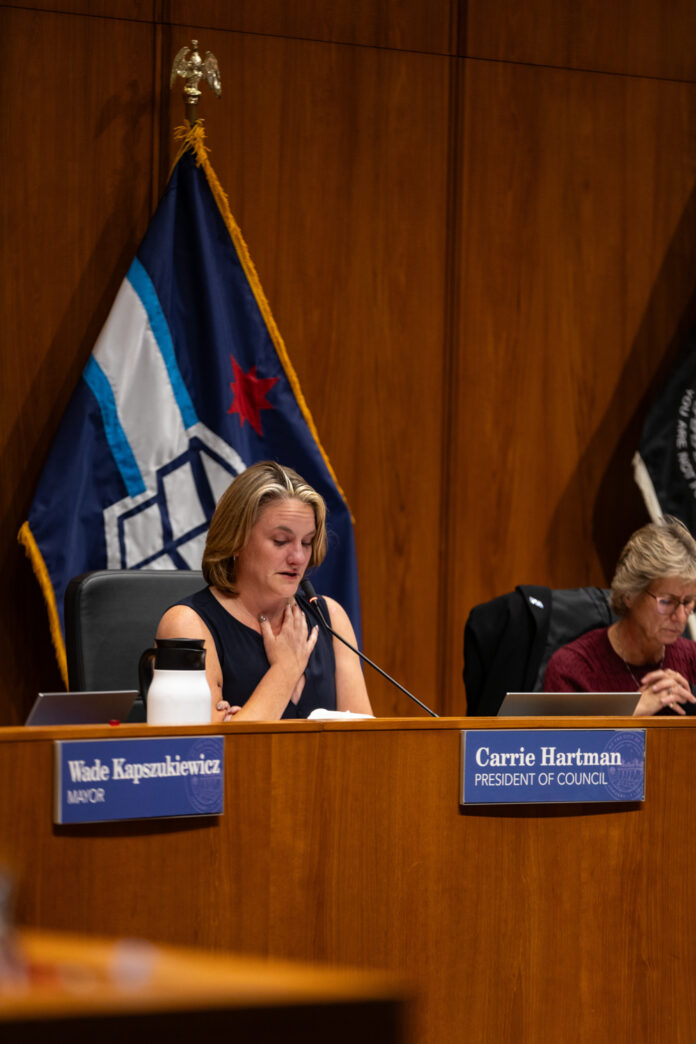
President of Toledo City Council, Carrie Hartman, At-Large, speaks from the heart during her last City Council Meeting at 1 Government Center in Toledo on Tuesday Oct. 7, 2025. (TFP photo by Stephen Zenner)

TOLEDO – Early voting began on Oct. 7, and the day before, President of Toledo City Council, Carrie Hartman, announced her resignation from council to take on the role of director of government relations with the University of Toledo.

This news came as a surprise. 

Hartman made every indication of running for another term for an at-large member on Toledo City Council; she no longer appears on the ballot for the Nov. 4 election, and votes she received prior to her resignation from Council are null.

Oct. 17 was Hartman’s last day as a city council member, but the Oct. 7 meeting was her last official city council meeting as an at-large member.

On that day in their closing remarks, colleagues celebrated the leadership of Hartman, in her role as president of council.

Councilmember George Sarantou was the first to congratulate Hartman on her new position with the University. 

Next Mac Driscoll, a fellow at-large council member, shared, “Now [an] even harder thing I have to say, which is a goodbye to a dear friend and someone who served the city well. President Hartman, you have exhibited nothing but grace, judiciousness, hard work, industriousness and and the city is served well by you. It’s very hard to say goodbye.”

At this point the goodbyes started to take a toll on Hartman as she began to shed tears. Council members John Hobbs III, Brittany Jones and Nick Komives shared quick appreciations of Hartman.

District 2 Council member Adam Martinez shared that while Hartman and he clashed at times in council, it had been “a pleasure serving” with her.

Attempting to lighten the mood of council, Council Member Sam Melden, District 5, joked he couldn’t wait to watch Hartman go through security at 1 Government Center, but admitted it was a bittersweet moment. Theresa Morris, council member for District 6, echoed these sentiments, and reminded council that Hartman would not be far off. 

In a sentimental goodbye, Hartman said through tears, “I don’t want to leave, and I feel very guilty for leaving my term early, but this is a tremendous opportunity for both the city and the university, and I’m very excited.”

After the meeting concluded, Hartman would not expound on the reason for her resignation, but did say it was not a planned move. 

University of Toledo offer rescinded

WTOL11 reported on Friday, Oct. 17, Hartman’s last day on Council, that the University of Toledo had rescinded its offer of employment in the position that was set to begin today (Monday, Oct. 20). The University has declined to give a reason for rescinding the position.

Mayor Wade Kapszukiewicz said, “We are heartbroken at how she has been treated and the precarious financial situation she now finds herself in. Relations between the city and university can’t help but be harmed by what has happened here.”

Read WTOL11’s full story by Andrew Bailey here.

Other Council news:

Appointments from the Mayor

A-443-25 Rob Voight replaced Richard Salisbury on the Comfort Heating, Cooling and Refrigeration Board of Control (HVAC). The office term for Voight expires on Oct. 7, 2028. 

A-444-25 Additionally, Craig Gabel and William McKinney, were reappointed to the same board. Their office term will expire on Oct. 7, 2028 as well. 

Items from Council

Presented by President Hartman

R-445-25 Council declared October 2025 as Domestic Violence Awareness Month in the City of Toledo. 

R-446-25  Adopted a calendar for 2026, for Toledo City Council. 

Presented by Council Member Hobbs

O-447-25 Authorized $35,000 from the Capital Improvement Fund District Improvement Program (CIFDIP) to be used for design and construction of access to restrooms at the Ottawa Ice Rink in District 1.

Presented by Council Member Williams

O-448-25 Authorized $28,000 from CIFDIP for the Permanent Blue Light Cameras Project, waiving competitive bidding and allowed the mayor to execute contracts related to the project/money. 

Councilmember Vanice Williams, District 4, presented the installation of two new cameras that will be installed in the 3000 block of Monroe Street and at the intersection of Ontario and Walnut. 

Yeas: Hartman, Williams and Brandon Sehlhorst, the director of economic development for Toledo. There were none against.

O-449-25 Authorized $17,500 from District 4’s CIFDIP for a new historic district monument sign for the Englewood area.

Led by the Lincoln School Coalition, the project involves the replacement of the Englewood Historic District sign in the Englewood neighborhood. 

From Council Members Komives, Gadus, Jones, McPherson, Morris and Williams

O-450-25 Amends Toledo Municipal Code (TMC) chapter 1725, requiring dumpsters or containers for eviction setouts. 

From Toledo Municipal Court

O-451-25 Amends TMC Chapter 2134 to updates language and terms. 

Council Member Williams presents items dealing with the Department of Parks and Youth Services

O-452-25 Authorized $169,497.10 from Local Fiscal Recovery Fund (LFRF) for the development of park and recreation facilities.

O-453-25 Authorized $25,000 from the Capital Improvement Fund (CIF) to renovate the athletic field at Robison Park.

O-454-25 Allows the mayor to enter into an agreement with the Arts Commission of Greater Toledo to implement the 2025 Municipal Art Plan, and authorized 1 percnet of the CIF for the arts. 

O-455-25 Allows the mayor to accept a $100,000 donation from the Owens Corning Foundation to support renovations at H.V. Savage Park. 

O-456-25 Allows the mayor to accept a grant from Helping Hens Foundation for $25,000 to support renovations at H.V. Savage Park. 

Council Member Hobbs presents items dealing with the Department of Law

O-457-25 Authorized $35,000 from the Risk Management Fund (RMF) to settle the claim in Brandon Upchurch v. City of Toledo

Upchurch’s vehicle was wrongly flagged as stolen, and he was attacked by a K-9 during a traffic stop by Toledo Police. Upchurch sought $75,000 in court, but settled for $35,000.

The incident happened in April of 2024 with charges against Upchurch dropped in August of that year. 

Council Member Hobbs presents items from the Department of Police Operations

O-458-25 Authorized $81,000 from CIF to buy radios

O-459-25 Authorized the mayor to buy a three-year subscription with Leads Online, an information service. This money, $174,598.76, came from the General Fund, and waived competitive bidding. 

O-460-25 Authorized the mayor to spend $45,232.29 from the General Fund to the Toledo Police Department (TPD) for the Resource Officer Program at Washington Local Schools. 

O-461-25 Authorized the Mayor to accept the 2022-PS-PSN-439A grant, $4,418, from the Bureau of Justice Services (BJA) and the Office of Criminal Justice Services (OCJS) for TPD. 

Council Member Komives presents items from Department of Transportation

R-462-25 Declared that the City of Toledo intends to get money back from the State of Ohio for the Dura Avenue Project. The reimbursement will go into the CIF. 

Council Member Martinez presents items dealing with the Department of Public Utilities

O-463-25 Authorized $150,000 to renew the Public Water System License with the Ohio Environmental Protection Agency (OEPA) for the water treatment facility at 3040 York St. This money comes from the Water Operating Fund (WOF). 

O-464-25 Allows the Mayor to get a loan for up to $75,000,000 for the Water Replacement Loan Fund to be used by the Distribution System Improvements Project.

The Clerk Reports

R-465-25 The city intends to vacate the 25-foot alley behind Champlain Street.

Cartoons by Don Lee: Quiet Quitting

0
Cartoon by Don Lee

No Kings protest brings crowds to Monroe and Secor

0
No Kings protester on Monroe Street in Toledo on Saturday, Oct. 18, 2025. (TFP photo by Stephen Zenner)

TOLEDO – On Saturday, Oct. 18, midday traffic on Monroe Street was delayed by the second No Kings protest, which was attended by opponents of the second Trump administration. Protesters lined both sides of the diagonal street from the intersection of Secor Road up to at least the 4900th block of Monroe Street, near the Barnes & Noble. 

Protesters did not block the street, but sympathizers and opposition both slowed to encourage or dismay the crowds.

“I’m 19. I don’t have much of an opinion on anything, but NPSM-7 makes it so you can’t say anything anti-capitalist, anything anti-American or anything anti-Christian. That’s straight up against our free speech,” said Jace Esquivel of west Toledo. NPSM-7 is a memorandum, not a law, but could lead to a chilling effect on speech.

No Kings protesters line Monroe Street. (TFP photo by Stephen Zenner)

There was no single issue raised by the citizens displeased with their government. Instead, a gauntlet of different actions by Trump term two instigated the opposition, because protesters believed President Donald Trump was overstepping the bounds of his station. 

Participants in the second No Kings protest characterized the behavior of Trump as violating the law, violating the constitution and violating what it meant to be an American. 

Two women wearing flamingo costumes introduced their protest amidst a barrage of honking car horns. “No Kings and just peace,” said Courtney Onofrey of West Toledo. 

When asked what part of Trump part two upset them most, Beth Onofrey, Courtney’s mother, said in one word, “ICE.”

“Ripping families apart, going into schools, going in hospitals, going into courthouses…that’s not American.”

Ken Toth, of Toledo, holds the ceremonial flag from the burial of his uncle, who fought in WWII during the second No Kings protest on Monroe Street. (TFP photo by Stephen Zenner)

The actions of Immigration & Customs Enforcement under Trump drew the most ire from protesters, not necessarily for deportations, but the way they were being carried out. 

“I think ICE can operate legally, but they’re not right now,” said Cathy Kuzma of Toledo. “They need to do it in a proper manner. If they find people that aren’t allowed to be here, they can go through the court system, but they’re not.” Kuzma went on to talk about the violations of ICE against United States citizens. 

Not far off from Kuzma and the Onofreys was Ken Toth, a Toledoan who held aloft a triangular folded flag during his protest.

“It’s my uncle’s flag from his casket. He served in World War Two. I consider myself to be a patriot, and I don’t like the trend towards autocracy that I see in the nation,” Toth said. “So I’m protesting the autocratic inclinations of the current administration, the weakness of the current Congress and the complicity of the Supreme Court.”

When asked for a specific action of the Trump administration, Toth said, “We don’t need the United States military in the streets of American cities.”

The other category of people who came out echoed Esquivel’s sentiments about losing rights as Americans. 

Lois Essenmacher, west Toledo, and Anthony Napoletano, west Toledo, participate in the second No Kings protest. Essenmacher said she was out because “He [Donald Trump] wants to destroy our right to vote.” (TFP photo by Stephen Zenner)

Dressed from head to toe like the Statue of Liberty, Janet McPherson of north Toledo expressed her fears.

“We’re losing our democracy, we’re losing our freedom of speech, we’re losing our voting rights,” she said. “They want to stop women from voting,” she added, likely referring to the proposed SAVE Act, which requires a person’s identification to match their birth certificate. This new scrutiny is feared to disenfranchise women who may have changed their name after marriage.

“I’m worried because they’ll try to take my vote away, and my children, my grandchildren and so on. Are they going to have any rights left at all?”

Others were more worried about Trump’s use of presidential power to settle personal scores. 

“He is destroying America,” said Chris Maher of Lambertville, Mich. “He [Donald Trump] hates his enemies. He hates Americans.” 

Regardless of their respective reasons, the protesters who came out expressed the relief they felt from the cathartic event. 

“I needed an outlet with all the stuff going on,” Michele Lutz of west Toledo said after hugging a fellow protester. “This renewed my faith in Toledo.” 

Chris Maher, Lambertville, Mich. Maher said of people across they aisle, “They are not bad people they listen to news sources that lie to them,” and added, “He [Donald Trump] hates his enemies, he hates Americans.” (TFP photo by Stephen Zenner)

Cerrsandra McPherson: Toledo City Council Member At-Large

0

In preparation for the November 2025 election, the Toledo Free Press has created a Voter’s Guide, complete with video interviews like this one. Stephen Zenner speaks to Toledo City Council Member At-Large Cerssandra McPherson about her goals for improving the lives of Toledoans.

Third-annual Witches Brew to conjure up fun for women

0

MAUMEE – There’s something to be said for witches around Halloween: the image of women in pointed hats with a wide brim, robed in black, grouped into a coven and conjuring up ways to instill fear in others.

Then there’s the coven that’ll gather for the third straight year in Maumee. Oh, they’ll have the hats and robes and related witchy apparel, but they’ll conjure up fun, sisterhood, and – at least for a short time – ease the fear of anxiety for the introverts among them.

This’ll be at a place not exactly associated with spookiness: a center for volleyball and pickleball. Instead of a bonfire and a bubbling caldron, there’ll be a disc jockey, bingo, crafts, dancing, a buffet dinner and more – the brainchild of a Perrysburg woman who a friend described as magical: Jodi Schramm.

The event is called Witches Brew, and it will be held from 6-10 p.m. on Saturday, Oct. 25, at Premier Academy, 1630 Market Place Drive, Maumee. The academy is owned by Schramm, who turned her fondness for Halloween and her desire to bring people together to create a special night for women. The only stipulation is the costume must be that of a witch.

The idea came to her after attending an outdoor Halloween gathering a few years ago in Sylvania. “I liked it,” Schramm said, “and I thought I could do the same thing and move it inside where it’s warmer. I have a facility with tables and chairs. I have a lot of decorations because I do banquets. I thought an inside one would be more popular.”

Plus, she said, “I’m a fan of Halloween. I just like it – the costumes, everything.” Thus was born Witches Brew 2023, which drew about 55 women, she said. Last year, attendance was
about 65. “This year I’m hoping for 75,” Schramm said. “It’s getting known now. People are coming back and bringing a friend.”

The cost is $60, which includes the buffet, a gift basket raffle, entertainment, tarot readings, and a costume contest, to name a few.

“It’s informal, yet structured,” Schramm said.

Brandy Crowe of Perrysburg recalls her reaction when she attended the first Witches Brew. “I was in awe,” she said, adding the décor, features, and activities were “better than I could’ve expected.”

The second year “I brought two or three of my friends,” she said. “It’s a great tagalong.” She plans to attend this year.

Wendy Arnold offered another perspective. “It’s cool at our age to be excited about dressing up for a Halloween costume party like when we were kids,” the Perrysburg resident said. Arnold is making her own costume; there are contests for the various components.

“My goal in life is to get the Best Hat award,” she said.

The focus on dressing as a witch – there are more creative versions that you can imagine, Arnold said – provides relief for those who are prone to anxiety. “It’s good for shy people because it’s structured with activities,” she said. “It’s a fun party for introverts – you’re going to be a witch, so there’s no stress over the costume.”

Whether introverted or outgoing, “Jodi brings women together to meet people,” said Amy Gerken of Perrysburg. “When you’re in your 50s and the kids are gone, that’s huge.”

About Jodi, not only for Witches Brew but other events she produces, Gerken said, “There’s nothing she does that isn’t magical.”

Register via Venmo: @jodi-schramm.

Inside Toledo City Council: addressing sewer collapse on Arlington

0
Doug Stevens, the director of public utilities, explains the needs of a broken pipe that the city will have to borrow $16 million to fix during a Toledo City Council Meeting at 1 Government Center in Toledo on Tuesday, Sept. 23, 2025. O-442-25 was passed to borrow the money from the state. (TFP photo by Stephen Zenner)

At a Toledo City Council on Sept. 23, an ordinance was passed to address the sewer collapse on Arlington Avenue. The below report is a recap of that item of business at Council, along with others.

For Immediate Consideration

O-442-25 (Passed)

Doug Stevens, the director of public utilities, presented this latest ordinance in reaction to a sewer repair project on Arlington Avenue. 

The project will mean the city borrows $16,000,000 from the Ohio Water Development Authority, and will authorize $60,000 from the Sanitary Sewer Replacement Fund for interest/repayment and other miscellaneous costs associated with the loan. 

According to Stevens, the ordinance is in reaction to a sewer collapse on Arlington Avenue for nearly nine months. 

The city has already gone 55 feet below the surface of the ground, and in that process Stevens said there was significantly more damage to the pipe than first believed. Additional shafts will have to be dug, and he mentioned each shaft is about $1.5 million each. 

After talking with the contractor, Stevens said, “It’s more cost effective and will be a better long-term solution to completely replace the line.”

Next June is when Stevens estimated the job would be completed, and it would include 1300 feet of pipe and tying it back into the system.

Council Member Nick Komives asked about the materials the pipe was made of, and Stevens was able to confirm the pipe was a type of polymer. 

Williams confirmed that the Woodruff project would not be as costly as the Arlington project. 

McPherson asked about the citizens of the area, and how they would be affected over the next almost year. The sewer and drainage commission implemented a type of freshener for the time-being to deal with the smell, Stevens said, and he hoped as the old sewage is pumped out the smell would lessen over time. 

He confirmed the road would be closed, detours would be set up and the frost would not be a problem. 

Sarantou asked about the interest rate the city would be receiving from the state, and Stevens said it was around 3.5 percent. 

When asked if there would be no more costs associated with this project, Stevens said, “At 50-feet of depth I can’t guarantee anything, but there shouldn’t be anything in the way at that depth.”

Stevens didn’t expect “anything of significance,” although there is risk associated with such deep digging. 

Honored Wisdom

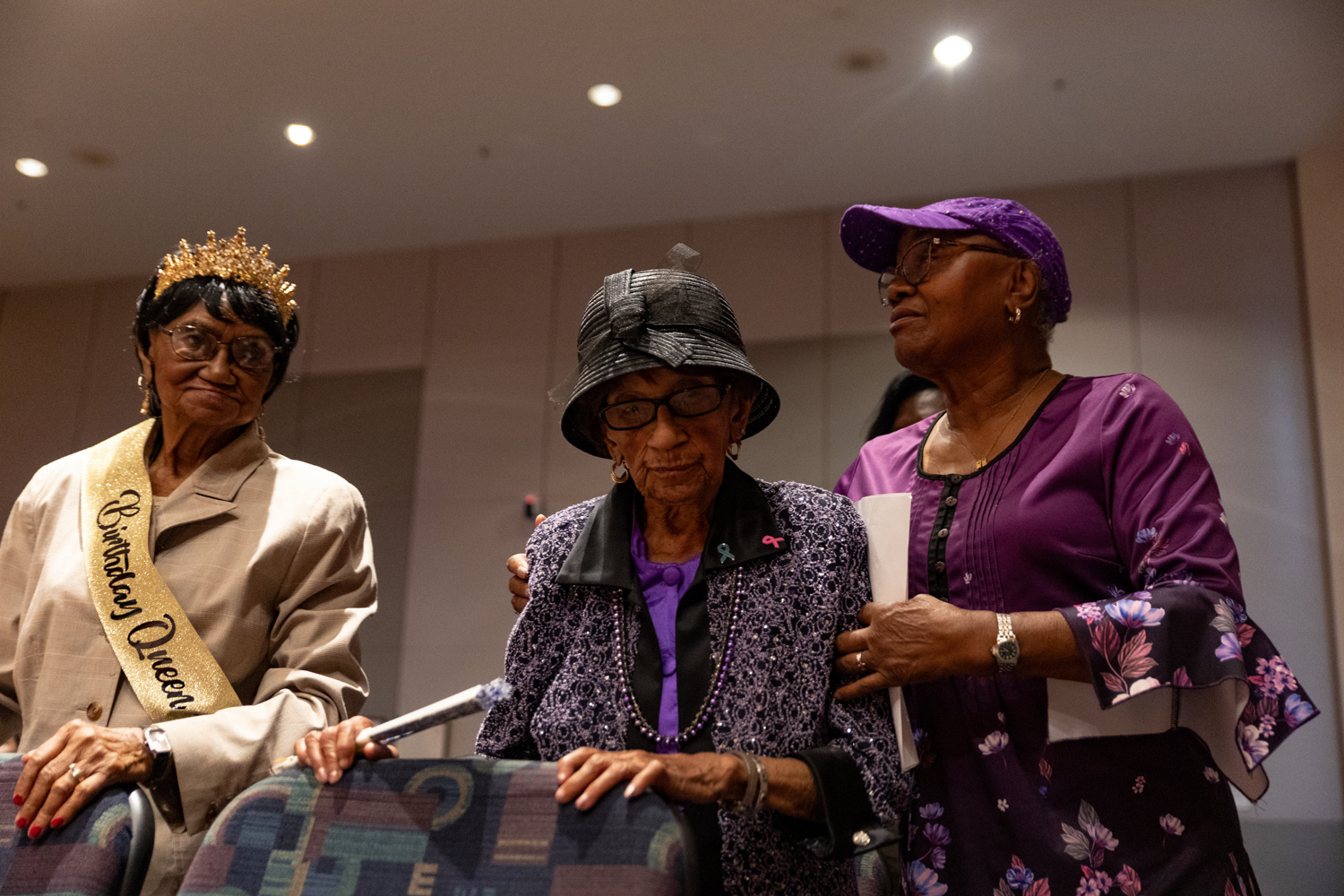
Cordelia Roberts, 100, and Amanda West, 103, are recognized for their longevity and legacies. West proclaimed at the podium that it was a good day. (TFP photo by Stephen Zenner)

Full families came to to honor two matriarchs at the meeting: Amanda West, 103, and Cordelia Roberts, 100.

Sons, daughters, grandchildren and other family members came to honor these centenarians and living pillars of their respective families. The front of the Council chambers was filled with family members photographing and filming the moment Toledo City Council honored the “longevity and legacy” of their families, presented by Council Member At-Large, Cerssandra McPherson.  

Thunderous applause rang out at the completion of the two sisters’ recognition, read by Julie Gibbons, the clerk of council, and then each matriarch was led to the podium to speak a few words. 

West was helped to the podium by her daughter, and when West was allowed to speak she proclaimed, “It’s a good day!” and thanked everyone in attendance and the council. 

Similarly Roberts thanked the council and then thanked God. “He will help you,” she said. “He will show you a good path.”

All of the council felt the gravity of wisdom bestowed from the elders, and let the women’s words hang in the air with respect. 

The Fair Housing Center

George Thomas, the CEO of The Fair Housing Center, as they are recognized during a Toledo City Council Meeting. (TFP photo by Stephen Zenner)

Before both centenarian Toledoans were honored, The Fair Housing Center was honored for their 50 year anniversary. 

In a much more formal recognition, the CEO of The Fair Housing Center, George Thomas, spoke briefly of the City of Toledo’s role in setting up the nonprofit, and the center’s role in advocating for better justice in housing. 

“It was funding from the City of Toledo to really help us get started,” Thomas said, and qualified that the money wasn’t much, just enough to begin their work. 

“Some of the first redlining cases, the first insurance determination case, the first cases about sexual harassment in housing all established right here in Toledo, Ohio,” he said about pouring over the archive in preparation for the organization’s 50th anniversary. 

Appointments (All Passed)

Alex Quinones was appointed to a three-year term with the Home Improvement & Home Remodeling Board of Control.

Second Reading (All Passed)

Council Member Vanice Williams, District 4, moved to amend O-357-25 and O-358-25 ordinances dealing with the forgiveness of loan balances, mortgage and security interests with respect to 24 single family rental housing units, part of United North School Homes LLC.

Williams Presents (All Passed)

R-425-25 Resolution to install street lighting in portions of an alley by Columbia St., Ashland Ave., Fulton St. and Bancroft St. Passed

Council Member John Hobbs III Presents (All Passed)

O-426-25 $225,746.57 from the General Fund to upgrade the audio, visual and recording equipment in three courtrooms in Toledo Municipal Court. Passed 

Council Member George Sarantou Presents (All Passed)

O-427-25 Allows the finance director to get advances from the Lucas County Auditor

O-428-25 Accepts property tax amounts and rates for 2026 budget from Lucas County 

Council Member Williams Presents (All Passed)

O-429-25 Lets the Mayor contract with The Inspired Lumber Project to create a vendor “hut” kit. As part of plans for a new International Holiday Market in Levis Square Park. With a budget of $37,500. Waiving competitive bidding. 

Council Member Nick Komives Presents (All Passed)

O-430-25 The mayor and director of law will appropriate property owned by HG Toledo LLC, at 1525 Cherry Street, for a safety project. Expenditure and payment of $325.

O-431-25 The mayor will enter into an agreement with TARTA for the TARTA LITE program, with a budget of $300,000. Money will come from the Capital Improvement Project Fund. And it allows the mayor to plan the project. 

O-432-25 Allows the mayor to receive grants from the Ohio Environmental Protection Agency (OEPA). No more than $2,000,000 can go into the Operation Grant Fund (OGF) from the OEPA. And no more than $700,000 can go to the OGF from the United States Environmental Protection Agency (EPA). The mayor can choose who gets these contracts. 

Council Member Adam Martinez Presents (All Passed)

O-433-25 Repealing O-235-25

In effect, allows the mayor to get $880,000 to fix/replace three belt filter presses at the Bay View Water Reclamation Plant.

O-434-25 allows the mayor $300,000 from the Water Operating Fund for “on-call emergency water distribution system repairs within the public rights-of-way and/or public water distribution easements.” 

Clerk Reports (All Passed)

R-435-25 Intent to vacate alley adjacent to Lot 17 and Lot 18 in Clifton Park. 

Council Member Theresa Morris Presents (All Passed)

O-436-25 Special use permit for a Community Center at 601 Junction Ave. 

O-437-25 Special use permit for a New Community Center at 2405 Stickney Ave. 

O-438-25 Amending the special use permit for a new gas station, granted by O-143-24, at 5765 Secor Road. 

O-439-25 Granting amendment to unit, granted by O-150-25, for a new library storage building at 3027 W. Alexis Road.

O-440-25 Amending Toledo Municipal Code Part Eleven by enacting § 1105.0207.

O-441-25 Amending Toledo Municipal Code Part Eleven by repealing section 1114.0402.

Ohio’s redistricting process explained

0
Ohio Redistricting Graphics | October 14, 2025 - 1

TOLEDO – This summer, congressional redistricting consumed national political debate. It all began in Texas after President Trump proposed that state officials draw new districts with the objective of helping Republicans gain more House seats in 2026’s midterms – or at least preserve their majority. In response, Texas lawmakers produced, and the governor signed into law, a congressional map that adds about five Republican-leaning districts.

In response, lawmakers in California redrew that state’s congressional map. Their aim was to counterbalance Texas’ new map by creating five more Democrat-leaning districts. However, in contrast to Texas’ redistricting effort, voters in California must first approve this map before it can be used in next year’s midterm elections. They will have their say on Proposition 50 during a special election this November.

In the time since, Missouri has also undertaken a mid-decade redistricting effort, which could flip one of the state’s two Democratic House seats. Typically, states redraw their congressional map every ten years, when new census data becomes available, making the mid-decade redistricting that has occurred in recent months an abnormality.

Ohio Redistricting Graphics | October 14, 2025

Ohio is also in a mid-decade redistricting process at the moment – but for a completely different reason than the aforementioned states. As Ohio Capital Journal Reporter Susan Tebben explained in a July Jaden Jefferson Reports interview, “the last two maps [Ohio lawmakers produced] did not have bipartisan support, and under the rules that we have in the state, the maps have to have bipartisan support to last ten years.”

Tebben noted that both of those maps were struck down by the Ohio Supreme Court for being “unduly partisan.” The latter of the two – despite the court’s ruling – had been able to be used anyway.

That brings us to where things stand now. The Ohio General Assembly is made up of two chambers: the state House and Senate. The GOP has a supermajority in both. The General Assembly had a Sept. 30 deadline to pass a congressional map, requiring support from three-fifths of members in each chamber. But that didn’t happen. Instead, as the Ohio Capital Journal reports, Republican lawmakers opted to “kick the process over to the Ohio Redistricting Commission.”

Per Ohio Senate Democrats, “the seven-member Ohio Redistricting Commission must adopt a plan by the end of October, with support from both Democrats on the ORC.” If the state’s redistricting commission isn’t able to pass a map, responsibility returns to the Republican-controlled state legislature to pass one, which – by law – would have to be by the end of November. At that point, it would need only a simple majority to do so. 

The Ohio Redistricting Commission is composed of five Republicans and two Democrats. Among the Republicans are Gov. Mike DeWine, Secretary of State Frank LaRose, Auditor Keith Faber, State Senator Jane Timken, and State Representative Brian Stewart. The commission’s two Democrats are State Senate Minority Leader Nicki Antonio and State House Minority Leader Dani Isaacsohn.

The Ohio Redistricting Commission itself has been a story, with some in the state wanting it to be replaced. In 2024, advocates were able to put a proposal on the ballot – known as Issue 1 – which, had it been passed, would have created a citizen redistricting commission.

For more coverage of redistricting and other happenings in Ohio politics, follow Jaden Jefferson on X (formerly Twitter), Facebook, and Instagram. He also has a YouTube channel, which you can check out – and subscribe to – here.

Toledo bridges gaps in mental health through community outreach

0
The panel of mental health experts and moderators. (From left) Scott Slyak, David Nalls, Laura Gipson, Dr. Anthony Bouyer, Jacob Spellis, Lynette Hair and Betina Layson. (TFP photo by Sidney Robison)

TOLEDO- The Kent Branch Library recently hosted a town meeting where mental health experts answered questions and listened to community concerns. Individuals spoke directly with mental health professionals about what they need from their services. 

The meeting was moderated by Betina Layson, equity manager of MHRSB (Mental Health and Recovery Services Board), and Scott Slyak, community executive director of MHRSB. 

The panel of mental health experts included Lynette Hair, executive director of Neighborhood Properties; Dr. Anthony Bouyer, New Concepts therapist; David Nalls, founder of Reconciliation Recovery Unlimited; Laura Gipson, community relations director for Team Recovery; and Jacob Spellis, CEO of Vital Health. 

The main topic was about the importance of harm reduction, stigma reduction, and community collaboration to support recovery and prevent substance abuse. The town hall meeting also focused on resources and support for mental health and substance use recovery in Lucas County. 

Bouyer started off the meeting explaining how to identify if a loved one is involved with a substance.  

“First thing you do is look at what kind of behaviors have started to change, and you may start seeing stroke reactions with, for example, cocaine use. You may start to see those who appear to be angry, particularly when they’re under the influence,” Bouyer said. 

“We never give up on our patients,” Spellis added. 

Slyak asked the panel what strategies could be used to reduce the stigma around substance use disorders. 

“We can work across organizations to provide comprehensive support and resources, making it easier for individuals to access help without fear of judgment,” said Gipson. 

Hair highlighted the various aspects of recovery, including social security assistance, job applications, and community involvement.

“The services we provide are to help people who are recovering from homelessness, recovering from traumas, recovering from mental health, [and] substance abuse,” she said.

Slyak asked what recovery meant to each of the panelists. 

Spellis explained that recovery is about living the life you want without being affected by substances, emphasizing personal freedom and self-direction.

“To me, recovery means living life on your own terms,” Spellis said. 

Nalls talked about the questions one could ask when someone is in the recovery stage.

“What type of recovery am I looking to gain? Do I want to gain recovery that’s just simply going through the motions? Or do I want to live a recovery, a recovered life where I’m actually doing my recovery?” Nalls said. 

Bouyer added that recovery is about living the life you want without being affected by substances. 

“Recovery means having the freedom and support to direct your own journey, recognizing that each individual’s path and definition of success will be unique,” he said. 

Gipson said, aside from her work at Team Recovery, she is also a part of the Sylvania Chamber and Toledo Chamber. 

“My background is in substance use disorders, mental health, geri psych, behaviors like dementia and Alzheimer’s,” Gipson said. 

Gipson has worked with the sober and recovery population for over ten years. 

“I started out as an STNA (State Tested Nursing Assistant) and while I did that, I went to school and then got my nursing license,” Gipson said. 

There are multiple factors that lead some individuals to not being able to get the mental health services that they need. 

“Individuals, a lot of the time, don’t have the ability to come and go the way they would like to, but they also don’t have the funds in order to call an Uber or a Lyft,” Gipson said. 

Gipson said that another barrier is insurance coverage.

“We at Team Recovery only help the population that are Medicaid eligible currently,” Gipson said. 

Betina Layson, health equity manager of mental health and recovery services, said that this was their second meeting specifically talking about mental health. 

“We had our first meeting on Aug. 8 of this year, but the meeting today [on Sept. 22] mainly focused on mental health and recovery,” Layson said. 

Layson said she is always looking for feedback from the community on what should be talked about at town hall meetings. 

The Crisis Care Helpline for the Zepf Center is 419-904-2273 and the harm reduction text line is 419-232-6555.