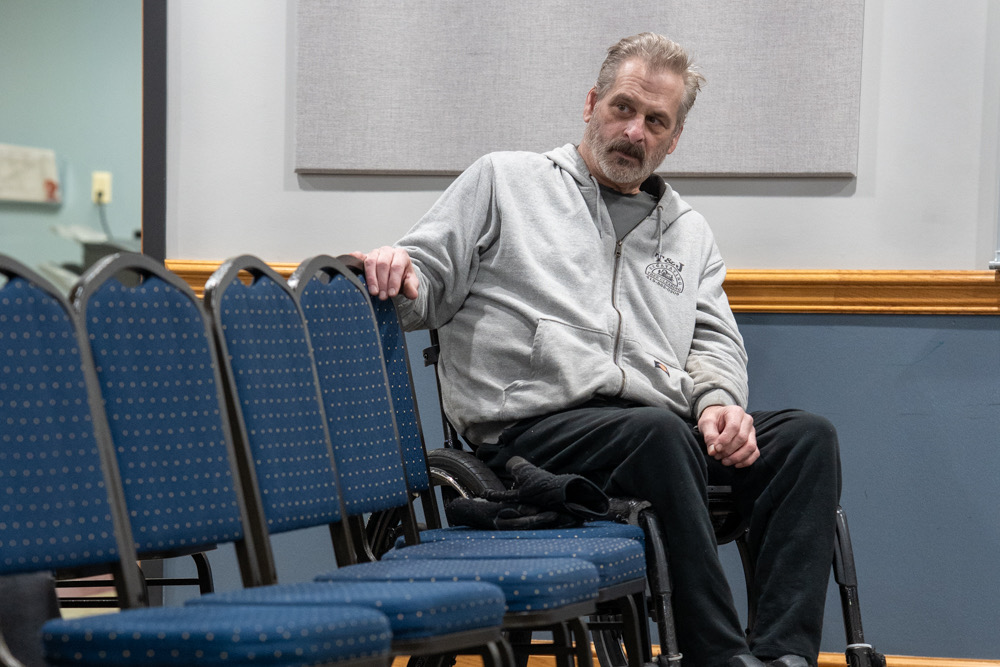
Anthony Wayne Junior High School teacher Jim Bolone writes books in his spare time. His latest, Zombie Seagulls, contains 14 spine-tingling stories. (AWFP photo by Karen Gerhardinger)
Bats, cannibals, clowns, gargoyles, spiders and witches terrify the teens in Jim Bolone‘s latest book, Zombie Seagulls – a compilation of short stories designed for reluctant readers of all ages.
“I grew up watching The Twilight Zone, Tales from the Crypt and Night Gallery,” he said. “These are stories that I’ve been telling to my three kids and my students for a long time. I finally put them down, and Mission Point Press said they’d like to publish them.”
Bolone, who is set to retire after a 30-year career as a language arts teacher at Anthony Wayne Junior High, got into publishing in 2021. Co-writing with Dave McVeigh, they published The Dockporter, using their shared experiences in the 1980s as teenagers schlepping tourists’ luggage from the ferry at Mackinac Island to nearby hotels. That book won them the 2022 Library of Michigan Notable Book Award. That series continued with two other books: Somewhere in Crime and MISguided.
Like the Dockporter series, many of the 14 stories in Zombie Seagulls take place on Mackinac Island, and have just the right length and suspense to be shared at summer camp – or cozied up on a sofa somewhere safe.
“This is comprised of micro-fiction and flash fiction – short, condensed stories that have a heart and soul,” he said. “It’s the perfect length for reluctant readers because they’re diced up into short pieces.”
As a kid growing up in Detroit, Bolone fell in love with stories not just from those TV series of the ’60s to ’80s, but in hearing his mom share some of the stories she was reading, like Truman Capote’s In Cold Blood.
“She would bring the story to life and it made me want to read,” he said. “Having a good teacher, mom, dad or friend to be so enthusiastic about something…makes a difference in encouraging kids to read.”
In addition to reading scary books and watching spooky shows, Bolone had his own adventures, such as a midnight bike ride from Detroit to Grosse Pointe with other 13-year-olds in the 1970s.
“Here we were, seven or eight of us – no helmets or cell phones – riding six or seven miles. Thank goodness, nothing happened.”
When he was about six or seven years old, Bolone accompanied his father – a jazz musician – to get a pack of cigarettes after a curfew was imposed during the Detroit riots.
“I asked him how old he would like to be forever. He said 21. Then he said, ‘Do me a favor, don’t get any older than 13.’ He made me promise, and I’ve held true to that promise. I’ve been immature my whole life,” Bolone laughed. “I find that has carried me through in a good way. Even in days of sadness and great loss, that innocence helps you see that there will always be another morning.”
He sees that innocence in the 12- and 13-year-olds he teaches – but that wasn’t his initial career choice. It was when Bolone went back to school to become a teacher that his advisor suggested junior high.
“I almost puked in my mouth,” he admits. “But, lo and behold, here I am almost 30 years later and he was right. These kids have the energy. They still believe in Halloween and Christmas and the things that belong to kids. They want be older, but they can still play with their toys. They have a universal sense of hope and excitement. And I’m grateful for that.”
Sitting on his duct-taped chair and glancing around his classroom, Bolone points to the wall where a mockup of the cover of Zombie Seagulls hangs.
“They’re all anticipating its release,” said Bolone, adding that many of his students – as well as their parents and grandparents – have read the Dockporter series and love the portrayal of kids coming of age during misadventures.
After multiple edits and revisions with Mission Point Press, Zombie Seagulls is set for release at the end of March, and will be available at Barnes and Noble, Books a Million and several independent bookstores. This summer, he’ll do a book signing on Mackinac Island and participate in the Detroit Book Fest – an invitation-only author festival that attracts more than 60,000 guests.
“I’m not getting rich; the fun is in the writing and in meeting the people who have read your books,” he said. “And it’s nice getting feedback from the community.”
Now that he’ll be retiring at the end of the school year, Bolone has ideas for several other books and he might also team up with McVeigh for another installment in the Dockporter series.
“Right now, my focus is on getting ready to make a life change, to face the unknown. I’ll write, dream and see what’s next,” he said.
The 118-year-old Roche de Boeuf Interurban bridge is slated for demolition this summer unless Gov. Mike DeWine issues another pause. Waterville is expecting to hear the governor’s decision within the next few days. (AWFP photo by Karen Gerhardinger)
WATERVILLE – By the end of this week, Waterville should know whether Gov. Mike DeWine will extend a one-year pause on demolition of the historic Roche de Boeuf Interurban bridge, Mayor Tim Pedro told Waterville City Council during its March 9 meeting.
“We’re not going to save the bridge if we don’t get more time,” said Pedro, who spoke to the governor for about 15 minutes on March 5.
DeWine was familiar with the project, as Pedro secured a one-year stay on the Ohio Department of Transportation’s demolition plans on April 8, 2025. With that year almost up, ODOT has already put the project out for bids, and on Monday, ODOT representatives were on site getting drone footage and photos.
During the year pause, the Save The Bridge Association (STBA) has been seeking alternatives to demolition. No matter what other construction options are available to preserve, stabilize or rehabilitate the bridge, one thing remains clear: the state no longer wants to maintain ownership of the bridge.
STBA member Barb Bruno, along with fellow volunteers Janice Braida, Frank Butwin, John Wasserman and Dave Weber, pleaded with Council to consider taking over administration of the bridge, either alone or in a consortium with other interested parties. ODOT could transfer the estimated $4 million in funds set aside for demolition to any entity that would assume administrative ownership, Bruno said.
“That’s why we need a delay – to work out the details,” Bruno said.
The STBA recently spoke with Metroparks Executive Director Dave Zenk, and Bruno believes more time would allow further conversations to see if Wood County Metroparks, the City of Waterville and other entities could work together on a plan to stabilize the bridge so it is safe. Bruno asked council to agree to be a part of that consortium.
Weber provided council with an estimate of costs to mothball or preserve the bridge to keep it safe, but council member Wayne Wagner said he wasn’t comfortable with making such a huge decision involving taxpayer dollars based on an estimate.
“I can give out estimates all day long, but it’s the contract that matters,” said Wagner, who owns a construction business. “If you want me to say yes on ownership, I need a firm price.”
Several council members cited concerns about investing taxpayer dollars into a bridge that might collapse while work is done on it. If one span falls, the others could collapse in a domino effect.
“You’ve got to address the risk for me,” Wagner said.
Wagner also wondered how the city could afford, or even find a company, to insure the bridge. Back in the 1970s when the bridge was added to the National Register of Historic Places, a group attempted to insure it. In the past few years, Council Member Mary Duncan said she’s called multiple companies, and none would offer to insure it at any price.
“I think that as a city, we have supported the effort as much as we can at this point. I really hope the governor gives us another year. That would really help the situation,” Duncan said.
Council members Scott Jahns, Todd Borowski, Nick Sargent and Rod Frey all shared concerns about using taxpayer dollars on the bridge.
“I would love to see the bridge saved, but ODOT wants to get rid of it because they want to be rid of the liability,” Frey said.
“We all have an obligation to protect the citizens’ money. Taking on liability is not the best way to risk tax dollars,” Borowski said.
IF the STBA could return with a contract from a major company, and show the ability to insure the bridge, city council might reconsider, Wagner said.
While disheartened, Braida said STBA members will continue to promote their efforts in the community, hanging up banners around town and selling T-shirts through JupMode to raise funds for the nonprofit.
“We want to create a sense of urgency,” she said of the recent outreach to residents and the media.
“Everywhere you look, the bridge is embedded in our in our identity,” Bruno said. “We’re really close now. When it’s gone, it’s gone. But I still believe there’s hope.”
During the meeting, council also:
The Anthony Wayne High School cheerleading team was recognized by Waterville City Council during its March 9 meeting. The team won both state and national championships. (AWFP photo by Karen Gerhardinger)
-Congratulated the Anthony Wayne High School cheerleading team for winning both the Ohio High School Athletic Association state championship and the America’s Cheerleading Cup Game Day competition. Pedro issued a proclamation recognizing the team.
-Heard that the Historic District Commission approved a conceptual drawing for an 18-foot-by-7-foot mural that Dean Davis will paint on the wall of a business on Mechanic Street to welcome those entering town from the bridge.
-Approved renewing its electric aggregation contract through the Northwest Ohio Aggregation Coalition (NOAC) at a rate of 9.8 cents per kilowatt hour, which will go into effect in June. That’s an increase of about 1 percent over the current rate of 9.75 kw/h. The contract is for 25 months.
-Heard that Administrator Jon Gochenour has sent out requests for proposals from current waste provider Republic Services, along with ARS, Klumm, Rumpke and Stevens Disposal.
-Listened to Duncan say that she received an email from First Energy representative Victor Coleman about her request to fix street lights that are not working. Instead of fixing those lights, First Energy will replace them with LED lights this summer, using new poles as well.
-Heard Pedro say that he is meeting with downtown business owners on Wednesday, March 25 at 8:30 a.m. to discuss initiatives for working together and funding for improvements.
-Learned that Bob Miller Interiors is moving to Mechanic Street downtown just south of the old Valero gas station.
-Approved Pedro’s recommendations for committee assignments, including: Jeff Lohse, Riverbend Industrial Park Committee; John Rozic, Finance Committee; Beth Sikorski, Public Safety Committee; and Karen Eboch, Parks and Recreation Committee. Wagner nominated Terri Massucci to also serve on the Parks and Recreation Committee, for which Wagner serves as council representative. But Pedro said he spoke to Massucci about how the position was taken by Eboch. After much discussion, council voted to table Wagner’s nomination of Massucci until the March 23 meeting.
-Awarded a $44,929 contract with Bauman Ford for a 2026 Ford Explorer. This is replacing a police vehicle that will be transferred to the Public Works Department.
-Awarded a $49,985 contract to Atlantic Emergency Solutions for fire turnout gear.
Housing prices are rising faster than prices overall. From March 2020 to December 2025, housing prices increased 57.5 percent nationally and 46 percent in Ohio. In contrast, overall inflation increased 26 percent nationally during the same period.
As county auditors re-assess property values, homeowners discover that they are required to pay higher property taxes. In Lucas County, the home value assessments increased 29.5 percent in the 2024-2025 reappraisal. Whereas individuals pay income tax from earned income, there is no additional income derived from ownership of a primary residence to pay the increased property tax. Herein lies the essence of the frustration facing homeowners throughout the country and here in northwest Ohio.
As property taxes increase, it is possible that some proportion of homeowners will not be able to afford or be unwilling to pay the taxes to remain in their home. For a far larger proportion of homeowners, higher tax bills require forgoing some consumption or tapping savings to pay the higher tax bill.
These statements presuppose that real income growth for homeowners is not matching or exceeding the increase in property taxes. These statements are supported by data reported by the US Census Bureau showing real median household income has decreased 2.6 percent since January 2020. A decline in median real income means that after all the reported wage increases, at least one-half of income earners can buy less than they could by in January 2020 due to inflation rising faster than income.
In response to rising property taxes across the country, citizen groups are seeking to reduce or to eliminate property taxes. In Ohio, there is an effort to add the issue on the ballot in November. The ballot initiative seeks to add an amendment to the Ohio constitution eliminating property tax and prohibiting any form of property tax in the future. Approximately 20 states are grappling with similar voter discord.
Governments use tax revenue to fund operations. Nearly all state and local tax revenue is derived from the combination sales tax, income taxes, and property tax. Among the three, property tax is typically the largest source of revenue. Last year, Ohio collected $13 billion from the sales tax and $10.4 billion from income taxes. In contrast, $24 billion in property tax revenue was collected.
Property tax is the primary source of revenue for local government. In Ohio, nearly two-thirds of property tax is allocated to schools. The remaining one-third is distributed among counties, townships, municipalities, and special districts (e. g. fire departments, parks, and libraries) from which the revenue is derived.
If the ballot initiative to eliminate property tax in Ohio passes, local governments will face challenges. Like many states, Ohio’s constitution prohibits budget deficits, and state law prohibits municipalities from intentionally operating in deficit. So, in the absence of the property tax revenue, three broad possibilities exist: raise revenue another way, reduce government expenditure, or some combination of both.
Two potential alternative means of raising revenue are the state income tax system and sales tax. The infrastructure already exists to collect these taxes. Based on the most recent tax receipts, replacing the property tax revenue would require, effectively, doubling the income tax or the sales tax collected annually.
While it may seem intuitive to anticipate that doubling the income tax rates and sales tax rate will double the total revenue, it is likely that the higher rates will inspire behavior to avoid paying the higher taxes.
Although some celebrity billionaires and athletes have forsaken California, purportedly to avoid the top 13.3 percent marginal income tax rate in favor of Florida or Texas, two states with no state income tax, studies suggest that the net outflow of residents due to tax rates is small. Nonetheless, California is experiencing net outflow of residents for any number of reasons.
It is more difficult for lower income individuals and households to relocate. It is also more often the case that lower income individuals and households utilize more government services. Given that studies reveal that higher income individuals and households are more able to relocate, any sort of net outflow is expected to disproportionately include higher income individuals and households that would pay more income and sales taxes. Avoiding an exodus seems essential.
There are two ways to modify a sales tax to increase revenue. One option is to raise the tax rate. The second option is to apply the tax to more goods (e.g. food) and services (e.g. healthcare). In either case, consumers will have an incentive to avoid paying the additional sales tax by purchasing goods in nearby jurisdictions with lower rates.
Property tax is consistent with the benefits-received principle of taxation. The tax is paid by county property owners to fund county, municipality, and township government services that residents utilize. Sales tax includes a base rate collected by the state and an additional county-level rate. Sales tax, therefore, is partially consistent with the benefits-received principle. However, there is one very big difference between property tax and sales tax: taxed property cannot be relocated, whereas taxed goods and services are easily transported.
Some Ohioans reside near the border of another state. If so, sales tax rate discrepancies might be sufficiently large to motivate Ohioans to cross into another state to make purchases. Similarly, variation in the county-level rate can be expected to encourage Ohioans to cross county boundaries to avoid higher tax rates.
Adjacent counties competing for tax revenue might instigate a race-to-the-bottom resulting in both counties unable to collect sufficient revenue to maintain service levels. The rapid development of Moon Township near Pittsburgh, PA, is frequently attributed to preferences to avoid taxes levied in Allegheny County to fund the construction of new stadiums for the Steelers and the Pirates.
It is difficult to imagine that advocates of eliminating property tax are sincere in their intent, given the challenges passage of the measure would impose on state and local governments. It seems unlikely that advocates think that eliminating property tax corresponds with eliminating taxes. Clearly, tax revenue would be collected some other way. Regardless of the motivation or the intent, there is little doubt that state legislators and the governor have the incentive to propose a viable alternative to address concerns.
There are a number of potential solutions. Counties can adjust the milage rate for all property owners. In addition, the legislature and governor can enact highly targeted measures to protect the most vulnerable homeowners most at risk of losing their home. Alternatively, limits can be established based on revenue requirements. Limiting property tax to revenue requirements addresses the concern with the current system that accommodates tax increases without legislative action and the accompanying accountability to voters.
“Taxation without representation” rallied the colonists to challenge the English King and Parliament. Rising property taxes does not require revolution so much as it requires attention and action in response to a change in macroeconomic conditions. The national scope of the challenge presents the opportunity for development of a variety potential solutions. Given the consequences of failing to resolve the problem, the incentives are properly assigned. Let’s hope that those positioned to affect meaningful change are up to the task.
Monclova residents including, seated, Jennifer Collins, Pat Aubry, Connie Curtis and, standing, Barb Frey, applauded the trustees' decision to impose a 12-month moratorium on data centers. (AWFP photo by Karen Gerhardinger)
Three Anthony Wayne-area communities have imposed temporary moratoriums on data centers – meaning no applications for such developments will be considered until that time has expired. How each community is using that pause varies.
Monclova Township
Monclova Township’s Board of Trustees voted Feb. 17 to implement a one-year moratorium, after months of pushback from residents concerned that a 200-acre site on Black Road would potentially be targeted for such a development.
Over several months, dozens of Waterside residents filled the township hall to urge trustees to pass that moratorium. Citing concerns that the Black Road property owner could just annex his land into Maumee – leaving the township with no control over the development – trustees resisted the idea of a moratorium, that is until they learned that Maumee was enacting a 12-month moratorium. News that the Shops at Fallen Timbers would be sold and reinvigorated also removed the fear that the mall property could be combined with that Black Road property for a data center site.
“The landscape has changed,” Trustee Barbara Lang said before the Feb. 17 vote on the moratorium. “Our approach regarding potential large-scale development, including a hypothetical data center, has been measured and strategic. Rejecting concepts prematurely or taking symbolic actions without considering annexation risk can unintentionally push development across our borders, where township residents lose any voice or protection.”
Waterside resident Mike Tyson is among the residents serving on a data center committee. (AWFP photo by Karen Gerhardinger)
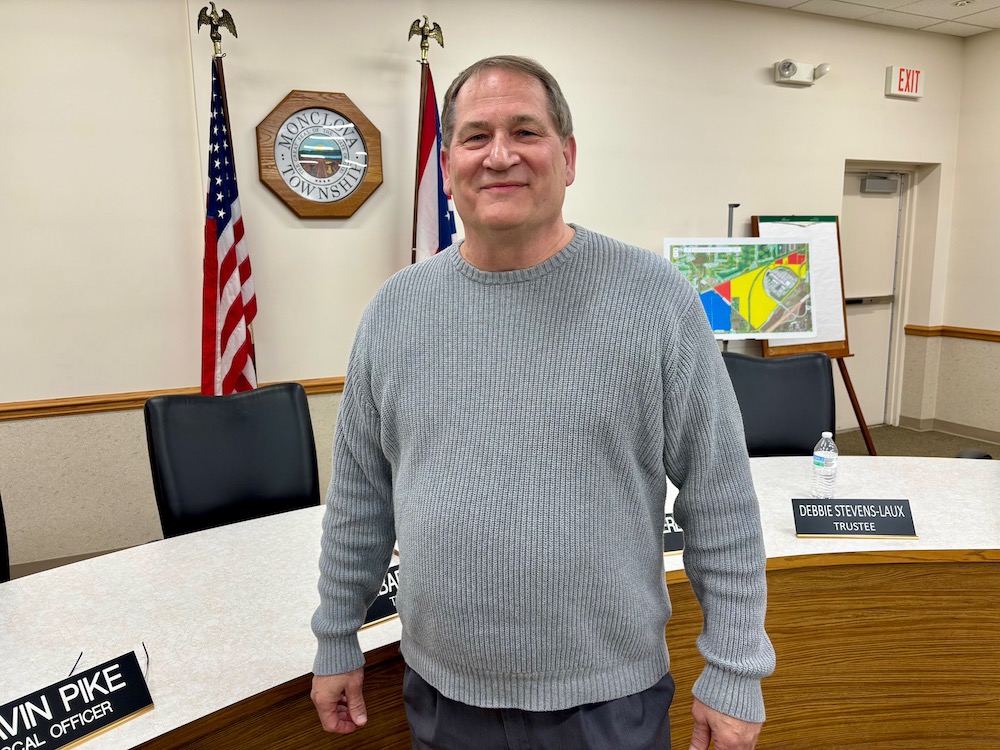
Following a citizen’s recommendation, the trustees asked a few residents to study data centers and make recommendations to Zoning Administrator Eric Wagner, the Zoning Commission and the trustees. Lang tapped Waterside resident Mike Tyson to lead the committee, which includes former Trustee Brian Craig and Don Feller, the co-founder of engineering firm Feller Finch Associates.
Tyson, who owned Mike’s Party Store in Bowling Green for 40 years, led a successful referendum on rezoning land east of I-75 for apartments in BG in the early 2000s. During that process and in the years following, Tyson said he’s learned a lot about zoning, and he’s using that knowledge to dig into zoning regulations around data centers from over 200 communities.
“We’ll put it into a guidebook. It will be heavily weighted toward public health, safety and environmental concerns,” he said, noting that he already has in mind a working title: Data Centers and Public Health – Zoning for a Safer Future.
Among the interesting details he’s found during his research: the Nuclear Regulatory Commission recommends that data centers should be at least 50 miles away from a nuclear power plant. Davis Besse is 38 miles from the Black Road property, and 35 miles from the Meta hyperscale data center being built in Wood County.
Within the next three months, Tyson and his committee plan to compile the data and present it the township, and the zoning commission can choose to add, modify and strengthen the township’s zoning code, he said.
Tyson said he’s open to having others join the three-person committee, especially those with zoning and clerical skills to help compile a presentation.
During the March 2 trustees’ meeting, resident Dianne Stroshine said she’s concerned that the committee is not sanctioned. She wants to see the committee’s goals and meeting minutes, along with published reports to the trustees.
“We want to make sure everyone’s voice is heard,” Stroshine said.
Lang said that their sanctioned committee is Wagner and the Zoning Commission, who will keep the trustees apprised of the progress made. Trustees are also seeking information from the Lucas County Plan Commission and Ohio Township Association on data centers.
Despite the existence of the committee, Waterside resident Risa Sindel said she’s working with her HOA to create a committee of their own, with members from a variety of professional backgrounds relevant to the issues surrounding economic, legal, construction practices, health implications, and more regarding the various types of data centers.
“I think it’s imperative that Monclova employ a mindful strategy to have professional experts and research-based citizens who can work together on this effort, especially as this very fluid national situation regarding data centers will be changing significantly over the next 12 months,” Sindel said. “I think it’s critically important for our township to take the most effective steps in protecting our community, if possible, from being stripped of its autonomy and instead be controlled by state and/or national decisions that are not in our best interest.”
Lang noted that Ohio and federal legislators seem to be moving away from local zoning for data centers.
“That will leave us without the opportunity to protect our neighborhoods, and those decisions will be made by people who aren’t your neighbors. We’re watching carefully as this issue develops further,” she said.
After reviewing the committee’s recommendations, Wagner said draft language could be presented at the county and township level, with a series of public hearings set to get input from residents. Lang said she hoped to have those recommendations this summer, in time for the hearings to take place later this year.
Waterville Township
In December, Waterville Township trustees imposed a year-long moratorium to allow time to consider the pros and cons, understand possible impacts, and fine-tune what conditions should be imposed if a data center developer applied for a conditional use permit to operate on agriculturally-zoned land.
“You can’t just use a moratorium as a way to kick the can down the road. You have to actually develop a study of the impact,” advised Lucas County Assistant Prosecuting Attorney John Borell during the December trustees’ meeting.
Waterville Township’s data center study committee held its first meeting on March 5, focusing on assigning roles and setting timelines and goals. The committee includes residents Rebecca Wooten, Brian Gowing, Russ Schifferly, Todd Kerschner, Todd Heller, Bob Seeman, Troy Herring, Brett Warner and Chris Weimer, as well as Zoning Inspector Jim Fischer, Zoning Commission Member Bill Burkett, and Board of Zoning Appeals members Steve Reinbolt, Jill Lipinski and Roger Tucholski.
“The expectation would be that they would finish their report in June or July to come to the trustees for review,” said Trustee Toby Miller. “Then anything we need to do from resolution standpoint we would have more than 90 days to send it to the zoning board and have plenty of time before the moratorium expires.”
Heller, who has been vocal against data centers, spoke during the February trustee’s meeting, and shared his objection to Burkett serving on the committee. In addition to serving on the township’s Zoning Commission, Burkett works for Regional Growth Partnership – which looks for development opportunities in Northwest Ohio. Heller sees that as a conflict. But Trustee Julie Theroux said there is no conflict of interest for Burkett.
“We have no data centers on the table and no conflict,” she said.
The trustees also noted that it’s not the Zoning Commission, or Burkett, that would make the final decision on any development anyway. If a data center application for a conditional use permit came in, the Zoning Commission would review and make recommendations, which are then reviewed by the county planners and be returned back to the township’s Board of Zoning Appeals for a final decision.
“There’s a chance for the public to speak at the county level, zoning board level and BZA level. So there are three possibilities for the general public to speak for or against it,” said Zoning Inspector Jim Fischer.
City of Waterville
Waterville Mayor Tim Pedro. (Courtesy photo)
Waterville City Council approved a six-month moratorium on Dec. 8, but does not plan to utilize a citizen committee, said Mayor Tim Pedro. Instead, Pedro, Administrator Jon Gochenour and members of council are doing research that included a December tour of data centers in New Albany, Ohio.
During that tour, Pedro said it became clear that there are multiple types of data centers, not just the hyperscale models like Meta is building in Middleton Township. Enterprise size data centers, such as one built in New Albany for Discover Card’s headquarters, are much smaller, he noted.
“Waterville does not have enough space for what I think people are suggesting that is being planned,” Pedro said, referring to the Middleton Township project. “I’m 99.99 percent certain that the city is never going to have what we call a data center. We just don’t have the space.”
The city is also tracking data-center focused legislation at the state level. This includes House Bill 646, which creates a statewide Data Center Study Commission to look at impacts on the environment, electrical grid, water usage, noise and light pollution, the local economy, farmland and national security.
“Local communities like Waterville can learn or glean from what is being discussed,” Pedro said of the state’s efforts. “Ultimately, in our case, at the end of the moratorium we will have had an honest, factual, data-driven discussion.”
The city will be better prepared in the event that a data center developer does show an interest in locating on M-1 Manufacturing zoned property – a decision made by a majority vote of council last year, said Pedro. The mayor said he doesn’t see that zoning changing as a result of research, but is open to a review of other options. Wayne Wagner, who was among the council members voting in favor of M-1 zoning, said he would like the Planning Commission to consider requiring applicants to apply for a conditional use permit – the process currently in place for applicants in Monclova Township and Waterville Township.
While each community has its own plan of action during the moratoriums, Tyson said he’s hoping to meet up with Maumee, Waterville and Waterville Township representatives to share some information. Pedro echoed that sentiment, noting that he’s already had meetings with leaders from Maumee, Whitehouse and Waterville Township to discuss a variety of topics.
Will Turner, Managing Director of the Upterra Group, announced $1 million in grants to develop programs for high school students to prepare for careers in the trades. (TFP photo by David Yonke)
TOLEDO – Northwest Ohio has everything in place for high-tech firms to build hyperscale data centers to meet the needs of the rapidly growing artificial intelligence market, according to state and local development officials.
Citing Meta’s $800 million data center now under construction in Wood County as one notable success story, speakers at the Regional Growth Partnership (RGP) of Northwest Ohio’s annual meeting, held in the Glass City Convention Center on March 5, said they were concerned about the spread of “misinformation” regarding data centers.
Speakers spotlighted numerous job- and revenue-creating projects developed throughout the 17-county region in 2025, resulting in 4,895 new jobs, 16,177 retained jobs, and $3.3 billion in capital investments.
But they also focused on the future, stressing the potential positive impact of luring new large-scale data centers to the area.
“There has been an incredible amount of talk surrounding data centers recently, and unfortunately, much of that talk has been misinformation,” said Dean Monske, president and CEO of the RGP.
“RGP has diligently been trying to overcome that misinformation for well over a year now, and we thought it was extremely important to use this platform today to educate and inform all of you about the facts and benefits we see from our region,” he added.
Gary Thompson, executive vice president of the Regional Growth Partnership of Northwest Ohio, discussed the future of Artificial Intelligence and Hyperscale Data Centers at the RGP’s 2026 annual meeting held Thursday, March 5, at the Glass City Center in downtown Toledo. (TFP photo by David Yonke)
More hyperscale data centers will be needed to meet the soaring AI market, which is expected to grow globally from $189 billion in 2023 to $4.8 trillion by 2033, according to Forbes magazine.
Monske introduced Gary Thompson, RGP executive vice president, who has been leading the group’s efforts on data centers for four years.
“Whether you like data centers or not, I hope you can at least see why our region is a suitable host for the industry,” Thompson said.
Among the factors cited in northwest Ohio’s favor:
-Flat, affordable land near power infrastructure
-Abundant, cost-effective natural gas from multiple sources
-70 million gallons a day of excess water capacity in Toledo alone
-35-plus colleges and universities providing “a built-in tech talent pipeline”
Thompson said he is “perplexed” by much of the opposition to hyperscale data centers, saying social media have given opponents “a very loud voice.”
One misperception, he said, is that data centers produce a loud, constant, annoying hum that can be heard throughout the neighborhood.
While that may be true of “chicken coop crypto mining” facilities, it is not true of the type of high-tech centers the RGP is seeking to attract, he said.
“I have stood in front of hyperscale data centers in the morning, in the afternoon, in the evening, in the sun, in the rain, in the wind, in the snow; they don’t make any noise,” Thompson said.
About 700 people attended the Regional Growth Partnership of Northwest Ohio’s 2026 annual meeting on Thursday, March 5, in the Glass City Center. (TFP photo by David Yonke)
He showed the crowd of 700 a video of a crypto mining facility consisting of a series of pole barns with openings for fans that produced a constant noise registering 84 decibels on a hand-held device, equivalent to the noise level of a gas-powered lawn mower.
In contrast, he showed a sleek, self-contained modern building like the one Meta is building in Middleton Township, north of Bowling Green, adding that such facilities have sound buffers and barriers that keep noise levels low.
“I think we can all agree that the ‘chicken coop crypto mining operation’ in the video is loud, obnoxious, ugly, undesirable, it’s not creating any jobs, it’s unwelcoming, it’s a nuisance… Let me be very clear, no one at the RGP or our utility partners are looking to attract crypto mining.”
He asserted that every northwest Ohio community has zoning ordinances that would make such a facility illegal. “They would not be able to get a building permit.”
An RGP handout said the Meta facility will employ more than 1,000 construction jobs with work on the project extending for 10 years – “not a quick build-and-leave” project.
Data centers create between 100 and 150 high-paying jobs and draw additional white-color tech companies to the region.
The handout sheet said hyperscale data centers construct “behind-the-scenes power plants that are privately funded and don’t impact ratepayers – they can actually add resilience to the grid.”
Thompson added that the facilities use “closed-loop cooling” that circulates about 30,000 gallons of water a day. “That’s equivalent to two Hampton Inn hotels.”
He said hyperscale data centers require between 200 and 1,000 acres of land, and that there is no shortage of available land in Ohio.
“To put data centers in perspective, if northwest Ohio landed 10 hyperscale data centers that are built on 1,000-acre campuses, we would use only three-tenths of 1 percent of the total farmland in our region,” Thompson said.
Chase Eikenbary, vice president of project management for the RGP, said there were 13 new projects in agriculture and food sciences in Northwest Ohio in 2025, creating 384 new jobs and $421 million in investments.
“Everyone in northwest Ohio is a farmer, loves a farmer, or loves what they do,” she said.
She said Marsha’s Buckeyes, based in Perrysburg, has received a grant to expand.
In the field of advanced manufacturing, Eikenbary said there were 60 new projects that created 2,528 jobs and brought in $1.8 billion in investments. Among the advanced manufacturing companies listed were Whirlpool, Nooter, Revere Plastics, and First Quality.
Eikenbary also spotlighted SmartSolve Industries, which is building a 10,000-square-foot research and development facility in Bowling Green with an investment of $3.6 million, creating 30 new jobs.
J.P. Nauseef, president and CEO of JobsOhio, told the crowd that northwest Ohio led the state in creating new jobs in 2025. He praised local businessmen and developers for their “unity and willingness to come together and work together on common economic development efforts.”
Whitehouse law director Kevin Heban (left) and chief operating officer Josh Hartbarger (right) listen to administrator Jordan Daugherty outline the rezoning process. (AWFP photo by Lucas Sells)
WHITEHOUSE – For 18 months, Artisan Craftbuilt Homes principal Charles Grass has sought to rezone 37.99 acres of farmland at 11320 Archbold Whitehouse Rd. to construct single family homes. Currently zoned S-1 Suburban, which has bigger lots, Grass initially asked for the more dense R-3, then, most recently, R-2 with a Planned Unit Development (PUD) – both of which were denied. On March 3, Grass listened as Whitehouse Village Council held a public hearing for his third attempt at rezoning, this time to an R-2.
Residents Jeff Heaney, Lisa Forwerck and Craig Whitman were among the residents who testified, citing concerns that the addition of homes Country Meadows South will impact traffic on Waterville Street and S.R. 64 (Centerville Street).
Centerville Street resident Jeff Heaney shares concerns about how the proposed subdivision will increase traffic. (AWFP photo by Lucas Sells)
“I think R-2 is way too dense. Traffic is going to be terrible. We don’t need more cars coming out near Westwyck,” said Whitman, who lives on Centerville. “It should be R-1 at a minimum.”
Oak Crossing Lane resident Tom Metzger asked for renderings of the neighborhood, and whether council would have access to plans and information like traffic studies before making a decision on the rezoning.
Administrator Jordan Daugherty explained that a zoning change is the first step, and gives the developer a framework to know how to develop a plat – a drawing that shows the layout of homes.
While Grass presented a potential plat to the Planning Commission on March 2, to get feedback on the design, those drawings for Country Meadows South Plat 1 were for discussion only. The renderings show Plat 1 with 21 lots on 20.4 acres, with lot sizes of 15,000 to 22,519 square feet. In total, Grass plans 37 lots on land bisected by Lone Oak Ditch. The southern portion will connect to West, Temperance and Waterville streets. A northern plat will eventually be platted will include curb cuts into S.R. 64.
Council member Carrie Tuohy, who lives on Temperance Street, said she’s concerned about the connection to her neighborhood, noting that it doesn’t have sidewalks and children play in the street. An increase in traffic will impact kids’ safety, she said.
Council’s objective is to determine whether R-2 is appropriate zoning for that land. It is surrounded by land that is zoned both R-2 and R-3, as well as M-2 manufacturing. A vote on the rezoning is slated for Tuesday, March 17 during the regular council meeting.
Artisan Craftbuilt Homes’ principal Charles Grass listens during a March 3 public hearing on rezoning 37.99 acres for the proposed Country Meadows South. (AWFP photo by Lucas Sells)
During the March 3 and Feb. 17 meetings, Whitehouse council also:
-Learned that the Anthony Wayne Regional Chamber of Commerce is working with the village to plan the June 11-13 Cherry Fest. Chamber President Zak Weimer and Board Member Joe Carter are working on plans for an enhanced Military Night and opening ceremony on Thursday, June 11, with funds from the beer and wine tent assisting the nonprofit Task Force 20. Additional musical performances are planned throughout the festival, which includes a Saturday, June 13 parade that steps off at 1 p.m.
-Heard that the mayor and council will be hosting an open session with residents at the Buzz Diner on Saturday, March 14 from 8:30 to 10 a.m.
-Learned that the Easter Egg Hunt will take place on Saturday, March 21 at the Whitehouse American Legion at 10 a.m.
-Listened to Mayor Rich Bingham declare March as Ohio Department of Developmental Disabilities Month in Whitehouse.
-Agreed to renew Paramount health insurance plans with a six percent increase.
-Approved a lease agreement with Brian Carroll to operate General’s Ice Cream out of the village-owned building.
Oak Crossing Lane resident Tom Metzger listens to the administrator explain the process for site plan approval. (AWFP photo by Lucas Sells)
-Adopted a cybersecurity and information security policy manual.
-Learned that Arbor Day festivities, in conjunction with Whitehouse Primary School third-graders, are set for Wednesday, April 29 at 1 p.m. in Whitehouse Park, with a rain date of Monday, May 4.
-Heard Fire Chief Jason Francis say that four part-time employees and one volunteer have been added to the roster.
-Approved the use of Whitehouse Park for Jon and Babs Marshall to host Ernie’s Angels-NW Ohio, a fundraiser for the Alzheimer’s Association of Northwest Ohio, on Sunday, June 28 from 11 a.m. to 2 p.m. Named for Babs’ father, Ernie Colon, who lost his battle with Alzheimer’s in 2018, the event includes more than 100 classic cars, food trucks, a DJ and vendors.
-Approved the use of village streets for two Run Toledo events: the Southfork Duathlon on Wednesday, May 27 and the Whitehouse Multi-Sport Festival on Saturday, June 20.
Jaden Jefferson explores what it’s like to curate, conserve, and educate vistors from Toledo’s museums. In this episode, he focuses on Toledo Museum of Art, the Toledo History Museum, and the Museum of the Great Lakes.
Everywhere in Toledo, you’ll find people who play a role in making our city tick – from hospitals and factories to restaurants and art galleries – and behind every person is a story. Our program, Toledo Works, highlights those stories from workers’ firsthand accounts. Each week, Toledo Free Press hosts Jaden Jefferson and Stephen Zenner focus on a different topic within the Toledo workforce, exploring their day-to-day challenges and triumphs.
Dark-eyed junco. (Photo by Art Weber, nature photographer for Metroparks Toledo)
The calendar says it’s March, which means the Vernal Equinox – the official start of spring – is not far off. This year it’s Tuesday, March 20 at 10:46 a.m. Eastern Time.
That doesn’t mean wildflowers will be suddenly blooming and warblers will be headed north right away. Spring’s arrival is a process, a wonderful process that anyone who enjoys the outdoors and nature revels in.
It’s also a reminder that it won’t be long before some species we’ve come to enjoy at our backyard feeding stations will be leaving us and heading north. That list is short compared to the number of species that will be migrating our way soon.
Still, they’ve kept us company through the depths of winter. The dark-eyed junco is a favorite that will be leaving us in the coming weeks, same for purple finch and tree sparrow.
Enjoy them while you can and keep your bird books and binoculars handy for the magnificent show that will follow.
Statewide sentiments on the economy, immigration, and democracy
TOLEDO – In 2024’s presidential election, Donald Trump carried Ohio – once a battleground – by 11 points, his largest margin of victory in the state. However, a new poll from Bowling Green State University finds that Ohio voters, despite the state’s strong Republican lean, aren’t pleased with everything Trump has done during his first year back in office.
The poll puts Trump’s approval rating at 41 percent, with “a net favorability rating of -19.” 59 percent of those polled, nearly six in ten, believe the country is on the “wrong track,” while only 34 percent viewed things as headed in the right direction.
Midterm issues in focus
It is a midterm election year. For the GOP, that means playing defense if the party is to retain control over the House of Representatives and Senate. For the president himself, that’s the difference between completing his agenda and spending his final two years in office as a lame duck.
But in this economy, in a literal sense, staying in control of Congress is not going to be an easy feat for Republicans. Over half of those polled, 55 percent, believe the economy has gotten worse under President Trump.
Asked to identify the three issues of greatest importance to them, the most frequent responses of those polled were: the economy (42 percent), threats to democracy (32 percent), healthcare (31 percent), immigration (31 percent), and inflation (29 percent). As this and other polls demonstrate, quite clearly, the economy will dominate the midterms.
Ohioans not completely sold on tariffs
Because the economy is of such concern to voters, it’s worth taking a look at how they feel toward the president’s tariffs, a key tenet of his economic policy. In this poll, nearly 60 percent oppose them. An overwhelming majority, 72 percent, believe they will be to the benefit of wealthy people. 66 percent see them as benefitting large corporations.
Important to the popularity of any economic policy is how the median earner feels about it. 69 percent aren’t convinced they’ll directly benefit from Trump’s tariffs. 67 percent believe that neither small businesses, nor labor unions, will benefit. 65 percent don’t think the working class will benefit, while 64 percent say the same about the middle class. Notably, given Ohio’s place in the auto industry, just over half of voters – 56 percent – don’t believe the auto industry stands to benefit from the president’s tariffs.
The party with the advantage
It’s not new for the party in the White House to lose popularity ahead of the midterms, or control of Congress, as a result. In the generic ballot, Democrats have an eight-point advantage over Republicans, with the party – according Dr. Robert Alexander, professor of political science at BGSU – “in a good position to make gains in this year’s midterm election,” based on the university’s polling.
An issue that’s expected to drive Democratic turnout in this year’s midterms: eagerness among the party’s base for checks on Immigration and Customs Enforcement (ICE). The Trump administration, in the midst of a major deportation push, has ramped up ICE operations across the country. Minneapolis, Minn. – which was the target of a multi-agency operation – ended with the deaths of two U.S. citizens, killed by immigration agents, during separate incidents.
In this poll, 90 percent said they’ve been following ICE operations under Trump’s second term. Around 60 percent oppose agents wearing masks, something Democrats are hoping to change in negotiations to fund the Department of Homeland Security. Two-thirds also oppose agents driving in unmarked vehicles, as well as the raids overall. One-fifth of those polled said they know someone who’s participated in a protest against ICE, while one-tenth said they have themselves.
Voters worry about democracy and constitutional rights
64 percent of poll respondents said they believe checks and balances “are currently not effective,” 57 percent said they’re dissatisfied with the state of democracy in the U.S., and 45 percent believe the executive branch has too much power.
Concern about democracy also spilled over into constitutional matters. 58 percent believe freedom from unreasonable search and seizure is “under threat,” while 57 percent said the same about freedom of speech, 55 percent about freedom of the press, and a slight majority, 51 percent, about freedom of assembly.
The United State Golf Association (USGA) announced that Inverness will be the host for the 2045 U.S. Open. (Courtesy photo)
TOLEDO –The Inverness Club, in Toledo, has hosted four U.S. Opens (1920, 1931, 1957, 1979), two PGA Championships (1986, 1993), two U.S. Senior Opens (2003, 2011), plus a U.S. Amateur, U.S. Junior Amateur, and most recently the 2021 Solheim Cup.
The 1920 U.S. Open was significant, as it was the first time the young Bobby Jones played in the event, finishing tied for eighth. Ted Ray won that year’s U.S. Open with Harry Vardon finishing runner-up.
George Von Elm and Billy Burke were tied at the end of regulation in the 1931 U.S. Open. They were still tied after 36 holes and had to return the next day to play another 36-hole playoff, which Burke won by a single stroke. 72 holes of regulation, plus 72 holes in playoff meant that the duo had played 144 holes of golf over five days. It is the longest playoff in golf history.
A 17-year-old Jack Nicklaus played in his first U.S. Open in the 1957 tournament. He missed the cut, but the Golden Bear went on to win four U.S. Opens and 18 major championships. The defending U.S. Open champion, Carey Middlecoff lost an 18-hole playoff to Dick Mayer to grab the trophy.
In 1979, Hale Irwin defeated Jerry Pate and Gary Player to win his second of three U.S. Open titles.
Greg Norman does not have fond memories of the Inverness Club. In the 1986 PGA Championship, he held a four-stroke lead after 54 holes, but struggled on the final day and Bob Tway holed a miraculous bunker shot on the 72nd hole to edge out the Great White Shark.
The PGA Championship returned to Inverness in 1993, and Norman was tied with Paul Azinger after 72 holes of regulation play. Azinger won on the second playoff hole and Norman had once again come close, but failed to grab a major.
The Inverness Club was completely renovated in 2019 and continues to be considered one of the great old courses in the country. (Courtesy photo)
With this resume of great golf, the Inverness Club has longed for a return of a major championship. The Club was completely renovated in 2019 and continues to be considered one of the great old courses in the country.
The United State Golf Association (USGA) announced that Inverness will be the host for the 2045 U.S. Open. With the success of the Solheim Cup in 2021, Toledo and Inverness proved that they can host a big-time event. For Toledo, it will be a huge economic boost and showcase the city at its best.
Inverness has seen its share of historic events, and more history will be made when the U.S. Open returns to the historic club in 2045.