The aftermath of the crash that took Joey's life. (Courtesy photo)
On Monday, September 20, 2010, we were sitting in the living room watching Swamp People, one of my son Joey’s favorite shows. He was a mama’s boy and a gentle giant at six foot three.
Joey was a senior at Piqua High School and planned to go on a farm science trip with friends the next day. I went to bed early because I had to be up at 3 a.m. for my nursing shift, so I told my boys goodnight and that I loved them. As I walked away, Joey said, “I love you too, Mom.”
The next morning a friend asked to take Joey’s place on the trip. My husband Ron was off work and decided to drive to Dayton with Joey to pick up a riding lawn mower, something Joey would have turned into a demolition derby project, one of his favorite hobbies.
At 1:45 p.m., I received a call from my sister Penny, a State Trooper. She never called me at work. She told me to meet her at the BMV in Troy. When I arrived, Penny and two other troopers were waiting, unable to look at me. I remember asking, “Why does my heart tell my feet to run?”
Laura’s son, Joey. (Courtesy photo)
Penny finally told me there had been a serious crash involving Ron and Joey. Ron had been Care Flighted, and they did not know if he would survive. Then she told me my son Joey was gone.
How do you go from kissing your child goodnight to being told you will never see them again? Joey was dead.
That same morning, a woman named Leanne had bought compressed air at Meijer, inhaled it in the parking lot, and then chose to drive. Impaired, she crossed the center line on State Route 718 and hit our truck head on at nearly 80 miles per hour.
Joey tried to avoid her by steering into the ditch, but she struck them driver-to-driver. The impact tore the truck apart. Joey was ejected, broke his neck, and died instantly. Ron survived, but with lasting injuries, including multiple fractures to his back.
There was no hospital goodbye, no final moment. Joey’s senior year never came. No prom. No graduation. A funeral 70 years too soon.
I kissed my son goodbye and walked away knowing nothing could fix what had happened. The smile that lit up every room, the laugh that brightened every day, the mama’s boy who gave the best hugs, the big brother to Brian, gone in an instant.
Our family will never be the same. A piece of each of us died with him. His death was completely preventable. If Leanne had simply taken the compressed air home, she would not have been impaired. She spent only an hour in a holding cell before being released. She died later that year from a drug overdose.
The HALT Drunk Driving Law, passed by Congress in 2021 with bipartisan support, requires new vehicles to include technology that can detect and stop impaired driving before it begins. The Insurance Institute for Highway Safety estimates it will save more than 10,000 lives every year. Joey would have been one of those lives saved.
Yet more than four years later, the federal government has missed multiple deadlines to implement this law. Meanwhile, Senator Bernie Moreno (R-Ohio) continues to question why sober drivers should have impaired-driving prevention technology in their vehicles.
Joey wasn’t impaired when the crash took his life and that’s exactly why this technology matters. Impaired driving threatens everyone on the road. The only ones who need to worry about this law are impaired drivers. The technology exists. The solutions are ready.
I urge my fellow Ohioans to contact lawmakers and tell them to support the HALT Law and demand its implementation.
This is not about politics. It is about preventing families from experiencing the heartbreak that shattered ours. Every day of delay risks another preventable tragedy. Every day risks another family losing their Joey.
Members of the Save the Bridge Association, including (from left) Olivia Murphy, Barb Bruno, Frank Butwin and Janice Braida, are working to save the 118-year-old Roche de Boeuf Interurban Bridge. (AWFP photo by Karen Gerhardinger)
WATERVILLE – With a little more than a month left before the Ohio Department of Transportation (ODOT) seeks bids to demolish the 118-year-old Roche de Boeuf Interurban Bridge, a volunteer group is seeking another reprieve from Gov. Mike DeWine.
“We’re still fighting to save our bridge,” said Save The Bridge Association (STBA) President Barb Bruno, addressing Waterville City Council on Feb. 9. Bruno, along with STBA member Janice Braida and Secretary Dave Weber, encouraged council to sign a letter of support in asking DeWine for an extension.
On April 7, 2025, DeWine issued a one-year halt on the demolition of the bridge, just days before ODOT was set to seek bids. In following months, the STBA was formed as a 501c3, with volunteers focusing on finding alternatives to demolition, including new construction methods for preserving the 12-arched bridge, grant funding and nominating the structure for Historic Civil Engineering National Landmark Status with the American Society of Civil Engineering (ASCE).
“ODOT sees the bridge as a problem. We see it as an asset,” said Braida, adding that it has become an iconic symbol of the city, even featuring prominently on the city’s logo.
In a summary of the progress made by the STBA, Weber states that ODOT stopped helping the group find alternatives, and instead has been focused on transferring ownership to another political entity.
“We were only recently informed of the importance of ODOT not owning this bridge, so we need more time to find an owner. We spent our time mostly on evaluating alternatives,” he stated in the memo.
“It’s a heavy lift to expect a citizens group to find a new owner in eight months,” Braida added, noting that the group has contacted several organizations, including the city, to see if any would have interest in taking ownership.
“It was made clear in the first meeting that whether the bridge comes down or not, ODOT will not be the owner of the property,” countered ODOT District 2 Director Pat McColley. “A government entity needs to be identified and the transfer of the property, including the bridge, needs to take place before demolition bids open.”
The project to demolish the structure is currently scheduled to be placed out for bid in April, with demolition work beginning after June 1.
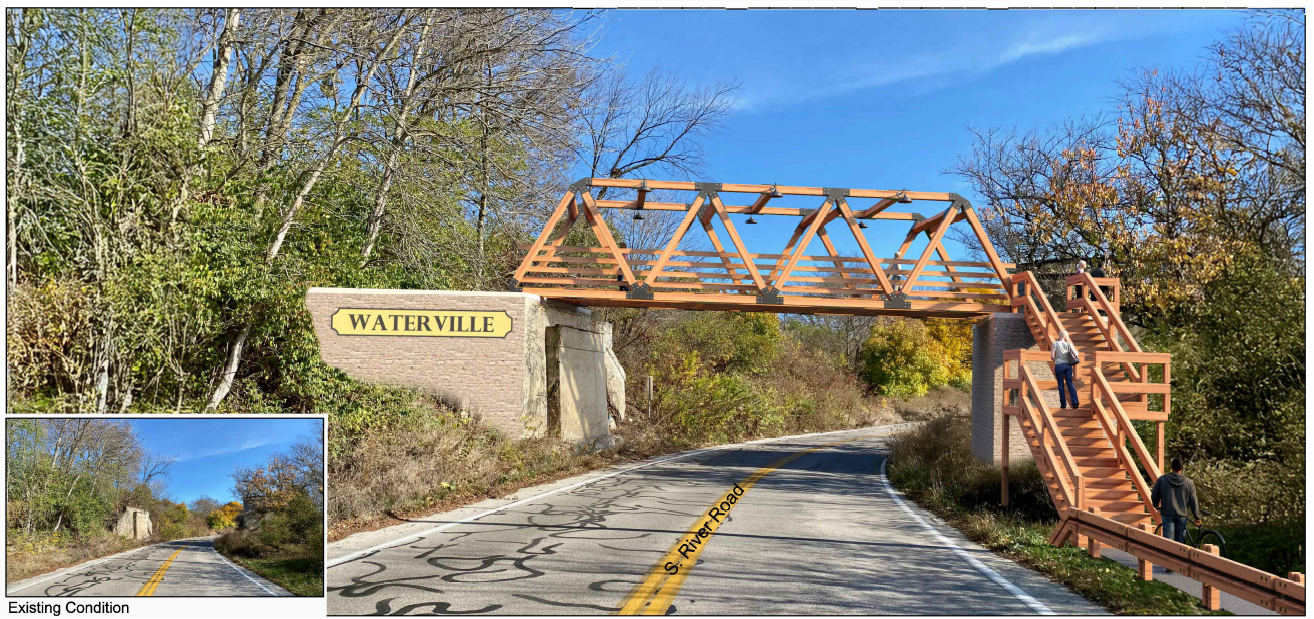
The city of Waterville obtained a grant to build a pedestrian walkway and overlook using two piers along South River Road. (Courtesy rendering)
Designed by Daniel Luten of Indianapolis, the 13-arch concrete bridge includes spandrels, arches and piers – including one that rests atop an outcrop of erosion-resistant limestone named “Rock of Beef” or “Buffalo Rock” by French traders. The rock was used as a meeting place by Native Americans prior to the 1794 Battle of Fallen Timbers. About a third of its mass was removed during construction in 1908.
Originally used as an interurban trolley line for the Ohio Electric Company, the bridge was abandoned in 1937, although used briefly for automotive traffic in the 1940s when the Waterville bridge was damaged and steel for repairs wasn’t available. In 1972, the bridge was placed on the National Register of Historic Places. It is a Registered Historic Place with the National Park Service and a state of Ohio Designated Historic Space.
In the years since, the bridge served as a party spot for teenagers, a backdrop for photos and paintings, and a place to explore when the river is low. With its impending designation as the Maumee River Water Trail, Waterville City Council began discussing concerns for the safety of boaters. Chunks of the bridge rest in the river, while others dangle from rebar. The city shared its concerns with ODOT in 2017. At the time, the bridge was thought to be owned by the city. Instead, it’s owned by the state.
Through engineering studies and core samples, those concerns were confirmed: the bridge was in dire shape. In 2019, ODOT presented multiple alternatives, ranging from complete rehabilitation (removing and replacing it) for $15 million, $3.9 million to save one arch, or $2.2 million to remove it. ODOT also tried to sell the bridge at an auction, but the potential buyers were unable to prove an ability to insure and secure the bridge.
“The bridge has continued to deteriorate over the years, including since the original feasibility study was performed, as evident by the common eye,” McColley said.
Simply placing signs underneath to divert water traffic will not alleviate the state’s liability to the Army Corps of Engineers or the safety of the public, which is why the bridge is slated for destruction, he said.
Weber, a retired engineer, said other ideas were not explored in full, such as securing the bridge using a technique involving carbon fiber reinforced polymer to keep the pieces in place. A $135,000 investment into testing the strength of the bridge and designing the mothballing process would be worth the effort to save a landmark, Weber said. He estimates that the work could be done for $1.7 million.
“The reference estimate was created by a private citizen, not a professional engineer, and ODOT has a very low level of confidence in the figures proposed in the estimate,” McColley responded, adding that ODOT looked at many alternatives, including mothballing.
One outcome of last year’s delay is that the city had time to apply for a grant for a pedestrian bridge and overlook using two abutments. Waterville received a $557,652 federal grant to cover 80 percent of the cost of the Roche de Boeuf Overlook and Shared Use Path Improvement Project, said City Administrator Jon Gochenour. Two of the existing bridge abutments – on the north and south sides of South River Road – will be used to create an overlook of the Maumee River and the Roche de Boeuf Island.
“The project will recognize the historical and cultural significance of the site to Native Americans and the historical development of the State of Ohio and the United States,” Gochenour said. “The site will be connected to the city’s existing shared use path system on the Anthony Wayne Trail and to the pedestrian path system of Farnsworth Metropark.”
While the project will save a portion of the Roche de Boeuf Bridge, the city still supports local efforts to save the entire bridge, Gochenour said.
STBA submitted its nomination for the bridge for Historic Civil Engineering National Landmark Status with the ASCE on Feb. 6. The bridge would be the first multi-arch concrete bridge to be recognized by the ASCE and the second oldest reinforced concrete arch bridge recognized by ASCE in the world.
“The interurban bridge was an engineering first it its day,” Weber said. “This bridge deserves a preservation plan – something we are fighting to make happen.”
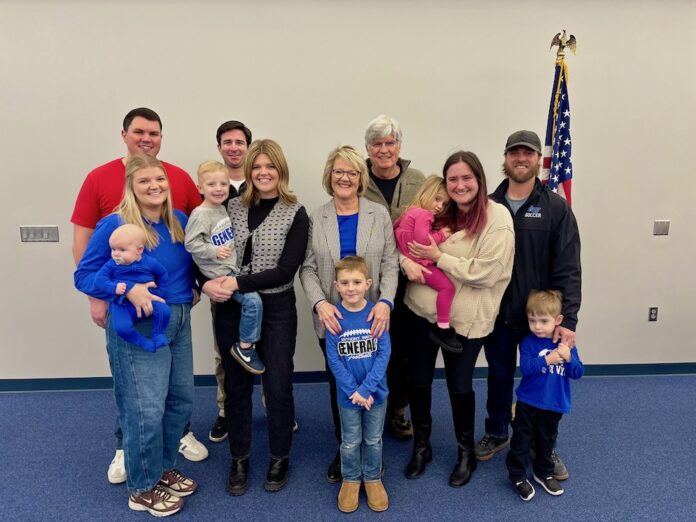
New board member Amy Barrett (center) was joined by her family prior to being sworn into office. (AWFP photo by Karen Gerhardinger)
Anthony Wayne Local Schools now has a new partner in supporting and promoting academic, artistic and athletic excellence.
Generals for Generations Foundation is a new 501c3 nonprofit organization designed to connect generations of Generals in support of those efforts, Foundation Board President Mike O’Shea told Anthony Wayne Board of Education during its Feb. 9 meeting.
“We don’t aim to maintain what already exists but to make it better,” O’Shea said.
In addition to serving as pastor at Waterville Community Church and raising three children in the district, O’Shea has served as a substitute teacher, bus driver, coach and member of a crisis response team during his 13 years of living in the district. It was during his experience as a member of the AW For Kids levy campaign in 2024 – one that failed by just a few votes – that O’Shea realized more needed to be done.
“It opened my eyes to the hard reality of school funding. If a district like Anthony Wayne wants to fund innovative programs to keep pace with evolving student needs, it will have to be done privately,” he said.
“It’s important to recognize that this is a private philanthropy that aims to have a strategic partnership with the school. It is neither beholden to the school board and district leadership, nor is it a rogue agency doing its own thing regardless of the school’s strategic plans. We hope that there is a great working relationship between the foundation and schools to identify innovative projects and programs, and then fund those privately,” he added.
O’Shea credits Superintendent Kevin Herman for having the vision to move forward with the foundation. In August 2025, a core group began working with Jenny Perin of Shift Consulting to prepare the framework for the foundation along with a system of fund development, alumni relations, communications, donor stewardship and donor recognition. Throughout last fall, representatives met with community members with a reputation for demonstrating pride and support of the district. These individuals will make an impact on the success of the foundation through volunteerism, philanthropy and strategic guidance.
“The purpose is to build a concentric circle, with a broader network of ambassadors,” O’Shea said.
In addition to O’Shea, the Generals for Generations board includes Angie Barney, Jen Harder, Tom Hertzfeld, Jason Hood, Shaunacy Miller, Andrew Nowicki, Lisa Schaller, Jon Schwanz, Jamie Smeltzer and Trey Tollstam.
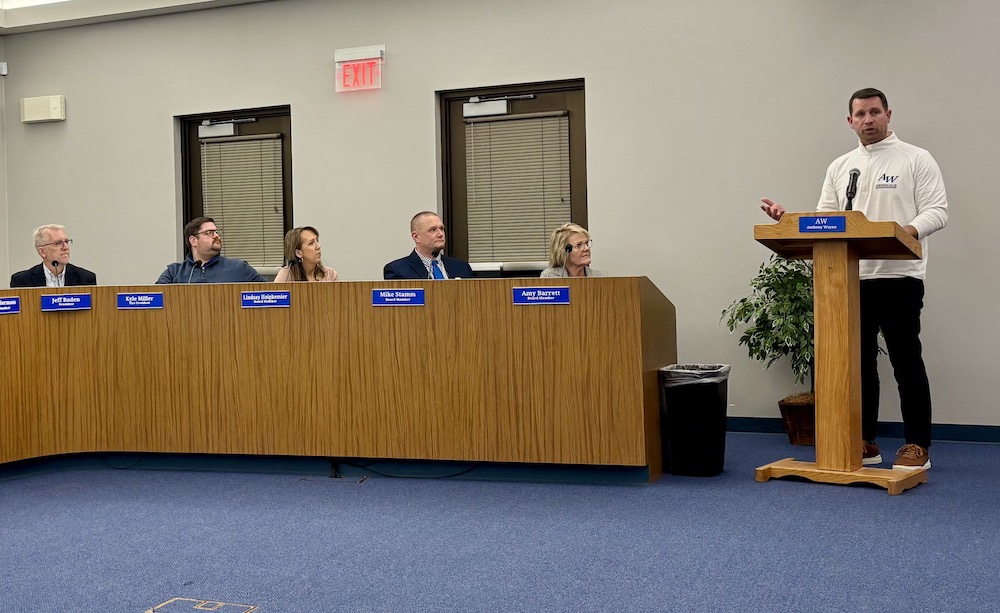
Mike O’Shea is the first president of the board of directors for the new Generals for Generations Foundation. He spoke to the board about the goals of the nonprofit organization. (AWFP photo by Karen Gerhardinger)
By the end of this year, the goal is to identify a flagship program that no other philanthropic organization in the AW area would be able to do, O’Shea said. Over the next three years, Generals for Generations should be ready to fund and execute that program.
In 50 years, O’Shea envisions Generals for Generations to have built up a $50 million to $75 million endowment that generates $3 million a year for innovative programs – all managed professionally be a day-to-day director and supervised by a board of trustees.
“It’s been an absolute joy working with Mike. His expertise in this area has helped us move the entire idea of a foundation forward,” Herman said. “The 10 individuals on this board have a lot of strengths and expertise in different areas. They are motivated. I’m very excited about the possibilities of where this foundation will be down the road. I’m thankful to Mike and the board for getting us to this spot.”
During the meeting, the board also:
-Welcomed new member Amy Barrett, who took the oath of office.
-Listened to an update on the financial forecast from Treasurer Kerri Johnson, who also outlined the potential impact of house bills on school finances.
-Approved overnight trips, including the varsity baseball team’s trip to Destin, Fla. and Fort Walton Beach, Fla. to participate in spring training on March 28; and the varsity softball team’s spring training trip to Orange Beach, Ala. March 29 through April 3. Costs will be paid for through fundraising. Students will travel with their families.
-Thanked retiring bus driver Barry Vincent and special education aide Shelly Bankey for their service. The board also approved the resignation of third grade teacher Lauren Dusseau at the end of the school year and the resignation of food service worker Melissa Pavlovic.
-Approved the early graduation of Donny Skiver with the class of 2026.
-Authorized Johnson to advertise for three 84-passenger school buses.
-Accepted the Ohio Attorney Generals Safety Grant of $17,109, which will be used to fund the high school’s facility dog, Jasper, and other school facility dogs in the district.
-Thanked high school teacher Bryan DeKay and his students for creating new 3-D printed name plates for the board members.
-Congratulated the high school dance and cheer teams for their winning Game Day routines. Dance took first place in the state competition while the cheerleading team won in the America’s Cup competition.
-Listened to residents Lyn Cox and Joe Ballmer speak about possible impacts of a data center on the school district’s finances. Both stated that any tax incentive offered by a data center developer might seem like a good deal but, in reality, would destroy property values in the district – thus driving down the district’s portion of property tax revenues, they said. Herman said that the district has not been approached by anyone proposing a payment in lieu of taxes (PILOT) agreement or any other incentive for a data center.
Fans get up close and personal with musicians at the 17th Annual Acoustics for Autism in 2025. (Courtesy photo by Toni with an eye)
MAUMEE – The 19th annual Acoustics for Autism event will be held on March 1, bringing the community together for a fun-filled day with music, family, friends and impact.
Acoustics for Autism is a free music festival in Uptown Maumee that is open to all ages. The festival was created to raise awareness for Project iAmto help provide resources, scholarships and opportunities for local families impacted by autism.
Nicole Khoury, organizer of Acoustics for Autism, performs with her band Arctic Clam in 2024. (Courtesy photo by Toni with an eye)
Nicole Khoury, the founder and executive director of Project iAm, said the organization was launched in 2008 and has been supporting families ever since.
“I saw a need for people in the area, families living with out-of-pocket expenses for autism spectrum disorders,” Khoury said. “We did a concert one time and raised about $10,000. 19 years later, we are still doing it.”
The festival contains local and regional musicians who perform across 10 stages. This year’s festival features a variety of bands, and live music will begin at 11:45 a.m. on select stages.
“There are 107 bands, such as Arctic Clam, The Skittle Bots, Distant Cousinz, The Grape Smugglers, Not Fast Enuff, Blitzen and The Beef Carvers,” Khoury said.
Jeff Stewart, one of the performers, said he has been with Acoustics for Autism since the beginning, and it means everything to be able to perform there.
“I love performing because I get to connect with people who haven’t seen me play in a while,” Stewart said. “It’s a beautiful day of the year.”
Festival goers may wonder how the event makes money if admission is free. Funds are raised from things like the silent auction that will go live Feb. 23, merchandise that people love year after year, beer sales, activities and raffles.
All event proceeds go towards families living with autism spectrum disorders. Khoury said all of the money raised goes into a scholarship fund as people apply and are granted scholarships, and over $1.3 million has been distributed since the organization started.
There are three different kid-centric areas for parents to choose from, and each area is filled with different activities tailored to the type of environment kids would prefer to be in. These areas either have a busy environment with other kids and music, a quiet environment with sensory-friendly activities, or a calm environment with crafts and light acoustic music.
“In the Maumee Indoor Theatre, we have a sensory family area for families that is first-come, first-served,” Khoury said. “Musicians will be doing a music therapy demo, and the movie ‘Trolls Band Together’ will be shown.”
To help with traffic, shuttles are being provided from three convenient locations. Shuttle pick-up and drop-off is being offered at the Hollywood Casino, Leroy and Margaret’s and the Anderson’s Old Lot.
The shuttle at the Hollywood Casino is free for festival goers, while the shuttle at Leroy and Margaret’s is free with a minimum $10 purchase inside, or $10 cash for a round-trip. The shuttle at Anderson’s Old Lot costs $5 cash for a round trip.
Stewart said Acoustics for Autism is a beautiful opportunity if people are looking to experience a community inititative, meet great people, and come across a lot of different food trucks and local businesses.
“I think now more than ever, community is important, and I think we’re all yearning for that,” Stewart said. “We’ve raised so much money for these kids, and at the end of the day, that’s the important thing.
Khoury said Acoustics for Autism is the only event of its kind, and a pure love fest where everyone has a good time. To learn more about Acoustics for Autism, visit acousticsforautism.com.
Changes are afoot in the Anthony Wayne area, and not just in Waterville or Whitehouse. The area’s four townships – Monclova, Providence, Swanton and Waterville – are welcoming new businesses and improvements over the next few years. Here’s a look at some of the projects under way.
Providence Township
Golfers of all abilities can play more than 2,000 courses from all over the world – from inside the soon-to-open Robertsims in downtown Neapolis.
Last fall, longtime township residents and Anthony Wayne graduates Scott and Beth Robertson were with friends, brainstorming “what ifs” for the former pizza shop at the corner of Main Street and Neapolis-Waterville Road. Pretty soon, someone suggested golf simulators.
“Our friends said, ‘Your family should do that – you’re a bunch of golf nuts,'” Scott said. “We talked about it … and saw an opportunity for a small family business.”
The Robertsons have six adult children – Joseph, Kitty, Jane, Ellie, Charlie and Ted – who all graduated from Anthony Wayne. Ted was a member of the General’s state-winning 2023 golf team. Charlie played in the state title-run in the two years prior. Both play for Lourdes University, and regularly use golf simulators to improve their game.
“We leaned on the boys’ knowledge. They see more simulation golf than I do,” said Scott.
The Roberstons teamed up with Carson and Wilson Bales of Clarity Golf, a Waterville-based company that installs simulators throughout the United States and abroad. The Bales will soon be installing the Uneekor EYE X02 with GSPro Software in the four bays where up to four players can convene to hit into a 10-foot by 15-foot screen.
“This a premium product,” Joseph said, noting that it uses three high-speed cameras for extensive ball and club data.
In the middle of the four bays will be tables and chairs so up to 24 golfers – such as those in leagues or parties – can gather and enjoy drinks, snacks and camaraderie. Although Robertsims will not operate a kitchen, it has a liquor license and will sell beverages in cans and bottles, along with snacks.
“Friendly is our biggest intention. We want to set ourselves apart, being a family-run business,” Beth said. “We want leagues, and we want it to be a ton of fun for the community. Anybody can do simulator golf. You don’t have to be a golfer.”
All six Robertson kids worked at White Pines Golf Course, where Ellie is a manager. The two entities are not affiliated, but will promote one another to customers.
“Because golfers are nuts and don’t want to stop when it gets cold…why not play in 70 degree indoor temperature all winter?” Scott said.
During warmer months, food trucks, picnic tables and outdoor games will be added outdoors to attract families or those who are taking a break from the Wabash Cannonball Trail that is just a putt away from Robertsims.
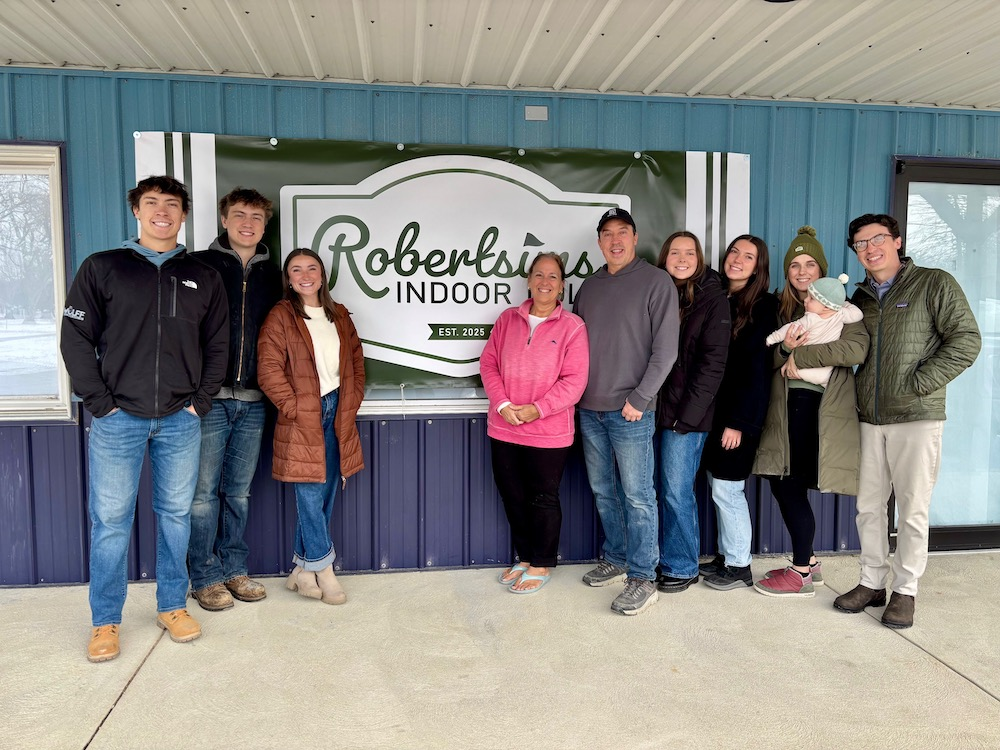
The Robertson family is set to open Robertsims – an indoor golf simulator facility – in Neapolis this spring. (AWFP photo by Karen Gerhardinger)
The Robertson family is set to open Robertsims – an indoor golf simulator facility – in Neapolis this spring.
Swanton Township
The Greens at Oak Openings – set on seven acres at the southwest corner of S.R. 295 and Airport Highway – will open this spring with a mini golf operation and a family-oriented restaurant.
Walking through the former Charlie’s Restaurant space last week, owner/operator Kevin Martin, his wife, Mandi, and their five children – Serafina, Jamey, Nolan, Griffin and Frankie – headed to the large “nest” in the party room. Soon other play areas will be set up, along with leather sofas and comfortable chairs where adults can relax and socialize while allowing children to play.
“We wanted to create a space where families can get together and mingle and play and not be at someone’s house,” Kevin said.
When finished, the main restaurant area will feature booths, houseplants and lots of sunlight, where patrons can enjoy food from Scorecard Eatery – with healthy options like salads and baked potatoes – as well as Jo-Jo’s Pizzeria, hard-dipped ice cream from Tee Time Treats and a cup of java from Revival Coffee Co. The restaurant will be open from 7 a.m. to 9 p.m.
The greens for the mini golf course are set up, and this spring, the Martins plan to landscape the area with plants, flowers, bushes and trees found in the greater Oak Openings region.
“We want to fully capture what the Oak Openings looks like,” Kevin said.
Owning a restaurant and golf course is not something that Kevin considered during his 10 years of working for his in-law’s company, Foundation Steel. But as the family watched Charlie’s close, an idea began to form on a way to serve the community, he said. The positive responses the family has received so far have been awesome, Kevin added.
A few more projects are planned for the remaining acreage around the restaurant and mini golf. For now, those are under wraps, he said.
The Martin family, including Kevin, Mandi and their children (from left) Jamey, Nolan, Serafina, Griffin and the youngest, Frankie, are excited to open the Greens at Oak Openings this spring. The operation includes The Nest – a restaurant with a play area for kids – as well as a mini golf operation. (AWFP photo by Karen Gerhardinger)
Superior Made RV Resort, at 4035 S. Berkey Southern Rd., will host its grand opening on Friday, June 12 at noon. Alicia and Nate Lawson, and their daughters, Shirley Roland and Arlinda Self, have been working to transform the former Big Sandy Campground into a destination resort, with 200 spaces for RVs – including 40 for overnight stays and 160 for seasonal campers – as well as rentable cabins.
Superior Made RV Resort is the first African American-owned RV resort in Ohio, and it answers a need that was stoked during the pandemic, when interest in camping spiked among those who had never thought about camping before.
“We’re full when it comes to seasonal sites,” said Alicia. “Of those seasonal site campers, 52 are occupied by African Americans and have never camped before – this is the first time stepping into a campground.”
After taking ownership last year, the Lawsons have repaved every street in the park, installed a new, larger playground, and cleaned up the campground. As the weather clears, work will continue on the beach area, with new sand, four large fire pits and seating areas, a stage for concerts, and lighting.
The Lawsons polled their seasonal campers on what to name the beach. The result: a sign with Harmony Beach will be posted when the area is complete. It’s an idea that reflects not just the music, but the ambience – a way to express that campers of multiple cultures can come together and relax, she said.
Next on the to-do list is renovating the office and the patio areas in preparation for a long-term goal of installing a new pool.
This AI-generated rendering shows an example of what the beach area of Superior Made RV Resort will look like when finished later this spring. (Courtesy rendering)
Oak Openings is the area’s largest Metropark, and much of it is within Swanton Township. A total of 428,000 visits were logged in the park last year, said spokesman Scott Carpenter.
This year, Oak Openings will have several improvements, including a new furnace and restroom upgrades in the Buehner Center; several footbridge and a Blue Trail boardwalk replacement; a hiking trail staircase replacement; berm improvements along Oak Openings Parkway; Evergreen Lake dam control improvements; and stone pull-off parking areas on Wilkins and Girdham roads. Last month, Swanton Township trustees removed more than 40 “no parking” signs that had been placed without authorization along a section of Girdham Road that is often used by those who appreciate the rare birds that fly through the area each spring.
Monclova Township
With a population of more than 16,000, Monclova Township is among the fastest-growing areas in Lucas County. And while most of that growth is around I-475 or in subdivisions, Monclova’s downtown has remained largely the same. That’s all about to change. The completion of a long-awaited sanitary sewer line along Monclova Road last year now opens up opportunities for commercial growth.
In a resident survey for the 2022 land use plan update, the creation of an “Olde Monclova” in the downtown area emerged as a top priority. Reveille Ltd., which led the plan update, provided renderings of what that might look like once a mini roundabout at Monclova and Waterville Monclova roads is completed this July.
Dave Kerscher‘s father, Duane, purchased just under three acres in downtown Monclova in the 1970s. Over the decades, he saw businesses close, the old Monclova school sit empty and the 1901 Monclova Country Church get moved to the Wolcott Heritage Center. In the late 1990s, a group of volunteers began renovating the old school into the community center, and, in 2005, the original post office that sat on the Kercher’s property was moved to the community center property and rebuilt, block by block.
“My dad’s vision was to someday bring the downtown Monclova area back to life with a commercial development that would offer services to the public, as he once remembered,” Kerscher said. “With the sewer line in and the roundabout going in this summer, the whole area will be finalized. I will bring some partners in to develop the land into a mixed use. I’d love to partner with Monclova Township, if they’re willing, to generate something special for the good of the township and its people. We’ll try to bring downtown Monclova back to life as it was decades ago. It’s been a long time coming back. “
The township owns a .15-acre parcel to the west of Kercher’s, and last year purchased an additional two acres to the west of that – commercially zoned land with an 1875 home next to Freeze Daddy’s. While Kerscher’s land is large enough for a mixed use development, he’s open to working with the township on designing something that’s tastefully done, with an old town feel.
In addition to a revitalized downtown, some of the other priorities outlined in the land use plan – which guides township decisions – include improved recreational opportunities, low-density housing and farmland preservation.
The township has invested into Keener Park over the past few years, including a sledding hill, walking path, and screening and lights for the much-used pickleball courts. Last year a gravel path was added to the front of the township administration building to connect Homecoming Park to Monclova Road. The township is also looking at other options for increasing connectivity with sidewalks and multi-use paths.
The Cannonball Prairie Metropark, located on Monclova Road between Weckerly and Eber, opened in 2020 and includes a walking path, prairie, a pond for boating and three campsites, along with a connection to the Wabash Cannonball North Fork Trail. The park had about 31,000 visits last year, said Carpenter.
Monclova sees consistent housing growth, with a total of 38 permits for new homes issued last year, said Zoning Administrator Eric Wagner, noting that some are on acreage parcels while others are in growing subdivisions like Stoney Creek, Rutherford and Stonegate. With 16 applications for housing permits so far this year, Wagner said he expects to see an increase for 2026. This includes villas on the southern two corners of Albon and US 20A, and homes in the new Maumee Western Estates, among others. Preliminary plans also call for a subdivision with acreage lots across from Otterbein on Black Road.
As a member of a small Monclova Township agricultural community, the newest trustee, Deborah Stevens-Laux, has seen the amount of available farmland shrink over the years. She notes that the Ryans, Ploceks, Plymales and Zwyers are among the farming families who remain, as the Scott family sold over 350 acres in 2024.
“We’d like to see farmland stay farmland, but it won’t stay that way forever. People also want to be able to sell their property. No one will judge anyone for sticking it out or for selling,” she said. “The same group of farmers are trying to make a living, and there’s only so much you can buy or lease.”
When she was running for trustee, Stevens-Laux said one of requests she heard most often was transparency – to make sure residents are informed of meeting times, agendas and minutes. The township is now offering more details on agendas posted at monclovatwp.org and is utilizing the MyMonclova app for sharing meeting information.
This summer, the township will see construction of four new roundabouts, including:
•Albon Road at Monclova Road, 45 days from April 13-June 6
•Monclova Road at Waterville-Monclova Road, 40 days from June 8 to July 18
•U.S. 20A at Albon, 60 days from Aug. 1 to Oct. 18
•U.S. 20A at Strayer, 60 days beginning Aug. 1
Since the U.S.20A interchange was opened last August, interest in available land around the corridor has greatly increased, Trustee Chuck Hoecherl said.
Some of the projects planned around the interchange and U.S. 20A include:
•A golf simulator at 3661 Briarfield Blvd.
•A Casey’s gas station and convenience store at the northeast corner of Briarfield and U.S. 20A.
•Two flex space rental commercial buildings on U.S.20A, just west of Strayer Rd.
•A 14-acre property at 0 Strayer Rd., south of U.S. 20A, is being eyed for an 83,050-square-foot warehouse building.
Other projects in the works:
•Yarder Manufacturing expects to move into its new 100,000-square-foot manufacturing facility on Riverfort Drive. Vice President Matt Yarder expects that other announcements for tenants of the new Legacy Business Park will be forthcoming.
• Redemption Church will build a 5,570-square foot fellowship hall on land that was recently purchased adjacent to their Salisbury Road property.
• Housing is planned for around the three hard corners of U.S. 20A and Albon – which are targeted for commercial. The northeast corner is being considered for a gas station and convenience store.
•Two new buildings are planned for Zero Gravity Trailer Sales at 10600 and 10611 Airport Highway.
•Tigon Golf Carts, 10420 Airport Highway, is expected to open in March. The company sells and services new and used carts, including street-legal, non-street-legal, and utility carts.
Waterville Township
This has been a busy year for Waterville Township Zoning Inspector Jim Fischer, who writes permits for homes, additions, accessory buildings, solar fields, fences, swimming pools and commercial buildings – in addition to following up on zoning complaints.
In 2025, he wrote 60 permits, including for 34 new homes. That’s up from 30 in 2024, 15 in 2023 and 6 in 2022.
By this time next year, the township will welcome at least 70 new 55-and-older residents, as construction is set to begin on the three-story Waterville Senior Lofts. The independent living apartment building represents a $21.5 million investment in the township, said Pivotal Senior Vice President of Development Pete Schwiegeraht.
Located off Waterville Monclova Road along U.S. 24, at 7830 Kay Drive, Waterville Senior Lofts will have one- and two-bedroom apartments, on-site management, a community room, fitness center, business center, outdoor picnic shelter and community gardens, he said.
“Construction will take about 13 months. We hope to have the building open in the first quarter of 2027,” Schwiegeraht said.
Like the nearby Whitehouse Square Senior Villages, Whitehouse Square Townhomes and Trailside Lofts in Maumee, the construction costs use state housing tax credits in order set rents at below market rate – at 80 percent of the area median income.
“There is very little access to reasonably-priced senior housing options in the Anthony Wayne area,” Schwiegeraht said. “This is an attractive area where seniors want to be – with good services and programming. We’re trying to serve the area with additional senior housing, to give them a product that allows them to age in place.”
The lofts will have a full-time manager and service technician and a part-time senior service coordinator to plan programs and events, including transportation to area stores and events. A new landing page, at pivotal-communities.com/properties/waterville-senior-lofts includes leasing information.
Construction will soon begin on a three-story, 70-unit Waterville Senior Lofts on Kay Drive in Waterville Township. (Courtesy rendering)
Just to the north, work on Fairway Village’s rental villas continues. And to the west, plans are underway for Walden, a single-family home subdivision that includes 71 homes in Waterville Township and 34 homes in Monclova Township – accessible off Dutch through Coventry Glen and off Stitt through Crimson Hollow.
Along Dutch Road, a self-storage facility is being constructed, and Geddis Paving and Excavating purchased the corner at Waterville Monclova Road, with plans to backfill the borrow pit.
To encourage business growth, the township is reactivating a dormant joint economic development district (JEDD) with Whitehouse, said Trustee Julie Theroux. With a JEDD, properties that agree to participate have an income tax collected from employees. Those funds are reinvested into the JEDD areas, which could include anywhere in the township. While the township cannot collect an income tax by law, a village or city can, and these partnerships are common in the area as a way to generate funds for infrastructure improvements in growing areas.
“It’s a win for property owners, the township and the village of Whitehouse,” Theroux said.
“We want to work jointly with our neighbors to bring in businesses and the kind of growth outlined in our land use plan. We haven’t seen the kind of commercial growth as other townships, but we know it’s coming, and we don’t want to be behind the eight ball.”
Once the areas of focus are outlined, Theroux said the JEDD members will work to attract businesses that residents want. A portion of the proceeds are used for improvements to further that business growth.
“This should be community driven and something that is a benefit to the whole township,” she said.
The JEDD could include areas along S.R, 64, Dutch Road, River Road and S.R. 295, but the 64 corridor is a priority, with a need for a long-term vision on how to handle increases in traffic. Theroux said she’d like to see the Lucas County Engineer, Ohio Department of Transportation and area municipalities work together to plan for the future.
“We need to look at what’s feasible. What I envision is a mixed commercial area with shops and restaurants, walking trails and a little sports facility.”
The township is currently updating its land use plan, which will serve as a guide to growth over the next 10 years. Trustee Toby Miller said that the township – with its available land and access to electric, gas and water – is attractive.
“There definitely is interest because of all those factors coming together. That’s why we’re revising our land use plan to make sure everybody has their input as far as how we want to zone and regulate these things,” Miller said. “What do we want to encourage or discourage, while maintaining the personality of the township and letting landowners do what they want with their land, within reason.”
Data centers have been at the forefront of discussions, and trustees in December imposed a 12-month moratorium to provide time for detailed research into potential impacts and how to regulate them. During the January meeting, trustees agreed to form an 8 to 10 member citizens committee to do a detailed study and make recommendations on what types of environmental and zoning regulations should be put into place.
“We have to live within the rules that the state and county put on us. I don’t think we have the legal authority to ban them outright, but we can absolutely put in all the things that we feel are requirements for us to consider,” Miller said.
In the coming year, Miller said trustees plan to analyze all their costs and look at ways to optimize every dollar. The November passage of a levy to raise $398,000 a year – beginning in 2027 – will help with sustaining the 24/7 police coverage and other services, but the township needs to continue working toward more sustainable income without another levy, he said.
TOLEDO- In November 2018, the CEO of Hope Toledo, John Jones, former mayor Wade Kapszukiewicz, and the Social Determinants of Health team at Promedica Hospital sought to improve the accessibility of education for Toledo youth. In meeting rooms full of caring teachers, administrators, and public officials, the problem wasn’t a lack of attention to the cause; it was a lack of organization.
John Jones, CEO of Hope Toledo. (Courtesy photo)
With the audacious goal of helping children from pre-kindergarten age to seniors in high school, Jones knew there needed to be a centralized organization where effort and funding could be allocated to each group.
“I went to my folks at Promedica and said, ‘Hey… Let’s get in the same room and let’s build something that we don’t see in the nation,’ said Jones.
And Hope Toledo was born, a nonprofit that ensures children’s access to education in the early years of their life, and an incentive to students who are looking to pursue post-secondary education.
One of these early incentives came via the Promise Scholarship Program—a full-tuition scholarship offered to the Start High School graduating classes of 2020, 2021, and 2022. Hope Toledo’s various partnerships funded this scholarship. However, with COVID-19 pausing higher education and the 2020 income tax levy failing to pass, Hope Toledo was forced to pivot their funding initiatives for both pre-kindergarten students and post-secondary students.
In the midst of this chaos, Promedica stepped in to support the pre-kindergarten side. However, the Promise Scholarship Fund could only be maintained until 2022.
“Even though the ballot measure didn’t pass, Promedica stepped up and said, ‘You know what? We want to see something fly here…’ They supported the first school year of pre-k classes with 10 providers, and we maintained that momentum to start the second year with 20 providers,” Jones stated.
Despite the financial hardships, Hope Toledo provided scholarships to 210 Start High School students and continues to provide pre-kindergarten education to approximately 1,100 students. In the 2025-2026 school year, Hope Toledo aims to provide education to an additional 500 children. While Hope Toledo has found success in their efforts, how can they stay afloat without more funding? Jones claims that they need help from the Toledo community to continue their work.
“No community — and I can say that, and I very rarely use absolute statements— no community does it at scale without public dollars. Private dollars, while wonderful, are just not enough to last in perpetuity, to fully fund the number of kids who need access to education. And that’s because of the cost,” Jones replied.
With the national average cost of pre-kindergarten in the U.S at $12,000 a year, Hope Toledo finds it difficult to find families who are willing to invest in their program. Although Hope Toledo provides income-based tuition assistance to families, the cost of living is too high for people to make the jump. How do you get families to invest in Hope Toledo, given that education seems unaffordable? According to Jones, you have to get people to understand that an investment in education at an early age is a long-term economic driver for the community.
“What Hope is trying to do over the last, particularly two years, I would say, almost three, is we’ve tried to change the narrative… I would much rather pay $15,000 now to support a community-wide effort to ensure children have access to early childhood education, which puts them on a positive trajectory. We as a community should want to pay $15,000 per kid as opposed to $60,000 to put them in juvenile detention.”
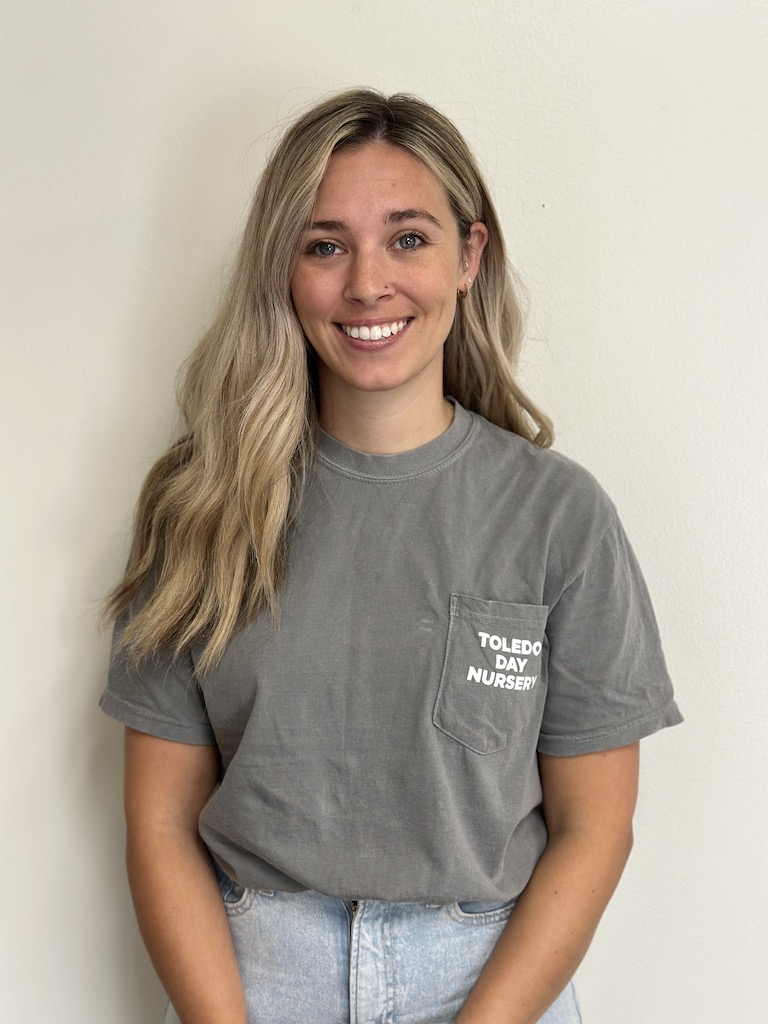
Julia Meyers, director of Toledo Day Nursery. (Courtesy photo)
Who they have helped:
Julia Myers, Co-Executive Director of Toledo Day Nursery, said that Hope Toledo’s impact on her work has been invaluable.
“Hope Toledo has facilitated the sharing of resources among providers, enabling us to access materials previously unavailable to some. This has been instrumental in our efforts to prioritize universal prekindergarten and emphasize its importance now more than ever. The state funding has been a hot topic, and the changes it has brought to our programs have posed challenges… Many providers are still struggling to navigate these changes. However, Hope Toledo has provided us with a platform where our voices can be heard.”
Camille Harris, owner of All 4 Kids LLC and All 4 Kids 2. (Courtesy photo)
Camille Harris, owner and operator of All 4 Kids LLC and All 4 Kids 2, notes that Hope Toledo has provided children with educational opportunities that were not available before their partnership.
“We now have better outreach to the community, and we have a better relationship with Toledo Public Schools. I struggled with that for nine years before Hope Toledo.”
However, Harris emphasizes that the community cannot stop advocating for more funding toward education.
“We need extra dollars from the county and the city to make this cohesive.” Read more about Hope Toledo’s mission here.
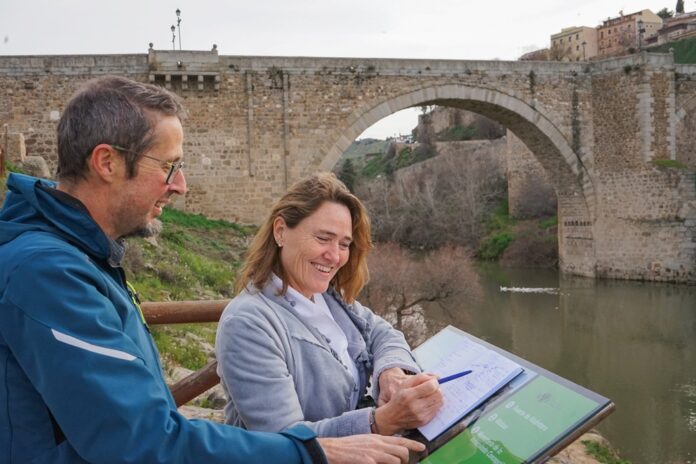
Raúl Urquiaga Cela, left, and Beatriz Larraz Iribas, both researchers at Tajo UCLM-SOLISS, discuss research plans on the edge of the historic downtown Toledo, Spain. (Toledo Free Press photo by Jake Zajkowski)
Two cities, continents apart, are both challenged with water quality — and how to govern it alongside farmers. In Toledo, Ohio, Lake Erie faces warmer temperatures, nutrient runoff from tributaries and harmful algal blooms. In its sister city, Toledo, Spain, the Tagus River suffers from downstream pollution from Madrid, low water flows and an uninhabitable river for citizens.
The relationship was formed in 1931 through Sister Cities International, the first partnership of its kind. Over the years, the cities have shared architectural influences, art exchanges and regional economies that are both driven by agribusiness. But a crisis in one city has accelerated research and solutions in many others.
A tribute of the sister city relationship hangs in the middle of downtown Toledo, Spain. (Toledo Free Press photo by Jake Zajkowski)
Northwest Ohio’s 2014 water crisis jumpstarted measurable change in Lake Erie’s health. Harmful algal blooms threaten drinking water supply, caused by urban and agricultural runoff of phosphorus, in addition to poorly regulated industrial polluters.
Beatriz Larraz Iribas is a research faculty member at the University of Castilla-La Mancha in Toledo, Spain and directs the Tagus River researcher group called Tajo UCLM-SOLISS. Compared to Lake Erie, their approach to protecting waterways is proactive.
“I don’t need fire in the river. I don’t need more dead fish to begin to solve the problem. It’s enough,” she said.
In Spain, a lack of water flow in the Tagus River is caused by diverting nearly half of its supply to an agricultural region in the south. Then, waste water dumping caused a bathing ban in the early 1970s and ecological wipeouts. Citizens lost access to their river.
Requiring water to irrigate and fertilizer to grow, farmers found a seat at the negotiation table offering economic counterbalances in a rush for environmental solutions. But both cities stand, still knowing long-term solutions to struggling water systems and ecosystem health have not been found.
Safe drinking water at the cost of the environment
The majority of drinking water in central Spain comes from the Sierra de Guadarrama Mountains, deposited into reservoirs called Entrepeñas and Buendía. Safe and accessible, the water supply supports the seven million residents of Madrid, who are closest to the reservoirs and cities like Toledo directly south.
But the management of wastewater reflects the same downstream consequences seen around the world. Madrid’s six wastewater treatment plants lack modern infrastructure, resulting in the discharge of polluted water into the Jarama River, a major tributary of the Tagus. Flowing north to south, the Jarama meets the Tagus, which runs east to west through Toledo before emptying into the Atlantic along Portugal’s coast.
Consistent cases of dead fish and year-round foam are attributed to ammonium levels 50 times higher than the permitted limit. Nitrates exceed their maximum permitted level 56 percent of the time, and phosphate concentrations reach 25 times higher than allowed, the research team said.
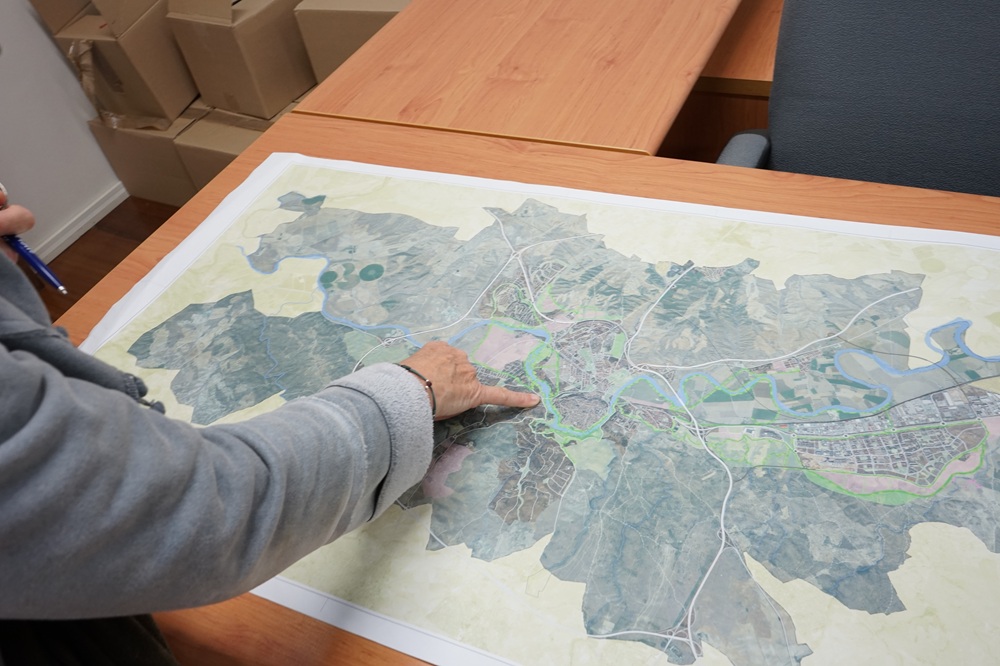
Left: Beatriz Larraz Iribas points to sites on the Tagus River where ecological transition is being tracked. Right: Foam develops on the shore of the river in Toledo, Spain. (TFP photo by Jake Zajkowski)
Although Canal Isabel II, Madrid’s public water company, has national mandates not to pollute, Larraz says, “They prefer not to invest in treatment plants and continue like that [pay endless penalties], and the governments permit it.” The Tagus River Basin Authority is in charge of such accountability.
Citizens were the first to notice the water dwindling, becoming more polluted. Warning signs were posted along the river that limited its use.
“It wasn’t activists, but it was people from the village,” Larraz said.
Safont Beach, an access point below the city of Toledo, Spain where Toledo Free Press interviewed the researchers, was once a regular bathing area. As water flow declined from Madrid to Toledo, authorities announced in 1972 that bathing in the river was prohibited due to health concerns. It wasn’t until 2009 that the Plataforma de Talavera de la Reina en Defensa del Tajo was formed, a civic group advocating against degradation and for increased river flow.
Later in 2012, researchers and watchdogs organized a research team led by Larraz to study the history, law, biology and chemistry of the Tagus River. Formed to create solutions and accountability for the deteriorating water system, the research team has grown to 40 members, following a 2021 partnership with the Soliss Foundation — a regional insurance company.
Their work now studies emergent pollutants in the Tagus River. One project Beatriz explained involves “comparing with the rest of the rivers in the world that have recovered the water quality.”
While researchers from the two Toledos haven’t worked together before, they are familiar with U.S. water issues, citing river fires in Cleveland — one of the origins of the Clean Water Act — in addition to algal blooms in Toledo, Ohio.
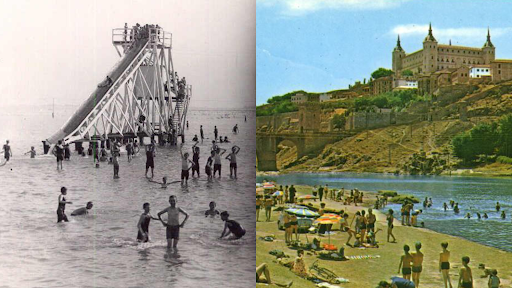
Left: Families swim at Toledo Beach in Temperance, Michigan 1923. (Toledo Lucas County Public Library) Right: Under Alcántara Bridge, locals bath in the Tagus River in 1965. (Photo by Luis Arribas).
For both cities, an early indicator of safe waterways was swimmability. What they share, like rivers across the world, are historical scenes of recreation rarely seen today. Regular swimming without concern occurred on the Maumee River and at the mouth of Lake Erie until about 1985, when the International Joint Commission designated it an Area of Concern due to contamination.
Agriculture and clean water trade-offs
The underlying cause of poor water quality in the Tagus River is the lack of flow. Hydroelectric dams slow the river’s natural east-to-west movement, and tributaries are diverted through a project more than a century in the making: the Tagus–Segura Water Transfer.
Producing one-quarter of Europe’s produce, southern Spain hosts one of the most concentrated, yet efficient, farming systems in the world. The region of Murcia supports outdoor, irrigated horticultural crops. In Almería, just east, low-tunnel greenhouses produce vegetables across 20 miles of plastic-covered land.
The Spanish state planned this water transfer in 1933, recognizing the region’s Mediterranean temperatures and sunlight perfect for produce growing. Construction finished in 1979, and the system — capable of transferring 158.5 billion gallons of water per year — became operational in 1991.
“This type of agriculture drinks whatever they want — no limits. They, without this water, couldn’t survive,” said Larraz. Water from the Entrepeñas and Buendía reservoirs is split, with nearly half sent to Murcia and Almería, and the rest flowing into tributaries and the Tagus River.
Exploitation rules limit how much water can be transferred. “In the national water plan it is said that the Tagus River has the priority to use the water before the water is transferred. But that law is not being followed. The farmers have a lot of power, because they are the ones that export to Europe,” she said.
Tomatoes grow in Southern Spain, amongst top crops like broccoli, lettuce, citrus and stone fruits. (TFP Photo by Jake Zajkowski)
Beatriz’s team consistently reexamines solutions outlined in international policy papers but says economic trade-offs continually obstruct problem-solving. Europe is generally self-sufficient in produce, dairy and wheat. Prioritizing a reliable food supply for Europe has overshadowed environmental policy and equity for cities like Toledo, Spain.
Parallel to U.S. policy, the Clean Water Act regulates point-source pollution, but nonpoint-source exemptions mean nutrient runoff, manure and pesticide applications fall outside federal authority — leaving local governments to develop solutions.
Regulating the watershed
What one city avoids, the other confronts. In northwest Ohio, state-led governance has helped curb runoff into the Maumee River and Lake Erie since Toledo’s 2014 drinking water crisis.
Under protocols set by the International Joint Commission between Ohio, Michigan and Canada, phosphorus reduction targets were established, though they are not always met.
Jordan Hoewischer, director of water quality and research for the Ohio Farm Bureau, said in a statement, “OFBF, along with the rest of the agricultural community, has gone above and beyond to help solve the water quality challenges of our state and has committed millions of dollars to water quality and nutrient management research, as well as providing strong support of Governor DeWine’s H2Ohio program, and those efforts at the farm level are making a difference downstream.”
Over the past 30 years, farmers have reduced fertilizer use by 33 percent, and 65 percent of Ohio counties have recorded phosphorus declines through soil testing, according to OFBF. Acknowledging agriculture’s role in runoff alongside climate factors such as rainfall and warming lake temperatures, Ohio launched H2Ohio, investing $270 million in wetlands and conservation practices.
H2Ohio has 2.5 million acres enrolled across Ohio, supporting conservation agriculture in grain crops. (TFP Photo by Jake Zajkowski)
Participation in land management reforms remains voluntary in both Ohio and the European Union — an approach often criticized for uneven results. After seven years of H2Ohio subsidies, lawmakers continue to debate whether improvements in Lake Erie can be directly attributed to wetlands or on-farm practices. While environmental obligations persist, the urgency that followed the 2014 crisis has faded, and a long-term water bill has stalled repeatedly.
Globally, agriculture exerts outsized political influence — not due to population size, but because of its role in gross domestic product and food security.
In Spain, progress has been slower. Larraz said outreach to policymakers has fallen flat. “We speak with the politicians here in Castilla, Almanza and with the water authority in Spain or in the towers river, but they don’t listen.”
Under the EU Water Framework Directive, rivers must reach good ecological status by 2027. “This directive has a date, a final day to be in good status. And we are not going to obtain that,” said Raúl Urquiaga Cela, a researcher at Tajo Chair UCLM-SOLISS.
Environmental groups have succeeded in securing a minimum flow requirement for the Tagus River — previously the only major Iberian river without one. The decision sparked protests from farmers who argue drought conditions could threaten their livelihoods. AP News reportedLucas Jiménez, president of the Central Irrigation Union, telling a crowd, “Let them leave the water in the hands of those who understand water.” Spain’s minister of ecological transition warned the 2023 protests not to escalate into a “water war.”
Science alone has not shaped the policies around water, as Toledo, Spain advocates and scientists explain. But the political will, enforcement and governments’ willingness to confront the agricultural and economic forces will define watersheds.
Art Weber is the nature photographer for Metroparks Toledo.
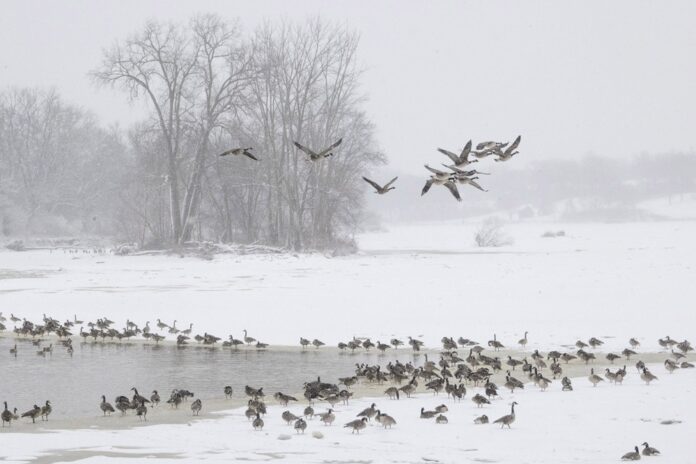
Canada geese are amazingly well-adapted for surviving our winters – provided they can find the open waters that they require for protection from predators, for preening to keep plumage clean for maximum insulation, for feeding in the shallows on underwater vegetation, and because, as cold as it might be, open water is warmer than bitter cold air.
Open water is at a premium these days, but it still can be found along the lake and bay at power plant discharges, for example, and in a few places along our waterways. One of those places is in the Maumee River at Side Cut Metropark where moving water, combined with geese movements, keep small areas open even in the deepest of winter. Find an open patch and watch geese working together, constantly moving in circles to keep the surface water from forming ice.
This property at 7010 Finzel Rd. is one of two Waterville Township properties whose owners petitioned the village to annex. (AWFP photo by Karen Gerhardinger)
Monclova Township is moving forward with fire department renovations. Whitehouse and Waterville Township leaders discuss petitions for annexation. Providence Township trustees consider opening up to additional public comments. These are a few of the highlights from meetings held in the Anthony Wayne area during the first week of February. Visit anthonywaynefreepress.com for the latest news.
Monclova
The men and women who staff Monclova Township Fire & Rescue will have more locker and sleeping space, as well as an updated kitchen, once renovations to the Albon Road fire station are complete.
During the Feb. 2 meeting, Monclova Township trustees approved a contract with JDI Group to renovate the fire station, including using an existing training room for dorms, installing a mezzanine in the vehicle bay for a workout room and storage, and adding a building behind the station for storage and training, said Fire Chief Matt Homik. With the increasing number of women serving as firefighters, EMTs and paramedics, separate dorms and lockers are needed, Homik added.
The current facility was built in 2001 and linked two older, existing buildings together, Homik said, pointing out the slope in a hall that was a compromise to deal with a change in elevation.
A separate contractor will be hired to do the work once JDI comes up with the plans, which will include how to maintain safety operations during construction, Homik said.
During the meeting, the trustees also:
-Listened to Fiscal Officer Gavin Pike explain the year-end financials and the basics of government accounting. All of the financials are available on the state auditor’s Ohio Open Checkbook site here.
-Passed a resolution opposing the execution of nondisclosure agreements (NDAs) with data center developers. Law Director Dawn Sanderson said trustees have not signed any NDAs during her long tenure, but the resolution is an effort to assuage the public’s concern about them.
“Trustees cannot use an NDA to avoid or circumvent Ohio Sunshine Laws,” Sanderson said, noting that some matters – such as personnel or health – are exceptions to those laws.
The trustees said they have not been asked to sign any NDAs, nor have they received any requests from data center developers.
-Asked Zoning Administrator Eric Wagner to begin changing the zoning resolution that outlines the notification process for zoning change requests. The Ohio Revised Code was changed in 2025 to allow townships to utilize their website and social media instead of a local newspaper. The township will also post a sign at the property that is being considered for rezoning. This will not change the process of a zoning change, which requires a total of three public hearings that include the county, the township zoning commission and the trustees.
-Agreed to move forward with a change that would specify permitted uses in the Monclova-Maumee-Toledo Joint Economic Development Zone (MMT-JEDZ) to those that bring in and create jobs.
“The reason for the creation of the JEDZ was to create economic development and jobs. There’s been some entities that have been interested in coming into the JEDZ area that have had a lack of employment creation and income production. We want to eliminate low- or no-impact use and bring in businesses that are going to create the development and jobs that we want. We want language that will detail better direction to our zoning boards,” Sanderson said.
-Agreed to update the personnel handbook to expand disciplinary actions for the misconduct of an employee even when not on the job.
“Because our employees represent the township, we don’t want to bring a bad reputation to the township,” Sanderson said.
-Reappointed Michelle Hudson Ross to another 5-year term on the Board of Zoning Appeals, ending Feb. 21, 2031.
–Agreed that Swanton Township Trustee Matt Beil should represent both Monclova and Swanton Township on the Toledo Express Airport Joint Economic Development District (TEA-JEDD), filling in the remainder of former Swanton Township Trustee Jeff Michael‘s unexpired term on the JEDD board.
-Heard an update on the Toledo Metropolitan Area Council of Governments (TMACOG) winter general assembly from Trustee Chuck Hoecherl. The entity is now renamed the Lake Erie West Regional Council. The members discussed possible impacts if a statewide initiative to eliminate property taxes passes in November. Hoecherl said that 50 percent of the township’s funds come from property tax, and eliminating those funds would strain the township’s ability to provide services including police, fire and roads, as well as infrastructure projects.
“The state hasn’t figure out a way yet to replace that [property tax income]. If it passes, it will take a year to figure out how to fill a 50 percent hole,” Hoecherl said.
Information from Lake Erie West Regional Council on house bills, including the proposed property tax elimination, data centers, cannabis, cybersecurity and other issues is posted here.
-Listened to Waterside residents Risa Sindel, Diane Stroshine and Linda Posodny speak about their concerns about a possible data center and ask for a moratorium to be put in place.
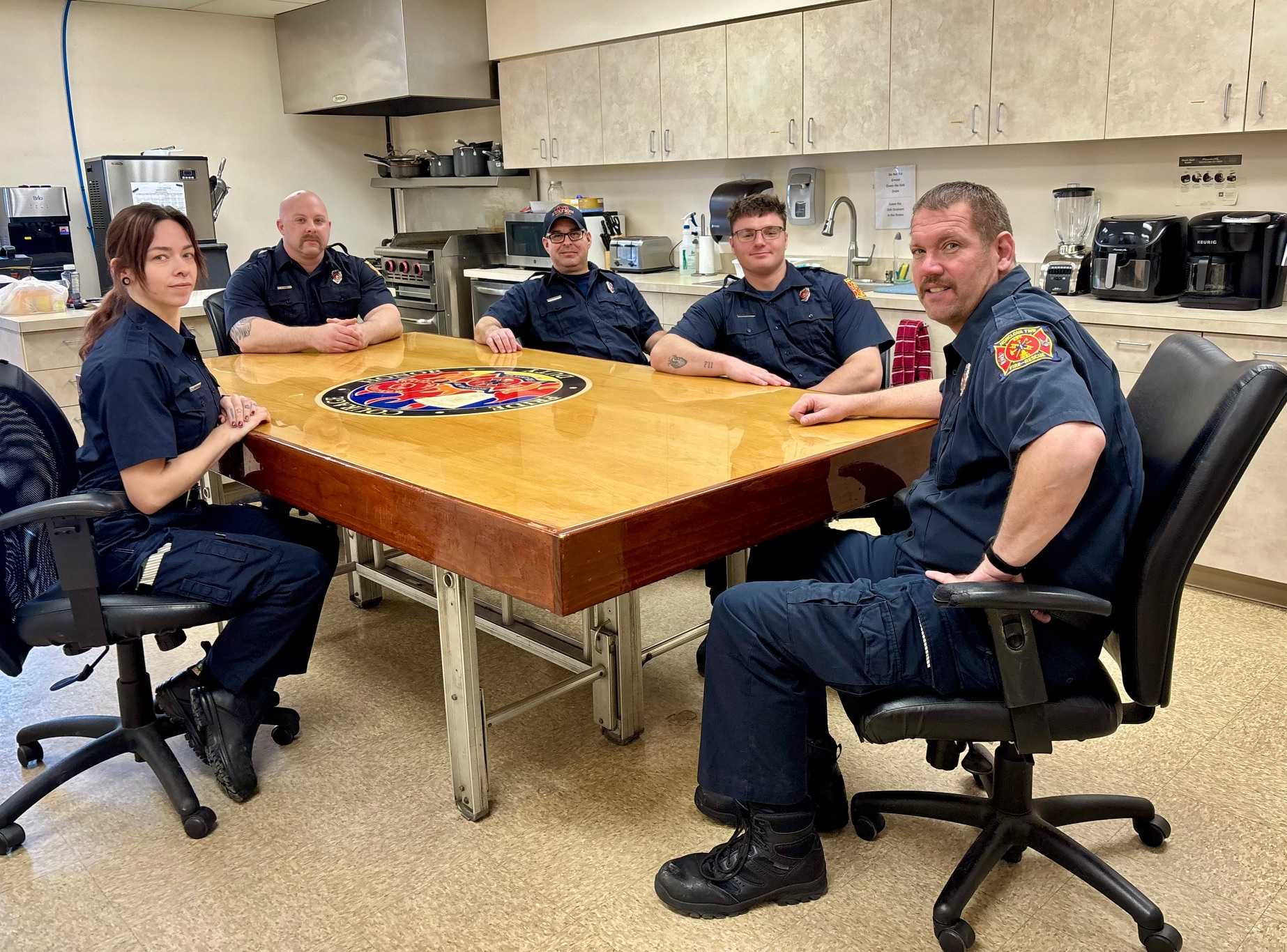
Monclova Township Fire & Rescue personnel (from left) Tracy Robertson, Mike Harris, Josh Stagner, Blake Reed and Bill Schultz sit in the kitchen of the fire station, which will undergo extensive renovations to provide more space for sleeping quarters, locker rooms and an upgraded kitchen. (AWFP photo by Karen Gerhardinger)
Whitehouse
The proposed annexation of two Waterville Township properties into Whitehouse has township residents raising concerns.
In late December, the village received two petitions for annexation. One is for a two-acre parcel at 7010 Finzel Rd., owned by RF Assets LLC, represented by Josh Doyle. Is is empty except for two older outbuildings, since a home was razed in 2018. The other petition is for a home owned by Amanda and Travis Ratcliff on 2.18 acres at the northeast corner of Winslow and Whitehouse Spencer Road.
During the Feb. 3 Whitehouse Village Council meeting, former Township Trustee Brett Warner and newly-elected Trustee Toby Miller noted that if council were to accept the annexation agreements, they would be defying a 2006 annexation agreement between the village and township – as the two parcels are in what was then defined as a “non-annexation area.”
Warner shared how, in the early 2000s – after the village annexed several properties – there were many “angry disputes” between the two municipalities. So he and then-mayor Stan Wielinski sat down and hammered out an agreement with a map showing specific areas where annexation should not occur. The township made many concessions in an effort to make that agreement work, he added.
“It was something we saw of as the future for the two entities. It allowed us to work together on fire (services), and continue to give us working relations,” Warner told Council. “And now it’s come to my attention that there’s a possibility that the agreement is going to be ignored. I would greatly appreciate that the annexation agreement be honored.”
Trustee Miller, pointing to a red-shaded portion on a map from the annexation agreement, said the village has a “duty and obligation to deny the application.” A Columbus law firm agrees that the two properties cannot be annexed, he said, and he accused the village of other areas in the non-annexation area over the past several years.
At least three Finzel Road residents attended the meeting, including Ryann Miller. He’s concerned that an annexation would lead to water and sewer lines being extended, and property owners being required to tap in – even if they’ve invested thousands of dollars into septic systems or wells.
Whitehouse Law Director Kevin Heban, Mayor Rich Bingham and several council members pointed out that the village did not solicit the petitions for annexation – that it was the property owners who applied, most likely because they want to get lower rates on utilities. On the flip side, those property owners would also need to pay a 1.5 percent income tax rate.
“We are not pursuing Waterville Township properties. We received a request from the property owners. By law, we’re required to hear the petition,” said Council Member Dave Riggenbach.
When the village receives a request, it first goes to the Lucas County Commissioners, then back to the village, which had until Feb. 5 to meet a 30-day deadline to send the petitions back to the county.
According to the Ohio Revised Code, if the petitions meet the statutory requirements, the village “shall” or “must” approve it and send it back to the county, Heban said.
“In looking at the petitions, they all meet the statutory requirements. If you choose not to approve it and send it back to the county, we are subject to a possible lawsuit and liability because they meet the requirements,” Heban said. “At this juncture, our opinion is that because they meet the statutory agreements you have no option but to approve.”
But, Heban added, that doesn’t mean the annexation has to go through. Even though Council voted 5-1 (with Carrie Tuohy voting no) to approve ordinances on the two annexations, as well as two resolutions stipulating the village would provide services to those properties if the annexation proceeds, Council has one more chance to vote for or against the annexation.
Once the county reviews the petitions again, they will be sent back to the village for final approval. According to Ohio Revised Code, the village at that point “may” approve the annexation, Heban said quoting the code. The word “may” gives the village flexibility to turn them down.
Before the vote was taken, Council agreed to enter into mediation with the township. Miller said he wants to be able to work together without lawyers, as that will cost money.
Mayor Bingham and several council members reiterated their wish to maintain a good relationship with the township.
“We do want to work together. We’re following a process that wasn’t our choice,” said Council President Steve Fine. “We are looking forward to talking to Waterville Township and hope we can continue to work together.”
During the meeting, council also:
• Listened to Bingham’s state of the village address, which is available here.
•Heard that a Coffee With the Mayor and Council will be held on Saturday, March 14 from 8:30 to 10 a.m. at the Buzz Diner, 6670 Providence St. The annual Easter Egg Hunt will be held on Saturday, March 21 at 11 a.m. at the Whitehouse American Legion, 6910 Providence St.
•Learned that a new Tree Commission member is being sought.
•Authorized Administrator Jordan Daugherty to apply for an Ohio Department of Natural Resources grant to install a multi-use path between the Wabash Cannonball Trail near the cell phone tower to Blue Creek Metropark, in order to keep e-bikes out of Whitehouse Park for safety purposes.
•Authorized Daugherty to seek bids for repaving Cemetery Road between the bike trail and Weckerly.
•Congratulated Nicholas Rupp for achieving his EMT certification.
•Learned that Officer Devin Lafferty will be leaving the police department – and the profession – to go back into the private sector. Chief Allan Baer said he’ll be seeking an officer to fill the full-time position.
(AWFP photo by Karen Gerhardinger)
Providence Township
Providence Township trustees are considering the placement of public comments on their meeting agendas.
During the Feb. 4 meeting, Manore Road resident Billy Goetz asked trustees to open up comments at the end of the meeting, after business has been discussed, rather than at the beginning of the meeting.
“We used to have it at the end of the meeting, and people didn’t like it,” said Trustee Steve Kendall, explaining that some residents wanted to make comments without having to sit through the entire meeting. “So that’s why we moved it up.”
Goetz sought information on the county’s plans to repave Manore Road, including the width and drainage tile. He also wanted to comment on bids being sought for replacing the electrical on the township’s diesel pump.
While the trustees agreed to allow public comment at the end of the Feb. 4 meeting, Kendall said they would need to discuss the option of moving comments to the end of the agenda.
“We’ve always had public comment, even though the state doesn’t require it,” Kendall said. “A lot of entities don’t.”
According to Lucas County Assistant Prosecuting Attorney John Borell, Ohio courts have held that the public has a right to attend public meetings but not participate.
“Comments by the public during a meeting are not legally required,” Borell said.
Jim Fischer, the zoning inspector for both Providence and Waterville townships, noted that Waterville Township only recently re-opened meetings to public comment after dozens of citizens came to ask about data centers. For over four years, public comments were not welcome in Waterville Township.
Trustee Jeremiah Floyd suggested offering two public comment sessions, at the beginning and the end of the meeting, just as offered by the village of Whitehouse.
The trustees agreed to revisit the topic during the Wednesday, Feb. 18 meeting and make a decision at that point.
During the meeting, the trustees also:
-Heard the at the Lucas County building regulations’ chief building official, David Golis, issued a stop work order on work that AE Electric did to wire a fuel pump next to the salt shed. The work was done without a permit. Plans for the work need to include a stamped engineer’s drawing. Trustees asked Road Superintendent Kevin Keifer to seek quotes from three contractors – ones that would provide a stamped engineer’s drawing. He brought quotes from Lake Erie Electric and GLIC Electrical during the last meeting, but didn’t ask for an engineer’s stamp to be included in the work listed in the quotes.
-Listened to Fischer say that he received a call from the Lucas County Health Department regarding the condition of a Meredith Street home in Neapolis. The property is in the non-zoned area of the township, and Fischer is limited in what he can do. A few years ago, the township filed an official complaint with the department, which declared the home unlivable. “It’s been in their court for a couple years. We were waiting for them to take care of it,” Kendall said.
-Heard that the Ohio Department of Transportation has certified that the township has 44.21 miles of roads.
-Discussed the impact on the township in the event that voters approve eliminating property taxes. While the township has a fire levy to cover fire and EMS expenses, property taxes help fund road improvements and other expenses.
-Agreed to postpone voting on a proposal to increase firefighter pay, citing concerns about big expenses on this year’s fire department budget and possible cuts in property tax funding.
-Spoke about the repaving of Manore Road. Because funds from the county are being used, the township needs to accept the county’s plans, which do not include widening the road. Goetz commented that, by not widening the road, the berm will deteriorate quickly as drivers get off the road to let other vehicles pass.
-Agreed to not ask for a hearing for a liquor license request by Robertsims, a new golf simulator facility opening this spring in Neapolis.