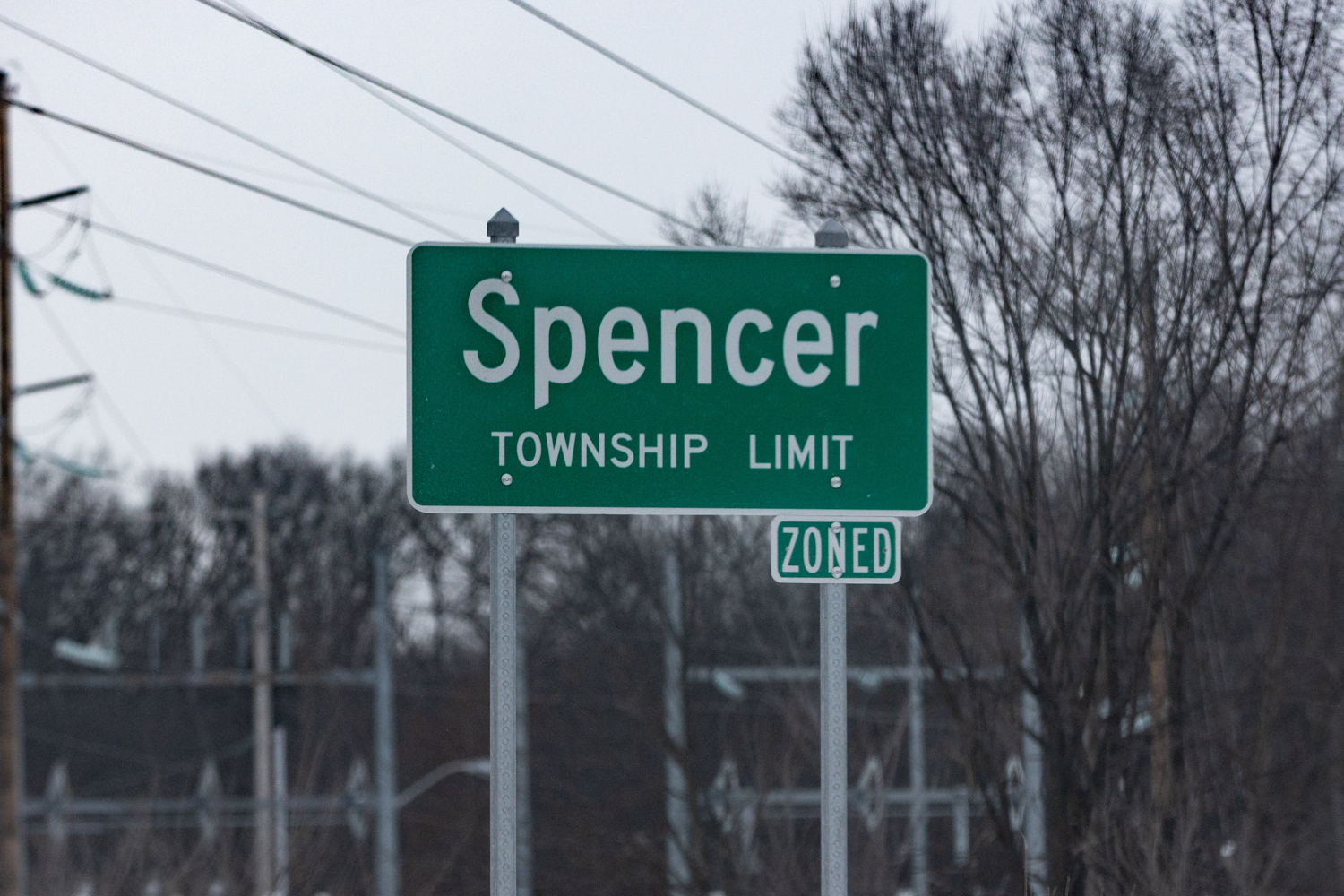
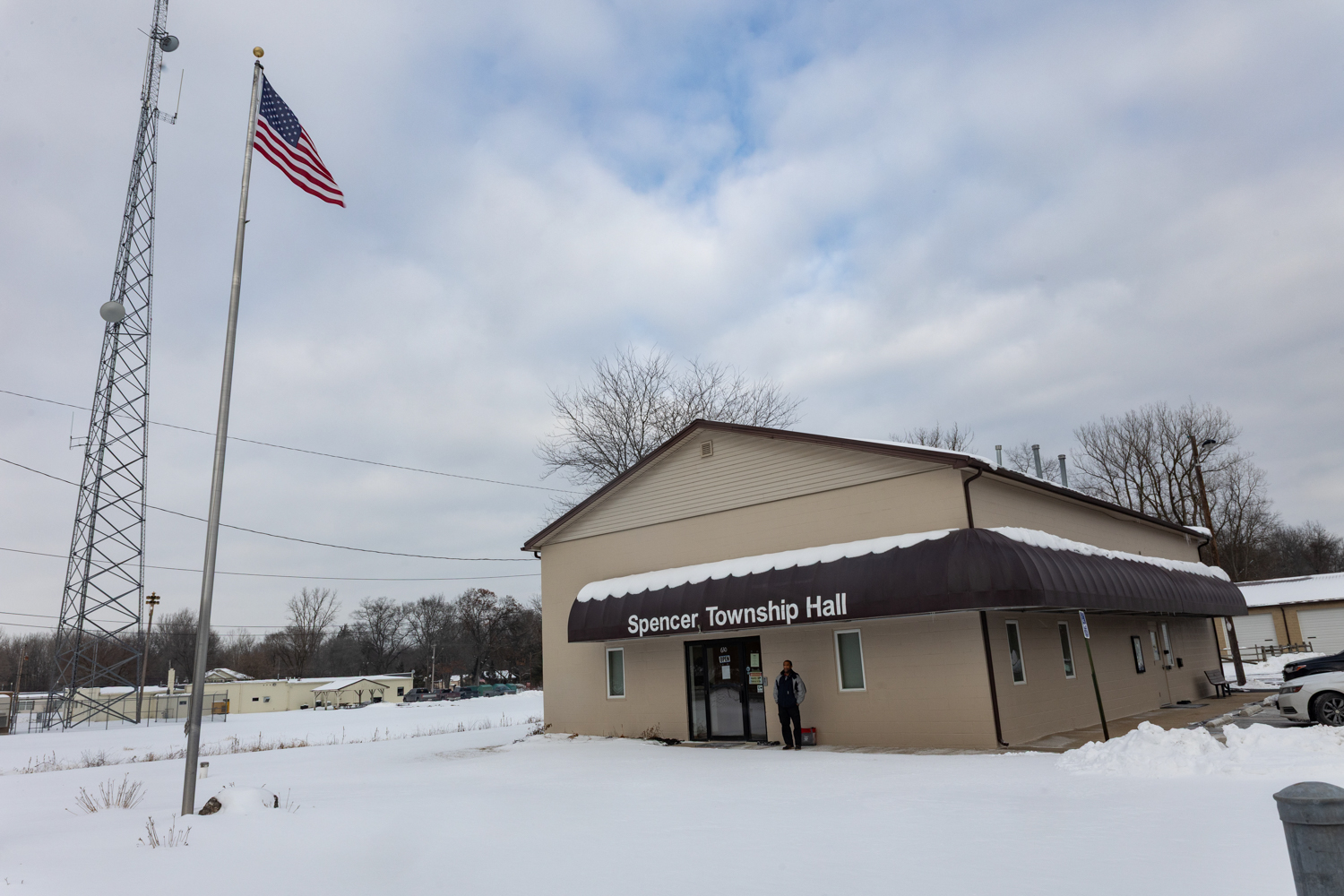
Spencer Township is listed on heavy equipment the township was able to purchase for its upkeep. (TFP photo by Stephen Zenner)
A look at the township’s past, present and future
SPENCER TOWNSHIP – Located in Lucas County lies Spencer Township, a rural community that has been around since the 1800s, though many people might not know much about its history or how it came to be.
Spencer Township is located in the central western part of Lucas County, bounded by Richfield Township, Springfield, Monclova and Swanton. The population remains fairly consistent, holding steady at about 1,800 people.
Some of the first settlers in the township were Germans who arrived between 1832 and 1835 when many immigrants were headed toward Michigan. Spencer Township was part of the territory claimed by Michigan until it was founded by the Lucas County Commissioners in 1845.
Jacky Dale, the interim director of the Spencer Township Neighborhood Center, said she has lived in the community for 25 years.
“It’s passionate, it’s diverse, and most of the people are very pleasant and welcoming, so it’s always nice,” Dale said.
Michael Hood, the nine time township trustee for Spencer Township, speaks with the Toledo Free Press at the Spencer Township Town Hall in Spencer Township, Ohio on Wednesday January 28, 2026. (TFP photo by Stephen Zenner)
Michael B. Hood, a Spencer Township trustee, says he has been a part of the community his entire life.
“When I was coming along back in the 1960s, 63 percent of the community was African American,” said Hood. “A lot of the people who came here settled from the South. My parents came here from Mississippi and settled here, and they liked this area [as] opposed to being in the city, because it reminded them of being in the South.”
Hood has been a township trustee since 1986 and is currently in his ninth term. He’s successfully been reelected nine out of 11 times and has remained in office since 2010.
“When I started, we only had one full-time employee who worked here,” he said. “Now we have administrative staff, the trustees and the fiscal officer – a total of five employees.”
Before he was a township trustee, Hood said he always considered himself active in the community.
“I was active in the community and volunteering, and I’ve always had a hand in dealing with young people and youth,” he said. “So I just saw that as a natural progression to move from that to becoming more involved and concerned with community issues overall.”
Spencer Township a rural community that has been around since the 1800s. (TFP photo by Stephen Zenner)
As community involvement in the township grew, so did their awareness of the challenges they face today.
One of the biggest challenges the township faces today is being unknown. While it has always been part of Lucas County, the township has often been overlooked as its own community.
The township has taken certain steps to make its presence known, such as putting up a sign, developing a website, and installing an electronic display board to advertise any meetings or functions in the community.
“We weren’t even on the older maps; we were just considered another part of western Lucas County,” Hood said. “We just erected a sign, probably four or five years ago, to intentionally let people know that we’re here because a lot of people thought we were a part of Springfield.”
Dale said not having the convenience of stores close by has been a challenge in the community.
“Just not having access to the fresh produce or even a local gas station, you’re five miles away from the closest store, and we don’t have public transportation,” Dale said. “The resources are quite small as far as that goes, and that’s why we started our ‘share table’ where people can donate canned goods and stuff like that.”
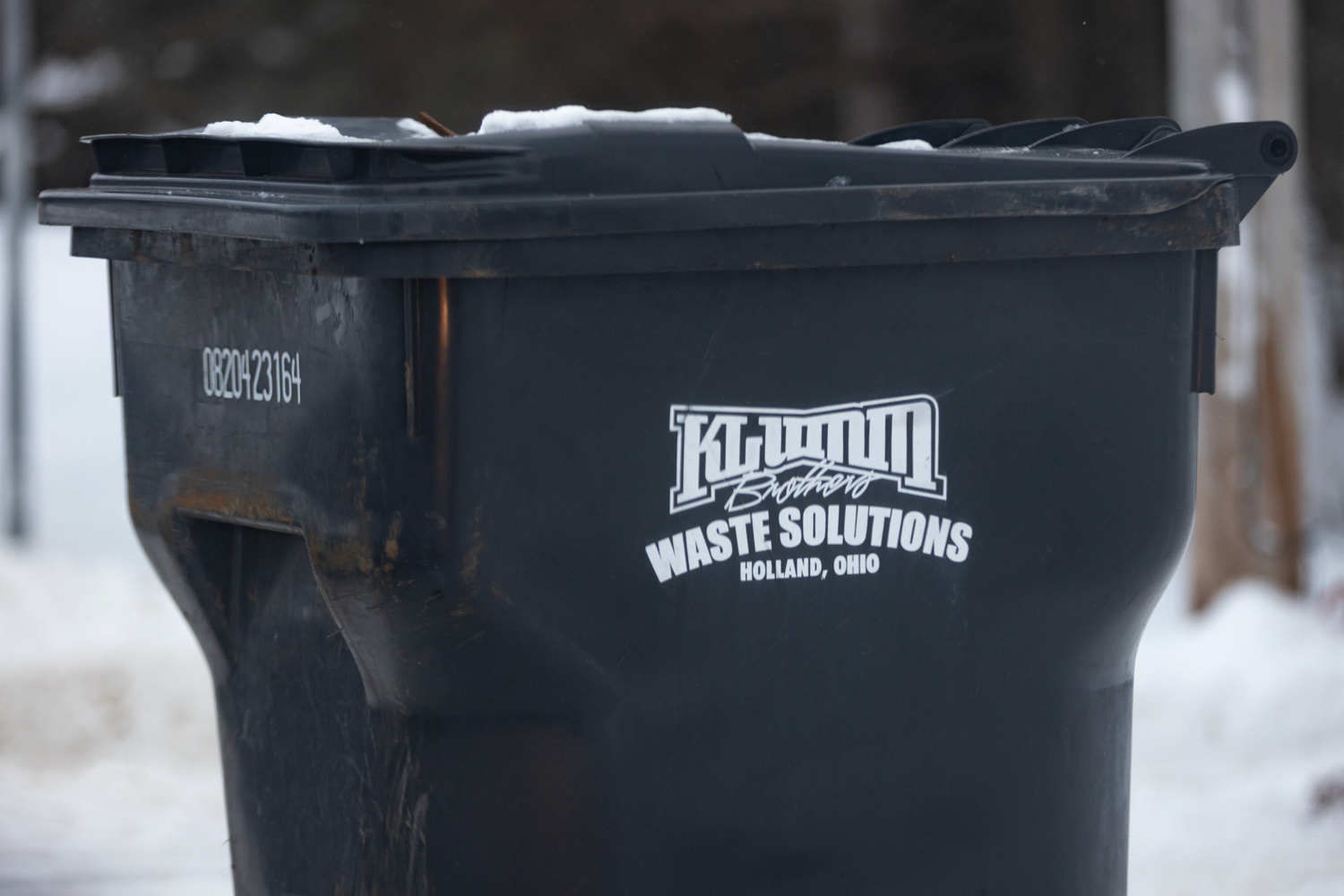
Spencer Township contracts with their own waste solutions, the local Klumm Brothers business out of Holland, Ohio. (TFP photo by Stephen Zenner)
The township once had a variety of shops in the 1970s, such as a laundromat, drive-in theater and auto shops. But during a period of urban renewal, or “urban removal,” as they call it, that began to disappear, and the community lost the little industry they did have.
According to Hood, the former Spencer-Sharples Local School District faced decreasing enrollment and a shrinking tax base, leading to its closing and consolidation with Toledo Public Schools by 1980. As a result, Spencer Township has been merged with Toledo Public Schools for the last 45 years.
Hood said the township is exploring the options of implementing its own school system, noting that kids in the township have to travel through two school districts just to get to school.
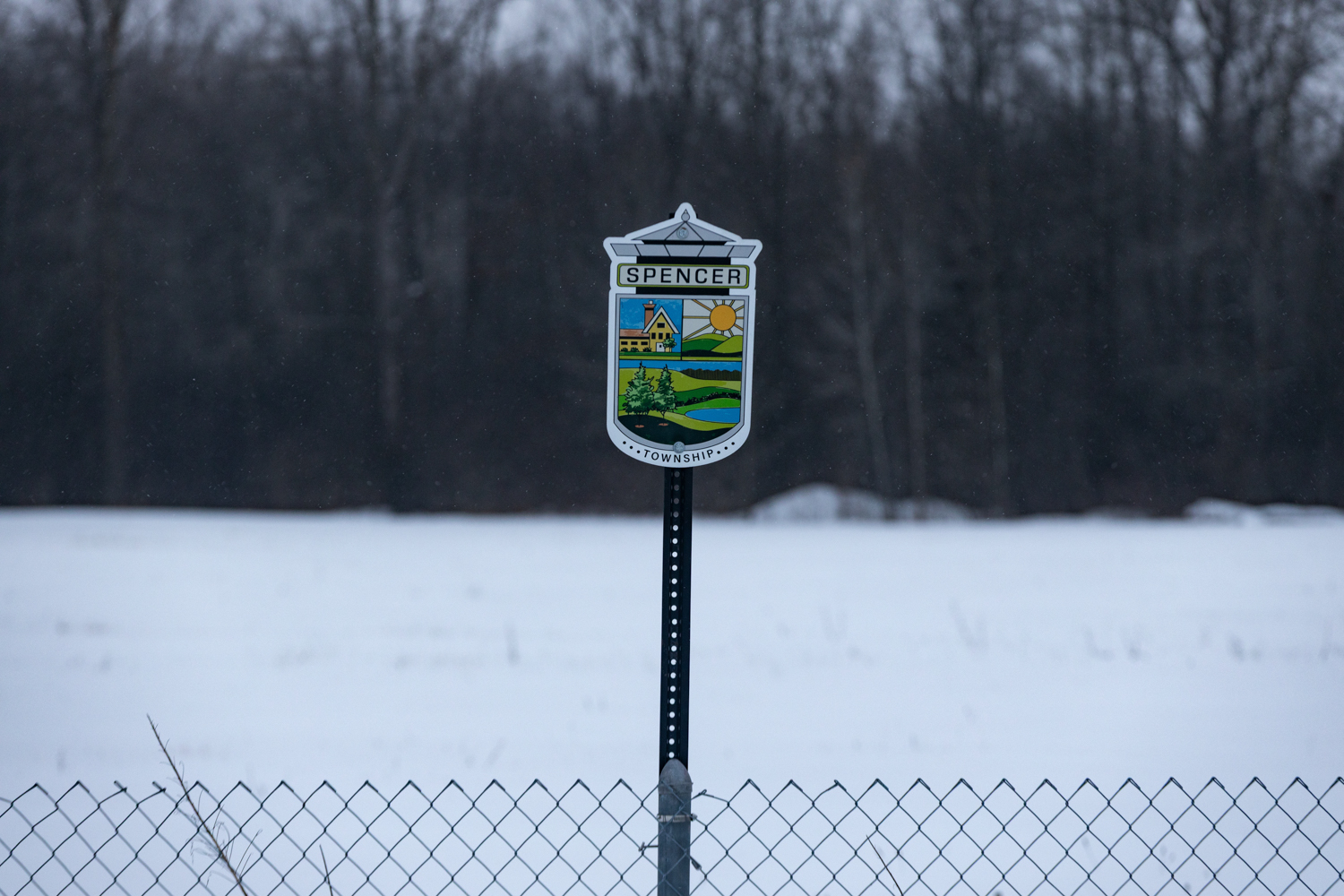
A Spencer Township marker sign. (TFP photo by Stephen Zenner)
“I would have loved to say we would have had a good working relationship with our surrounding communities, but that was not the case,” he said. “We tried to get and meet the Swanton and Springfield schools, but they both rejected us. And that’s how we ended up in Toledo Public Schools.”
In terms of plans, the township recently created an organization in October 2025 called the Community Improvement Corporation (CIC) to pursue economic development projects. The organization has the task of performing any economic development that takes place in Spencer Township.
Spencer Township is home to many due to its nice, family-oriented community. The community features amenities such as a nature park for fishing and kayaking. It also has historic landmarks such as Old Spencer Township Hall, Spencer Sharples High School and the current Spencer Township Hall.
“It’s always been a good place for raising families because we are isolated away from so much that’s happening in other areas,” he said. “Spencer Township was and has been a hidden gem that people are discovering. It’s the only place I’ve ever called home, and I don’t plan on leaving it.”
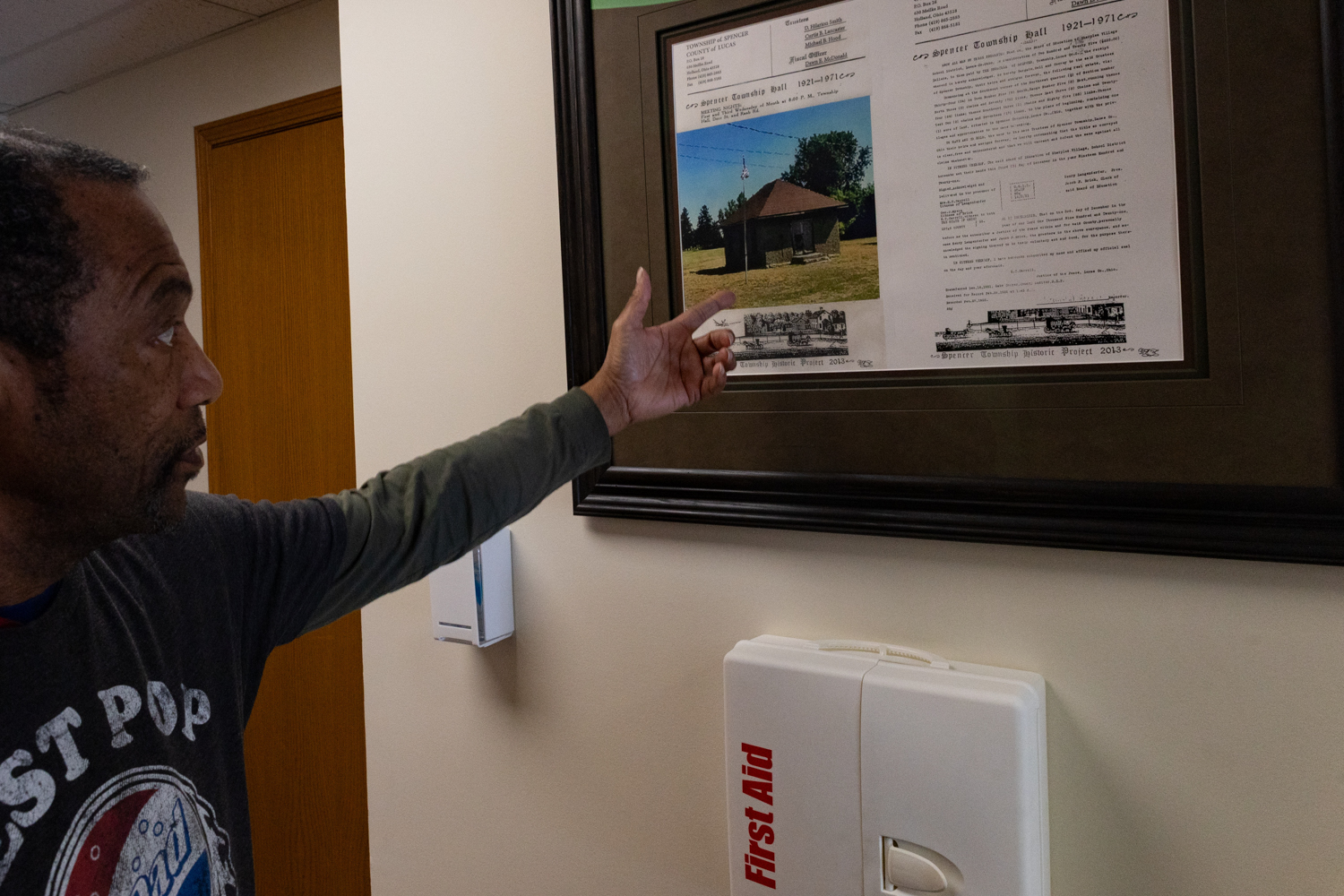
Michael Hood, the nine time township trustee for Spencer Township, points at a picture of the original Spencer Township Town Hall in the newer town hall. (TFP photo by Stephen Zenner)
Dale said the passion of the people is what she likes most about living in Spencer Township.
“It’s a small community, but they’re close-knit, and everybody checks on everybody,” she said. “The general people are very nice and caring, and they look out for each other.”
Hood says Spencer Township has been under the radar for the past 10 to 15 years, but due to the new influx of people from all over, the community is getting discovered.
“We want people to know that we’re here. We’re Spencer Township; we’re our own entity,” he said. “We are tired of being in everyone else’s shadow, and so this is our coming out period.”
Michael Hood, the township trustee for Spencer Township, stands outside of the Spencer Township Town Hall. (TFP photo by Stephen Zenner)
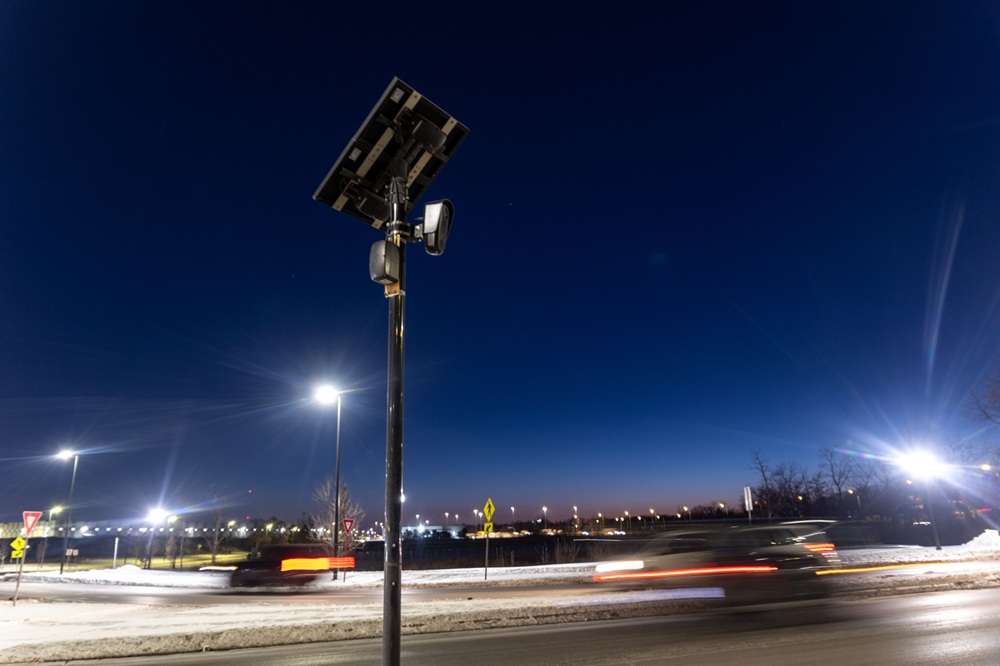
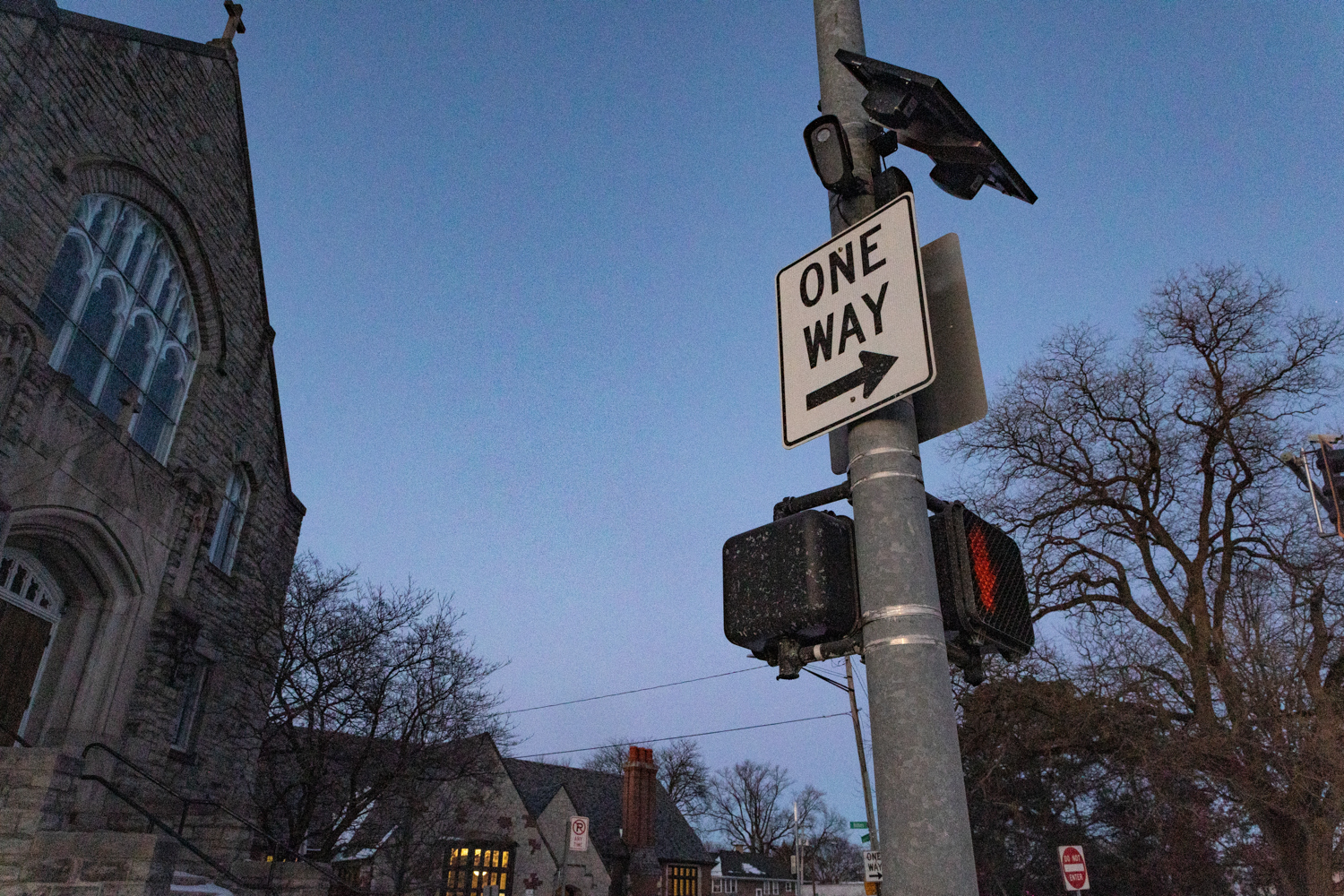
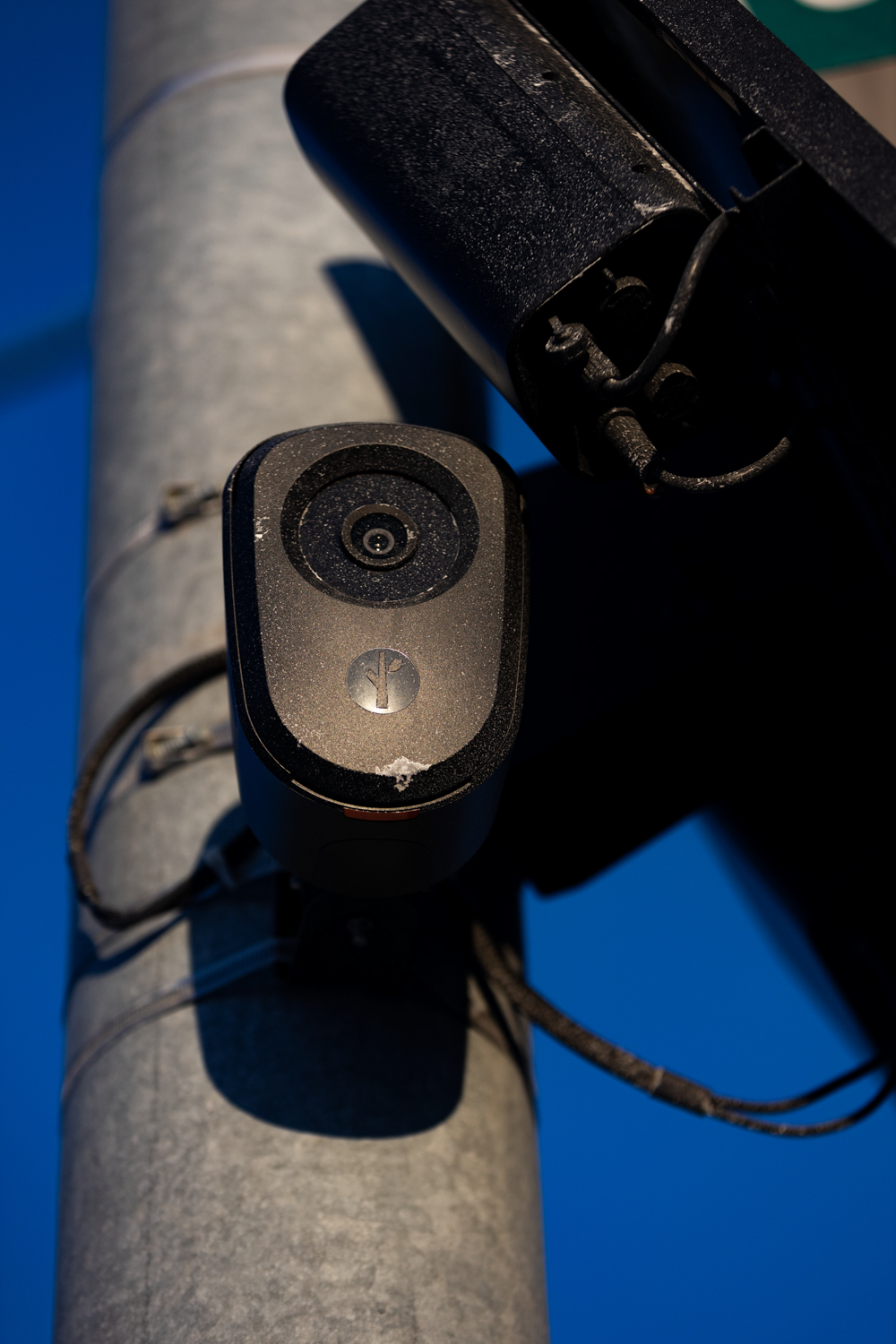
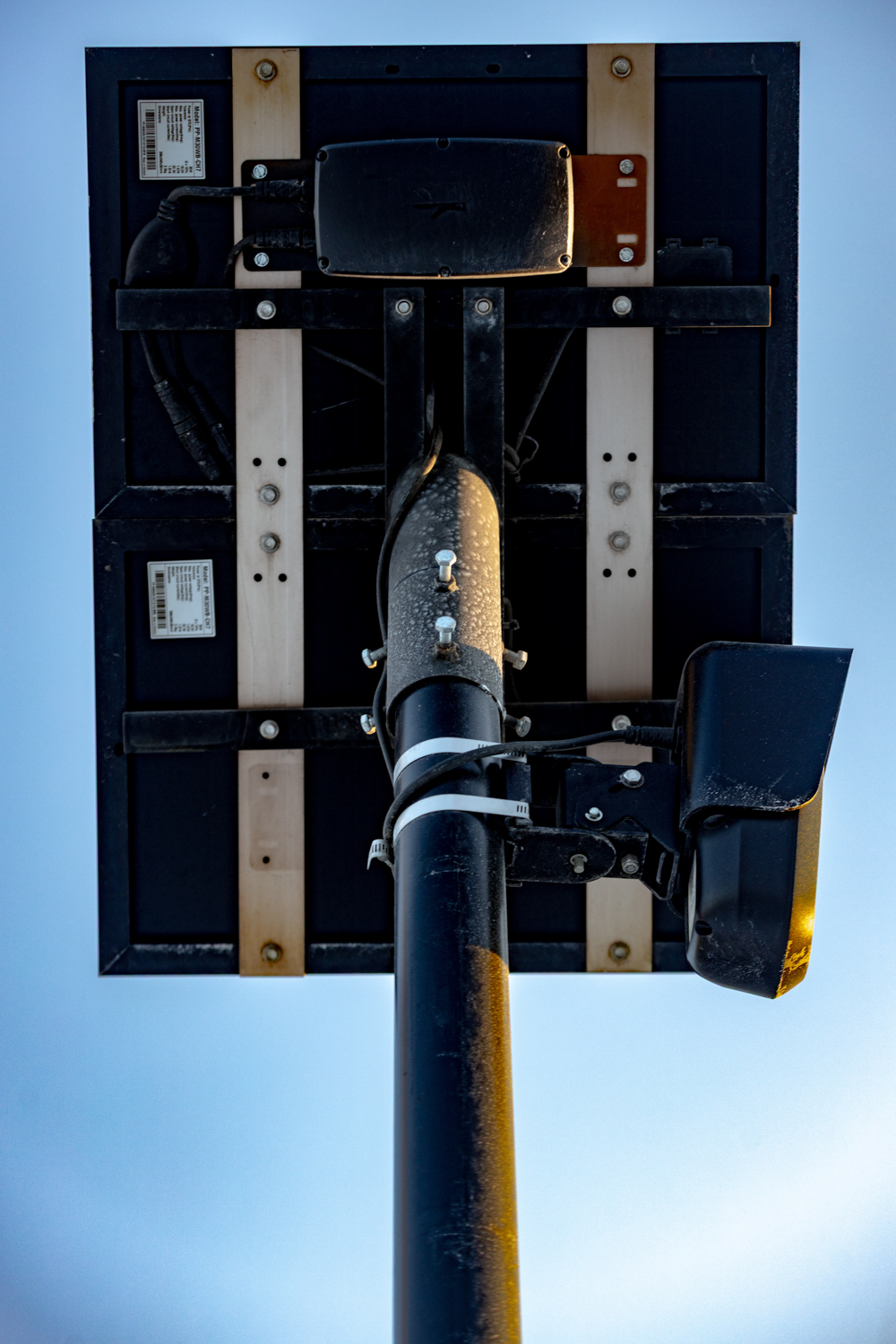
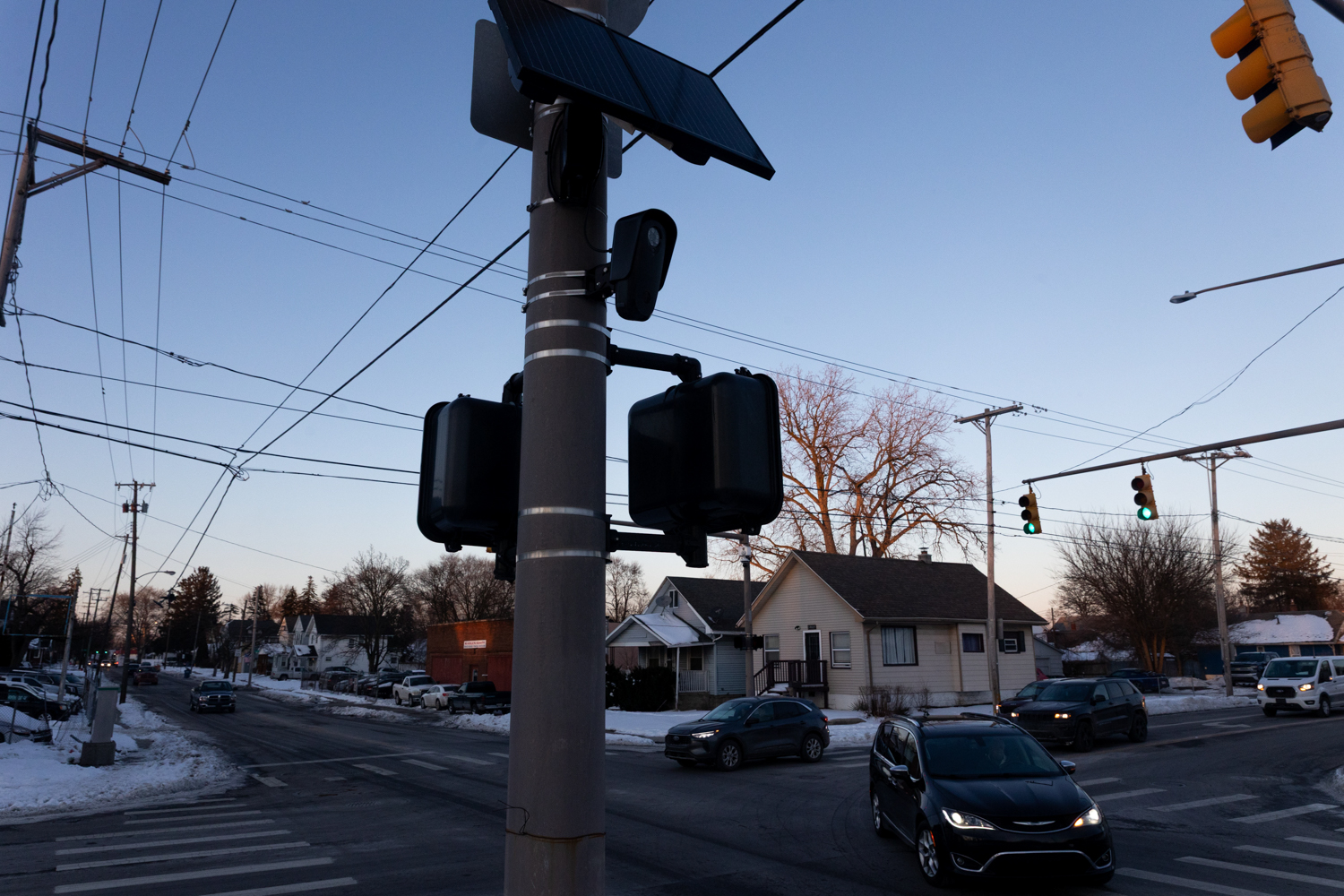
Flock Safety camera at West Sylvania Avenue and Homeville Circle in Toledo on Wednesday, Feb. 4, 2026. The City of Toledo approved a three year $846,000 contract with Flock Safety cameras in November of 2025, $282,000 annually, but the ubiquity of Flock surveillance systems in the United States raises questions about privacy and data security. (TFP photo by Stephen Zenner)
TOLEDO – Interactions with pictures, phrases or videos on Instagram, X or TikTok are watched, weighed and measured.
While this may not be ideal, it is tolerated, as long as the surveillance is contained within the user’s phone and the info is used for seemingly benign things, like targeted ads.
But now, Artificial Intelligence (AI) has allowed pattern recognition to inch its way into the material world with an improved ability to verify identity and track behavior outside of the use of phones.
“We used to use what’s called ALPR devices on our police vehicles,” said Mike Navarre, the Lucas County Sheriff. “ALPR is Automatic License Plate Reader; that’s what it stands for.”
From what Navarre remembered of the technology while working as the police chief in Toledo and Oregon, he said the old ALPRs weren’t specific. “It wouldn’t distinguish between different states’ [license plates].” And they also weren’t very accurate. “The reader would catch a license plate number of a car that was either passing the vehicle or they saw parked on the side of the road.”
The mix of unspecific and inaccurate data provided by ALPRs on law enforcement cars weighed down the effectiveness of the system.
“We utilized it, but it wasn’t really great,” Navarre said.
“But then along comes Flock cameras,” he said.
Flock
Flock Group Inc. is a privately held company based out of Atlanta, Ga., valued at around $7.5 billion last March, its last funding round.
Garrett Langley, the current CEO of Flock and one of its three founders, has stated the mission of Flock is to get rid of crime altogether.
Flock Safety camera on Berdan Avenue near the roundabout with Jeep Parkway in Toledo. (TFP photo by Stephen Zenner)
In an interview with Forbes, Langley said, “The full mission is we just genuinely don’t think that crime should exist. We actually think it’s a decision we’ve made as a society that crime is allowed to happen, and we think with technology, with people, with policy, crime can be a thing of the past.”
Since its startup in 2017, Flock has become most known for its license plate reader cameras, but Langley breaks down Flock products into three categories.
“Devices that detect evidence,” which includes ALPRs, gunshot detectors, mobile security trailers and traditional security cameras.
The second part of Flock’s product line is their Application Programming Interface or API, and this is the software that works to decode the massive amount of surveillance information coming into law enforcement or companies. This software makes it easier for customers of Flock to find what they’re looking for.
The third and final part of their product line are fast response devices, mainly drones they are marketing as Drone First Responders (DFR).
According to Mohamad Nasser, a sergeant with the Toledo Police Department (TPD), TPD has “approximately 107” ALPRs, and at least one DFR.
Toledo’s first contract with Flock was signed in 2022, and Nasser said it was an upgrade from the previous system. In November 2025, Toledo City Council renewed this contract for three years, an $846,000 contract, paying $282,000 to Flock a year. The only dissenting vote on the Flock contract was City Council Member At-Large Nick Komives.
Nasser told the Toledo Free Press, “The main benefit is faster, more accurate identification of vehicles involved in crimes, which helps solve cases more efficiently and keeps officers safer by providing real-time alerts. For example, Flock cameras have assisted in locating stolen vehicles and suspects in hit-skip investigations, which led to quicker arrests.”
The Sheriff has corroborated the effectiveness of the camera system, and while Lucas County’s investment is much less at $62,500 a year for 28 cameras, Navarre has been pleased with the results.
“The technology has improved tremendously,” said Navarre, and called Flock cameras a “tremendous success.”
Specifically, Navarre cited improvements in searchable qualities of the ALPRs, like being able to lookup make, model, year, color, partial plate numbers, or qualitative aspects to vehicles, like specific damage or markings on the vehicles.
“Let’s say that a [vehicle had a] Trump/Vance bumper sticker on the back. Then you could search for vehicles that had that bumper sticker,” he said.
According to Flock’s website, each time a vehicle passes by the camera, it takes in the following information:
License plate image
Vehicle image
Vehicle characteristics (e.g. color, make)
License plate number
License plate state
Date
Time
Camera location
Then it holds that data for 30 days by default, but those settings could be altered by whichever organization is using the cameras.
Sheriff Navarre shared a shortlist of Flock success cases from the county, including quickly picking up a man in violation of parole who was later convicted of murder; a stolen Hyundai Elantra was flagged, leading to arrests; and a stolen Ford Escape was returned to the owner, and the individual who stole the vehicle was apprehended with what appeared to illegal substances.
“It’s extremely efficient. It’s made solvability rates tremendously higher,” said Rodney Theis, the associate vice president for public safety and Chief of Police for the for the University of Toledo. Theis said the University of Toledo Police Department (UTPD) followed The Ohio State University’s lead on Flock, citing their successes with the new system.
Here in Toledo, Flock put a sharp end to catalytic converter theft, Theis said, applauding the technology as “one of the best resources we put in place.”
Interlocking parts
Successes with Flock have helped the company grow its reach across law enforcement groups, and in the private sector.
Locally, Lowes, ProMedica and some private schools use Flock cameras for their own security systems, and Meijer uses another brand of ALPR, Genetec, to monitor their parking lot.
Part of the effectiveness of the Flock system deals with its integration, sharing data from cameras across multiple jurisdictions, entities and areas to create a massive interlocking system of surveillance that is able to catch perpetrators across cities and states.
Companies and law enforcement control who they share their Flock data with.
Flock Safety camera on Lewis Avenue near West Sylvania Avenue in Toledo. (TFP photo by Stephen Zenner)
Up until recently, Flock planned to integrate with the Amazon subsidiary, Ring, allowing owners of the Ring cameras to share their camera feeds with law enforcement.
But following pushback from Ring’s Super Bowl ad, promising integration across cameras to find lost pets, in a feature called “Search Party,” the deal between Ring and Flock backtracked.
“Following a comprehensive review, we determined the planned Flock Safety integration would require significantly more time and resources than anticipated,” read a statement from Ring in Fortune.
The most recent estimate for the total number of Flock cameras in the United States is 90,000+ as reported by The Guardian, not including other ALPR companies.
Depending on data sharing preferences or hierarchy in law enforcement, much or all of this data potentially could be consolidated, allowing for an incredibly powerful surveillance tool.
Concerns over Flock
As Flock has spread across thousands of organizations in the United States, its use has raised concerns over privacy.
“The problem with mass surveillance is that it always expands beyond the uses for which it is initially justified,” wrote Jay Stanley, senior policy analyst at the American Civil Liberties Union (ACLU)’s Speech, Privacy, and Technology Project, when specifically writing about the Flock ALPR system.
Lucas County Commissioner Pete Gerken moved to take a stand against the Flock system on July 22, 2025, but was too late to affect its reach into Lucas County.
“We’re living in a time when mass surveillance has now become a federal policy, and it has had chilling effects on our population, especially the minority population in our community,” Gerken said, and claimed the system would disproportionately affect minorities in Lucas County.
“Even though I did vote in favor of this, I must ask to reconsider my vote, and I would like to bring this back before the board.”
After some words from Commissioner Lisa Sobecki, who had further questions on the matter, and wanted to delay the vote, Anita Lopez, Lucas County Commissioner, and Gerken voted against the contract with Flock.
Flock Safety camera at Lewis Avenue and Eleanor Avenue in Toledo. (TFP photo by Stephen Zenner)
A week before, at the July 15 meeting of the commissioners, the Flock contract was approved by all three commissioners without comment, along with multiple other items from the sheriff, and Navarre signed the contract with Flock that day.
This made the contract with Flock binding, locking Lucas County into a five-year contract, seemingly just as Gerken and Lopez were starting to question its use.
Surveillance studied
In 2013, before the Flock Group Inc. existed, Neil M. Richard wrote an article, “The Dangers of Surveillance,” in the Harvard Law Review, and argued that “our society lacks an understanding of why (and when) government surveillance is harmful.”
Richard outlined the potential intellectual and political harms, claiming that surveillance is harmful first, “because it can chill the exercise of our civil liberties.”
“Intellectual Privacy” is the term Richard used to explain how people can come to their own conclusions freely, and explained how new ideas or innovations could be considered controversial or taboo, leading to their suppression under surveillance.
The first amendment, he said, is so important that “its protection should err on the side of caution;” otherwise, he warned, more practically that mass surveillance, “could lead to discrimination, coercion and selective enforcement,” of the law.
Flock Safety camera at West Sylvania Avenue near Torrance Road in Toledo. (TFP photo by Stephen Zenner)
At the core of why this happens, Richard said surveillance creates an unequal power dynamic between the watcher and the watched. “That information gives the watcher increased power over the watched that can be used to persuade, influence or otherwise control them — even if they do not know they are being watched or persuaded. ”
“As a society, we are thus of two minds about surveillance,” he said.
“On the one hand, it is creepy, Orwellian and corrosive of civil liberties. On the other hand, it keeps us and our children safe.”
Can surveillance be safe?
Firm boundaries on information gathering have not yet been determined, and much of this is due to the rapid advances in the digital era.
“So you will hear a ‘right to privacy’ inferred in court cases,” said Ben Stickle, Professor of Criminal Justice at Middle Tennessee State University, while cautioning that the “right to privacy” is an inferred right derived from multiple constitutional amendments and a large lexicon of case law.
Explicitly, “That’s not a right that we have,” he said. “That doesn’t mean it’s not implied.”
Generally, if people were out in public, even viewable from a public place, the law has held that kind of information as public.
“And that might have made sense a number of years ago,” he said. “But now that, within seconds, all of these digital trails can be pieced together to know exactly who’s where at all times, what they’re doing, who they’re standing close to, whether you’re driving left or right or too fast or too slow, I don’t know that that’s really been addressed quite yet from a legal perspective.”
Flock Safety camera at West Sylvania Avenue and Homeville Circle in Toledo. (TFP photo by Stephen Zenner)
Stickle, who has done research on crime dealing with package theft and the effects of the now popular Ring cameras, mentioned ALPRs and other cameras feel invasive, but makes a counterpoint that the infrastructure for massive surveillance already exists.
“How is this any different than the fact that your credit card company knows everything that you’re doing, so does your phone company, so does your internet, and you put those three things together and they know everything?” he said.
“One could argue, well, this is already occurring. Now, it’s just video,” Stickle said, while he affirmed, “I think it’s time in our society we at least have a discussion about how this works together.”
Lawsuits against mass surveillance
At the forefront of the conversation over police surveillance are court cases against the use of Flock, and general objections to the massive reach of the Flock system.
Lee Schmidt argued that “he effectively cannot leave his neighborhood without the NPD [Norfolk Police Department] knowing about it,” in Lee Schmidt and Crystal Arrington v. City of Norfolk, Virginia.
This case provides details on some of the capabilities of Flock framed differently than law enforcement, or how Flock frames the use of their equipment, and argued the issue of mass surveillance has already been ruled against in a previous court case.
Flock Safety camera at West Sylvania Avenue near Torrance Road in Toledo. (TFP photo by Stephen Zenner)
In “Leaders of a Beautiful Struggle v. Baltimore Police Department, the U.S. Court of Appeals for the Fourth Circuit struck down an aerial surveillance program precisely because it created record of where everyone in the city of Baltimore had gone over the past 45 days,” the complaint reads in the filing.
According to the 2021 ruling by Chief Judge Roger Gregory, “because the AIR [Aerial Investigation Research] program enables police to deduce from the whole of individuals’ movements, we hold that accessing its data is a search, and its warrantless operation violates the Fourth Amendment.”
Other specific arguments of note in this case include that, “society’s expectation has been that law enforcement officers would not and could not monitor and catalogue the whole of a person’s movements over 30 days.”
“Society has likewise not expected police to be able to reconstruct the entirety of a person’s movements retrospectively, even without knowing in advance that they want to follow a particular person.”
Other grievances include the availability of the system, no need for probable cause or a warrant to access the massive database, and the prevalence of the cameras (172 cameras in the city of Norfolk).
An excerpt from the complaint outlines the specific reality Lee Schmidt observed in his city:
“Once he [Lee Schmidt] leaves his neighborhood, he routinely passes some of the many other cameras posted at undisclosed locations throughout the City. In fact, Lee has noticed cameras other than the ones outside his neighborhood during his daily travels in Norfolk.
“Each time, the Flock Cameras have taken pictures of his car as it passed by and stored those pictures, along with the associated data, for at least 30 days.”
The court complaint goes into detail surrounding “what Flock calls a ‘Vehicle Fingerprint.’”
“The ‘fingerprint’ includes the color and make of the car and any distinctive features, like a bumper sticker or roof rack. Flock’s software converts each of those details into text and stores them in an organized database. Flock users can then easily filter their searches based on those features because the ‘Vehicle Fingerprint’ automatically links different images of the same car within Flock’s database, creating a record of that car’s movements over time.”
Schmidt and Arrington hope to permanently get rid of Flock cameras in Norfolk for good under this precedent.
Is 500 cameras too many?
In a similar case with different specifics, San Jose, California’s use of the Flock system is particularly encompassing, utilizing 500 cameras across the city, and storing the “vehicle fingerprint” on city-goers for a rolling one year, far longer than the default save for data by Flock.
In the lawsuit, Services, Immigrant Rights & Education Network; Council on American-Islamic Relations, California v. City of San Jose, the plaintiffs hold that law enforcement should need a warrant to access the Flock system.
“Records show that the Police Department routinely conducts warrantless searches of its ALPR location database,” the complaint reads.
“According to publicly released audit documents, the Police Department searched for driver locations 261,711 times between June 5, 2024 and June 17, 2025.”
Granted that these are separate searches of different vehicles over one year’s time, San Jose Police have searched roughly a fourth of the city under the Flock system.
“By tracking where people are across time, ALPR information can reveal a map of a person’s private habits, movements, and associations and other ‘privacies of life.’”
Flock Safety camera on Berdan Avenue near the roundabout with Haverhill Drive in Toledo, (TFP photo by Stephen Zenner)
Carpenter v. United States, a Supreme Court case involving the use of cell tower data to pinpoint the locations of a suspect in robberies in the Midwest was cited in the San Jose case.
This cell data was obtained without a warrant, and the majority of the Supreme Court ruled that “the Government’s acquisition of Carpenter’s cell-site records was a Fourth Amendment search,” and should have required a warrant.
The plaintiffs are arguing the same against the city of San Jose.
Where are the cameras?
In a different case in Oregon, Seth May is suing the city of Eugene, Ore. to know the specific locations of Flock cameras in the city, which they have refused to share (May v. City of Eugene).
The main argument for this lawsuit is that the city is in Violation of Oregon Public Records Law (ORS 192.311–.431).
The Lucas County Sheriff’s Office shared a list of the locations of all their Flock cameras with the Toledo Free Press, and the Toledo Police Department (TPD) shared an “approximate” number: 107.
But this transparency has been at the discretion of the department or organization.
Like many issues surrounding Flock and surveillance in the United States, there aren’t uniform rules for how the technology is used across the country or across departments.
Flock Safety camera at Mount Vernon Avenue and West Bancroft in Toledo. (TFP photo by Stephen Zenner)
In an effort to push back against widespread surveillance, Will Freeman, a software engineer and privacy advocate, created a website and began facilitating community around stopping the spread of ALPRs.
Named in reaction to the Atlanta-based company, DeFlock.org shares educational resources on ALPRs, connects visitors to the site with anti-surveillance groups and contains a GPS map where people report and/or observe the location of ALPRs in real time.
The online map doesn’t claim to be all-encompassing, but it has been correct in the instances observed by the Toledo Free Press. Over 15 separate locations provided by DeFlock were inspected by the Toledo Free Press, and were correct; the only mistake was one location with one camera instead of two claimed by the anti-surveillance website.
Langley, when speaking to Forbes, openly said the ACLU and the Electronic Frontier Foundation (EFF) were legitimate opponents of Flock who worked within the law, and differentiated their work from DeFlock.
“And then unfortunately there’s terroristic organizations, like DeFlock, whose primary motivation is chaos,” Langley said. “They are closer to Antifa than anything else.”
It should be noted that DeFlock hasn’t broken the law, and doesn’t advocate for breaking the law. It should also be noted their stance is firmly against the spread of automated license plate readers, and most of their resources undermine the use of Flock as a legitimate tool for law enforcement.
DeFlock states outright on their website, “Our mission is simple: to shine a light on the widespread use of ALPR technology, raise awareness about the threats it poses to personal privacy and civil liberties, and empower the public to take action.”
Enabled misuses
For decades, surveillance cameras have been a normal progression of security, but May v. City of Eugene highlights the main difference between the Flock system and localized security cameras.
“Flock allows and intends for its mass surveillance data to be broadly shared outside the local jurisdiction where individual cameras are located, including with federal agencies and private parties.
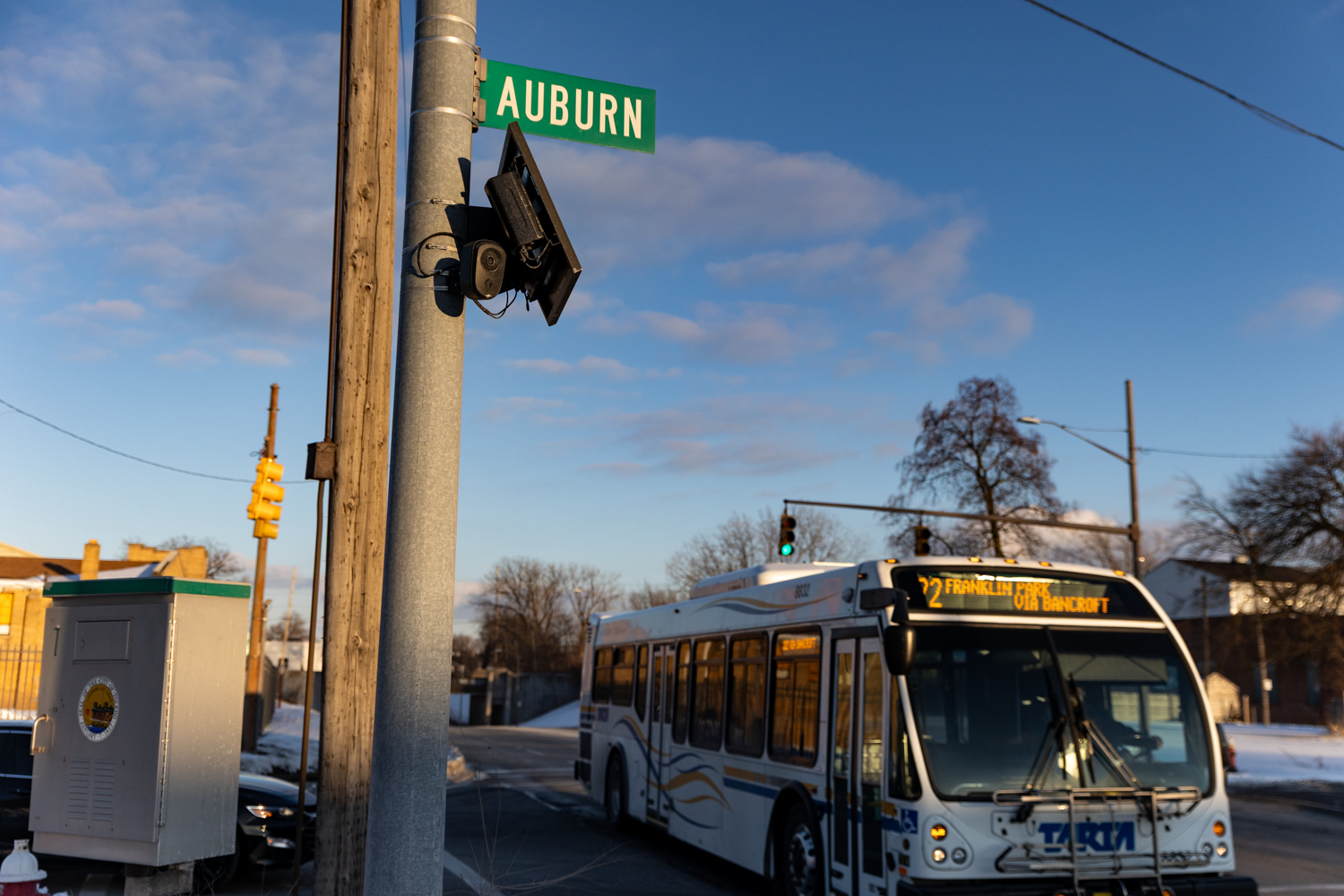
Flock Safety camera at West Bancroft and Auburn Avenue in Toledo. (TFP photo by Stephen Zenner)
“While individual cameras may be deployed by a single municipality or police department, the data captured by the cameras is then uploaded unencrypted to an AI-powered surveillance platform maintained by the private Flock Safety corporation.
“Law enforcement officers or even private parties across the country can then access that data with little to no oversight.
“Reporting and records show that Flock camera networks are routinely shared with and accessed by multiple local, state, federal, and private law enforcement agencies without clear consent or notice.”
“This cross-agency data access has enabled misuse,” the filing claims, and then lists five sources to back up their claims, showing how searches were performed on behalf of agencies violating different department’s terms of use of the Flock system and even state law in some cases.
More specifically, most of these searches were in service to immigration enforcement, and many of these instances involve local law enforcement credentials being “borrowed” by federal agencies.
DEA in Illinois
Palos Heights Detective Todd Hutchinson, shared his password with an unnamed Drug Enforcement Administration (DEA) agent who searched for immigration violations using Hutchinson’s password.
State law prohibits LPR data to be used in immigration cases, and Hutchinson was disciplined for sharing his password. Although, after he changed the password for Flock, he was again accosted for it.
“Dave Maass, director of investigations at the Electronic Frontier Foundation (EFF), told Unraveled Press ‘this is not something that is supposed to happen.’
“‘The fact that PHPD did not know about this until journalists caught it is a sign that this agency as a whole is not acting responsibly with this data’ he added.”
According to the same article by Unraveled, “data collected by researchers showed cops and sheriffs in states like Florida and Texas performing searches of Illinois license plate reader networks.”
Colorado
In Loveland, Colorado, Customs and Border Protection (CBP), were able to access the Flock system through Flock’s now discontinued federal pilot program, which invited the Loveland Police Department to share their Flock information one to one (1:1). The LPD accepted the sharing invitation, but like in Illinois, sharing such information violated state law.
Searches made in the Flock system under the subject “ICE” tipped off investigators.
And now, Denver, Colo. has disabled national data sharing with Flock after an audit of their system showed it was used over 1,400 times for immigration enforcement without their consent.
The city of Denver is now looking for an alternative to the Flock system.
In August of last year (2025) Langley, CEO of Flock, addressed the Flock system’s use by DHS:
Flock Safety camera at Mount Vernon Avenue and West Bancroft in Toledo. (TFP photo by Stephen Zenner)
“While it is true that Flock does not presently have a contractual relationship with any U.S. Department of Homeland Security agencies, we have engaged in limited pilots with the U.S. Customs and Border Protection (CBP) and Homeland Security Investigations (HSI), to assist those agencies in combating human trafficking and fentanyl distribution.
“We clearly communicated poorly. We also didn’t create distinct permissions and protocols in the Flock system to ensure local compliance for federal agency users.”
Langley said the company would appoint a new Chief Legal Officer, and take these steps:
“All federal customers will be designated within Flock as a distinct ‘Federal’ user category in the system. This distinction will give local agencies better information to determine their sharing settings. Moving forward, federal users will not be added to Statewide or Nationwide lookup. Any sharing request, audit or display of these agencies will clearly delineate that an organization is federal.”
Each police department chooses who it shares with, and these are the options as listed by Flock.
“There are customizable options for data sharing amongst agencies:
1:1 Sharing – police departments can choose to share camera access with other PDs, in order to solve cross-jurisdictional crime, on a 1:1 basis (one PD to one PD), within a specific geographic radius (sharing with all agencies within 10 miles, for example), or within their state. Agencies can also elect not to share any data outside their own agency, or remove themselves from sharing at any time.
National Lookup – police departments can choose to join Flock’s National Lookup network, which enables a unique type of sharing. Specifically built for far-reaching crimes like human or narcotics trafficking and missing persons, National Lookup allows police to search for the full plate number of one specific, known license plate (only a complete license plate) across cameras that other police departments have also opted in to share with this network.
Some states, like California, do not allow any sharing across state borders. For those states, Flock has disabled National Lookup to make compliance easier. And private customers never have access to law enforcement data.”
Policy by policy
Flock use and access to ALPR data is dictated – like most things surrounding the new technology – on an individual, organizational level.
Each organization using Flock in northwest Ohio dictates what the technology is used for. ProMedica addressed the use of Flock cameras around their facilities, and Tausha Moore, the associate vice president of strategic communications for ProMedica, said, “We have established strict protocols that balance security needs with patient privacy and ethical data management.” Moore assured the Toledo Free Press that the surveillance equipment was in compliance with HIPAA regulations.
Separately, Metroparks Toledo, a public park district that employs park rangers, also uses Flock for their own law enforcement.
The Metroparks use less surveillance than many other governmental entities in the area, only using one ALPR and four traditional Flock security cameras, but have stated they used Flock for criminal investigations surrounding “smash and grab” thefts.
Flock Safety camera at Mount Vernon Avenue and West Bancroft in Toledo. (TFP photo by Stephen Zenner)
Scott Carpenter, the director of public relations for Metroparks Toledo, said on the topic of Flock cameras, “We use Flock cameras because of their ease of use, quality of the cameras and their ability to be installed anywhere with no separate power or internet. Also, because of the ability to share and use information between law enforcement departments when investigating crimes.
“All of our Flock cameras are actually used in our Riverfront Development, so Glass City Metropark and the Riverwalk. It’s just a more densely populated, heavily visited area.”
For those five cameras, the Metroparks have available a Flock transparency portal, a webpage used to give the public more specific information on how they use Flock cameras.
Metroparks Toledo specifically prohibits the use of their cameras for immigration enforcement, traffic enforcement, harassment, intimidation or personal use.
For those concerned with privacy, these prohibitions seem like great news, until looking at the Metroparks’ sharing information. Under the section labeled, “Organizations granted access to OH – Metroparks Toledo data,” there are 1,242 separate entities listed, with only 298 within Ohio.
This means the cameras at the Metroparks could be accessed from any number of agencies outside of Ohio and who may not be held to Ohio’s laws or to the specific uses the Metroparks dictate for their data.
Navarre said the Lucas County Sheriff’s Office shared their Flock data “strictly in Ohio, and it’s only with other agencies that have Flock cameras.”
Theis expressed a similar sentiment held by the UTPD, and explained a bit of why there was an attention to keeping Flock data inside the state.
“There was an issue with Flock back in December,” Theis said. “If a department shared information with other agencies, specifically, out of state agencies, those public records requests were held differently, so that data could become more public.”
And this is part of the problem with an openly shared mass surveillance system without strict regulation. Not every department is playing by the same rules, and it’s unclear who has access to which cameras Toledoans may pass on a daily basis.
LCSO and UTPD said they limited sharing Flock data to entities inside the state of Ohio, and limited their use for criminal investigations. But depending on other local department preferences, another integrated Ohio law enforcement entity could violate cross-jurisdictional policies of another department.
Nasser spoke for TPD: “Sharing is governed by department policy and is limited to approved law enforcement agencies, primarily to support legitimate cross-jurisdictional criminal investigations.”
This statement doesn’t tell us much, only that law enforcement may access TPD’s Flock data, and only for law enforcement purposes.
Even so, multiple sources have reported sharing login credentials from different police departments with federal agencies.
And while coordination between federal, state and local departments is normal, sharing login credentials provides ample room for a legitimate organization to facilitate a breach of their own data and other departments’ data.
Regarding ICE’s access to the county’s Flock system, Lucas County Sheriff Navarre said, “I’m not aware that they’ve [ICE has] asked to use our cameras,” and then reaffirmed, “They can’t do it automatically.” The caveat to all this is the chain of command.
“I can tell you that if we get a request from ICE to assist them, we’re going to assist them. We’re not gonna tell them no,” he said.
But ICE might not need to ask.
Local sharing
Flock cameras for Sylvania, Holland and Ottawa County all stipulate through their Flock transparency portals that the cameras should not be used for “immigration enforcement.”
But if all three share their data with Rossford PD, a police department that allows their cameras to be used for immigration enforcement, the whole system is compromised on their specific uses.
Flock Safety camera at Mount Vernon Avenue and West Bancroft in Toledo. (TFP photo by Stephen Zenner)
Theis countered this sentiment. “What we have to do as law enforcement leaders is we got to make sure we have good protections in place, good procedures and policies in place.”
And he made mention that UTPD audits their systems to find violations against improper surveillance use.
“We [have] got to hold people very, very accountable,” he said. “By that, I mean if somebody were to violate the public’s trust by using a system, unauthorized access to a system, they’re probably going to face criminal charges and termination of their position. And we stress that with our officers. You put regulations in place, you put policy in place, you put training in place, and you hold people accountable.”
When asked about how UTPD is able to hold other departments accountable to their own policy guidelines for use of Flock, or if they know when or how their system is searched from a department they freely share with, this was their statement:
“The University of Toledo Police Department (UTPD) is not notified when a law enforcement agency that has been granted access to its Flock Safety vehicle and license plate data searches the database.”
Local abuses of intelligence
Not too long ago, former Rossford Police Officer Glenn Goss Jr. was held accountable for his misuse of a police database.
Goss Jr. resigned from his position after being indicted under “two fifth-degree felony counts of unauthorized use of the Law Enforcement Automated Database System (LEADS), one third-degree count of tampering with evidence and two misdemeanor counts of menacing by stalking,” according to WTOL 11.
The Court of Common Pleas of Wood County found Goss Jr. guilty of all counts, and was sentenced in 2021.
Goss Jr. was found to have stalked two women, one of whom screenshotted her correspondence with Goss Jr.
In the text conversation the woman appeared noticeably disoriented, and asked, “Who even are you[?]” “So how’d you even know who I was[?] lol.”
Goss Jr. informed the woman he was law enforcement by sending a picture of himself in uniform, and told her he looked up her information using the woman’s license plate number.
During several coercive attempts to flirt with wth woman, Goss Jr. referenced how fast she was driving, and this caused the woman to ask, “Am I in trouble?!”
Goss Jr. replied, “You were almost in trouble,” and told her, “The next person I stopped wasn’t so lucky hahaha[.]”
Flock Safety camera at Upton Avenue and Berdan Avenue in Toledo. (TFP photo by Stephen Zenner)
A similar instance of stalking with the use of police surveillance systems happened in 2022 when “Kechi Police Lieutenant Victor Heiar was arrested by the Wichita Police Department after it was discovered he utilized his position within the police department to unlawfully access WPD’s Flock license plate reader technology to monitor where his estranged wife was located,” KWCH 12 News reported.
“Every single search conducted inside of Flock has to have a reason you’re doing the search, and then is stored in perpetuity,” Langley said about the potential misuse of Flock during an interview with Forbes.
Thomas Brewster, senior editor for Forbes, pushed back on the efficacy of officers needing to put in a reason for searching the database. In some of the Freedom of Information Act (FOIA) requests that had been made public, Brewster said the search credentials were filled out with broad, meaningless and short entries like “INV” or simply “Investigation” that could mean anything.
In reaction to whether it was a concern that police could obfuscate their search with broad language Langley said, “I think we will never be satisfied with the level of which we can provide transparency and controls to elected officials.”
“I don’t think it’s our job to police the police, because no one has asked to; no one is actively asking us to.”
Langley did however say Flock had tools in development for administrators or internal affairs for the “person whose actual job it is to police the police.”
It remains to be seen if the safeguards in place are adequate, especially considering federal use of the systems through credential sharing.
Misunderstanding of police databases
Heiar and Goss Jr. are easy to label as bad eggs, but the conviction of former Rossford Police Chief Glenn Goss Sr., father of Glen Goss Jr., shows at the very least a misunderstanding of when it is appropriate to use a police database.
Goss Sr. pleaded guilty to two instances of accessing a police database after he had retired from his position as police chief after over three decades of work in law enforcement.
He was initially charged with three to seven felony counts of unauthorized use of the Law Enforcement Automated Database System (LEADS), identical to his son’s charges, but the charges were downgraded following a plea deal.
“At the time I didn’t realize it, but at this time I realize that it is a criminal act,” Goss Sr. said according to reporting by the Sentinel-Tribune.
Flock Safety camera at Monroe Street and Cardinal Street in Toledo. (TFP photo by Stephen Zenner)
Jerome Phillips, Goss Sr.’s attorney, said all the information Goss Sr. looked up through the database was publicly available through public Bureau of Motor Vehicles records, which begs the question of why he didn’t look up the information through the Bureau of Motor Vehicles.
In his own defense, Goss Sr. said he looked up the active status of his wife and father’s licenses, but according to older reporting, it’s hard to say whether he looked up his wife and father’s licenses three to seven times.
Goss’ use of the database took place from 2019 to 2024 after he resigned from his duties as Chief of Police in 2018, but Goss remained on with the RPD in a lesser role until 2022.
The former police chief’s actions were deemed not to be malicious, but even the well-meaning misuse of a police database does not inspire confidence in the use of the powerfully upgraded Flock system.
Because of his plea deal, the only meaningful punishment for the multiple felonies, downgraded to misdemeanors, was paying about $500 in court costs, probation and bad press.
Each of his misdemeanors carry 180-day jail term, which could be enforced if Goss Sr. violates the dictates of his probation.
Watching increased investigations into the public
Beyond the inconsistent policies across law enforcement departments using Flock, beyond the unclear accountability measures in place to hold law enforcement to account, beyond the unclear sharing guidelines and practices, the Flock system has opened up new data sets for the government to look into.
Flock has defined certain cross state movements as “suspicious.”
According to reporting by the Associated Press and the Public Broadcasting Service (PBS), “chat logs show Border Patrol agents and Texas sheriff’s deputies trading tips about vehicles’ travel patterns — based on suspicions about little more than someone taking a quick trip to the border region and back,” the article reads.
Flock Safety camera at West Bancroft and Auburn Avenue in Toledo. (TFP photo by Stephen Zenner)
Government observation of movements is creating more reasons for law enforcement to confront Americans.
What was initially labeled a missing person’s case in Texas, has drawn ire after the words “had an abortion, search for female” were used to search the Flock system twice, first accessing 17,684 cameras, and then broadened to 83,345 cameras, according to reporting by 404 Media and documents obtained by the EFF.
“Over two days in April, the woman went through the process of taking medication to induce an abortion. Two weeks later, her partner – who would later be charged with domestic violence against her – reported her to the sheriff’s office,” a report from the EFF reads.
An excerpt from the Johnson County Sheriff’s Office (JCSO) detective’s sworn affidavit is posted to the article by the EFF, and shows the detective on the case referred to it as a “death investigation…of a non-viable fetus,” a crime in Texas.
According to the Dallas Observer, “At the time, Johnson County Sheriff AdamKing — who has since been indicted on unrelated perjury and workplace sexual harassment charges — denied that the license plate readers were used to investigate the abortion, stating that detectives had instead been searching for the woman as a missing person and were hoping to ensure her safety. King told The Dallas Morning News that the woman ‘was not under investigation at any point.’”
The CEO of Flock, Langley, backed the claim from King, and called reporting around this instance “clickbait” in his interview with Forbes.
When pushed about the search query in the Flock system, and that people have been prosecuted in other cases for “unlawful abortions,” Langley focused in on the word “unlawful,” and said, “Flock doesn’t write the laws.”
“Flock has really no control over what a local government chooses to do or not do,” he said.
Further excerpts of the investigator’s affidavit talk about how the woman came to JCSO. “Detective Miller was initially under the impression *redacted came to the Sheriff’s Office to tell her side of the story about the non-viable fetus.”
And according to reporting from the EFF, “after collecting the evidence from the woman’s partner, the investigators say they consulted the district attorney’s office, only to be told they could not press charges against the woman.”
How hackable?
“The danger here is that technologies enlisted for surveillance, implemented with inconsistent protections, threatens to undermine one set of rights in favor of others,” writes Binoy Kampmark in a 2020 journal article reacting to the spread of surveillance technologies during the Covid-19 pandemic.
A more recent concern with Flock is how secure the data and systems are from outside access.
YouTuber and researcher Benn Jordan has picked up about a million views per video when he speaks about the vulnerabilities of the Flock system. Jordan’s main source when referencing over 40 security vulnerabilities is Jon Gaines (GainSec), a cybersecurity researcher, as his main source for replicating the vulnerabilities of the Flock system.
Flock Safety camera on Haverhill Drive near Phillips Avenue in Toledo. (TFP photo by Stephen Zenner)
Jordan claimed he was able to easily find passwords and login credentials on the dark web and access Flock without two factor authentication, a problem Flock has since said they have fixed.
Gaines published a security analysis of the Flock cameras known as the Whitepaper in November of 2025, and listed it on GitHub. A major claim made by Gaines is that he could gain access to Flock cameras with “30 seconds and a stick,” to touch the camera.
“‘The stuff that is running on the devices themselves is lacking,’ Gaines said, pointing out that his research is designed to help stop future bad actors,” in a report from News9.
Flock dismissed the findings of GainSec noting “…none of the vulnerabilities detailed in the report have an impact on our customers’ ability to carry out their public safety objectives. Exploitation of these vulnerabilities would not only require physical access to a device, but also require intimate knowledge of internal device hardware.”
404 Media conducted their own research on Flock cameras, and published an article about Flock’s Condor PTZ cameras, not ALPRs.
“Flock left livestreams and administrator control panels for at least 60 of its AI-enabled Condor cameras around the country exposed to the open internet, where anyone could watch them, download 30 days worth of video archive, and change settings, see log files, and run diagnostics.”
The online article shows footage of Jason Koebler, the journalist reporting for 404 Media, walking on the street in front of what is presumed to be the Flock camera.
Throughout the article, links to Jordan’s videos showing similar claims, gaining access to the system, and following individuals from camera to camera, are provided.
Even though Flock Safety downplayed the seriousness of Jordan, Gaines and 404 Media’s security findings, in early February, Flock hired Bishop Fox, a cybersecurity firm, to test their system and find vulnerabilities.
Summation
“There’s always a worry of what we call a panopticon kind of state here,” said Brendan Dooley, associate professor of sociology and criminal justice for Mount St. Mary’s University. “The way I explain it to my students is sort of like Sauron, the all-seeing-eye.
“So there’s a method of a hyper control,” he said, and what we need to be aware of is the “security versus the liberty trade-off.”
Both criminologists the Toledo Free Press talked to for this story, multiple police chiefs, and Flock’s CEO all argued surveillance on a massive scale has existed for a while, through cellphones, app data, internet and credit histories.
What’s different now is the aggregation of data systems, the speed with which information can be searched and now, with the Flock system, there is a physical presence across most cities in America that is admitting to actual police surveillance.
Privacy is becoming less and less of a guarantee, and the United States is now in the middle of deciding what the new boundaries will be and how they will be enforced.
Inside the Radbill Center for Life Design. (BGSU courtesy photo by Craig Bell Photo)
BOWLING GREEN – Audrey Rowland did not have a college major in mind as her senior year at Sylvania Southview High School was winding down in 2023.
“I did so many things in high school and I have so many interests,” the Sylvania Township native said. “I’m a first-generation college student, and I had no idea what college looked like. I just knew I wanted to go.”
Rowland, now 21, toured the Bowling Green State University campus in 2023 and was introduced to the school’s Life Design program, which was launched in 2020 under current BGSU President Dr. Rodney Rogers.
Audrey Rowland, from Sylvania Township. She is a junior at BGSU and on track to graduate in 2027. (BGSU courtesy photo)
“It was just what I needed to figure out college and how to be a college student,” Rowland said. “I didn’t have anyone in my life who had been to a four-year university. I didn’t know what college would look like.
“I was jumping into it without a lot of knowledge and I needed a lot of guidance. I went in undecided.”
Life Design changed her life.
The program’s goal is to help BGSU students build confidence in their decisions, build a framework on how to differentiate their experience, and empower them with the skills they need to navigate their career and life in general.
Adrienne Ausdenmoore, the associate vice president and executive director of the Radbill Center for College and Life Design at BGSU (BGSU Courtesy photo)
Adrienne Ausdenmoore is the associate vice president and executive director of the Radbill Center for College and Life Design at BGSU. Originally from West Virginia, she attended the University of Dayton and has been at Bowling Green for four years.
She has been involved with Life Design since 2022 and said her role within the program is to “focus on integrating Life Design throughout campus.”
“The idea for Life Design was to really build a framework for success at BG,” Ausdenmoore said. “A lot of things make it special. One in particular is we are being really intentional with how we’re setting up students for success when they get to BGSU, such as problem solving and what they want out of life or their career and their college experience. It’s really important, and it’s infused throughout campus.
“It’s not very often you have a campus that speaks the same vocabulary with the same mission,” she added. “We focus a lot on taking action, being curious and being problem solvers. We want students to be able to design their future. How are they being intentional about what they want out of college and what they want out of their future careers.”
More than 10,000 students have been involved with Life Design since 2020. (BGSU courtesy photo)
Life Design is open to all BGSU students. Some students, Ausdenmoore said, take a course with Life Design as part of their major. Many first-year students are involved.
“We have a team of Life Design coaches who are able to walk along students to support them,” Ausdenmoore said. “Any student can be involved at any time and it’s part of their tuition. One-on-one coaching is included. It’s one of the perks of being a BGSU student in general.”
She said more than 10,000 students have been involved with Life Design since 2020, and thousands more have been exposed to it via workshops, coaching and other programs.”
Students who are still undecided on a major or what career to pursue can participate in a class where they spend their first semester together with a life center coach exploring majors and careers.
“A vast majority have picked a career or a major by the end of that semester,” Ausdenmoore said. “The idea is to do that intentional work and explore and talk to people on campus and people in different industries.”
Life Design welcomes transfer students from other institutions, offering a one-credit class that helps them feel more connected to the BGSU campus.
Inside the Radbill Center for Life Design. Life Design is open to all BGSU students. Some students, Ausdenmoore said, take a course with Life Design as part of their major. Many first-year students are involved. (BGSU courtesy photo by Craig Bell Photo)
Student athletes also take advantage of the program. Ausdenmoore called it a “partnership with athletics” at BGSU.
“All of our student athletes take the Life Design class together, and one of their Life Design professors leads that class,” she said. “There is also an upper-level class to help them decide on what to do after their athletic careers are over. It’s really focused on life after sports.”
Rowland scheduled to graduate in 2027
Rowland is in her junior year at BGSU and is a liberal studies major specializing in communication and design. She has a 3.6 GPA and is on schedule to graduate in 2027.
Rowland said meeting with a Life Design life coach on her initial visit to campus in 2023 was an eye-opener.
“I was sold after that experience,” she said. “It was only BG for me. Life Design really taught me about what college actually is, like how to be in college and make my experience meaningful. It’s the reason I have my major. It was so helpful to be in that community of other students who didn’t figure it out. I found what major suited me.”
Rowland added that, based on her college experience over the past few years, she wouldn’t change a thing.
“I’ve had so much support within Life Design and I’ve been so involved and gained so many amazing experiences,” she said. “I tailored myself to my goals. I’ve had so much support navigating that, and I’m very satisfied.”
Stephen Zenner leads the conversation about women’s reproductive healthcare in Toledo by speaking to Shelly Varelli, certified midwife and advocate for women who want an autonomous birth experience. He then speaks with Amelia Stower, who still works for the Toledo Women’s Center despite the stress of running Toledo’s lone abortion clinic in years past.
Everywhere in Toledo, you’ll find people who play a role in making our city tick – from hospitals and factories to restaurants and art galleries – and behind every person is a story. Our program, Toledo Works, highlights those stories from workers’ firsthand accounts. Each week, Toledo Free Press hosts Jaden Jefferson and Stephen Zenner focus on a different topic within the Toledo workforce, exploring their day-to-day challenges and triumphs.
TOLEDO – Dana, Inc., a longtime stalwart in Toledo’s automotive community, in January completed the sale of its off-highway business for $2.7 billion to an Indianapolis-based leader in the manufacture of automatic transmissions.
“We are now a more-focused company dedicated to serving light- and commercial-vehicle customers with both traditional and electrified systems,” said R. Bruce McDonald, chairman and chief executive officer of the Maumee-based Dana.
He added, “Closing this transaction marks an important step in Dana’s evolution.” McDonald said it will “strengthen our balance sheet, improve margins, reduce complexity, and position us to accelerate innovation and growth in our core markets.”
Dana, which set up shop in Toledo in 1929, makes axles, driveshafts, transmissions and more for a wide range of vehicles.
Allison Transmission Holdings, Inc., purchased the off-highway group, which makes drive and motion systems for heavy-duty vehicles used in agriculture, construction, mining, and other industries.
“We are excited to welcome our new colleagues from Dana to Allison,” said David Graziosi, Allison chair, president, and CEO. “Together, we have an expanded market reach and broader portfolio of high-quality and reliable products.”
Allison is a leading designer and manufacturer of vehicle propulsion solutions for commercial and defense vehicles, the largest global manufacturer of medium- and heavy-duty fully automatic transmissions, and a leader in electrified propulsion systems.
McDonald said the proceeds will enable Dana to reduce debt by about $2 billion, and to return $1 billion to shareholders through 2027.
Responding to the sale, the credit-rating agency S&P Global, formerly Standard & Poor’s, raised Dana’s credit rating to BB.
“Our upgrade reflects Dana’s material debt reduction achieved through the sale of its off-highway business and significant progress in cost-cutting initiatives,” the agency said. “We believe Dana is well-positioned to outperform the market due to its scale and leadership in key product categories.”
Gracie Hunter (left) and Hannah Tam (right). (TFP photo by Lucas)
TOLEDO – From November of last year to early March, students from around the Toledo area will be pursuing a philanthropic goal of raising as much money as possible for Blood Cancer United (BCU), a fundraising program designed to raise both funds and awareness for blood cancer, a disease that is most commonly recognized in conditions like lymphoma and leukemia.
An estimated 1,759,461 people in the U.S. are living with or in remission from leukemia, lymphoma, myeloma, myelodysplastic syndromes (MDS), or myeloproliferative neoplasms (MPNs), per BCU’s website.
This year, a pair of students from Notre Dame Academy are striving to reach their goal by their March 7 deadline. Sophomores Gracie Hunter and Hannah Tam are friends that met in their freshman year at Notre Dame, and together they decided that this year they were going to participate in BCU. The pair talked about what motivated them to participate in the challenge.
“We’d seen people do it before, and the amount of money they raised. [We saw] the impact it had. We just thought it would be something cool to do,” said Hunter.
Staying motivated is always necessary, and the daunting goal of $100,000 is enough motivation for the pair to keep working, but BCU also offers other incentives for the students participating. Along with fiscal rewards like trips to New York, BCU also offers letters of recommendations from the CEO, but the most sought-after reward is the title of National Student Visionaries of the Year. The title is awarded to the team that can raise the most money for the year.
Hannah and Gracie hold a sign to celebrate the beginning of their campaign in November of last year. (Courtesy photo)
But apart from fiscal rewards and letters from business executives, Hunter and Tam felt they have learned invaluable life skills that they feel will prepare them for the real world. Through coming up with pitches to convince companies to donate and coordinating those meetings, the pair has learned more than just how to fundraise.
“I think I’ve learned how to talk to adults and be confident, because before, I would never have been able to do something like this,” said Hunter. “Like sending a random email out, asking for thousands of dollars, and giving a pitch to a big company. I’ve gained skills through the program.”
Early on, the two found that even when pursuing an altruistic goal like raising money, frustrations still arise. Trying to find ways to approach donors and occasionally hearing only radio silence in response was deterring to say the least.
“I think the hardest part is just knowing where to start and what to start doing,” Tam remarked. “And I think it is frustrating when you reach out to some potential donors and they don’t even give anything that you expected.”
To help students find opportunities, BCU occasionally sends out “challenges” for participants. One of these challenges that the pair had participated in was sending the most emails in the month of November. Their reward for winning this challenge was the opportunity to pitch a meeting to a local company to ask for donations. Challenges like these, according to the two, help keep participants focused and give them direction.
For Hannah and Gracie, this challenge has developed a lot from an initially vague interest in the fundraiser to a nearly half-year long journey of growth and determination to raise as much money as possible. If you are interested in learning more about this project, visit their donation page.
A bag of goodies that the duo have received during their campaign. (TFP photo by Lucas Sells)
A Blood Moon, captured by Art Weber, nature photographer for Metroparks Toledo.
They call it a Blood Moon, a phenomenon that briefly turns the bright white appearance of our full moon a dark – or blood – red.
There’s nothing magical at work; it’s simply a total eclipse that will occur when our earth is positioned just right between the sun and the moon. The deep red occurs when the moon is totally covered with earth’s shadow, and it’s only the sunlight’s long red wavelengths that can bend to reach it.
The only total eclipse – solar or lunar — we’ll see this year will occur in the early morning hours of Tuesday, March 3. Maximum coverage will be about 6:33 a.m. Provided the skies are clear, best viewing will be in dark-sky locations with minimal light pollution. Metroparks will host a special free program for viewing at Howard Marsh Metropark. For program information and to register visit MetroparksToledo.com and search for “Star Struck: Total Lunar Eclipse.”
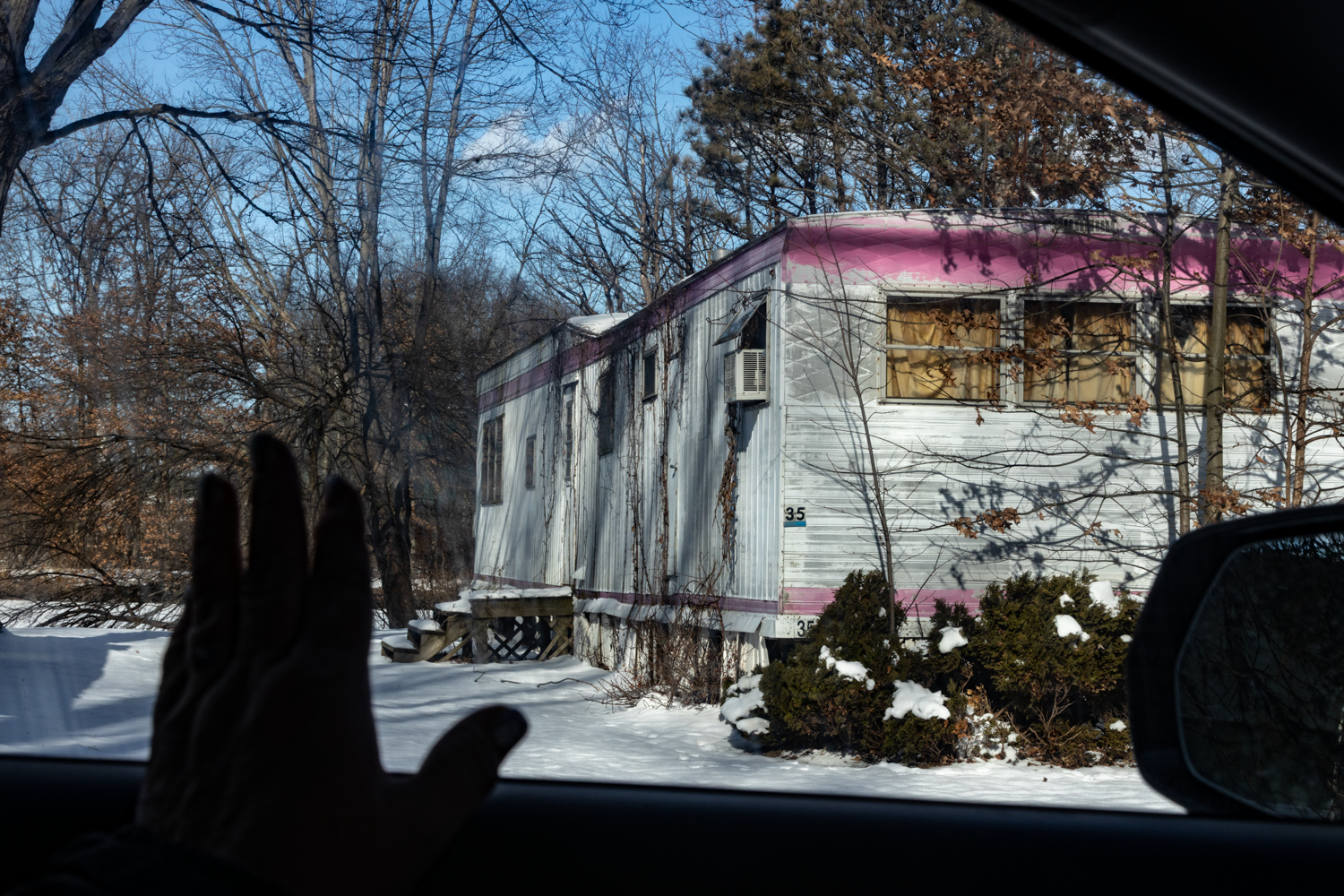
Robert Hawkins, a retired resident of the mobile home park, shows a home a few spots down from his home that is in poor condition at Arrowhead Lake mobile home park in Swanton, Ohio on Saturday January 17, 2026. (AWFP photo by Stephen Zenner)
SWANTON TOWNSHIP – Looking out his back patio door at the frozen Arrowhead Lake last month, Army veteran Robert Hawkins recalled the reasons why he moved to the Swanton Township mobile home community years ago: affordable rent, friendly neighbors and a view of the lake.
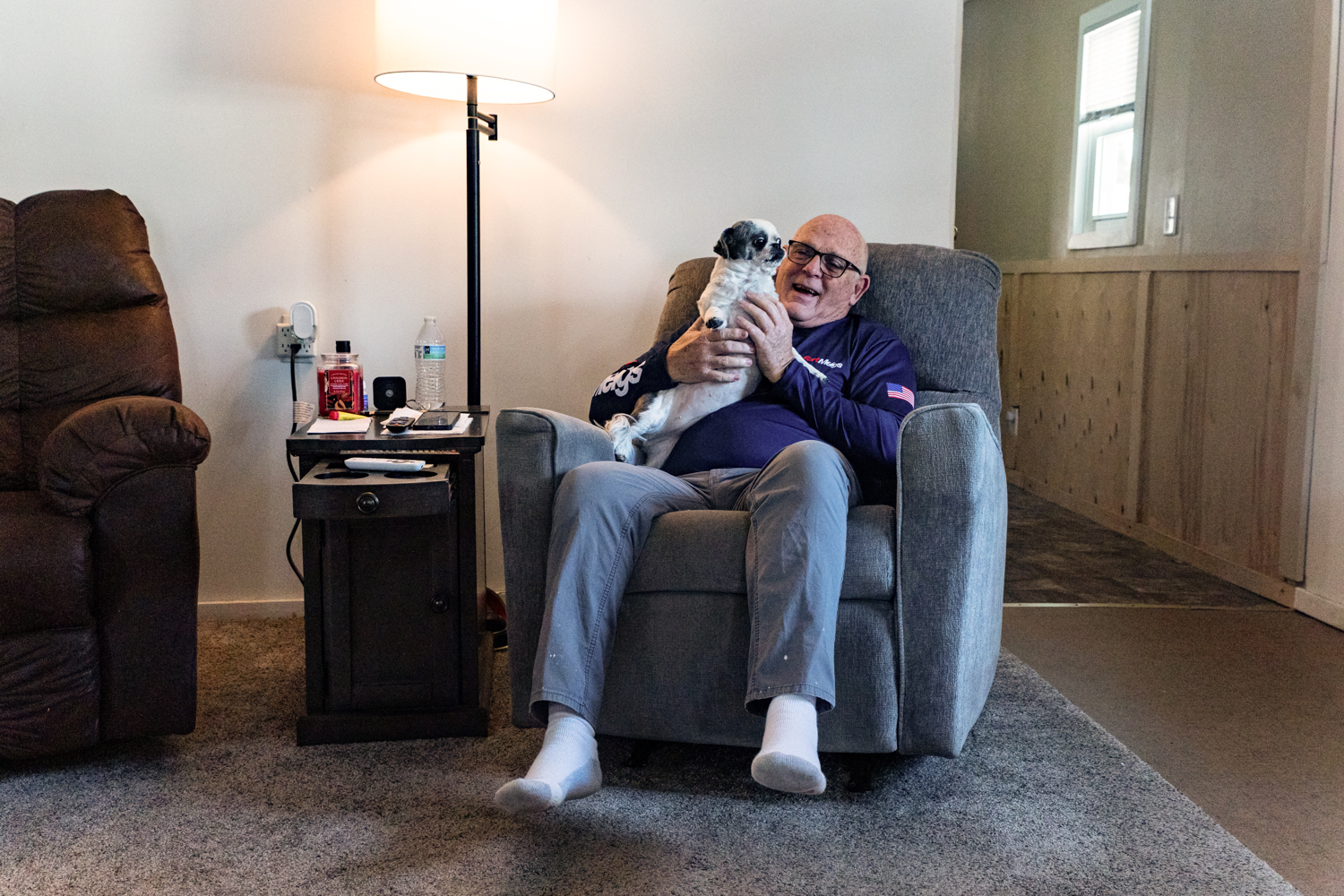
A retiree, Hawkins invested $8,000 into fixing up a $100 mobile home in Arrowhead Lake Mobile Home Park (ALMHP), where he lives with his Shih Tzu, Mia. While he’s invested in his home, Hawkins points out that many have been abandoned and left to deteriorate, many turned over to the park’s owner but not maintained.
Robert Hawkins, a resident of Arrowhead Lake and retired Army veteran, holds his dog, Mia, 7, in a reclining chair inside of his home at Arrowhead Lake mobile home park. (AWFP photo by Stephen Zenner)
Hawkins is one of several residents – some speaking on condition of anonymity for fear of repercussions from the management – who have lived in ALMHP for years, but have seen a more rapid change in the past decade: climbing lot rents, additional garbage and water utility fees, deteriorating property conditions and numerous water boil advisories due to water line breaks on a system that the Ohio EPA has said must be repaired or replaced.
“There are many layers to the problems here,” said Kim Middleton, who has lived in the park since 1997.
Located on S.R. 295 between the Ohio Turnpike and the railroad tracks, Arrowhead Lake Mobile Home Park was originally a campground, with the lake created when the Ohio Turnpike was built in the 1950s. With large trees and an aerator in the pond, the park was clean and well kept while it was under private ownership, Middleton said. Now just 45 percent of the 285 lots are occupied, and many of the vacant homes have multiple violations.
Zoning Violations
For two years ending on Dec. 31, Middleton served as the Swanton Township zoning inspector, so she understands code violations. On December 19 – shortly before she resigned – Middleton sent a six-page letter from Swanton Township, detailing “multiple reports and complaints concerning the deplorable conditions,” to the three entities involved with the park. Arrowhead Lake LLC purchased the property in 2017 for $4,057,900. The park’s owner, MHC Capital and management company, FTI Management, are both based in Los Angeles. Requests to speak with representatives from these companies were not returned.
“Arrowhead Lake” on water facility at Arrowhead Lake mobile home park. (AWFP photo by Stephen Zenner)
The six-page letter from Swanton Township, dated Dec. 19, 2025, details “multiple reports and complaints concerning the deplorable conditions.”
“The complaints include conditions which invite both vagrants and an abundance of nuisance critters. Residents have reported trespassers to local law enforcement on several occasions. Nuisance critters have taken up residence in the vacant/abandoned homes, causing damage to properties and health risks to residents,” the letter states, detailing raccoons, squirrels, opossums, vermin and feral cats.
The letter lists 69 properties, the majority of which have been vacant for over five years, that need to be repaired, made habitable, or removed. The violations include missing skirting, overgrown vegetation and trees, fire damage, accumulated junk and refuse, inoperable vehicles, and homes that are no longer habitable due to fire, natural disaster or other physical deterioration.
The county requires that no structures, planting, fencing or mounding be within 25 feet of ditches and creeks, but Wiregrass Creek is filled with growth and debris, the letter states.
“They just let the weed trees grow up through the homes and porches,” Middleton said, pointing out several homes overgrown with weed trees. “They say that their maintenance man walks the park daily. If he did, he would see all these things.”
Vacant mobile home left in poor condition at Arrowhead Lake mobile home park. (AWFP photo by Stephen Zenner)
Trees Posing Danger
“One of our biggest issues here is dead, decaying, falling trees,” Middleton said. “They don’t want to spend the money to take care of anything. They think we’re just complaining, but I’ll show you why.”
Mobile home left in poor condition at Arrowhead Lake. (AWFP photo by Stephen Zenner)
She drives past a home where, on Dec. 29, a large tree fell through the roof, narrowly missing a sleeping occupant. Management states that residents are responsible for caring for the first 10 feet of a tree from the ground up, Middleton said. This one was huge, and crushed the roof, leaving gaping holes and dangling wires. Middleton said the park manager told the family to use space heaters to stay warm. So she contacted the Springfield Township Fire Department for help. Fire Inspector Scott Bockelman and Assistant Chief Andrew Sauder came out to look.
“Scott is everyone’s hero here,” she said, noting that Bockelman stayed on the phone with the FTI corporate office until he had assurances that the family could be located into a different home. The family was provided a vacant home, but Middleton learned a few days later that it didn’t have water due to a leaky water tank – an issue she pushed management to rectify.
Water Issues
Two residents filed suit against Arrowhead, FTI and MHC for failing to comply with their obligations to operate a public water system under the Safe Drinking Water Act. From July 2015 through February 2020, the property owners failed to properly maintain the system, resulting in water failing to meet basic hardness, radionuclide and chlorination standards, according to a U.S. District Court filing. The company was ordered to take several actions to address multiple violations, including replacing the deteriorating clear well – a storage tank for water – and doing regular testing on the water. While some smaller measures were completed, the clearwell remains unchanged.
(AWFP photo by Stephen Zenner)
Last July, the Ohio EPA sent a notice of violation to FTI Property Management following a sanitary survey showing multiple violations still outstanding. In December, FTI’s environmental compliance department informed the EPA that, instead of repairing or replacing the clear well, it instead plans to hook up to City of Toledo water with a private line that will run under the railroad tracks – once it has permission from the railroad for access and has approval from the Lucas County Sanitary Engineer of its design. On Jan. 8, the EPA sent the park owners a notice of violation (NOV) for elevated levels of hardness in its water supply and for not providing enough bottled water – at least one gallon per person per day – which is required as part of its contingency plan.
Dina Pierce, an Ohio EPA spokesperson, said the EPA received an after-action report from ALMHP about the Jan. 8 NOV on Feb. 6.
“According to the after-action report, increased water hardness was caused by a blockage in a water-softening system line. The blockage was removed, the line was repaired, and the water hardness has returned to an acceptable level,” Pierce said. “Ohio EPA is working with the park to revise its contingency plan for responding to elevated hardness levels regarding notifying residents and providing bottled water. The facility continues to work with Toledo and the Lucas County Sanitary Engineer’s Office to connect to the city’s public water system.”
Several residents shared a concern that their problems won’t end if the park hooks up to city water. Many of the lines are original from when it was a campground, and could burst under the pressure of city water. One resident said a mainline has burst under her home twice, causing extensive damage.
On Jan. 31, residents were notified that an emergency main line water repair was taking place, and that all water would be shut off. Water would need to be boiled as “disease-causing organisms may have entered the water supply.”
Many residents share a sense of frustration for the ongoing problems.
“It’s stall, avoid, play dumb, say you’re waiting on estimates. The EPA is just as guilty as Arrowhead. The EPA doesn’t hold them accountable. They give them firm deadlines and say there are consequences, but they don’t follow through,” said one resident.
Hawkins, like many others, resorts to spending money on buying bottled water for drinking and brushing his teeth. But that doesn’t replace the water he uses to shower.
“My skin is bad, dried out. You flush the toilet and it smells like bleach,” he said.
(AWFP photo by Stephen Zenner)
Laurie Langenderfer, who has lived in the park since 1998, recently spent $800 for a plumber to analyze every pipe under her home, trying to determine why her water usage doubled in the fall and winter to over 11,000 gallons a month.
“He went to the park office to say that he checked it from one end of the home to another, and there is no leak – he thinks it’s a main line,” she said, noting that a main line should be repaired by the park.
To save from using too much water, she fills jugs at work, buys bottled water and has cut back on shower usage and toilet flushing. In the meantime, she’s still trying to come up with $499.66 that Universal Utilities – the third party billing company for water – said is due March 4. And while the water bill is high, her sewer rates have doubled as well, Langenderfer said.
Several residents noted that the community’s two wastewater treatment plants that, on warm days, can have an overwhelming odor. One resident said she took a photo of what appeared to be raw sewage on the ground near the treatment plant at the front of the community.
What can be done?
As of Feb. 16, the company missed the Jan. 20 deadline set by the township to correct the dozens of issues. Mike Nowicki, the Swanton Township trustee handling zoning until a new inspector is appointed, confirmed that he has not received any response from the owners. So he’s asked the county’s assistant prosecuting attorney, John Borell, for help.
If a zoning violation is not appealed to the Board of Zoning Appeals or corrected, typically the next step is for the township would be to file an action in Common Pleas Court, Borell advised.
“We will have to look for ways to correct the situation without cooperation from the owners. The fact that the situation involves mobile homes…it is a little more legally complicated,” he said.
Manufactured homes are regulated by the Ohio Department of Commerce, more specifically the Manufactured Homes Program and Ohio Revised Code Chapter 4781-Manufactured Homes, said Springfield Township Assistant Fire Chief Andrew Sauder.
“The Ohio Fire Code has not completely identified these properties and their requirements as it has other commercial or multi-residential structures,” Sauder said, adding that the Fire Prevention Bureau is limited to fire lanes, turning radius and private water mains when it comes to enforcement of mobile home communities.
“Unfortunately, there is no local governmental agency that would take immediate action such as the Lucas County Building Regulations or local zoning departments as they are not the Authority Having Jurisdiction,” he added.
He recommends that the township enact a property maintenance code, which would allow the local zoning department to take action rather than rely on other governmental agencies like the health department to deal with rodent infestations, for example.
Referring to the fallen tree on the home in Arrowhead Lake in December, Sauder said such a property maintenance code would allow the township to take immediate action on health, safety and security, as opposed to awaiting action from the state.
Robert Hawkins, a resident of Arrowhead Lake mobile home park, shows different ways he has attempted to clean up his neighborhood at Arrowhead Lake mobile home park. (AWFP photo by Stephen Zenner)
Franklin Freytag, public information officer for the Department of Commerce, said the Division of Industrial Compliance regulates the development and maintenance of the physical premises and infrastructure of manufactured home parks.
“While the division has exclusive authority to license manufactured home park operators, it’s important to note that numerous other governmental entities can have regulatory authority over a manufactured home park or part of a park,” Freytag said, referring to the Ohio EPA’s jurisdiction of the water system as an example.
He confirmed that Arrowhead MHC, LLC does have an active operator license, which is required for each calendar year. Every park is inspected for compliance with the Division of Industrial Compliance’s rules, but renewal of a license is not contingent or tied in with such an inspection – but any violations found during an inspection could be cited and issued to the park operator for correction, he said.
Kim Middleton, a resident of Arrowhead Lake and retired code enforcement worker, showed AWFP different mobile homes left in poor condition at Arrowhead Lake mobile home park in Swanton, Ohio on Saturday January 17, 2026. (AWFP photo by Stephen Zenner)
Increasing Costs
Many of the residents in Arrowhead Lake have lived there for decades. While it was privately owned, the sense of community was strong and the cost of living affordable, they agree. And then the park went through several ownership changes. With each one, fees went up.
Langenderfer, a widow on a fixed income, pointed out that she has to pay a pet fee for her dog, even though she owns her home. When she first moved in, the water and garbage were included in the rent.
In January, FTI Property Management notified residents that rents were increasing from $454 to $527 a month, to cover the cost of park maintenance. A new fee for utility monitoring was added a few years ago, and garbage rates are increasing for the park, which doesn’t use the township’s pickup.
“A lot of people here live on very fixed incomes. That increase of $58 for rent and trash pickup will put a lot of people in a very serious financial bind. The ever-increasing price of water and sewer isn’t helping anything,” said Middleton.
Despite the problems, Hawkins said he can’t imagine moving. Finding another place with low rent and a great view would be a challenge. And he likes his neighbors, including fellow veterans. Middleton and her husband plan to move to Michigan after retiring in a few years.
“Our kids are mad at us for not moving years ago. Our home is paid for, and all we pay for is the lot,” she said. “We’ve been fighting this for a while. I’m not going to stop just because I know we’re moving.”
MHC Capital is owned by Kwame Granderson, a Harvard-educated real estate attorney who owns hundreds of mobile home communities, and who hosts seminars for vetted investors to learn how to “acquire communities at favorable prices at favorable prices from largely mom and pop sellers with unsophisticated management who are nearing retirement and lack access to capital,” according to an MHC Capital investment overview. MHC owns 22 communities in the tri-state area, including Arrowhead Lake, Grand Rapids Estates, Sylvania Estates and and Twinwall Mobile Home Community in Toledo.
While MHC might be focused on making a profit, Arrowhead’s residents just want them to make things right: provide clean, safe drinking water; fix the sewage system; take out the dangerous trees; and haul out or fix the decrepit homes.
Th creek at Arrowhead Lake mobile home park is green. (AWFP photo by Stephen Zenner)
The aftermath of the crash that took Joey's life. (Courtesy photo)
On Monday, September 20, 2010, we were sitting in the living room watching Swamp People, one of my son Joey’s favorite shows. He was a mama’s boy and a gentle giant at six foot three.
Joey was a senior at Piqua High School and planned to go on a farm science trip with friends the next day. I went to bed early because I had to be up at 3 a.m. for my nursing shift, so I told my boys goodnight and that I loved them. As I walked away, Joey said, “I love you too, Mom.”
The next morning a friend asked to take Joey’s place on the trip. My husband Ron was off work and decided to drive to Dayton with Joey to pick up a riding lawn mower, something Joey would have turned into a demolition derby project, one of his favorite hobbies.
At 1:45 p.m., I received a call from my sister Penny, a State Trooper. She never called me at work. She told me to meet her at the BMV in Troy. When I arrived, Penny and two other troopers were waiting, unable to look at me. I remember asking, “Why does my heart tell my feet to run?”
Laura’s son, Joey. (Courtesy photo)
Penny finally told me there had been a serious crash involving Ron and Joey. Ron had been Care Flighted, and they did not know if he would survive. Then she told me my son Joey was gone.
How do you go from kissing your child goodnight to being told you will never see them again? Joey was dead.
That same morning, a woman named Leanne had bought compressed air at Meijer, inhaled it in the parking lot, and then chose to drive. Impaired, she crossed the center line on State Route 718 and hit our truck head on at nearly 80 miles per hour.
Joey tried to avoid her by steering into the ditch, but she struck them driver-to-driver. The impact tore the truck apart. Joey was ejected, broke his neck, and died instantly. Ron survived, but with lasting injuries, including multiple fractures to his back.
There was no hospital goodbye, no final moment. Joey’s senior year never came. No prom. No graduation. A funeral 70 years too soon.
I kissed my son goodbye and walked away knowing nothing could fix what had happened. The smile that lit up every room, the laugh that brightened every day, the mama’s boy who gave the best hugs, the big brother to Brian, gone in an instant.
Our family will never be the same. A piece of each of us died with him. His death was completely preventable. If Leanne had simply taken the compressed air home, she would not have been impaired. She spent only an hour in a holding cell before being released. She died later that year from a drug overdose.
The HALT Drunk Driving Law, passed by Congress in 2021 with bipartisan support, requires new vehicles to include technology that can detect and stop impaired driving before it begins. The Insurance Institute for Highway Safety estimates it will save more than 10,000 lives every year. Joey would have been one of those lives saved.
Yet more than four years later, the federal government has missed multiple deadlines to implement this law. Meanwhile, Senator Bernie Moreno (R-Ohio) continues to question why sober drivers should have impaired-driving prevention technology in their vehicles.
Joey wasn’t impaired when the crash took his life and that’s exactly why this technology matters. Impaired driving threatens everyone on the road. The only ones who need to worry about this law are impaired drivers. The technology exists. The solutions are ready.
I urge my fellow Ohioans to contact lawmakers and tell them to support the HALT Law and demand its implementation.
This is not about politics. It is about preventing families from experiencing the heartbreak that shattered ours. Every day of delay risks another preventable tragedy. Every day risks another family losing their Joey.
Members of the Save the Bridge Association, including (from left) Olivia Murphy, Barb Bruno, Frank Butwin and Janice Braida, are working to save the 118-year-old Roche de Boeuf Interurban Bridge. (AWFP photo by Karen Gerhardinger)
WATERVILLE – With a little more than a month left before the Ohio Department of Transportation (ODOT) seeks bids to demolish the 118-year-old Roche de Boeuf Interurban Bridge, a volunteer group is seeking another reprieve from Gov. Mike DeWine.
“We’re still fighting to save our bridge,” said Save The Bridge Association (STBA) President Barb Bruno, addressing Waterville City Council on Feb. 9. Bruno, along with STBA member Janice Braida and Secretary Dave Weber, encouraged council to sign a letter of support in asking DeWine for an extension.
On April 7, 2025, DeWine issued a one-year halt on the demolition of the bridge, just days before ODOT was set to seek bids. In following months, the STBA was formed as a 501c3, with volunteers focusing on finding alternatives to demolition, including new construction methods for preserving the 12-arched bridge, grant funding and nominating the structure for Historic Civil Engineering National Landmark Status with the American Society of Civil Engineering (ASCE).
“ODOT sees the bridge as a problem. We see it as an asset,” said Braida, adding that it has become an iconic symbol of the city, even featuring prominently on the city’s logo.
In a summary of the progress made by the STBA, Weber states that ODOT stopped helping the group find alternatives, and instead has been focused on transferring ownership to another political entity.
“We were only recently informed of the importance of ODOT not owning this bridge, so we need more time to find an owner. We spent our time mostly on evaluating alternatives,” he stated in the memo.
“It’s a heavy lift to expect a citizens group to find a new owner in eight months,” Braida added, noting that the group has contacted several organizations, including the city, to see if any would have interest in taking ownership.
“It was made clear in the first meeting that whether the bridge comes down or not, ODOT will not be the owner of the property,” countered ODOT District 2 Director Pat McColley. “A government entity needs to be identified and the transfer of the property, including the bridge, needs to take place before demolition bids open.”
The project to demolish the structure is currently scheduled to be placed out for bid in April, with demolition work beginning after June 1.
The city of Waterville obtained a grant to build a pedestrian walkway and overlook using two piers along South River Road. (Courtesy rendering)
Designed by Daniel Luten of Indianapolis, the 13-arch concrete bridge includes spandrels, arches and piers – including one that rests atop an outcrop of erosion-resistant limestone named “Rock of Beef” or “Buffalo Rock” by French traders. The rock was used as a meeting place by Native Americans prior to the 1794 Battle of Fallen Timbers. About a third of its mass was removed during construction in 1908.
Originally used as an interurban trolley line for the Ohio Electric Company, the bridge was abandoned in 1937, although used briefly for automotive traffic in the 1940s when the Waterville bridge was damaged and steel for repairs wasn’t available. In 1972, the bridge was placed on the National Register of Historic Places. It is a Registered Historic Place with the National Park Service and a state of Ohio Designated Historic Space.
In the years since, the bridge served as a party spot for teenagers, a backdrop for photos and paintings, and a place to explore when the river is low. With its impending designation as the Maumee River Water Trail, Waterville City Council began discussing concerns for the safety of boaters. Chunks of the bridge rest in the river, while others dangle from rebar. The city shared its concerns with ODOT in 2017. At the time, the bridge was thought to be owned by the city. Instead, it’s owned by the state.
Through engineering studies and core samples, those concerns were confirmed: the bridge was in dire shape. In 2019, ODOT presented multiple alternatives, ranging from complete rehabilitation (removing and replacing it) for $15 million, $3.9 million to save one arch, or $2.2 million to remove it. ODOT also tried to sell the bridge at an auction, but the potential buyers were unable to prove an ability to insure and secure the bridge.
“The bridge has continued to deteriorate over the years, including since the original feasibility study was performed, as evident by the common eye,” McColley said.
Simply placing signs underneath to divert water traffic will not alleviate the state’s liability to the Army Corps of Engineers or the safety of the public, which is why the bridge is slated for destruction, he said.
Weber, a retired engineer, said other ideas were not explored in full, such as securing the bridge using a technique involving carbon fiber reinforced polymer to keep the pieces in place. A $135,000 investment into testing the strength of the bridge and designing the mothballing process would be worth the effort to save a landmark, Weber said. He estimates that the work could be done for $1.7 million.
“The reference estimate was created by a private citizen, not a professional engineer, and ODOT has a very low level of confidence in the figures proposed in the estimate,” McColley responded, adding that ODOT looked at many alternatives, including mothballing.
One outcome of last year’s delay is that the city had time to apply for a grant for a pedestrian bridge and overlook using two abutments. Waterville received a $557,652 federal grant to cover 80 percent of the cost of the Roche de Boeuf Overlook and Shared Use Path Improvement Project, said City Administrator Jon Gochenour. Two of the existing bridge abutments – on the north and south sides of South River Road – will be used to create an overlook of the Maumee River and the Roche de Boeuf Island.
“The project will recognize the historical and cultural significance of the site to Native Americans and the historical development of the State of Ohio and the United States,” Gochenour said. “The site will be connected to the city’s existing shared use path system on the Anthony Wayne Trail and to the pedestrian path system of Farnsworth Metropark.”
While the project will save a portion of the Roche de Boeuf Bridge, the city still supports local efforts to save the entire bridge, Gochenour said.
STBA submitted its nomination for the bridge for Historic Civil Engineering National Landmark Status with the ASCE on Feb. 6. The bridge would be the first multi-arch concrete bridge to be recognized by the ASCE and the second oldest reinforced concrete arch bridge recognized by ASCE in the world.
“The interurban bridge was an engineering first it its day,” Weber said. “This bridge deserves a preservation plan – something we are fighting to make happen.”